 Скачать презентацию Organization Structure and its specific Made by 2
Organization Structure. BelolipetskayaIFF2-4.pptx
- Количество слайдов: 13



Organization Structure and its specific. Made by 2 nd bachelor student Group 2 -4 Belolipetskaya Anastasia
What is it? task allocation coordination and supervision An organization can be structured in many different ways, depending on their objectives. In an organization of any size or complexity, employees' responsibilities typically are defined by what they do, who they report to, and for managers, who reports to them.

Types of organization. Pre-bureaucratic (entrepreneurial) -structure is most common in smaller organizations and is best used to solve simple tasks. Bureaucratic - are better suited for more complex or larger scale organizations, usually adopting a tall structure. Post-bureaucratic - in which decisions are based on dialogue and consensus rather than authority and command. Functional structure - Employees tend to perform a specialized set of tasks. Divisional structure - groups each organizational function into a division. Matrix structure - employees by both function and product.
Apple. Mission: “To offer the best technology for PC and transfer them to the greatest possible number of people. ” Competitive strategy: “most of the money Apple makes a newly invented device. More than two-thirds of the profits the company receives from the sale of these types of products that did not exist five years ago (i. Phone and i. Pad). A 78% revenue Apple brings the device to which no one could imagine 10 years ago (i. Pod and i. Tunes)”. In just ten years, Apple has invented three radical new platform. But these inventions were only a means to an end. These inventions have allowed Apple to gain access to all the main methods of information consumption.
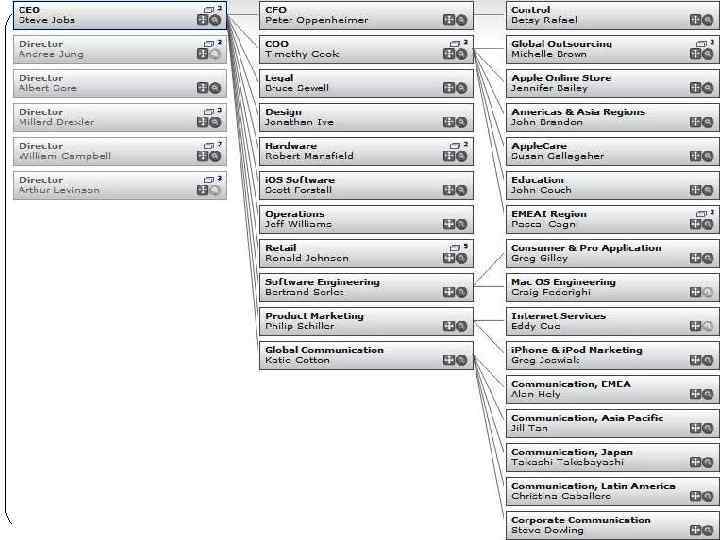
The organizational structure of the company. organized along functional lines Clustering of similar tasks helps to ensure economies of scale, encourage learning and expanding capabilities, and the use of standardized monitoring systems. Since the cross-functional integration occurs at the top level of the organization, functional structures greatly facilitate centralized control of the CEO and top management team.
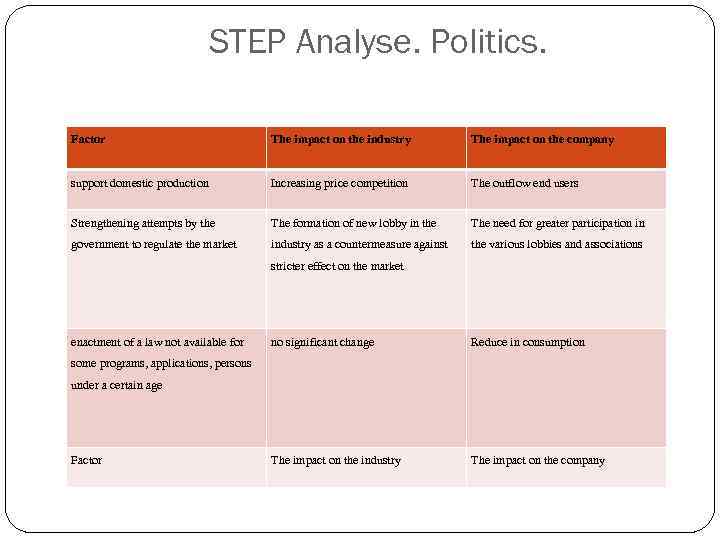
STEP Analyse. Politics. Factor The impact on the industry The impact on the company support domestic production Increasing price competition The outflow end users Strengthening attempts by the The formation of new lobby in the The need for greater participation in government to regulate the market industry as a countermeasure against the various lobbies and associations stricter effect on the market enactment of a law not available for no significant change Reduce in consumption The impact on the industry The impact on the company some programs, applications, persons under a certain age Factor
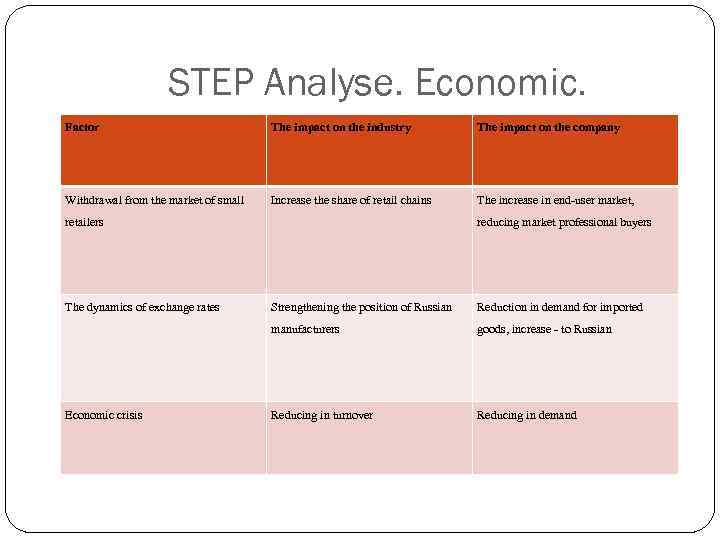
STEP Analyse. Economic. Factor The impact on the industry The impact on the company Withdrawal from the market of small Increase the share of retail chains The increase in end-user market, retailers The dynamics of exchange rates reducing market professional buyers Reduction in demand for imported manufacturers Economic crisis Strengthening the position of Russian goods, increase - to Russian Reducing in turnover Reducing in demand
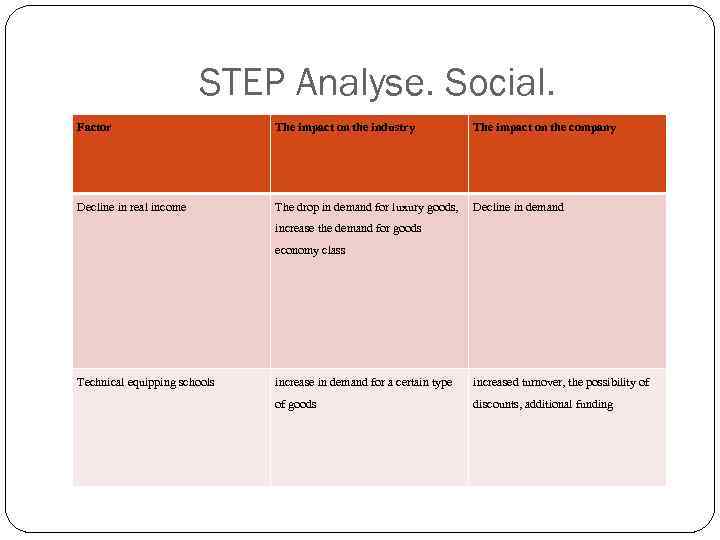
STEP Analyse. Social. Factor The impact on the industry The impact on the company Decline in real income The drop in demand for luxury goods, Decline in demand increase the demand for goods economy class Technical equipping schools increase in demand for a certain type increased turnover, the possibility of of goods discounts, additional funding
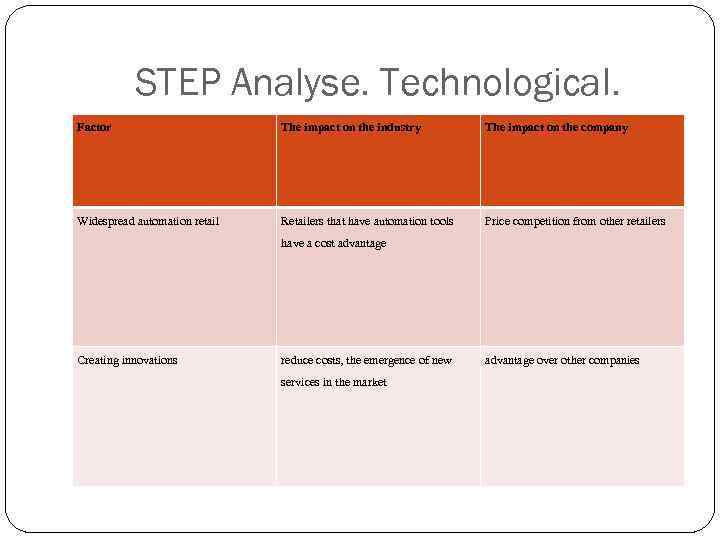
STEP Analyse. Technological. Factor The impact on the industry The impact on the company Widespread automation retail Retailers that have automation tools Price competition from other retailers have a cost advantage Creating innovations reduce costs, the emergence of new services in the market advantage over other companies
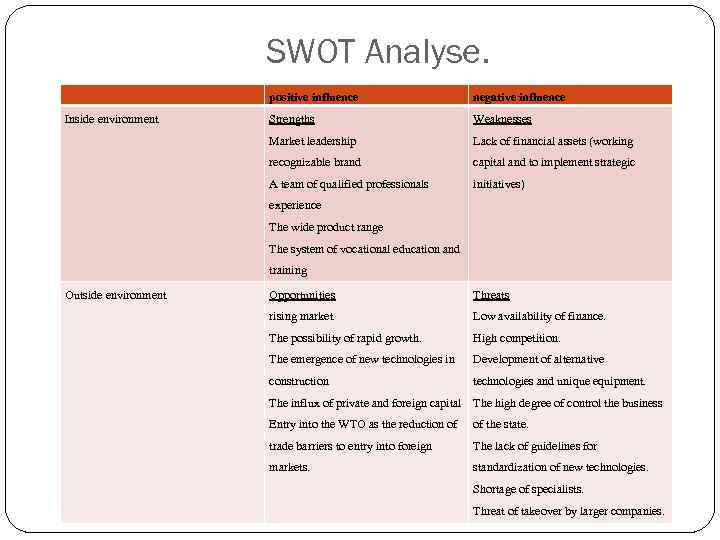
SWOT Analyse. positive influence Strengths Weaknesses Market leadership Lack of financial assets (working recognizable brand capital and to implement strategic A team of qualified professionals Inside environment negative influence initiatives) experience The wide product range The system of vocational education and training Outside environment Opportunities Threats rising market Low availability of finance. The possibility of rapid growth. High competition. The emergence of new technologies in Development of alternative construction technologies and unique equipment. The influx of private and foreign capital The high degree of control the business Entry into the WTO as the reduction of of the state. trade barriers to entry into foreign The lack of guidelines for markets. standardization of new technologies. Shortage of specialists. Threat of takeover by larger companies.

thank for attention!
Скачать презентацию Organization Structure and its specific Made by 2
Organization Structure. BelolipetskayaIFF2-4.pptx