


 Скачать презентацию Organization of sports trips and sports events
Lecture 4..pptx
- Количество слайдов: 41
 Organization of sports trips and sports events
 Sports infrastructure • facilities for the competitions (stadiums, arenas, etc. ); • auxiliary facilities (locker rooms, showers, referee’s rooms); • facilities for spectators; • technical facilities for engineering equipment; • transforming structures; • specialized educational institutions (specialized high schools, training facilities, research laboratories).
 Facilities for competitions. Ukraine Catalyzers of development • 2009 – Final games of Football Euro championship among juniors in Donetsk and Mariupol • 2012 European Football Championship • 2015 – Final Basketball Championships among men (6 Ukrainian cities) • 2022 – Winter Olympic Games Candidate (? )
 Facilities for competitions. Ukraine • There are more than 4000 sports facilities in Ukraine • There around 1740 sports halls of different profile. • There is a lack of schools of higher sportsmanship, Olympic reserve schools, specialized training centers • Some of these facilities exist in Ivano-Frankivsk, Dnipropetrovsk, Donetsk, Odesa, Kyiv and Kharkiv region. • Since 2000 new sports facilities were built (around 20 % from total amount of sports facilities)
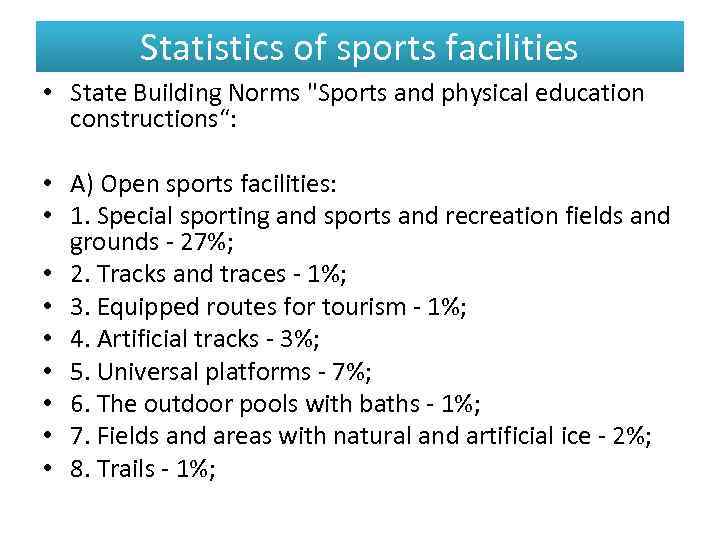 Statistics of sports facilities • State Building Norms "Sports and physical education constructions“: • A) Open sports facilities: • 1. Special sporting and sports and recreation fields and grounds - 27%; • 2. Tracks and traces - 1%; • 3. Equipped routes for tourism - 1%; • 4. Artificial tracks - 3%; • 5. Universal platforms - 7%; • 6. The outdoor pools with baths - 1%; • 7. Fields and areas with natural and artificial ice - 2%; • 8. Trails - 1%;
 Statistics of sports facilities • • State Building Norms "Sports and physical education constructions“: B) Closed sports facilities: 9. Gyms - 23%; 10. Pools (with heating) - 3%; 11. Field and track with artificial ice - 1%; 12. Athletic and recreational facilities - 5%; 13. Co-operative structure - 2%;
 Statistics of sports facilities • State Building Norms "Sports and physical education constructions“: • С) Stadiums: • 14. Specialized for individual kinds of sports - 14%; • 15. Complex - 2%; • D) Sports facilities, depending on natural landscape conditions: • 16. Rowing base - 2%; • 17. Grounds- 1%; • 18. Off-site (оборудованные) locations - 2%; • 19. Ski - 1%; • 20. Rinks with artificial ice - 1%
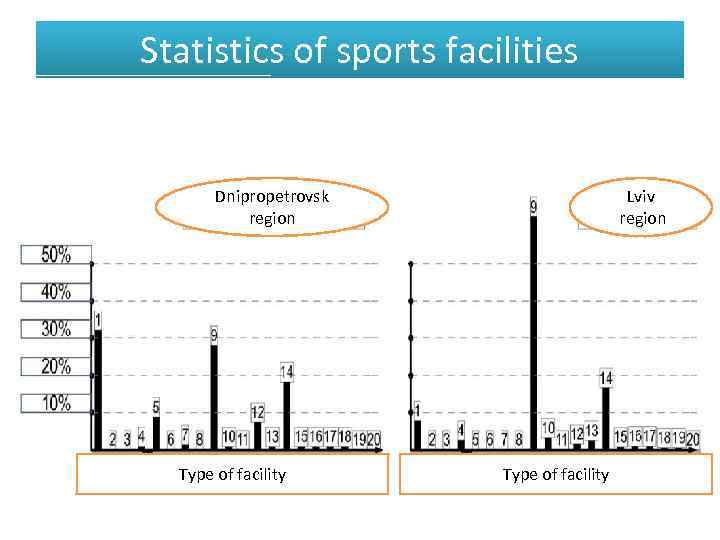 Statistics of sports facilities Dnipropetrovsk region Type of facility Lviv region Type of facility
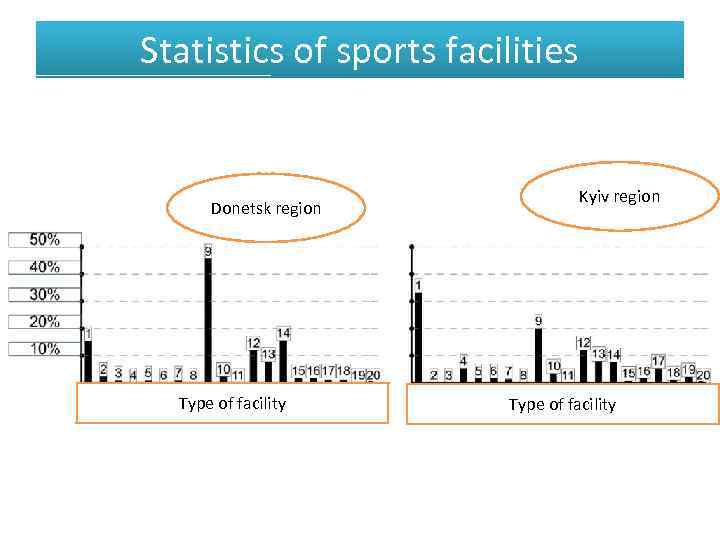 Statistics of sports facilities Donetsk region Type of facility Kyiv region Type of facility
 World’s Most Famous and Largest Sports Facilities
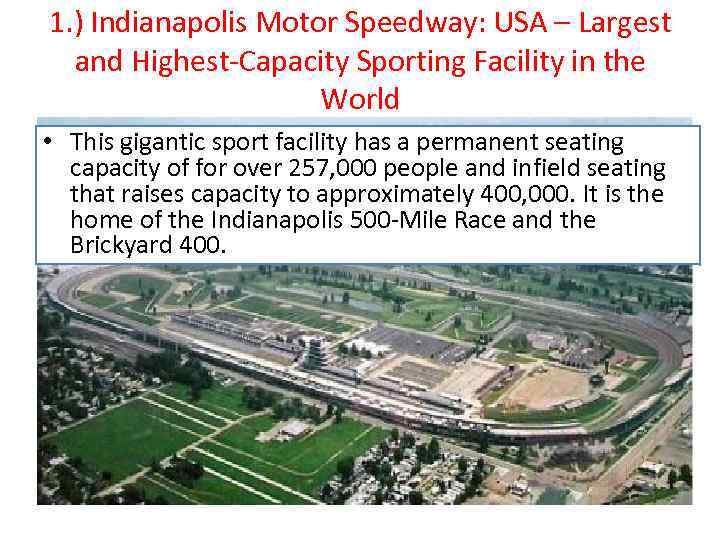 1. ) Indianapolis Motor Speedway: USA – Largest and Highest-Capacity Sporting Facility in the World • This gigantic sport facility has a permanent seating capacity of for over 257, 000 people and infield seating that raises capacity to approximately 400, 000. It is the home of the Indianapolis 500 -Mile Race and the Brickyard 400.
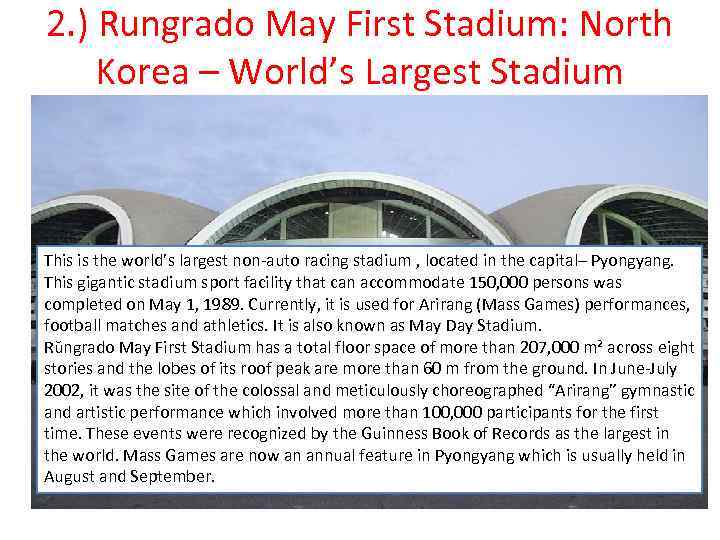 2. ) Rungrado May First Stadium: North Korea – World’s Largest Stadium This is the world’s largest non-auto racing stadium , located in the capital– Pyongyang. This gigantic stadium sport facility that can accommodate 150, 000 persons was completed on May 1, 1989. Currently, it is used for Arirang (Mass Games) performances, football matches and athletics. It is also known as May Day Stadium. Rŭngrado May First Stadium has a total floor space of more than 207, 000 m² across eight stories and the lobes of its roof peak are more than 60 m from the ground. In June-July 2002, it was the site of the colossal and meticulously choreographed “Arirang” gymnastic and artistic performance which involved more than 100, 000 participants for the first time. These events were recognized by the Guinness Book of Records as the largest in the world. Mass Games are now an annual feature in Pyongyang which is usually held in August and September.
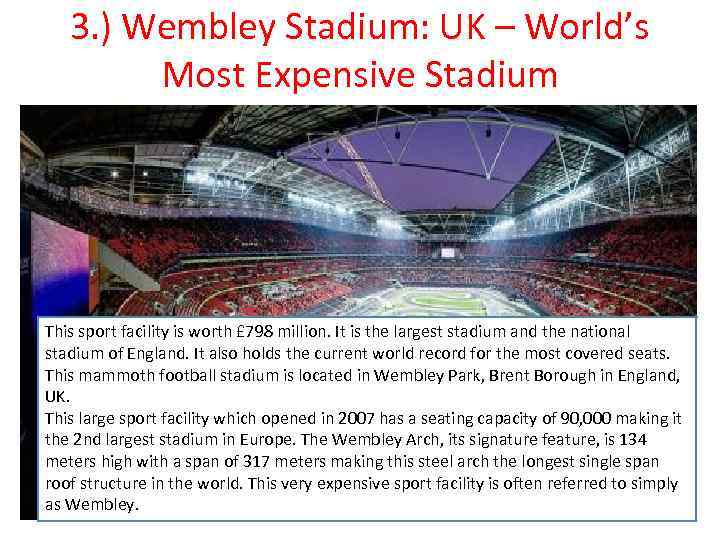 3. ) Wembley Stadium: UK – World’s Most Expensive Stadium This sport facility is worth £ 798 million. It is the largest stadium and the national stadium of England. It also holds the current world record for the most covered seats. This mammoth football stadium is located in Wembley Park, Brent Borough in England, UK. This large sport facility which opened in 2007 has a seating capacity of 90, 000 making it the 2 nd largest stadium in Europe. The Wembley Arch, its signature feature, is 134 meters high with a span of 317 meters making this steel arch the longest single span roof structure in the world. This very expensive sport facility is often referred to simply as Wembley.
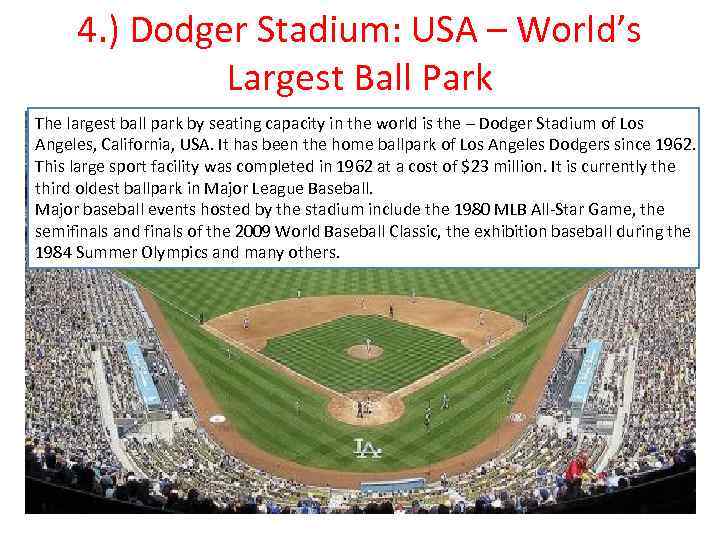 4. ) Dodger Stadium: USA – World’s Largest Ball Park The largest ball park by seating capacity in the world is the – Dodger Stadium of Los Angeles, California, USA. It has been the home ballpark of Los Angeles Dodgers since 1962. This large sport facility was completed in 1962 at a cost of $23 million. It is currently the third oldest ballpark in Major League Baseball. Major baseball events hosted by the stadium include the 1980 MLB All-Star Game, the semifinals and finals of the 2009 World Baseball Classic, the exhibition baseball during the 1984 Summer Olympics and many others.
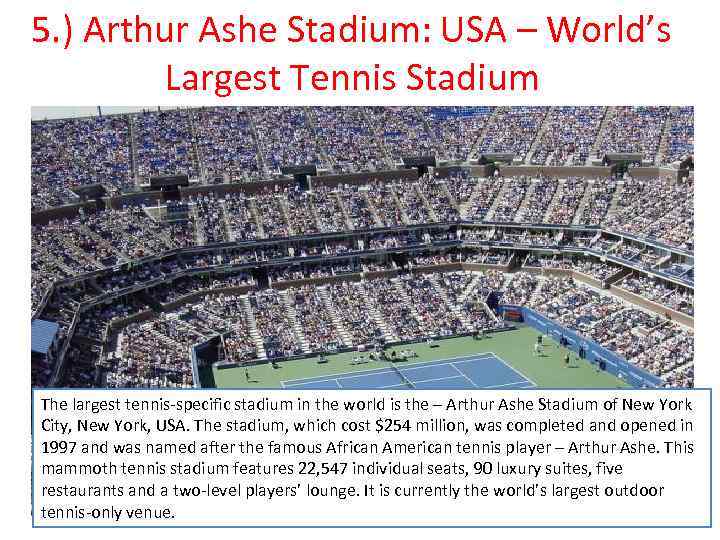 5. ) Arthur Ashe Stadium: USA – World’s Largest Tennis Stadium The largest tennis-specific stadium in the world is the – Arthur Ashe Stadium of New York City, New York, USA. The stadium, which cost $254 million, was completed and opened in 1997 and was named after the famous African American tennis player – Arthur Ashe. This mammoth tennis stadium features 22, 547 individual seats, 90 luxury suites, five restaurants and a two-level players’ lounge. It is currently the world’s largest outdoor tennis-only venue.
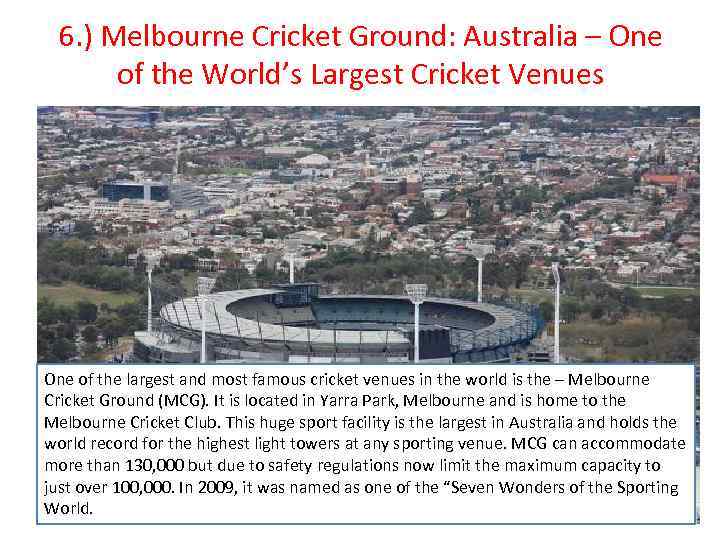 6. ) Melbourne Cricket Ground: Australia – One of the World’s Largest Cricket Venues One of the largest and most famous cricket venues in the world is the – Melbourne Cricket Ground (MCG). It is located in Yarra Park, Melbourne and is home to the Melbourne Cricket Club. This huge sport facility is the largest in Australia and holds the world record for the highest light towers at any sporting venue. MCG can accommodate more than 130, 000 but due to safety regulations now limit the maximum capacity to just over 100, 000. In 2009, it was named as one of the “Seven Wonders of the Sporting World.
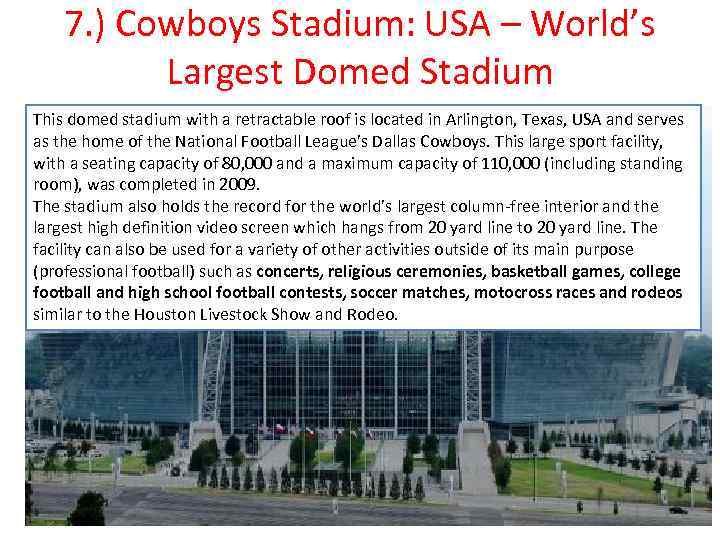 7. ) Cowboys Stadium: USA – World’s Largest Domed Stadium This domed stadium with a retractable roof is located in Arlington, Texas, USA and serves as the home of the National Football League’s Dallas Cowboys. This large sport facility, with a seating capacity of 80, 000 and a maximum capacity of 110, 000 (including standing room), was completed in 2009. The stadium also holds the record for the world’s largest column-free interior and the largest high definition video screen which hangs from 20 yard line to 20 yard line. The facility can also be used for a variety of other activities outside of its main purpose (professional football) such as concerts, religious ceremonies, basketball games, college football and high school football contests, soccer matches, motocross races and rodeos similar to the Houston Livestock Show and Rodeo.
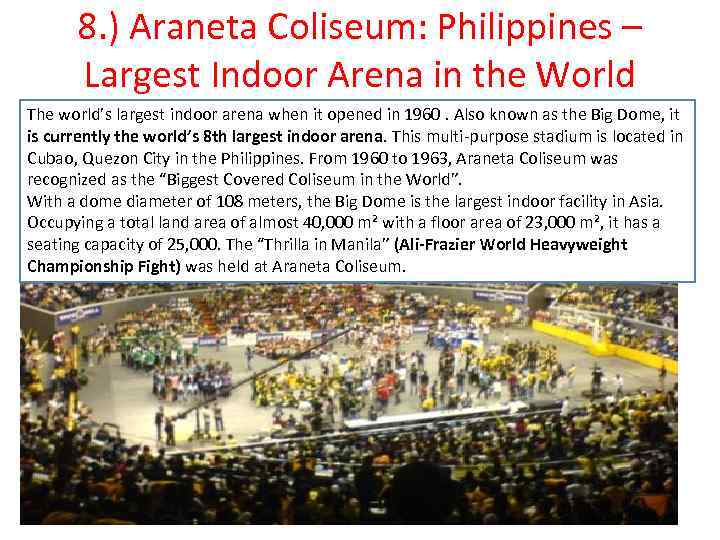 8. ) Araneta Coliseum: Philippines – Largest Indoor Arena in the World The world’s largest indoor arena when it opened in 1960. Also known as the Big Dome, it is currently the world’s 8 th largest indoor arena. This multi-purpose stadium is located in Cubao, Quezon City in the Philippines. From 1960 to 1963, Araneta Coliseum was recognized as the “Biggest Covered Coliseum in the World”. With a dome diameter of 108 meters, the Big Dome is the largest indoor facility in Asia. Occupying a total land area of almost 40, 000 m² with a floor area of 23, 000 m², it has a seating capacity of 25, 000. The “Thrilla in Manila” (Ali-Frazier World Heavyweight Championship Fight) was held at Araneta Coliseum.
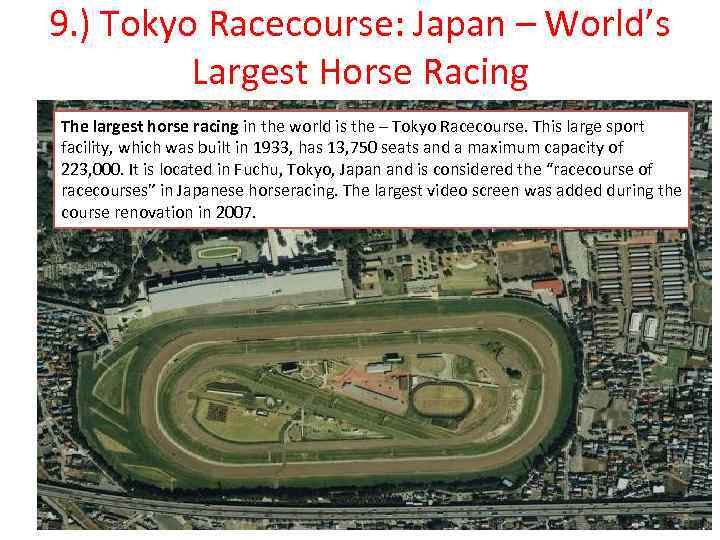 9. ) Tokyo Racecourse: Japan – World’s Largest Horse Racing The largest horse racing in the world is the – Tokyo Racecourse. This large sport facility, which was built in 1933, has 13, 750 seats and a maximum capacity of 223, 000. It is located in Fuchu, Tokyo, Japan and is considered the “racecourse of racecourses” in Japanese horseracing. The largest video screen was added during the course renovation in 2007.
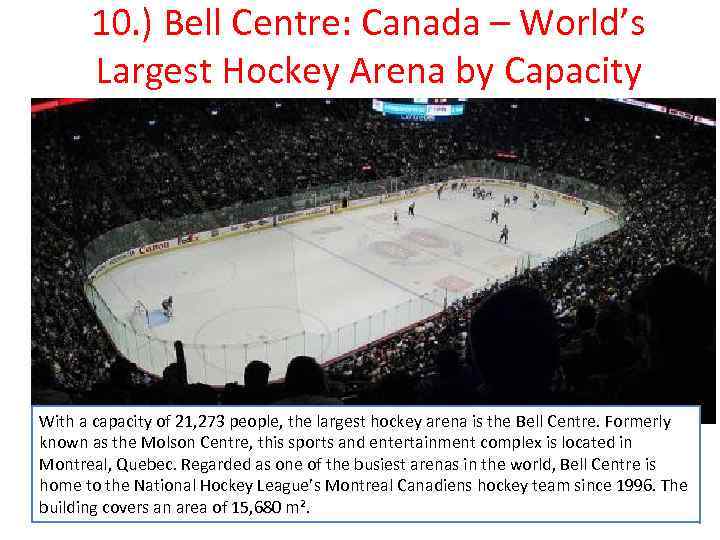 10. ) Bell Centre: Canada – World’s Largest Hockey Arena by Capacity With a capacity of 21, 273 people, the largest hockey arena is the Bell Centre. Formerly known as the Molson Centre, this sports and entertainment complex is located in Montreal, Quebec. Regarded as one of the busiest arenas in the world, Bell Centre is home to the National Hockey League’s Montreal Canadiens hockey team since 1996. The building covers an area of 15, 680 m².
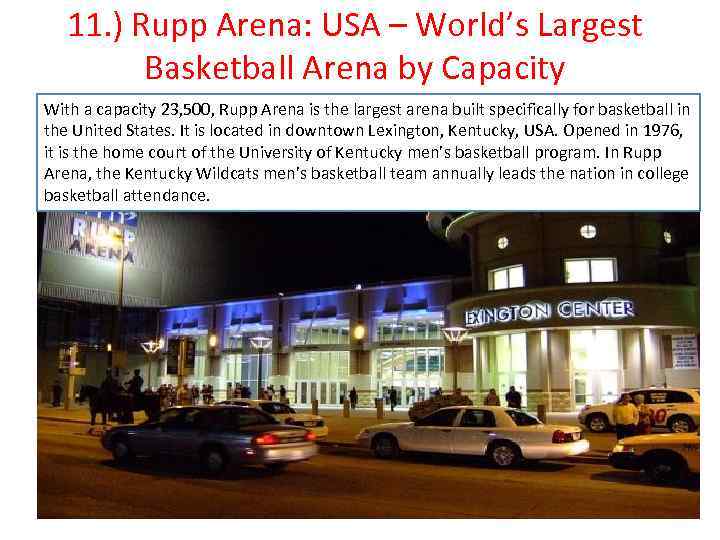 11. ) Rupp Arena: USA – World’s Largest Basketball Arena by Capacity With a capacity 23, 500, Rupp Arena is the largest arena built specifically for basketball in the United States. It is located in downtown Lexington, Kentucky, USA. Opened in 1976, it is the home court of the University of Kentucky men’s basketball program. In Rupp Arena, the Kentucky Wildcats men’s basketball team annually leads the nation in college basketball attendance.
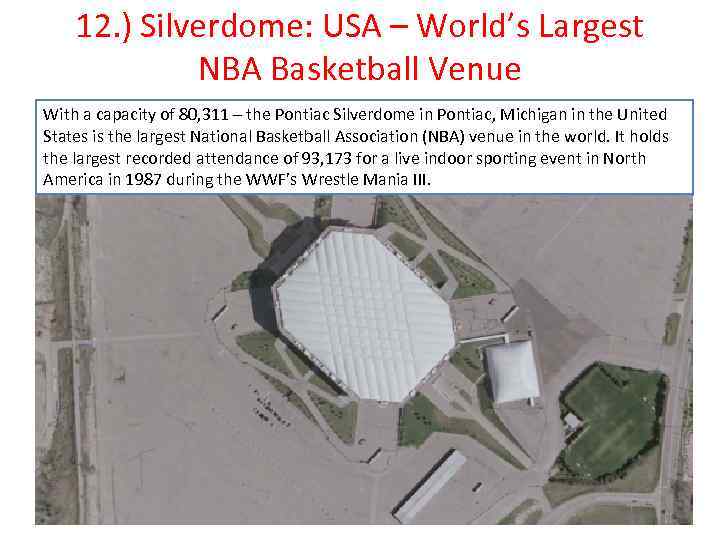 12. ) Silverdome: USA – World’s Largest NBA Basketball Venue With a capacity of 80, 311 – the Pontiac Silverdome in Pontiac, Michigan in the United States is the largest National Basketball Association (NBA) venue in the world. It holds the largest recorded attendance of 93, 173 for a live indoor sporting event in North America in 1987 during the WWF’s Wrestle Mania III.
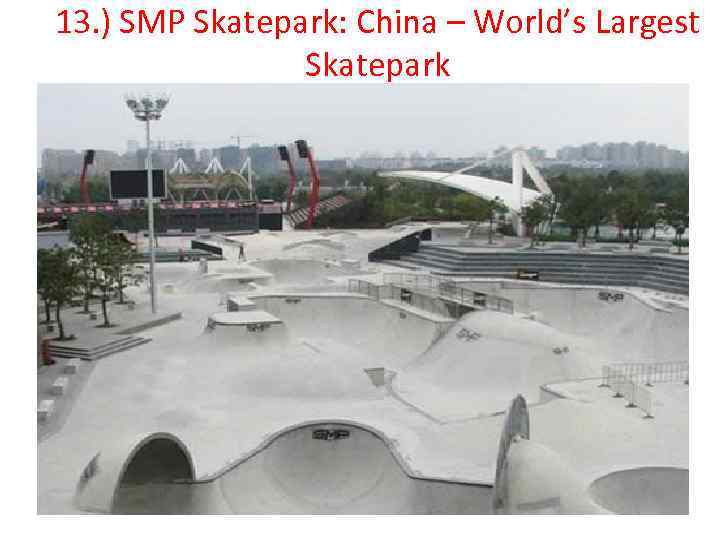 13. ) SMP Skatepark: China – World’s Largest Skatepark
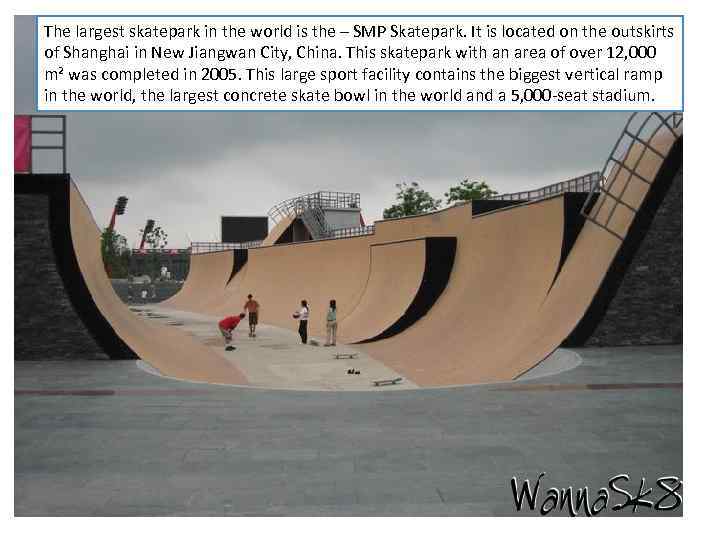 The largest skatepark in the world is the – SMP Skatepark. It is located on the outskirts of Shanghai in New Jiangwan City, China. This skatepark with an area of over 12, 000 m² was completed in 2005. This large sport facility contains the biggest vertical ramp in the world, the largest concrete skate bowl in the world and a 5, 000 -seat stadium.
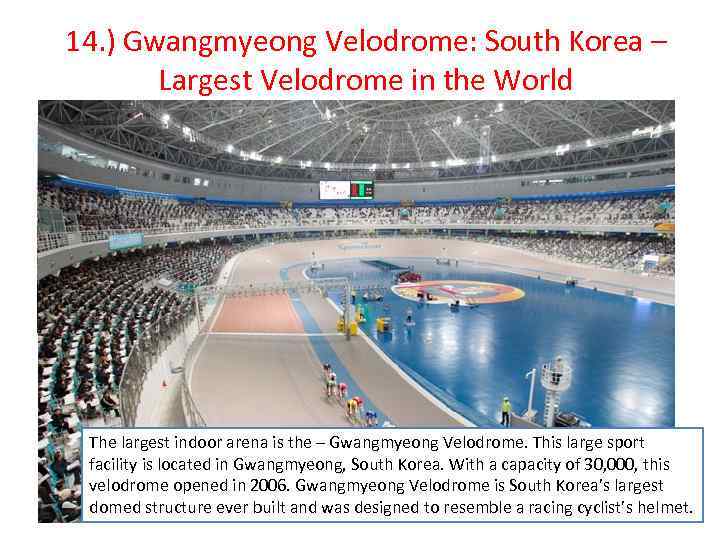 14. ) Gwangmyeong Velodrome: South Korea – Largest Velodrome in the World The largest indoor arena is the – Gwangmyeong Velodrome. This large sport facility is located in Gwangmyeong, South Korea. With a capacity of 30, 000, this velodrome opened in 2006. Gwangmyeong Velodrome is South Korea’s largest domed structure ever built and was designed to resemble a racing cyclist’s helmet.
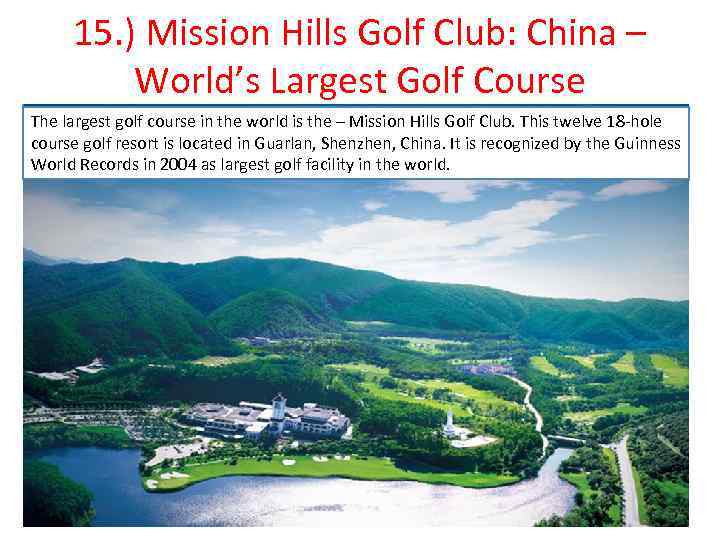 15. ) Mission Hills Golf Club: China – World’s Largest Golf Course The largest golf course in the world is the – Mission Hills Golf Club. This twelve 18 -hole course golf resort is located in Guarlan, Shenzhen, China. It is recognized by the Guinness World Records in 2004 as largest golf facility in the world.
 Security of sports tourists
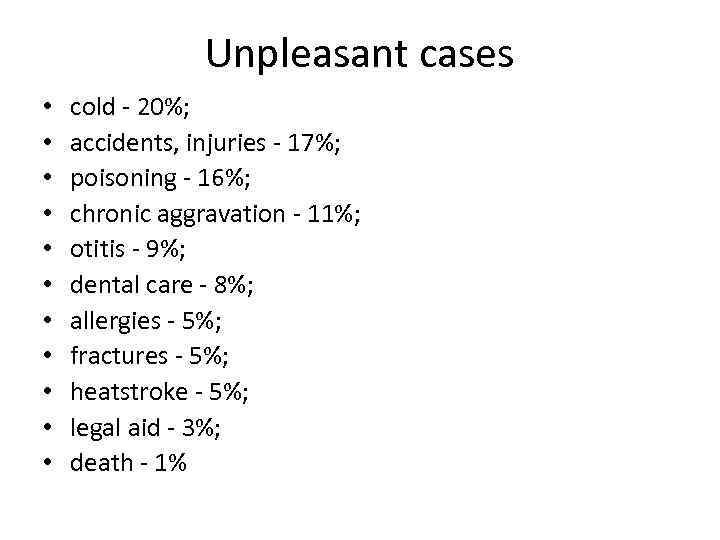 Unpleasant cases • • • cold - 20%; accidents, injuries - 17%; poisoning - 16%; chronic aggravation - 11%; otitis - 9%; dental care - 8%; allergies - 5%; fractures - 5%; heatstroke - 5%; legal aid - 3%; death - 1%
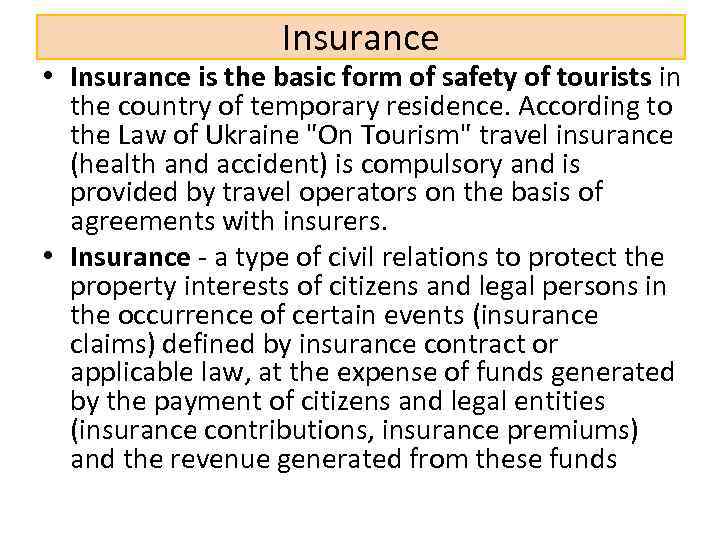 Insurance • Insurance is the basic form of safety of tourists in the country of temporary residence. According to the Law of Ukraine "On Tourism" travel insurance (health and accident) is compulsory and is provided by travel operators on the basis of agreements with insurers. • Insurance - a type of civil relations to protect the property interests of citizens and legal persons in the occurrence of certain events (insurance claims) defined by insurance contract or applicable law, at the expense of funds generated by the payment of citizens and legal entities (insurance contributions, insurance premiums) and the revenue generated from these funds
 • Insurance of tourists - a voluntary medical insurance for the tour in case of sudden illness, death, or injury from a tourist in an accident and property insurance for personal property and baggage (transferred) from one another. • However, besides these types of insurance, tourists sometimes have to apply for other types of insurance assistance (legal, administrative, technical, etc. ). Because of this, some domestic insurance companies enter into cooperation agreements with foreign insurance service companies facilitate on insurance services directly from the destination.
 Insurance of tourists in foreign tourist trips usually include: • providing emergency medical care in case of a sudden illness or accident; • transportation to the nearest hospital capable to quality care under appropriate medical supervision: • evacuation to the country of permanent residence under proper medical supervision; • nosocomial (внутребольничный) control and inform the family of the patient; • providing medicines; • consultation of medical specialist (if necessary); • payment of transportation costs for the delivery of patient tourist or his body (in the case of death) to the country of habitual residence; • legal aid tourists during the investigation of civil and criminal cases abroad.
 Sport Event Classification • • • a. Mega Events Very large and high profile games and events, including at the apex, the Olympic and Paralympic Games can yield billions of dollars’ worth of media coverage, prestige and economic impact for the host, but require a significant capital investment. There are three types of International events eligible for support, the larger of which would fall into the “Mega” category: • International Major Multisport Games - Large multisport games governed by an international sport franchise holder with links to sports' International Federations, for example: the Olympic and Paralympic Summer and Winter Games; the Commonwealth Games; and the Pan American Games. • International Single Sport Events. These events are governed by a sport's International Federation or regional/continental counterpart, e. g. , World Championships and World Cups. Events may range in size and complexity from small to large. • International Multisport Games for Aboriginal Peoples and Persons with a Disability.
 Sport Event Classification b. Games • Games are multi-sport events. These can be very large due to the number of sports being hosted at one location at the same time. These can be directed by governments (e. g. , Canada Games and BC Games), or by separate organizations, e. g. , the IOC or the North American Indigenous Games. Relatively few events are games, although their size makes them attractive targets. In British Columbia (Canada), the BC Games Society helps arrange Winter Games, Summer Games, Seniors Games, Disability Games and Northern Winter Games, every year or second year. The Winter and Summer Canada Games each rotate to BC approximately every 40 years. Other games can be for specific groups, e. g. , the Police and Fire Games or social/sport events for cultural groups. The World Masters Games is one of the world’s largest participation sport events. • Hosting games often requires a wide range of suitable venues, as many sports featured are “mandatory”, and given their size, experience hosting major events and a breadth of sport events may be advantageous.
 Sport Event Classification • c. Championships • These are single-sport properties with rights held by the respective sport organization, where a championship tournament is often the culmination of a season’s sport activity. These are often referred to as “the provincials” or “the nationals”. The winner of the championship may qualify for the next level. • Many championships are arranged by school and university/college sports associations. Adaptive/ disability/ wheelchair sport events are growing in importance in BC’s sport calendar. • The format of the event and the location will be decided by the provincial, national, or international sport governing bodies. Depending on the event, securing such events may be very competitive. There is usually a preference to hold the championships in different regions from year to year, to stimulate interest in different regions and access new host community volunteers and resources. • Community sport groups will be very familiar with the championships for their sport, with the priorities of the organization awarding the hosting rights, and with the key individuals taking such decisions.
 Sport Event Classification d. Tournaments • Tournaments are other events, usually for a single sport. Whereas a championship is “owned” by a sport governing body, tournaments can be the initiative of any organization choosing to initiate them. Many are arranged by local sport organizations, but they may also be sponsored by a school, church or temple, or a pub, for example. They are generally held in the same place at the same time every year and can become a familiar part of the sport’s and a community’s annual calendar. • Tournaments may be competitive, but are often as much participation and recreation-focused as results-oriented. Participation-focused events can be very attractive tourism generators, as high participation equals high visitation. While some youth events may involve lower yield “four to a room” accommodation or even billeting, they can also bring the families of participants and pre-post event vacations. Adult participation events can also be the stimulus for a longer trip, e. g. , adding a fishing trip onto a ball tournament visit. Some are traditionally marked by extensive after-hours entertainment and indulgence. • Sport organizations may arrange an annual tournament as a fundraising initiative, to help subsidize its year-round sport program. Tournaments may be scheduled on holiday weekends.
 Sport Event Classification e. Training Camps • Championships, tournaments, and games are often competitive events, but competition follows athlete development and training. • National or provincial teams with athletes living in different cities are brought together on regular schedules to train and work together with each other and with coaches. • In addition to such training arranged by technical directors of governing bodies and high performance teams, training camps may be more individual. Commercial summer hockey camps may offer additional training for youth players, and these can be packaged as part of a vacation for the whole family. Such camps may take advantage of good facilities during the off-season when their capacity for special events may be greater. • Most sports have regular training camps at the regional and national level. The location of training camps is dependent on services, facilities and equipment available, costs, the location of the coach, and the number of athletes in a particular community.
 Sport Event Classification g. Conferences • Sport organizations arrange many meetings and conferences, sometimes in conjunction with major events. • Annual General Meetings of Regional sports organizations or Non-governmental sports organizations bring sport leaders and organizers from across the region or across the county, as do meetings of sport technical staff. • Trade shows or exhibitions may be involved with such meetings. In addition to the immediate tourism benefit, these can also be opportunities to introduce decision-makers to facilities and future hosting opportunities in the community. Selection of a community for a conference is often connected to where the sporting event is taking place or where the sport’s leadership resides.
 Sport Event Classification • h. Professional Sports • Very much part of sport tourism, professional sports teams tend to primarily serve a local market with spectator entertainment. They also bring visiting teams to town, but this is balanced by their nights spent on away games. While visiting team fans may accompany their team’s visit from their home town, these are generally limited in numbers, apart from major events. • Professional sports may have more impact in attracting visitors from smaller markets without a franchise to the larger community, similar to arts and culture events attracting visitors to a major city for concerts or museum exhibitions.
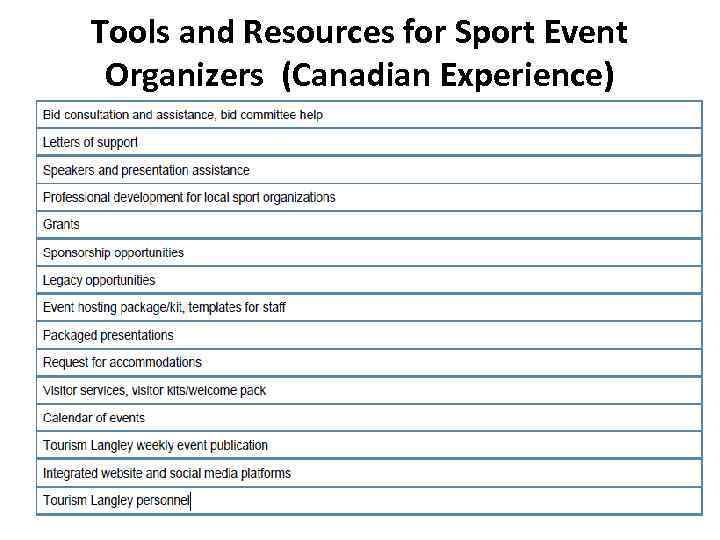 Tools and Resources for Sport Event Organizers (Canadian Experience)
 Hometask: • You need to organize a trip for your academic group on a sports event in Ukraine or abroad. • 1. Find out about the sports events in Ukraine or abroad. • 2. Find the materials about the history of competition (event), about winners – everything which can be interesting for the participants of the trip. • 3. Find out about the rules of the competition (the game). • 4. Try to interest your classmates with this trip, even though they are not the fans of this kind of sport. • 5. Find out the rules of behavior at the stadium or at the territory of sports club, about whether it is prohibited to take some things, cameras with you.
 • 6. Prepare a short jotting for each participants of the trip with the following information: - Time and place of departure and arrival home; - The list of things necessary to have; - The plan of stadium attendance with the time of arrival and departure; - The rules of behavior; - The main rules of game. 7. Calculate the cost of the trip. 8. Describe the type of insurance used in this trip