


 Скачать презентацию Organization of Congress Powers of Congress o
ddd99bb4f8759290d02344854e7e942e.ppt
- Количество слайдов: 25
 Organization of Congress
 Powers of Congress o Enumerated Powers n Article I Section 8 n Broad and General o “Provide for the common defense and general welfare” n Narrow and Specific o “Punishment for counterfeiting” n List contains over 20 powers o Lay and collect taxes o Borrow money o Establish a post office
 Powers of Congress o Elastic Clause – Implied Powers n Last paragraph in Section 8 o “To make all laws which shall be necessary and proper for carrying into execution the foregoing powers” n Mc. Culloch v Maryland 1819 o Congress possess unenumerated powers o Choose any means not prohibited by the Constitution to achieve a constitutional end
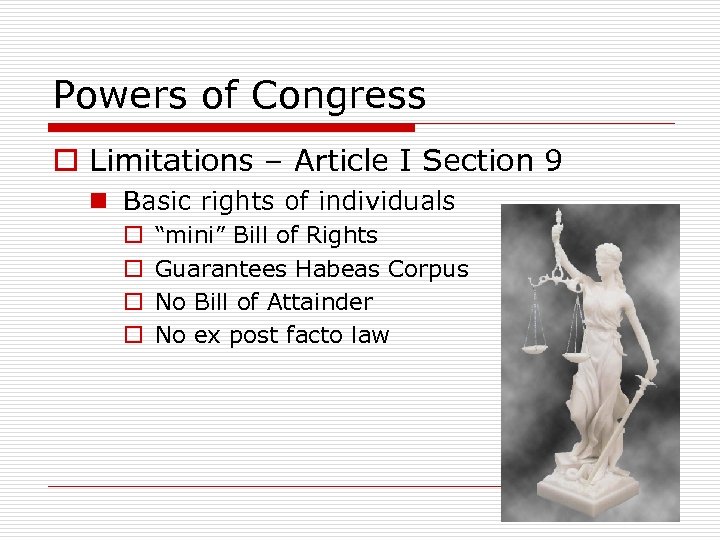 Powers of Congress o Limitations – Article I Section 9 n Basic rights of individuals o o “mini” Bill of Rights Guarantees Habeas Corpus No Bill of Attainder No ex post facto law
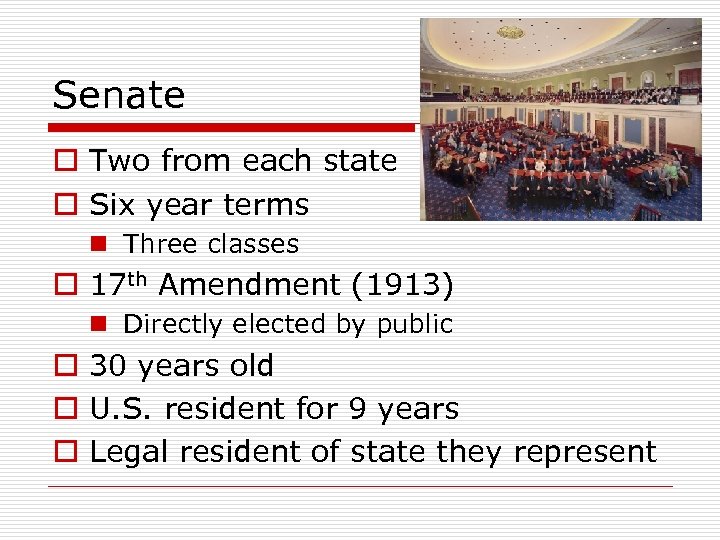 Senate o Two from each state o Six year terms n Three classes o 17 th Amendment (1913) n Directly elected by public o 30 years old o U. S. resident for 9 years o Legal resident of state they represent
 Senate Leadership o President of Senate – Joe Biden n U. S. Vice-president n Now mainly ceremonial n May vote to break ties o President Pro-Tempore – Daniel Inouye D - HI n Presides in the absence of VP n Usually person with the greatest seniority n Third in line of Presidential Succession
 Senate Leadership o Majority Leader: Harry Reid (D) Nevada o Minority Leader: Mitch Mc. Connell (R) KT n Chosen leader from each party n Schedule business of the Senate o Majority Whip: Richard Durbin (D) Ill o Minority Whip: Jon Kyl (R) Miss. n Assist party leader n Round up members for a vote
 Senate Leadership – each party has o Conference Chair o Conference Secretary n Presides over party meetings o Policy Chair n Schedules legislation n Makes recommendations on party policy o Campaign Committee n Provide funds n Advice/assistance to party candidates
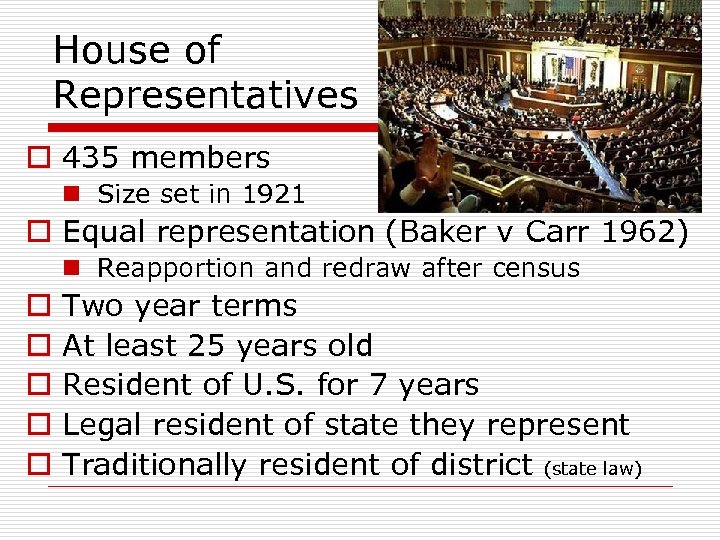 House of Representatives o 435 members n Size set in 1921 o Equal representation (Baker v Carr 1962) n Reapportion and redraw after census o o o Two year terms At least 25 years old Resident of U. S. for 7 years Legal resident of state they represent Traditionally resident of district (state law)
 House Leadership o Speaker of the House n n n n John Boehner R - Ohio Elected by majority party Party leader Presiding officer over entire House Directs/decides the committees for new bills Influences what bills are brought up for vote 2 nd in line of Presidential Succession
 House Leadership o Majority Leader: Eric Cantor - VA o Minority Leader: Nancy Pelosi - CA n Floor leader n Manages debate or appoints manager o Majority Whip: Kevin Mc. Carthy - CA o Minority Whip: Steny Hoyer - MD n Assist leader n Round up votes n Ass’t whips
 House Leadership o Conference Chair o Conference Secretary n Presides over party meetings o Policy Chair n Schedules legislation n Makes recommendations on party policy o Campaign Committee n Provide funds n Advice/assistance to party candidates
 Leadership and Power o Leadership positions and political power in both the Senate and House are determined by Party. o House and Senate determine their own rules. o Majority control is important. o Representation on all committees is usually in proportion to the majority party’s control of the chamber. o party leaders
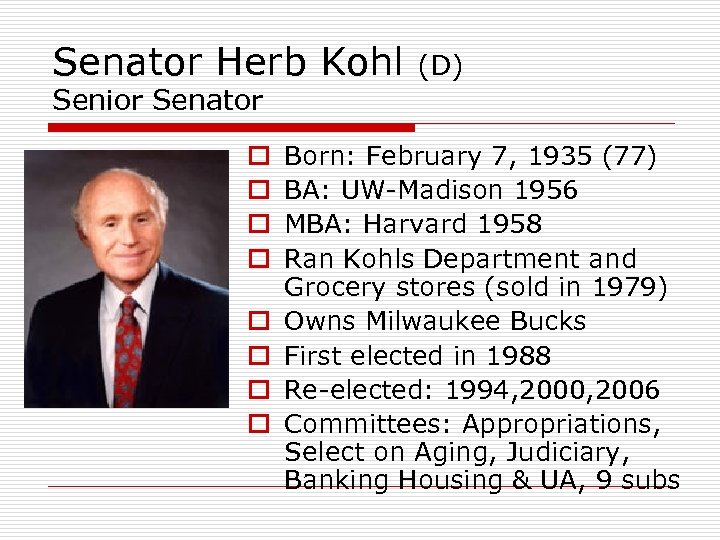 Senator Herb Kohl (D) Senior Senator o o o o Born: February 7, 1935 (77) BA: UW-Madison 1956 MBA: Harvard 1958 Ran Kohls Department and Grocery stores (sold in 1979) Owns Milwaukee Bucks First elected in 1988 Re-elected: 1994, 2000, 2006 Committees: Appropriations, Select on Aging, Judiciary, Banking Housing & UA, 9 subs
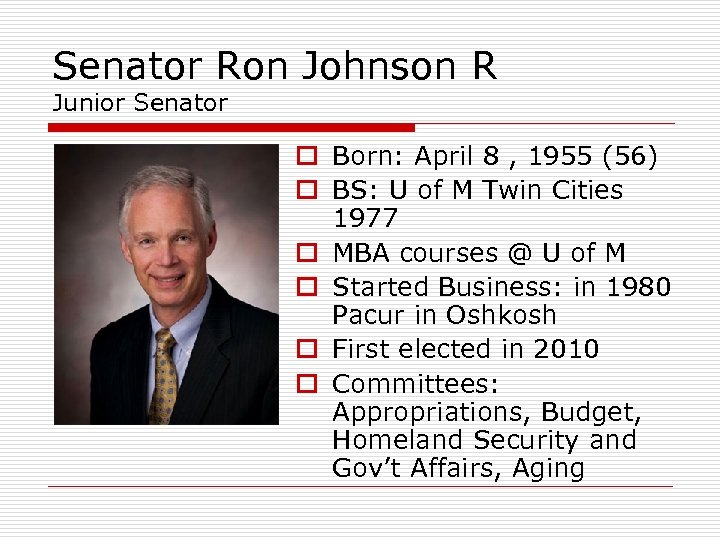 Senator Ron Johnson R Junior Senator o Born: April 8 , 1955 (56) o BS: U of M Twin Cities 1977 o MBA courses @ U of M o Started Business: in 1980 Pacur in Oshkosh o First elected in 2010 o Committees: Appropriations, Budget, Homeland Security and Gov’t Affairs, Aging
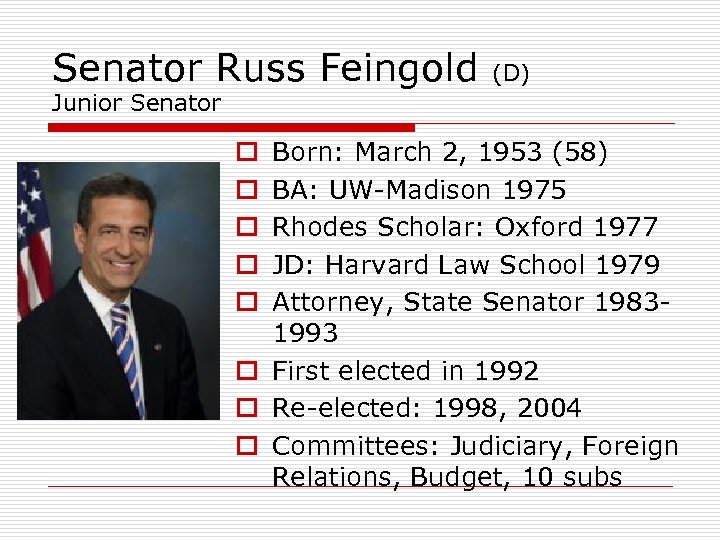 Senator Russ Feingold (D) Junior Senator Born: March 2, 1953 (58) BA: UW-Madison 1975 Rhodes Scholar: Oxford 1977 JD: Harvard Law School 1979 Attorney, State Senator 19831993 o First elected in 1992 o Re-elected: 1998, 2004 o Committees: Judiciary, Foreign Relations, Budget, 10 subs o o o
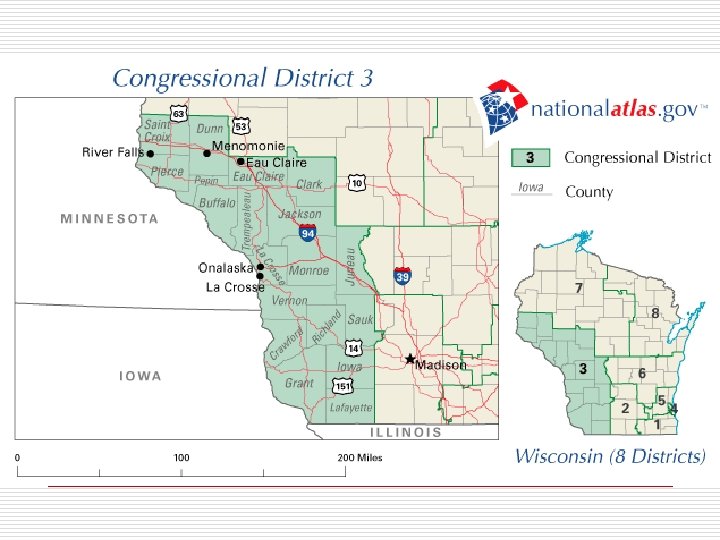
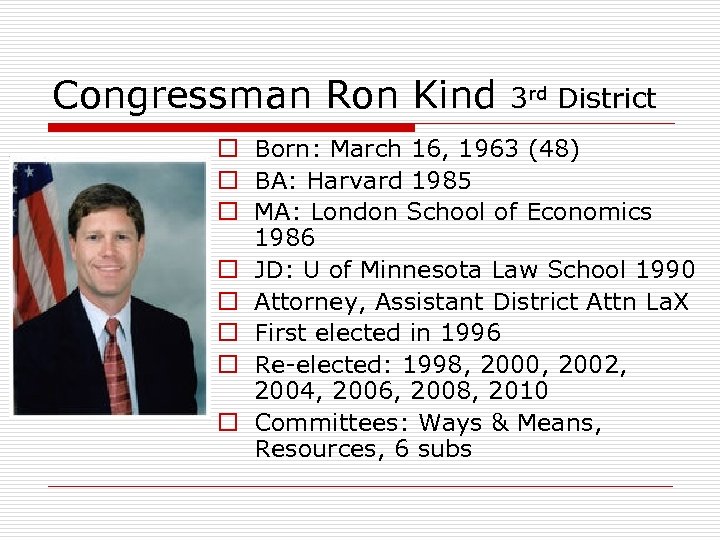 Congressman Ron Kind 3 rd District o Born: March 16, 1963 (48) o BA: Harvard 1985 o MA: London School of Economics 1986 o JD: U of Minnesota Law School 1990 o Attorney, Assistant District Attn La. X o First elected in 1996 o Re-elected: 1998, 2000, 2002, 2004, 2006, 2008, 2010 o Committees: Ways & Means, Resources, 6 subs
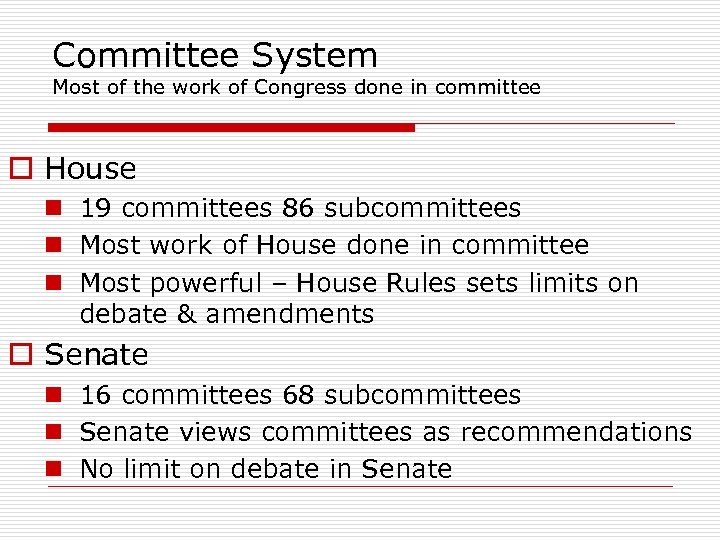 Committee System Most of the work of Congress done in committee o House n 19 committees 86 subcommittees n Most work of House done in committee n Most powerful – House Rules sets limits on debate & amendments o Senate n 16 committees 68 subcommittees n Senate views committees as recommendations n No limit on debate in Senate
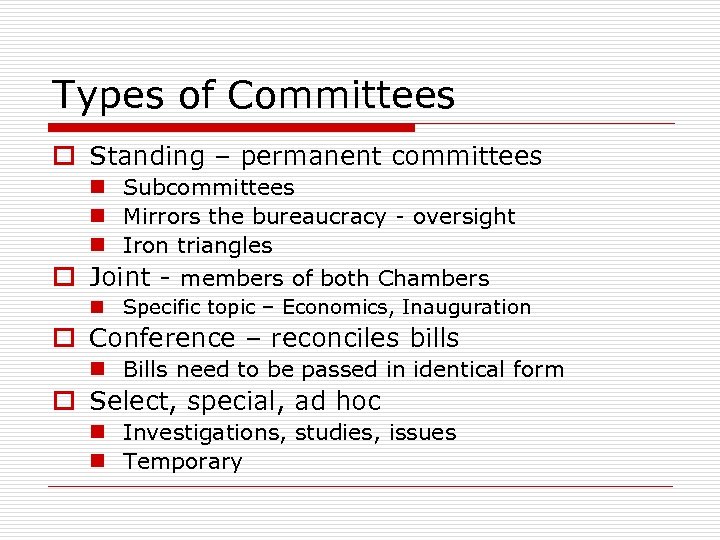 Types of Committees o Standing – permanent committees n Subcommittees n Mirrors the bureaucracy - oversight n Iron triangles o Joint - members of both Chambers n Specific topic – Economics, Inauguration o Conference – reconciles bills n Bills need to be passed in identical form o Select, special, ad hoc n Investigations, studies, issues n Temporary
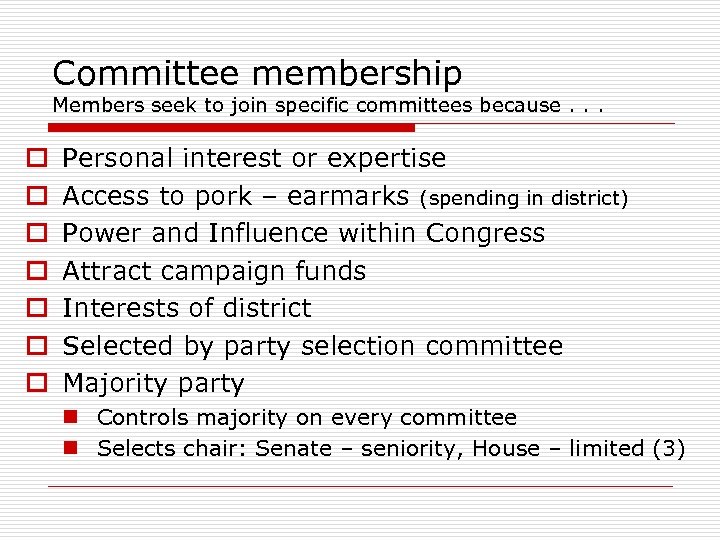 Committee membership Members seek to join specific committees because. . . o o o o Personal interest or expertise Access to pork – earmarks (spending in district) Power and Influence within Congress Attract campaign funds Interests of district Selected by party selection committee Majority party n Controls majority on every committee n Selects chair: Senate – seniority, House – limited (3)
 Constituent Interests (casework) o Serve as intermediary between individual and the government bureaucracy o Solve problems n Social Security n Passports n IRS o Individuals remember favors - vote
 Legislative Oversight o Crucial Role – Assess the impact of policy o Determine if administration is following the legislative intent o Correcting, Changing, Eliminating o Public Complaints / Feedback often start the process o Sunset Laws can be used – not common o Legislative Veto – used but ruled unconstitutional (I. N. S v Chadha)
 Legislative Oversight o Problems with Oversight n n n Unrewarding & usually not attention grabbing Confrontational in nature Huge and complex task Can be used for partisan political objectives Current news article
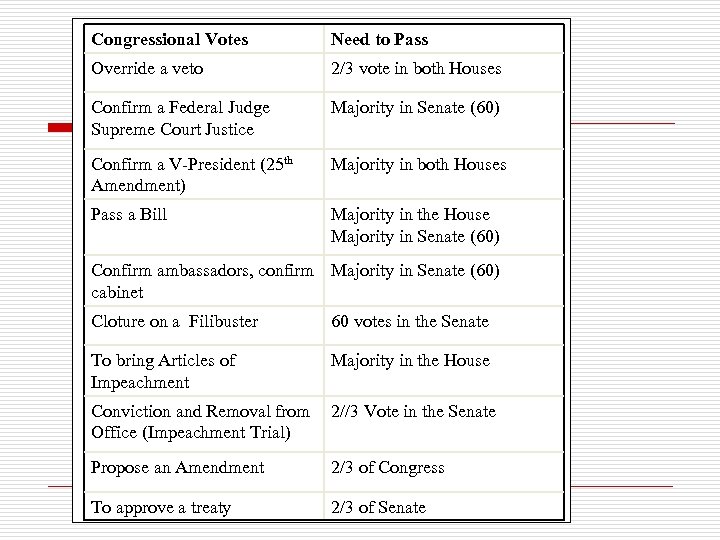 Congressional Votes Need to Pass Override a veto Congressional Votes 2/3 vote in to Pass Need both Houses Override a veto Confirm a Federal Judge Supreme Court Justice Confirm a SC 2/3 in Senate (60) Majorityvote in both Houses Majority in Senate Confirm a V-President Majority in both Houses Majority in Houses Confirm a V-President (25 th Amendment) Pass a Bill Majority in the House Confirm ambassadors, Majority in Senate (60) Majority in Senate confirm cabinet Confirm ambassadors, confirm Majority in Senate (60) 60 votes in the Senate cabinet Cloture on a Filibuster To Filibuster Majority Senate Cloture on a bring Articles of 60 votes in the House Impeachment To bring Articles of and Removal Majority in the Senate Conviction 2//3 Vote House Impeachment Office (Impeachment from Conviction and Removal from 2//3 Vote in the Senate Trial) Office (Impeachment. Amendment Propose an Trial) 2/3 of Congress Propose an Amendment To approve a treaty 2/3 of Congress 2/3 of Senate To approve a treaty 2/3 of Senate