


 Скачать презентацию Organizate La Escuela La Cultura ch 2
6b6735a39c3aa846ac859aedd352c356.ppt
- Количество слайдов: 57
 ¡Organizate! La Escuela – La Cultura ch. 2
 Brainstorm in Spanish or English: • What materials do you need for school each year? • What do you buy yearly or keep year to year? • Where do you go to buy your school supplies?
 Culture: The education system – Needs & Wants for School: • How do you get ready to go back to school? • Where do you shop? • What items to you need to buy or can keep year to year? • Are those the same needs and wants of students abroad? What do they need for school? Where do they shop?
 Culture: The education system – Differences with Needs & Wants for School: Pro’s & Con’s España/LA Los EEUU Materials: school sends home a letter with the basics and students buy in a “papelería; ” they must buy own textbooks Materials: school sends home a letter 9 th gr. and students shop in a “librería or almacén; ” school provides texts through state funding Dress Code: buy and wear a uniform (liked by all because it eliminates differences in economic status and all feel equal) Dress Code: wear what you are comfortable in and states your personality *gym uniforms
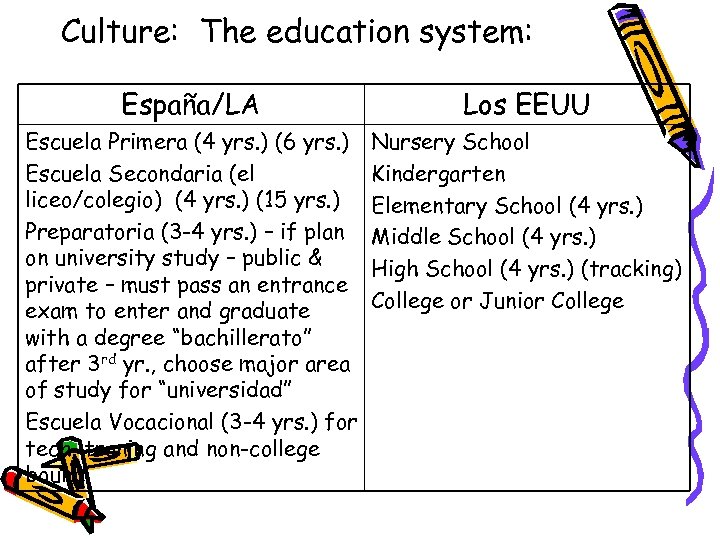 Culture: The education system: España/LA Los EEUU Escuela Primera (4 yrs. ) (6 yrs. ) Escuela Secondaria (el liceo/colegio) (4 yrs. ) (15 yrs. ) Preparatoria (3 -4 yrs. ) – if plan on university study – public & private – must pass an entrance exam to enter and graduate with a degree “bachillerato” after 3 rd yr. , choose major area of study for “universidad” Escuela Vocacional (3 -4 yrs. ) for tech. traning and non-college bound Nursery School Kindergarten Elementary School (4 yrs. ) Middle School (4 yrs. ) High School (4 yrs. ) (tracking) College or Junior College
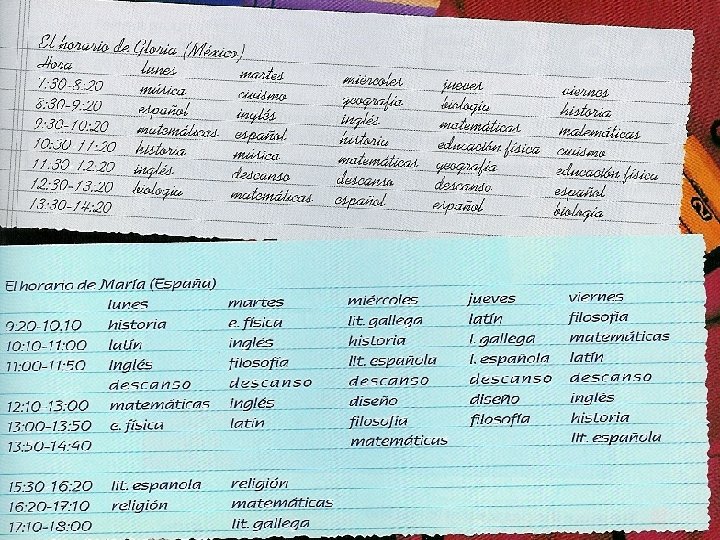
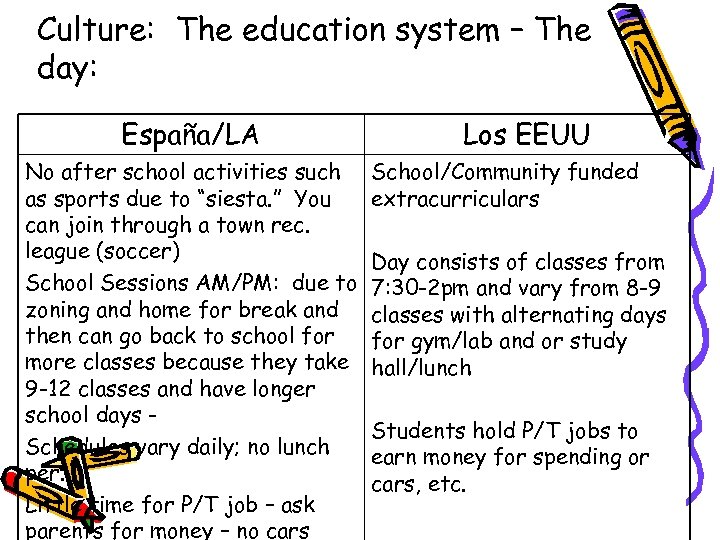 Culture: The education system – The day: España/LA No after school activities such as sports due to “siesta. ” You can join through a town rec. league (soccer) School Sessions AM/PM: due to zoning and home for break and then can go back to school for more classes because they take 9 -12 classes and have longer school days Schedules vary daily; no lunch per. Little time for P/T job – ask parents for money – no cars Los EEUU School/Community funded extracurriculars Day consists of classes from 7: 30 -2 pm and vary from 8 -9 classes with alternating days for gym/lab and or study hall/lunch Students hold P/T jobs to earn money for spending or cars, etc.
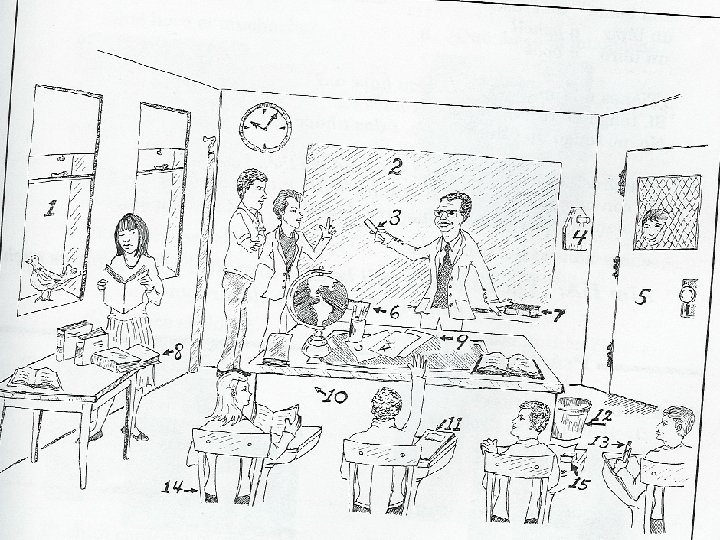
 La Escuela El Colegio y Las Clases “¿Qué hay en la clase? ” High School and Classes “What’s in the classroom? ”
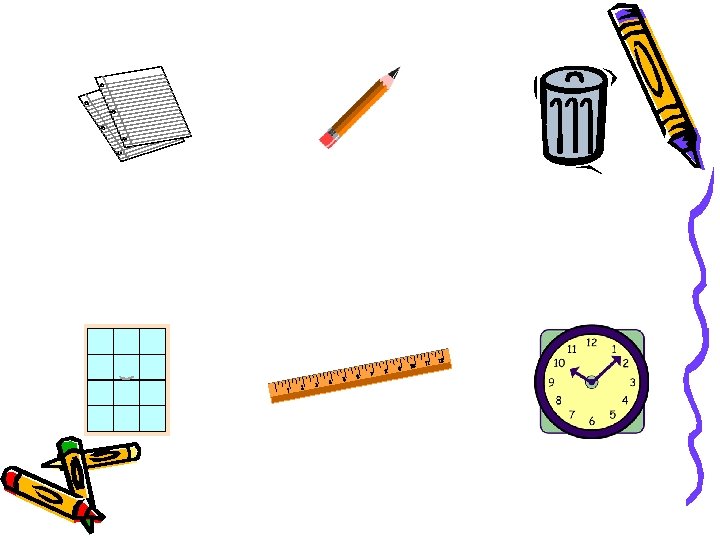
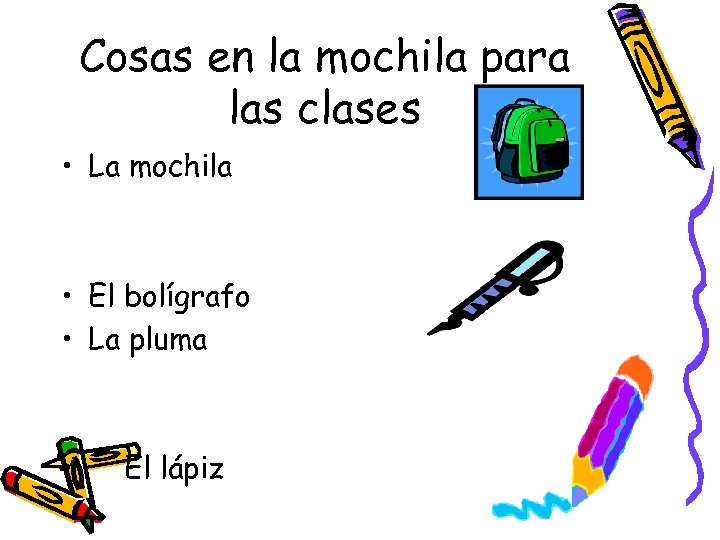 Cosas en la mochila para las clases • La mochila • El bolígrafo • La pluma • El lápiz
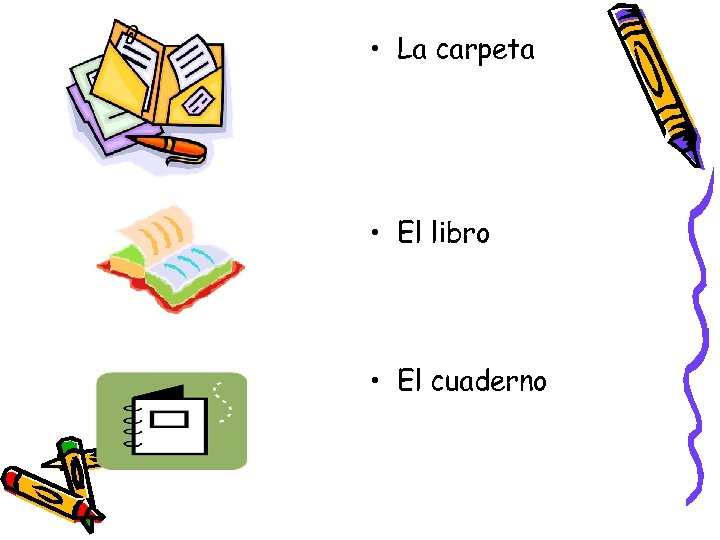 • La carpeta • El libro • El cuaderno
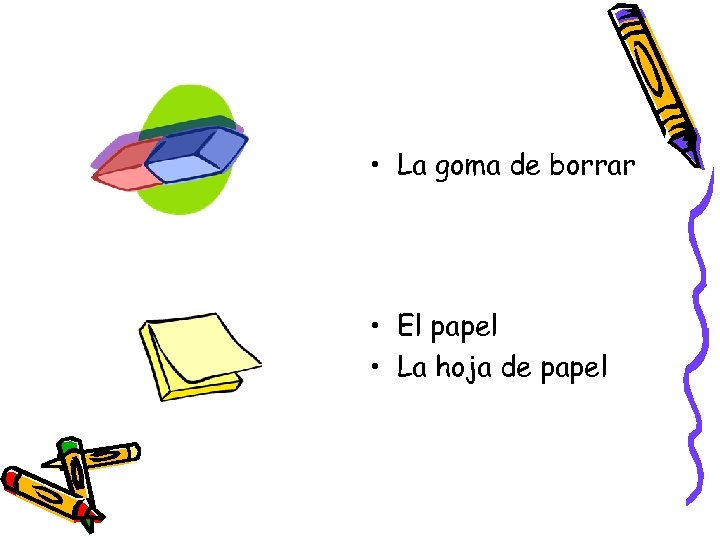 • La goma de borrar • El papel • La hoja de papel
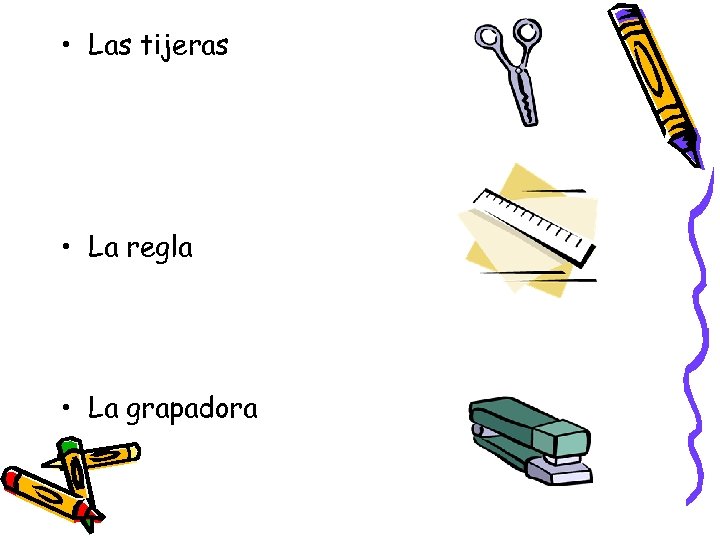 • Las tijeras • La regla • La grapadora
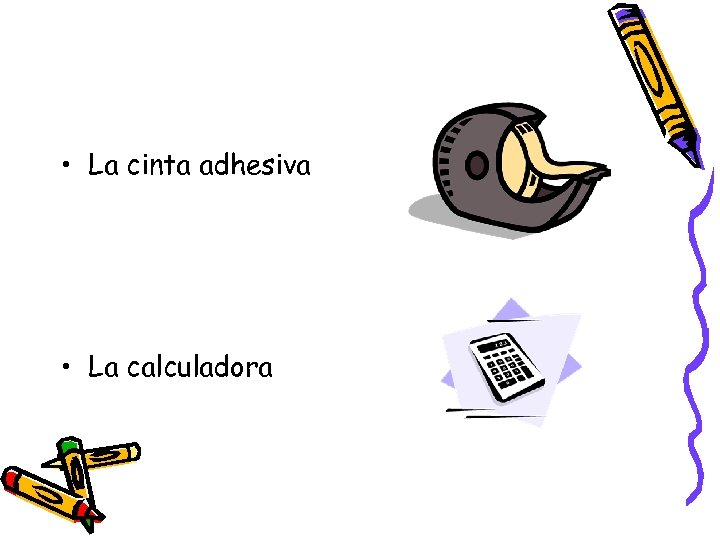 • La cinta adhesiva • La calculadora
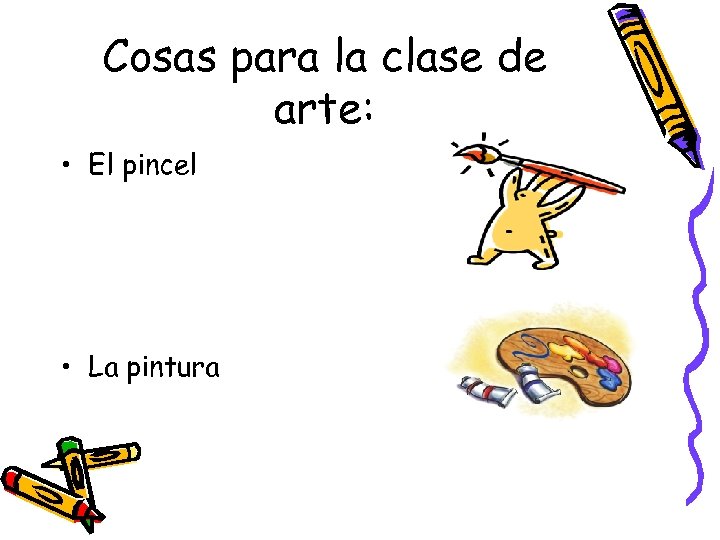 Cosas para la clase de arte: • El pincel • La pintura
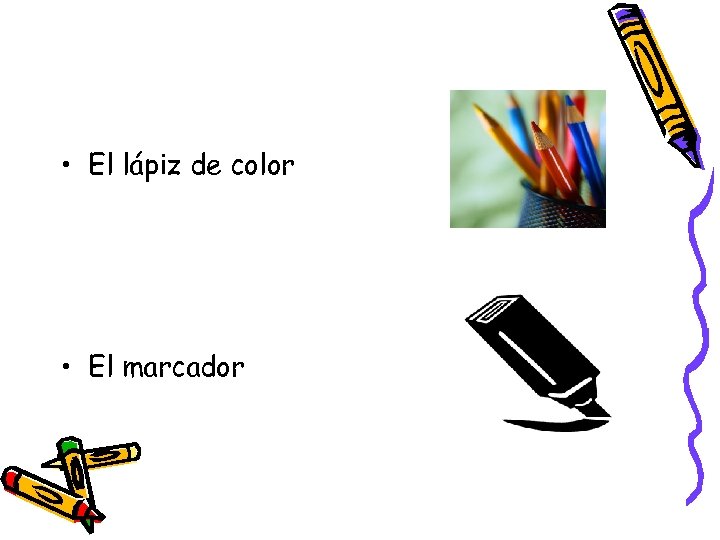 • El lápiz de color • El marcador
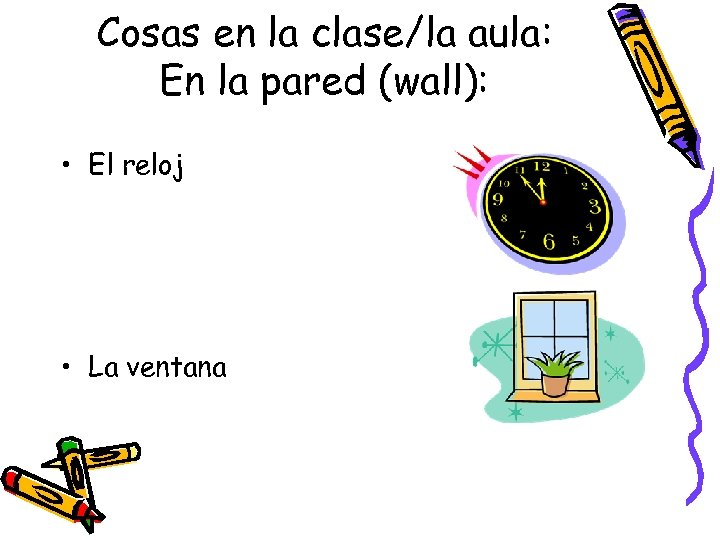 Cosas en la clase/la aula: En la pared (wall): • El reloj • La ventana
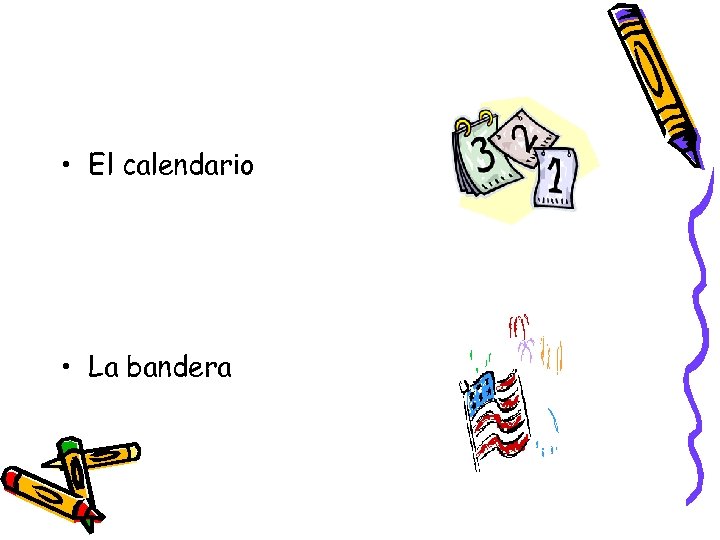 • El calendario • La bandera
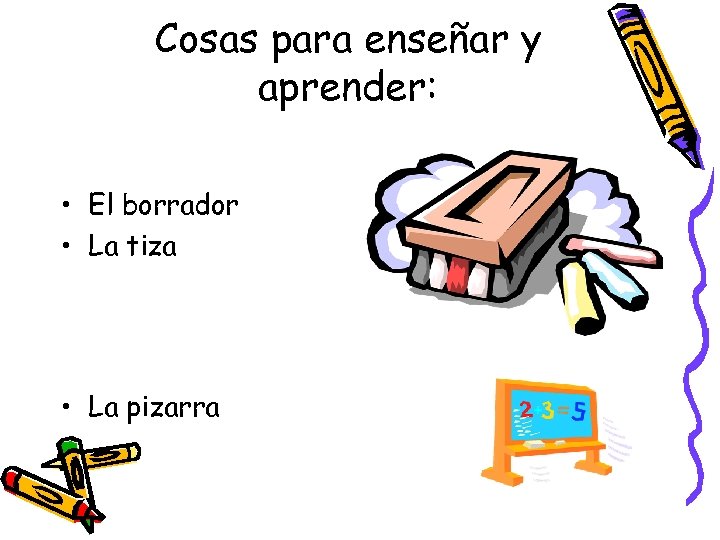 Cosas para enseñar y aprender: • El borrador • La tiza • La pizarra
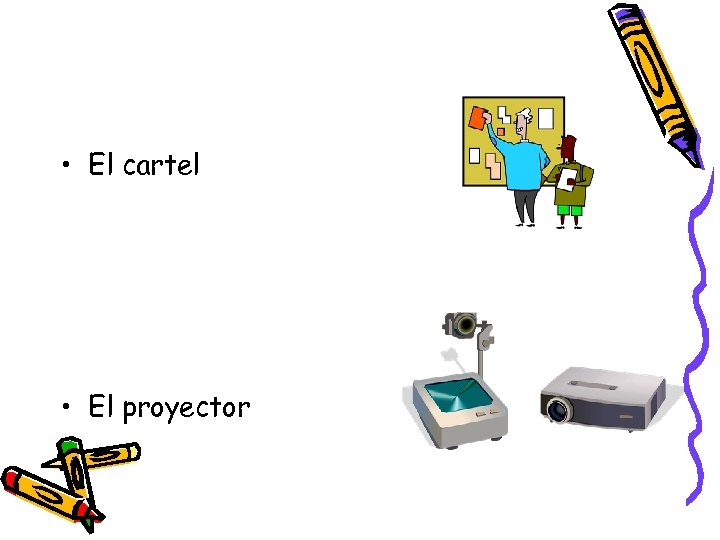 • El cartel • El proyector
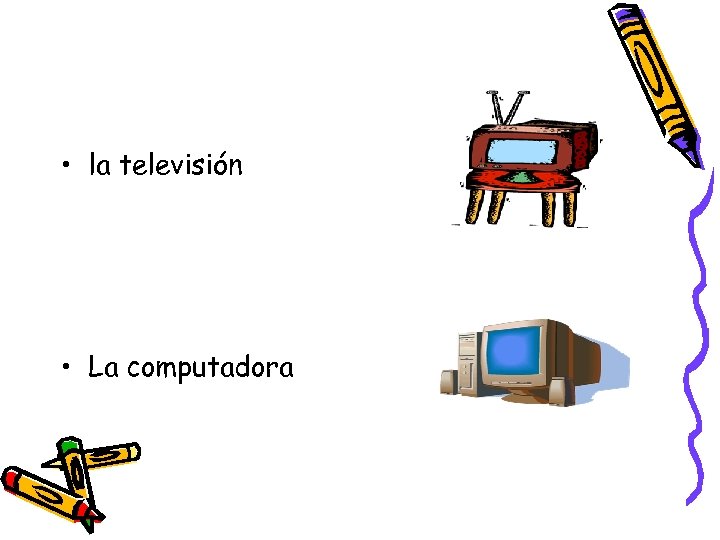 • la televisión • La computadora
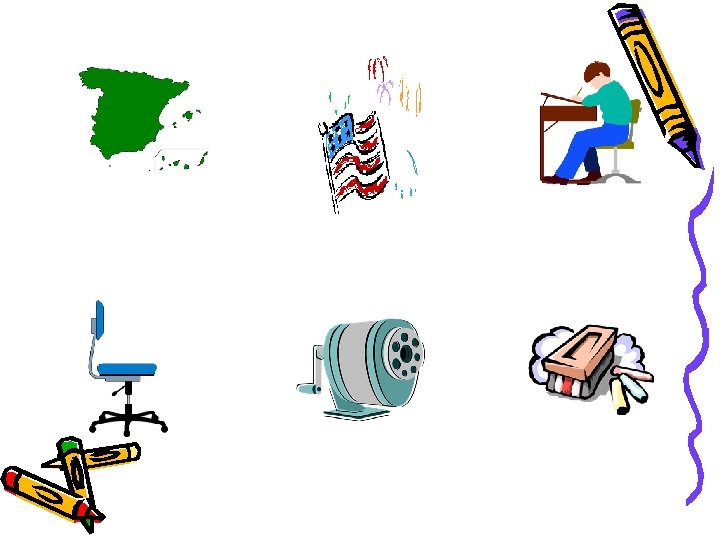
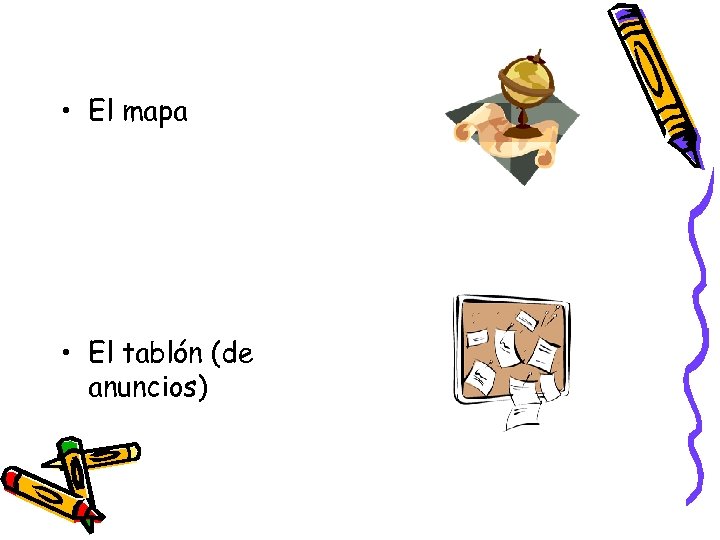 • El mapa • El tablón (de anuncios)
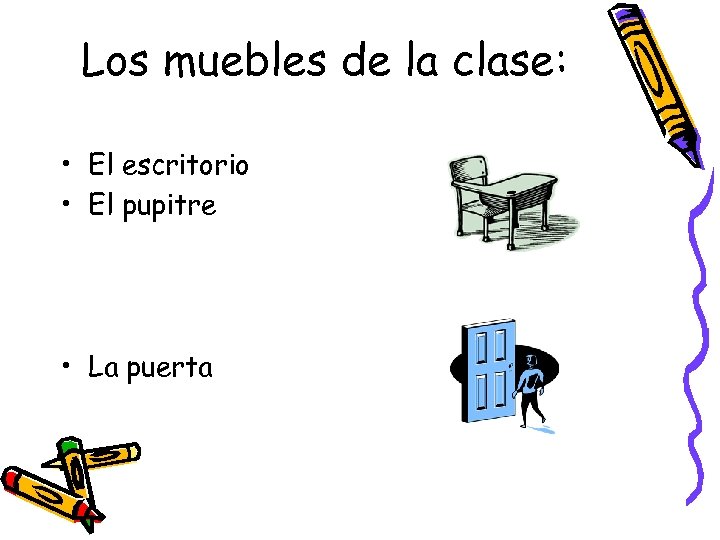 Los muebles de la clase: • El escritorio • El pupitre • La puerta
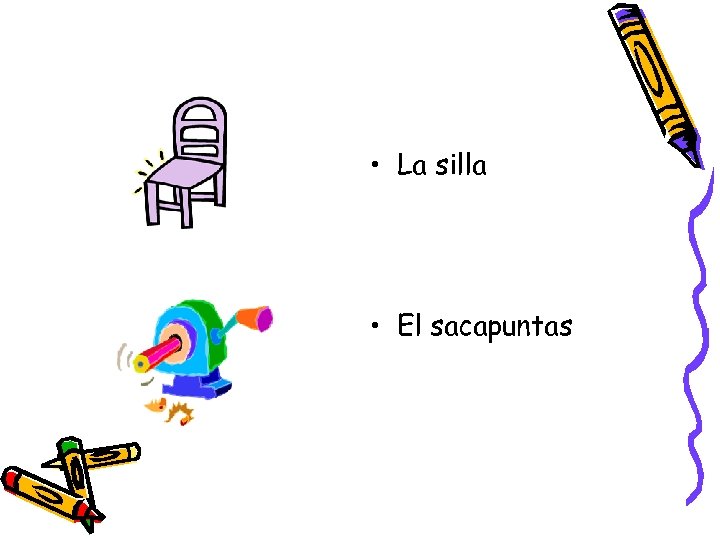 • La silla • El sacapuntas
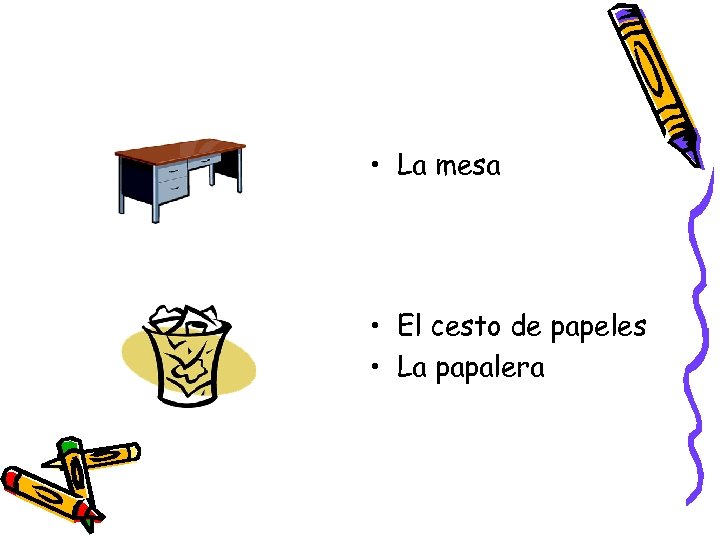 • La mesa • El cesto de papeles • La papalera
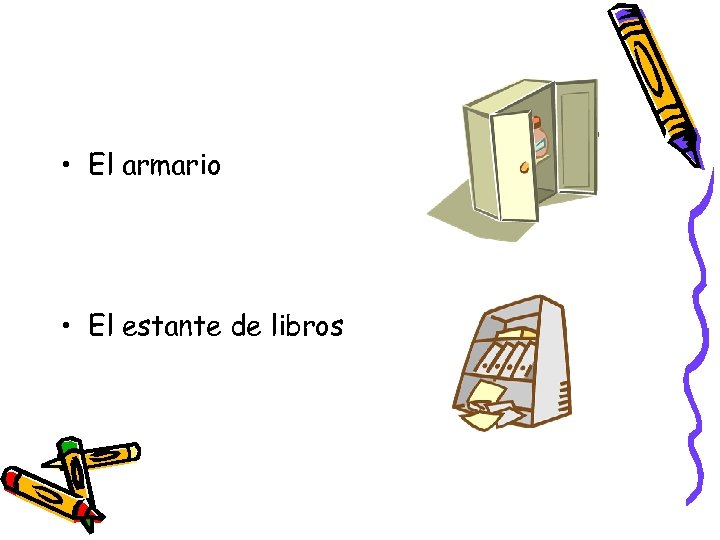 • El armario • El estante de libros
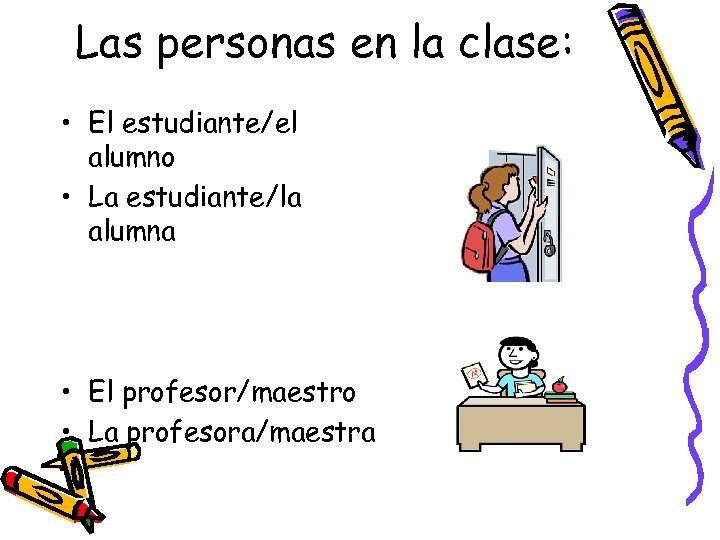 Las personas en la clase: • El estudiante/el alumno • La estudiante/la alumna • El profesor/maestro • La profesora/maestra
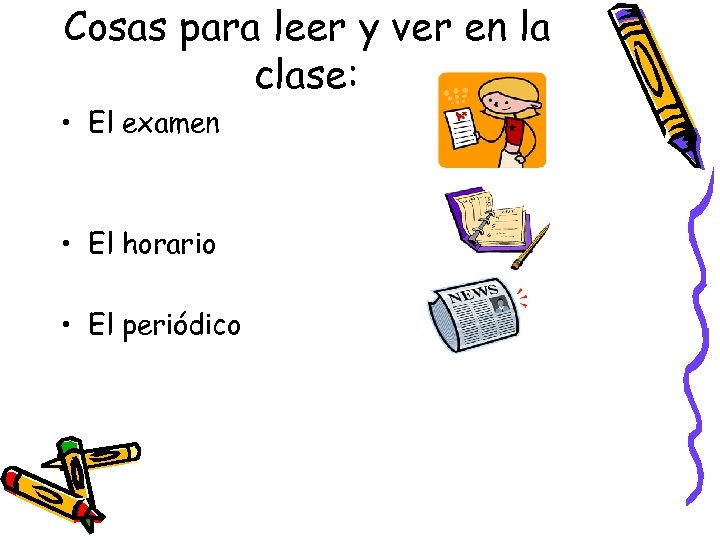 Cosas para leer y ver en la clase: • El examen • El horario • El periódico
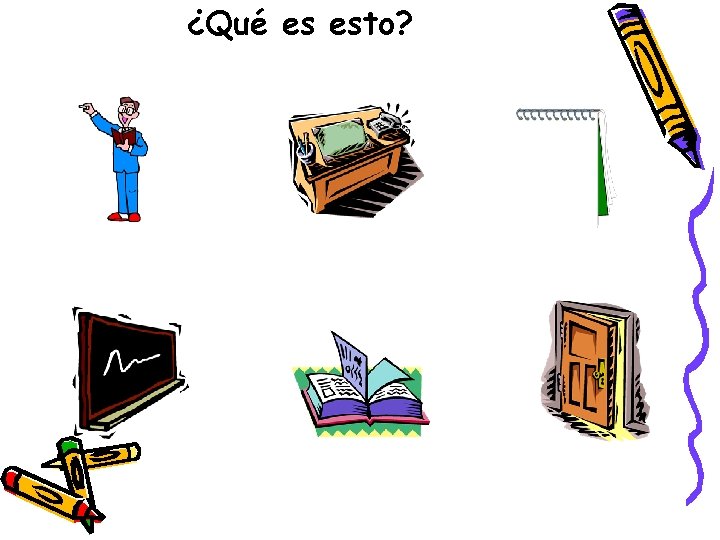 ¿Qué es esto?
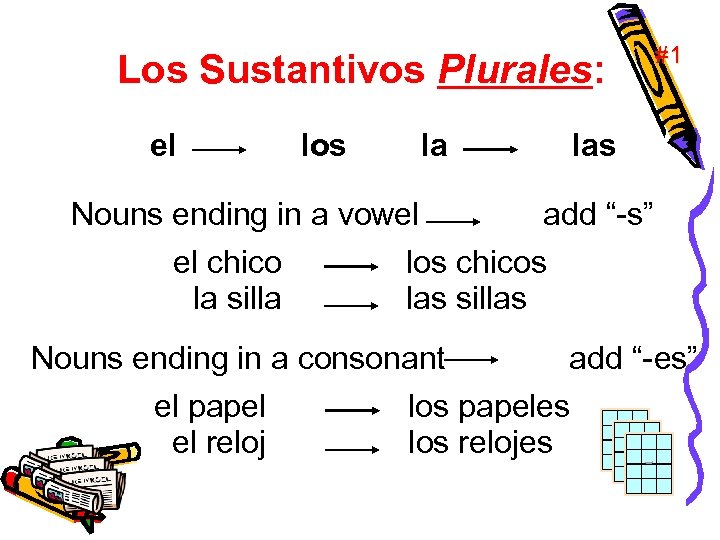 Los Sustantivos Plurales: el los la #1 las Nouns ending in a vowel add “-s” el chico los chicos la silla las sillas Nouns ending in a consonant add “-es” el papel los papeles el reloj los relojes
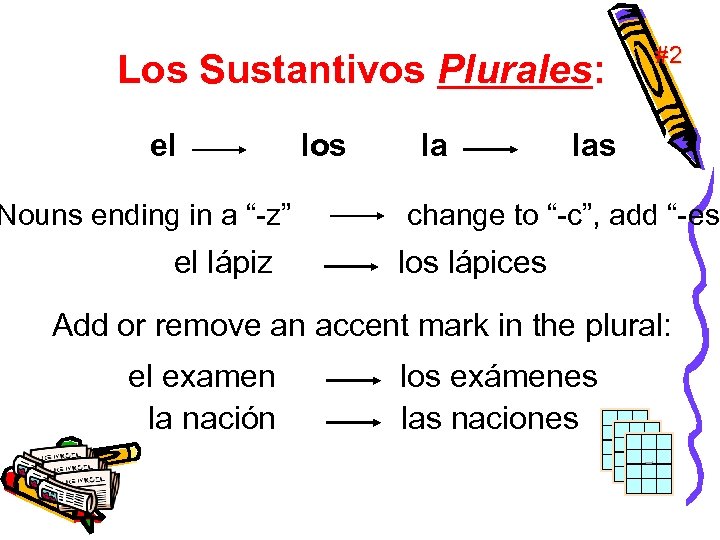 Los Sustantivos Plurales: el Nouns ending in a “-z” el lápiz los la #2 las change to “-c”, add “-es” los lápices Add or remove an accent mark in the plural: el examen la nación los exámenes las naciones
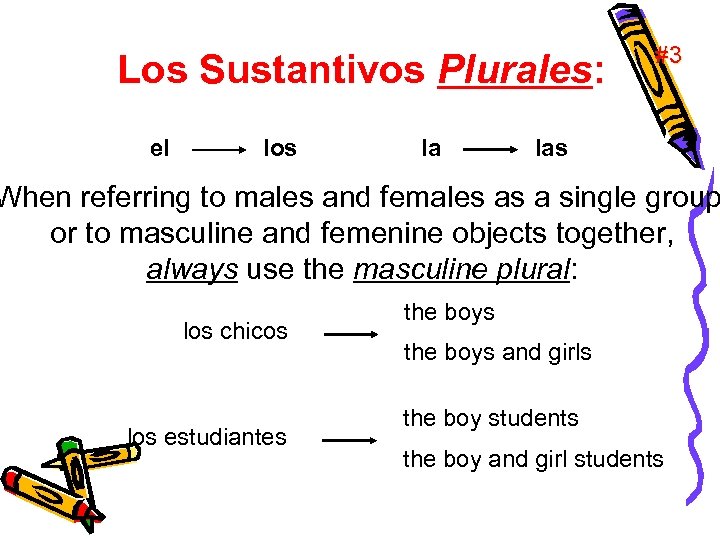 Los Sustantivos Plurales: el los la #3 las When referring to males and females as a single group or to masculine and femenine objects together, always use the masculine plural: los chicos los estudiantes the boys and girls the boy students the boy and girl students
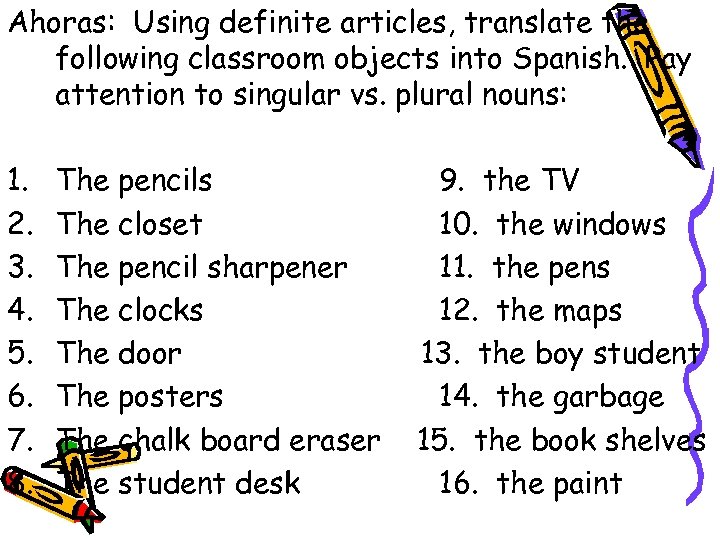 Ahoras: Using definite articles, translate the following classroom objects into Spanish. Pay attention to singular vs. plural nouns: 1. 2. 3. 4. 5. 6. 7. 8. The pencils The closet The pencil sharpener The clocks The door The posters The chalk board eraser The student desk 9. the TV 10. the windows 11. the pens 12. the maps 13. the boy student 14. the garbage 15. the book shelves 16. the paint
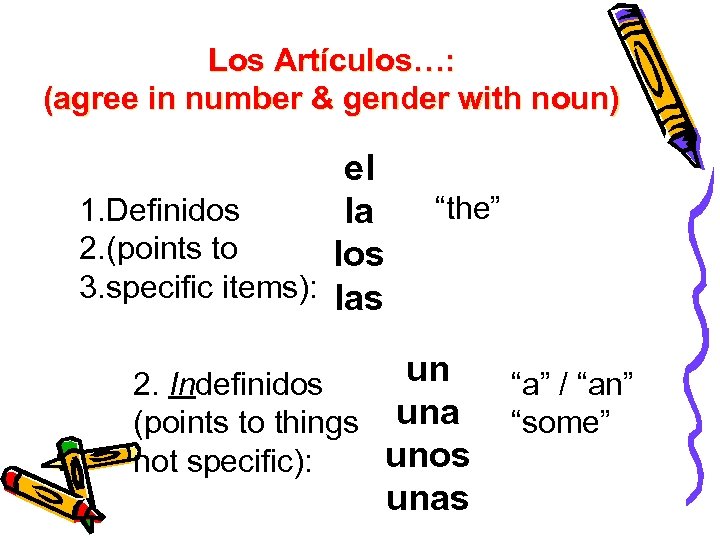 Los Artículos…: (agree in number & gender with noun) el 1. Definidos la 2. (points to los 3. specific items): las “the” un 2. Indefinidos (points to things una unos not specific): unas “a” / “an” “some”
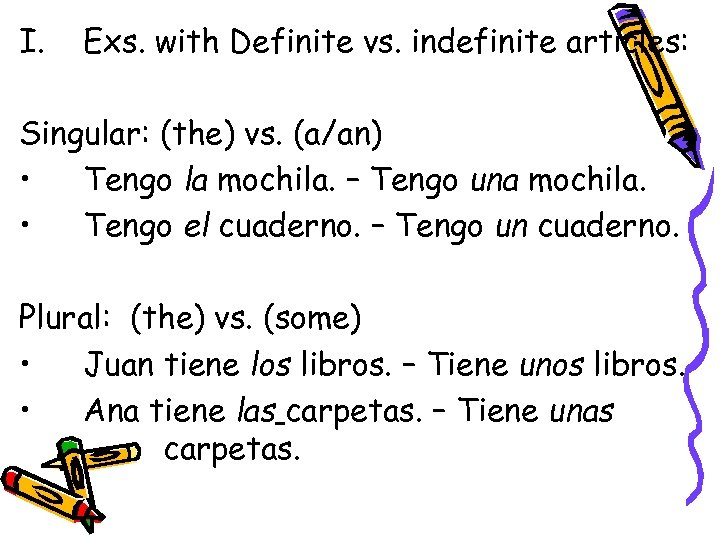 I. Exs. with Definite vs. indefinite articles: Singular: (the) vs. (a/an) • Tengo la mochila. – Tengo una mochila. • Tengo el cuaderno. – Tengo un cuaderno. Plural: (the) vs. (some) • Juan tiene los libros. – Tiene unos libros. • Ana tiene las carpetas. – Tiene unas carpetas.
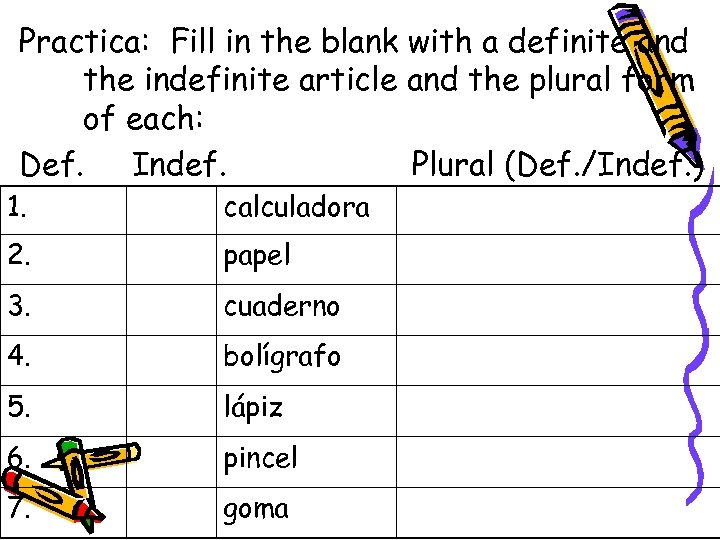 Practica: Fill in the blank with a definite and the indefinite article and the plural form of each: Def. Indef. Plural (Def. /Indef. ) 1. calculadora 2. papel 3. cuaderno 4. bolígrafo 5. lápiz 6. pincel 7. goma
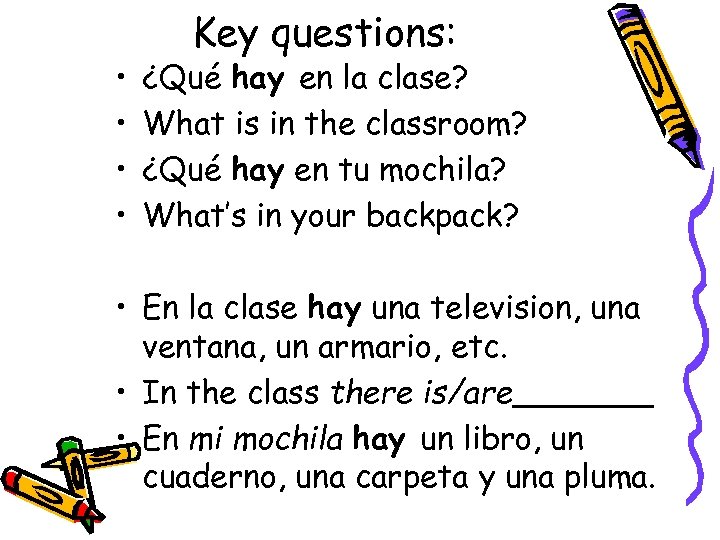 • • Key questions: ¿Qué hay en la clase? What is in the classroom? ¿Qué hay en tu mochila? What’s in your backpack? • En la clase hay una television, una ventana, un armario, etc. • In the class there is/are_______ • En mi mochila hay un libro, un cuaderno, una carpeta y una pluma.
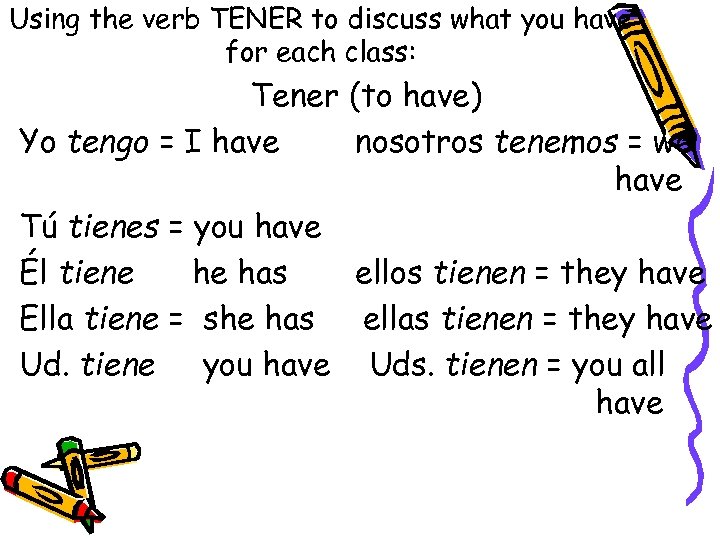 Using the verb TENER to discuss what you have for each class: Tener (to have) Yo tengo = I have nosotros tenemos = we have Tú tienes = you have Él tiene he has ellos tienen = they have Ella tiene = she has ellas tienen = they have Ud. tiene you have Uds. tienen = you all have
 Key question: • ¿Qué tienes en tu mochila para las clases? • What do you have in your backpack for classes? • Yo tengo unos libros y un cuaderno en mi mochila. • ¿Ya tienes una pluma? Do you already have a pen? • Sí, ya tengo una pluma. / Yes, I already have a pen. • No, no ya tengo pluma. / No, I don’t have a pen already. *Note: articles: un, una, unos, unas are dropped in negative sentences.
 Key question: • ¿Qué tiene Marco para el español? • What does Marco have for Spanish class? • Marco tiene un diccionario y una carpeta. • ¿Tienen los estudiantes los cuadernos? Do the students have notebooks? • Sí, ellos tienen los cuadernos. / No, ellos no tienen cuadernos.
 Más practica con Tener: B. Insert the correct form of Tener and translate the class object to create a sentence: Ex: yo / tener / a pencil = Tengo un lápiz. 1. Juana / tener / a notebook and a pen 2. tú / tener / a backpack ? 3. Los alumnos / tener / some paper 4. Nosotros / tener / some rulers and folders 5. El profesor / tener / the chalk and the eraser
 I. Practicamos: In a complete sentence, answer the question to describe 3 things that you have for each class: ¿Qué tienes en tu mochila para la clase de…. ? 1. Español 2. Inglés 3. Matemáticas 4. Arte 5. Historia *now interview 5 classmates to ask what they have for each class and report in el/ella form
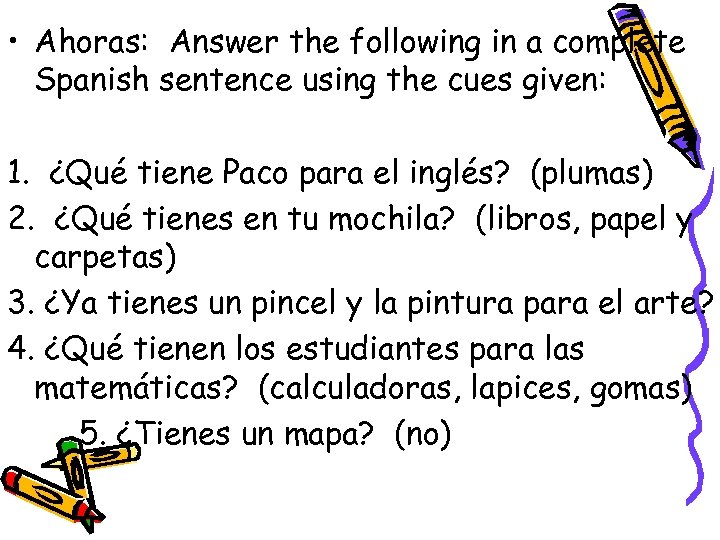 • Ahoras: Answer the following in a complete Spanish sentence using the cues given: 1. ¿Qué tiene Paco para el inglés? (plumas) 2. ¿Qué tienes en tu mochila? (libros, papel y carpetas) 3. ¿Ya tienes un pincel y la pintura para el arte? 4. ¿Qué tienen los estudiantes para las matemáticas? (calculadoras, lapices, gomas) 5. ¿Tienes un mapa? (no)
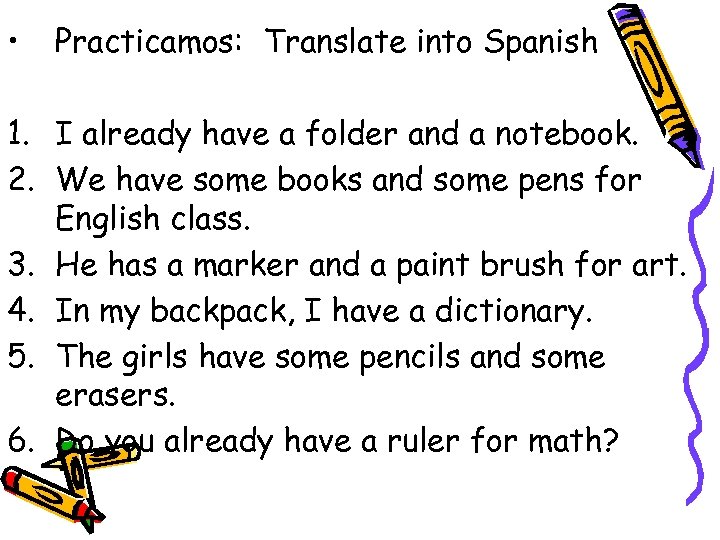 • Practicamos: Translate into Spanish 1. I already have a folder and a notebook. 2. We have some books and some pens for English class. 3. He has a marker and a paint brush for art. 4. In my backpack, I have a dictionary. 5. The girls have some pencils and some erasers. 6. Do you already have a ruler for math?
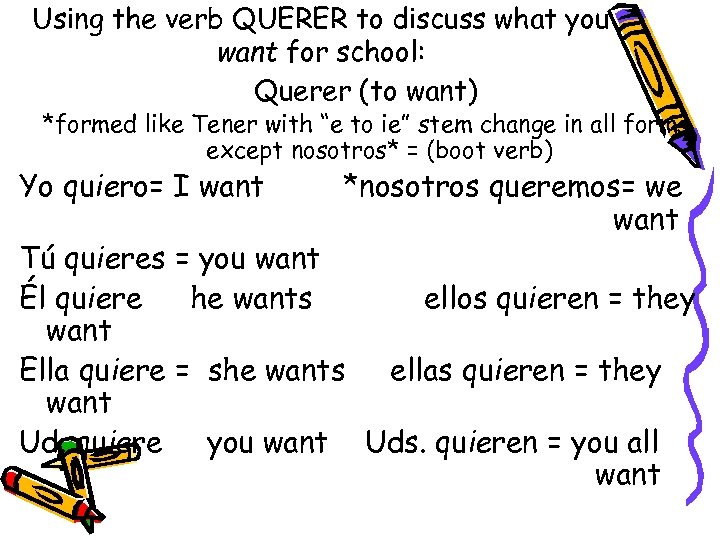 Using the verb QUERER to discuss what you want for school: Querer (to want) *formed like Tener with “e to ie” stem change in all forms except nosotros* = (boot verb) Yo quiero= I want *nosotros queremos= we want Tú quieres = you want Él quiere he wants ellos quieren = they want Ella quiere = she wants ellas quieren = they want Ud. quiere you want Uds. quieren = you all want
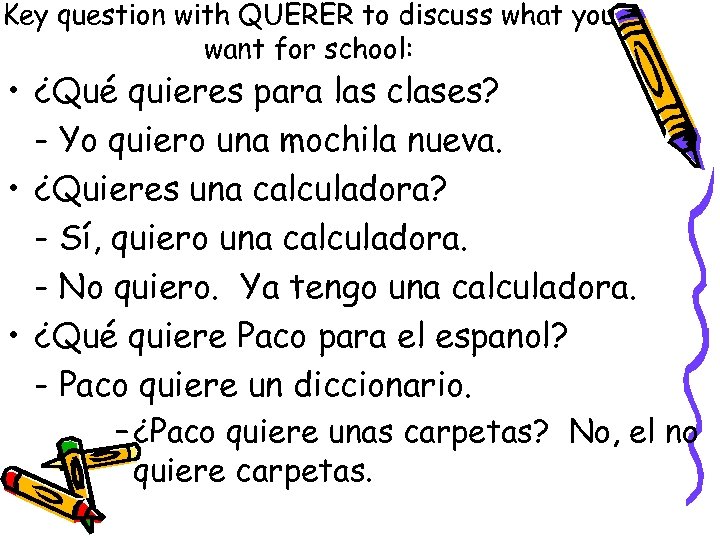 Key question with QUERER to discuss what you want for school: • ¿Qué quieres para las clases? - Yo quiero una mochila nueva. • ¿Quieres una calculadora? - Sí, quiero una calculadora. - No quiero. Ya tengo una calculadora. • ¿Qué quiere Paco para el espanol? - Paco quiere un diccionario. – ¿Paco quiere unas carpetas? No, el no quiere carpetas.
 Más practica con Querer: B. Insert the correct form of Querer and translate the class object to create a sentence: Ex: yo / querer / a pencil = Quiero un lápiz. 1. Jose / querer / a dictionary 2. tú / querer / some paper? 3. Angela y yo / querer / some colored pencils 4. Los profesores / querer / some posters and bookshelves 5. Yo / querer / the paint for art class
 Answer the following in a complete Spanish sentence using the cues given: 1. ¿Qué quiere Paco para la historia? (a notebook) 2. ¿Qué quieres en tu mochila para las clases? (some pens, some folders, and some paper) 3. ¿Quiere Anita un pincel para el ingles? (no) 4. ¿Qué quieren los estudiantes para las matemáticas? (a ruler, a calculator, some pencils) 5. ¿Quieres unas gomas? (si)
 • Practicamos: Translate into Spanish 1. I already have a notebook, but I want a folder for class. 2. We want some pencils for English class. 3. The teacher has the chalk, but he wants some board erasers. 4. In my backpack, I want a dictionary. 5. The girls want 15 pens. 6. Do you want the book?
 Ahoras: Traduzcan al espanol con TENER o QUERER: 1. I want some markers for art class. 2. He already has a backpack. 3. Anita and I want many things for school. 4. They want some pencils for math class. 5. Do you want a dictionary for Spanish class? 6. What does Ana want for English class? 7. What do you have in your backpack?
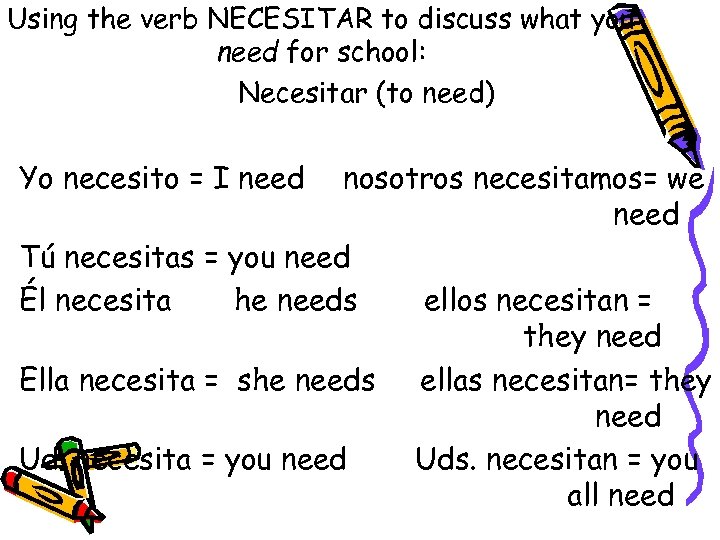 Using the verb NECESITAR to discuss what you need for school: Necesitar (to need) Yo necesito = I need nosotros necesitamos= we need Tú necesitas = you need Él necesita he needs ellos necesitan = they need Ella necesita = she needs ellas necesitan= they need Ud. necesita = you need Uds. necesitan = you all need
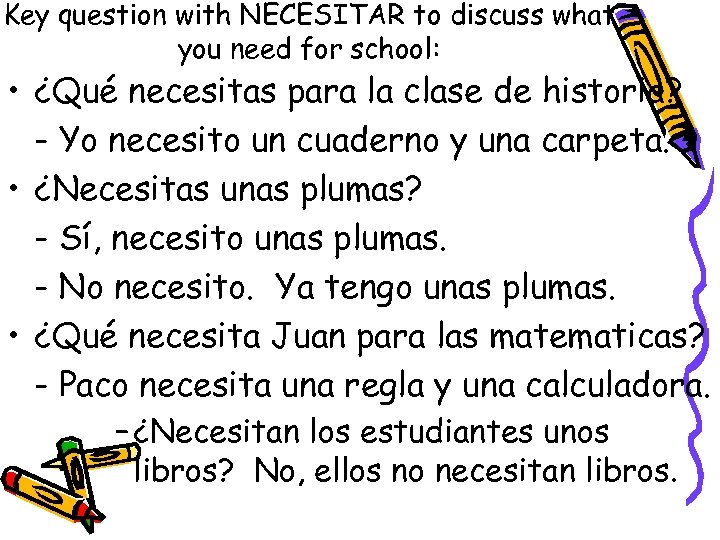 Key question with NECESITAR to discuss what you need for school: • ¿Qué necesitas para la clase de historia? - Yo necesito un cuaderno y una carpeta. • ¿Necesitas unas plumas? - Sí, necesito unas plumas. - No necesito. Ya tengo unas plumas. • ¿Qué necesita Juan para las matematicas? - Paco necesita una regla y una calculadora. – ¿Necesitan los estudiantes unos libros? No, ellos no necesitan libros.
 Ahoras: Write a question and answer based on the information provided using NECESITAR: Ex: (tú) (some pens) – ¿Qué necesitas tú? Yo necesito unas plumas. 1. (Elena) (a ruler) 2. (Marcos y Rafael) (some paper) 3. (tú) (many things) 4. (El profesor Martinez) (the chalk) 5. (Pedro) (some folders and notebooks)
 Reviewing your needs and wants or school: I. In complete sentences, list 5 things you want for school and each class. II. In complete sentences, list 5 things you need for school and each class. III. In complete sentences, list 5 things you already have for school and each class.
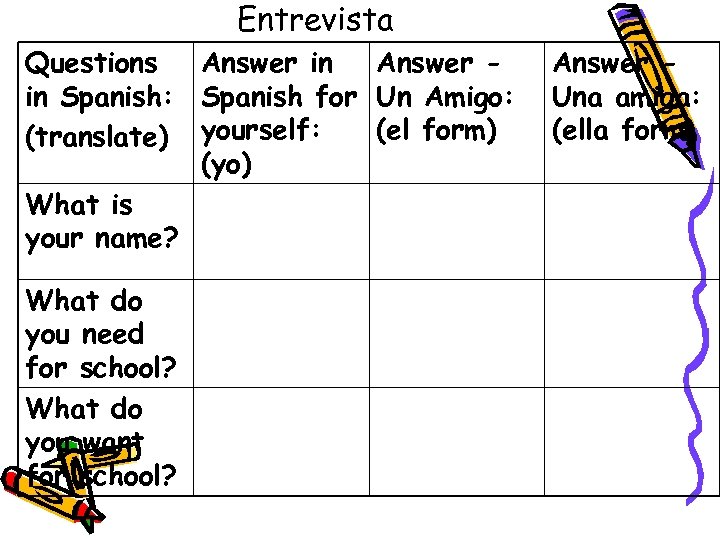 Entrevista Questions Answer in Spanish: Spanish for Un Amigo: (el form) (translate) yourself: (yo) What is your name? What do you need for school? What do you want for school? Answer Una amiga: (ella form)