Скачать презентацию Организационная структура гостиниц 1 Основные элементы в структуре
Организационная структура гостиниц.ppt
- Количество слайдов: 115
 Организационная структура гостиниц 1. Основные элементы в структуре гостиниц. 2. Службы бронирования размещения
 Организационная структура – это модель взаимоотношений между должностями в гостинице и между ее работниками. p структура придает определенную форму гостиничному предприятию. p
 Цель структуры: p p разделение труда; определение задач и обязанностей; определение ролей и взаимоотношений; определение путей ( каналов) взаимосвязи.
 до начала ХХ века в мировом гостиничном хозяйстве доминировала европейская классическая модель организационной структуры. p Она выстраивалась вокруг двух важных управленческих должностей – метрдотеля и шеф-повара. p
 Первый должен был следить за взаимодействием между персоналом и гостями – обслуживание должно было строго протекать в соответствии с политикой данного отеля p Второй (шеф-повар) являлся хозяином кухни. Он отвечал за процесс выбора и подготовки блюд, предлагаемых гостям отеля. Такая организационная структура отражала ту роль, которую, прежде всего, играла служба питания. p
 Разработка (выстраивание) организационной структуры. Целевые функции – это основные функции организации, которые обеспечивают производственный процесс и нацелены на конечный продукт (результат). p В гостинице к ключевым функциям относят p
 p p p p - прием и размещения гостей-клиентов; продажа номеров; производство питания и напитков; организация конференций и встреч и т. п. маркетинг. К функциональным элементам относят - обеспечение безопасности; - административная деятельность
 p p В организационной структуре гостиницы персонал делится на два вида: - сотрудники, обязанности которых связаны с основной деятельностью предприятия – обычно называются линейными менеджерами. В гостиницах они работают в службе приема и размещения, производства питания, в номерной. - сотрудники, которые поддерживают деятельность предприятия и работу линейных служащих, называются функциональным персоналом. Они обеспечивают работу отдела кадров, бухгалтерии, инженерной службы и т. п. Очевидно, что от работы этого персонала очень сильно зависит качество обслуживания.
 Служащие функциональных подразделений в отличие от линейных сотрудников не имеют права руководить работниками других отделов. p При разработке организационной структуры предприятия зарубежные специалисты предлагают пять направлений: p
 p Специализация решает вопрос распределения задач между работниками. Если на предприятии такой специализации нет, то персонал несет ответственность за все или почти за все вопросы. Главное здесь для управляющих – определить масштабы специализации. Специализация должна способствовать увеличению производительности труда, упрощению управленческого контроля, но ни в какой степени не должна приводить к понижению мотивации у сотрудников и падению интереса к работе. Дать свободу творчества , но до определенных границ. Как установить эти границы? В этом есть проблема.
 p Департаментизация. Ее задача группировать вместе определенные виды работ. Это помогает координировать деятельность разных работников предприятия. Например в ресторанах разделяют процесс производство питания и обслуживание посетителей по разным департаментам (подразделениям).
 p Определение полномочий. После структурирования организации (т. е. разделения ее на департаменты) определяются полномочия руководителей отдельных структур организации. Естественно, что при определении полномочий в первую очередь учитывают личные качества служащих; уровень их профессиональной подготовки; среду, где они работают; стиль управления компании.
 разработка организационной структуры гостиницы может строиться на разных принципах. p p пирамидальная схема организации каждый работник в организации имеет своего руководителя, которому он подотчетен. В таких гостиничных предприятиях, если гендиректор хочет провести какие-то изменения в службе номерного фонда, то он должен это обсудить с руководителем данной службы. И подчиненный сотрудник прежде выходит на непосредственного руководителя( а не лично связываться с генеральным директором ).
 принципе единства команды. В такой структуре каждый работник подотчетен только одному руководителю. p принцип делегирования полномочий p Делегирование осуществляется p - с направления мелких задач подчиненным; p - с передачи полной ответственности за решение. p
 p работа специалистов по управлению гостиничным предприятием заключается в контроле за тем, чтобы клиенты получали приличное обслуживание.
 организационную структуру гостиницы главные подразделения p - подразделение (отдел) обслуживания номеров. p - отдел напитков и пищевых продуктов; p - отдел финансов; p - отдел трудовых ресурсов; p -маркетинговый отдел. p. p
 вспомогательные. - отдел снабжения; p - отдел технического обслуживания; p - отдел службы безопасности; p - системный отдел (несет ответственность за нормальную работу всех компьютерных систем и программного обеспечения). p
 службы приема и размещения p В ее функции входит бронирование, регистрация, распределение номеров, оказание гостям различных информационных услуг, взимание оплаты за проживание и ведение необходимой документации, а также введение и поддержание в рабочем состоянии базы данных, которые отражают информацию о клиентах и состоянии номерного фонда.
 Количество сотрудников зависит от вместимости, назначения и категории гостиницы и контингента p служба приема и размещения включает в себя несколько должностей, помимо названных, в эту службу входят телефонный оператор, агент по бронированию мест в гостинице; портье по выдаче ключей. p
 p Взаимозаменяемость повышает качество обслуживания – ускоряется процесс обслуживания и экономится время клиентов. Особенно это важно, когда наступает « час пик» . Иногда в такое время вводится дополнительная смена ( с 6. 00 – до 14. 00) для того, чтобы разгрузить дневную смену. Зарубежные специалисты предлагают периодически чередовать между сотрудниками закрепленные за ними функции.
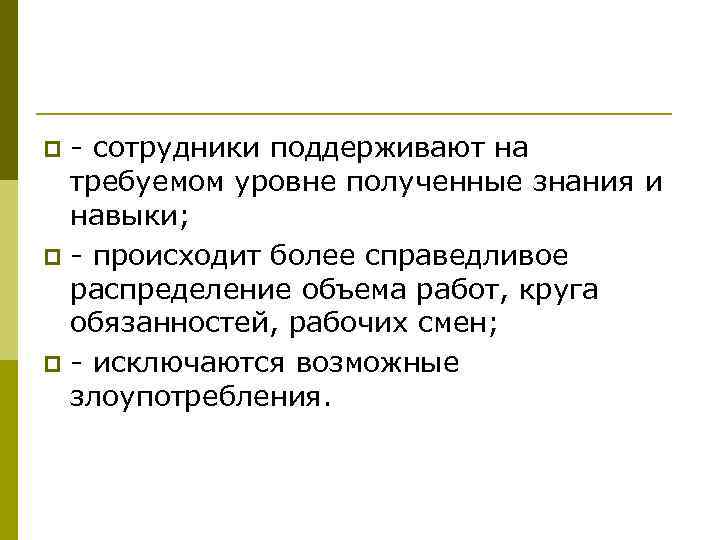 - сотрудники поддерживают на требуемом уровне полученные знания и навыки; p - происходит более справедливое распределение объема работ, круга обязанностей, рабочих смен; p - исключаются возможные злоупотребления. p
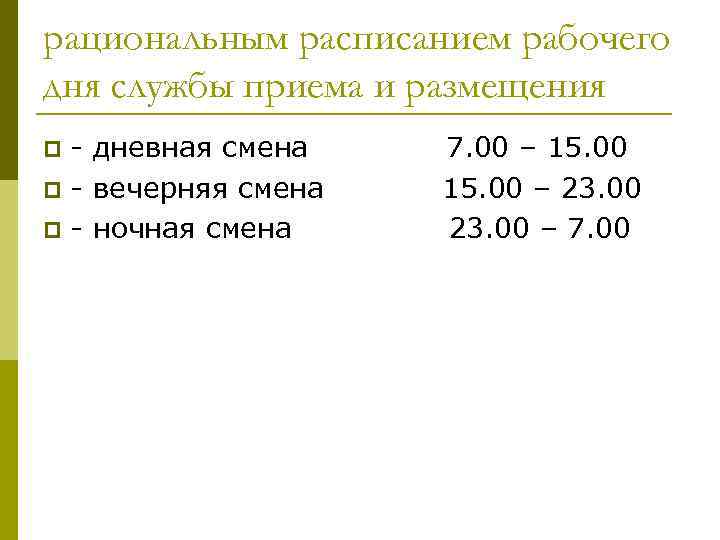 рациональным расписанием рабочего дня службы приема и размещения - дневная смена p - вечерняя смена p - ночная смена p 7. 00 – 15. 00 – 23. 00 – 7. 00
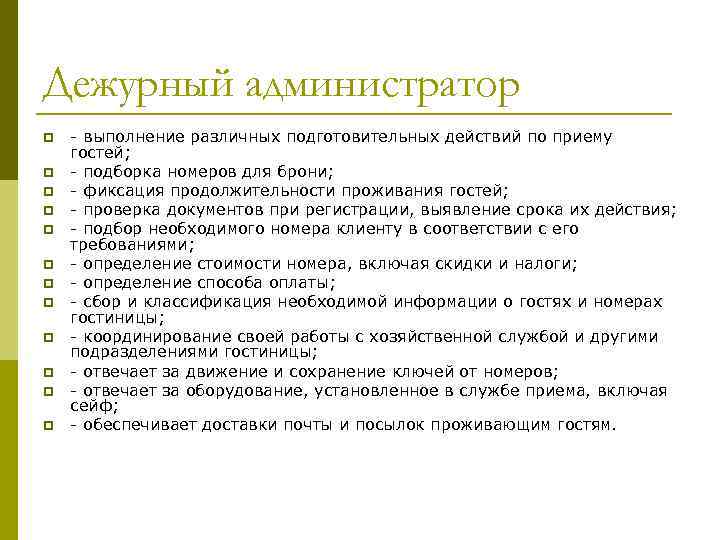 Дежурный администратор p p p - выполнение различных подготовительных действий по приему гостей; - подборка номеров для брони; - фиксация продолжительности проживания гостей; - проверка документов при регистрации, выявление срока их действия; - подбор необходимого номера клиенту в соответствии с его требованиями; - определение стоимости номера, включая скидки и налоги; - определение способа оплаты; - сбор и классификация необходимой информации о гостях и номерах гостиницы; - координирование своей работы с хозяйственной службой и другими подразделениями гостиницы; - отвечает за движение и сохранение ключей от номеров; - отвечает за оборудование, установленное в службе приема, включая сейф; - обеспечивает доставки почты и посылок проживающим гостям.
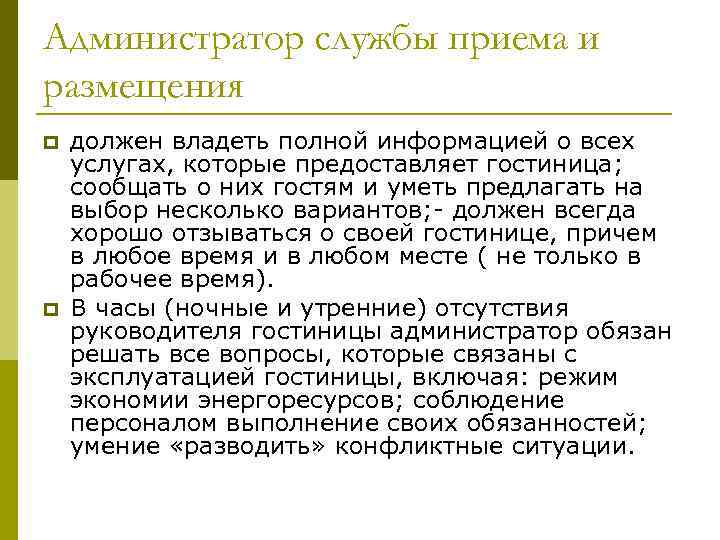 Администратор службы приема и размещения p p должен владеть полной информацией о всех услугах, которые предоставляет гостиница; сообщать о них гостям и уметь предлагать на выбор несколько вариантов; - должен всегда хорошо отзываться о своей гостинице, причем в любое время и в любом месте ( не только в рабочее время). В часы (ночные и утренние) отсутствия руководителя гостиницы администратор обязан решать все вопросы, которые связаны с эксплуатацией гостиницы, включая: режим экономии энергоресурсов; соблюдение персоналом выполнение своих обязанностей; умение «разводить» конфликтные ситуации.
 Руководитель p p p - иметь ( обладать) необходимый объем экономических и коммерческих знаний; - иметь организаторские способности; - обладать объемом знаний по психологии, т. е. хорошо разбираться в людях; - иметь хорошую память на лица; - иметь внутреннюю культуру: быть тактичным, уметь сглаживать, разрешать конфликты; - должен обладать представительной внешностью и уметь уверенно держать себя.
 специфическим обязанностям руководителя службы приема и размещения - возможность обучения и переобучения персонала службы; p - должен владеть знаниями всех стандартов осуществления процедуры приема и размещения; p - должен знать все виды производимых работ и быть готовым ответить на вопросы любого работника и гостя. p
 p Руководитель службы приема и размещения имеет ненормированный рабочий день. Он может задерживаться на работе, вызываться в выходные дни и в любое время, если возникла нестандартная ситуация. Руководитель службы должен быть обеспечен мобильными средствами связи.
 Основные цели и задачи службы приема и размещения p p это предоставление гостям самого высокого качества услуг, а также увеличение процента загрузки гостиницы. работа в сфере гостиничного сервиса (обслуживания) имеет ряд особенностей, практически любая услуга, оказываемая клиенту, требует кооперации нескольких служб и, следовательно, координации действий работников разных специальностей. - большинство массовых профессий в отеле не требуют высокой квалификации от работников. Именно поэтому в зарубежных отелях так много иммигрантов из развивающихся стран, работающих горничными, уборщиками и т. п. ;
 p - работа персонала гостиницы, особенно тех, кто непосредственно контактирует с клиентами, требует умения и желания находить общий язык с самыми разными людьми, поскольку среди постояльцев гостиницы бывают богатые и бедные, молодые и пожилые, спокойные и вспыльчивые, трезвые и пьяные, представители разных специальностей, в том числе и криминальные элементы.
 p - работа отеля – непрерывное производство: отель работает 24 часа в сутки, 365 дней в году. У менеджеров рабочий день, как мы уже отмечали, не нормирован и практически всегда больше 8 часов в день. При этом работа менеджеров высшего уровня отличается высокой долей разговорных контактов и относительно небольшим временем, расходуемым на работу с письмами и документами. Работа менеджеров отличается высокими нервными нагрузками.
 The Structures of the Hotel Industry Two distinct structures frame the operation p and form of the modern hotel: p. Organizational structure p. Physical structure p
 The Organizational Structure • Every hotel, no matter its size and complexity, has an organizational structure that enables it to carry out its daily operations. • Hotels employ a vast number of people with a variety of skills. However, each hotel organizes this diversified workforce in different ways.
 Ownership • Ownership can be rest within an individual, a partnership, a joint venture, a REIT or a public corporation. • Companies that both manage and own hotels can also own and manage other companies, subsidiaries of the parent. • Corporations are favored because investors have limited liability. • Individuals who own shares are not liable for company obligations. The corporate “ person” is the one responsible.
 The General Manager • Coordinating the whole, unifying the specialties, and directing joint efforts is the job of the general manager. • General manager (GM or the GM ) is the favored title at the unit level–the operating hotel. • Standing alone, the title of general manager indicates no ownership interests.
 • The GM is simply the employee most responsible to ownership, corporate or otherwise, and the one person accountable for the full scope of the operation. • Total responsibility for all that happens in every department rests with the GM. • The GM deals either directly with ownership or indirectly through layers of corporate levels and titles.
 • GMs of large organizations have an assistant, the “executive assistant manager. ” • During the period of one person ownership, GM personified their hotels. • Studies of general managers—and GMs are heavily studied—indicate work weeks of up to 65 hours.
 GM salaries are dependent on several criteria: the size of the hotel; the ADR the manager is able to deliver; and the revenue generated by the property. p Manager’s salaries ranging between $50, 000 and $2, 000 per year. p The median salary for general managers is over $125, 000 plus incentives. p
 p p GM has an assistant “ executive assistant manager”, who has one of many “assistants managers. ” Hotel companies support their managers with experts in specialized areas of law, employment, environment, taxes and technology. The food and beverage manager has direct operating responsibilities. At one time, food and beverage accounted for nearly half of hotel revenues industry wide.
 The Hotel ( or Resident ) Manager The Hotel manager, also called the house manager or resident manager. p Large hotels do have resident managers and all the support positions. p Housekeeping; security; rooms; engineering ( repairs and maintenance ); laundry and valet; revenue control; shops, rentals and business centers; concierges; pools and spas are all support positions. p
 The Rooms Manager Reservations, telephone, concierge, and uniformed services are among departments reporting to the rooms manager, as is the front desk. p Room Reservations: Reservations are requests for rooms from prospective guests. p
 Manager of Guest Services One final level of management is needed for our full-service-hotel illustration, the manager of guest services. p Large hotels have assistant managers supporting this position during each shift. p Guest-service managers control the immediate front-office staff, who are pivotal to the rooms department’s assignment. p
 The Building Structure Every hotel offers both guest rooms and the organization to deliver those rooms. But the similarity ends there. p The differences in the physical buildings and the differences in the delivery systems distinguish one property from another. It is these differences that segment the industry into its many parts. p
 D. Hotel Organization Mission Statement Defines the unique purpose that sets one hotel or hotel company apart from others. It expresses the underlying philosophy that gives meaning and direction to hotel policies. A hotel’s mission statement should address the interests of three diverse groups: guests, management, and employees. Objectives Are those ends an organization must achieve to effectively carry out its mission. An objective is more specific than a mission; it calls for levels of achievement which can be observed and measured.
 Goals Define the purpose of a department or division; they direct the actions of managers and employees and the functions of the department or division towards fulfilling the hotel’s mission. Strategies Are the methods a department or division plans to use to achieve its goals. Organizational Chart A schematic representation of the relationships between positions within the organization. It shows where each position fits in the overall organization as well as where divisions of responsibility and lines of authority lie. Solid lines on the chart indicate direct-line accountability. Dotted lines indicate relationships that involve a high degree of cooperation and communication, but not direct reporting relationship.
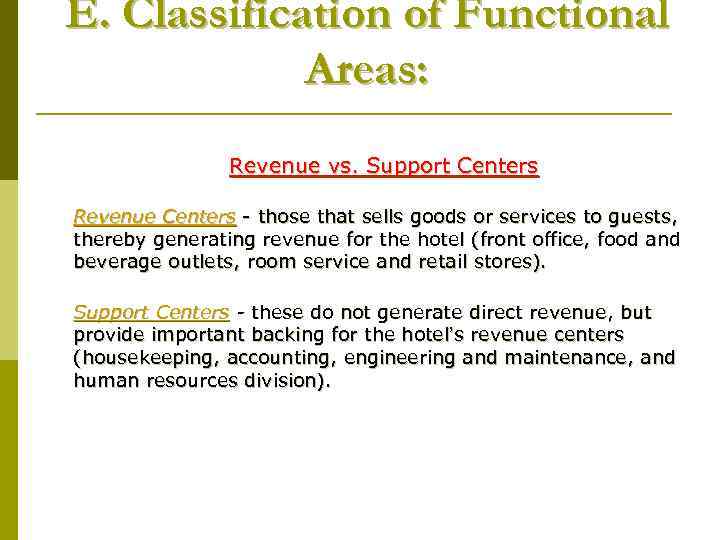 E. Classification of Functional Areas: Revenue vs. Support Centers Revenue Centers - those that sells goods or services to guests, thereby generating revenue for the hotel (front office, food and beverage outlets, room service and retail stores). Support Centers - these do not generate direct revenue, but provide important backing for the hotel’s revenue centers (housekeeping, accounting, engineering and maintenance, and human resources division).
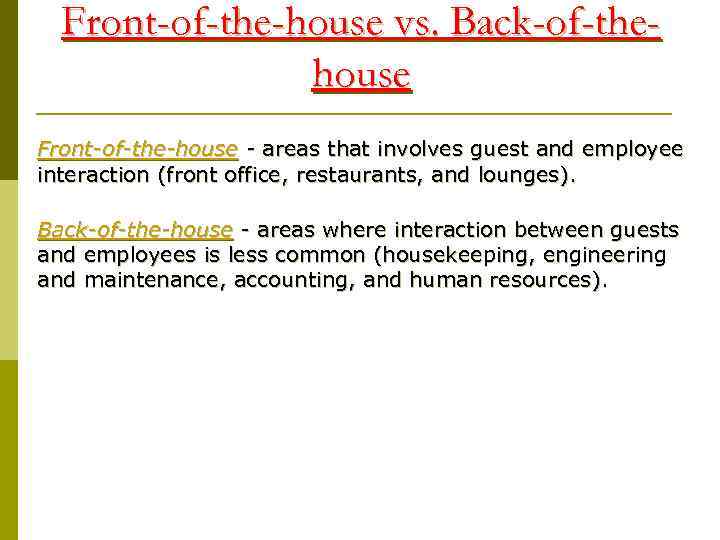 Front-of-the-house vs. Back-of-thehouse Front-of-the-house - areas that involves guest and employee interaction (front office, restaurants, and lounges). Back-of-the-house - areas where interaction between guests and employees is less common (housekeeping, engineering and maintenance, accounting, and human resources).
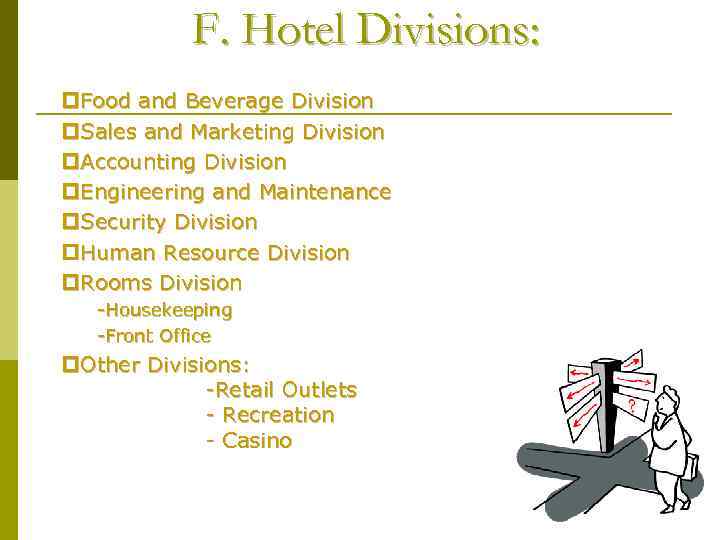 F. Hotel Divisions: p. Food and Beverage Division p. Sales and Marketing Division p. Accounting Division p. Engineering and Maintenance p. Security Division p. Human Resource Division p. Rooms Division -Housekeeping -Front Office p. Other Divisions: -Retail Outlets - Recreation - Casino
 The Building Structure Every hotel offers both guest rooms and the organization to deliver those rooms. But the similarity ends there. p The differences in the physical buildings and the differences in the delivery systems distinguish one property from another. It is these differences that segment the industry into its many parts.
 The Old versus The New The Old: Inside Rooms are enclosed by wings of the building. The view is downward toward the roof on the lower floor, which is often dirty and unsightly. p The New: Suites and All-Suites are very nice, some have luxurious accommodations include kitchens and formal dining rooms, saunas or swimming pools, and even libraries.
 Corner Rooms: are the most desirable rooms on the floor. p Motor Inns: is a child of the motel.
 Numbering for Identification The floor number comes first followed by the room number. Americans number the first sleeping floor as floor one regardless of the number of intervening levels between it and the ground. Numbering rooms is more arbitrary than numbering floors. Each hotel is architecturally unique.
 Room Shape and Size Room shape is architecturally driven; room size is a financial/ marketing decision. p Interior room shapes result from the design (concave, square, round) of the hotel. p Balconies are often part of a façade that adds interest to the outside of a building. p The 12 -foot or 13 -foot width is upped to 16 feet, a luxury-sized room.
 Bed and Bad The Bed: p ◦ The modern American hotel room has gone through periods which favored, first, the double bed and then twin beds. p p p ◦ Americans are getting bigger. The queen and king beds have taken over.
 Bed Sizes and symbol: ◦ Single Bed: symbol S, sleeps a person. When the room is furnished with one twin, the symbol S is used, when furnished with a double bed, the symbol is D. p Twin Beds: A twin room, symbol T, contains two beds each accommodating one person. p Double Bed: Symbol D p
 ◦Queen and King Beds: symbol Q and K. Although designed for two; three or four persons might squeeze in when the room is taken as a family room. p ◦Hollywood Bed ( Two beds joined by a common headboard ): using the symbol of the twins, T, since that’s what they are. p ◦Studio Bed ( Room ): is a sofa by day and a bed by night. This is not popular anymore. Symbol UP “ undersized parlor. ” p
 Sleigh Bed: Any bed can be a sleigh bed, so named because of the sleigh-like shape of the headboard and footboard. p ◦Daybed: like studio beds except they are additions to the hotel room rather than basic furnishings. p ◦Sofa Bed: is similar in function to a studio bed. p ◦Rollaway Bed ( Cot ): is a portable utility bed added to the usual room furnishings. p
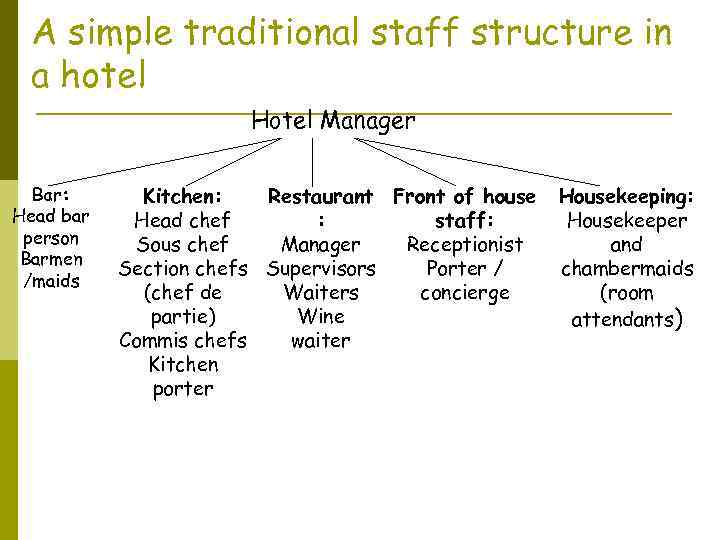 A simple traditional staff structure in a hotel Hotel Manager Bar: Head bar person Barmen /maids Kitchen: Restaurant Front of house Head chef : staff: Sous chef Manager Receptionist Section chefs Supervisors Porter / (chef de Waiters concierge partie) Wine Commis chefs waiter Kitchen porter Housekeeping: Housekeeper and chambermaids (room attendants)
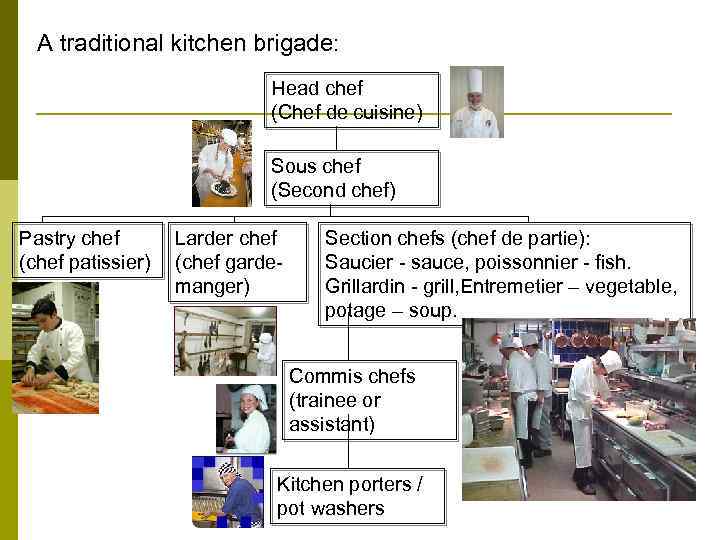 A traditional kitchen brigade: Head chef (Chef de cuisine) Sous chef (Second chef) Pastry chef (chef patissier) Larder chef (chef gardemanger) Section chefs (chef de partie): Saucier - sauce, poissonnier - fish. Grillardin - grill, Entremetier – vegetable, potage – soup. Commis chefs (trainee or assistant) Kitchen porters / pot washers
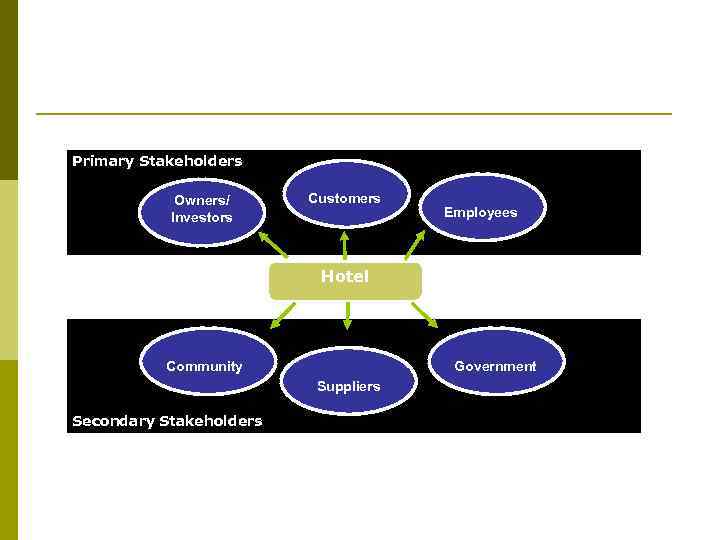 Stakeholders Primary Stakeholders Owners/ Investors Customers Employees Hotel Community Government Suppliers Secondary Stakeholders
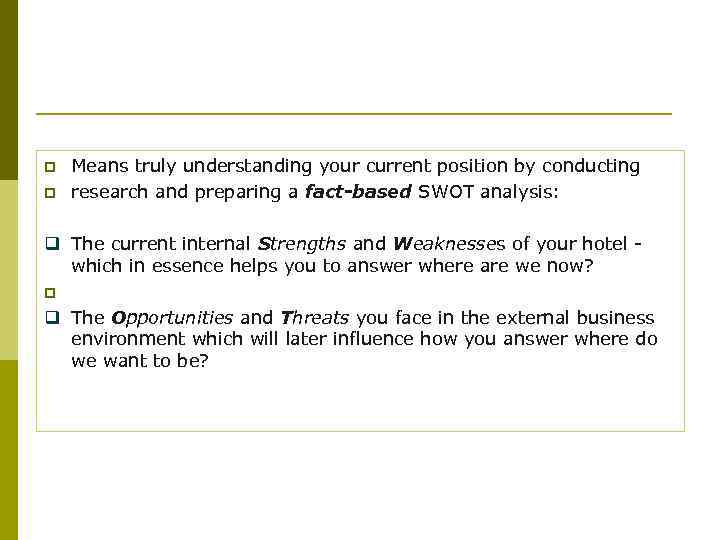 Where are we now? p p Means truly understanding your current position by conducting research and preparing a fact-based SWOT analysis: q The current internal Strengths and Weaknesses of your hotel which in essence helps you to answer where are we now? p q The Opportunities and Threats you face in the external business environment which will later influence how you answer where do we want to be?
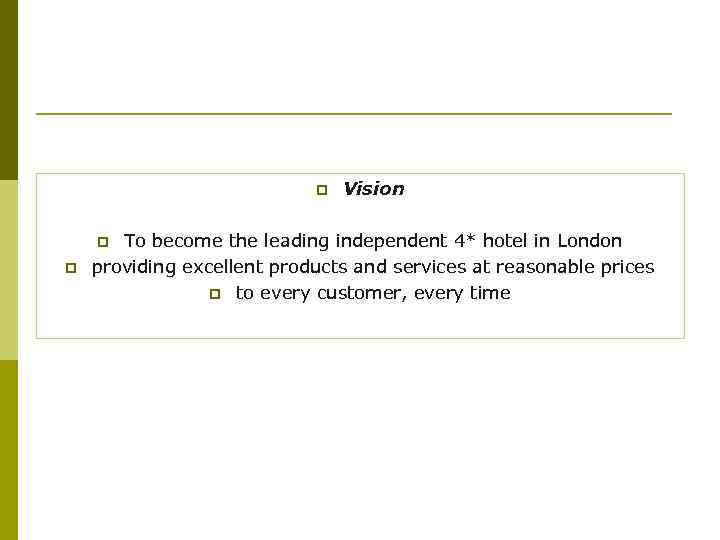 Vision p To become the leading independent 4* hotel in London providing excellent products and services at reasonable prices p to every customer, every time p p Vision
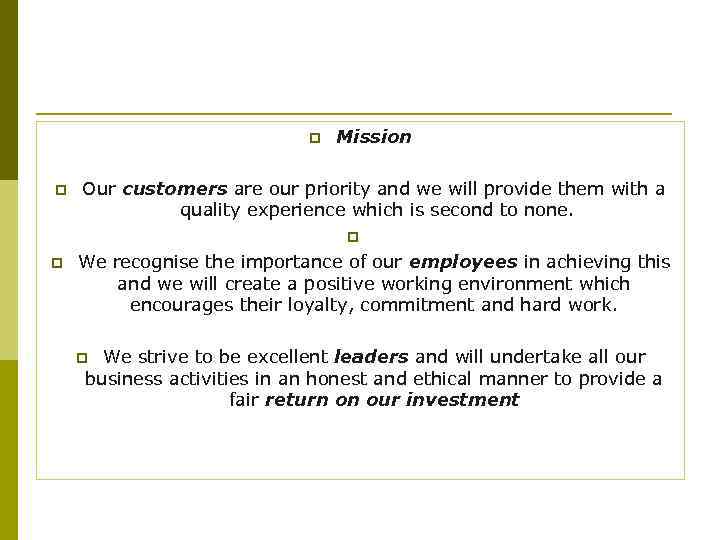 Mission p p Mission Our customers are our priority and we will provide them with a quality experience which is second to none. p p We recognise the importance of our employees in achieving this and we will create a positive working environment which encourages their loyalty, commitment and hard work. We strive to be excellent leaders and will undertake all our business activities in an honest and ethical manner to provide a fair return on our investment p
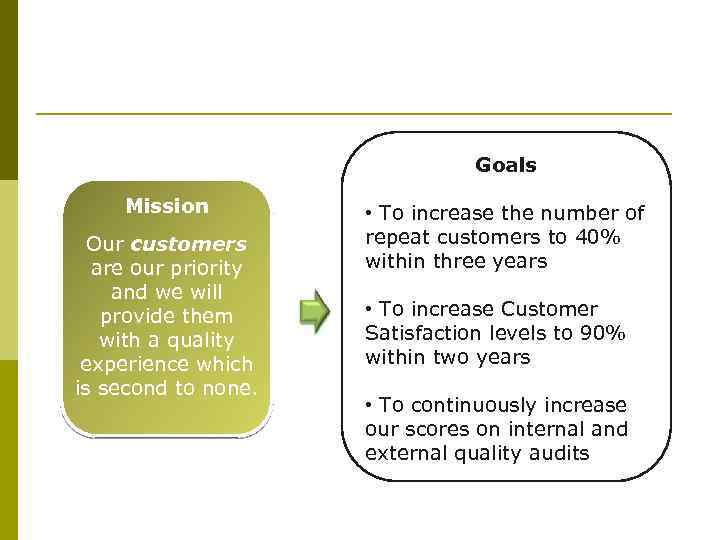 From Mission to Goals Mission Our customers are our priority and we will provide them with a quality experience which is second to none. • To increase the number of repeat customers to 40% within three years • To increase Customer Satisfaction levels to 90% within two years • To continuously increase our scores on internal and external quality audits
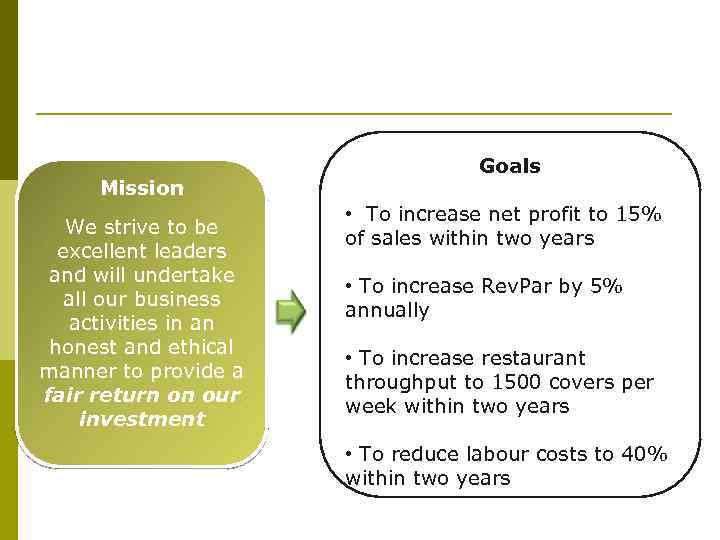 From Mission to Goals Mission We strive to be excellent leaders and will undertake all our business activities in an honest and ethical manner to provide a fair return on our investment Goals • To increase net profit to 15% of sales within two years • To increase Rev. Par by 5% annually • To increase restaurant throughput to 1500 covers per week within two years • To reduce labour costs to 40% within two years
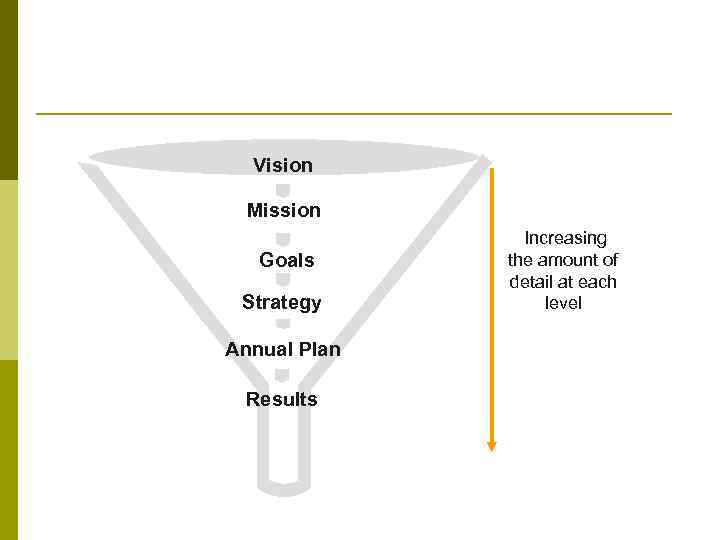 Funnel Approach Vision Mission Goals Strategy Annual Plan Results Increasing the amount of detail at each level
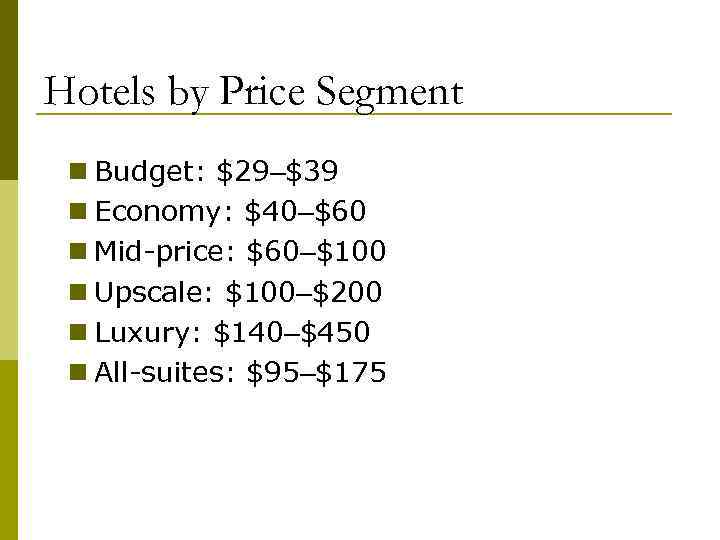 Hotels by Price Segment n Budget: $29–$39 n Economy: $40–$60 n Mid-price: $60–$100 n Upscale: $100–$200 n Luxury: $140–$450 n All-suites: $95–$175
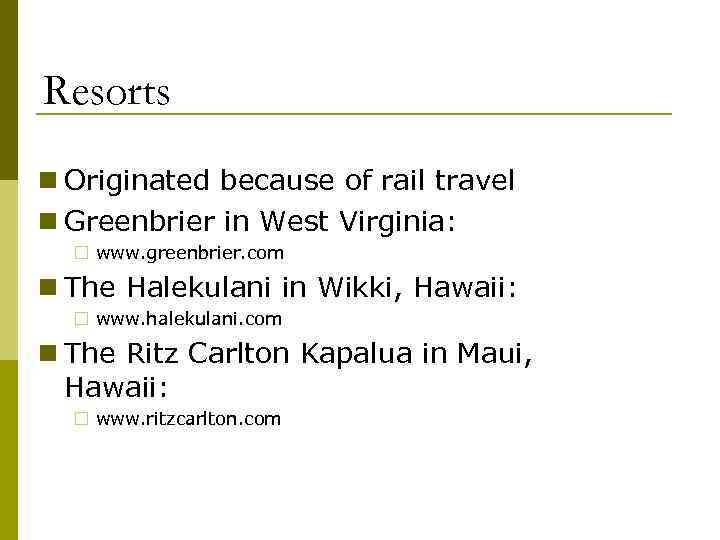 Resorts n Originated because of rail travel n Greenbrier in West Virginia: ¨ www. greenbrier. com n The Halekulani in Wikki, Hawaii: ¨ www. halekulani. com n The Ritz Carlton Kapalua in Maui, Hawaii: ¨ www. ritzcarlton. com
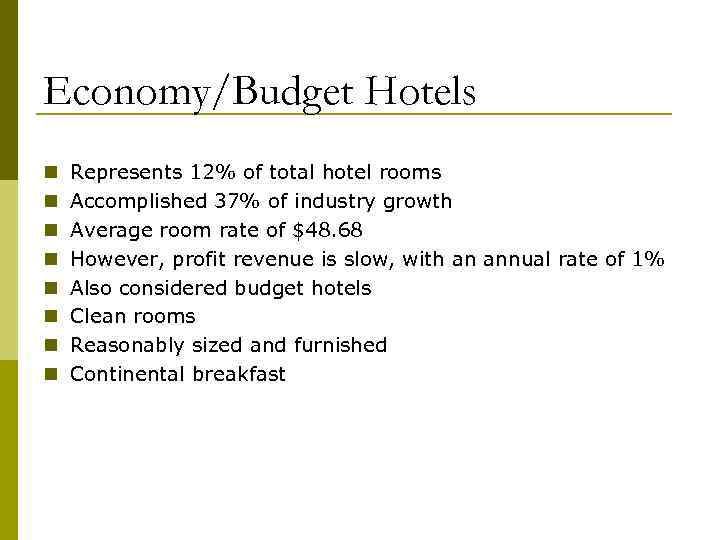 Economy/Budget Hotels n n n n Represents 12% of total hotel rooms Accomplished 37% of industry growth Average room rate of $48. 68 However, profit revenue is slow, with an annual rate of 1% Also considered budget hotels Clean rooms Reasonably sized and furnished Continental breakfast
 All-Suite n n Cater to guests for an extended period Reduction in rate based on length of stay More space than typical hotel Example: ¨ Embassy Suites (www. embassy-suites. com)
 Vertical Integration n Lodging companies meeting the needs of several types of guests based on price, facilities, and amenities n Choice hotels that have several chains that meet their diverse clientele: n n Luxury: Clarion Mid-scale: Quality Inn/Suites Budget: Comfort Inn Economy: Sleep Inn n www. hotelchoice. com
 The Best Hotels n Some previous winners: ¨ Oriental Hotel in Bangkok, Thailand ¨ Regent of Hong Kong ¨ Bel-Air of Los Angeles
 Unusual Hotels n Ice Hotel in Swedish Lapland n The Treetops Hotel in Kenya n Underwater Hotel in Australia n Capsule Hotel in Japan n The Burj Al Arab in Dubai
 Trends n n n n Capacity control Safety and security Assets and capital Technology New management Globalization Consolidation Gaming n Diversification within segments n Rapid growth in vacation ownership n Increase in number of spas and treatments offered n Increase in development of multi-use hotels
 Functions of a Hotel n Lodging accommodations n Revenue centers n Cost centers n Serve and enrich society n Profit for the owners
 Role of a General Manager n Chief Operating Officer (COO) n Ensuring highest level of associate and guest service n Overseeing and coordinating operations n Increasing profitability
 Qualities of Successful Hospitality Leaders n Leadership n Attention to detail n Follow-through n People skills n Patience n Ability to delegate effectively
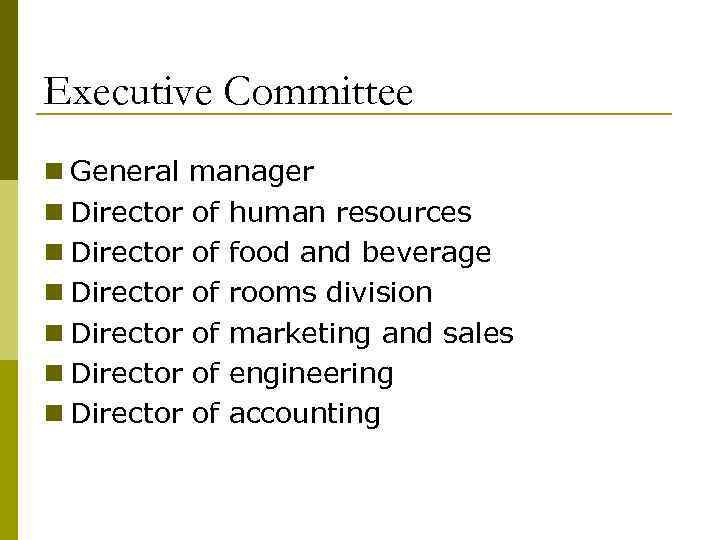 Executive Committee n General manager n Director of human resources n Director of food and beverage n Director of rooms division n Director of marketing and sales n Director of engineering n Director of accounting
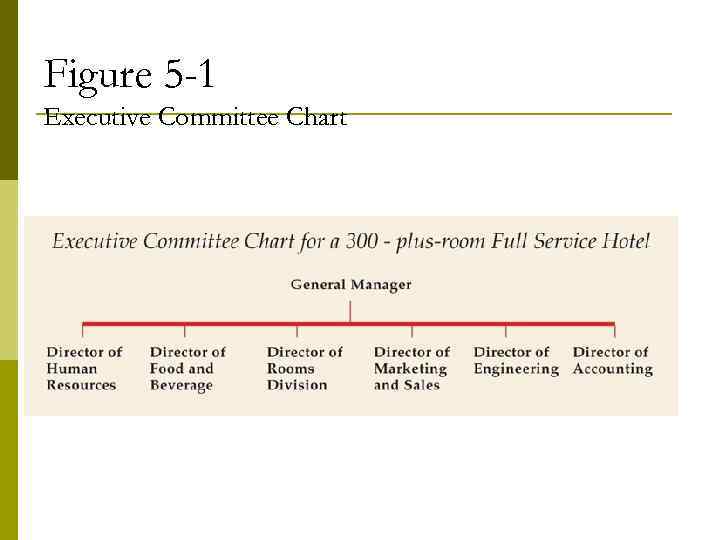 Figure 5 -1 Executive Committee Chart
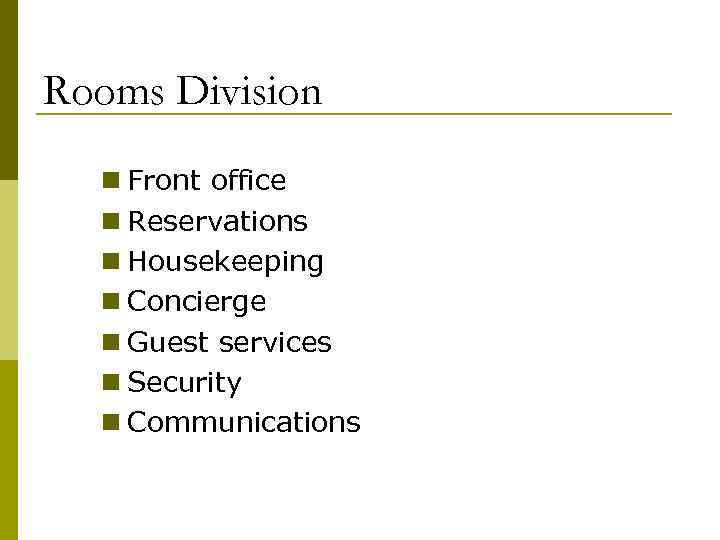 Rooms Division n Front office n Reservations n Housekeeping n Concierge n Guest services n Security n Communications
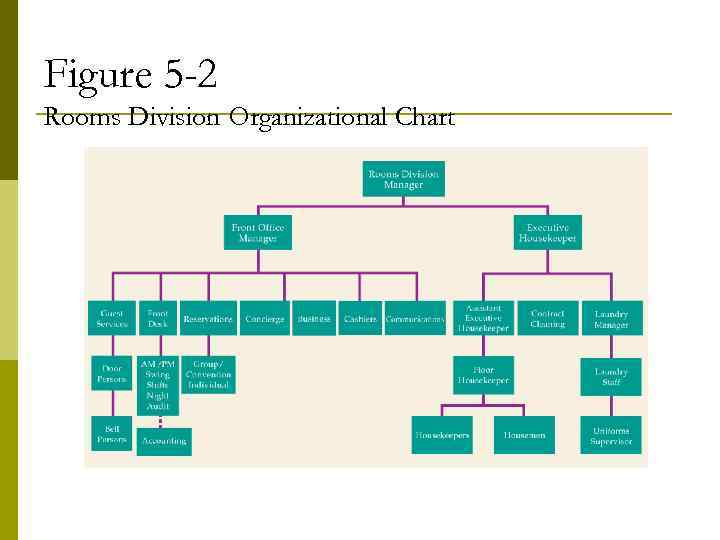 Figure 5 -2 Rooms Division Organizational Chart
 Front Office Manager (FOM) n Enhance guest services n Ensure the desired percentage of each market segment is achieved n Make and exceed budget forecasts
 Basic Functions of the Front Office n n n n Review previous night’s occupancy/ADR Review arrivals/departures/VIP rooms Staffing adjustments/scheduling Look over market mix Meet with lead GSAs Sell rooms Maintain balanced guest accounts Offer services such as faxes, mail, messages, etc.
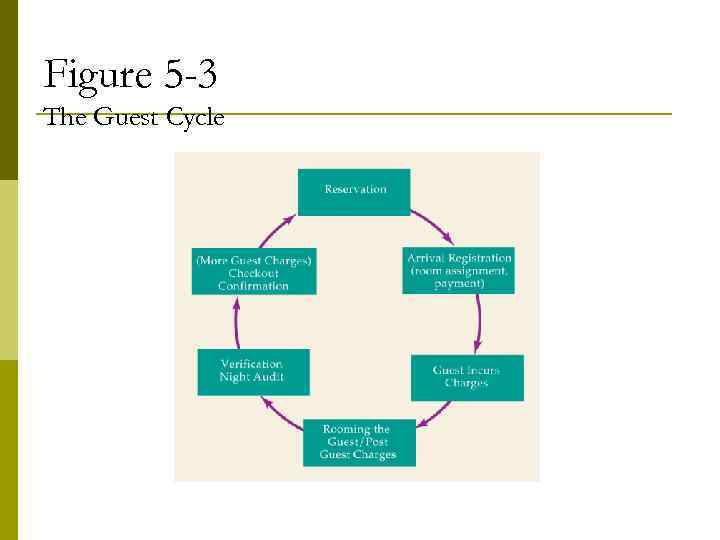 Figure 5 -3 The Guest Cycle
 Night Auditor n Posts charges n Closes the books on a daily basis n Balances guest accounts n Completes daily report
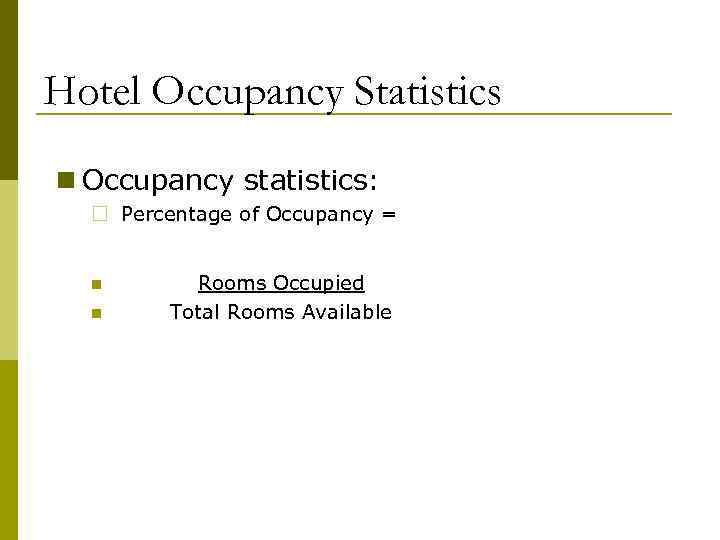 Hotel Occupancy Statistics n Occupancy statistics: ¨ Percentage of Occupancy = n n Rooms Occupied Total Rooms Available
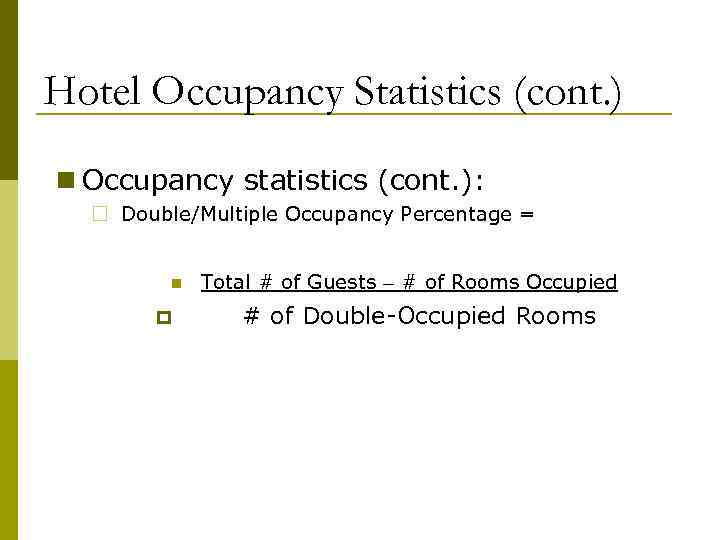 Hotel Occupancy Statistics (cont. ) n Occupancy statistics (cont. ): ¨ Double/Multiple Occupancy Percentage = n p Total # of Guests – # of Rooms Occupied # of Double-Occupied Rooms
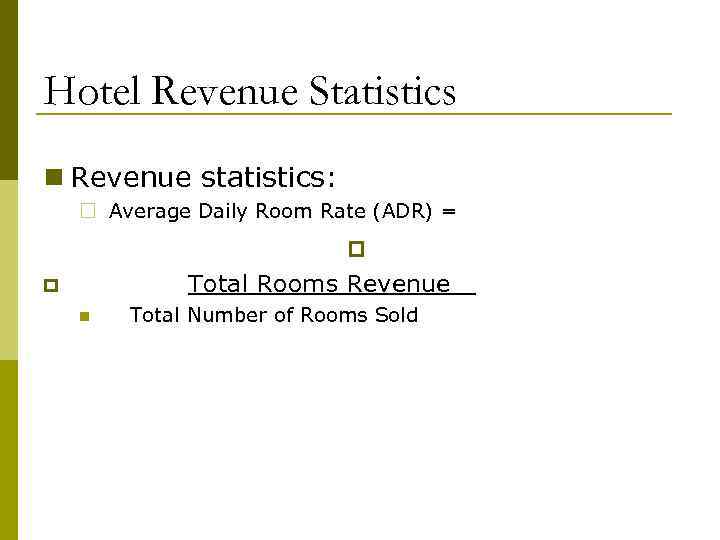 Hotel Revenue Statistics n Revenue statistics: ¨ Average Daily Room Rate (ADR) = p Total Rooms Revenue p n Total Number of Rooms Sold
 Reservations n Internet n First area of guest contact n A sales position n Telephone skills n Central Reservations System (CRS)
 Reservation Definitions n Confirmed reservation n Guaranteed reservation n Advance deposit/advance payment n No show n 6 PM release
 Guest Services Uniformed Service n Bell captain or guest services manager n Door attendants: ¨ Hotel’s unofficial greeters n Bell persons: ¨ Escort guests to their rooms ¨ Transport luggage p
 Concierge n Part of guest/uniformed services n Elevate properties’ marketable value n Typically in a luxury hotel n Unique requests n Knowledge of city n Ability to speak several languages preferred
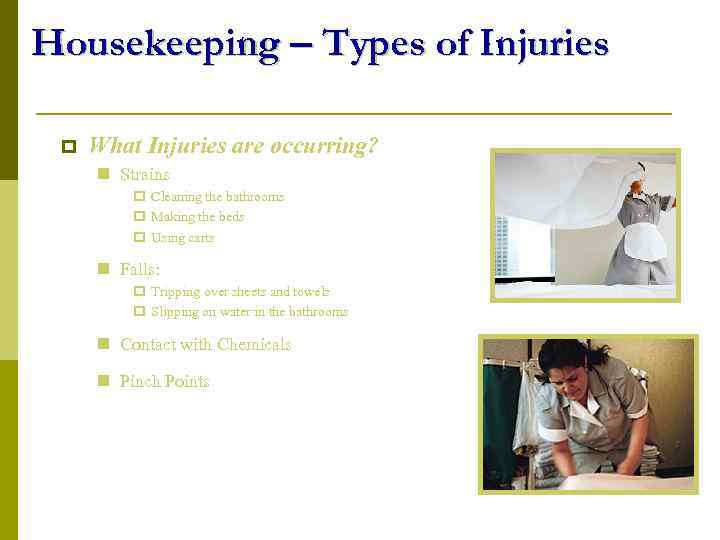 Housekeeping – Types of Injuries p What Injuries are occurring? n Strains p Cleaning the bathrooms p Making the beds p Using carts n Falls: p Tripping over sheets and towels p Slipping on water in the bathrooms n Contact with Chemicals n Pinch Points
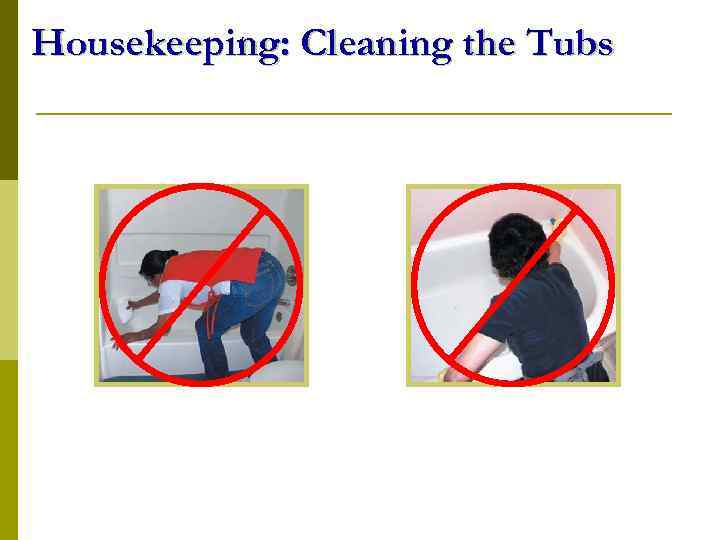 Housekeeping: Cleaning the Tubs
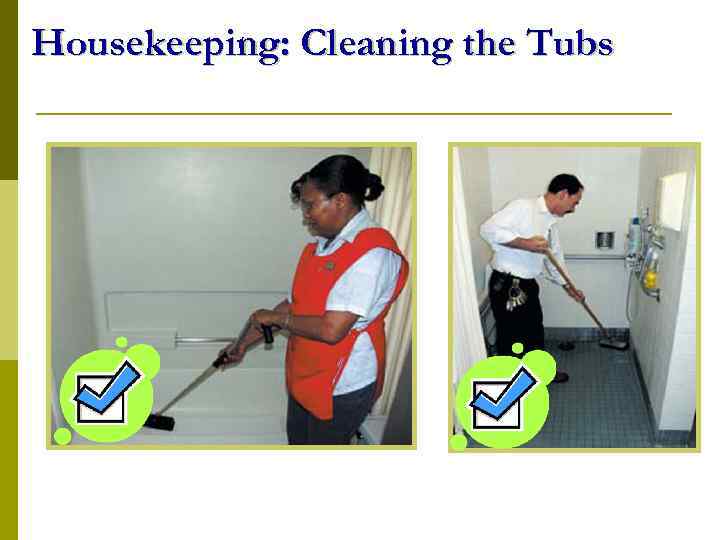 Housekeeping: Cleaning the Tubs
 Housekeeping: Cleaning Tile Walls
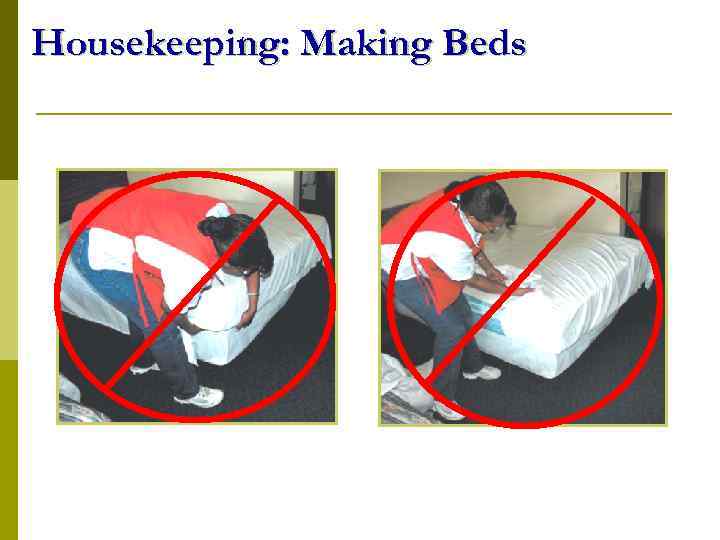 Housekeeping: Making Beds
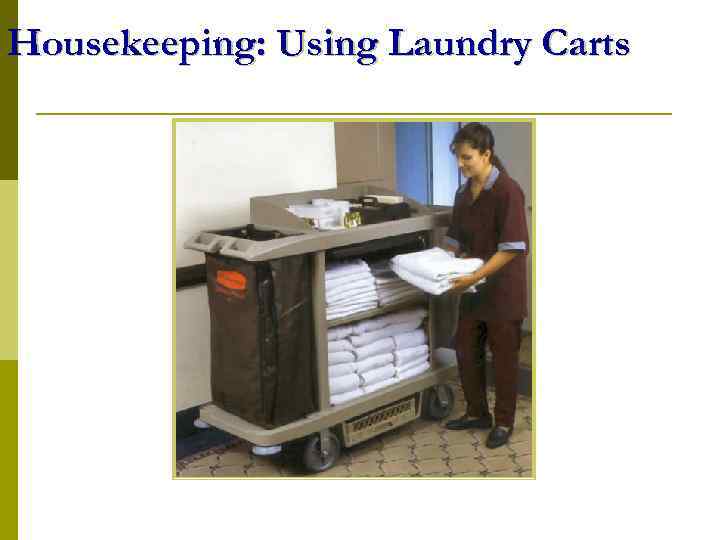 Housekeeping: Using Laundry Carts
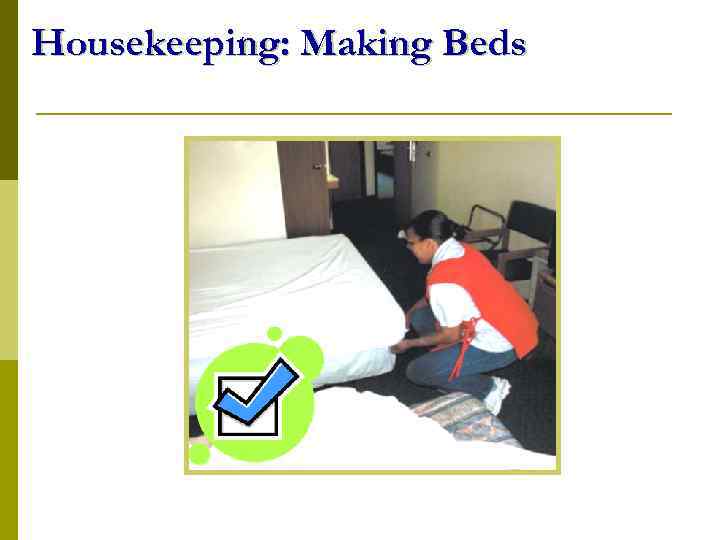 Housekeeping: Making Beds
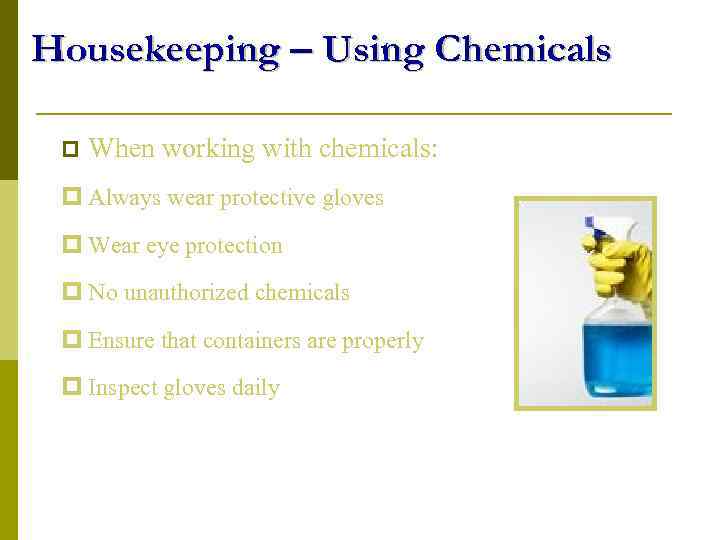 Housekeeping – Using Chemicals p When working with chemicals: p Always wear protective gloves p Wear eye protection p No unauthorized chemicals p Ensure that containers are properly p Inspect gloves daily closed
 Housekeeping – Using Chemicals p When working with chemicals: n Tell your employer if you experience any irritation or allergy from gloves you have used. n Never mix cleaning chemicals. n When diluting always add the concentrated liquid to water, not the water to the concentrate.
 Housekeeping: Cleaning Tile Walls
 Технология услуг размещения 3. 1. Классификация средств размещения: отечественный и зарубежный опыт. 3. 2. Основной технологический процесс производства гостиничных услуг – прием и размещение. 3. 3. Основной технологический процесс потребления гостиничных услуг. Клининговые технологии. Технология ведения бельевого хозяйства. 3. 4. Технология гостеприимства: технологическая, гуманитарная и коммерческая концепции.