


 Скачать презентацию Organic Hoophouse Fertility Challenges Anu Rangarajan Cornell University
8190babddf2bd53f444e60fd118eb37e.ppt
- Количество слайдов: 19
 Organic Hoophouse Fertility Challenges Anu Rangarajan Cornell University Dept. of Horticulture
 Unique factors important to managing hoophouses l Season extension = Longer season l l l l unheated Producing during ‘off-season’ Longer period requiring fertility Minimum rotation or rest periods Highly diverse crop mix Intensive management to maximize profit per square foot Water efficiency high
 Unique challenges related to Hoophouse Fertility l Nitrate accumulation in winter grown greens l Salt buildup in soils l Soil pests- Garden symphyllan- similar plant symptoms to salt damage
 Fertility Approaches l Add compost to build soil OM levels to 10 - 15% l Add additional minerals, based on soil tests l Occasionally incorporate green manures and cover crops l Particularly prior to establishing a hoophouse site l Liquid feeds and sidedressing with other nutrient sources
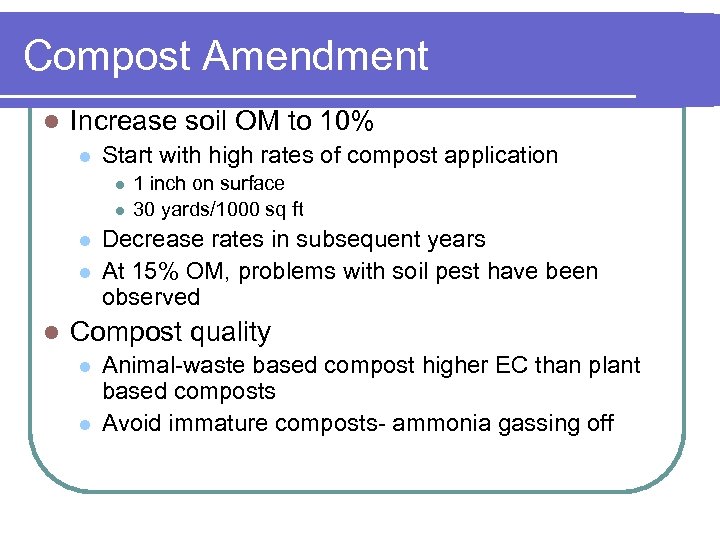 Compost Amendment l Increase soil OM to 10% l Start with high rates of compost application l l l 1 inch on surface 30 yards/1000 sq ft Decrease rates in subsequent years At 15% OM, problems with soil pest have been observed Compost quality l l Animal-waste based compost higher EC than plant based composts Avoid immature composts- ammonia gassing off
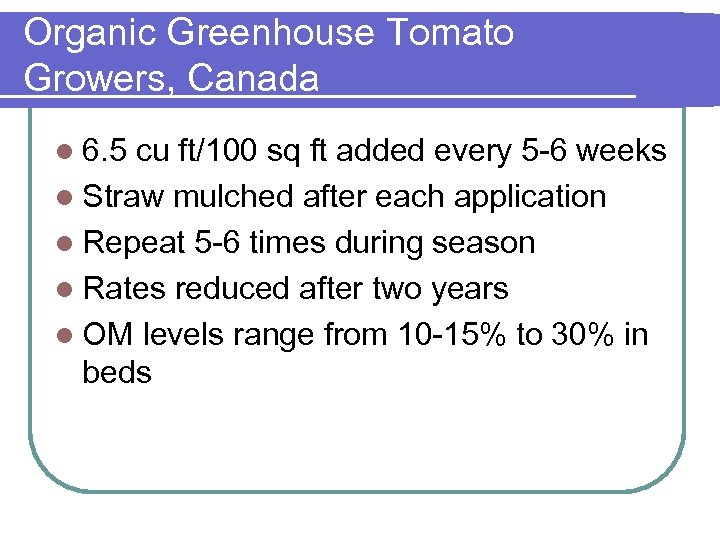 Organic Greenhouse Tomato Growers, Canada l 6. 5 cu ft/100 sq ft added every 5 -6 weeks l Straw mulched after each application l Repeat 5 -6 times during season l Rates reduced after two years l OM levels range from 10 -15% to 30% in beds
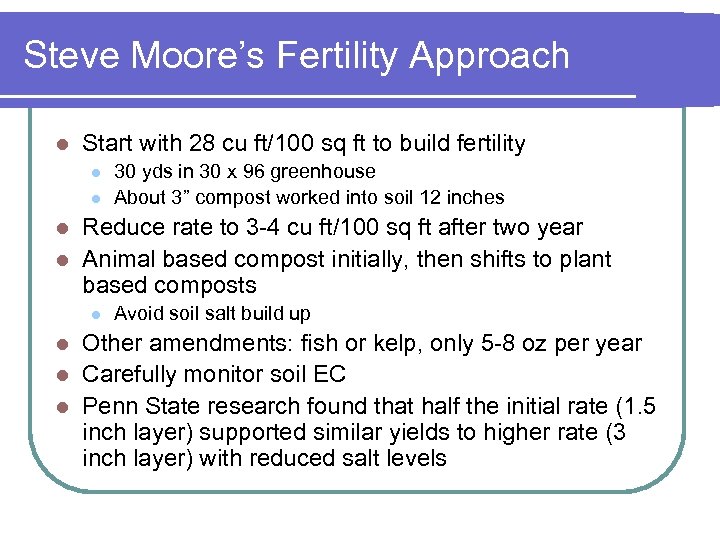 Steve Moore’s Fertility Approach l Start with 28 cu ft/100 sq ft to build fertility l l 30 yds in 30 x 96 greenhouse About 3” compost worked into soil 12 inches Reduce rate to 3 -4 cu ft/100 sq ft after two year l Animal based compost initially, then shifts to plant based composts l l Avoid soil salt build up Other amendments: fish or kelp, only 5 -8 oz per year l Carefully monitor soil EC l Penn State research found that half the initial rate (1. 5 inch layer) supported similar yields to higher rate (3 inch layer) with reduced salt levels l
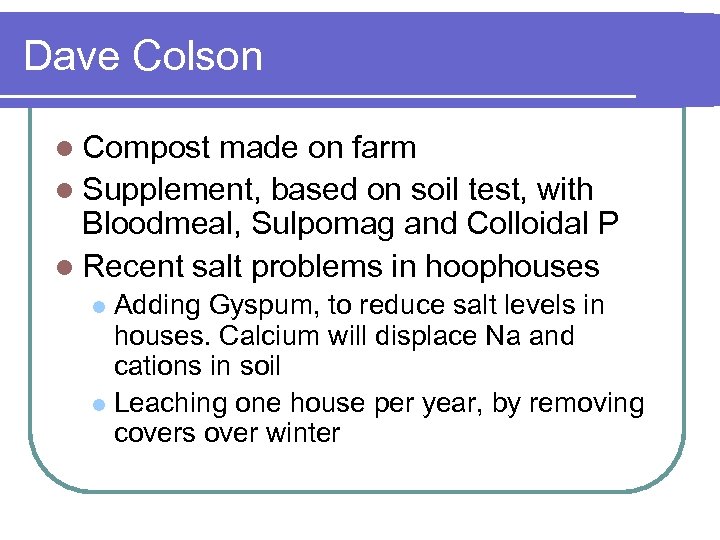 Dave Colson l Compost made on farm l Supplement, based on soil test, with Bloodmeal, Sulpomag and Colloidal P l Recent salt problems in hoophouses Adding Gyspum, to reduce salt levels in houses. Calcium will displace Na and cations in soil l Leaching one house per year, by removing covers over winter l
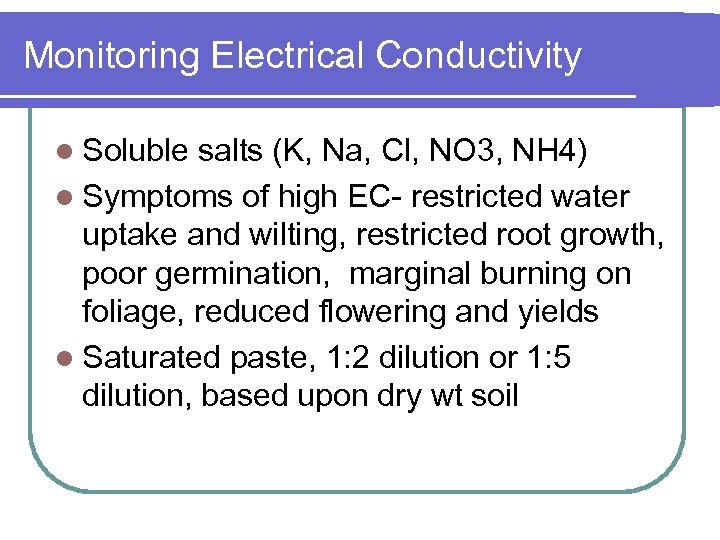 Monitoring Electrical Conductivity l Soluble salts (K, Na, Cl, NO 3, NH 4) l Symptoms of high EC- restricted water uptake and wilting, restricted root growth, poor germination, marginal burning on foliage, reduced flowering and yields l Saturated paste, 1: 2 dilution or 1: 5 dilution, based upon dry wt soil
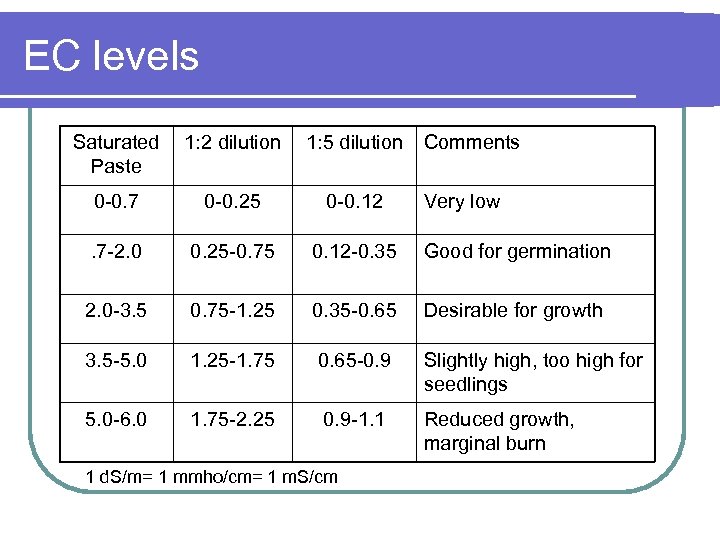 EC levels Saturated Paste 1: 2 dilution 1: 5 dilution 0 -0. 7 0 -0. 25 0 -0. 12 . 7 -2. 0 0. 25 -0. 75 0. 12 -0. 35 Good for germination 2. 0 -3. 5 0. 75 -1. 25 0. 35 -0. 65 Desirable for growth 3. 5 -5. 0 1. 25 -1. 75 0. 65 -0. 9 Slightly high, too high for seedlings 5. 0 -6. 0 1. 75 -2. 25 0. 9 -1. 1 Reduced growth, marginal burn 1 d. S/m= 1 mmho/cm= 1 m. S/cm Comments Very low
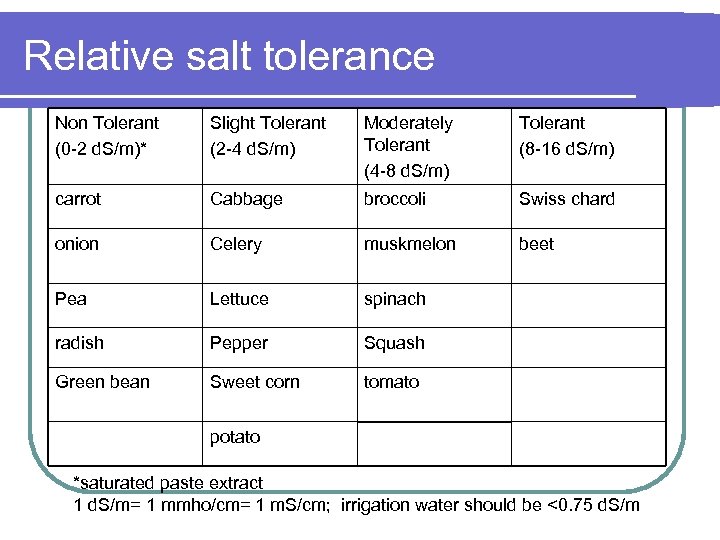 Relative salt tolerance Non Tolerant (0 -2 d. S/m)* Slight Tolerant (2 -4 d. S/m) Moderately Tolerant (4 -8 d. S/m) Tolerant (8 -16 d. S/m) carrot Cabbage broccoli Swiss chard onion Celery muskmelon beet Pea Lettuce spinach radish Pepper Squash Green bean Sweet corn tomato potato *saturated paste extract 1 d. S/m= 1 mmho/cm= 1 m. S/cm; irrigation water should be <0. 75 d. S/m
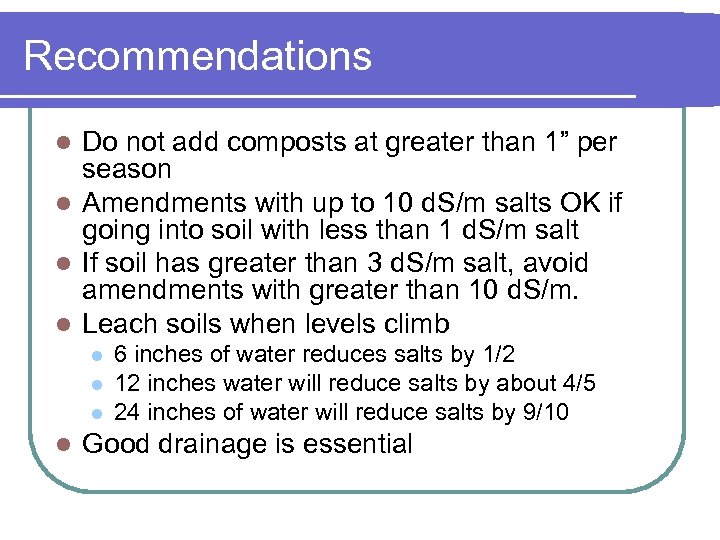 Recommendations Do not add composts at greater than 1” per season l Amendments with up to 10 d. S/m salts OK if going into soil with less than 1 d. S/m salt l If soil has greater than 3 d. S/m salt, avoid amendments with greater than 10 d. S/m. l Leach soils when levels climb l l l 6 inches of water reduces salts by 1/2 12 inches water will reduce salts by about 4/5 24 inches of water will reduce salts by 9/10 Good drainage is essential
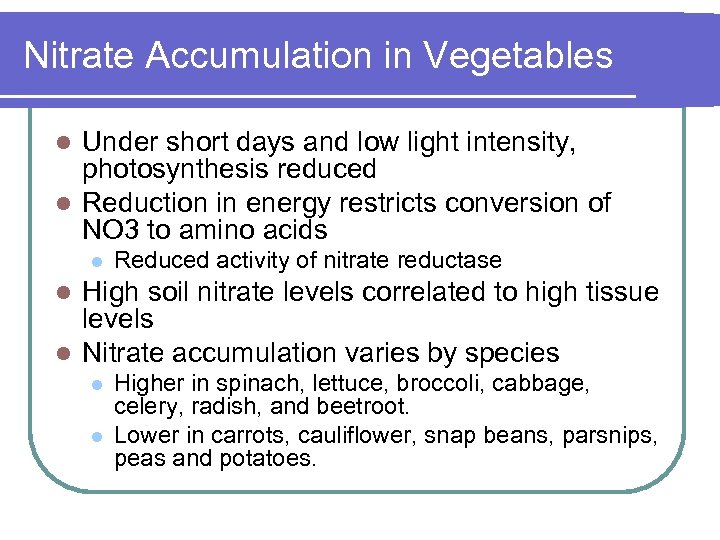 Nitrate Accumulation in Vegetables Under short days and low light intensity, photosynthesis reduced l Reduction in energy restricts conversion of NO 3 to amino acids l l Reduced activity of nitrate reductase High soil nitrate levels correlated to high tissue levels l Nitrate accumulation varies by species l l l Higher in spinach, lettuce, broccoli, cabbage, celery, radish, and beetroot. Lower in carrots, cauliflower, snap beans, parsnips, peas and potatoes.
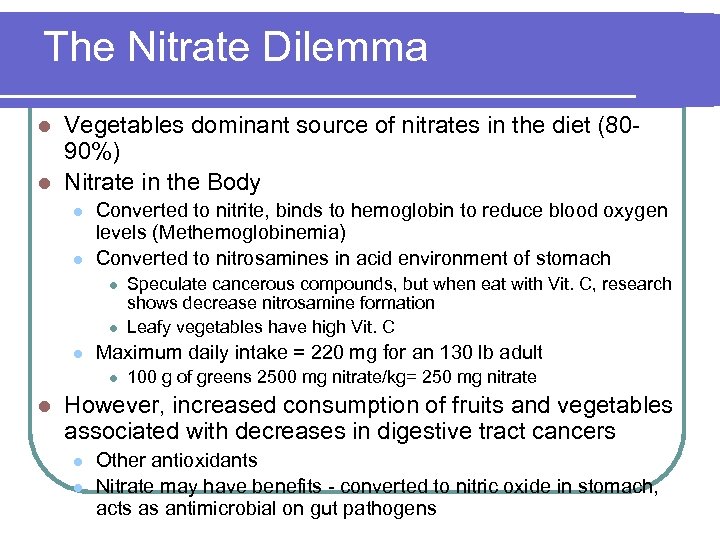 The Nitrate Dilemma Vegetables dominant source of nitrates in the diet (8090%) l Nitrate in the Body l l l Converted to nitrite, binds to hemoglobin to reduce blood oxygen levels (Methemoglobinemia) Converted to nitrosamines in acid environment of stomach l l l Maximum daily intake = 220 mg for an 130 lb adult l l Speculate cancerous compounds, but when eat with Vit. C, research shows decrease nitrosamine formation Leafy vegetables have high Vit. C 100 g of greens 2500 mg nitrate/kg= 250 mg nitrate However, increased consumption of fruits and vegetables associated with decreases in digestive tract cancers l l Other antioxidants Nitrate may have benefits - converted to nitric oxide in stomach, acts as antimicrobial on gut pathogens
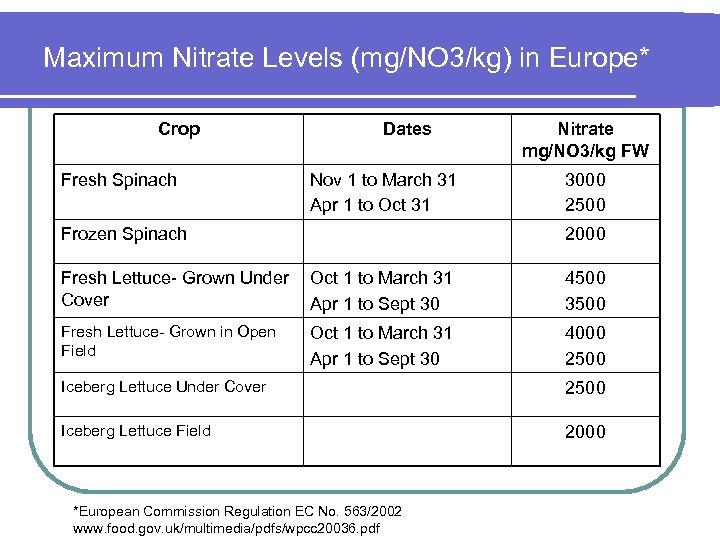 Maximum Nitrate Levels (mg/NO 3/kg) in Europe* Crop Fresh Spinach Dates Nov 1 to March 31 Apr 1 to Oct 31 Frozen Spinach Nitrate mg/NO 3/kg FW 3000 2500 2000 Fresh Lettuce- Grown Under Cover Oct 1 to March 31 Apr 1 to Sept 30 4500 3500 Fresh Lettuce- Grown in Open Field Oct 1 to March 31 Apr 1 to Sept 30 4000 2500 Iceberg Lettuce Under Cover 2500 Iceberg Lettuce Field 2000 *European Commission Regulation EC No. 563/2002 www. food. gov. uk/multimedia/pdfs/wpcc 20036. pdf
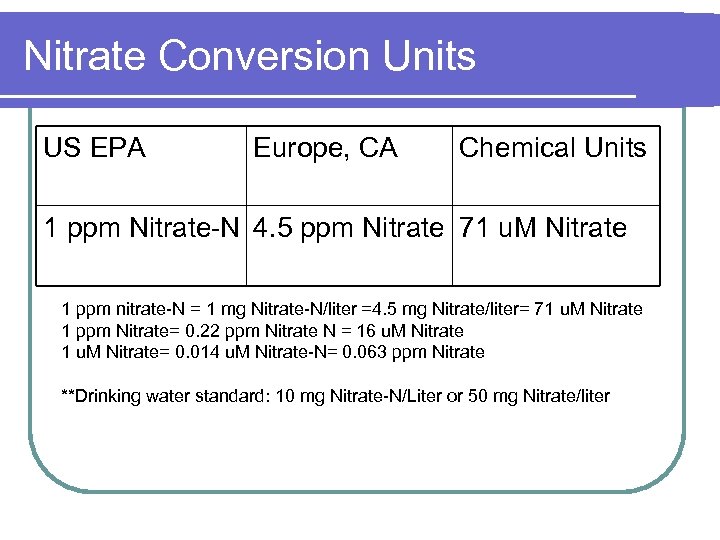 Nitrate Conversion Units US EPA Europe, CA Chemical Units 1 ppm Nitrate-N 4. 5 ppm Nitrate 71 u. M Nitrate 1 ppm nitrate-N = 1 mg Nitrate-N/liter =4. 5 mg Nitrate/liter= 71 u. M Nitrate 1 ppm Nitrate= 0. 22 ppm Nitrate N = 16 u. M Nitrate 1 u. M Nitrate= 0. 014 u. M Nitrate-N= 0. 063 ppm Nitrate **Drinking water standard: 10 mg Nitrate-N/Liter or 50 mg Nitrate/liter
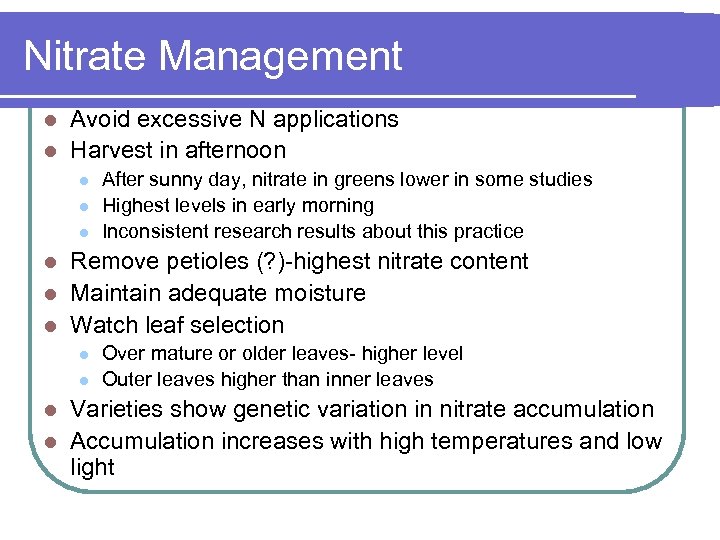 Nitrate Management Avoid excessive N applications l Harvest in afternoon l l After sunny day, nitrate in greens lower in some studies Highest levels in early morning Inconsistent research results about this practice Remove petioles (? )-highest nitrate content l Maintain adequate moisture l Watch leaf selection l l l Over mature or older leaves- higher level Outer leaves higher than inner leaves Varieties show genetic variation in nitrate accumulation l Accumulation increases with high temperatures and low light l
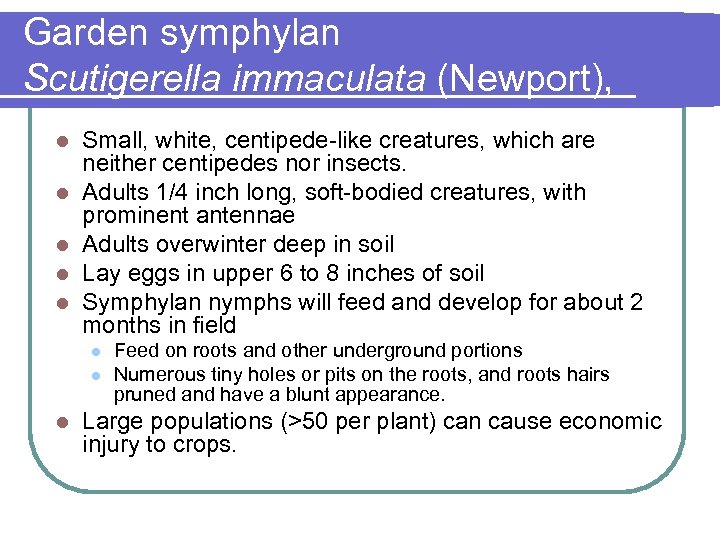 Garden symphylan Scutigerella immaculata (Newport), l l l Small, white, centipede-like creatures, which are neither centipedes nor insects. Adults 1/4 inch long, soft-bodied creatures, with prominent antennae Adults overwinter deep in soil Lay eggs in upper 6 to 8 inches of soil Symphylan nymphs will feed and develop for about 2 months in field l l l Feed on roots and other underground portions Numerous tiny holes or pits on the roots, and roots hairs pruned and have a blunt appearance. Large populations (>50 per plant) can cause economic injury to crops.
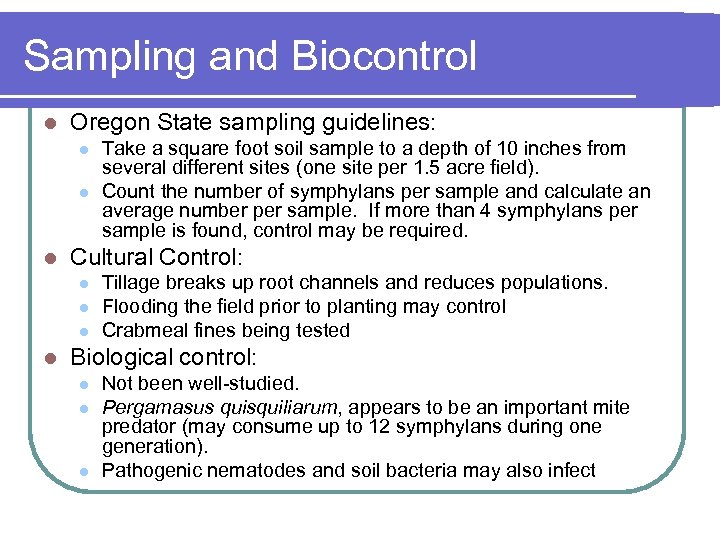 Sampling and Biocontrol l Oregon State sampling guidelines: l l l Cultural Control: l l Take a square foot soil sample to a depth of 10 inches from several different sites (one site per 1. 5 acre field). Count the number of symphylans per sample and calculate an average number per sample. If more than 4 symphylans per sample is found, control may be required. Tillage breaks up root channels and reduces populations. Flooding the field prior to planting may control Crabmeal fines being tested Biological control: l l l Not been well-studied. Pergamasus quisquiliarum, appears to be an important mite predator (may consume up to 12 symphylans during one generation). Pathogenic nematodes and soil bacteria may also infect