


 Скачать презентацию Organic Chemistry Aromatic Compounds Arenes compounds containing
OrgChem_Arenes_Final.ppt
- Количество слайдов: 87
 Organic Chemistry Aromatic Compounds
 Arenes: compounds containing both aliphatic and aromatic parts. Alkylbenzenes Alkenylbenzenes Alkynylbenzenes Etc. Emphasis on the effect that one part has on the chemistry of the other half. Reactivity & orientation 2
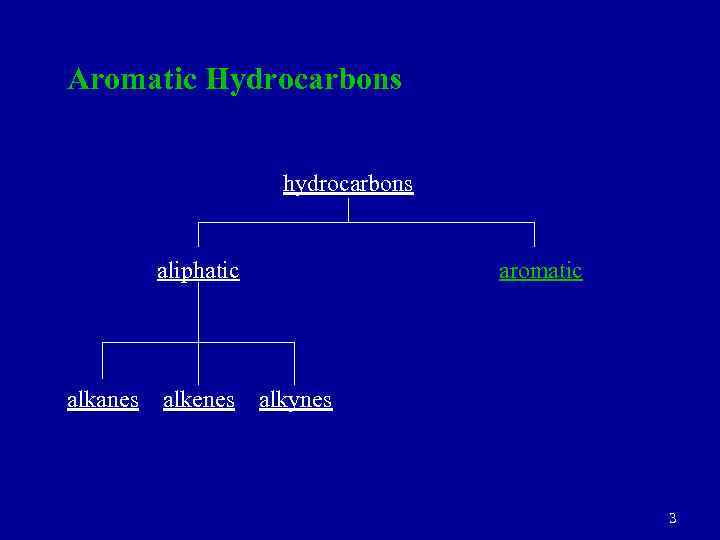 Aromatic Hydrocarbons hydrocarbons aliphatic alkanes alkenes aromatic alkynes 3
 Aliphatic compounds: open-chain compounds and ring compounds that are chemically similar to open-chain compounds. Alkanes, alkenes, alkynes, dienes, alicyclics, etc. Aromatic compounds: unsaturated ring compounds that are far more stable than they should be and resist the addition reactions typical of unsaturated aliphatic compounds. Benzene and related compounds. 4
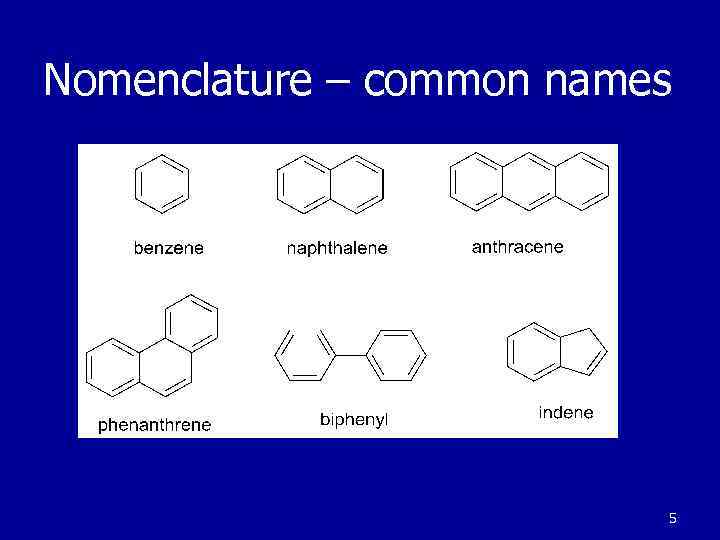 Nomenclature – common names 5
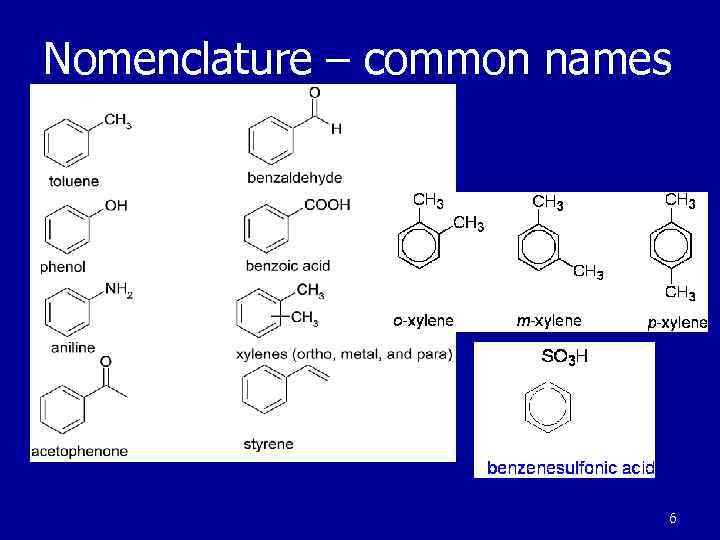 Nomenclature – common names 6
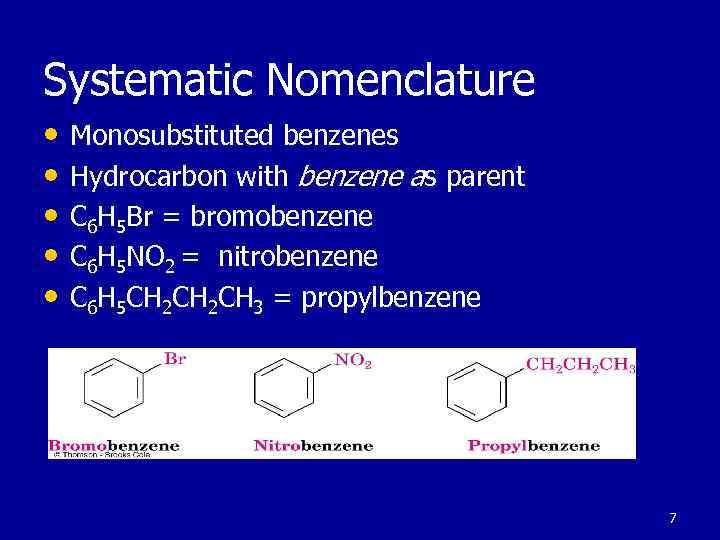 Systematic Nomenclature • Monosubstituted benzenes • Hydrocarbon with benzene as parent • C 6 H 5 Br = bromobenzene • C 6 H 5 NO 2 = nitrobenzene • C 6 H 5 CH 2 CH 3 = propylbenzene 7
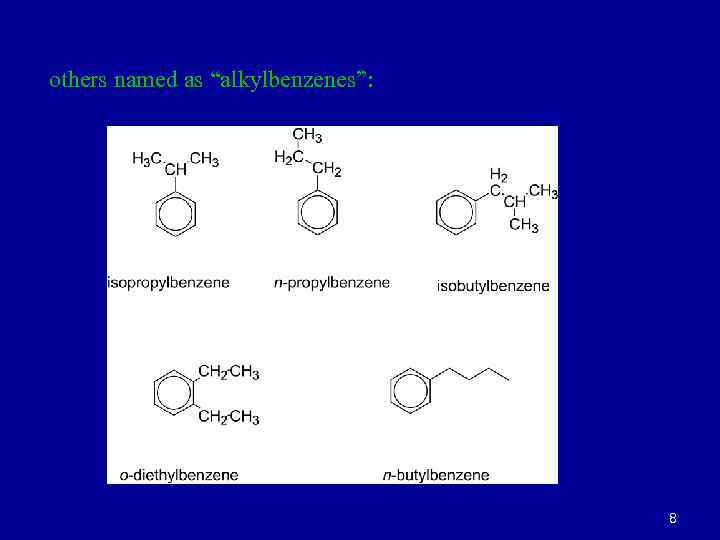 others named as “alkylbenzenes”: 8
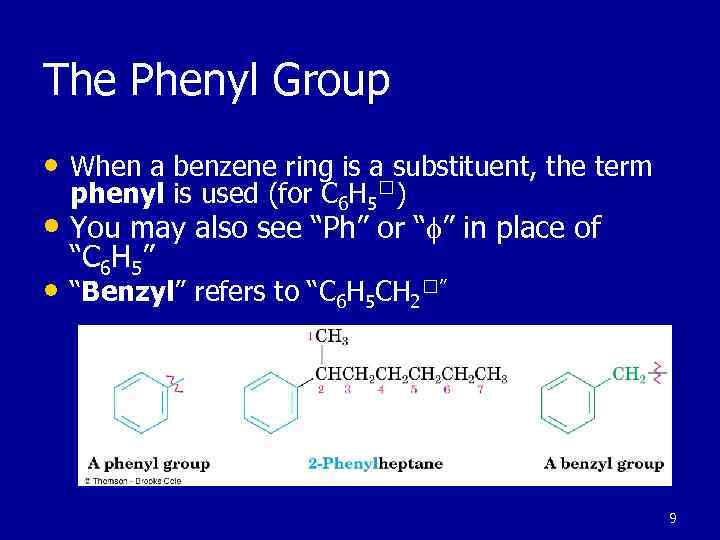 The Phenyl Group • When a benzene ring is a substituent, the term phenyl is used (for C 6 H 5 ) • You may also see “Ph” or “f” in place of “C 6 H 5” • “Benzyl” refers to “C 6 H 5 CH 2 ” 9
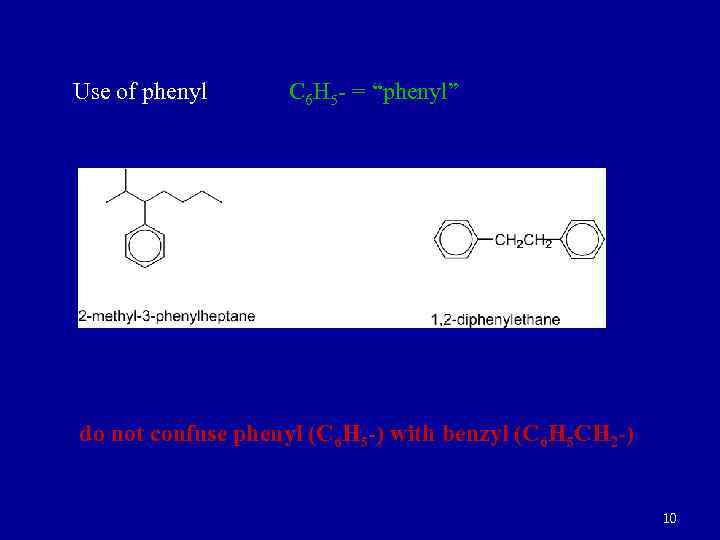 Use of phenyl C 6 H 5 - = “phenyl” do not confuse phenyl (C 6 H 5 -) with benzyl (C 6 H 5 CH 2 -) 10
 Nomenclature: Side Chains • If side chain has < 6 carbons – Alkyl benzene • If side chain has > 6 carbons – Phenyl alkane 11
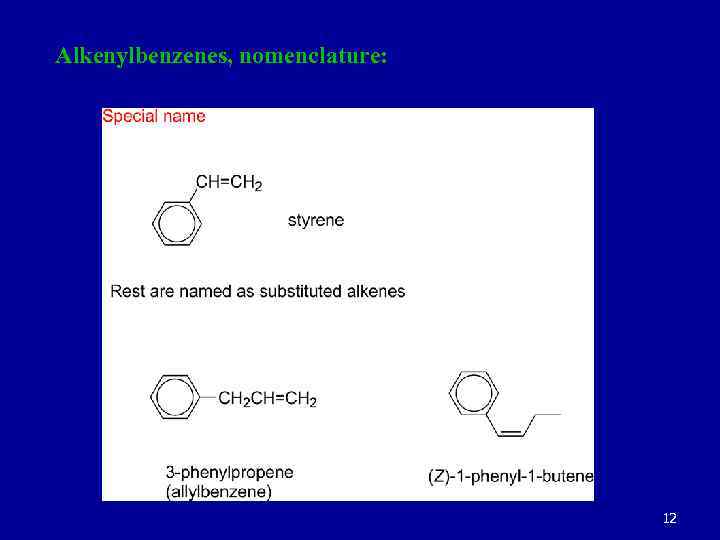 Alkenylbenzenes, nomenclature: 12
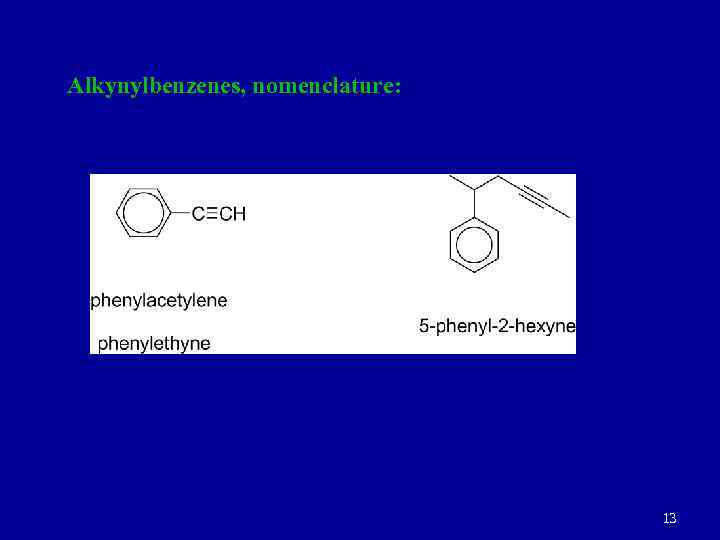 Alkynylbenzenes, nomenclature: 13
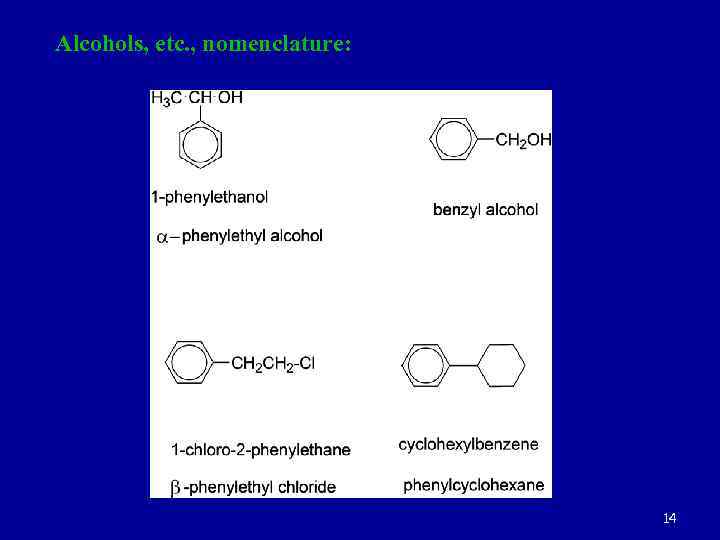 Alcohols, etc. , nomenclature: 14
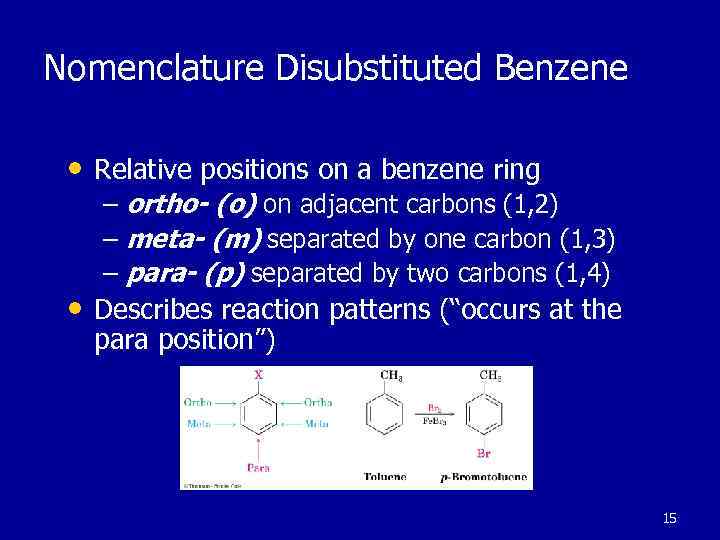 Nomenclature Disubstituted Benzene • Relative positions on a benzene ring – ortho- (o) on adjacent carbons (1, 2) – meta- (m) separated by one carbon (1, 3) – para- (p) separated by two carbons (1, 4) • Describes reaction patterns (“occurs at the para position”) 15
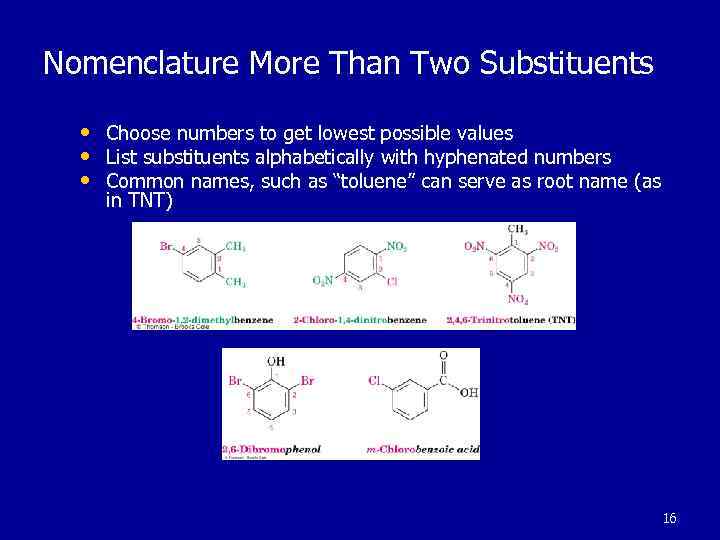 Nomenclature More Than Two Substituents • • • Choose numbers to get lowest possible values List substituents alphabetically with hyphenated numbers Common names, such as “toluene” can serve as root name (as in TNT) 16
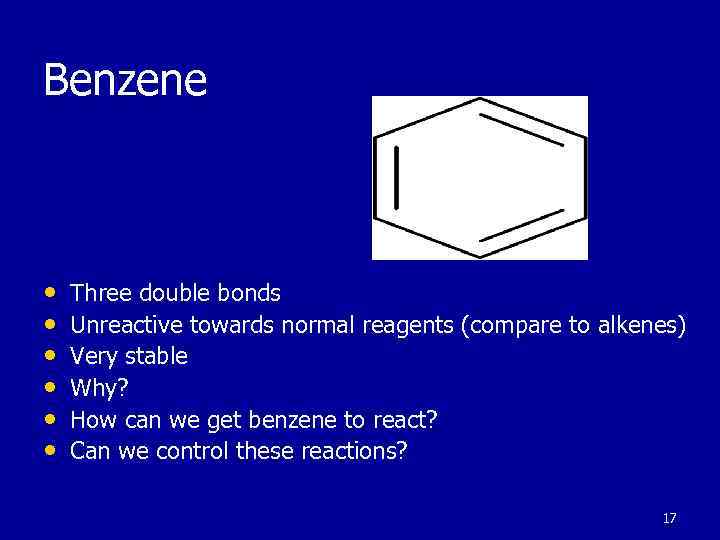 Benzene • • • Three double bonds Unreactive towards normal reagents (compare to alkenes) Very stable Why? How can we get benzene to react? Can we control these reactions? 17
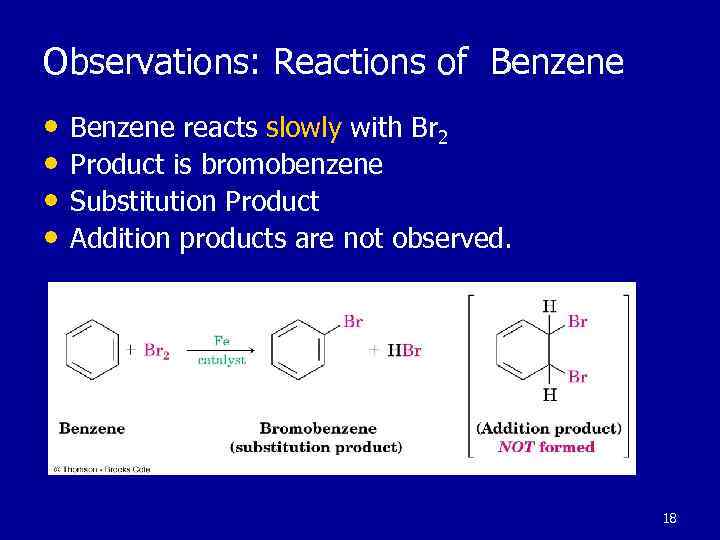 Observations: Reactions of Benzene • Benzene reacts slowly with Br 2 • Product is bromobenzene • Substitution Product • Addition products are not observed. 18
 Stability of Benzene • KMn. O 4 – Reacts with alkenes – No reaction with benzene • HCl – Reacts with alkenes – No reaction with benzene • HBr – Reacts with alkenes – No reaction with benzene 19
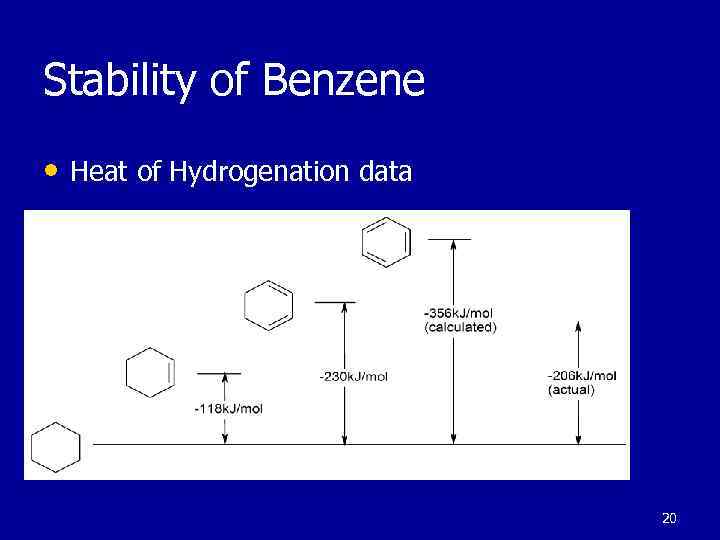 Stability of Benzene • Heat of Hydrogenation data 20
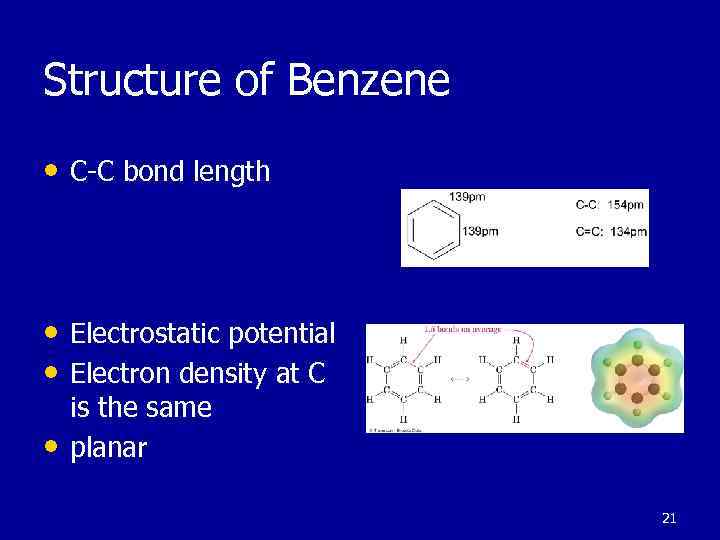 Structure of Benzene • C-C bond length • Electrostatic potential • Electron density at C • is the same planar 21
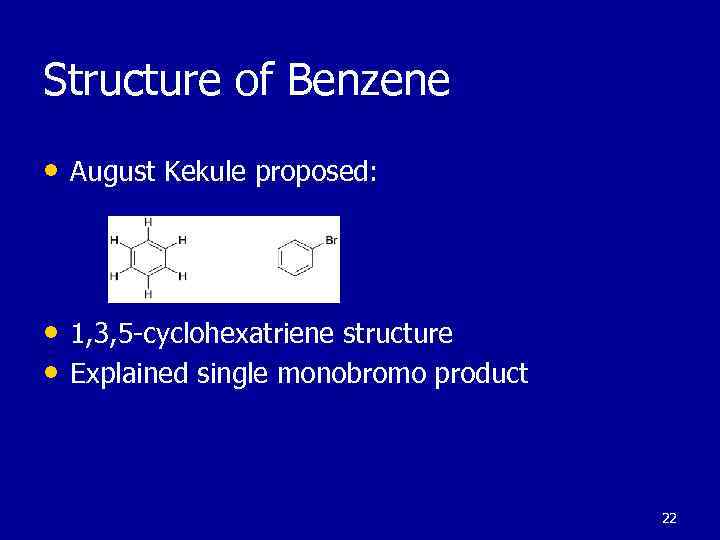 Structure of Benzene • August Kekule proposed: • 1, 3, 5 -cyclohexatriene structure • Explained single monobromo product 22
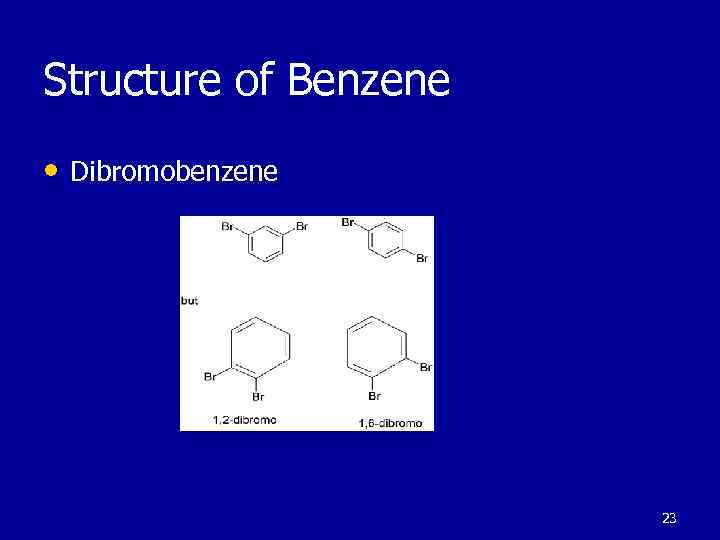 Structure of Benzene • Dibromobenzene 23
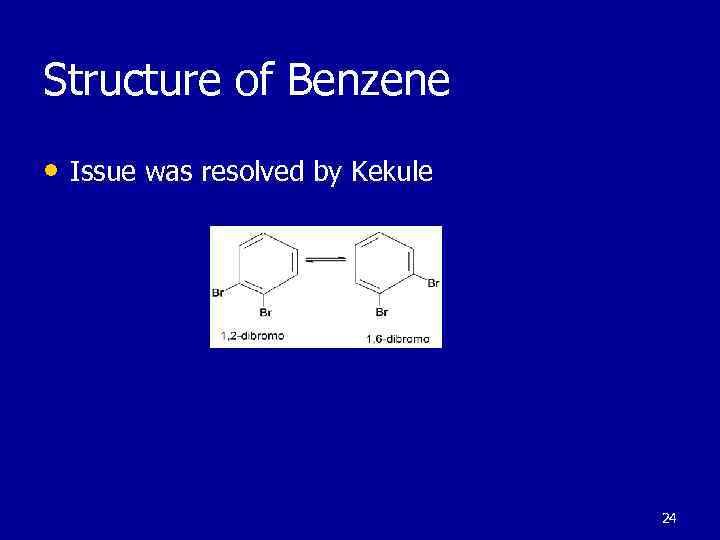 Structure of Benzene • Issue was resolved by Kekule 24
 Structure of Benzene • Explains the observed products • Does not explain – Unreactive nature of benzene – Observation of only substitution products • A triene – As reactive as any alkene – Would give addition products – Not expected to be more stable 25
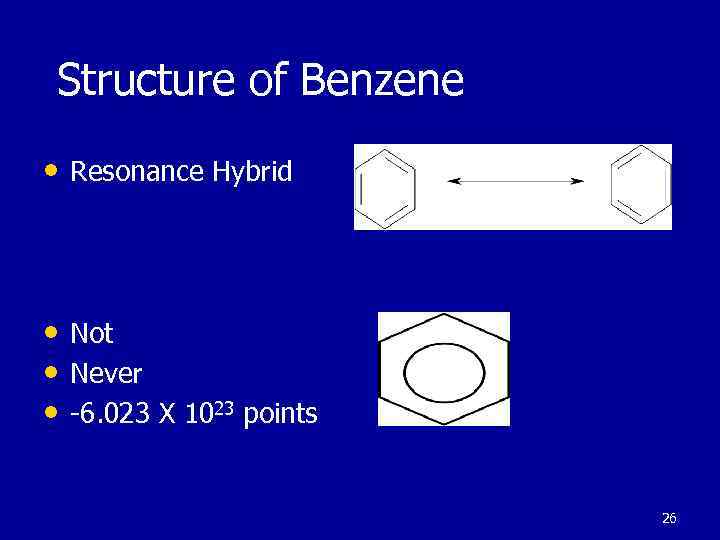 Structure of Benzene • Resonance Hybrid • Not • Never • -6. 023 X 1023 points 26
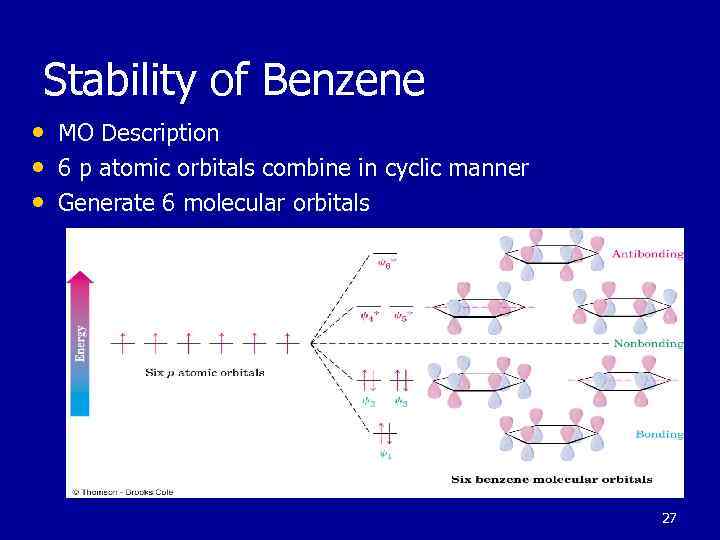 Stability of Benzene • MO Description • 6 p atomic orbitals combine in cyclic manner • Generate 6 molecular orbitals 27
 Key Ideas on Benzene • Unusually stable • heat of hydrogenation 150 k. J/mol lower than a cyclic • • • triene Planar hexagon: bond angles are 120° carbon–carbon bond lengths 139 pm Undergoes substitution not addition Resonance hybrid One more important factor is the number of electrons in the cyclic orbital 28
 Aromaticity • E Huckel (1931) – Aromaticity is a property of certain molecules – Chemistry would be similar to benzene – Meet the following criteria • • Planar Mono cyclic system Conjugated pi system Contains 4 n + 2 electrons • Can apply rules to variety of compounds and determine • aromatic nature. Led to wild chase to make compounds – Met the rules – Violated the rules 29
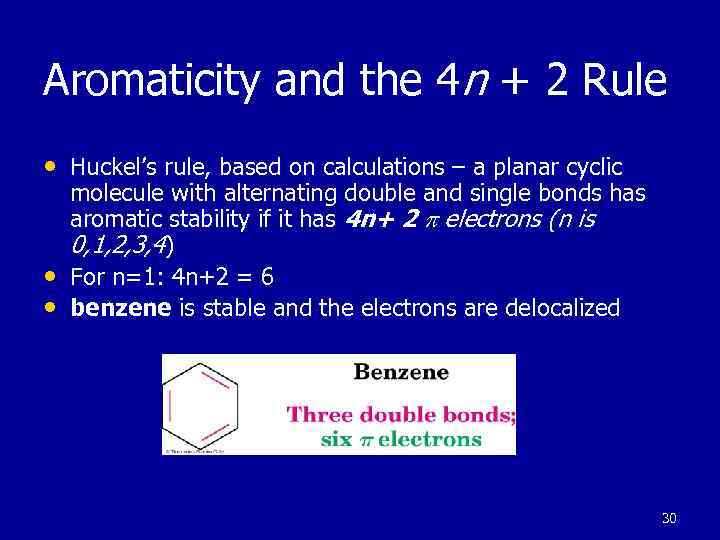 Aromaticity and the 4 n + 2 Rule • Huckel’s rule, based on calculations – a planar cyclic • • molecule with alternating double and single bonds has aromatic stability if it has 4 n+ 2 electrons (n is 0, 1, 2, 3, 4) For n=1: 4 n+2 = 6 benzene is stable and the electrons are delocalized 30
 Compounds With 4 n Electrons Are Not Aromatic (May be Anti-aromatic) • Planar, cyclic molecules with 4 n electrons are much less stable than expected (anti-aromatic) • They will distort out of plane and behave like ordinary alkenes • 4 - and 8 -electron compounds are not delocalized • Alternating single and double bonds 31
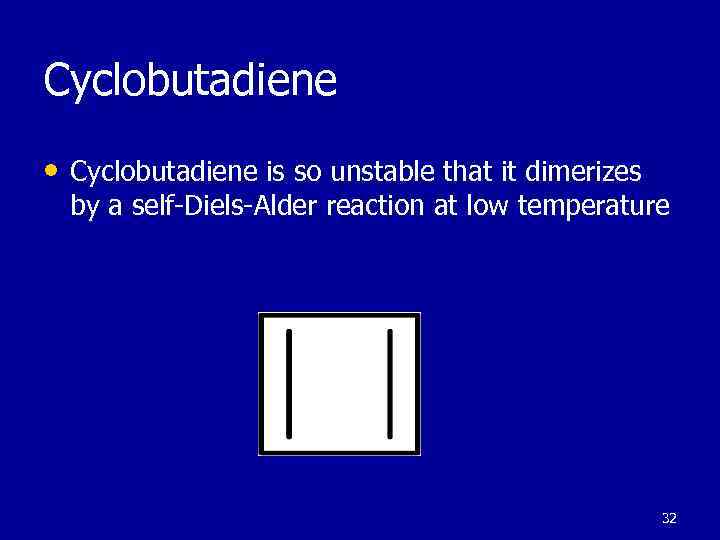 Cyclobutadiene • Cyclobutadiene is so unstable that it dimerizes by a self-Diels-Alder reaction at low temperature 32
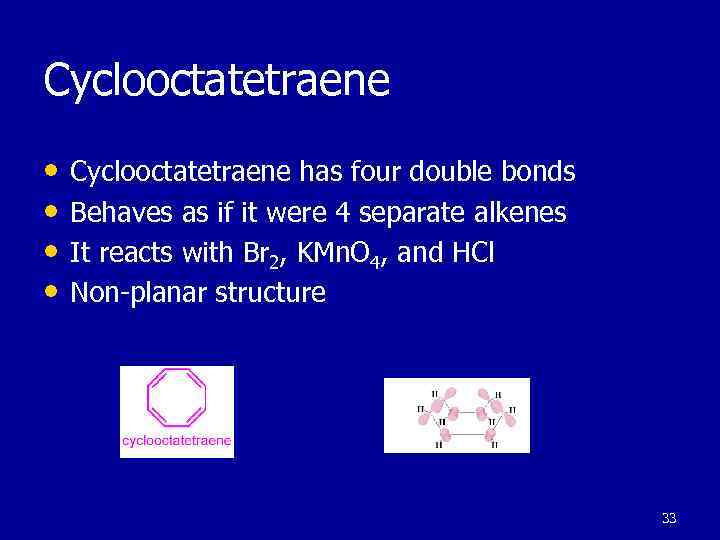 Cyclooctatetraene • Cyclooctatetraene has four double bonds • Behaves as if it were 4 separate alkenes • It reacts with Br 2, KMn. O 4, and HCl • Non-planar structure 33
 Aromatic Heterocycles • Heterocyclic compounds contain elements • • other than carbon in a ring, such as N, S, O, P There are many heterocyclic aromatic compounds Cyclic compounds that contain only carbon are called carbocycles Nomenclature is specialized Four are important in biological chemistry 34
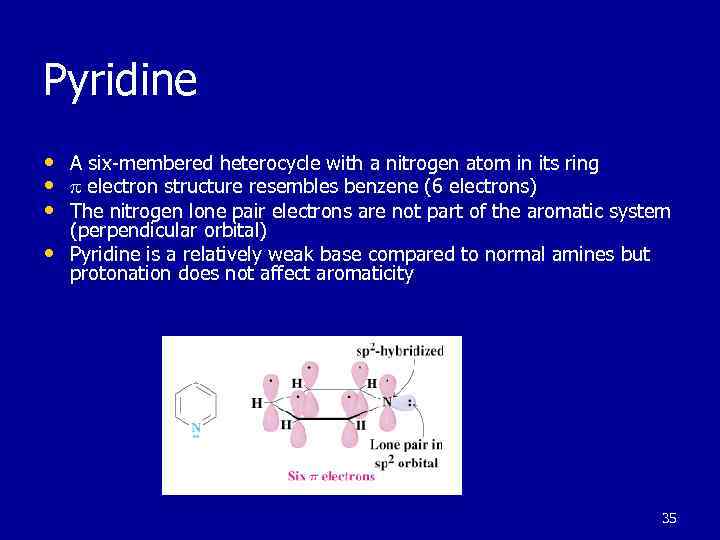 Pyridine • A six-membered heterocycle with a nitrogen atom in its ring • electron structure resembles benzene (6 electrons) • The nitrogen lone pair electrons are not part of the aromatic system • (perpendicular orbital) Pyridine is a relatively weak base compared to normal amines but protonation does not affect aromaticity 35
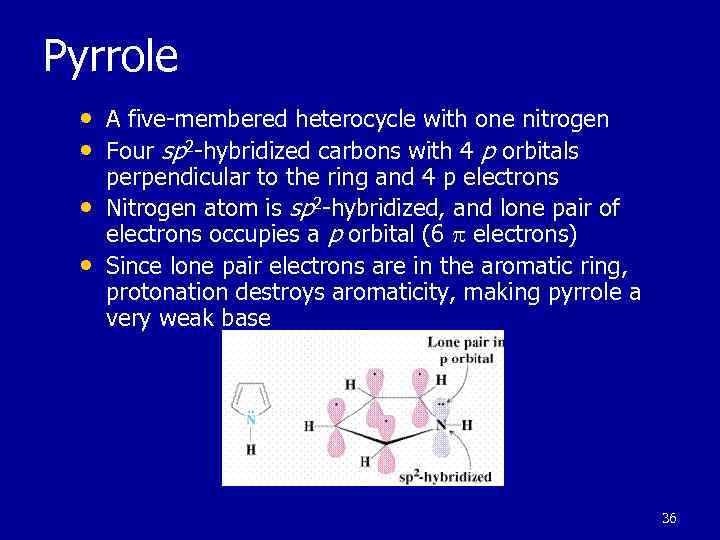 Pyrrole • A five-membered heterocycle with one nitrogen • Four sp 2 -hybridized carbons with 4 p orbitals • • perpendicular to the ring and 4 p electrons Nitrogen atom is sp 2 -hybridized, and lone pair of electrons occupies a p orbital (6 electrons) Since lone pair electrons are in the aromatic ring, protonation destroys aromaticity, making pyrrole a very weak base 36
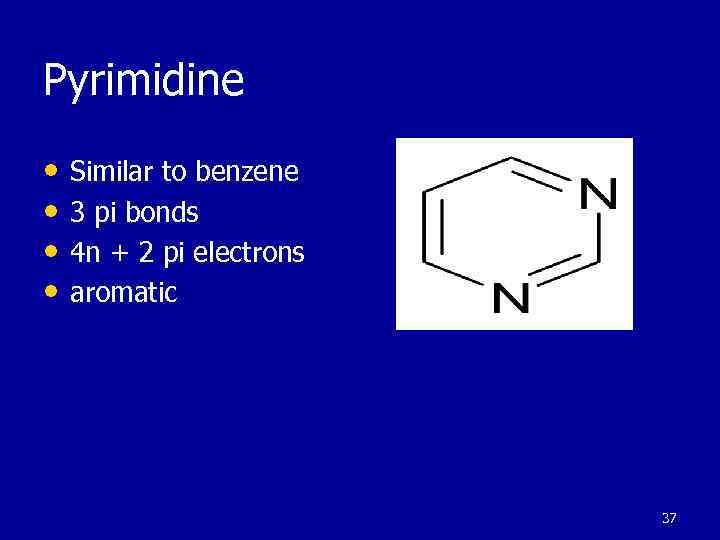 Pyrimidine • Similar to benzene • 3 pi bonds • 4 n + 2 pi electrons • aromatic 37
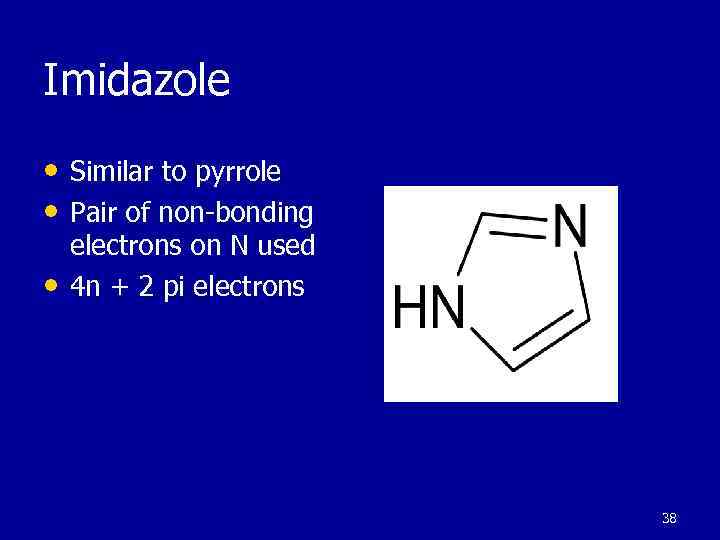 Imidazole • Similar to pyrrole • Pair of non-bonding • electrons on N used 4 n + 2 pi electrons 38
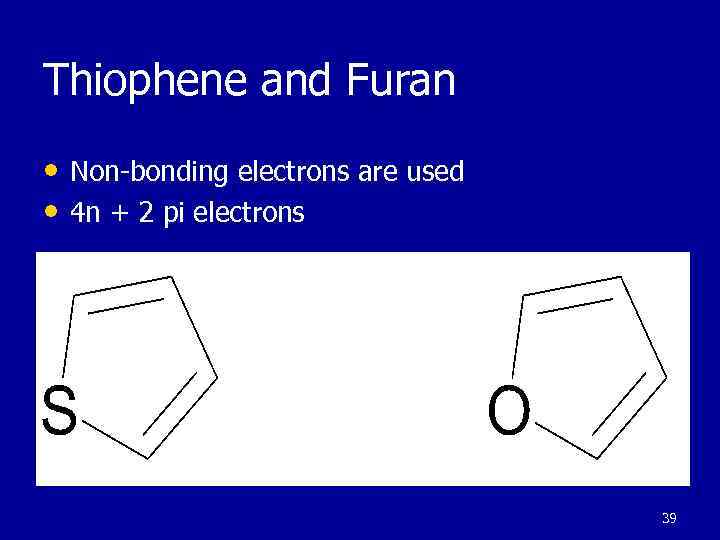 Thiophene and Furan • Non-bonding electrons are used • 4 n + 2 pi electrons 39
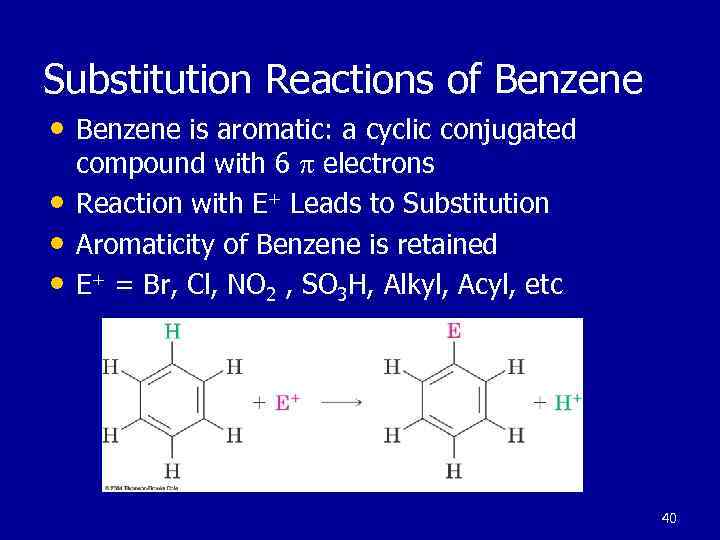 Substitution Reactions of Benzene • Benzene is aromatic: a cyclic conjugated • • • compound with 6 electrons Reaction with E+ Leads to Substitution Aromaticity of Benzene is retained E+ = Br, Cl, NO 2 , SO 3 H, Alkyl, Acyl, etc 40
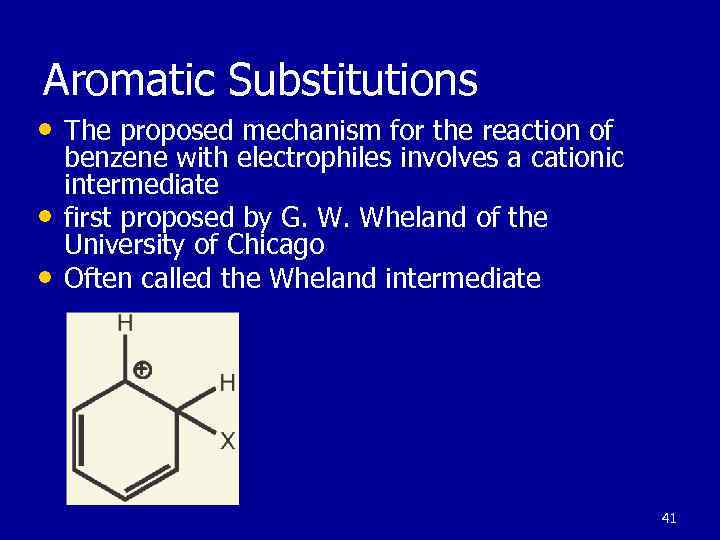 Aromatic Substitutions • The proposed mechanism for the reaction of • • benzene with electrophiles involves a cationic intermediate first proposed by G. W. Wheland of the University of Chicago Often called the Wheland intermediate 41
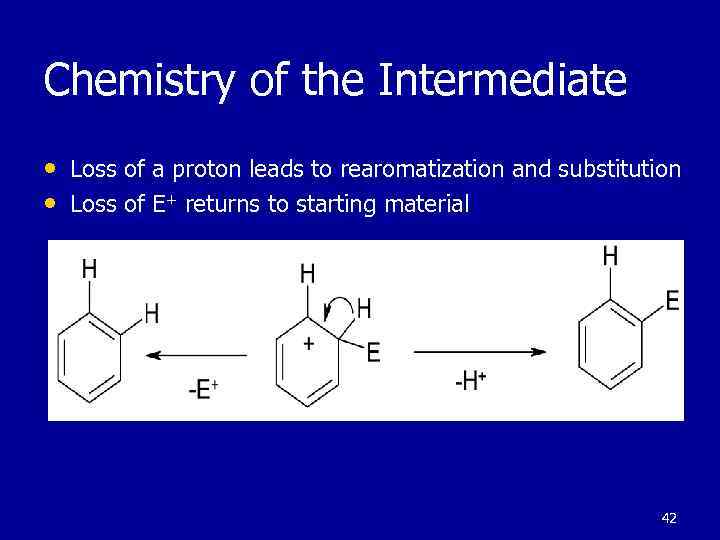 Chemistry of the Intermediate • Loss of a proton leads to rearomatization and substitution • Loss of E+ returns to starting material 42
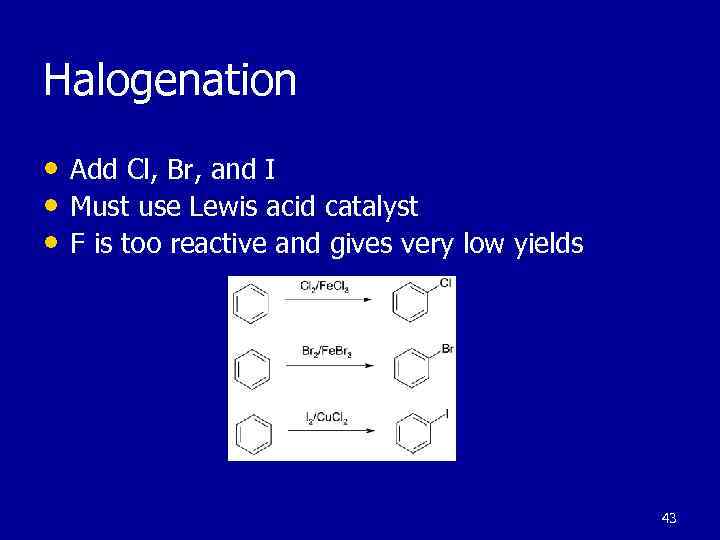 Halogenation • Add Cl, Br, and I • Must use Lewis acid catalyst • F is too reactive and gives very low yields 43
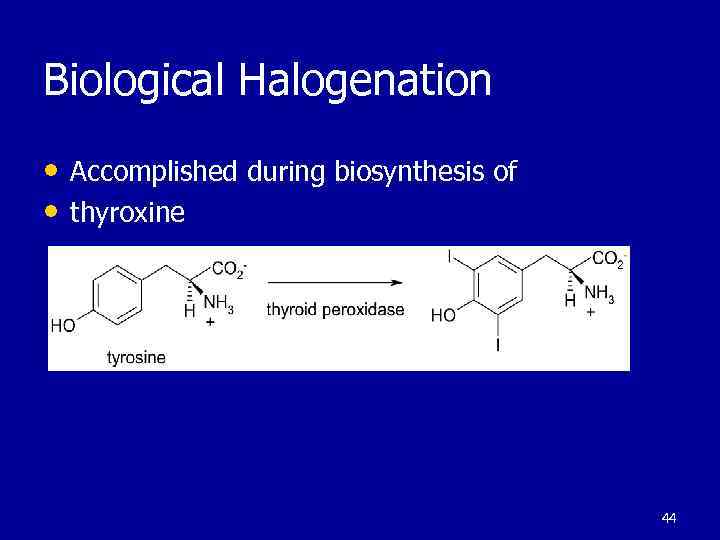 Biological Halogenation • Accomplished during biosynthesis of • thyroxine 44
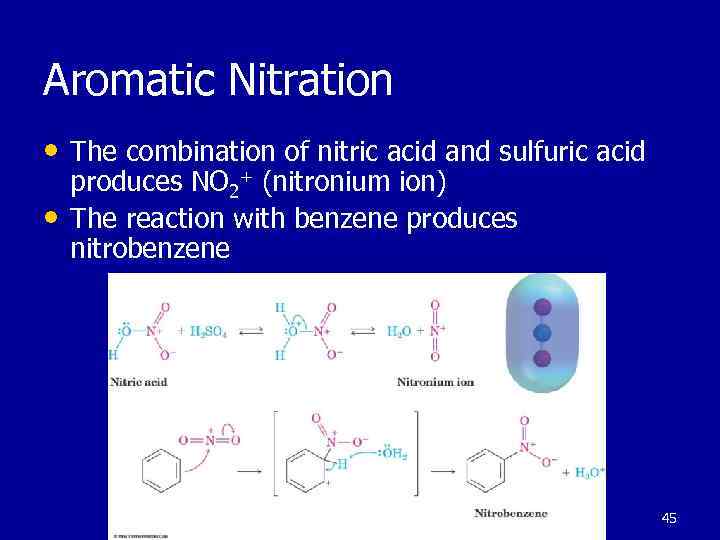 Aromatic Nitration • The combination of nitric acid and sulfuric acid • produces NO 2+ (nitronium ion) The reaction with benzene produces nitrobenzene 45
![Nitrobenzenes: Precursors to Anilines • • Nitric acid destroys alkenes through [O] In sulfuric](https://present5.com/presentation/-42647088_280428761/image-46.jpg "Nitrobenzenes: Precursors to Anilines • • Nitric acid destroys alkenes through [O] In sulfuric") Nitrobenzenes: Precursors to Anilines • • Nitric acid destroys alkenes through [O] In sulfuric acid reacts with benzene giving nitrobenzene Nitrobenzene may be reduced to aniline Aniline useful precursors to many industrially important organic compounds 46
Nitrobenzenes: Precursors to Anilines • • Nitric acid destroys alkenes through [O] In sulfuric acid reacts with benzene giving nitrobenzene Nitrobenzene may be reduced to aniline Aniline useful precursors to many industrially important organic compounds 46
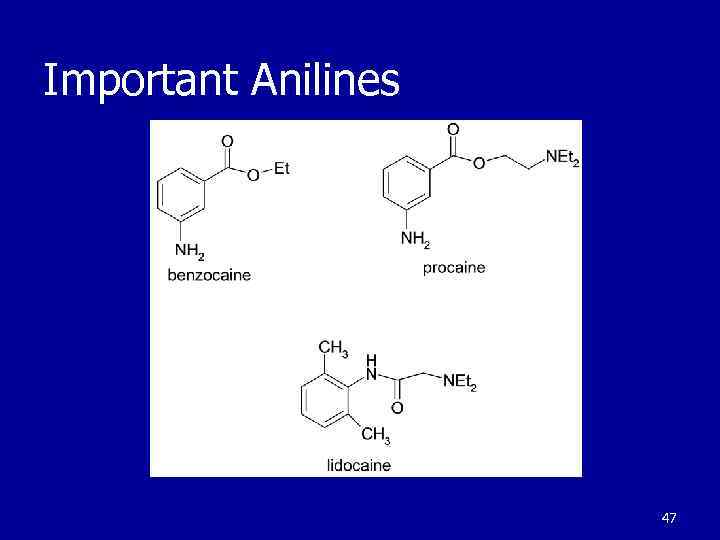 Important Anilines 47
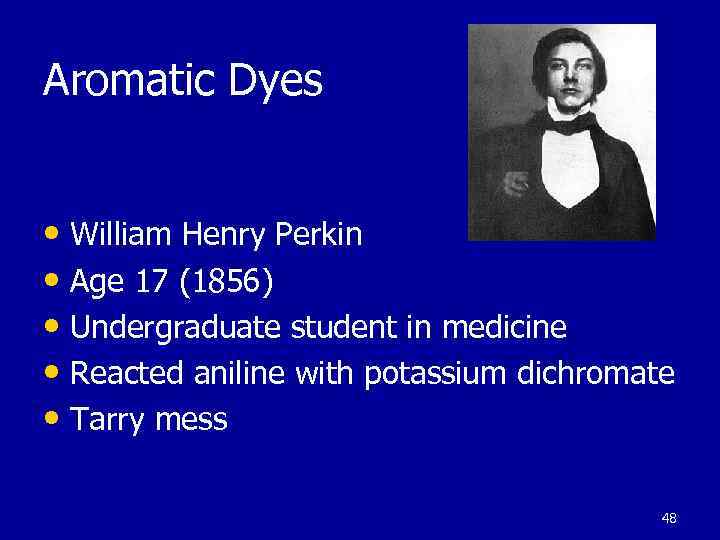 Aromatic Dyes • William Henry Perkin • Age 17 (1856) • Undergraduate student in medicine • Reacted aniline with potassium dichromate • Tarry mess 48
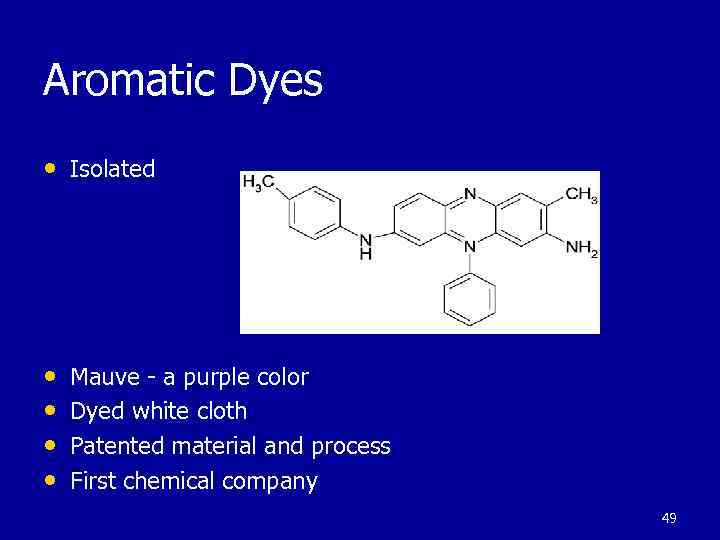 Aromatic Dyes • Isolated • • Mauve - a purple color Dyed white cloth Patented material and process First chemical company 49
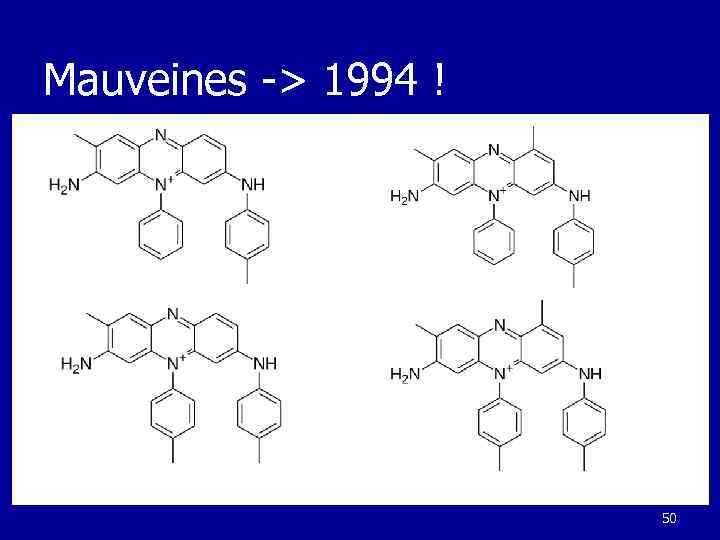 Mauveines -> 1994 ! 50
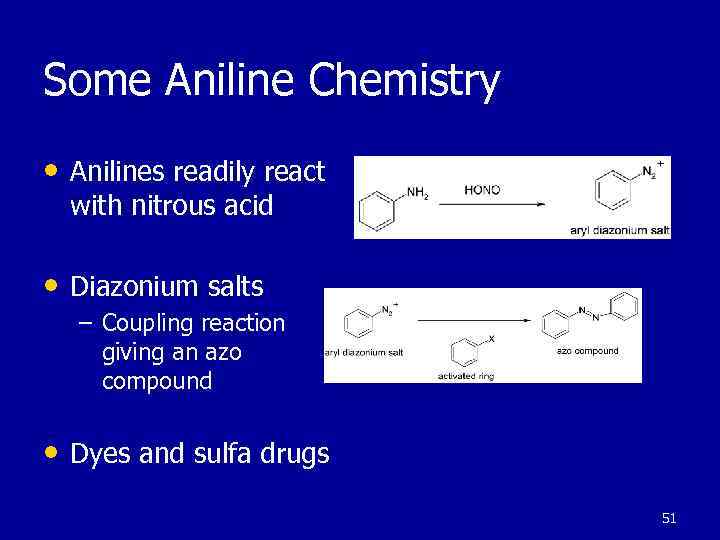 Some Aniline Chemistry • Anilines readily react with nitrous acid • Diazonium salts – Coupling reaction giving an azo compound • Dyes and sulfa drugs 51
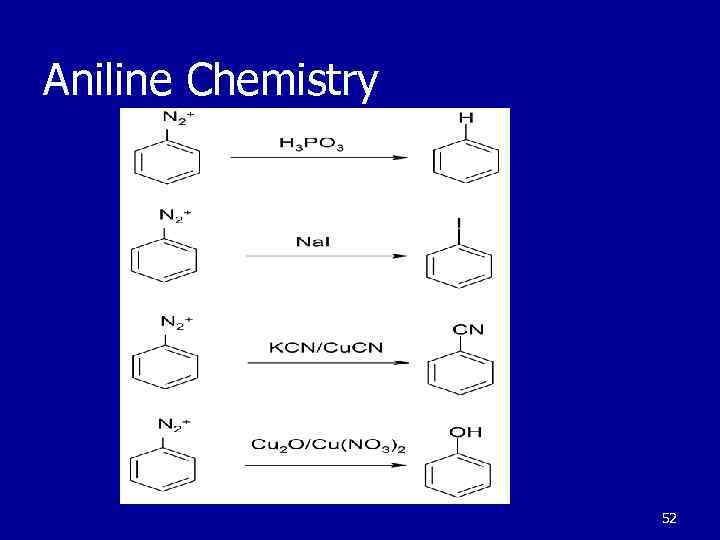 Aniline Chemistry 52
 How do we make sulfuric acid? • H 2 SO 4 – least expensive manufactured chemical • S (mined pure) + O 2 • SO 3 + H 2 O SO 3 H 2 SO 4 • Continue adding SO 3 gives • Fuming sulfuric acid: H 2 SO 4/ SO 3 53
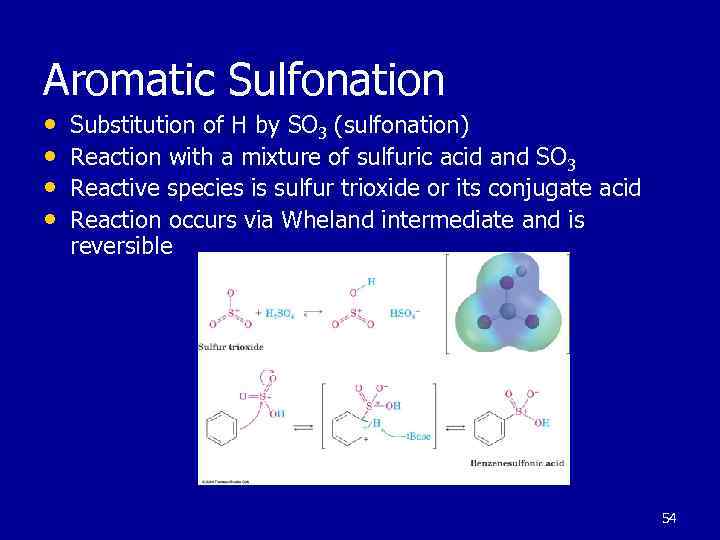 Aromatic Sulfonation • • Substitution of H by SO 3 (sulfonation) Reaction with a mixture of sulfuric acid and SO 3 Reactive species is sulfur trioxide or its conjugate acid Reaction occurs via Wheland intermediate and is reversible 54
 Benzene Sulfonic Acid • Manufacture of Ion Exchange Resins – Water softening – Water purification – Environmental restoration (removal of toxic metal ions) 55
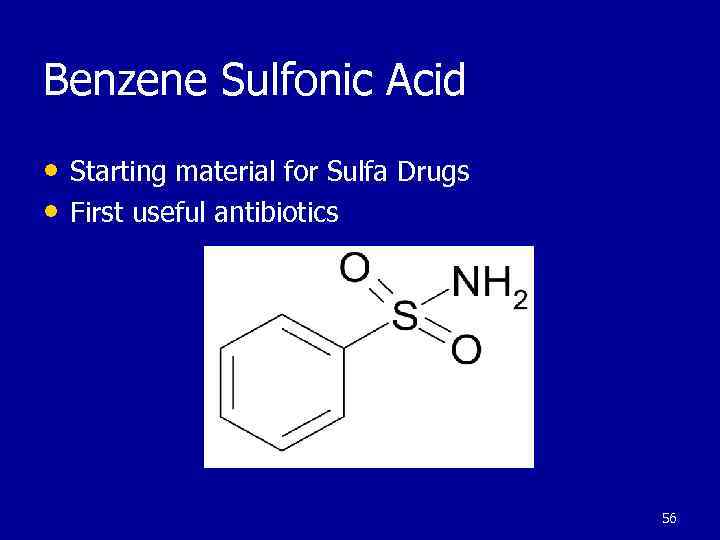 Benzene Sulfonic Acid • Starting material for Sulfa Drugs • First useful antibiotics 56
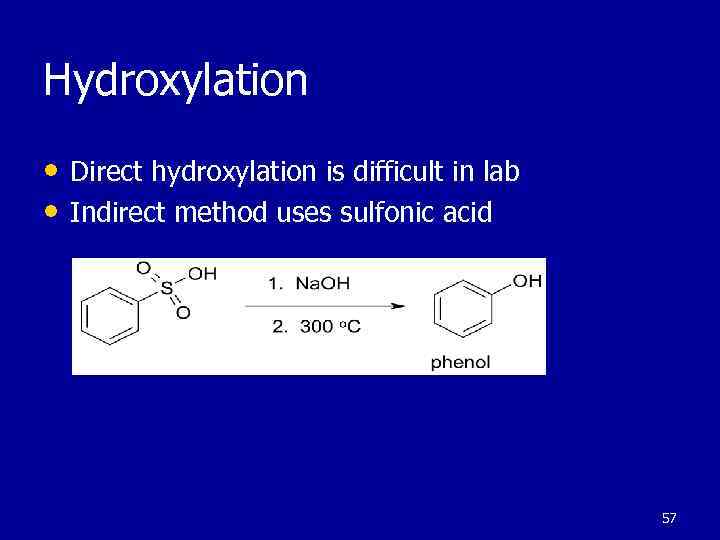 Hydroxylation • Direct hydroxylation is difficult in lab • Indirect method uses sulfonic acid 57
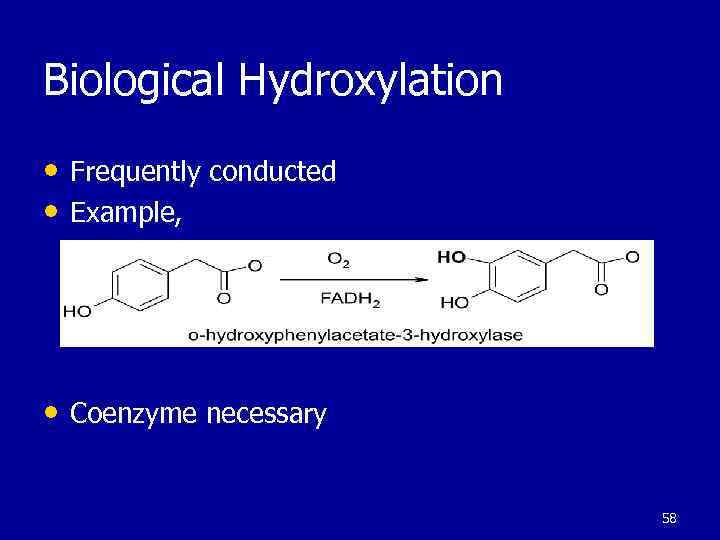 Biological Hydroxylation • Frequently conducted • Example, • Coenzyme necessary 58
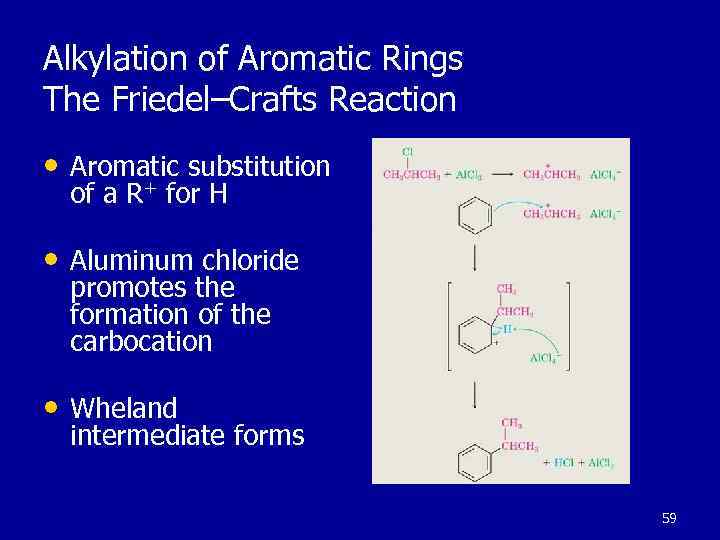 Alkylation of Aromatic Rings The Friedel–Crafts Reaction • Aromatic substitution + of a R + for H • Aluminum chloride promotes the formation of the carbocation • Wheland intermediate forms 59
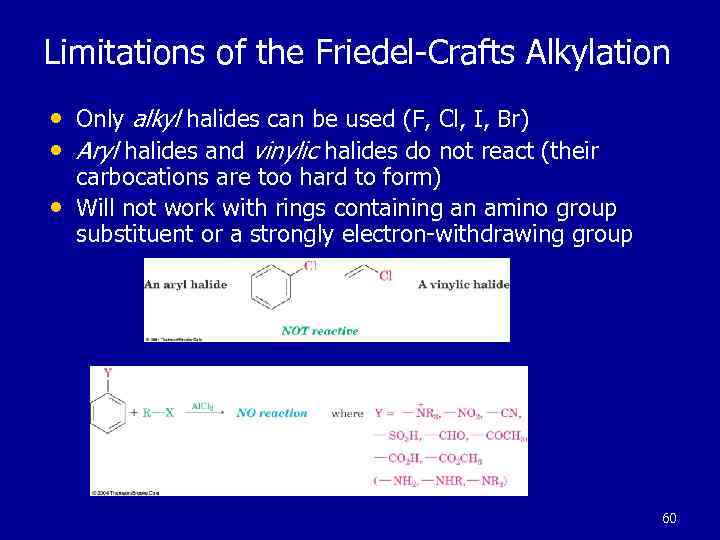 Limitations of the Friedel-Crafts Alkylation • Only alkyl halides can be used (F, Cl, I, Br) • Aryl halides and vinylic halides do not react (their • carbocations are too hard to form) Will not work with rings containing an amino group substituent or a strongly electron-withdrawing group 60
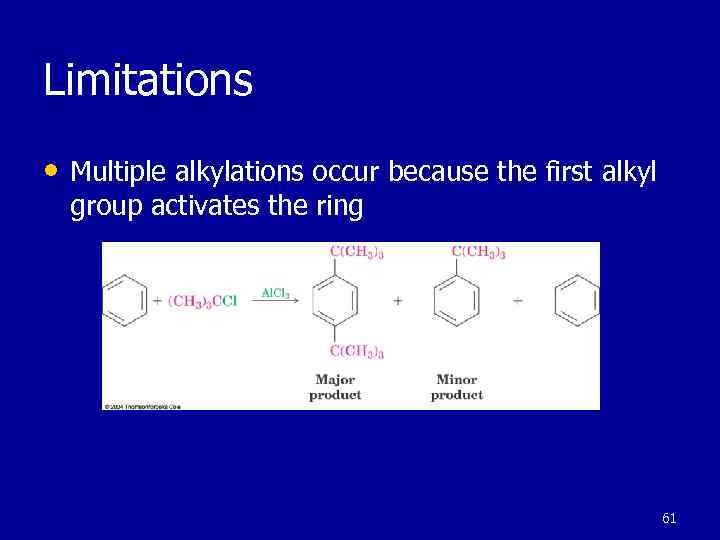 Limitations • Multiple alkylations occur because the first alkyl group activates the ring 61
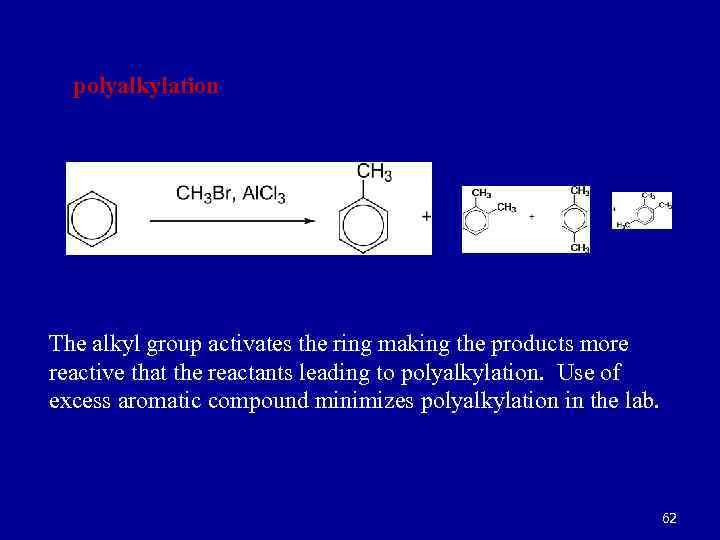 polyalkylation The alkyl group activates the ring making the products more reactive that the reactants leading to polyalkylation. Use of excess aromatic compound minimizes polyalkylation in the lab. 62
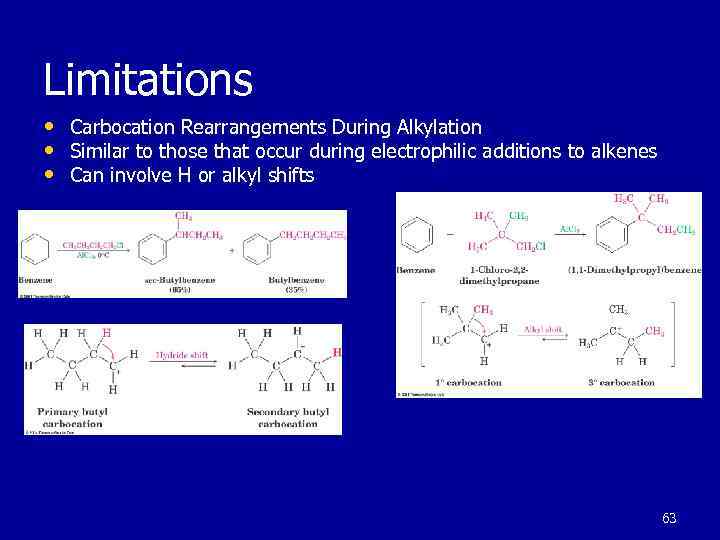 Limitations • Carbocation Rearrangements During Alkylation • Similar to those that occur during electrophilic additions to alkenes • Can involve H or alkyl shifts 63
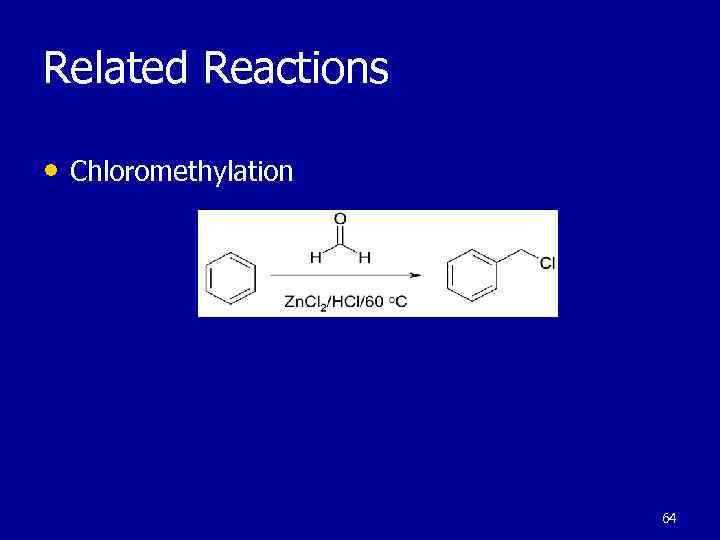 Related Reactions • Chloromethylation 64
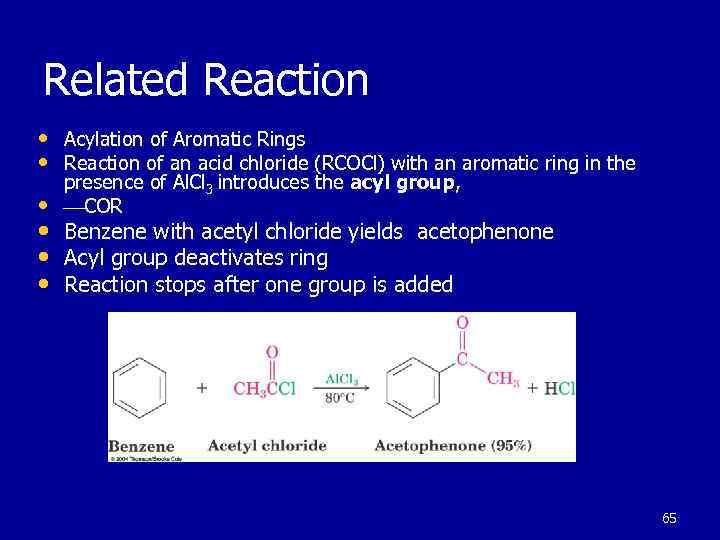 Related Reaction • Acylation of Aromatic Rings • Reaction of an acid chloride (RCOCl) with an aromatic ring in the • • presence of Al. Cl 3 introduces the acyl group, COR Benzene with acetyl chloride yields acetophenone Acyl group deactivates ring Reaction stops after one group is added 65
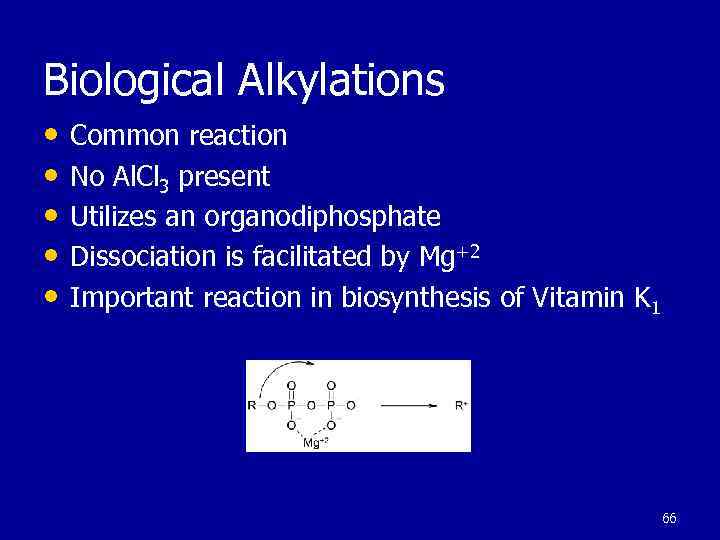 Biological Alkylations • Common reaction • No Al. Cl 3 present • Utilizes an organodiphosphate • Dissociation is facilitated by Mg+2 • Important reaction in biosynthesis of Vitamin K 1 66
 Ring Substitution Effects • Activation and deactivation of ring – Alkyl activates the ring – Acyl deactivates the ring • Activating Groups – group promotes substitution faster than benzene • Deactivating Groups – group promotes substitution slower than benzene 67
 Activating and Deactivating Groups • Activating groups – electron donating groups – stabilizes the carbocation intermediate – activates through induction or resonance • Deactivating groups – electron withdrawing groups – destabilizes the carbocation intermediate – deactivates through induction or resonance 68
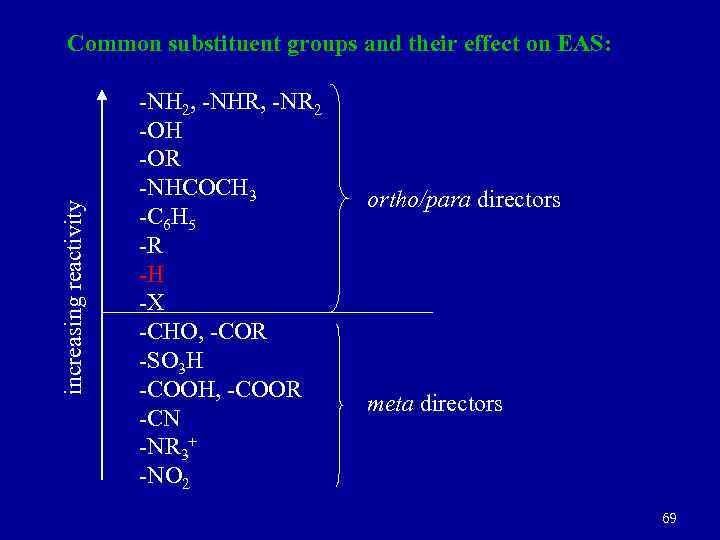 increasing reactivity Common substituent groups and their effect on EAS: -NH 2, -NHR, -NR 2 -OH -OR -NHCOCH 3 -C 6 H 5 -R -H -X -CHO, -COR -SO 3 H -COOH, -COOR -CN -NR 3+ -NO 2 ortho/para directors meta directors 69
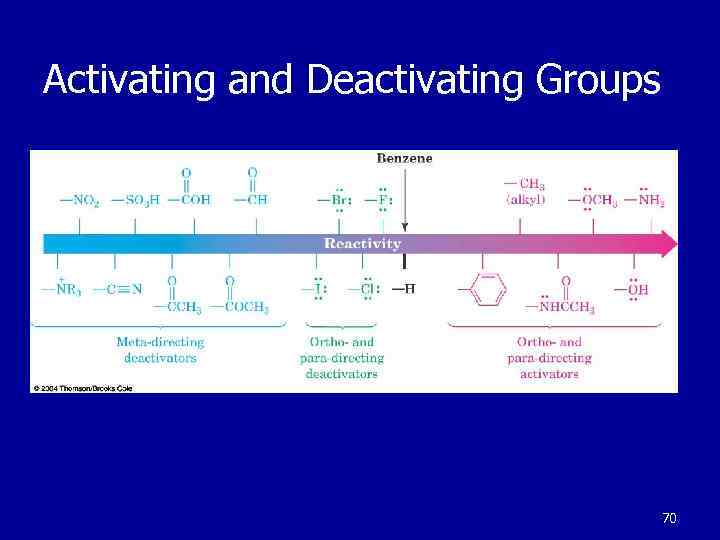 Activating and Deactivating Groups 70
 Origins of Substituent Effects • Inductive effect - withdrawal or donation of • electrons through a s bond Resonance effect - withdrawal or donation of electrons through a bond due to the overlap of a p orbital on the substituent with a p orbital on the aromatic ring 71
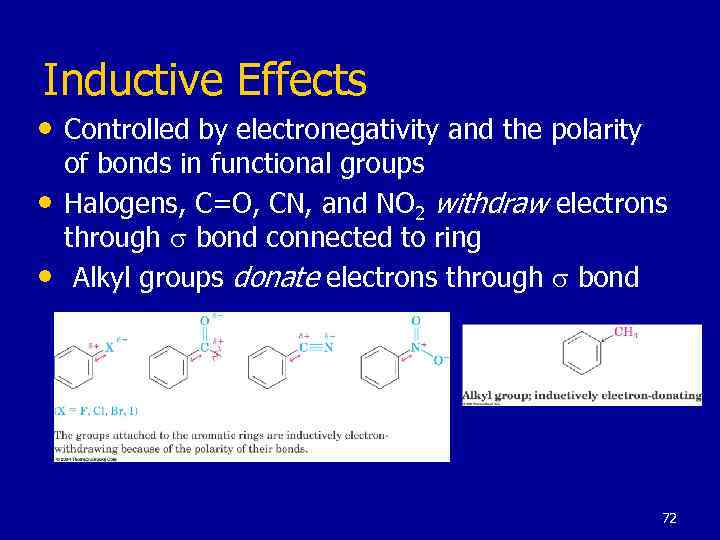 Inductive Effects • Controlled by electronegativity and the polarity • • of bonds in functional groups Halogens, C=O, CN, and NO 2 withdraw electrons through s bond connected to ring Alkyl groups donate electrons through s bond 72
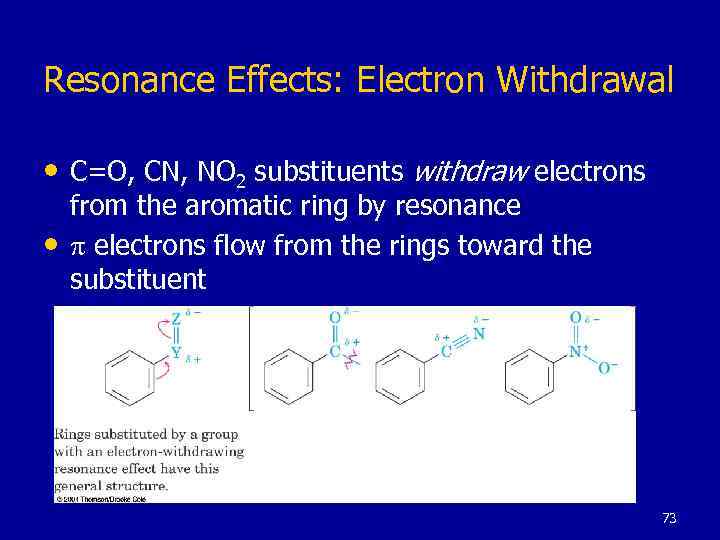 Resonance Effects: Electron Withdrawal • C=O, CN, NO 2 substituents withdraw electrons • from the aromatic ring by resonance electrons flow from the rings toward the substituent 73
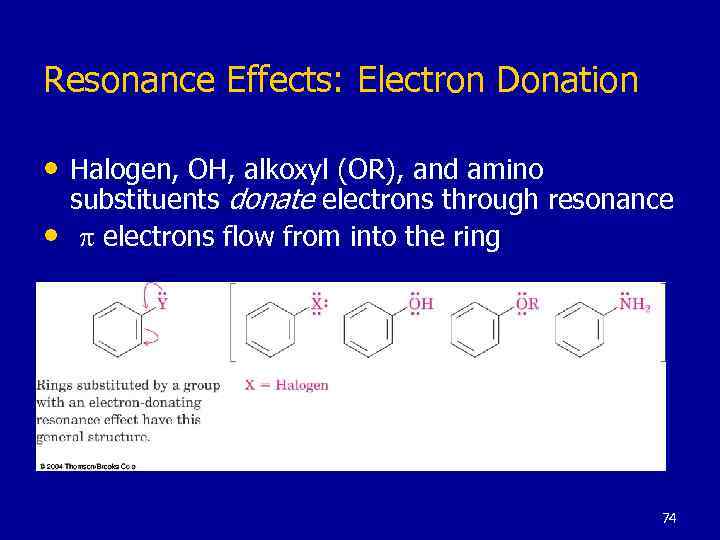 Resonance Effects: Electron Donation • Halogen, OH, alkoxyl (OR), and amino • substituents donate electrons through resonance electrons flow from into the ring 74
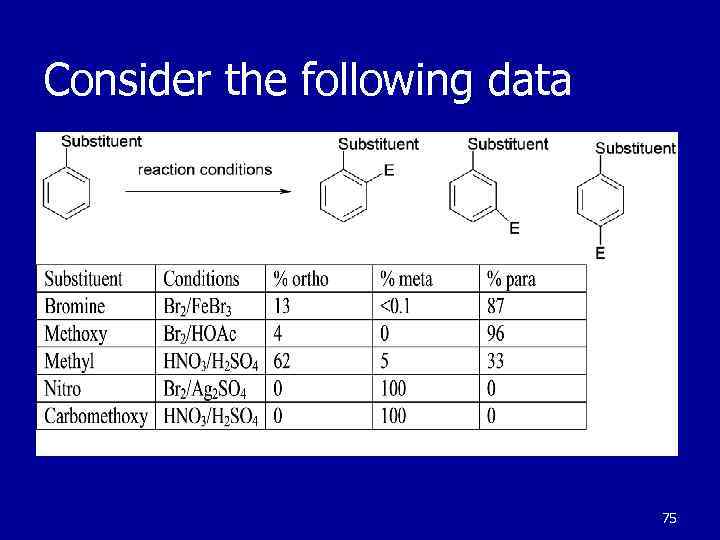 Consider the following data 75
 Analysis of Data • Methoxy and Methyl • Activating • Ortho and para products • Nitro and Carbomethoxy • Deactivating • Meta product • Bromine • Deactivating • Ortho and para products 76
 Ring Effects - Conclusions • Activating groups • Substitution is faster than for benzene • Groups direct substitution to o/p positions • Deactivating Groups • Substitution is slower than for benzene • Groups direct substitution to m position • Halogens • Deactivate ring • Substitution is slower than for benzene • Groups direct substitution to o/p positions 77
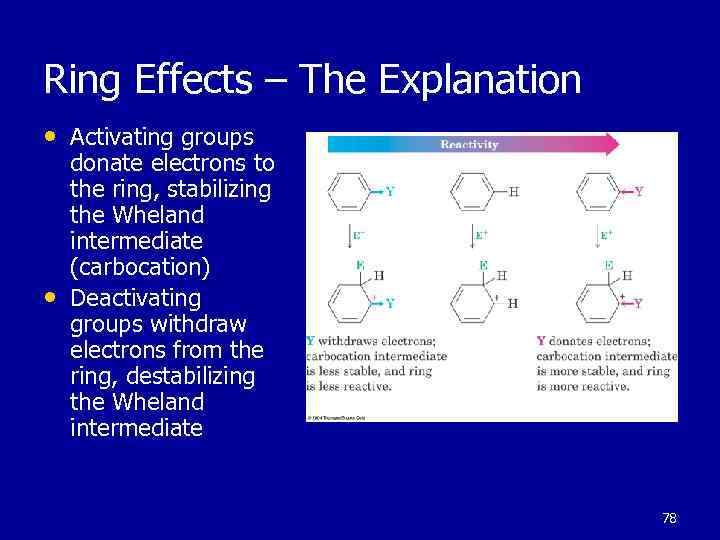 Ring Effects – The Explanation • Activating groups • donate electrons to the ring, stabilizing the Wheland intermediate (carbocation) Deactivating groups withdraw electrons from the ring, destabilizing the Wheland intermediate 78
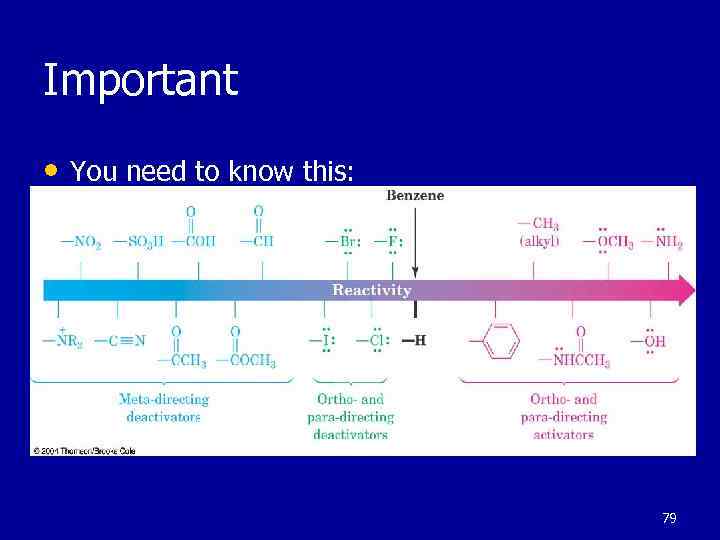 Important • You need to know this: 79
 Oxidation of Benzene • Toluene is readily oxidized by reagents • Benzene is inert to oxidizing agents – Benzene is toxic to humans – Benzene is a suspected carcinogen • Cytochrom P – strong oxidant in Liver – Primary detoxification process used 80
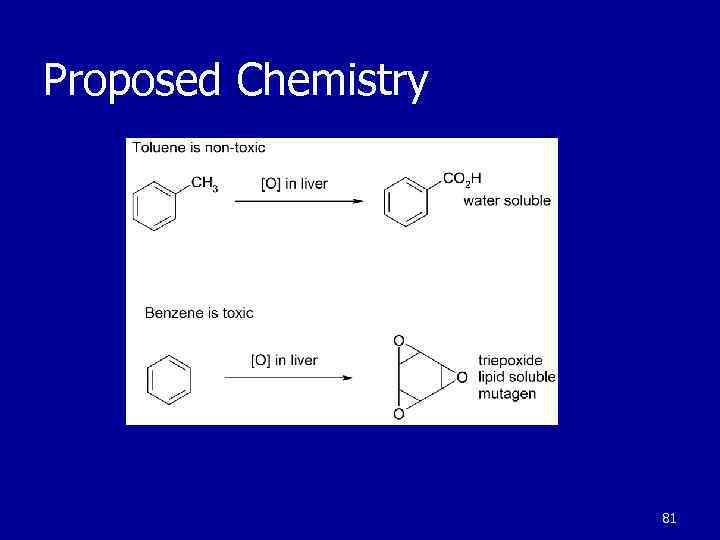 Proposed Chemistry 81
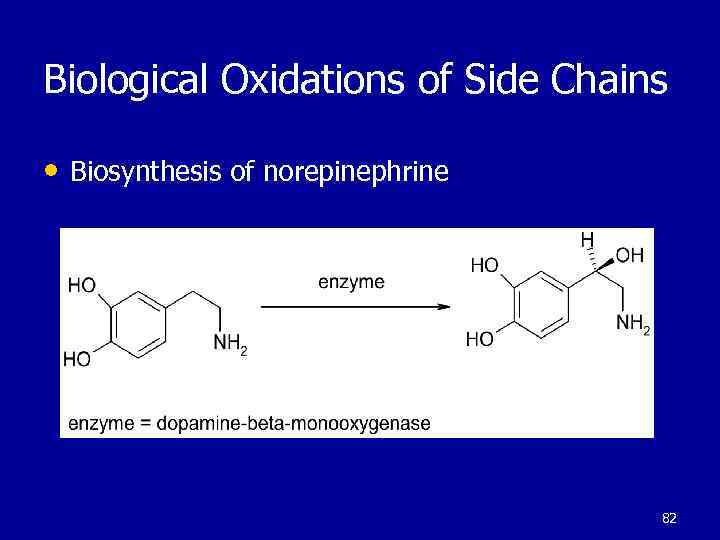 Biological Oxidations of Side Chains • Biosynthesis of norepinephrine 82
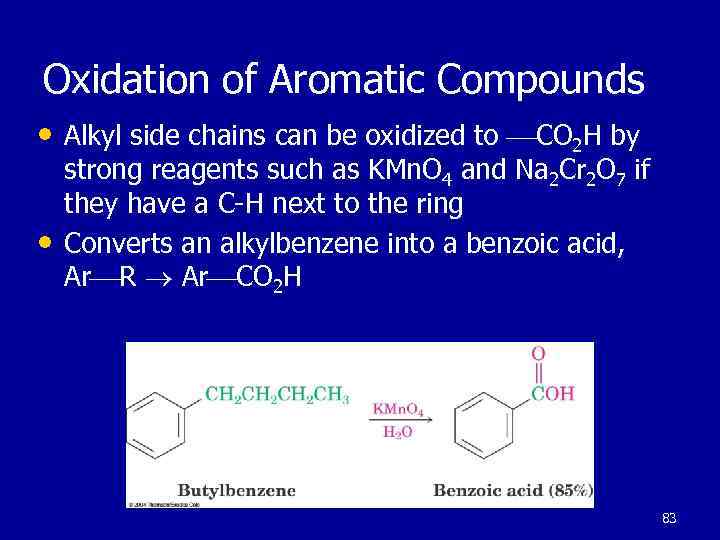 Oxidation of Aromatic Compounds • Alkyl side chains can be oxidized to CO 2 H by • strong reagents such as KMn. O 4 and Na 2 Cr 2 O 7 if they have a C-H next to the ring Converts an alkylbenzene into a benzoic acid, Ar R Ar CO 2 H 83
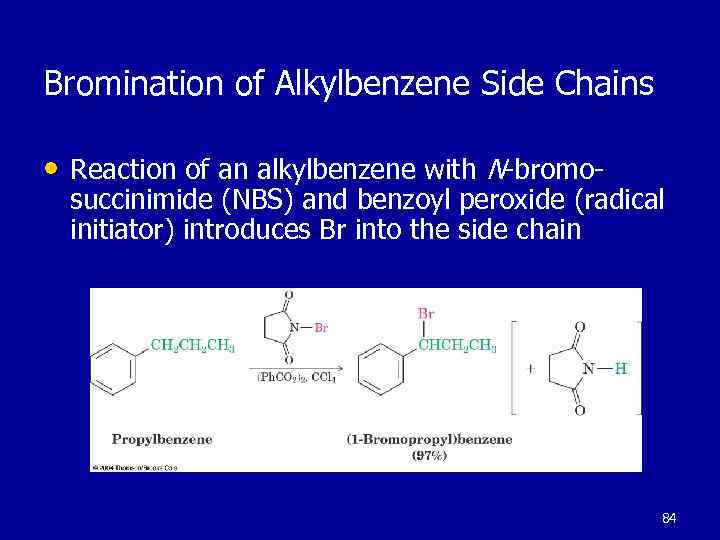 Bromination of Alkylbenzene Side Chains • Reaction of an alkylbenzene with N-bromo- succinimide (NBS) and benzoyl peroxide (radical initiator) introduces Br into the side chain 84
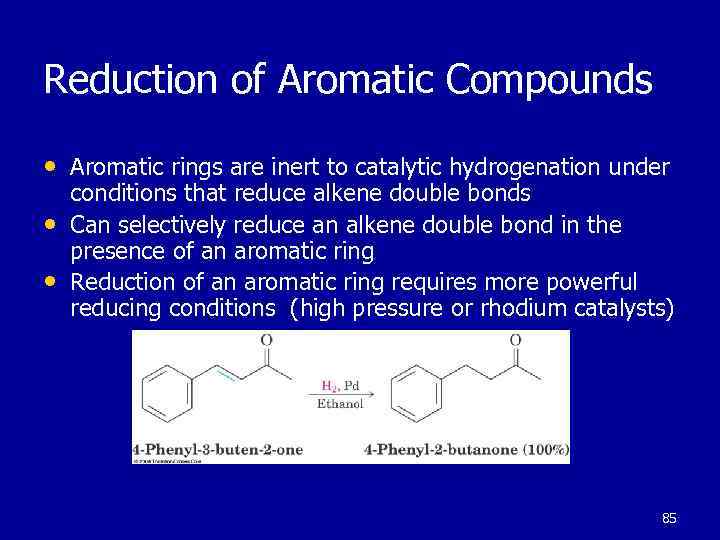 Reduction of Aromatic Compounds • Aromatic rings are inert to catalytic hydrogenation under • • conditions that reduce alkene double bonds Can selectively reduce an alkene double bond in the presence of an aromatic ring Reduction of an aromatic ring requires more powerful reducing conditions (high pressure or rhodium catalysts) 85
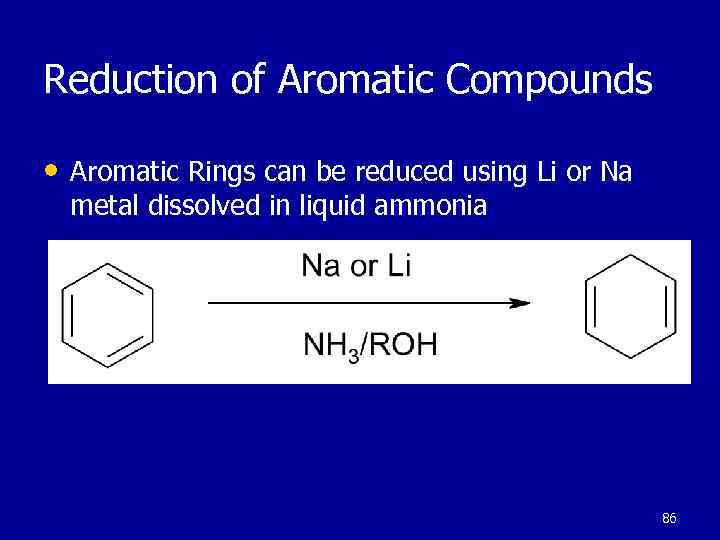 Reduction of Aromatic Compounds • Aromatic Rings can be reduced using Li or Na metal dissolved in liquid ammonia 86
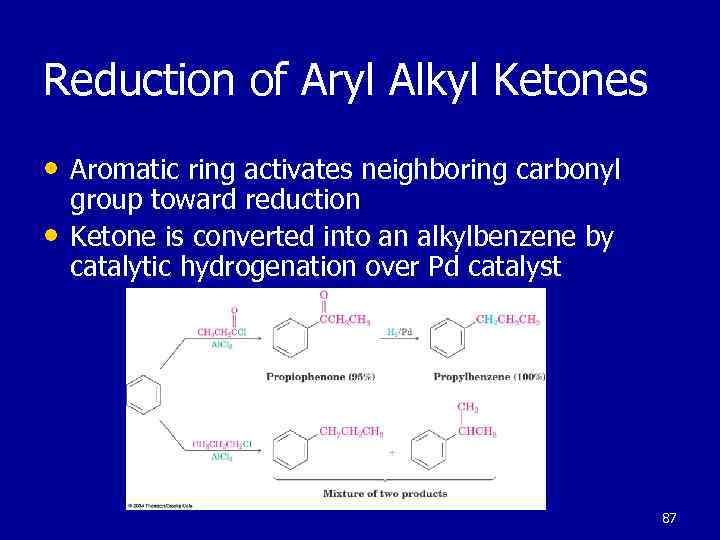 Reduction of Aryl Alkyl Ketones • Aromatic ring activates neighboring carbonyl • group toward reduction Ketone is converted into an alkylbenzene by catalytic hydrogenation over Pd catalyst 87