 Скачать презентацию Oregon ASK Statewide Afterschool Network Beth Unverzagt Director
046cf730a81cef4c7b081f74f44bbf64.ppt
- Количество слайдов: 25



Oregon. ASK Statewide Afterschool Network Beth Unverzagt, Director Tammy Marino, Ed. Coordinator www. oregonask. org
Oregon. ASK Partners City of Salem Safe Kids Oregon PTA Oregon Community Education Association OCCF Employment - Child Care Division Oregon Mentors Office of the Governor ODE – USDA & 21 st. CCLC Alliance of Y’s SUN schools OSU Extension – 4 H Afterschool Oregon Alliance for Arts Education Oregon State Library – Youth Services Education Northwest Oregon Volunteers Community College – WIA Inclusive Child Care Fight Crime: Invest in Kids Child Care Resource and Referral Network Willamette ESD Boys and Girls Clubs of America DHS - Prevention & Subsidy Oregon Department of Fish and Wildlife Oregon Recreation and Park Assoc. Campfire, USA
Oregon. ASK Mission To support, expand advocate for quality out-of-school time programs and activities for children, youth, and families throughout Oregon.
Vision All Oregon children, youth and families will have access to quality out-of-school time options within their communities. All services will enhance children’s positive development, and future opportunities while keeping them safe from harm. All programs, services and activities will be of high quality and contribute to strong communities and schools.
Goals § § § Create a sustainable structure of statewide, regional, and local partnerships, particularly school-community partnerships, and continue our focus on support of statewide policy development. Support the development and growth of statewide policies that will secure the resources needed to sustain new and existing afterschool programs. Support statewide systems to ensure programs are of high quality.
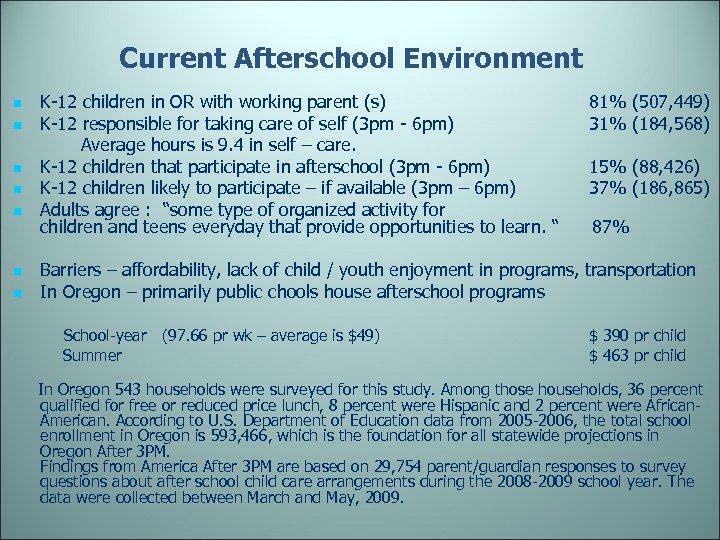
Current Afterschool Environment K-12 children in OR with working parent (s) 81% (507, 449) n K-12 responsible for taking care of self (3 pm - 6 pm) 31% (184, 568) Average hours is 9. 4 in self – care. n K-12 children that participate in afterschool (3 pm - 6 pm) 15% (88, 426) n K-12 children likely to participate – if available (3 pm – 6 pm) 37% (186, 865) n Adults agree : “some type of organized activity for children and teens everyday that provide opportunities to learn. “ 87% n n n Barriers – affordability, lack of child / youth enjoyment in programs, transportation In Oregon – primarily public chools house afterschool programs School-year (97. 66 pr wk – average is $49) Summer $ 390 pr child $ 463 pr child In Oregon 543 households were surveyed for this study. Among those households, 36 percent qualified for free or reduced price lunch, 8 percent were Hispanic and 2 percent were African. American. According to U. S. Department of Education data from 2005 -2006, the total school enrollment in Oregon is 593, 466, which is the foundation for all statewide projections in Oregon After 3 PM. Findings from America After 3 PM are based on 29, 754 parent/guardian responses to survey questions about after school child care arrangements during the 2008 -2009 school year. The data were collected between March and May, 2009.
Expanded Learning Opportunities “Expanded learning opportunities” mean a variety of initiatives that ensure students have access to a diverse array of content-rich, high -quality opportunities that expand the time they are actively engaged in learning. These activities provide students structured opportunities for academic support and enrichment; extra-curricular activities; mentoring; recreation; character education; and other developmental activities.
Terminology n “Before- and after-school programs” - school or community-based programs that occur before the scheduled school day begins and/or after the scheduled school day ends on weekday afternoons. They may offer a range of diverse programming including academic support, homework help, mentoring, field trips, physical education, and arts and cultural enrichment. “Summer programs”, which include two main categories: n “School-based remediation and credit-recovery programs” – programs that provide supplemental instruction and supports for students not performing at grade level. n “Extracurricular, recreational, and enrichment programs” – programs offered by schools, community-based providers, youth-serving organizations, and for-profit companies.
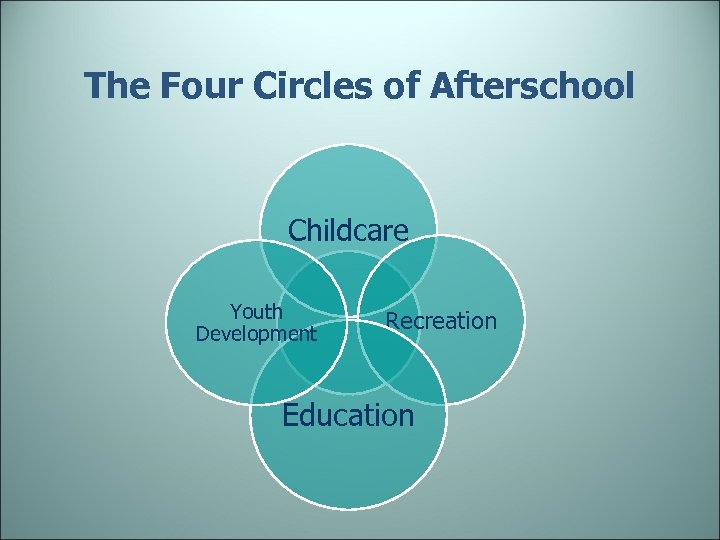
The Four Circles of Afterschool Childcare Youth Development Recreation Education
Oregon Afterschool Landscape n n n Schools - 21 st CCLC, Title One, School Improvement Non-profits organizations & school foundations Parks and Recreation Districts (23) Boys and Girls Clubs (12 clubs 44 sites) YMCA (14) Family child care providers
Four Sets of Notable Findings n n Development of reliable and valid measurement tools Afterschool meta-analysis Evidence of both general and specific programs effects Integration and alignment of afterschool, summer, and school day
Afterschool programs can address some of the educational challenges of poverty for children and youth “ Elementary and middle school students who participated in high “ quality after school programs, alone or in combination with other activities, …demonstrated significant gains in standardized scores. Further, regular participation in afterschool programs was associated with improvements in work habits and task persistence. ” n Two year longitudinal study of 3, 000 elementary and middle school students in 14 cities in 8 states. Vandell, D. , Reisner, E. & Pierce, K.
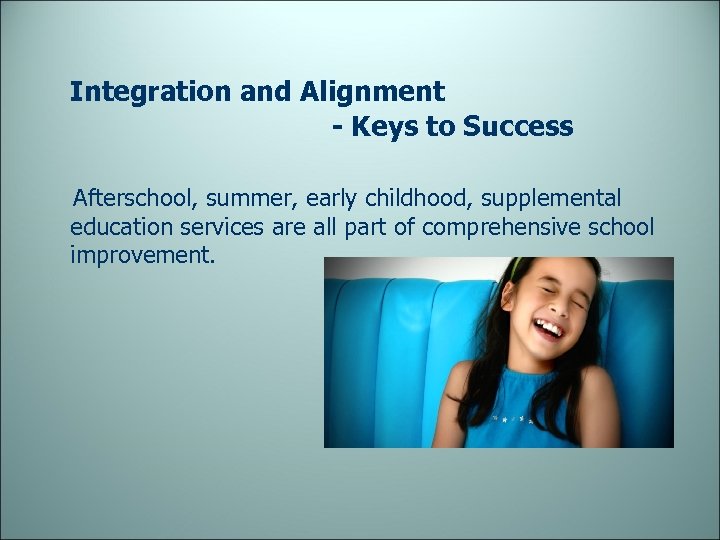
Integration and Alignment - Keys to Success Afterschool, summer, early childhood, supplemental education services are all part of comprehensive school improvement.
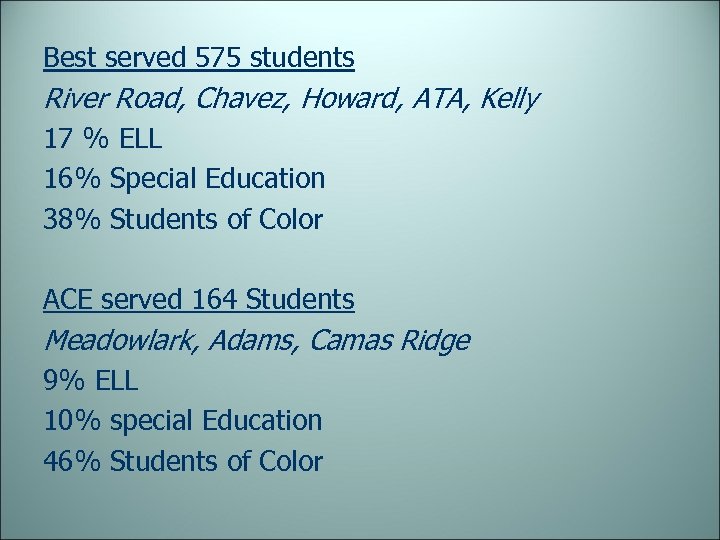
Best served 575 students River Road, Chavez, Howard, ATA, Kelly 17 % ELL 16% Special Education 38% Students of Color ACE served 164 Students Meadowlark, Adams, Camas Ridge 9% ELL 10% special Education 46% Students of Color
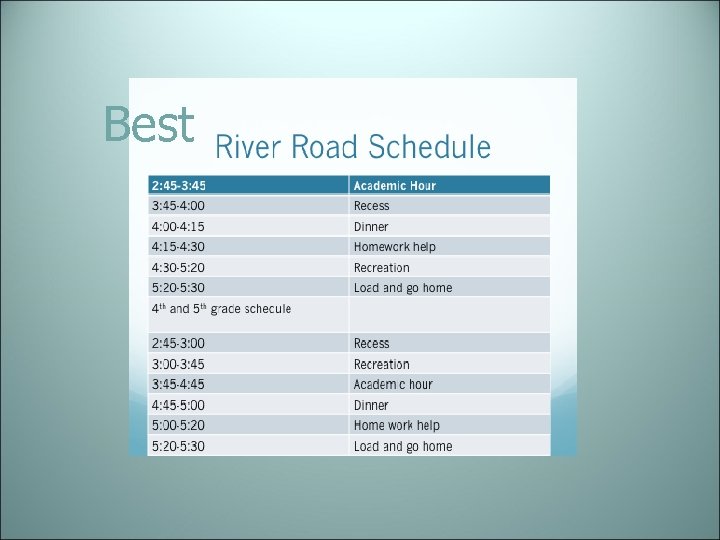
Best
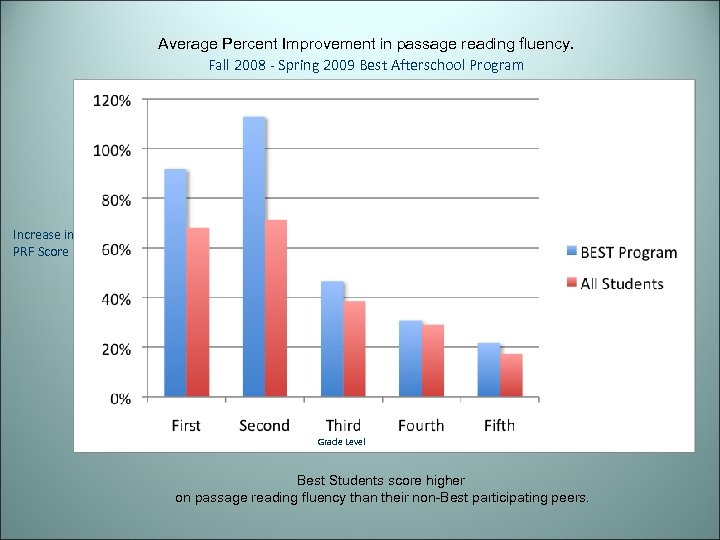
Average Percent Improvement in passage reading fluency. Fall 2008 - Spring 2009 Best Afterschool Program Increase in PRF Score Grade Level Best Students score higher on passage reading fluency than their non-Best participating peers.
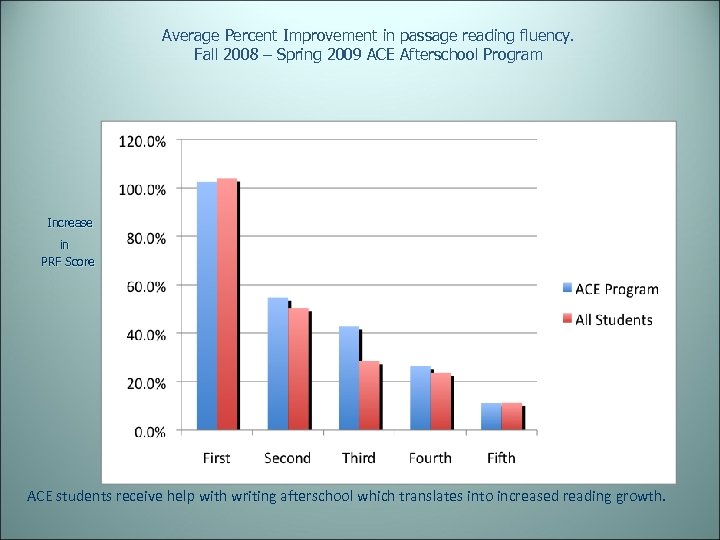
Average Percent Improvement in passage reading fluency. Fall 2008 – Spring 2009 ACE Afterschool Program Increase in PRF Score ACE students receive help with writing afterschool which translates into increased reading growth.
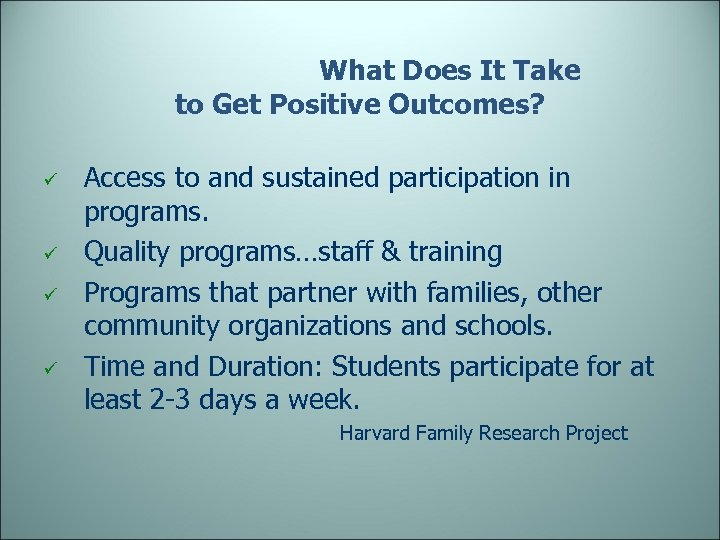
What Does It Take to Get Positive Outcomes? ü ü Access to and sustained participation in programs. Quality programs…staff & training Programs that partner with families, other community organizations and schools. Time and Duration: Students participate for at least 2 -3 days a week. Harvard Family Research Project
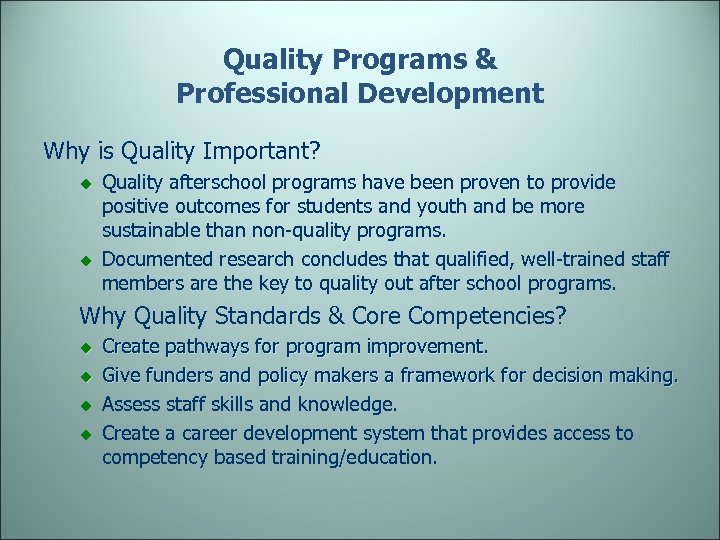
Quality Programs & Professional Development Why is Quality Important? u u Quality afterschool programs have been proven to provide positive outcomes for students and youth and be more sustainable than non-quality programs. Documented research concludes that qualified, well-trained staff members are the key to quality out after school programs. Why Quality Standards & Core Competencies? u u Create pathways for program improvement. Give funders and policy makers a framework for decision making. Assess staff skills and knowledge. Create a career development system that provides access to competency based training/education.
Oregon. ASK The collaboration has created Oregon n n Core Competencies Program Standards Program Self Assessment Glossary of Terms
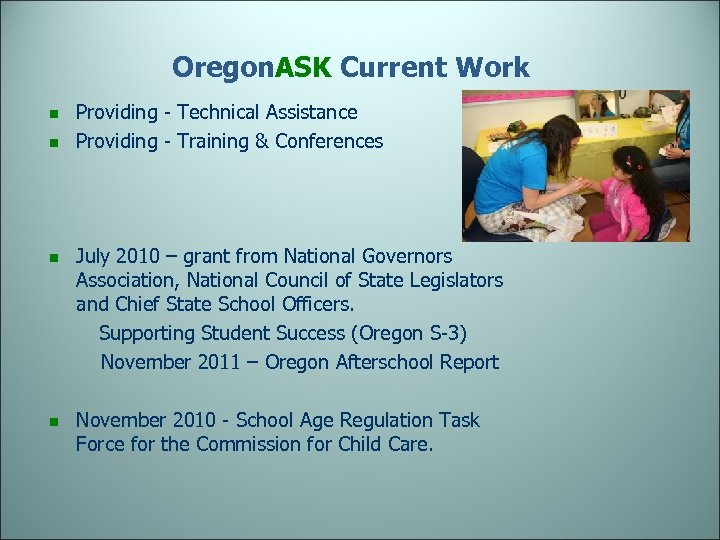
Oregon. ASK Current Work n n Providing - Technical Assistance Providing - Training & Conferences July 2010 – grant from National Governors Association, National Council of State Legislators and Chief State School Officers. Supporting Student Success (Oregon S-3) November 2011 – Oregon Afterschool Report n n November 2010 - School Age Regulation Task Force for the Commission for Child Care.
Challenges n n Lack of readily available statistics on programs – resulting in a lack of understanding about the current environment which inhibits development of policy. Longitudinal coordinated data systems that accommodate common core measures of programs and students supplemented by program specific measures. Information systems to ensure that information about students is shared across supports shared best practices and professional development opportunities Capacity on state and local levels to ensure program sustainability and promote quality.
Challenges State level policy coordination. n Alignment, coordination and accountability of funding streams that support programs. u Formalized systems for communication u Local program issues Safety Transportation Resources n
Support the creation of “complementary learning” environments. This idea is a systemic approach which intentionally integrates both school and nonschool supports. Will ensure that all children have the skills they need to succeed in school and in life. A complementary learning approach creates a seamless pathway from birth to college.
Скачать презентацию Oregon ASK Statewide Afterschool Network Beth Unverzagt Director
046cf730a81cef4c7b081f74f44bbf64.ppt