


 Скачать презентацию Ordinary Extraordinary Results from an scientific 1987
2f7b42ce64d9442aa528675bf47057de.ppt
- Количество слайдов: 113
 Ordinary? Extraordinary?
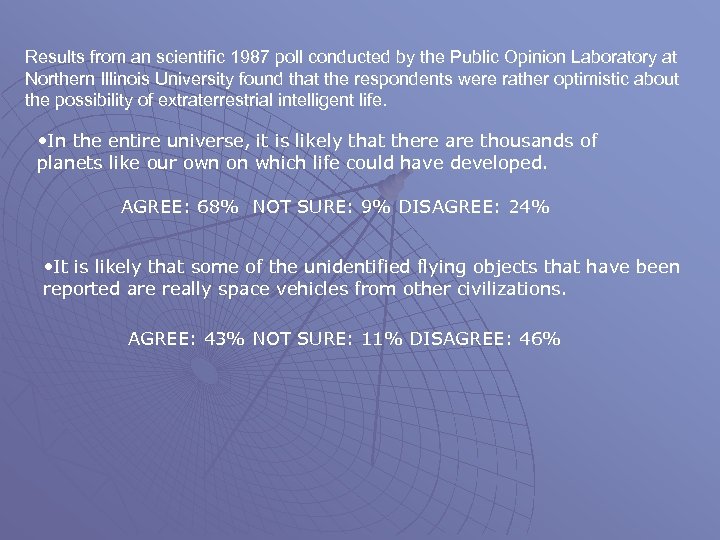 Results from an scientific 1987 poll conducted by the Public Opinion Laboratory at Northern Illinois University found that the respondents were rather optimistic about the possibility of extraterrestrial intelligent life. • In the entire universe, it is likely that there are thousands of planets like our own on which life could have developed. AGREE: 68% NOT SURE: 9% DISAGREE: 24% • It is likely that some of the unidentified flying objects that have been reported are really space vehicles from other civilizations. AGREE: 43% NOT SURE: 11% DISAGREE: 46%
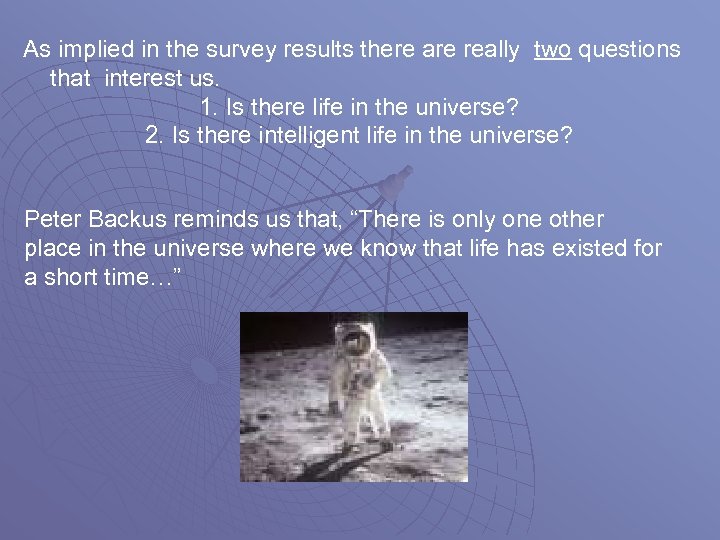 As implied in the survey results there are really two questions that interest us. 1. Is there life in the universe? 2. Is there intelligent life in the universe? Peter Backus reminds us that, “There is only one other place in the universe where we know that life has existed for a short time…”
 A sad spectacle. If they be inhabited, what a scope for misery and folly. If they be not inhabited, what a waste of space. Thomas Carlyle 19 th Century Scottish writer
 Intelligence… A sentient community of beings capable of sending their message across interstellar space. It is written this way to underline the need for a common framework to discuss what is meant by the word intelligent. This definition would disqualify our own species a century ago. On our planet we see many different forms of intelligent behavior such as that found among the apes, dolphins and other plant and animal species, so the above definition is not written to demean any intelligent forms of life on this world. It would be hard to imagine beings that were unable to interact with the universe on very complex level involving technology or without a deep knowledge of its physical properties.
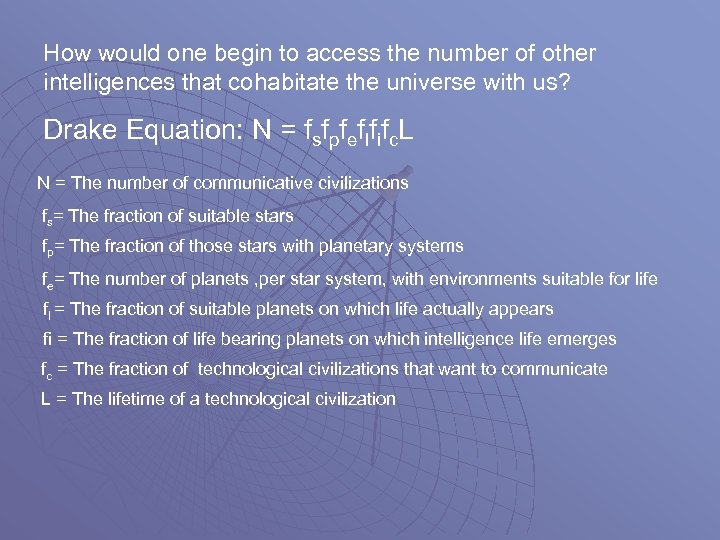 How would one begin to access the number of other intelligences that cohabitate the universe with us? Drake Equation: N = fsfpfeflfifc. L N = The number of communicative civilizations fs= The fraction of suitable stars fp= The fraction of those stars with planetary systems fe= The number of planets , per star system, with environments suitable for life fl = The fraction of suitable planets on which life actually appears fi = The fraction of life bearing planets on which intelligence life emerges fc = The fraction of technological civilizations that want to communicate L = The lifetime of a technological civilization
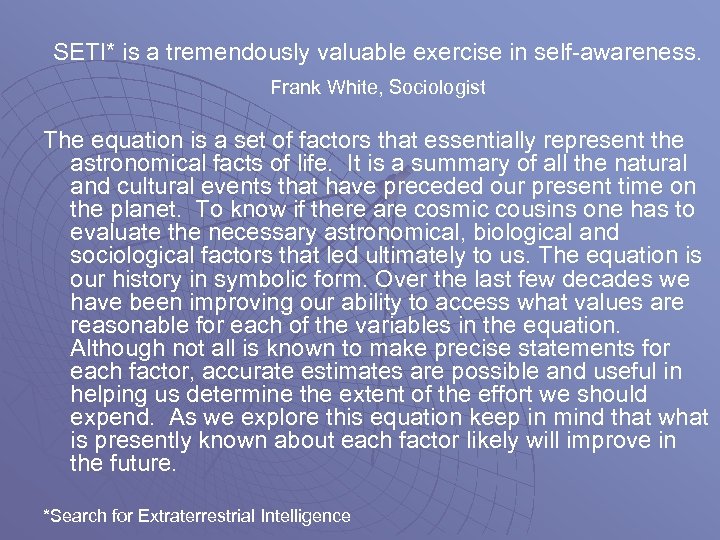 SETI* is a tremendously valuable exercise in self-awareness. Frank White, Sociologist The equation is a set of factors that essentially represent the astronomical facts of life. It is a summary of all the natural and cultural events that have preceded our present time on the planet. To know if there are cosmic cousins one has to evaluate the necessary astronomical, biological and sociological factors that led ultimately to us. The equation is our history in symbolic form. Over the last few decades we have been improving our ability to access what values are reasonable for each of the variables in the equation. Although not all is known to make precise statements for each factor, accurate estimates are possible and useful in helping us determine the extent of the effort we should expend. As we explore this equation keep in mind that what is presently known about each factor likely will improve in the future. *Search for Extraterrestrial Intelligence
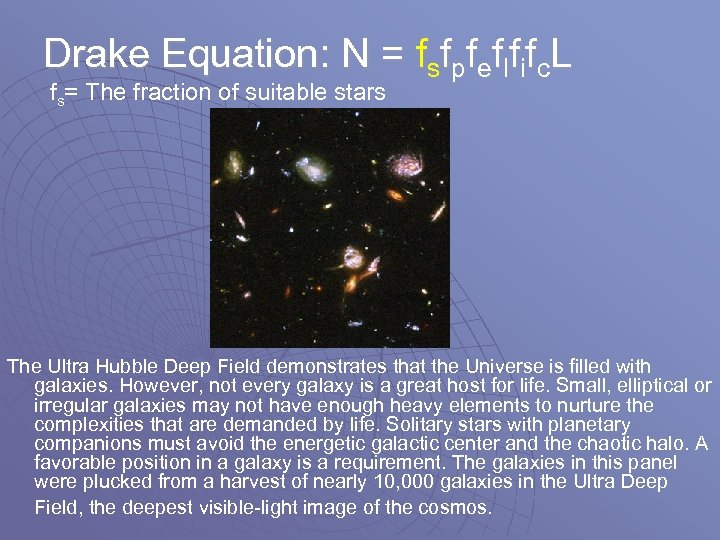 Drake Equation: N = fsfpfeflfifc. L fs= The fraction of suitable stars The Ultra Hubble Deep Field demonstrates that the Universe is filled with galaxies. However, not every galaxy is a great host for life. Small, elliptical or irregular galaxies may not have enough heavy elements to nurture the complexities that are demanded by life. Solitary stars with planetary companions must avoid the energetic galactic center and the chaotic halo. A favorable position in a galaxy is a requirement. The galaxies in this panel were plucked from a harvest of nearly 10, 000 galaxies in the Ultra Deep Field, the deepest visible-light image of the cosmos.
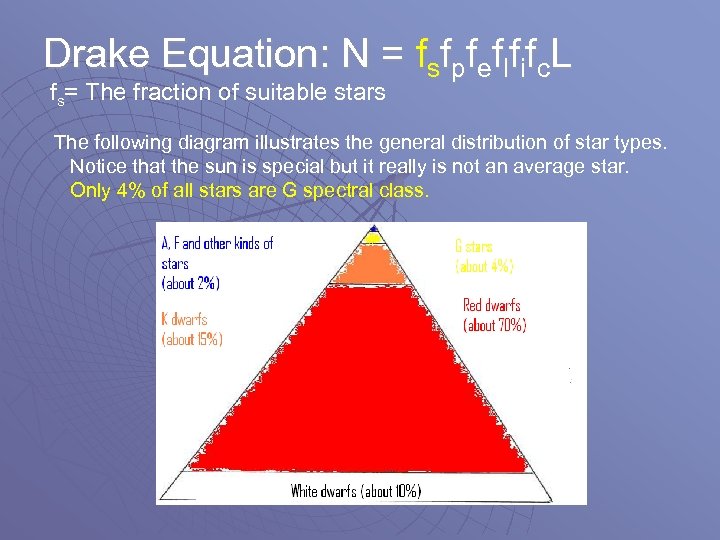 Drake Equation: N = fsfpfeflfifc. L fs= The fraction of suitable stars The following diagram illustrates the general distribution of star types. Notice that the sun is special but it really is not an average star. Only 4% of all stars are G spectral class.
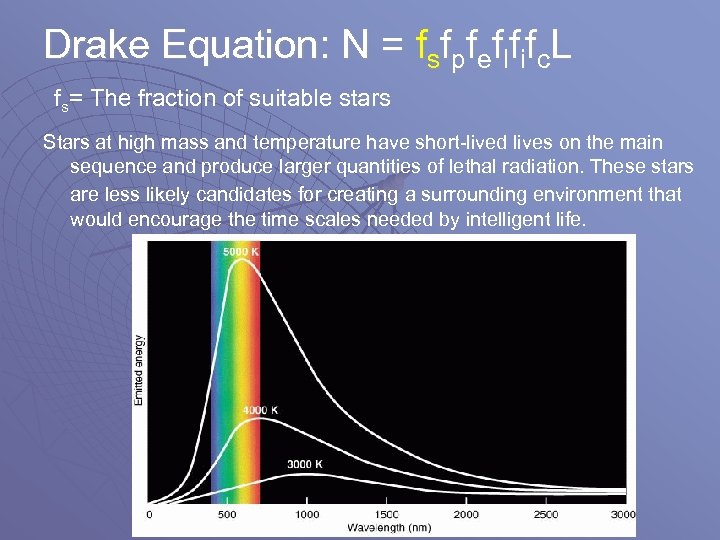 Drake Equation: N = fsfpfeflfifc. L fs= The fraction of suitable stars Stars at high mass and temperature have short-lived lives on the main sequence and produce larger quantities of lethal radiation. These stars are less likely candidates for creating a surrounding environment that would encourage the time scales needed by intelligent life.
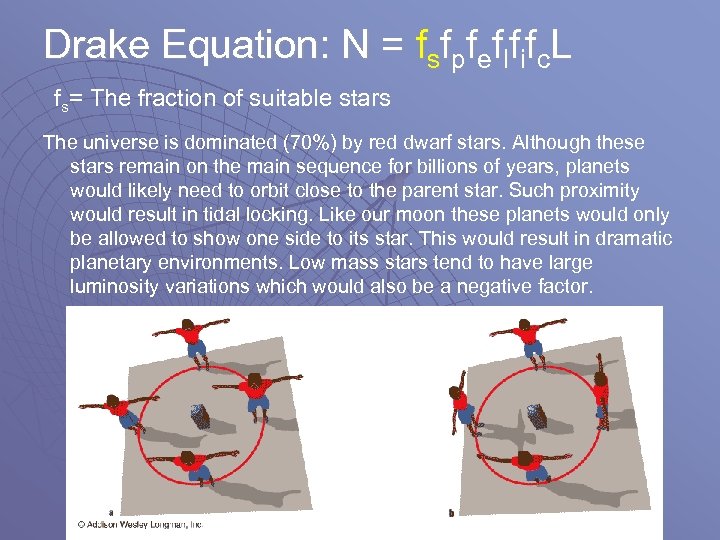 Drake Equation: N = fsfpfeflfifc. L fs= The fraction of suitable stars The universe is dominated (70%) by red dwarf stars. Although these stars remain on the main sequence for billions of years, planets would likely need to orbit close to the parent star. Such proximity would result in tidal locking. Like our moon these planets would only be allowed to show one side to its star. This would result in dramatic planetary environments. Low mass stars tend to have large luminosity variations which would also be a negative factor.
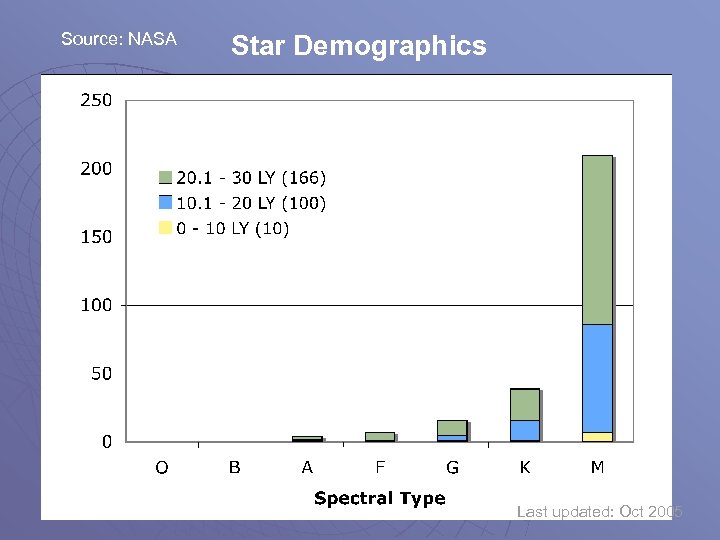 Source: NASA Star Demographics Last updated: Oct 2005
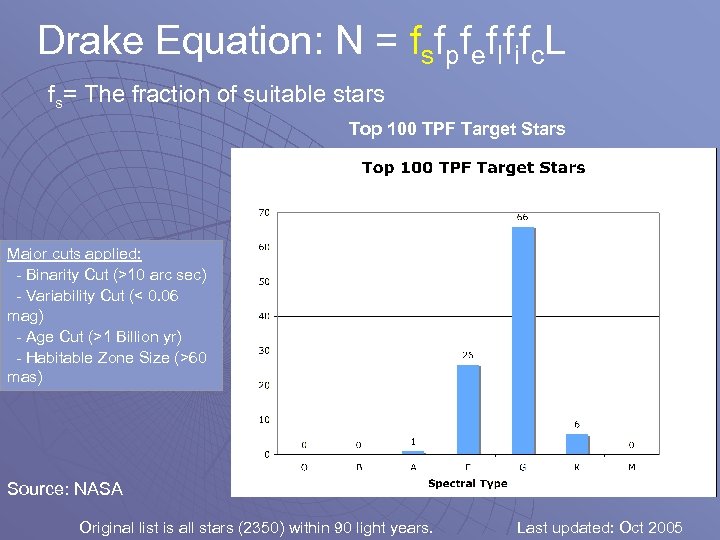 Drake Equation: N = fsfpfeflfifc. L fs= The fraction of suitable stars Top 100 TPF Target Stars Major cuts applied: - Binarity Cut (>10 arc sec) - Variability Cut (< 0. 06 mag) - Age Cut (>1 Billion yr) - Habitable Zone Size (>60 mas) Source: NASA Original list is all stars (2350) within 90 light years. Last updated: Oct 2005
 Drake Equation: N = fsfpfeflfifc. L fs= The fraction of suitable stars u In our particular corner of the Milky Way, the average metallicity of nearby stars appears to be about two-thirds that of our Sun. Specific evidence for our Sun’s being unusual is the fact that it contains significantly more carbon than is found in similar stars in our region of the galaxy. Average abundance of carbon in nearby stars is estimated to be about 225 carbon atoms per million hydrogen atoms. Estimates for our favorite star range from 350 to 470 carbon atoms per million hydrogen atoms. These figures strongly suggest that our Sun is “different” from most stars in the galaxy, having originated in a region especially rich in heavier elements. Luckily for us this region was richer not only in the common carbon atom but also in the rarer and heavier elements such as copper, zinc, tin, and many others. In fact, it may have been the shock wave of a nearby supernova explosion itself that produced a momentary compression within the presolar cloud. This may have both initiated the formation of our star and provided additional heavy elements that are so useful in building complex living things. William Burger
 Drake Equation: N = fsfpfeflfifc. L fs= The fraction of suitable stars The Sun is: u u u Stable-very slight variability in energy production Long Lived-main sequence resident for about 10 billion years Solitary-most stars are part of multiple star systems Metal Enriched-such an environment makes planets and life more likely Galactically Located Well-the sun is far away from the active energetic galactic core
 Drake Equation: N = fsfpfeflfifc. L fs= The fraction of suitable stars Summary: The galaxy is filled with billions of stars but solitary stars like the sun that are metal enriched are rare. Although low mass stars are more plentiful, they also present some limiting characteristics. At present this is the only factor in the equation that is known well.
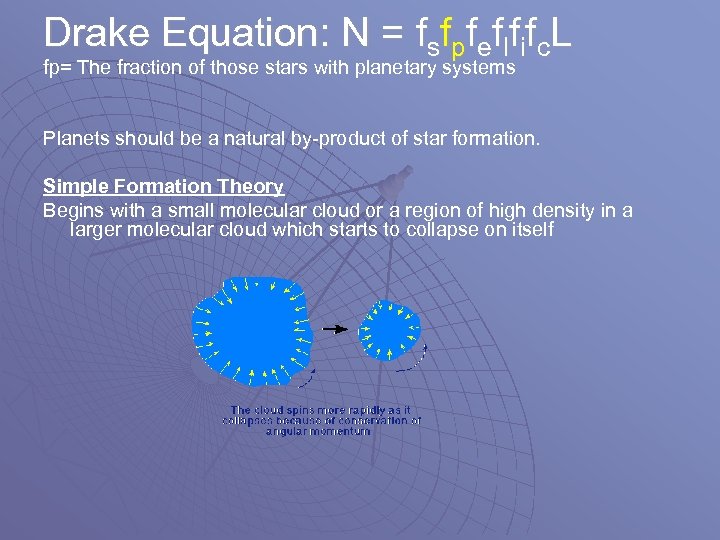 Drake Equation: N = fsfpfeflfifc. L fp= The fraction of those stars with planetary systems Planets should be a natural by-product of star formation. Simple Formation Theory Begins with a small molecular cloud or a region of high density in a larger molecular cloud which starts to collapse on itself
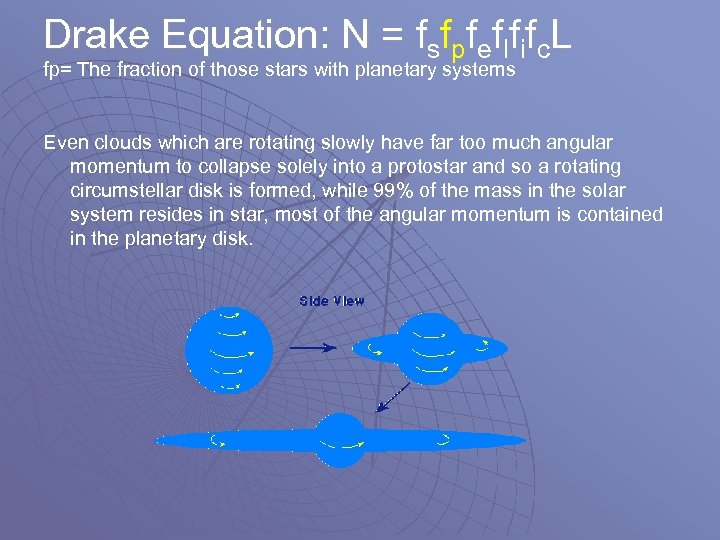 Drake Equation: N = fsfpfeflfifc. L fp= The fraction of those stars with planetary systems Even clouds which are rotating slowly have far too much angular momentum to collapse solely into a protostar and so a rotating circumstellar disk is formed, while 99% of the mass in the solar system resides in star, most of the angular momentum is contained in the planetary disk.
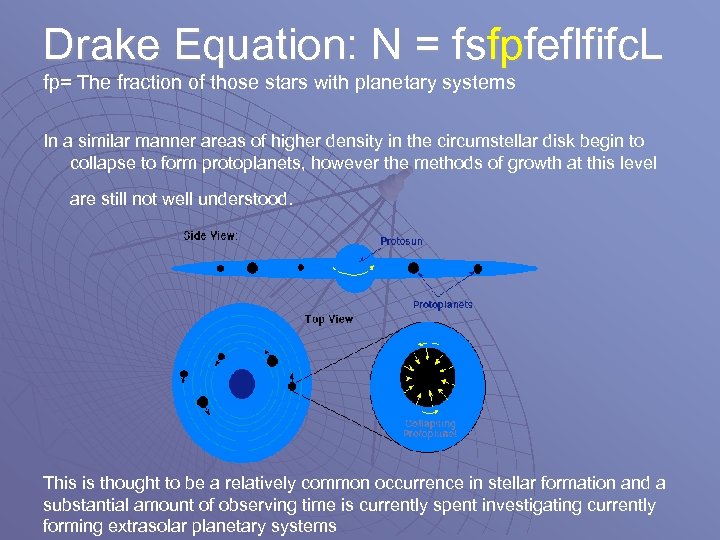 Drake Equation: N = fsfpfeflfifc. L fp= The fraction of those stars with planetary systems In a similar manner areas of higher density in the circumstellar disk begin to collapse to form protoplanets, however the methods of growth at this level are still not well understood. This is thought to be a relatively common occurrence in stellar formation and a substantial amount of observing time is currently spent investigating currently forming extrasolar planetary systems
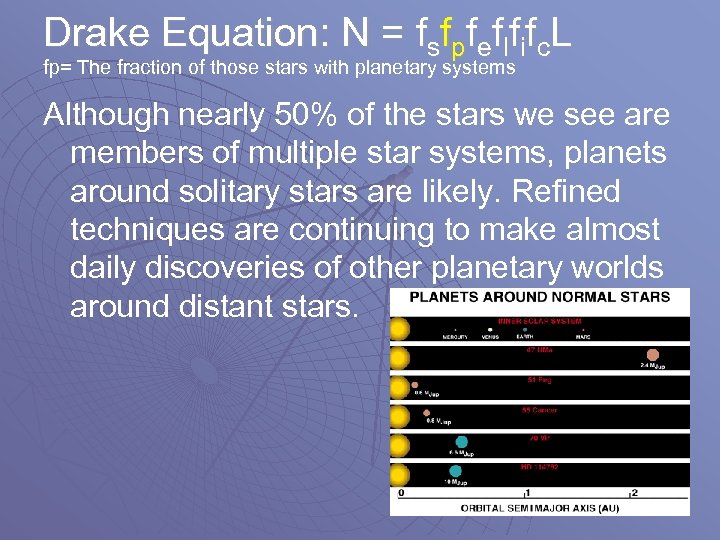 Drake Equation: N = fsfpfeflfifc. L fp= The fraction of those stars with planetary systems Although nearly 50% of the stars we see are members of multiple star systems, planets around solitary stars are likely. Refined techniques are continuing to make almost daily discoveries of other planetary worlds around distant stars.
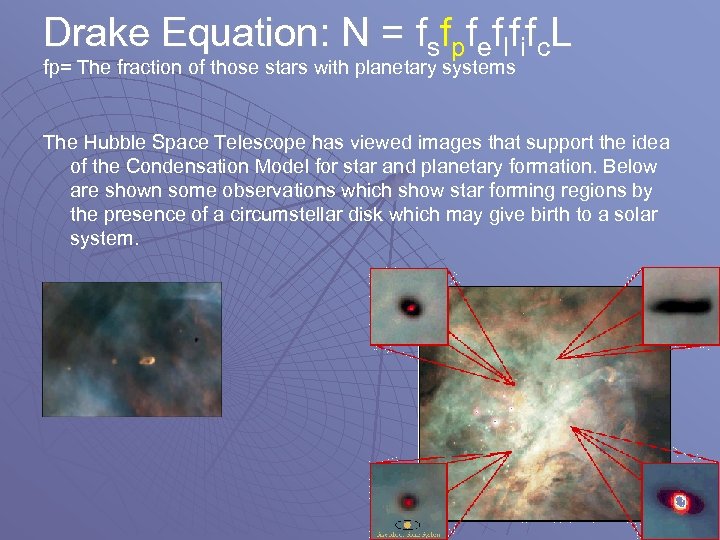 Drake Equation: N = fsfpfeflfifc. L fp= The fraction of those stars with planetary systems The Hubble Space Telescope has viewed images that support the idea of the Condensation Model for star and planetary formation. Below are shown some observations which show star forming regions by the presence of a circumstellar disk which may give birth to a solar system.
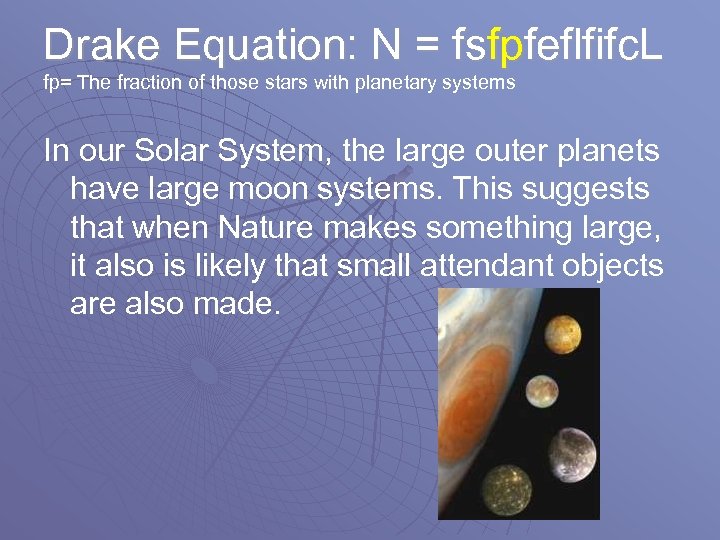 Drake Equation: N = fsfpfeflfifc. L fp= The fraction of those stars with planetary systems In our Solar System, the large outer planets have large moon systems. This suggests that when Nature makes something large, it also is likely that small attendant objects are also made.
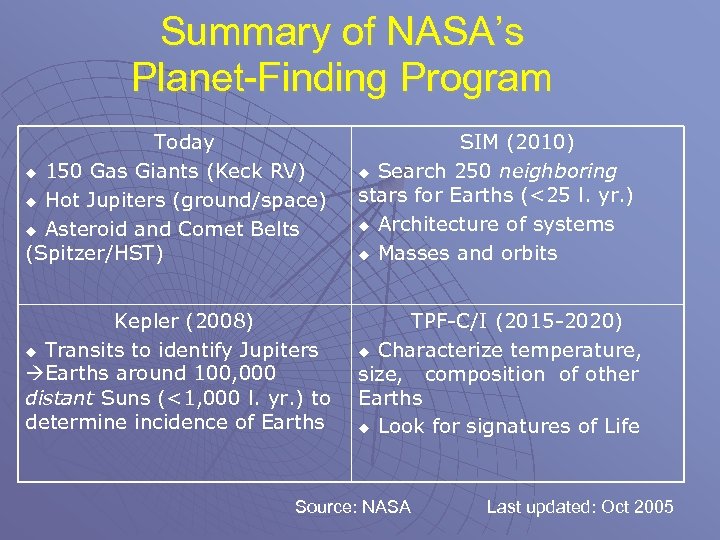 Summary of NASA’s Planet-Finding Program Today u 150 Gas Giants (Keck RV) u Hot Jupiters (ground/space) u Asteroid and Comet Belts (Spitzer/HST) SIM (2010) u Search 250 neighboring stars for Earths (<25 l. yr. ) u Architecture of systems u Masses and orbits Kepler (2008) u Transits to identify Jupiters Earths around 100, 000 distant Suns (<1, 000 l. yr. ) to determine incidence of Earths TPF-C/I (2015 -2020) u Characterize temperature, size, composition of other Earths u Look for signatures of Life Source: NASA Last updated: Oct 2005
 Drake Equation: N = fsfpfeflfifc. L Summary: Planet detection technology will continue to improve as space borne instruments are launched. Planets seem to be natural by products of the star formation process. Although the current data reflects a detection technique bias, systems like our own may still be in the minority.
 Drake Equation: N = fsfpfeflfifc. L fe= The number of planets , per star system, with environments suitable for life A suitable planet is not only about the three most important words in real estate: location, location but other factors are also important. u Location: Liquid surface water is a requirement for complex life. This requires that a planet reside within a certain distance from a star that supports a conducive temperature range for the chemistry of liquid water. A planet must also be far enough away from the star to avoid tidal locking.
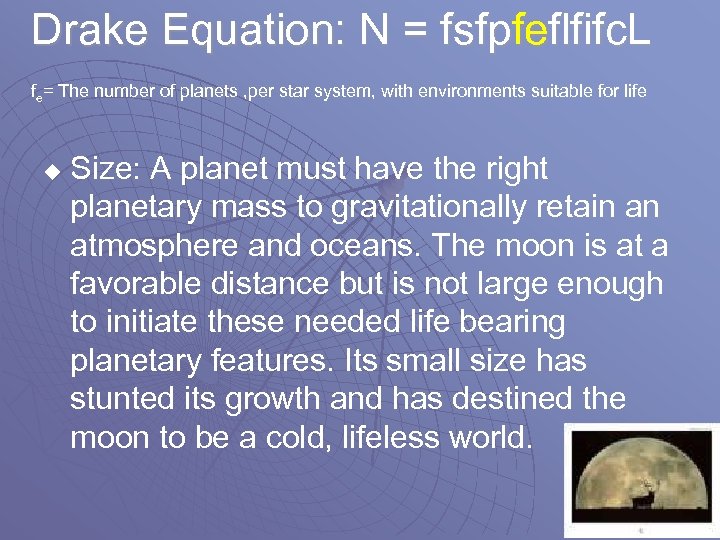 Drake Equation: N = fsfpfeflfifc. L fe= The number of planets , per star system, with environments suitable for life u Size: A planet must have the right planetary mass to gravitationally retain an atmosphere and oceans. The moon is at a favorable distance but is not large enough to initiate these needed life bearing planetary features. Its small size has stunted its growth and has destined the moon to be a cold, lifeless world.
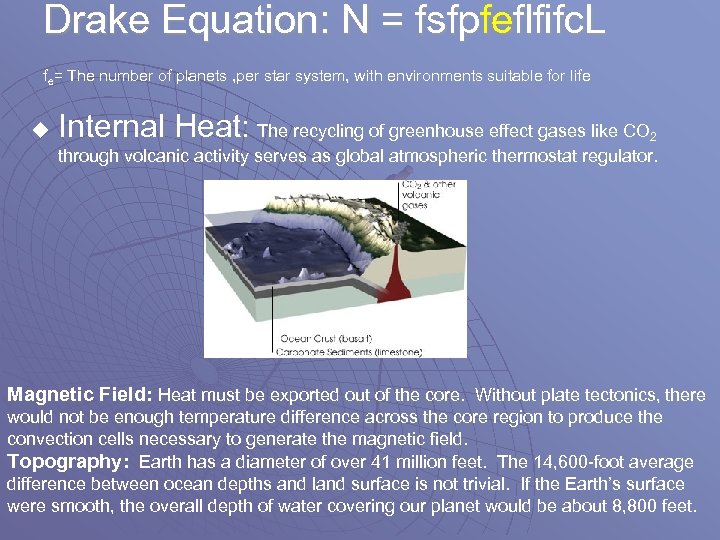 Drake Equation: N = fsfpfeflfifc. L fe= The number of planets , per star system, with environments suitable for life u Internal Heat: The recycling of greenhouse effect gases like CO 2 through volcanic activity serves as global atmospheric thermostat regulator. Magnetic Field: Heat must be exported out of the core. Without plate tectonics, there would not be enough temperature difference across the core region to produce the convection cells necessary to generate the magnetic field. Topography: Earth has a diameter of over 41 million feet. The 14, 600 -foot average difference between ocean depths and land surface is not trivial. If the Earth’s surface were smooth, the overall depth of water covering our planet would be about 8, 800 feet.
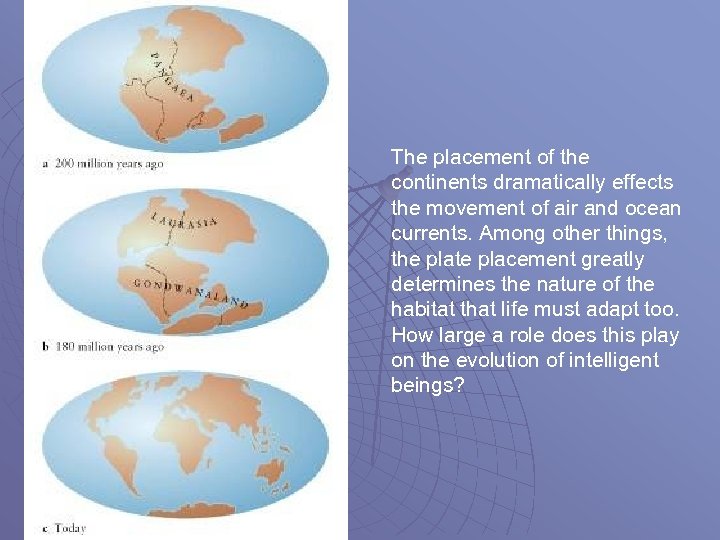 The placement of the continents dramatically effects the movement of air and ocean currents. Among other things, the plate placement greatly determines the nature of the habitat that life must adapt too. How large a role does this play on the evolution of intelligent beings?
 Drake Equation: N = fsfpfeflfifc. L fe= The number of planets , per star system, with environments suitable for life u Atmospheric Properties: An air layer is needed for the maintenance of adequate surface temperature and pressure for plants and animals. A hydrologic cycle of liquid, solid and gaseous water must be present to help erode the land to generate deposits of nutrients and economic mineral ores. Oxygen, an efficient energy exchange mechanism, must be “invented” by photosynthesis. The atmosphere must have the right proportion of this essential gas. The atmosphere must also be composed of gases that are capable of shielding the surface from dangerous radiation and small space debris. Both quality and quantity are narrowly defined.
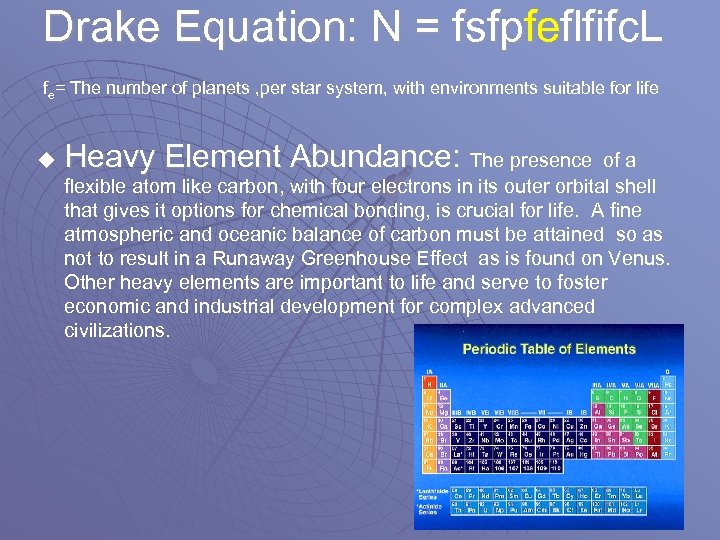 Drake Equation: N = fsfpfeflfifc. L fe= The number of planets , per star system, with environments suitable for life u Heavy Element Abundance: The presence of a flexible atom like carbon, with four electrons in its outer orbital shell that gives it options for chemical bonding, is crucial for life. A fine atmospheric and oceanic balance of carbon must be attained so as not to result in a Runaway Greenhouse Effect as is found on Venus. Other heavy elements are important to life and serve to foster economic and industrial development for complex advanced civilizations.
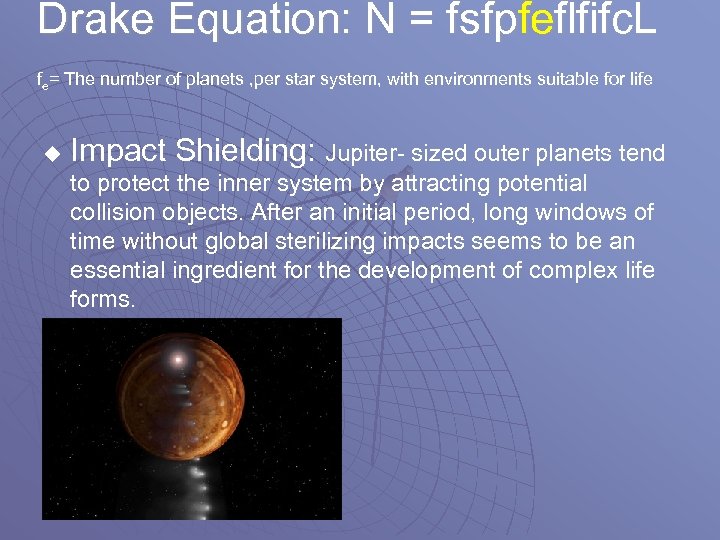 Drake Equation: N = fsfpfeflfifc. L fe= The number of planets , per star system, with environments suitable for life u Impact Shielding: Jupiter- sized outer planets tend to protect the inner system by attracting potential collision objects. After an initial period, long windows of time without global sterilizing impacts seems to be an essential ingredient for the development of complex life forms.
 Drake Equation: N = fsfpfeflfifc. L fe= The number of planets , per star system, with environments suitable for life u Impact Generation: Physicist John Cramer offers a viewpoint that also may be equally valid. There is a gap in the Asteroid Belt at a distance of 2. 5 AU. The gap occurs because of a resonance effect. An asteroid at this distance orbits the Sun in precisely 1/3 the time that Jupiter does. Jupiter and the asteroid line up on every third orbit of the asteroid. Jupiter will gravitationally accelerate, in the same direction, the asteroid. Over time this cumulative gravitational effect will create an unstable orbit. Calculations show that there is a high probability that the new orbit of the asteroid will be one that crosses the orbit of our planet. According to Cramer, “Evolution seems to be pumped by cycles of crises and stability. ” Although Nature is able to generate many other disasters that life needs to adapt to, the thought that a system of planets and asteroids of the right masses and precise orbital patterns to “pump evolution” and to have this “evolution pump” operate at the correct rate is at the very least an interesting bit of speculation.
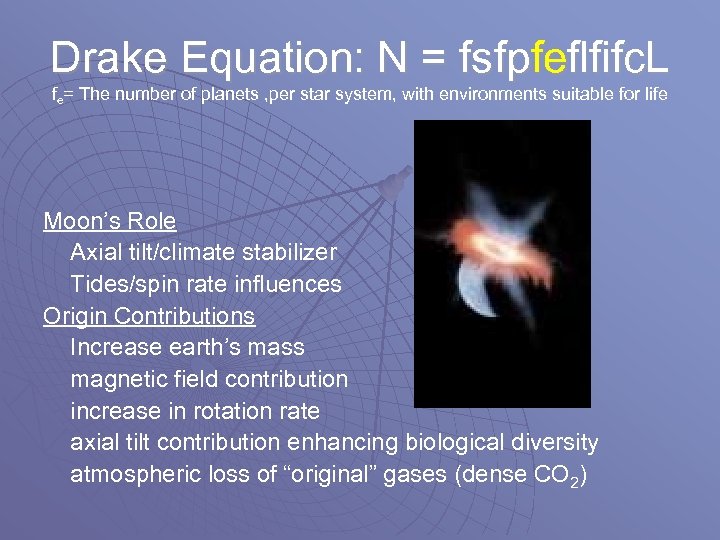 Drake Equation: N = fsfpfeflfifc. L fe= The number of planets , per star system, with environments suitable for life Moon’s Role Axial tilt/climate stabilizer Tides/spin rate influences Origin Contributions Increase earth’s mass magnetic field contribution increase in rotation rate axial tilt contribution enhancing biological diversity atmospheric loss of “original” gases (dense CO 2)
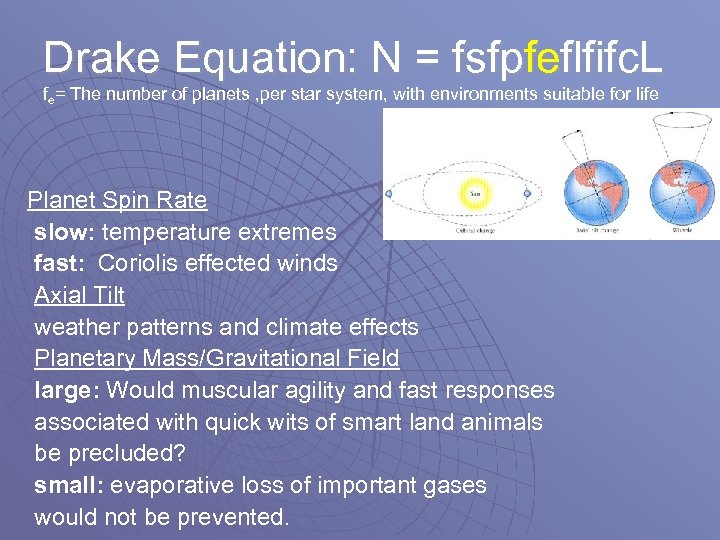 Drake Equation: N = fsfpfeflfifc. L fe= The number of planets , per star system, with environments suitable for life Planet Spin Rate slow: temperature extremes fast: Coriolis effected winds Axial Tilt weather patterns and climate effects Planetary Mass/Gravitational Field large: Would muscular agility and fast responses associated with quick wits of smart land animals be precluded? small: evaporative loss of important gases would not be prevented.
 Drake Equation: N = fsfpfeflfifc. L Summary: Only one stable life bearing planetary system is presently known. Creating a favorable planetary environment for advanced life forms not only requires a preferred size and location but atmospheric, oceanic and geologic conditions must also be in harmony. Various extraterrestrial conditions play major roles as well. It should be noted that the timing or sequence of events can not be neglected as to the quality and quantity of the “life product” that arises on a habitable environment.
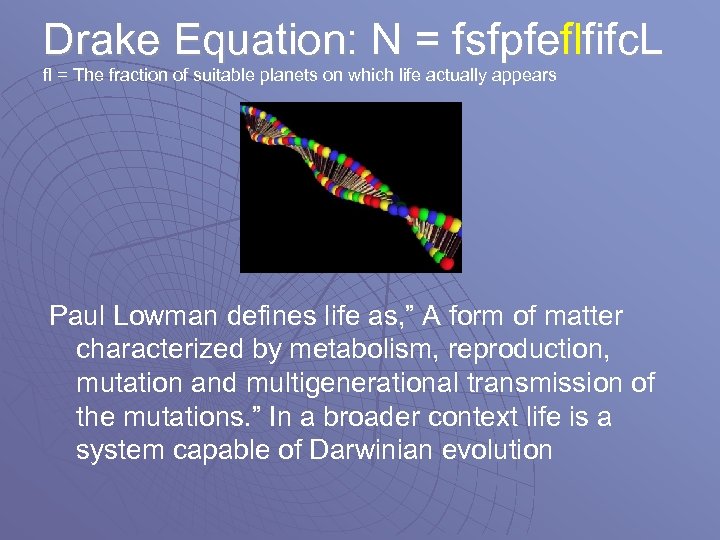 Drake Equation: N = fsfpfeflfifc. L fl = The fraction of suitable planets on which life actually appears Paul Lowman defines life as, ” A form of matter characterized by metabolism, reproduction, mutation and multigenerational transmission of the mutations. ” In a broader context life is a system capable of Darwinian evolution
 Drake Equation: N = fsfpfeflfifc. L fl = The fraction of suitable planets on which life actually appears Chemically, life reflects the composition of the universe UNIVERSE COMPOSITION Hydrogen 90% Helium Oxygen 9% Carbon Nitrogen 4 major LIVING CELLS COMPOSITION Hydrogen Oxygen 99% Carbon Nitrogen 7 minor Sodium Potassium. 7% Calcium Magnesium Sulfur Phosphorous Chlorine Trace Iodine Iron Copper Zinc Magenese . 3%
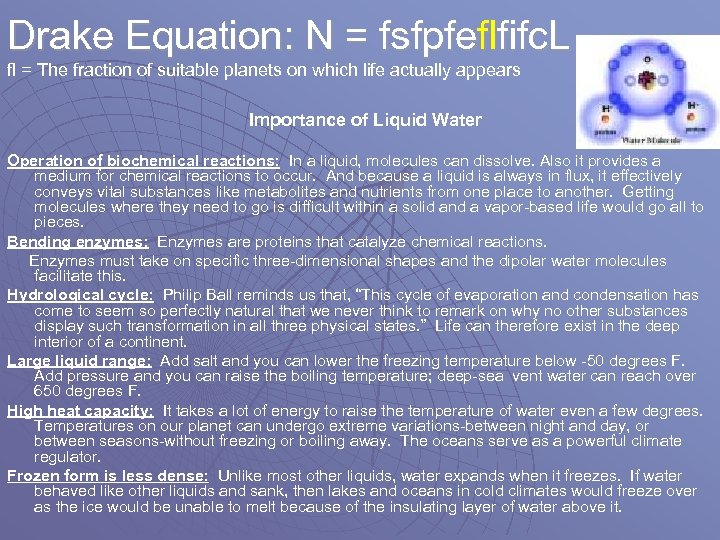 Drake Equation: N = fsfpfeflfifc. L fl = The fraction of suitable planets on which life actually appears Importance of Liquid Water Operation of biochemical reactions: In a liquid, molecules can dissolve. Also it provides a medium for chemical reactions to occur. And because a liquid is always in flux, it effectively conveys vital substances like metabolites and nutrients from one place to another. Getting molecules where they need to go is difficult within a solid and a vapor-based life would go all to pieces. Bending enzymes: Enzymes are proteins that catalyze chemical reactions. Enzymes must take on specific three-dimensional shapes and the dipolar water molecules facilitate this. Hydrological cycle: Philip Ball reminds us that, “This cycle of evaporation and condensation has come to seem so perfectly natural that we never think to remark on why no other substances display such transformation in all three physical states. ” Life can therefore exist in the deep interior of a continent. Large liquid range: Add salt and you can lower the freezing temperature below -50 degrees F. Add pressure and you can raise the boiling temperature; deep-sea vent water can reach over 650 degrees F. High heat capacity: It takes a lot of energy to raise the temperature of water even a few degrees. Temperatures on our planet can undergo extreme variations-between night and day, or between seasons-without freezing or boiling away. The oceans serve as a powerful climate regulator. Frozen form is less dense: Unlike most other liquids, water expands when it freezes. If water behaved like other liquids and sank, then lakes and oceans in cold climates would freeze over as the ice would be unable to melt because of the insulating layer of water above it.
 Drake Equation: N = fsfpfeflfifc. L fl = The fraction of suitable planets on which life actually appears Principles of Evolution * all organisms tend to produce more offspring than can possibly survive. * offspring vary among themselves, and are not carbon copies of an immutable type. * at least some variation is passed down by inheritance to future generations (tall parents tend to have tall children). Since nature’s limited ecology can not accommodate all, many offspring die. Then on average, survivors will tend to be individuals with variations that are fortuitously best suited to changing local environments. The accumulation of these favorable variants through time will produce evolutionary change.
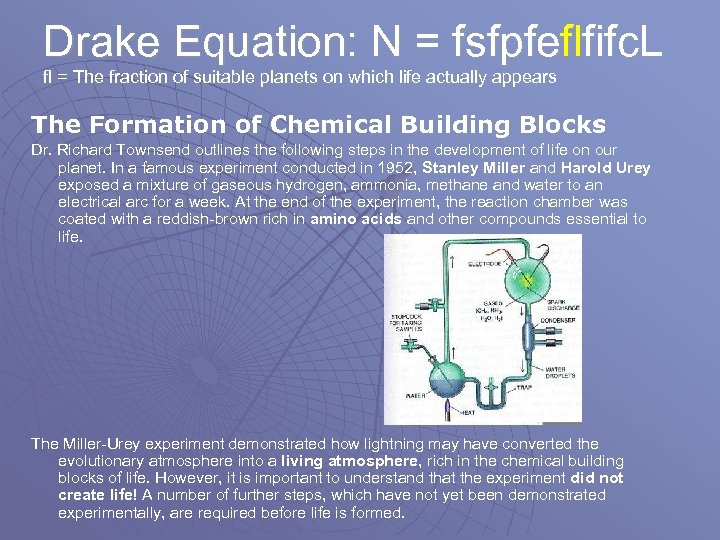 Drake Equation: N = fsfpfeflfifc. L fl = The fraction of suitable planets on which life actually appears The Formation of Chemical Building Blocks Dr. Richard Townsend outlines the following steps in the development of life on our planet. In a famous experiment conducted in 1952, Stanley Miller and Harold Urey exposed a mixture of gaseous hydrogen, ammonia, methane and water to an electrical arc for a week. At the end of the experiment, the reaction chamber was coated with a reddish-brown rich in amino acids and other compounds essential to life. The Miller-Urey experiment demonstrated how lightning may have converted the evolutionary atmosphere into a living atmosphere, rich in the chemical building blocks of life. However, it is important to understand that the experiment did not create life! A number of further steps, which have not yet been demonstrated experimentally, are required before life is formed.
 Drake Equation: N = fsfpfeflfifc. L fl = The fraction of suitable planets on which life actually appears The Formation of Macromolecules After the formation of the amino acids and other building blocks, and their subsequent solution in liquid water, various processes (such as adsorption on clay particles, or confinement in evaporating pools) would have conspired to concentrate these compounds. Under the influence of an energy source (such as UV light or heat), the concentrated compounds would have combined to form large macromolecules, such as polypeptides (precursors of proteins) and polynucleotides (precursors of DNA).
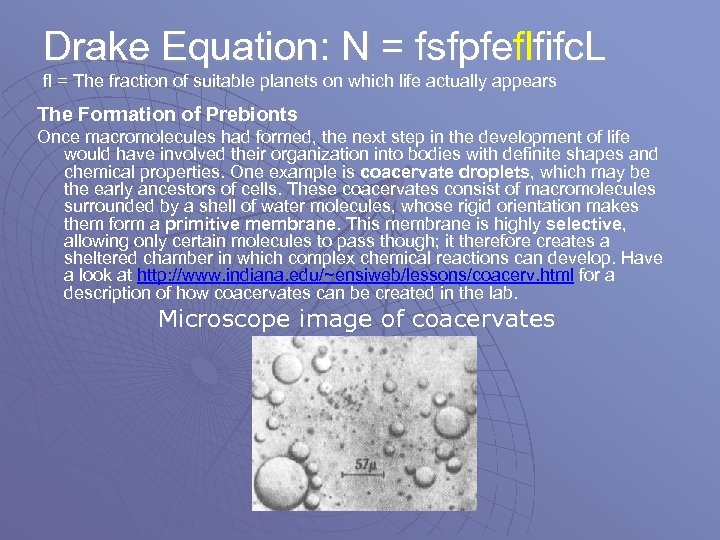 Drake Equation: N = fsfpfeflfifc. L fl = The fraction of suitable planets on which life actually appears The Formation of Prebionts Once macromolecules had formed, the next step in the development of life would have involved their organization into bodies with definite shapes and chemical properties. One example is coacervate droplets, which may be the early ancestors of cells. These coacervates consist of macromolecules surrounded by a shell of water molecules, whose rigid orientation makes them form a primitive membrane. This membrane is highly selective, allowing only certain molecules to pass though; it therefore creates a sheltered chamber in which complex chemical reactions can develop. Have a look at http: //www. indiana. edu/~ensiweb/lessons/coacerv. html for a description of how coacervates can be created in the lab. Microscope image of coacervates
 Drake Equation: N = fsfpfeflfifc. L fl = The fraction of suitable planets on which life actually appears The Formation of Prokaryotic Organisms With ever-more complex reactions taking place in prebionts, a point was reached where self-replicating molecules were formed. One example is the nucleic acids, such as DNA and RNA. These molecules have the ability to copy themselves, and therefore act as information stores. Due to random mutations occurring during the copying process, the appearance of self-replicating molecules meant that the prebionts began to evolve through the process of natural selection. Only those prebionts which were able to make the best use of the available sources of energy and raw materials were able to survive and produce a new generation of prebionts, containing the genetic information of their own "parents". At the point, the prebionts had reached a level of advancement which amounted to living organisms (albeit primitive). These singlecelled organisms were prokaryotic, meaning that they lacked an inner membrane around a nucleus of genetic material. They were much like present-day bacteria.
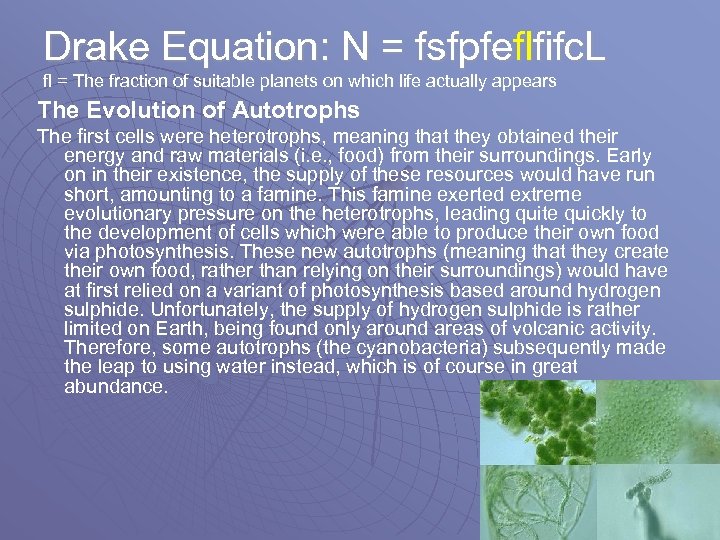 Drake Equation: N = fsfpfeflfifc. L fl = The fraction of suitable planets on which life actually appears The Evolution of Autotrophs The first cells were heterotrophs, meaning that they obtained their energy and raw materials (i. e. , food) from their surroundings. Early on in their existence, the supply of these resources would have run short, amounting to a famine. This famine exerted extreme evolutionary pressure on the heterotrophs, leading quite quickly to the development of cells which were able to produce their own food via photosynthesis. These new autotrophs (meaning that they create their own food, rather than relying on their surroundings) would have at first relied on a variant of photosynthesis based around hydrogen sulphide. Unfortunately, the supply of hydrogen sulphide is rather limited on Earth, being found only around areas of volcanic activity. Therefore, some autotrophs (the cyanobacteria) subsequently made the leap to using water instead, which is of course in great abundance.
 Drake Equation: N = fsfpfeflfifc. L fl = The fraction of suitable planets on which life actually appears The Evolution of Aerobic Organisms When photosynthesis is based around water, it produces a significant by-product: oxygen. Since oxygen was highly toxic to the cyanobacteria producing it, they were forced to evolve means of protecting themselves from it, primarily by excreting it as a gas. Their success in this led to the steady pumping of oxygen into the Earth's atmosphere. Initially, the oxygen would have reacted with surface minerals to create oxides. This would have gone on until about 2 billion years ago when all of the available minerals were already oxidized. At this juncture, the levels of atmospheric oxygen would have begun to rise, and a new type of heterotrophic life evolved to take advantage of the oxygen as an energy source: the aerobic respirators.
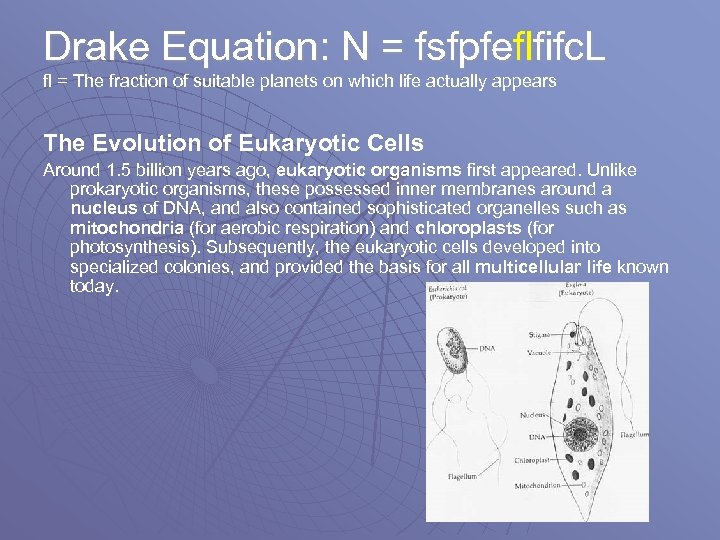 Drake Equation: N = fsfpfeflfifc. L fl = The fraction of suitable planets on which life actually appears The Evolution of Eukaryotic Cells Around 1. 5 billion years ago, eukaryotic organisms first appeared. Unlike prokaryotic organisms, these possessed inner membranes around a nucleus of DNA, and also contained sophisticated organelles such as mitochondria (for aerobic respiration) and chloroplasts (for photosynthesis). Subsequently, the eukaryotic cells developed into specialized colonies, and provided the basis for all multicellular life known today.
 Drake Equation: N = fsfpfeflfifc. L fl = The fraction of suitable planets on which life actually appears How rare it is to have life! Photosynthesis might never have happened * Photosynthesis involves chlorophyll, a photo-sensitive pigment which is capable of capturing a photon from the Sun. - (not intended to capture energy at first, only in place as a dye to protect against UV). – sort of like the dyes in your eye which are color sensitive. - Pigment absorbs sufficient energy for an electron to be raised to an “excited” state – but electron returns to normal in a nano-second (10 -9 seconds). *The crucial step is to manipulate the electron such that it stays excited for milliseconds (10 -3), not nano-seconds. This extra time allows the energy to be moved to a molecule where the living organism can use it. * That crucial step was accomplished when bacteria created the “magnetosome”, now present in bacteria, fish and humans. - Electrons stay “excited” in the presence of a magnetic field - So biology created a magnet for living things out of iron – a biological magnet called a magnetosome. • Thus iron became an essential part of life – as we know it on Earth! Habitats for Life in the Solar System, and Beyond Claudia J. Alexander 6/29/00
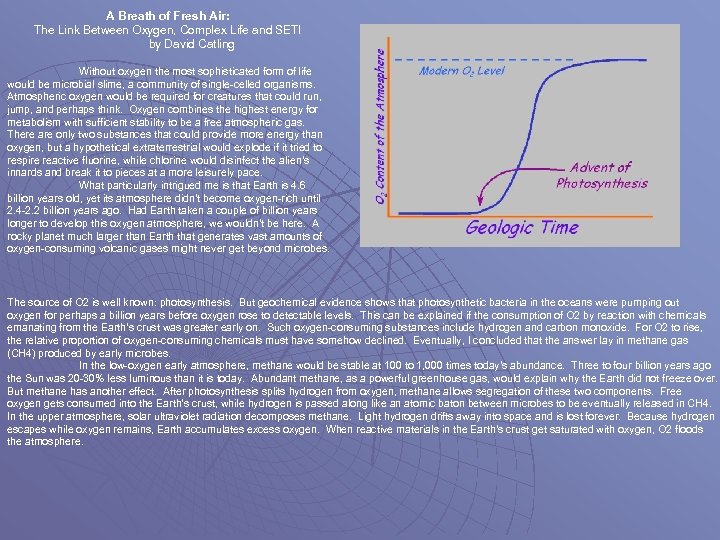 A Breath of Fresh Air: The Link Between Oxygen, Complex Life and SETI by David Catling Without oxygen the most sophisticated form of life would be microbial slime, a community of single-celled organisms. Atmospheric oxygen would be required for creatures that could run, jump, and perhaps think. Oxygen combines the highest energy for metabolism with sufficient stability to be a free atmospheric gas. There are only two substances that could provide more energy than oxygen, but a hypothetical extraterrestrial would explode if it tried to respire reactive fluorine, while chlorine would disinfect the alien’s innards and break it to pieces at a more leisurely pace. What particularly intrigued me is that Earth is 4. 6 billion years old, yet its atmosphere didn’t become oxygen-rich until 2. 4 -2. 2 billion years ago. Had Earth taken a couple of billion years longer to develop this oxygen atmosphere, we wouldn’t be here. A rocky planet much larger than Earth that generates vast amounts of oxygen-consuming volcanic gases might never get beyond microbes. The source of O 2 is well known: photosynthesis. But geochemical evidence shows that photosynthetic bacteria in the oceans were pumping out oxygen for perhaps a billion years before oxygen rose to detectable levels. This can be explained if the consumption of O 2 by reaction with chemicals emanating from the Earth’s crust was greater early on. Such oxygen-consuming substances include hydrogen and carbon monoxide. For O 2 to rise, the relative proportion of oxygen-consuming chemicals must have somehow declined. Eventually, I concluded that the answer lay in methane gas (CH 4) produced by early microbes. In the low-oxygen early atmosphere, methane would be stable at 100 to 1, 000 times today’s abundance. Three to four billion years ago the Sun was 20 -30% less luminous than it is today. Abundant methane, as a powerful greenhouse gas, would explain why the Earth did not freeze over. But methane has another effect. After photosynthesis splits hydrogen from oxygen, methane allows segregation of these two components. Free oxygen gets consumed into the Earth’s crust, while hydrogen is passed along like an atomic baton between microbes to be eventually released in CH 4. In the upper atmosphere, solar ultraviolet radiation decomposes methane. Light hydrogen drifts away into space and is lost forever. Because hydrogen escapes while oxygen remains, Earth accumulates excess oxygen. When reactive materials in the Earth’s crust get saturated with oxygen, O 2 floods the atmosphere.
 Drake Equation: N = fsfpfeflfifc. L fl = The fraction of suitable planets on which life actually appears Significance of Sex Asexual reproduction produces offspring who are all “holding the same hand of cards. ” Exchanging genes with oneself or a close relative doesn’t produce much in the way of variability among the offspring. Virtually all long-term studies of asexual self-reproduction indicate that eventually the lineage begins to decline in viability. Bad mutations accumulate and there is no way to get rid of them. As a result some small organisms tend to have episodes of sexual reproduction from time to time. Sexual reproduction produces a huge variety of different “hands” by continuously reshuffling the cards. Sex produces diversity within populations to meet the challenges of inevitable and unpredictable environmental changes as well as having varied offspring who can take advantage of minor differences in the local environment. More significantly, the continual recombination of genes, thanks to sex, is perhaps the only way of dealing with the environment’s nastiest challenge: short-lived, rapidly mutating pathogens and parasites. Finally, sex allows advantageous new genes to spread through the population much more rapidly than is possible in asexual reproduction. William Burger
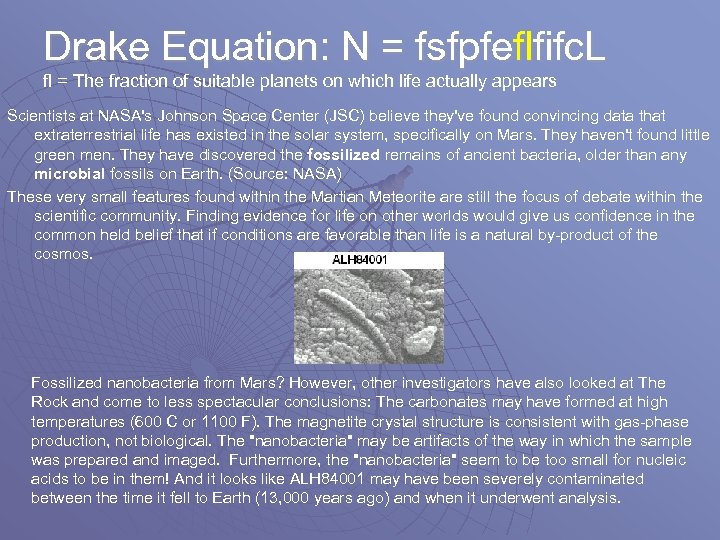 Drake Equation: N = fsfpfeflfifc. L fl = The fraction of suitable planets on which life actually appears Scientists at NASA's Johnson Space Center (JSC) believe they've found convincing data that extraterrestrial life has existed in the solar system, specifically on Mars. They haven't found little green men. They have discovered the fossilized remains of ancient bacteria, older than any microbial fossils on Earth. (Source: NASA) ( These very small features found within the Martian Meteorite are still the focus of debate within the scientific community. Finding evidence for life on other worlds would give us confidence in the common held belief that if conditions are favorable than life is a natural by-product of the cosmos. Fossilized nanobacteria from Mars? However, other investigators have also looked at The Rock and come to less spectacular conclusions: The carbonates may have formed at high temperatures (600 C or 1100 F). The magnetite crystal structure is consistent with gas-phase production, not biological. The "nanobacteria" may be artifacts of the way in which the sample was prepared and imaged. Furthermore, the "nanobacteria" seem to be too small for nucleic acids to be in them! And it looks like ALH 84001 may have been severely contaminated between the time it fell to Earth (13, 000 years ago) and when it underwent analysis.
 Drake Equation: N = fsfpfeflfifc. L fl = The fraction of suitable planets on which life actually appears Biology is not an isolated entity. All the planetary and astronomical conditions of its environment either encourage or discourage the biochemical experiments it constructs to meet the demands of the selective evolutionary escalation pressure sources. William Burger reminds us about the challenges that life itself creates. He states, “The biological “arms race” is a situation in which a species must respond to environmental variation, predator and prey, disease and host relationships and the pressure from pests. ” It is a dynamic and time dependent stage to perform upon. As my mother would say, “Life is hard yard by yard…”
 Drake Equation: N = fsfpfeflfifc. L fl = The fraction of suitable planets on which life actually appears Summary: One can be encouraged by the fact that the chemistry of life mimics the composition of stars. Experimental investigations involving extreme environments on Earth demonstrate the tenacity of life. Investigations of Mars and the moons of Jupiter and Saturn will deepen our understanding of the conditions that foster life. However, many subtle steps such as the development of a cell membrane and the chemistry of photosynthesis seem to suggest some narrow passage ways exist and that environmental barriers may arrest development. Although life appeared upon Earth early in the history of the planet, time’s influence is an uncertainty.
 Drake Equation: N = fsfpfeflfifc. L fi = The fraction of life bearing planets on which intelligence life emerges Is intelligence inevitable? . . . Doubt Supposed Nature wipe the slate of Earth clean and started over. Over time would the result end up with us again? Anthropologist Irven De. Vore reminds us that, " Evolution is history; it’s not a series of predictions. Natural selection, which is the engine driving evolution, is an uncaring, blind process. ” He suggests that the development of intelligence is highly improbable because of its dependency on contingency, catastrophe and competition. “By contingency I mean an unpredictable series of antecedent events-living species are dependent on all preceding events. ” Catastrophe creates the need for change. Nature is guided by the principle that if it ain’t broke don’t fix it. Competition urges biochemistry to experiment as it seeks effective solutions. These dynamic dependencies are active ingredients whose proper proportions are probably unknowable.
 Drake Equation: N = fsfpfeflfifc. L fi = The fraction of life bearing planets on which intelligence life emerges Is intelligence inevitable? . . . Doubt From the Encyclopedia Britannica: “It is difficult to imagine life evolving on another planet without progressing towards intelligence. ” Earth history again supports exactly the opposite conclusion. In reality, vanishingly few animals on Earth have bothered with much of either intelligence or dexterity. No animal has acquired remotely as much of either as have we; those that have acquired a little of one (smart dolphins, dexterous spiders) have acquired none of the other; and the only other species to acquire a little of both (common and pygmy chimpanzees) have been rather unsuccessful. Earth’s really successful species have instead been dumb and clumsy rats and beetles, which found better routes to their current dominance. Jared Diamond
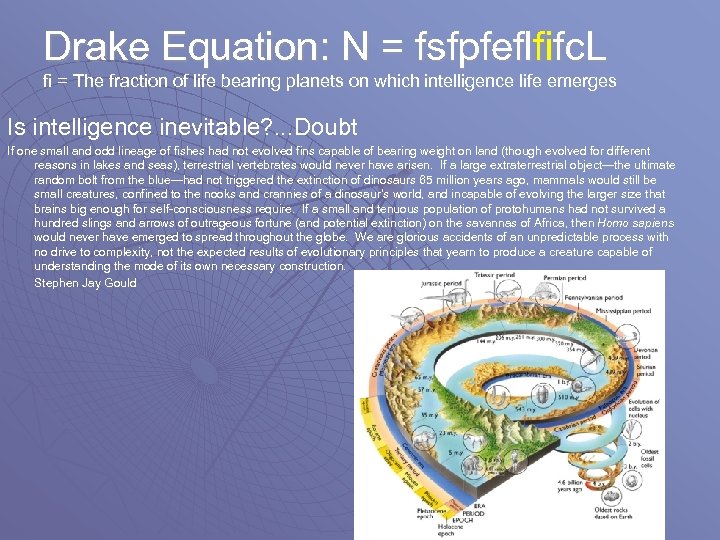 Drake Equation: N = fsfpfeflfifc. L fi = The fraction of life bearing planets on which intelligence life emerges Is intelligence inevitable? . . . Doubt If one small and odd lineage of fishes had not evolved fins capable of bearing weight on land (though evolved for different reasons in lakes and seas), terrestrial vertebrates would never have arisen. If a large extraterrestrial object—the ultimate random bolt from the blue—had not triggered the extinction of dinosaurs 65 million years ago, mammals would still be small creatures, confined to the nooks and crannies of a dinosaur’s world, and incapable of evolving the larger size that brains big enough for self-consciousness require. If a small and tenuous population of protohumans had not survived a hundred slings and arrows of outrageous fortune (and potential extinction) on the savannas of Africa, then Homo sapiens would never have emerged to spread throughout the globe. We are glorious accidents of an unpredictable process with no drive to complexity, not the expected results of evolutionary principles that yearn to produce a creature capable of understanding the mode of its own necessary construction. Stephen Jay Gould
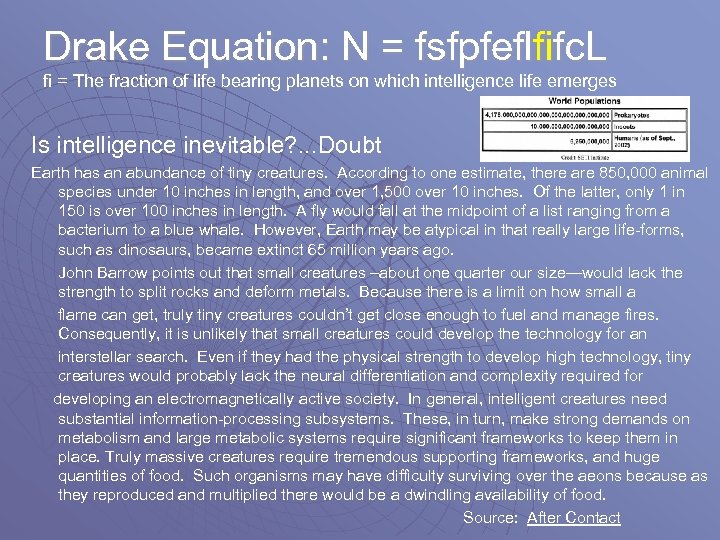 Drake Equation: N = fsfpfeflfifc. L fi = The fraction of life bearing planets on which intelligence life emerges Is intelligence inevitable? . . . Doubt Earth has an abundance of tiny creatures. According to one estimate, there are 850, 000 animal species under 10 inches in length, and over 1, 500 over 10 inches. Of the latter, only 1 in 150 is over 100 inches in length. A fly would fall at the midpoint of a list ranging from a bacterium to a blue whale. However, Earth may be atypical in that really large life-forms, such as dinosaurs, became extinct 65 million years ago. John Barrow points out that small creatures –about one quarter our size—would lack the strength to split rocks and deform metals. Because there is a limit on how small a flame can get, truly tiny creatures couldn’t get close enough to fuel and manage fires. Consequently, it is unlikely that small creatures could develop the technology for an interstellar search. Even if they had the physical strength to develop high technology, tiny creatures would probably lack the neural differentiation and complexity required for developing an electromagnetically active society. In general, intelligent creatures need substantial information-processing subsystems. These, in turn, make strong demands on metabolism and large metabolic systems require significant frameworks to keep them in place. Truly massive creatures require tremendous supporting frameworks, and huge quantities of food. Such organisms may have difficulty surviving over the aeons because as they reproduced and multiplied there would be a dwindling availability of food. Source: After Contact
 Drake Equation: N = fsfpfeflfifc. L fi = The fraction of life bearing planets on which intelligence life emerges Is intelligence inevitable? . . . Doubt Upper limits on size might be relaxed on a planet that is covered with water or some other supportive medium, but creatures brought up in the sea or a thick gas atmosphere may lack two prerequisites for interstellar broadcasting. They are unlikely to have had the opportunity to experiment with electricity and are unlikely to have their curiosity piqued by a clear view of the heavens. Very large creatures could have information processing constraints stemming from the sheer distance that their nerve impulses must travel. When we consider the distribution of sizes of lifeforms on Earth, those species that we suspect of having the greatest intelligence (humans, apes, dolphins) tend to fall within a relatively narrow range. Source: After Contact
 Drake Equation: N = fsfpfeflfifc. L fi = The fraction of life bearing planets on which intelligence life emerges A rich terrestrial biota is a necessary condition for both the origin of intelligence life and its progressive development. Without a rich threedimensional land flora to support a feisty fauna, the likelihood of evolving smart monkeys and even smarter humans would be zero. The vulnerability of island species to extinction makes clear that arms races have been most intense and prolonged on the world’s largest contiguous land surfaces. And here again, it looks like we’ve been incredibly lucky with a just-about-perfect planet, providing land areas both large and small on which many different evolutionary dramas might unfold. Had the Earth’s land surfaces been divided into many small areas, it seems unlikely that our own particular primate lineage would have reached its present state. William Burger
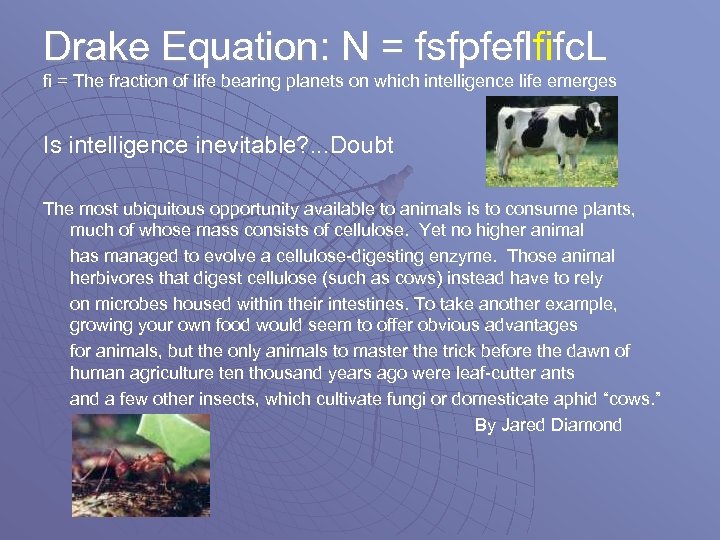 Drake Equation: N = fsfpfeflfifc. L fi = The fraction of life bearing planets on which intelligence life emerges Is intelligence inevitable? . . . Doubt The most ubiquitous opportunity available to animals is to consume plants, much of whose mass consists of cellulose. Yet no higher animal has managed to evolve a cellulose-digesting enzyme. Those animal herbivores that digest cellulose (such as cows) instead have to rely on microbes housed within their intestines. To take another example, growing your own food would seem to offer obvious advantages for animals, but the only animals to master the trick before the dawn of human agriculture ten thousand years ago were leaf-cutter ants and a few other insects, which cultivate fungi or domesticate aphid “cows. ” By Jared Diamond
 Drake Equation: N = fsfpfeflfifc. L fi = The fraction of life bearing planets on which intelligence life emerges Is intelligence inevitable? . . . Doubt THE EVOLUTION OF BEHAVIOR The emergence of extra-genetic information systems was no trivial event in the grand scheme of things. Biological facts livened up the story when the behavior of matter became in part organized by information encoded in genes, the units of inheritance. Psychological facts first emerged in the epic of evolution when the behavior of matter came under the organizing influence of information encoded in engrams, the units of memory. While genes preserve changes wrought by natural selection across generations of species, engrams preserve the changes effected by learning throughout the lifetime of an individual. Adaptation by genetic change is always a game of chance, whereas adaptation by learning and memory eventually leads to a game of choice. The engram is therefore more than a unit of memory, it is a unit of freedom as well. The plasticity of neural systems amounts to a promise of freedom from the rigid constraints of genetic determinism. Organisms are advantaged by learning only when they learn the right stuff—that is, when engrams are relevant to the design of adaptive behaviors. Learning must therefore be selective, systematically constrained by innate biases, for otherwise it would be far too random and inefficient. The advantages of learning often depend upon learning the right stuff in the right order. Memory systems work as well as they do only because they are constrained by genetic programs. Genetically endowed rules bias and constrain the operations of neural systems in many ways. Source: Religion Is Not About God Loyal Rue
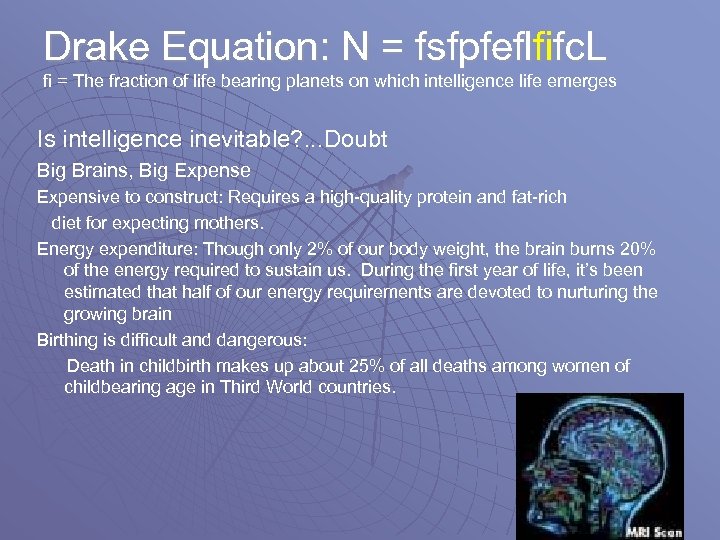 Drake Equation: N = fsfpfeflfifc. L fi = The fraction of life bearing planets on which intelligence life emerges Is intelligence inevitable? . . . Doubt Big Brains, Big Expense Expensive to construct: Requires a high-quality protein and fat-rich diet for expecting mothers. Energy expenditure: Though only 2% of our body weight, the brain burns 20% of the energy required to sustain us. During the first year of life, it’s been estimated that half of our energy requirements are devoted to nurturing the growing brain Birthing is difficult and dangerous: Death in childbirth makes up about 25% of all deaths among women of childbearing age in Third World countries.
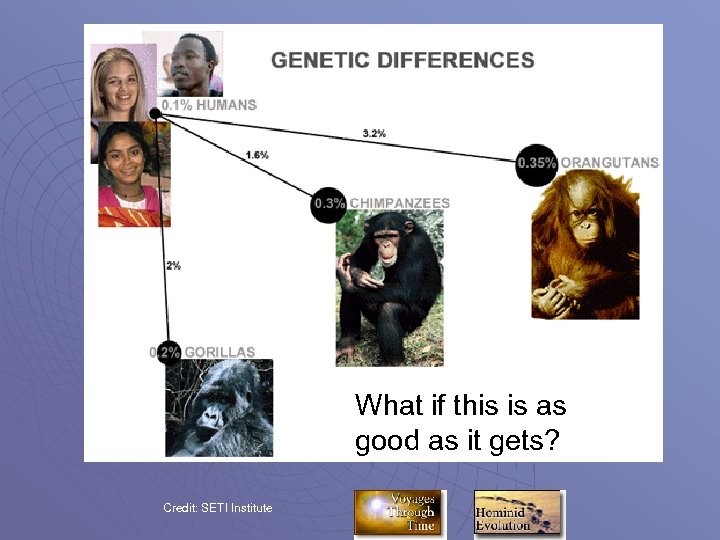 What if this is as good as it gets? Credit: SETI Institute
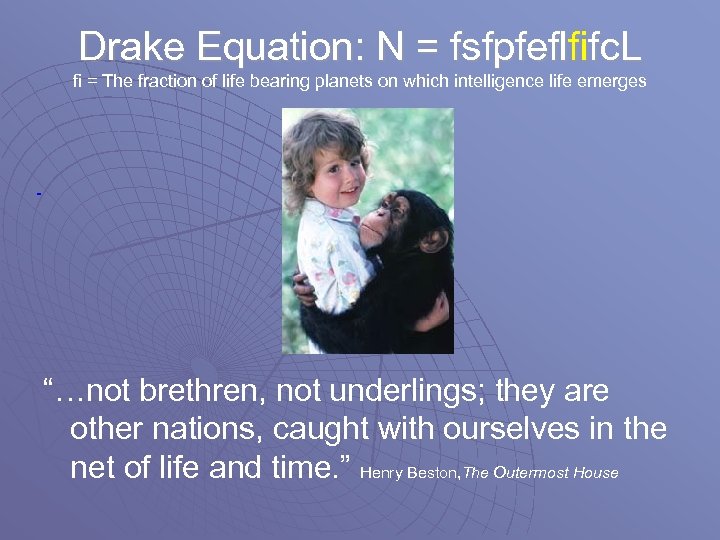 Drake Equation: N = fsfpfeflfifc. L fi = The fraction of life bearing planets on which intelligence life emerges “…not brethren, not underlings; they are other nations, caught with ourselves in the net of life and time. ” Henry Beston, The Outermost House
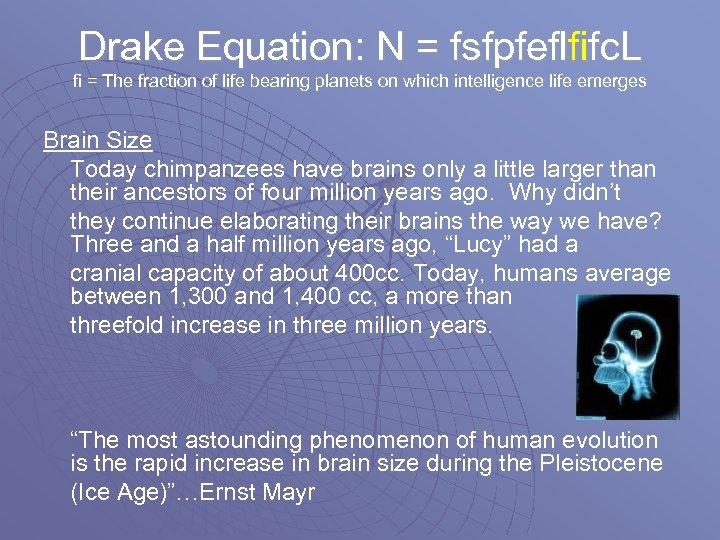 Drake Equation: N = fsfpfeflfifc. L fi = The fraction of life bearing planets on which intelligence life emerges Brain Size Today chimpanzees have brains only a little larger than their ancestors of four million years ago. Why didn’t they continue elaborating their brains the way we have? Three and a half million years ago, “Lucy” had a cranial capacity of about 400 cc. Today, humans average between 1, 300 and 1, 400 cc, a more than threefold increase in three million years. “The most astounding phenomenon of human evolution is the rapid increase in brain size during the Pleistocene (Ice Age)”…Ernst Mayr
 Drake Equation: N = fsfpfeflfifc. L fi = The fraction of life bearing planets on which intelligence life emerges Two million years ago, several protohuman lineages had coexisted side by side until a shakedown left only one. It now appears that a similar shakedown occurred within the last sixty thousand years, and that all of us alive in the world today are descended from the winner of that shakedown. What was the last missing ingredient whose acquisition helped our ancestors to win? The identity of the ingredient that produced the Great Leap Forward poses an archaeological puzzle without an accepted answer. It doesn’t show up in fossil skeletons. It may have been a change in only 0. 1 percent of our DNA. What tiny change in genes could have had such enormous consequences? Like some other scientists who have speculated about this question, I can think of only one plausible answer: the anatomical basis for spoken complex language. Chimpanzees, gorillas, and even monkeys are capable of symbolic communication not dependent on spoken words. Primates can use not just signs and computer keys, but also sounds, as symbols. For instance, wild vervet monkeys have a natural form of symbolic communication bases on grunts, with slightly different grunts to mean “leopard, ” “eagle, ” and “snake. ” Given this capability for symbolic communication using sounds, why have apes not gone on to develop much more complex natural languages of their own? The answer seems to involve the structure of the larynx, tongue, and associated muscles that give us fine control over spoken sounds. Like a Swiss watch, all of whose many parts have to be well designed for the watch to keep time at all, our vocal tract depends on the precise functioning of many structures and muscles. Chimps are thought to be physically incapable of producing several of the commonest human vowels. If we too were limited to just a few vowels and consonants, our own vocabulary would be greatly reduced. That’s why it’s plausible that the missing ingredient may have been some modifications of the protohuman vocal tract to give us finer control and permit formation of a much greater variety of sounds. Such fine modifications of muscles need not be detectable in fossil skulls. It’s easy to appreciate how a tiny change in anatomy resulting in capacity for speech would produce a huge change in behavior. With language, it takes only a few seconds to communicate the message, “Turn sharp right at the fourth tree and drive the male antelope toward the reddish boulder, where I’ll hide to spear it. ” Without language, that message could not be communicated at all. without language, two protohumans could not brainstorm together about how to devise a better tool, or about what a cave painting might mean. Without language, even one protohuman would have had difficulty thinking out for himself or herself how to devise a better tool. Source: The Third Chimpanzee by Jared Diamond
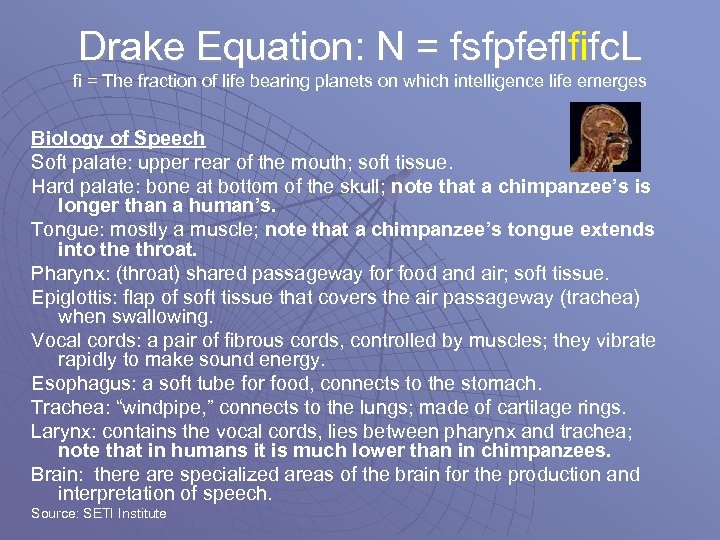 Drake Equation: N = fsfpfeflfifc. L fi = The fraction of life bearing planets on which intelligence life emerges Biology of Speech Soft palate: upper rear of the mouth; soft tissue. Hard palate: bone at bottom of the skull; note that a chimpanzee’s is longer than a human’s. Tongue: mostly a muscle; note that a chimpanzee’s tongue extends into the throat. Pharynx: (throat) shared passageway for food and air; soft tissue. Epiglottis: flap of soft tissue that covers the air passageway (trachea) when swallowing. Vocal cords: a pair of fibrous cords, controlled by muscles; they vibrate rapidly to make sound energy. Esophagus: a soft tube for food, connects to the stomach. Trachea: “windpipe, ” connects to the lungs; made of cartilage rings. Larynx: contains the vocal cords, lies between pharynx and trachea; note that in humans it is much lower than in chimpanzees. Brain: there are specialized areas of the brain for the production and interpretation of speech. Source: SETI Institute
 Drake Equation: N = fsfpfeflfifc. L fi = The fraction of life bearing planets on which intelligence life emerges Language Communication of perceptual knowledge: Our brain not only pictures reality, it can conceptualize and communicate that picture. “Vocal grooming” (Robert Dunbar): Helps to maintain status relationships, reconciliation and trust development more efficiently.
 Drake Equation: N = fsfpfeflfifc. L fi = The fraction of life bearing planets on which intelligence life emerges Chimps also share xenophobia with us; they clearly recognize members of other bands as different from members of their own band, and treat them very differently. Chimps’ inefficiency as killers reflects their lack of weapons, but it remains surprising that they have not learned to kill by strangling, although that would be within their capabilities. Not only is each individual killing inefficient by our standards, but so is the whole course of chimp genocide. Partly, this inefficiency again reflects chimps’ lack of weapons. Partly, too, genocidal chimps are much inferior to humans in brainpower and hence in strategic planning. Chimps apparently cannot plan a night attack or a coordinated ambush by a split assault team. In short, of all our human hallmarks—art, spoken language, drugs, and the others—the one that has been derived most straightforwardly from animal precursors is genocide. Common chimps already carried out planned killings, extermination of neighboring bands, war of territorial conquest, and abduction of young nubile females. If chimps were given spears and some instruction in their use, their killings would undoubtedly begin to approach ours in efficiency. Chimpanzee behavior suggests that a major reason for our human hallmark of group living was defense against other human groups, especially once we acquired weapons and a large enough brain to plan ambushes. Thus, of the two patterns of genocide commonest among humans, both have animal precedents; killing both men and women fits the common chimpanzee and wolf pattern, while killing men and sparing women fits the gorilla and lion pattern. There is an almost universal hierarchy of scorn, according to which literate peoples with advanced metallurgy, look down on herders, who look down on farmers, who look down on nomads or hunter-gatherers. Source: The Third Chimpanzee by Jared Diamond
 Drake Equation: N = fsfpfeflfifc. L fi = The fraction of life bearing planets on which intelligence life emerges For tens of thousands of years, possession of a massive brain and all the other hallmarks of modern Homo sapiens had not changed basic human lifestyles. Despite a more varied tool kit, exquisite artistic ability, and evidence of ritualistic activity, human communities had exhibited no major demographic change for well over a million years. As hunting and gathering bands, humans continued to aggregate in numbers between 20 and 150 individuals-not very different from a troop of baboon With a really fine computer in place, human brain expansion seems to have leveled off somewhere between 100, 000 and 30, 000 years ago. With improved language skills, complex knowledge could be transferred from generation to generation. New inventions could move between different lineages and across huge distances. Cultural evolution could be rapid and purposefully directed. But despite these advantages we were still either local or nomadic hunter-gatherers. Jared Diamond
 Drake Equation: N = fsfpfeflfifc. L fi = The fraction of life bearing planets on which intelligence life emerges It is extraordinary to think that only in the last twelve thousand years has civilization, as we understand it, taken off. There must have been an extraordinary explosion about 10, 000 BC—and there was. But it was a quiet explosion. It was the end of the Ice Age. It is usually called the ‘agricultural revolution. ’ But I think of it as something much wider, the biological revolution. There was intertwined in it the cultivation of plants and the domestication of animals in a kind of leap-frog. With that there comes an equally powerful social revolution. Because now it became possible—more than that, it became necessary—for man to settle. And this creature that had roamed and marched for a million years had to make the crucial decision: whether he would cease to be a nomad and become a villager. We have an anthropological record of the struggle of conscience of a people who make this decision: the record is the Bible, the Old Testament. I believe that civilization rests on that decision. As for people who never made it, there are few survivors. There are some nomad tribes who still go through these vast transhumance journeys from one grazing ground to another: the Bakhtiari in Persia, for example. You have actually to travel with them and live with them to understand that civilization can never grow up on the move. It is not possible in the nomad life to make things that will not be needed for several weeks. The Bakhtiari life is too narrow to have time or skill for specialization. There is no room for innovation, because there is not time, on the move, between evening and morning, coming and going all their lives, to develop a new device or a new thought—not even a new tune. The only habits that survive are the old habits. The only ambition of the son is to be like the father. It is a life without features. Every night is the end of a day like the last, and every morning will be the beginning of a journey like the day before. The largest single step in the ascent of man is the change from nomad to village agriculture. What made that possible? An act of will by men, surely; but with that, a strange and secret act of nature. In the burst of new vegetation at the end of the Ice Age, hybrid wheat appeared in the Middle East. Before 8000 BC wheat was not the luxuriant plant it is today; it was merely one of many wild grasses that spread throughout the Middle East. By some genetic accident, the wild wheat crossed with a natural goat grass and formed a fertile hybrid. In terms of the genetic machinery that directs growth, it combined the fourteen chromosomes of wild wheat with the fourteen chromosomes of goat grass, and produced Emmer with twenty-eight chromosomes. For such a hybrid to be fertile is rare but not unique among plants. But now the story of the rich plant life that followed the Ice Ages becomes more surprising. There was a second genetic accident, which may have come about because Emmer was already cultivated. Emmer crossed with another natural goat grass and produced a still larger hybrid with forty-two chromosomes, which is bread wheat. That was improbable enough in itself, and we know that bread wheat would not have been fertile but for a specific genetic mutation on one chromosome. Yet there is something even stranger. Now we have a beautiful ear of wheat, but one which will never spread in the wind because the ear is too tight to break up. And if I do break it up why, then the chaff flies off and every grain falls exactly where it grew. Let me remind you, that is quite different from the wild wheats or from the first, primitive hybrid, Emmer. In those primitive forms the ear is much more open, and if the ear breaks up then you get quite a different effect—you get grains which will fly in the wind. The bread wheats have lost that ability. Suddenly, man and the plant have come together. Man has wheat that he lives by, but the wheat also thinks that man was made for him because only so can it be propagated. For the bread wheats can only multiply with help; man must harvest the ears and scatter their seeds; and the life of each, man and the plant, depends on the other. By Jared Diamond
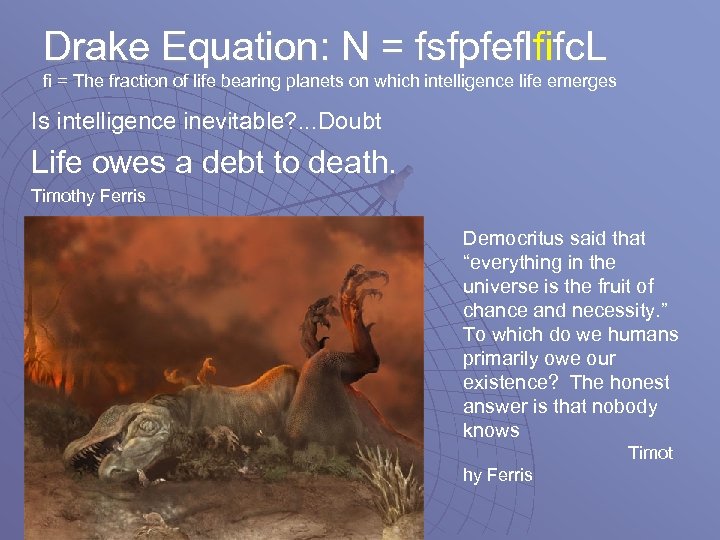 Drake Equation: N = fsfpfeflfifc. L fi = The fraction of life bearing planets on which intelligence life emerges Is intelligence inevitable? . . . Doubt Life owes a debt to death. Timothy Ferris Democritus said that “everything in the universe is the fruit of chance and necessity. ” To which do we humans primarily owe our existence? The honest answer is that nobody knows Timot hy Ferris
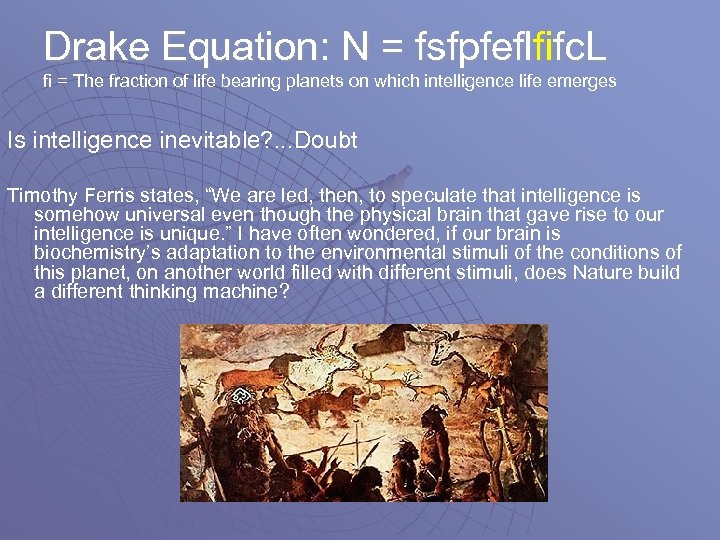 Drake Equation: N = fsfpfeflfifc. L fi = The fraction of life bearing planets on which intelligence life emerges Is intelligence inevitable? . . . Doubt Timothy Ferris states, “We are led, then, to speculate that intelligence is somehow universal even though the physical brain that gave rise to our intelligence is unique. ” I have often wondered, if our brain is biochemistry’s adaptation to the environmental stimuli of the conditions of this planet, on another world filled with different stimuli, does Nature build a different thinking machine?
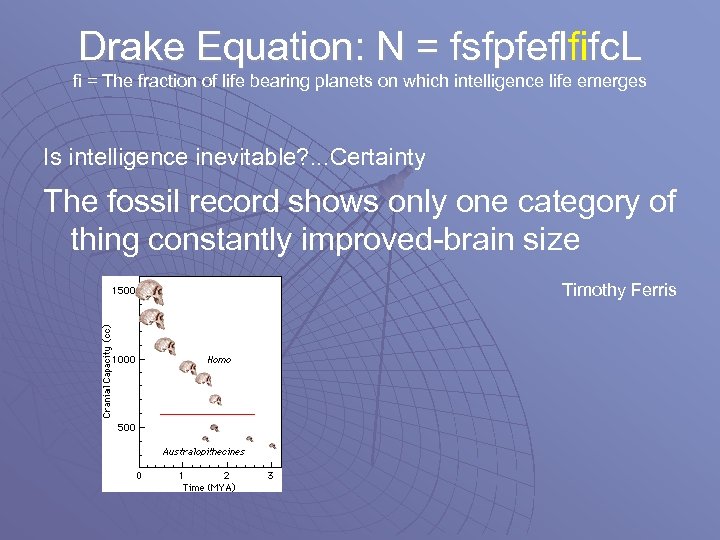 Drake Equation: N = fsfpfeflfifc. L fi = The fraction of life bearing planets on which intelligence life emerges Is intelligence inevitable? . . . Certainty The fossil record shows only one category of thing constantly improved-brain size Timothy Ferris
 Drake Equation: N = fsfpfeflfifc. L fi = The fraction of life bearing planets on which intelligence life emerges Is intelligence inevitable? . . . Certainty Look around you. Imagine how many pages of paper would be necessary to reconstruct the changing information scene that your eyes describe in a glance. Astronomer Armand Delsemme observes, " The bottleneck that slowed down evolution from the primitive bacteria to intelligence was the need to transform the photosynthetic cell (using light as an energy source) into an eye (using light as an information source). He continues, “The major impediment to the emergence of intelligence lay in the extremely large number of very small mutations needed to transform the photosynthetic cell into an eye. ” Visual systems are the starting point for complex information processing. ” In this view, “The evolution of the eye and that of the brain are coupled, because a visual image contains an immense amount of constantly changing information that needs to be filtered and processed. ” Delsemme argues, “That the slowness of evolution and not the improbability limits the emergence of intelligence. ”
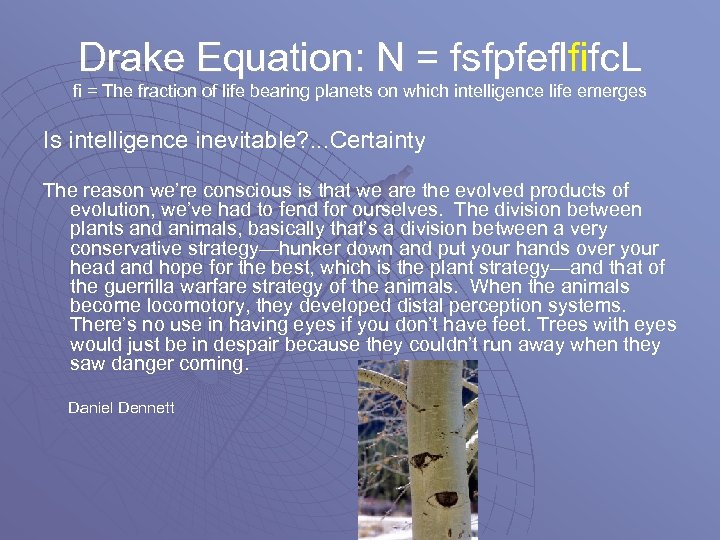 Drake Equation: N = fsfpfeflfifc. L fi = The fraction of life bearing planets on which intelligence life emerges Is intelligence inevitable? . . . Certainty The reason we’re conscious is that we are the evolved products of evolution, we’ve had to fend for ourselves. The division between plants and animals, basically that’s a division between a very conservative strategy—hunker down and put your hands over your head and hope for the best, which is the plant strategy—and that of the guerrilla warfare strategy of the animals. When the animals become locomotory, they developed distal perception systems. There’s no use in having eyes if you don’t have feet. Trees with eyes would just be in despair because they couldn’t run away when they saw danger coming. Daniel Dennett
 Drake Equation: N = fsfpfeflfifc. L fi = The fraction of life bearing planets on which intelligence life emerges Is intelligence inevitable? . . . Certainty Comparative psychologist Lori Marino also finds a certain inevitability in the evolution of intelligence. She notes that to our knowledge, trends toward increased relative brain size and increased intelligence have never been reversed. She proposes that even though neurons are biologically “expensive, ” it may be easier to develop greater intelligence than new physical adaptations. Relative to, say, developing anatomical and metabolic characteristics that would have allowed us to meet our current speed records on land, in the sea, and in the air, it was easier to evolve brains that allow us to build speedboats, racing cars, airplanes, and rockets! If, in fact, adding information-processing capacity is the most feasible way of relaxing the restrictions imposed by the physical demands of such physical activities. Source: After Contact
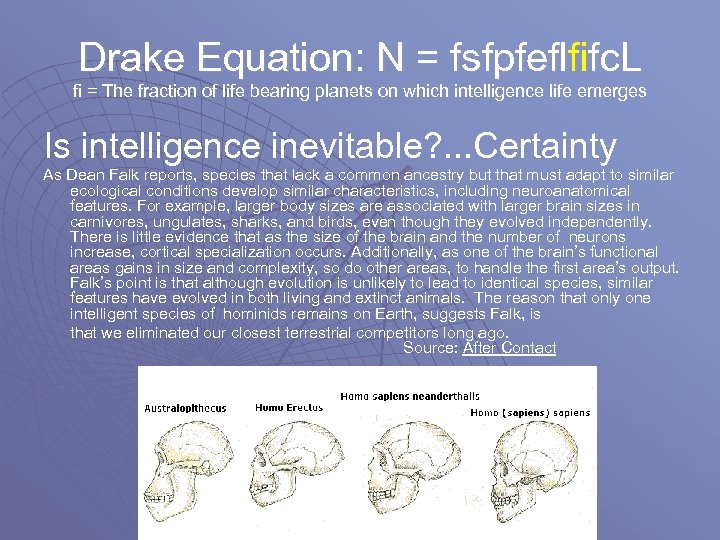 Drake Equation: N = fsfpfeflfifc. L fi = The fraction of life bearing planets on which intelligence life emerges Is intelligence inevitable? . . . Certainty As Dean Falk reports, species that lack a common ancestry but that must adapt to similar ecological conditions develop similar characteristics, including neuroanatomical features. For example, larger body sizes are associated with larger brain sizes in carnivores, ungulates, sharks, and birds, even though they evolved independently. There is little evidence that as the size of the brain and the number of neurons increase, cortical specialization occurs. Additionally, as one of the brain’s functional areas gains in size and complexity, so do other areas, to handle the first area’s output. Falk’s point is that although evolution is unlikely to lead to identical species, similar features have evolved in both living and extinct animals. The reason that only one intelligent species of hominids remains on Earth, suggests Falk, is that we eliminated our closest terrestrial competitors long ago. Source: After Contact
 Drake Equation: N = fsfpfeflfifc. L fi = The fraction of life bearing planets on which intelligence life emerges Is intelligence inevitable? . . . Certainty The Principle of Emergence is the process of complex pattern formation from simpler rules. This can be a dynamic process (occurring over time), such as the evolution of the human brain over thousands of successive generations; or emergence can happen over disparate size scales, such as the interactions between a macroscopic number of neurons producing a human brain capable of thought (even though the constituent neurons are not themselves conscious). For a phenomenon to be termed emergent it should generally be unpredictable from a lower level description. Usually the phenomenon does not exist at all or only in trace amounts at the very lowest level. Thus, a straightforward phenomenon such as the probability of finding a raisin in a slice of cake growing with the portion-size does not generally require a theory of emergence to explain. It may however be profitable to consider the emergence of the texture of the cake as a relatively complex result of the baking process and the mixture of ingredients. There is no consensus amongst scientists as to how much emergence should be relied upon as an explanation. It does not appear possible to unambiguously decide whether a phenomenon should be classified as emergent, and even in the cases where classification is agreed upon it rarely helps to explain the phenomena in any deep way. In fact, calling a phenomenon emergent is sometimes used in lieu of any better explanation. From Wikipedia, the free encyclopedia.
 Drake Equation: N = fsfpfeflfifc. L fi = The fraction of life bearing planets on which intelligence life emerges Is intelligence inevitable? . . . Certainty Emergent structures in Nature Emergent structures are patterns not created by a single event or rule. There is nothing that commands the system to form a pattern, but instead the interactions of each part to its immediate surroundings causes a complex process which leads to order. One might conclude that emergent structures are more than the sum of their parts because the emergent order will not arise if the various parts are simply coexisting; the interaction of these parts is central. A biological example is an ant colony. The queen does not give direct orders and does not tell the ants what to do. Instead, each ant reacts to stimuli in the form of chemical scent from larvae, other ants, intruders, food and build up of waste, and leaves behind a chemical trail, which, in turn, provides a stimulus to other ants. Here each ant is an autonomous unit that reacts depending only on its local environment and the genetically encoded rules for its variety of ant. Despite the lack of centralized decision making, ant colonies exhibit complex behavior and have even been able to demonstrate the ability to solve geometric problems. For example, the ant colonies routinely find the maximum distance from all colony entrances to dispose of dead bodies. Besides emergence in ant colonies, which is like other emergent structures in social insects mainly based on pheromones and chemical scents, emergence can be observed in swarms and flocks. Flocking is a well-known behavior in many animal species from swarming locusts to fish and birds. Emergent structures are a favorite strategy found in many animal groups: colonies of ants, piles of termites, swarms of bees, flocks of birds, herds of mammals, shoals/schools of fish, and packs of wolves. Emergent structures can be found in many natural phenomena, from the physical to the biological domain. The spatial structure and shape of galaxies is an emergent property, which characterizes the large-scale distribution of energy and matter in the universe. Weather phenomena with a similar form such as hurricanes are emergent properties, too. Many speculate that consciousness and life itself are emergent properties of a network of many interacting neurons and complex molecules, respectively. Life is a major source of complexity, and evolution is the major principle or driving force behind life. In this view, evolution is the main reason for the growth of complexity in the natural world. There is also a view that the beginning and development of evolution itself can be regarded as an emergent property of the laws of physics in our universe. From Wikipedia, the free encyclopedia.
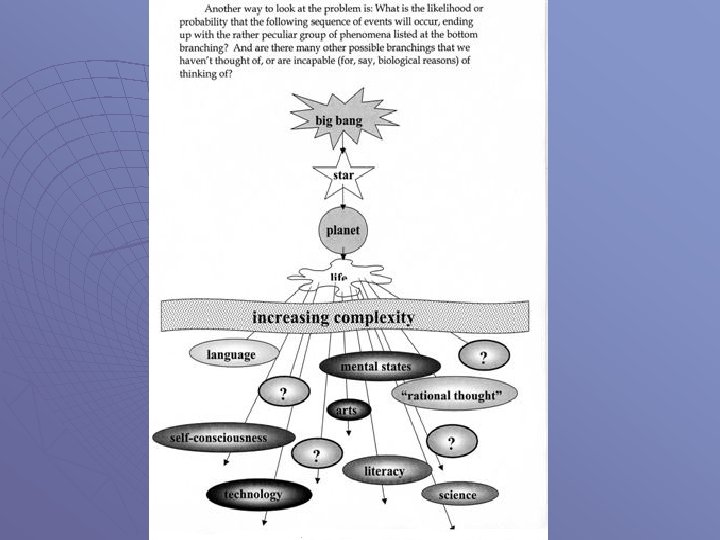
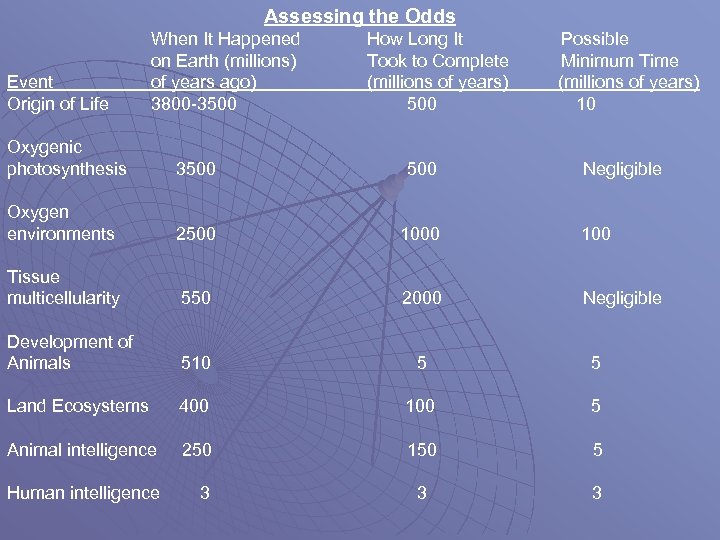 Assessing the Odds Event Origin of Life When It Happened on Earth (millions) of years ago) 3800 -3500 How Long It Took to Complete (millions of years) 500 Possible Minimum Time (millions of years) 10 Oxygenic photosynthesis 3500 Oxygen environments 2500 100 Tissue multicellularity 550 2000 Negligible Development of Animals 510 5 5 Land Ecosystems 400 100 5 Animal intelligence 250 150 5 Human intelligence 3 3 3 Negligible
 Drake Equation: N = fsfpfeflfifc. L fi = The fraction of life bearing planets on which intelligence life emerges Astonishing Accidents u u u Solar Nebula Metallicity Origin of the Moon Plate Tectonics Cell Membrane Photosynthesis Life on Land Historical Impacts Human Brain Agricultural Revolution Scientific Cultures Space Environment “Protection” Time
 Drake Equation: N = fsfpfeflfifc. L fi = The fraction of life bearing planets on which intelligence life emerges Summary: * A highly advanced central nervous system must be developed. * The life form must have dominance over his environment, especially his food source --to gain free time to pursue interests --to ensure the reproduction of the life form. * A vast amount of disturbance-free, non-catastrophic time is required for the evolution of life to intelligent life. * The rate of emergence of intelligent life on Earth is about one in 50 billion species. * There is only one set of statistics to interpret and base judgment and further statistics on. * There are millions of other links on a complex chain of events that combine in perfect sequence to make intelligence possible. * This is probably the toughest number to formulate since there is only one seemingly-unique life form that has accomplished this. * The intelligent life form must exhibit a pursuit of technology as we as a desire to communicate on an interstellar level (unlike dolphins or the Amish). * They must understand be able to use the kind of instruments [we use] which are capable of detecting and sending [our form of interstellar signals.
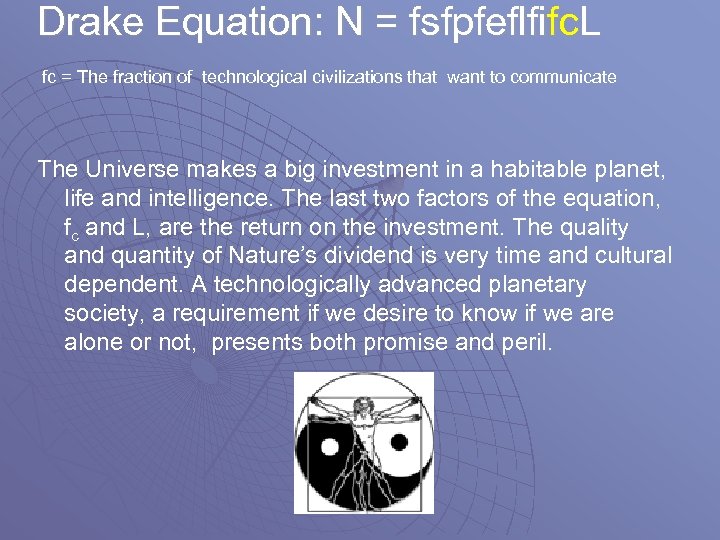 Drake Equation: N = fsfpfeflfifc. L fc = The fraction of technological civilizations that want to communicate The Universe makes a big investment in a habitable planet, life and intelligence. The last two factors of the equation, fc and L, are the return on the investment. The quality and quantity of Nature’s dividend is very time and cultural dependent. A technologically advanced planetary society, a requirement if we desire to know if we are alone or not, presents both promise and peril.
 Drake Equation: N = fsfpfeflfifc. L fc = The fraction of technological civilizations that want to communicate I make a sharp distinction between intelligence and technology. It is easy to imagine a highly intelligent society with no particular interest in technology. Freeman J. Dyson
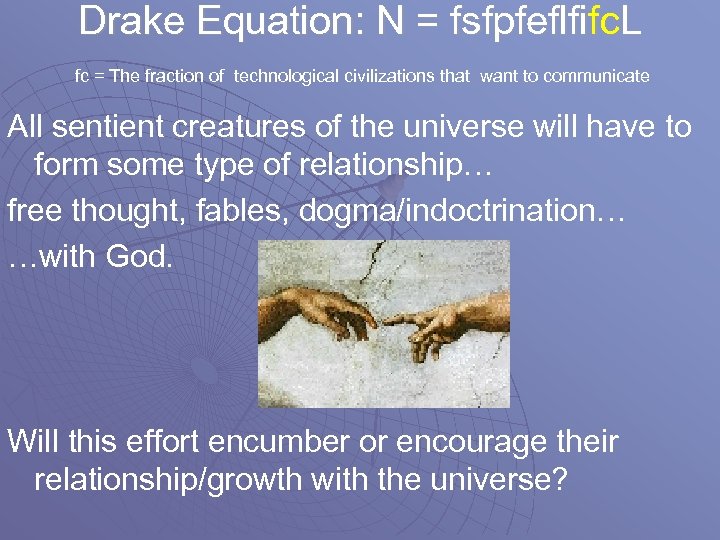 Drake Equation: N = fsfpfeflfifc. L fc = The fraction of technological civilizations that want to communicate All sentient creatures of the universe will have to form some type of relationship… free thought, fables, dogma/indoctrination… …with God. Will this effort encumber or encourage their relationship/growth with the universe?
 Drake Equation: N = fsfpfeflfifc. L fc = The fraction of technological civilizations that want to communicate Man is a singular creature. He has a set of gifts which make him unique among the animals: so that, unlike them, he is not a figure in the landscape-he is a shaper of the landscape. Every landscape in the world is full of these exact and beautiful adaptations, by which an animal fits into its environment like one cogwheel into another. …man is the only one who is not locked into his environment. His imagination, his reason, his emotional subtlety and toughness, make it possible for him not to accept the environment but to change it. Humans have a quality that release the brake which the environment imposes on all other creatures. When we find in the sludge of two million years ago the fossils of the creature who was to become man, we are struck by the differences between his skeleton and ours. …we find that among the animals the hunter has changed as little as the hunted. Jacob Bronowski
 Drake Equation: N = fsfpfeflfifc. L fc = The fraction of technological civilizations that want to communicate Contrary to what many seem to believe, natural selection does not exhibit an inherent progressive drive. Complexity took a long time to evolve. Really big brains are rare; they were the outcome of very special circumstances. Our big brain did not just happen; our genome had to be shoved forward with continuing and relentless selection. Building extraordinary brains required extraordinary pressure. In addition, the sci-tech revolution was not the result of an unfolding manifest destiny. A scientific culture depended on the development of agriculture, metallurgy and the industrial and “legal” revolutions. Given enough time, how likely is it for really intelligent cultures circling distant stars to break out of their religious, military or bureaucratic conservatism and focus on deep analysis of the world around them? Building an efficient bureaucracy is very different from developing a tradition of careful experimentation and the testing of hypotheses. William Burger
 Drake Equation: N = fsfpfeflfifc. L fc = The fraction of technological civilizations that want to communicate TWENTY-EIGHT “CANONICAL” MILESTONES Source: The Futurist May-June 2003 1. Big Bang and associated processes: 15. 5 billion years ago 2. Origin of Milky Way, first stars: 10 billion years ago 3. Origin of life on Earth, formation of the solar system and the Earth, oldest rocks: 4 billion years ago 4. First eukaryotes, invention of sex (by microorganisms) atmospheric oxygen, oldest photosynthetic plants, plate tectonic established : 2 billion years ago 5. First multicellular life (sponges, seaweeds, protozoans): 1 billion years ago 6. Cambrian explosion, invertebrates, plants colonize land, first trees, reptiles, insects, amphibians: 430 billion years ago 7. First mammals, first birds, first dinosaurs, first use of tools: 210 million years ago 8. First flowering plants, oldest angiosperm fossil: 139 million years ago 9. Asteroid collision, first primates, mass extinction (including dinosaurs): 54. 6 million years ago 10. First hominids, first hominids: 28. 5 million years ago 11. First orangutan, origin of proconsul: 16. 5 million years ago 12. Chimpanzees and humans diverge, earliest hominid bipedalism: 5. 1 million years ago 13. First stone tools, first humans, Ice Age, Homo erectus, origin of spoken language: 2. 2 million years ago 14. Emergence of Homo sapiens: 555, 000 years ago 15. Domestication of fire, Homo heidelbergensis: 325, 000 years ago 16. Differentiation of human DNA types: 200, 000 years ago 17. Emergence of “modern humans, ” earliest burial of the dead: 105, 700 years ago 18. Rock art, protowriting: 35, 800 years ago 19. Invention of agriculture: 19, 200 years ago 20. Techniques for starting fire, first cities: 11, 000 years ago 21. Development of the wheel, writing, archaic empires: 4, 907 years ago 22. Democracy, city-states, the Greeks, Buddha: 2, 437 years ago 23. Zero and decimals invented, Rome falls, Moslem conquest: 1, 440 years ago 24. Renaissance (printing press), discovery of New World, the scientific method: 539 years ago 25. Industrial revolution (steam engine), political revolutions (France, USA): 225 years ago 26. Modern physics, radio, electricity, automobile, airplane: 100 years ago 27. DNA structure described, transistor invented, nuclear energy, World War II, Cold War, Sputnik: 50 years ago 28. Internet, human genome sequenced: 5 years ago
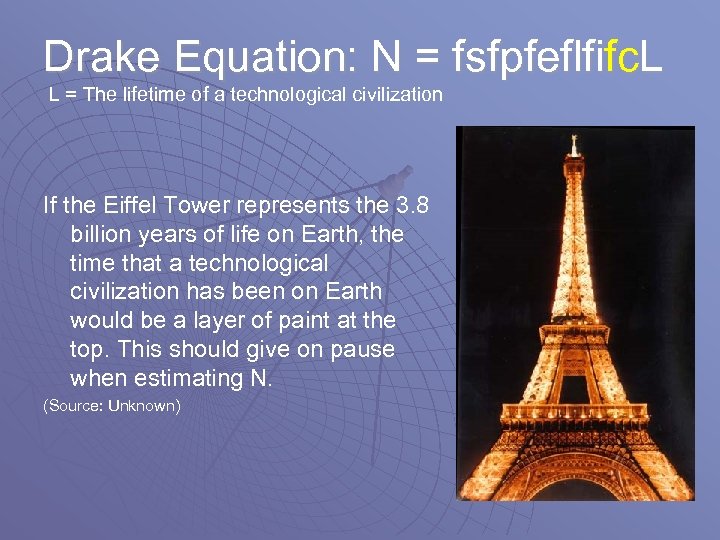 Drake Equation: N = fsfpfeflfifc. L L = The lifetime of a technological civilization If the Eiffel Tower represents the 3. 8 billion years of life on Earth, the time that a technological civilization has been on Earth would be a layer of paint at the top. This should give on pause when estimating N. (Source: Unknown)
 Drake Equation: N = fsfpfeflfifc. L fc = The fraction of technological civilizations that want to communicate The greatest void in interstellar communication is not space, but time. Timothy Ferris
 Drake Equation: N = fsfpfeflfifc. L fc = The fraction of technological civilizations that want to communicate Summary: This is a very difficult number to evaluate since there is only one seemingly-unique and culturally encouraged life form that has accomplished this. The intelligent life form must exhibit a pursuit of technology as well as have the desire to communicate on an interstellar level (unlike dolphins or a culture like the Amish). They must understand be able to use the kind of instruments [we use] which are capable of detecting and sending [our form of] interstellar signals. Coexisting in the universe in the same time may not be likely.
 Drake Equation: N = fsfpfeflfifc. L L = The lifetime of a technological civilization u Peril Human history becomes more and more a race between education and catastrophe. H. G. Wells The future of humankind will be decided by the race between two competing human drives, one to unleash military power to compete for planet Earth’s finite resources, the other to cooperate to provide access to unlimited extraterrestrial resources. Thomas O. Paine
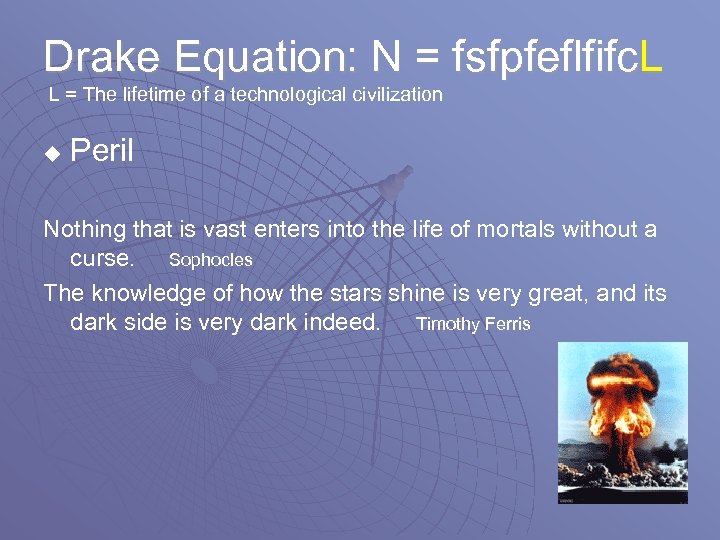 Drake Equation: N = fsfpfeflfifc. L L = The lifetime of a technological civilization u Peril Nothing that is vast enters into the life of mortals without a curse. Sophocles The knowledge of how the stars shine is very great, and its dark side is very dark indeed. Timothy Ferris
 u Peril
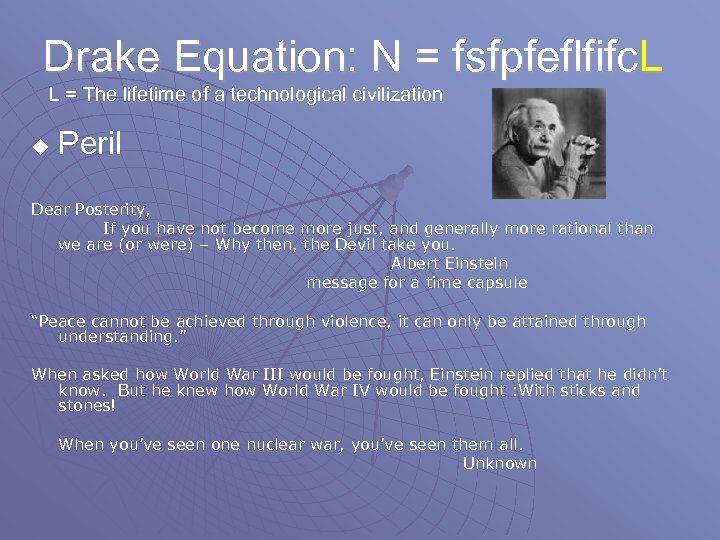 Drake Equation: N = fsfpfeflfifc. L L = The lifetime of a technological civilization u Peril Dear Posterity, If you have not become more just, and generally more rational than we are (or were) – Why then, the Devil take you. Albert Einstein message for a time capsule “Peace cannot be achieved through violence, it can only be attained through understanding. ” When asked how World War III would be fought, Einstein replied that he didn’t know. But he knew how World War IV would be fought : With sticks and stones! When you’ve seen one nuclear war, you’ve seen them all. Unknown
 Drake Equation: N = fsfpfeflfifc. L L = The lifetime of a technological civilization u u Peril Traditional Justification for Committing Genocide Possessing the “right” religion, race, political belief or a claim to represent progress or a higher level of civilization is usually a major motivation that bands genocidists together. Human ethical codes regard animals differently. Genocidists routinely compare their victims to animals. Most believers in a universal code still consider self-defense justified. Jared Diamond Our obligation is not just to learn but also to love. . . Timothy Ferris
 u Peril Source: The Futurist ( article May-June 2003) By James John Bell Technological change isn’t just happening fast. It’s happening at an exponential rate. Contrary to the commonsense, intuitive, linear view, we won’t just experience 100 years of progress in the twenty-first century—it will be more like 20, 000 years of progress. The near future results of exponential technological growth will be staggering: the merging of biological and nonbiological entities in biorobotics, plants and animals engineered to grow pharmaceutical drugs, software-based “life, ” smart robots, and atom-sized machines that self-replicate like living matter… In a now-infamous cover story in Wired magazine, “Why the Future Doesn’t Need Us, ” Bill Joy (Sun Microsystems Chief Scientist) warned of the dangers posed by developments in genetics, nanotechnology, and robotics. Unless things change, Joy predicted, “We could be the last generation of humans. ” Joy warned that “knowledge alone will enable mass destruction” and termed this phenomenon “knowledge-enabled mass destruction. ” The twentieth century gave rise to nuclear, biological, and chemical (NBC) technologies that, while powerful, require access to vast amounts of raw (and often rare) materials, technical information, and large-scale industries. The twenty-first century technologies of genetics, nanotechnology, and robotics (GNR), however, will require neither large facilities nor rare raw materials. The threat posed by GNR technologies becomes further amplified by the fact that some of these new technologies have been designed to be able to replicate—i. e. , they can build new versions of themselves. Nuclear bombs did not sprout more bombs, and toxic spills did not grow more spills. If the new self-replicating GNR technologies are released into the environment, they could be nearly impossible to recall or control. Joy understands that the greatest dangers we face ultimately stem from a world where global corporations dominate—a future where much of the world has no voice in how the world is run. Twenty-first century GNR technologies, he writes, “are bein g developed almost exclusively by corporate enterprises. We are aggressively pursuing the promises of these new technologies within the now-unchallenged system of global capitalism and its manifold financial incentives and competitive pressures. ” The next arms race is not based on replicating and perfecting a single deadly technology, like the nuclear bombs of the past or some space-based weapon of the future. This new arms race is about accelerating the development and integration of advanced autonomous, biotechnological, and human-robotic systems into the military apparatus A mishap or a massive war using these new technologies could be more catastrophic than any nuclear war… The rate at which GNR technologies are being adopted by our society—without regard to long-term safety testing or researching the political, cultural, and economic ramifications—mirrors the development and proliferation of nuclear power and weapons. The human loss caused by experimentation, production, and development is still being felt from the era of NBC technologies.
 Drake Equation: N = fsfpfeflfifc. L L = The lifetime of a technological civilization “Estimates of the fraction of land transformed or degraded by humanity…fall in the range of 39 to 50%. . . Land transformation represents the primary driving force in the loss of biological diversity worldwide. ” The modern increase in CO 2 represents the clearest and best documented signal of human alteration of the Earth system for thousands of years until about 1800, and has increased exponentially since then. There is no doubt that this increase has been driven by human activity…The fact that increased CO 2 affects differentially means that it is likely to drive substantial changes in the species composition and dynamics of all terrestrial ecosystems. ” “Humanity now uses more than half of the runoff water that is fresh and reasonably accessible, with about 70% of this use in agriculture…In the U. S. only 2% of the rivers run unimpeded…Major rivers, including the Colorado, the Nile, and the Ganges, are used so extensively that little water reaches the sea. ” “Overall, human activity adds at least as much fixed nitrogen to terrestrial ecosystems as do all natural sources combined…Beyond any doubt, humanity is a major biogeochemical force on Earth. ” “Recent calculations suggest that rates of species extinction are now on the order of 100 to 1000 times those before humanity’s dominance of Earth…At present 11% of the remaining birds, 18% of mammals, 5% of fish, and 8% of plant species on Earth are threatened with extinction. ” “All these seemingly disparate phenomena trace to a single cause—the growing scale of the human enterprise. The rates, scales, kinds, and combinations of changes occurring now are fundamentally different from those at any other time in history; we are changing Earth more rapidly than we are understanding it. ” Source: The Physics Teacher 10/2001
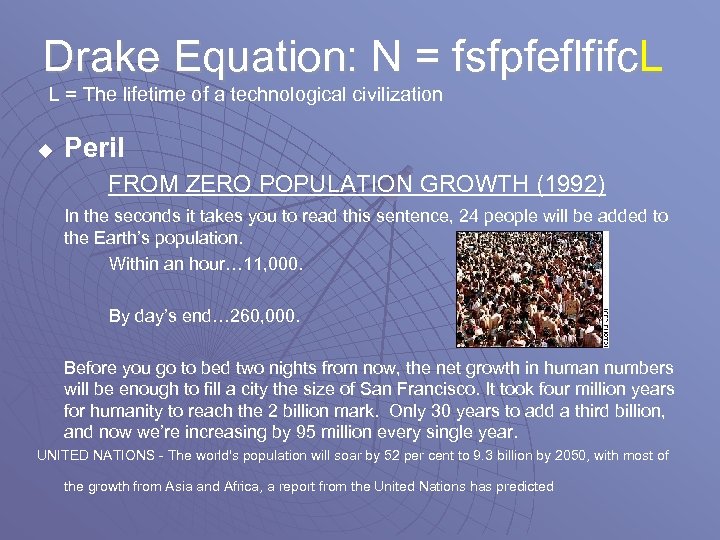 Drake Equation: N = fsfpfeflfifc. L L = The lifetime of a technological civilization u Peril FROM ZERO POPULATION GROWTH (1992) In the seconds it takes you to read this sentence, 24 people will be added to the Earth’s population. Within an hour… 11, 000. By day’s end… 260, 000. Before you go to bed two nights from now, the net growth in human numbers will be enough to fill a city the size of San Francisco. It took four million years for humanity to reach the 2 billion mark. Only 30 years to add a third billion, and now we’re increasing by 95 million every single year. UNITED NATIONS - The world's population will soar by 52 per cent to 9. 3 billion by 2050, with most of the growth from Asia and Africa, a report from the United Nations has predicted
 Drake Equation: N = fsfpfeflfifc. L L = The lifetime of a technological civilization u Peril Please view the following hyperlink: http: //www. gnostic. org/eupho/iftheworld. htm u The human condition. . . Our enemies are not each other, our enemies are poverty…ignorance…disease…greed…violence. There is nothing more frightening than active ignorance. Goethe
 Drake Equation: N = fsfpfeflfifc. L L = The lifetime of a technological civilization Starvation, pollution, and destructive technology are increasing; usable farmland, food stocks in the sea, other natural products, and environmental capacity to absorb wastes are decreasing. As more people with more power scramble for fewer resources, something has to give. So what is likely to happen? There are many grounds for pessimism. Jared Diamond The fossil record offers little solace. Ninety percent of the species that ever lived on Earth eventually vanished, many of them the victims of global catastrophes that in some ways resemble nuclear war, global warming, ozone depletion, and the other unpalatable futures we’re busily making possible for ourselves. We are just one more species; what is to prevent us from joining the silent majority? Timothy Ferris Strange that humans should make up lists of living things in danger. Why we fail to list ourselves is really stranger. unknown
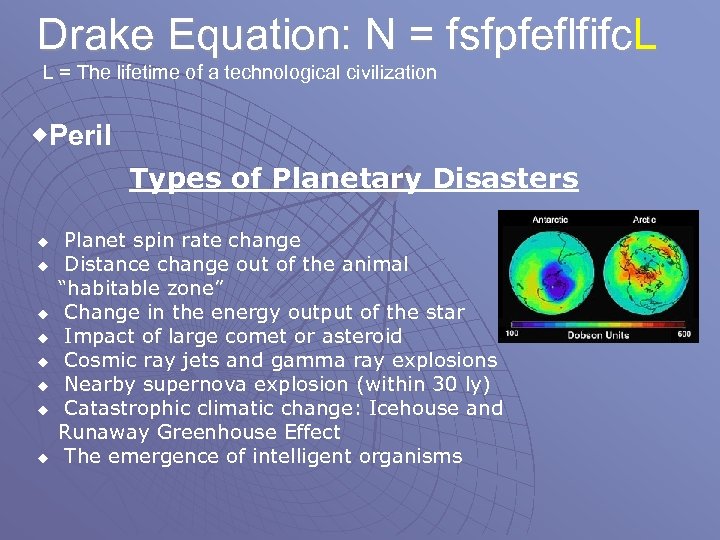 Drake Equation: N = fsfpfeflfifc. L L = The lifetime of a technological civilization u Peril Types of Planetary Disasters u u u u Planet spin rate change Distance change out of the animal “habitable zone” Change in the energy output of the star Impact of large comet or asteroid Cosmic ray jets and gamma ray explosions Nearby supernova explosion (within 30 ly) Catastrophic climatic change: Icehouse and Runaway Greenhouse Effect The emergence of intelligent organisms
 Drake Equation: N = fsfpfeflfifc. L L = The lifetime of a technological civilization u Peril Earthling Enigma If all pathways (faith systems) are equally valid human creation, certainly vested shareholders will be reluctant to choose a system or the “best of” that is most suitable to respond to our global challenges. Questions arise. Does the historical survival of the fittest model serve as the selection mechanism? Will the traditional institutions (philosophy, religion, science) remain in their competitive tribal camps or will they seek avenues of cooperation? How do we globalize these diverse responses to the human condition? Will the time requirements demanded by wisdom and tolerance be available to us? Larry Mascotti 12/2000
 Drake Equation: N = fsfpfeflfifc. L L = The lifetime of a technological civilization u Promise Our group struggle to survive is based on the cultural/tribal metaphors of our youth. When we encounter others, we often find ourselves engaged in a clash of metaphors. We war over the analogies that we use to help us cope and survive with our encounters in this mysterious universe. We fail to remember that the metaphorical answers we have created for the large unanswerable questions are human creations of our youth. We must find ways to abandon the egocentric metaphors of our arrested adolescence. The survival of our species depends on our ability to acknowledge our metaphors so that we may reach the maturity level that is required of cosmic citizenship. Larry Mascotti December 10, 2002
 Drake Equation: N = fsfpfeflfifc. L L = The lifetime of a technological civilization u Promise Although these are sobering challenges, Earth offers reasons for optimism. u u u More democracies exist around the world Global economic relationships make the world more interconnected Multi-cultural awareness and tolerance is replacing clan and blood relationships Work continues to: u u u Elevate the status of women Rid the planet of war, poverty, disease and environmental abuses Create a more gentle, civil and caring atmosphere for children and young people
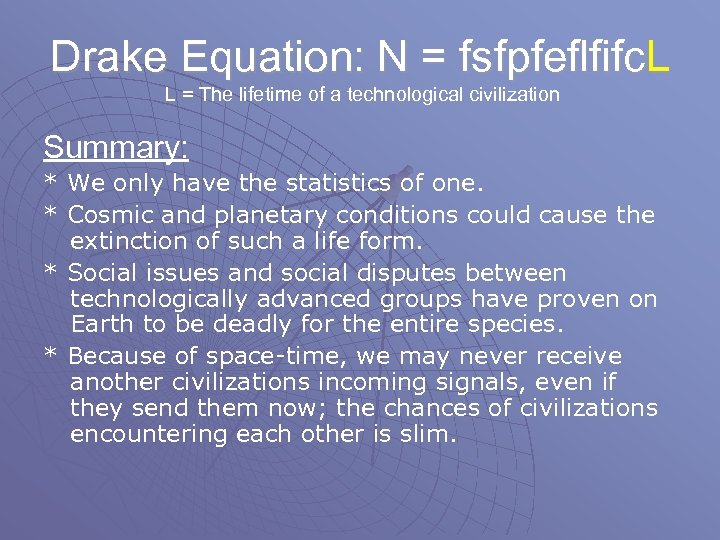 Drake Equation: N = fsfpfeflfifc. L L = The lifetime of a technological civilization Summary: * We only have the statistics of one. * Cosmic and planetary conditions could cause the extinction of such a life form. * Social issues and social disputes between technologically advanced groups have proven on Earth to be deadly for the entire species. * Because of space-time, we may never receive another civilizations incoming signals, even if they send them now; the chances of civilizations encountering each other is slim.
 Drake Equation: N = fsfpfeflfifc. L Hope… On any given night, a vast array of extraterrestrials frequent the television sets and movie screens of our planet. We’ve come to expect a universe filled with intelligent aliens. (Principle of Mediocrity) Reality… Most of the universe is too cold, too hot, too dense, too vacuous, too dark, too bright, or not composed of the right elements to support life. As any term in such an equation approaches zero, so too does the final product!

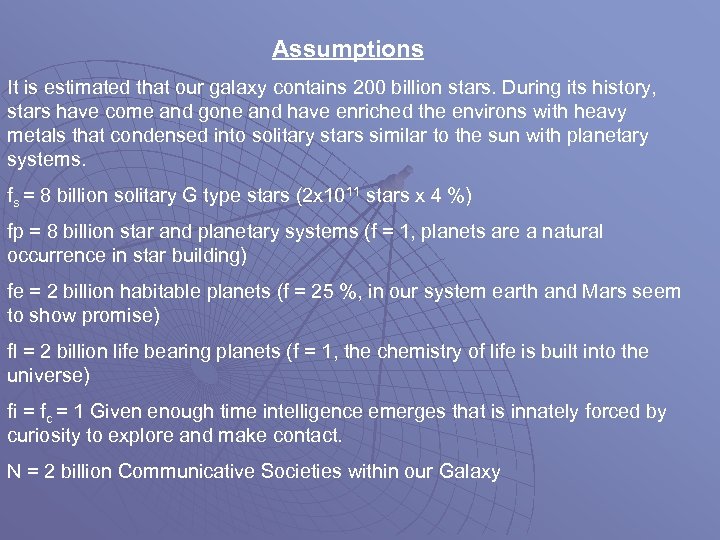 Assumptions It is estimated that our galaxy contains 200 billion stars. During its history, stars have come and gone and have enriched the environs with heavy metals that condensed into solitary stars similar to the sun with planetary systems. fs = 8 billion solitary G type stars (2 x 10¹¹ stars x 4 %) fp = 8 billion star and planetary systems (f = 1, planets are a natural occurrence in star building) fe = 2 billion habitable planets (f = 25 %, in our system earth and Mars seem to show promise) fl = 2 billion life bearing planets (f = 1, the chemistry of life is built into the universe) fi = fc = 1 Given enough time intelligence emerges that is innately forced by curiosity to explore and make contact. N = 2 billion Communicative Societies within our Galaxy
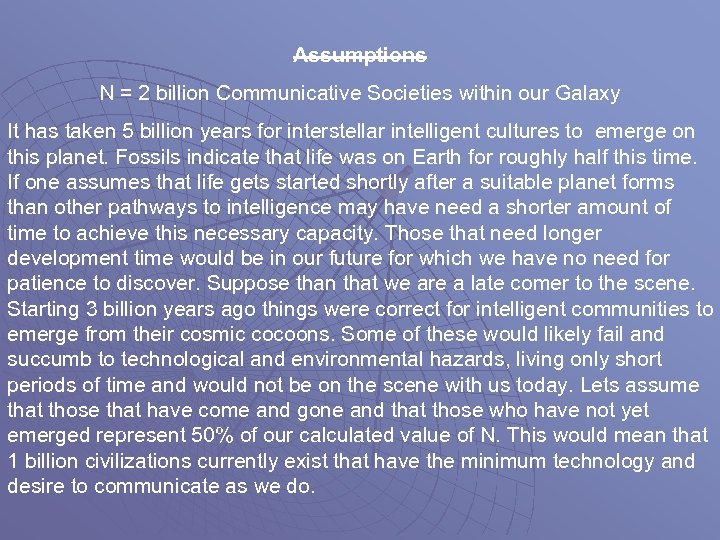 Assumptions N = 2 billion Communicative Societies within our Galaxy It has taken 5 billion years for interstellar intelligent cultures to emerge on this planet. Fossils indicate that life was on Earth for roughly half this time. If one assumes that life gets started shortly after a suitable planet forms than other pathways to intelligence may have need a shorter amount of time to achieve this necessary capacity. Those that need longer development time would be in our future for which we have no need for patience to discover. Suppose than that we are a late comer to the scene. Starting 3 billion years ago things were correct for intelligent communities to emerge from their cosmic cocoons. Some of these would likely fail and succumb to technological and environmental hazards, living only short periods of time and would not be on the scene with us today. Lets assume that those that have come and gone and that those who have not yet emerged represent 50% of our calculated value of N. This would mean that 1 billion civilizations currently exist that have the minimum technology and desire to communicate as we do.
 Assumptions N = 1 billion Communicative Societies within our Galaxy If we are such a late comer to the scene, than many of these civilizations have L values that extend for millions or billions of years. We can barely imagine what such civilizations would be like. Are they geneticallyengineered photosynthetic, disease-free, immortal beings with regenerating brains? Or are they self-replicating conscious bio-computers? Could they be beings that have transcended the levels of ideas, concepts, etc. ? Would they care to engage in a dialogue with us? Remember noninterference is the Prime Directive. Such advanced societies would lower the value of N. One wonders that if such long lived intelligence is flourishing within the Galaxy why have they gone undetected by our efforts? One billion Communicative Societies would also imply that we should be able to “reach out and touch” such cosmic cousins for they would be relatively close, within tens to hundreds of light years away. In the word of Enrico Fermi, “Where is everybody? ”…The Fermi Paradox
 Ordinary? Extraordinary? Be ashamed to die until you have won some victory for humanity. Horace Mann There isn’t enough time for love, So what does that leave for hate? Credits: Larry Mascotti Bill Copeland