 Скачать презентацию Orbital Aggregation Space Infrastructure Systems OASIS Executive
a76747f29dfe085289f18638222c63ac.ppt
- Количество слайдов: 32



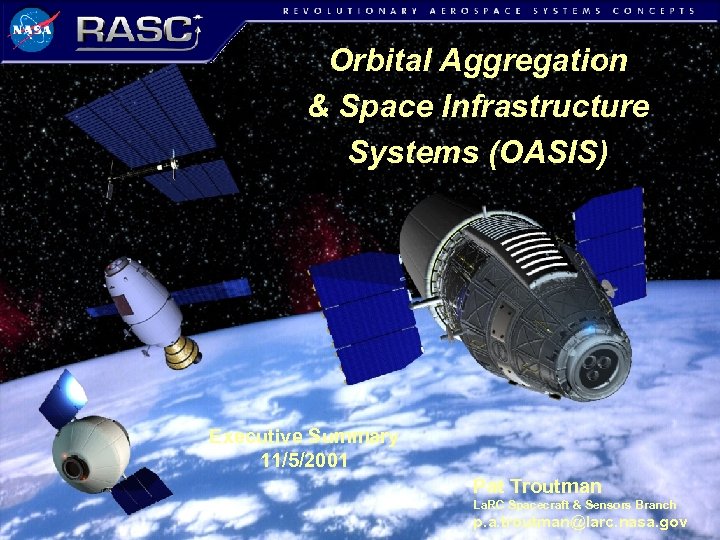
Orbital Aggregation & Space Infrastructure Systems (OASIS) Executive Summary 11/5/2001 Pat Troutman La. RC Spacecraft & Sensors Branch p. a. troutman@larc. nasa. gov
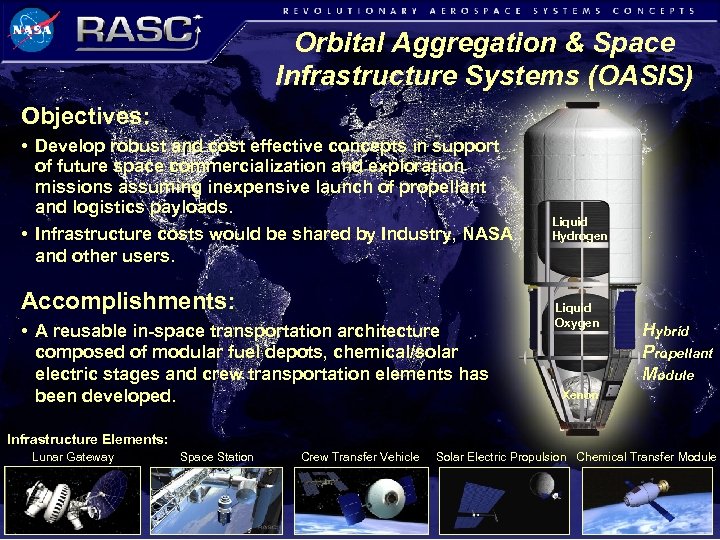
Orbital Aggregation & Space Infrastructure Systems (OASIS) Objectives: • Develop robust and cost effective concepts in support of future space commercialization and exploration missions assuming inexpensive launch of propellant and logistics payloads. • Infrastructure costs would be shared by Industry, NASA and other users. Accomplishments: • A reusable in-space transportation architecture composed of modular fuel depots, chemical/solar electric stages and crew transportation elements has been developed. Liquid Hydrogen Liquid Oxygen Hybrid Propellant Module Xenon Infrastructure Elements: Lunar Gateway Space Station Crew Transfer Vehicle Solar Electric Propulsion Chemical Transfer Module
Minimize point designs of elements in support of specific space mission objectives and maximize modularity, reusability and commonality of elements across many missions, enterprises and organizations.
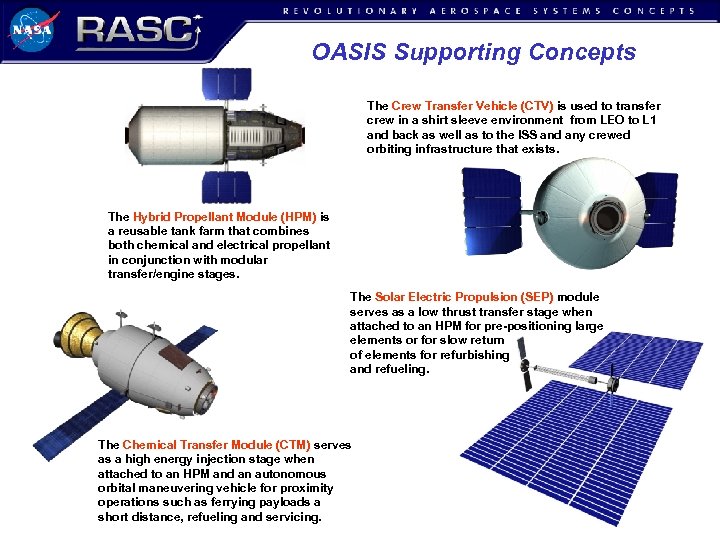
OASIS Supporting Concepts The Crew Transfer Vehicle (CTV) is used to transfer crew in a shirt sleeve environment from LEO to L 1 and back as well as to the ISS and any crewed orbiting infrastructure that exists. The Hybrid Propellant Module (HPM) is a reusable tank farm that combines both chemical and electrical propellant in conjunction with modular transfer/engine stages. The Solar Electric Propulsion (SEP) module serves as a low thrust transfer stage when attached to an HPM for pre-positioning large elements or for slow return of elements for refurbishing and refueling. The Chemical Transfer Module (CTM) serves as a high energy injection stage when attached to an HPM and an autonomous orbital maneuvering vehicle for proximity operations such as ferrying payloads a short distance, refueling and servicing.
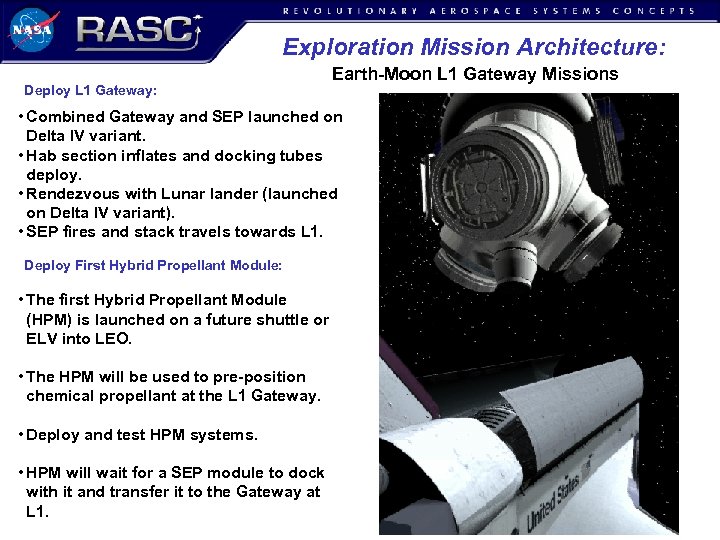
Exploration Mission Architecture: Deploy L 1 Gateway: Earth-Moon L 1 Gateway Missions • Combined Gateway and SEP launched on Delta IV variant. • Hab section inflates and docking tubes deploy. • Rendezvous with Lunar lander (launched on Delta IV variant). • SEP fires and stack travels towards L 1. Deploy First Hybrid Propellant Module: • The first Hybrid Propellant Module (HPM) is launched on a future shuttle or ELV into LEO. • The HPM will be used to pre-position chemical propellant at the L 1 Gateway. • Deploy and test HPM systems. • HPM will wait for a SEP module to dock with it and transfer it to the Gateway at L 1.
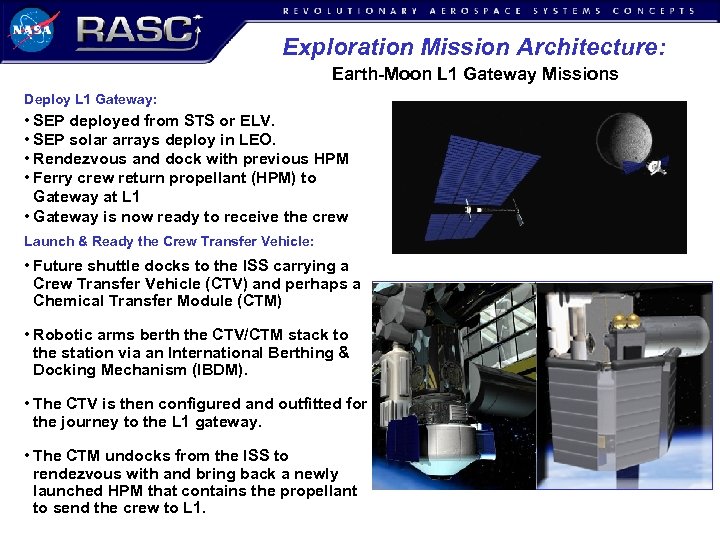
Exploration Mission Architecture: Earth-Moon L 1 Gateway Missions Deploy L 1 Gateway: • SEP deployed from STS or ELV. • SEP solar arrays deploy in LEO. • Rendezvous and dock with previous HPM • Ferry crew return propellant (HPM) to Gateway at L 1 • Gateway is now ready to receive the crew Launch & Ready the Crew Transfer Vehicle: • Future shuttle docks to the ISS carrying a Crew Transfer Vehicle (CTV) and perhaps a Chemical Transfer Module (CTM) • Robotic arms berth the CTV/CTM stack to the station via an International Berthing & Docking Mechanism (IBDM). • The CTV is then configured and outfitted for the journey to the L 1 gateway. • The CTM undocks from the ISS to rendezvous with and bring back a newly launched HPM that contains the propellant to send the crew to L 1.
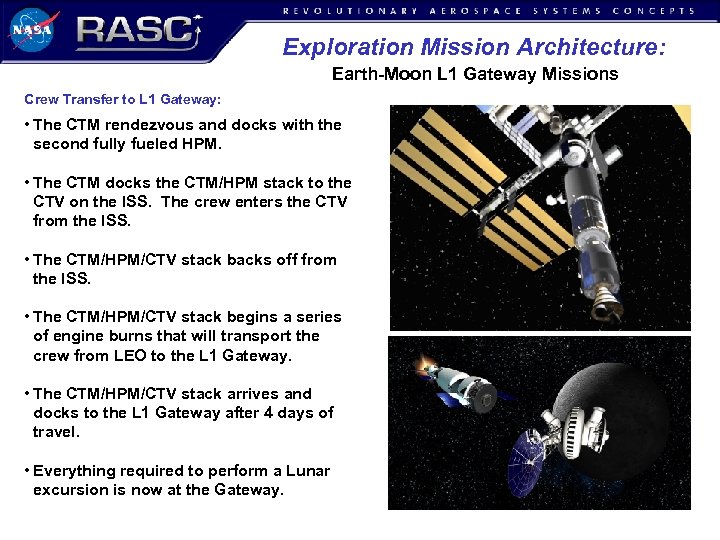
Exploration Mission Architecture: Earth-Moon L 1 Gateway Missions Crew Transfer to L 1 Gateway: • The CTM rendezvous and docks with the second fully fueled HPM. • The CTM docks the CTM/HPM stack to the CTV on the ISS. The crew enters the CTV from the ISS. • The CTM/HPM/CTV stack backs off from the ISS. • The CTM/HPM/CTV stack begins a series of engine burns that will transport the crew from LEO to the L 1 Gateway. • The CTM/HPM/CTV stack arrives and docks to the L 1 Gateway after 4 days of travel. • Everything required to perform a Lunar excursion is now at the Gateway.
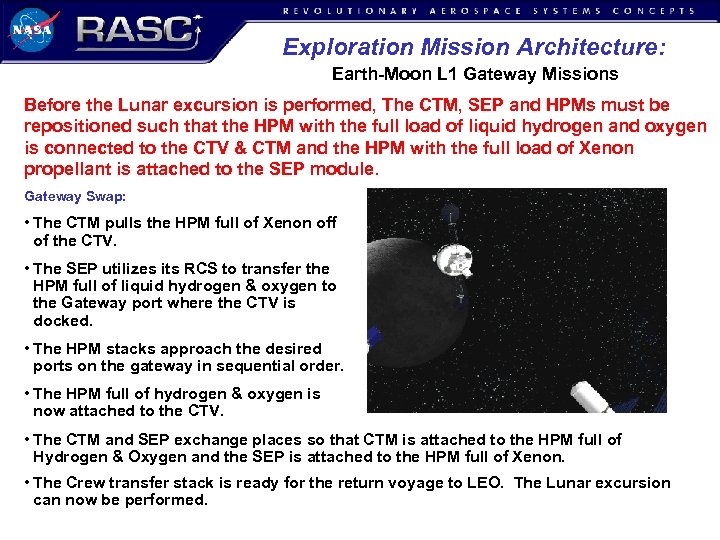
Exploration Mission Architecture: Earth-Moon L 1 Gateway Missions Before the Lunar excursion is performed, The CTM, SEP and HPMs must be repositioned such that the HPM with the full load of liquid hydrogen and oxygen is connected to the CTV & CTM and the HPM with the full load of Xenon propellant is attached to the SEP module. Gateway Swap: • The CTM pulls the HPM full of Xenon off of the CTV. • The SEP utilizes its RCS to transfer the HPM full of liquid hydrogen & oxygen to the Gateway port where the CTV is docked. • The HPM stacks approach the desired ports on the gateway in sequential order. • The HPM full of hydrogen & oxygen is now attached to the CTV. • The CTM and SEP exchange places so that CTM is attached to the HPM full of Hydrogen & Oxygen and the SEP is attached to the HPM full of Xenon. • The Crew transfer stack is ready for the return voyage to LEO. The Lunar excursion can now be performed.
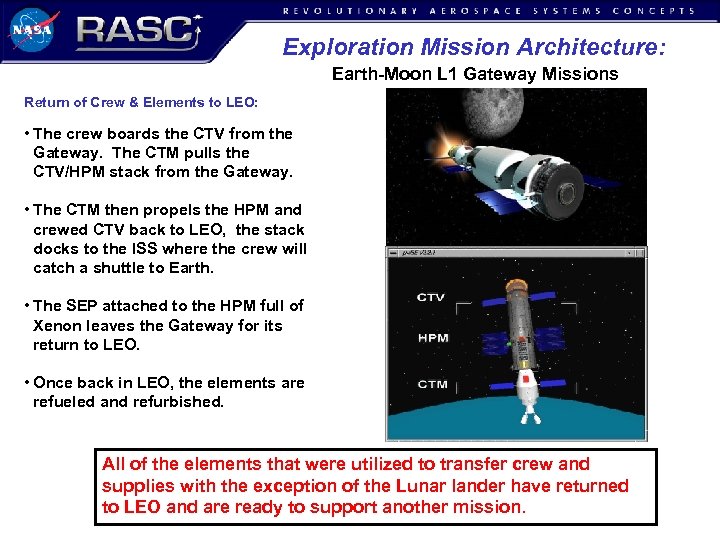
Exploration Mission Architecture: Earth-Moon L 1 Gateway Missions Return of Crew & Elements to LEO: • The crew boards the CTV from the Gateway. The CTM pulls the CTV/HPM stack from the Gateway. • The CTM then propels the HPM and crewed CTV back to LEO, the stack docks to the ISS where the crew will catch a shuttle to Earth. • The SEP attached to the HPM full of Xenon leaves the Gateway for its return to LEO. • Once back in LEO, the elements are refueled and refurbished. All of the elements that were utilized to transfer crew and supplies with the exception of the Lunar lander have returned to LEO and are ready to support another mission.
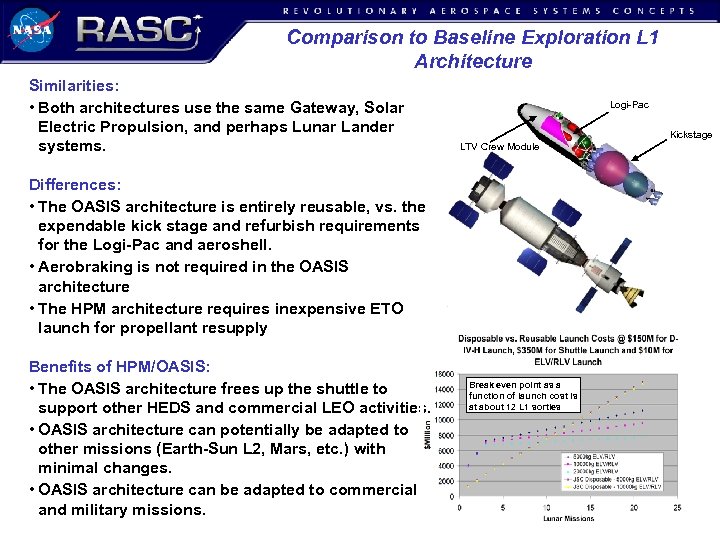
Comparison to Baseline Exploration L 1 Architecture Similarities: • Both architectures use the same Gateway, Solar Electric Propulsion, and perhaps Lunar Lander systems. Logi-Pac Kickstage LTV Crew Module Differences: • The OASIS architecture is entirely reusable, vs. the expendable kick stage and refurbish requirements for the Logi-Pac and aeroshell. • Aerobraking is not required in the OASIS architecture • The HPM architecture requires inexpensive ETO launch for propellant resupply Benefits of HPM/OASIS: • The OASIS architecture frees up the shuttle to support other HEDS and commercial LEO activities. • OASIS architecture can potentially be adapted to other missions (Earth-Sun L 2, Mars, etc. ) with minimal changes. • OASIS architecture can be adapted to commercial and military missions. Break even point as a function of launch cost is at about 12 L 1 sorties
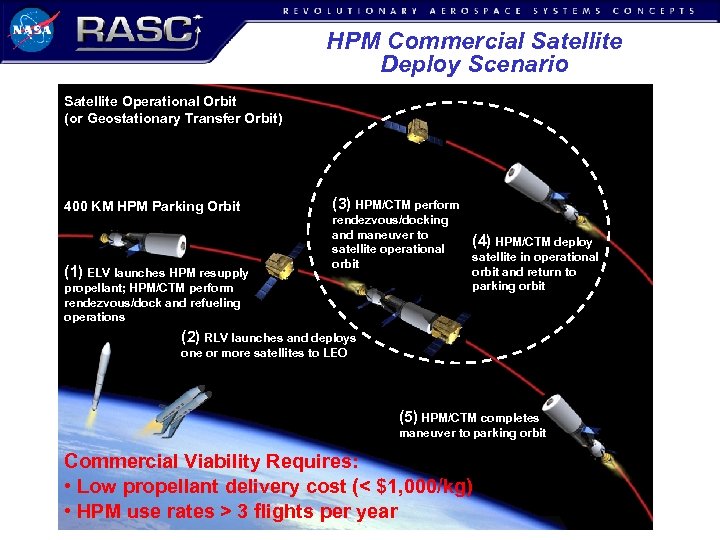
HPM Commercial Satellite Deploy Scenario Satellite Operational Orbit (or Geostationary Transfer Orbit) 400 KM HPM Parking Orbit (1) ELV launches HPM resupply (3) HPM/CTM perform rendezvous/docking and maneuver to satellite operational orbit propellant; HPM/CTM perform rendezvous/dock and refueling operations (4) HPM/CTM deploy satellite in operational orbit and return to parking orbit (2) RLV launches and deploys one or more satellites to LEO (5) HPM/CTM completes maneuver to parking orbit Commercial Viability Requires: • Low propellant delivery cost (< $1, 000/kg) • HPM use rates > 3 flights per year
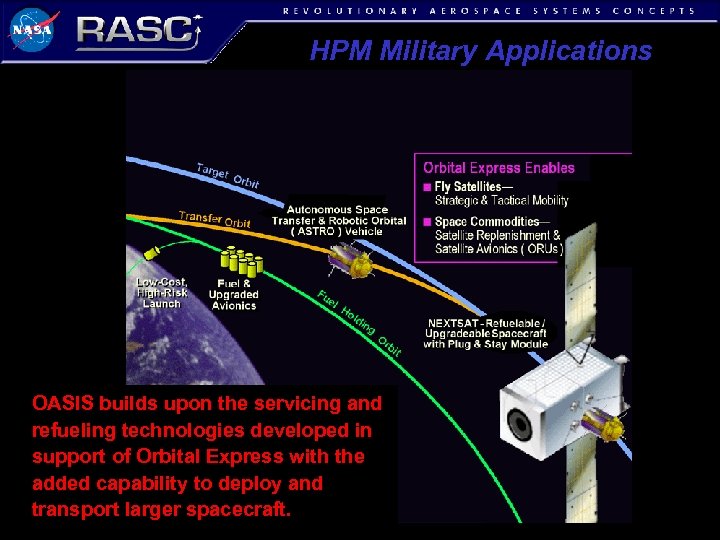
HPM Military Applications OASIS builds upon the servicing and refueling technologies developed in support of Orbital Express with the added capability to deploy and transport larger spacecraft.
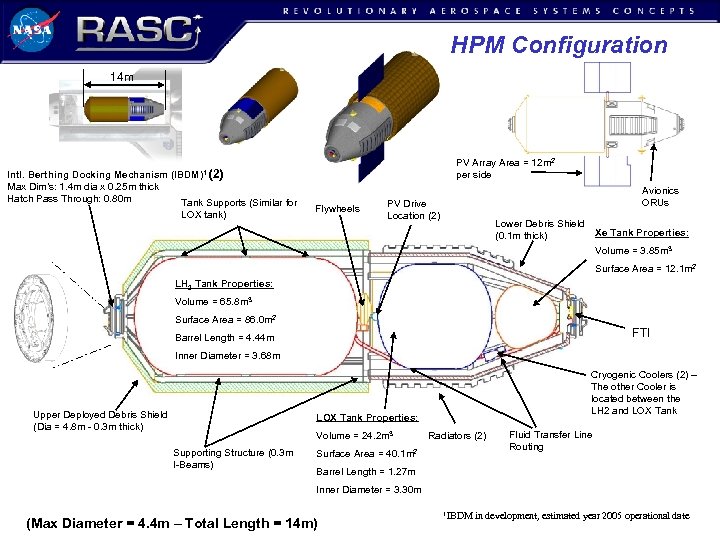
HPM Configuration 14 m Intl. Berthing Docking Mechanism Max Dim’s: 1. 4 m dia x 0. 25 m thick Hatch Pass Through: 0. 80 m (IBDM)1 PV Array Area = 12 m 2 per side (2) Tank Supports (Similar for LOX tank) Flywheels Avionics ORUs PV Drive Location (2) Lower Debris Shield (0. 1 m thick) Xe Tank Properties: Volume = 3. 85 m 3 Surface Area = 12. 1 m 2 LH 2 Tank Properties: Volume = 65. 8 m 3 Surface Area = 86. 0 m 2 FTI Barrel Length = 4. 44 m Inner Diameter = 3. 68 m Upper Deployed Debris Shield (Dia = 4. 8 m - 0. 3 m thick) Cryogenic Coolers (2) – The other Cooler is located between the LH 2 and LOX Tank Properties: Volume = 24. 2 m 3 Supporting Structure (0. 3 m I-Beams) Radiators (2) Surface Area = 40. 1 m 2 Fluid Transfer Line Routing Barrel Length = 1. 27 m Inner Diameter = 3. 30 m (Max Diameter = 4. 4 m – Total Length = 14 m) 1 IBDM in development, estimated year 2005 operational date
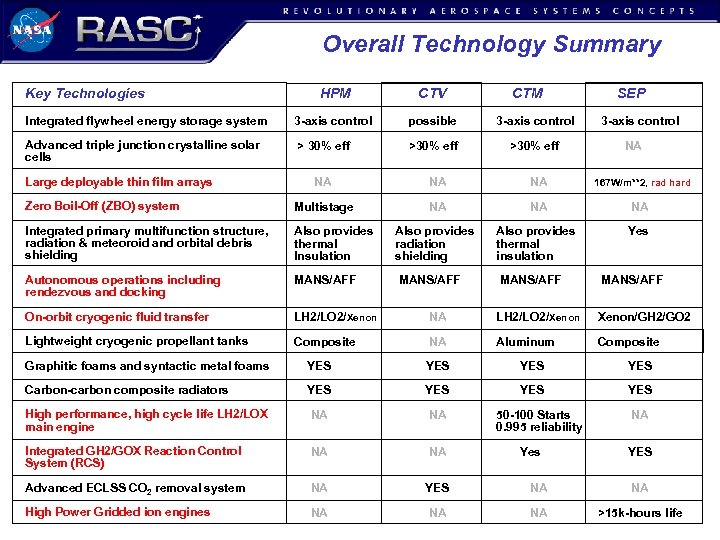
Overall Technology Summary Key Technologies HPM CTV Integrated flywheel energy storage system 3 -axis control possible 3 -axis control Advanced triple junction crystalline solar cells > 30% eff >30% eff Large deployable thin film arrays CTM SEP 3 -axis control NA NA 167 W/m**2, rad hard Zero Boil-Off (ZBO) system Multistage NA NA NA Integrated primary multifunction structure, radiation & meteoroid and orbital debris shielding Also provides thermal Insulation Also provides radiation shielding Also provides thermal insulation Yes Autonomous operations including rendezvous and docking MANS/AFF On-orbit cryogenic fluid transfer LH 2/LO 2/Xenon NA LH 2/LO 2/Xenon/GH 2/GO 2 Lightweight cryogenic propellant tanks Composite NA Aluminum Composite Graphitic foams and syntactic metal foams YES YES Carbon-carbon composite radiators YES YES High performance, high cycle life LH 2/LOX main engine NA NA Integrated GH 2/GOX Reaction Control System (RCS) NA NA Advanced ECLSS CO 2 removal system NA YES NA NA High Power Gridded ion engines NA NA NA >15 k-hours life 50 -100 Starts 0. 995 reliability Yes NA YES
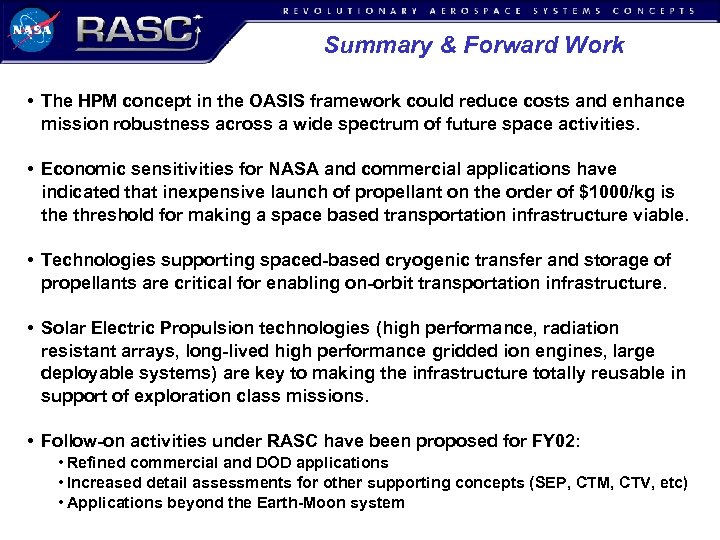
Summary & Forward Work • The HPM concept in the OASIS framework could reduce costs and enhance mission robustness across a wide spectrum of future space activities. • Economic sensitivities for NASA and commercial applications have indicated that inexpensive launch of propellant on the order of $1000/kg is the threshold for making a space based transportation infrastructure viable. • Technologies supporting spaced-based cryogenic transfer and storage of propellants are critical for enabling on-orbit transportation infrastructure. • Solar Electric Propulsion technologies (high performance, radiation resistant arrays, long-lived high performance gridded ion engines, large deployable systems) are key to making the infrastructure totally reusable in support of exploration class missions. • Follow-on activities under RASC have been proposed for FY 02: • Refined commercial and DOD applications • Increased detail assessments for other supporting concepts (SEP, CTM, CTV, etc) • Applications beyond the Earth-Moon system
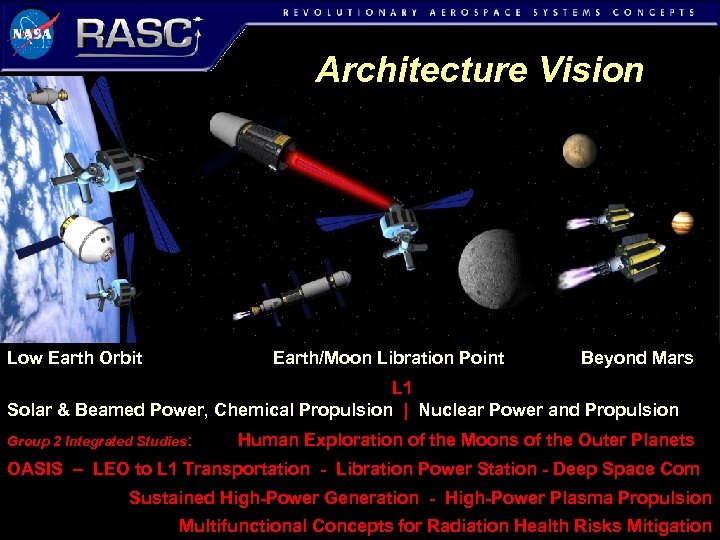
Architecture Vision Low Earth Orbit Earth/Moon Libration Point Beyond Mars L 1 Solar & Beamed Power, Chemical Propulsion | Nuclear Power and Propulsion Group 2 Integrated Studies: Human Exploration of the Moons of the Outer Planets OASIS – LEO to L 1 Transportation - Libration Power Station - Deep Space Com Sustained High-Power Generation - High-Power Plasma Propulsion Multifunctional Concepts for Radiation Health Risks Mitigation
Backup
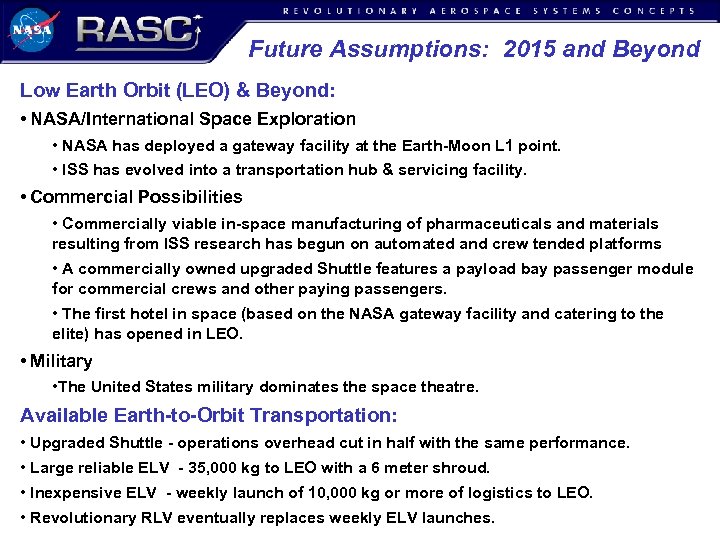
Future Assumptions: 2015 and Beyond Low Earth Orbit (LEO) & Beyond: • NASA/International Space Exploration • NASA has deployed a gateway facility at the Earth-Moon L 1 point. • ISS has evolved into a transportation hub & servicing facility. • Commercial Possibilities • Commercially viable in-space manufacturing of pharmaceuticals and materials resulting from ISS research has begun on automated and crew tended platforms • A commercially owned upgraded Shuttle features a payload bay passenger module for commercial crews and other paying passengers. • The first hotel in space (based on the NASA gateway facility and catering to the elite) has opened in LEO. • Military • The United States military dominates the space theatre. Available Earth-to-Orbit Transportation: • Upgraded Shuttle - operations overhead cut in half with the same performance. • Large reliable ELV - 35, 000 kg to LEO with a 6 meter shroud. • Inexpensive ELV - weekly launch of 10, 000 kg or more of logistics to LEO. • Revolutionary RLV eventually replaces weekly ELV launches.
Elements
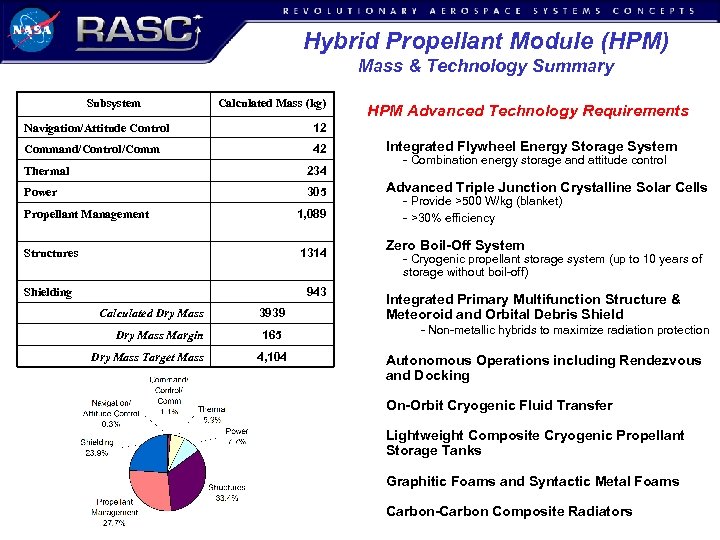
Hybrid Propellant Module (HPM) Mass & Technology Summary Subsystem Calculated Mass (kg) Navigation/Attitude Control 12 Command/Control/Comm 42 HPM Advanced Technology Requirements Thermal 234 Power 305 Propellant Management 1, 089 Structures 1314 Shielding 943 Calculated Dry Mass 3939 Dry Mass Margin 165 Dry Mass Target Mass 4, 104 Integrated Flywheel Energy Storage System - Combination energy storage and attitude control Advanced Triple Junction Crystalline Solar Cells - Provide >500 W/kg (blanket) - >30% efficiency Zero Boil-Off System - Cryogenic propellant storage system (up to 10 years of storage without boil-off) Integrated Primary Multifunction Structure & Meteoroid and Orbital Debris Shield - Non-metallic hybrids to maximize radiation protection Autonomous Operations including Rendezvous and Docking On-Orbit Cryogenic Fluid Transfer Lightweight Composite Cryogenic Propellant Storage Tanks Graphitic Foams and Syntactic Metal Foams Carbon-Carbon Composite Radiators
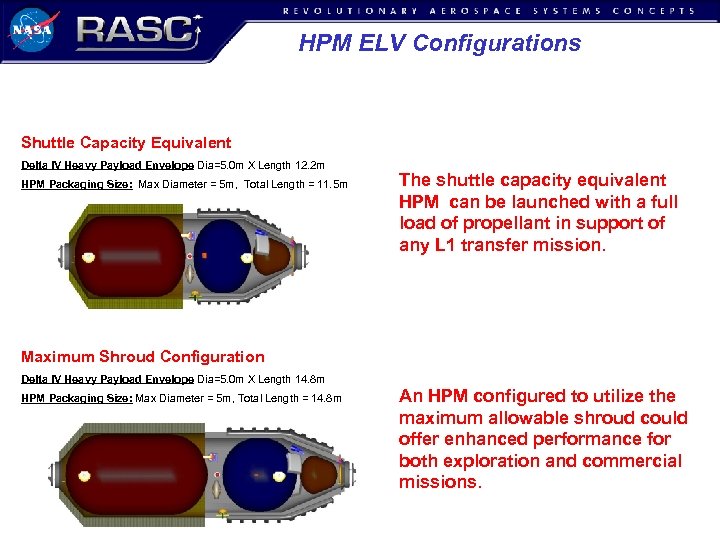
HPM ELV Configurations Shuttle Capacity Equivalent Delta IV Heavy Payload Envelope Dia=5. 0 m X Length 12. 2 m HPM Packaging Size: Max Diameter = 5 m, Total Length = 11. 5 m The shuttle capacity equivalent HPM can be launched with a full load of propellant in support of any L 1 transfer mission. Maximum Shroud Configuration Delta IV Heavy Payload Envelope Dia=5. 0 m X Length 14. 8 m HPM Packaging Size: Max Diameter = 5 m, Total Length = 14. 8 m An HPM configured to utilize the maximum allowable shroud could offer enhanced performance for both exploration and commercial missions.
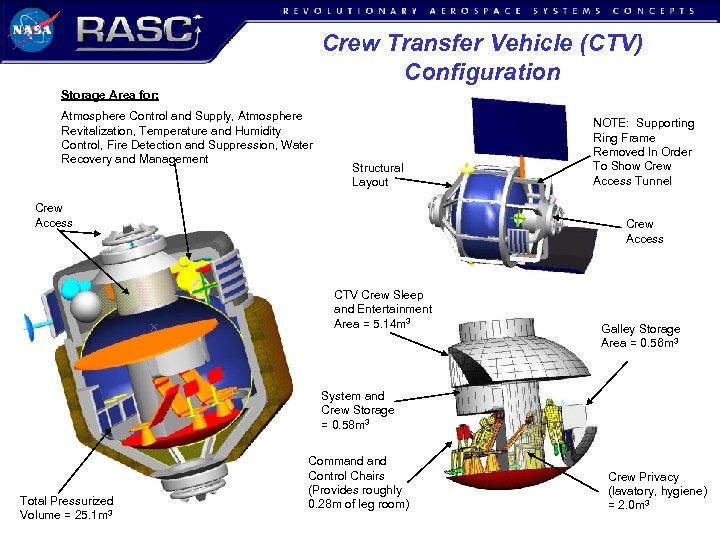
Crew Transfer Vehicle (CTV) Configuration Storage Area for: Atmosphere Control and Supply, Atmosphere Revitalization, Temperature and Humidity Control, Fire Detection and Suppression, Water Recovery and Management Structural Layout Crew Access NOTE: Supporting Ring Frame Removed In Order To Show Crew Access Tunnel Crew Access CTV Crew Sleep and Entertainment Area = 5. 14 m 3 Galley Storage Area = 0. 56 m 3 System and Crew Storage = 0. 58 m 3 Total Pressurized Volume = 25. 1 m 3 Command Control Chairs (Provides roughly 0. 28 m of leg room) Crew Privacy (lavatory, hygiene) = 2. 0 m 3
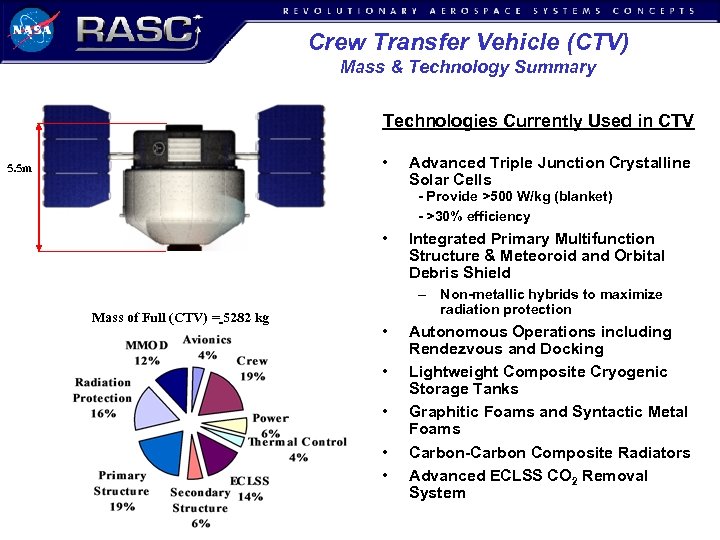
Crew Transfer Vehicle (CTV) Mass & Technology Summary Technologies Currently Used in CTV • 5. 5 m Advanced Triple Junction Crystalline Solar Cells - Provide >500 W/kg (blanket) - >30% efficiency • Mass of Full (CTV) = 5282 kg Integrated Primary Multifunction Structure & Meteoroid and Orbital Debris Shield – Non-metallic hybrids to maximize radiation protection • • • Autonomous Operations including Rendezvous and Docking Lightweight Composite Cryogenic Storage Tanks Graphitic Foams and Syntactic Metal Foams Carbon-Carbon Composite Radiators Advanced ECLSS CO 2 Removal System
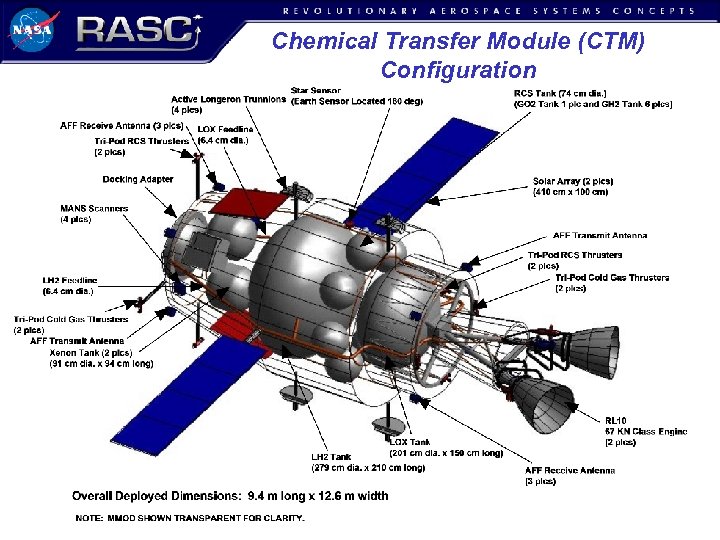
Chemical Transfer Module (CTM) Configuration
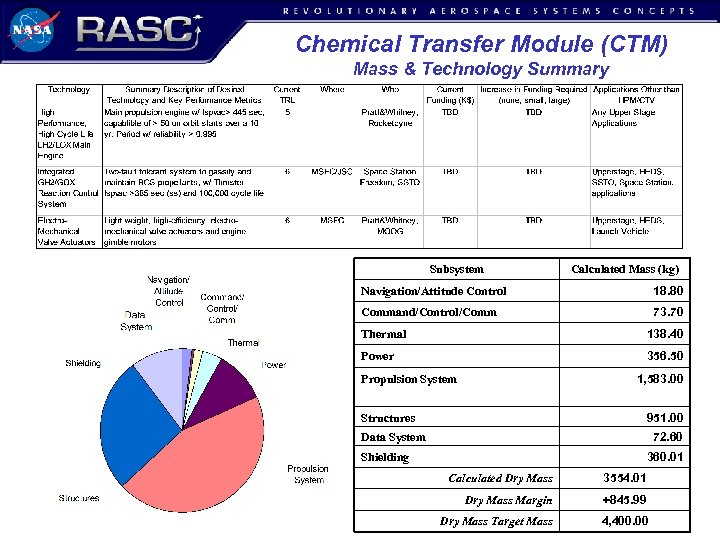
Chemical Transfer Module (CTM) Mass & Technology Summary Subsystem Calculated Mass (kg) Navigation/Attitude Control 18. 80 Command/Control/Comm 73. 70 Thermal 138. 40 Power 356. 50 1, 583. 00 Propulsion System 951. 00 Structures 72. 60 Data System 360. 01 Shielding Calculated Dry Mass 3554. 01 Dry Mass Margin +845. 99 Dry Mass Target Mass 4, 400. 00
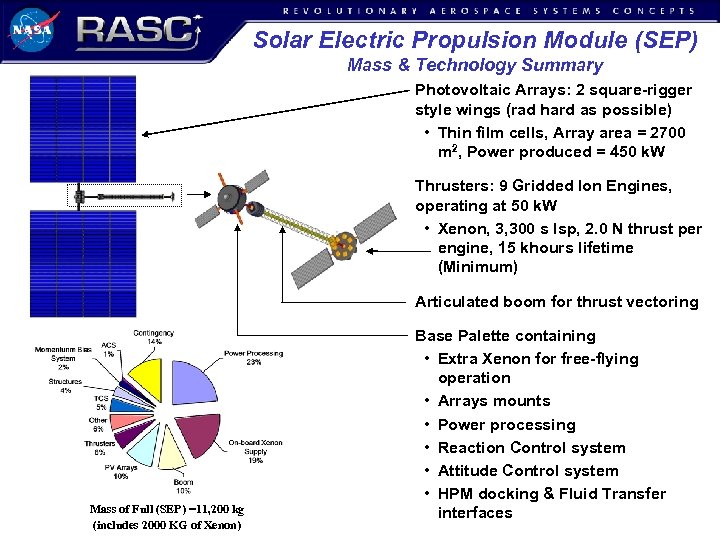
Solar Electric Propulsion Module (SEP) Mass & Technology Summary Photovoltaic Arrays: 2 square-rigger style wings (rad hard as possible) • Thin film cells, Array area = 2700 m 2, Power produced = 450 k. W Thrusters: 9 Gridded Ion Engines, operating at 50 k. W • Xenon, 3, 300 s Isp, 2. 0 N thrust per engine, 15 khours lifetime (Minimum) Articulated boom for thrust vectoring Mass of Full (SEP) =11, 200 kg (includes 2000 KG of Xenon) Base Palette containing • Extra Xenon for free-flying operation • Arrays mounts • Power processing • Reaction Control system • Attitude Control system • HPM docking & Fluid Transfer interfaces
Commercial Backup
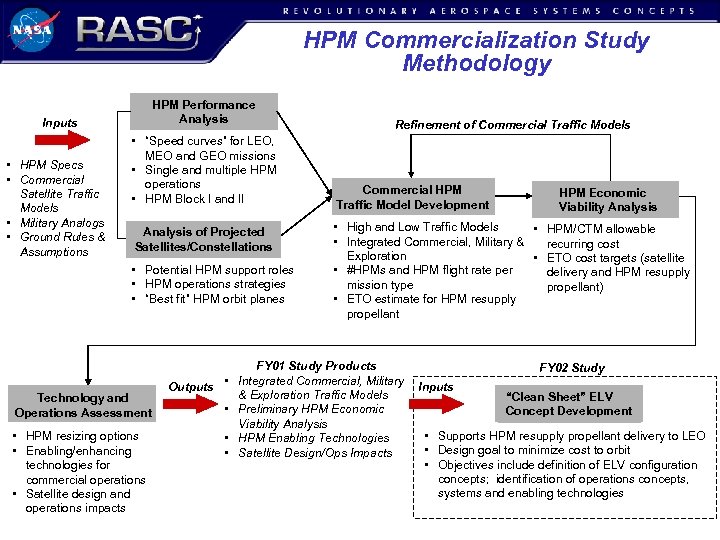
HPM Commercialization Study Methodology HPM Performance Analysis Inputs • HPM Specs • Commercial Satellite Traffic Models • Military Analogs • Ground Rules & Assumptions • “Speed curves” for LEO, MEO and GEO missions • Single and multiple HPM operations • HPM Block I and II Analysis of Projected Satellites/Constellations • Potential HPM support roles • HPM operations strategies • “Best fit” HPM orbit planes Technology and Operations Assessment • HPM resizing options • Enabling/enhancing technologies for commercial operations • Satellite design and operations impacts Outputs • • Refinement of Commercial Traffic Models Commercial HPM Traffic Model Development HPM Economic Viability Analysis • High and Low Traffic Models • HPM/CTM allowable • Integrated Commercial, Military & recurring cost Exploration • ETO cost targets (satellite • #HPMs and HPM flight rate per delivery and HPM resupply mission type propellant) • ETO estimate for HPM resupply propellant FY 01 Study Products Integrated Commercial, Military & Exploration Traffic Models Preliminary HPM Economic Viability Analysis HPM Enabling Technologies Satellite Design/Ops Impacts FY 02 Study Inputs “Clean Sheet” ELV Concept Development • Supports HPM resupply propellant delivery to LEO • Design goal to minimize cost to orbit • Objectives include definition of ELV configuration concepts; identification of operations concepts, systems and enabling technologies
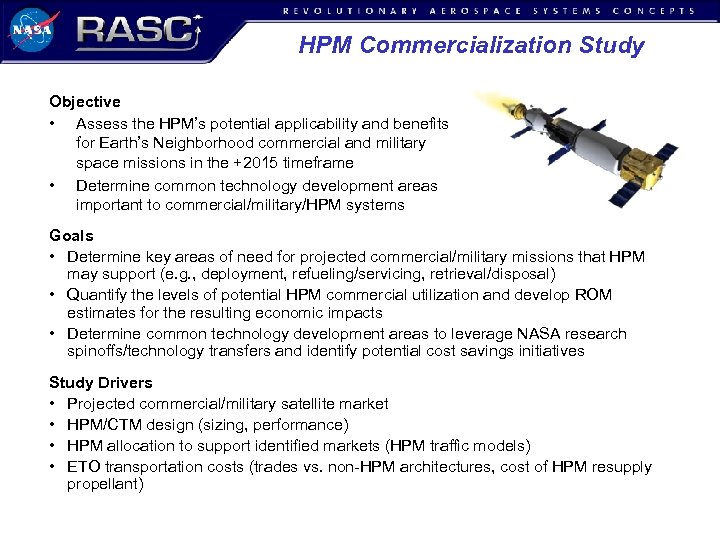
HPM Commercialization Study Objective • Assess the HPM’s potential applicability and benefits for Earth’s Neighborhood commercial and military space missions in the +2015 timeframe • Determine common technology development areas important to commercial/military/HPM systems Goals • Determine key areas of need for projected commercial/military missions that HPM may support (e. g. , deployment, refueling/servicing, retrieval/disposal) • Quantify the levels of potential HPM commercial utilization and develop ROM estimates for the resulting economic impacts • Determine common technology development areas to leverage NASA research spinoffs/technology transfers and identify potential cost savings initiatives Study Drivers • Projected commercial/military satellite market • HPM/CTM design (sizing, performance) • HPM allocation to support identified markets (HPM traffic models) • ETO transportation costs (trades vs. non-HPM architectures, cost of HPM resupply propellant)
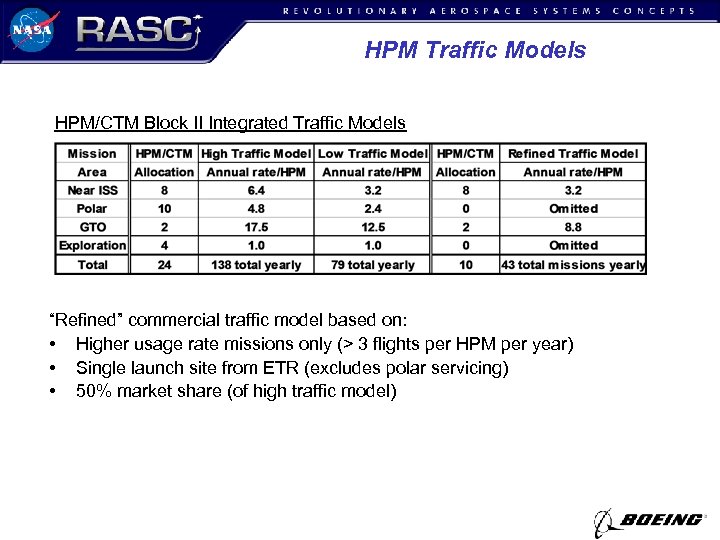
HPM Traffic Models HPM/CTM Block II Integrated Traffic Models “Refined” commercial traffic model based on: • Higher usage rate missions only (> 3 flights per HPM per year) • Single launch site from ETR (excludes polar servicing) • 50% market share (of high traffic model)
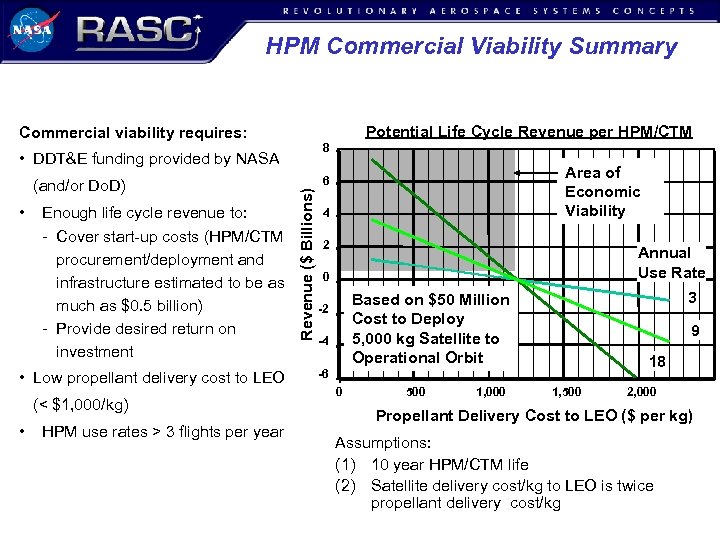
HPM Commercial Viability Summary Potential Life Cycle Revenue per HPM/CTM Commercial viability requires: 8 • DDT&E funding provided by NASA • Enough life cycle revenue to: - Cover start-up costs (HPM/CTM procurement/deployment and infrastructure estimated to be as much as $0. 5 billion) - Provide desired return on investment • Low propellant delivery cost to LEO (< $1, 000/kg) • HPM use rates > 3 flights per year Area of Economic Viability 6 Revenue ($ Billions) (and/or Do. D) 4 2 Annual Use Rate 0 3 Based on $50 Million Cost to Deploy 5, 000 kg Satellite to Operational Orbit -2 -4 9 18 -6 0 500 1, 000 1, 500 2, 000 Propellant Delivery Cost to LEO ($ per kg) Assumptions: (1) 10 year HPM/CTM life (2) Satellite delivery cost/kg to LEO is twice propellant delivery cost/kg
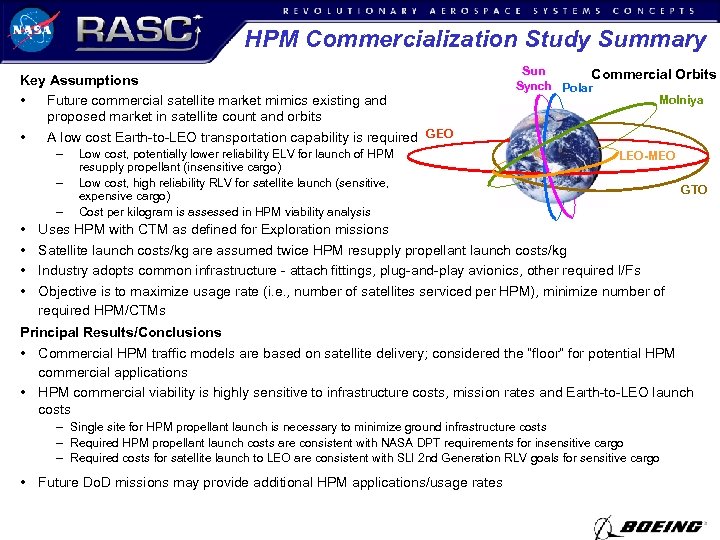
HPM Commercialization Study Summary Key Assumptions • Future commercial satellite market mimics existing and proposed market in satellite count and orbits • A low cost Earth-to-LEO transportation capability is required GEO – – – • • Low cost, potentially lower reliability ELV for launch of HPM resupply propellant (insensitive cargo) Low cost, high reliability RLV for satellite launch (sensitive, expensive cargo) Cost per kilogram is assessed in HPM viability analysis Sun Commercial Orbits Synch Polar Molniya LEO-MEO GTO Uses HPM with CTM as defined for Exploration missions Satellite launch costs/kg are assumed twice HPM resupply propellant launch costs/kg Industry adopts common infrastructure - attach fittings, plug-and-play avionics, other required I/Fs Objective is to maximize usage rate (i. e. , number of satellites serviced per HPM), minimize number of required HPM/CTMs Principal Results/Conclusions • Commercial HPM traffic models are based on satellite delivery; considered the “floor” for potential HPM commercial applications • HPM commercial viability is highly sensitive to infrastructure costs, mission rates and Earth-to-LEO launch costs – Single site for HPM propellant launch is necessary to minimize ground infrastructure costs – Required HPM propellant launch costs are consistent with NASA DPT requirements for insensitive cargo – Required costs for satellite launch to LEO are consistent with SLI 2 nd Generation RLV goals for sensitive cargo • Future Do. D missions may provide additional HPM applications/usage rates
Скачать презентацию Orbital Aggregation Space Infrastructure Systems OASIS Executive
a76747f29dfe085289f18638222c63ac.ppt