


 Скачать презентацию Orange Production Karipkhan Alikhan Mikhail Rodovolskiy The
Orange Production1 1.pptx
- Количество слайдов: 8
 Orange Production Karipkhan Alikhan Mikhail Rodovolskiy
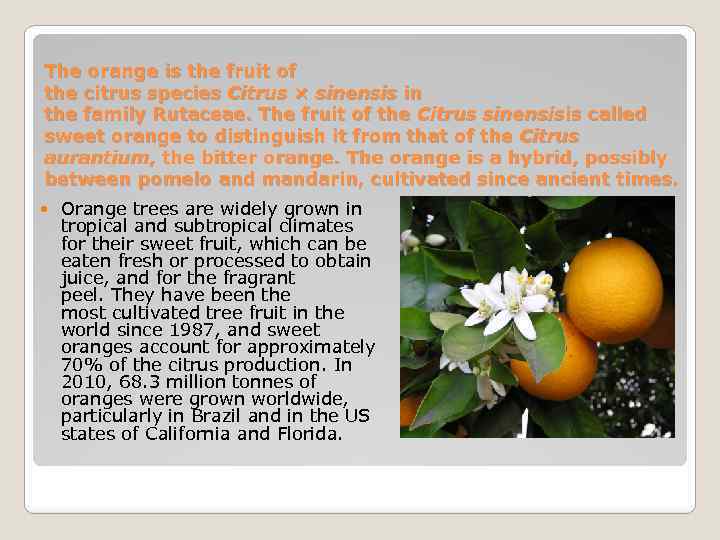 The orange is the fruit of the citrus species Citrus × sinensis in the family Rutaceae. The fruit of the Citrus sinensisis called sweet orange to distinguish it from that of the Citrus aurantium, the bitter orange. The orange is a hybrid, possibly between pomelo and mandarin, cultivated since ancient times. Orange trees are widely grown in tropical and subtropical climates for their sweet fruit, which can be eaten fresh or processed to obtain juice, and for the fragrant peel. They have been the most cultivated tree fruit in the world since 1987, and sweet oranges account for approximately 70% of the citrus production. In 2010, 68. 3 million tonnes of oranges were grown worldwide, particularly in Brazil and in the US states of California and Florida.
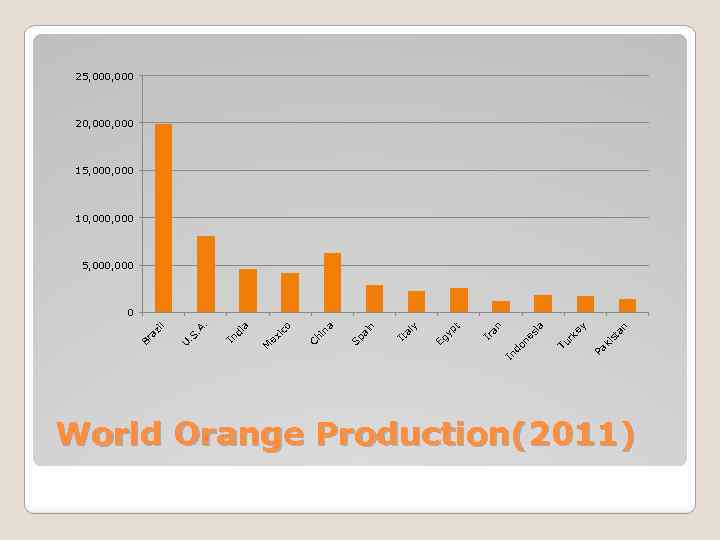 25, 000 20, 000 15, 000 10, 000 5, 000 Pa k is t an ey rk Tu es ia on In d Ir an t Eg yp y al It ai n Sp a in Ch ic o M ex a di In . A. S U Br az il . 0 World Orange Production(2011)
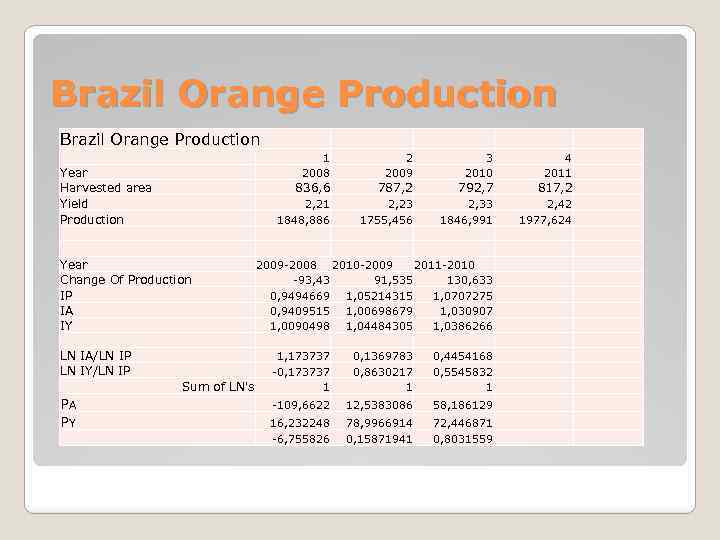 Brazil Orange Production 1 2008 3 2010 4 2011 836, 6 787, 2 792, 7 817, 2 2, 21 1848, 886 Year Harvested area Yield Production 2 2009 2, 23 1755, 456 2, 33 1846, 991 2, 42 1977, 624 Year Change Of Production IP IA IY LN IA/LN IP LN IY/LN IP PA PY 2009 -2008 2010 -2009 2011 -2010 -93, 43 91, 535 130, 633 0, 9494669 1, 05214315 1, 0707275 0, 9409515 1, 00698679 1, 030907 1, 0090498 1, 04484305 1, 0386266 1, 173737 0, 1369783 0, 4454168 -0, 173737 0, 8630217 0, 5545832 Sum of LN's 1 1 1 -109, 6622 12, 5383086 58, 186129 16, 232248 -6, 755826 78, 9966914 0, 15871941 72, 446871 0, 8031559
 Production Orange projections assume that orange production expansion will slow down. The main reasons are serious disease problems in Brazil and Florida and fewer new plantings elsewhere in the Western Hemisphere due to the lagged effect of low prices in the past. More specifically, projected orange production in 2010 is 66. 4 million tonnes, approximately 14 percent greater than that realized over the 1997 -99 period. The projected annual rate of growth of 1. 12 percent is substantially lower than the 3. 46 percent that occurred from 1987 -89 to 1997 -99. The projected production is expected to be utilized as 36. 3 million tonnes fresh and 30. 1 million tonnes processed. The share of production claimed by processed utilization is projected to increase marginally. Orange production in developed countries is projected to grow at an annual rate of 0. 6 percent with most of that growth coming from the United States. Production in Europe is projected to show little change, with a small increase in Spain offset by declines in Italy and Greece. Production in South Africa is expected to continue to grow as it continues to exploit its advantage as an offseason supplier to the northern hemisphere. Production in Israel will continue to be affected by population growth that will compete with citrus and agricultural crops for land water. Japan’s orange industry is also projected to continue its secular decline as availability of imports increases.
 Production Production in developing countries is projected to increase at an annual rate of 1. 23 percent. Over the next ten years, it is likely the Brazil will experience a sizeable contraction of production as the combined effects of disease and low grower prices are felt. By 2010, however, the Brazilian industry should recover, with production returning to levels seen in the late 1990 s, and maintain its dominance of the world processed orange market. Mexico is vulnerable to the citrus tristeza virus that has already been found in the Yucatan peninsula. Mexican producers, mainly small growers, have been unable to take advantage of preferential access to the US market offered under the North American Free Trade Agreement (NAFTA). Smaller western hemisphere orange exporting countries such as Argentina, Cuba, Belize and Costa Rica should find market opportunities as the larger orange producing regions undergo adjustment. Cuba has expanded its orange processing capacity and output despite the trade embargo imposed by the United States. The processing sector of Belize and Costa Rica has also undergone consolidation that should lower costs. Orange producing countries in Asia are expected to continue to expand production, but nearly all of it will be consumed in domestic markets. China is projected to overtake Mexico as the third largest orange producing country and India will challenge Spain as the fifth largest producer. However, huge domestic markets in both of these countries mean that virtually all production will be consumed internally. The exception is Turkey, which is competitive in the European market, due to its geographic location and its association through a customs union with the EC. The Mediterranean countries of Morocco and Egypt are also expected to benefit from their proximity to Europe.
 Consumption and trade World consumption of oranges grew at a compound rate of 3. 5 percent over the period 1987 -89 to 1997 -99. Consumption of fresh oranges grew at an annual rate of 2. 8 percent, while processed orange consumption grew at 4. 4 percent per annum. Increased consumption of processed oranges in Europe was one of the primary forces supporting expanded world consumption. Even though per capita consumption of fresh oranges in the EC declined from 12. 6 to 9. 5 kg, per capita processed orange consumption more than doubled to 28 kg (fresh fruit equivalent). Per capita consumption of processed oranges also grew in Canada and United States, which offset decreased fresh orange consumption in Canada. Among developed countries, the United States is one of the few that realized modest increased consumption of fresh oranges.
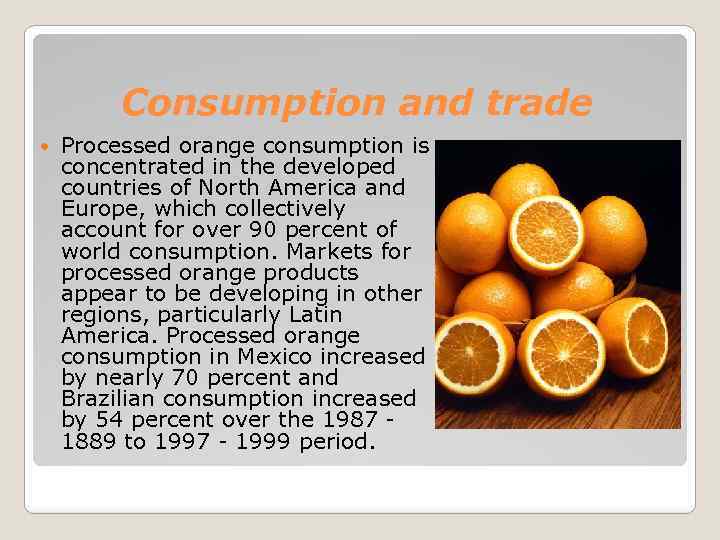 Consumption and trade Processed orange consumption is concentrated in the developed countries of North America and Europe, which collectively account for over 90 percent of world consumption. Markets for processed orange products appear to be developing in other regions, particularly Latin America. Processed orange consumption in Mexico increased by nearly 70 percent and Brazilian consumption increased by 54 percent over the 1987 - 1889 to 1997 - 1999 period.