


 Скачать презентацию Oral language skills and the incarcerated young offender
61eb4405a5d3ca4bb97ab1736b0d49e1.ppt
- Количество слайдов: 29
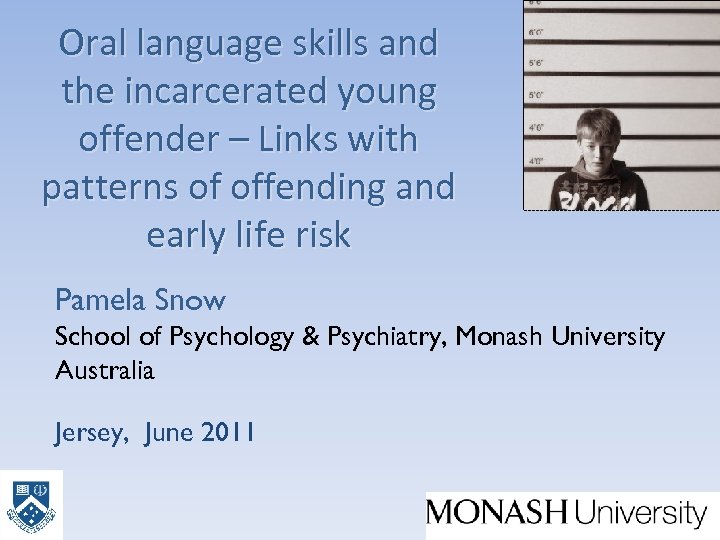 Oral language skills and the incarcerated young offender – Links with patterns of offending and early life risk Pamela Snow School of Psychology & Psychiatry, Monash University Australia Jersey, June 2011
 Acknowledgements • Australian Research Council (Discovery Program) • Criminology Research Council • Professor Martine Powell – Co-investigator • Margaret Kent and Rita Cauchi, Research Assistants • Participants in our studies
 In today’s presentation • Factors that promote Oral Language Competence (OLC) in early life • Why does OLC matter across the lifespan? • Our research on OLC in high-risk young males • What do these findings mean for the young person at-risk in the early years / already in the justice system?
 Oral language competence? • Everyday speaking and listening skills • Auditory processing and comprehension • Expressive language skills – semantics (vocabulary) , syntax (grammar), pragmatics (use) • Socially and culturally determined rules and practices • Important in facilitating the transition to literacy in the early school years, but not just literacy’s ‘Hand Maiden’
 Language: Surface and hidden meanings Similes Metaphor Idiom Jokes Sarcasm
 Threats* to the development of OLC • Neglect – esp socio-emotional • Abuse • Parental MH problems e. g. depression, substance abuse • Social disadvantage / low SES / chaotic family • Developmental disabilities • Male gender • Sensory deficits • Inadequate / interrupted education – b/c language continues to emerge / evolve throughout childhood, adolescence and across the adult life-span *Cumulative in nature
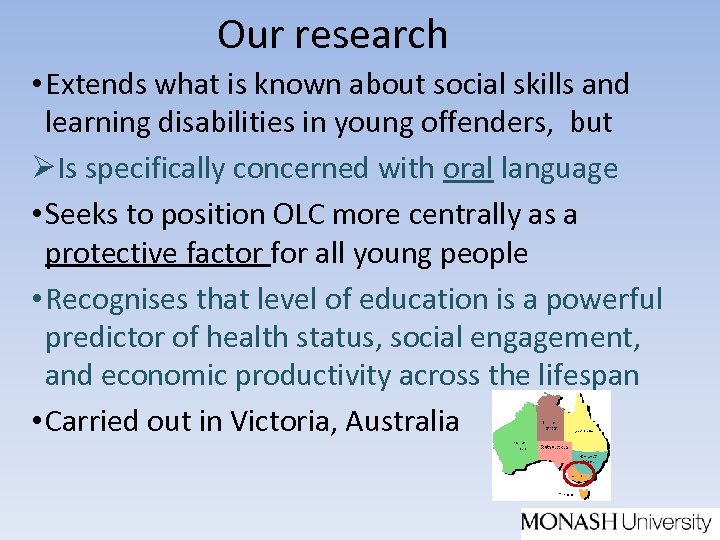 Our research • Extends what is known about social skills and learning disabilities in young offenders, but ØIs specifically concerned with oral language • Seeks to position OLC more centrally as a protective factor for all young people • Recognises that level of education is a powerful predictor of health status, social engagement, and economic productivity across the lifespan • Carried out in Victoria, Australia
 The Victorian context • Active diversion of youth offenders from custodial sentences • Unique “Dual Track” system for 17 -20 year-olds • Lowest rate of youth supervision or detention nationally (Australian Institute of Health and Welfare, 2006) • Fewer indigenous offenders than other States
 TWO KEY STUDIES 1. Community-based young offenders 2. Incarcerated young offenders
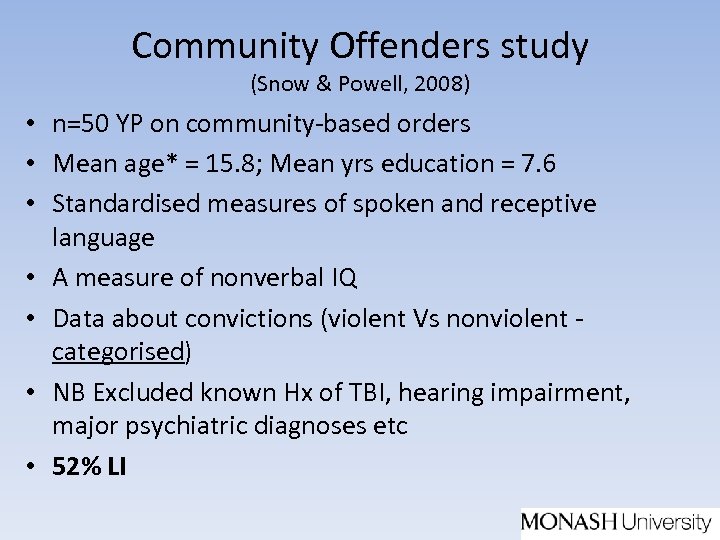 Community Offenders study (Snow & Powell, 2008) • n=50 YP on community-based orders • Mean age* = 15. 8; Mean yrs education = 7. 6 • Standardised measures of spoken and receptive language • A measure of nonverbal IQ • Data about convictions (violent Vs nonviolent categorised) • NB Excluded known Hx of TBI, hearing impairment, major psychiatric diagnoses etc • 52% LI
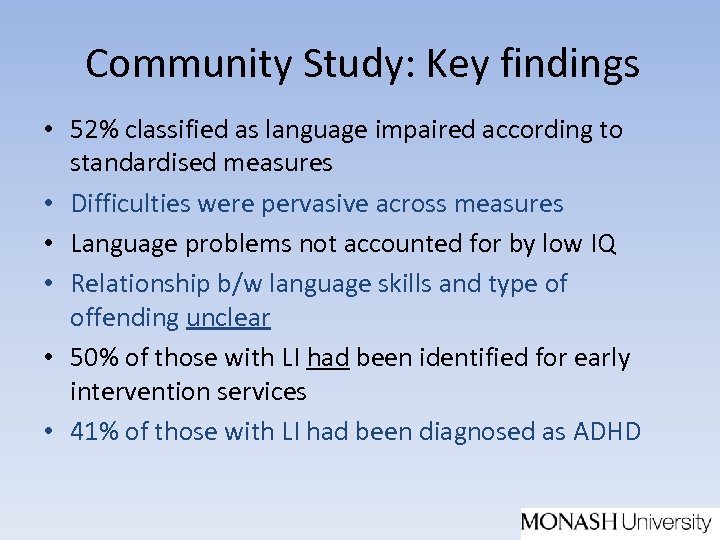 Community Study: Key findings • 52% classified as language impaired according to standardised measures • Difficulties were pervasive across measures • Language problems not accounted for by low IQ • Relationship b/w language skills and type of offending unclear • 50% of those with LI had been identified for early intervention services • 41% of those with LI had been diagnosed as ADHD
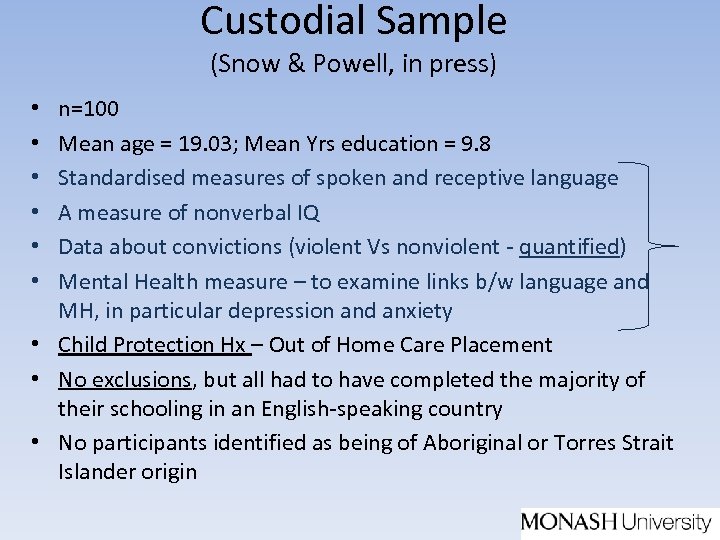 Custodial Sample (Snow & Powell, in press) n=100 Mean age = 19. 03; Mean Yrs education = 9. 8 Standardised measures of spoken and receptive language A measure of nonverbal IQ Data about convictions (violent Vs nonviolent - quantified) Mental Health measure – to examine links b/w language and MH, in particular depression and anxiety • Child Protection Hx – Out of Home Care Placement • No exclusions, but all had to have completed the majority of their schooling in an English-speaking country • No participants identified as being of Aboriginal or Torres Strait Islander origin • • •
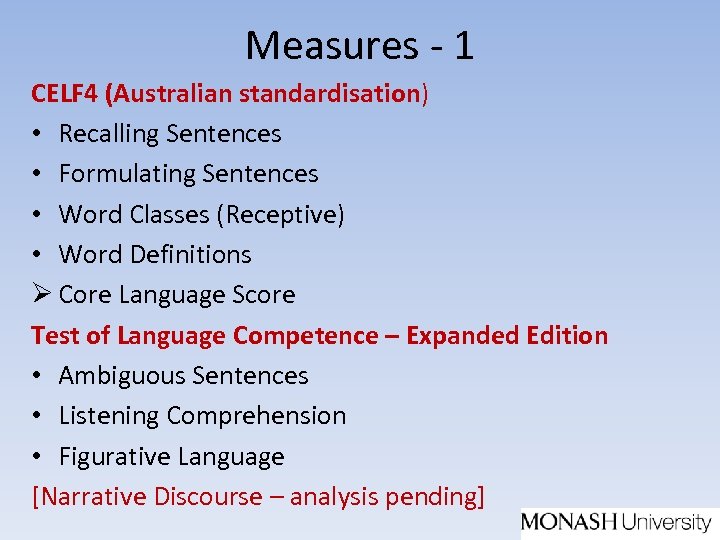 Measures - 1 CELF 4 (Australian standardisation) • Recalling Sentences • Formulating Sentences • Word Classes (Receptive) • Word Definitions Ø Core Language Score Test of Language Competence – Expanded Edition • Ambiguous Sentences • Listening Comprehension • Figurative Language [Narrative Discourse – analysis pending]
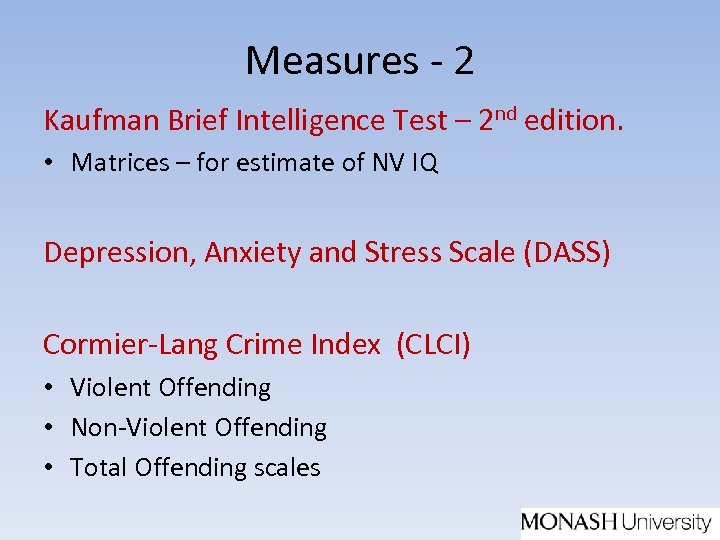 Measures - 2 Kaufman Brief Intelligence Test – 2 nd edition. • Matrices – for estimate of NV IQ Depression, Anxiety and Stress Scale (DASS) Cormier-Lang Crime Index (CLCI) • Violent Offending • Non-Violent Offending • Total Offending scales
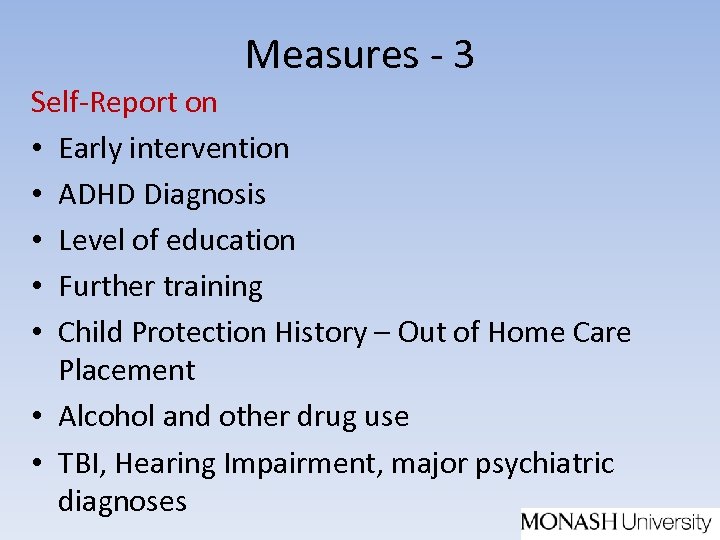 Measures - 3 Self-Report on • Early intervention • ADHD Diagnosis • Level of education • Further training • Child Protection History – Out of Home Care Placement • Alcohol and other drug use • TBI, Hearing Impairment, major psychiatric diagnoses
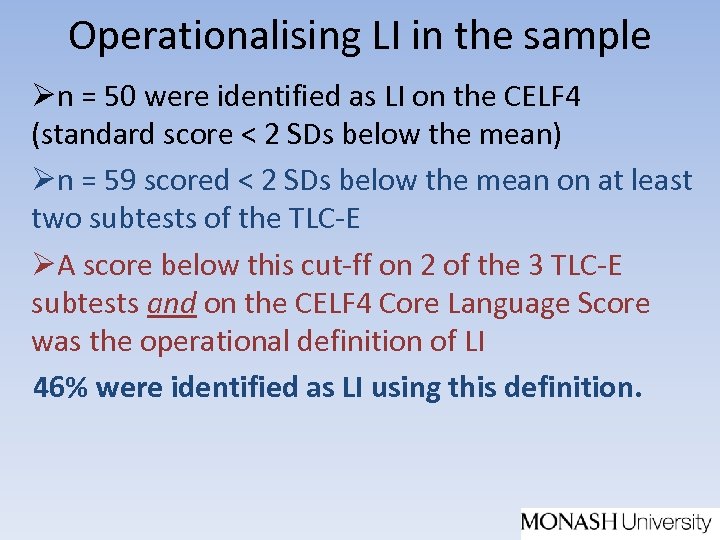 Operationalising LI in the sample Øn = 50 were identified as LI on the CELF 4 (standard score < 2 SDs below the mean) Øn = 59 scored < 2 SDs below the mean on at least two subtests of the TLC-E ØA score below this cut-ff on 2 of the 3 TLC-E subtests and on the CELF 4 Core Language Score was the operational definition of LI 46% were identified as LI using this definition.
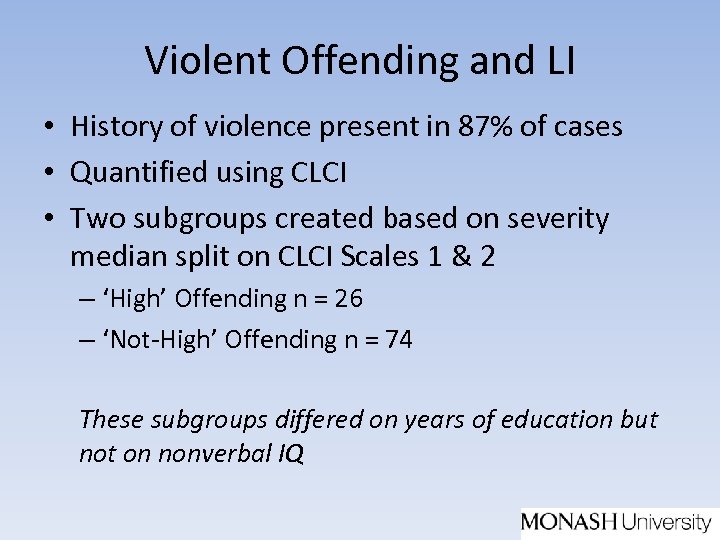 Violent Offending and LI • History of violence present in 87% of cases • Quantified using CLCI • Two subgroups created based on severity median split on CLCI Scales 1 & 2 – ‘High’ Offending n = 26 – ‘Not-High’ Offending n = 74 These subgroups differed on years of education but not on nonverbal IQ
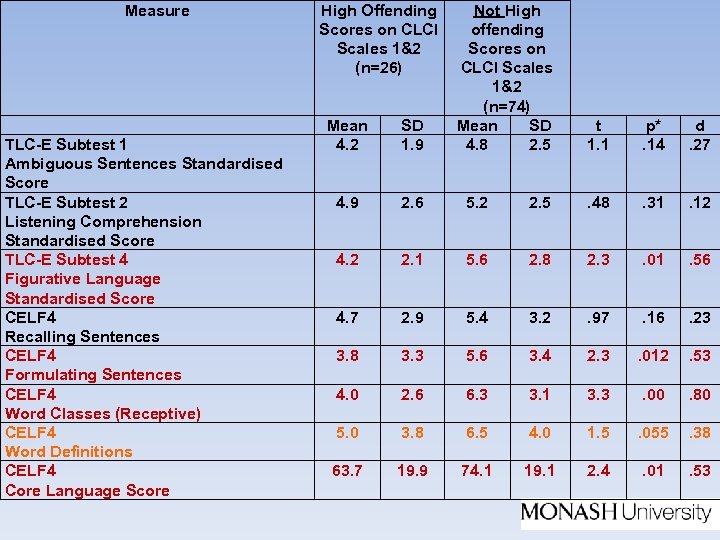 Measure TLC-E Subtest 1 Ambiguous Sentences Standardised Score TLC-E Subtest 2 Listening Comprehension Standardised Score TLC-E Subtest 4 Figurative Language Standardised Score CELF 4 Recalling Sentences CELF 4 Formulating Sentences CELF 4 Word Classes (Receptive) CELF 4 Word Definitions CELF 4 Core Language Score High Offending Scores on CLCI Scales 1&2 (n=26) Not High offending Scores on CLCI Scales 1&2 (n=74) Mean SD t 4. 8 2. 5 1. 1 Mean 4. 2 SD 1. 9 p*. 14 d. 27 4. 9 2. 6 5. 2 2. 5 . 48 . 31 . 12 4. 2 2. 1 5. 6 2. 8 2. 3 . 01 . 56 4. 7 2. 9 5. 4 3. 2 . 97 . 16 . 23 3. 8 3. 3 5. 6 3. 4 2. 3 . 012 . 53 4. 0 2. 6 6. 3 3. 1 3. 3 . 00 . 80 5. 0 3. 8 6. 5 4. 0 1. 5 . 055 . 38 63. 7 19. 9 74. 1 19. 1 2. 4 . 01 . 53
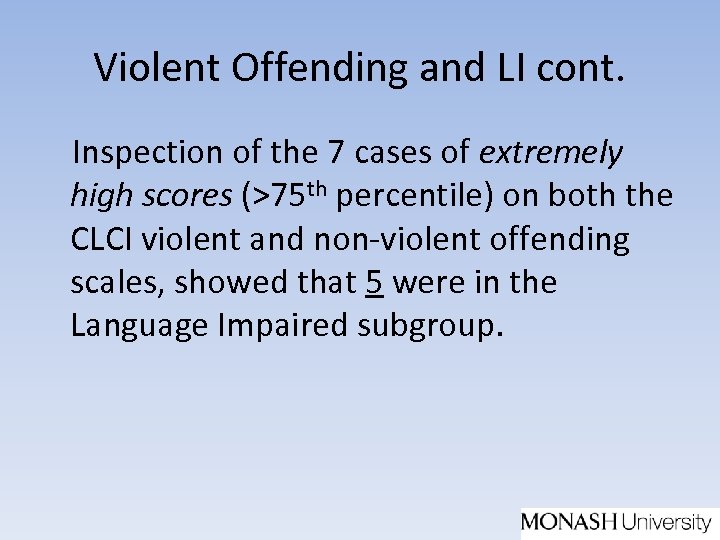 Violent Offending and LI cont. Inspection of the 7 cases of extremely high scores (>75 th percentile) on both the CLCI violent and non-violent offending scales, showed that 5 were in the Language Impaired subgroup.
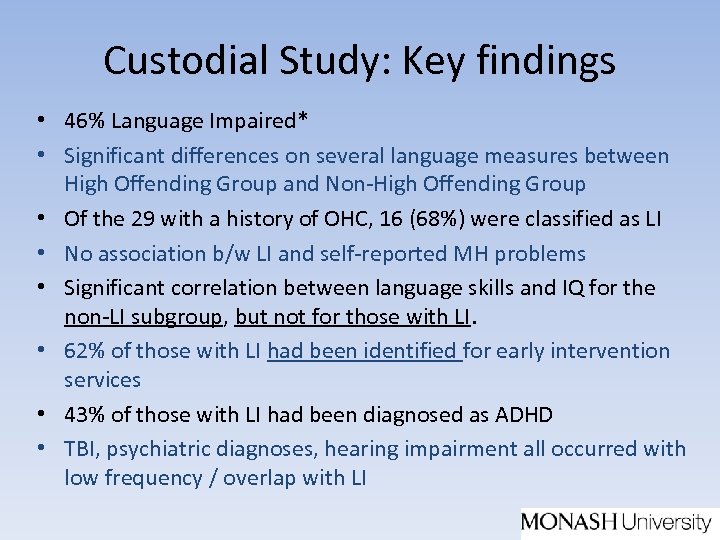 Custodial Study: Key findings • 46% Language Impaired* • Significant differences on several language measures between High Offending Group and Non-High Offending Group • Of the 29 with a history of OHC, 16 (68%) were classified as LI • No association b/w LI and self-reported MH problems • Significant correlation between language skills and IQ for the non-LI subgroup, but not for those with LI. • 62% of those with LI had been identified for early intervention services • 43% of those with LI had been diagnosed as ADHD • TBI, psychiatric diagnoses, hearing impairment all occurred with low frequency / overlap with LI
 Limitations / considerations Self-selection into the study => bias? Operationalisation of LI – were we too conservative? MH measure – sensitivity? Minimum Data Set – not part of our thinking 10 years ago, but should have been • Many may have had Child Protection involvement but without OHC placement – this is difficult to assess via self-report • Many likely to have trauma backgrounds – difficult to capture, but important developmentally • Community / Custodial offender distinction is somewhat artificial • •
 Take home messages • Clinically significant language impairment is present in ~ 50% of young male offenders • IQ is not an explanatory mechanism • Early intervention has – Not occurred – Been inadequate • Other labels (e. g. ADHD, Conduct Disorder) are likely to be applied • Early risk (as measured by OHCP) increases vulnerability but is also a missed intervention opportunity • Undetected LI will make being a witness, suspect or victim more challenging for a young person • Interpersonal violence instead of prosocial ways of dealing with ambiguity / hostility? ?
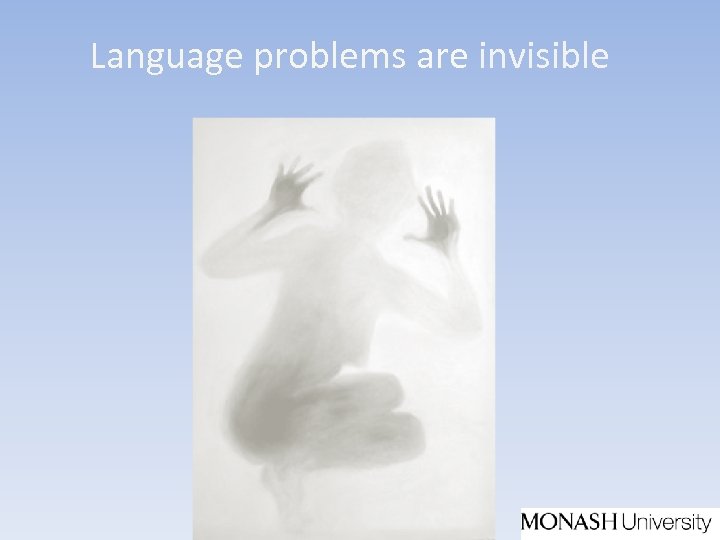 Language problems are invisible
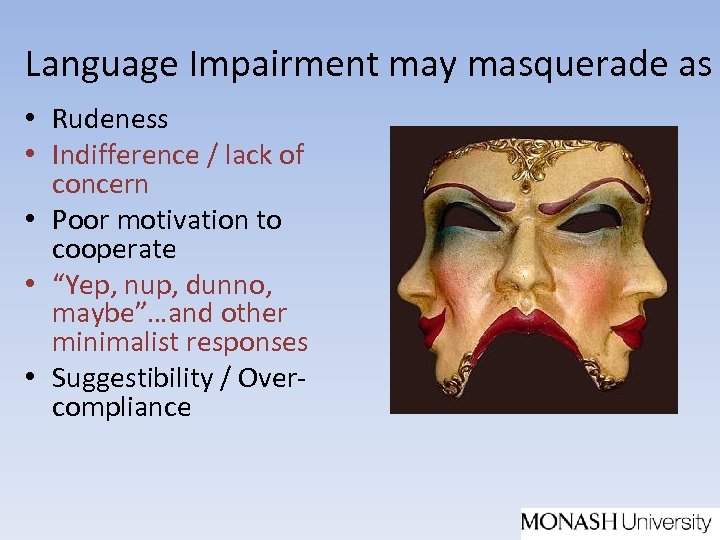 Language Impairment may masquerade as • Rudeness • Indifference / lack of concern • Poor motivation to cooperate • “Yep, nup, dunno, maybe”…and other minimalist responses • Suggestibility / Overcompliance
 What does all of this mean for. . Early intervention with high-risk boys? Forensic interviewing of youth offenders? Counselling of young offenders? Restorative Justice conferencing? Mental Health across the lifespan? Mastery Optimism / Hope Delivery of literacy and social skill interventions within the (youth) justice system? Young people in the Child Protection system?
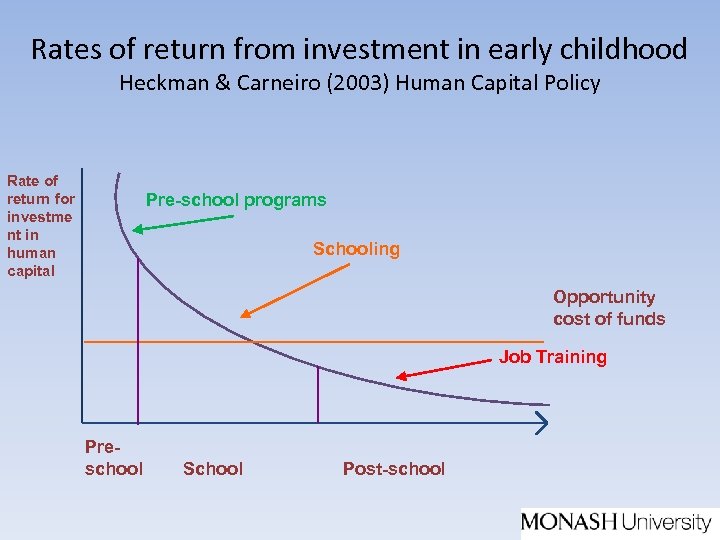 Rates of return from investment in early childhood Heckman & Carneiro (2003) Human Capital Policy Rate of return for investme nt in human capital Pre-school programs Schooling Opportunity cost of funds Job Training Preschool School Post-school
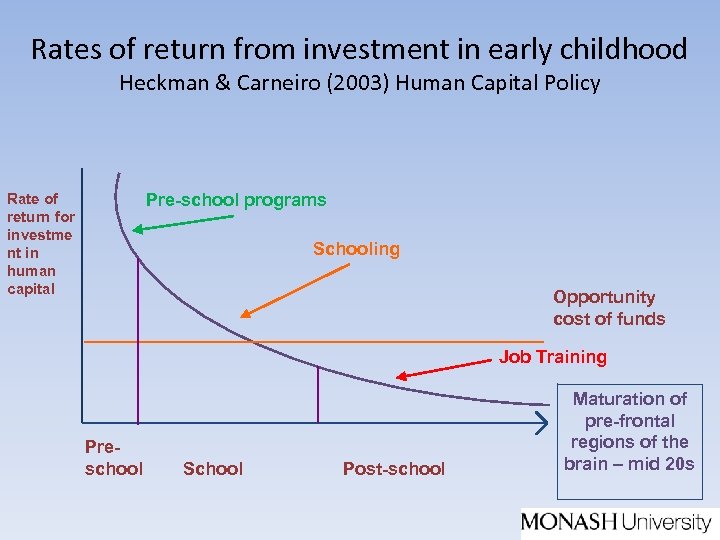 Rates of return from investment in early childhood Heckman & Carneiro (2003) Human Capital Policy Rate of return for investme nt in human capital Pre-school programs Schooling Opportunity cost of funds Job Training Preschool School Post-school Maturation of pre-frontal regions of the brain – mid 20 s
 Selected Publications Snow, P. C. & Powell, M. B. (in press) Oral language competence in incarcerated young offenders: Links with offending severity. International Journal of Speech Language Pathology. Snow, P. C. , Sanger, D. D. & Bryan, K. (2011, in press). Listening to adolescents with speech, language and communication needs who are in contact with the youth justice system. In S. Roulstone & S. Mc. Leod (Editors). Listening to Children and Young People with Speech, Language and Communication Needs. UK: J&R Press. Snow, P. C. & Sanger, D. D. (2010). Restorative justice conferencing and the youth offender: Exploring the role of oral language competence. International Journal of Language and Communication Disorders. Released early online August 18 2010. Snow, P. C. , Powell, M. B. , & Murphett, R. (2009). Getting the story from child witnesses: Exploring the application of a story grammar framework. Psychology, Crime & Law 15(6), 555 -568. Snow, P. C. (2009). Oral language competence and equity of access to education and health. In K. Bryan (Ed) Communication in Healthcare. Interdisciplinary Communication Studies Volume 1 (Series Editor: Colin B. Grant), (pp 101 -134). Bern: Peter Lang European Academic Publishers. Snow, P. C. (2009). Child maltreatment, mental health and oral language competence: Inviting Speech Language Pathology to the prevention table. International Journal of Speech Language Pathology 11(12), 95 -103. Snow, P. C. & Powell, M. B. (2008). Oral language competence, social skills, and high risk boys: What are juvenile offenders trying to tell us? Children and Society 22, 16 -28. Snow, P. C. & Powell, M. B. (2005). What’s the story? An exploration of narrative language abilities in male juvenile offenders. Psychology, Crime and Law 11(3) 239 -253. Snow, P. & Powell, M. (2004). Interviewing juvenile offenders: The importance of oral language competence. Current Issues in Criminal Justice 16(2), 220 -225. Snow, P. C. & Powell, M. B. (2004). Developmental language disorders and adolescent risk: A public-health advocacy role for speech pathologists? International Journal of Speech Language Pathology 6(4), 221 -229. Humber, E. & Snow, P. C. (2001). The oral language skills of young offenders: A pilot investigation. Psychiatry, Psychology and Law, 8(1), 1 -11.
 Further information: pamela. snow@monash. edu