


 Скачать презентацию Oral health and workforce issues reflections from
0e8653c3c43d4f9dbc318a559ddde617.ppt
- Количество слайдов: 27
 Oral health and workforce issues – reflections from Oman Dr. Salahudeen Al Bulushi Director of Dental & Oral Health Ministry of Health
 Content Introduction Demography Oral health status of Omani population Workforce in Oman Challenges and need for improvements Public health measures implemented Future prospective Key factors in workforce planning
 Introduction Human resources are critical in to the sustainability of any healthcare system. Achieving self reliance was developed by the strategic direction of various healthcare governing bodies, so has the work done to develop national programs, utilize scholarship opportunities, and conduct appropriate continuing professional development activities to ensure a strategic approach to addressing the needs of the expanding Omani population. Healthcare leaders from the civil, armed forces, educational, and private institutions have created a harmonious collaborative effort to develop, strengthen, and sustain an internationally reputed healthcare system and subsequent workforce.
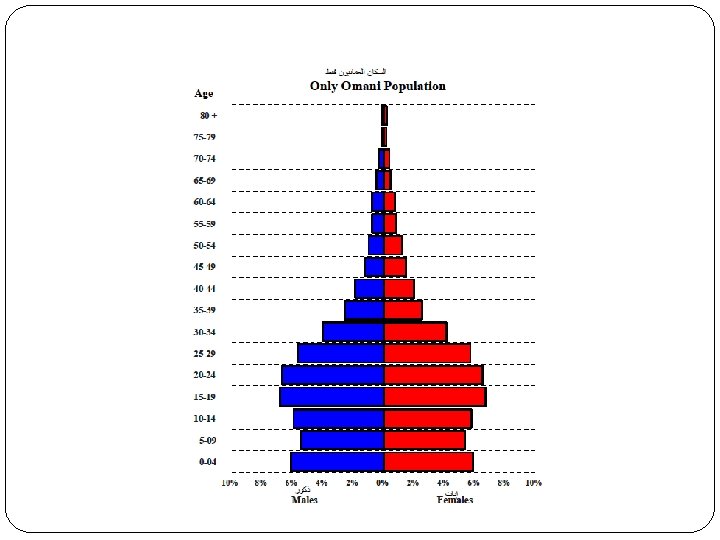
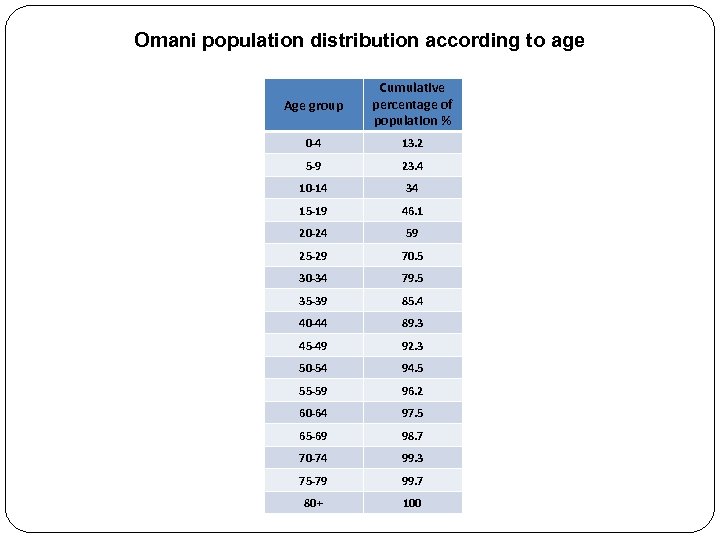 Omani population distribution according to age Age group Cumulative percentage of population % 0 -4 13. 2 5 -9 23. 4 10 -14 34 15 -19 46. 1 20 -24 59 25 -29 70. 5 30 -34 79. 5 35 -39 85. 4 40 -44 89. 3 45 -49 92. 3 50 -54 94. 5 55 -59 96. 2 60 -64 97. 5 65 -69 98. 7 70 -74 99. 3 75 -79 99. 7 80+ 100
 ORAL HEALTH STATUS OF OMANI POPULATION
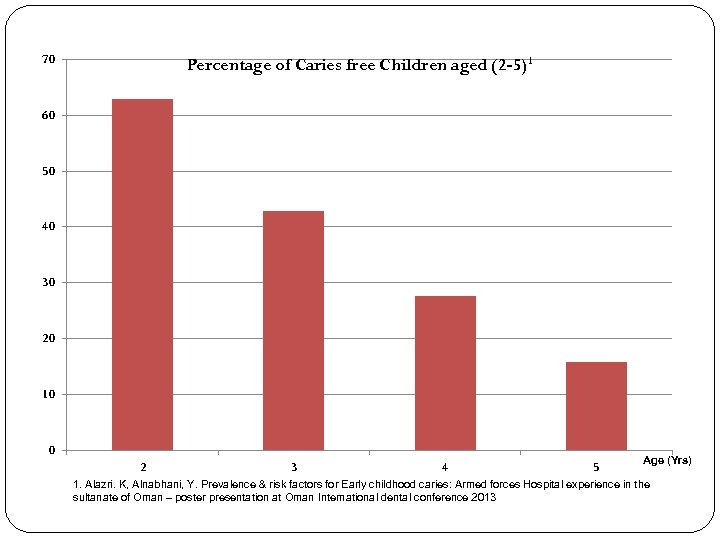 70 Percentage of Caries free Children aged (2 -5)1 60 50 40 30 20 10 0 2 3 4 5 Age (Yrs) 1. Alazri. K, Alnabhani, Y. Prevalence & risk factors for Early childhood caries: Armed forces Hospital experience in the sultanate of Oman – poster presentation at Oman International dental conference 2013
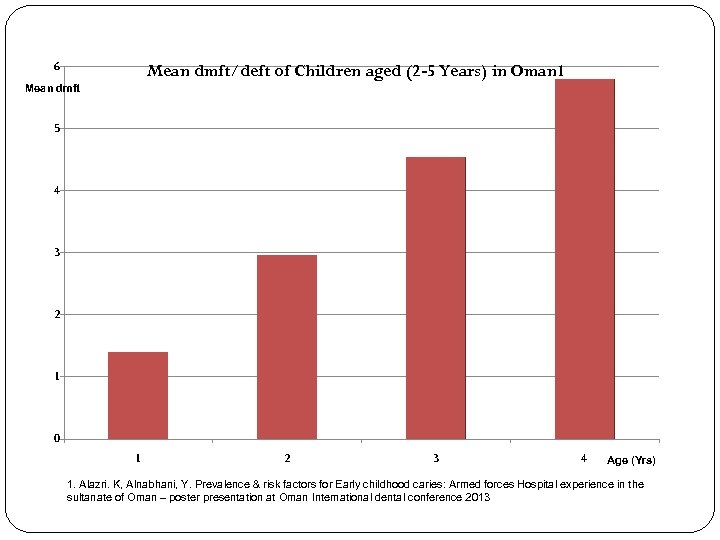 6 Mean dmft/deft of Children aged (2 -5 Years) in Oman 1 Mean dmft 5 4 3 2 1 0 1 2 3 4 Age (Yrs) 1. Alazri. K, Alnabhani, Y. Prevalence & risk factors for Early childhood caries: Armed forces Hospital experience in the sultanate of Oman – poster presentation at Oman International dental conference 2013
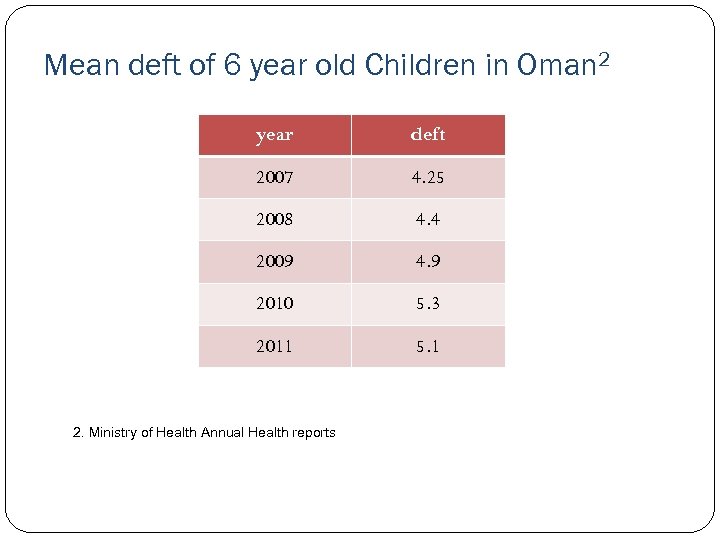 Mean deft of 6 year old Children in Oman 2 year deft 2007 4. 25 2008 4. 4 2009 4. 9 2010 5. 3 2011 5. 1 2. Ministry of Health Annual Health reports
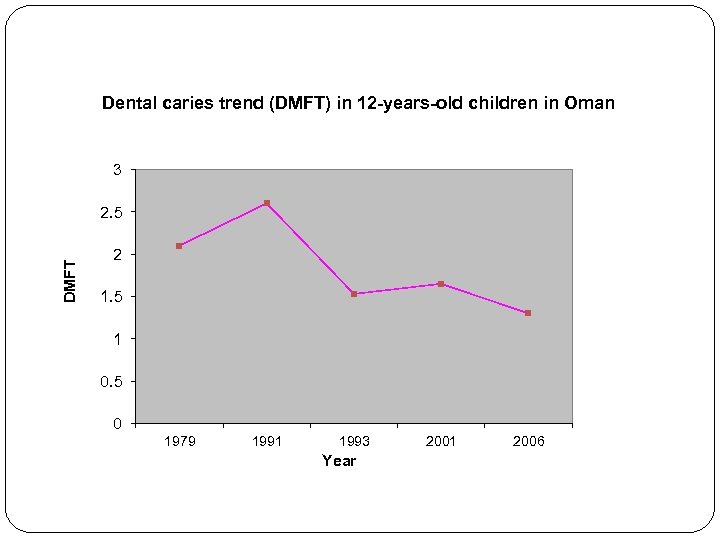 Dental caries trend (DMFT) in 12 -years-old children in Oman 3 DMFT 2. 5 2 1. 5 1 0. 5 0 1979 1991 1993 Year 2001 2006
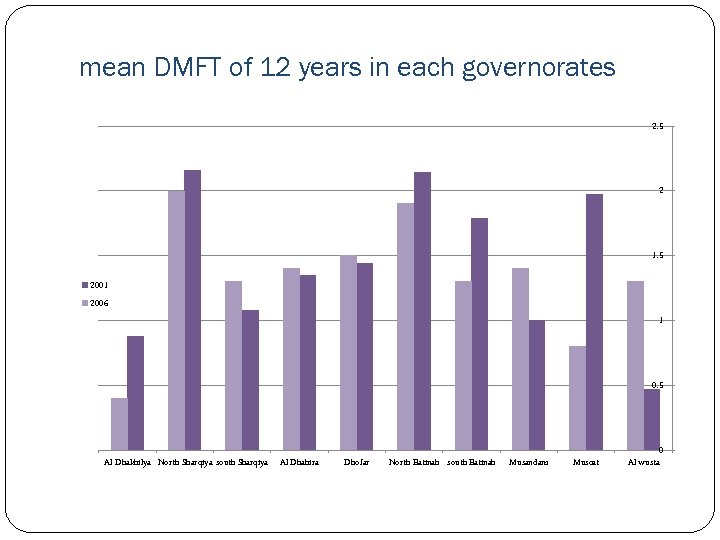 mean DMFT of 12 years in each governorates 2. 5 2 1. 5 2001 2006 1 0. 5 Al Dhakhilya North Sharqiya south Sharqiya Al Dhahira Dhofar North Batinah south Batinah Musandam Muscat 0 Al wusta
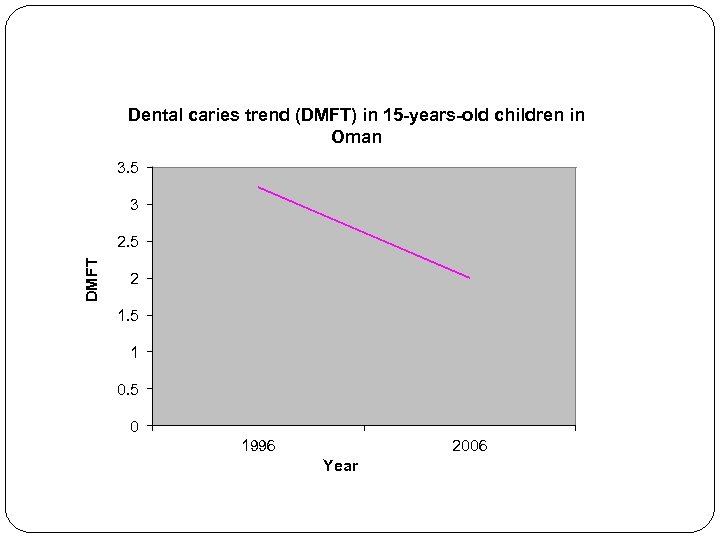 Dental caries trend (DMFT) in 15 -years-old children in Oman 3. 5 3 DMFT 2. 5 2 1. 5 1 0. 5 0 1996 2006 Year
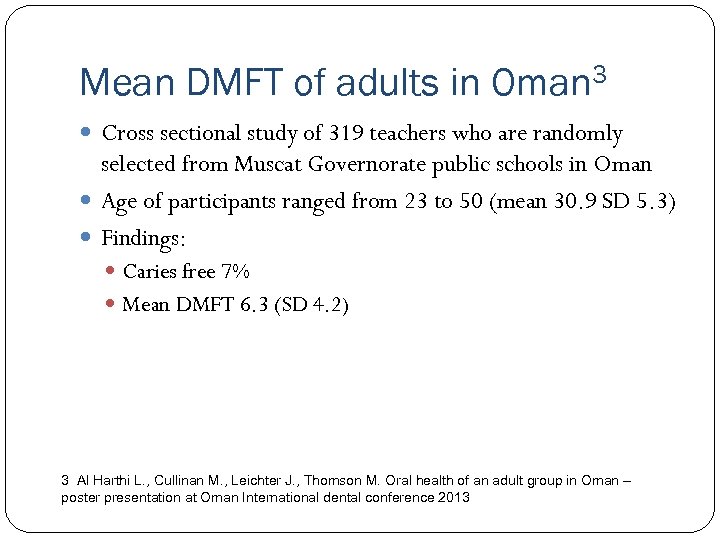 Mean DMFT of adults in Oman 3 Cross sectional study of 319 teachers who are randomly selected from Muscat Governorate public schools in Oman Age of participants ranged from 23 to 50 (mean 30. 9 SD 5. 3) Findings: Caries free 7% Mean DMFT 6. 3 (SD 4. 2) 3 Al Harthi L. , Cullinan M. , Leichter J. , Thomson M. Oral health of an adult group in Oman – poster presentation at Oman International dental conference 2013
 Workforce in Oman
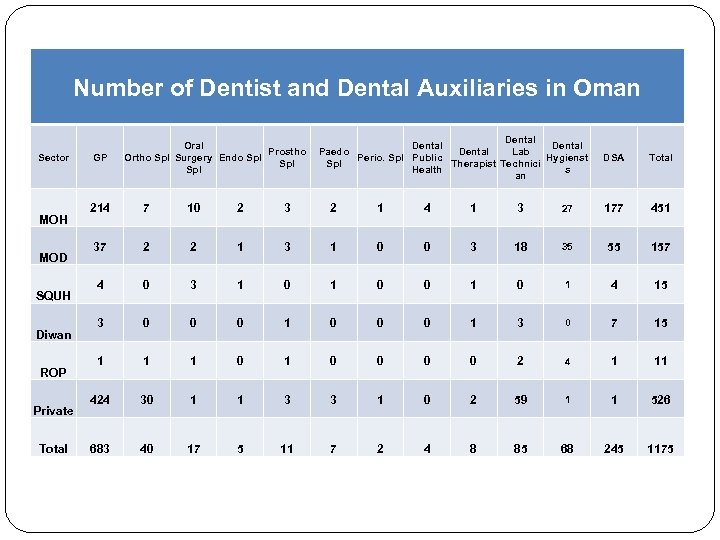 Number of Dentist and Dental Auxiliaries in Oman Sector MOH MOD SQUH Diwan ROP Private Total GP Oral Prostho Ortho Spl Surgery Endo Spl Spl Dental Paedo Dental Lab Perio. Spl Public Hygienst Spl Therapist Technici Health s an DSA Total 214 7 10 2 3 2 1 4 1 3 27 177 451 37 2 2 1 3 1 0 0 3 18 35 55 157 4 0 3 1 0 0 1 4 15 3 0 0 0 1 3 0 7 15 1 1 1 0 0 0 0 2 4 1 11 424 30 1 1 3 3 1 0 2 59 1 1 526 683 40 17 5 11 7 2 4 8 85 68 245 1175
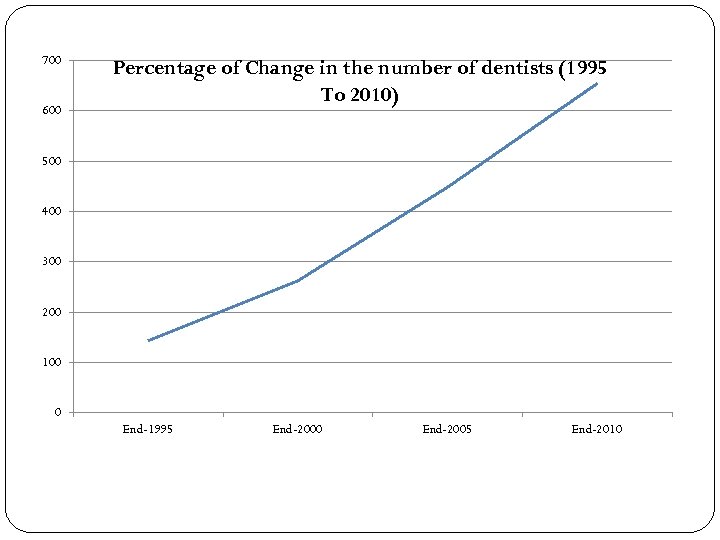 700 600 Percentage of Change in the number of dentists (1995 To 2010) 500 400 300 200 100 0 End-1995 End-2000 End-2005 End-2010
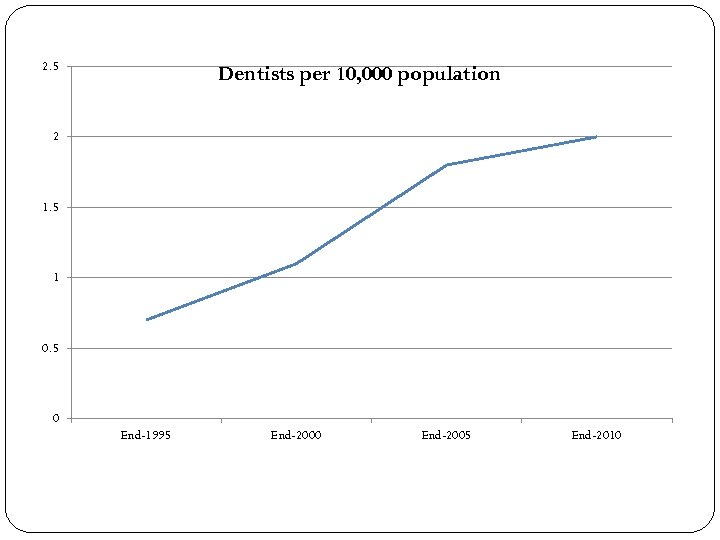 2. 5 Dentists per 10, 000 population 2 1. 5 1 0. 5 0 End-1995 End-2000 End-2005 End-2010
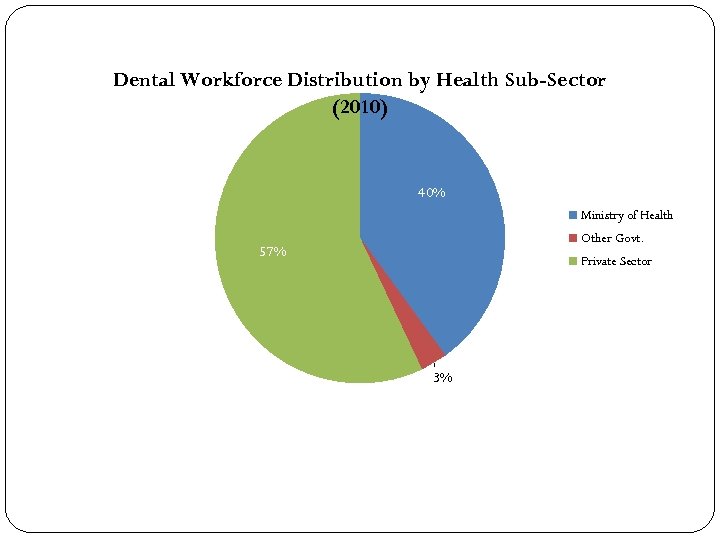 Dental Workforce Distribution by Health Sub-Sector (2010) 40% Ministry of Health Other Govt. 57% Private Sector 3%
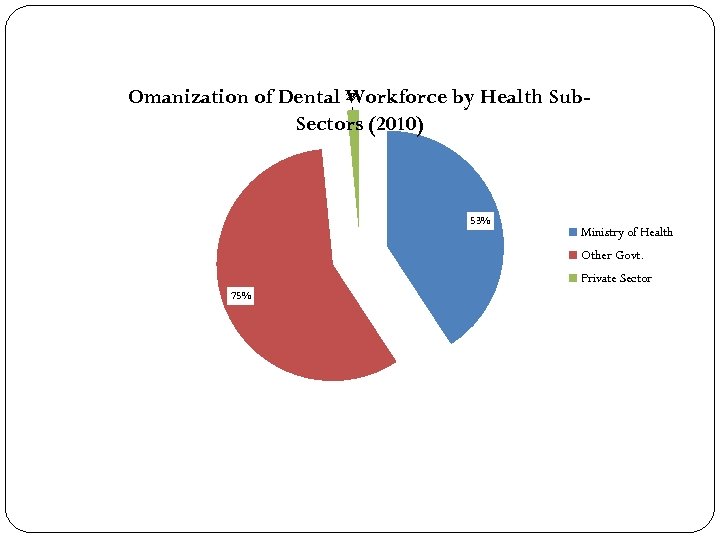 2% Omanization of Dental Workforce by Health Sub. Sectors (2010) 53% Ministry of Health Other Govt. Private Sector 75%
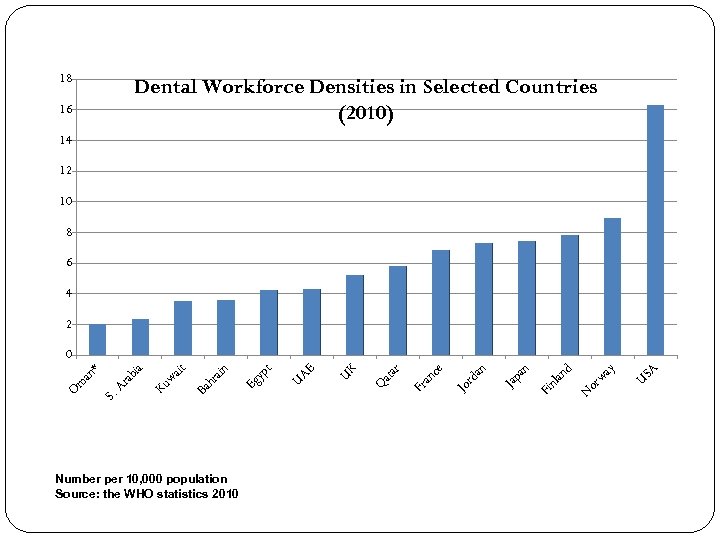 18 Dental Workforce Densities in Selected Countries (2010) 16 14 12 10 8 6 4 2 Number per 10, 000 population Source: the WHO statistics 2010 US A ay rw No d lan Fin an Jap n da Jo r ce an Fr r Q ata UK E UA t Eg yp hr ain Ba it wa Ku bia ra S. A O m an * 0
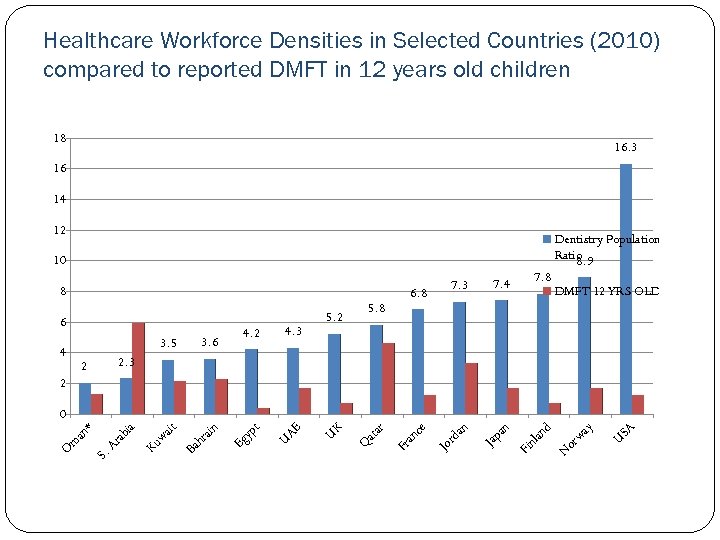 Healthcare Workforce Densities in Selected Countries (2010) compared to reported DMFT in 12 years old children 18 16. 3 16 14 12 10 8 6 3. 5 4 4. 2 4. 3 5. 2 5. 8 6. 8 7. 3 7. 4 7. 8 Dentistry Population Ratio 8. 9 DMFT 12 YRS OLD 2. 3 2 2 US A ay rw No d lan Fin an Jap n da Jo r ce an Fr r Q ata UK E UA t Eg yp hr ain Ba it wa Ku bia ra S. A O m an * 0
 Public Health measures implemented Topping up fluorides in the public water Topical Fluoride applications and fissure sealant in Oman
 Future prospective Pre-school children fluoride applications School-based dental preventive programmes Increase number of pediatric, orthodontists specialist services Expanding the primary health care services Public education campaign focused on oral health prevention and education. The establishment of the National Dental Workforce Planning Group
 Challenges and need for improvements Private dental college to train undergraduate dental students Rapid expansion (or planned expansion) of dental facilities by most service providers Un organized private dental sector Risk factors
 Key factors in workforce planning WHO (2001) and the Canadian Health services Research Foundation (2007) a comprehensive study of the workforce planning may take into consideration: Changing health needs in the population; Productivity, practice patterns or variances in specialty mix Increased investment in health promotion and chronic disease management and the resulting need for different skills and deployment; Advances in treatment and technology that may change the type and amount of treatment patients need; New service delivery models Expanded scopes of practice and new deployment models/roles; and The distribution of the workforce.
 Key factors in workforce planning Key implications for healthcare decision-makers must involve a need-based and outcome-directed outcome, the needs do not remain constant, and changes are multifaceted requiring multi-disciplinary intervention that is clearly measured and documented
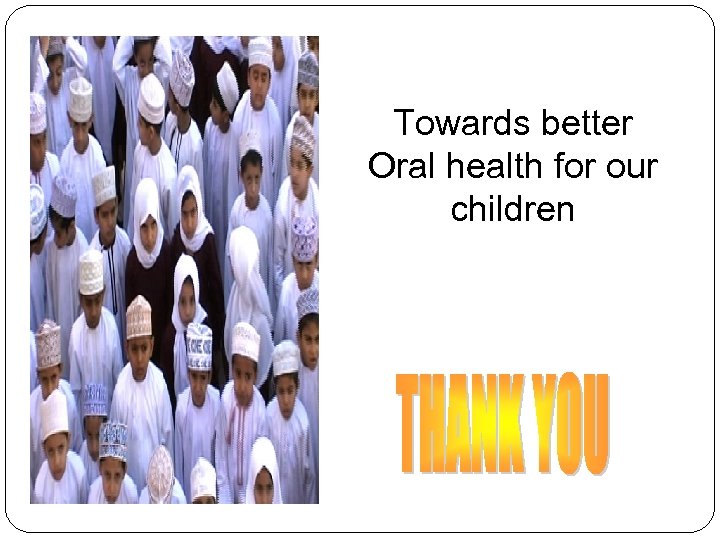 Towards better Oral health for our children