


 Скачать презентацию Options Futures Fin 444 Instructor Tsong-Yue Lai
af6c783241ef733849a4678cf610dbb1.ppt
- Количество слайдов: 114
 Options & Futures Fin 444 Instructor Tsong-Yue Lai, Ph. D.
 • • • Whole Picture of Fin 444 Call→ (Creates) Put (∵ Put-Call parity) Call & Put → Forward Contract Futures Contract = A Series of Forward Contracts Swap = A Portfolio of Forward Contracts In Sum, If you know the Call Options, You know all
 Chapter 1: Introduction • KEY CONCEPTS: – Distinct between Real Asset/Services & Financial Asset – Definitions of Options, Forward, Futures, Option on Futures, Swaps – Review of the Basic Concepts of Risk-Return, Risk Preferences, Short Selling & Mkt Efficiency – Arbitrage & the Law of One Price, Storage & Delivery – Advantage of These Markets – Criticisms of Derivative Markets & the Difference Between Speculation & Gambling
 • 1. Markets for Real Asset & Service • Real Assets (Tangible) vs. Services (Intangible) • Ex. Real Assets: Food, Car, housing, Clothing etc. (Tangible) • Services: Lawyer, CPA, Financial Advice, etc. . (Intangible) • 2. Financial Assets Markets: • Financial Asset: a claim on an economic unit (e. g. , equity, business or individual) • Ex. Stock, Bond, Promissory Note • Market for Financial Asset (primary & secondary mkts): • Money mkt(short-term debt) & Capital mkt(long-term claims) • 3. Derivative Markets(Option, Forward, Futures, Swap etc. ) • Financial Contract: An Agreement between two parties (buyer vs. seller) in which each party gives something to the other • Ex. Option, Forward, Futures, Swap.
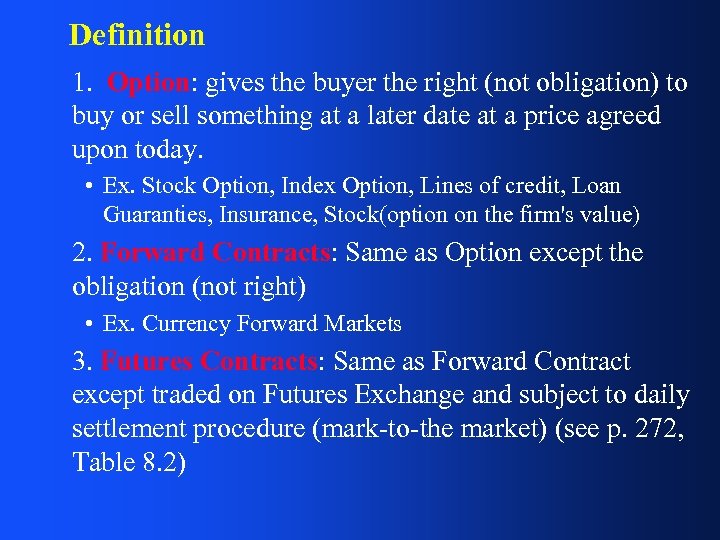 Definition 1. Option: gives the buyer the right (not obligation) to buy or sell something at a later date at a price agreed upon today. • Ex. Stock Option, Index Option, Lines of credit, Loan Guaranties, Insurance, Stock(option on the firm's value) 2. Forward Contracts: Same as Option except the obligation (not right) • Ex. Currency Forward Markets 3. Futures Contracts: Same as Forward Contract except traded on Futures Exchange and subject to daily settlement procedure (mark-to-the market) (see p. 272, Table 8. 2)
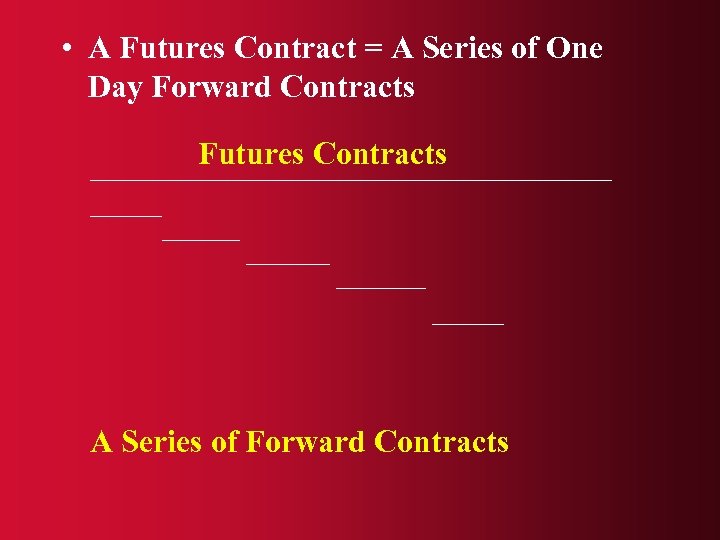 • A Futures Contract = A Series of One Day Forward Contracts Futures Contracts A Series of Forward Contracts
 4. Options on Futures: Same as Option with the Futures Contract as the underlying asset. 5. Swap: A contract in which 2 parties agree to exchange cash flows.
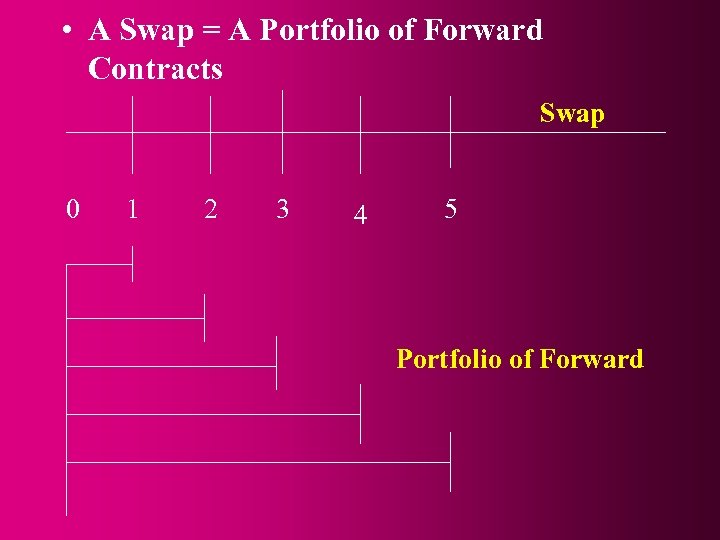 • A Swap = A Portfolio of Forward Contracts Swap 0 1 2 3 4 5 Portfolio of Forward
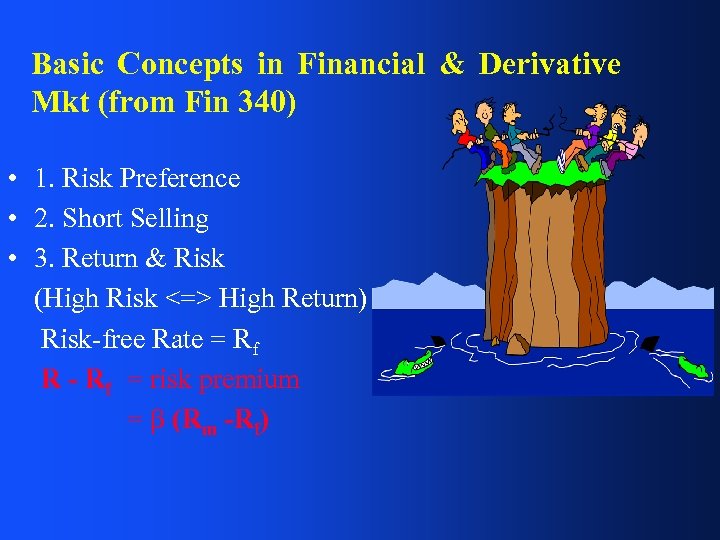 Basic Concepts in Financial & Derivative Mkt (from Fin 340) • 1. Risk Preference • 2. Short Selling • 3. Return & Risk (High Risk <=> High Return) Risk-free Rate = Rf R - Rf = risk premium = (Rm -Rf)
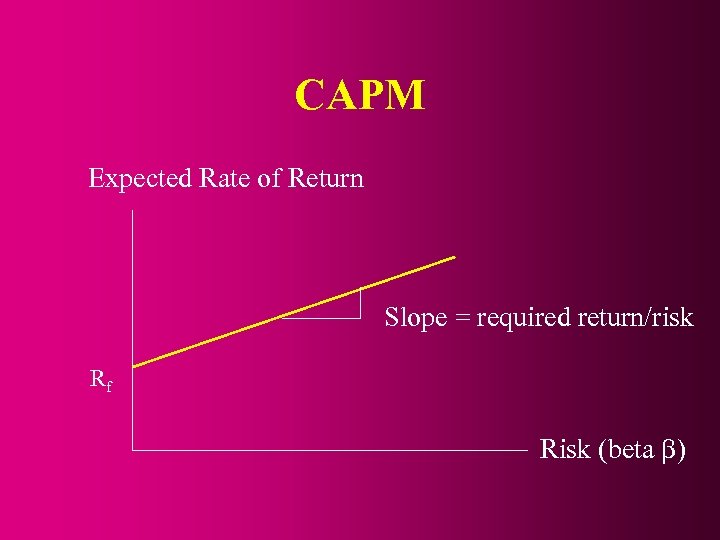 CAPM Expected Rate of Return Slope = required return/risk Rf Risk (beta )
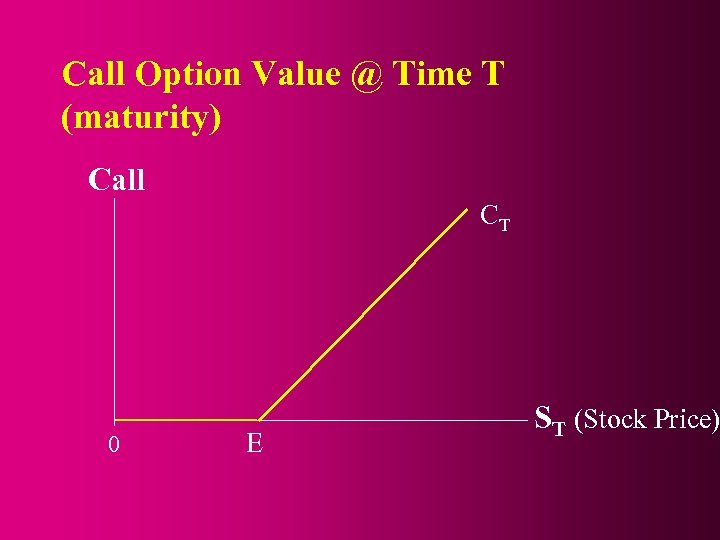 Call Option Value @ Time T (maturity) Call CT 0 E ST (Stock Price)
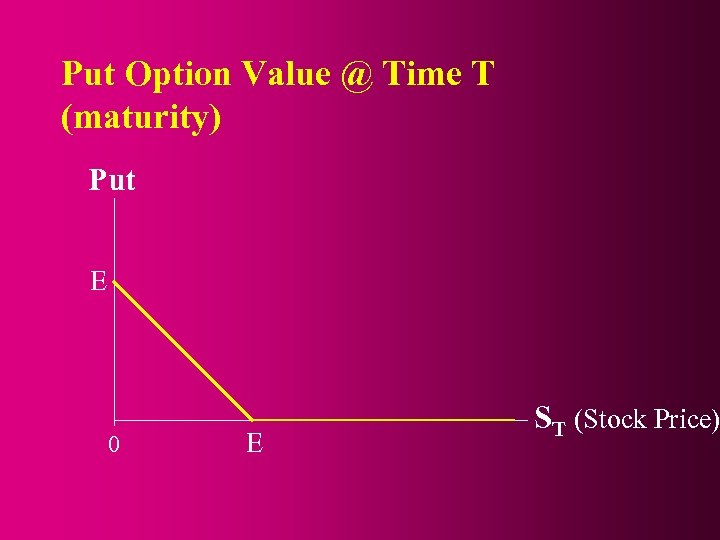 Put Option Value @ Time T (maturity) Put E 0 E ST (Stock Price)
 (High Risk <=> High Return) If & Only If Market Must Be Efficient • Issue of Market Efficiency: – Current price reflects all relevant information. – A market is efficient with respect to a set of information if it is impossible to make a NPV > 0 based upon that information • Note: Market Efficiency is only a hypothesis not a theory – Weak form Market Efficiency : Past Information – Semi-strong form Market Efficiency: All Public Information – Strong form Market Efficiency: All Information
 Linkages Between Spot & Derivatives Mkts: • 1. Arbitrage and the Law of One Price ° Different location, service could result in different prices for the identical good. ° Arbitrage: zero investment zero risk with positive NPV ° No arbitrage => The Law of One Price (two identical goods cannot sell different prices, or the same risk should have the return) • 2. Factors affect the price difference between spot and option and futures markets ° Storage ° Delivery & Settlement (i. e. , how to fulfill the contract)
 The Role of Derivative Markets • 1. Hedge Risk(i. e. , Risk management) (add no risk into economy, risk transfer) • 2. Provide Information (investor's future expectation etc. ) • 3. Operational Advantages (benefit to whole society) a. Low transaction cost (compare to the spot market) b. Greater liquidity (large $ transaction) c. Easily sell short • 4. Market Efficiency (because arbitrage opp. ) • 5. Speculation (Re-distribute wealth, neither create nor destroy wealth)
 Chapter 2: The Structure of Options Markets KEY CONCEPTS: – Explanation of Puts & Calls – Characteristics of Contracts – Types of Option Traders – Mechanics of Trading Options – Exercise Procedure – The Clearinghouse – Reading Quotes – Transaction Costs
 Call (Put): A contract that the buyer has the right to buy (sell) an asset at a fixed price (i. e. , exercise, striking, strike) before or at a specific date (i. e. the maturity date). Ex. Rain check, Loan guarantee, Callable Bond, Warrants • The price of the option is called as Premium. • American Option: Can exercise the right before or at the maturity date • European Option: Only can exercise at the maturity date. • Hedge = A strategy to protect an asset's value

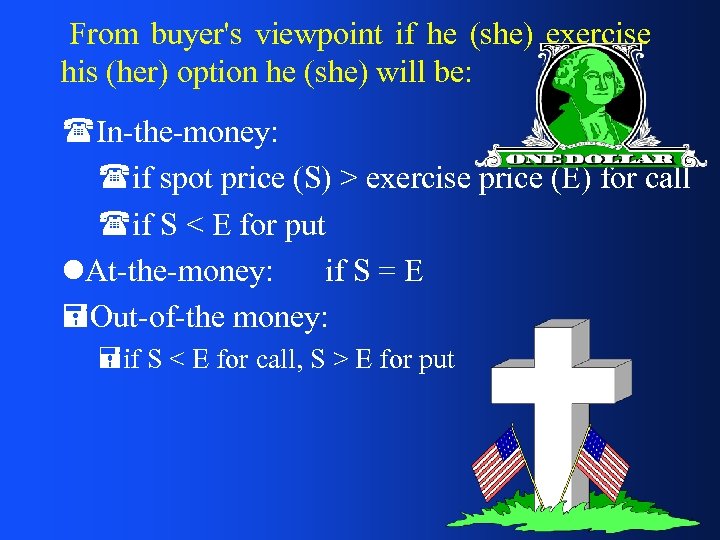 From buyer's viewpoint if he (she) exercise his (her) option he (she) will be: (In-the-money: (if spot price (S) > exercise price (E) for call (if S < E for put l. At-the-money: if S = E =Out-of-the money: =if S < E for call, S > E for put
 OTC Options Market • Advantage of OTC • 1. No Standard terms (E, T, basket option (option on specific portfolio) etc. ) • 2. Private information • 3. Unregulated • Disadvantage of OTC • 1. Credit Risk • 2. Large size of transaction exclude investors • Size of OTC: Underlying Value $76 T with $2. 1 T Mkt Value in 12/2007 • Total transaction contract Volume over $1 B in 2004 • Trading options on: bonds, interest rates, commodities, swap , foreign currency, and other
 (Listing requirement CBOE): • (1) Profit before extraordinary > $1 MM in last 8 Quarters • (2) More than 6, 000 shareholders • (3) More than 7 million shares must be owned by non-inside stockholder • (4) Stock price must be greater than $10 in last 3 months • (5) More than 2. 4 million shares traded over last 12 months
 Contract size of option: 1 stock option contract = 100 shares of stock • Note 1: number of shares/option and exercise price will be adjusted if there is a stock dividend. • Ex. 20% stock dividend (with E 0 = 55) => 1 option = 120 shares (after the stock dividend) and E 1 = E 0/1. 2 = 45. 875 (to nearest 1/8) • Note 2: split (two for one) => get one option credit/option and exercise price reduce to half of it previous price • Note 3: exercise price will not be adjusted for the cash dividend
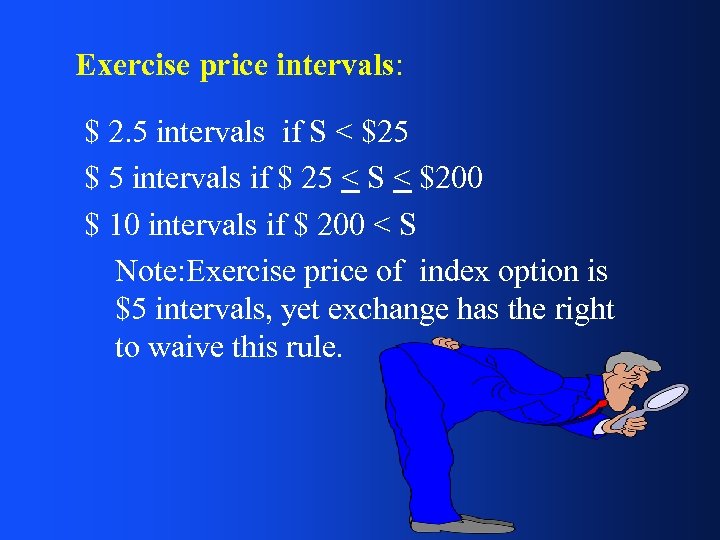 Exercise price intervals: $ 2. 5 intervals if S < $25 $ 5 intervals if $ 25 < S < $200 $ 10 intervals if $ 200 < S Note: Exercise price of index option is $5 intervals, yet exchange has the right to waive this rule.
 Expiration Dates: The Sat. following the third Friday of January cycle: Jan, Apr, July, & Oct (1) February cycle: Feb, May, Aug, Nov (2) March cycle: March, June, Sep, Dec. (3) • Note 1: Current, next, and next two months in the cycle. • Note 2: WSJ covers only first 3 months • Note 3: Since 1993, CBOE and AMEX offer up to three years option (Long Term Equity Anticipation Securities, LEAPS) • Note 4: FLEX options(offered by CBOE) on stock indexes and permit the investors to specify the E, other contract terms, and expiration date T up to 5 yrs (FLEX options are a response the options in OTC)
 Participates in Option Market • 1. Seat: Membership in an exchange (cost about $875, 000 in 2005, w/annual fee &5, 400), Lease (a Seat): 0. 5%-0. 75%/month of Membership Price p. 35 • 2. Market maker(CBOE & PSE separate Broker & Dealer, But not in Amex & Phlx) • Bid price: the purchase price of market maker • Ask price: the selling price of market maker • Spread = Ask price - Bid price
 • 3. Option traders (Spreaders): a. Scalpers: hold a few minutes b. Position traders • 4. Floor brokers (executes trade orders) • 5. Order book officials (key in order in the computer & execute the limit order) Other Option Trading System (Amex & Phlx) (other Option exchanges see Table 2. 1, p. 32) • 6. Specialist (a market maker) • 7. Registered option traders (a trader & a broker)
 Order (Same as in the Stock Mkt): • (1) • (2) Market Order: The best price at the market. Limit Order: Buy or sell @ a specific price or better (a) good-till-canceled (b) day order • (3) Stop(Loss) Order: Sell at the best available price • (4) All or None Order (two different price): All or none, same price order • (5) Offsetting Order: to close the position OCC: Options Clearing Corporation is the intermediary in each transaction to guarantee the writer's performance
 Procedure of Transaction: (Similar to the Stock Mkt) • Buyer --> personal broker --> brokerage firm --> it's clearing firm (a member of OCC) --> OCC --> seller's clearing firm (a member of OCC) --> seller's brokerage firm --> personal broker --> Seller
 Exercising Options: Delivery or Cash Settlement • Note: 1 n 1998 about 11% of call & 14% of put on the CBOE were exercised, and about 30% of call and 37% of put were expired • Cash Settlement = (Index - E)x multiple • Open interest = outstanding contracts • Option price quotations: (see p. 40)
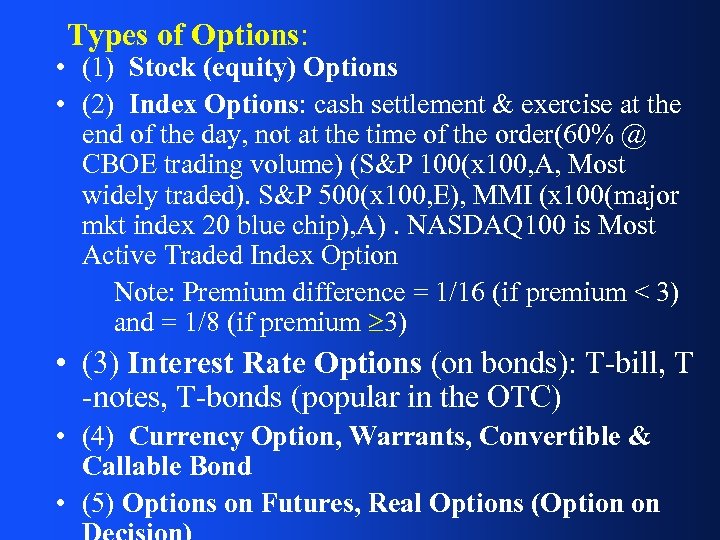 Types of Options: • (1) Stock (equity) Options • (2) Index Options: cash settlement & exercise at the end of the day, not at the time of the order(60% @ CBOE trading volume) (S&P 100(x 100, A, Most widely traded). S&P 500(x 100, E), MMI (x 100(major mkt index 20 blue chip), A). NASDAQ 100 is Most Active Traded Index Option Note: Premium difference = 1/16 (if premium < 3) and = 1/8 (if premium 3) • (3) Interest Rate Options (on bonds): T-bill, T -notes, T-bonds (popular in the OTC) • (4) Currency Option, Warrants, Convertible & Callable Bond • (5) Options on Futures, Real Options (Option on
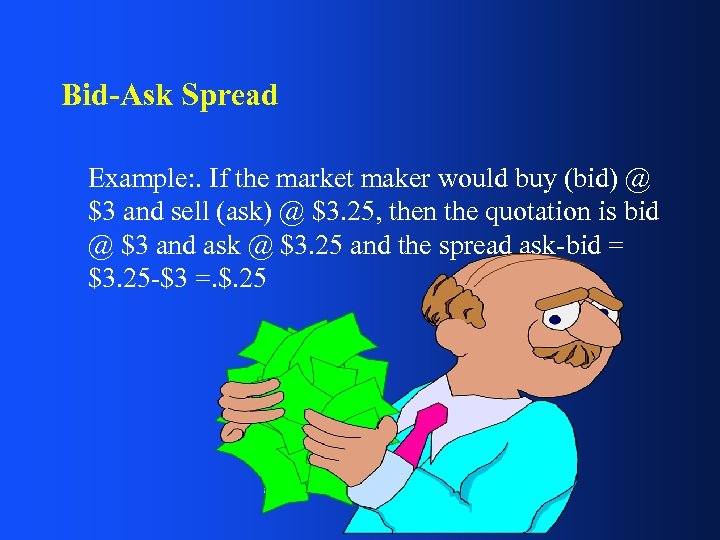 Bid-Ask Spread Example: . If the market maker would buy (bid) @ $3 and sell (ask) @ $3. 25, then the quotation is bid @ $3 and ask @ $3. 25 and the spread ask-bid = $3. 25 -$3 =. $. 25
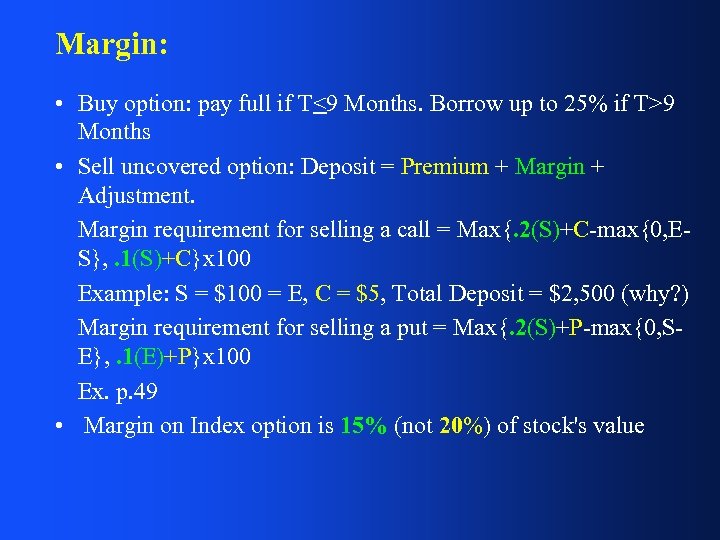 Margin: • Buy option: pay full if T<9 Months. Borrow up to 25% if T>9 Months • Sell uncovered option: Deposit = Premium + Margin + Adjustment. Margin requirement for selling a call = Max{. 2(S)+C-max{0, ES}, . 1(S)+C}x 100 Example: S = $100 = E, C = $5, Total Deposit = $2, 500 (why? ) Margin requirement for selling a put = Max{. 2(S)+P-max{0, SE}, . 1(E)+P}x 100 Ex. p. 49 • Margin on Index option is 15% (not 20%) of stock's value
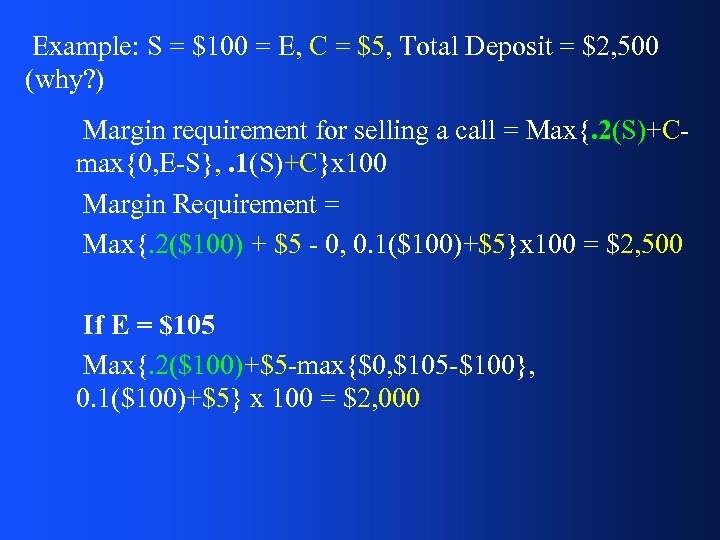 Example: S = $100 = E, C = $5, Total Deposit = $2, 500 (why? ) Margin requirement for selling a call = Max{. 2(S)+Cmax{0, E-S}, . 1(S)+C}x 100 Margin Requirement = Max{. 2($100) + $5 - 0, 0. 1($100)+$5}x 100 = $2, 500 If E = $105 Max{. 2($100)+$5 -max{$0, $105 -$100}, 0. 1($100)+$5} x 100 = $2, 000
 Chapter 3: Option Pricing • KEY CONCEPTS: • Minimum Values of Options • Maximum Values of Options • Values of Options @ Expiration • Effect of Time to Expiration on Option Prices • Effect of Exercise Price on Option Prices • Lower Bound of European Options • Early Exercise & the Difference Between American & European Options • Effect of Interest Rates on Option Prices • Effect of Volatility of the Stock on Option Prices • European & American Put-Call Parity
 Notation: Relax, it is only notations ! S: Stock price Not A Big Deal ! E: Exercise price T: Time to maturity (yearly base) r: Risk-free rate ST: Stock price @ maturity time T C(S, T, E, r, σ): Call price P(S, T, E, r, σ): Put price Note: T = # of days to the maturity/365, (annual)
 Steps to Determine the Risk-free Rate r (see P. 56): • (1) Find the average T-bill rate = (bid + ask)/2 in the same month of maturity of option • (2) Calculate # days to option’s maturity on the same month /360 • (3) Find the T-bill price by 100 -(1)x(2) = Y • (4) Find the yield on T-bill = risk-free rate r by r = (100/Y)365/# of days to maturity of option -1
 Example Ex. On x/21, T-bill quoted 5. 59 & 5. 63 mature on (x+1)/20. (1). (5. 63+5. 59)/2 = 5. 61, (2). 29/360, (3). 100 - 5. 61(29/360) = 99. 5481, (4). r =(100/99. 5481)365/29 - 1= 5. 866%
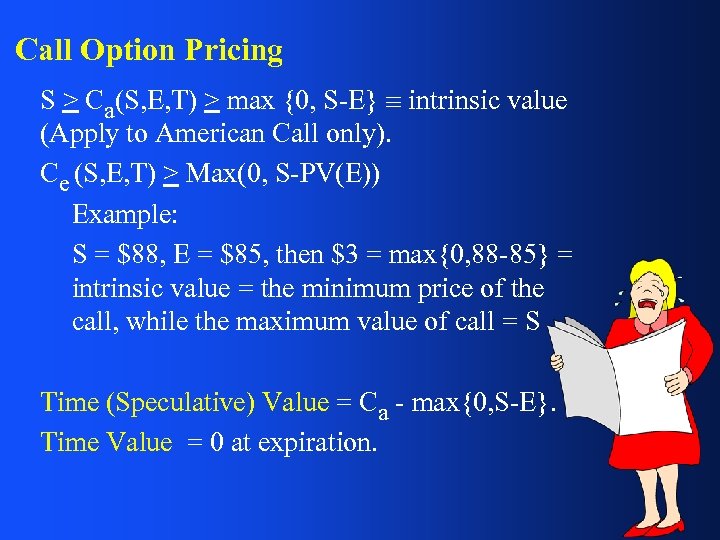 Call Option Pricing S > Ca(S, E, T) > max {0, S-E} intrinsic value (Apply to American Call only). Ce (S, E, T) > Max(0, S-PV(E)) Example: S = $88, E = $85, then $3 = max{0, 88 -85} = intrinsic value = the minimum price of the call, while the maximum value of call = S Time (Speculative) Value = Ca - max{0, S-E}. Time Value = 0 at expiration.
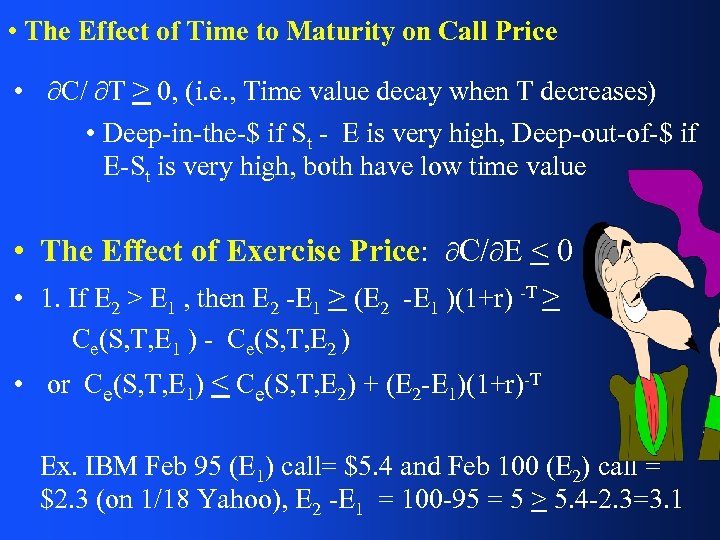 • The Effect of Time to Maturity on Call Price • C/ T > 0, (i. e. , Time value decay when T decreases) • Deep-in-the-$ if St - E is very high, Deep-out-of-$ if E-St is very high, both have low time value • The Effect of Exercise Price: C/ E < 0 • 1. If E 2 > E 1 , then E 2 -E 1 > (E 2 -E 1 )(1+r) -T > Ce(S, T, E 1 ) - Ce(S, T, E 2 ) • or Ce(S, T, E 1) < Ce(S, T, E 2) + (E 2 -E 1)(1+r)-T Ex. IBM Feb 95 (E 1) call= $5. 4 and Feb 100 (E 2) call = $2. 3 (on 1/18 Yahoo), E 2 -E 1 = 100 -95 = 5 > 5. 4 -2. 3=3. 1
 American Call Option Also Satisfies: • E 2 -E 1 > Ca(S, T, E 1) - Ca(S, T, E 2) or Ca(S, T, E 1) < Ca(S, T, E 2) + E 2 -E 1 if E 2 > E 1 • 2. Ce(S, T, E) + E(1+r)-T > S (why? ) • American call > European call (why? ) Note: If No dividend, then American call should not early exercise Because S-E < S - E(1+r)-T < Ce(S, T, E) < Ca(S, T, E) (alive) Note: Early exercise is likely if there is a dividend Because S-E could be > Ca(S-D, T, E) • The Effect of Risk-free Rate on Call Option: C/ r > 0 • The Effect of Stock Volatility on Call Option: C/ > 0
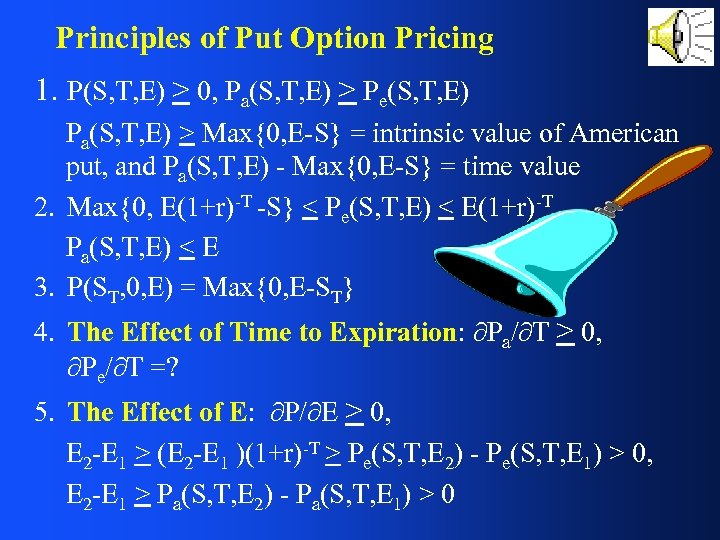 Principles of Put Option Pricing 1. P(S, T, E) > 0, Pa(S, T, E) > Pe(S, T, E) Pa(S, T, E) > Max{0, E-S} = intrinsic value of American put, and Pa(S, T, E) - Max{0, E-S} = time value 2. Max{0, E(1+r)-T -S} < Pe(S, T, E) < E(1+r)-T, Pa(S, T, E) < E 3. P(ST, 0, E) = Max{0, E-ST} 4. The Effect of Time to Expiration: Pa/ T > 0, Pe/ T =? 5. The Effect of E: P/ E > 0, E 2 -E 1 > (E 2 -E 1 )(1+r)-T > Pe(S, T, E 2) - Pe(S, T, E 1) > 0, E 2 -E 1 > Pa(S, T, E 2) - Pa(S, T, E 1) > 0
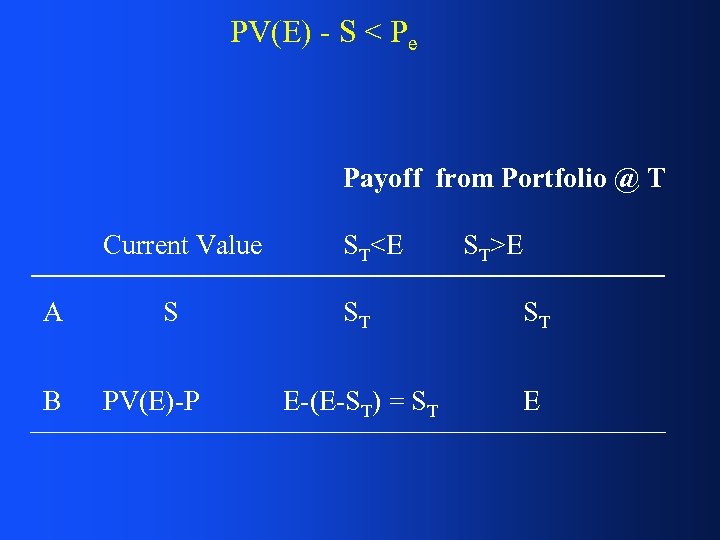 PV(E) - S < Pe Payoff from Portfolio @ T Current Value A B S PV(E)-P ST
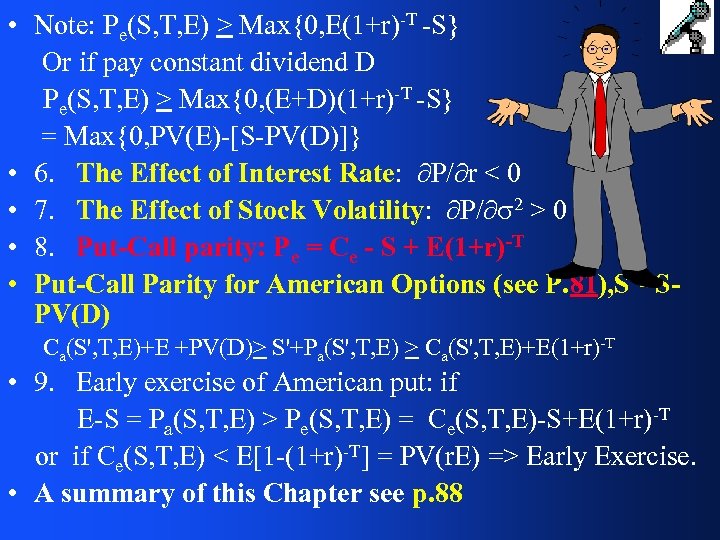 • Note: Pe(S, T, E) > Max{0, E(1+r)-T -S} Or if pay constant dividend D Pe(S, T, E) > Max{0, (E+D)(1+r)-T -S} = Max{0, PV(E)-[S-PV(D)]} • 6. The Effect of Interest Rate: P/ r < 0 • 7. The Effect of Stock Volatility: P/ 2 > 0 • 8. Put-Call parity: Pe = Ce - S + E(1+r)-T • Put-Call Parity for American Options (see P. 81), S’=SPV(D) Ca(S', T, E)+E +PV(D)> S'+Pa(S', T, E) > Ca(S', T, E)+E(1+r)-T • 9. Early exercise of American put: if E-S = Pa(S, T, E) > Pe(S, T, E) = Ce(S, T, E)-S+E(1+r)-T or if Ce(S, T, E) < E[1 -(1+r)-T] = PV(r. E) => Early Exercise. • A summary of this Chapter see p. 88
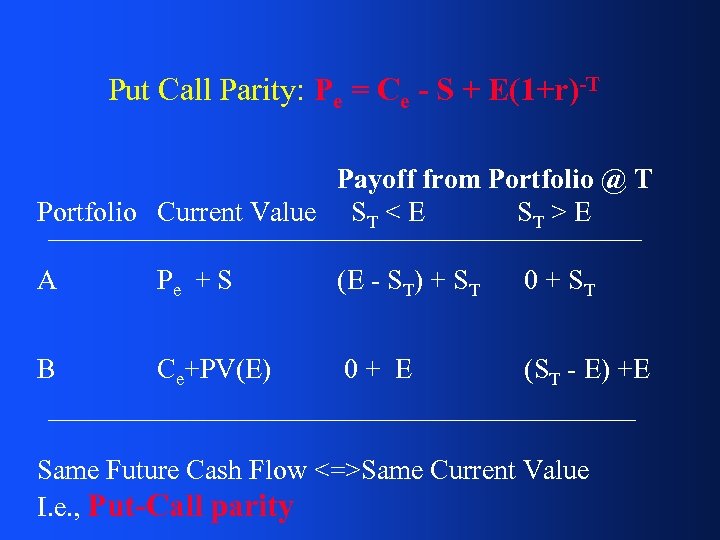 Put Call Parity: Pe = Ce - S + E(1+r)-T Payoff from Portfolio @ T Portfolio Current Value ST < E ST > E A Pe + S (E - ST) + ST 0 + ST B Ce+PV(E) 0+ E (ST - E) +E Same Future Cash Flow <=>Same Current Value I. e. , Put-Call parity

 Chapter 4: Binomial Option Pricing Model KEY CONCEPTS: – The Binomial Model – How Arbitrage Forces the Option Price to Equal the Price from the Binomial Model – How the Hedge Is Constructed and Adjusted Through Time
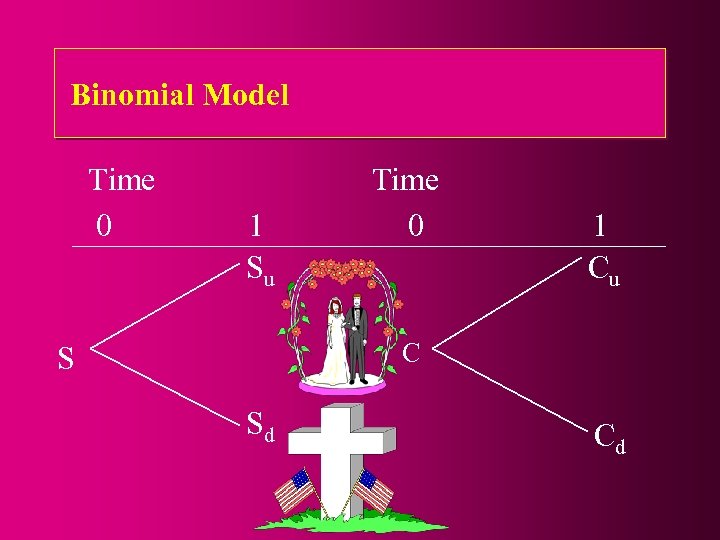 Binomial Model Time 0 1 Su Time 0 1 Cu C S Sd Cd
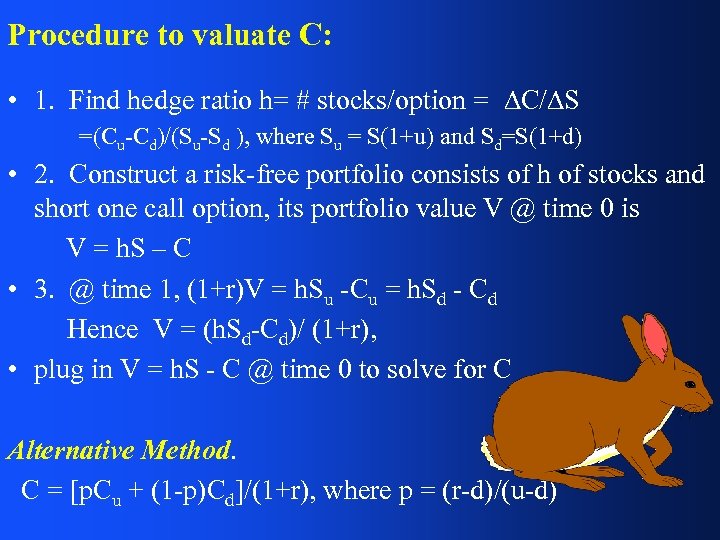 Procedure to valuate C: • 1. Find hedge ratio h= # stocks/option = C/ S =(Cu-Cd)/(Su-Sd ), where Su = S(1+u) and Sd=S(1+d) • 2. Construct a risk-free portfolio consists of h of stocks and short one call option, its portfolio value V @ time 0 is V = h. S – C • 3. @ time 1, (1+r)V = h. Su -Cu = h. Sd - Cd Hence V = (h. Sd-Cd)/ (1+r), • plug in V = h. S - C @ time 0 to solve for C Alternative Method. C = [p. Cu + (1 -p)Cd]/(1+r), where p = (r-d)/(u-d)
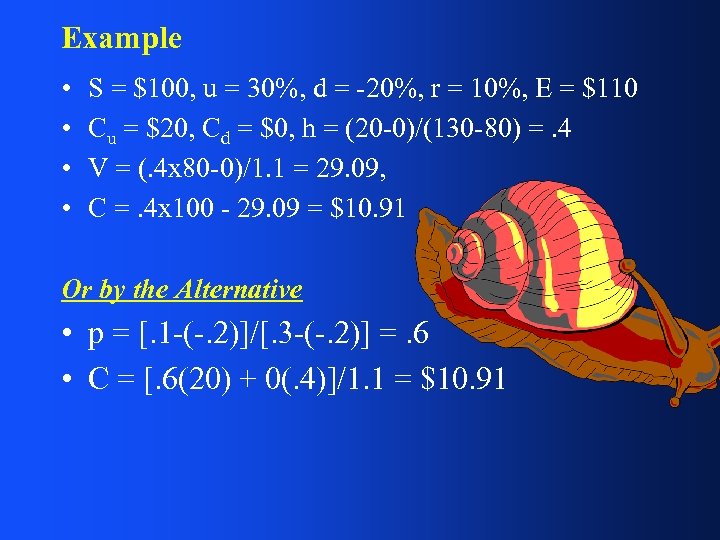 Example • • S = $100, u = 30%, d = -20%, r = 10%, E = $110 Cu = $20, Cd = $0, h = (20 -0)/(130 -80) =. 4 V = (. 4 x 80 -0)/1. 1 = 29. 09, C =. 4 x 100 - 29. 09 = $10. 91 Or by the Alternative • p = [. 1 -(-. 2)]/[. 3 -(-. 2)] =. 6 • C = [. 6(20) + 0(. 4)]/1. 1 = $10. 91
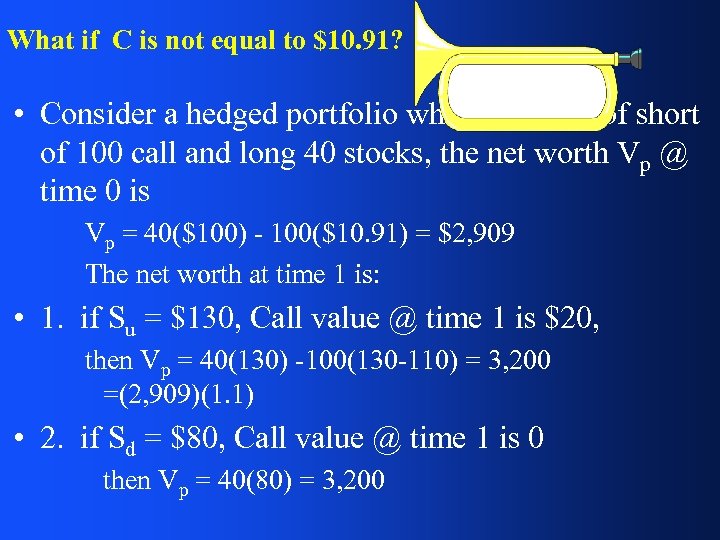 What if C is not equal to $10. 91? • Consider a hedged portfolio which consists of short of 100 call and long 40 stocks, the net worth Vp @ time 0 is Vp = 40($100) - 100($10. 91) = $2, 909 The net worth at time 1 is: • 1. if Su = $130, Call value @ time 1 is $20, then Vp = 40(130) -100(130 -110) = 3, 200 =(2, 909)(1. 1) • 2. if Sd = $80, Call value @ time 1 is 0 then Vp = 40(80) = 3, 200
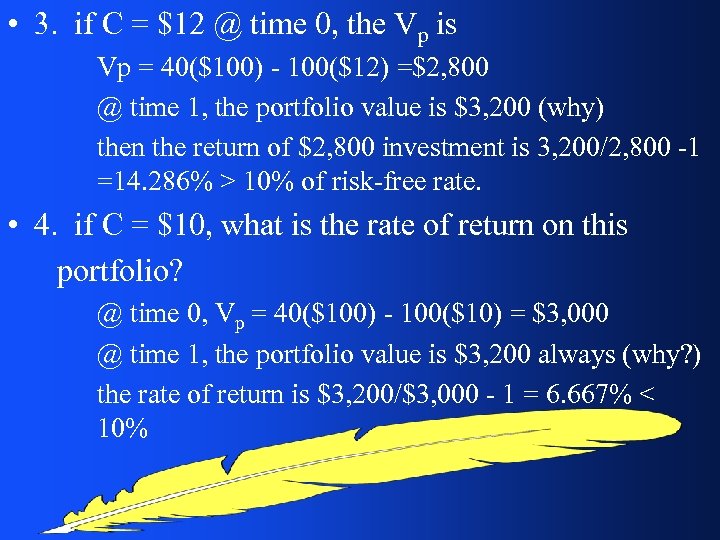 • 3. if C = $12 @ time 0, the Vp is Vp = 40($100) - 100($12) =$2, 800 @ time 1, the portfolio value is $3, 200 (why) then the return of $2, 800 investment is 3, 200/2, 800 -1 =14. 286% > 10% of risk-free rate. • 4. if C = $10, what is the rate of return on this portfolio? @ time 0, Vp = 40($100) - 100($10) = $3, 000 @ time 1, the portfolio value is $3, 200 always (why? ) the rate of return is $3, 200/$3, 000 - 1 = 6. 667% < 10%
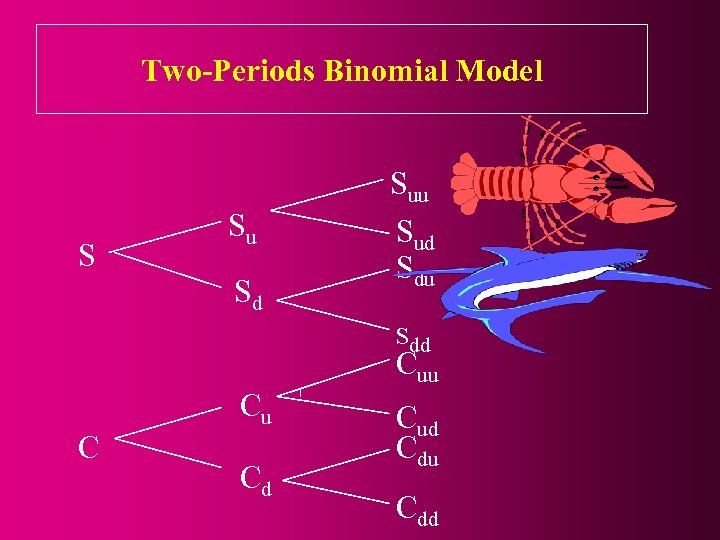 Two-Periods Binomial Model S Su Sd Suu Sud Sdu Sdd Cuu Cu C Cd Cud Cdu Cdd
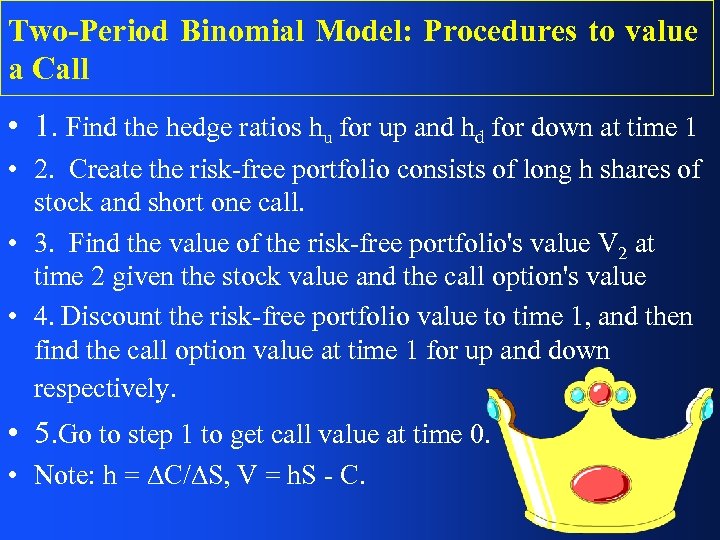 Two-Period Binomial Model: Procedures to value a Call • 1. Find the hedge ratios hu for up and hd for down at time 1 • 2. Create the risk-free portfolio consists of long h shares of stock and short one call. • 3. Find the value of the risk-free portfolio's value V 2 at time 2 given the stock value and the call option's value • 4. Discount the risk-free portfolio value to time 1, and then find the call option value at time 1 for up and down respectively. • 5. Go to step 1 to get call value at time 0. • Note: h = C/ S, V = h. S - C.
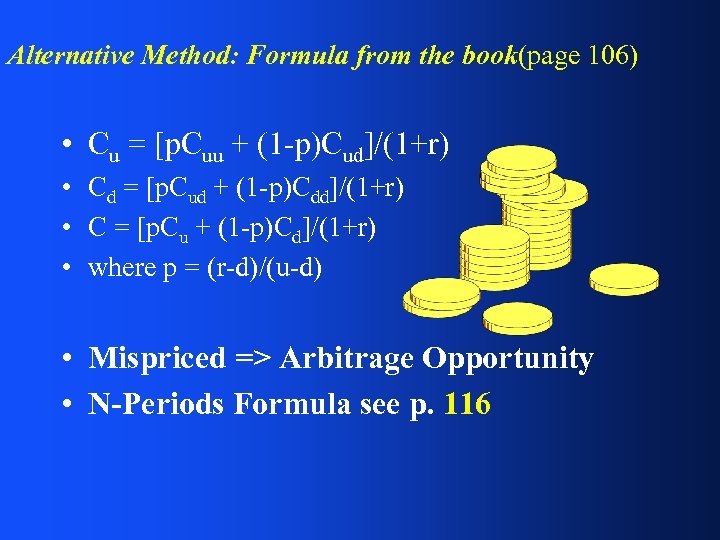 Alternative Method: Formula from the book(page 106) • Cu = [p. Cuu + (1 -p)Cud]/(1+r) • Cd = [p. Cud + (1 -p)Cdd]/(1+r) • C = [p. Cu + (1 -p)Cd]/(1+r) • where p = (r-d)/(u-d) • Mispriced => Arbitrage Opportunity • N-Periods Formula see p. 116
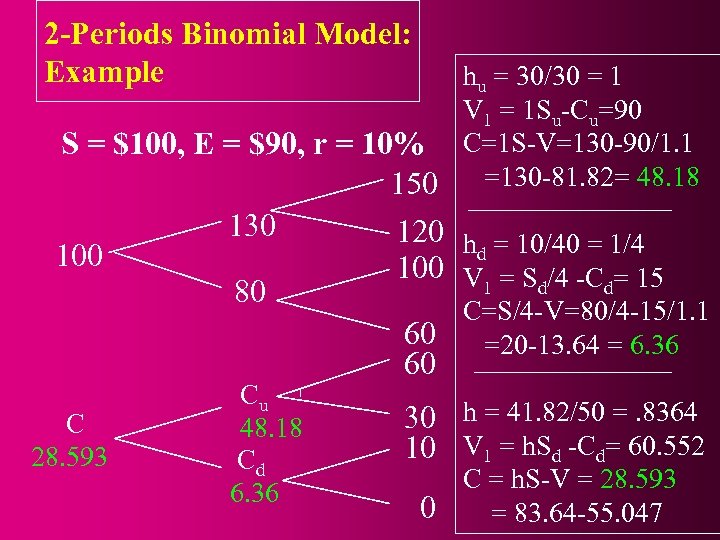 2 -Periods Binomial Model: Example hu = 30/30 = 1 V 1 = 1 Su-Cu=90 S = $100, E = $90, r = 10% C=1 S-V=130 -90/1. 1 150 =130 -81. 82= 48. 18 100 130 80 C 28. 593 Cu 48. 18 Cd 6. 36 120 h = 10/40 = 1/4 d 100 V 1 = Sd/4 -Cd= 15 C=S/4 -V=80/4 -15/1. 1 60 =20 -13. 64 = 6. 36 60 30 h = 41. 82/50 =. 8364 10 V 1 = h. Sd -Cd= 60. 552 C = h. S-V = 28. 593 0 = 83. 64 -55. 047
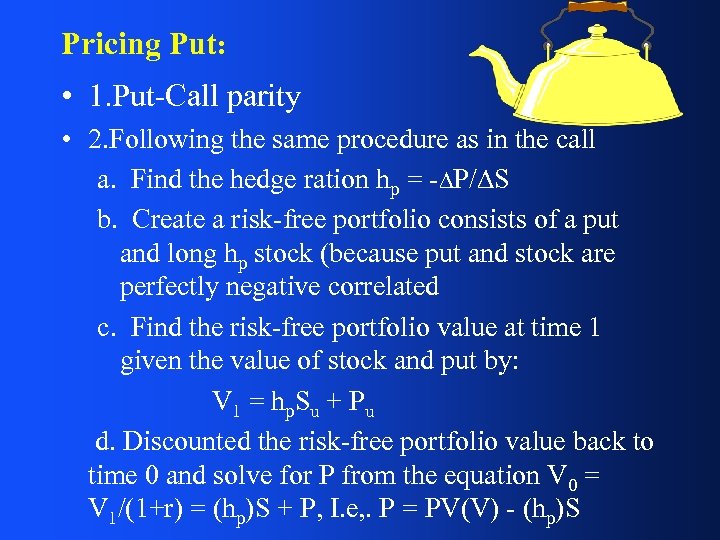 Pricing Put: • 1. Put-Call parity • 2. Following the same procedure as in the call a. Find the hedge ration hp = - P/ S b. Create a risk-free portfolio consists of a put and long hp stock (because put and stock are perfectly negative correlated c. Find the risk-free portfolio value at time 1 given the value of stock and put by: V 1 = h p. S u + P u d. Discounted the risk-free portfolio value back to time 0 and solve for P from the equation V 0 = V 1/(1+r) = (hp)S + P, I. e, . P = PV(V) - (hp)S
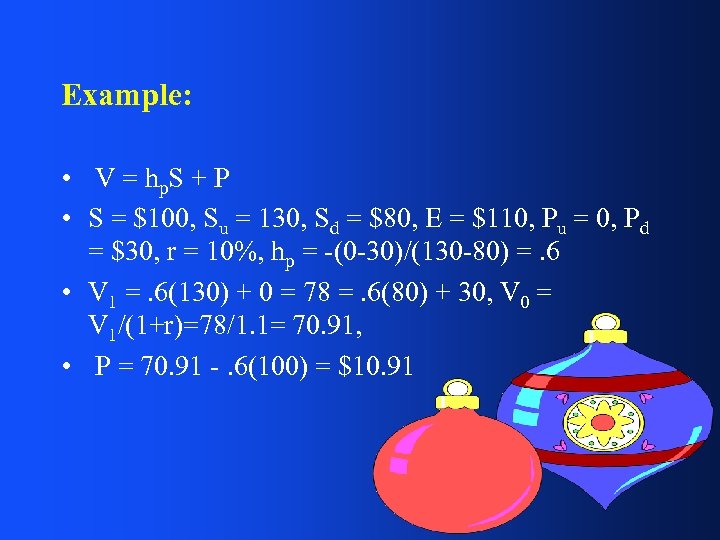 Example: • V = hp. S + P • S = $100, Su = 130, Sd = $80, E = $110, Pu = 0, Pd = $30, r = 10%, hp = -(0 -30)/(130 -80) =. 6 • V 1 =. 6(130) + 0 = 78 =. 6(80) + 30, V 0 = V 1/(1+r)=78/1. 1= 70. 91, • P = 70. 91 -. 6(100) = $10. 91
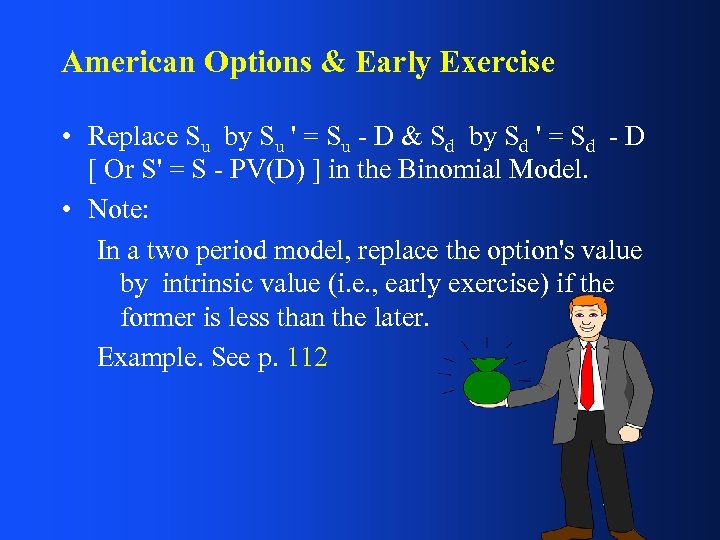 American Options & Early Exercise • Replace Su by Su ' = Su - D & Sd by Sd ' = Sd - D [ Or S' = S - PV(D) ] in the Binomial Model. • Note: In a two period model, replace the option's value by intrinsic value (i. e. , early exercise) if the former is less than the later. Example. See p. 112
 Note: • The relationship among call, put, risk-free rate, stock see Fig 21, p. 175
 Chapter 6: Basic Option Strategies • Basic Profit Equations for Stocks, Calls and Puts • How the Choice of Exercise Price Enters into the Investor's Decision • How to Determine the Profit & Breakeven for Different Option Strategies? • How Maximum and Minimum Profits and Breakeven Stock Prices are Determined • That the Writer's Position is the Mirror Image of the Buyer's Position • How the Combination and Advanced Strategies are Merely Portfolios of Certain Basic Option Positions • How Stock Positions are Protected with Short Calls or Long Puts • Synthetic Puts and Calls and How Conversions and
 Buy a Stock S
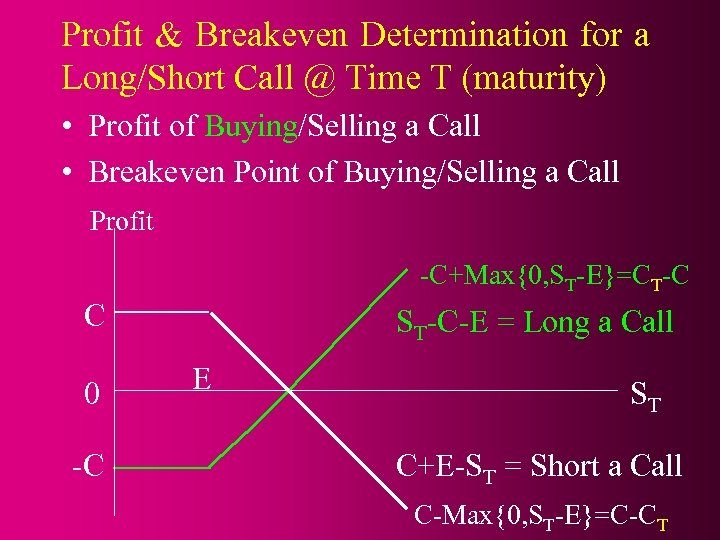 Profit & Breakeven Determination for a Long/Short Call @ Time T (maturity) • Profit of Buying/Selling a Call • Breakeven Point of Buying/Selling a Call Profit -C+Max{0, ST-E}=CT-C C 0 -C ST-C-E = Long a Call E ST C+E-ST = Short a Call C-Max{0, ST-E}=C-CT
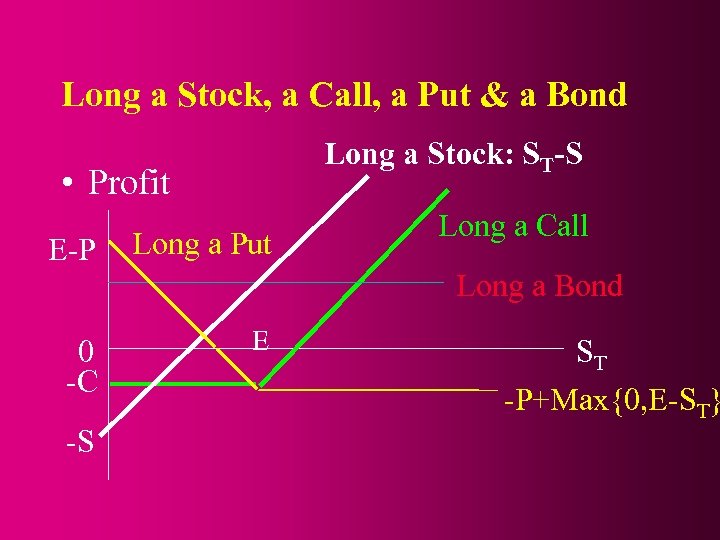 Long a Stock, a Call, a Put & a Bond Long a Stock: ST-S • Profit E-P Long a Put Long a Call Long a Bond 0 -C -S E ST -P+Max{0, E-ST}
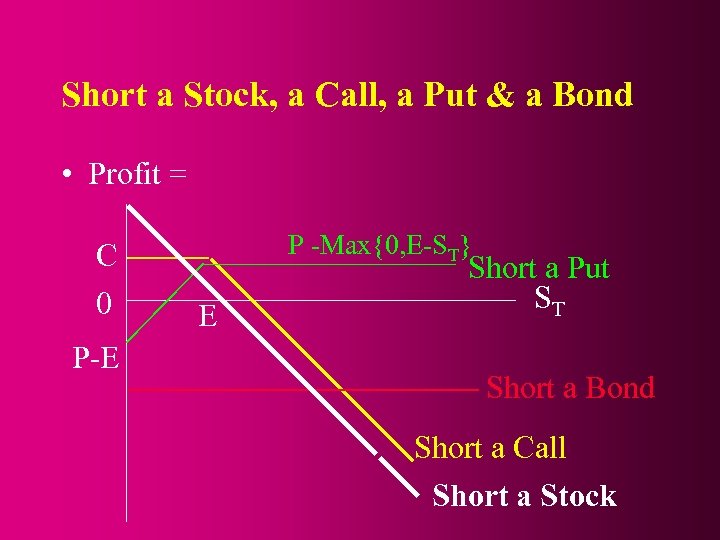 Short a Stock, a Call, a Put & a Bond • Profit = C 0 P-E P -Max{0, E-ST} E Short a Put ST Short a Bond Short a Call Short a Stock
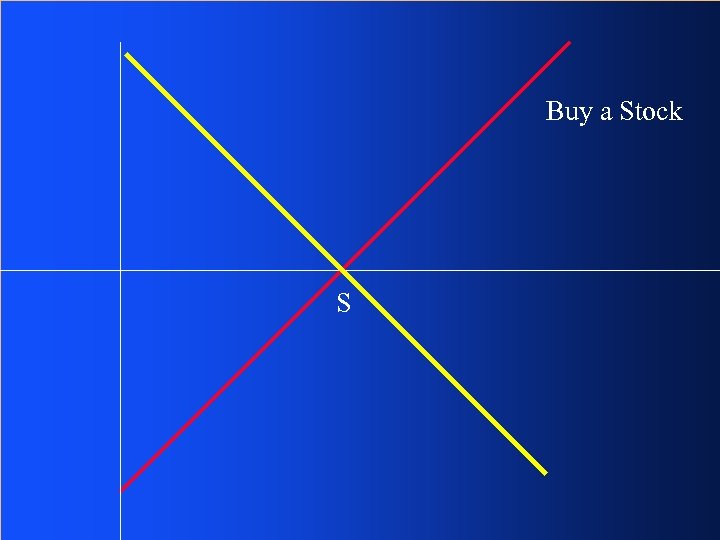
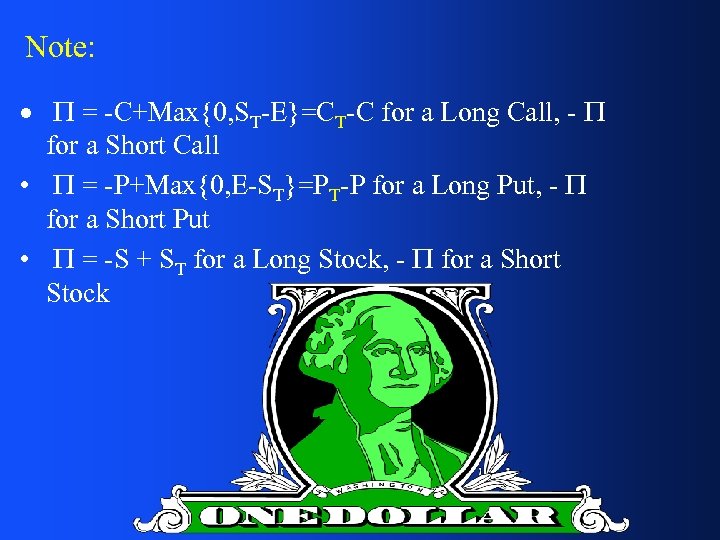 Note: · = -C+Max{0, ST-E}=CT-C for a Long Call, - for a Short Call • = -P+Max{0, E-ST}=PT-P for a Long Put, - for a Short Put • = -S + ST for a Long Stock, - for a Short Stock
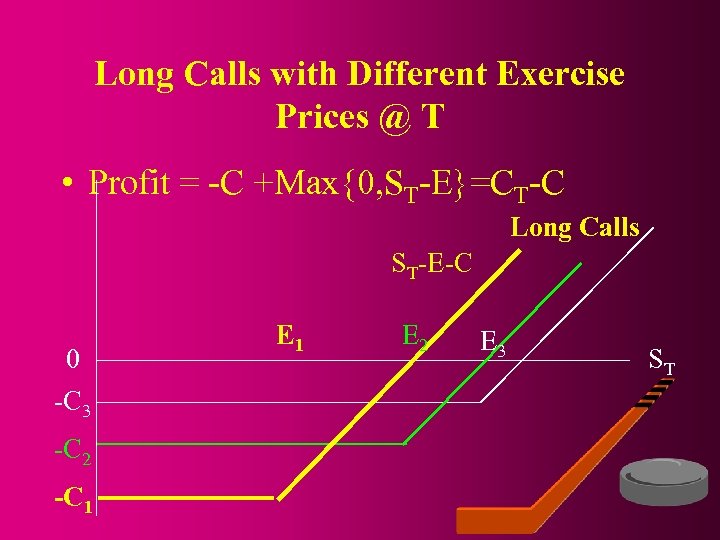 Long Calls with Different Exercise Prices @ T • Profit = -C +Max{0, ST-E}=CT-C Long Calls ST-E-C 0 -C 3 -C 2 -C 1 E 2 E 3 ST
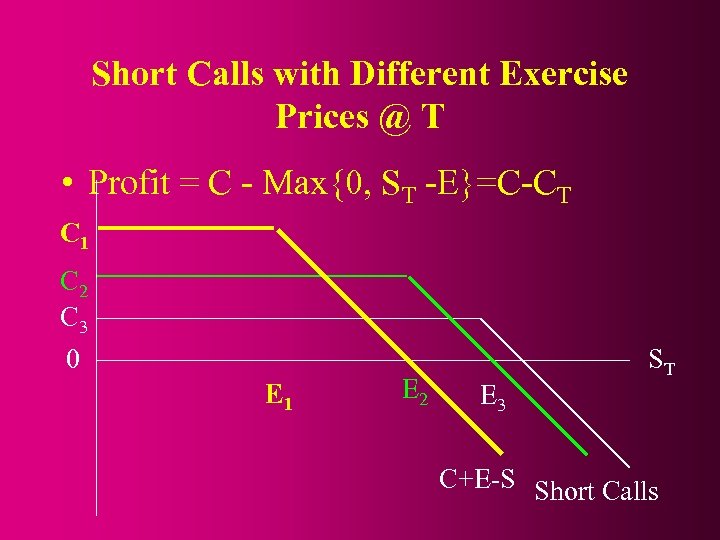 Short Calls with Different Exercise Prices @ T • Profit = C - Max{0, ST -E}=C-CT C 1 C 2 C 3 0 E 1 E 2 ST E 3 C+E-S Short Calls
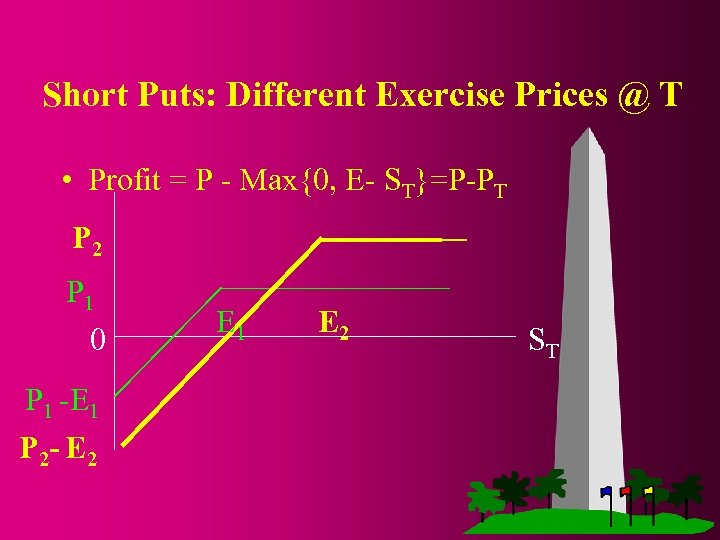 Short Puts: Different Exercise Prices @ T • Profit = P - Max{0, E- ST}=P-PT P 2 P 1 0 P 1 -E 1 P 2 - E 2 E 1 E 2 ST
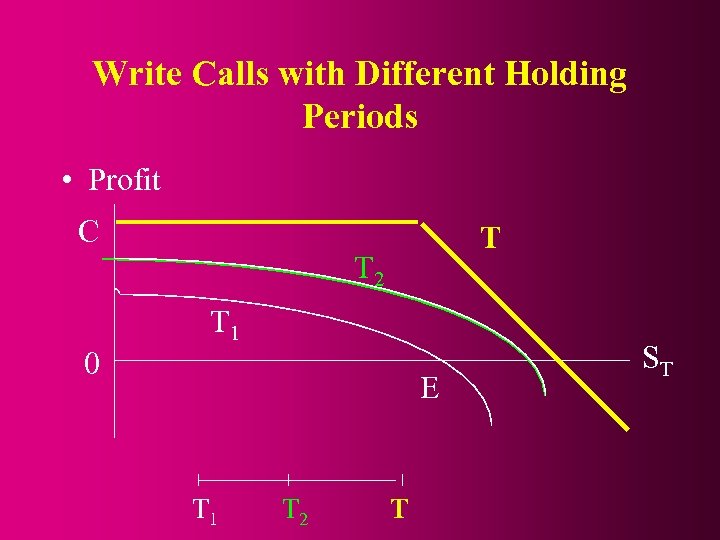 Write Calls with Different Holding Periods • Profit C T T 2 T 1 0 E T 1 T 2 T ST
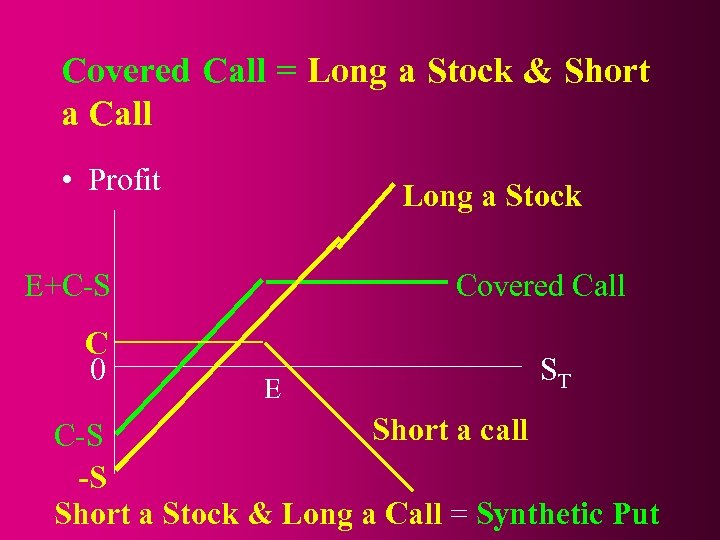 Covered Call = Long a Stock & Short a Call • Profit Long a Stock E+C-S C 0 Covered Call E ST Short a call C-S -S Short a Stock & Long a Call = Synthetic Put
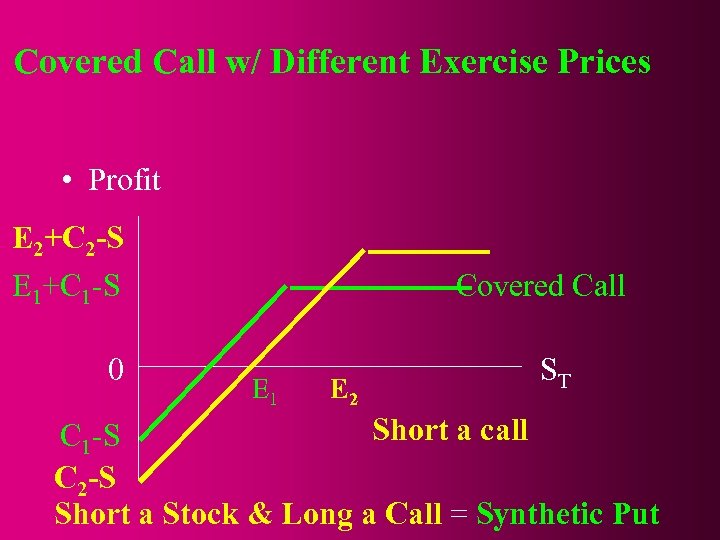 Covered Call w/ Different Exercise Prices • Profit E 2+C 2 -S E 1+C 1 -S 0 Covered Call E 1 E 2 ST Short a call C 1 -S C 2 -S Short a Stock & Long a Call = Synthetic Put
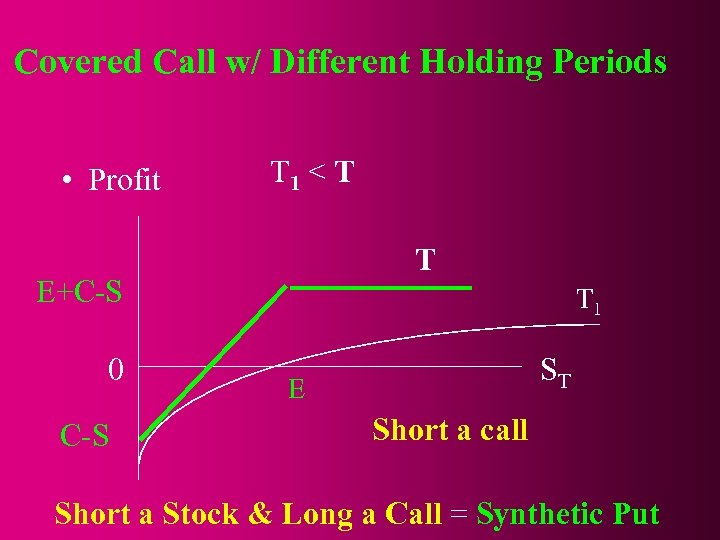 Covered Call w/ Different Holding Periods • Profit T 1 < T T E+C-S 0 C-S T 1 ST E Short a call Short a Stock & Long a Call = Synthetic Put
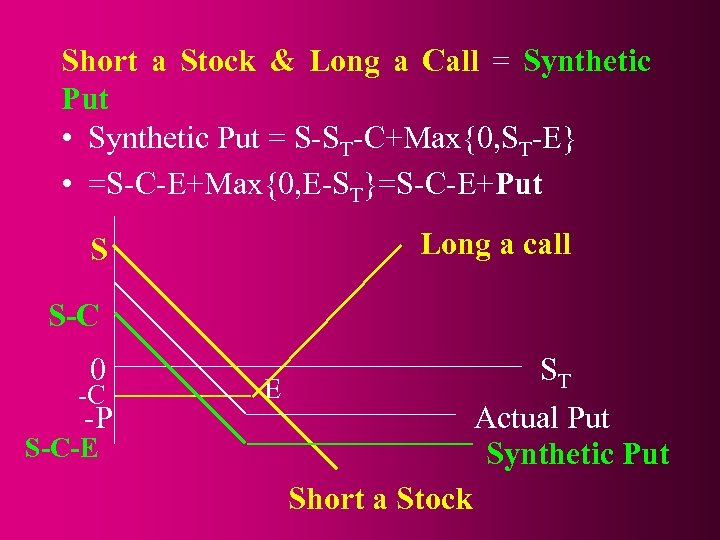 Short a Stock & Long a Call = Synthetic Put • Synthetic Put = S-ST-C+Max{0, ST-E} • =S-C-E+Max{0, E-ST}=S-C-E+Put Long a call S S-C 0 -C -P ST Actual Put Synthetic Put E S-C-E Short a Stock
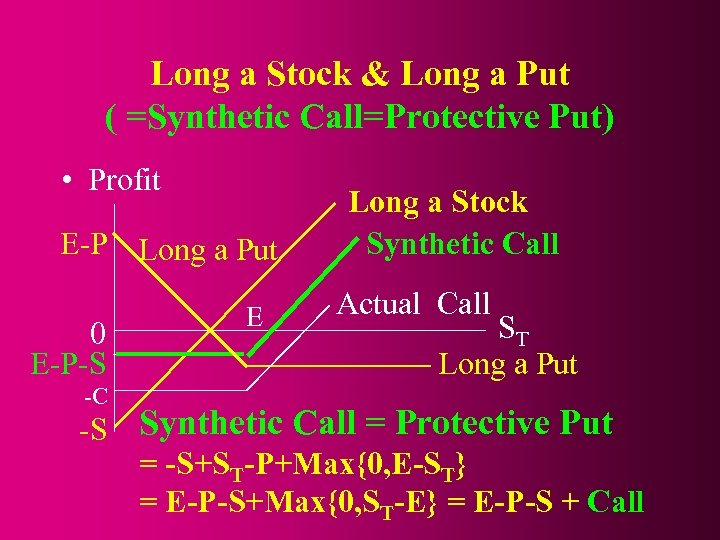 Long a Stock & Long a Put ( =Synthetic Call=Protective Put) • Profit E-P Long a Put 0 E-P-S -C E Long a Stock Synthetic Call Actual Call ST Long a Put -S Synthetic Call = Protective Put = -S+ST-P+Max{0, E-ST} = E-P-S+Max{0, ST-E} = E-P-S + Call
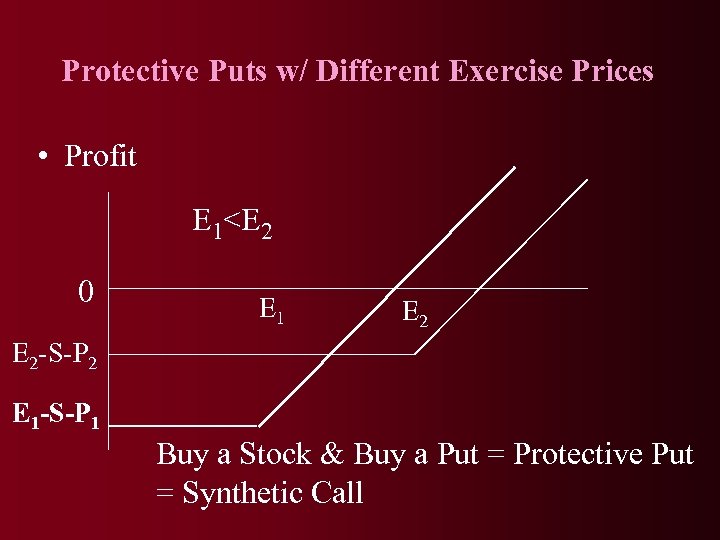 Protective Puts w/ Different Exercise Prices • Profit E 1
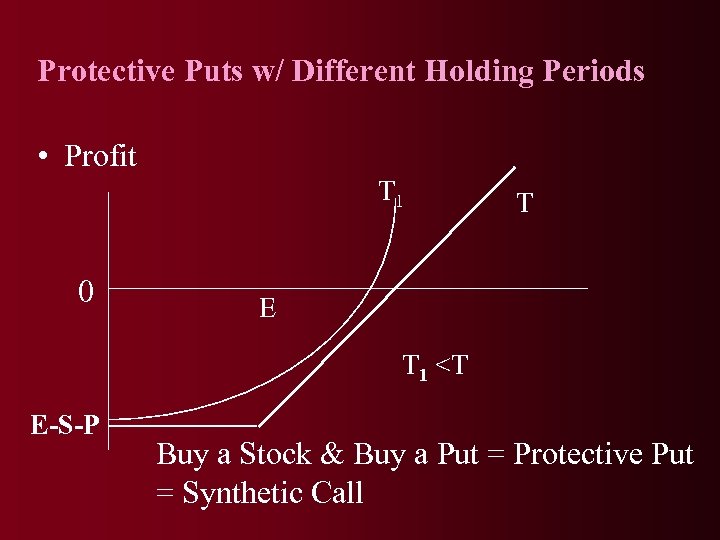 Protective Puts w/ Different Holding Periods • Profit T 1 0 T E T 1
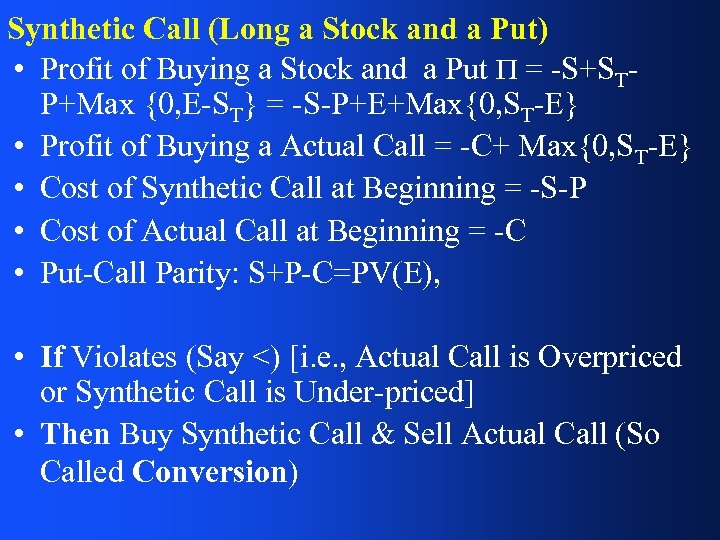 Synthetic Call (Long a Stock and a Put) • Profit of Buying a Stock and a Put = -S+STP+Max {0, E-ST} = -S-P+E+Max{0, ST-E} • Profit of Buying a Actual Call = -C+ Max{0, ST-E} • Cost of Synthetic Call at Beginning = -S-P • Cost of Actual Call at Beginning = -C • Put-Call Parity: S+P-C=PV(E), • If Violates (Say <) [i. e. , Actual Call is Overpriced or Synthetic Call is Under-priced] • Then Buy Synthetic Call & Sell Actual Call (So Called Conversion)
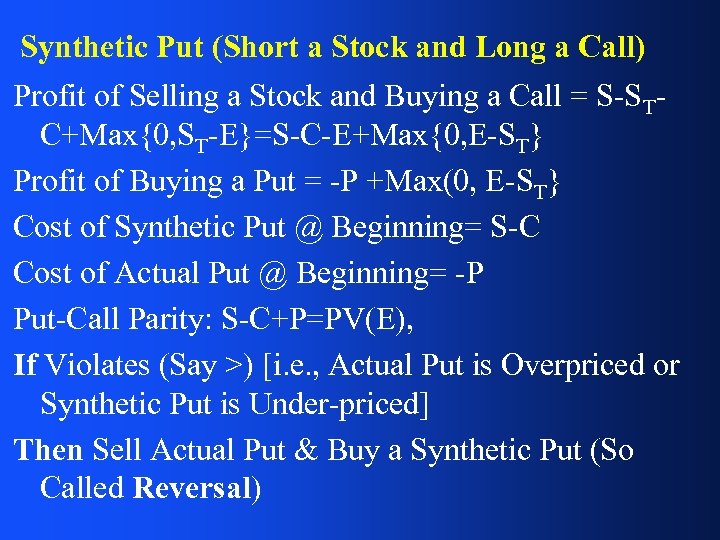 Synthetic Put (Short a Stock and Long a Call) Profit of Selling a Stock and Buying a Call = S-STC+Max{0, ST-E}=S-C-E+Max{0, E-ST} Profit of Buying a Put = -P +Max(0, E-ST} Cost of Synthetic Put @ Beginning= S-C Cost of Actual Put @ Beginning= -P Put-Call Parity: S-C+P=PV(E), If Violates (Say >) [i. e. , Actual Put is Overpriced or Synthetic Put is Under-priced] Then Sell Actual Put & Buy a Synthetic Put (So Called Reversal)
 Note: • Long a Call & Short a Stock = Synthetic Put • Long a Put & Stock = Synthetic Call • Conversion, Sell a Actual Call Buy a Synthetic Call • Reverse Conversion, Buy a Synthetic Put & Sell an Actual Put
 Chapter 7: Advanced Option Strategies • KEY CONCEPTS 7 – Basic Principles of Money Spreads and Combinations – Difference Between Bull and Bear Spreads and the Types of Options that are More Appropriate for Each – Relative Rates of Time Value Decay in a Calendar Spread – Ratio Spread – How Closing Position Prior to Expiration Affects Spreads, Straddles and Variations of Straddles – Difference Between Straps and Strips versus Straddles and Why You Choose One Strategy Over Another – How to Evaluate a Box Spread
 A: Spreads: One Long & One Short Option • 1. Vertical(or Money) Spread (Same T Different E) – – Call Bull Spread Call Bear Spread Put Bull Spread Put Bear Spread • 2. Horizontal Spread (Same E Different T)
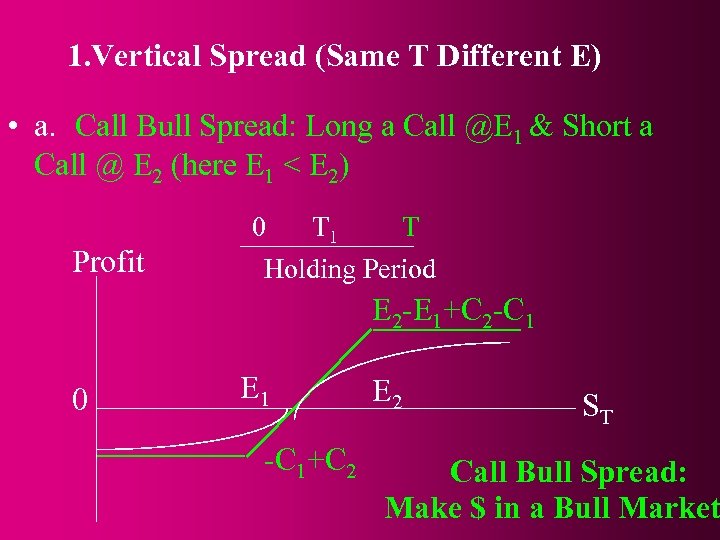 1. Vertical Spread (Same T Different E) • a. Call Bull Spread: Long a Call @E 1 & Short a Call @ E 2 (here E 1 < E 2) Profit 0 T 1 T Holding Period E 2 -E 1+C 2 -C 1 0 E 1 -C 1+C 2 E 2 ST Call Bull Spread: Make $ in a Bull Market
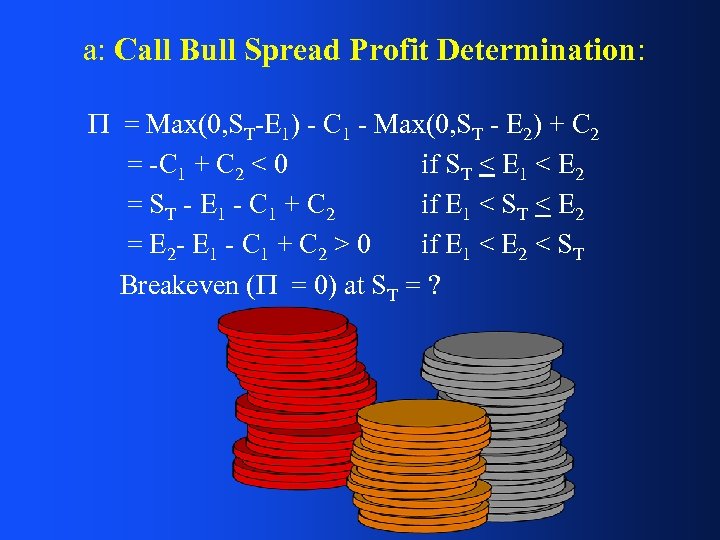 a: Call Bull Spread Profit Determination: = Max(0, ST-E 1) - C 1 - Max(0, ST - E 2) + C 2 = -C 1 + C 2 < 0 if ST < E 1 < E 2 = S T - E 1 - C 1 + C 2 if E 1 < ST < E 2 = E 2 - E 1 - C 1 + C 2 > 0 if E 1 < E 2 < ST Breakeven ( = 0) at ST = ?
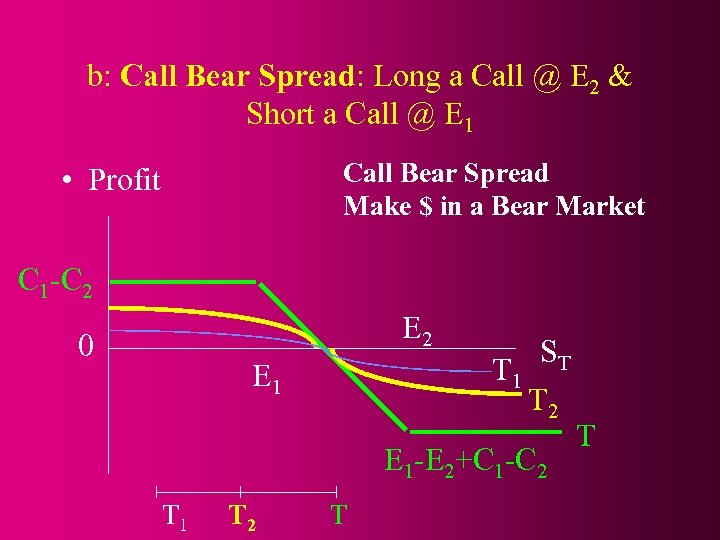 b: Call Bear Spread: Long a Call @ E 2 & Short a Call @ E 1 Call Bear Spread Make $ in a Bear Market • Profit C 1 -C 2 E 2 0 E 1 ST T 1 T 2 E 1 -E 2+C 1 -C 2 T 1 T 2 T T
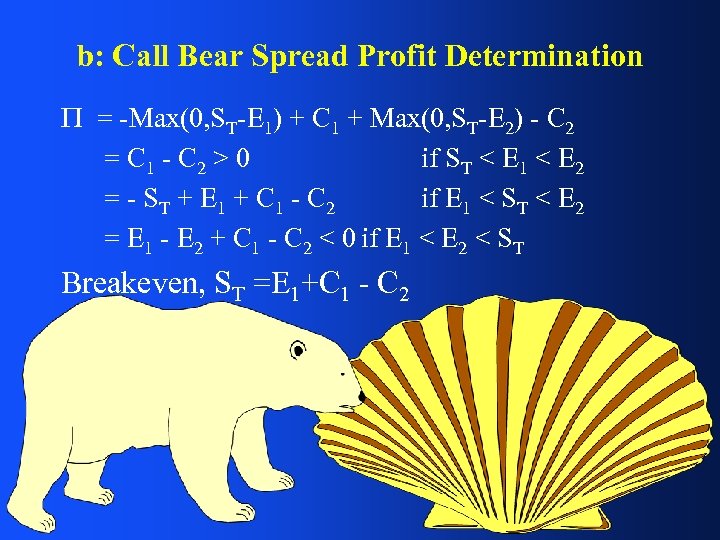 b: Call Bear Spread Profit Determination = -Max(0, ST-E 1) + C 1 + Max(0, ST-E 2) - C 2 = C 1 - C 2 > 0 if ST < E 1 < E 2 = - ST + E 1 + C 1 - C 2 if E 1 < ST < E 2 = E 1 - E 2 + C 1 - C 2 < 0 if E 1 < E 2 < ST Breakeven, ST =E 1+C 1 - C 2
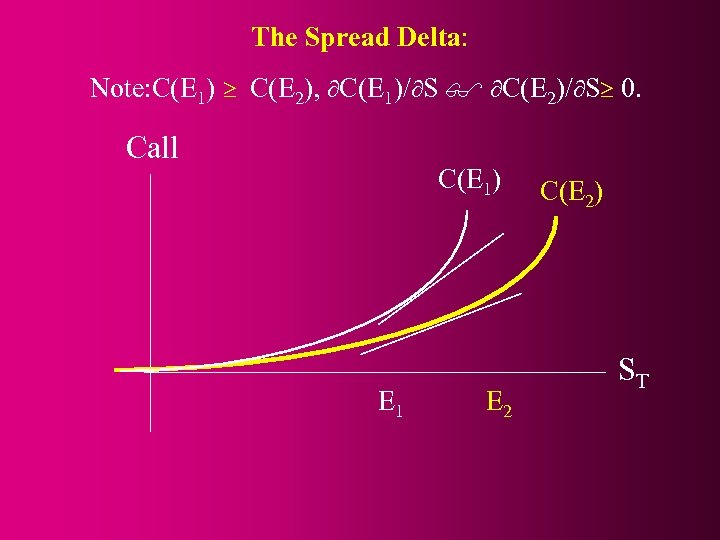 The Spread Delta: Note: C(E 1) C(E 2), C(E 1)/ S C(E 2)/ S 0. Call C(E 1) E 1 E 2 C(E 2) ST
 c: Put Money Spreads: • Bull Spreads: Long a Put @ E 1 & Short a Put @ E 2 • Bear Spreads: Long a Put @ E 2 & Short a Put @ E 1 • why?
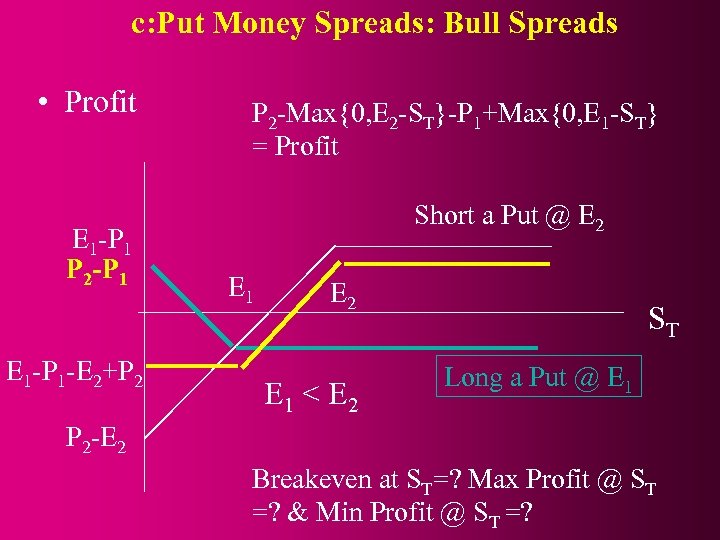 c: Put Money Spreads: Bull Spreads • Profit E 1 -P 1 P 2 -P 1 E 1 -P 1 -E 2+P 2 P 2 -Max{0, E 2 -ST}-P 1+Max{0, E 1 -ST} = Profit Short a Put @ E 2 E 1 < E 2 ST Long a Put @ E 1 P 2 -E 2 Breakeven at ST=? Max Profit @ ST =? & Min Profit @ ST =?
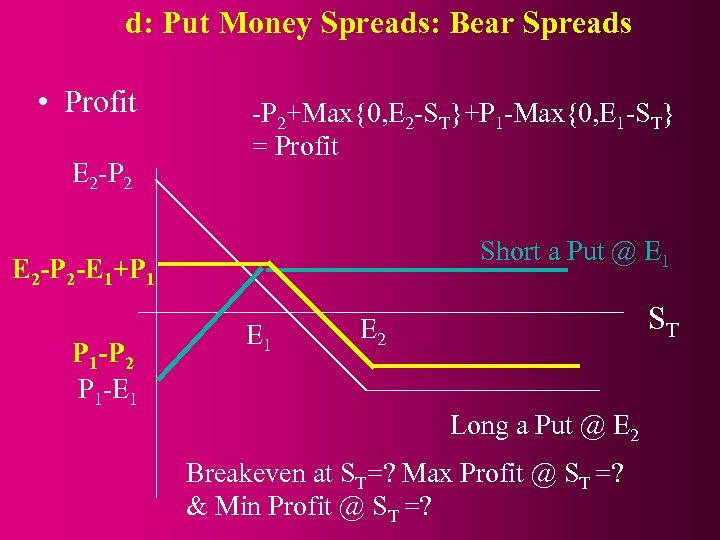 d: Put Money Spreads: Bear Spreads • Profit E 2 -P 2+Max{0, E 2 -ST}+P 1 -Max{0, E 1 -ST} = Profit Short a Put @ E 1 E 2 -P 2 -E 1+P 1 P 1 -P 2 P 1 -E 1 ST E 2 Long a Put @ E 2 Breakeven at ST=? Max Profit @ ST =? & Min Profit @ ST =?
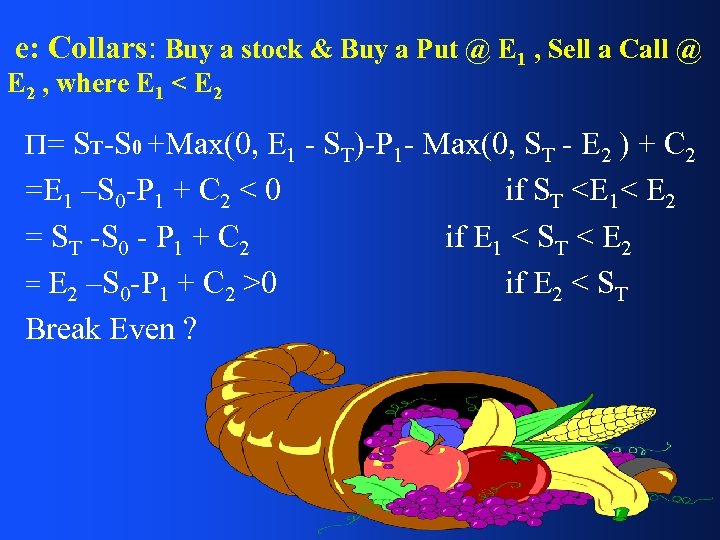 e: Collars: Buy a stock & Buy a Put @ E 1 , Sell a Call @ E 2 , where E 1 < E 2 = ST-S 0 +Max(0, E 1 - ST)-P 1 - Max(0, ST - E 2 ) + C 2 =E 1 –S 0 -P 1 + C 2 < 0 = ST -S 0 - P 1 + C 2 = E 2 –S 0 -P 1 + C 2 >0 Break Even ? if ST
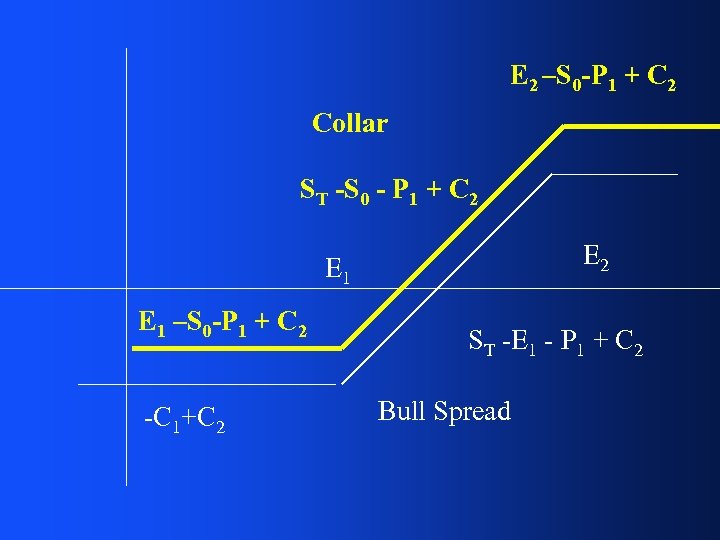 E 2 –S 0 -P 1 + C 2 Collar ST -S 0 - P 1 + C 2 E 1 E 1 –S 0 -P 1 + C 2 -C 1+C 2 ST -E 1 - P 1 + C 2 Bull Spread
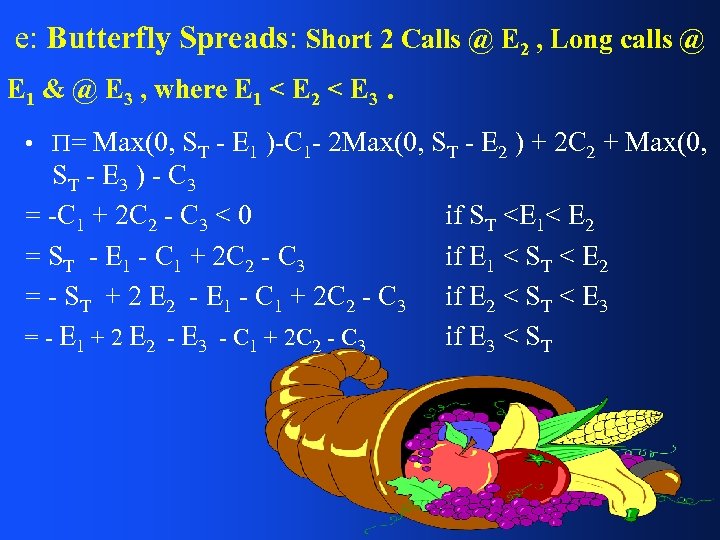 e: Butterfly Spreads: Short 2 Calls @ E 2 , Long calls @ E 1 & @ E 3 , where E 1 < E 2 < E 3. • = Max(0, ST - E 1 )-C 1 - 2 Max(0, ST - E 2 ) + 2 C 2 + Max(0, ST - E 3 ) - C 3 = -C 1 + 2 C 2 - C 3 < 0 = ST - E 1 - C 1 + 2 C 2 - C 3 = - ST + 2 E 2 - E 1 - C 1 + 2 C 2 - C 3 = - E 1 + 2 E 2 - E 3 - C 1 + 2 C 2 - C 3 if ST

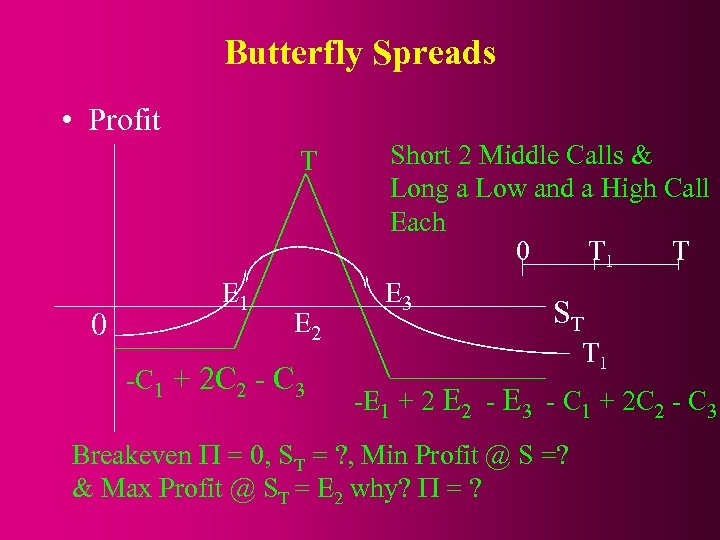 Butterfly Spreads • Profit T 0 E 1 E 2 -C 1 + 2 C 2 - C 3 Short 2 Middle Calls & Long a Low and a High Call Each 0 T 1 T E 3 ST T 1 -E 1 + 2 E 2 - E 3 - C 1 + 2 C 2 - C 3 Breakeven = 0, ST = ? , Min Profit @ S =? & Max Profit @ ST = E 2 why? = ?
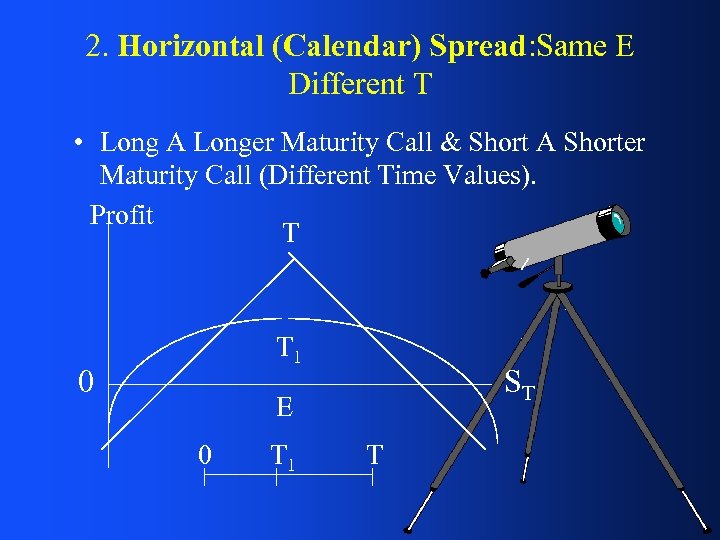 2. Horizontal (Calendar) Spread: Same E Different T • Long A Longer Maturity Call & Short A Shorter Maturity Call (Different Time Values). Profit T T 1 0 ST E 0 T 1 T
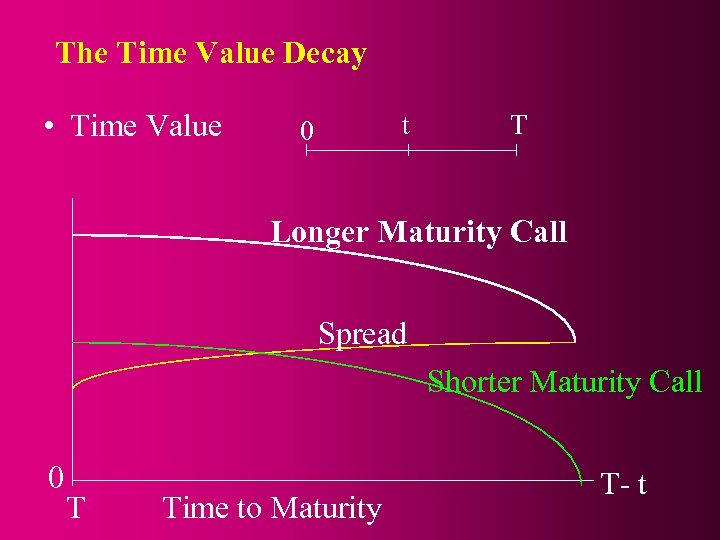 The Time Value Decay • Time Value t 0 T Longer Maturity Call Spread Shorter Maturity Call 0 T Time to Maturity T- t
 Ratio Spreads: long N 1 call @ C 1 and N 2 call @ C 2 (Applies to Money or Calendar Spread) • Find N 1 and N 2 such that this portfolio value V is risk-free to Stock, where V = N 1 C 1 + N 2 C 2, i. e. , • Solve for N 1/N 2 = -( C 2/ S)/( C 1/ S) < 0, so ratio spread is N 1 long @ C 1 and N 2 short @ C 2. • Ex. see p. 241 End of Spread
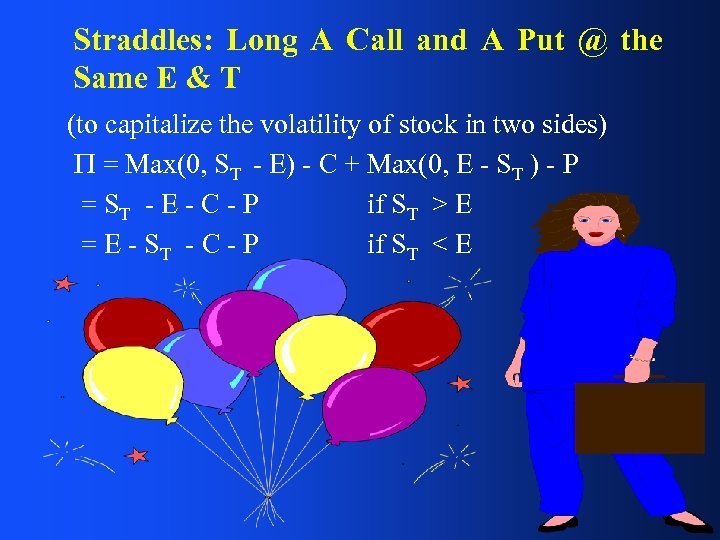 Straddles: Long A Call and A Put @ the Same E & T (to capitalize the volatility of stock in two sides) = Max(0, ST - E) - C + Max(0, E - ST ) - P = ST - E - C - P if ST > E = E - ST - C - P if ST < E
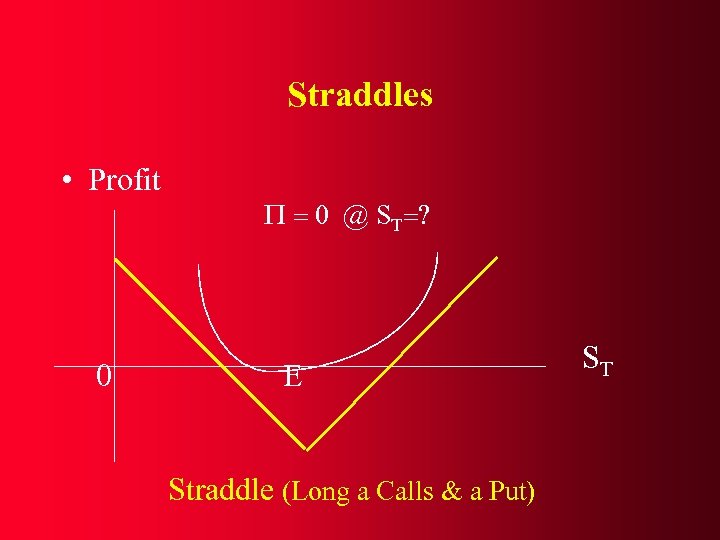 Straddles • Profit 0 @ ST E Straddle (Long a Calls & a Put) ST
 a. Straps: Long 2 Calls & One Put (bet market will go up) = 2 Max(0, ST - E) - 2 C + Max(0, E - ST ) - P = 2 ST - 2 E - 2 C - P if ST > E = -2 C + E - ST - P if ST < E Breakeven @ ST such that = 0 (2 solutions) Where is the minimum of ?
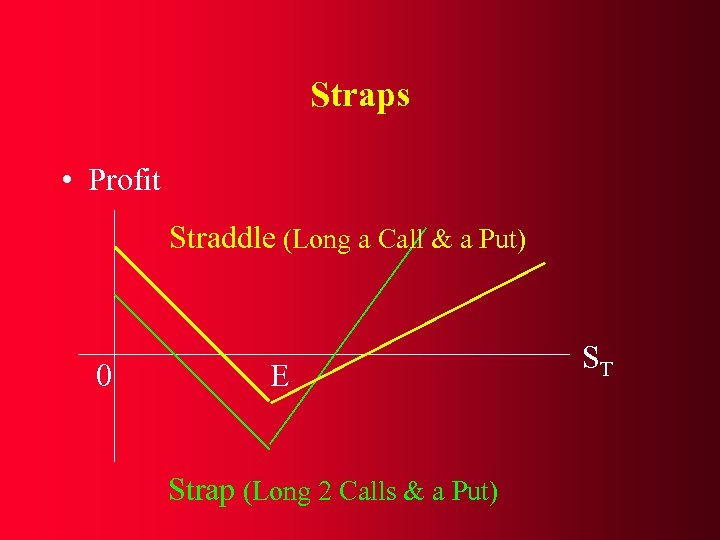 Straps • Profit Straddle (Long a Call & a Put) 0 E Strap (Long 2 Calls & a Put) ST
 b. Strips: Long 2 Puts & One Call (bet market will go down) = Max(0, ST - E) - C + 2 Max(0, E - ST ) - 2 P = ST - E - C - 2 P if ST > E = -C + 2 E - 2 ST - 2 P if ST < E There are 2 Breakeven points, where ? Where is the minimum of ? When the of Straddle = the of Strip (or Strap)? Profit on Short the Straddle, Strip, Strap ?
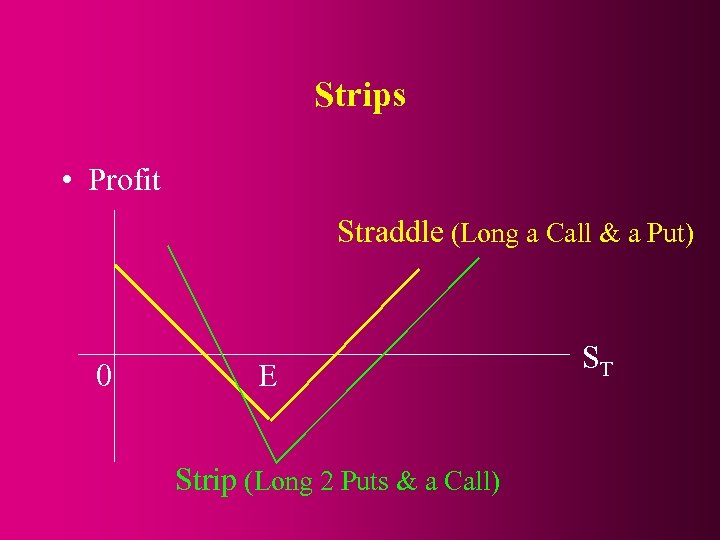 Strips • Profit Straddle (Long a Call & a Put) 0 E Strip (Long 2 Puts & a Call) ST
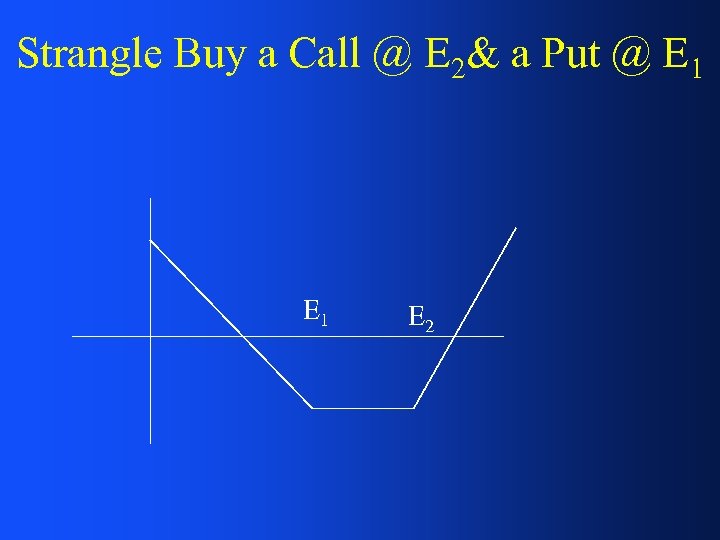 Strangle Buy a Call @ E 2& a Put @ E 1 E 2
 c. Box Spreads: Long One Call & Short One Put @ E 1 & Short one Call & Long One Put @ E 2 = Max(0, ST-E 1) - C 1 - Max(0, ST -E 2) + C 2 + Max(0, E 2 - ST) - P 2 - Max(0, E 1 - ST) + P 1 = E 2 - E 1 - C 1 + C 2 -P 2+P 1 (risk-free, check) From put-call parity @ E 1 and @ E 2 are S = C 1 -P 1+ PV(E 1) S = C 2 -P 2+ PV(E 2) ÞPV(E 2 - E 1) = (C 1 - C 2) - (P 1 -P 2) = Cost of Box Spread=Bull Call + Bear Put
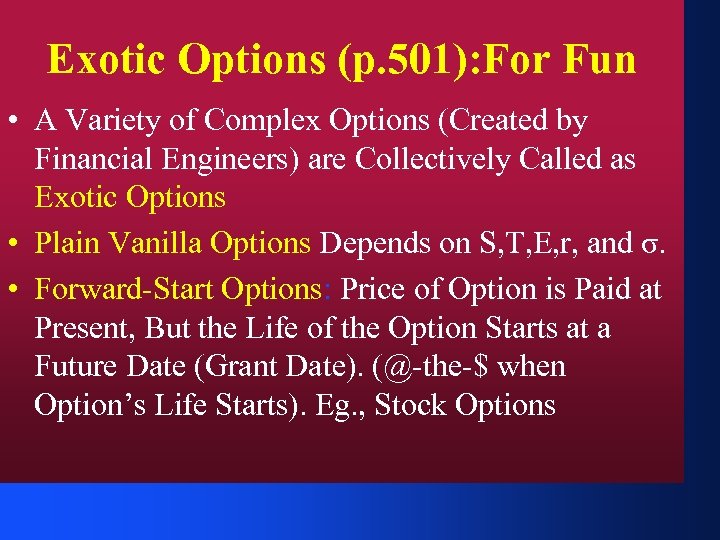 Exotic Options (p. 501): For Fun • A Variety of Complex Options (Created by Financial Engineers) are Collectively Called as Exotic Options • Plain Vanilla Options Depends on S, T, E, r, and σ. • Forward-Start Options: Price of Option is Paid at Present, But the Life of the Option Starts at a Future Date (Grant Date). (@-the-$ when Option’s Life Starts). Eg. , Stock Options
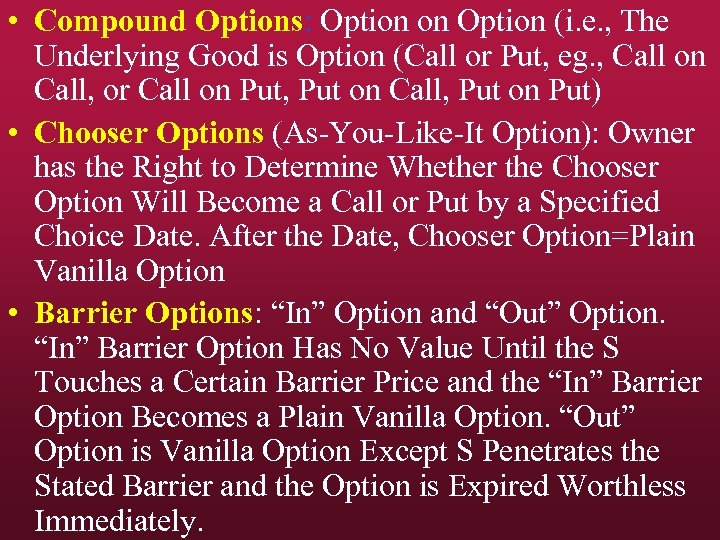 • Compound Options: Option on Option (i. e. , The Underlying Good is Option (Call or Put, eg. , Call on Call, or Call on Put, Put on Call, Put on Put) • Chooser Options (As-You-Like-It Option): Owner has the Right to Determine Whether the Chooser Option Will Become a Call or Put by a Specified Choice Date. After the Date, Chooser Option=Plain Vanilla Option • Barrier Options: “In” Option and “Out” Option. “In” Barrier Option Has No Value Until the S Touches a Certain Barrier Price and the “In” Barrier Option Becomes a Plain Vanilla Option. “Out” Option is Vanilla Option Except S Penetrates the Stated Barrier and the Option is Expired Worthless Immediately.
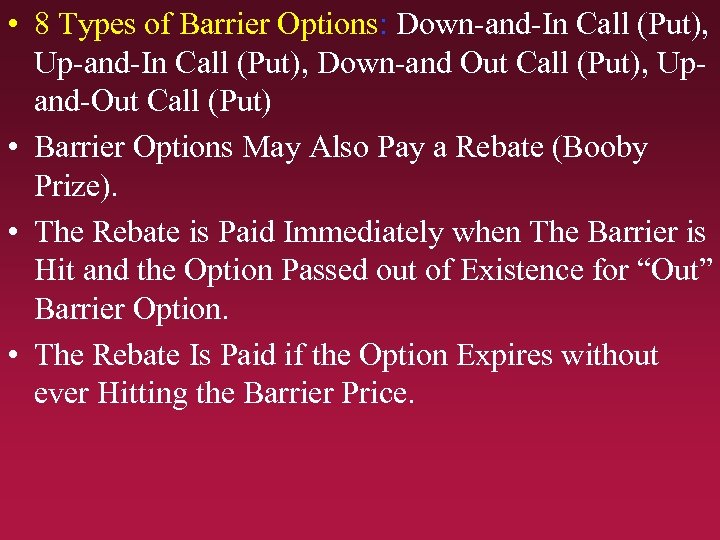 • 8 Types of Barrier Options: Down-and-In Call (Put), Up-and-In Call (Put), Down-and Out Call (Put), Upand-Out Call (Put) • Barrier Options May Also Pay a Rebate (Booby Prize). • The Rebate is Paid Immediately when The Barrier is Hit and the Option Passed out of Existence for “Out” Barrier Option. • The Rebate Is Paid if the Option Expires without ever Hitting the Barrier Price.
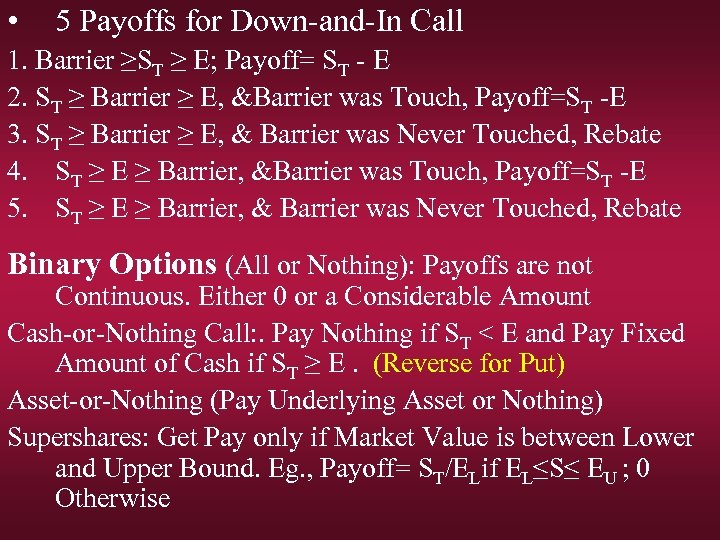 • 5 Payoffs for Down-and-In Call 1. Barrier ≥ST ≥ E; Payoff= ST - E 2. ST ≥ Barrier ≥ E, &Barrier was Touch, Payoff=ST -E 3. ST ≥ Barrier ≥ E, & Barrier was Never Touched, Rebate 4. ST ≥ E ≥ Barrier, &Barrier was Touch, Payoff=ST -E 5. ST ≥ E ≥ Barrier, & Barrier was Never Touched, Rebate Binary Options (All or Nothing): Payoffs are not Continuous. Either 0 or a Considerable Amount Cash-or-Nothing Call: . Pay Nothing if ST < E and Pay Fixed Amount of Cash if ST ≥ E. (Reverse for Put) Asset-or-Nothing (Pay Underlying Asset or Nothing) Supershares: Get Pay only if Market Value is between Lower and Upper Bound. Eg. , Payoff= ST/ELif EL≤S≤ EU ; 0 Otherwise
![• Lookback Options: Max{0, ST-Min[St, St+1, St+2, …, ST]} for Call Purchased @](https://present5.com/presentation/af6c783241ef733849a4678cf610dbb1/image-112.jpg "• Lookback Options: Max{0, ST-Min[St, St+1, St+2, …, ST]} for Call Purchased @") • Lookback Options: Max{0, ST-Min[St, St+1, St+2, …, ST]} for Call Purchased @ t Mature @ T For Put: Max{0, Max[St, St+1, St+2, …, ST)-ST]} for Put Purchased @ t Mature @ T • Average Price Options (Asian Option: Offered by Bankers Trust was the 1 st to Offer such Products in Tokyo Office). Payoff=Average of the St, t=t…T • Exchange Options: Option to Exchange one Asset for Another • Rainbow Options: Options on 2 Risky Assets (# of Risky Assets =# of Colors in the Rainbow) 1. Call on the Best of 2 Risky Assets & Cash (No Exercise Price): 3 Choices @T, Risky Asset 1, Risky Asset 2, Fixed Cash Amount
• Lookback Options: Max{0, ST-Min[St, St+1, St+2, …, ST]} for Call Purchased @ t Mature @ T For Put: Max{0, Max[St, St+1, St+2, …, ST)-ST]} for Put Purchased @ t Mature @ T • Average Price Options (Asian Option: Offered by Bankers Trust was the 1 st to Offer such Products in Tokyo Office). Payoff=Average of the St, t=t…T • Exchange Options: Option to Exchange one Asset for Another • Rainbow Options: Options on 2 Risky Assets (# of Risky Assets =# of Colors in the Rainbow) 1. Call on the Best of 2 Risky Assets & Cash (No Exercise Price): 3 Choices @T, Risky Asset 1, Risky Asset 2, Fixed Cash Amount
 • http//www. hedgestreet. com • http//www. intrade. com
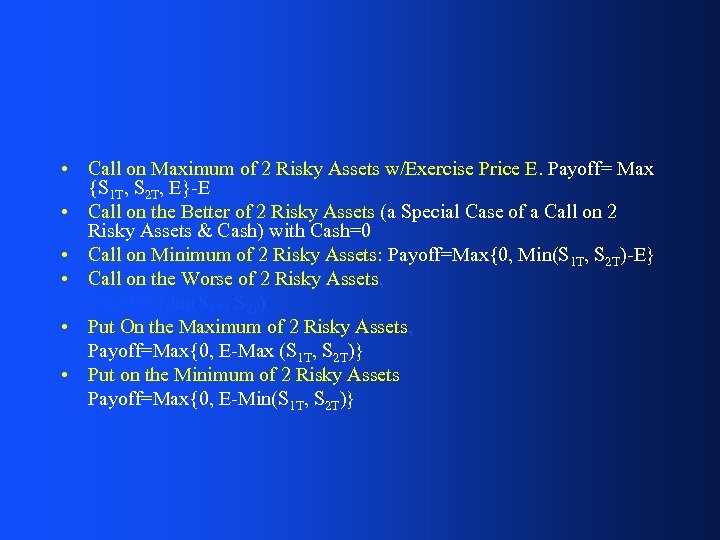 • Call on Maximum of 2 Risky Assets w/Exercise Price E. Payoff= Max {S 1 T, S 2 T, E}-E • Call on the Better of 2 Risky Assets (a Special Case of a Call on 2 Risky Assets & Cash) with Cash=0 • Call on Minimum of 2 Risky Assets: Payoff=Max{0, Min(S 1 T, S 2 T)-E} • Call on the Worse of 2 Risky Assets, Payoff= Min(S 1 T, S 2 T) • Put On the Maximum of 2 Risky Assets, Payoff=Max{0, E-Max (S 1 T, S 2 T)} • Put on the Minimum of 2 Risky Assets Payoff=Max{0, E-Min(S 1 T, S 2 T)}