


 Скачать презентацию Options An Introduction to Derivative Securities Introduction
c2b4ce506fa72d2f7e9f22f63a74ff81.ppt
- Количество слайдов: 21
 Options An Introduction to Derivative Securities
 Introduction o As the name is meant to imply, derivative securities are financial instruments that derive their value from an “underlying” asset. o In this sense they can be seen as “side bets” between two investors as to what will happen to the value of the underlying asset. n The characterization of them as a bet implies pure speculation on the part of the investors. The main use of derivatives, however is actually in reducing or “hedging” risk. o Being side bets, they are in “zero net supply. ”
 Options o While there are many types of derivative securities, our concentration in this introduction will be on option contracts, in particular call option contracts. o Option contracts are financial contracts that give their owner the right (not the obligation) to buy (call) or sell (put) the underlying asset (commonly a stock or a bond) either on (European) or on or before (American) a specific date (expiration date) for a fixed price (exercise price).
 Call Options o A call option gives the owner the right to buy an asset at a fixed price on (or before) a given date. o Definitions n n n Call price Stock price (current and at maturity) Exercise price Time to expiration American versus European In/out of/at the money
 Long Position in a Call o Suppose that a particular call option can be exercised 6 months from now at the exercise price of $20. What will be the value of a long position in (ownership of) the call at expiration if: n n n The call is in the money – e. g. ST = $40? It is out of the money – e. g. ST = $15? Under what condition would we say the call is at the money?
 Put Options o Ownership of a put option on an underlying asset provides the right to sell that asset for a fixed price on (or before) the expiration date. o Suppose a particular put option can be exercised one year from now at the exercise price of $15. What is the value of the put at expiration if: n n The put is in the money – e. g. ST = $8? It is out of the money – e. g. ST = $35?
 Short Positions in Options o For every buyer there is a seller. o An investor who writes a call on common stock promises to deliver shares of that stock if the option is exercised by the option holder. The seller is obligated to do so. n What are the possible payoffs at expiration? o An investor who writes a put agrees to purchase shares of that stock if the put holder should so request (exercise). n What are the possible payoffs at expiration?
 Combinations of Options o “Betting on volatility. ” n What if you don’t disagree with the market on the current price but you think it is more volatile than other investors. Can you take a position that will provide positive returns if you are right? n Can you bet against volatility? n There exist a myriad of other possibilities, let’s look at a particular relationship of great interest.
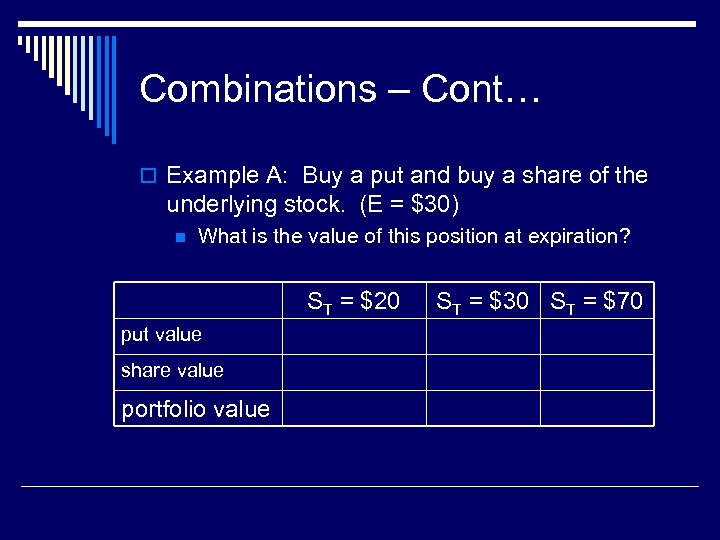 Combinations – Cont… o Example A: Buy a put and buy a share of the underlying stock. (E = $30) n What is the value of this position at expiration? ST = $20 put value share value portfolio value ST = $30 ST = $70
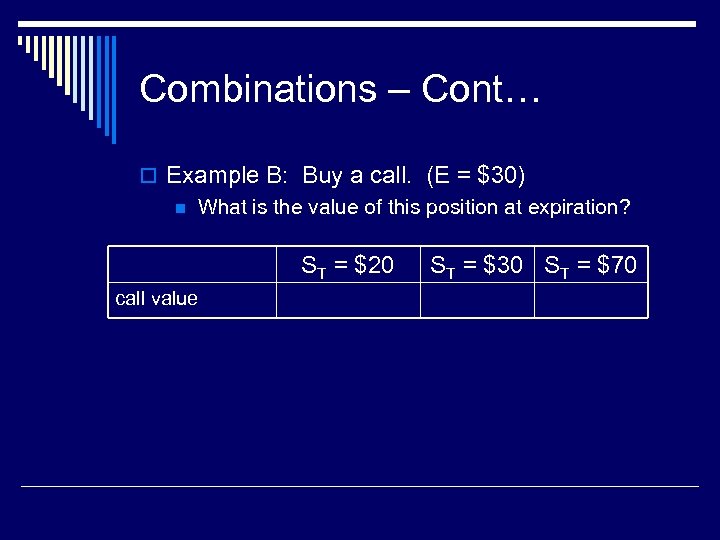 Combinations – Cont… o Example B: Buy a call. (E = $30) n What is the value of this position at expiration? ST = $20 call value ST = $30 ST = $70
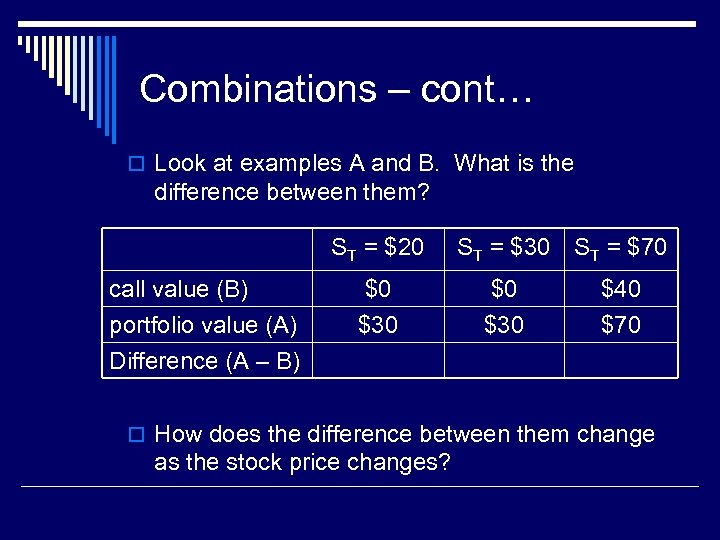 Combinations – cont… o Look at examples A and B. What is the difference between them? ST = $20 call value (B) portfolio value (A) Difference (A – B) $0 $30 ST = $70 $0 $30 $40 $70 o How does the difference between them change as the stock price changes?
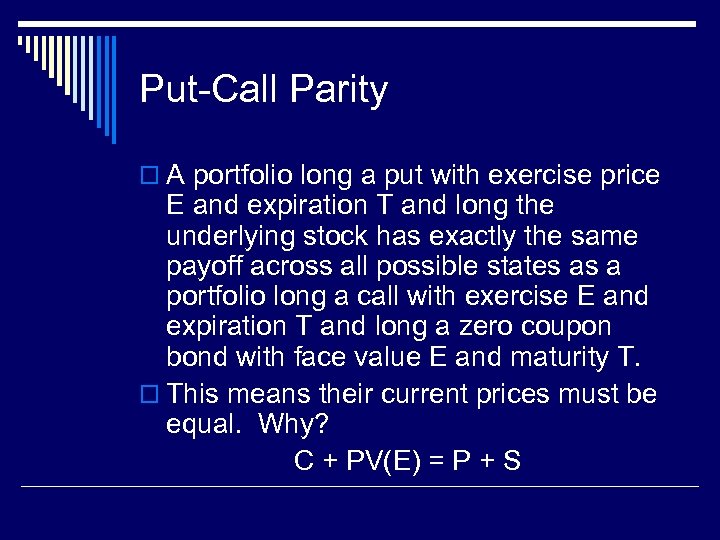 Put-Call Parity o A portfolio long a put with exercise price E and expiration T and long the underlying stock has exactly the same payoff across all possible states as a portfolio long a call with exercise E and expiration T and long a zero coupon bond with face value E and maturity T. o This means their current prices must be equal. Why? C + PV(E) = P + S
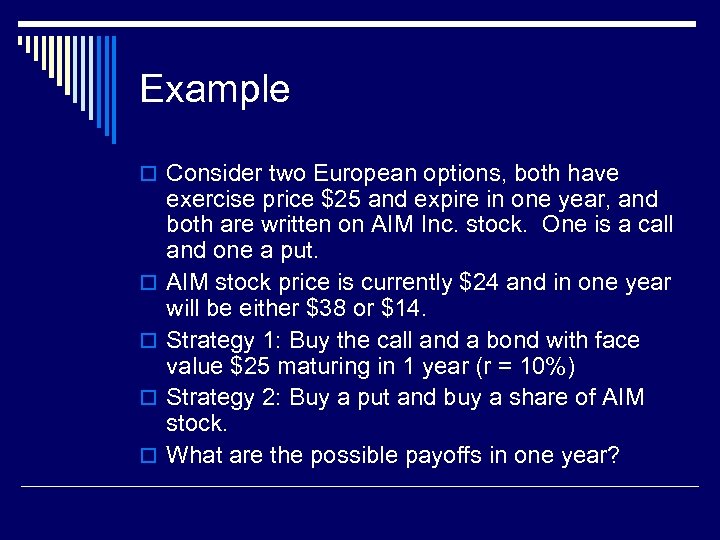 Example o Consider two European options, both have o o exercise price $25 and expire in one year, and both are written on AIM Inc. stock. One is a call and one a put. AIM stock price is currently $24 and in one year will be either $38 or $14. Strategy 1: Buy the call and a bond with face value $25 maturing in 1 year (r = 10%) Strategy 2: Buy a put and buy a share of AIM stock. What are the possible payoffs in one year?
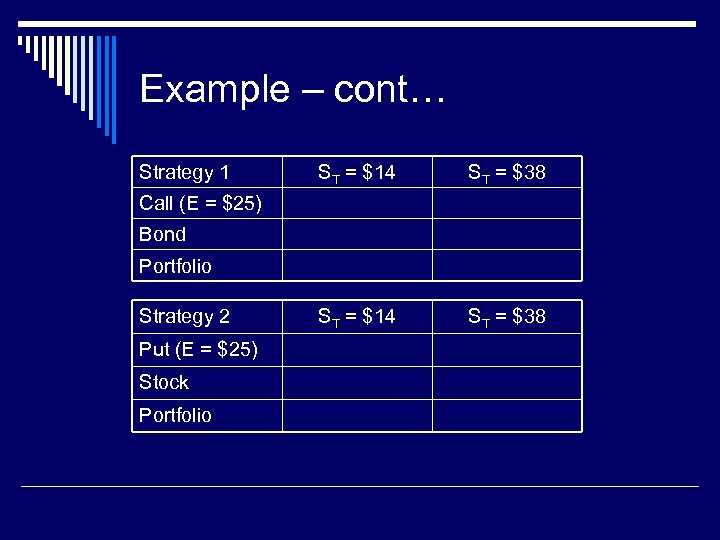 Example – cont… Strategy 1 ST = $14 ST = $38 Call (E = $25) Bond Portfolio Strategy 2 Put (E = $25) Stock Portfolio
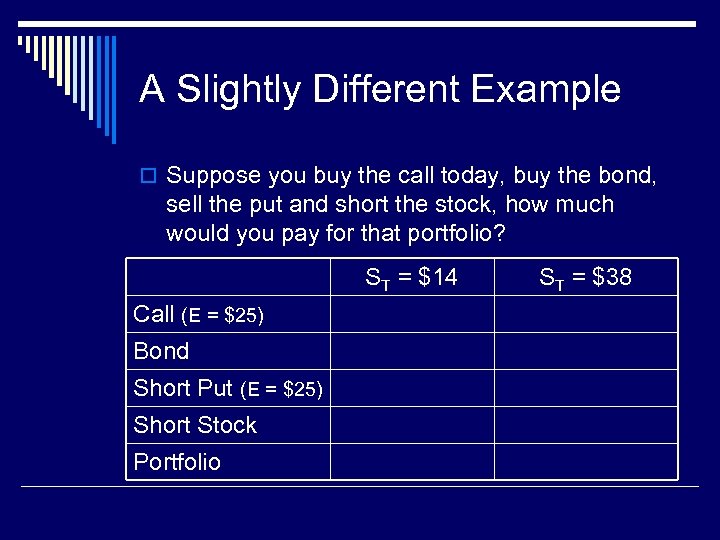 A Slightly Different Example o Suppose you buy the call today, buy the bond, sell the put and short the stock, how much would you pay for that portfolio? ST = $14 Call (E = $25) Bond Short Put (E = $25) Short Stock Portfolio ST = $38
 A Final Example o Suppose you desperately want to buy a put option on AIM Inc. but there is no one who wants to write a put? Is there a way you can satisfy your cravings?
 Binomial Option Pricing Model o Can we find the correct price of a one year call o o on AIM Inc. stock? Use the same approach as in deriving the putcall parity relation. If we can find a portfolio of AIM stock and a risk free bond that mimics the payoff on the call we can price the call. (Assume rf = 10%. ) That portfolio and the call must have the same price. Why? We can price the portfolio since we know the current price of the stock and the bond.
 Binomial Model o Recall the payoff at expiration on the call option is $0 if the stock price goes down to $14 and is $13 if the stock price rises to $38. n This is a change of $13 from “bad” to “good” outcome. o One share of stock however has a change of $24 across outcomes. o What if we buy 13/24 ths of a share? n n n The payoff on this position is $7. 58 if the stock price goes down and $20. 58 it goes up. The position costs $13. The number 13/24 is called the “hedge ratio” or “delta” of this option.
 Binomial Model o Notice that the value of our position now changes by $13 for an up versus a down move in stock price. o The only problem is that the payoff does not exactly match the call payoff. o This is easily corrected however if we could subtract $7. 58 from each outcome on our position in the stock. o We can do that by borrowing so we have to repay exactly $7. 58 at the expiration of the call.
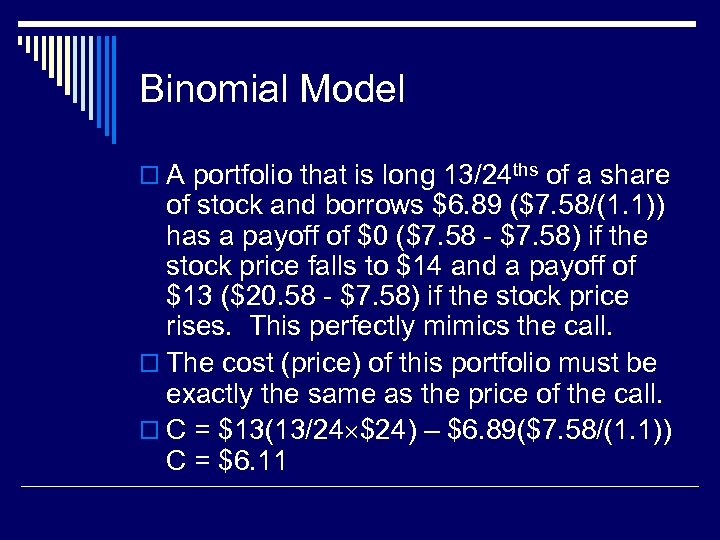 Binomial Model o A portfolio that is long 13/24 ths of a share of stock and borrows $6. 89 ($7. 58/(1. 1)) has a payoff of $0 ($7. 58 - $7. 58) if the stock price falls to $14 and a payoff of $13 ($20. 58 - $7. 58) if the stock price rises. This perfectly mimics the call. o The cost (price) of this portfolio must be exactly the same as the price of the call. o C = $13(13/24 $24) – $6. 89($7. 58/(1. 1)) C = $6. 11
 Binomial Model o This model, while very simple, captures the essence of most option pricing models. o The famous Black Scholes option pricing model follows from exactly this same logic, the main difference is that rather than a binomial model to capture stock prices we use a geometric Brownian motion (a continuous time stochastic process). o There have been various extensions of the simple option pricing model, allowing random “jumps” in the stock price, changing volatility, etc. , many of which rely on the simple replicating portfolio argument presented in these notes. o Understanding options and the basics of option pricing can help in a variety of situation.