 Скачать презентацию OPTIONAL LOGO HERE THE EFFECT OF MATERNAL OBESITY
964456ee6708dacce01e106c090fe40e.ppt
- Количество слайдов: 1



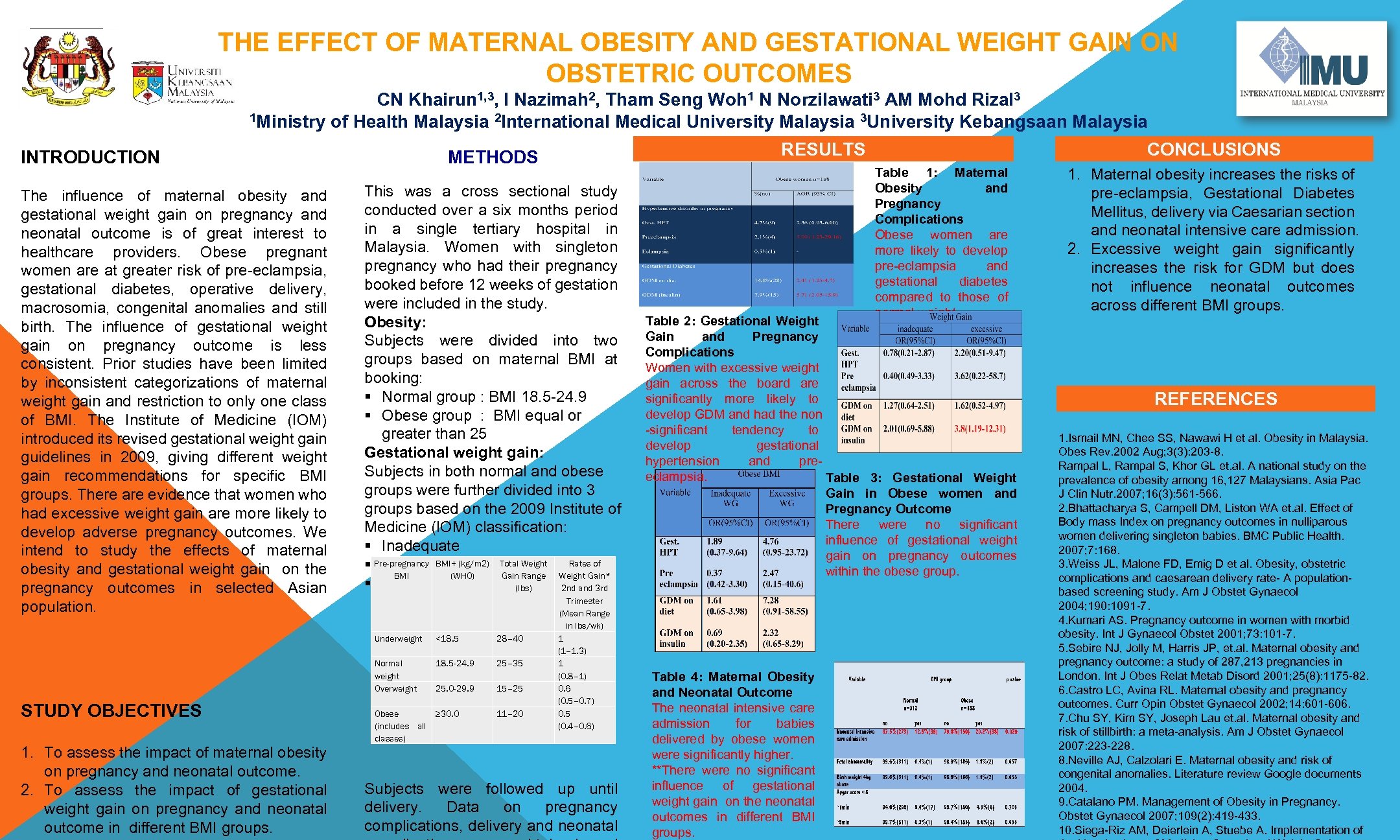
OPTIONAL LOGO HERE THE EFFECT OF MATERNAL OBESITY AND GESTATIONAL WEIGHT GAIN ON OBSTETRIC OUTCOMES OPTIONAL LOGO HERE CN Khairun 1, 3, I Nazimah 2, Tham Seng Woh 1 N Norzilawati 3 AM Mohd Rizal 3 1 Ministry of Health Malaysia 2 International Medical University Malaysia 3 University Kebangsaan Malaysia INTRODUCTION The influence of maternal obesity and gestational weight gain on pregnancy and neonatal outcome is of great interest to healthcare providers. Obese pregnant women are at greater risk of pre-eclampsia, gestational diabetes, operative delivery, macrosomia, congenital anomalies and still birth. The influence of gestational weight gain on pregnancy outcome is less consistent. Prior studies have been limited by inconsistent categorizations of maternal weight gain and restriction to only one class of BMI. The Institute of Medicine (IOM) introduced its revised gestational weight gain guidelines in 2009, giving different weight gain recommendations for specific BMI groups. There are evidence that women who had excessive weight gain are more likely to develop adverse pregnancy outcomes. We intend to study the effects of maternal obesity and gestational weight gain on the pregnancy outcomes in selected Asian population. This was a cross sectional study conducted over a six months period in a single tertiary hospital in Malaysia. Women with singleton pregnancy who had their pregnancy booked before 12 weeks of gestation were included in the study. Obesity: Subjects were divided into two groups based on maternal BMI at booking: § Normal group : BMI 18. 5 -24. 9 § Obese group : BMI equal or greater than 25 Gestational weight gain: Subjects in both normal and obese groups were further divided into 3 groups based on the 2009 Institute of Medicine (IOM) classification: § Inadequate § Pre-pregnancy BMI+ (kg/m 2) Total Weight Rates of Adequate BMI (WHO) Gain Range Weight Gain* § Excessive weight gain. 2 nd and 3 rd (lbs) Underweight 1. To assess the impact of maternal obesity on pregnancy and neonatal outcome. 2. To assess the impact of gestational weight gain on pregnancy and neonatal outcome in different BMI groups. <18. 5 28– 40 Normal weight Overweight STUDY OBJECTIVES RESULTS METHODS 18. 5 -24. 9 25– 35 25. 0 -29. 9 15– 25 Obese (includes all classes) ≥ 30. 0 11– 20 Trimester (Mean Range in lbs/wk) 1 (1– 1. 3) 1 (0. 8– 1) 0. 6 (0. 5– 0. 7) 0. 5 (0. 4– 0. 6) Subjects were followed up until delivery. Data on pregnancy complications, delivery and neonatal CONCLUSIONS Table 1: Maternal Obesity and Pregnancy Complications Obese women are more likely to develop pre-eclampsia and gestational diabetes compared to those of normal weight. Table 2: Gestational Weight Gain and Pregnancy Complications Women with excessive weight gain across the board are significantly more likely to develop GDM and had the non -significant tendency to develop gestational hypertension and preeclampsia. Table 3: Gestational Weight Gain in Obese women and Pregnancy Outcome There were no significant influence of gestational weight gain on pregnancy outcomes within the obese group. Table 4: Maternal Obesity and Neonatal Outcome The neonatal intensive care admission for babies delivered by obese women were significantly higher. **There were no significant influence of gestational weight gain on the neonatal outcomes in different BMI groups. 1. Maternal obesity increases the risks of pre-eclampsia, Gestational Diabetes Mellitus, delivery via Caesarian section and neonatal intensive care admission. 2. Excessive weight gain significantly increases the risk for GDM but does not influence neonatal outcomes across different BMI groups. REFERENCES 1. Ismail MN, Chee SS, Nawawi H et al. Obesity in Malaysia. Obes Rev. 2002 Aug; 3(3): 203 -8. Rampal L, Rampal S, Khor GL et. al. A national study on the prevalence of obesity among 16, 127 Malaysians. Asia Pac J Clin Nutr. 2007; 16(3): 561 -566. 2. Bhattacharya S, Campell DM, Liston WA et. al. Effect of Body mass Index on pregnancy outcomes in nulliparous women delivering singleton babies. BMC Public Health. 2007; 7: 168. 3. Weiss JL, Malone FD, Emig D et al. Obesity, obstetric complications and caesarean delivery rate- A populationbased screening study. Am J Obstet Gynaecol 2004; 190: 1091 -7. 4. Kumari AS. Pregnancy outcome in women with morbid obesity. Int J Gynaecol Obstet 2001; 73: 101 -7. 5. Sebire NJ, Jolly M, Harris JP, et. al. Maternal obesity and pregnancy outcome: a study of 287, 213 pregnancies in London. Int J Obes Relat Metab Disord 2001; 25(8): 1175 -82. 6. Castro LC, Avina RL. Maternal obesity and pregnancy outcomes. Curr Opin Obstet Gynaecol 2002; 14: 601 -606. 7. Chu SY, Kim SY, Joseph Lau et. al. Maternal obesity and risk of stillbirth: a meta-analysis. Am J Obstet Gynaecol 2007: 223 -228. 8. Neville AJ, Calzolari E. Maternal obesity and risk of congenital anomalies. Literature review Google documents 2004. 9. Catalano PM. Management of Obesity in Pregnancy. Obstet Gynaecol 2007; 109(2): 419 -433. 10. Siega-Riz AM, Deierlein A, Stuebe A. Implementation of
Скачать презентацию OPTIONAL LOGO HERE THE EFFECT OF MATERNAL OBESITY
964456ee6708dacce01e106c090fe40e.ppt