


 Скачать презентацию Optimizing survey costs in mixed mode environment Vasja
2ea5264bddfe1b0fa46d924f715efc29.ppt
- Количество слайдов: 21
 Optimizing survey costs in mixed mode environment Vasja Vehovar, Katja Lozar Manfreda, Nejc Berzelak, Faculty of social sciences, University of Ljubljana, Slovenia Eva Belak, Statistical Office of Republic of Slovenia NTTS conference, Brussels, 19 th February, 2009
 Trends in survey data collection 1. Trend towards paper-less and people-less data collection 2. Trend towards non-probability samples. 3. Trend of mixing survey modes.
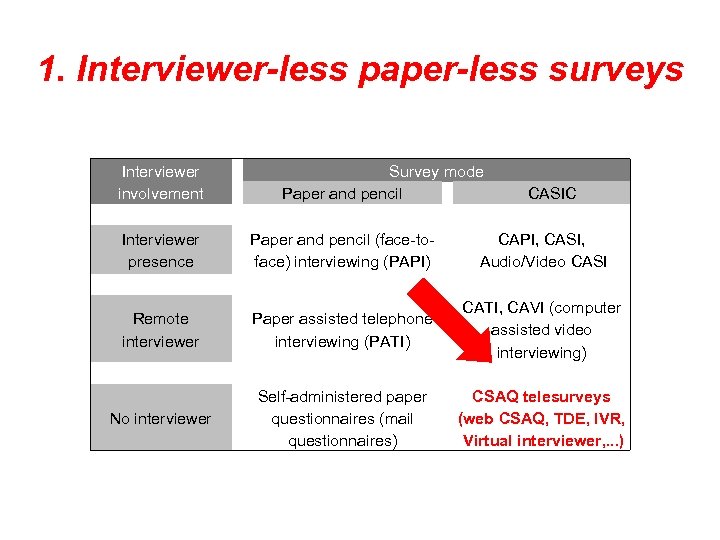 1. Interviewer-less paper-less surveys Interviewer involvement Survey mode Paper and pencil CASIC Interviewer presence Paper and pencil (face-toface) interviewing (PAPI) CAPI, CASI, Audio/Video CASI Remote interviewer Paper assisted telephone interviewing (PATI) CATI, CAVI (computer assisted video interviewing) No interviewer Self-administered paper questionnaires (mail questionnaires) CSAQ telesurveys (web CSAQ, TDE, IVR, Virtual interviewer, . . . )
 2. The art of non-probability samples “Quota sampling is difficult to discuss precisely, because it is not a scientific method with precise definition. It is more of an art practiced widely with very different skills and diverse successes by many people in different places. There exist no textbooks on the subject to which we can refer to base our discussion. This alone should be a warning signal. ” Leslie Kish on quota sampling, 1993
 3. Mixing of the survey modes With mixing modes we hope to: 1. increase response and/or coverage rates (and thus lower the corresponding biases): • “sharper” follow-up mode may convert the non-respondents (e. g. unsuccessful mail attempt is followed with telephone one); • additional frame may increase the coverage of the target population (e. g. mobile phone combined with face-to-face); 2. lower the costs (e. g. web, TDM mail)
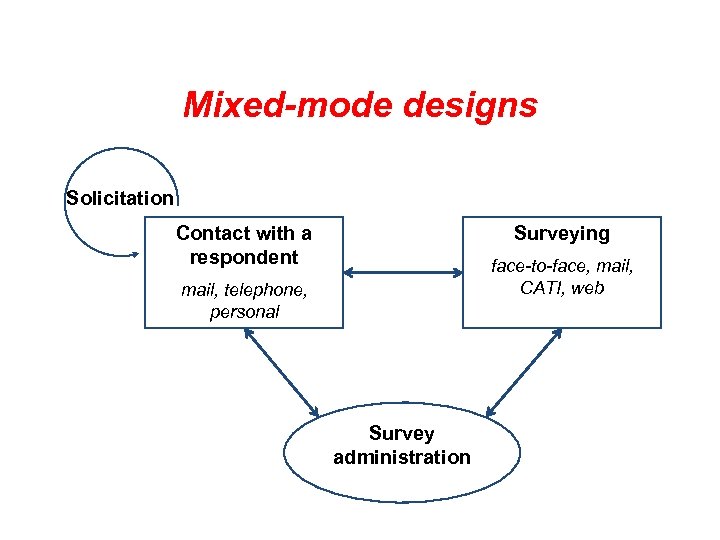 Mixed-mode designs Solicitation Contact with a respondent Surveying face-to-face, mail, CATI, web mail, telephone, personal Survey administration
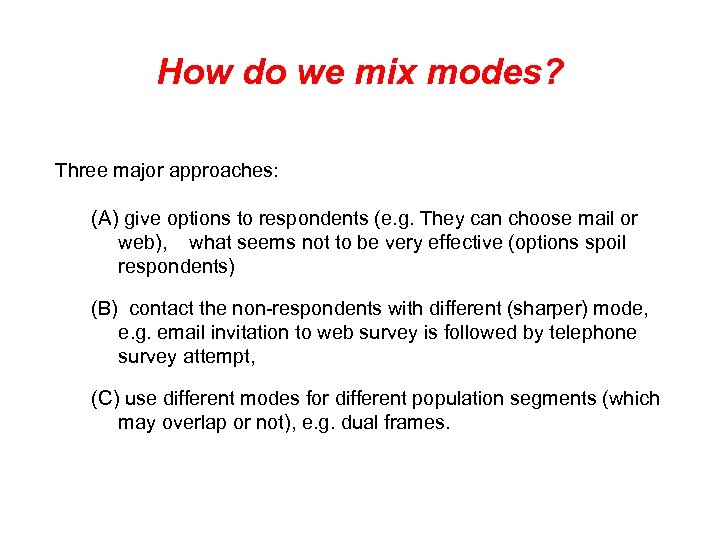 How do we mix modes? Three major approaches: (A) give options to respondents (e. g. They can choose mail or web), what seems not to be very effective (options spoil respondents) (B) contact the non-respondents with different (sharper) mode, e. g. email invitation to web survey is followed by telephone survey attempt, (C) use different modes for different population segments (which may overlap or not), e. g. dual frames.
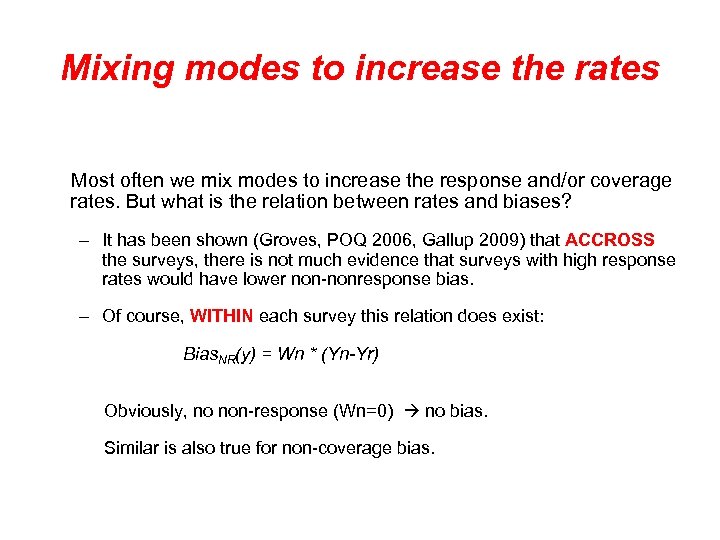 Mixing modes to increase the rates Most often we mix modes to increase the response and/or coverage rates. But what is the relation between rates and biases? – It has been shown (Groves, POQ 2006, Gallup 2009) that ACCROSS the surveys, there is not much evidence that surveys with high response rates would have lower non-nonresponse bias. – Of course, WITHIN each survey this relation does exist: Bias. NR(y) = Wn * (Yn-Yr) Obviously, no non-response (Wn=0) no bias. Similar is also true for non-coverage bias.
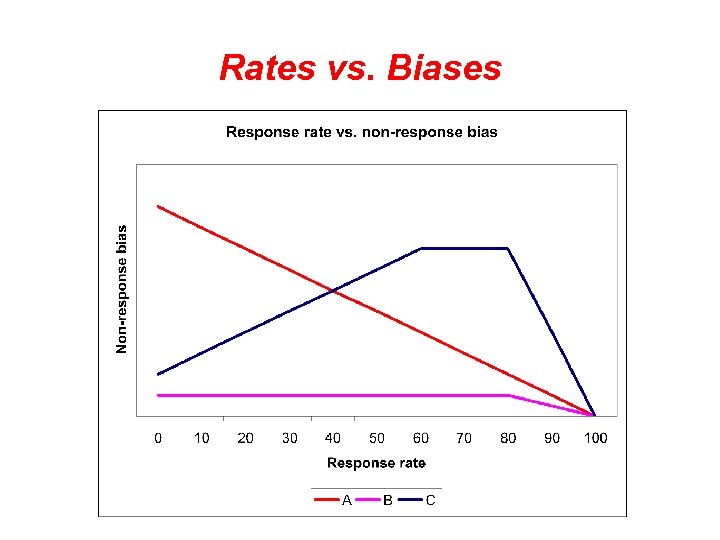 Rates vs. Biases
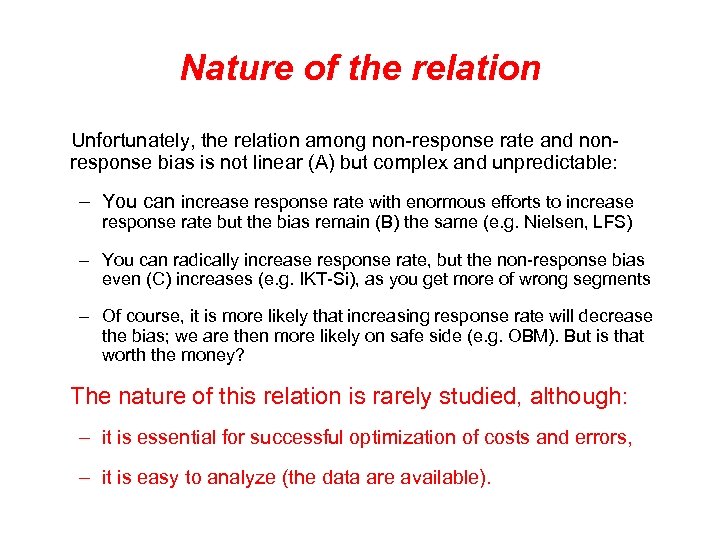 Nature of the relation Unfortunately, the relation among non-response rate and nonresponse bias is not linear (A) but complex and unpredictable: – You can increase response rate with enormous efforts to increase response rate but the bias remain (B) the same (e. g. Nielsen, LFS) – You can radically increase response rate, but the non-response bias even (C) increases (e. g. IKT-Si), as you get more of wrong segments – Of course, it is more likely that increasing response rate will decrease the bias; we are then more likely on safe side (e. g. OBM). But is that worth the money? The nature of this relation is rarely studied, although: – it is essential for successful optimization of costs and errors, – it is easy to analyze (the data are available).
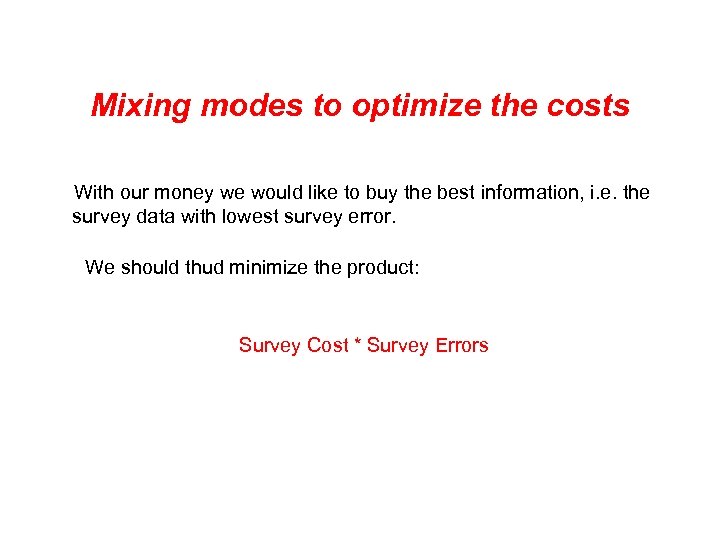 Mixing modes to optimize the costs With our money we would like to buy the best information, i. e. the survey data with lowest survey error. We should thud minimize the product: Survey Cost * Survey Errors
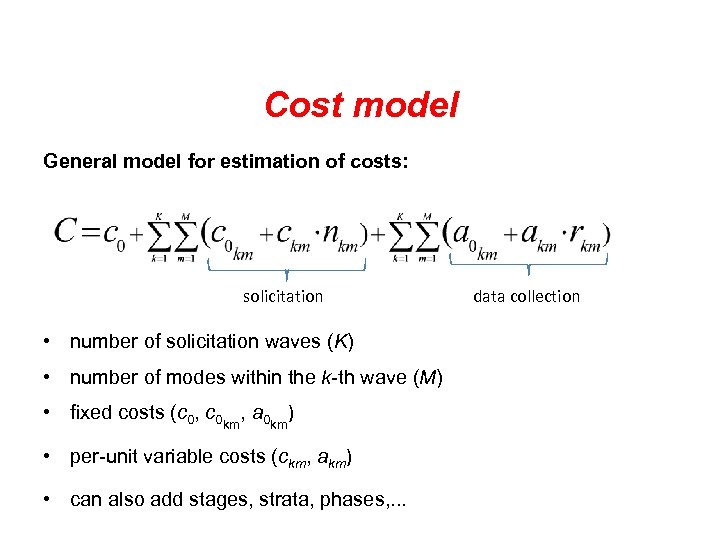 Cost model General model for estimation of costs: solicitation • number of solicitation waves (K) • number of modes within the k-th wave (M) • fixed costs (c 0, c 0 km, a 0 km) • per-unit variable costs (ckm, akm) • can also add stages, strata, phases, . . . data collection
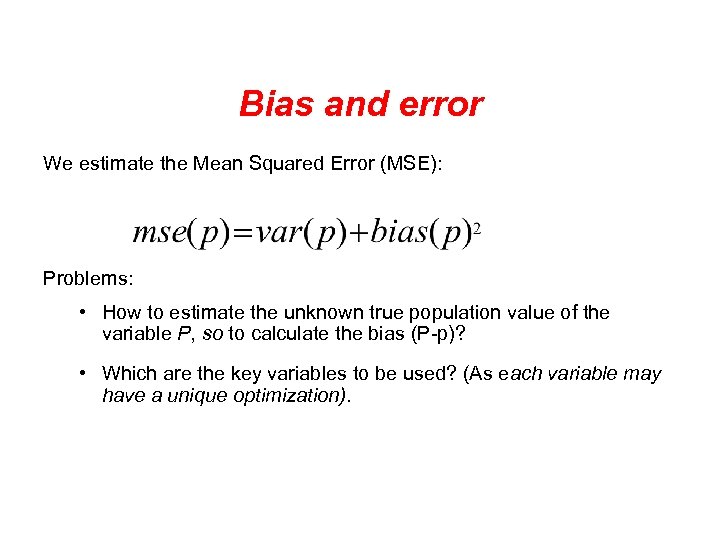 Bias and error We estimate the Mean Squared Error (MSE): Problems: • How to estimate the unknown true population value of the variable P, so to calculate the bias (P-p)? • Which are the key variables to be used? (As each variable may have a unique optimization).
 Approaches to the problem • Analytical solutions for optimization • Simulation studies • Web application (!) • Case study
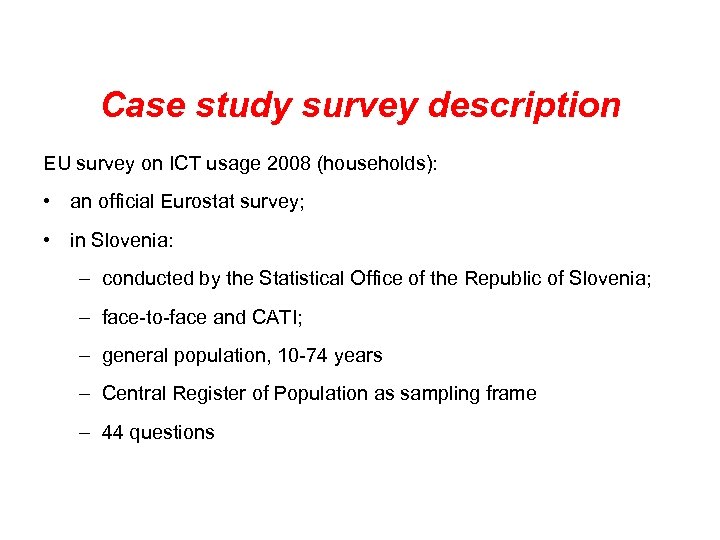 Case study survey description EU survey on ICT usage 2008 (households): • an official Eurostat survey; • in Slovenia: – conducted by the Statistical Office of the Republic of Slovenia; – face-to-face and CATI; – general population, 10 -74 years – Central Register of Population as sampling frame – 44 questions
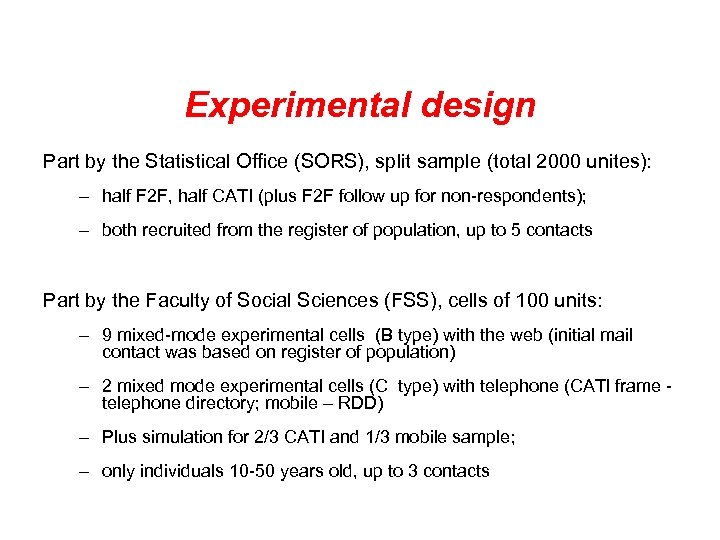 Experimental design Part by the Statistical Office (SORS), split sample (total 2000 unites): – half F 2 F, half CATI (plus F 2 F follow up for non-respondents); – both recruited from the register of population, up to 5 contacts Part by the Faculty of Social Sciences (FSS), cells of 100 units: – 9 mixed-mode experimental cells (B type) with the web (initial mail contact was based on register of population) – 2 mixed mode experimental cells (C type) with telephone (CATI frame telephone directory; mobile – RDD) – Plus simulation for 2/3 CATI and 1/3 mobile sample; – only individuals 10 -50 years old, up to 3 contacts
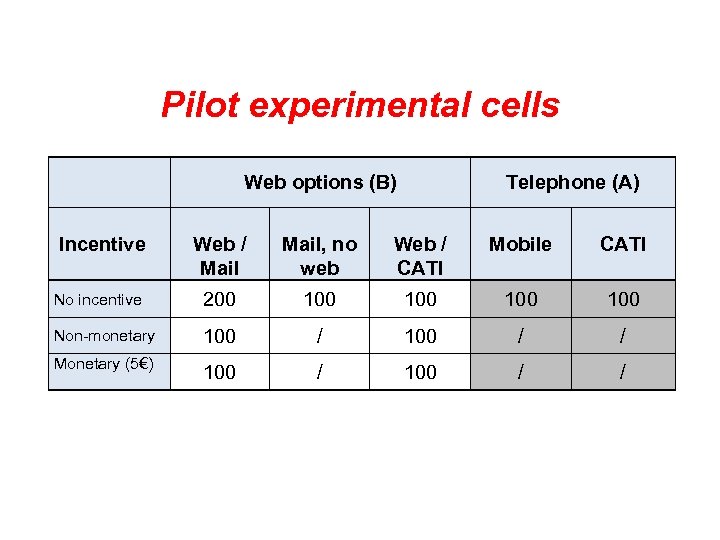 Pilot experimental cells Web options (B) Telephone (A) Web / Mail, no web Web / CATI Mobile CATI No incentive 200 100 100 Non-monetary 100 / / Monetary (5€) 100 / / Incentive
 Comparisons We analyzed all cells for fixed (equal) effective sample sizes (n=1000). We used the parameters from real data to recalculate the figures. We present here only the variable AGE. .
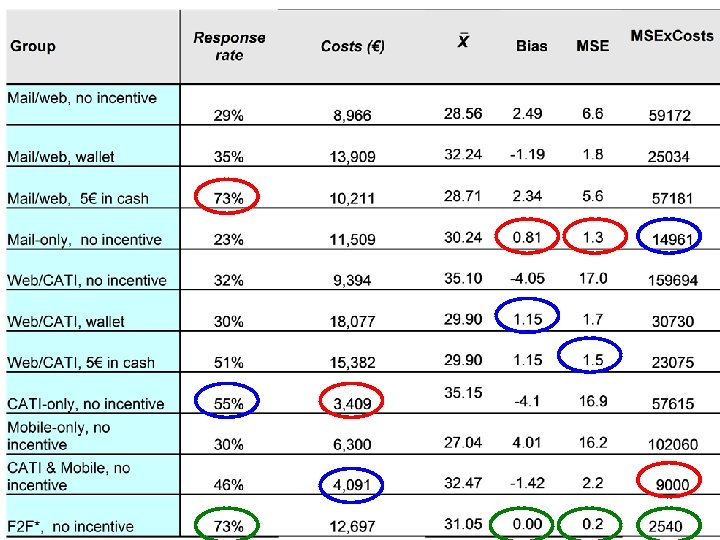
 Summary 1. 2. 3. 4. 5. Are we explicit what we optimize? Response rates? Costs? Biases? MSEs? Or we truly optimize product MSE*Costs? Cost-error issues in mixed mode surveys are very complex to process intuitively. Each variable may behave differently. There is no general solution for our specific cost-error problem; there are only some general principles. We need more analysis of our past costs and biases. We need more experiments for better decisions in the future. It is very hard to beat the face-to-face option (bias dominates!). Can probability based panels, with a lot of incentives, using mixed modes (predominantly web) provide optimal cost-error solution? In Netherlands (i. e. the LISS panel) they are already close to 50% response rates and around 1€ per minute of responding time.
 More http: //Web. SM. org