


 Скачать презентацию Optimization of Swimming Performance Emotion- Action-Centered Approaches
3b96ca7e8ee37b5da4439ff58d611a99.ppt
- Количество слайдов: 48
 Optimization of Swimming Performance Emotion- & Action-Centered Approaches Juri Hanin & Muza Hanina (juri. hanin@kihu. fi) Research Institute for Olympic Sports, Jyväskylä, Finland Swimming Coaches’ Seminar 28. 12. 2011 Riga, Lavia 3/18/2018 1
 Исследования и консультирование Спортсмены, тренеры, команды: n 1967 - 1990 - в России - 4 Oлимпиады n 1991 - 2011 - в Финляндии - 8 Oлимпиад Основные виды спорта: n командные: хоккей, футбол, волейбол, гребля n индивидуальные: л/атлетика, плавание. прыжки в воду, cтрельба, bowling, гольф, sailing, лыжи, фиг воду, cтрельба -катание, гимнастика, oриентирование, теннис, etc.
 Спортивная психология - тенденции в прошлом 1. Акцент на проблемах: § стресс-реакции § тревога § мертвая точка § коррекция недостатков 2. Групповые сравнения: § акцент на средних, успешных и неуспешных, § игнорирование внутриинд. динамики
 Спортивная психология сейчас 1. Акцент на позитивном: § § § выявление инд. ресурсов (strengths) использование стресса оптимизация деятельности 2. Главный акцент на индивиде: § индивидуально лучший уровень § стабильность и внутри-инд. динамика * Hanin, 2000, 2003
 Психологическая подготовка - систематическое использование психологических процессов чтобы влиять на мысли, эмоции, мотивацию, поведение, действия, и общение спортсмена (или команды) в специфическом контексте. * Hanin, 1997
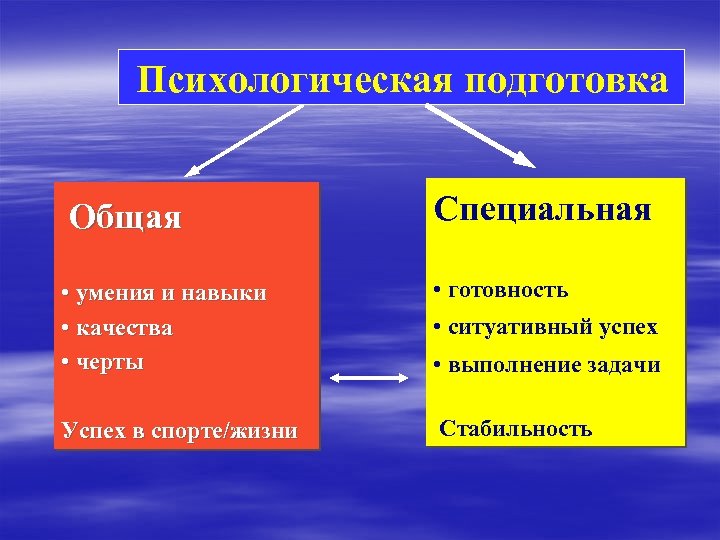 Психологическая подготовка Общая Специальная • умения и навыки • качества • черты Успех в спорте/жизни • готовность • ситуативный успех • выполнение задачи Стабильность
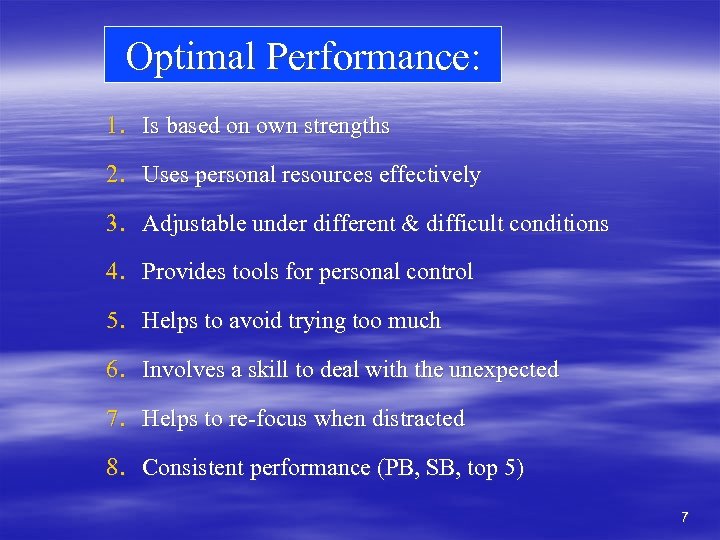 Optimal Performance: 1. Is based on own strengths 2. Uses personal resources effectively 3. Adjustable under different & difficult conditions 4. Provides tools for personal control 5. Helps to avoid trying too much 6. Involves a skill to deal with the unexpected 7. Helps to re-focus when distracted 8. Consistent performance (PB, SB, top 5) 7
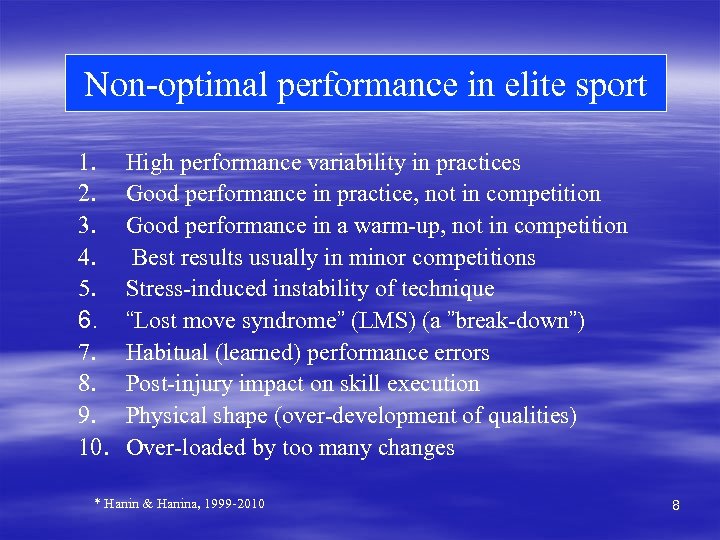 Non-optimal performance in elite sport 1. 2. 3. 4. 5. 6. 7. 8. 9. 10. High performance variability in practices Good performance in practice, not in competition Good performance in a warm-up, not in competition Best results usually in minor competitions Stress-induced instability of technique “Lost move syndrome” (LMS) (a ”break-down”) Habitual (learned) performance errors Post-injury impact on skill execution Physical shape (over-development of qualities) Over-loaded by too many changes * Hanin & Hanina, 1999 -2010 8
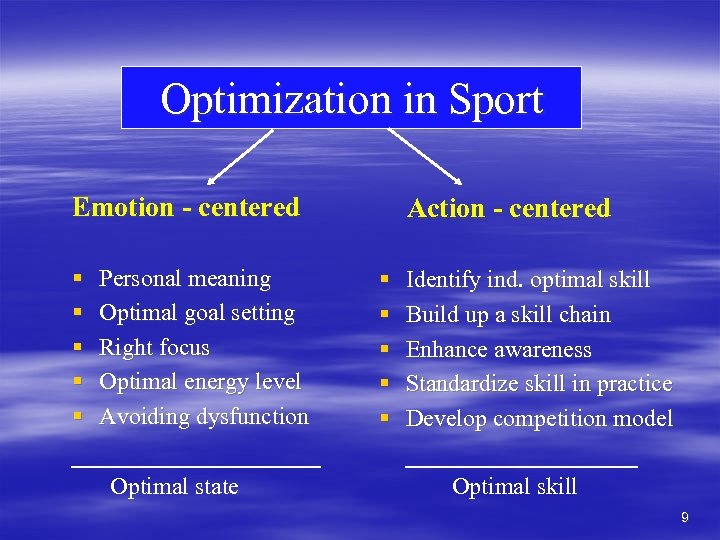 Optimization in Sport Emotion - centered Action - centered § § § § § Personal meaning Optimal goal setting Right focus Optimal energy level Avoiding dysfunction Optimal state Identify ind. optimal skill Build up a skill chain Enhance awareness Standardize skill in practice Develop competition model Optimal skill 9
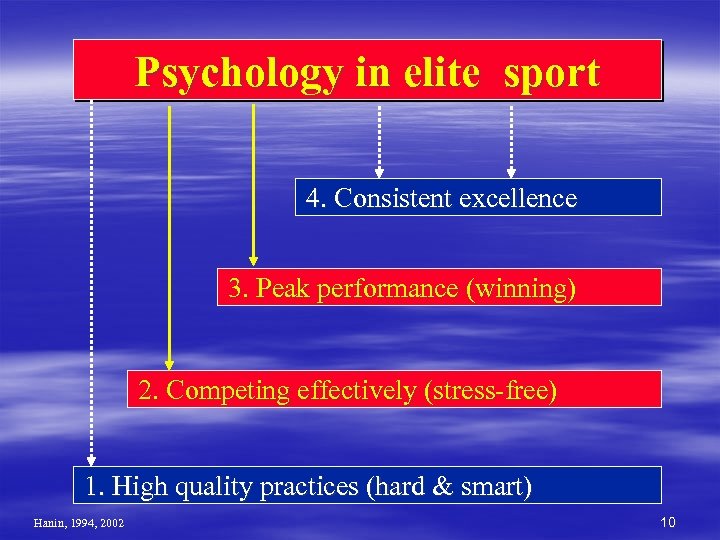 Psychology in elite sport 4. Consistent excellence 3. Peak performance (winning) 2. Competing effectively (stress-free) 1. High quality practices (hard & smart) Hanin, 1994, 2002 10
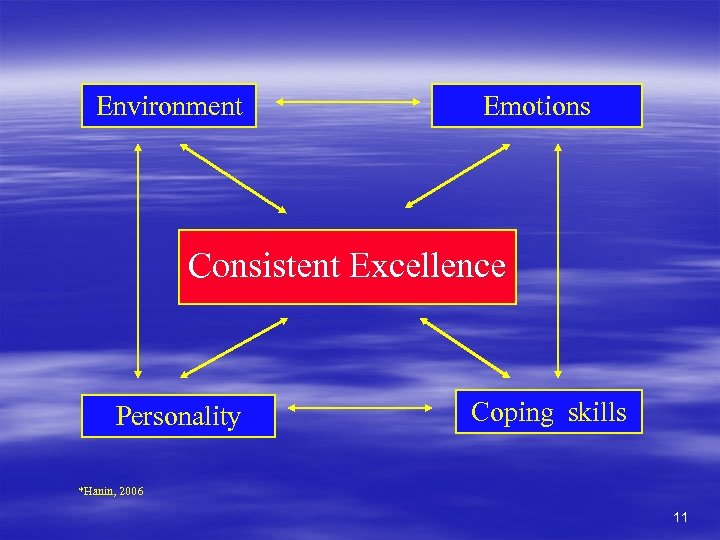 Environment Emotions Consistent Excellence Personality Coping skills *Hanin, 2006 11
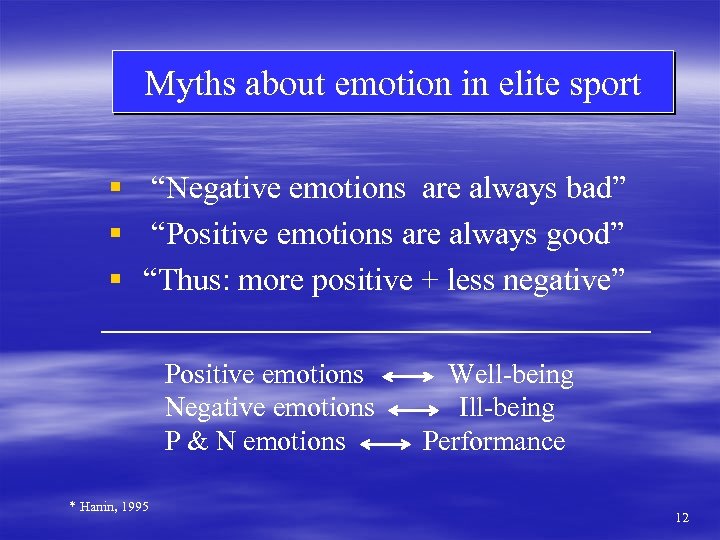 Myths about emotion in elite sport § “Negative emotions are always bad” § “Positive emotions are always good” § “Thus: more positive + less negative” Positive emotions Well-being Negative emotions Ill-being P & N emotions Performance * Hanin, 1995 12
 Emotion-centered Coping § To prevent overreaction to competitve stress § To reinforce situational success § To deal with unexpected distractions § To get ”psyched up” & mobilized § To calm down after unexpected success § To calm down after situational failure § To deal with potential problems 13
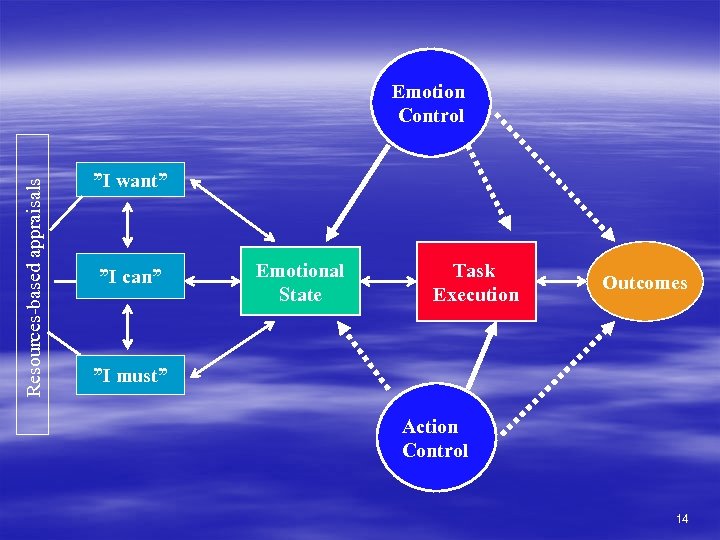 Resources-based appraisals Emotion Control ”I want” ”I can” Emotional State Task Execution Outcomes ”I must” Action Control 14
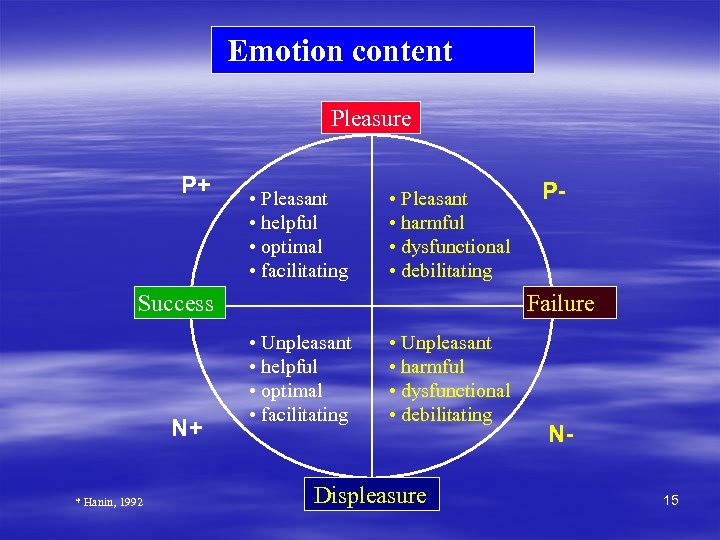 Emotion content Pleasure P+ • Pleasant • helpful • optimal • facilitating • Pleasant • harmful • dysfunctional • debilitating Success N+ * Hanin, 1992 P- Failure • Unpleasant • helpful • optimal • facilitating • Unpleasant • harmful • dysfunctional • debilitating Displeasure N 15
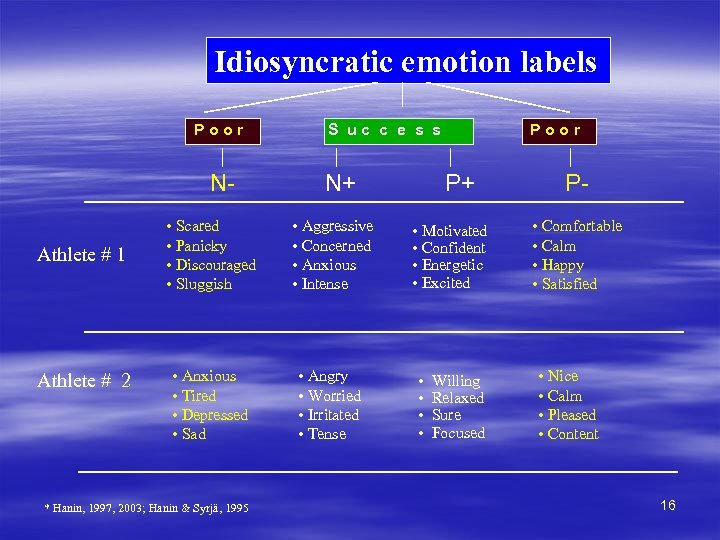 Idiosyncratic emotion labels Poor NAthlete # 1 Athlete # 2 S uc c e s s N+ Poor P+ • Scared • Panicky • Discouraged • Sluggish • Aggressive • Concerned • Anxious • Intense • Motivated • Confident • Energetic • Excited • Anxious • Tired • Depressed • Sad • Angry • Worried • Irritated • Tense • Willing • Relaxed • Sure • Focused * Hanin, 1997, 2003; Hanin & Syrjä, 1995 P • Comfortable • Calm • Happy • Satisfied • Nice • Calm • Pleased • Content 16
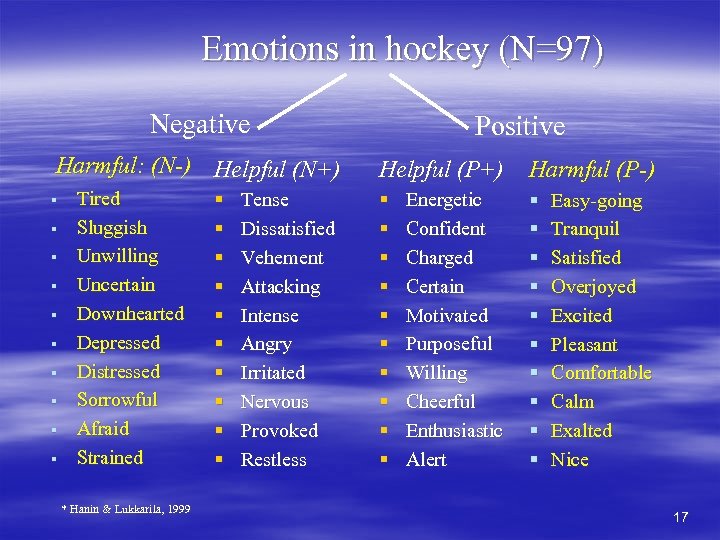 Emotions in hockey (N=97) Negative Harmful: (N-) Helpful (N+) § § § § § Tired Sluggish Unwilling Uncertain Downhearted Depressed Distressed Sorrowful Afraid Strained * Hanin & Lukkarila, 1999 § § § § § Tense Dissatisfied Vehement Attacking Intense Angry Irritated Nervous Provoked Restless Positive Helpful (P+) Harmful (P-) § § § § § Energetic Confident Charged Certain Motivated Purposeful Willing Cheerful Enthusiastic Alert Easy-going Tranquil Satisfied Overjoyed Excited Pleasant Comfortable Calm Exalted Nice 17
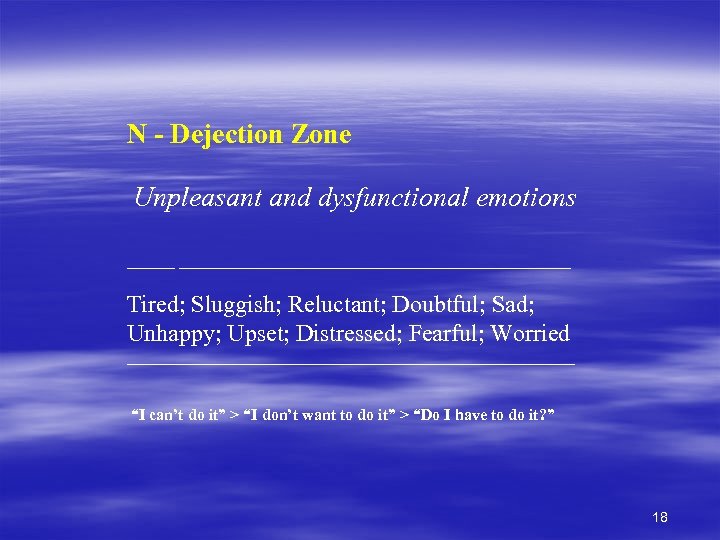 N - Dejection Zone Unpleasant and dysfunctional emotions ____________________________ Tired; Sluggish; Reluctant; Doubtful; Sad; Unhappy; Upset; Distressed; Fearful; Worried ____________________________ “I can’t do it” > “I don’t want to do it” > “Do I have to do it? ” 18
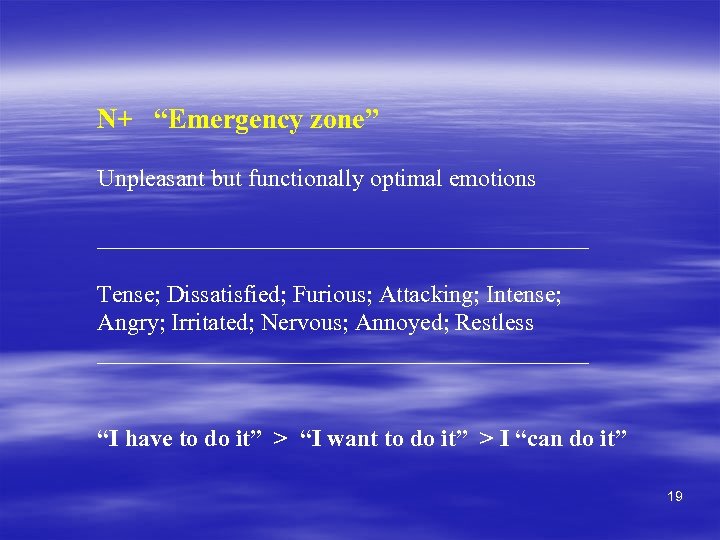 N+ “Emergency zone” Unpleasant but functionally optimal emotions _____________________ Tense; Dissatisfied; Furious; Attacking; Intense; Angry; Irritated; Nervous; Annoyed; Restless _____________________ “I have to do it” > “I want to do it” > I “can do it” 19
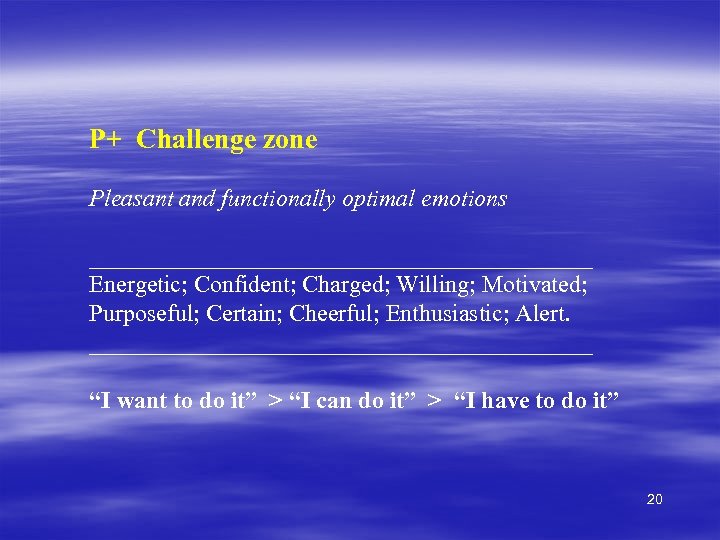 P+ Challenge zone Pleasant and functionally optimal emotions _____________________ Energetic; Confident; Charged; Willing; Motivated; Purposeful; Certain; Cheerful; Enthusiastic; Alert. _____________________ “I want to do it” > “I can do it” > “I have to do it” 20
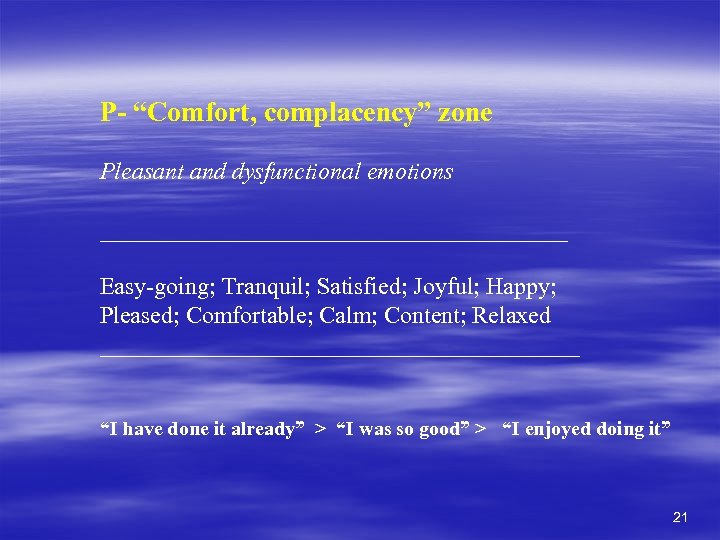 P- “Comfort, complacency” zone Pleasant and dysfunctional emotions ____________________ Easy-going; Tranquil; Satisfied; Joyful; Happy; Pleased; Comfortable; Calm; Content; Relaxed ____________________ “I have done it already” > “I was so good” > “I enjoyed doing it” 21
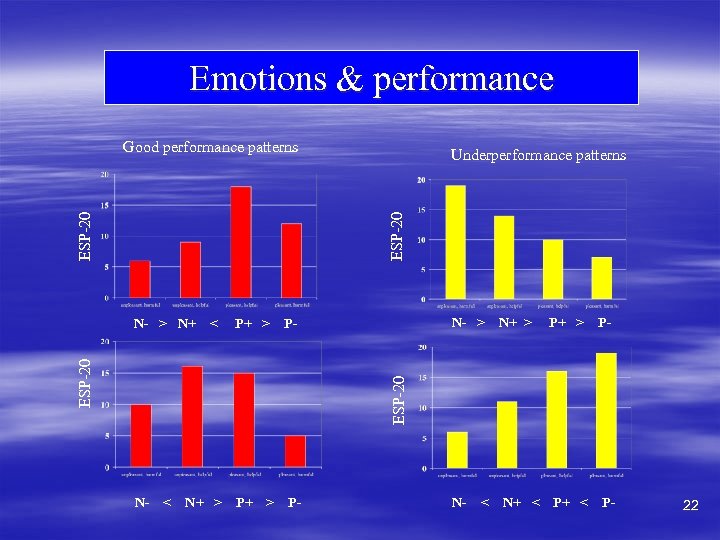 Emotions & performance Underperformance patterns ESP-20 Good performance patterns N- > N+ > P+ > P- ESP-20 N- > N+ < P+ > P- N- < N+ < P- 22
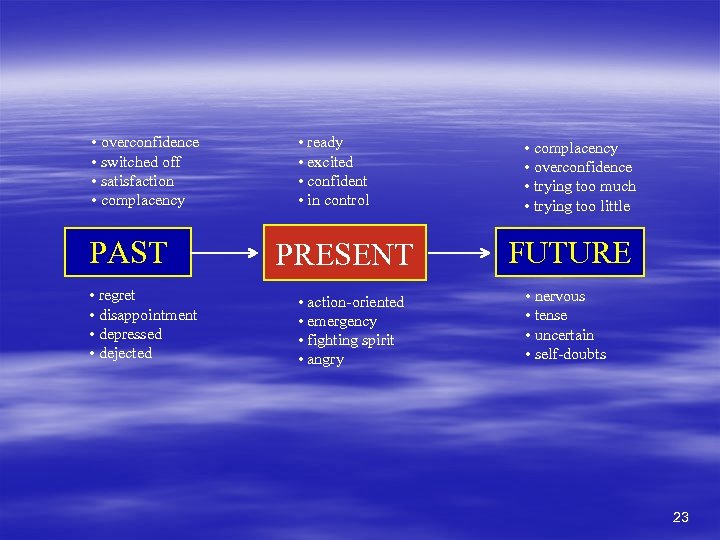 • overconfidence • switched off • satisfaction • complacency PAST • regret • disappointment • depressed • dejected • ready • excited • confident • in control PRESENT • action-oriented • emergency • fighting spirit • angry • complacency • overconfidence • trying too much • trying too little FUTURE • nervous • tense • uncertain • self-doubts 23
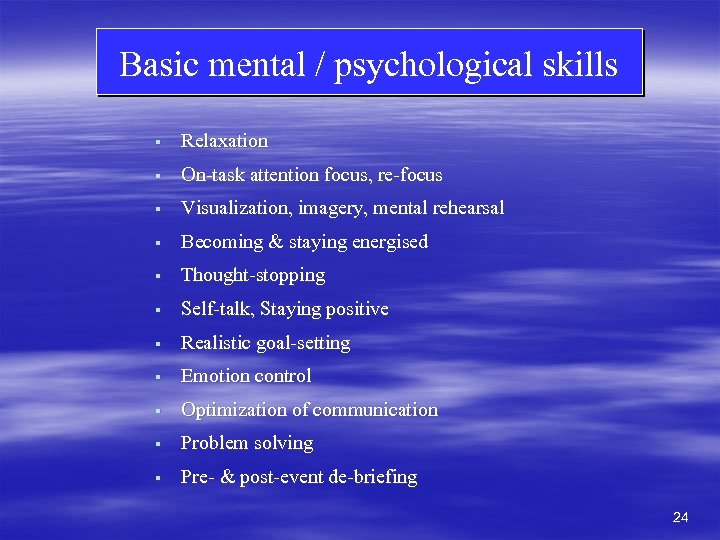 Basic mental / psychological skills § Relaxation § On-task attention focus, re-focus § Visualization, imagery, mental rehearsal § Becoming & staying energised § Thought-stopping § Self-talk, Staying positive § Realistic goal-setting § Emotion control § Optimization of communication § Problem solving § Pre- & post-event de-briefing 24
 The Need for Action-centered Coping § § § § Underperformance in major competitions Unexpected skill breakdown ”Lost move” syndrome Physical shape (too much, too little) Habitual performance errors under stress Change-induced problems with technique ”New ideas” from outside 25
 Athletes’ typical comments: § § § § § I don’t know why it happened… I was in my best ever shape… Something happened to my technique… My technique just ”vanished” Whatever I tried, it did not help… I tried too much… My focus was not clear… I was distracted by unimportnat details… I was over-arouzed… 26
 Typical emotional response to problems in technique § § § Disappointment, frustration, Self-doubts, low self-confidence Drop in motivation, helplessness Fears, panick Questioning selected program Relationships problems (coach, team) 27
 The Identfication-Control-Correction (ICC)-program § § § Motor task as a movement sequence/”chain” Key components in the ”chain” Functional links between these components Subjective perception of ”chain” components Enhancing awareness of ”chain” components Using key components to enhance self-control * Hanina & Hanin, 2002 -08 28
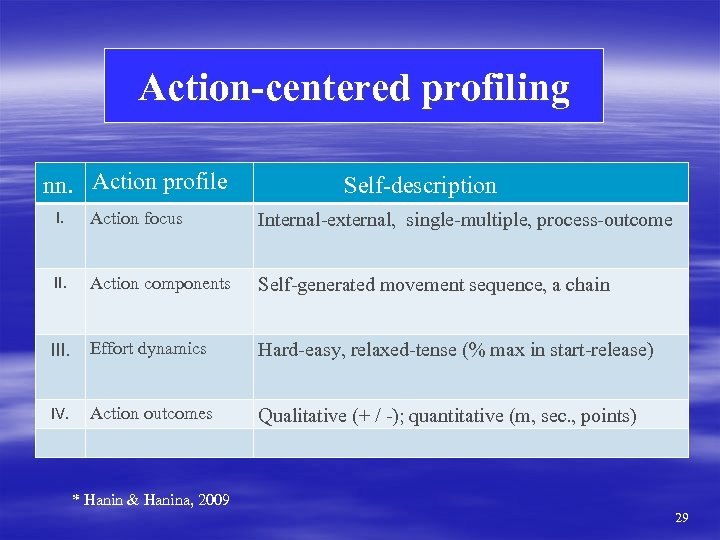 Action-centered profiling nn. Action profile Self-description I. Action focus Internal-external, single-multiple, process-outcome II. Action components Self-generated movement sequence, a chain III. Effort dynamics Hard-easy, relaxed-tense (% max in start-release) IV. Action outcomes Qualitative (+ / -); quantitative (m, sec. , points) * Hanin & Hanina, 2009 29
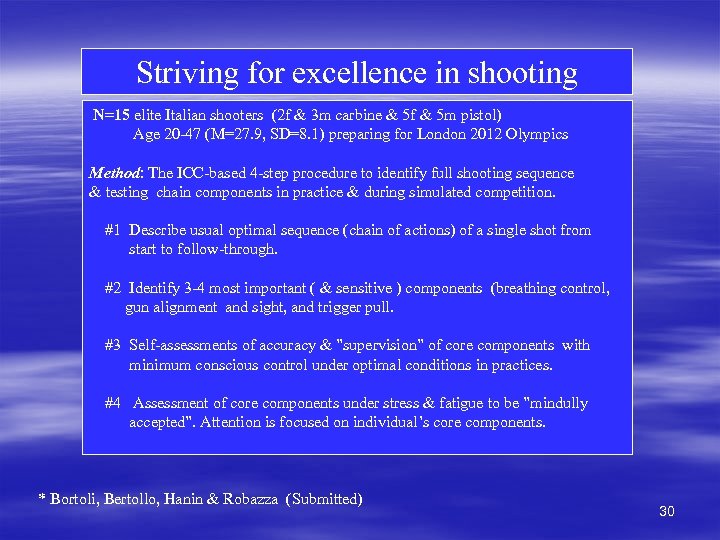 Striving for excellence in shooting N=15 elite Italian shooters (2 f & 3 m carbine & 5 f & 5 m pistol) Age 20 -47 (M=27. 9, SD=8. 1) preparing for London 2012 Olympics Method: The ICC-based 4 -step procedure to identify full shooting sequence & testing chain components in practice & during simulated competition. #1 Describe usual optimal sequence (chain of actions) of a single shot from start to follow-through. #2 Identify 3 -4 most important ( & sensitive ) components (breathing control, gun alignment and sight, and trigger pull. #3 Self-assessments of accuracy & ”supervision” of core components with minimum conscious control under optimal conditions in practices. #4 Assessment of core components under stress & fatigue to be ”mindully accepted”. Attention is focused on individual’s core components. * Bortoli, Bertollo, Hanin & Robazza (Submitted) 30
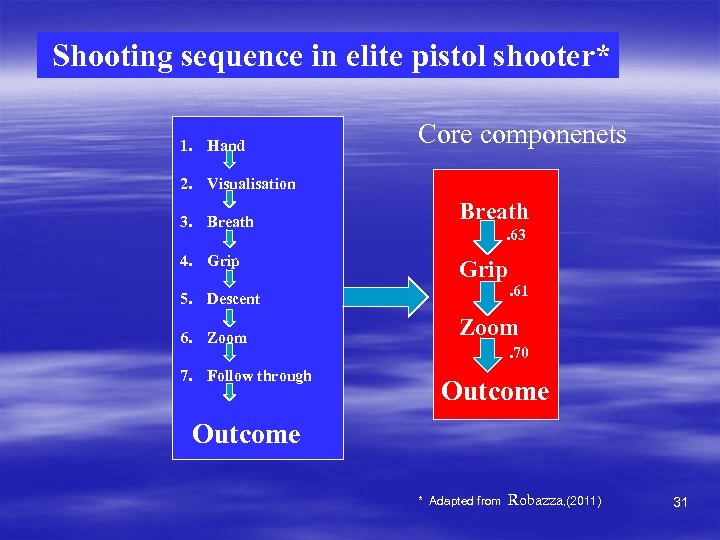 Shooting sequence in elite pistol shooter* 1. Hand Core componenets 2. Visualisation 3. Breath 4. Grip Breath. 63 Grip 5. Descent 6. Zoom 7. Follow through . 61 Zoom. 70 Outcome * Adapted from Robazza, (2011) 31
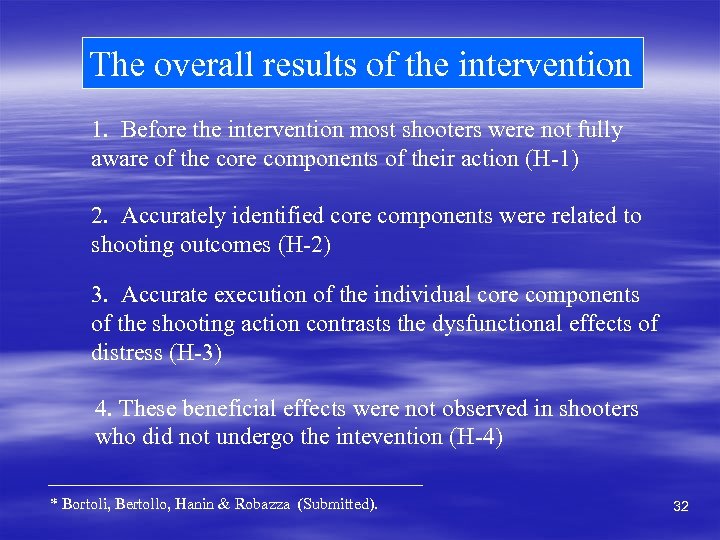 The overall results of the intervention 1. Before the intervention most shooters were not fully aware of the core components of their action (H-1) 2. Accurately identified core components were related to shooting outcomes (H-2) 3. Accurate execution of the individual core components of the shooting action contrasts the dysfunctional effects of distress (H-3) 4. These beneficial effects were not observed in shooters who did not undergo the intevention (H-4) * Bortoli, Bertollo, Hanin & Robazza (Submitted). 32
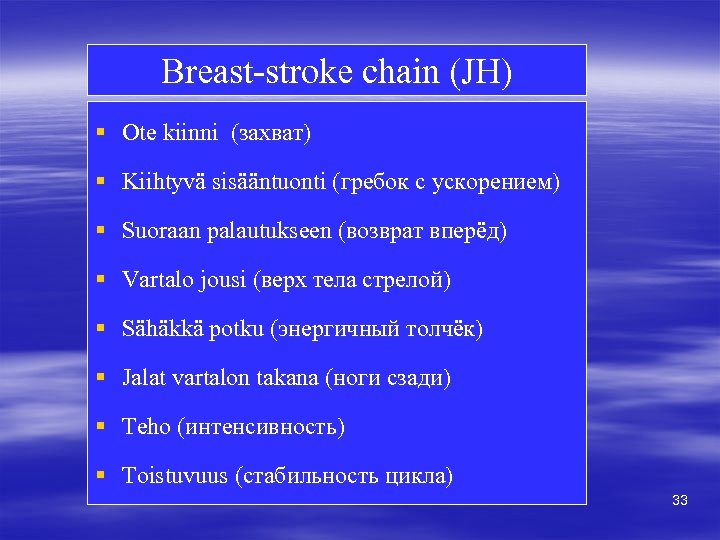 Breast-stroke chain (JH) § Ote kiinni (захват) § Kiihtyvä sisääntuonti (гребок с ускорением) § Suoraan palautukseen (возврат вперёд) § Vartalo jousi (верх тела стрелой) § Sähäkkä potku (энергичный толчёк) § Jalat vartalon takana (ноги сзади) § Teho (интенсивность) § Toistuvuus (стабильность цикла) 33
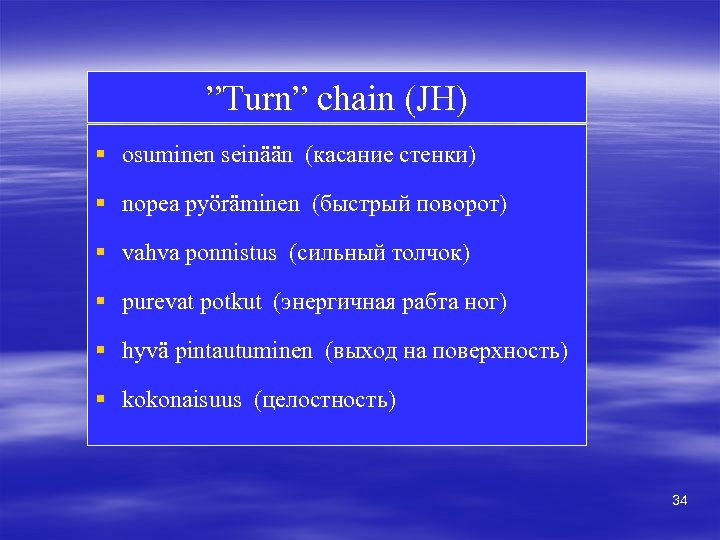 ”Turn” chain (JH) § osuminen seinään (касание стенки) § nopea pyöräminen (быстрый поворот) § vahva ponnistus (сильный толчок) § purevat potkut (энергичная рабта ног) § hyvä pintautuminen (выход на поверхность) § kokonaisuus (целостность) 34
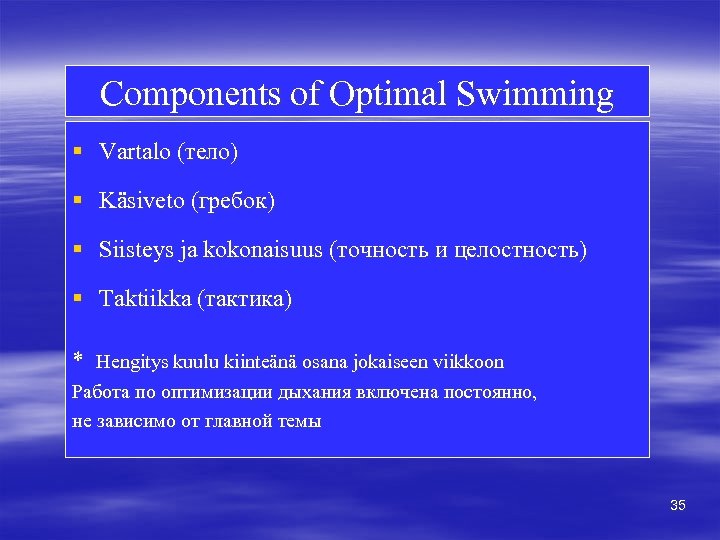 Components of Optimal Swimming § Vartalo (тело) § Käsiveto (гребок) § Siisteys ja kokonaisuus (точность и целостность) § Taktiikka (тактика) * Hengitys kuulu kiinteänä osana jokaiseen viikkoon Работа по оптимизации дыхания включена постоянно, не зависимо от главной темы 35
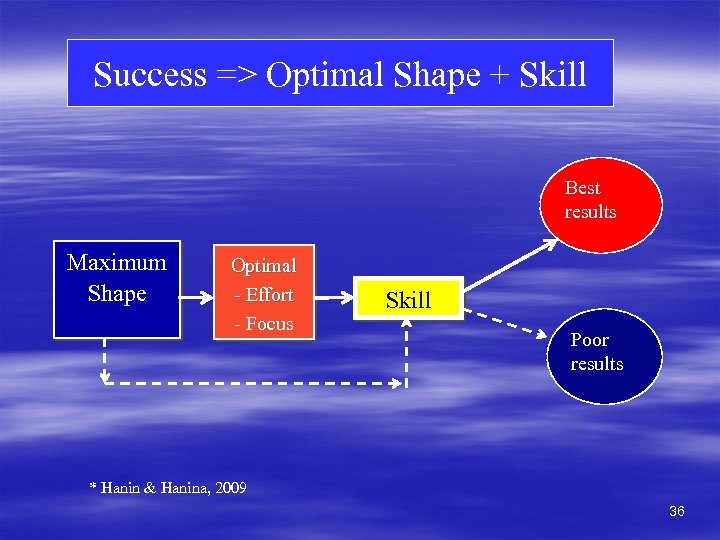 Success => Optimal Shape + Skill Best results Maximum Shape Optimal - Effort - Focus Skill Poor results * Hanin & Hanina, 2009 36
 Performance Errors a mistake, or inaccuracy, or incorrectness (in action, activity) the condition of deviating from accuracy, correctness, or some standard of a task execution (Collins English Dictionary. 3 rd Ed. , 1991, p. 528)
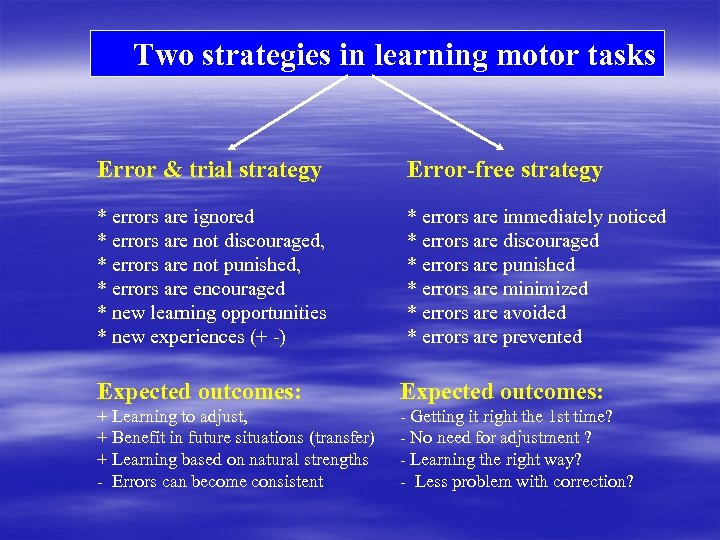 Two strategies in learning motor tasks Error & trial strategy Error-free strategy * errors are ignored * errors are not discouraged, * errors are not punished, * errors are encouraged * new learning opportunities * new experiences (+ -) * errors are immediately noticed * errors are discouraged * errors are punished * errors are minimized * errors are avoided * errors are prevented Expected outcomes: + Learning to adjust, + Benefit in future situations (transfer) + Learning based on natural strengths - Errors can become consistent - Getting it right the 1 st time? - No need for adjustment ? - Learning the right way? - Less problem with correction?
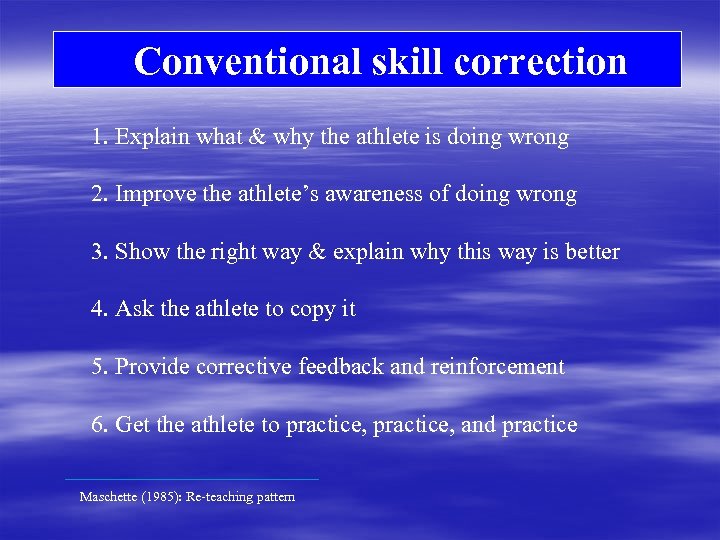 Conventional skill correction 1. Explain what & why the athlete is doing wrong 2. Improve the athlete’s awareness of doing wrong 3. Show the right way & explain why this way is better 4. Ask the athlete to copy it 5. Provide corrective feedback and reinforcement 6. Get the athlete to practice, and practice Maschette (1985): Re-teaching pattern
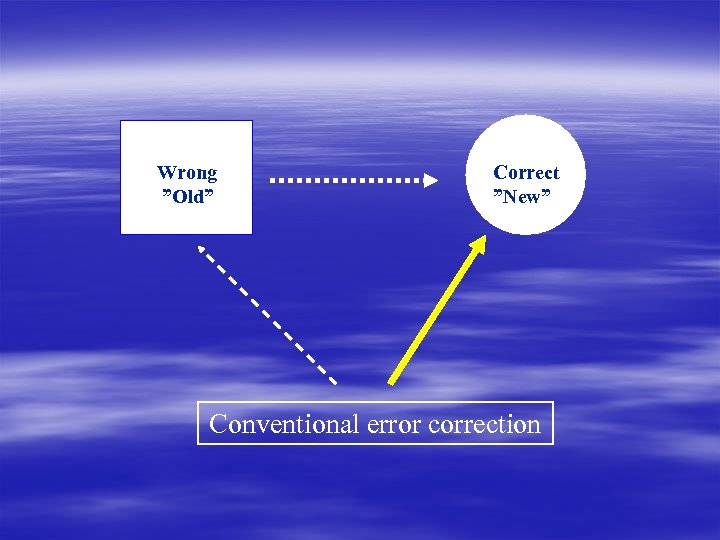 Wrong ”Old” Correct ”New” Conventional error correction
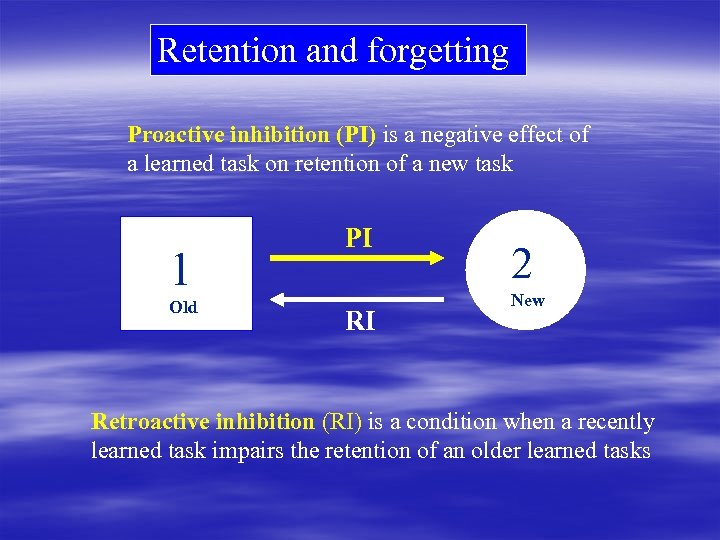 Retention and forgetting Proactive inhibition (PI) is a negative effect of a learned task on retention of a new task 1 Old PI RI 2 New Retroactive inhibition (RI) is a condition when a recently learned task impairs the retention of an older learned tasks
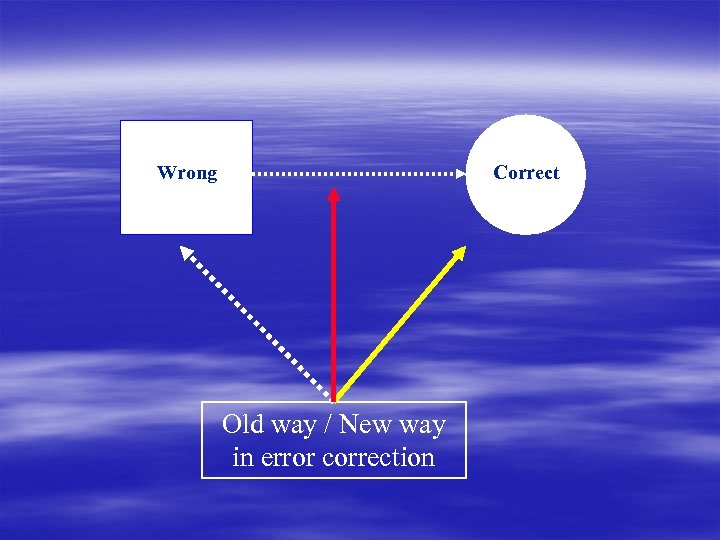 Wrong Correct Old way / New way in error correction
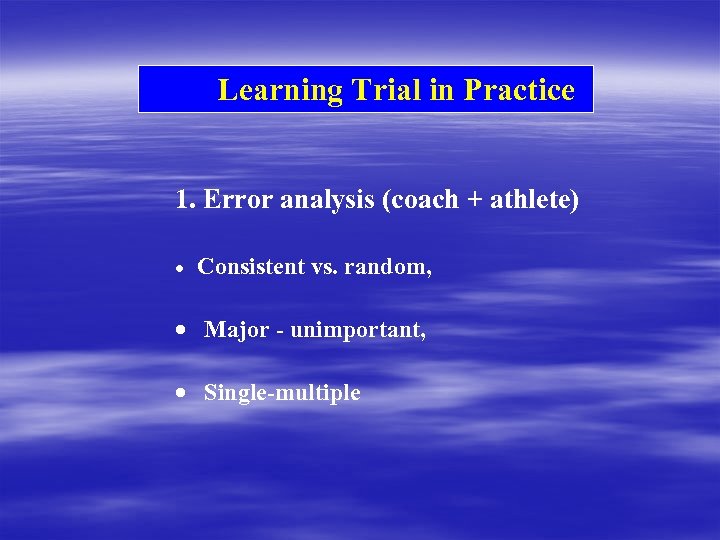 Learning Trial in Practice 1. Error analysis (coach + athlete) · Consistent vs. random, · Major - unimportant, · Single-multiple
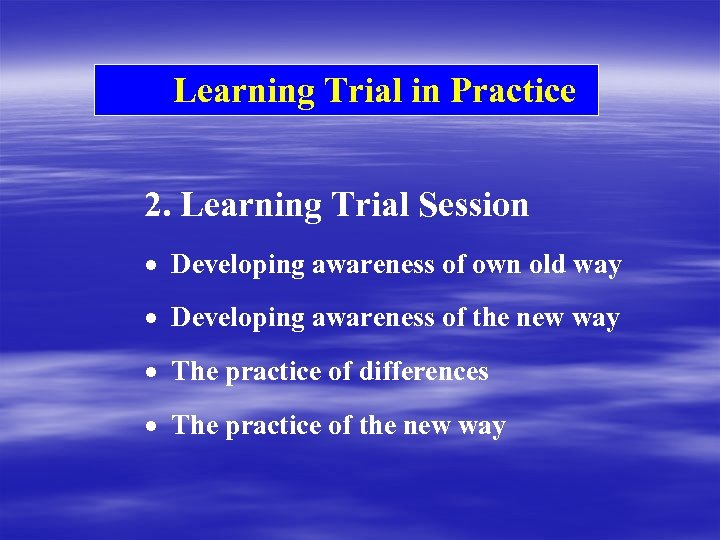 Learning Trial in Practice 2. Learning Trial Session · Developing awareness of own old way · Developing awareness of the new way · The practice of differences · The practice of the new way
 Learning Trial in Practice 3. Summary + home work · Explaining mechanisms · Expected results · Handling spontaneous recovery
 Extended intervention procedure: § Error identification from best-worst performances § Old Way as an erroneous movement pattern § Causes & effects of the Old Way are identified § New Way as an individually optimal movement pattern § Learning Trial (LT) for a rapid & permanent change § Post-LT standardization & stabilization of a New Way
 The ICC applications (2002 -11): 1. 2. 3. 4. 5. 6. 7. 8. 9. 10. 11. 12. Running (100 m, 400 m) Jumping (high, long, pole-vault) Throwing (javelin, hammer, shot-put) Swimming (starts, breast-stroke) Diving (1 m & 3 m springboard) Volley-ball (ball reception) Soccer (free kick) Pistol & rifle shooting Car-racing (F-1; DBT; FPA) Sailing Bowling Free-style skiing 47
 Ведущая проблематика 1. Психологическая подготовка 2. Стресс и тревога 3. Решение проблемных ситуаций 4. Оптимизация эмоциональных состояний 5. Прогнозирование деятельности 6. Анализ выступлений 7. Оптимизация деятельности 8. Коррекция ошибок 9. Межличное общение игроков и тренеров 10. Тренер как руководитель и лидер 11. Карьера игроков и тренеров 12. Клуб и сборная