


 Скачать презентацию Optimization of intrusion detection systems for wireless sensor
7d8315744fd84cc288af7339f7bebba7.ppt
- Количество слайдов: 20
 Optimization of intrusion detection systems for wireless sensor networks using evolutionary algorithms Martin Stehlík Faculty of Informatics Masaryk University Brno
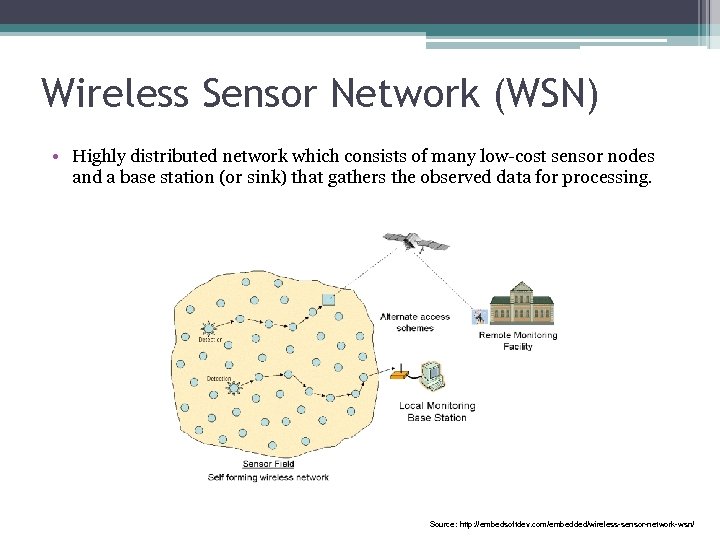 Wireless Sensor Network (WSN) • Highly distributed network which consists of many low-cost sensor nodes and a base station (or sink) that gathers the observed data for processing. Source: http: //embedsoftdev. com/embedded/wireless-sensor-network-wsn/
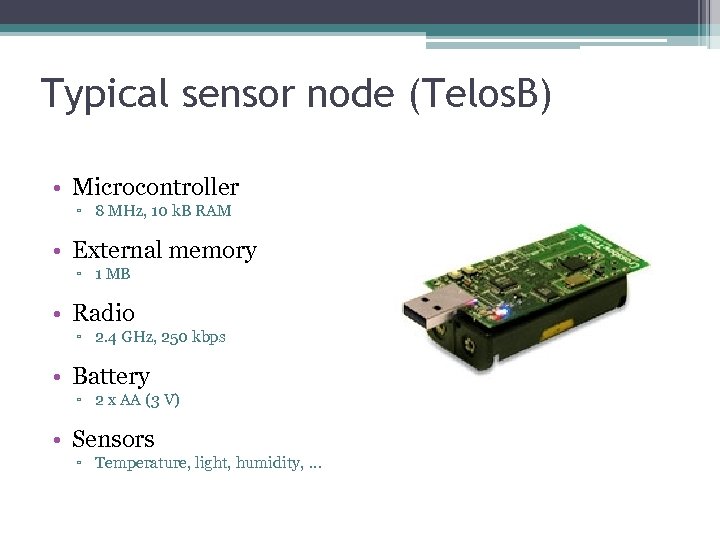 Typical sensor node (Telos. B) • Microcontroller ▫ 8 MHz, 10 k. B RAM • External memory ▫ 1 MB • Radio ▫ 2. 4 GHz, 250 kbps • Battery ▫ 2 x AA (3 V) • Sensors ▫ Temperature, light, humidity, …
 Security • Sensor nodes: ▫ Communicate wirelessly. ▫ Have lower computational capabilities. ▫ Have limited energy supply. ▫ Can be easily captured. ▫ Are not tamper-resistant. • WSNs are deployed in hostile environment. • WSNs are more vulnerable than conventional networks by their nature.
 Attacker model • Passive attacker ▫ Eavesdrops on transmissions. • Active attacker ▫ Alters data. ▫ Drops or selectively forwards packets. ▫ Replays packets. ▫ Injects packets. ▫ Jams the network. => can be detected by Intrusion Detection System.
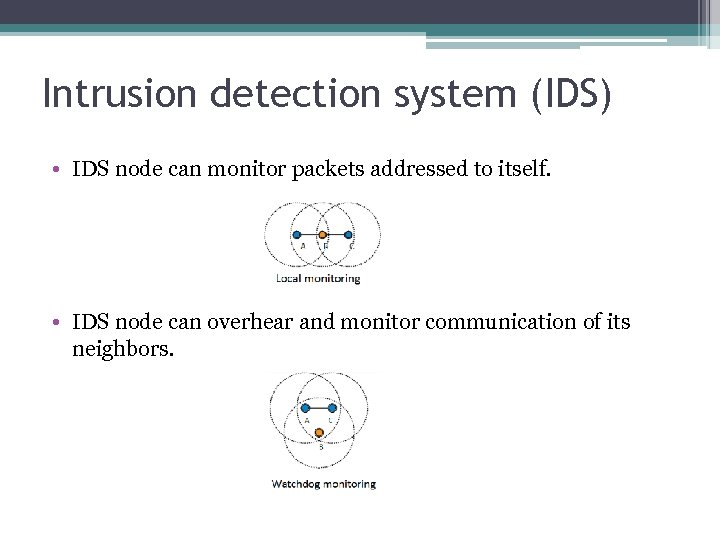 Intrusion detection system (IDS) • IDS node can monitor packets addressed to itself. • IDS node can overhear and monitor communication of its neighbors.
 IDS techniques • Many techniques have been proposed to detect different attacks. • We can measure: ▫ Packet sent & delivery ratio. ▫ Packet sending & receiving rate. ▫ Carrier sensing time. ▫ Sending power. • And monitor: ▫ Packet alteration. ▫ Dropping.
 IDS optimization • Sensor nodes are limited in their energy and memory. • Better IDS accuracy usually requires: ▫ Energy (network lifetime). ▫ Memory (restriction to other applications). Þ Trade-off between IDS accuracy and WSN performance and lifetime. High-level aim: • Framework for (semi)automated design and optimization of IDS parameters.
 Why do we simulate WSN? • Time of implementation and runtime (e. g. battery depletion). • Simulation of hundreds or thousands sensor nodes. • Verifiability of results. • Repeatability of tests. • Protocols that work during simulations may fail in real environment because of simplicity of the model. ▫ Thorough comparison of simulators with reality can be found in [SSM 11].
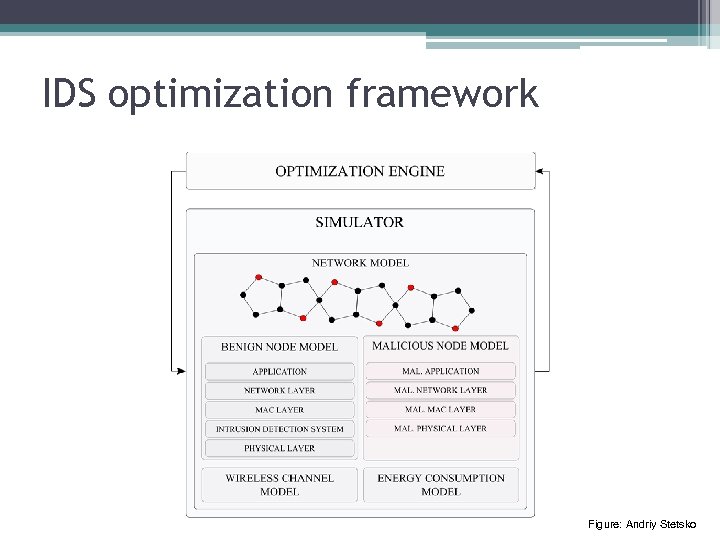 IDS optimization framework Figure: Andriy Stetsko
 Simulator • Input: candidate solution represented as a simulation configuration. ▫ Number of monitored neighbors. ▫ Max. number of buffered packets. ▫ … • Output: statistics of a simulation. ▫ Detection accuracy. ▫ Memory and energy consumption. • Simulation: specific WSN running predefined time configured according to the candidate solution.
 Optimization engine • Input: statistics from the simulator. ▫ Detection accuracy. ▫ Memory and energy consumption. • Output: new candidate solution(s) in form of simulation configurations. ▫ Number of monitored neighbors. ▫ Max. number of buffered packets. ▫ … • Algorithms: evolutionary algorithms, particle swarm optimization, simulated annealing, …
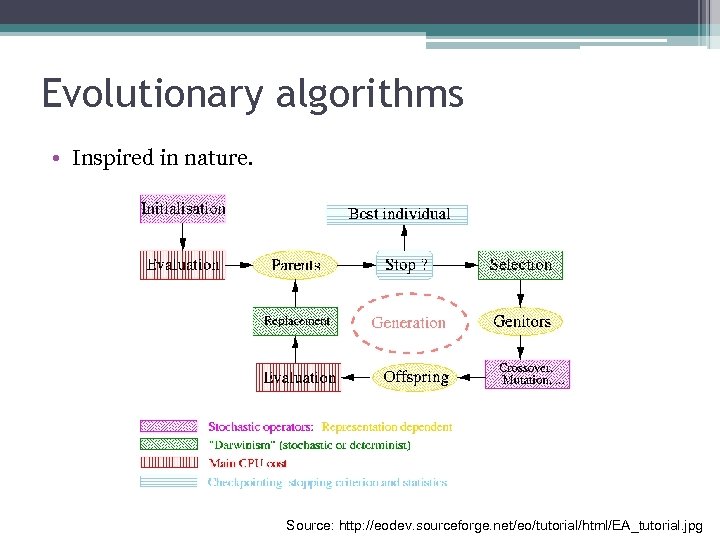 Evolutionary algorithms • Inspired in nature. Source: http: //eodev. sourceforge. net/eo/tutorial/html/EA_tutorial. jpg
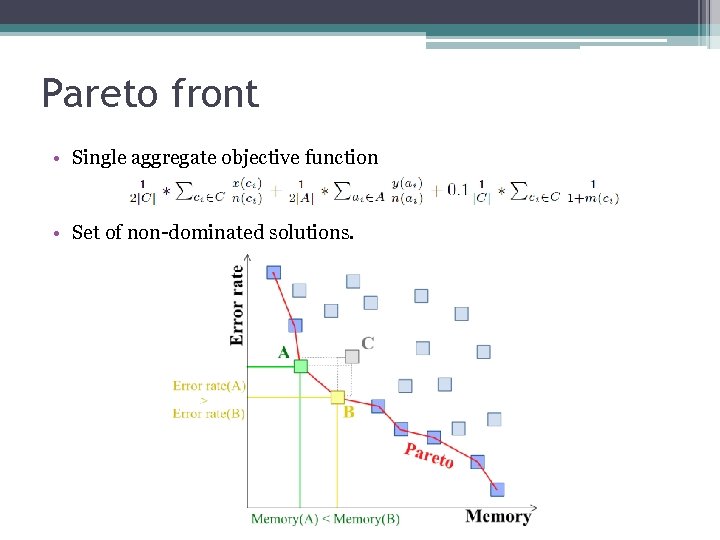 Pareto front • Single aggregate objective function • Set of non-dominated solutions.
![Our test case • Pareto front. Source: [SSSM 13]](https://present5.com/presentation/7d8315744fd84cc288af7339f7bebba7/image-15.jpg "Our test case • Pareto front. Source: [SSSM 13]") Our test case • Pareto front. Source: [SSSM 13]
Our test case • Pareto front. Source: [SSSM 13]
![Multi-objective evolutionary algorithms • What did the evolution find? Source: [SSSM 13]](https://present5.com/presentation/7d8315744fd84cc288af7339f7bebba7/image-16.jpg "Multi-objective evolutionary algorithms • What did the evolution find? Source: [SSSM 13]") Multi-objective evolutionary algorithms • What did the evolution find? Source: [SSSM 13]
Multi-objective evolutionary algorithms • What did the evolution find? Source: [SSSM 13]
 Conclusion • Utilization of MOEAs in unexplored areas of research. • MOEAs enable to choose between optimized solutions according to our requirements. • Main goal: working IDS framework for WSNs. ▫ Design of robust solutions for large WSNs, enabling detection of various attacks.
 Acknowledgments • This work was supported by the project VG 20102014031, programme BV II/2 - VS, of the Ministry of the Interior of the Czech Republic.
 Thank you for your attention.
![References • [SSM 11] A. Stetsko, M. Stehlík, and V. Matyáš. Calibrating and comparing](https://present5.com/presentation/7d8315744fd84cc288af7339f7bebba7/image-20.jpg "References • [SSM 11] A. Stetsko, M. Stehlík, and V. Matyáš. Calibrating and comparing") References • [SSM 11] A. Stetsko, M. Stehlík, and V. Matyáš. Calibrating and comparing simulators for wireless sensor networks. In Proceedings of the 8 th IEEE International Conference on Mobile Adhoc and Sensor Systems, MASS '11, pages 733 -738, Los Alamitos, CA, USA, 2011. IEEE Computer Society. • [SSSM 13] M. Stehlík, A. Saleh, A. Stetsko, and V. Matyáš. Multi-Objective Optimization of Intrusion Detection Systems for Wireless Sensor Networks. Submitted to 12 th European Conference on Artificial Life. • [SMS 13] A. Stetsko, V. Matyáš, and M. Stehlík. A Framework for optimization of intrusion detection system parameters in wireless sensor networks. Prepared for a journal submission.
References • [SSM 11] A. Stetsko, M. Stehlík, and V. Matyáš. Calibrating and comparing simulators for wireless sensor networks. In Proceedings of the 8 th IEEE International Conference on Mobile Adhoc and Sensor Systems, MASS '11, pages 733 -738, Los Alamitos, CA, USA, 2011. IEEE Computer Society. • [SSSM 13] M. Stehlík, A. Saleh, A. Stetsko, and V. Matyáš. Multi-Objective Optimization of Intrusion Detection Systems for Wireless Sensor Networks. Submitted to 12 th European Conference on Artificial Life. • [SMS 13] A. Stetsko, V. Matyáš, and M. Stehlík. A Framework for optimization of intrusion detection system parameters in wireless sensor networks. Prepared for a journal submission.