 Скачать презентацию Optically sensitive MCP image tube with a Medipix
0734bd8096d8b64efa301cc414c3d95f.ppt
- Количество слайдов: 37



Optically sensitive MCP image tube with a Medipix 2 ASIC readout John Vallerga, Jason Mc. Phate, Anton Tremsin and Oswald Siegmund Space Sciences Laboratory University of California, Berkeley SPIE Instr. for Astronomy, Marseille, John Vallerga, jvv@ssl. berkeley. edu
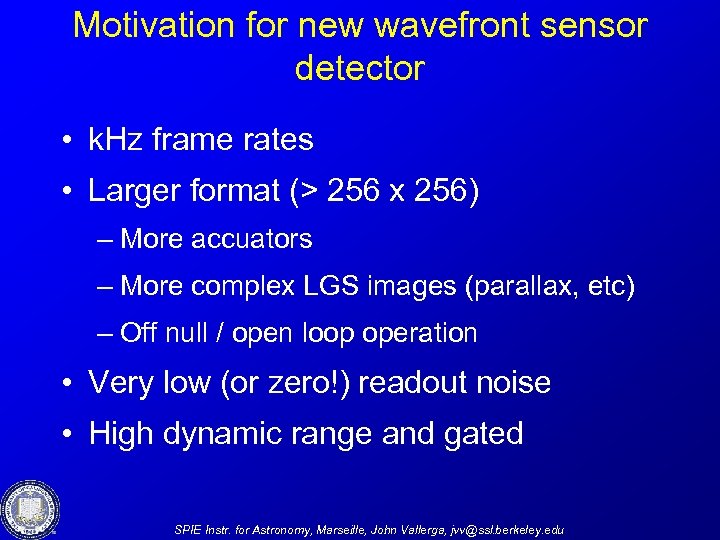
Motivation for new wavefront sensor detector • k. Hz frame rates • Larger format (> 256 x 256) – More accuators – More complex LGS images (parallax, etc) – Off null / open loop operation • Very low (or zero!) readout noise • High dynamic range and gated SPIE Instr. for Astronomy, Marseille, John Vallerga, jvv@ssl. berkeley. edu
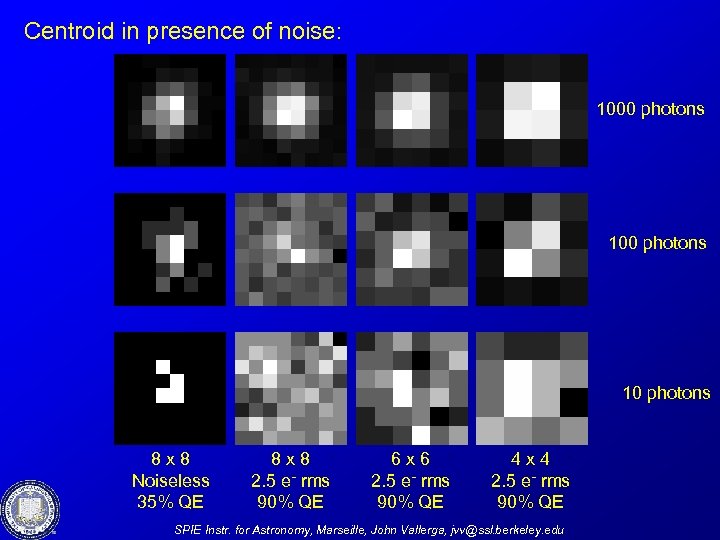
Centroid in presence of noise: 1000 photons 10 photons 8 x 8 Noiseless 35% QE 8 x 8 2. 5 e- rms 90% QE - 6 x 6 2. 5 e- rms 90% QE - 4 x 4 2. 5 e- rms 90% QE SPIE Instr. for Astronomy, Marseille, John Vallerga, jvv@ssl. berkeley. edu -
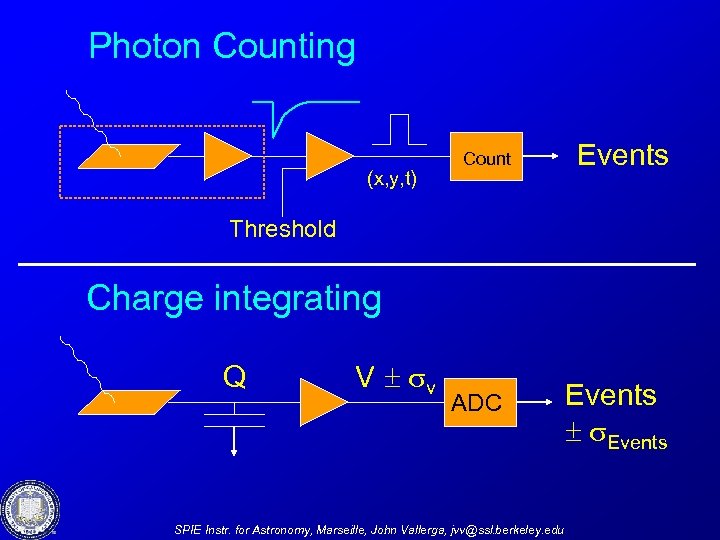
Photon Counting (x, y, t) Count Events Threshold Charge integrating Q V ± sv ADC SPIE Instr. for Astronomy, Marseille, John Vallerga, jvv@ssl. berkeley. edu Events ± s. Events
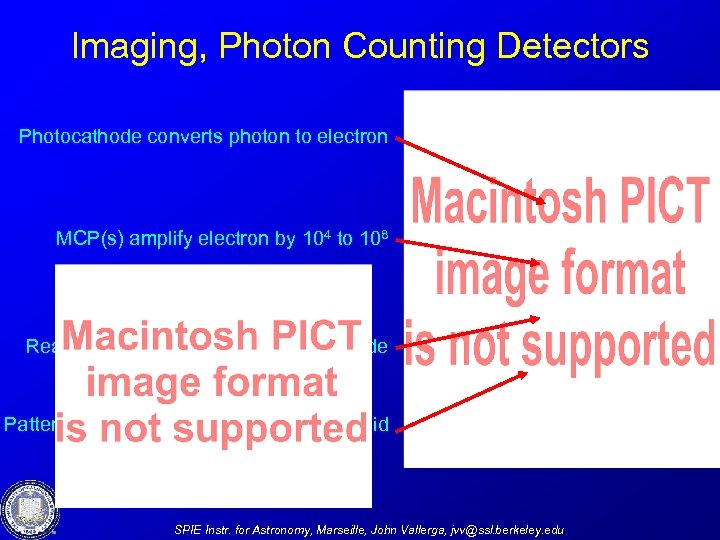
Imaging, Photon Counting Detectors Photocathode converts photon to electron MCP(s) amplify electron by 104 to 108 Rear field accelerates electrons to anode Patterned anode measures charge centroid SPIE Instr. for Astronomy, Marseille, John Vallerga, jvv@ssl. berkeley. edu
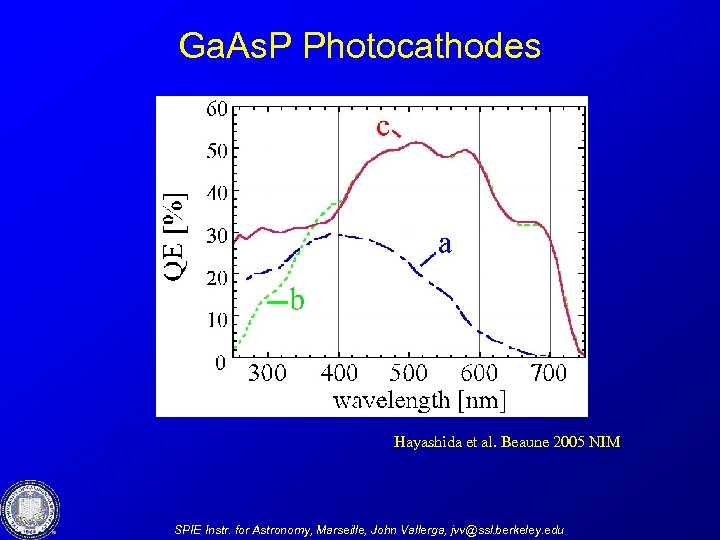
Ga. As. P Photocathodes Hayashida et al. Beaune 2005 NIM SPIE Instr. for Astronomy, Marseille, John Vallerga, jvv@ssl. berkeley. edu
Wavefront Sensor Event Rates • 5000 centroids • Kilohertz feedback rates (atmospheric timescale) • 1000 detected events per spot for sub-pixel centroiding Ø 5000 x 1000 = 5 Gigahertz counting rate! • Requires integrating detector SPIE Instr. for Astronomy, Marseille, John Vallerga, jvv@ssl. berkeley. edu
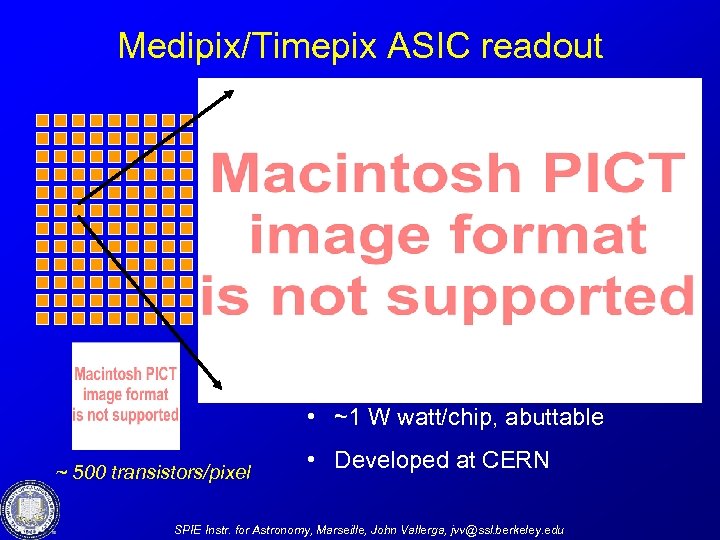
Medipix/Timepix ASIC readout • 256 x 256 array of 55 µm pixels • Integrates counts, not charge • 100 k. Hz/pxl • Frame rate: 1 k. Hz • Low noise (100 e-) = low gain operation (10 ke-) • GHz global count rate • ~1 W watt/chip, abuttable ~ 500 transistors/pixel • Developed at CERN SPIE Instr. for Astronomy, Marseille, John Vallerga, jvv@ssl. berkeley. edu
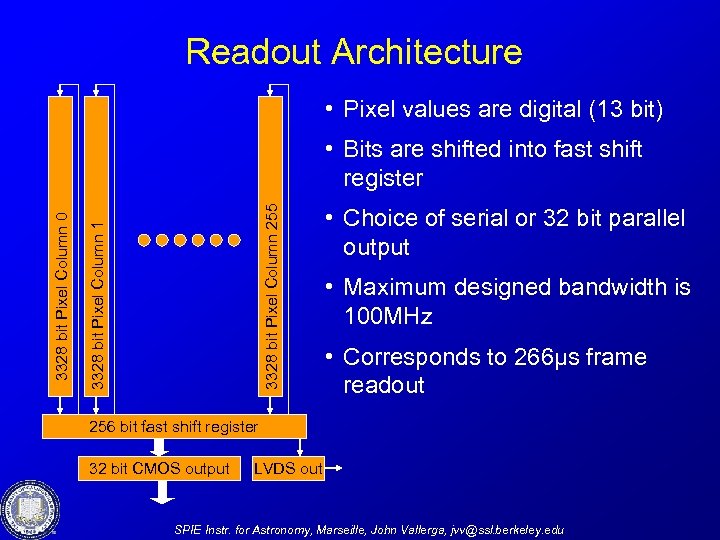
Readout Architecture • Pixel values are digital (13 bit) 3328 bit Pixel Column 255 3328 bit Pixel Column 1 3328 bit Pixel Column 0 • Bits are shifted into fast shift register • Choice of serial or 32 bit parallel output • Maximum designed bandwidth is 100 MHz • Corresponds to 266µs frame readout 256 bit fast shift register 32 bit CMOS output LVDS out SPIE Instr. for Astronomy, Marseille, John Vallerga, jvv@ssl. berkeley. edu
“Built-in” Electronic Shutter • • • Enables/Disables counter Timing accuracy to 10 ns Uniform across Medipix Multiple cycles per frame No lifetime issues External input - can be phased to laser SPIE Instr. for Astronomy, Marseille, John Vallerga, jvv@ssl. berkeley. edu
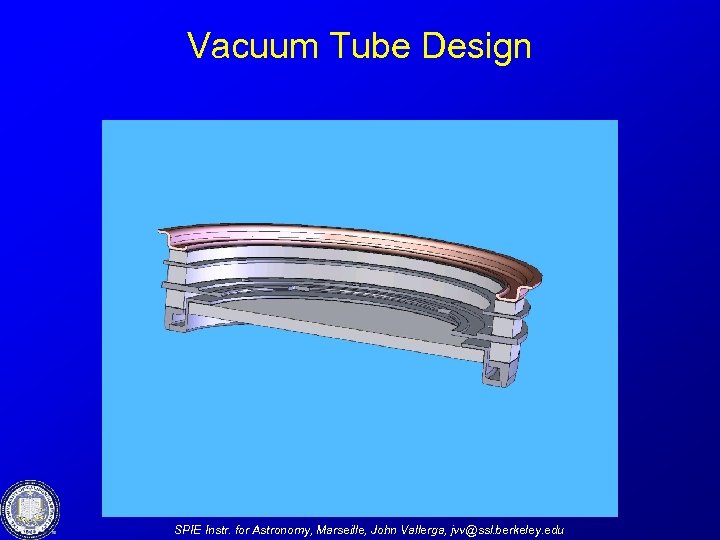
Vacuum Tube Design SPIE Instr. for Astronomy, Marseille, John Vallerga, jvv@ssl. berkeley. edu
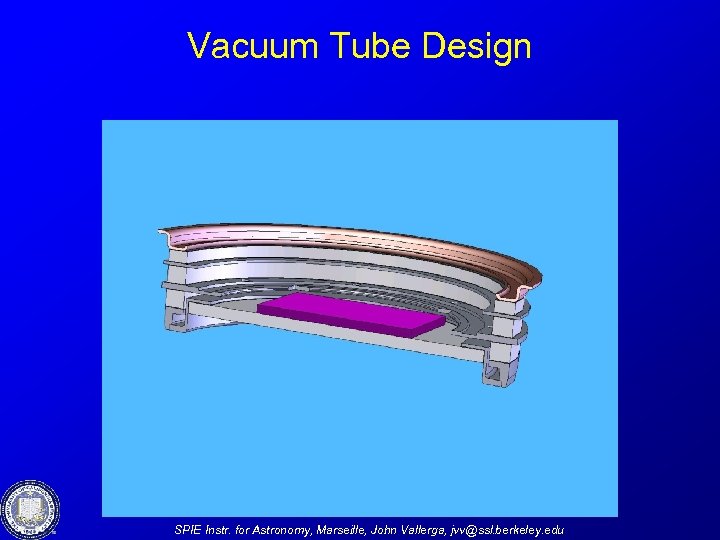
Vacuum Tube Design SPIE Instr. for Astronomy, Marseille, John Vallerga, jvv@ssl. berkeley. edu
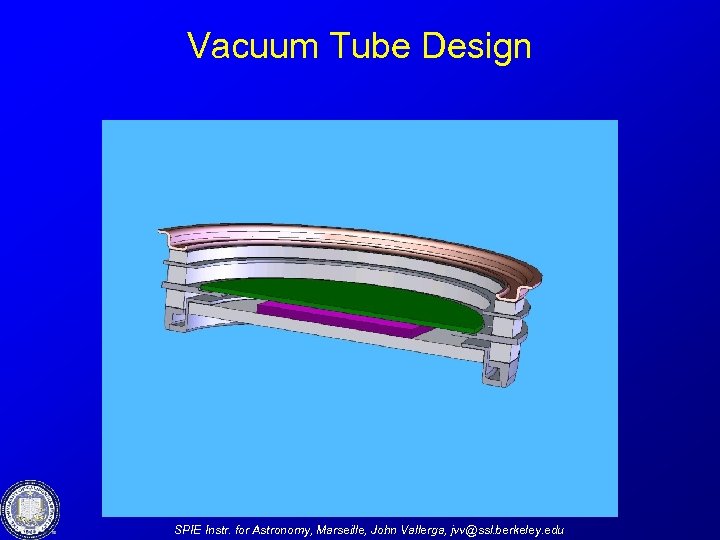
Vacuum Tube Design SPIE Instr. for Astronomy, Marseille, John Vallerga, jvv@ssl. berkeley. edu
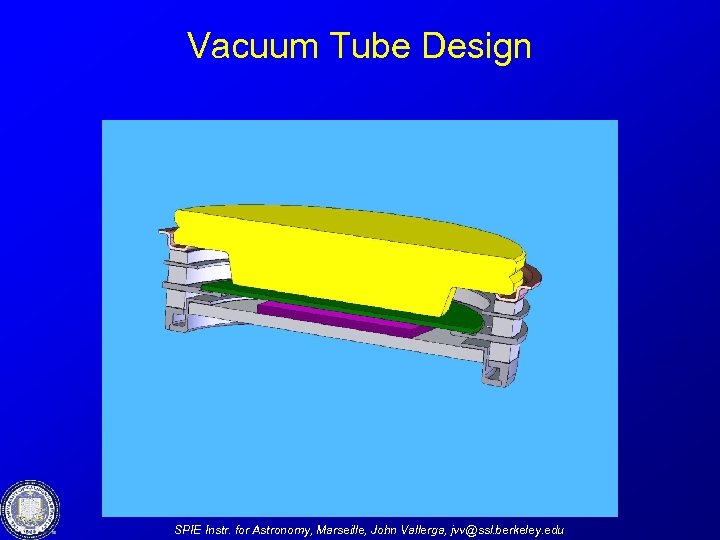
Vacuum Tube Design SPIE Instr. for Astronomy, Marseille, John Vallerga, jvv@ssl. berkeley. edu
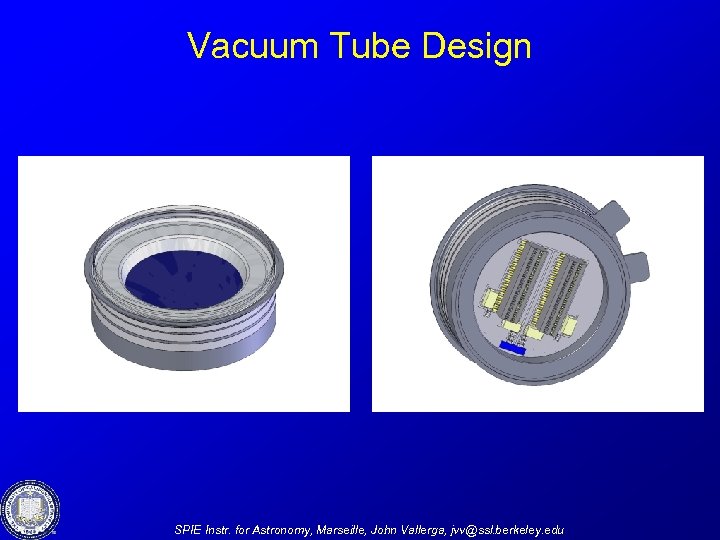
Vacuum Tube Design SPIE Instr. for Astronomy, Marseille, John Vallerga, jvv@ssl. berkeley. edu
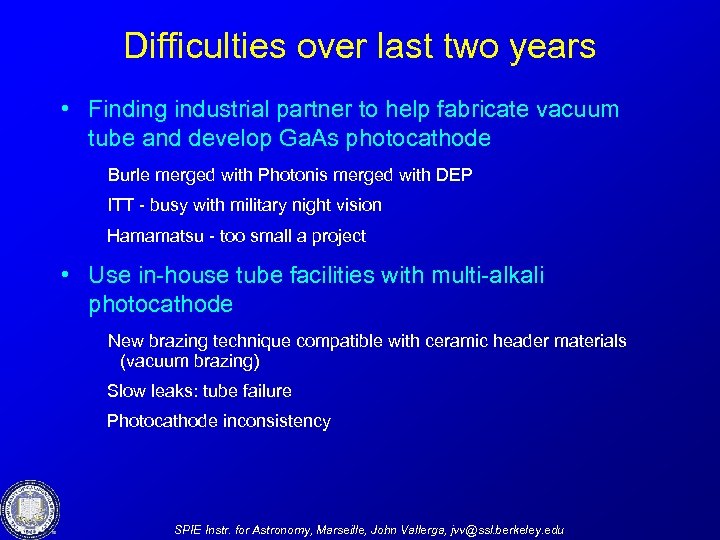
Difficulties over last two years • Finding industrial partner to help fabricate vacuum tube and develop Ga. As photocathode Burle merged with Photonis merged with DEP ITT - busy with military night vision Hamamatsu - too small a project • Use in-house tube facilities with multi-alkali photocathode New brazing technique compatible with ceramic header materials (vacuum brazing) Slow leaks: tube failure Photocathode inconsistency SPIE Instr. for Astronomy, Marseille, John Vallerga, jvv@ssl. berkeley. edu
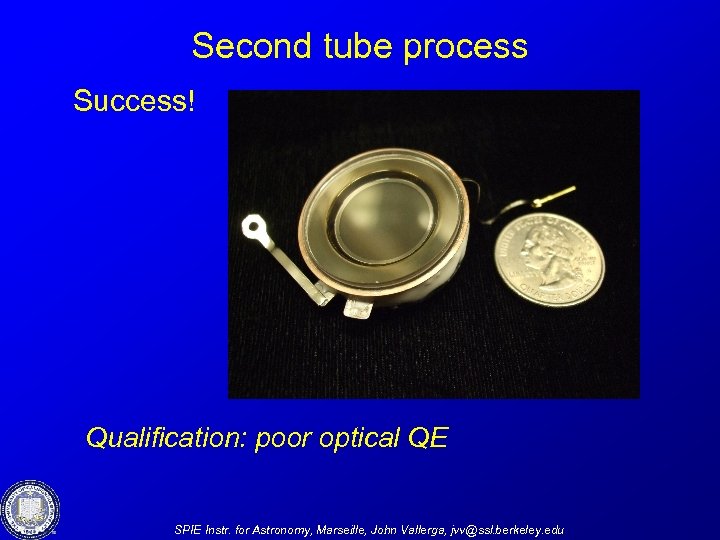
Second tube process Success! Qualification: poor optical QE SPIE Instr. for Astronomy, Marseille, John Vallerga, jvv@ssl. berkeley. edu
Quantum efficiency (factor of 4 too low) SPIE Instr. for Astronomy, Marseille, John Vallerga, jvv@ssl. berkeley. edu
First tests in darkroom SPIE Instr. for Astronomy, Marseille, John Vallerga, jvv@ssl. berkeley. edu
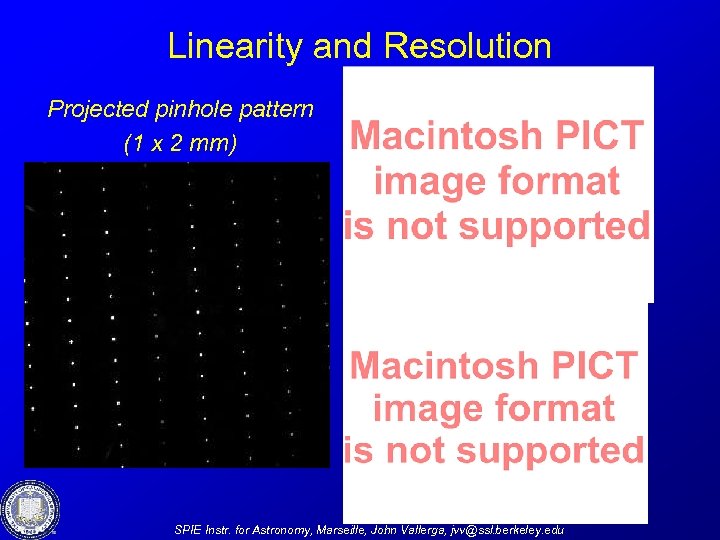
Linearity and Resolution Projected pinhole pattern (1 x 2 mm) SPIE Instr. for Astronomy, Marseille, John Vallerga, jvv@ssl. berkeley. edu
Flat field • White light • 66 MHz input rate • No optic • No “hex” pattern • Black pixels are masked in Medipix 2 • Locally uniform 20 µs 50 s SPIE Instr. for Astronomy, Marseille, John Vallerga, jvv@ssl. berkeley. edu
Fixed pattern noise SNR > 200 SPIE Instr. for Astronomy, Marseille, John Vallerga, jvv@ssl. berkeley. edu
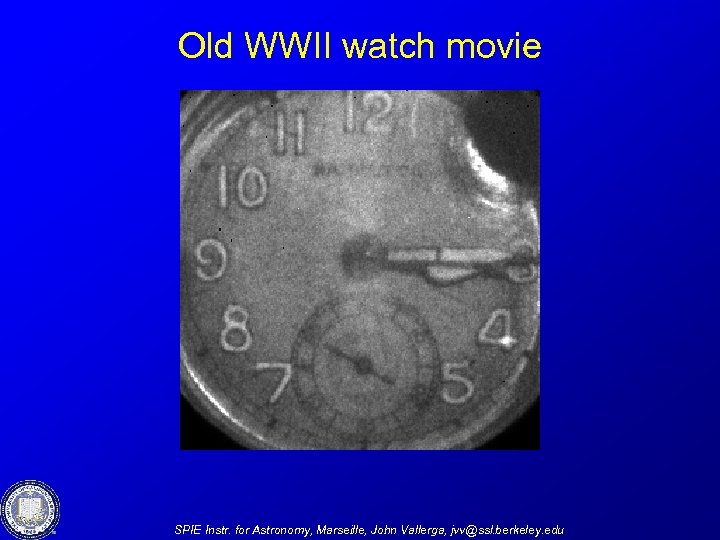
Old WWII watch movie SPIE Instr. for Astronomy, Marseille, John Vallerga, jvv@ssl. berkeley. edu
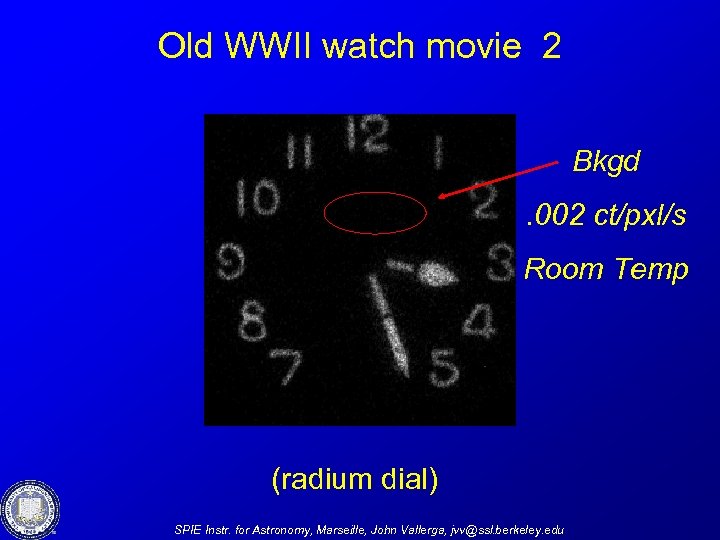
Old WWII watch movie 2 Bkgd. 002 ct/pxl/s Room Temp (radium dial) SPIE Instr. for Astronomy, Marseille, John Vallerga, jvv@ssl. berkeley. edu
Gain and Event Threshold SPIE Instr. for Astronomy, Marseille, John Vallerga, jvv@ssl. berkeley. edu
Gain and Event Threshold SPIE Instr. for Astronomy, Marseille, John Vallerga, jvv@ssl. berkeley. edu
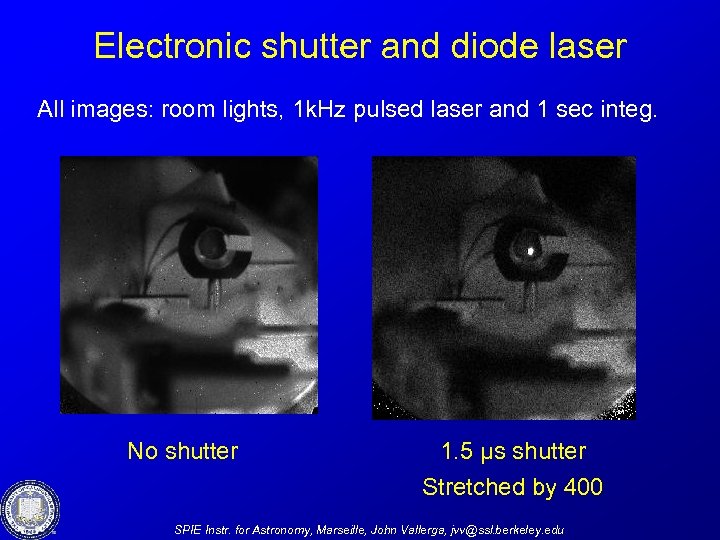
Electronic shutter and diode laser All images: room lights, 1 k. Hz pulsed laser and 1 sec integ. No shutter 1. 5 µs shutter Stretched by 400 SPIE Instr. for Astronomy, Marseille, John Vallerga, jvv@ssl. berkeley. edu
Medipix 3 - late 2008 • 0. 13 µm CMOS technology • Twice as many transistors in pixel • Concurrent readout/integration • Serial readout at 250 MHz clock • Up to 10, 000 frames/sec SPIE Instr. for Astronomy, Marseille, John Vallerga, jvv@ssl. berkeley. edu
Summary and future work • Demonstration of successful use of Medipix 2 in sealed MCP tube • More laboratory and telescope tests to be done • Working with Photonis to incorporate our various readout technologies into their tubes – Delayline, cross strip, Medipix, Timepix, etc. – Standard industrial design – Better and more consistent photocathodes • UV, neutron imaging tubes SPIE Instr. for Astronomy, Marseille, John Vallerga, jvv@ssl. berkeley. edu
Acknowledgements This work was funded by an AODP grant managed by NOAO and funded by NSF Thanks to the Medipix Collaboration: • Univ. of Barcelona • University of Napoli • University of Cagliari • NIKHEF • CEA • University of Pisa • CERN • University of Auvergne • University of Freiburg • Medical Research Council • University of Glasgow • Czech Technical University • Czech Academy of Sciences • ESRF • Mid-Sweden University • University of Erlangen-Nurnberg SPIE Instr. for Astronomy, Marseille, John Vallerga, jvv@ssl. berkeley. edu

City Movie - 1 Cycle Line Frequency SPIE Instr. for Astronomy, Marseille, John Vallerga, jvv@ssl. berkeley. edu
Extra slides SPIE Instr. for Astronomy, Marseille, John Vallerga, jvv@ssl. berkeley. edu
Timepix version of Medipix Amplitude rather than counts using “time over threshold’ technique If charge clouds are large, can determine centroid to subpixel accuracy Tradeoff is count rate as event collisions in frame destroy centroid information Single UV photon events SPIE Instr. for Astronomy, Marseille, John Vallerga, jvv@ssl. berkeley. edu
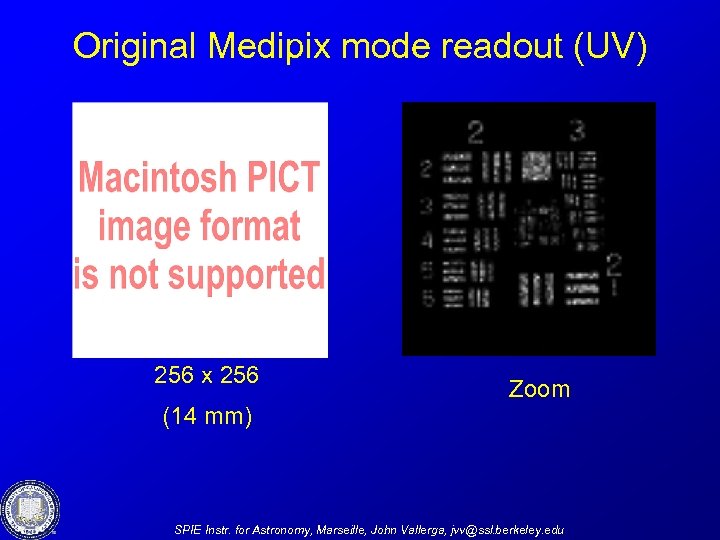
Original Medipix mode readout (UV) 256 x 256 (14 mm) Zoom SPIE Instr. for Astronomy, Marseille, John Vallerga, jvv@ssl. berkeley. edu
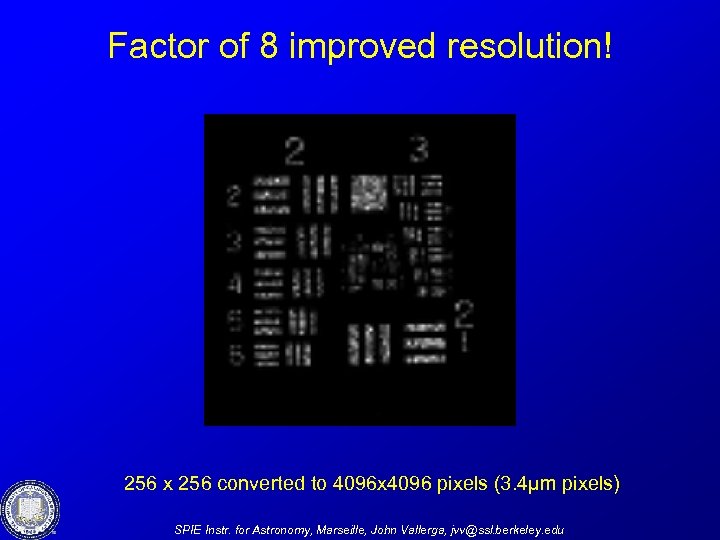
Factor of 8 improved resolution! 256 x 256 converted to 4096 x 4096 pixels (3. 4µm pixels) SPIE Instr. for Astronomy, Marseille, John Vallerga, jvv@ssl. berkeley. edu
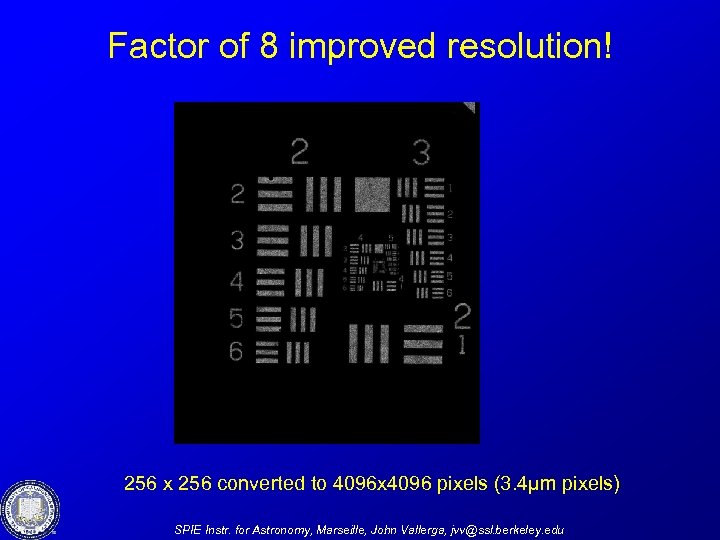
Factor of 8 improved resolution! 256 x 256 converted to 4096 x 4096 pixels (3. 4µm pixels) SPIE Instr. for Astronomy, Marseille, John Vallerga, jvv@ssl. berkeley. edu
Centroid error vs. input fluence SPIE Instr. for Astronomy, Marseille, John Vallerga, jvv@ssl. berkeley. edu
Скачать презентацию Optically sensitive MCP image tube with a Medipix
0734bd8096d8b64efa301cc414c3d95f.ppt