 Скачать презентацию Optical Sensor and DAQ in Ice Cube Chiba
de58661193eb94d8262ce9826da13106.ppt
- Количество слайдов: 40



Optical Sensor and DAQ in Ice. Cube Chiba July, 2003 Albrecht Karle University of Wisconsin-Madison karle@amanda. wisc. edu

Outline • Events signatures and their requirements on DAQ. • The design of the optical sensor for Ice. Cube. • A brief construction status.

The Ice. Cube Collaboration Institutions: 11 US, 9 European institutions and 1 Japanese institution; ≈150 people 1. Bartol Research Institute, University of Delaware 2. 3. 4. 5. 6. 7. 8. 9. 10. 11. 12. 13. 14. 15. 16. 17. 18. 19. 20. 21. BUGH Wuppertal, Germany Universite Libre de Bruxelles, Brussels, Belgium CTSPS, Clark-Atlanta University, Atlanta USA DESY-Zeuthen, Germany Institute for Advanced Study, Princeton, USA Dept. of Technology, Kalmar University, Kalmar, Sweden Lawrence Berkeley National Laboratory, Berkeley, USA Department of Physics, Southern University and A&M College, Baton Rouge, LA, USA Dept. of Physics, UC Berkeley, USA Institute of Physics, University of Mainz, Germany University of Mons-Hainaut, Mons, Belgium Dept. of Physics and Astronomy, University of Pennsylvania, Philadelphia, USA Dept. of Astronomy, Dept. of Physics, SSEC, University of Wisconsin, Madison, USA Physics Department, University of Wisconsin, River Falls, USA Division of High Energy Physics, Uppsala University, Uppsala, Sweden Fysikum, Stockholm University, Stockholm, Sweden University of Alabama Vrije Universiteit Brussel, Belgium Dept. of Physics, niversity of Maryland, USA Chiba University, Japan
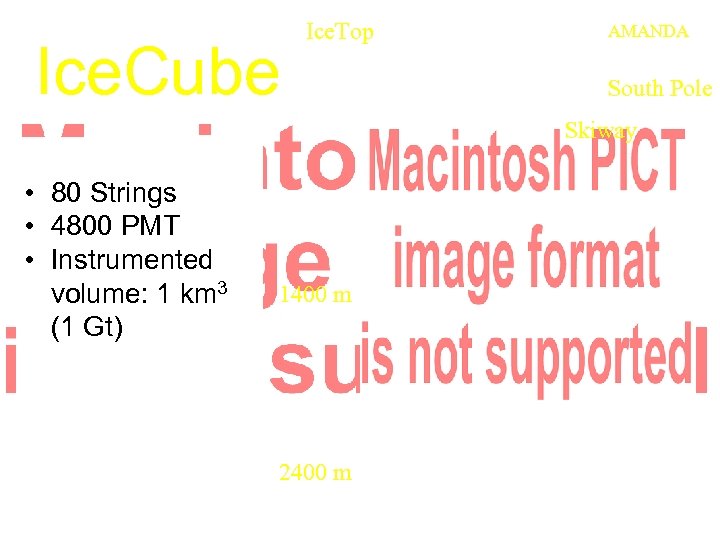
Ice. Cube Ice. Top AMANDA South Pole Skiway • 80 Strings • 4800 PMT • Instrumented volume: 1 km 3 (1 Gt) 1400 m 2400 m
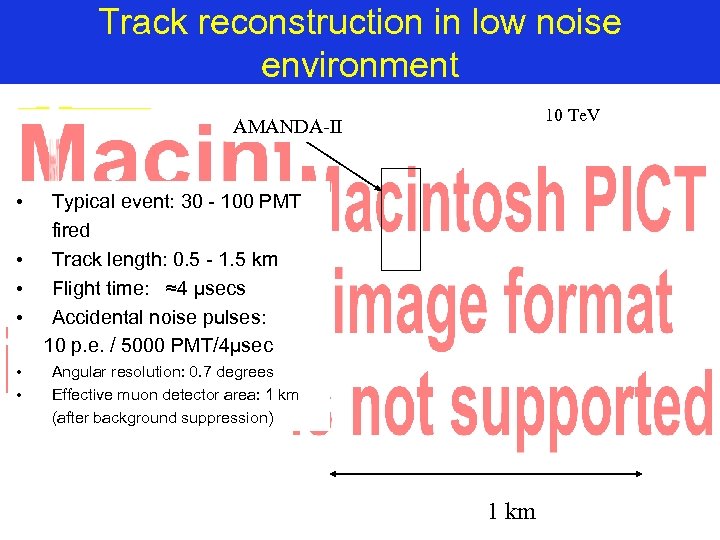
Track reconstruction in low noise environment 10 Te. V AMANDA-II • • • Typical event: 30 - 100 PMT fired Track length: 0. 5 - 1. 5 km Flight time: ≈4 µsecs Accidental noise pulses: 10 p. e. / 5000 PMT/4µsec Angular resolution: 0. 7 degrees Effective muon detector area: 1 km (after background suppression) 1 km
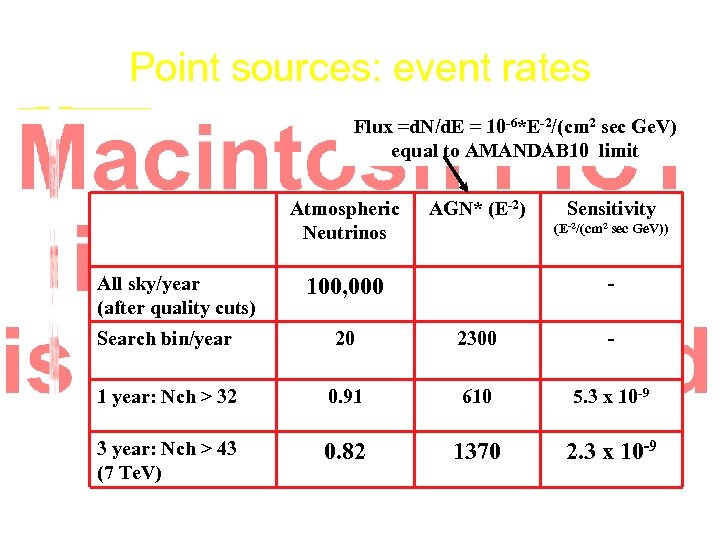
Point sources: event rates Flux =d. N/d. E = 10 -6*E-2/(cm 2 sec Ge. V) equal to AMANDAB 10 limit Atmospheric Neutrinos All sky/year (after quality cuts) AGN* (E-2) Sensitivity (E-2/(cm 2 sec Ge. V)) - 100, 000 Search bin/year 20 2300 - 1 year: Nch > 32 0. 91 610 5. 3 x 10 -9 3 year: Nch > 43 (7 Te. V) 0. 82 1370 2. 3 x 10 -9

Point source sensitivity The sensitivity of Ice. Cube to an E^-2 neutrino spectrum is comparable to the sensitivity of GLAST to an E^-2 photon spectrum (1 yr) Ice. Cube 3 years
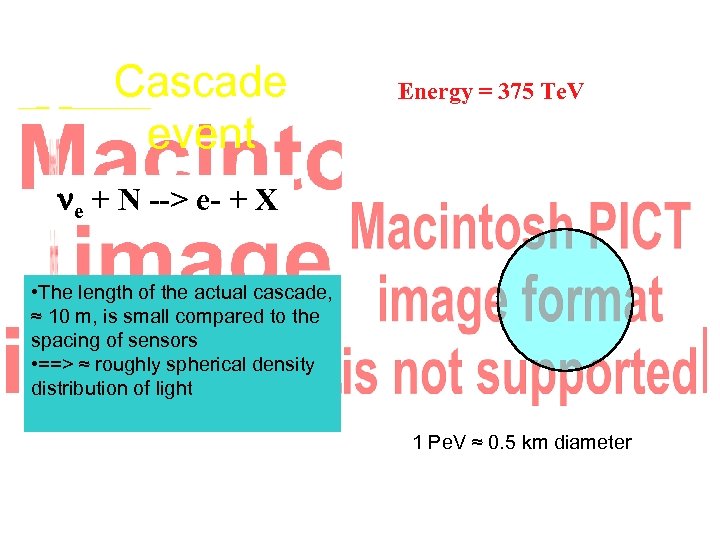
Cascade event Energy = 375 Te. V e + N --> e- + X • The length of the actual cascade, ≈ 10 m, is small compared to the spacing of sensors • ==> ≈ roughly spherical density distribution of light 1 Pe. V ≈ 0. 5 km diameter
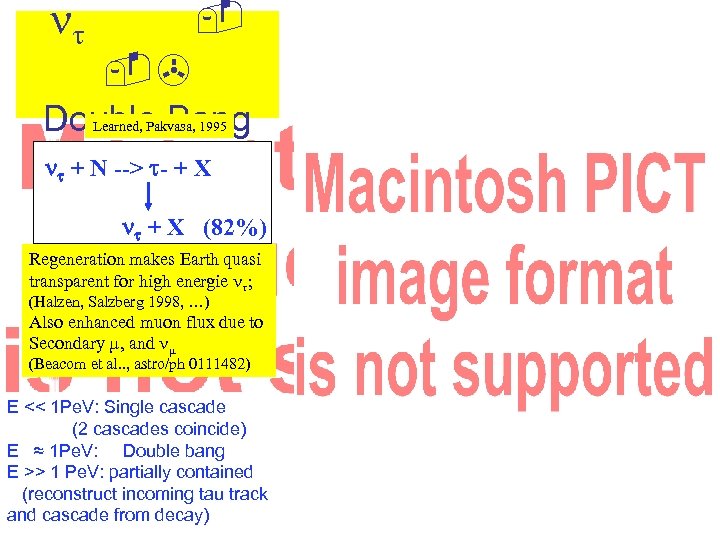
Double Bang Learned, Pakvasa, 1995 t + N --> t- + X t + X (82%) Regeneration makes Earth quasi transparent for high energie ; (Halzen, Salzberg 1998, …) Also enhanced muon flux due to Secondary µ, and µ (Beacom et al. . , astro/ph 0111482) E << 1 Pe. V: Single cascade (2 cascades coincide) E ≈ 1 Pe. V: Double bang E >> 1 Pe. V: partially contained (reconstruct incoming tau track and cascade from decay)
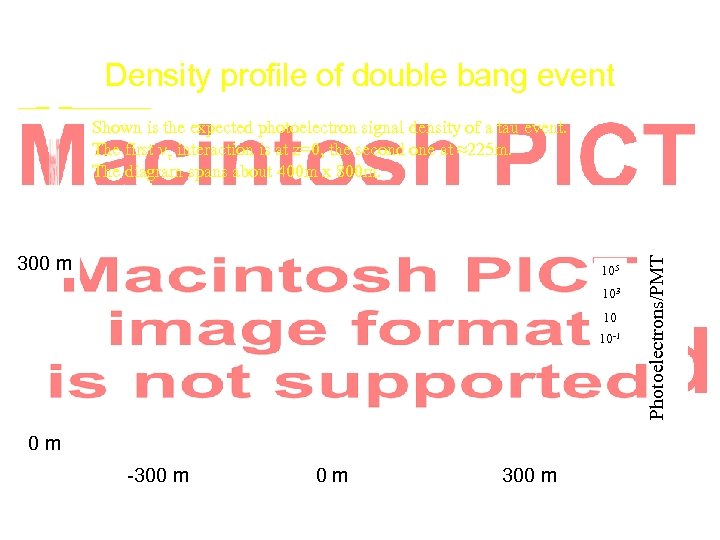
Density profile of double bang event 300 m 105 103 10 10 -1 0 m -300 m 0 m 300 m Photoelectrons/PMT Shown is the expected photoelectron signal density of a tau event. The first interaction is at z=0, the second one at ≈225 m. The diagram spans about 400 m x 800 m.
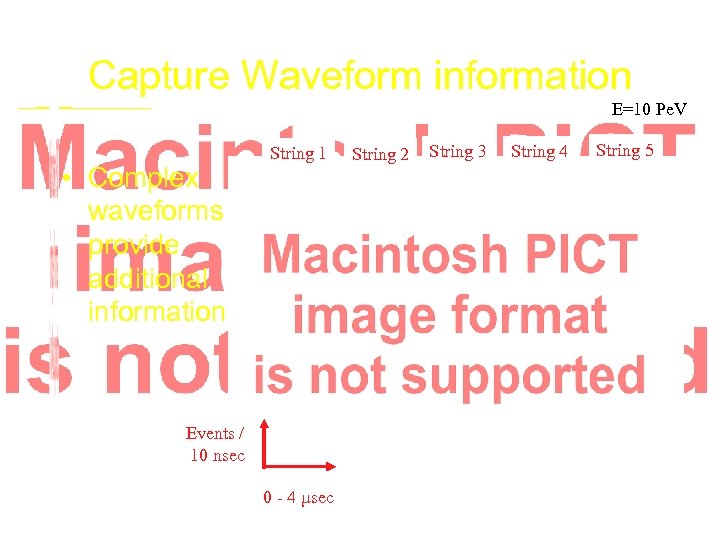
Capture Waveform information E=10 Pe. V • Complex waveforms provide additional information String 1 Events / 10 nsec 0 - 4 µsec String 2 String 3 String 4 String 5
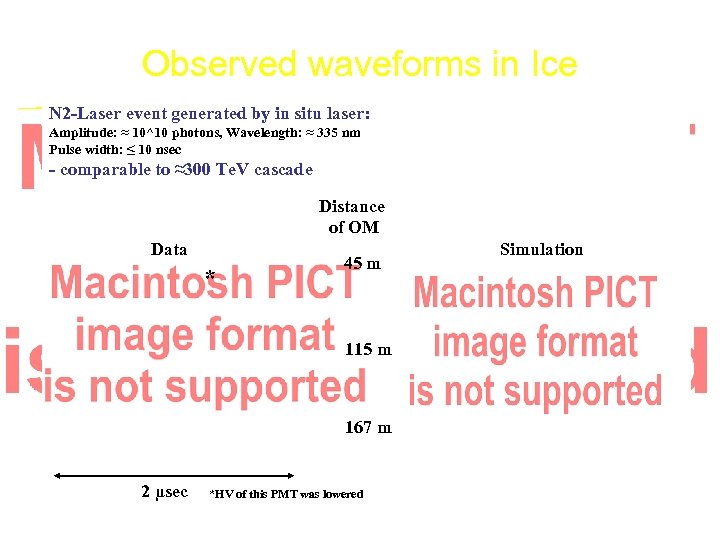
Observed waveforms in Ice N 2 -Laser event generated by in situ laser: Amplitude: ≈ 10^10 photons, Wavelength: ≈ 335 nm Pulse width: ≤ 10 nsec - comparable to ≈300 Te. V cascade Distance of OM Data * 45 m 115 m 167 m 2 µsec *HV of this PMT was lowered Simulation
Energy reconstruction Small detectors: Muon energy is difficult to measure because of fluctuations in d. E/dx Ice. Cube: Integration over large sampling+ scattering of light reduces the fluctutions energy loss. Eµ=10 Te. V ≈ 90 hits Eµ=6 Pe. V ≈ 1000 hits
Design goals • Ice. Cube was designed to detect to neutrinos over a wider range of energies and all flavors. • If one would wish to build a detector to detect primarily Pe. V or Ee. V neutrinos, one would obviously end up with a different detector.
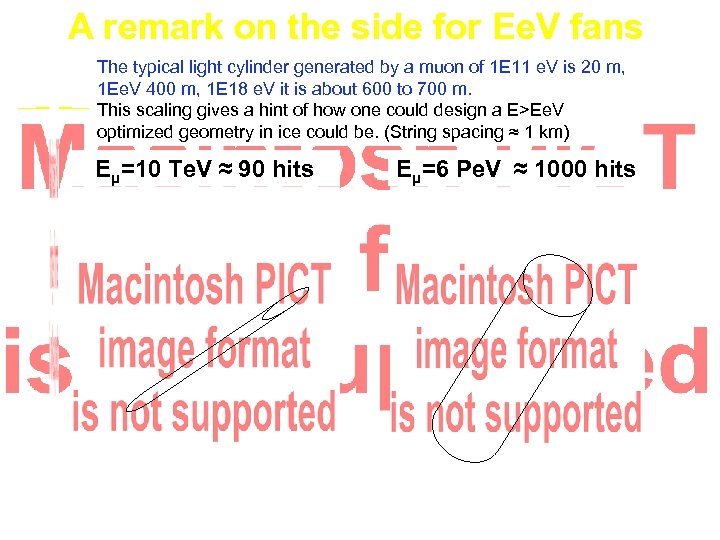
A remark on the side for Ee. V fans The typical light cylinder generated by a muon of 1 E 11 e. V is 20 m, 1 Ee. V 400 m, 1 E 18 e. V it is about 600 to 700 m. This scaling gives a hint of how one could design a E>Ee. V optimized geometry in ice could be. (String spacing ≈ 1 km) Eµ=10 Te. V ≈ 90 hits Eµ=6 Pe. V ≈ 1000 hits
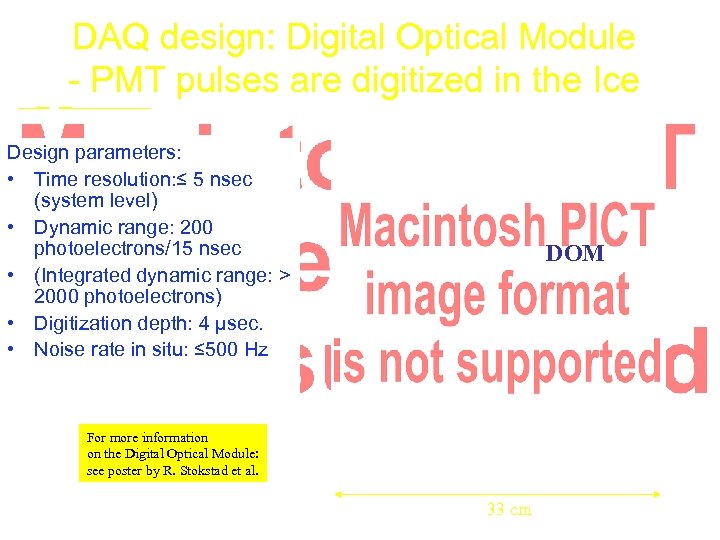
DAQ design: Digital Optical Module - PMT pulses are digitized in the Ice Design parameters: • Time resolution: ≤ 5 nsec (system level) • Dynamic range: 200 photoelectrons/15 nsec • (Integrated dynamic range: > 2000 photoelectrons) • Digitization depth: 4 µsec. • Noise rate in situ: ≤ 500 Hz DOM For more information on the Digital Optical Module: see poster by R. Stokstad et al. 33 cm
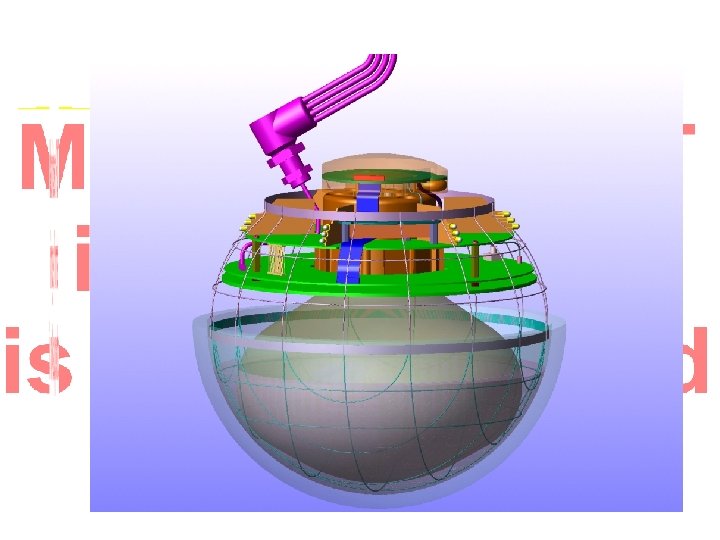
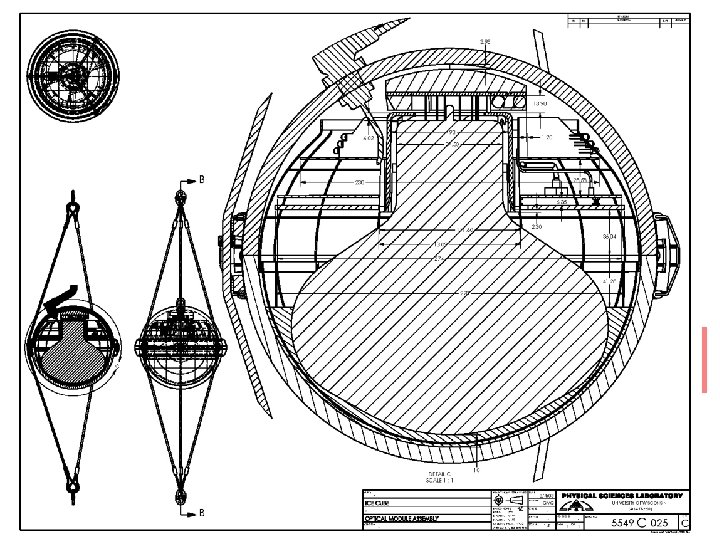
Assembled DOM
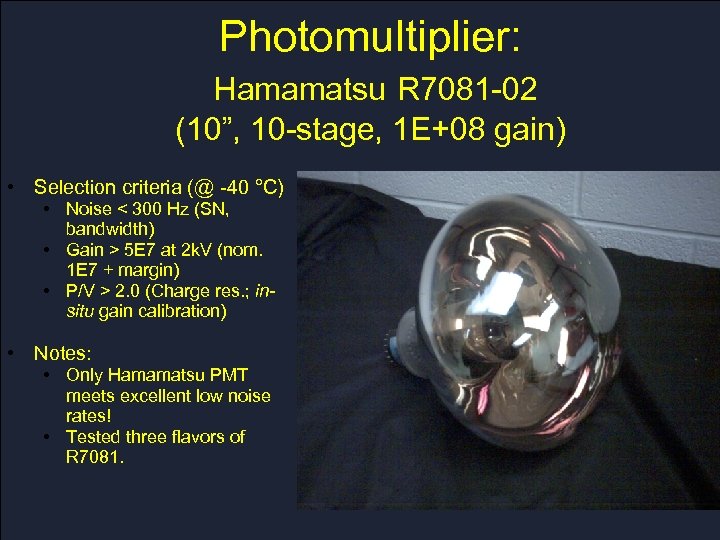
Photomultiplier: Hamamatsu R 7081 -02 (10”, 10 -stage, 1 E+08 gain) • Selection criteria (@ -40 °C) • Noise < 300 Hz (SN, bandwidth) • Gain > 5 E 7 at 2 k. V (nom. 1 E 7 + margin) • P/V > 2. 0 (Charge res. ; insitu gain calibration) • Notes: • Only Hamamatsu PMT meets excellent low noise rates! • Tested three flavors of R 7081.

Custom design: 5000 DOMs, 2500 copper pairs, 800 PCI cards (10 racks) DAQ Network architecture Off the shelf IT infrastructure, Computers, switches, disks DAQ Software Datahandling software
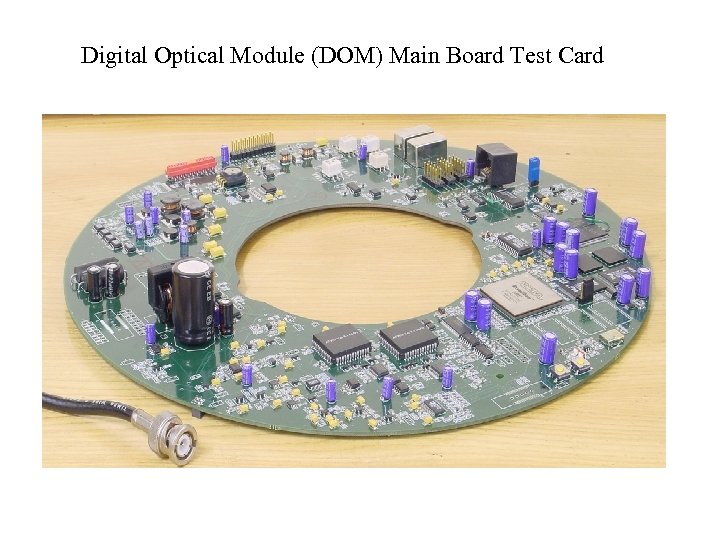
Digital Optical Module (DOM) Main Board Test Card
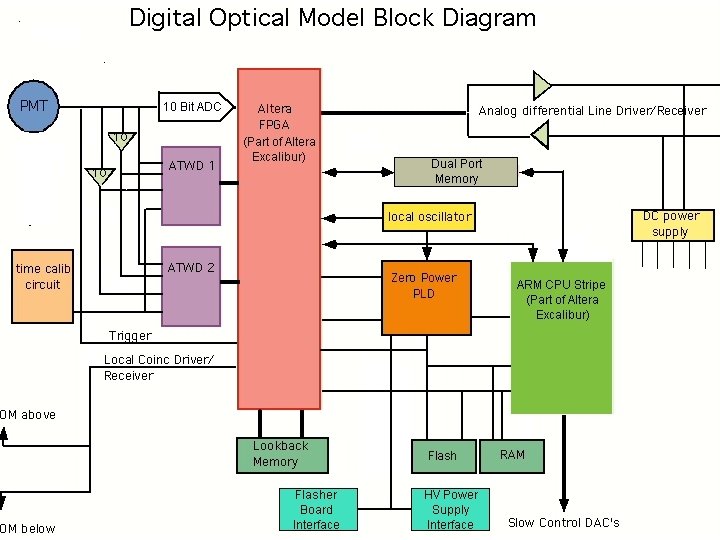
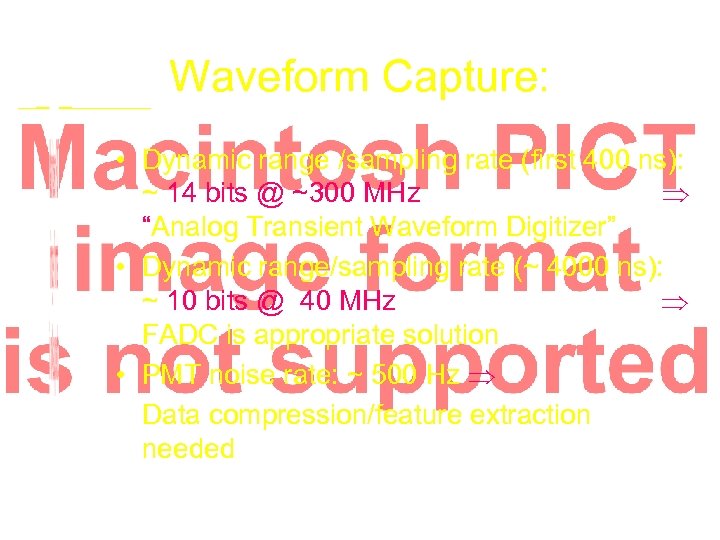
Waveform Capture: • Dynamic range /sampling rate (first 400 ns): ~ 14 bits @ ~300 MHz “Analog Transient Waveform Digitizer” • Dynamic range/sampling rate (~ 4000 ns): ~ 10 bits @ 40 MHz FADC is appropriate solution • PMT noise rate: ~ 500 Hz Data compression/feature extraction needed

Design goals Operational parameters (typical) SPE: 5 m. V Electronic noise: <0. 2 (0. 1) V Dynamic range: 200 PE/15 nsec 1000 PE/4 µsec Overall noise rate of DOM: 500 - 1000 Hz

Ice. Cube String 1400 m OM Spacing: 17 m 2400 m

The DOM communicates via ≈3 km copper wires to the central DAQ 2 DOMs on one twisted pair Bandwidth goal: 1 Mbit/sec
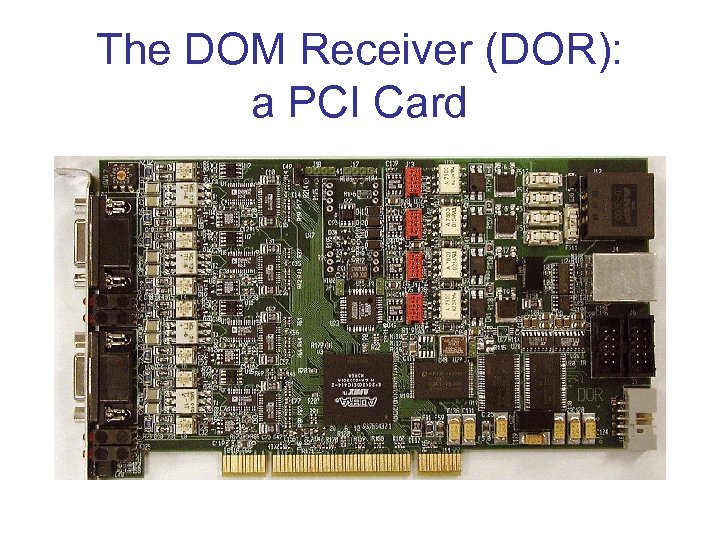
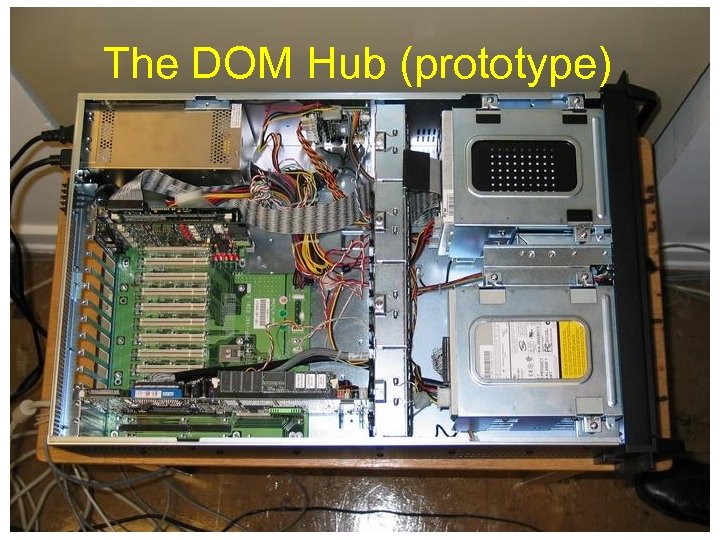
The DOM Receiver (DOR): a PCI Card
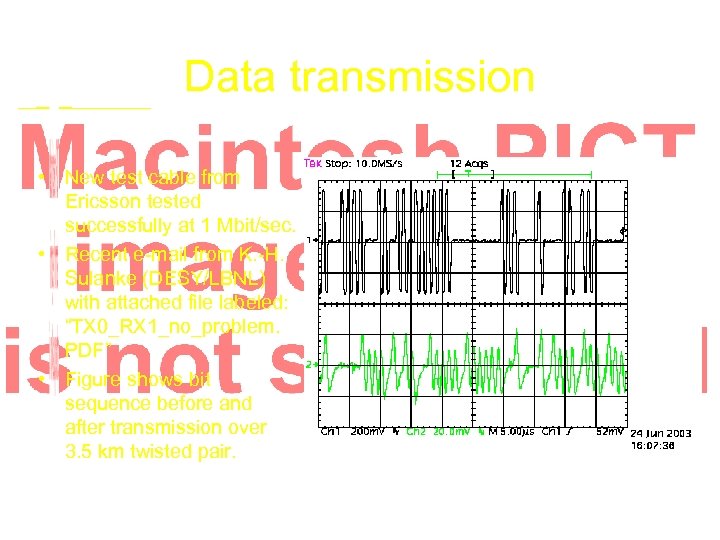
Data transmission • New test cable from Ericsson tested successfully at 1 Mbit/sec. • Recent e-mail from K. -H. Sulanke (DESY/LBNL) with attached file labeled: “TX 0_RX 1_no_problem. PDF” • Figure shows bit sequence before and after transmission over 3. 5 km twisted pair.
The DOM Hub (prototype)
Counting room 52’ x 28’ Preliminary, (30%)

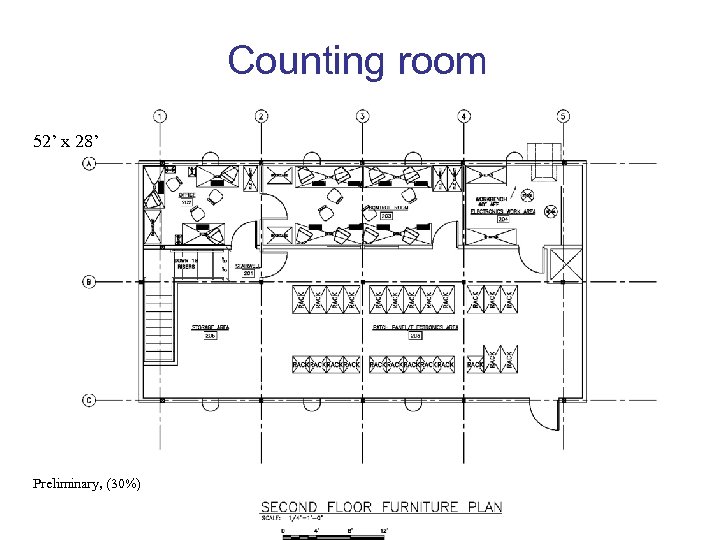
Counting House will be very similar to other buildings at the South Pole. ARO building, South Pole
Low temperature Laboratories and Test facilities • The Collaboration is building production and test facilities in Europe, US and in Japan. • Sensors to be tested in large dark freezers. • Production, Verification and initial calibration of each DOM during extended test periods (months) prior to deployment.
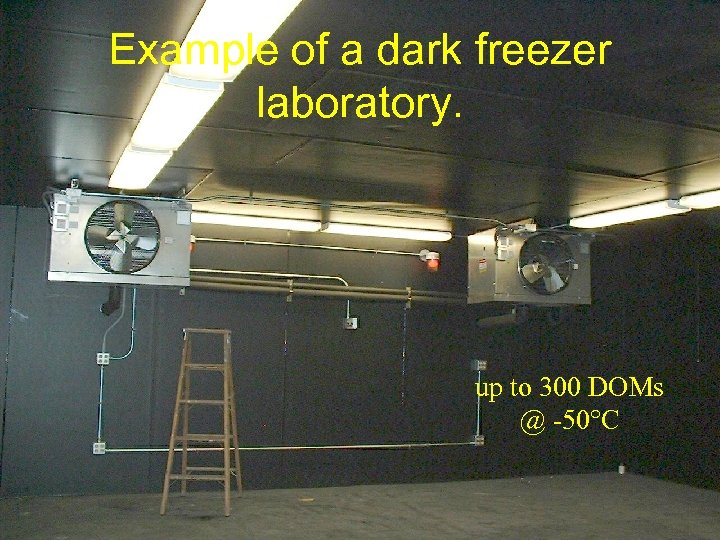
Example of a dark freezer laboratory. up to 300 DOMs @ -50°C
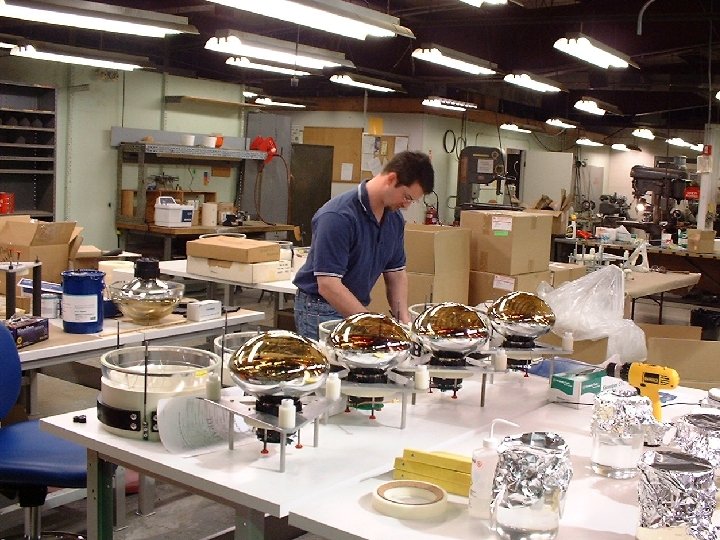

Production of drill components
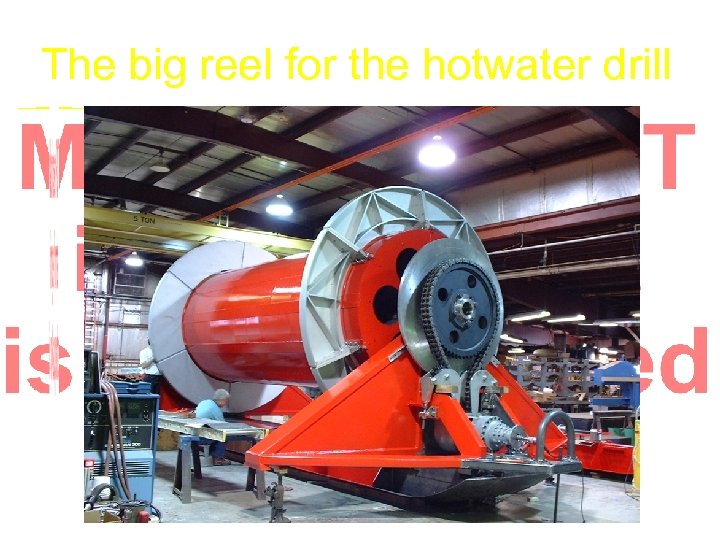
The big reel for the hotwater drill

Hotwater Drilling • New drill: Faster and more reliable. • Drilling time to 2000 m depth: 35 h • (AMANDA: 80 h) • Diameter: 50 cm Picture: AMANDA drill
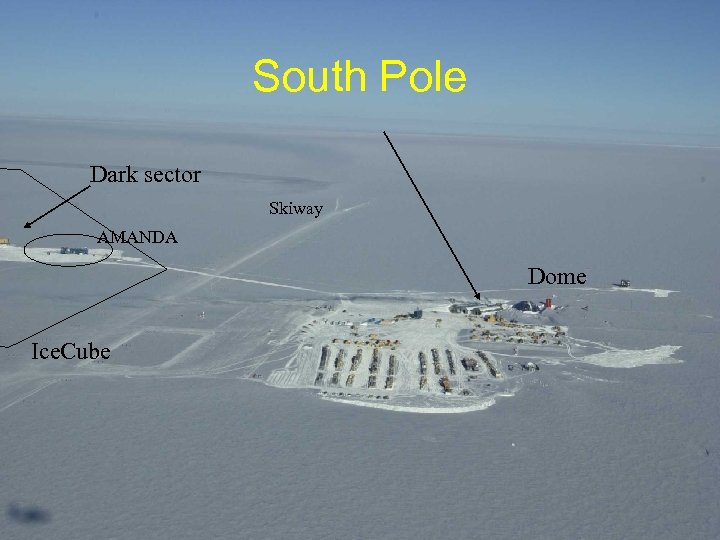
South Pole Dark sector Skiway AMANDA Dome Ice. Cube

First Deployment planned in 04/05 season. No more freezing: Deployment will be in heated environment.
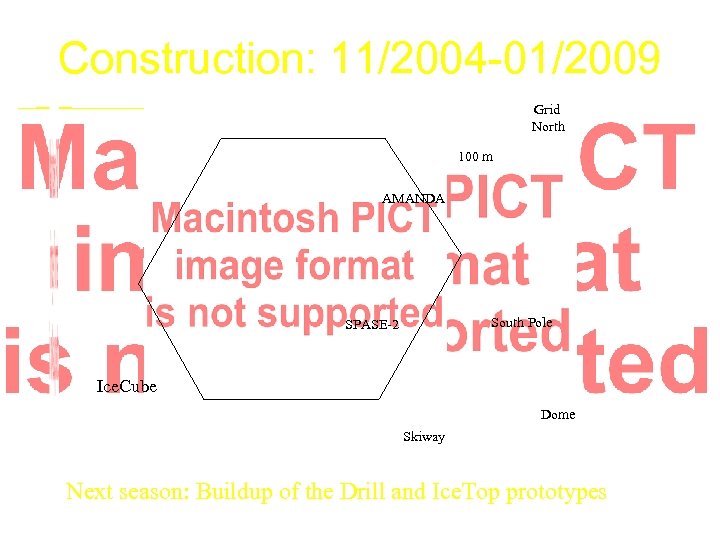
Construction: 11/2004 -01/2009 Grid North 100 m AMANDA South Pole SPASE-2 Ice. Cube Dome Skiway Next season: Buildup of the Drill and Ice. Top prototypes
Скачать презентацию Optical Sensor and DAQ in Ice Cube Chiba
de58661193eb94d8262ce9826da13106.ppt