 Скачать презентацию Optical Performance Modeling of the James Webb Space
027c0fca154fcf50524f7132d5a9e8ff.ppt
- Количество слайдов: 1



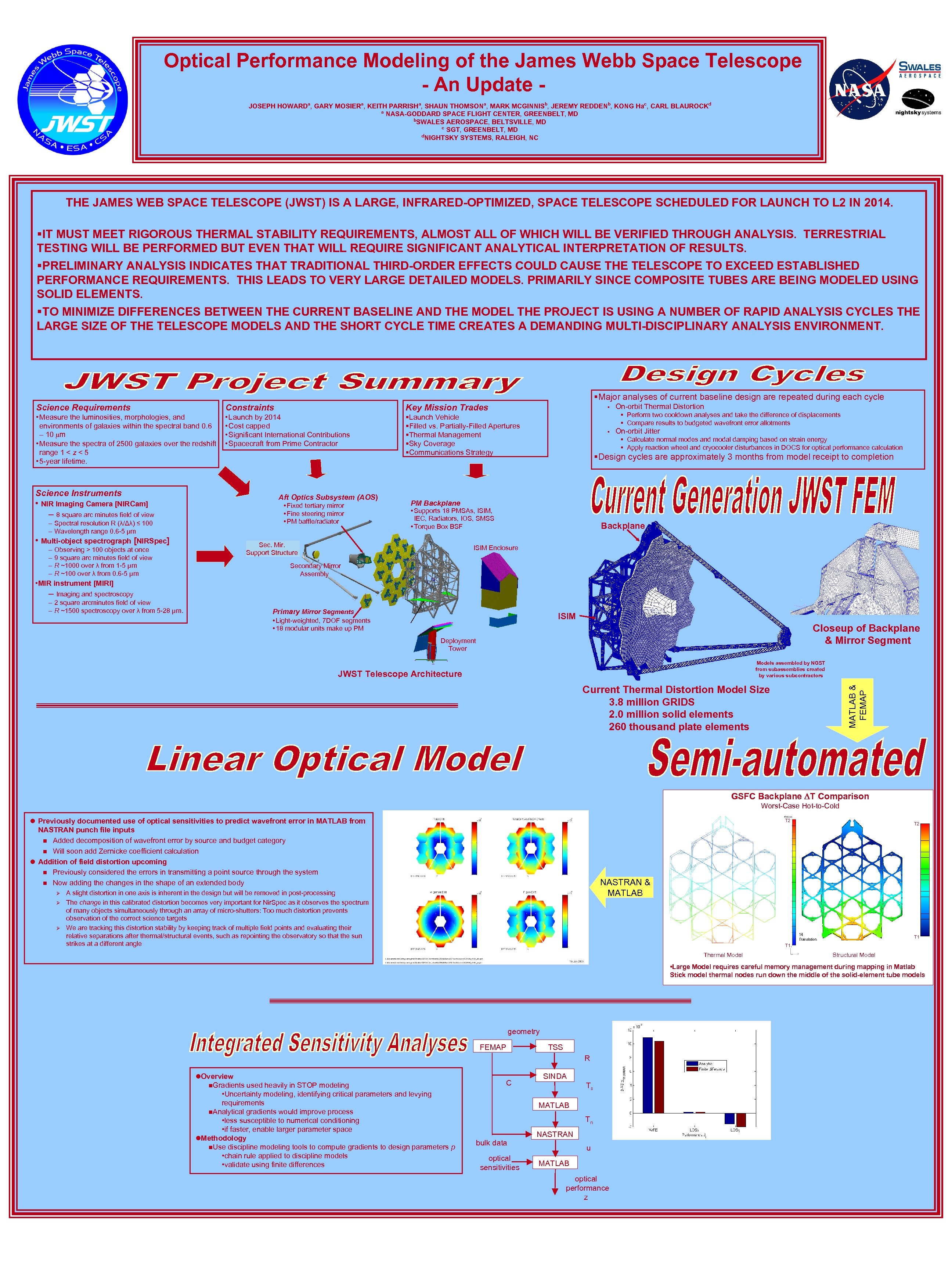
Optical Performance Modeling of the James Webb Space Telescope - An Update JOSEPH HOWARDa, GARY MOSIERa, KEITH PARRISHa, SHAUN THOMSONa, MARK MCGINNISb, JEREMY REDDENb, KONG Hac, CARL BLAUROCKd a NASA-GODDARD SPACE FLIGHT CENTER, GREENBELT, MD b SWALES AEROSPACE, BELTSVILLE, MD c SGT, GREENBELT, MD d NIGHTSKY SYSTEMS, RALEIGH, NC THE JAMES WEB SPACE TELESCOPE (JWST) IS A LARGE, INFRARED-OPTIMIZED, SPACE TELESCOPE SCHEDULED FOR LAUNCH TO L 2 IN 2014. §IT MUST MEET RIGOROUS THERMAL STABILITY REQUIREMENTS, ALMOST ALL OF WHICH WILL BE VERIFIED THROUGH ANALYSIS. TERRESTRIAL TESTING WILL BE PERFORMED BUT EVEN THAT WILL REQUIRE SIGNIFICANT ANALYTICAL INTERPRETATION OF RESULTS. §PRELIMINARY ANALYSIS INDICATES THAT TRADITIONAL THIRD-ORDER EFFECTS COULD CAUSE THE TELESCOPE TO EXCEED ESTABLISHED PERFORMANCE REQUIREMENTS. THIS LEADS TO VERY LARGE DETAILED MODELS. PRIMARILY SINCE COMPOSITE TUBES ARE BEING MODELED USING SOLID ELEMENTS. §TO MINIMIZE DIFFERENCES BETWEEN THE CURRENT BASELINE AND THE MODEL THE PROJECT IS USING A NUMBER OF RAPID ANALYSIS CYCLES THE LARGE SIZE OF THE TELESCOPE MODELS AND THE SHORT CYCLE TIME CREATES A DEMANDING MULTI-DISCIPLINARY ANALYSIS ENVIRONMENT. §Major analyses of current baseline design are repeated during each cycle Science Requirements Constraints Key Mission Trades § • Measure the luminosities, morphologies, and environments of galaxies within the spectral band 0. 6 – 10 µm • Measure the spectra of 2500 galaxies over the redshift range 1 < z < 5 • 5 -year lifetime. • Launch by 2014 • Cost capped • Significant International Contributions • Spacecraft from Prime Contractor §Launch Vehicle §Filled vs. Partially-Filled Apertures §Thermal Management §Sky Coverage §Communications Strategy § Science Instruments • NIR Imaging Camera [NIRCam] – 8 square arc minutes field of view – Spectral resolution R (λ/Δλ) ≤ 100 – Wavelength range 0. 6 -5 µm • Multi-object spectrograph [NIRSpec] – Observing > 100 objects at once – 9 square arc minutes field of view – R ~1000 over λ from 1 -5 µm – R ~100 over λ from 0. 6 -5 µm Aft Optics Subsystem (AOS) • Fixed tertiary mirror • Fine steering mirror • PM baffle/radiator On-orbit Thermal Distortion § Perform two cooldown analyses and take the difference of displacements § Compare results to budgeted wavefront error allotments On-orbit Jitter § Calculate normal modes and modal damping based on strain energy § Apply reaction wheel and cryocooler disturbances in DOCS for optical performance calculation §Design cycles are approximately 3 months from model receipt to completion PM Backplane • Supports 18 PMSAs, ISIM, IEC, Radiators, IOS, SMSS • Torque Box BSF Sec. Mir. Support Structure Backplane ISIM Enclosure Secondary Mirror Assembly • MIR instrument [MIRI] – Imaging and spectroscopy – 2 square arcminutes field of view – R ~1500 spectroscopy over λ from 5 -28 µm. Primary Mirror Segments ISIM • Light-weighted, 7 DOF segments • 18 modular units make up PM Closeup of Backplane & Mirror Segment Deployment Tower Models assembled by NGST from subassemblies created by various subcontractors JWST Telescope Architecture MATLAB & FEMAP Current Thermal Distortion Model Size 3. 8 million GRIDS 2. 0 million solid elements 260 thousand plate elements GSFC Backplane DT Comparison Worst-Case Hot-to-Cold l Previously documented use of optical sensitivities to predict wavefront error in MATLAB from NASTRAN punch file inputs n Added decomposition of wavefront error by source and budget category n Will soon add Zernicke coefficient calculation l Addition of field distortion upcoming n Previously considered the errors in transmitting a point source through the system n Now adding the changes in the shape of an extended body Ø Ø Ø A slight distortion in one axis is inherent in the design but will be removed in post-processing The change in this calibrated distortion becomes very important for Nir. Spec as it observes the spectrum of many objects simultaneously through an array of micro-shutters: Too much distortion prevents observation of the correct science targets We are tracking this distortion stability by keeping track of multiple field points and evaluating their relative separations after thermal/structural events, such as repointing the observatory so that the sun strikes at a different angle T 2 NASTRAN & MATLAB SDR 3 Hot-to-cold Slew Wavefront Error T 1 Thermal Model Structural Model • Large Model requires careful memory management during mapping in Matlab Stick model thermal nodes run down the middle of the solid-element tube models geometry FEMAP TSS R l. Overview n. Gradients used heavily in STOP modeling • Uncertainty modeling, identifying critical parameters and levying requirements n. Analytical gradients would improve process • less susceptible to numerical conditioning • if faster, enable larger parameter space l. Methodology n. Use discipline modeling tools to compute gradients to design parameters p • chain rule applied to discipline models • validate using finite differences C SINDA Ts MATLAB Tn bulk data optical sensitivities NASTRAN u MATLAB optical performance z
Скачать презентацию Optical Performance Modeling of the James Webb Space
027c0fca154fcf50524f7132d5a9e8ff.ppt