 Скачать презентацию Optical Networks CS 294 -3 Distributed Service
033527cb35339acd34cf79ab2b335a90.ppt
- Количество слайдов: 37



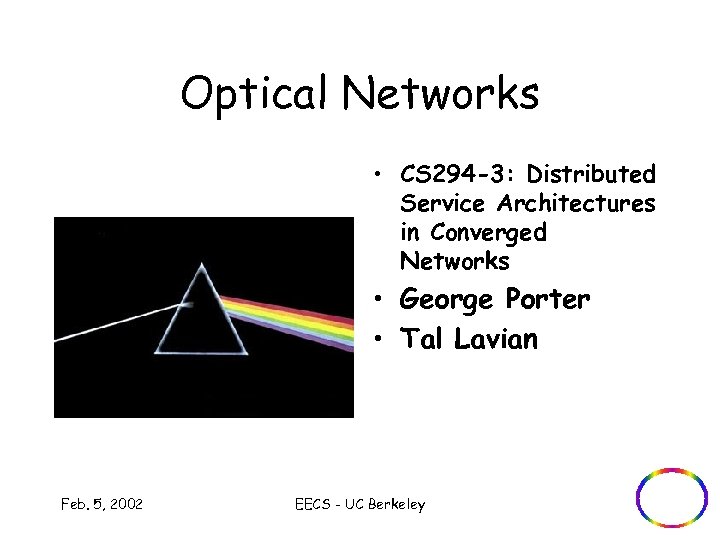
Optical Networks • CS 294 -3: Distributed Service Architectures in Converged Networks • George Porter • Tal Lavian Feb. 5, 2002 EECS - UC Berkeley
Overview • Physical technology, devices • How are optical networks currently deployed? • Customer-empowered networks – – New applications, ways of doing business How does this change the “big picture”? How do we do it? What are the challenges? Payoffs? Feb. 5, 2002 EECS - UC Berkeley
Overview • Physical technology, devices • How are optical networks currently deployed? • Customer-empowered networks – – New applications, ways of doing business How does this change the “big picture”? How do we do it? What are the challenges? Payoffs? Feb. 5, 2002 EECS - UC Berkeley
Why optical? • Handle increase in IP traffic – Moore’s law doesn’t apply here – 1984: 50 Mbps, 2001: 6. 4 Tbps • Reduce cost of transmitting a bit – Cost/bit down by 99% in last 5 years • Enable new applications and services by pushing optics towards the edges Feb. 5, 2002 EECS - UC Berkeley
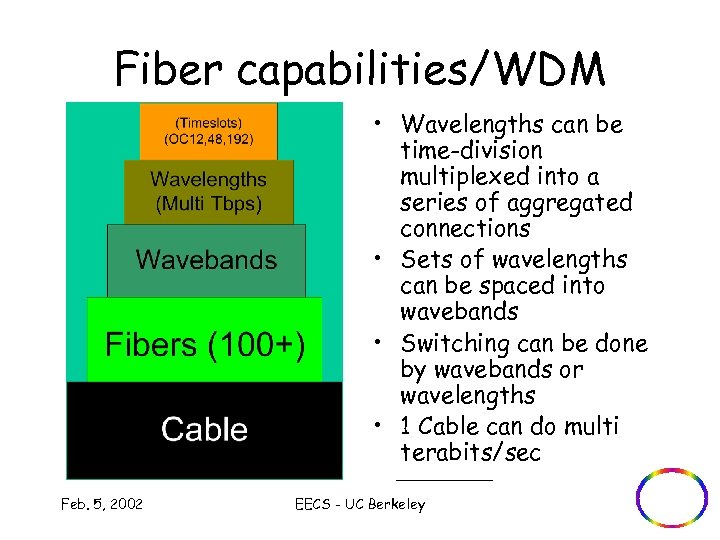
Fiber capabilities/WDM • Wavelengths can be time-division multiplexed into a series of aggregated connections • Sets of wavelengths can be spaced into wavebands • Switching can be done by wavebands or wavelengths • 1 Cable can do multi terabits/sec Feb. 5, 2002 EECS - UC Berkeley
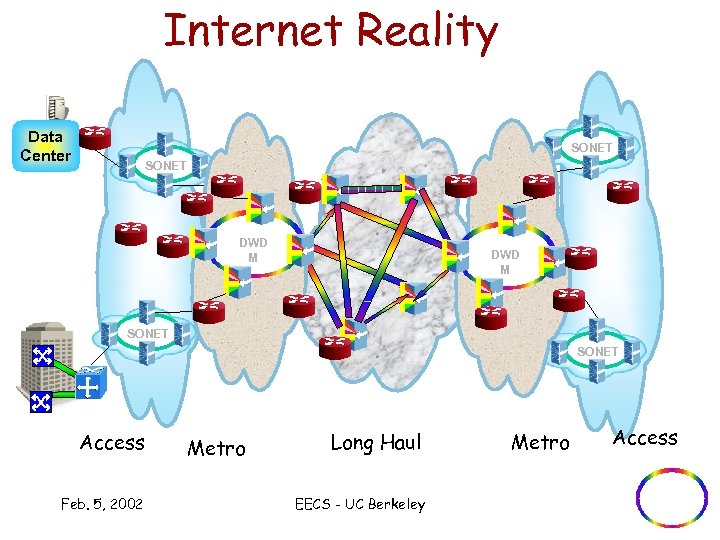
Internet Reality Data Center SONET DWD M SONET Access Feb. 5, 2002 Metro Long Haul EECS - UC Berkeley Metro Access
Devices • Add/Drop multiplexer • Optical Cross Connect (OXC) – Tunable: no need to keep the same wavelength end-to-end – Switches lambdas from input to output port • For “transparent optical network”, wavelengths treated as opaque objects, with routing control brought out-of-band Feb. 5, 2002 EECS - UC Berkeley
Overview • Physical technology, devices • How are optical networks currently deployed? • Customer-empowered networks – – New applications, ways of doing business How does this change the “big picture”? How do we do it? What are the challenges? Payoffs? Feb. 5, 2002 EECS - UC Berkeley
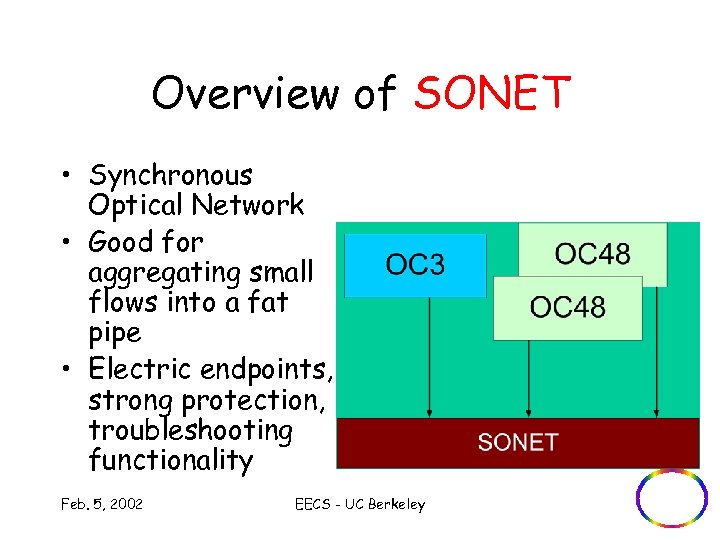
Overview of SONET • Synchronous Optical Network • Good for aggregating small flows into a fat pipe • Electric endpoints, strong protection, troubleshooting functionality Feb. 5, 2002 EECS - UC Berkeley
Today’s provisioning • Anywhere between months to minutes – Semi-automatic schemes – Much like old-style telephone operator • The fact is there are tons of fibers underground, but they are not organized in a way where you can utilize their full potential Feb. 5, 2002 EECS - UC Berkeley
Drive to autoswitched network • Make the network intelligent • On-demand bandwidth to the edge of the network • New applications – Disaster Recovery – Distributed SAN – Data warehousing • Backup Bunkers (no more tapes) – Big Pipes on Demand • Download movies to movie theaters • Site replication – Optical VPN Feb. 5, 2002 EECS - UC Berkeley – Grid Computing
Overview • Physical technology, devices • How are optical networks currently deployed? • Customer-empowered networks – – New applications, ways of doing business How does this change the “big picture”? How do we do it? What are the challenges? Payoffs? Feb. 5, 2002 EECS - UC Berkeley
Customer empowered nets • Huge bandwidth to the enterprise – The curb – The house – The desktop • End hosts can submit requirements to the network, which can then configure itself to provide that service • Issues of APIs, costs, Qo. S Feb. 5, 2002 EECS - UC Berkeley
Changing the big picture • Now the converged network looks different • Dial-up bandwidth has huge implications • Pushing bandwidth to the edges of the network – Affects service placement, for example Feb. 5, 2002 EECS - UC Berkeley
Bandwidth at the edges • Services placed there (Service. Po. P) • Need to connect services to customers and other services • Metro networks – Use of Ethernet as low cost/flexible mechanism • Eventually fibers to pcmcia? ! Feb. 5, 2002 EECS - UC Berkeley
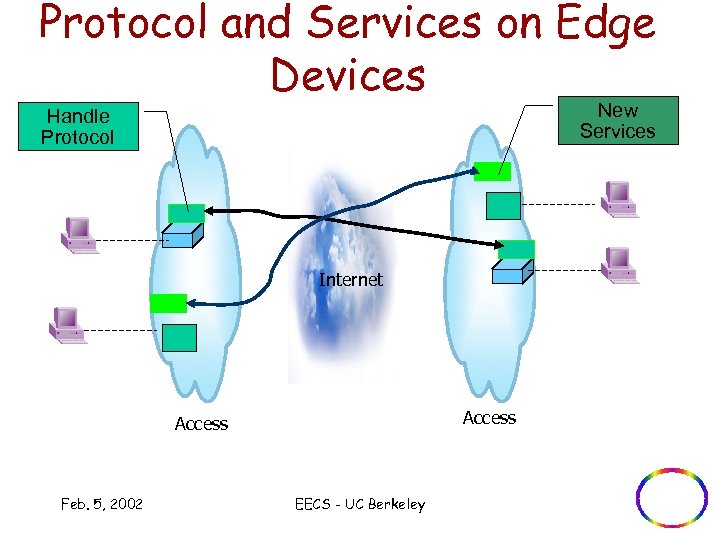
Protocol and Services on Edge Devices New Services Handle Protocol Internet Access Feb. 5, 2002 EECS - UC Berkeley
Service. Po. Ps • Service. Po. Ps act as intermediary between service provider and customer • Connectivity between Service. Po. P and customer more important than provider to customer • Feature is very fast infrastructure Feb. 5, 2002 EECS - UC Berkeley
Metro networks • Interim step: services in service. Po. Ps • Tap into fast connections here for enterprises • Use of Ethernet as protocol to connect the enterprise to the MAN • Avoid need for last mile for certain applications/services Feb. 5, 2002 EECS - UC Berkeley
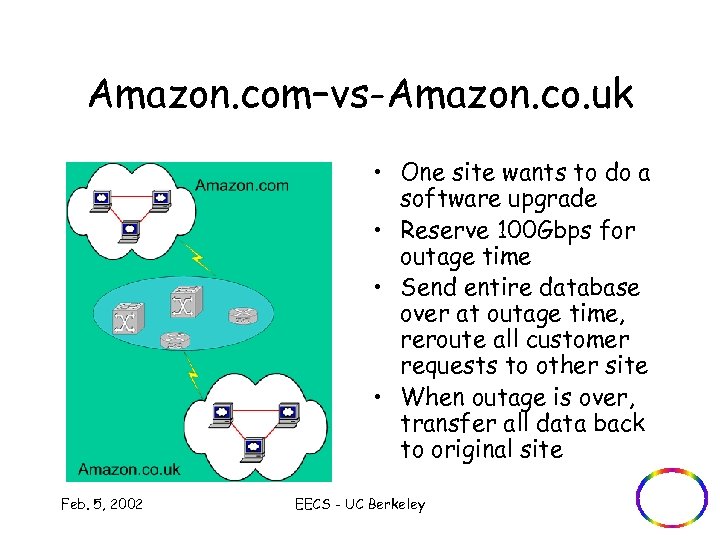
Amazon. com–vs-Amazon. co. uk • One site wants to do a software upgrade • Reserve 100 Gbps for outage time • Send entire database over at outage time, reroute all customer requests to other site • When outage is over, transfer all data back to original site Feb. 5, 2002 EECS - UC Berkeley
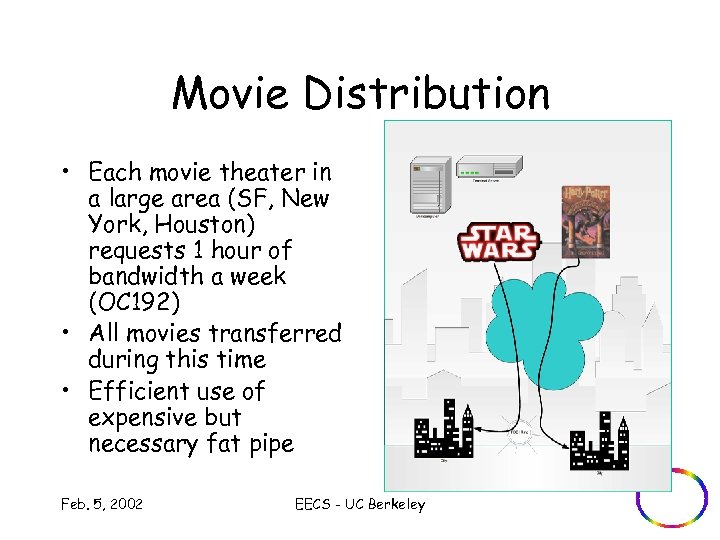
Movie Distribution • Each movie theater in a large area (SF, New York, Houston) requests 1 hour of bandwidth a week (OC 192) • All movies transferred during this time • Efficient use of expensive but necessary fat pipe Feb. 5, 2002 EECS - UC Berkeley
New type of businesses • Data warehousing: no more mailing tapes • Have tape vaults with gigabit connectivity • Data is sent optically to destination, where it is written to magnetic tape Feb. 5, 2002 EECS - UC Berkeley
How to do it • Generalized Multiprotocol Label Switching (GMPLS) • UNI: user-to-network interface as API to specify requirements, service requests • NNI: network-to-network interface acts as API between entities for service composition/path formation Feb. 5, 2002 EECS - UC Berkeley
How to do it • Interdomain? • Wavelength selection/routing • Exchange info – – Connectivity Wavelengths Qos, bandwidth requirements Switching instructions Feb. 5, 2002 EECS - UC Berkeley
Canarie’s approach • OBGP (Optical BGP) • Routers spawn “virtual BGP” processes that peers can connect to • By modifying BGP messages, lightpath information can be traded between ASes Feb. 5, 2002 EECS - UC Berkeley
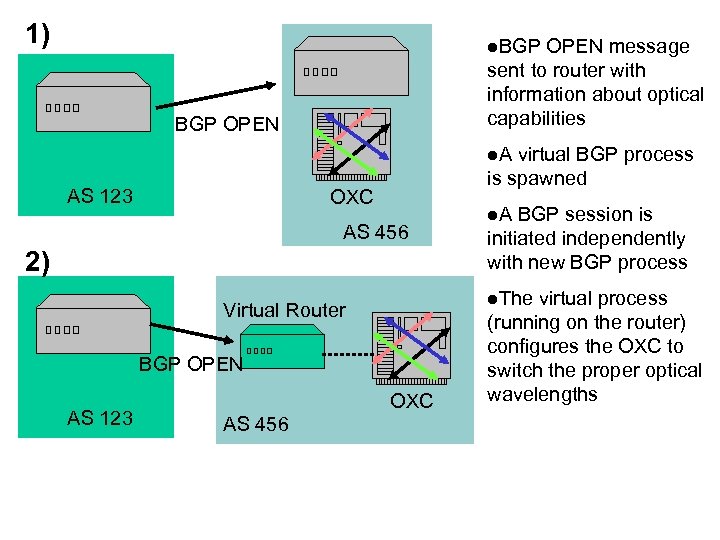
1) l. BGP OPEN message sent to router with information about optical capabilities BGP OPEN l. A AS 123 virtual BGP process is spawned OXC AS 456 2) BGP OPEN OXC AS 456 BGP session is initiated independently with new BGP process l. The Virtual Router AS 123 l. A virtual process (running on the router) configures the OXC to switch the proper optical wavelengths
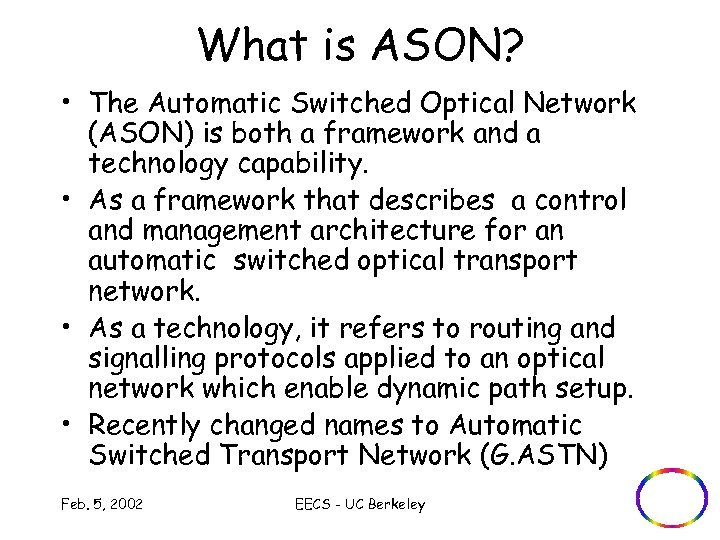
What is ASON? • The Automatic Switched Optical Network (ASON) is both a framework and a technology capability. • As a framework that describes a control and management architecture for an automatic switched optical transport network. • As a technology, it refers to routing and signalling protocols applied to an optical network which enable dynamic path setup. • Recently changed names to Automatic Switched Transport Network (G. ASTN) Feb. 5, 2002 EECS - UC Berkeley
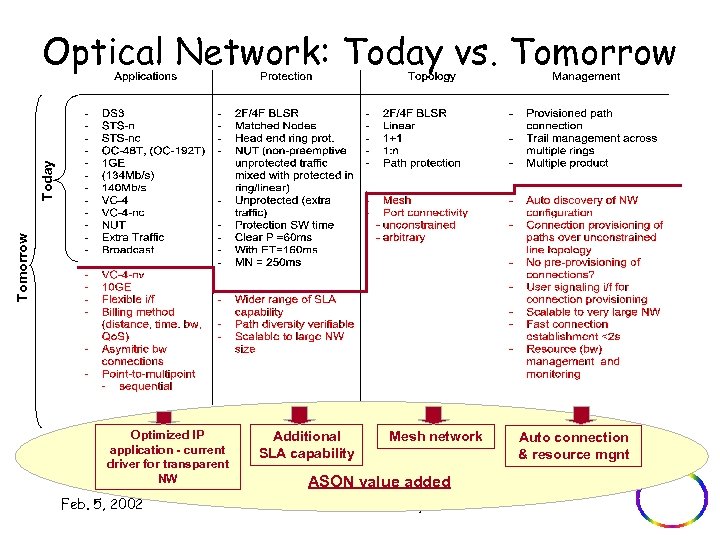
Tomorrow Today Optical Network: Today vs. Tomorrow Optimized IP application - current driver for transparent NW Feb. 5, 2002 Additional SLA capability Mesh network ASON value added EECS - UC Berkeley Auto connection & resource mgnt
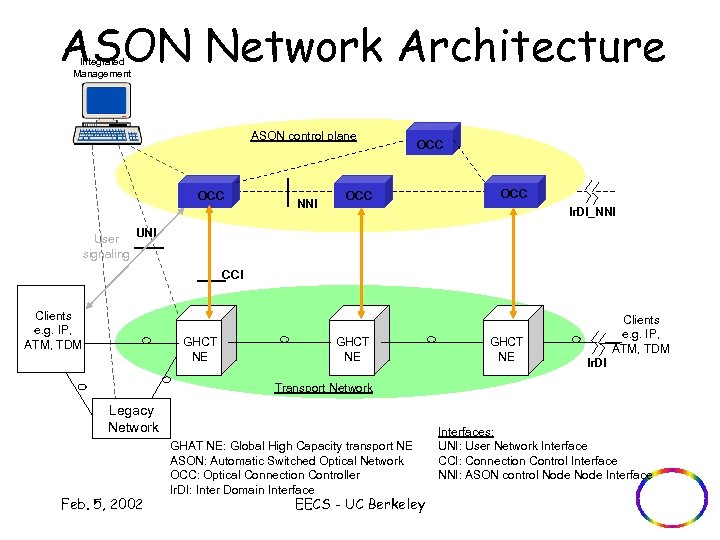
ASON Network Architecture Integrated Management ASON control plane OCC User signaling NNI OCC OCC Ir. DI_NNI UNI CCI Clients e. g. IP, ATM, TDM GHCT NE Clients e. g. IP, ATM, TDM Ir. DI Transport Network Legacy Network Feb. 5, 2002 GHAT NE: Global High Capacity transport NE ASON: Automatic Switched Optical Network OCC: Optical Connection Controller Ir. DI: Inter Domain Interface EECS - UC Berkeley Interfaces: UNI: User Network Interface CCI: Connection Control Interface NNI: ASON control Node Interface
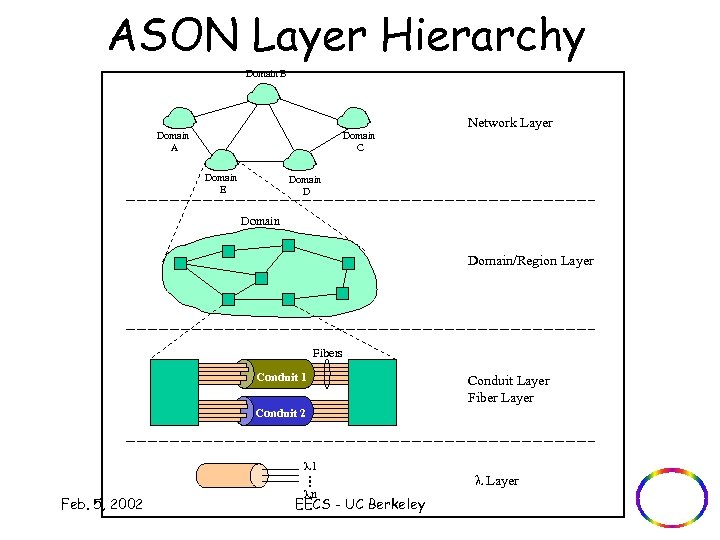
ASON Layer Hierarchy Domain B Domain A Domain C Domain E Network Layer Domain/Region Layer Fibers Conduit 1 Conduit Layer Fiber Layer Conduit 2 l 1 Feb. 5, 2002 ln EECS - UC Berkeley l Layer
Resilient packet ring (802. 17) • Put lan on top of man • 50 ms protection • Feb. 5, 2002 EECS - UC Berkeley
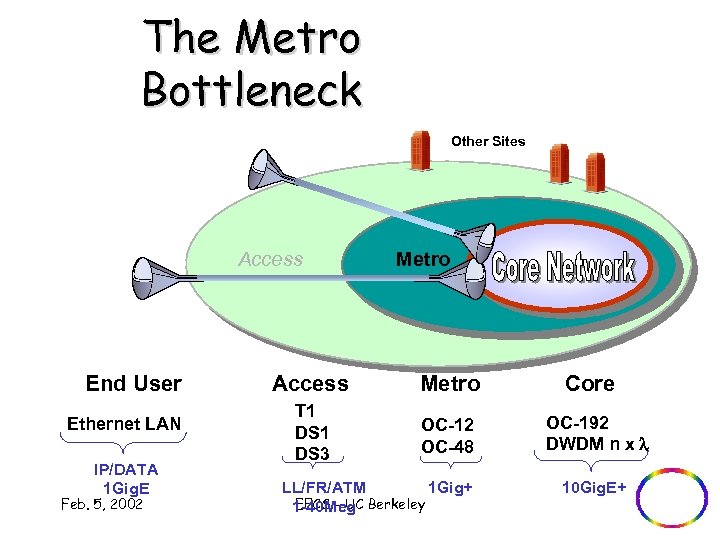
The Metro Bottleneck Other Sites Access End User Ethernet LAN IP/DATA 1 Gig. E Feb. 5, 2002 Metro Access Metro T 1 DS 3 OC-12 OC-48 LL/FR/ATM 1 Gig+ EECS - UC 1 -40 Meg Berkeley Core OC-192 DWDM n x l 10 Gig. E+
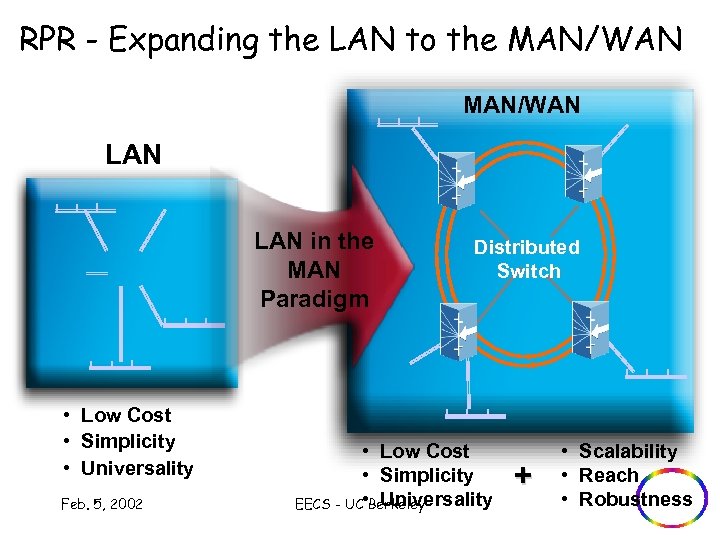
RPR - Expanding the LAN to the MAN/WAN LAN in the MAN Paradigm • Low Cost • Simplicity • Universality Feb. 5, 2002 Distributed Switch • Low Cost • Simplicity Universality EECS - UC • Berkeley + • Scalability • Reach • Robustness
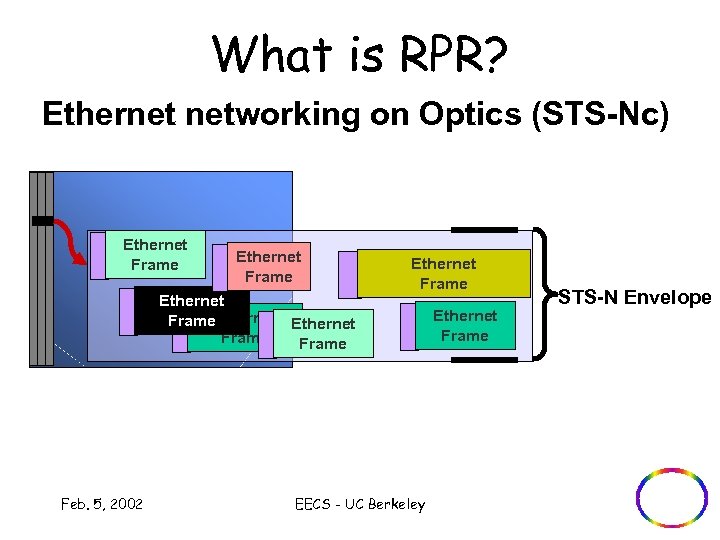
What is RPR? Ethernet networking on Optics (STS-Nc) Ethernet Frame Ethernet Frame Feb. 5, 2002 Ethernet Frame EECS - UC Berkeley Ethernet Frame STS-N Envelope
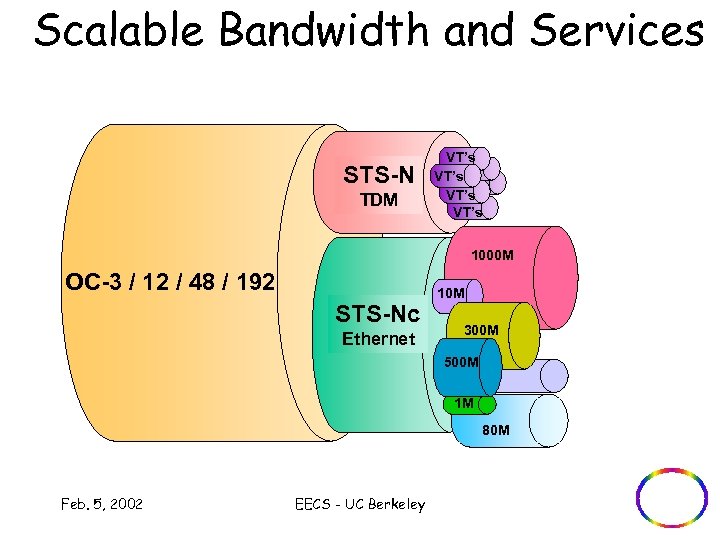
Scalable Bandwidth and Services STS-N TDM VT’s 1000 M OC-3 / 12 / 48 / 192 STS-Nc Ethernet 10 M 300 M 500 M 1 M 80 M Feb. 5, 2002 EECS - UC Berkeley
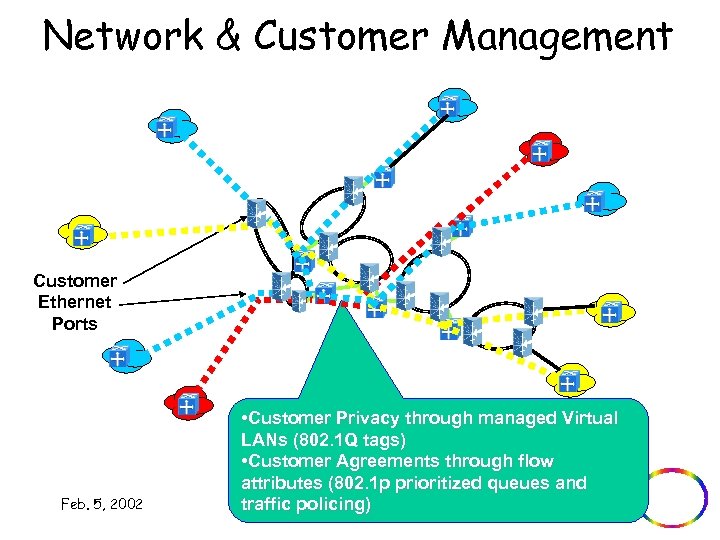
Network & Customer Management Customer Ethernet Ports Feb. 5, 2002 • Customer Privacy through managed Virtual LANs (802. 1 Q tags) • Customer Agreements through flow attributes (802. 1 p prioritized queues and traffic EECS - UC Berkeley policing)
Move to optical • The key is to find a way to use the infrastructure that we have available in an efficient manner • What services are available? What can we do? • Challenges? Feb. 5, 2002 EECS - UC Berkeley
The Future is Bright e h t in t h a lig s n f nd o e t ere i Th Feb. 5, 2002 l unne he t EECS - UC Berkeley
Скачать презентацию Optical Networks CS 294 -3 Distributed Service
033527cb35339acd34cf79ab2b335a90.ppt