


 Скачать презентацию Optical Imaging http www stecf org rhook NEON Archive_Garching 2008 ppt
d4c2c0ffda317a44a415699c948f1024.ppt
- Количество слайдов: 37
 Optical Imaging http: //www. stecf. org/~rhook/NEON/Archive_Garching 2008. ppt Richard Hook ST-ECF/ESO 27 th August 2008 NEON Archive School, Garching 1
 Some Caveats & Warnings! • This is an overview of some basic aspects of direct astronomical digital imaging - but many things are omitted (eg, adaptive optics)! • I have tried to not mention material covered in other talks (photometry, spectroscopy…) • I am a bit biased by my own background, mostly Hubble imaging. • I have avoided getting deep into technicalities so apologise if some material seems rather trivial. 27 th August 2008 NEON Archive School, Garching 2
 Summary of topics • • The imaging formation process The point-spread function The pixel-response function Artifacts, defects and noise characteristics Basic image reduction Image combination, dithering and drizzling FITS format and metadata • Colour • Software - the Scisoft collection 27 th August 2008 NEON Archive School, Garching 3
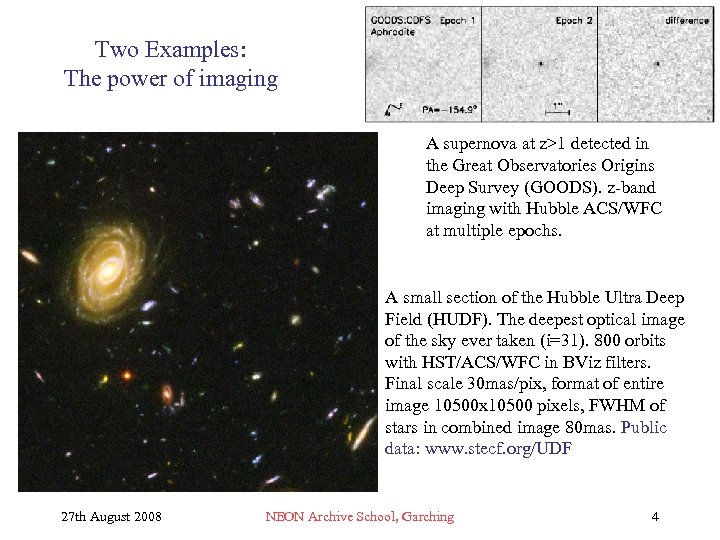 Two Examples: The power of imaging A supernova at z>1 detected in the Great Observatories Origins Deep Survey (GOODS). z-band imaging with Hubble ACS/WFC at multiple epochs. A small section of the Hubble Ultra Deep Field (HUDF). The deepest optical image of the sky ever taken (i=31). 800 orbits with HST/ACS/WFC in BViz filters. Final scale 30 mas/pix, format of entire image 10500 x 10500 pixels, FWHM of stars in combined image 80 mas. Public data: www. stecf. org/UDF 27 th August 2008 NEON Archive School, Garching 4
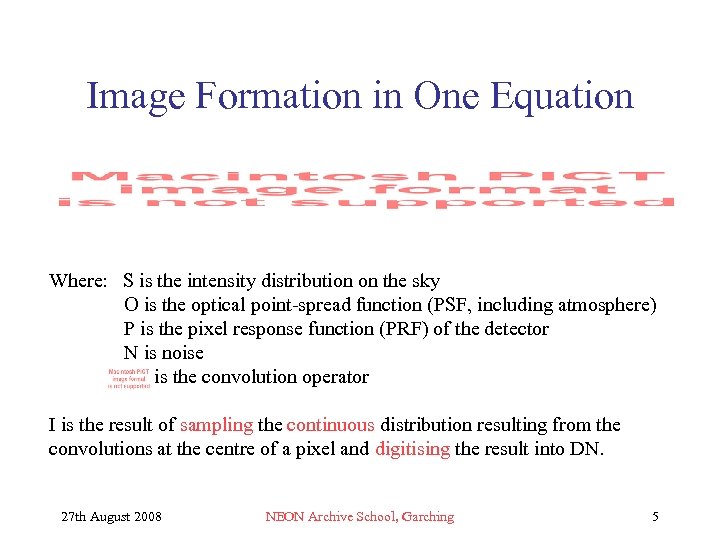 Image Formation in One Equation Where: S is the intensity distribution on the sky O is the optical point-spread function (PSF, including atmosphere) P is the pixel response function (PRF) of the detector N is noise is the convolution operator I is the result of sampling the continuous distribution resulting from the convolutions at the centre of a pixel and digitising the result into DN. 27 th August 2008 NEON Archive School, Garching 5
 The Point-Spread Function (O) • The PSF is the shape of the image of a point source (such as a star) at the detector • It determines the resolution and structure of an image • The two main influences on the PSF are the optics and the atmosphere • PSFs vary with time, position on the image, colour etc 27 th August 2008 NEON Archive School, Garching 6
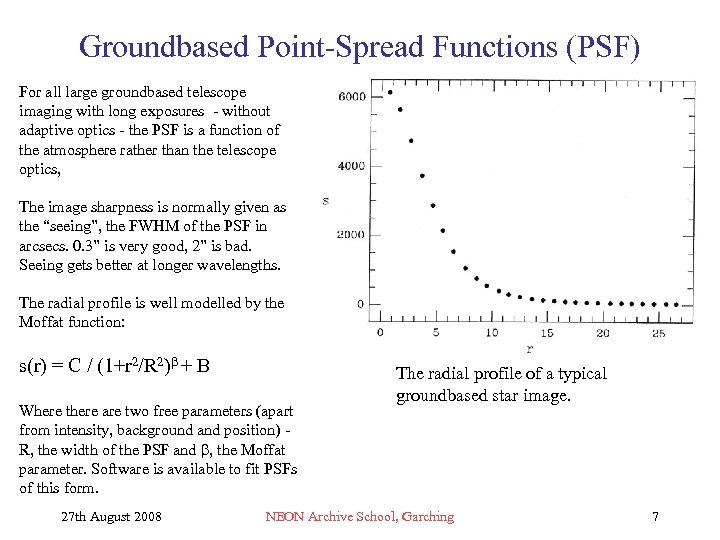 Groundbased Point-Spread Functions (PSF) For all large groundbased telescope imaging with long exposures - without adaptive optics - the PSF is a function of the atmosphere rather than the telescope optics, The image sharpness is normally given as the “seeing”, the FWHM of the PSF in arcsecs. 0. 3” is very good, 2” is bad. Seeing gets better at longer wavelengths. The radial profile is well modelled by the Moffat function: s(r) = C / (1+r 2/R 2)b + B Where there are two free parameters (apart from intensity, background and position) R, the width of the PSF and b, the Moffat parameter. Software is available to fit PSFs of this form. 27 th August 2008 The radial profile of a typical groundbased star image. NEON Archive School, Garching 7
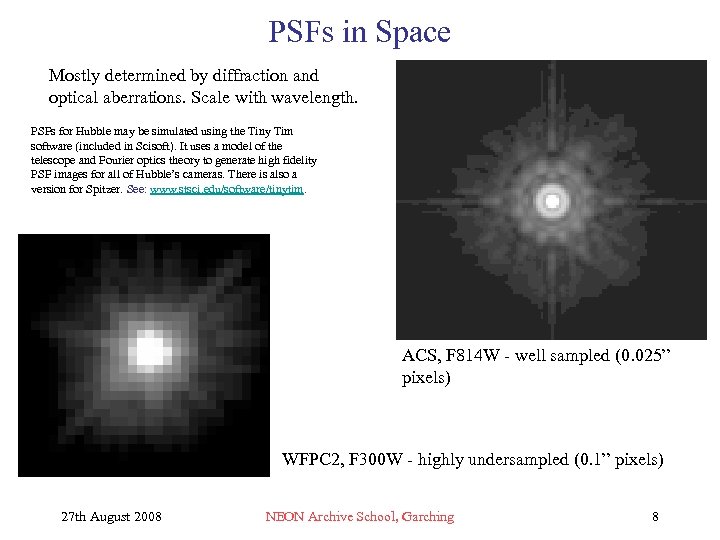 PSFs in Space Mostly determined by diffraction and optical aberrations. Scale with wavelength. PSFs for Hubble may be simulated using the Tiny Tim software (included in Scisoft). It uses a model of the telescope and Fourier optics theory to generate high fidelity PSF images for all of Hubble’s cameras. There is also a version for Spitzer. See: www. stsci. edu/software/tinytim. ACS, F 814 W - well sampled (0. 025” pixels) WFPC 2, F 300 W - highly undersampled (0. 1” pixels) 27 th August 2008 NEON Archive School, Garching 8
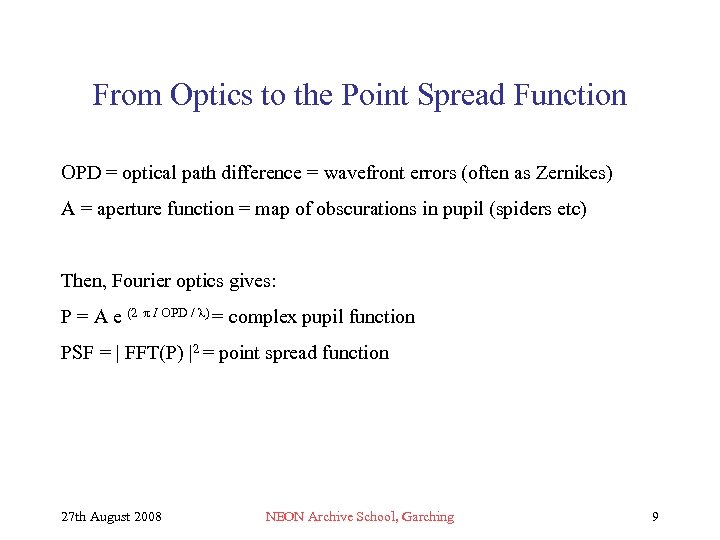 From Optics to the Point Spread Function OPD = optical path difference = wavefront errors (often as Zernikes) A = aperture function = map of obscurations in pupil (spiders etc) Then, Fourier optics gives: P = A e (2 I OPD / ) = complex pupil function PSF = | FFT(P) |2 = point spread function 27 th August 2008 NEON Archive School, Garching 9
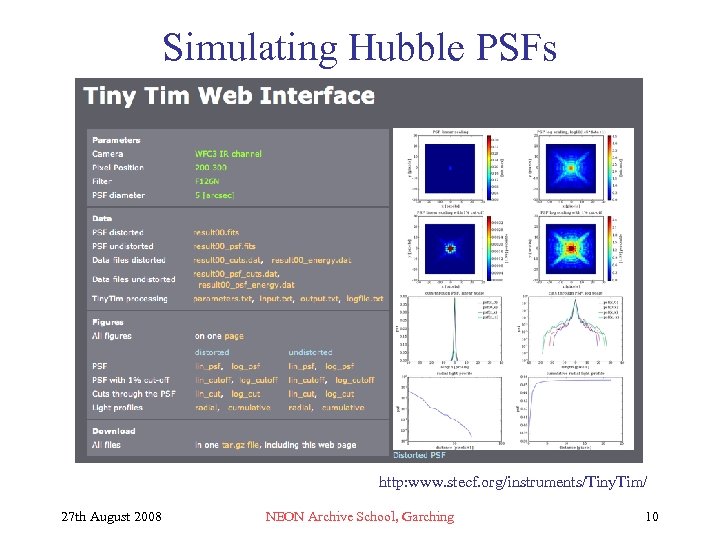 Simulating Hubble PSFs http: www. stecf. org/instruments/Tiny. Tim/ 27 th August 2008 NEON Archive School, Garching 10
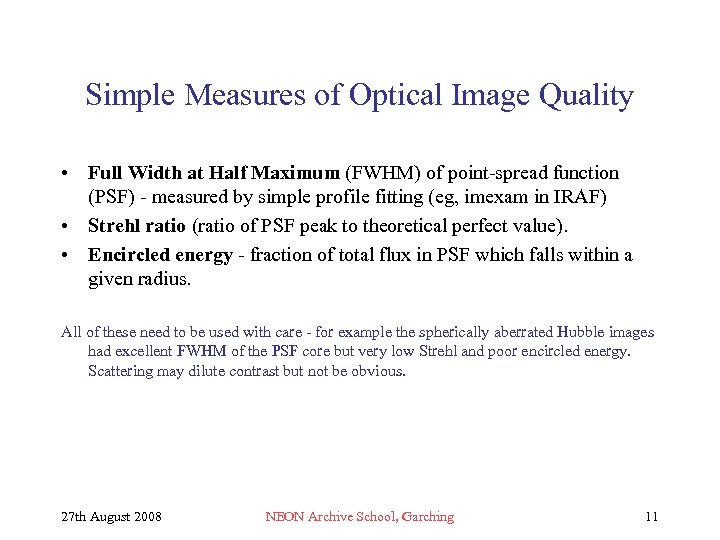 Simple Measures of Optical Image Quality • Full Width at Half Maximum (FWHM) of point-spread function (PSF) - measured by simple profile fitting (eg, imexam in IRAF) • Strehl ratio (ratio of PSF peak to theoretical perfect value). • Encircled energy - fraction of total flux in PSF which falls within a given radius. All of these need to be used with care - for example the spherically aberrated Hubble images had excellent FWHM of the PSF core but very low Strehl and poor encircled energy. Scattering may dilute contrast but not be obvious. 27 th August 2008 NEON Archive School, Garching 11
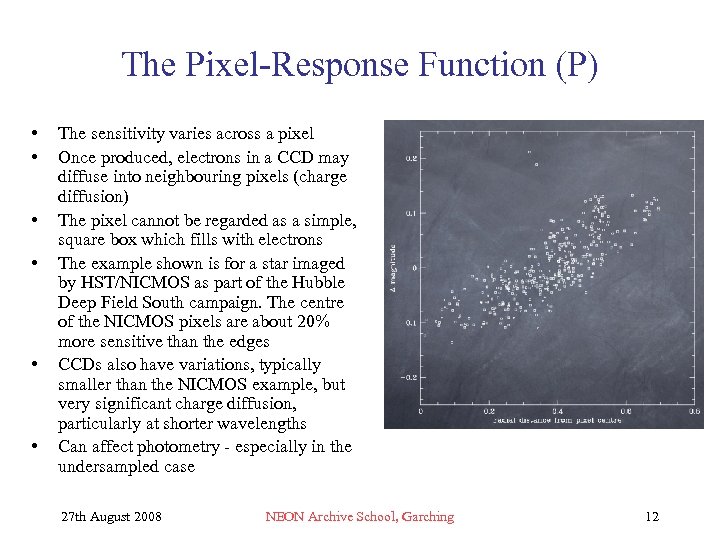 The Pixel-Response Function (P) • • • The sensitivity varies across a pixel Once produced, electrons in a CCD may diffuse into neighbouring pixels (charge diffusion) The pixel cannot be regarded as a simple, square box which fills with electrons The example shown is for a star imaged by HST/NICMOS as part of the Hubble Deep Field South campaign. The centre of the NICMOS pixels are about 20% more sensitive than the edges CCDs also have variations, typically smaller than the NICMOS example, but very significant charge diffusion, particularly at shorter wavelengths Can affect photometry - especially in the undersampled case 27 th August 2008 NEON Archive School, Garching 12
 Image Defects and Artifacts • Cosmic-ray hits - unpredictable, numerous, bright, worse from space • Bad pixels - predictable (but change with time), fixed to given pixels, may be “hot”, may affect whole columns • Saturation (digital and full-well) and resulting bleeding from bright objects • Ghost images - reflections from optical elements • Cross-talk - electronic ghosts • Charge transfer efficiency artifacts • Glints, grot and many other nasty things 27 th August 2008 NEON Archive School, Garching 13
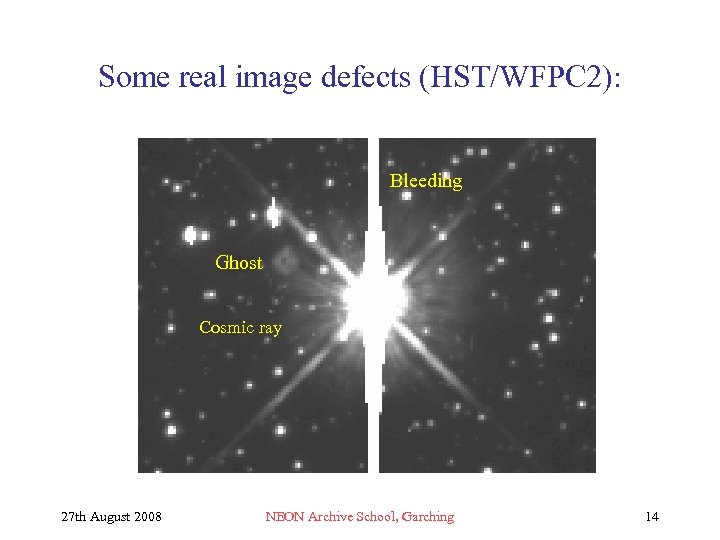 Some real image defects (HST/WFPC 2): Bleeding Ghost Cosmic ray 27 th August 2008 NEON Archive School, Garching 14
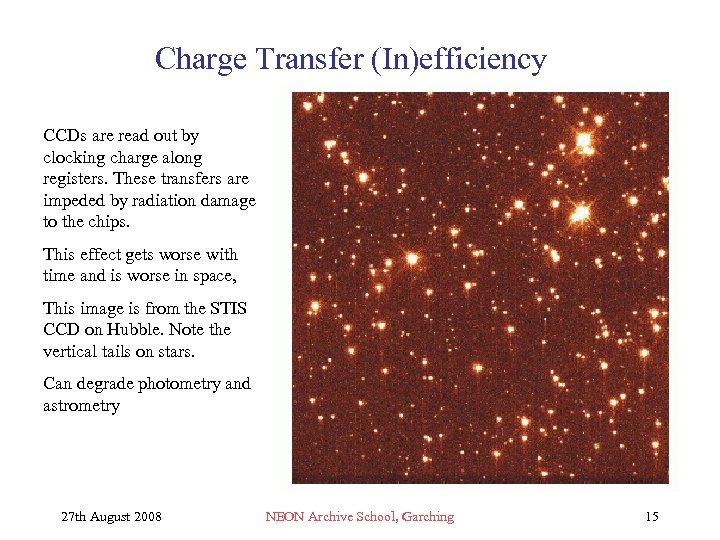 Charge Transfer (In)efficiency CCDs are read out by clocking charge along registers. These transfers are impeded by radiation damage to the chips. This effect gets worse with time and is worse in space, This image is from the STIS CCD on Hubble. Note the vertical tails on stars. Can degrade photometry and astrometry 27 th August 2008 NEON Archive School, Garching 15
 Noise • For CCD images there are two main sources of noise: – Poisson “shot” noise from photon statistics, applies to objects, the sky and dark noise, SNR increases as the square root of exposure time – Gaussian noise from the CCD readout, independent of exposure time • For long exposures of faint objects through broad filters the sky is normally the dominant noise source • For short exposures or through narrow-band filters readout noise can become important but is small for modern CCDs 27 th August 2008 NEON Archive School, Garching 16
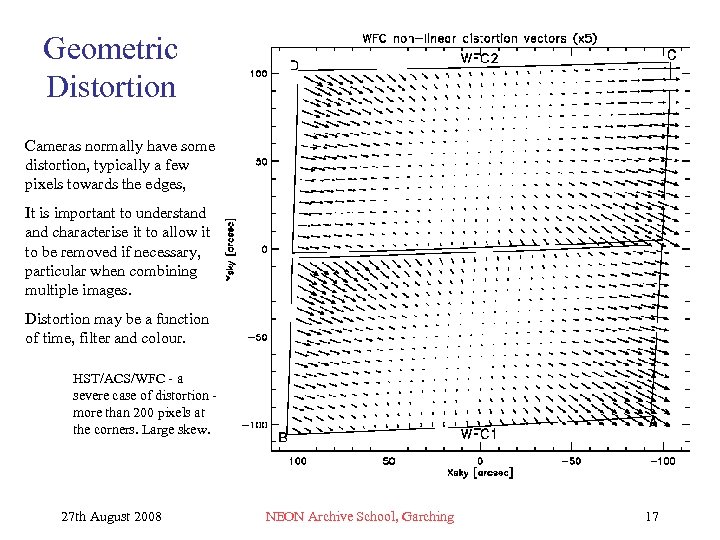 Geometric Distortion Cameras normally have some distortion, typically a few pixels towards the edges, It is important to understand characterise it to allow it to be removed if necessary, particular when combining multiple images. Distortion may be a function of time, filter and colour. HST/ACS/WFC - a severe case of distortion more than 200 pixels at the corners. Large skew. 27 th August 2008 NEON Archive School, Garching 17
 Basic Frame Calibration • Raw CCD images are normally processed by a standard pipeline to remove the instrumental signature. The main three steps are: – Subtraction of bias (zero-point offset) – Subtraction of dark (proportional to exposure) – Division by flat-field (correction for sensitivity variation) • Once good calibration files are available basic processing can be automated and reliable • After this processing images are not combined and still contain cosmic rays and other defects • Standard archive products for some telescopes (eg, Hubble) have had On-The-Fly Recalibration (OTFR) performed with the best reference files 27 th August 2008 NEON Archive School, Garching 18
 Sampling and Frame Size • Ideally pixels should be small enough to well sample the PSF (ie, PRF negligible). Pixel < PSF_FWHM/2. • But, small pixels have disadvantages: – Smaller fields of view (detectors are finite and expensive) – More detector noise per unit sky area (eg, PC/WF comparison) • Instrument designers have to balance these factors and often opt for pixel scales which undersample the PSF. – Eg, HST/WFPC 2/WF - PSF about 50 mas at V, PRF 100 mas. – HST/ACS/WFC - PSF about 30 mas at U, PRF 50 mas. • In the undersampled regime the PRF > PSF • From the ground sampling depends on the seeing, instrument designers need to anticipate the likely quality of the site. 27 th August 2008 NEON Archive School, Garching 19
 Image Combination • Multiple images are normally taken of the same target: – To avoid too many cosmic-rays – To allow longer exposures – To allow dithering (small shifts between exposures) – To allow mosaicing (large shifts to cover bigger areas) • If the multiple images are well aligned then they may be combined easily using tools such as imcombine in IRAF which can also flag and ignore certain image defects such as cosmic-rays • Combining multiple dithered images, particularly if they are undersampled is less easy… 27 th August 2008 NEON Archive School, Garching 20
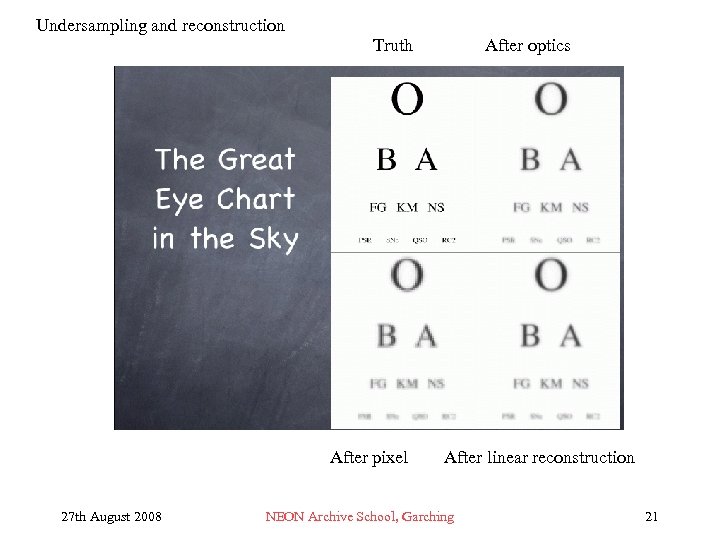 Undersampling and reconstruction Truth After pixel 27 th August 2008 After optics After linear reconstruction NEON Archive School, Garching 21
 Simple ways of combining dithered data • Shift-and-add - introduces extra blurring and can’t handle distortion, easy, fast. Useful when there are many images and little distortion. Fast. • Interlacing - putting input image pixel values onto a finer output grid and using precise fractional offsets. • More sophisticated re-sampling and flux-redistributing algorithms • In all cases you need a way to measure the shifts (and possibly rotations) 27 th August 2008 NEON Archive School, Garching 22
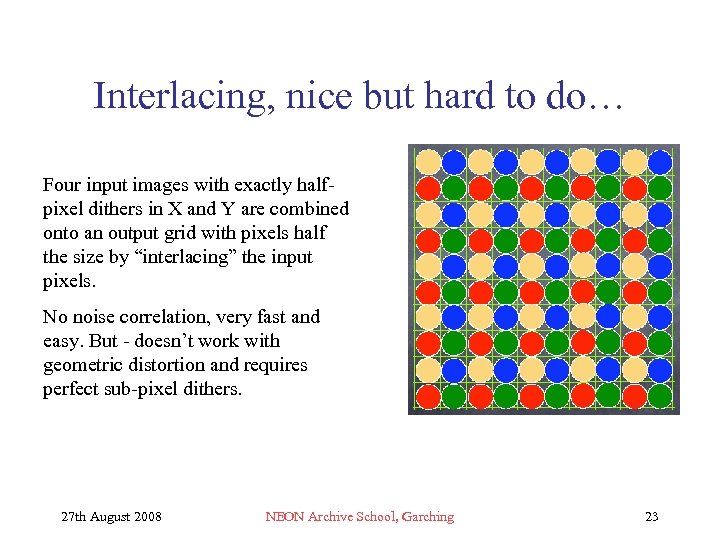 Interlacing, nice but hard to do… Four input images with exactly halfpixel dithers in X and Y are combined onto an output grid with pixels half the size by “interlacing” the input pixels. No noise correlation, very fast and easy. But - doesn’t work with geometric distortion and requires perfect sub-pixel dithers. 27 th August 2008 NEON Archive School, Garching 23
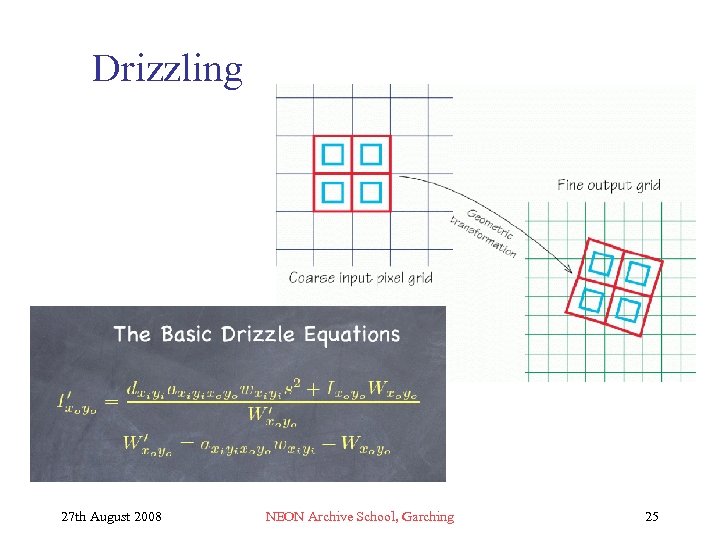
 Drizzling • A general-purpose image combination method • Each input pixel is mapped onto the output, including geometric distortion correction and any linear transformations • On the output pixels are combined according to their individual weights - for example bad pixels can have zero weight • The “kernel” on the output can be varied from a square like the original pixel (shift-and-add) to a point (interlacing) or, as usual, something in between • Preserves astrometric and photometric fidelity • Developed for the Hubble Deep Field, used for most Hubble imaging now • Other good alternatives exist (eg, Bertin’s SWarp) 27 th August 2008 NEON Archive School, Garching 24
 Drizzling 27 th August 2008 NEON Archive School, Garching 25
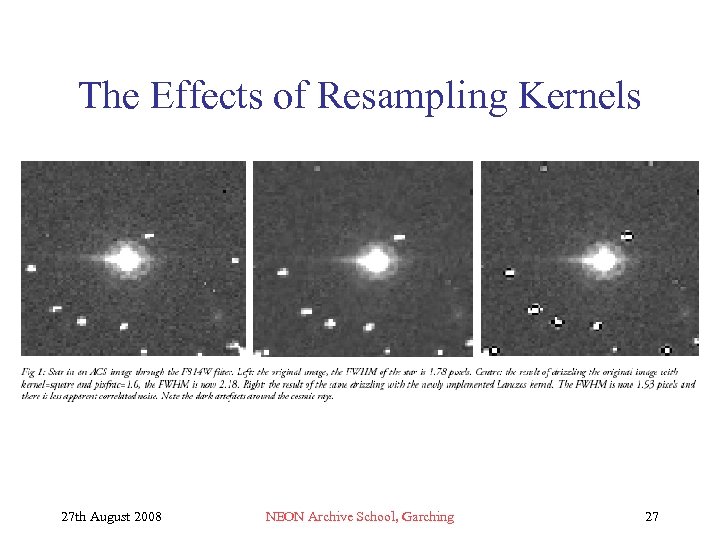
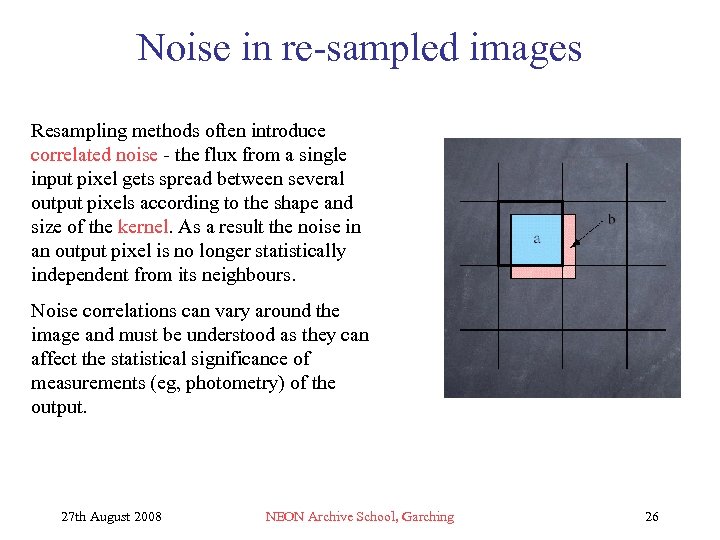 Noise in re-sampled images Resampling methods often introduce correlated noise - the flux from a single input pixel gets spread between several output pixels according to the shape and size of the kernel. As a result the noise in an output pixel is no longer statistically independent from its neighbours. Noise correlations can vary around the image and must be understood as they can affect the statistical significance of measurements (eg, photometry) of the output. 27 th August 2008 NEON Archive School, Garching 26
 The Effects of Resampling Kernels 27 th August 2008 NEON Archive School, Garching 27
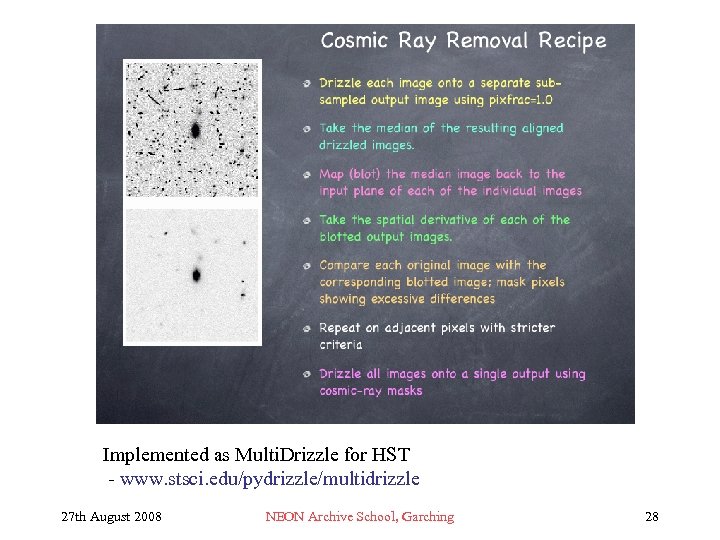 Implemented as Multi. Drizzle for HST - www. stsci. edu/pydrizzle/multidrizzle 27 th August 2008 NEON Archive School, Garching 28
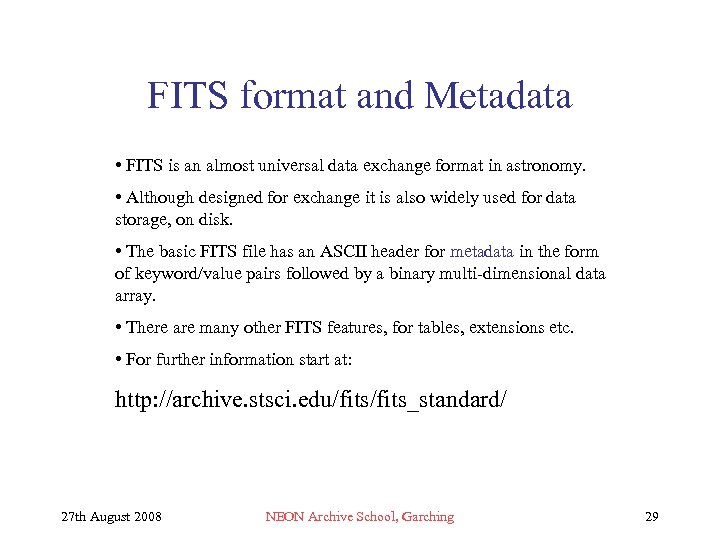 FITS format and Metadata • FITS is an almost universal data exchange format in astronomy. • Although designed for exchange it is also widely used for data storage, on disk. • The basic FITS file has an ASCII header for metadata in the form of keyword/value pairs followed by a binary multi-dimensional data array. • There are many other FITS features, for tables, extensions etc. • For further information start at: http: //archive. stsci. edu/fits_standard/ 27 th August 2008 NEON Archive School, Garching 29
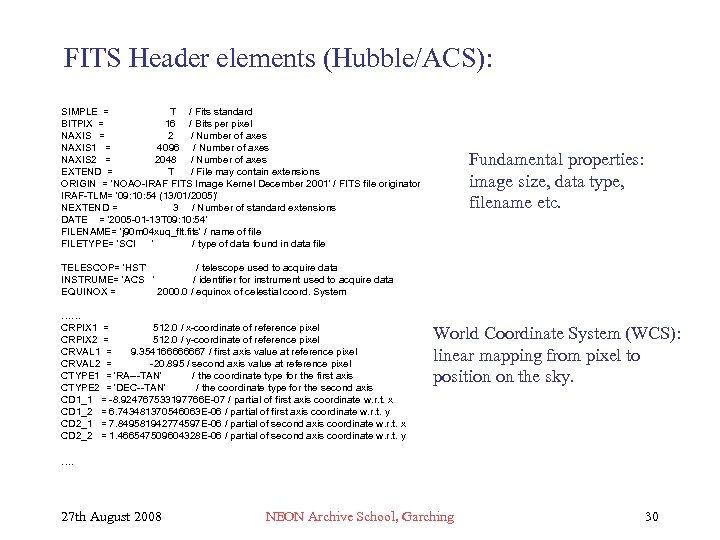 FITS Header elements (Hubble/ACS): SIMPLE = T / Fits standard BITPIX = 16 / Bits per pixel NAXIS = 2 / Number of axes NAXIS 1 = 4096 / Number of axes NAXIS 2 = 2048 / Number of axes EXTEND = T / File may contain extensions ORIGIN = 'NOAO-IRAF FITS Image Kernel December 2001' / FITS file originator IRAF-TLM= '09: 10: 54 (13/01/2005)' NEXTEND = 3 / Number of standard extensions DATE = '2005 -01 -13 T 09: 10: 54' FILENAME= 'j 90 m 04 xuq_flt. fits' / name of file FILETYPE= 'SCI ' / type of data found in data file Fundamental properties: image size, data type, filename etc. TELESCOP= 'HST' / telescope used to acquire data INSTRUME= 'ACS ' / identifier for instrument used to acquire data EQUINOX = 2000. 0 / equinox of celestial coord. System …… CRPIX 1 = 512. 0 / x-coordinate of reference pixel CRPIX 2 = 512. 0 / y-coordinate of reference pixel CRVAL 1 = 9. 354166666667 / first axis value at reference pixel CRVAL 2 = -20. 895 / second axis value at reference pixel CTYPE 1 = 'RA---TAN' / the coordinate type for the first axis CTYPE 2 = 'DEC--TAN' / the coordinate type for the second axis CD 1_1 = -8. 924767533197766 E-07 / partial of first axis coordinate w. r. t. x CD 1_2 = 6. 743481370546063 E-06 / partial of first axis coordinate w. r. t. y CD 2_1 = 7. 849581942774597 E-06 / partial of second axis coordinate w. r. t. x CD 2_2 = 1. 466547509604328 E-06 / partial of second axis coordinate w. r. t. y World Coordinate System (WCS): linear mapping from pixel to position on the sky. …. 27 th August 2008 NEON Archive School, Garching 30
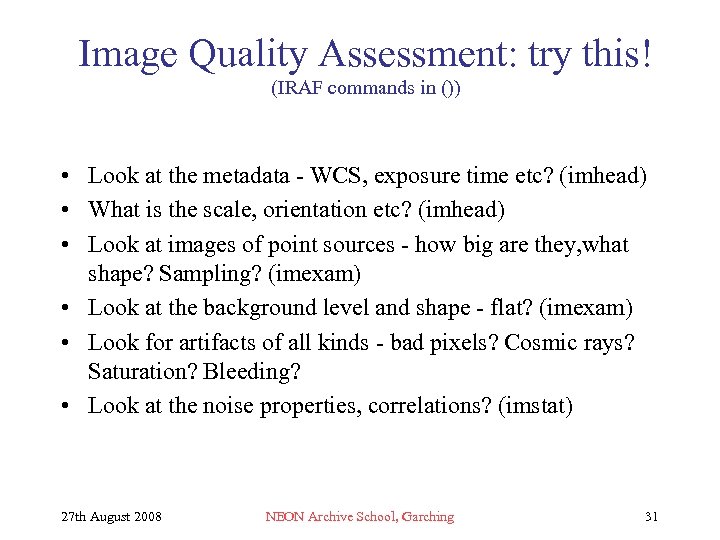 Image Quality Assessment: try this! (IRAF commands in ()) • Look at the metadata - WCS, exposure time etc? (imhead) • What is the scale, orientation etc? (imhead) • Look at images of point sources - how big are they, what shape? Sampling? (imexam) • Look at the background level and shape - flat? (imexam) • Look for artifacts of all kinds - bad pixels? Cosmic rays? Saturation? Bleeding? • Look at the noise properties, correlations? (imstat) 27 th August 2008 NEON Archive School, Garching 31
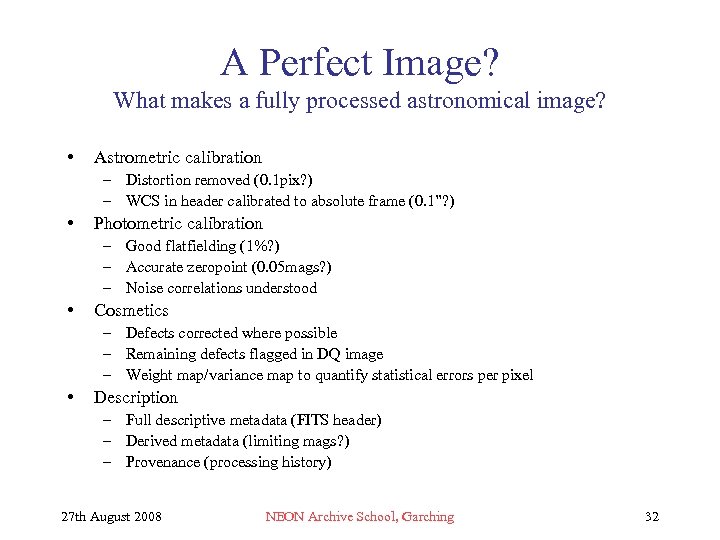 A Perfect Image? What makes a fully processed astronomical image? • Astrometric calibration – Distortion removed (0. 1 pix? ) – WCS in header calibrated to absolute frame (0. 1”? ) • Photometric calibration – Good flatfielding (1%? ) – Accurate zeropoint (0. 05 mags? ) – Noise correlations understood • Cosmetics – Defects corrected where possible – Remaining defects flagged in DQ image – Weight map/variance map to quantify statistical errors per pixel • Description – Full descriptive metadata (FITS header) – Derived metadata (limiting mags? ) – Provenance (processing history) 27 th August 2008 NEON Archive School, Garching 32
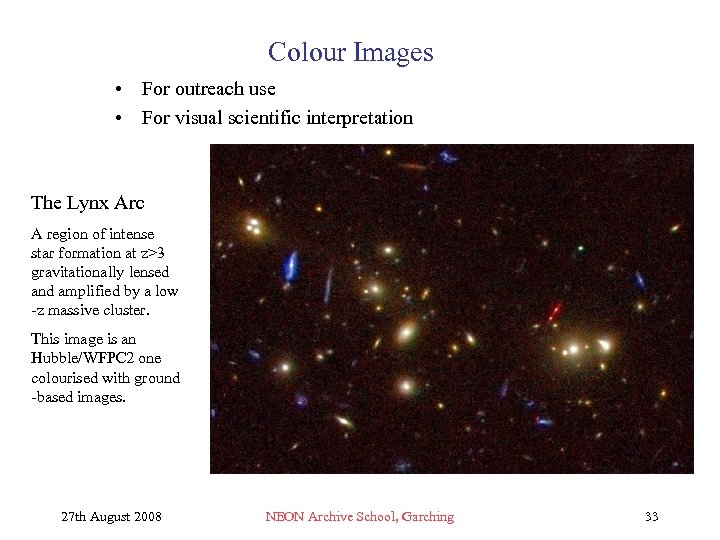 Colour Images • For outreach use • For visual scientific interpretation The Lynx Arc A region of intense star formation at z>3 gravitationally lensed and amplified by a low -z massive cluster. This image is an Hubble/WFPC 2 one colourised with ground -based images. 27 th August 2008 NEON Archive School, Garching 33
 Making Colour Images Developed by Lars Christensen and collaborators: www. spacetelescope. org/projects/fits_liberator 27 th August 2008 NEON Archive School, Garching 34
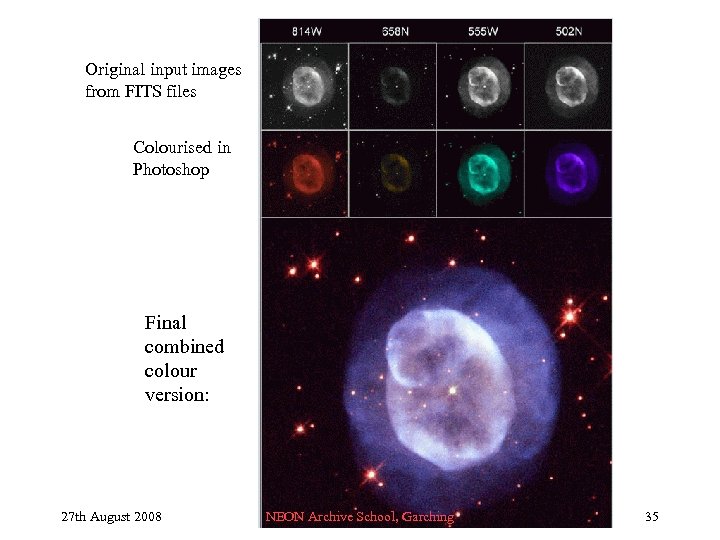 Original input images from FITS files Colourised in Photoshop Final combined colour version: 27 th August 2008 NEON Archive School, Garching 35
 Software Scisoft is a collection of many useful astronomical packages and tools for Linux (Fedora Core 6) computers. It can be downloaded from: http: //www. eso. org/scisoft Most of the software mentioned in this talk is included and “ready to run”. There is also a Mac version. Packages on the include: IRAF, STSDAS, TABLES etc ESO-MIDAS SExtractor/SWarp ds 9, Skycat Tiny Tim Python …etc, etc. + VO tools (new in Scisoft VII) 27 th August 2008 NEON Archive School, Garching 36
 Enjoy the school! http: //www. stecf. org/~rhook/NEON/Archive_Garching 2008. ppt 27 th August 2008 NEON Archive School, Garching 37