


 Скачать презентацию Optical Data Exfiltration from Microsensor Networks smart dust
21d4f0a562730803cd86e1a2b9723b2f.ppt
- Количество слайдов: 52
 Optical Data Exfiltration from Microsensor Networks (smart dust by any other name…) K. Pister EECS, BSAC UC Berkeley SMART DUST
 Do. D Workshops • RAND 1992 • “Smart Chaff”, “Floating Finks” • Bruno Augenstein, Seldon Crary, Noel Macdonald, Randy Steeb, … • Santa Fe, 1995 • Xan Alexander, Ken Gabriel; Roger Howe, George Whitesides, … • ISAT 1995, 1996, 1997, 1998, 1999, 2000 • … SMART DUST
 University Programs • UCLA • Bill Kaiser (LWIM, WINS) • Greg Pottie (AWAIRS) • U. Michigan • Ken Wise • USC • Deborah Estrin • UCB • K. Pister (Smart Dust) • … SMART DUST
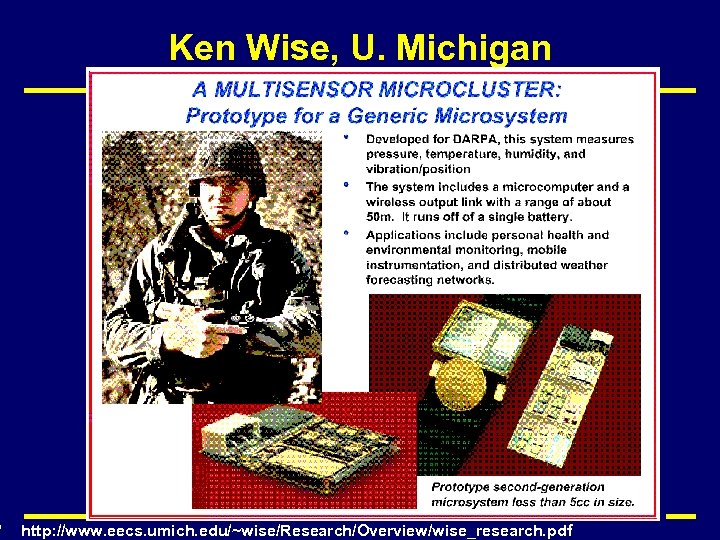 • Ken Wise, U. Michigan SMART DUST http: //www. eecs. umich. edu/~wise/Research/Overview/wise_research. pdf
 Smart Dust Goals • Autonomous sensor node (mote) in 1 mm 3 • MAV delivery • Thousands of motes • Many interrogators • Demonstrate useful/complex integration in 1 mm 3 SMART DUST
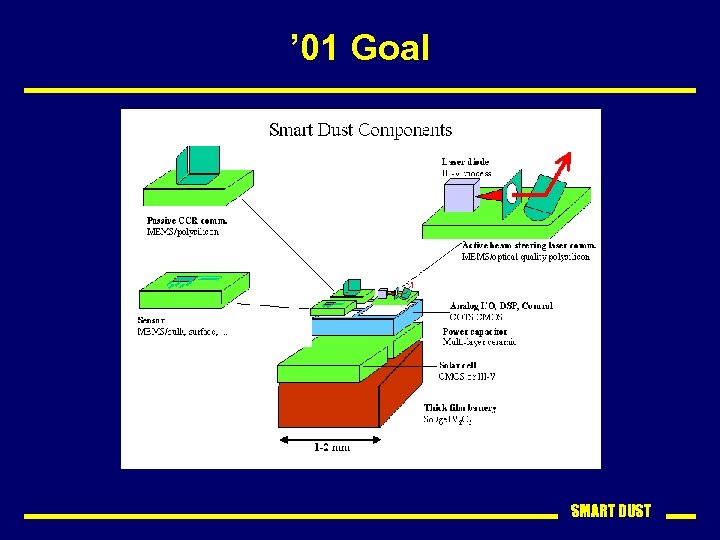 ’ 01 Goal SMART DUST
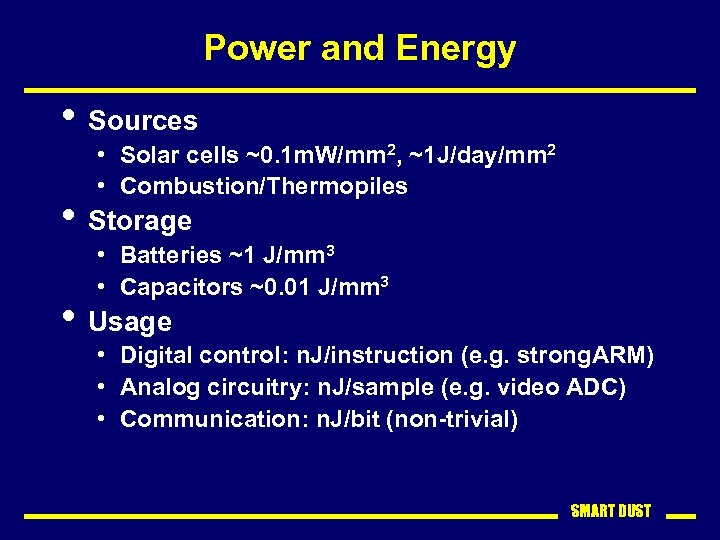 Power and Energy • Sources • Solar cells ~0. 1 m. W/mm 2, ~1 J/day/mm 2 • Combustion/Thermopiles • Storage • Batteries ~1 J/mm 3 • Capacitors ~0. 01 J/mm 3 • Usage • Digital control: n. J/instruction (e. g. strong. ARM) • Analog circuitry: n. J/sample (e. g. video ADC) • Communication: n. J/bit (non-trivial) SMART DUST
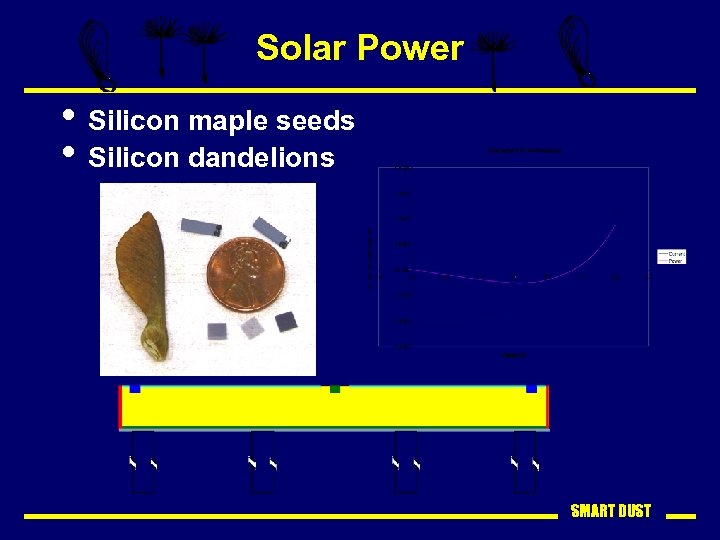 Solar Power • Silicon maple seeds • Silicon dandelions SMART DUST
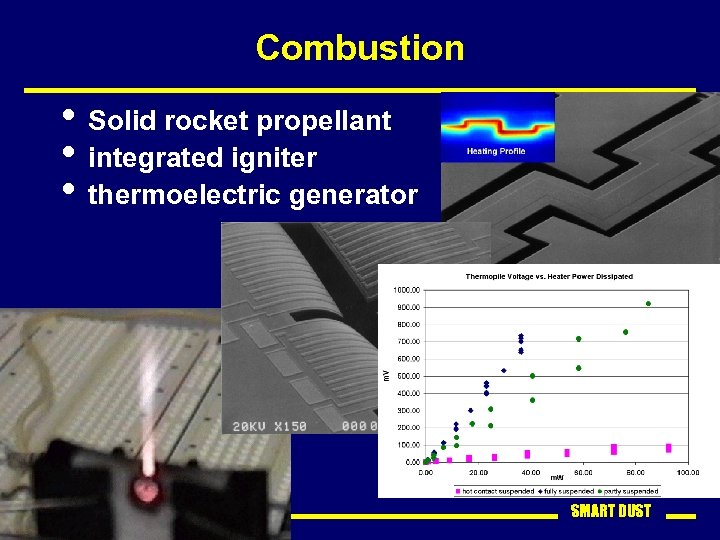 Combustion • Solid rocket propellant • integrated igniter • thermoelectric generator SMART DUST
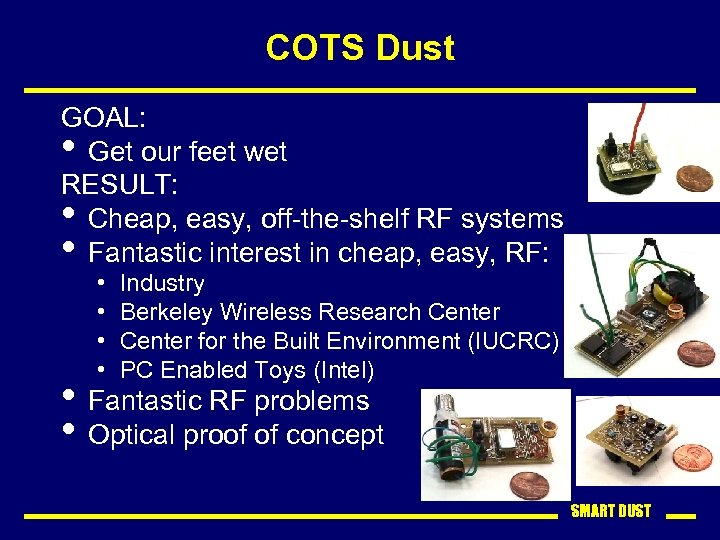 COTS Dust GOAL: • Get our feet wet RESULT: • Cheap, easy, off-the-shelf RF systems • Fantastic interest in cheap, easy, RF: • • Industry Berkeley Wireless Research Center for the Built Environment (IUCRC) PC Enabled Toys (Intel) • Fantastic RF problems • Optical proof of concept SMART DUST
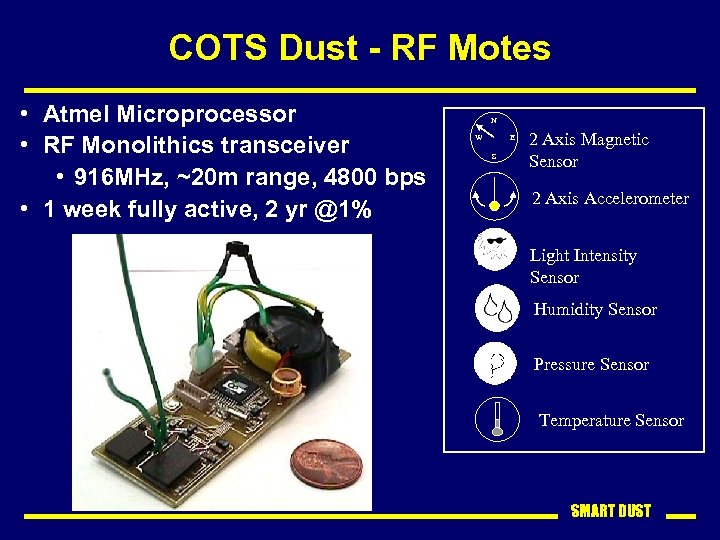 COTS Dust - RF Motes • Atmel Microprocessor • RF Monolithics transceiver • 916 MHz, ~20 m range, 4800 bps • 1 week fully active, 2 yr @1% N W E S 2 Axis Magnetic Sensor 2 Axis Accelerometer Light Intensity Sensor Humidity Sensor Pressure Sensor Temperature Sensor SMART DUST
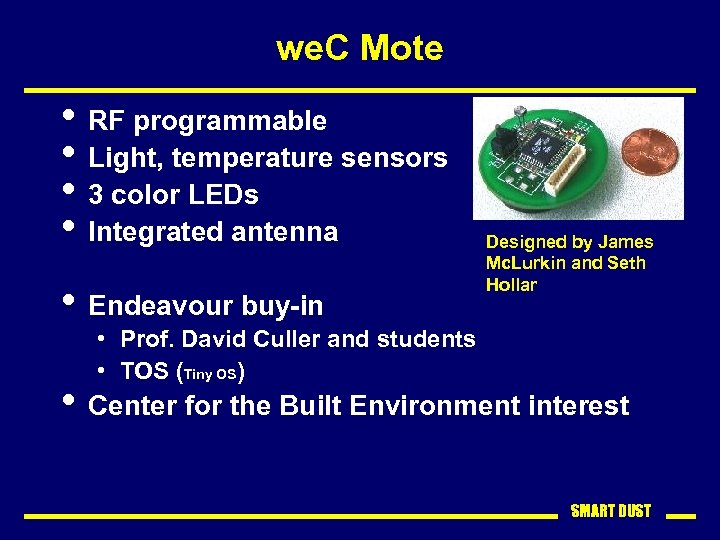 we. C Mote • RF programmable • Light, temperature sensors • 3 color LEDs • Integrated antenna • Endeavour buy-in Designed by James Mc. Lurkin and Seth Hollar • Prof. David Culler and students • TOS (Tiny OS) • Center for the Built Environment interest SMART DUST
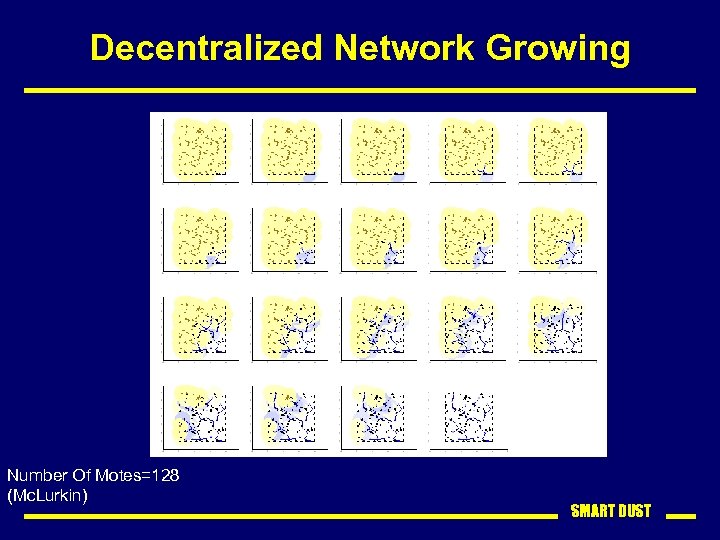 Decentralized Network Growing Number Of Motes=128 (Mc. Lurkin) SMART DUST
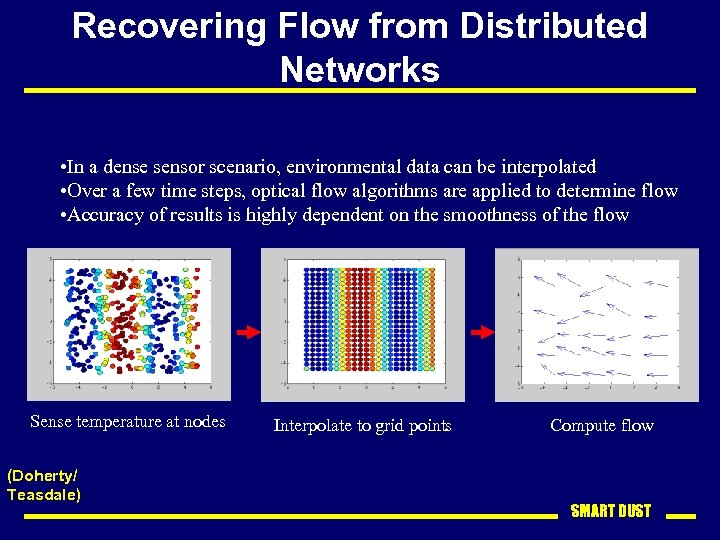 Recovering Flow from Distributed Networks • In a dense sensor scenario, environmental data can be interpolated • Over a few time steps, optical flow algorithms are applied to determine flow • Accuracy of results is highly dependent on the smoothness of the flow Sense temperature at nodes (Doherty/ Teasdale) Interpolate to grid points Compute flow SMART DUST
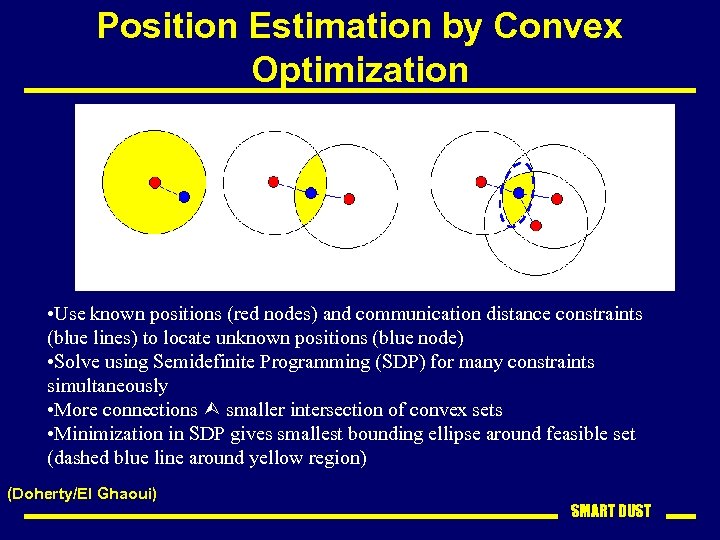 Position Estimation by Convex Optimization • Use known positions (red nodes) and communication distance constraints (blue lines) to locate unknown positions (blue node) • Solve using Semidefinite Programming (SDP) for many constraints simultaneously • More connections smaller intersection of convex sets • Minimization in SDP gives smallest bounding ellipse around feasible set (dashed blue line around yellow region) (Doherty/El Ghaoui) SMART DUST
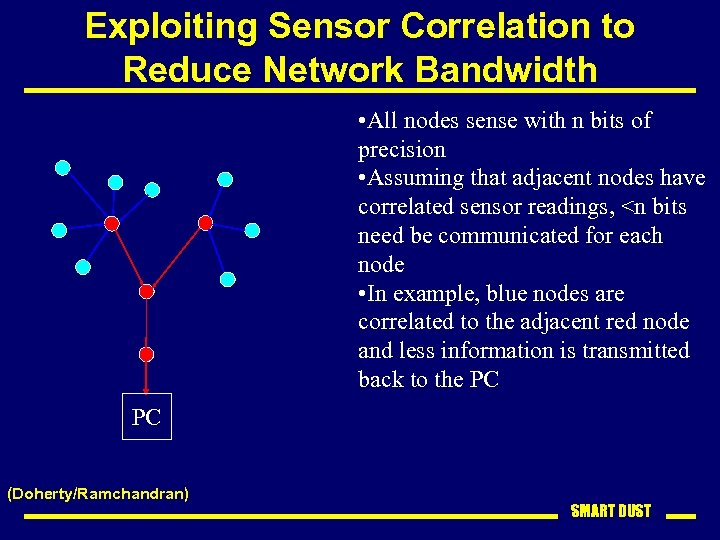 Exploiting Sensor Correlation to Reduce Network Bandwidth • All nodes sense with n bits of precision • Assuming that adjacent nodes have correlated sensor readings,
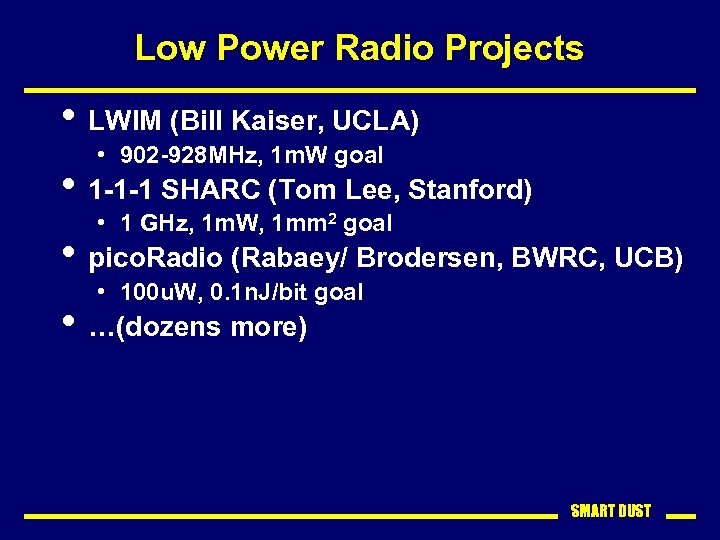 Low Power Radio Projects • LWIM (Bill Kaiser, UCLA) • 902 -928 MHz, 1 m. W goal • 1 -1 -1 SHARC (Tom Lee, Stanford) • 1 GHz, 1 m. W, 1 mm 2 goal • pico. Radio (Rabaey/ Brodersen, BWRC, UCB) • 100 u. W, 0. 1 n. J/bit goal • …(dozens more) SMART DUST
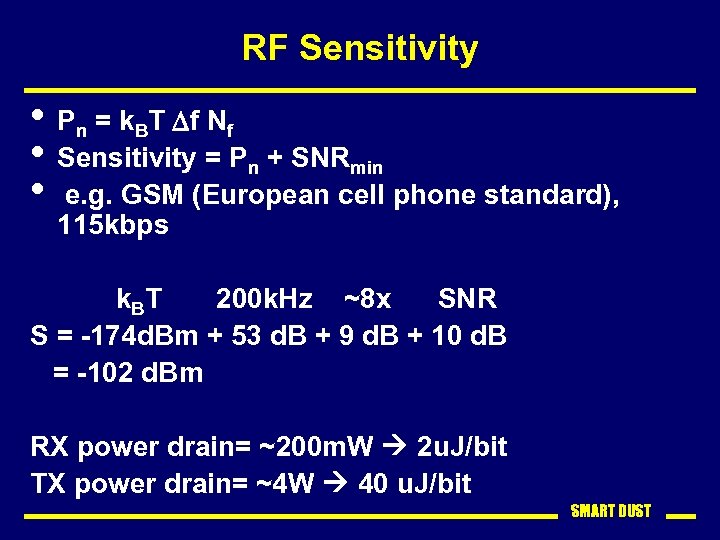 RF Sensitivity • Pn = k. BT Df Nf • Sensitivity = Pn + SNRmin • e. g. GSM (European cell phone standard), 115 kbps k BT 200 k. Hz ~8 x SNR S = -174 d. Bm + 53 d. B + 9 d. B + 10 d. B = -102 d. Bm RX power drain= ~200 m. W 2 u. J/bit TX power drain= ~4 W 40 u. J/bit SMART DUST
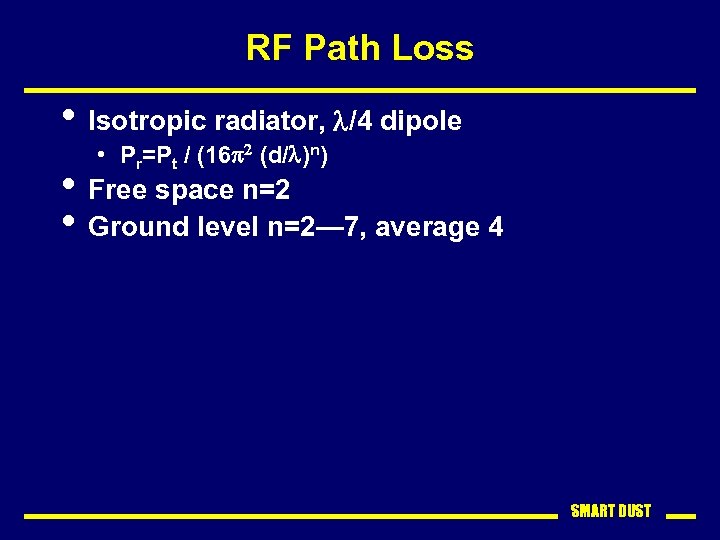 RF Path Loss • Isotropic radiator, l/4 dipole • Pr=Pt / (16 p 2 (d/l)n) • Free space n=2 • Ground level n=2— 7, average 4 SMART DUST
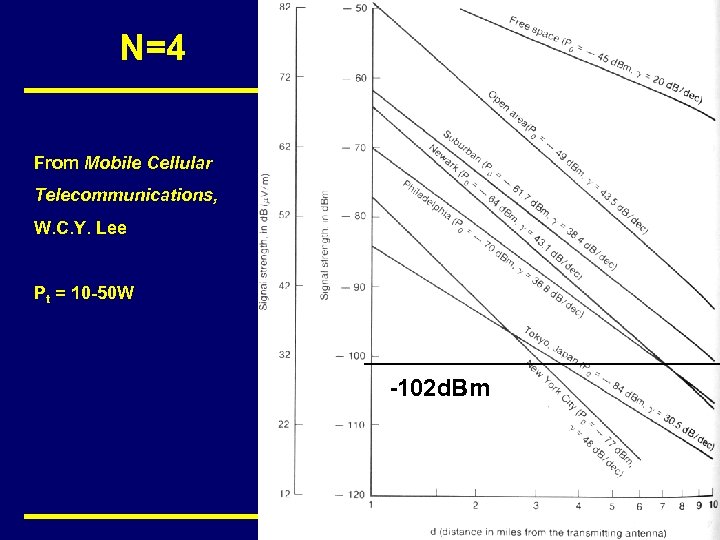 N=4 From Mobile Cellular Telecommunications, W. C. Y. Lee Pt = 10 -50 W -102 d. Bm SMART DUST
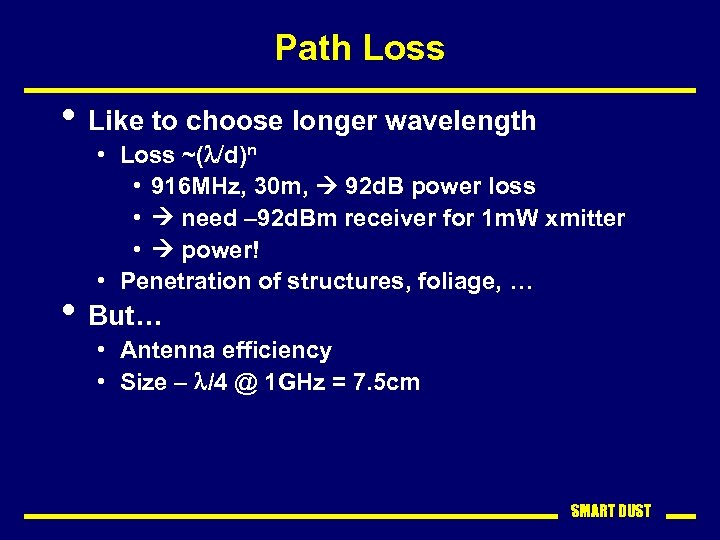 Path Loss • Like to choose longer wavelength • Loss ~(l/d)n • 916 MHz, 30 m, 92 d. B power loss • need – 92 d. Bm receiver for 1 m. W xmitter • power! • Penetration of structures, foliage, … • But… • Antenna efficiency • Size – l/4 @ 1 GHz = 7. 5 cm SMART DUST
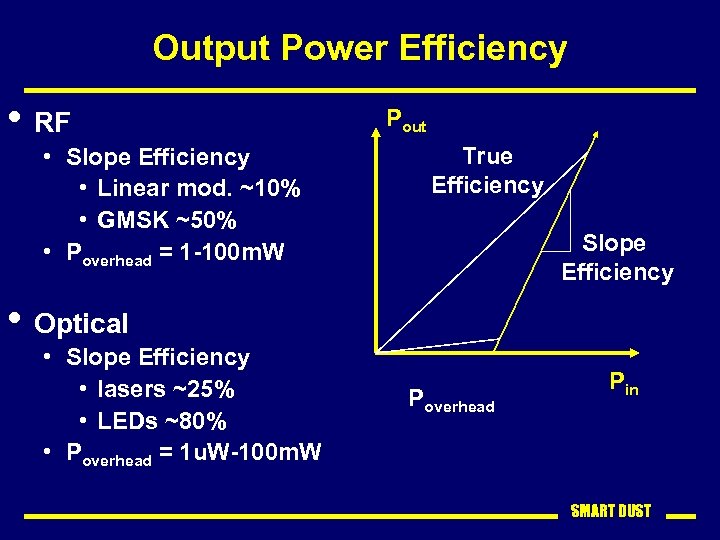 Output Power Efficiency • RF • Slope Efficiency • Linear mod. ~10% • GMSK ~50% • Poverhead = 1 -100 m. W Pout True Efficiency Slope Efficiency • Optical • Slope Efficiency • lasers ~25% • LEDs ~80% • Poverhead = 1 u. W-100 m. W Poverhead Pin SMART DUST
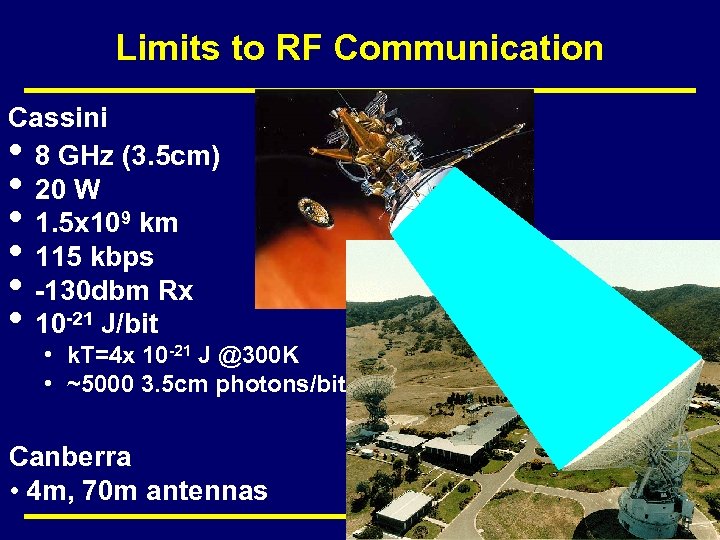 Limits to RF Communication Cassini • 8 GHz (3. 5 cm) • 20 W • 1. 5 x 10⁹ km • 115 kbps • -130 dbm Rx • 10 -21 J/bit • k. T=4 x 10 -21 J @300 K • ~5000 3. 5 cm photons/bit Canberra • 4 m, 70 m antennas SMART DUST
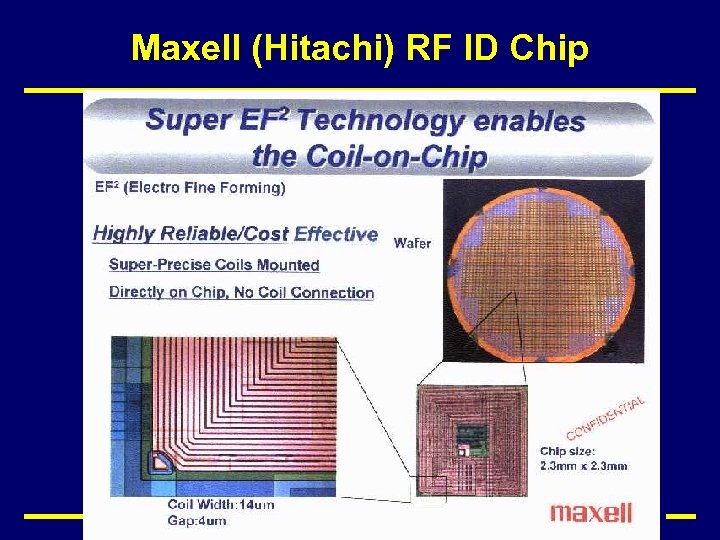 Maxell (Hitachi) RF ID Chip SMART DUST
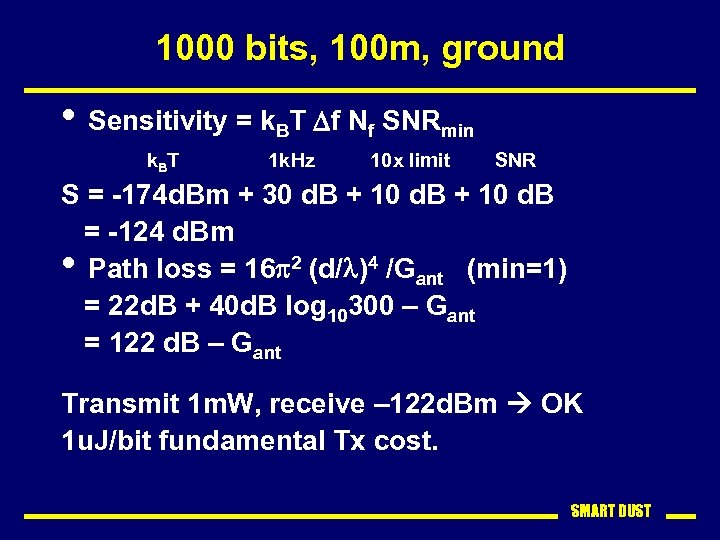 1000 bits, 100 m, ground • Sensitivity = k. BT Df Nf SNRmin k. BT 1 k. Hz 10 x limit SNR S = -174 d. Bm + 30 d. B + 10 d. B = -124 d. Bm • Path loss = 16 p 2 (d/l)4 /Gant (min=1) = 22 d. B + 40 d. B log 10300 – Gant = 122 d. B – Gant Transmit 1 m. W, receive – 122 d. Bm OK 1 u. J/bit fundamental Tx cost. SMART DUST
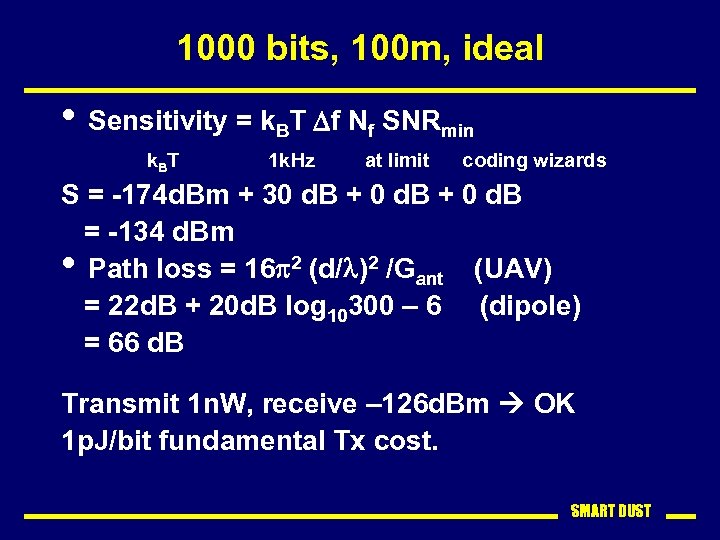 1000 bits, 100 m, ideal • Sensitivity = k. BT Df Nf SNRmin k. BT 1 k. Hz at limit coding wizards S = -174 d. Bm + 30 d. B + 0 d. B = -134 d. Bm • Path loss = 16 p 2 (d/l)2 /Gant (UAV) = 22 d. B + 20 d. B log 10300 – 6 (dipole) = 66 d. B Transmit 1 n. W, receive – 126 d. Bm OK 1 p. J/bit fundamental Tx cost. SMART DUST
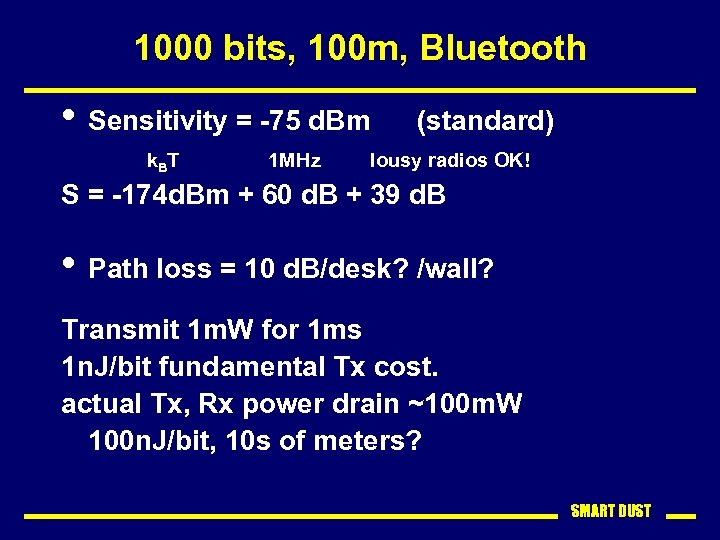 1000 bits, 100 m, Bluetooth • Sensitivity = -75 d. Bm k. BT 1 MHz (standard) lousy radios OK! S = -174 d. Bm + 60 d. B + 39 d. B • Path loss = 10 d. B/desk? /wall? Transmit 1 m. W for 1 ms 1 n. J/bit fundamental Tx cost. actual Tx, Rx power drain ~100 m. W 100 n. J/bit, 10 s of meters? SMART DUST
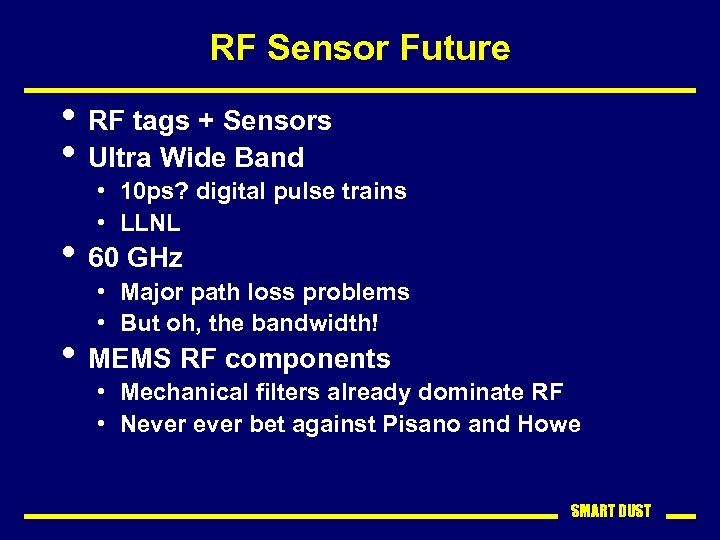 RF Sensor Future • RF tags + Sensors • Ultra Wide Band • 10 ps? digital pulse trains • LLNL • 60 GHz • Major path loss problems • But oh, the bandwidth! • MEMS RF components • Mechanical filters already dominate RF • Never bet against Pisano and Howe SMART DUST
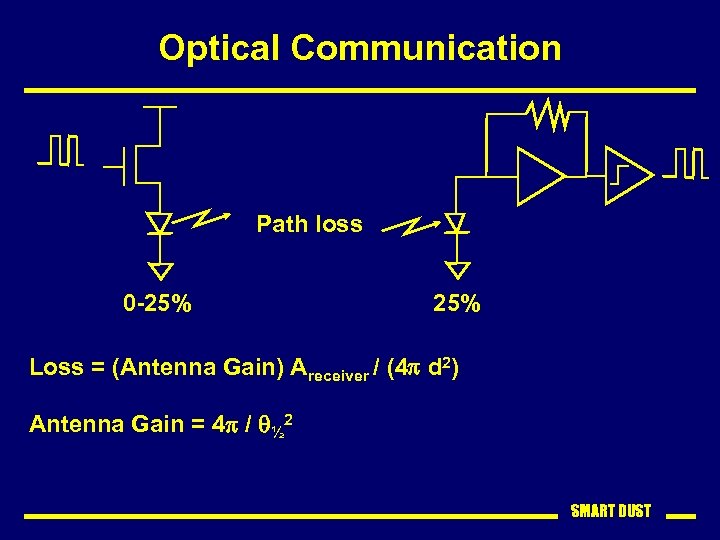 Optical Communication Path loss 0 -25% Loss = (Antenna Gain) Areceiver / (4 p d 2) Antenna Gain = 4 p / q½ 2 SMART DUST
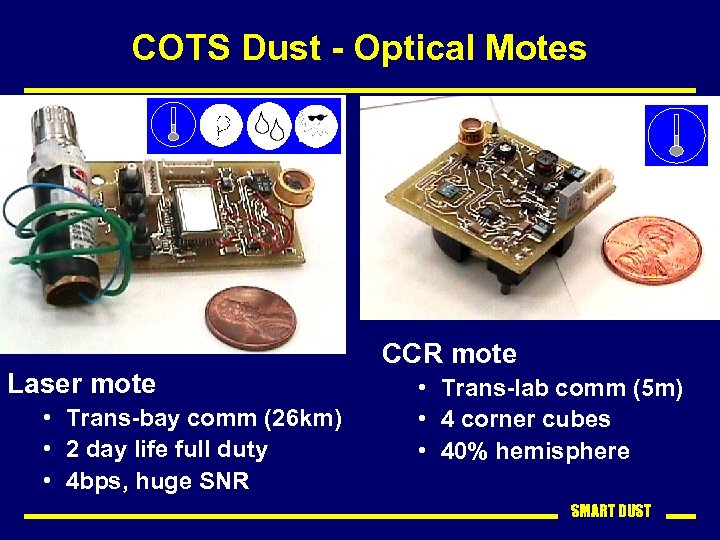 COTS Dust - Optical Motes Laser mote • Trans-bay comm (26 km) • 2 day life full duty • 4 bps, huge SNR CCR mote • Trans-lab comm (5 m) • 4 corner cubes • 40% hemisphere SMART DUST
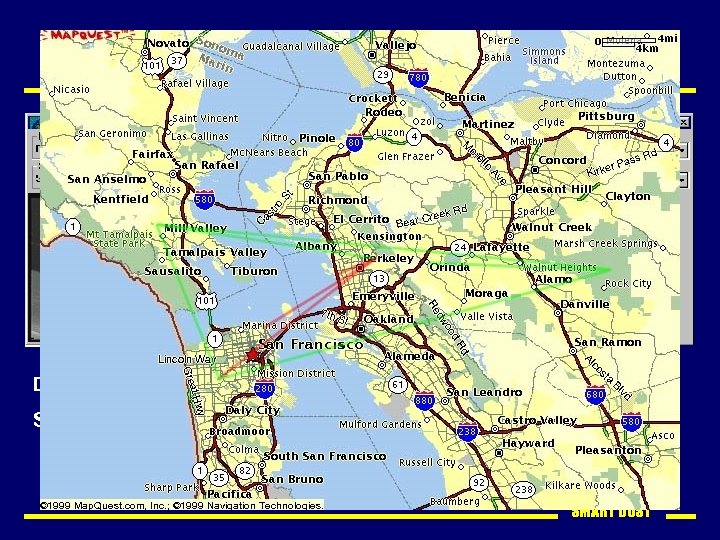 Video Semaphore Decoding Diverged beam @ 300 m Shadow or full sunlight Diverged beam @ 5. 2 km In shadow in evening sun SMART DUST
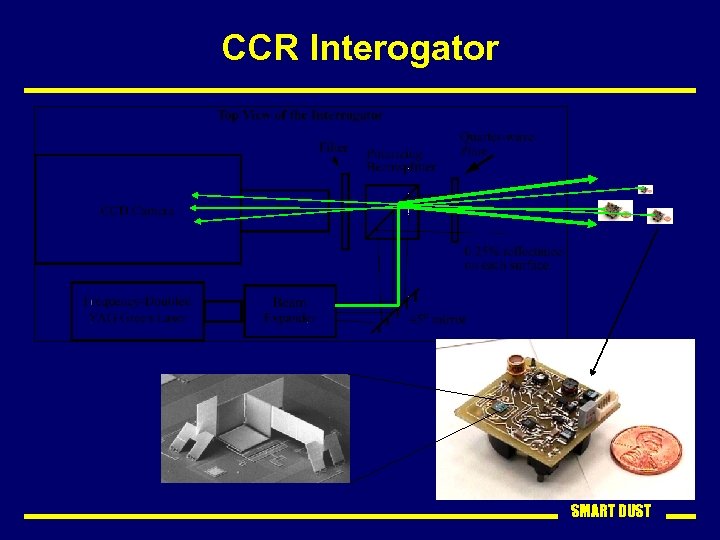 CCR Interogator SMART DUST
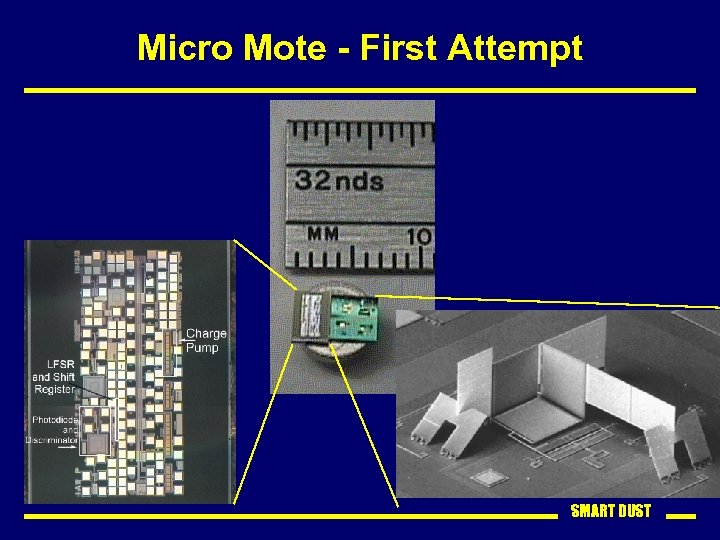 Micro Mote - First Attempt SMART DUST
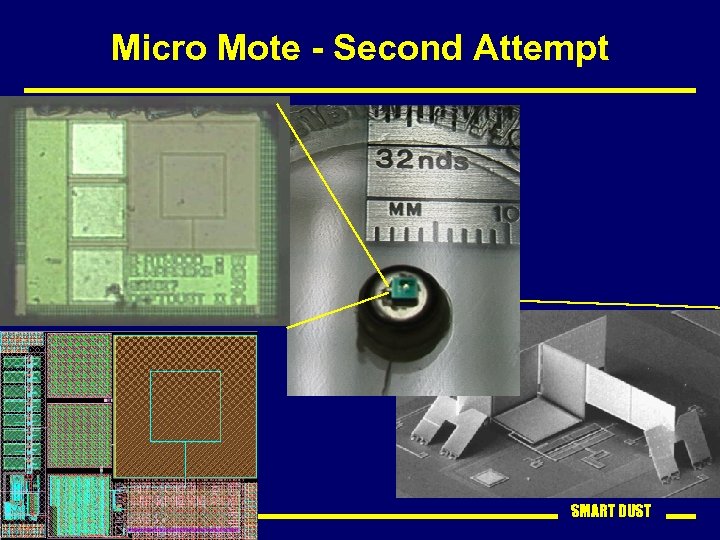 Micro Mote - Second Attempt SMART DUST
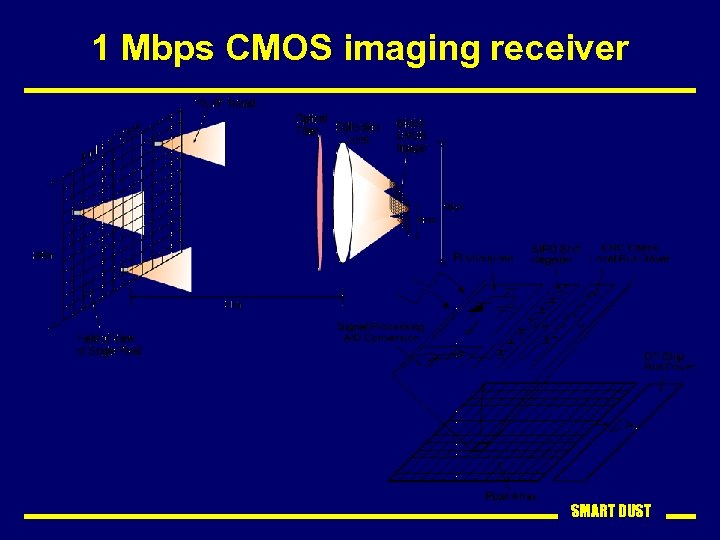 1 Mbps CMOS imaging receiver SMART DUST
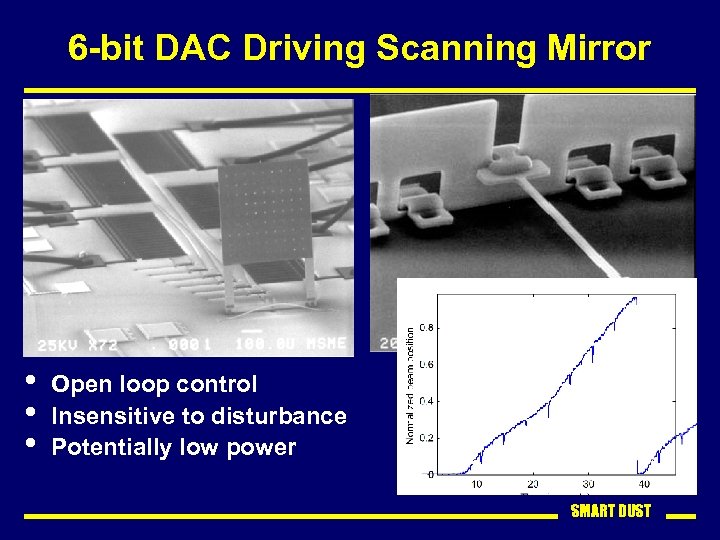 6 -bit DAC Driving Scanning Mirror • • • Open loop control Insensitive to disturbance Potentially low power SMART DUST
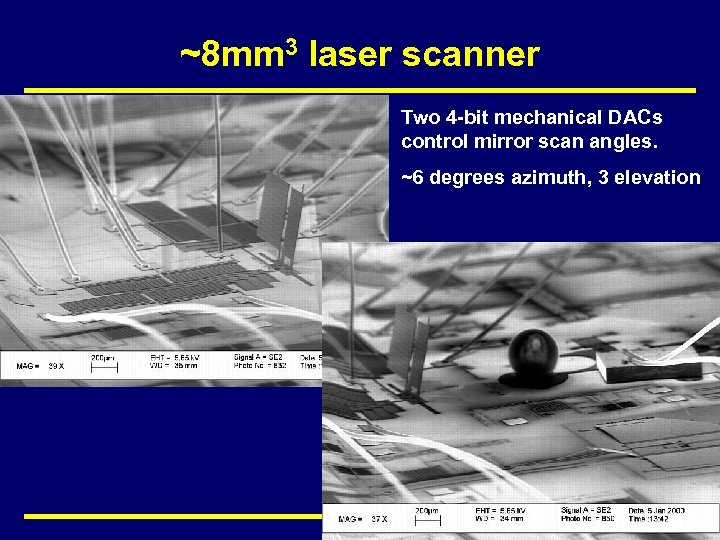 ~8 mm 3 laser scanner Two 4 -bit mechanical DACs control mirror scan angles. ~6 degrees azimuth, 3 elevation SMART DUST
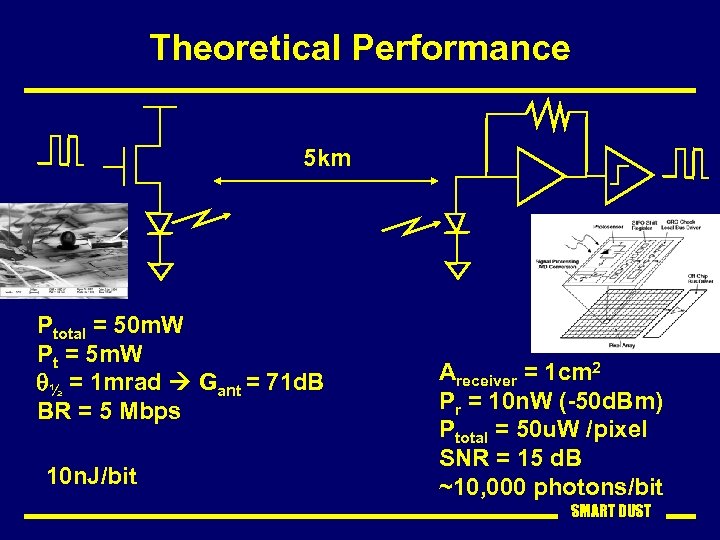 Theoretical Performance 5 km Ptotal = 50 m. W Pt = 5 m. W q½ = 1 mrad Gant = 71 d. B BR = 5 Mbps 10 n. J/bit Areceiver = 1 cm 2 Pr = 10 n. W (-50 d. Bm) Ptotal = 50 u. W /pixel SNR = 15 d. B ~10, 000 photons/bit SMART DUST
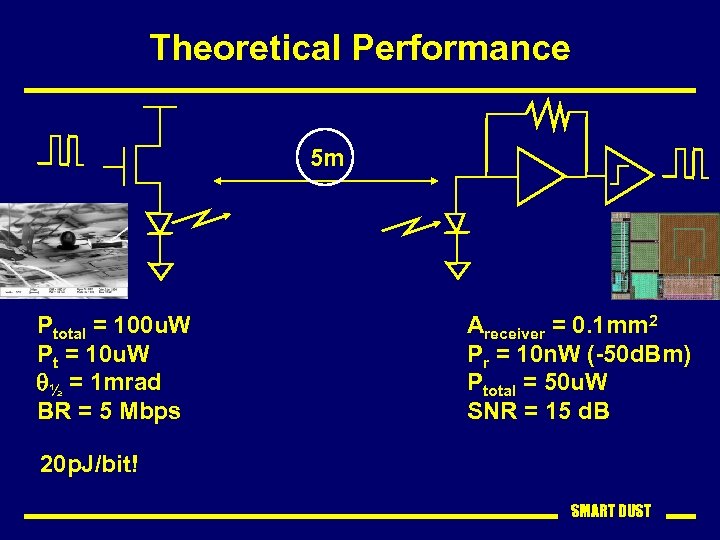 Theoretical Performance 5 m Ptotal = 100 u. W Pt = 10 u. W q½ = 1 mrad BR = 5 Mbps Areceiver = 0. 1 mm 2 Pr = 10 n. W (-50 d. Bm) Ptotal = 50 u. W SNR = 15 d. B 20 p. J/bit! SMART DUST
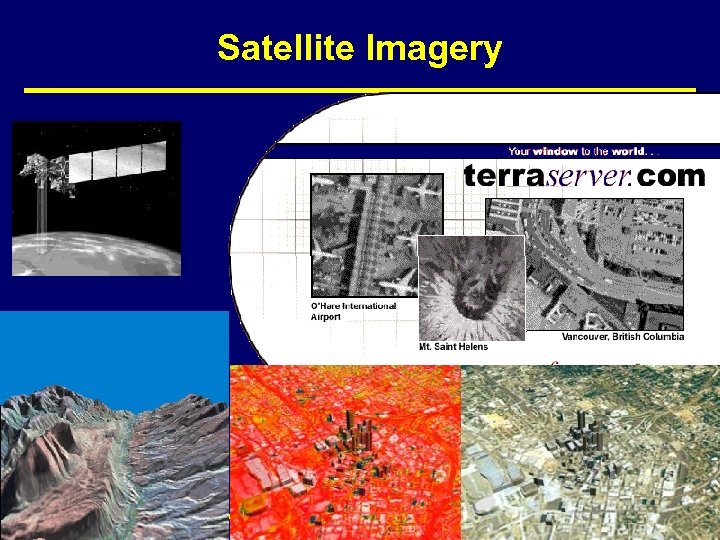 Satellite Imagery SMART DUST
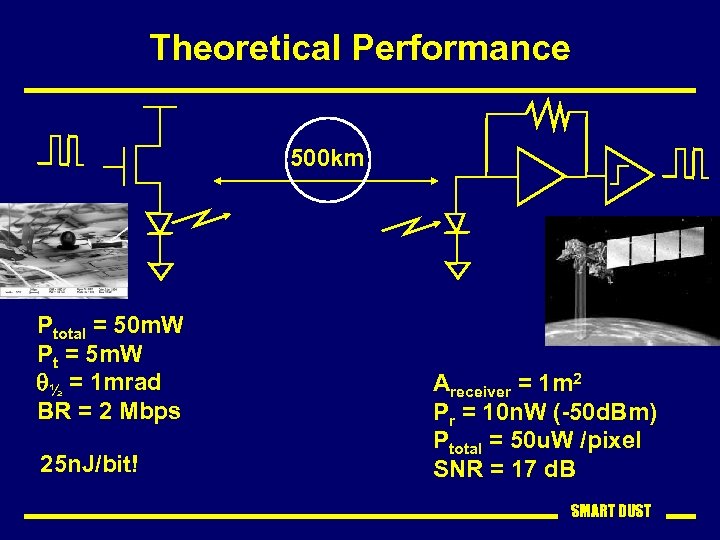 Theoretical Performance 500 km Ptotal = 50 m. W Pt = 5 m. W q½ = 1 mrad BR = 2 Mbps 25 n. J/bit! Areceiver = 1 m 2 Pr = 10 n. W (-50 d. Bm) Ptotal = 50 u. W /pixel SNR = 17 d. B SMART DUST
 Conclusion • Grit your teeth and use the radio • 50 u. J/bit 1 -10 km • 100 n. J/bit 0 -50 m Unless you’re lucky enough to have line of sight: • Use optical comm when possible • 10 n. J/bit 1 -10 km • 20 p. J/bit 0 -50 m SMART DUST
 Teaming • Endeavour • CBE • BWRC SMART DUST
 Battery Energy • AA • Hearing Aid • Rechargeable • Lead Acid SMART DUST
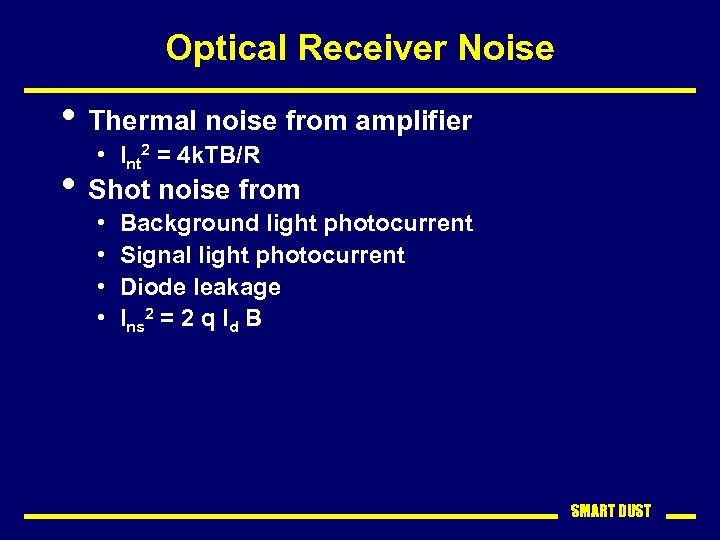 Optical Receiver Noise • Thermal noise from amplifier • Int 2 = 4 k. TB/R • Shot noise from • • Background light photocurrent Signal light photocurrent Diode leakage Ins 2 = 2 q Id B SMART DUST
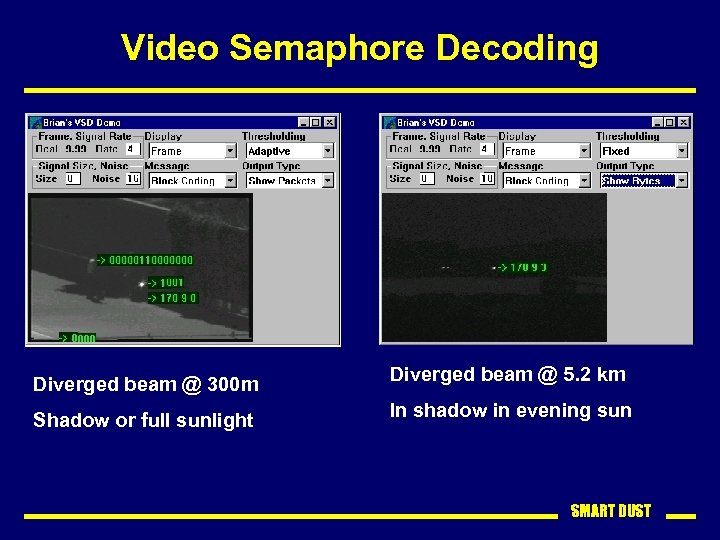 Video Semaphore Decoding Diverged beam @ 300 m Shadow or full sunlight Diverged beam @ 5. 2 km In shadow in evening sun SMART DUST
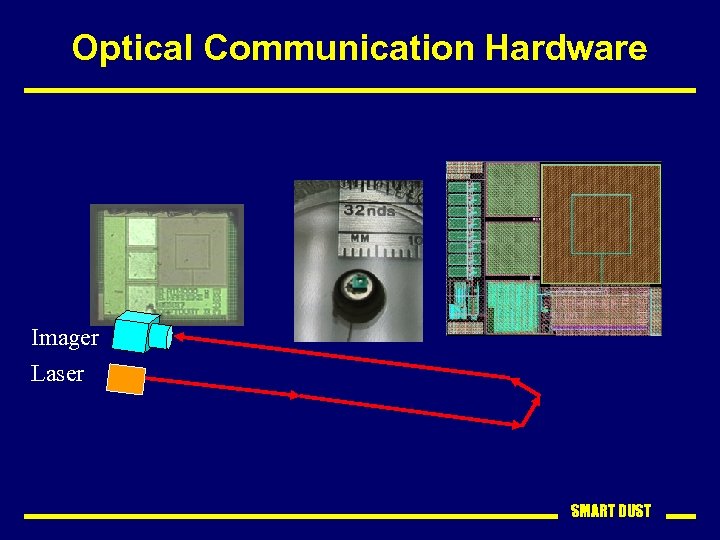 Optical Communication Hardware Imager Laser SMART DUST
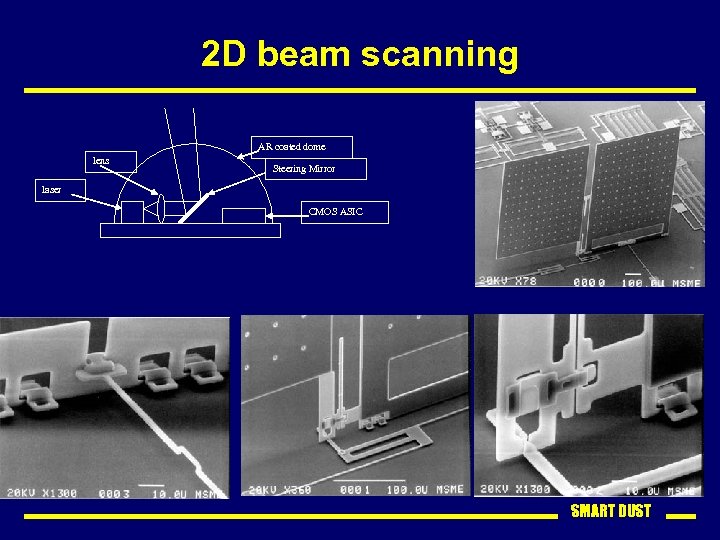 2 D beam scanning AR coated dome lens Steering Mirror laser CMOS ASIC SMART DUST
 Distributed Algorithms Centroid Location • Find edges • Diffuse pheromone from the edges inward • Find the lowest concentration using Min/Max sharing • If you have the lowest concentration, turn yellow (James Mc. Lurkin) Number Of Motes=500 Communications Range=. 8 SMART DUST
 Mote Position Estimation • • • Give GPS receivers to some motes and call them “Basis Motes”. Ask them to turn gray. Each Basis Mote diffuses it’s own pheromone throughout the group The position of any other mote can be estimated from the levels of basis pheromones present. SMART DUST
 Lots of exponentials • Digital circuits • Speed, memory • Size, power, cost • Communication circuits • Range, data rate • Size, power, cost • MEMS Sensors • Measurands, sensitivity • Size, power, cost SMART DUST
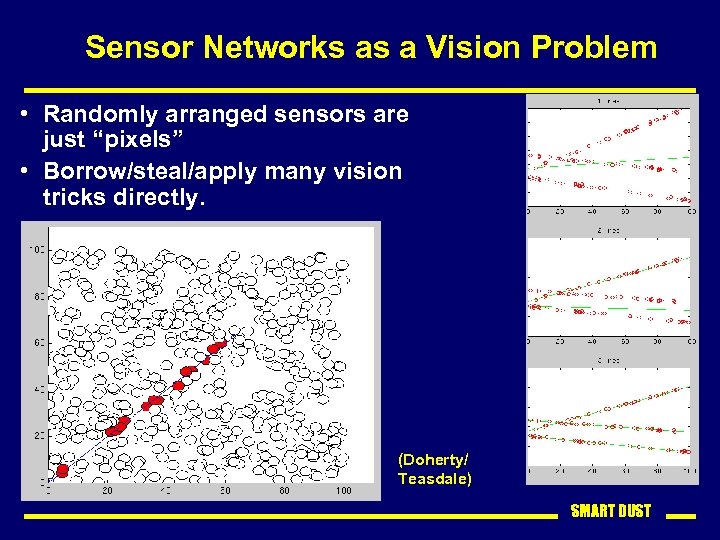 Sensor Networks as a Vision Problem • Randomly arranged sensors are just “pixels” • Borrow/steal/apply many vision tricks directly. (Doherty/ Teasdale) SMART DUST