


 Скачать презентацию Opportunities Shift in Perspective for Infectious Disease
6e3b2b9d0cffb551c5b1996bf8f4477b.ppt
- Количество слайдов: 10
 Opportunities
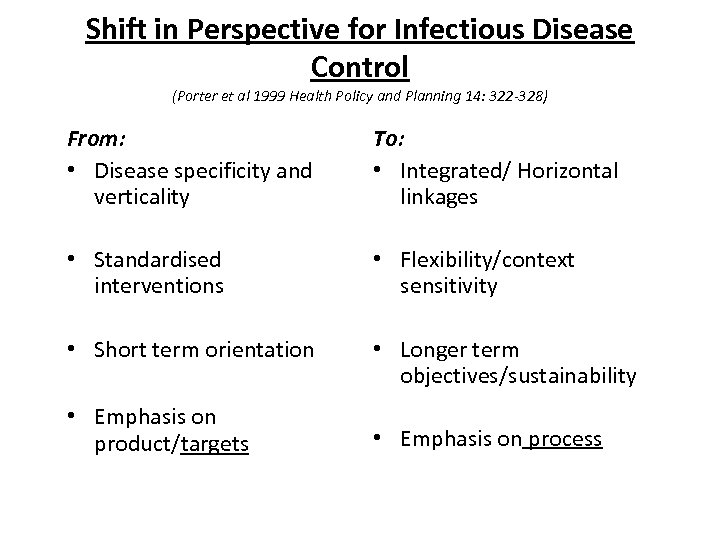 Shift in Perspective for Infectious Disease Control (Porter et al 1999 Health Policy and Planning 14: 322 -328) From: • Disease specificity and verticality To: • Integrated/ Horizontal linkages • Standardised interventions • Flexibility/context sensitivity • Short term orientation • Longer term objectives/sustainability • Emphasis on product/targets • Emphasis on process
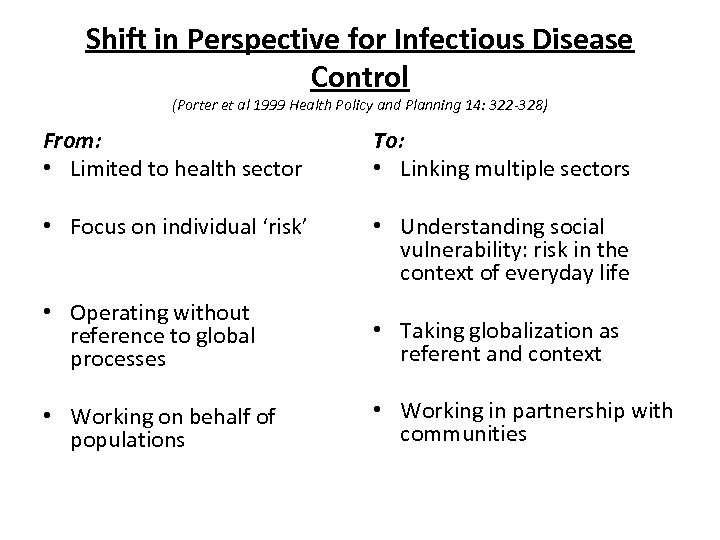 Shift in Perspective for Infectious Disease Control (Porter et al 1999 Health Policy and Planning 14: 322 -328) From: • Limited to health sector To: • Linking multiple sectors • Focus on individual ‘risk’ • Understanding social vulnerability: risk in the context of everyday life • Operating without reference to global processes • Taking globalization as referent and context • Working on behalf of populations • Working in partnership with communities
 Tuberculosis Control as an example
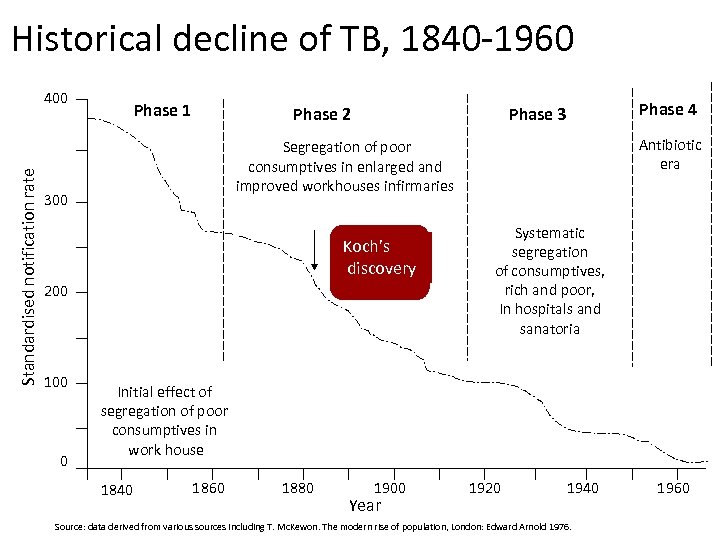 Historical decline of TB, 1840 -1960 Standardised notification rate 400 Phase 1 Koch’s discovery 200 0 Antibiotic era Segregation of poor consumptives in enlarged and improved workhouses infirmaries 300 100 Phase 4 Phase 3 Phase 2 Systematic segregation of consumptives, rich and poor, In hospitals and sanatoria Initial effect of segregation of poor consumptives in work house 1840 1860 1880 1900 Year 1920 1940 Source: data derived from various sources including T. Mc. Kewon. The modern rise of population, London: Edward Arnold 1976. 1960
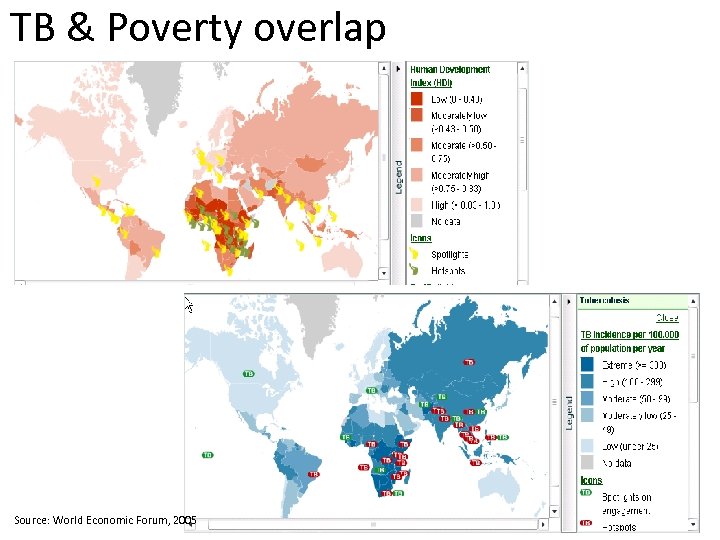 TB & Poverty overlap Source: World Economic Forum, 2005
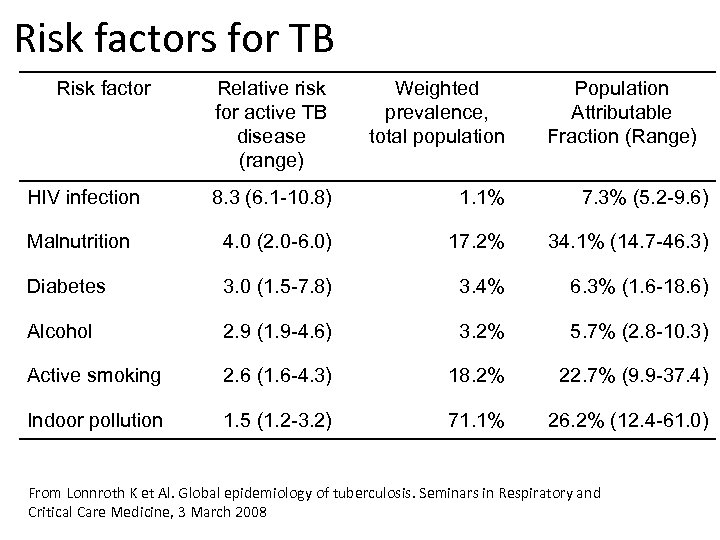 Risk factors for TB Risk factor Relative risk for active TB disease (range) Weighted prevalence, total population Population Attributable Fraction (Range) HIV infection 8. 3 (6. 1 -10. 8) 1. 1% 7. 3% (5. 2 -9. 6) Malnutrition 4. 0 (2. 0 -6. 0) 17. 2% 34. 1% (14. 7 -46. 3) Diabetes 3. 0 (1. 5 -7. 8) 3. 4% 6. 3% (1. 6 -18. 6) Alcohol 2. 9 (1. 9 -4. 6) 3. 2% 5. 7% (2. 8 -10. 3) Active smoking 2. 6 (1. 6 -4. 3) 18. 2% 22. 7% (9. 9 -37. 4) Indoor pollution 1. 5 (1. 2 -3. 2) 71. 1% 26. 2% (12. 4 -61. 0) From Lonnroth K et Al. Global epidemiology of tuberculosis. Seminars in Respiratory and Critical Care Medicine, 3 March 2008
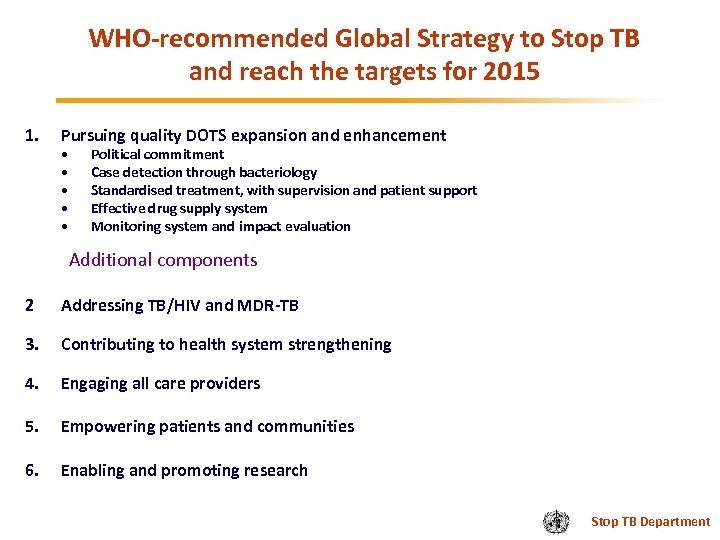 WHO-recommended Global Strategy to Stop TB and reach the targets for 2015 1. Pursuing quality DOTS expansion and enhancement • • • Political commitment Case detection through bacteriology Standardised treatment, with supervision and patient support Effective drug supply system Monitoring system and impact evaluation Additional components 2 Addressing TB/HIV and MDR-TB 3. Contributing to health system strengthening 4. Engaging all care providers 5. Empowering patients and communities 6. Enabling and promoting research Stop TB Department
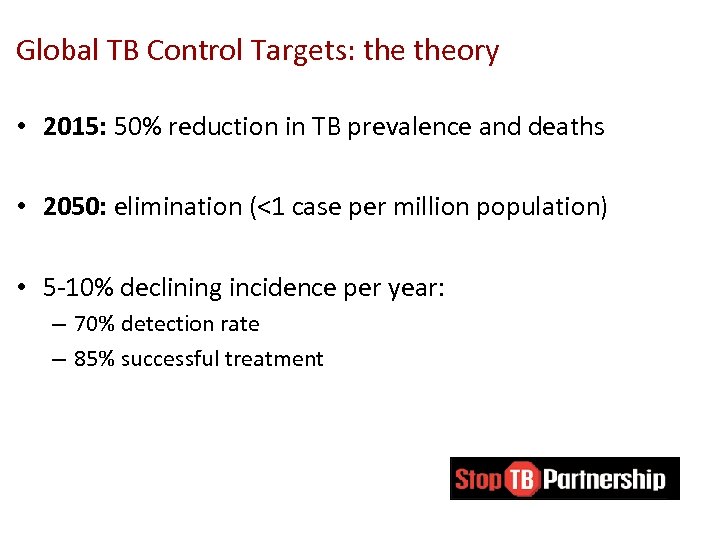 Global TB Control Targets: theory • 2015: 50% reduction in TB prevalence and deaths • 2050: elimination (<1 case per million population) • 5 -10% declining incidence per year: – 70% detection rate – 85% successful treatment
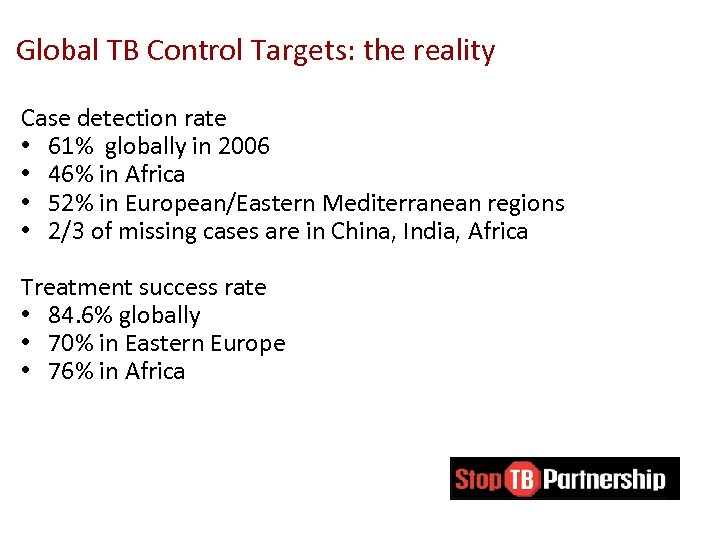 Global TB Control Targets: the reality Case detection rate • 61% globally in 2006 • 46% in Africa • 52% in European/Eastern Mediterranean regions • 2/3 of missing cases are in China, India, Africa Treatment success rate • 84. 6% globally • 70% in Eastern Europe • 76% in Africa