


 Скачать презентацию OPHI Oxford Poverty Human Development Initiative Department
c8d6f44aa624f01281fd7277e20b70d8.ppt
- Количество слайдов: 62
 OPHI Oxford Poverty & Human Development Initiative Department of International Development Queen Elizabeth House, University of Oxford www. ophi. org. uk Open Dialogue Day 16 June 2008
 Counting and Multidimensional Poverty Measurement by Sabina Alkire and James Foster OPHI 16 June, 2008
 Why Multidimensional Poverty? • • Capability Approach Data Tools Demand
 How to Measure? • Variables • Identification • Aggregation
 Our Proposal • Variables – Assume given • Identification – Dual cutoffs • Aggregation – Adjusted FGT
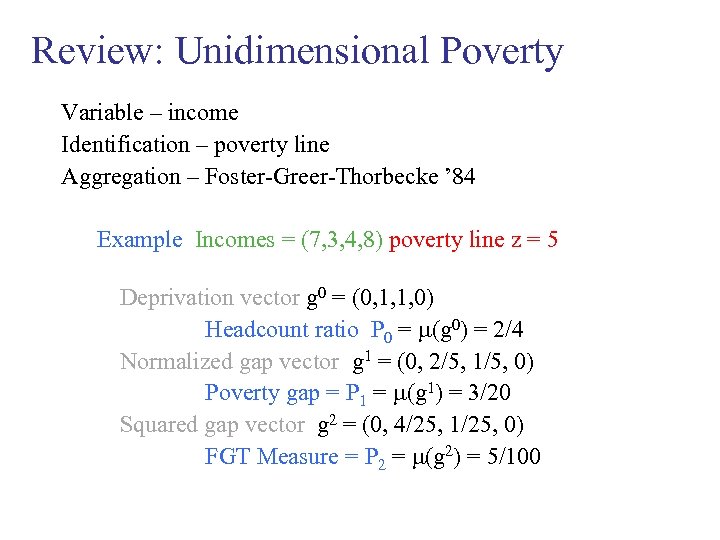 Review: Unidimensional Poverty Variable – income Identification – poverty line Aggregation – Foster-Greer-Thorbecke ’ 84 Example Incomes = (7, 3, 4, 8) poverty line z = 5 Deprivation vector g 0 = (0, 1, 1, 0) Headcount ratio P 0 = m(g 0) = 2/4 Normalized gap vector g 1 = (0, 2/5, 1/5, 0) Poverty gap = P 1 = m(g 1) = 3/20 Squared gap vector g 2 = (0, 4/25, 1/25, 0) FGT Measure = P 2 = m(g 2) = 5/100
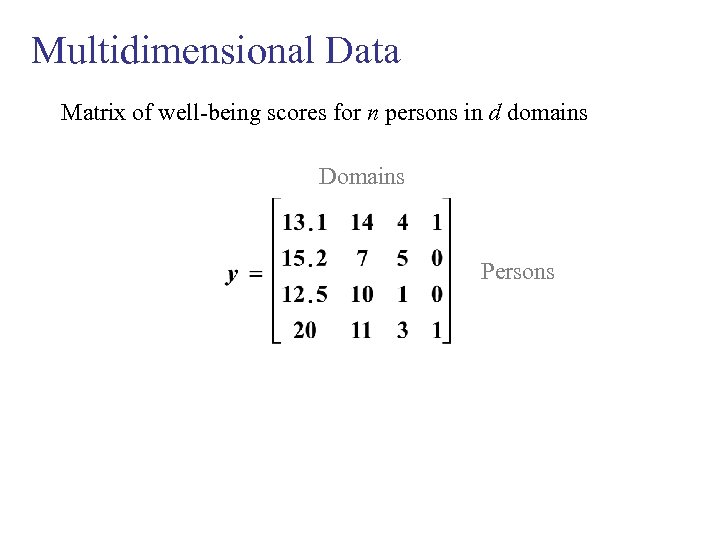 Multidimensional Data Matrix of well-being scores for n persons in d domains Domains Persons
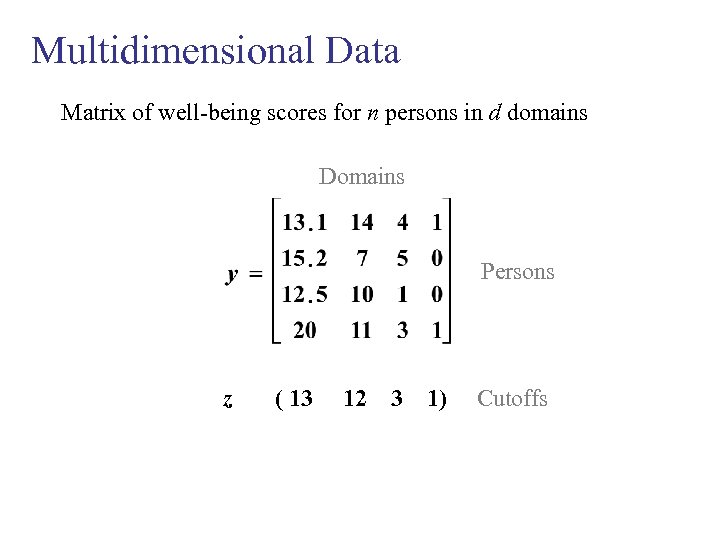 Multidimensional Data Matrix of well-being scores for n persons in d domains Domains Persons z ( 13 12 3 1) Cutoffs
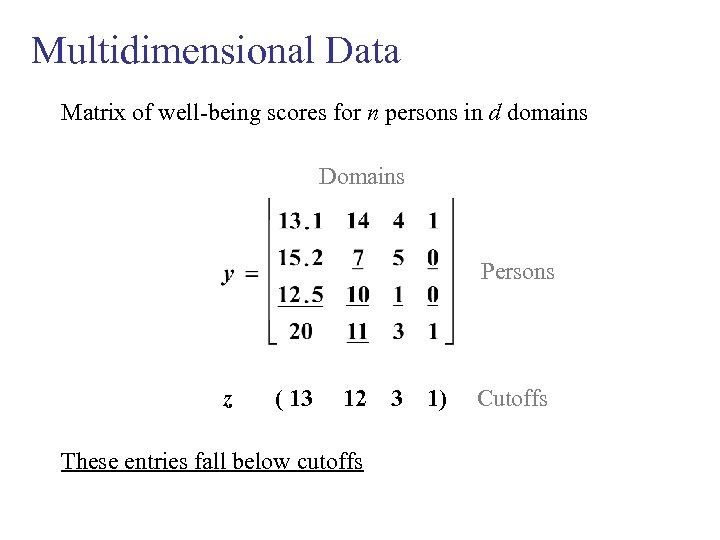 Multidimensional Data Matrix of well-being scores for n persons in d domains Domains Persons z ( 13 12 These entries fall below cutoffs 3 1) Cutoffs
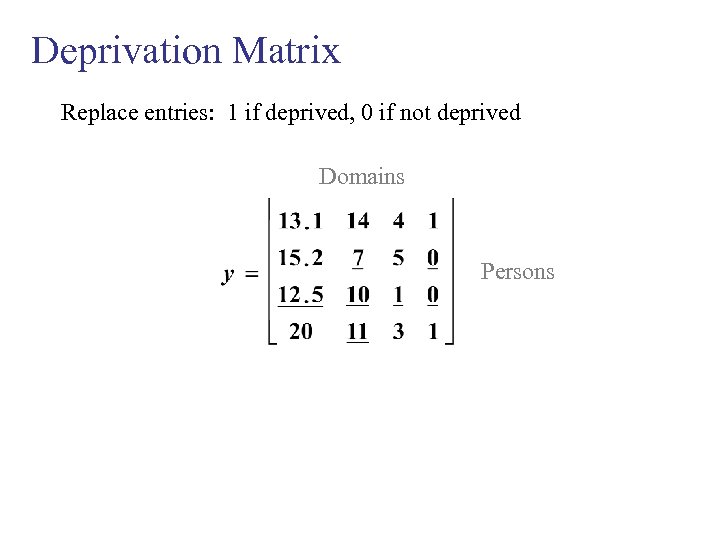 Deprivation Matrix Replace entries: 1 if deprived, 0 if not deprived Domains Persons
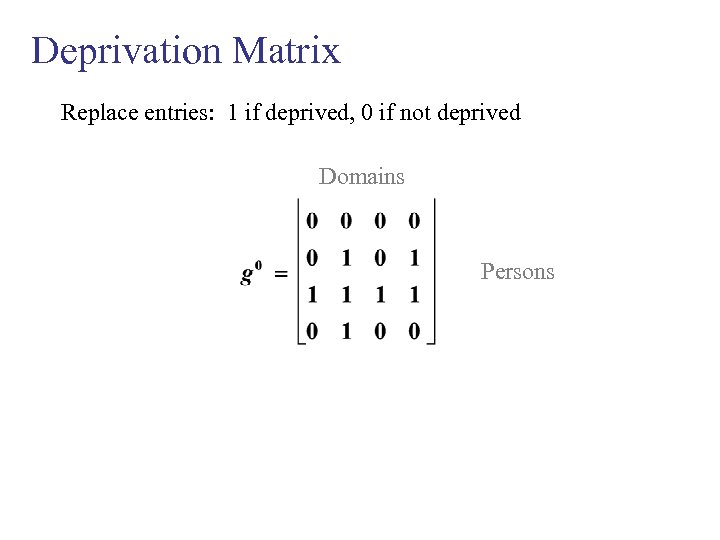 Deprivation Matrix Replace entries: 1 if deprived, 0 if not deprived Domains Persons
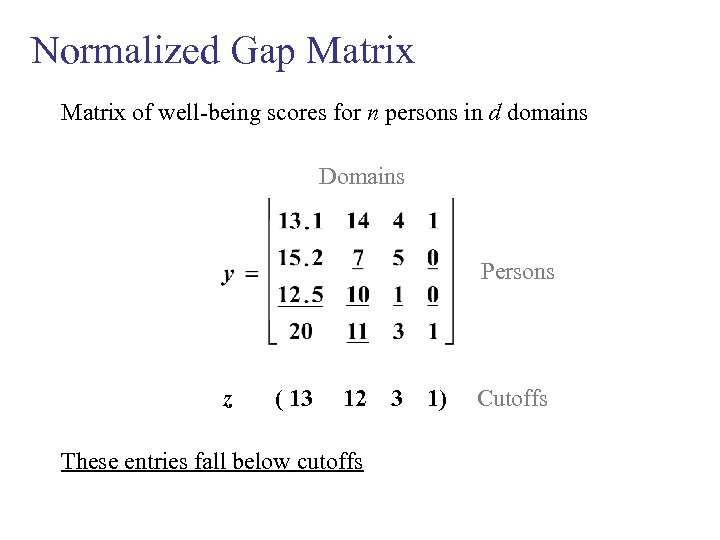 Normalized Gap Matrix of well-being scores for n persons in d domains Domains Persons z ( 13 12 These entries fall below cutoffs 3 1) Cutoffs
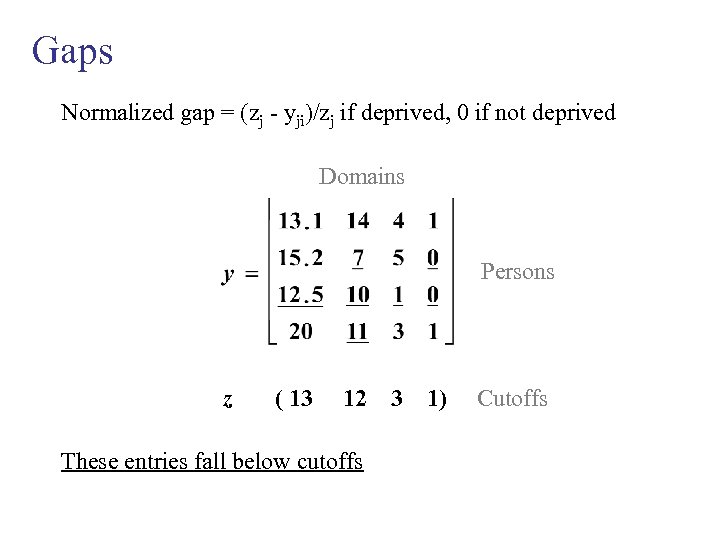 Gaps Normalized gap = (zj - yji)/zj if deprived, 0 if not deprived Domains Persons z ( 13 12 These entries fall below cutoffs 3 1) Cutoffs
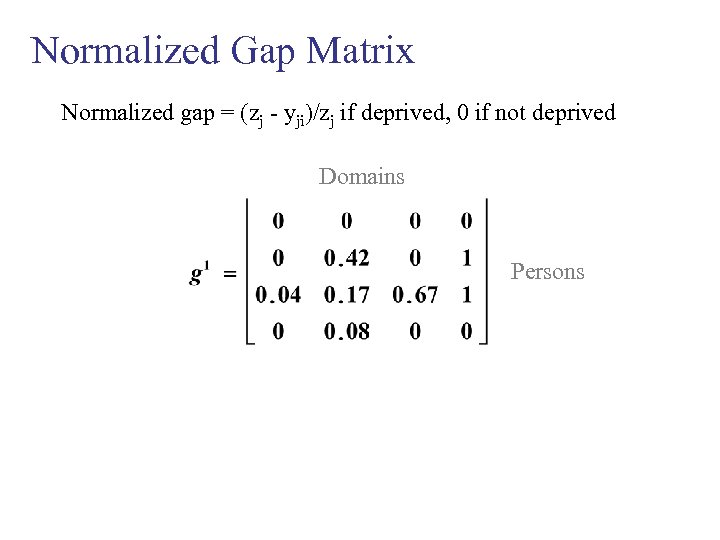 Normalized Gap Matrix Normalized gap = (zj - yji)/zj if deprived, 0 if not deprived Domains Persons
![Squared Gap Matrix Squared gap = [(zj - yji)/zj]2 if deprived, 0 if not](https://present5.com/presentation/c8d6f44aa624f01281fd7277e20b70d8/image-15.jpg "Squared Gap Matrix Squared gap = [(zj - yji)/zj]2 if deprived, 0 if not") Squared Gap Matrix Squared gap = [(zj - yji)/zj]2 if deprived, 0 if not deprived Domains Persons
Squared Gap Matrix Squared gap = [(zj - yji)/zj]2 if deprived, 0 if not deprived Domains Persons
![Squared Gap Matrix Squared gap = [(zj - yji)/zj]2 if deprived, 0 if not](https://present5.com/presentation/c8d6f44aa624f01281fd7277e20b70d8/image-16.jpg "Squared Gap Matrix Squared gap = [(zj - yji)/zj]2 if deprived, 0 if not") Squared Gap Matrix Squared gap = [(zj - yji)/zj]2 if deprived, 0 if not deprived Domains Persons
Squared Gap Matrix Squared gap = [(zj - yji)/zj]2 if deprived, 0 if not deprived Domains Persons
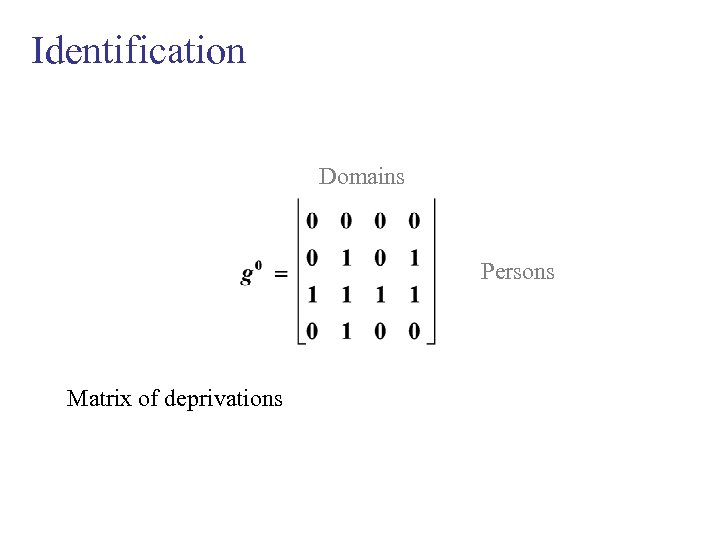 Identification Domains Persons Matrix of deprivations
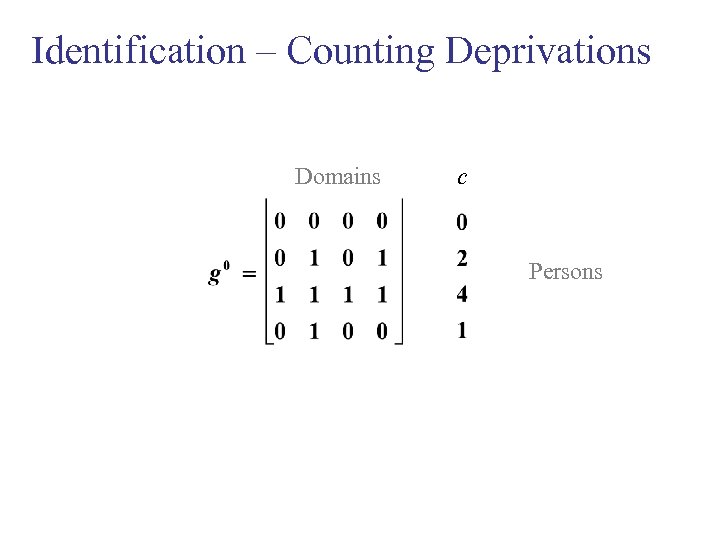 Identification – Counting Deprivations Domains c Persons
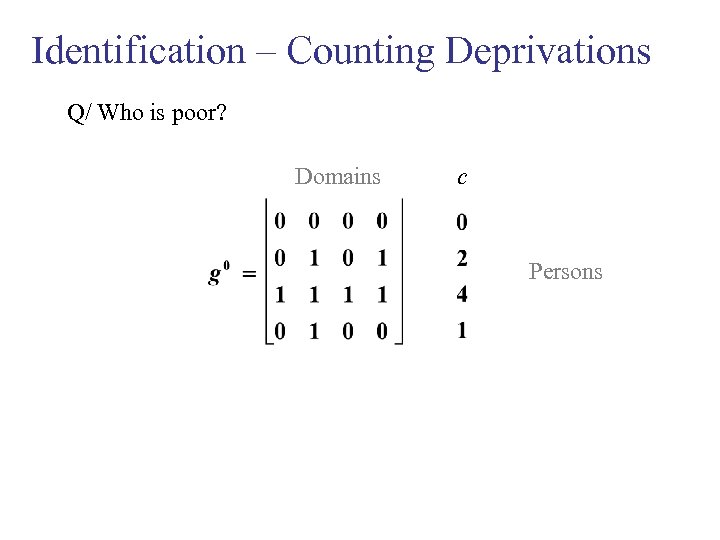 Identification – Counting Deprivations Q/ Who is poor? Domains c Persons
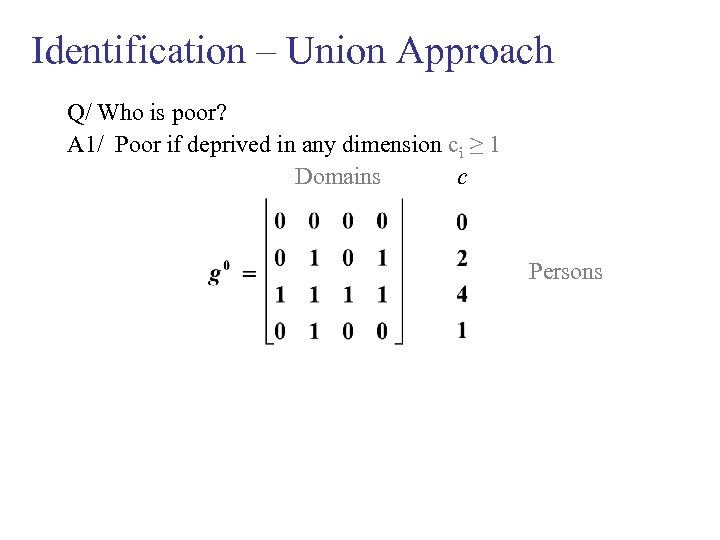 Identification – Union Approach Q/ Who is poor? A 1/ Poor if deprived in any dimension ci ≥ 1 Domains c Persons
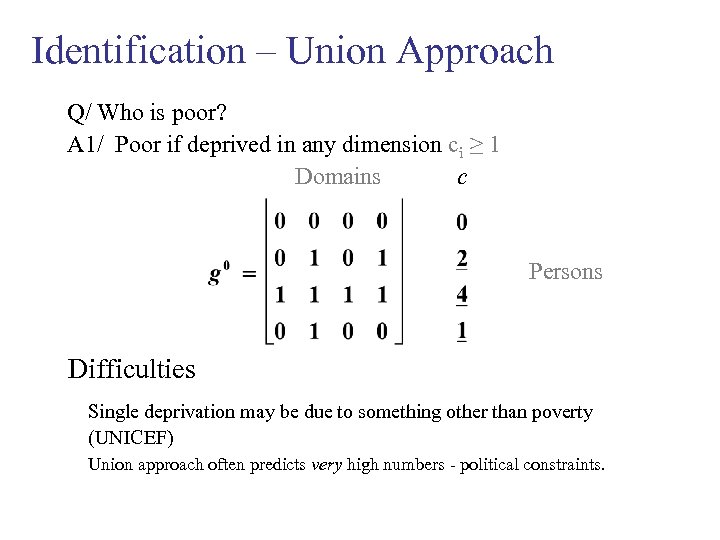 Identification – Union Approach Q/ Who is poor? A 1/ Poor if deprived in any dimension ci ≥ 1 Domains c Persons Difficulties Single deprivation may be due to something other than poverty (UNICEF) Union approach often predicts very high numbers - political constraints.
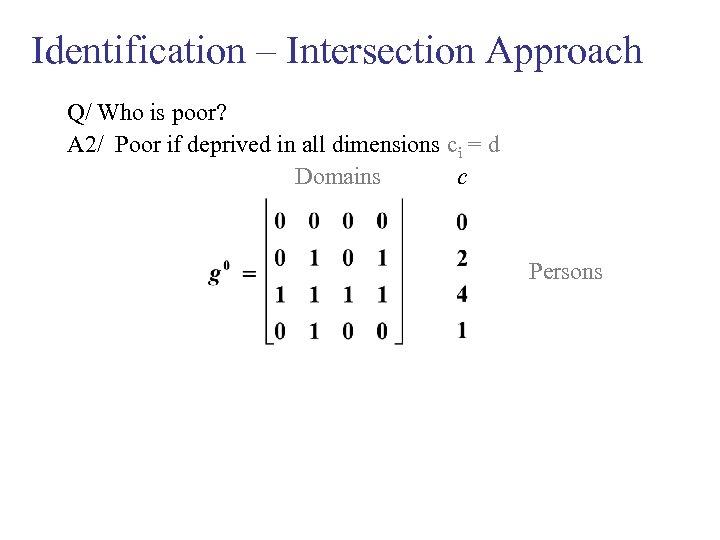 Identification – Intersection Approach Q/ Who is poor? A 2/ Poor if deprived in all dimensions ci = d Domains c Persons
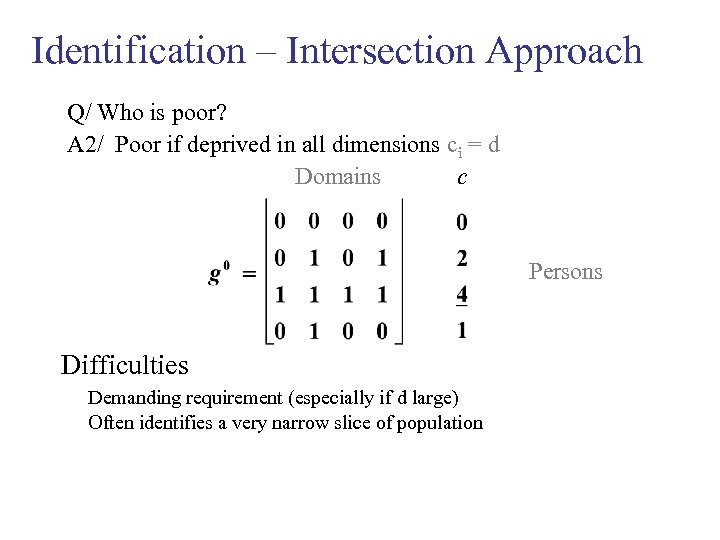 Identification – Intersection Approach Q/ Who is poor? A 2/ Poor if deprived in all dimensions ci = d Domains c Persons Difficulties Demanding requirement (especially if d large) Often identifies a very narrow slice of population
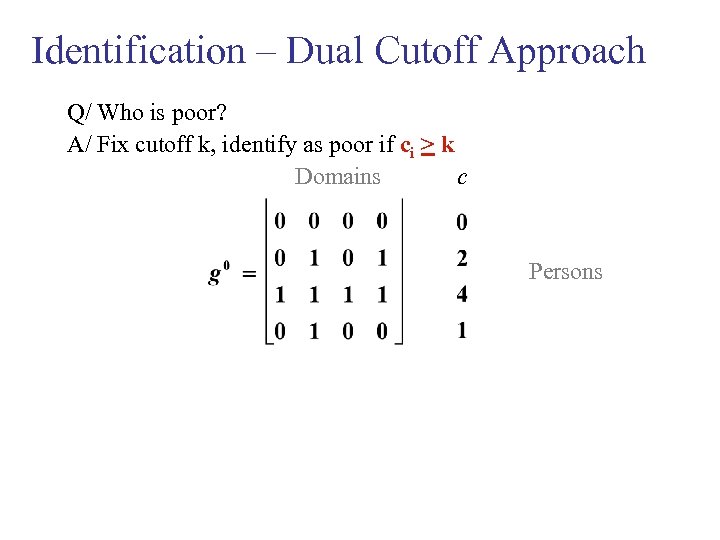 Identification – Dual Cutoff Approach Q/ Who is poor? A/ Fix cutoff k, identify as poor if ci > k Domains c Persons
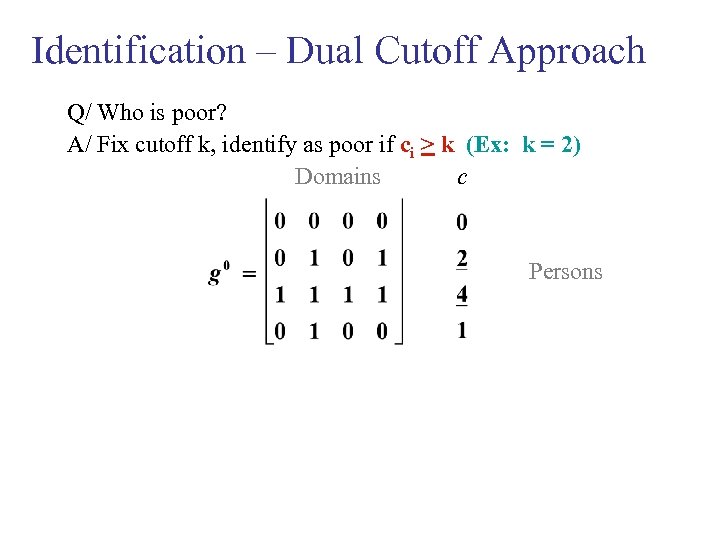 Identification – Dual Cutoff Approach Q/ Who is poor? A/ Fix cutoff k, identify as poor if ci > k (Ex: k = 2) Domains c Persons
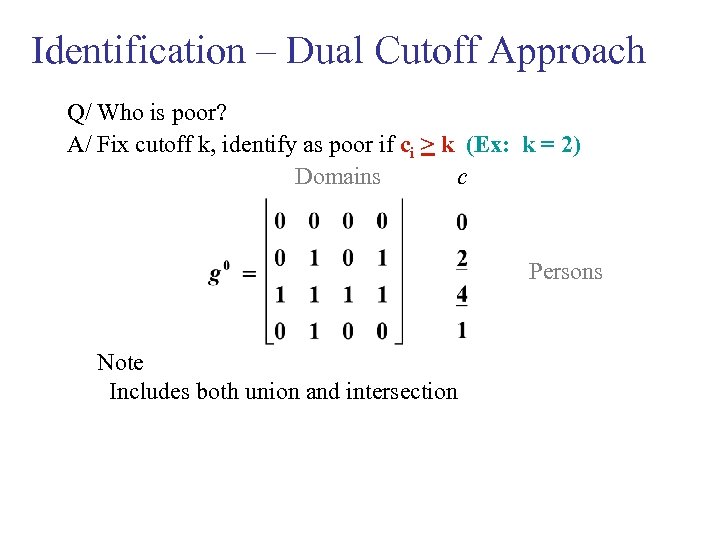 Identification – Dual Cutoff Approach Q/ Who is poor? A/ Fix cutoff k, identify as poor if ci > k (Ex: k = 2) Domains c Persons Note Includes both union and intersection
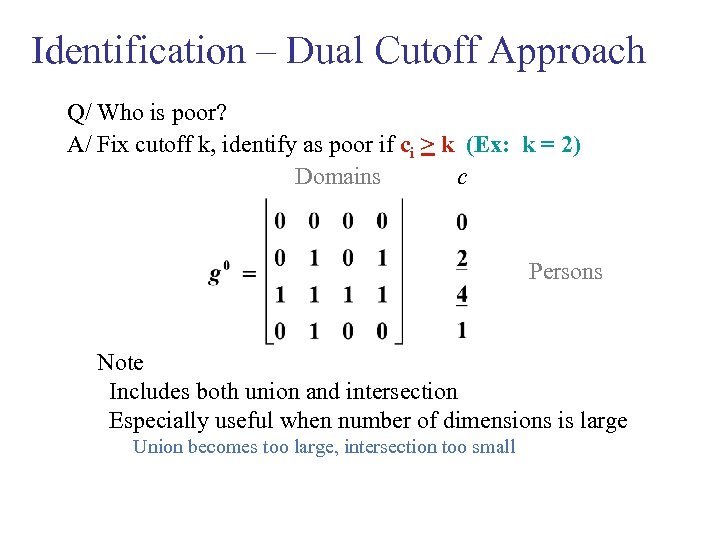 Identification – Dual Cutoff Approach Q/ Who is poor? A/ Fix cutoff k, identify as poor if ci > k (Ex: k = 2) Domains c Persons Note Includes both union and intersection Especially useful when number of dimensions is large Union becomes too large, intersection too small
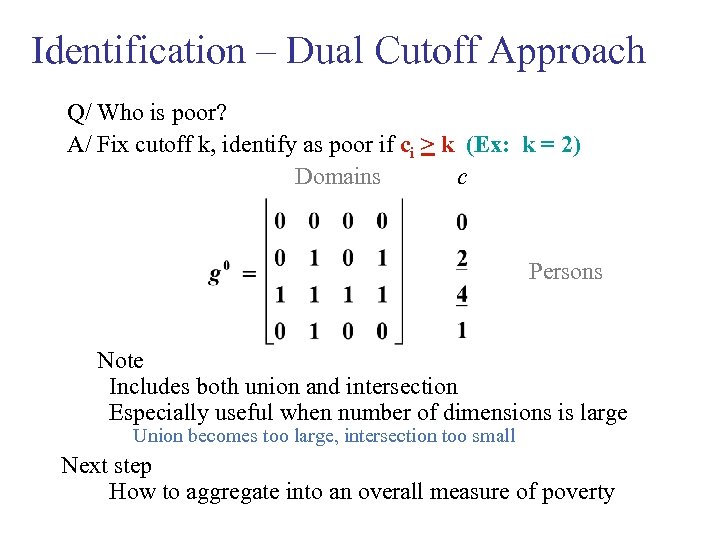 Identification – Dual Cutoff Approach Q/ Who is poor? A/ Fix cutoff k, identify as poor if ci > k (Ex: k = 2) Domains c Persons Note Includes both union and intersection Especially useful when number of dimensions is large Union becomes too large, intersection too small Next step How to aggregate into an overall measure of poverty
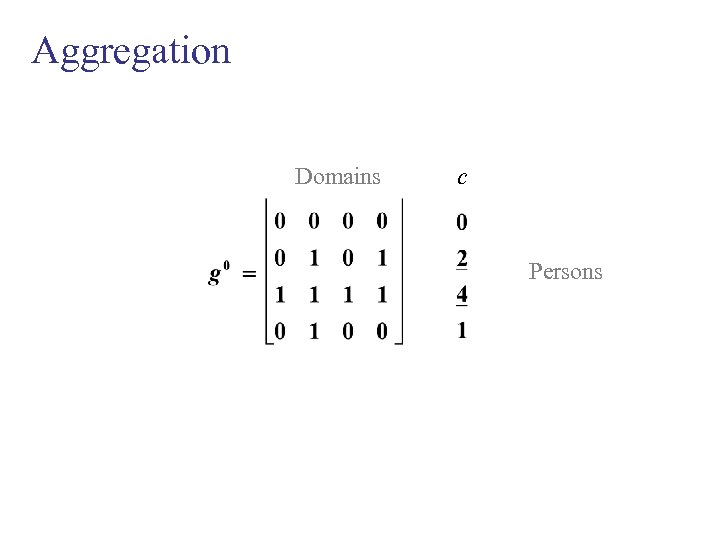 Aggregation Domains c Persons
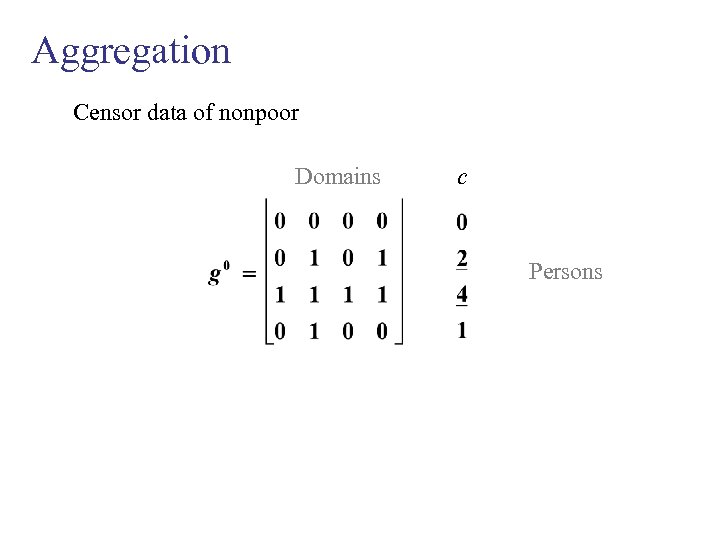 Aggregation Censor data of nonpoor Domains c Persons
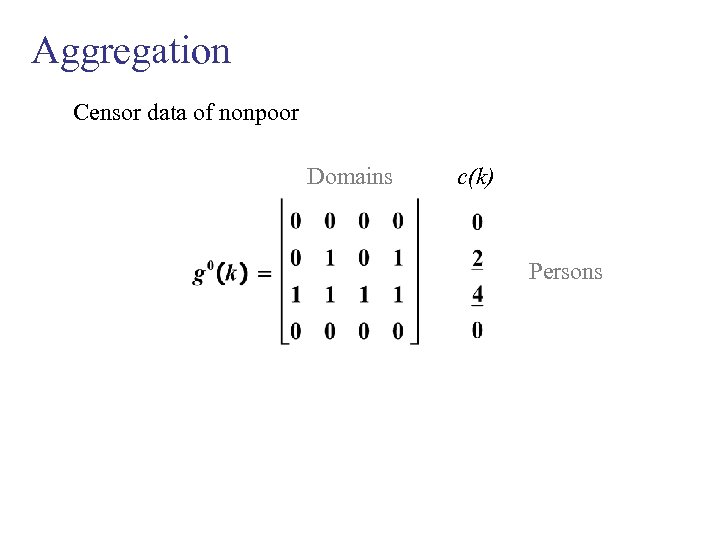 Aggregation Censor data of nonpoor Domains c(k) Persons
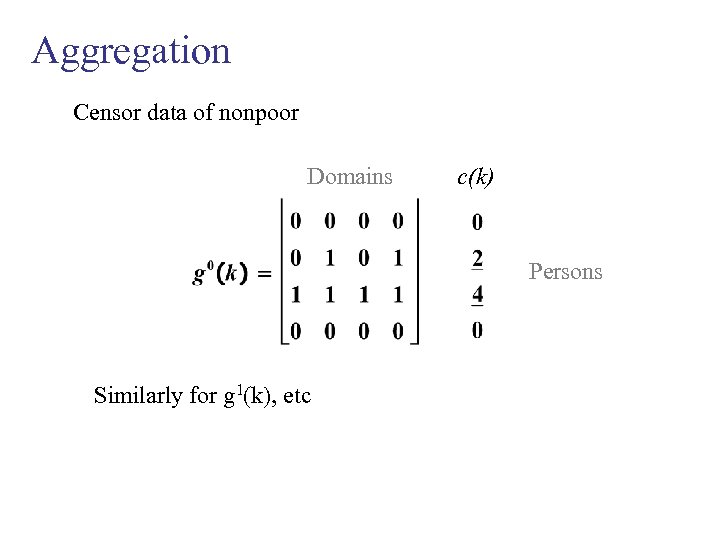 Aggregation Censor data of nonpoor Domains c(k) Persons Similarly for g 1(k), etc
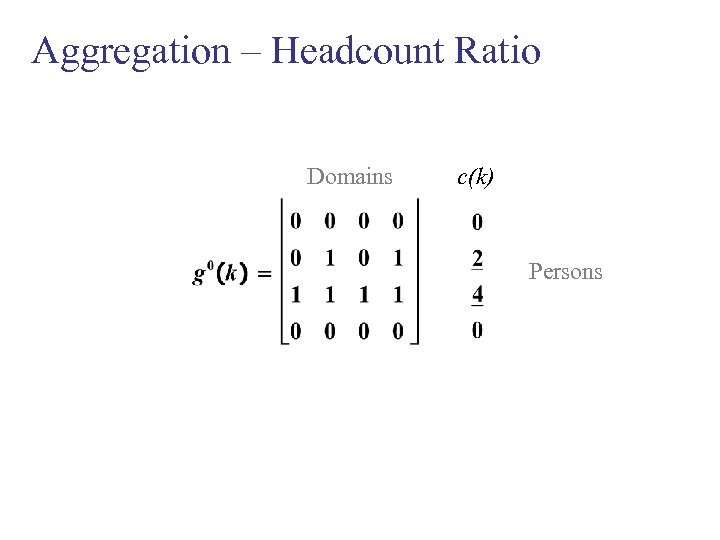 Aggregation – Headcount Ratio Domains c(k) Persons
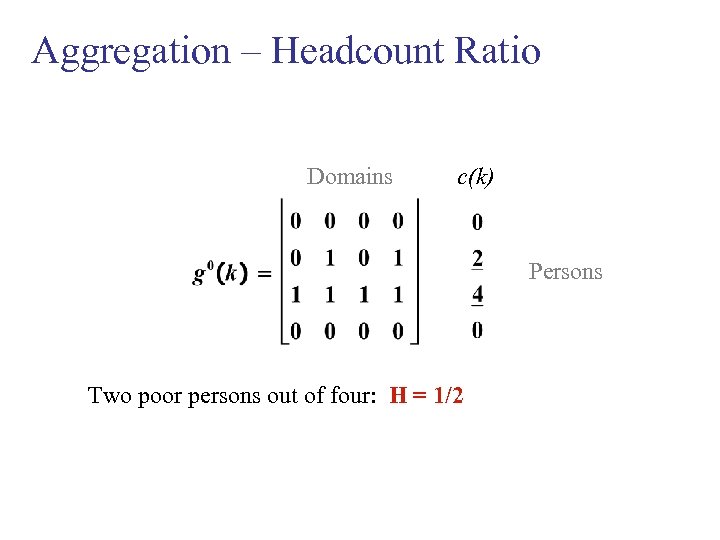 Aggregation – Headcount Ratio Domains c(k) Persons Two poor persons out of four: H = 1/2
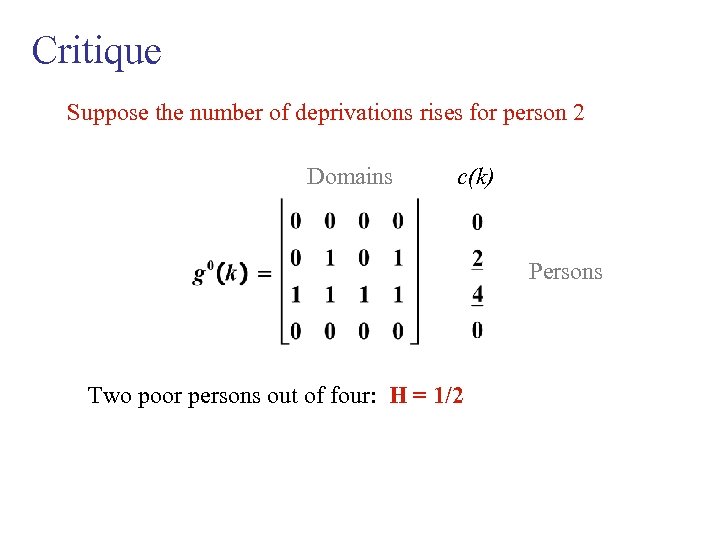 Critique Suppose the number of deprivations rises for person 2 Domains c(k) Persons Two poor persons out of four: H = 1/2
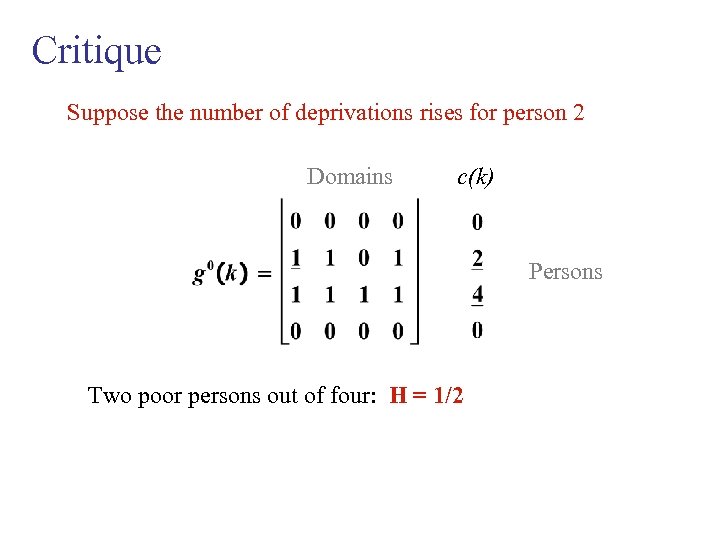 Critique Suppose the number of deprivations rises for person 2 Domains c(k) Persons Two poor persons out of four: H = 1/2
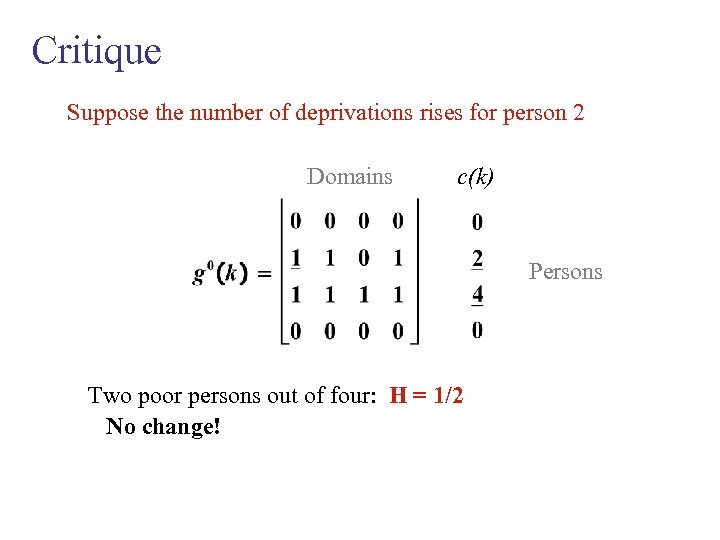 Critique Suppose the number of deprivations rises for person 2 Domains c(k) Persons Two poor persons out of four: H = 1/2 No change!
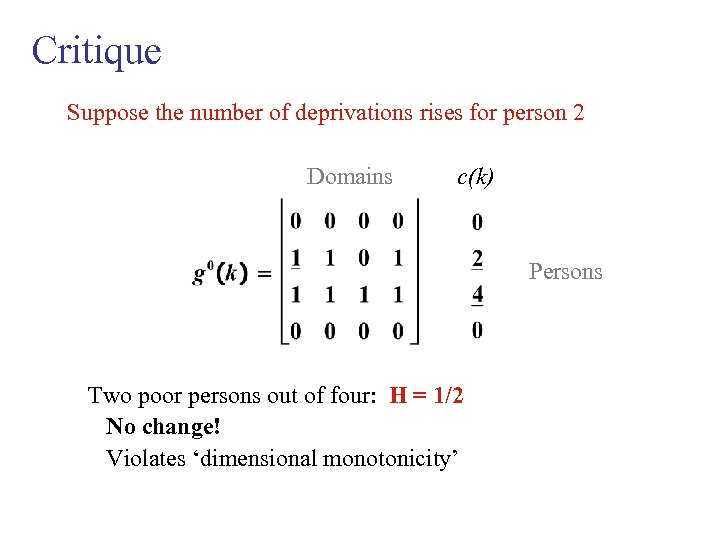 Critique Suppose the number of deprivations rises for person 2 Domains c(k) Persons Two poor persons out of four: H = 1/2 No change! Violates ‘dimensional monotonicity’
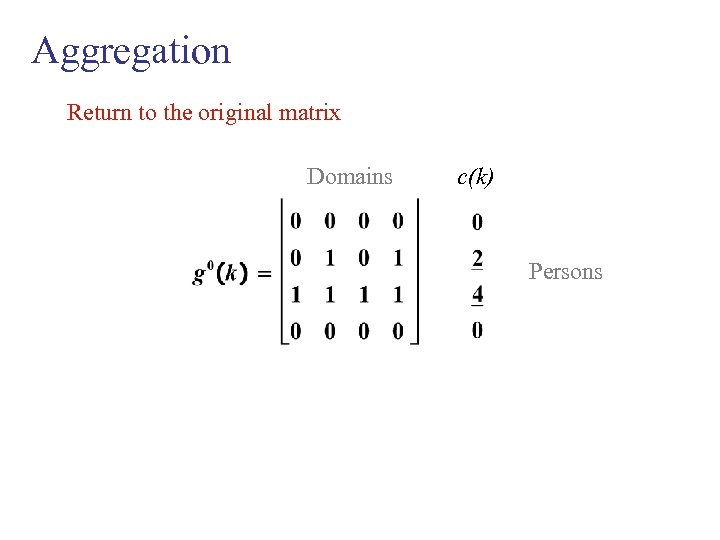
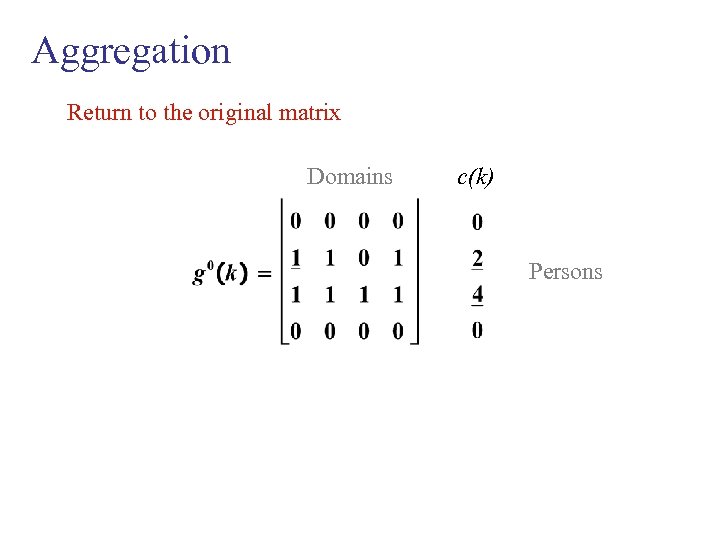 Aggregation Return to the original matrix Domains c(k) Persons
 Aggregation Return to the original matrix Domains c(k) Persons
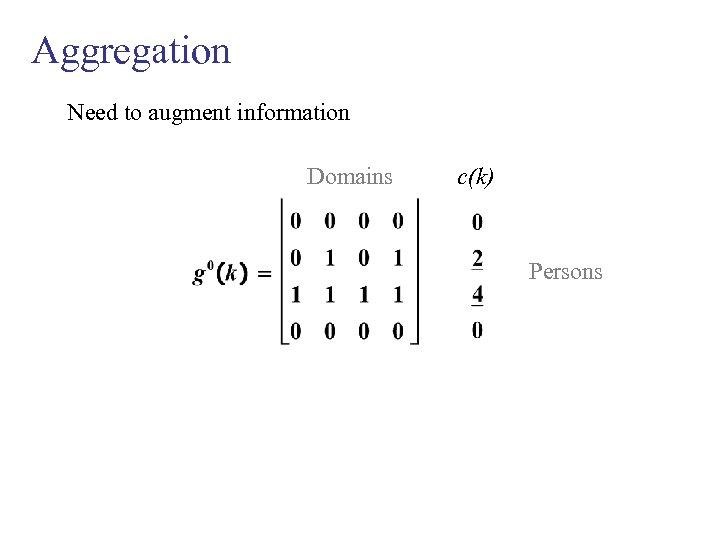 Aggregation Need to augment information Domains c(k) Persons
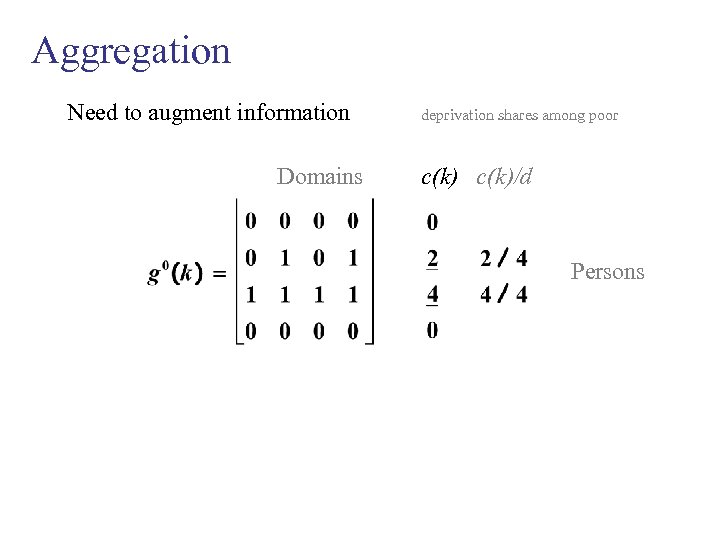 Aggregation Need to augment information Domains deprivation shares among poor c(k)/d Persons
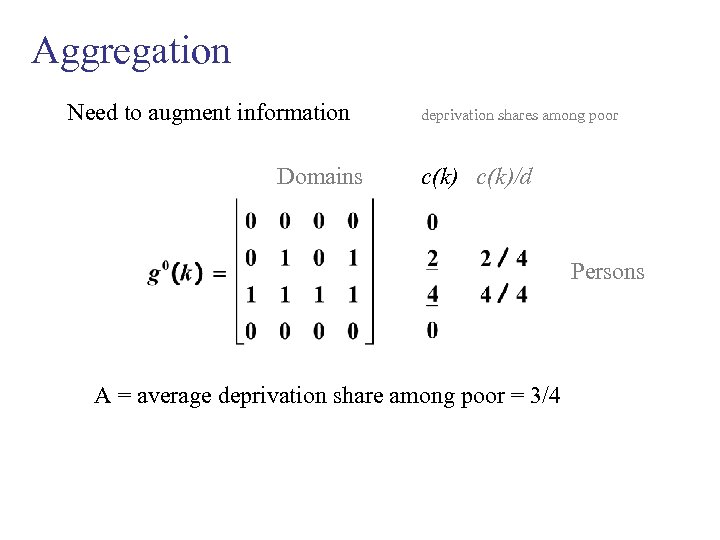 Aggregation Need to augment information Domains deprivation shares among poor c(k)/d Persons A = average deprivation share among poor = 3/4
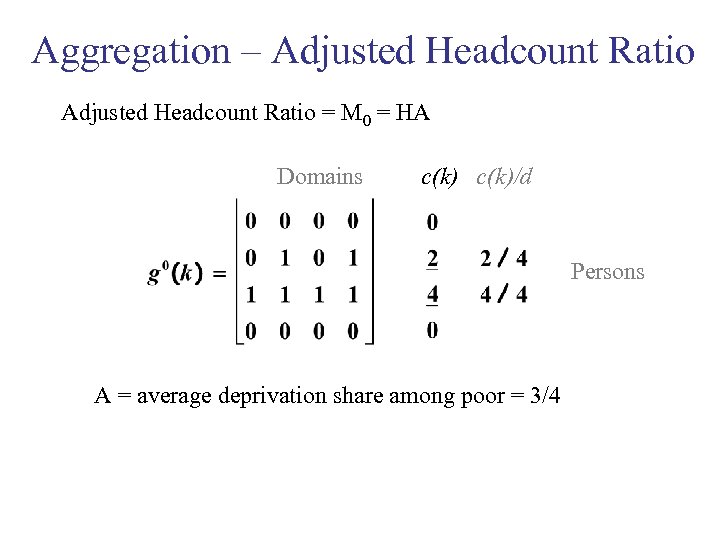 Aggregation – Adjusted Headcount Ratio = M 0 = HA Domains c(k)/d Persons A = average deprivation share among poor = 3/4
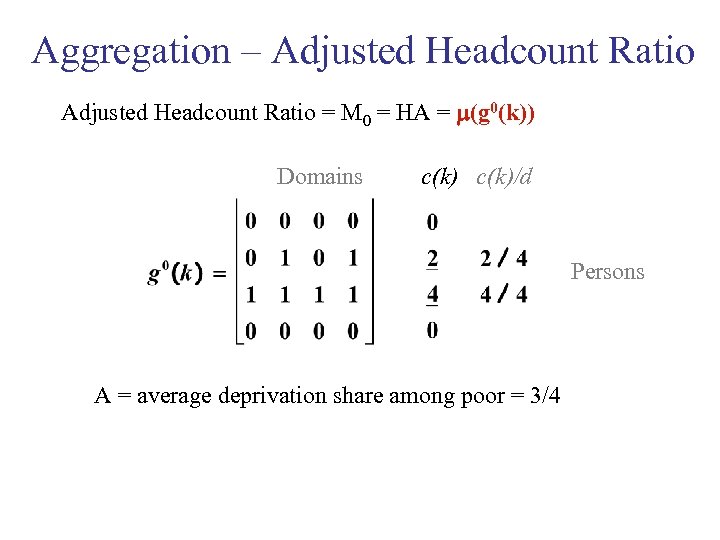 Aggregation – Adjusted Headcount Ratio = M 0 = HA = m(g 0(k)) Domains c(k)/d Persons A = average deprivation share among poor = 3/4
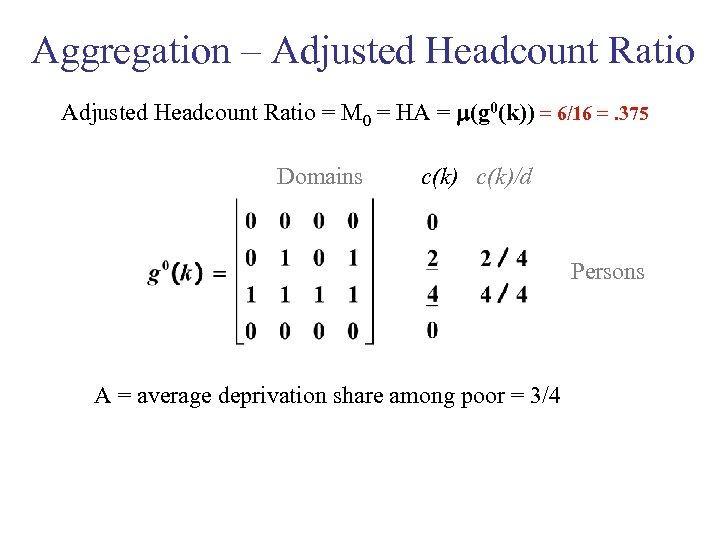 Aggregation – Adjusted Headcount Ratio = M 0 = HA = m(g 0(k)) = 6/16 =. 375 Domains c(k)/d Persons A = average deprivation share among poor = 3/4
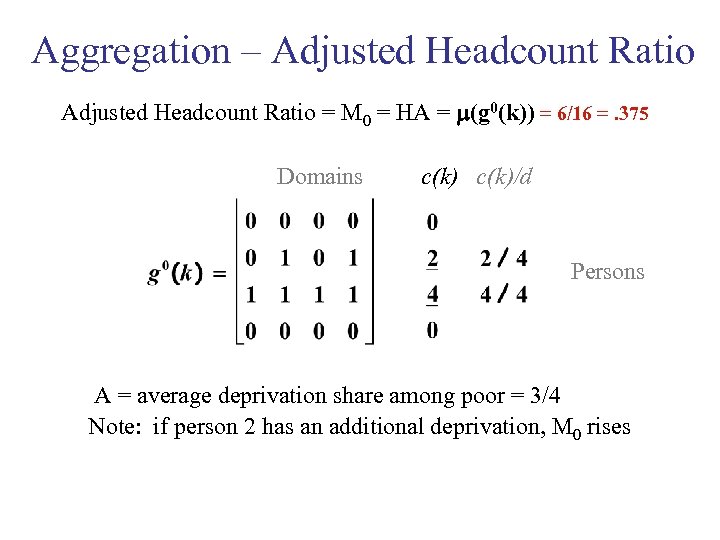 Aggregation – Adjusted Headcount Ratio = M 0 = HA = m(g 0(k)) = 6/16 =. 375 Domains c(k)/d Persons A = average deprivation share among poor = 3/4 Note: if person 2 has an additional deprivation, M 0 rises
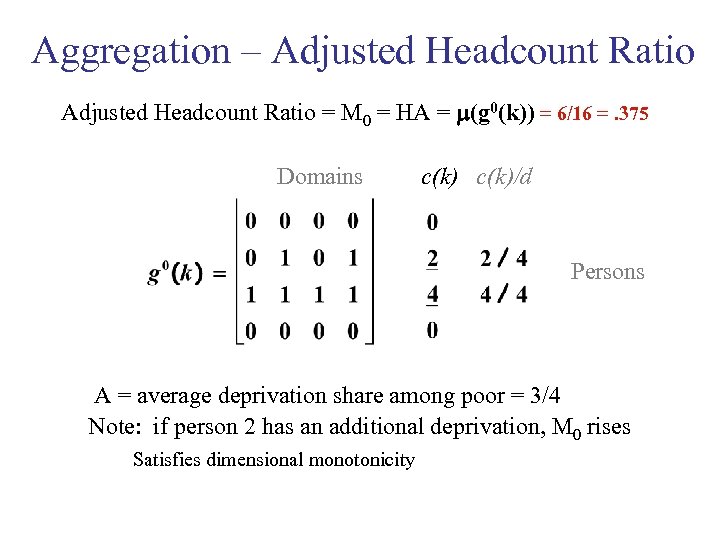 Aggregation – Adjusted Headcount Ratio = M 0 = HA = m(g 0(k)) = 6/16 =. 375 Domains c(k)/d Persons A = average deprivation share among poor = 3/4 Note: if person 2 has an additional deprivation, M 0 rises Satisfies dimensional monotonicity
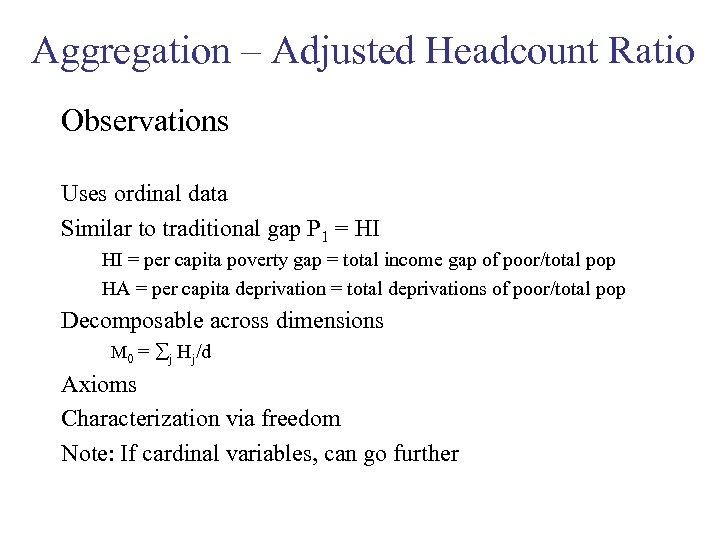 Aggregation – Adjusted Headcount Ratio Observations Uses ordinal data Similar to traditional gap P 1 = HI HI = per capita poverty gap = total income gap of poor/total pop HA = per capita deprivation = total deprivations of poor/total pop Decomposable across dimensions M 0 = j Hj/d Axioms Characterization via freedom Note: If cardinal variables, can go further
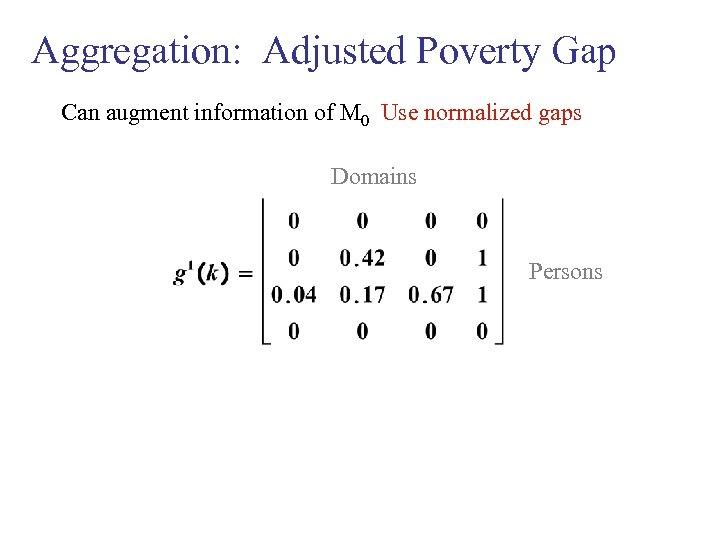 Aggregation: Adjusted Poverty Gap Can augment information of M 0 Use normalized gaps Domains Persons
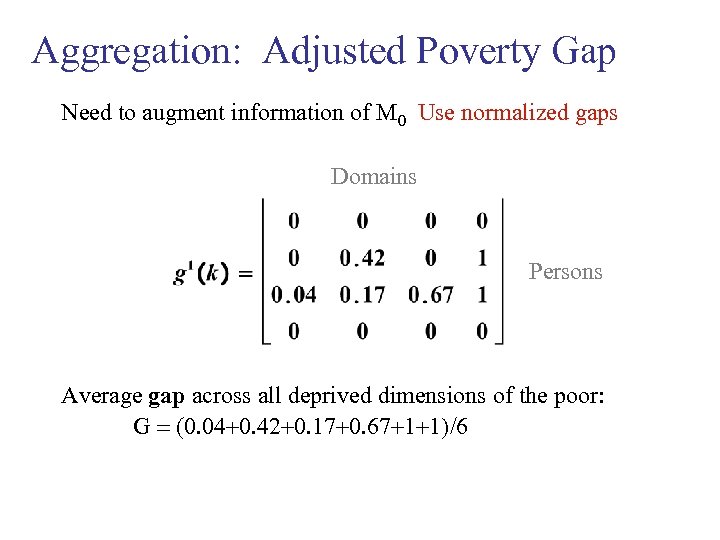 Aggregation: Adjusted Poverty Gap Need to augment information of M 0 Use normalized gaps Domains Persons Average gap across all deprived dimensions of the poor: G = /
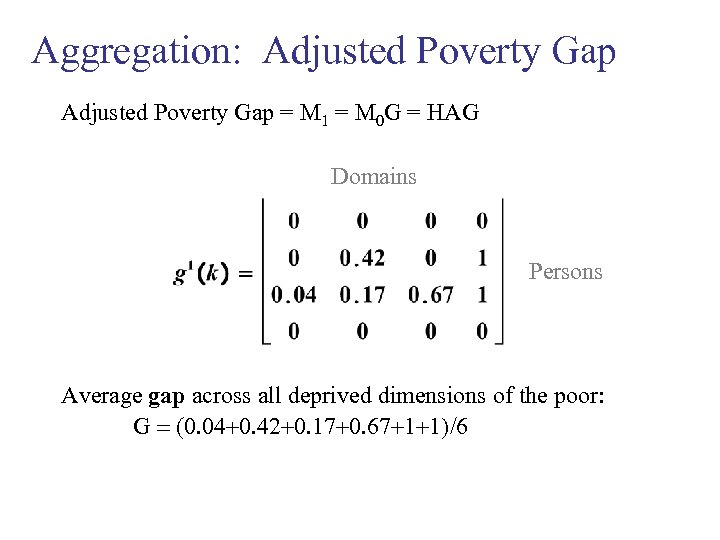 Aggregation: Adjusted Poverty Gap = M 1 = M 0 G = HAG Domains Persons Average gap across all deprived dimensions of the poor: G = /
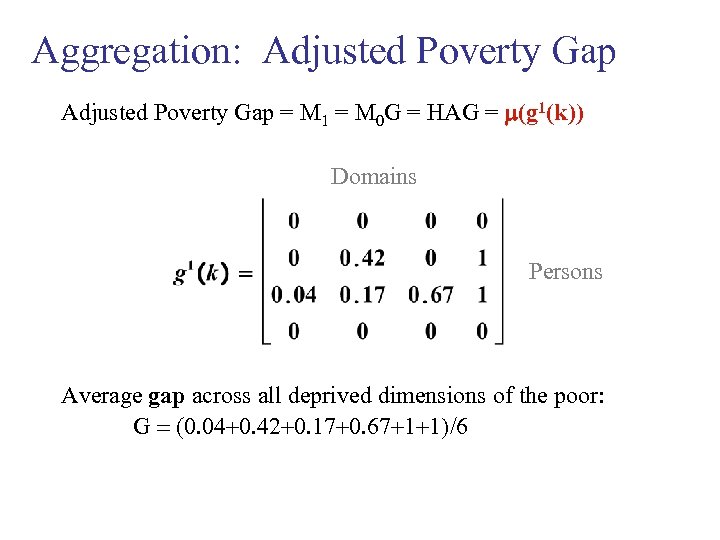 Aggregation: Adjusted Poverty Gap = M 1 = M 0 G = HAG = m(g 1(k)) Domains Persons Average gap across all deprived dimensions of the poor: G = /
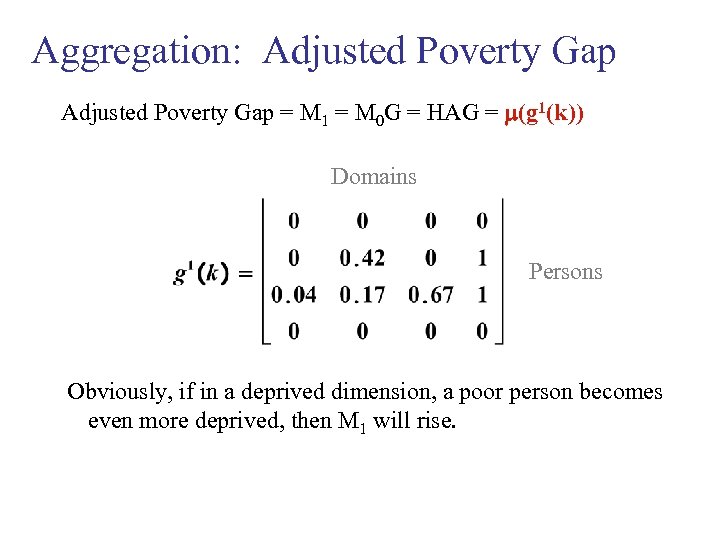 Aggregation: Adjusted Poverty Gap = M 1 = M 0 G = HAG = m(g 1(k)) Domains Persons Obviously, if in a deprived dimension, a poor person becomes even more deprived, then M 1 will rise.
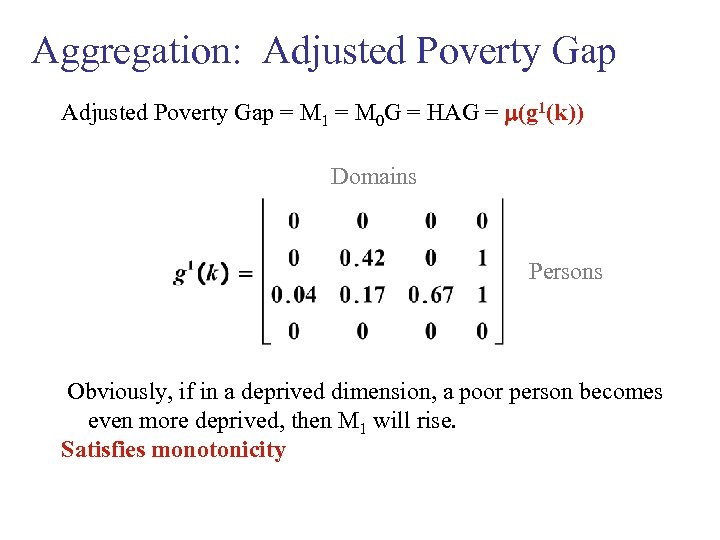 Aggregation: Adjusted Poverty Gap = M 1 = M 0 G = HAG = m(g 1(k)) Domains Persons Obviously, if in a deprived dimension, a poor person becomes even more deprived, then M 1 will rise. Satisfies monotonicity
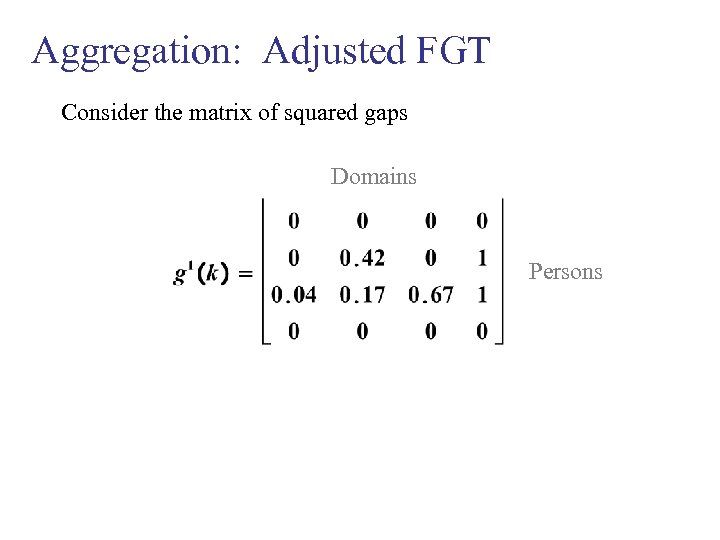 Aggregation: Adjusted FGT Consider the matrix of squared gaps Domains Persons
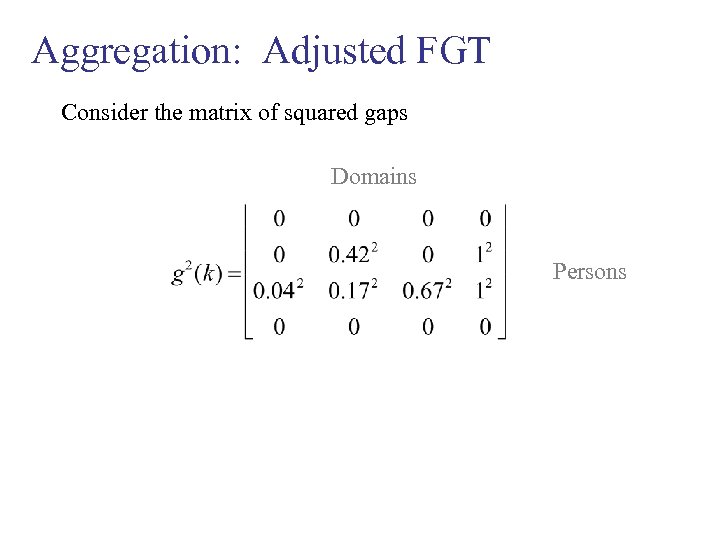 Aggregation: Adjusted FGT Consider the matrix of squared gaps Domains Persons
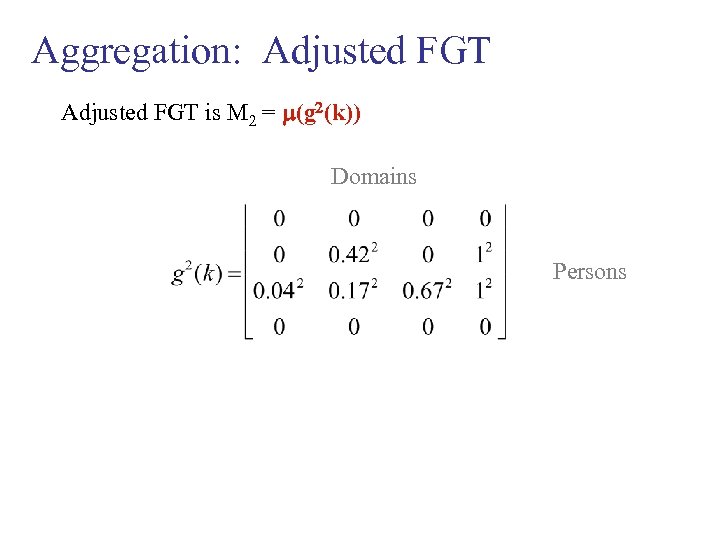 Aggregation: Adjusted FGT is M = m(g 2(k)) Domains Persons
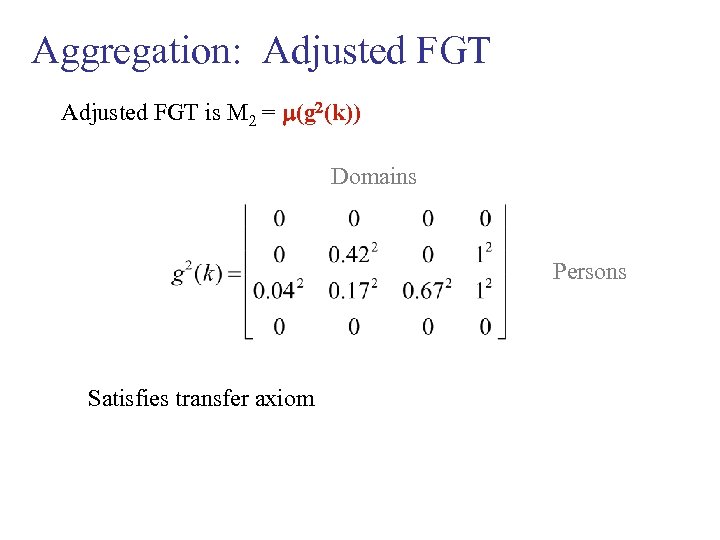 Aggregation: Adjusted FGT is M = m(g 2(k)) Domains Persons Satisfies transfer axiom
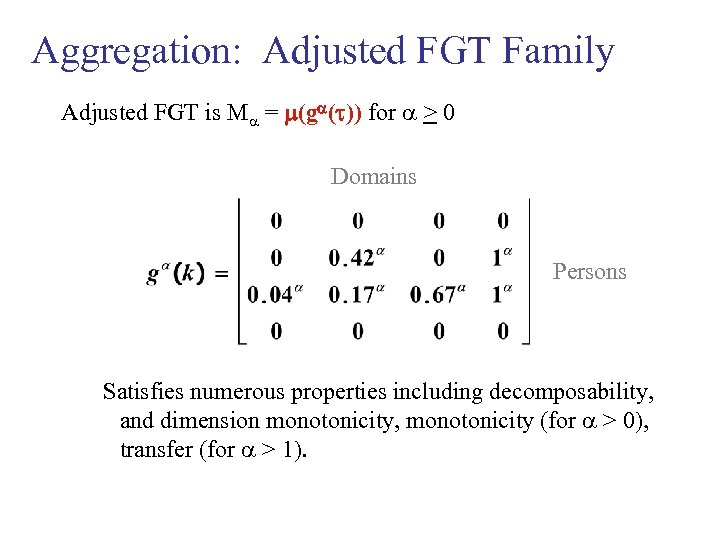 Aggregation: Adjusted FGT Family Adjusted FGT is M = m(ga(t)) for > 0 Domains Persons Satisfies numerous properties including decomposability, and dimension monotonicity, monotonicity (for > 0), transfer (for > 1).
 Extension Modifying for weights Weighted identification Weight on income: 50% Weight on education, health: 25% Cutoff = 0. 50 Poor if income poor, or suffer two or more deprivations Cutoff = 0. 60 Poor if income poor and suffer one or more other deprivations Nolan, Brian and Christopher T. Whelan, Resources, Deprivation and Poverty, 1996 Weighted aggregation
 Next Applications Sub-Saharan Africa Latin America China India Bhutan Questions?