


 Скачать презентацию Operations Management Project Management Chapter 3 Learning
d4d0e3a0c94be77cc86a899bf119cbfa.ppt
- Количество слайдов: 46
 Operations Management Project Management Chapter 3
 Learning Objectives When you complete this chapter, you should be able to : Identify or Define: ¨ Work breakdown structure ¨ Critical path ¨ AOA and AON Networks ¨ Forward and Backward Passes ¨ Variability in Activity Times 3 -2
 Learning Objectives Continued When you complete this chapter, you should be able to : Describe or Explain: ¨ The role of the project manager ¨ Program evaluation and review technique (PERT) ¨ Critical path method (CPM) ¨ Crashing a project ¨ The Use of MS Project 3 -3
 Management of Large Projects ¨ Planning - goal setting, project definition, team organization ¨ Scheduling - relating people, money, and supplies to specific activities and activities to one and other ¨ Controlling - monitoring resources, costs, quality, and budgets; revising plans and shifting resources to meet time and cost demands 3 -4
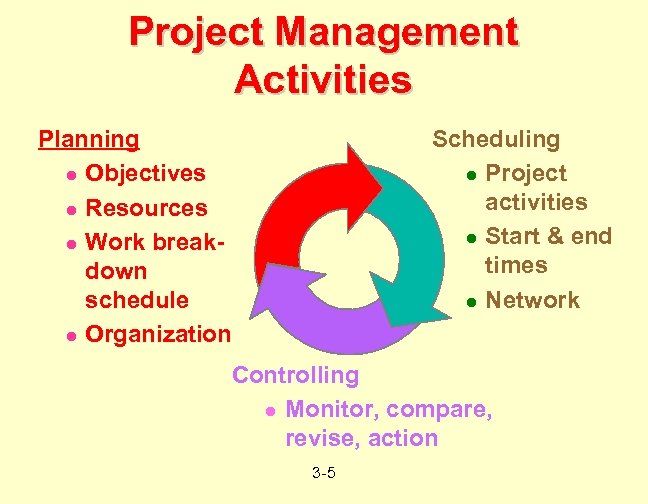 Project Management Activities Planning l Objectives l Resources l Work breakdown schedule l Organization Scheduling l Project activities l Start & end times l Network Controlling l Monitor, compare, revise, action 3 -5
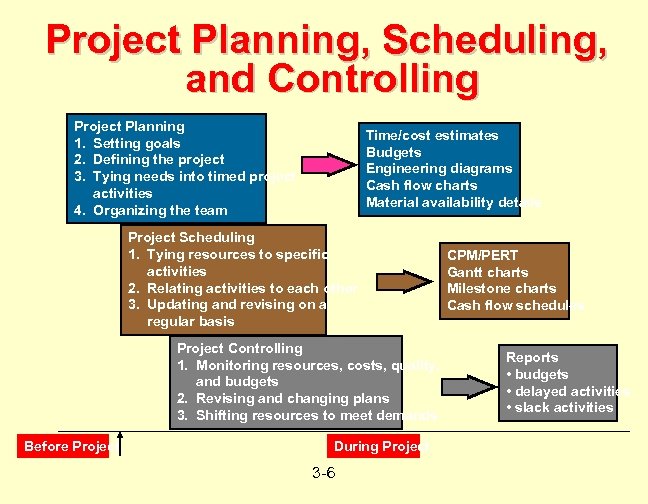 Project Planning, Scheduling, and Controlling Project Planning 1. Setting goals 2. Defining the project 3. Tying needs into timed project activities 4. Organizing the team Time/cost estimates Budgets Engineering diagrams Cash flow charts Material availability details Project Scheduling 1. Tying resources to specific activities 2. Relating activities to each other 3. Updating and revising on a regular basis Project Controlling 1. Monitoring resources, costs, quality, and budgets 2. Revising and changing plans 3. Shifting resources to meet demands Before Project During Project 3 -6 CPM/PERT Gantt charts Milestone charts Cash flow schedules Reports • budgets • delayed activities • slack activities
 Project Planning ¨ Establishing objectives ¨ Defining project ¨ Creating work breakdown structure ¨ Determining resources ¨ Forming organization 3 -7
 Project Organization ¨ Often temporary structure ¨ Uses specialists from entire company ¨ Headed by project manager ¨ Coordinates activities ¨ Monitors schedule & costs ¨ Permanent structure called ‘matrix organization’ 3 -8
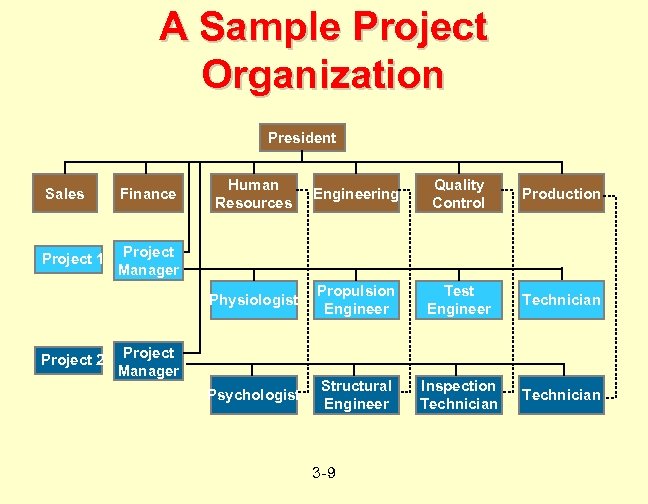 A Sample Project Organization President Finance Project 1 Human Resources Engineering Quality Control Production Physiologist Sales Propulsion Engineer Test Engineer Technician Psychologist Structural Engineer Inspection Technician Project Manager Project 2 Project Manager 3 -9
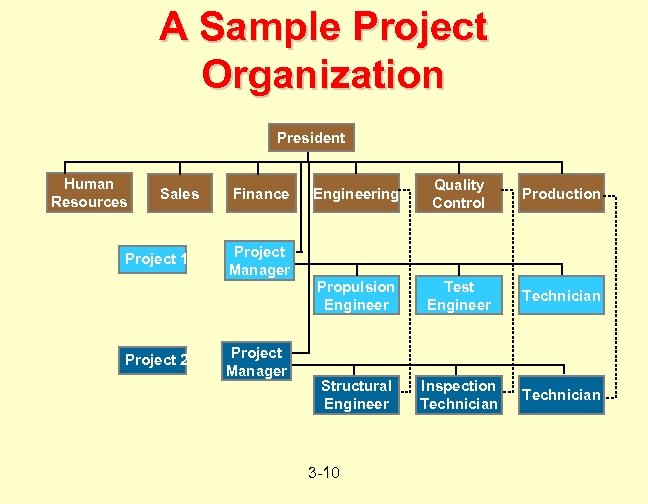 A Sample Project Organization President Human Resources Project 1 Project 2 Finance Engineering Quality Control Production Propulsion Engineer Sales Test Engineer Technician Structural Engineer Inspection Technician Project Manager 3 -10
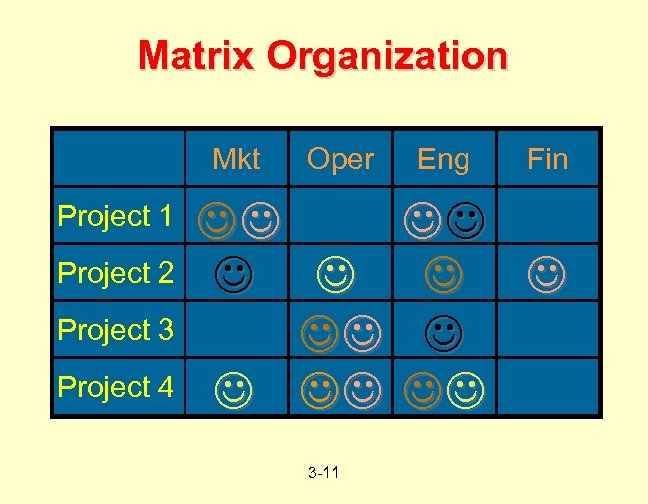 Matrix Organization Mkt Project 1 Project 2 Project 3 Project 4 Oper 3 -11 Eng Fin
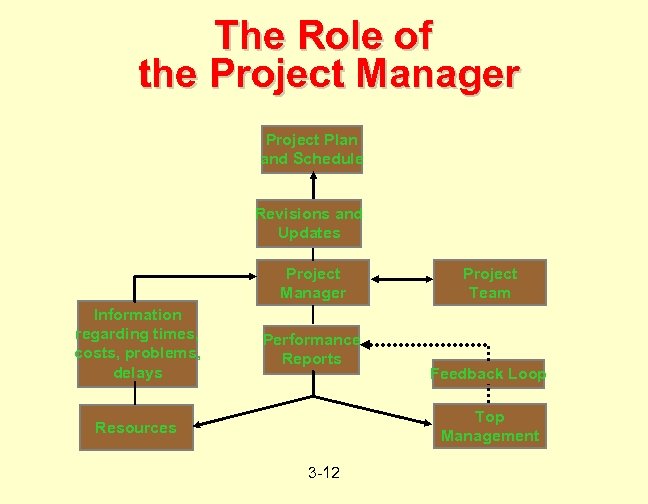 The Role of the Project Manager Project Plan and Schedule Revisions and Updates Project Manager Information regarding times, costs, problems, delays Performance Reports Project Team Feedback Loop Top Management Resources 3 -12
 Work Breakdown Structure ¨ 1. Project ¨ 2. Major tasks in the project ¨ 3. Subtasks in the major tasks ¨ 4. Activities (or work packages) to be completed 3 -13
 Project Scheduling ¨ Identifying precedence relationships ¨ Sequencing activities ¨ Determining activity times & costs ¨ Estimating material & worker requirements ¨ Determining critical activities 3 -14
 Purposes of Project Scheduling ¨ Shows the relationship of each activity to others and to the whole project. ¨ Identifies the precedence relationships among activities. ¨ Encourages the setting of realistic time and cost estimates for each activity. ¨ Helps make better use of people, money, and material resources by identifying critical bottlenecks in the project. 3 -15
 Project Management Techniques ¨ Gantt chart ¨ Critical Path Method (CPM) ¨ Program Evaluation & Review Technique (PERT) 3 -16
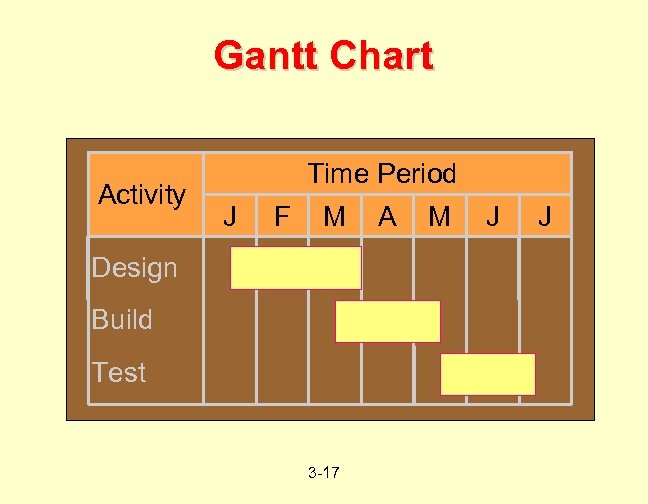 Gantt Chart Activity Time Period J F M Design Build Test 3 -17 A M J J
 Project Control Reports ¨ Detailed cost breakdowns for each task ¨ Total program labor curves ¨ Cost distribution tables ¨ Functional cost and hour summaries ¨ Raw materials and expenditure forecasts ¨ Variance reports ¨ Time analysis reports ¨ Work status reports 3 -18
 PERT and CPM ¨ Network techniques ¨ Developed in 1950’s ¨ CPM by Du. Pont for chemical plants (1957) ¨ PERT by Booz, Allen & Hamilton with the U. S. Navy, for Polaris missile (1958) ¨ Consider precedence relationships and interdependencies ¨ Each uses a different estimate of activity times 3 -19
 Questions Which May Be Addressed by PERT & CPM ¨ Is the project on schedule, ahead of schedule, or behind schedule? ¨ Is the project over or under cost budget? ¨ Are there enough resources available to finish the project on time? ¨ If the project must be finished in less than the scheduled amount of time, what is the way to accomplish this at 3 -20 least cost?
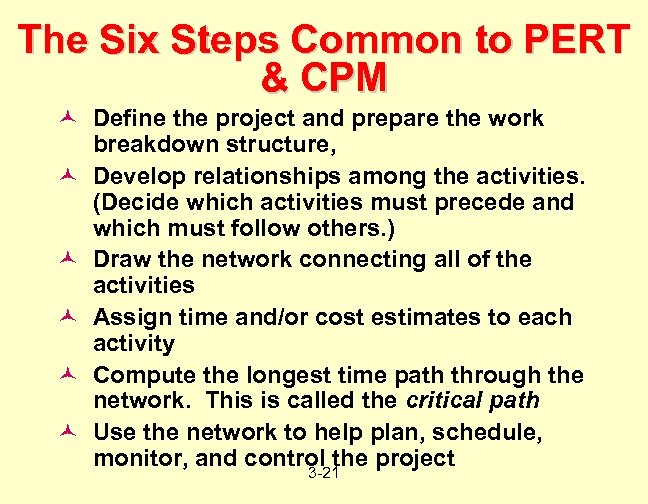 The Six Steps Common to PERT & CPM © Define the project and prepare the work breakdown structure, © Develop relationships among the activities. (Decide which activities must precede and which must follow others. ) © Draw the network connecting all of the activities © Assign time and/or cost estimates to each activity © Compute the longest time path through the network. This is called the critical path © Use the network to help plan, schedule, monitor, and control the project 3 -21
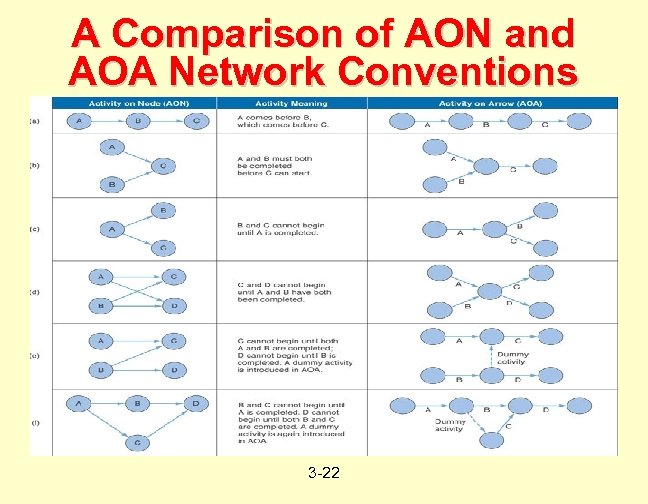 A Comparison of AON and AOA Network Conventions 3 -22
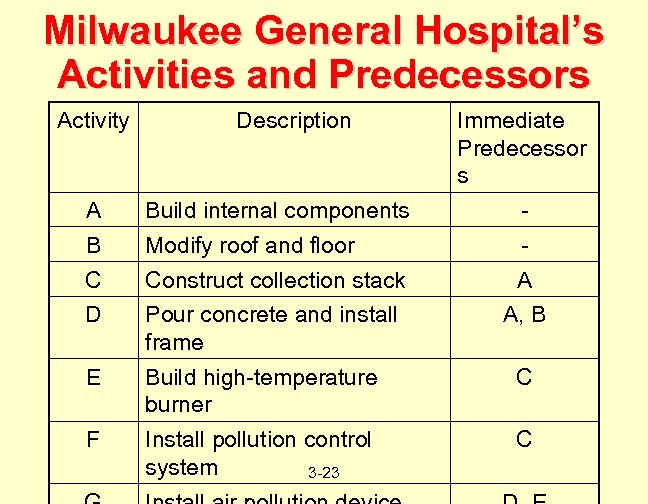 Milwaukee General Hospital’s Activities and Predecessors Activity Description Immediate Predecessor s A Build internal components - B Modify roof and floor - C Construct collection stack A D Pour concrete and install frame A, B E Build high-temperature burner C F Install pollution control system 3 -23 C
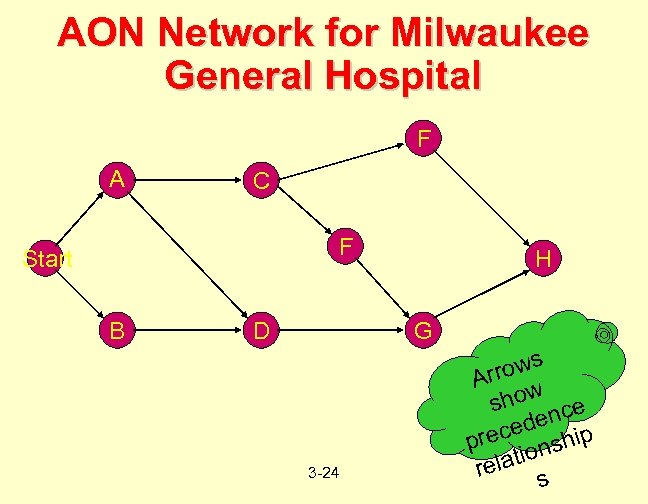 AON Network for Milwaukee General Hospital F A C F Start B D H G 3 -24 s rrow A show nce cede hip pre ons elati r s
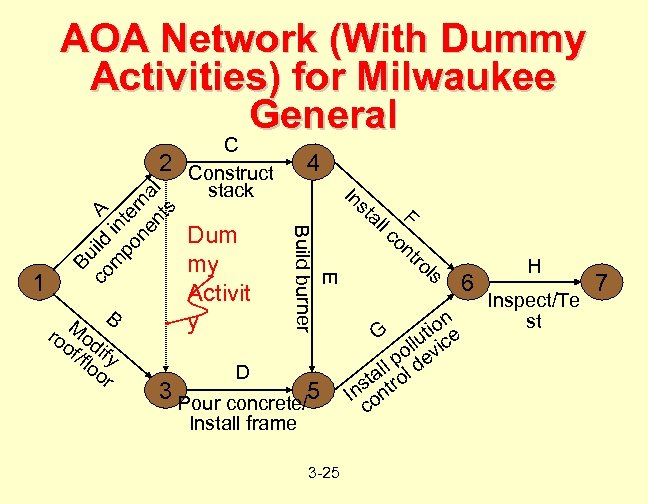 AOA Network (With Dummy Activities) for Milwaukee General M B ro od of if /flo y or Dum my Activit y 4 In st E Build burner 1 Bu co ild A m in po te ne rna nt l s 2 C Construct stack D 3 Pour concrete/5 Install frame 3 -25 al F lc on tro ls 6 n tio e G lu c ol evi ll p l d stantro In o c H Inspect/Te st 7
 Critical Path Analysis ¨ Provides activity information ¨ Earliest (ES) & latest (LS) start ¨ Earliest (EF) & latest (LF) finish ¨ Slack (S): Allowable delay ¨ Identifies critical path ¨ Longest path in network ¨ Shortest time project can be completed ¨ Any delay on critical path activities delays project ¨ Critical path activities have 0 slack 3 -26
 Earliest Start and Finish Steps ¨ Begin at starting event and work forward ¨ ES = 0 for starting activities ¨ ES is earliest start ¨ EF = ES + Activity time ¨ EF is earliest finish ¨ ES = Maximum EF of all predecessors for non-starting activities 3 -27
 Latest Start and Finish Steps ¨ Begin at ending event and work backward ¨ LF = Maximum EF for ending activities ¨ LF is latest finish; EF is earliest finish ¨ LS = LF - Activity time ¨ LS is latest start ¨ LF = Minimum LS of all successors for non-ending activities 3 -28
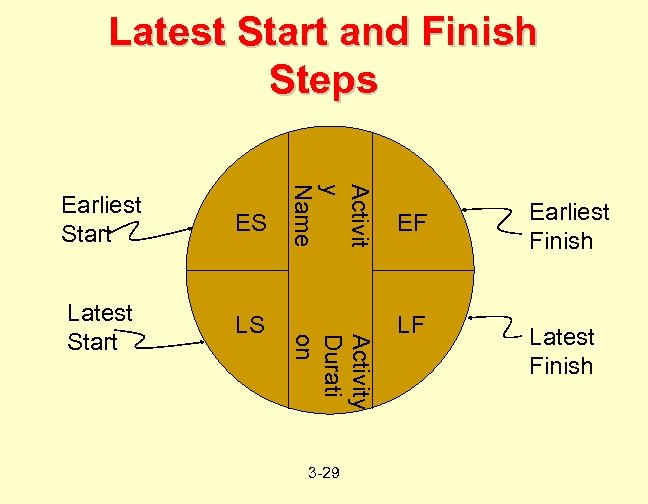 Latest Start and Finish Steps Latest Start LS Activity Durati on ES Activit y Name Earliest Start 3 -29 EF Earliest Finish LF Latest Finish
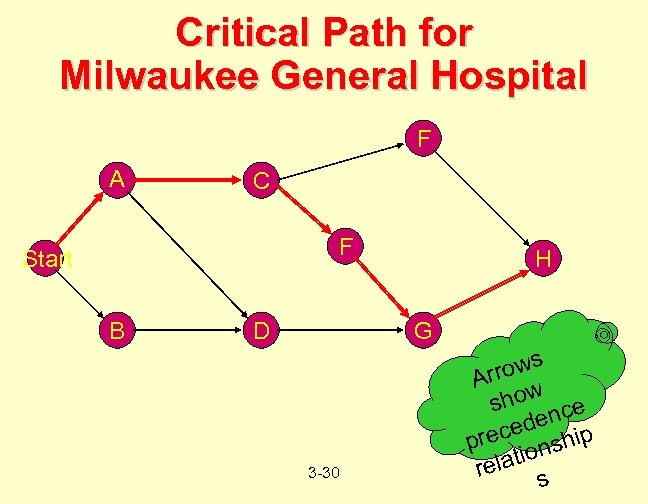 Critical Path for Milwaukee General Hospital F A C F Start B D H G 3 -30 s rrow A show nce cede hip pre ons elati r s
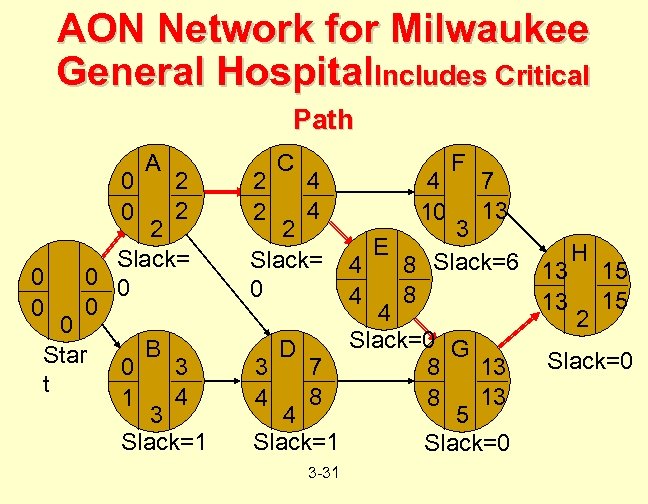 AON Network for Milwaukee General Hospital. Includes Critical Path A 0 H 2 0 A 2 2 Slack= 0 H 0 0 Start 0 0 0 Star 0 B 3 B H t 4 1 3 Slack=1 C 2 H 4 4 2 C 2 Slack= 0 F F 4 H 7 10 13 3 E H 4 H 8 Slack=6 13 15 F H 8 4 13 15 4 2 Slack=0 G DD Slack=0 3 H 7 8 G 13 H 8 13 4 8 4 5 Slack=1 Slack=0 3 -31
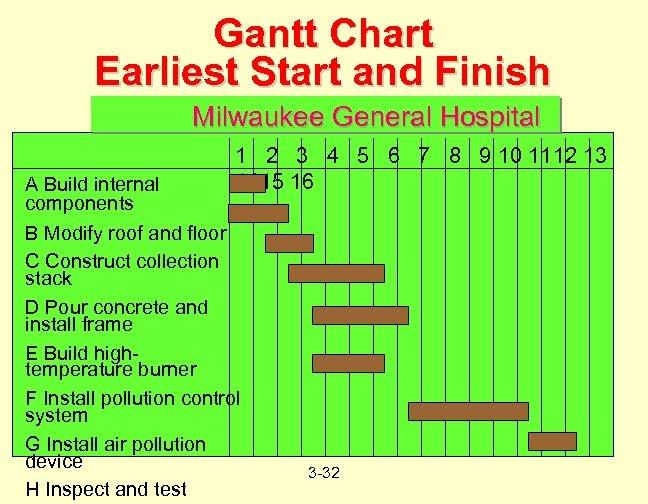 Gantt Chart Earliest Start and Finish Milwaukee General Hospital 1 2 3 4 5 6 7 8 9 10 1112 13 1415 16 A Build internal components B Modify roof and floor C Construct collection stack D Pour concrete and install frame E Build hightemperature burner F Install pollution control system G Install air pollution device H Inspect and test 3 -32
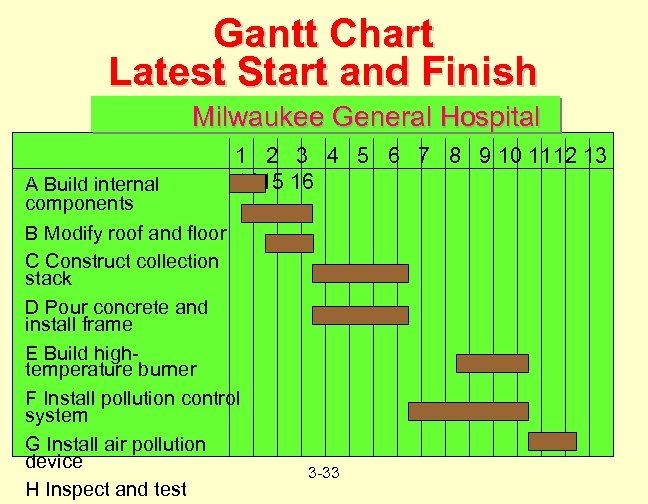 Gantt Chart Latest Start and Finish Milwaukee General Hospital 1 2 3 4 5 6 7 8 9 10 1112 13 1415 16 A Build internal components B Modify roof and floor C Construct collection stack D Pour concrete and install frame E Build hightemperature burner F Install pollution control system G Install air pollution device H Inspect and test 3 -33
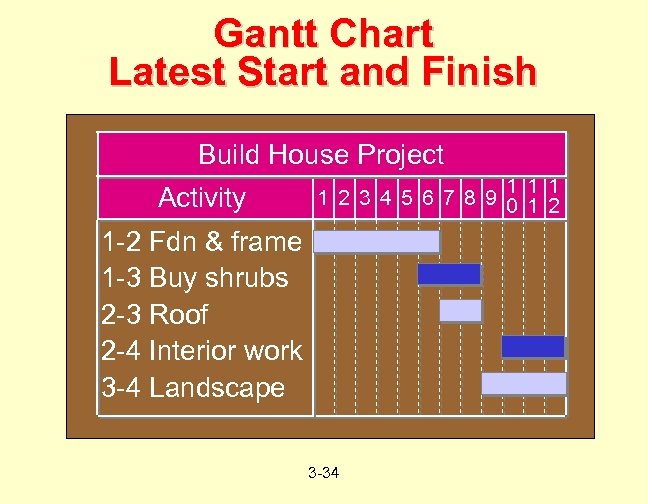 Gantt Chart Latest Start and Finish Build House Project Activity 1 1 2 3 4 5 6 7 8 9 0 1 2 1 -2 Fdn & frame 1 -3 Buy shrubs 2 -3 Roof 2 -4 Interior work 3 -4 Landscape 3 -34
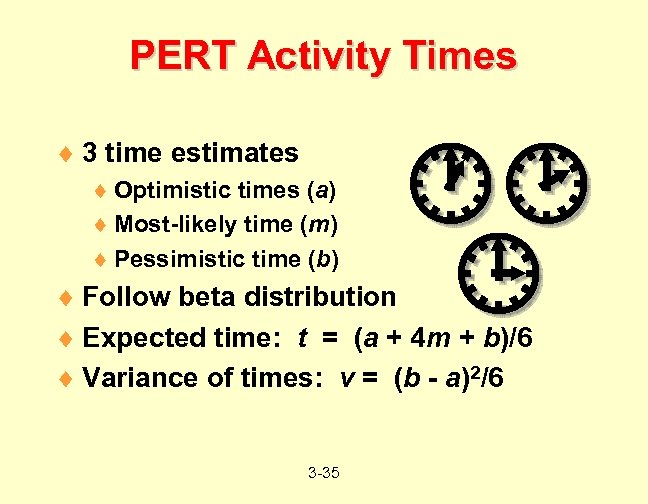 PERT Activity Times ¨ 3 time estimates ¨ Optimistic times (a) ¨ Most-likely time (m) ¨ Pessimistic time (b) ¨ Follow beta distribution ¨ Expected time: t = (a + 4 m + b)/6 ¨ Variance of times: v = (b - a)2/6 3 -35
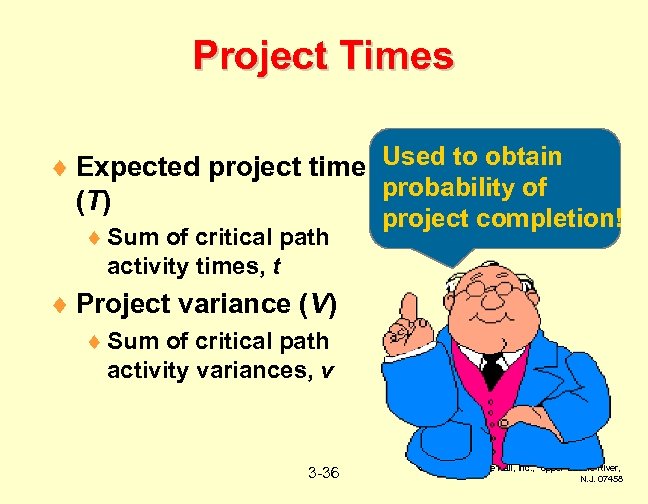 Project Times ¨ Expected project time Used to obtain probability of (T) ¨ Sum of critical path activity times, t project completion! ¨ Project variance (V) ¨ Sum of critical path activity variances, v 3 -36 © 2004 by Prentice Hall, Inc. , Upper Saddle River, N. J. 07458
 PERT Probability Example You’re a project planner for General Dynamics. A submarine project has an expected completion time of 40 weeks, with a standard deviation of 5 weeks. What is the probability of finishing the sub in 50 weeks or less? 3 -37 © 1995 Corel Corp.
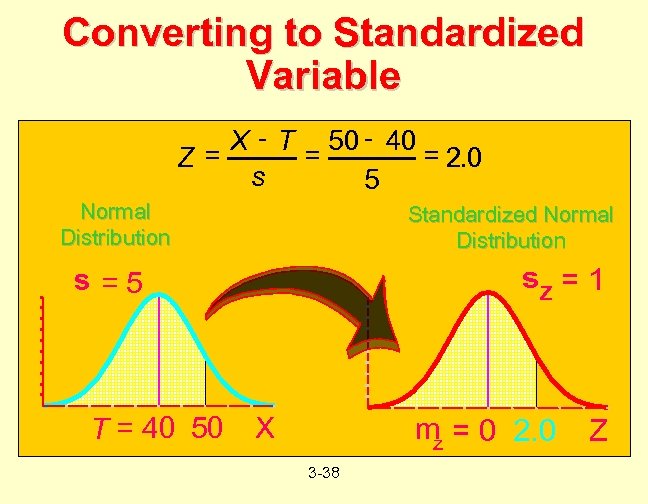 Converting to Standardized Variable X - T 50 - 40 = = 2. 0 Z= s 5 Normal Distribution Standardized Normal Distribution s. Z = 1 s=5 T = 40 50 m = 0 2. 0 z X 3 -38 Z
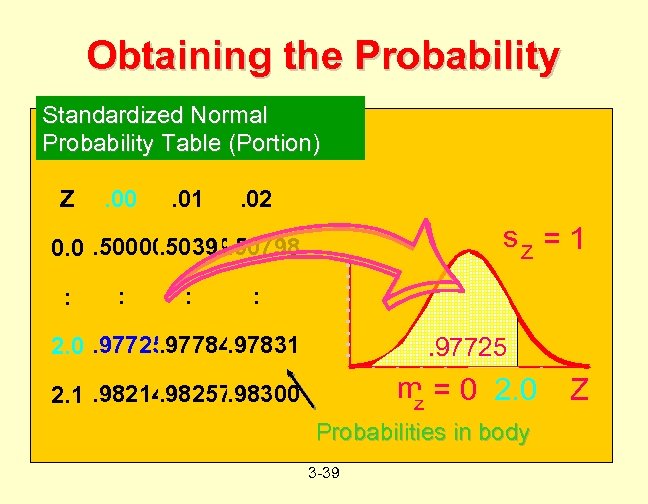 Obtaining the Probability Standardized Normal Probability Table (Portion) Z . 00 . 01 . 02 s. Z = 1 . 50399. 50798 0. 0. 50000 : : . 97784. 97831 2. 0. 97725 . 98257. 98300 2. 1. 98214 m = 0 2. 0 z Probabilities in body 3 -39 Z
 Variability of Completion Time for Noncritical Paths ¨ Variability of times for activities on noncritical paths must be considered when finding the probability of finishing in a specified time. ¨ Variation in noncritical activity may cause change in critical path. 3 -40
 Factors to Consider when Crashing ¨ The amount by which an activity is crashed is, in fact, permissible. ¨ Taken together, the shortened activity durations will enable one to finish the project by the due date. ¨ The total cost of crashing is as small as possible. 3 -41
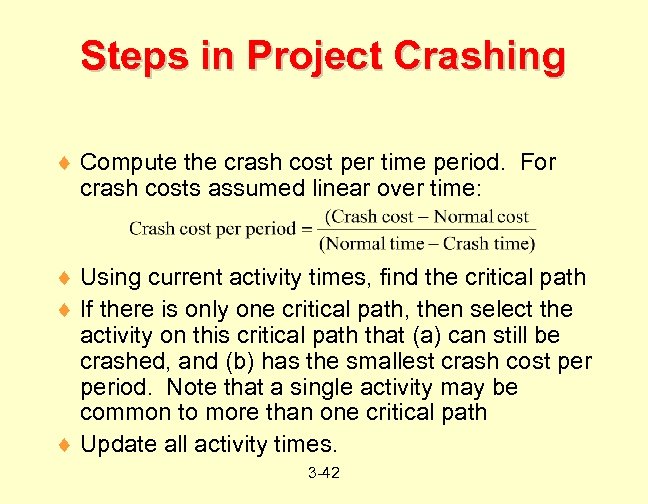 Steps in Project Crashing ¨ Compute the crash cost per time period. For crash costs assumed linear over time: ¨ Using current activity times, find the critical path ¨ If there is only one critical path, then select the activity on this critical path that (a) can still be crashed, and (b) has the smallest crash cost period. Note that a single activity may be common to more than one critical path ¨ Update all activity times. 3 -42
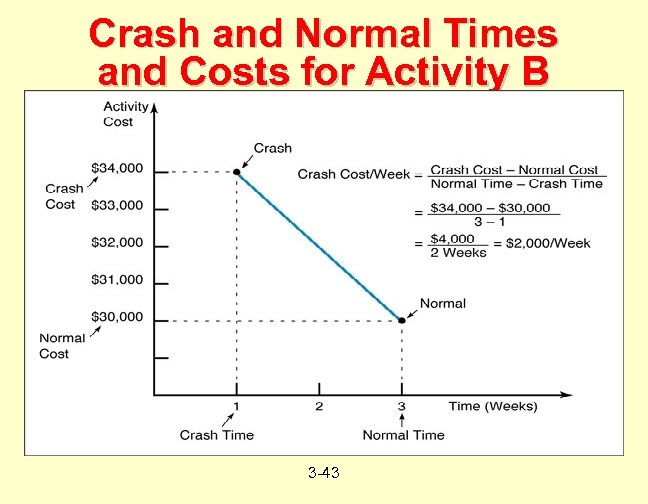 Crash and Normal Times and Costs for Activity B 3 -43
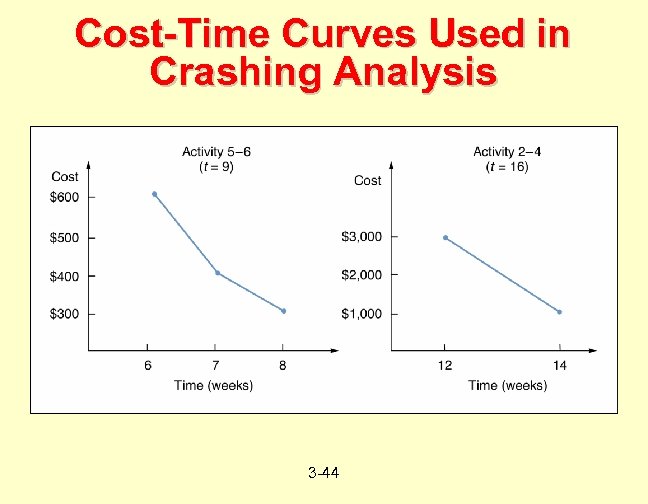 Cost-Time Curves Used in Crashing Analysis 3 -44
 Advantages of PERT/CPM ¨ Especially useful when scheduling and controlling large projects. ¨ Straightforward concept and not mathematically complex. ¨ Graphical networks aid perception of relationships among project activities. ¨ Critical path & slack time analyses help pinpoint activities that need to be closely watched. ¨ Project documentation and graphics point out who is responsible for various activities. ¨ Applicable to a wide variety of projects. ¨ Useful in monitoring schedules and costs. 3 -45
 Limitations of PERT/CPM ¨ Assumes clearly defined, independent, & stable activities ¨ Specified precedence relationships ¨ Activity times (PERT) follow beta distribution ¨ Subjective time estimates ¨ Over-emphasis on critical path 3 -46