 Скачать презентацию Operations Management Location Strategies Background þ Global
c215b852a72eedc60053ebd07dd68501.ppt
- Количество слайдов: 43



Operations Management Location Strategies
Background þ Global Company Profile: Fed. Ex þ The Strategic Importance of Location þ Location decision making research paper
Learning Objectives 1. Identify and explain seven major factors that effect location decisions 2. Compute labor productivity 3. 4. Apply the factor-rating method Complete a locational break-even analysis graphically and mathematically 5. Use the center-of-gravity method
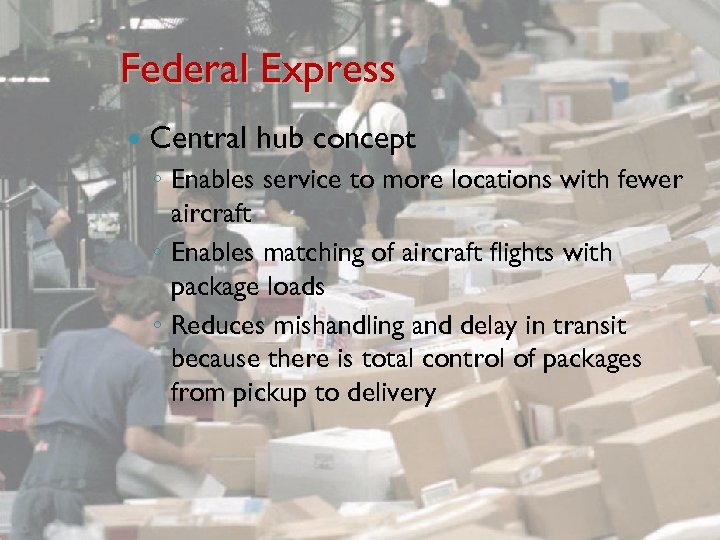
Federal Express Central hub concept ◦ Enables service to more locations with fewer aircraft ◦ Enables matching of aircraft flights with package loads ◦ Reduces mishandling and delay in transit because there is total control of packages from pickup to delivery
Location Strategy þ One of the most important decisions a firm makes þ Increasingly global in nature þ Significant impact on fixed and variable costs þ Decisions made relatively infrequently þ The objective is to maximize the benefit of location to the firm
Location and Costs þ Location decisions based on low cost require careful consideration þ Once in place, location-related costs are fixed in place and difficult to reduce þ Determining optimal facility location is a god investment
Location and Innovation þ Cost is not always the most important aspect of a strategic decision þ Four key attributes when strategy is based on innovation þ High-quality and specialized inputs þ An environment that encourages investment and local rivalry þ A sophisticated local market þ Local presence of related and supporting industries
Location Decisions þ Long-term decisions þ Decisions made infrequently þ Decision greatly affects both fixed and variable costs þ Once committed to a location, many resource and cost issues are difficult to change
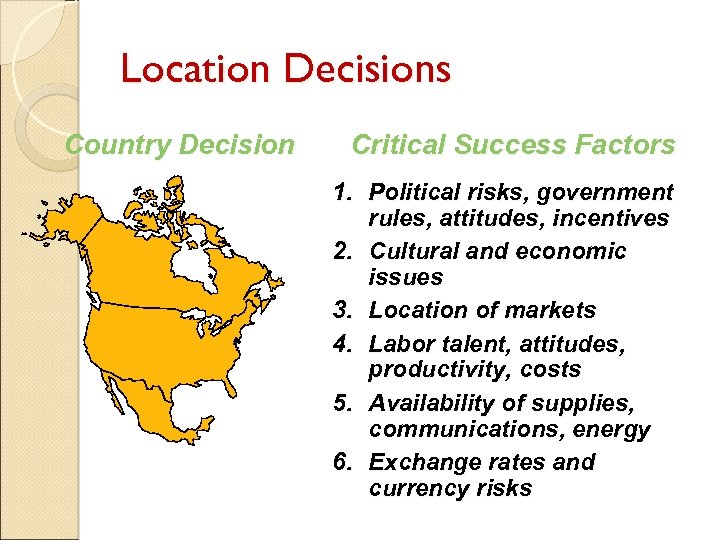
Location Decisions Country Decision Critical Success Factors 1. Political risks, government rules, attitudes, incentives 2. Cultural and economic issues 3. Location of markets 4. Labor talent, attitudes, productivity, costs 5. Availability of supplies, communications, energy 6. Exchange rates and currency risks
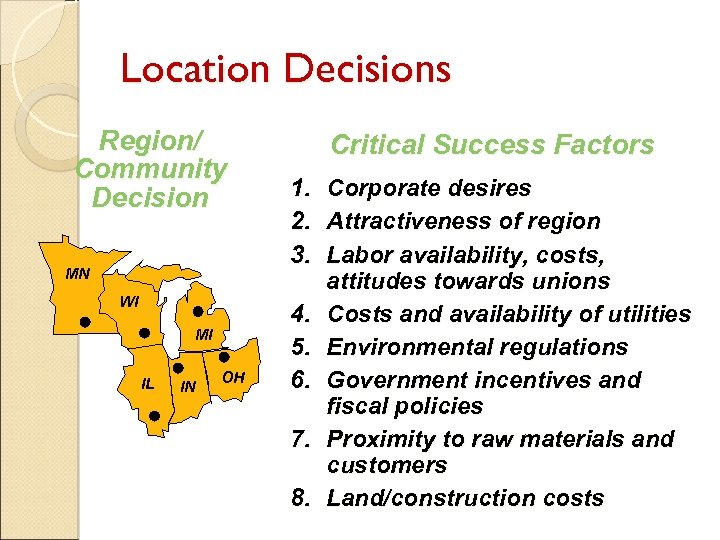
Location Decisions Region/ Community Decision MN WI MI IL IN OH Critical Success Factors 1. Corporate desires 2. Attractiveness of region 3. Labor availability, costs, attitudes towards unions 4. Costs and availability of utilities 5. Environmental regulations 6. Government incentives and fiscal policies 7. Proximity to raw materials and customers 8. Land/construction costs
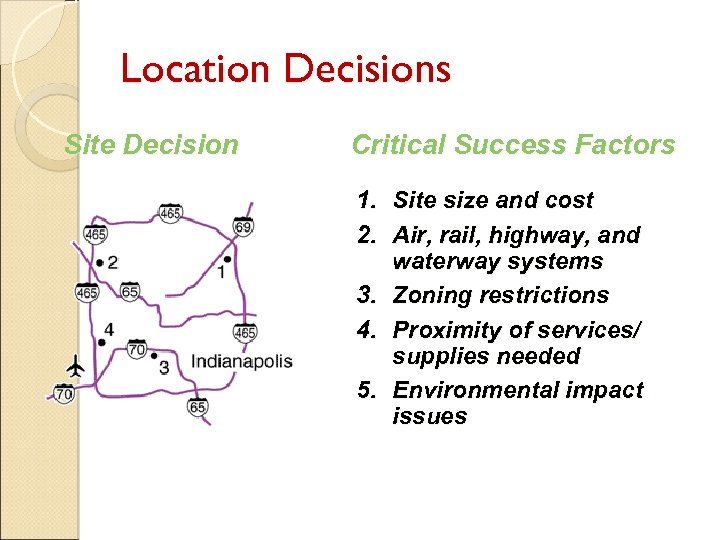
Location Decisions Site Decision Critical Success Factors 1. Site size and cost 2. Air, rail, highway, and waterway systems 3. Zoning restrictions 4. Proximity of services/ supplies needed 5. Environmental impact issues
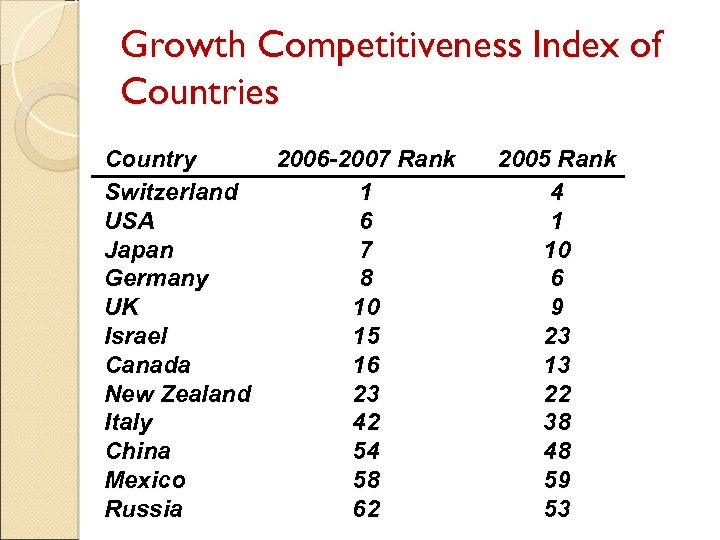
Growth Competitiveness Index of Countries Country Switzerland USA Japan Germany UK Israel Canada New Zealand Italy China Mexico Russia 2006 -2007 Rank 1 6 7 8 10 15 16 23 42 54 58 62 2005 Rank 4 1 10 6 9 23 13 22 38 48 59 53
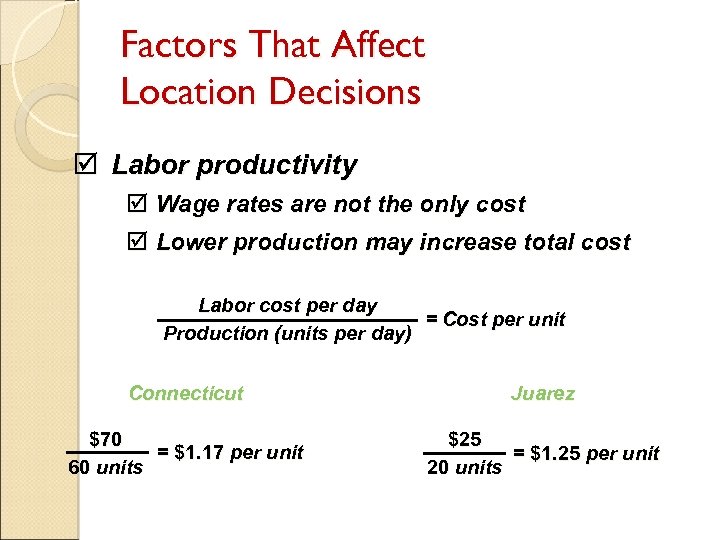
Factors That Affect Location Decisions þ Labor productivity þ Wage rates are not the only cost þ Lower production may increase total cost Labor cost per day = Cost per unit Production (units per day) Connecticut Juarez $70 = $1. 17 per unit 60 units $25 = $1. 25 per unit 20 units
Factors That Affect Location Decisions þ Exchange rates and currency risks þ Can have a significant impact on cost structure þ Rates change over time þ Costs þ Tangible - easily measured costs such as utilities, labor, materials, taxes þ Intangible - less easy to quantify and include education, public transportation, community, quality-of-life
Factors That Affect Location Decisions þ Exchange rates and currency risks þ Can have a significant impact on cost Location structure decisions based þ Rates change over time on costs alone þ Costs can create þ Tangible - easily measured costs such as difficult ethical utilities, labor, materials, taxes situations þ Intangible - less easy to quantify and include education, public transportation, community, quality-of-life
Factors That Affect Location Decisions þ Political risk, values, and culture þ National, state, local governments attitudes toward private and intellectual property, zoning, pollution, employment stability may be in flux þ Worker attitudes towards turnover, unions, absenteeism þ Globally cultures have different attitudes towards punctuality, legal, and ethical issues
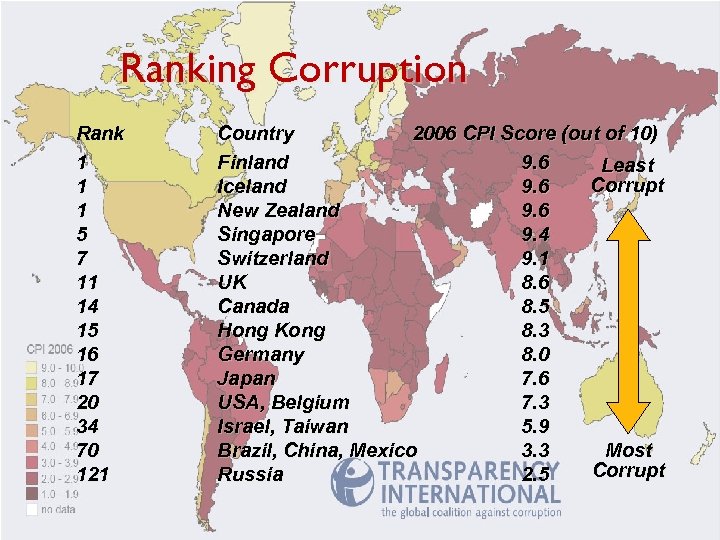
Ranking Corruption Rank 1 1 1 5 7 11 14 15 16 17 20 34 70 121 Country 2006 CPI Score (out of 10) Finland 9. 6 Least Corrupt Iceland 9. 6 New Zealand 9. 6 Singapore 9. 4 Switzerland 9. 1 UK 8. 6 Canada 8. 5 Hong Kong 8. 3 Germany 8. 0 Japan 7. 6 USA, Belgium 7. 3 Israel, Taiwan 5. 9 Most Brazil, China, Mexico 3. 3 Corrupt Russia 2. 5
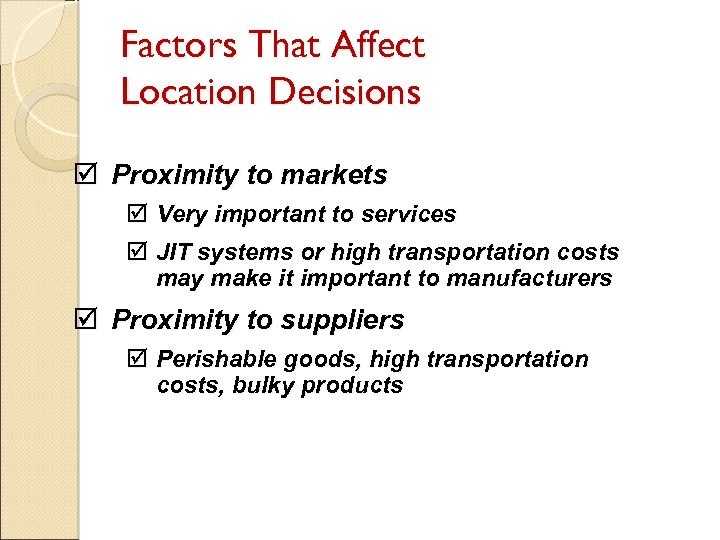
Factors That Affect Location Decisions þ Proximity to markets þ Very important to services þ JIT systems or high transportation costs may make it important to manufacturers þ Proximity to suppliers þ Perishable goods, high transportation costs, bulky products
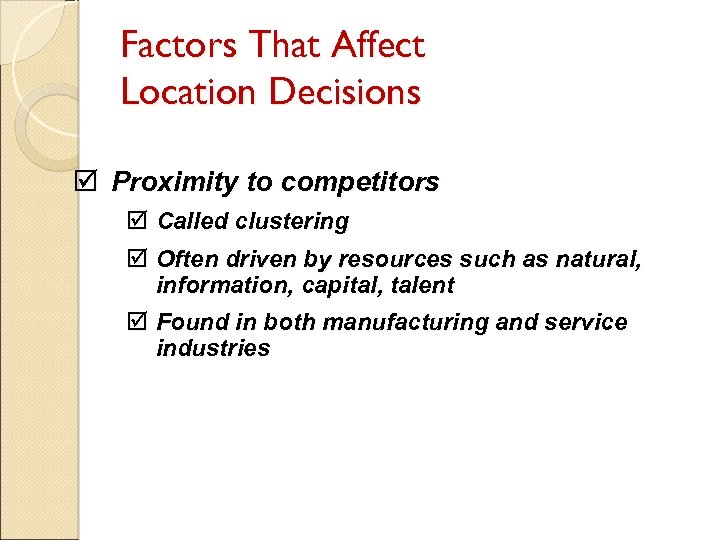
Factors That Affect Location Decisions þ Proximity to competitors þ Called clustering þ Often driven by resources such as natural, information, capital, talent þ Found in both manufacturing and service industries
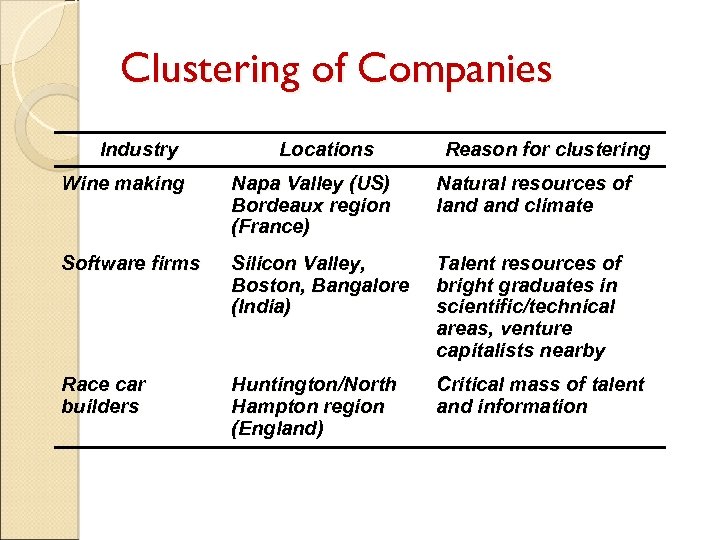
Clustering of Companies Industry Locations Reason for clustering Wine making Napa Valley (US) Bordeaux region (France) Natural resources of land climate Software firms Silicon Valley, Boston, Bangalore (India) Talent resources of bright graduates in scientific/technical areas, venture capitalists nearby Race car builders Huntington/North Hampton region (England) Critical mass of talent and information
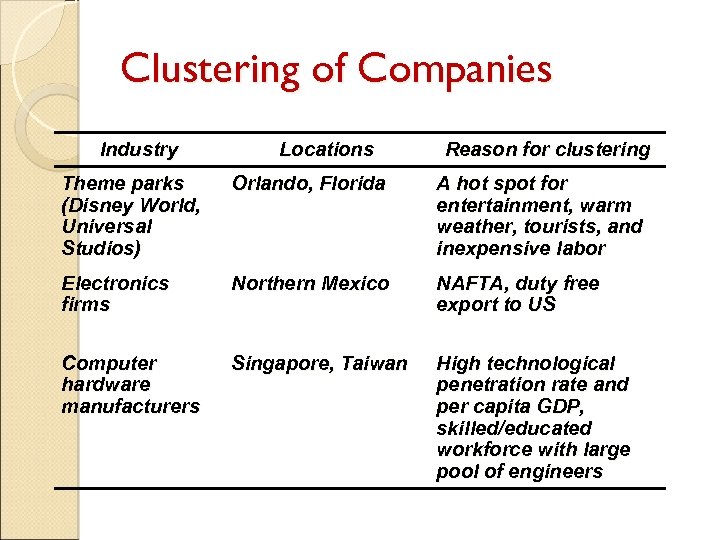
Clustering of Companies Industry Locations Reason for clustering Theme parks (Disney World, Universal Studios) Orlando, Florida A hot spot for entertainment, warm weather, tourists, and inexpensive labor Electronics firms Northern Mexico NAFTA, duty free export to US Computer hardware manufacturers Singapore, Taiwan High technological penetration rate and per capita GDP, skilled/educated workforce with large pool of engineers
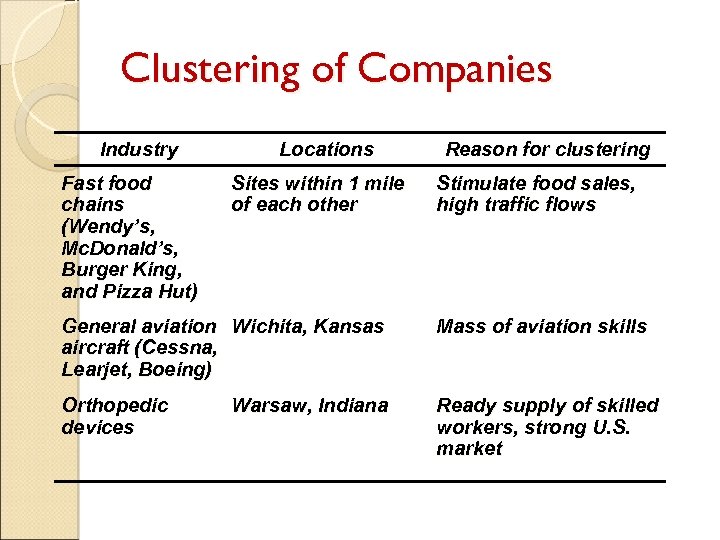
Clustering of Companies Industry Fast food chains (Wendy’s, Mc. Donald’s, Burger King, and Pizza Hut) Locations Sites within 1 mile of each other Reason for clustering Stimulate food sales, high traffic flows General aviation Wichita, Kansas aircraft (Cessna, Learjet, Boeing) Mass of aviation skills Orthopedic devices Ready supply of skilled workers, strong U. S. market Warsaw, Indiana
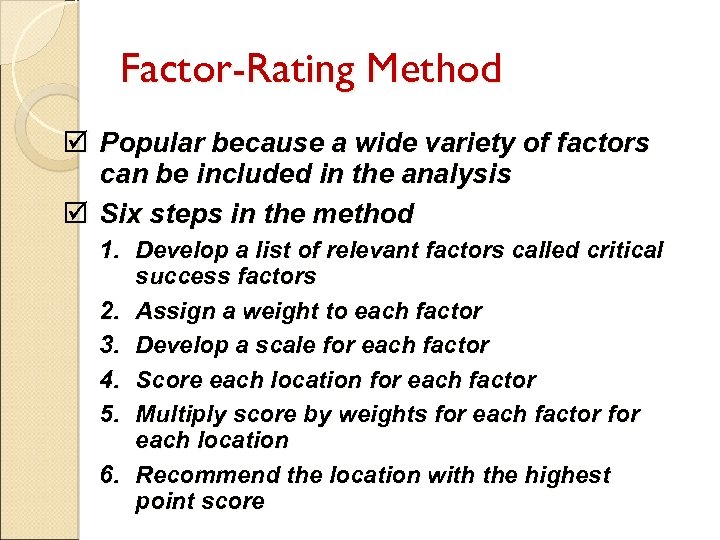
Factor-Rating Method þ Popular because a wide variety of factors can be included in the analysis þ Six steps in the method 1. Develop a list of relevant factors called critical success factors 2. Assign a weight to each factor 3. Develop a scale for each factor 4. Score each location for each factor 5. Multiply score by weights for each factor for each location 6. Recommend the location with the highest point score
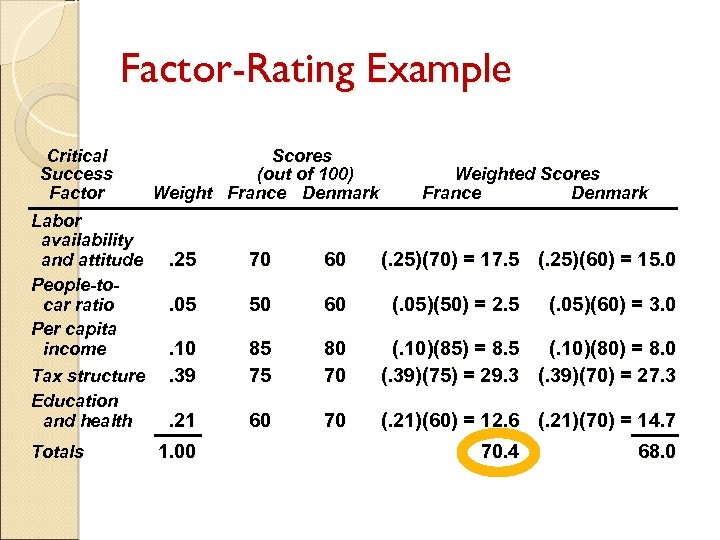
Factor-Rating Example Critical Success Factor Labor availability and attitude People-tocar ratio Per capita income Tax structure Education and health Totals Scores (out of 100) Weight France Denmark Weighted Scores France Denmark . 25 70 60 . 05 50 60 . 10. 39 85 75 80 70 (. 10)(85) = 8. 5 (. 10)(80) = 8. 0 (. 39)(75) = 29. 3 (. 39)(70) = 27. 3 . 21 60 70 (. 21)(60) = 12. 6 (. 21)(70) = 14. 7 1. 00 (. 25)(70) = 17. 5 (. 25)(60) = 15. 0 (. 05)(50) = 2. 5 70. 4 (. 05)(60) = 3. 0 68. 0
Locational Break-Even Analysis þ Method of cost-volume analysis used for industrial locations þ Three steps in the method 1. Determine fixed and variable costs for each location 2. Plot the cost for each location 3. Select location with lowest total cost for expected production volume
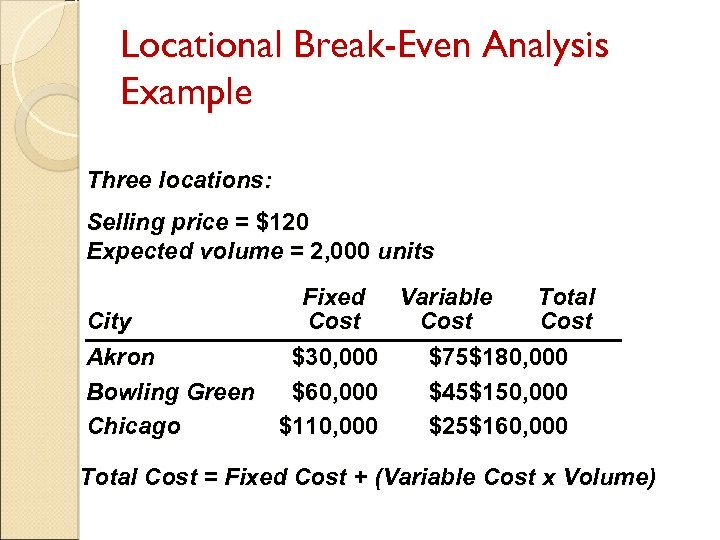
Locational Break-Even Analysis Example Three locations: Selling price = $120 Expected volume = 2, 000 units Fixed Variable Total City Cost Akron $30, 000 $75$180, 000 Bowling Green $60, 000 $45$150, 000 Chicago $110, 000 $25$160, 000 Total Cost = Fixed Cost + (Variable Cost x Volume)
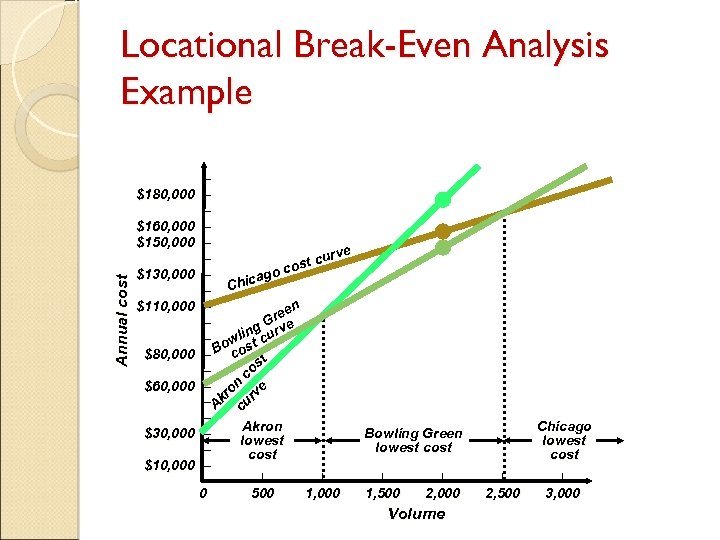
Annual cost Locational Break-Even Analysis Example – $180, 000 – – $160, 000 – $150, 000 – e – curv ost oc $130, 000 – icag – Ch $110, 000 – n ree G e – ingcurv – owl t s $80, 000 – B co t s – co $60, 000 – on e kr urv –A c – Akron Bowling Green $30, 000 – lowest cost – cost $10, 000 – | | | – 0 500 1, 000 1, 500 2, 000 Volume Chicago lowest cost | | 2, 500 3, 000
Center-of-Gravity Method þ Finds location of distribution center that minimizes distribution costs þ Considers þ Location of markets þ Volume of goods shipped to those markets þ Shipping cost (or distance)
Center-of-Gravity Method þ Place existing locations on a coordinate grid þ Grid origin and scale is arbitrary þ Maintain relative distances þ Calculate X and Y coordinates for ‘center of gravity’ þ Assumes cost is directly proportional to distance and volume shipped
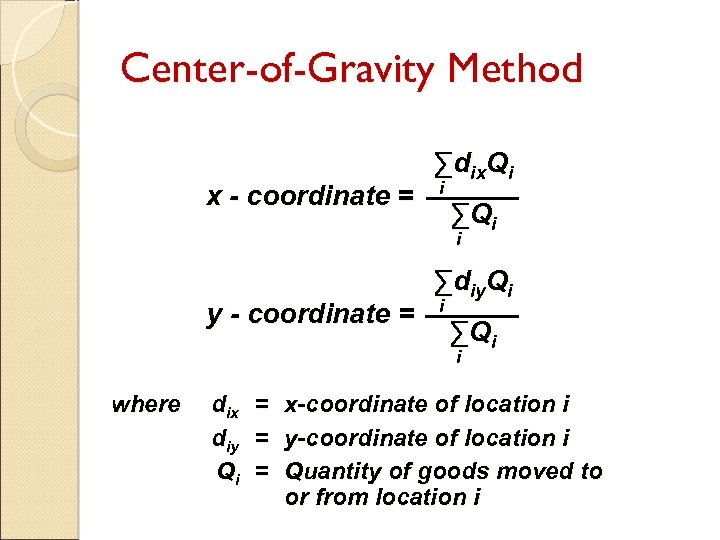
Center-of-Gravity Method x - coordinate = ∑dix. Qi i ∑Qi i y - coordinate = ∑diy. Qi i ∑Qi i where dix = x-coordinate of location i diy = y-coordinate of location i Qi = Quantity of goods moved to or from location i
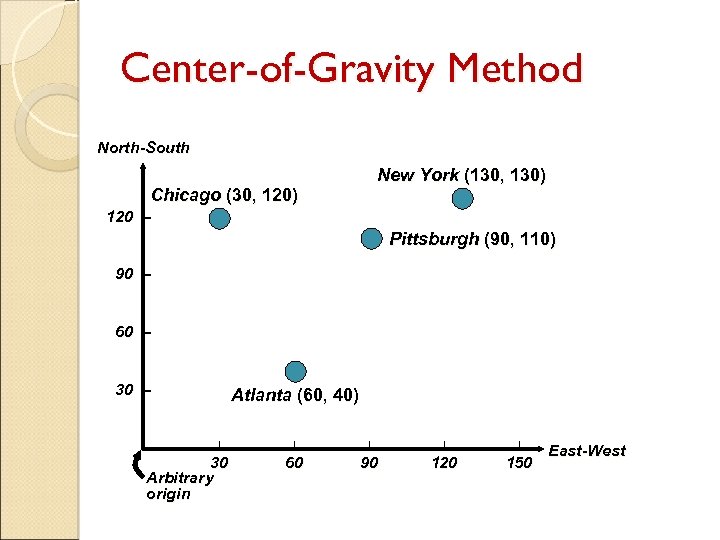
Center-of-Gravity Method North-South New York (130, 130) Chicago (30, 120) 120 – Pittsburgh (90, 110) 90 – 60 – 30 – | – Atlanta (60, 40) | 30 Arbitrary origin | | 60 90 120 150 East-West
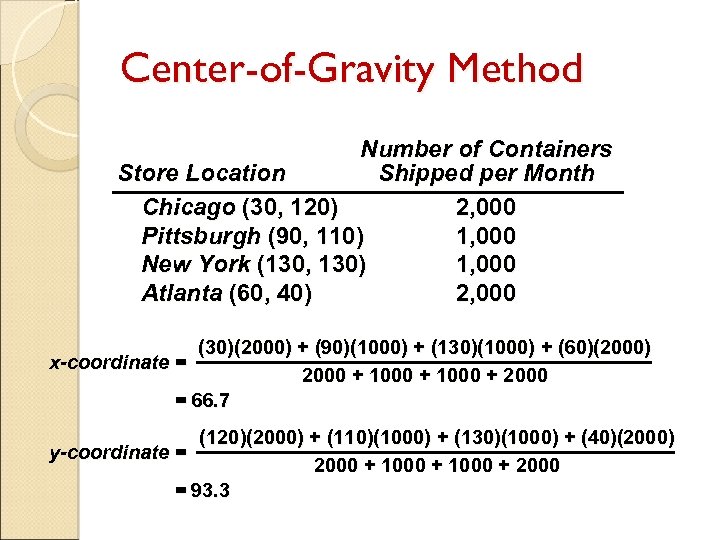
Center-of-Gravity Method Number of Containers Store Location Shipped per Month Chicago (30, 120) 2, 000 Pittsburgh (90, 110) 1, 000 New York (130, 130) 1, 000 Atlanta (60, 40) 2, 000 (30)(2000) + (90)(1000) + (130)(1000) + (60)(2000) x-coordinate = 2000 + 1000 + 2000 = 66. 7 (120)(2000) + (110)(1000) + (130)(1000) + (40)(2000) y-coordinate = 2000 + 1000 + 2000 = 93. 3
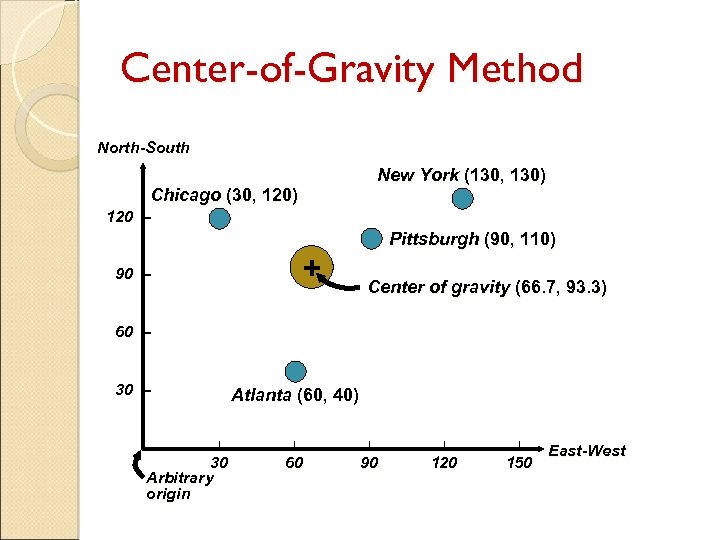
Center-of-Gravity Method North-South New York (130, 130) Chicago (30, 120) 120 – Pittsburgh (90, 110) + 90 – Center of gravity (66. 7, 93. 3) 60 – 30 – | – Atlanta (60, 40) | 30 Arbitrary origin | | 60 90 120 150 East-West
Transportation Model þ Finds amount to be shipped from several points of supply to several points of demand þ Solution will minimize total production and shipping costs þ A special class of linear programming problems
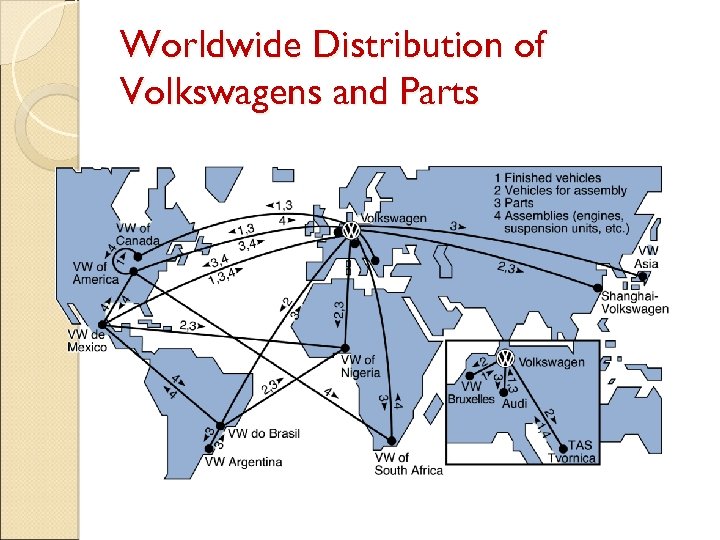
Worldwide Distribution of Volkswagens and Parts
Service Location Strategy 1. Purchasing power of customer-drawing area 2. Service and image compatibility with demographics of the customer-drawing area 3. Competition in the area 4. Quality of the competition 5. Uniqueness of the firm’s and competitors’ locations 6. Physical qualities of facilities and neighboring businesses 7. Operating policies of the firm 8. Quality of management
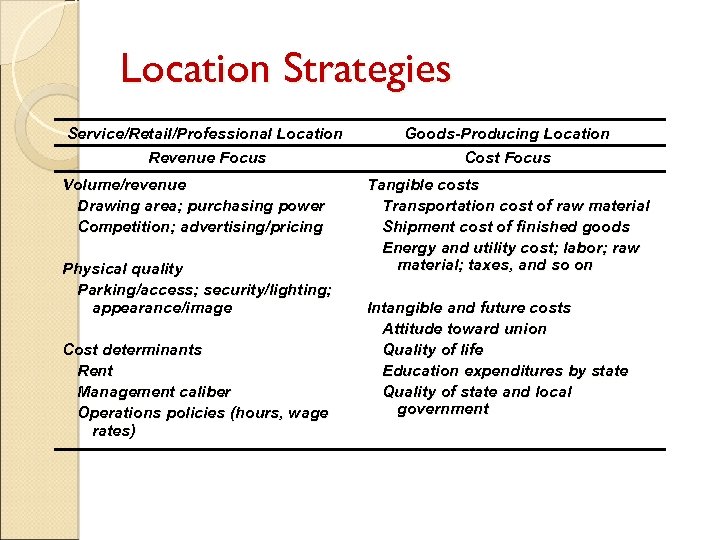
Location Strategies Service/Retail/Professional Location Revenue Focus Volume/revenue Drawing area; purchasing power Competition; advertising/pricing Physical quality Parking/access; security/lighting; appearance/image Cost determinants Rent Management caliber Operations policies (hours, wage rates) Goods-Producing Location Cost Focus Tangible costs Transportation cost of raw material Shipment cost of finished goods Energy and utility cost; labor; raw material; taxes, and so on Intangible and future costs Attitude toward union Quality of life Education expenditures by state Quality of state and local government
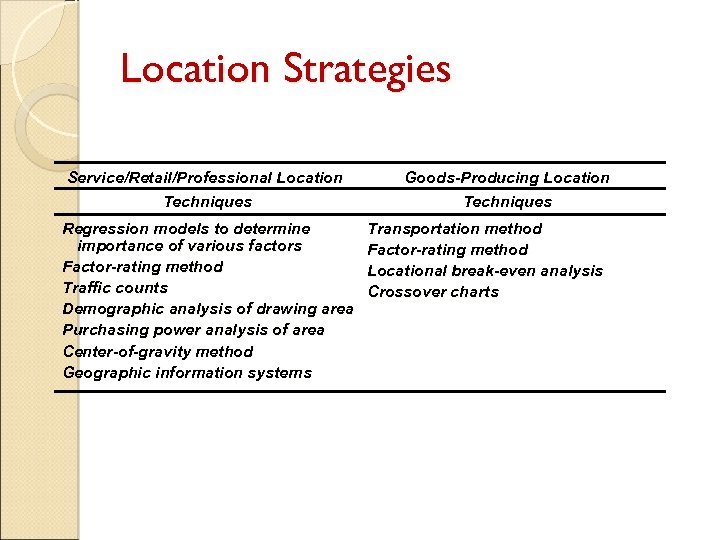
Location Strategies Service/Retail/Professional Location Techniques Regression models to determine importance of various factors Factor-rating method Traffic counts Demographic analysis of drawing area Purchasing power analysis of area Center-of-gravity method Geographic information systems Goods-Producing Location Techniques Transportation method Factor-rating method Locational break-even analysis Crossover charts
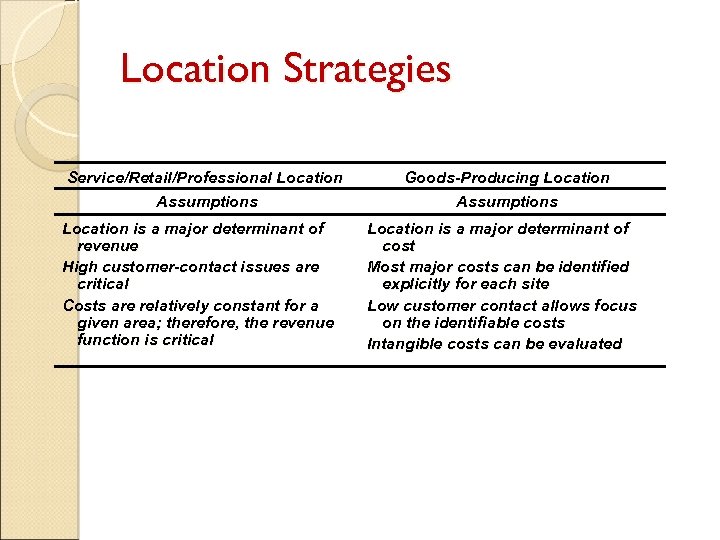
Location Strategies Service/Retail/Professional Location Assumptions Location is a major determinant of revenue High customer-contact issues are critical Costs are relatively constant for a given area; therefore, the revenue function is critical Goods-Producing Location Assumptions Location is a major determinant of cost Most major costs can be identified explicitly for each site Low customer contact allows focus on the identifiable costs Intangible costs can be evaluated
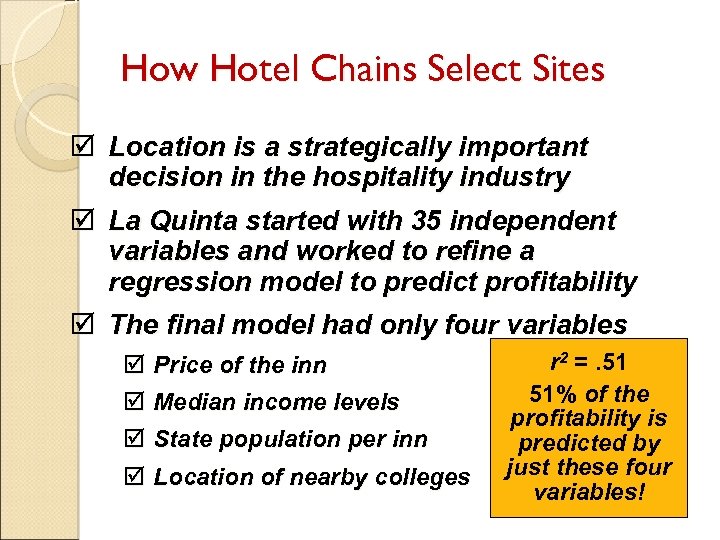
How Hotel Chains Select Sites þ Location is a strategically important decision in the hospitality industry þ La Quinta started with 35 independent variables and worked to refine a regression model to predict profitability þ The final model had only four variables þ Price of the inn þ Median income levels þ State population per inn þ Location of nearby colleges r 2 =. 51 51% of the profitability is predicted by just these four variables!
The Call Center Industry þ Requires neither face-to-face contact nor movement of materials þ Has very broad location options þ Traditional variables are no longer relevant þ Cost and availability of labor may drive location decisions
Geographic Information Systems (GIS) þ þ Important tool to help in location analysis Enables more complex demographic analysis þ Available data bases include þ Detailed census data þ Detailed maps þ Utilities þ Geographic features þ Locations of major services
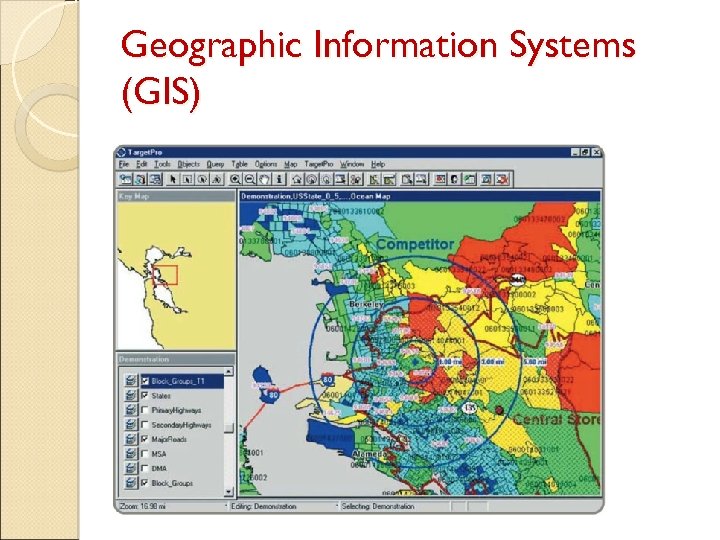
Geographic Information Systems (GIS)
Скачать презентацию Operations Management Location Strategies Background þ Global
c215b852a72eedc60053ebd07dd68501.ppt