


 Скачать презентацию Operations Management Chapter 2 Operations Strategy in
645746fc8e64a51c9123b78cadfce1cf.ppt
- Количество слайдов: 62
 Operations Management Chapter 2 – Operations Strategy in a Global Environment Delivered by: Eng. Mosab I. Tabash © 2008 Prentice Hall, Inc. 2–
 Outline þ Global Company Profile: Boeing þ A Global View of Operations þ Cultural and Ethical Issues þ Developing Missions And Strategies þ Mission þ Strategy © 2008 Prentice Hall, Inc. 2– 2
 Outline – Continued þ Achieving Competitive Advantage Through Operations þ Competing On Differentiation þ Competing On Cost þ Competing On Response þ Ten Strategic OM Decisions © 2008 Prentice Hall, Inc. 2– 3
 Outline – Continued þ Issues In Operations Strategy þ Research þ Preconditions þ Dynamics © 2008 Prentice Hall, Inc. 2– 4
 Outline – Continued þ Strategy Development and Implementation þ Critical Success Factors and Core Competencies þ Build and Staff the Organization þ Integrate OM with Other Activities © 2008 Prentice Hall, Inc. 2– 5
 þ Global Operations Strategy Options þ International Strategy þ Multidomestic Strategy þ Global Strategy þ Transnational Strategy © 2008 Prentice Hall, Inc. 2– 6
 Global Strategies þ Boeing – sales and production are worldwide þ Sony – purchases components from suppliers in Thailand, Malaysia, and around the world © 2008 Prentice Hall, Inc. 2– 7
 Global Strategies þ Volvo – considered a Swedish company but it is controlled by an American company, Ford. The current Volvo S 40 is built in Belgium and shares its products with the Mazda 3 built in Japan and the Ford Focus built in Europe. þ Haier – A Chinese company, produces compact refrigerators (it has one-third of the US market) © 2008 Prentice Hall, Inc. 2– 8
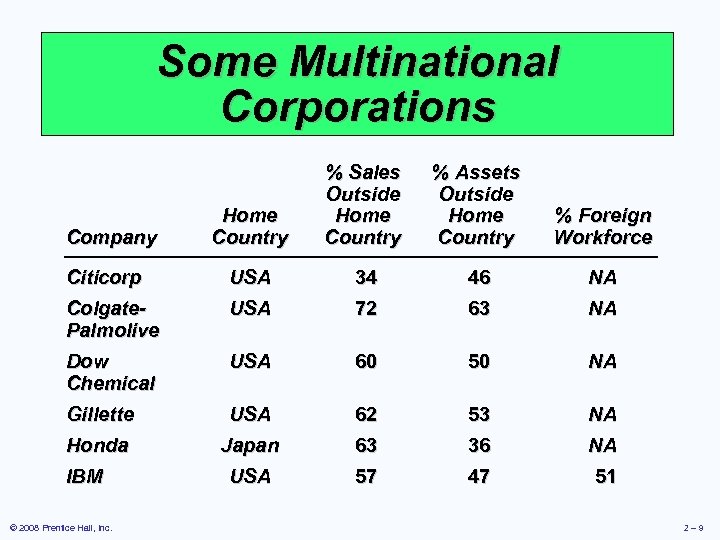 Some Multinational Corporations Home Country % Sales Outside Home Country % Assets Outside Home Country % Foreign Workforce Citicorp USA 34 46 NA Colgate. Palmolive USA 72 63 NA Dow Chemical USA 60 50 NA Gillette USA 62 53 NA Honda Japan 63 36 NA USA 57 47 51 Company IBM © 2008 Prentice Hall, Inc. 2– 9
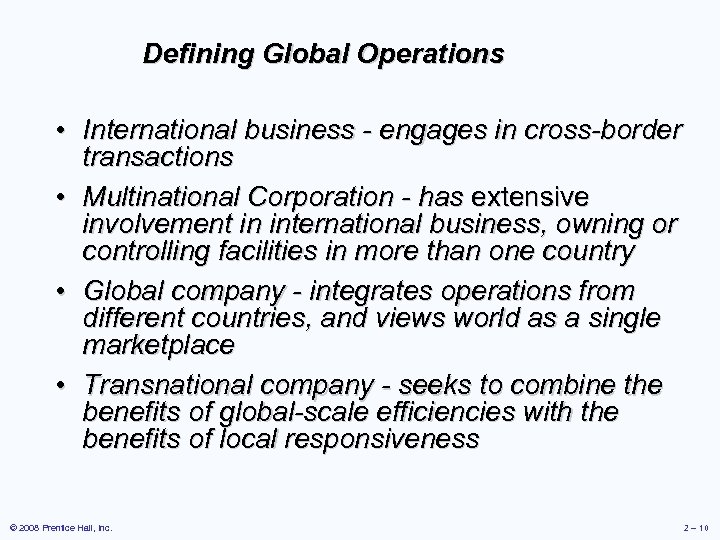 Defining Global Operations • International business - engages in cross-border transactions • Multinational Corporation - has extensive involvement in international business, owning or controlling facilities in more than one country • Global company - integrates operations from different countries, and views world as a single marketplace • Transnational company - seeks to combine the benefits of global-scale efficiencies with the benefits of local responsiveness © 2008 Prentice Hall, Inc. 2 – 10
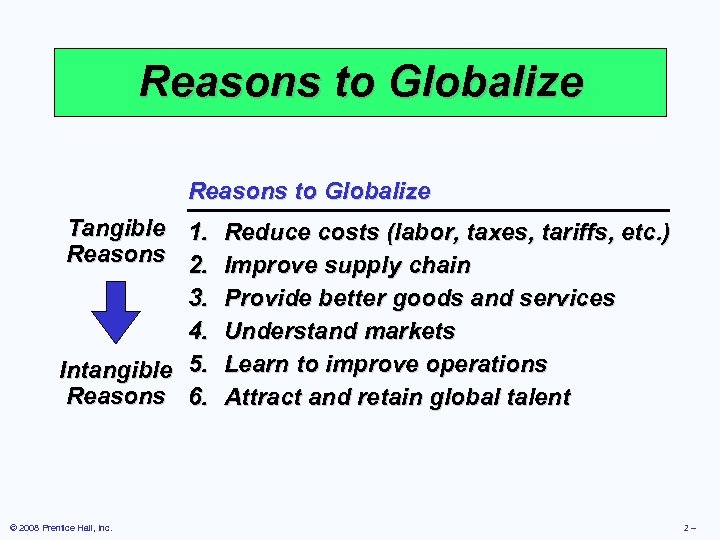 Reasons to Globalize Tangible 1. Reduce costs (labor, taxes, tariffs, etc. ) Reasons 2. Improve supply chain 3. Provide better goods and services 4. Understand markets Intangible 5. Learn to improve operations Reasons 6. Attract and retain global talent © 2008 Prentice Hall, Inc. 2–
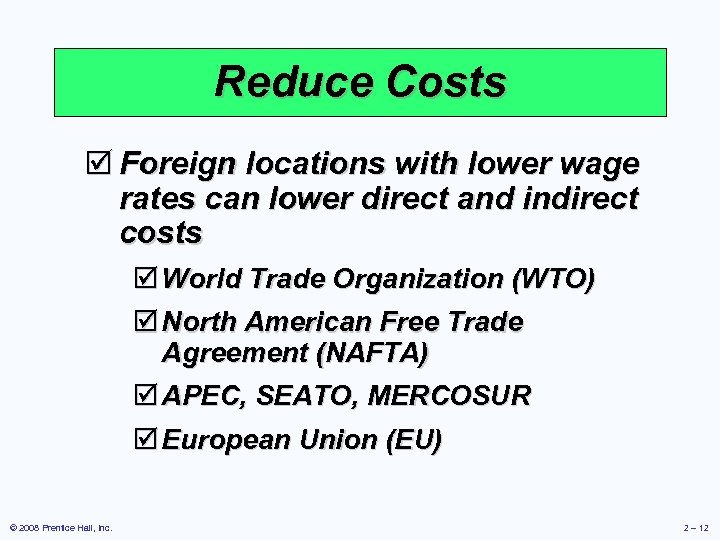 Reduce Costs þ Foreign locations with lower wage rates can lower direct and indirect costs þ World Trade Organization (WTO) þ North American Free Trade Agreement (NAFTA) þ APEC, SEATO, MERCOSUR þ European Union (EU) © 2008 Prentice Hall, Inc. 2 – 12
 Improve the Supply Chain þ Locating facilities closer to unique resources þ Auto design to California þ Athletic shoe production to China þ Perfume manufacturing in France © 2008 Prentice Hall, Inc. 2 – 13
 Provide Better Goods and Services þ Objective and subjective characteristics of goods and services þ On-time deliveries þ Cultural variables þ Improved customer service © 2008 Prentice Hall, Inc. 2 – 14
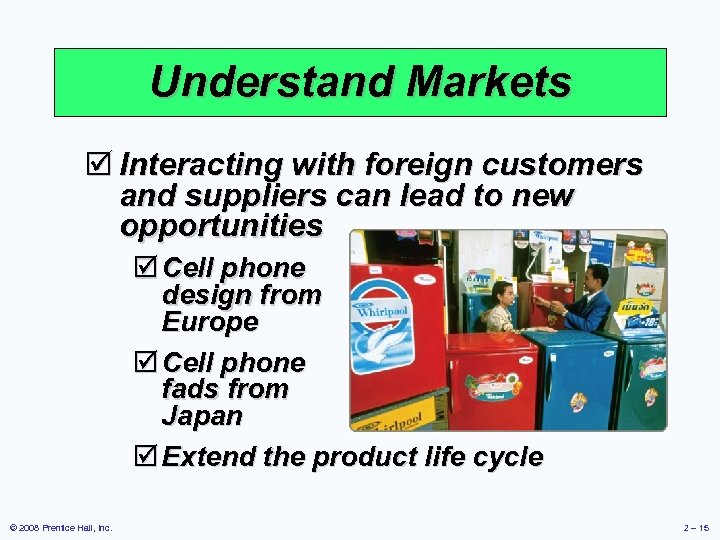 Understand Markets þ Interacting with foreign customers and suppliers can lead to new opportunities þ Cell phone design from Europe þ Cell phone fads from Japan þ Extend the product life cycle © 2008 Prentice Hall, Inc. 2 – 15
 Learn to Improve Operations þ Remain open to the free flow of ideas þ General Motors partnered with a Japanese auto manufacturer to learn þ Equipment and layout have been improved using ergonomic competence © 2008 Prentice Hall, Inc. 2 – 16
 Attract and Retain Global Talent þ Offer better employment opportunities þ Better growth opportunities and insulation against unemployment þ Relocate unneeded personnel to more prosperous locations þ Incentives for people who like to travel © 2008 Prentice Hall, Inc. 2 – 17
 Cultural and Ethical Issues þ Cultures can be quite different þ Attitudes can be quite different towards þ Punctuality þ Environment © 2008 Prentice Hall, Inc. 2 – 18
 Developing Missions and Strategies Mission statements tell an organization where it is going The Strategy tells the organization how to get there © 2008 Prentice Hall, Inc. 2 – 19
 Mission þ Mission - where are you going? þ Organization’s purpose for being þ Answers ‘What do we provide society? ’ þ Provides boundaries and focus © 2008 Prentice Hall, Inc. 2 – 20
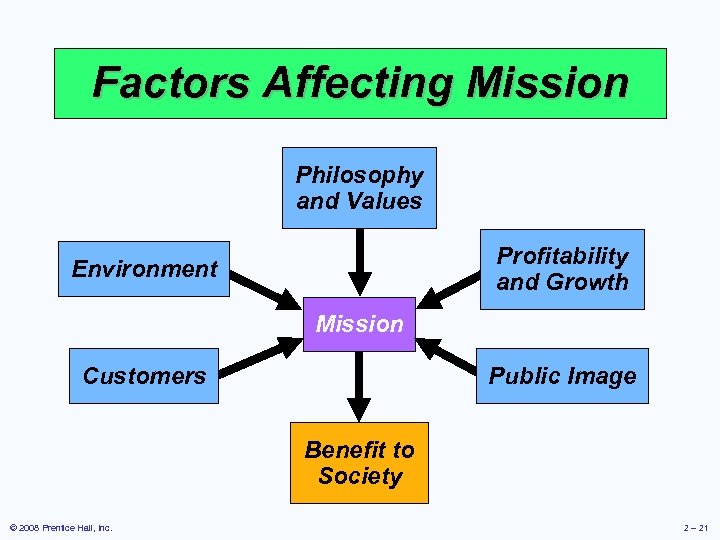 Factors Affecting Mission Philosophy and Values Profitability and Growth Environment Mission Customers Public Image Benefit to Society © 2008 Prentice Hall, Inc. 2 – 21
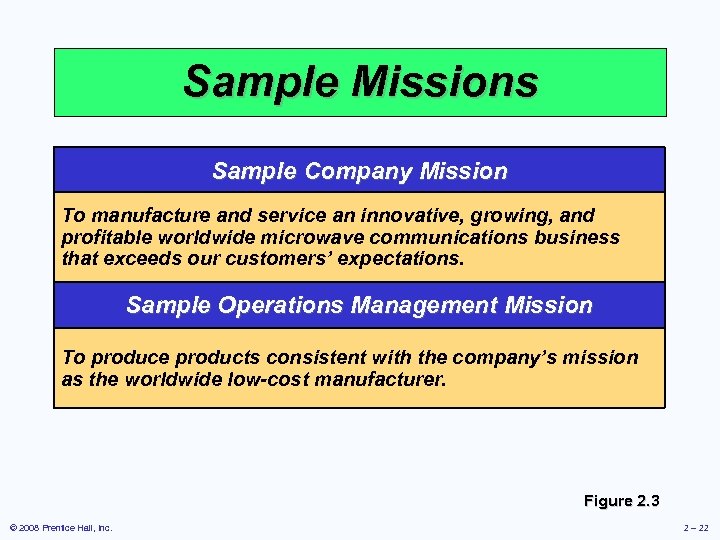 Sample Missions Sample Company Mission To manufacture and service an innovative, growing, and profitable worldwide microwave communications business that exceeds our customers’ expectations. Sample Operations Management Mission To produce products consistent with the company’s mission as the worldwide low-cost manufacturer. Figure 2. 3 © 2008 Prentice Hall, Inc. 2 – 22
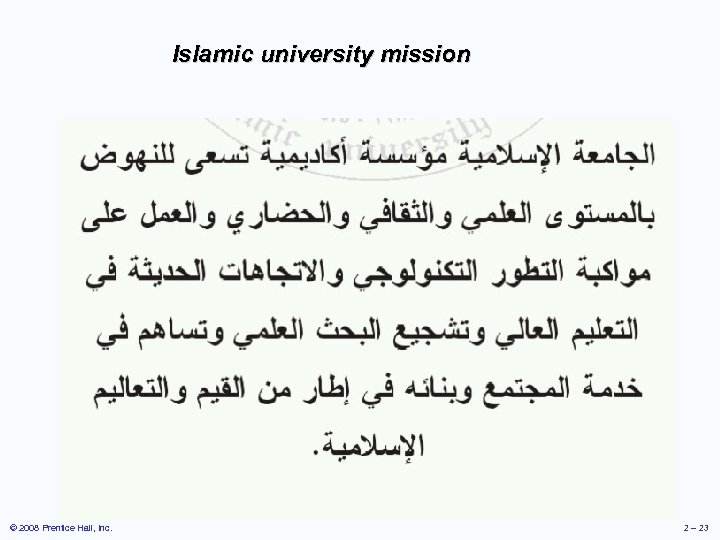 Islamic university mission Figure 2. 3 © 2008 Prentice Hall, Inc. 2 – 23
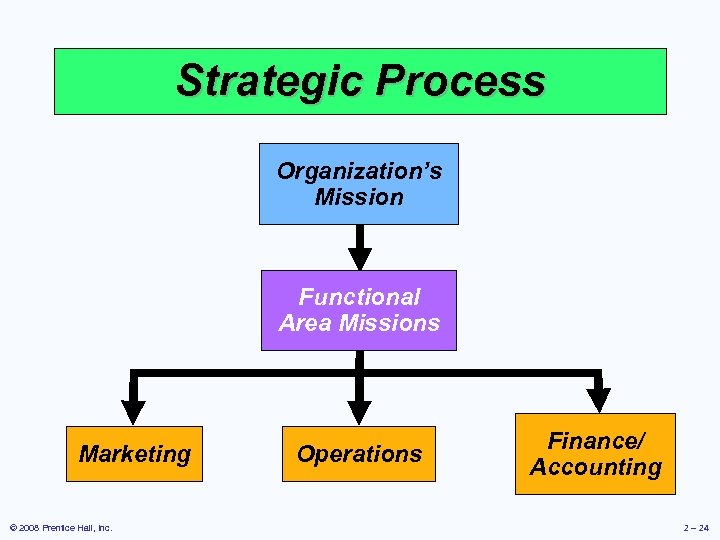 Strategic Process Organization’s Mission Functional Area Missions Marketing © 2008 Prentice Hall, Inc. Operations Finance/ Accounting 2 – 24
 Strategy þ Action plan to achieve mission þ Functional areas have strategies þ Strategies exploit opportunities and strengths, neutralize threats, and avoid weaknesses © 2008 Prentice Hall, Inc. 2 – 25
 Strategies for Competitive Advantage þ Differentiation – better, or at least different þ Cost leadership – cheaper þ Response – rapid response © 2008 Prentice Hall, Inc. 2 – 26
 Competing on Differentiation Uniqueness can go beyond both the physical characteristics and service attributes to encompass everything that impacts customer’s perception of value þ Safeskin gloves – leading edge products þ Walt Disney Magic Kingdom – experience differentiation þ Hard Rock Cafe – dining experience © 2008 Prentice Hall, Inc. 2 – 27
 Competing on Cost Provide the maximum value as perceived by customer. Does not imply low quality. þ Southwest Airlines – secondary airports, no frills service, efficient utilization of equipment þ Wal-Mart – small overheads, , distribution costs þ Franz Colruyt – no bags, low light, no music, doors on freezers © 2008 Prentice Hall, Inc. 2 – 28
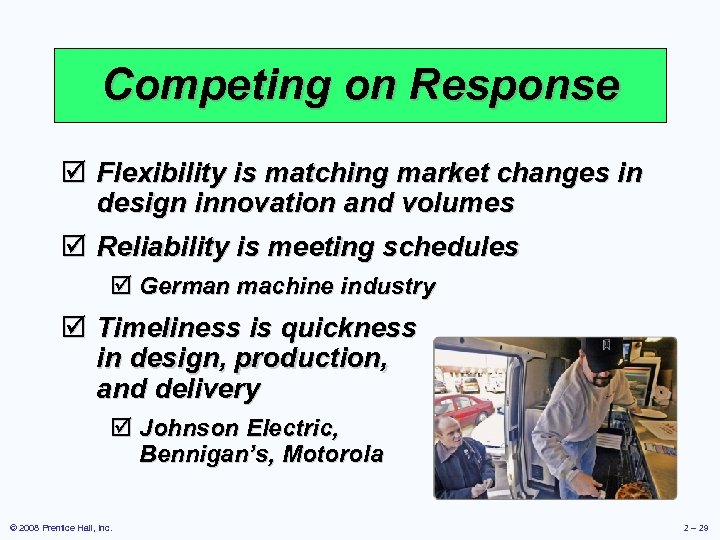 Competing on Response þ Flexibility is matching market changes in design innovation and volumes þ Reliability is meeting schedules þ German machine industry þ Timeliness is quickness in design, production, and delivery þ Johnson Electric, Bennigan’s, Motorola © 2008 Prentice Hall, Inc. 2 – 29
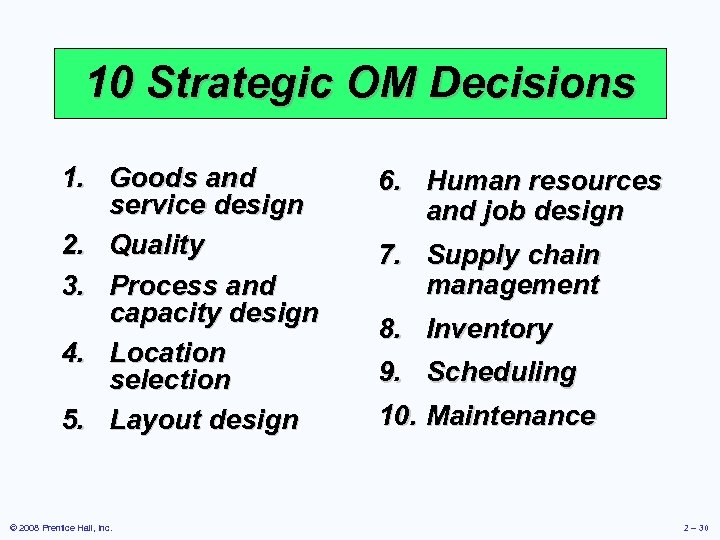 10 Strategic OM Decisions 1. Goods and service design 2. Quality 3. Process and capacity design 4. Location selection 5. Layout design © 2008 Prentice Hall, Inc. 6. Human resources and job design 7. Supply chain management 8. Inventory 9. Scheduling 10. Maintenance 2 – 30
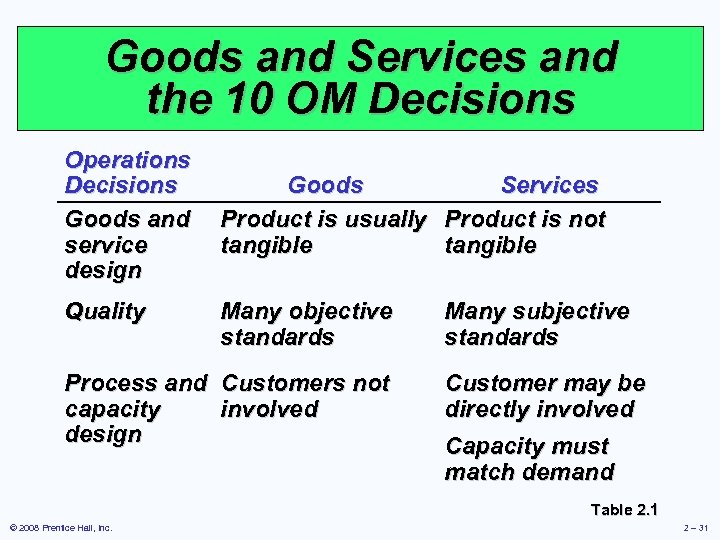 Goods and Services and the 10 OM Decisions Operations Decisions Goods and service design Quality Services Goods Product is usually Product is not tangible Many objective standards Process and Customers not capacity involved design Many subjective standards Customer may be directly involved Capacity must match demand Table 2. 1 © 2008 Prentice Hall, Inc. 2 – 31
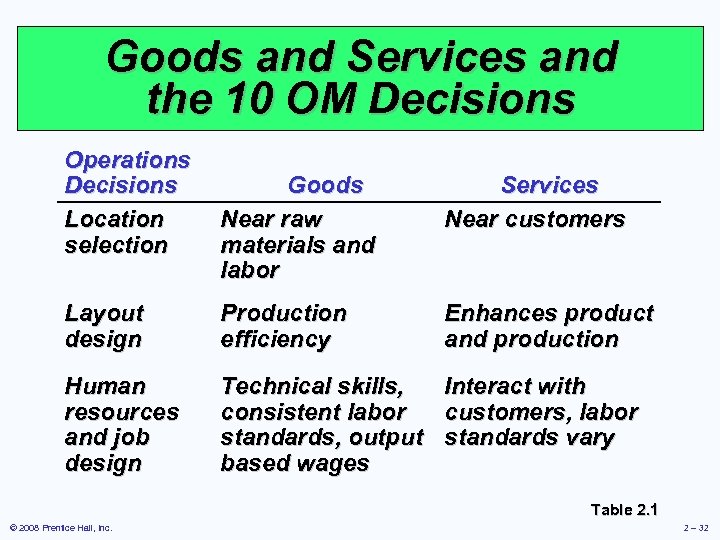 Goods and Services and the 10 OM Decisions Operations Decisions Location selection Goods Near raw materials and labor Services Near customers Layout design Production efficiency Enhances product and production Human resources and job design Technical skills, consistent labor standards, output based wages Interact with customers, labor standards vary Table 2. 1 © 2008 Prentice Hall, Inc. 2 – 32
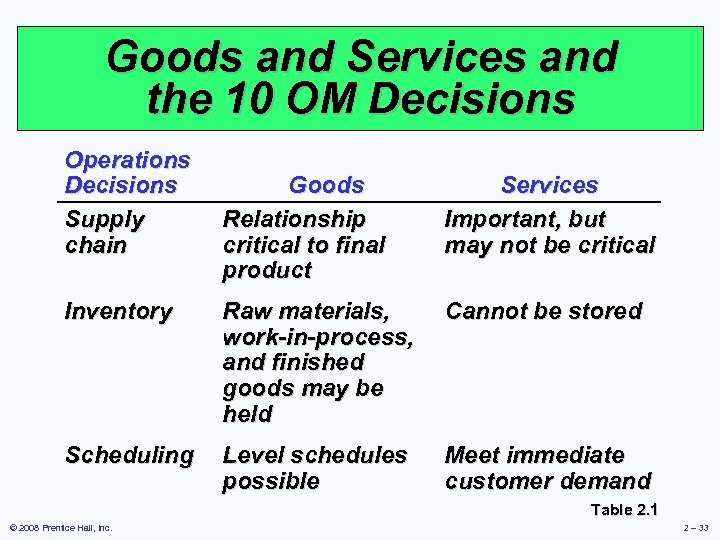 Goods and Services and the 10 OM Decisions Operations Decisions Supply chain Goods Relationship critical to final product Services Important, but may not be critical Inventory Raw materials, work-in-process, and finished goods may be held Cannot be stored Scheduling Level schedules possible Meet immediate customer demand Table 2. 1 © 2008 Prentice Hall, Inc. 2 – 33
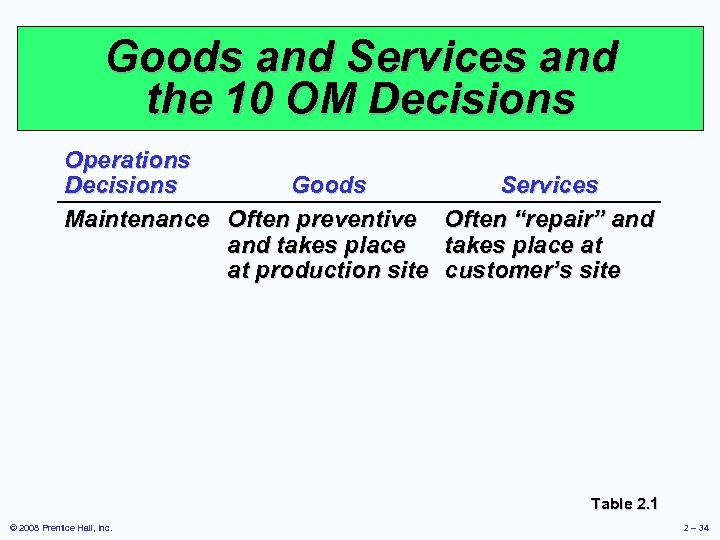 Goods and Services and the 10 OM Decisions Operations Services Decisions Goods Maintenance Often preventive Often “repair” and takes place at at production site customer’s site Table 2. 1 © 2008 Prentice Hall, Inc. 2 – 34
 Managing Global Service Operations Requires a different perspective on: þ Capacity planning þ Location planning þ Facilities design and layout þ Scheduling © 2008 Prentice Hall, Inc. 2 – 35
 Capacity planning Capacity is the highest reasonable output rate which can be achieved with the current product specifications, workforce, plant and equipment. Two distinct ways to view capacity. • • Design capacity Effective capacity What is the difference ? © 2008 Prentice Hall, Inc. 2 – 36
 Capacity planning • Design capacity is the maximum possible rate of output that can be achieved. • Effective capacity is the rate of output that a firm is capable of achieving. Given process limitation such as preventive maintenance , downtime, setup time. • Actual output rate will be less than effective capacity when production losses , like what losses? © 2008 Prentice Hall, Inc. 2 – 37
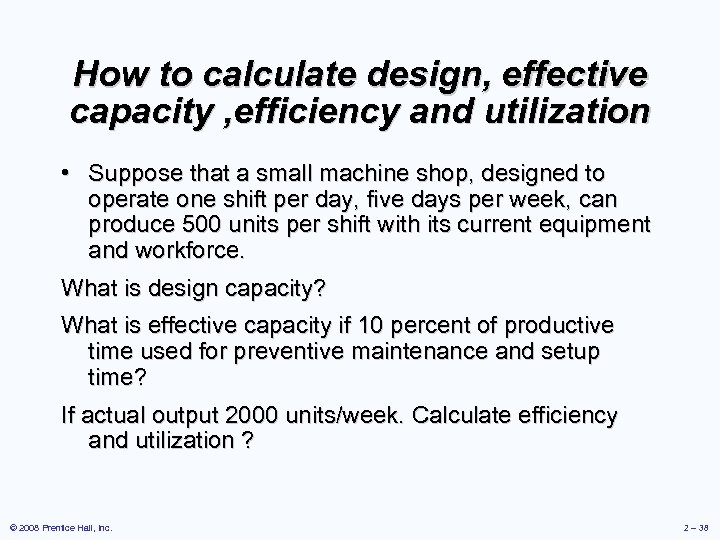 How to calculate design, effective capacity , efficiency and utilization • Suppose that a small machine shop, designed to operate one shift per day, five days per week, can produce 500 units per shift with its current equipment and workforce. What is design capacity? What is effective capacity if 10 percent of productive time used for preventive maintenance and setup time? If actual output 2000 units/week. Calculate efficiency and utilization ? © 2008 Prentice Hall, Inc. 2 – 38
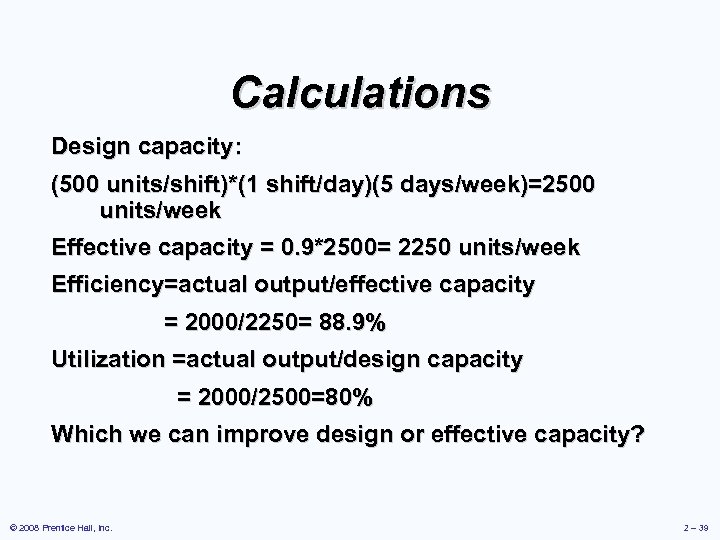 Calculations Design capacity: (500 units/shift)*(1 shift/day)(5 days/week)=2500 units/week Effective capacity = 0. 9*2500= 2250 units/week Efficiency=actual output/effective capacity = 2000/2250= 88. 9% Utilization =actual output/design capacity = 2000/2500=80% Which we can improve design or effective capacity? © 2008 Prentice Hall, Inc. 2 – 39
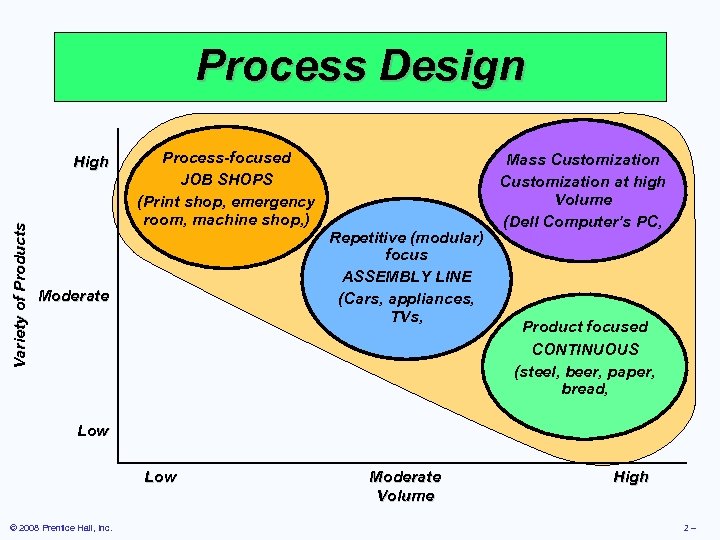 Process Design Variety of Products High Process-focused JOB SHOPS (Print shop, emergency room, machine shop, ) Repetitive (modular) focus ASSEMBLY LINE (Cars, appliances, TVs, Moderate Mass Customization at high Volume (Dell Computer’s PC, Product focused CONTINUOUS (steel, beer, paper, bread, Low © 2008 Prentice Hall, Inc. Moderate Volume High 2–
 Issues In Operations Strategy þ Research about effective operations management strategies þ Preconditions for developing effective OM strategies þ The dynamics of OM strategy development © 2008 Prentice Hall, Inc. 2 – 41
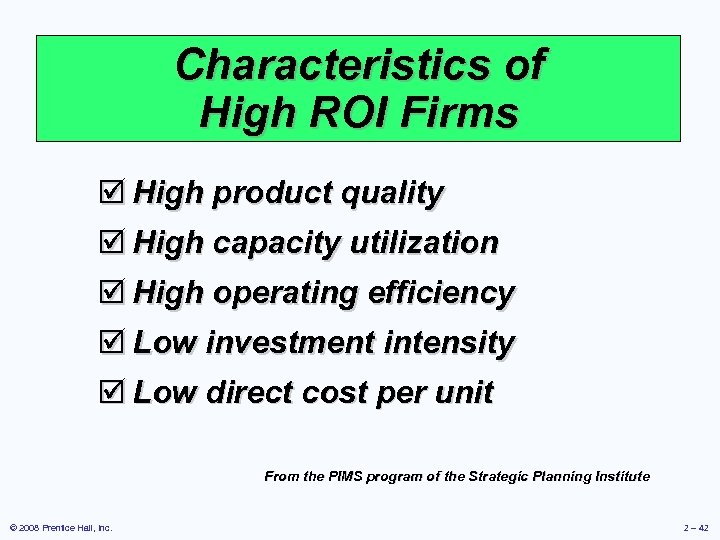 Characteristics of High ROI Firms þ High product quality þ High capacity utilization þ High operating efficiency þ Low investment intensity þ Low direct cost per unit From the PIMS program of the Strategic Planning Institute © 2008 Prentice Hall, Inc. 2 – 42
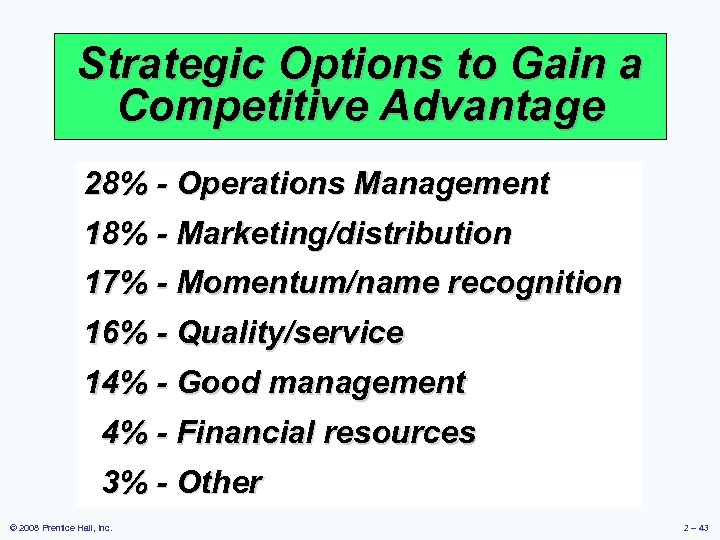 Strategic Options to Gain a Competitive Advantage 28% - Operations Management 18% - Marketing/distribution 17% - Momentum/name recognition 16% - Quality/service 14% - Good management 4% - Financial resources 3% - Other © 2008 Prentice Hall, Inc. 2 – 43
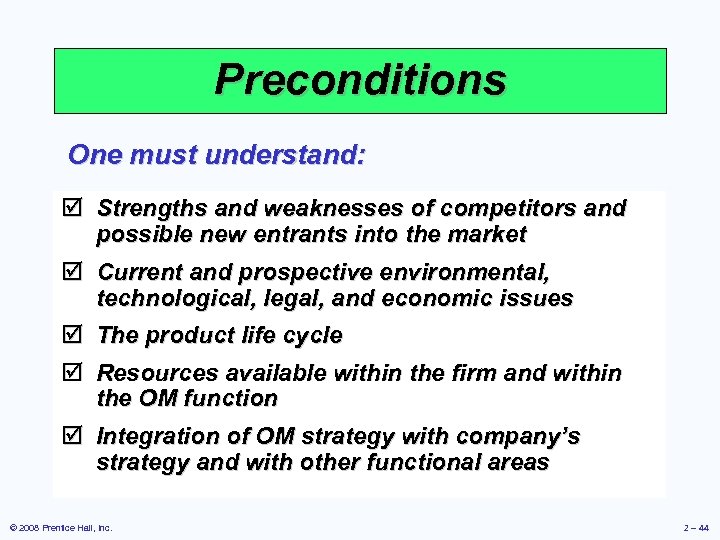 Preconditions One must understand: þ Strengths and weaknesses of competitors and possible new entrants into the market þ Current and prospective environmental, technological, legal, and economic issues þ The product life cycle þ Resources available within the firm and within the OM function þ Integration of OM strategy with company’s strategy and with other functional areas © 2008 Prentice Hall, Inc. 2 – 44
 Environmental Scanning is the monitoring, evaluating and disseminating of information from the external and internal environments to key people within corporation. 45
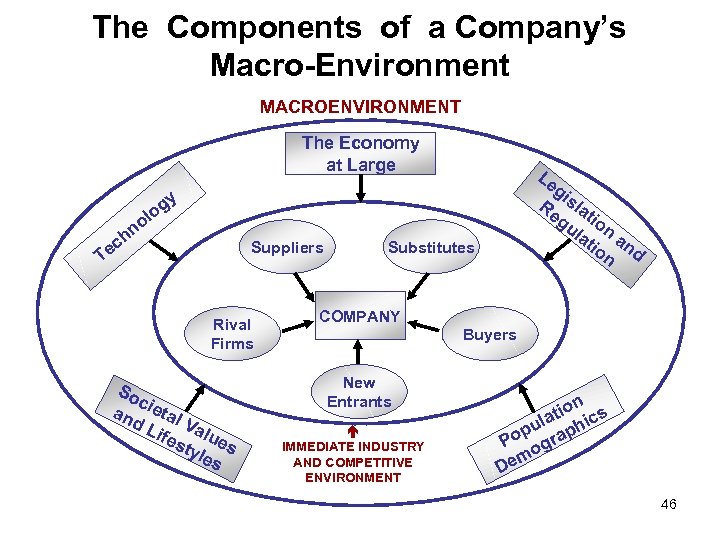 The Components of a Company’s Macro-Environment MACROENVIRONMENT The Economy at Large Le gi Re sla gu tio la n a tio n n d gy o ol n ch e Suppliers T Rival Firms So c an ietal d. L V ife alue sty s les Substitutes COMPANY Buyers New Entrants IMMEDIATE INDUSTRY AND COMPETITIVE ENVIRONMENT n tio ics la pu raph Po og m De 46
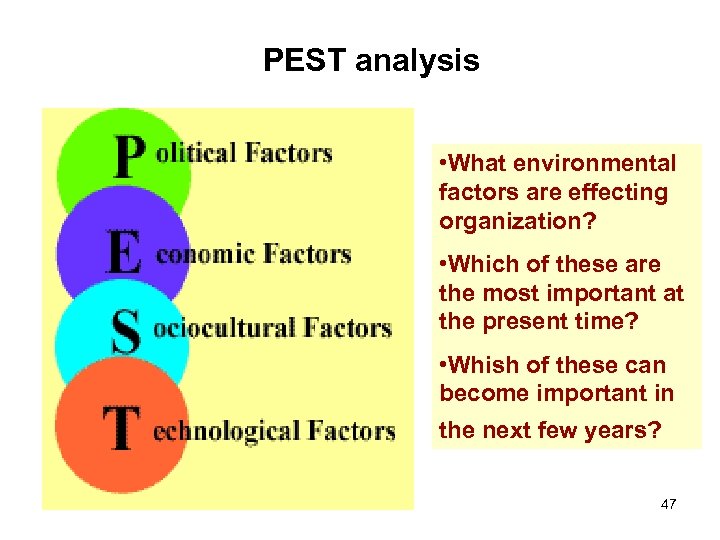 PEST analysis • What environmental factors are effecting organization? • Which of these are the most important at the present time? • Whish of these can become important in the next few years? 47
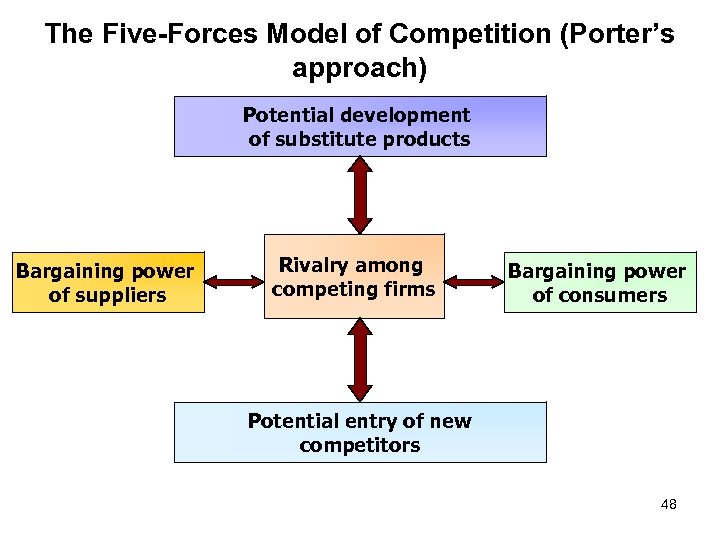 The Five-Forces Model of Competition (Porter’s approach) Potential development of substitute products Bargaining power of suppliers Rivalry among competing firms Bargaining power of consumers Potential entry of new competitors 48
 Dynamics of Strategic Change þ Changes within the organization þ þ Personnel Finance Technology Product life þ Changes in the environment © 2008 Prentice Hall, Inc. 2 – 49
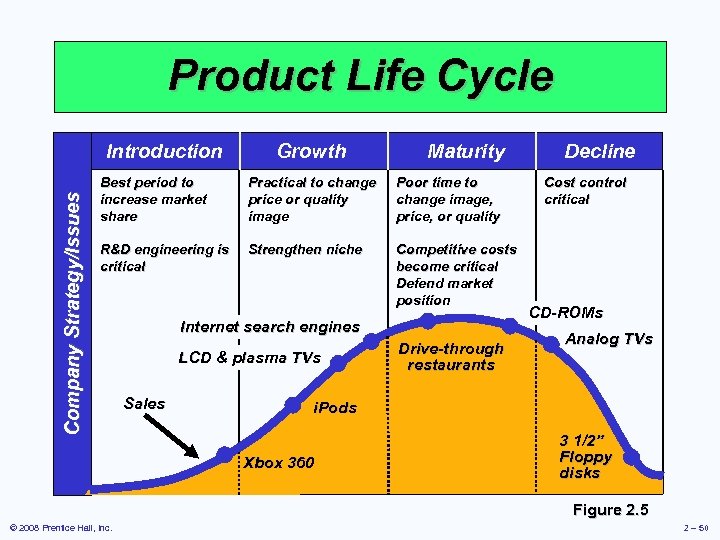 Product Life Cycle Company Strategy/Issues Introduction Growth Maturity Best period to increase market share Practical to change price or quality image Poor time to change image, price, or quality R&D engineering is critical Strengthen niche Competitive costs become critical Defend market position Internet search engines LCD & plasma TVs Sales Drive-through restaurants Decline Cost control critical CD-ROMs Analog TVs i. Pods Xbox 360 3 1/2” Floppy disks Figure 2. 5 © 2008 Prentice Hall, Inc. 2 – 50
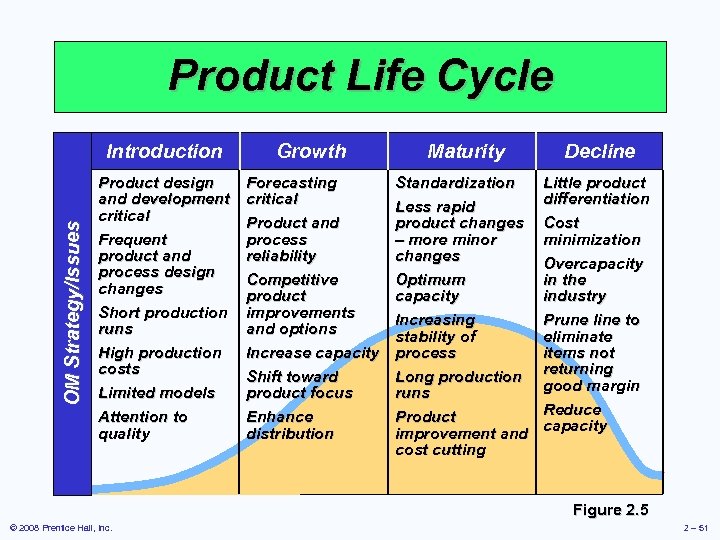 Product Life Cycle OM Strategy/Issues Introduction Growth Maturity Decline Product design and development critical Frequent product and process design changes Short production runs High production costs Limited models Attention to quality Forecasting critical Product and process reliability Competitive product improvements and options Increase capacity Shift toward product focus Enhance distribution Standardization Less rapid product changes – more minor changes Optimum capacity Increasing stability of process Long production runs Product improvement and cost cutting Little product differentiation Cost minimization Overcapacity in the industry Prune line to eliminate items not returning good margin Reduce capacity Figure 2. 5 © 2008 Prentice Hall, Inc. 2 – 51
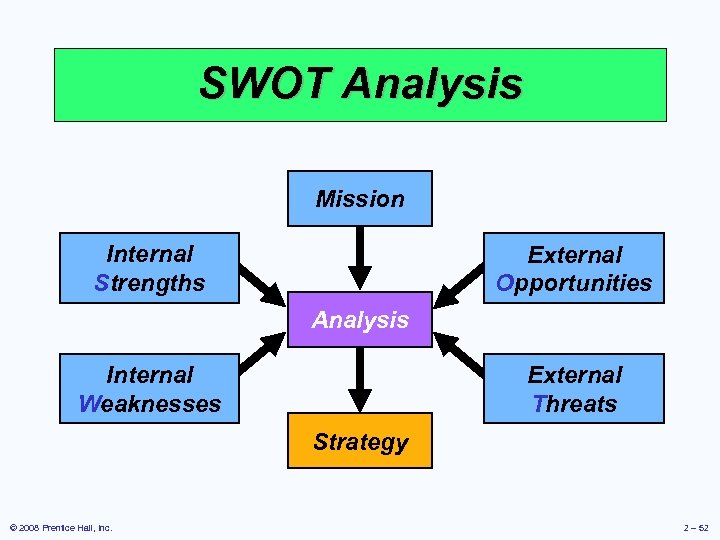 SWOT Analysis Mission Internal Strengths External Opportunities Analysis Internal Weaknesses External Threats Strategy © 2008 Prentice Hall, Inc. 2 – 52
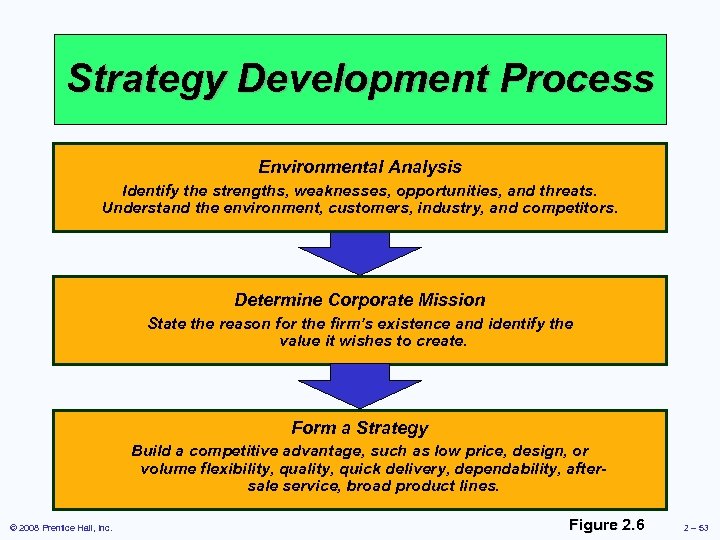 Strategy Development Process Environmental Analysis Identify the strengths, weaknesses, opportunities, and threats. Understand the environment, customers, industry, and competitors. Determine Corporate Mission State the reason for the firm’s existence and identify the value it wishes to create. Form a Strategy Build a competitive advantage, such as low price, design, or volume flexibility, quality, quick delivery, dependability, aftersale service, broad product lines. © 2008 Prentice Hall, Inc. Figure 2. 6 2 – 53
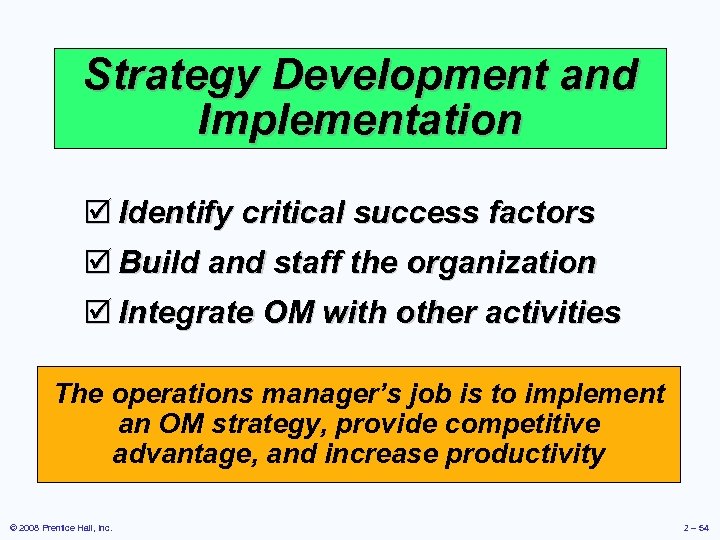 Strategy Development and Implementation þ Identify critical success factors þ Build and staff the organization þ Integrate OM with other activities The operations manager’s job is to implement an OM strategy, provide competitive advantage, and increase productivity © 2008 Prentice Hall, Inc. 2 – 54
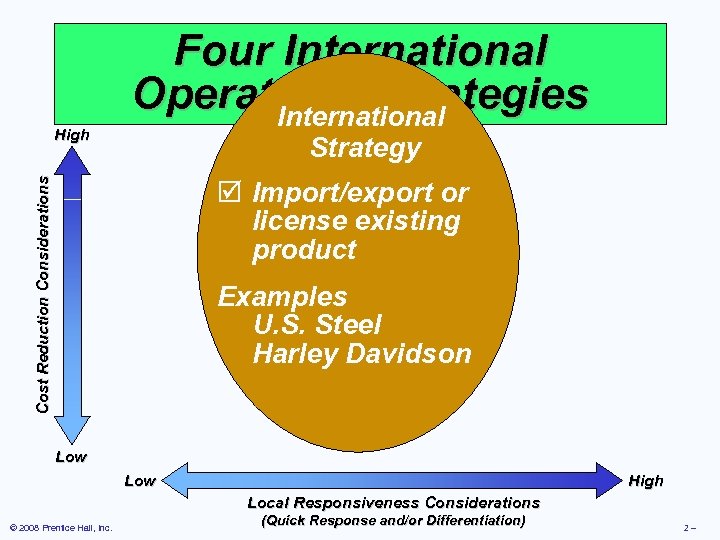 Strategy Cost Reduction Considerations High Four International Operations Strategies International þ Import/export or license existing product Examples U. S. Steel Harley Davidson Low High Local Responsiveness Considerations © 2008 Prentice Hall, Inc. (Quick Response and/or Differentiation) 2–
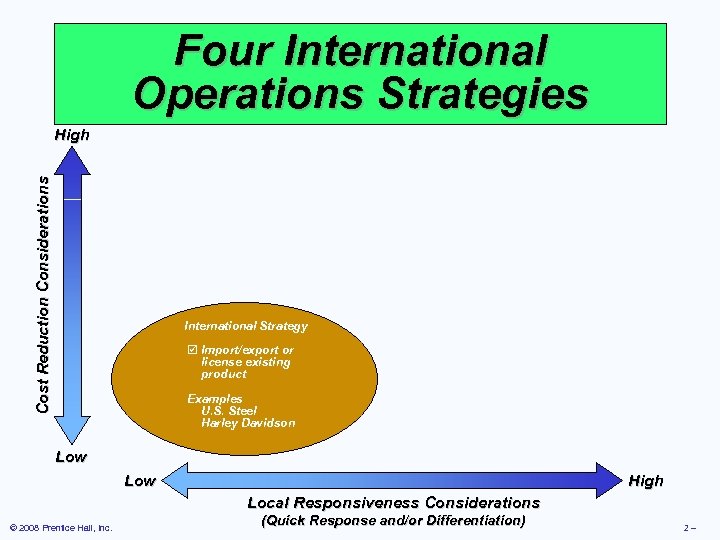 Four International Operations Strategies Cost Reduction Considerations High International Strategy þ Import/export or license existing product Examples U. S. Steel Harley Davidson Low High Local Responsiveness Considerations © 2008 Prentice Hall, Inc. (Quick Response and/or Differentiation) 2–
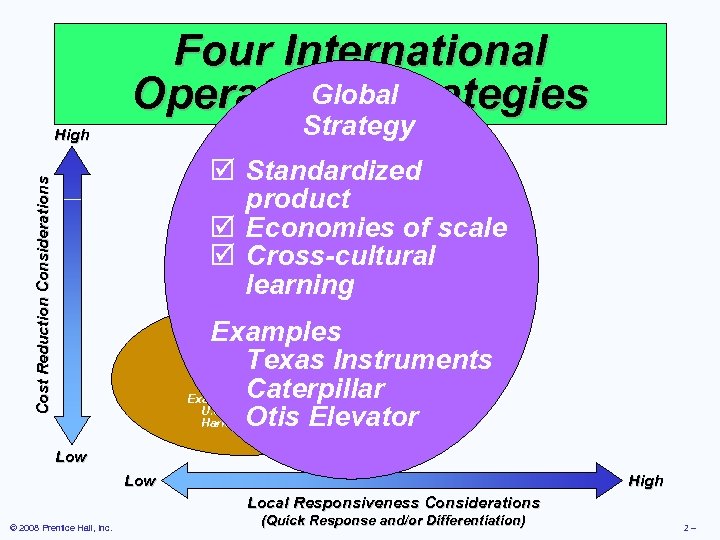 Four International Global Operations Strategies Strategy High Cost Reduction Considerations þ Standardized product þ Economies of scale þ Cross-cultural learning Examples Texas Instruments Examples Caterpillar U. S. Steel Otis Harley Davidson Elevator International Strategy þ Import/export or license existing product Low High Local Responsiveness Considerations © 2008 Prentice Hall, Inc. (Quick Response and/or Differentiation) 2–
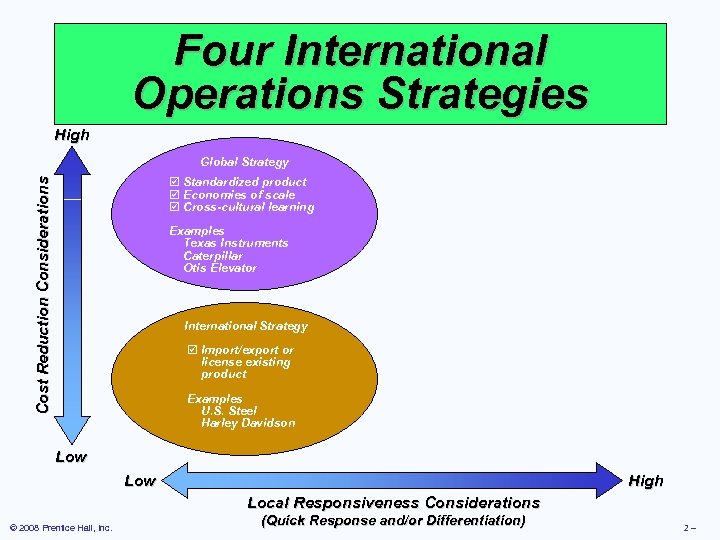 Four International Operations Strategies High Global Strategy Cost Reduction Considerations þ Standardized product þ Economies of scale þ Cross-cultural learning Examples Texas Instruments Caterpillar Otis Elevator International Strategy þ Import/export or license existing product Examples U. S. Steel Harley Davidson Low High Local Responsiveness Considerations © 2008 Prentice Hall, Inc. (Quick Response and/or Differentiation) 2–
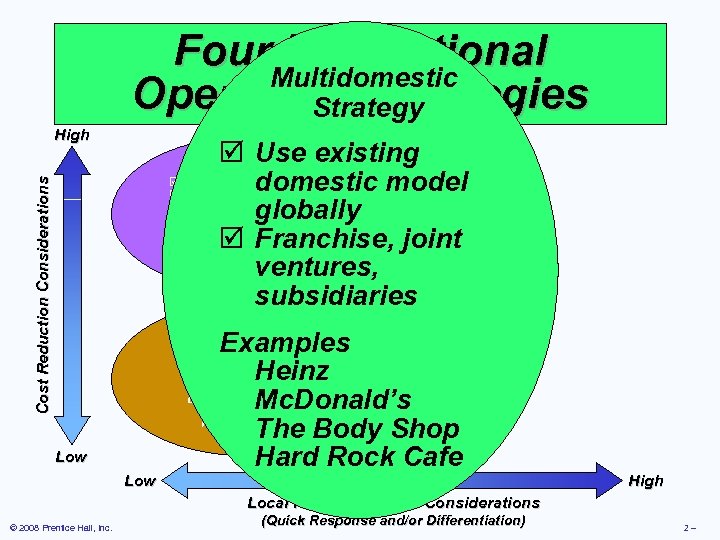 Four. Multidomestic International Operations Strategies Strategy High þ Use existing þ Standardized product domestic model þ Economies of scale þ Cross-cultural learning globally Examples Texas þ Franchise, joint Instruments Caterpillar Otis Elevator ventures, subsidiaries Cost Reduction Considerations Global Strategy International Strategy Examples Heinz Examples Mc. Donald’s U. S. Steel Harley Davidson The Body Shop Hard Rock Cafe þ Import/export or license existing product Low High Local Responsiveness Considerations © 2008 Prentice Hall, Inc. (Quick Response and/or Differentiation) 2–
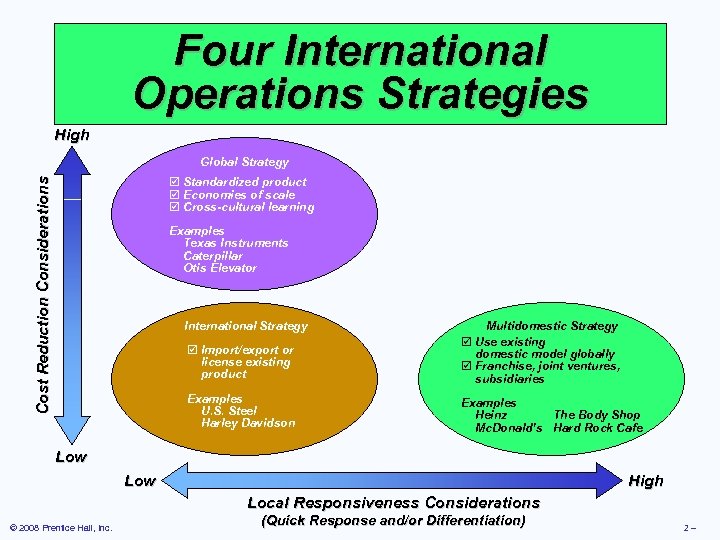 Four International Operations Strategies High Global Strategy Cost Reduction Considerations þ Standardized product þ Economies of scale þ Cross-cultural learning Examples Texas Instruments Caterpillar Otis Elevator International Strategy þ Import/export or license existing product Multidomestic Strategy þ Use existing domestic model globally þ Franchise, joint ventures, subsidiaries Examples U. S. Steel Harley Davidson Examples Heinz The Body Shop Mc. Donald’s Hard Rock Cafe Low High Local Responsiveness Considerations © 2008 Prentice Hall, Inc. (Quick Response and/or Differentiation) 2–
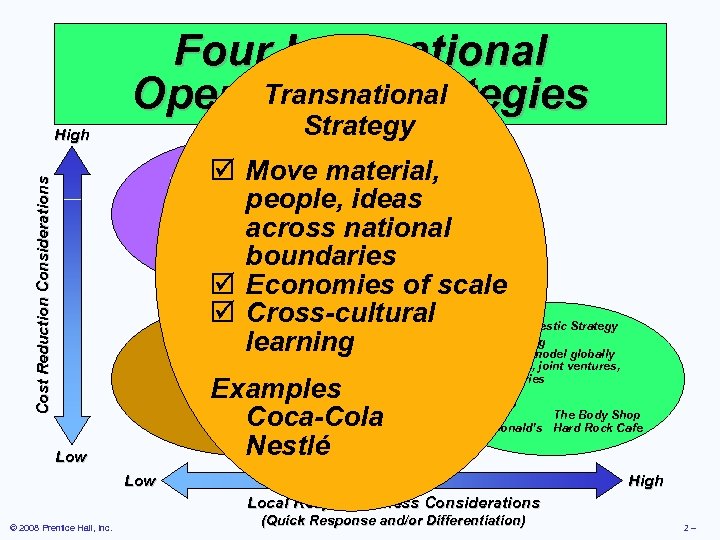 Four International Transnational Operations Strategies Strategy High þ Move material, people, ideas Examples across national Texas Instruments Caterpillar boundaries Otis Elevator þ Economies of scale þ Cross-cultural International Strategy Multidomestic Strategy þ Use existing learning þ Import/export or domestic model globally Global Strategy Cost Reduction Considerations þ Standardized product þ Economies of scale þ Cross-cultural learning license existing product Examples Coca-Cola Nestlé Examples U. S. Steel Harley Davidson Low þ Franchise, joint ventures, subsidiaries Examples Heinz The Body Shop Mc. Donald’s Hard Rock Cafe Low High Local Responsiveness Considerations © 2008 Prentice Hall, Inc. (Quick Response and/or Differentiation) 2–
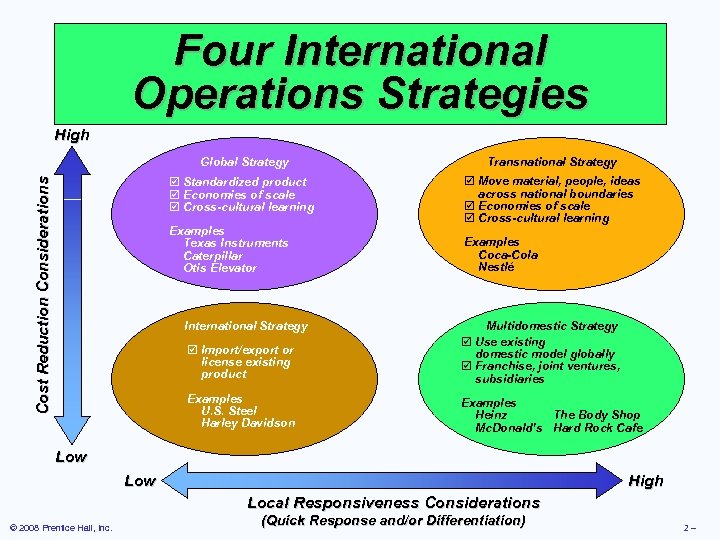 Four International Operations Strategies High Transnational Strategy þ Standardized product þ Economies of scale þ Cross-cultural learning Cost Reduction Considerations Global Strategy þ Move material, people, ideas across national boundaries þ Economies of scale þ Cross-cultural learning Examples Texas Instruments Caterpillar Otis Elevator International Strategy Examples Coca-Cola Nestlé þ Import/export or license existing product Multidomestic Strategy þ Use existing domestic model globally þ Franchise, joint ventures, subsidiaries Examples U. S. Steel Harley Davidson Examples Heinz The Body Shop Mc. Donald’s Hard Rock Cafe Low High Local Responsiveness Considerations © 2008 Prentice Hall, Inc. (Quick Response and/or Differentiation) 2–