


 Скачать презентацию Operational use of ENVISAT at the Danish Meteorological
ce718d115111ad0ef03563f173e00d11.ppt
- Количество слайдов: 12
 Operational use of ENVISAT at the Danish Meteorological Institute Preliminary Results and Experience from the first two months Keld Q. Hansen DMI International Ice Charting Working Group V – Hamburg 19 -23 April 2004
 Why use ENVISAT? International Ice Charting Working Group V – Hamburg 19 -23 April 2004
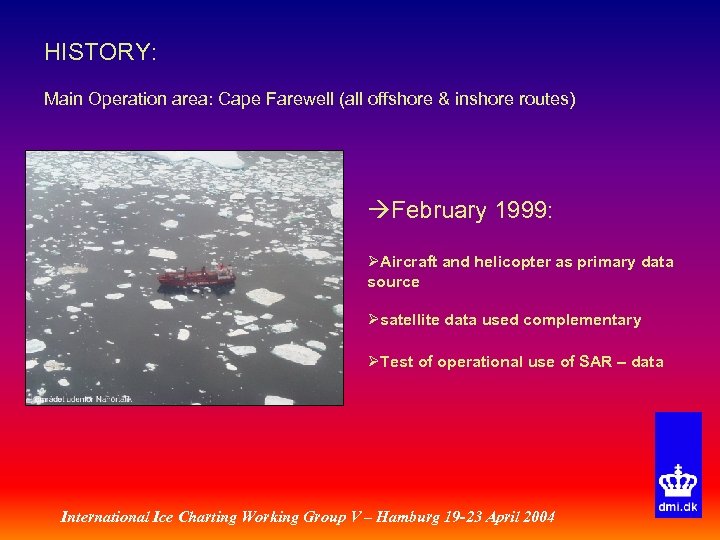 HISTORY: Main Operation area: Cape Farewell (all offshore & inshore routes) February 1999: ØAircraft and helicopter as primary data source Øsatellite data used complementary ØTest of operational use of SAR – data International Ice Charting Working Group V – Hamburg 19 -23 April 2004
 March 1999 ØRadarsat primary data source for ice mapping (offshore) ØHelicopter used inshore ØJune-July (surface melt water) : ice recco aircraft in service in combination with Radarsat Can we skip the aircraft completely? Yes, IF we have SAR data from TWO satellites ØOK frequency and coverage => potential skipping of poor data Øthe satellites can be backup for each other International Ice Charting Working Group V – Hamburg 19 -23 April 2004
 ØThe launch of ENVISAT (March 2002) was expected to realize this future opportunity…. . but time went by …. ØSummer 2003 first ice season without ice recco aircraft BUT only ONE satellite… luckily the ice season was the lightest in 50 years ØWinter 2003/04: contract with Kongsberg Satellite Station on delivery of 250 Envisat scenes/year (= data from Tromsø and Gatineau). ØThe operational setup is complicated by the fact that we need direct broadcast and taped data to cover all areas of interest. ØOnly limited evidence of ENVISAT’s operational capability. ØWe decided to only use ENVISAT outside DMI primary mapping area International Ice Charting Working Group V – Hamburg 19 -23 April 2004
 Planning of SAR scenes: ENVISAT: DESCW (developed by ESA) Ødesigned for multi purposes Øinflexible (shifting scenes is difficult) Ønot user friendly (100’s of mouse clicks) Øtime consuming RADARSAT: SPA (Swath Planning Application) Øsingle purpose Øsimple Øflexible Øsaves swathplans in various formats at the same time International Ice Charting Working Group V – Hamburg 19 -23 April 2004
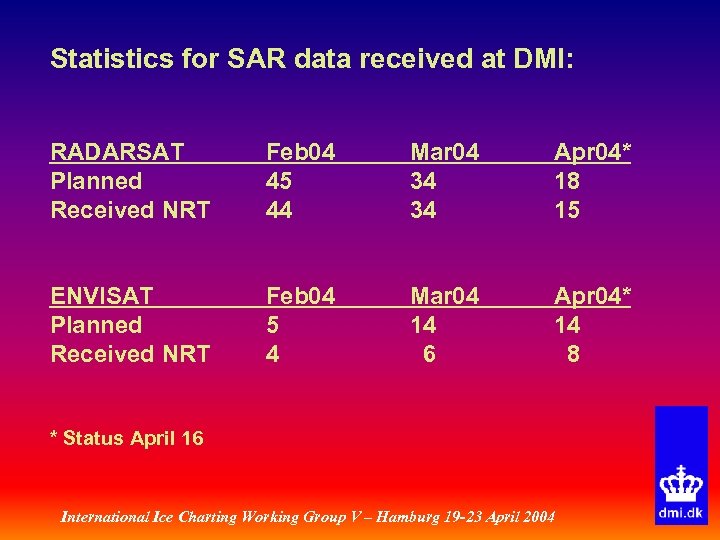 Statistics for SAR data received at DMI: RADARSAT Planned Received NRT Feb 04 45 44 Mar 04 34 34 Apr 04* 18 15 ENVISAT Planned Received NRT Feb 04 5 4 Mar 04 14 6 Apr 04* 14 8 * Status April 16 International Ice Charting Working Group V – Hamburg 19 -23 April 2004
 Experienced ENVISAT NRT Problems Ø Scene is cancelled example 15 th April 2004: “Order cancelled by ESA due to conflict”. (message received 2 hours after satellite pass) Ø Scene is delayed Ø Scene does not cover 500 km Ø Scene is shifted north-south International Ice Charting Working Group V – Hamburg 19 -23 April 2004
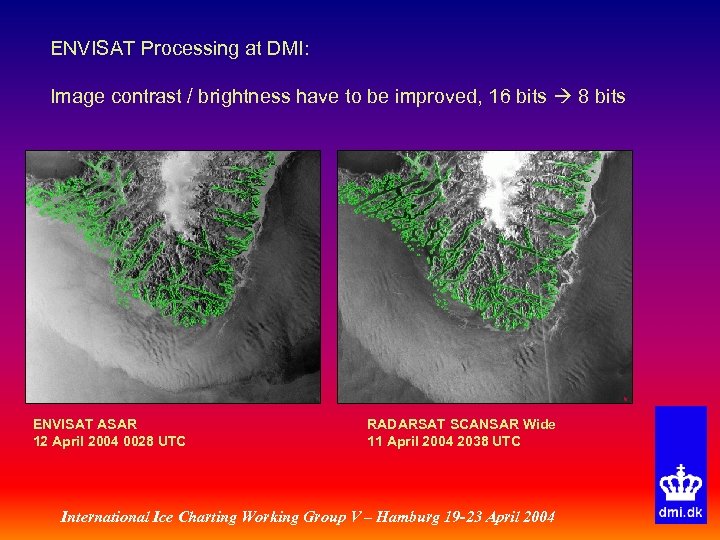 ENVISAT Processing at DMI: Image contrast / brightness have to be improved, 16 bits 8 bits ENVISAT ASAR 12 April 2004 0028 UTC RADARSAT SCANSAR Wide 11 April 2004 2038 UTC International Ice Charting Working Group V – Hamburg 19 -23 April 2004
 Status Mid-April 2004: ØRadarsat is still the primary data source in the Cape Farewell area. ØEnvisat complementary. ØMay 2004: Test of Envisat operational capability outside Cape Farewell area No Radarsat data ordered !!!! International Ice Charting Working Group V – Hamburg 19 -23 April 2004
 Future… Ø We expect stable delivery of data to be accomplished – we need more than 95 % success rate. Ø We would like to reduce time from order to actual satellite pass, do anybody have experience with emergency planning ? Ø We need to improve image contrast / brightness (DMI, ESA ? ) Ø Continuous dialogue on faster and stable NRT delivery with the purpose of improving the service (KSAT, ESA) Ø We look forward to user friendly swath planning software (ESA) Ø Aircraft backup back up in 2004 RADARSAT is an excellent backup for ENVISAT has until now NOT proved backup potential International Ice Charting Working Group V – Hamburg 19 -23 April 2004
 ESA…. ? International Ice Charting Working Group V – Hamburg 19 -23 April 2004