 Скачать презентацию Operational Flood Forecasting for Bangladesh Tom Hopson RAL-NCAR
cbc3837ed3e4bd5390a33ef3589e0e19.ppt
- Количество слайдов: 36



Operational Flood Forecasting for Bangladesh: Tom Hopson, RAL-NCAR Peter Webster, Georgia Tech A. R. Subbiah and R. Selvaraju, Asian Disaster Preparedness Centre Climate Forecast Applications for Bangladesh (CFAB): USAID/CARE/ECMWF/NASA/NOAA Bangladesh Stakeholders: Bangladesh Meteorological Department, Flood Forecasting and Warning Center, Bangladesh Water Development Board, Department of Agriculture Extension, Disaster Management Bureau, Institute of Water Modeling, Center for Environmental and Geographic Information Services, CAREBangladesh
Climate Forecasting Applications for Bangladesh (CFAB) The CFAB project goals: • Develop resilient forecast schemes that capitalize on skillful modeling techniques and advanced data sources at time-scales: 1 -6 months, 20 -25 days, 1 -10 days (2000) • Develop an infrastructure within Bangladesh to: a) make use of the forecasts -- establish pilot projects at selected sites, showing measurable improvements (2006) b) eventually own the prediction schemes -- facilitate a technological transfer (2008)
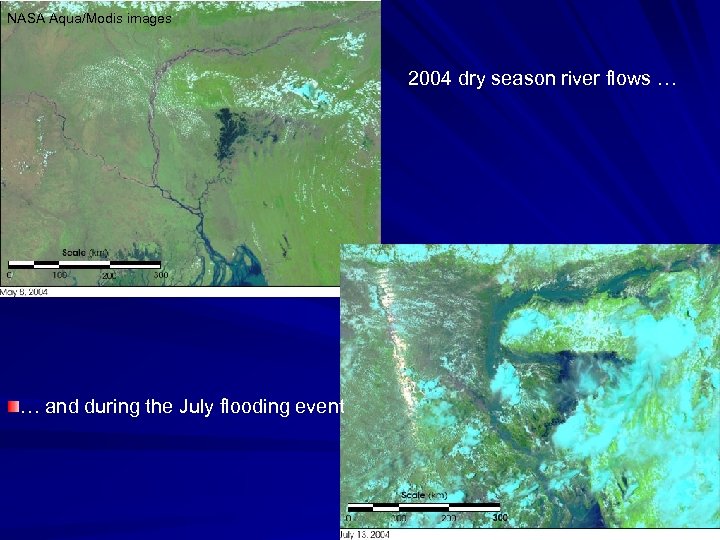
NASA Aqua/Modis images 2004 dry season river flows … … and during the July flooding event
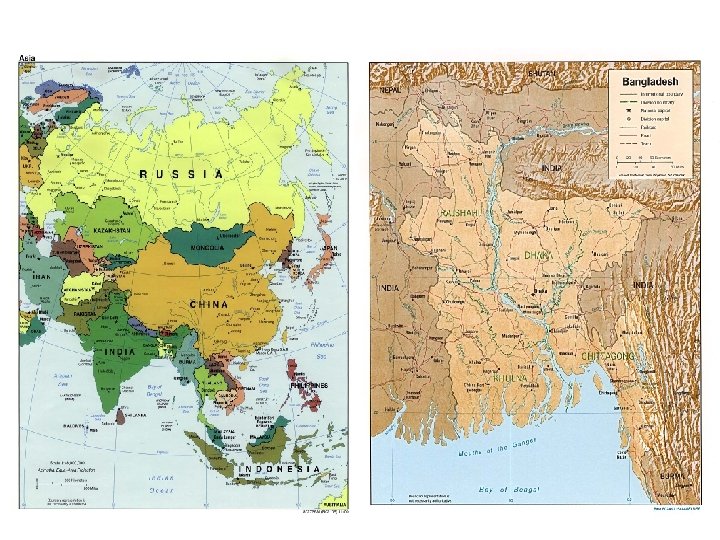
Bangladesh background About 1/3 of land area floods the monsoon rainy season Size: sightly smaller than Iowa (144, 000 sq km) Border countries: Burma (193 km), India (4, 053 km) Population: 140 million 36% of population below poverty line Within the top 5 of: poorest and most densely populated in the world Natural disasters: Nov 1970 Bhola cyclone -- at least 300, 000 died in 20 min (12 m) April 1991 Bangladesh cyclone -- 138, 000 died (6 m)
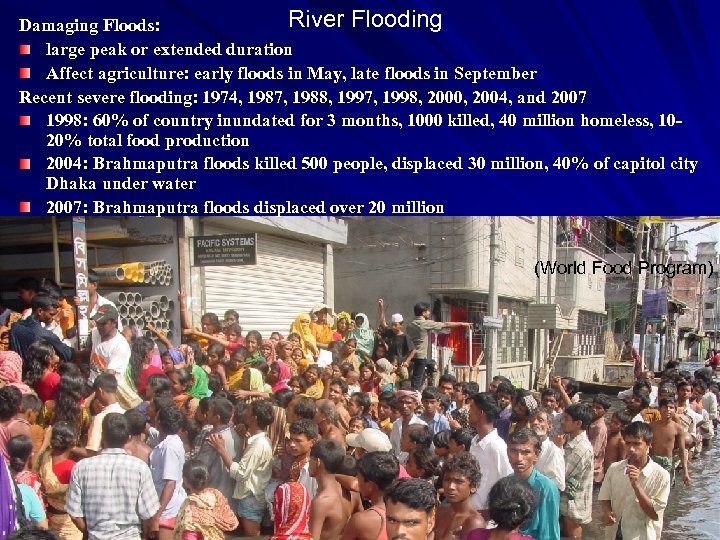
River Flooding Damaging Floods: large peak or extended duration Affect agriculture: early floods in May, late floods in September Recent severe flooding: 1974, 1987, 1988, 1997, 1998, 2000, 2004, and 2007 1998: 60% of country inundated for 3 months, 1000 killed, 40 million homeless, 1020% total food production 2004: Brahmaputra floods killed 500 people, displaced 30 million, 40% of capitol city Dhaka under water 2007: Brahmaputra floods displaced over 20 million (World Food Program)
Overview: Bangladesh flood forecasting I. CFAB History -- sea-level backwater effects II. 1 -10 day Discharge Forecasting 1. precipitation forecast bias removal 2. multi-model river forecasting 3. accounting for all error: weather and hydrologic errors III. 2007 Floods and Warning System Pilot Areas
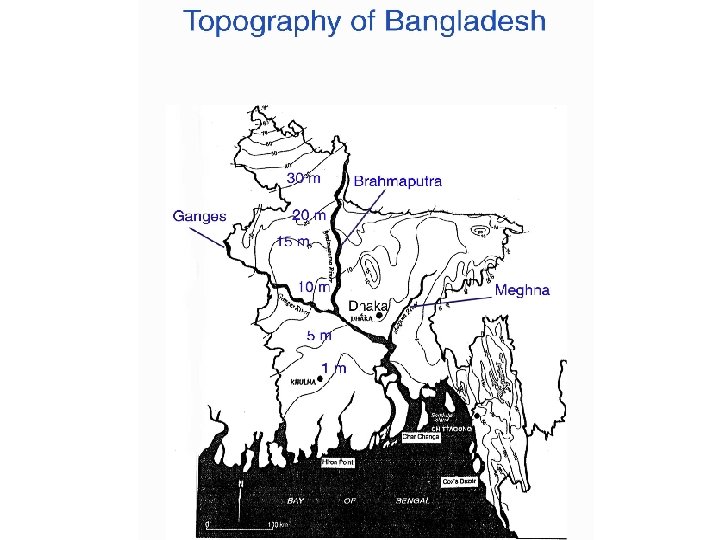
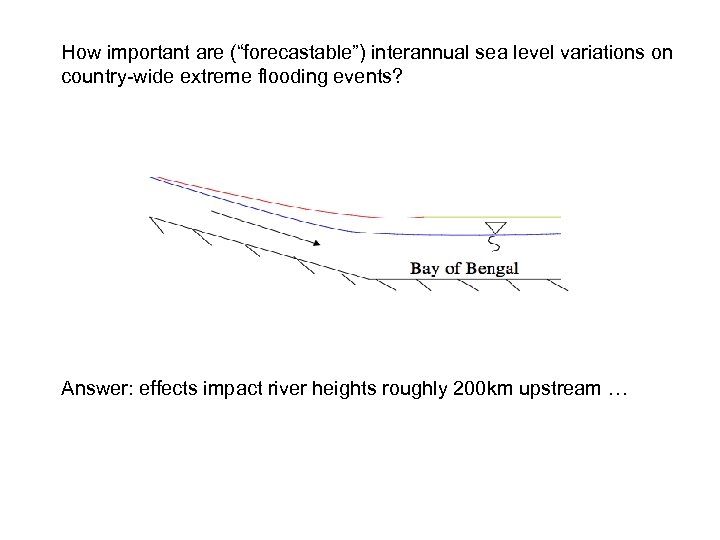
How important are (“forecastable”) interannual sea level variations on country-wide extreme flooding events? Answer: effects impact river heights roughly 200 km upstream …
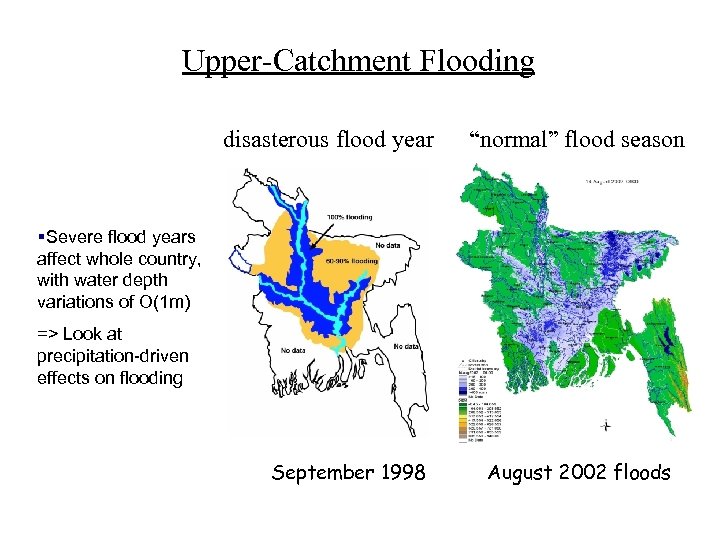
Upper-Catchment Flooding disasterous flood year “normal” flood season §Severe flood years affect whole country, with water depth variations of O(1 m) => Look at precipitation-driven effects on flooding September 1998 August 2002 floods
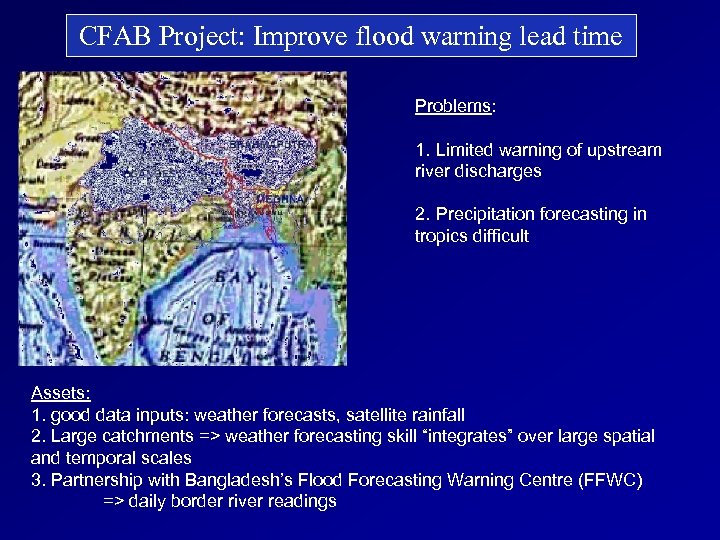
CFAB Project: Improve flood warning lead time Problems: 1. Limited warning of upstream river discharges 2. Precipitation forecasting in tropics difficult Assets: 1. good data inputs: weather forecasts, satellite rainfall 2. Large catchments => weather forecasting skill “integrates” over large spatial and temporal scales 3. Partnership with Bangladesh’s Flood Forecasting Warning Centre (FFWC) => daily border river readings
Merged FFWC-CFAB Hydraulic Model Schematic Primary forecast boundary conditions shown in gold: Ganges at Hardinge Bridge Brahmaputra at Bahadurabad
![Transforming (Ensemble) Rainfall into (Probabilistic) River Flow Forecasts Rainfall Probability Rainfall [mm] Discharge Probability](https://present5.com/presentation/cbc3837ed3e4bd5390a33ef3589e0e19/image-13.jpg "Transforming (Ensemble) Rainfall into (Probabilistic) River Flow Forecasts Rainfall Probability Rainfall [mm] Discharge Probability")
Transforming (Ensemble) Rainfall into (Probabilistic) River Flow Forecasts Rainfall Probability Rainfall [mm] Discharge Probability Discharge [m 3/s] Above danger level probability 36% Greater than climatological seasonal risk?
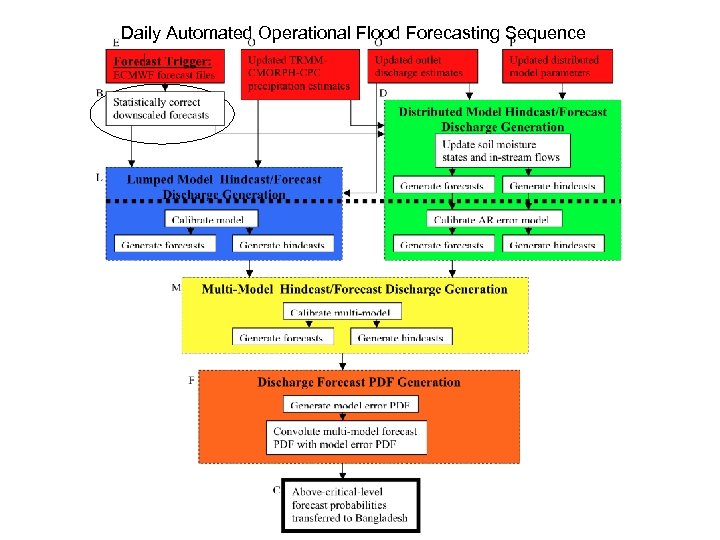
Daily Automated Operational Flood Forecasting Sequence
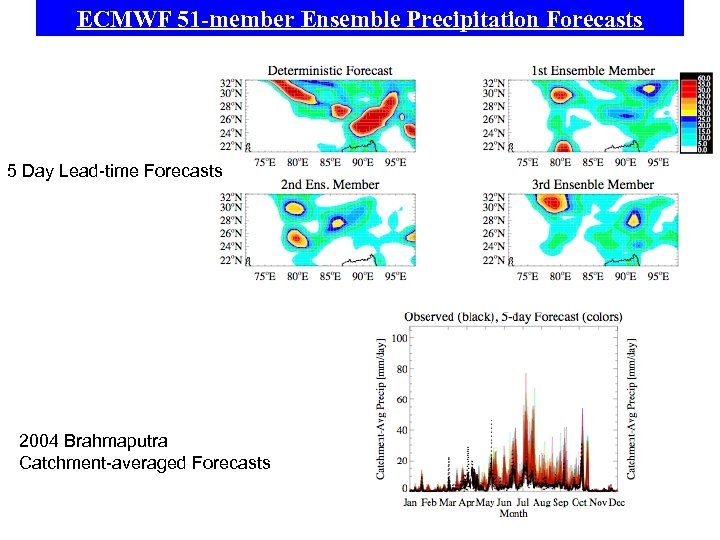
ECMWF 51 -member Ensemble Precipitation Forecasts 5 Day Lead-time Forecasts 2004 Brahmaputra Catchment-averaged Forecasts
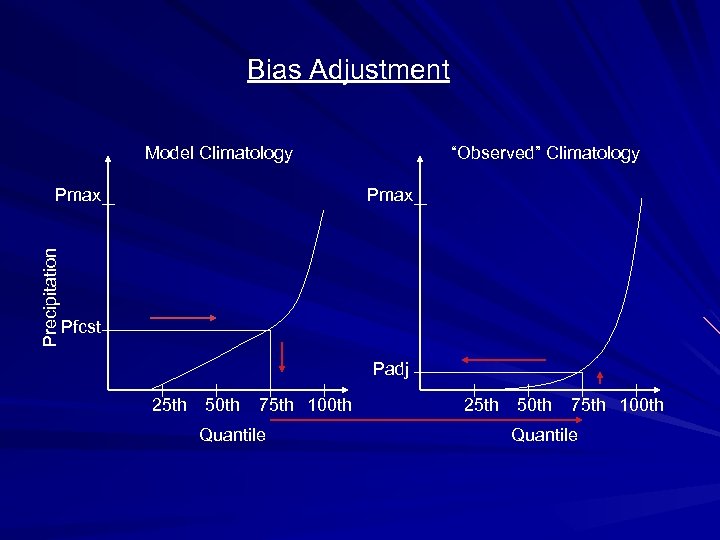
Bias Adjustment Model Climatology Precipitation Pmax “Observed” Climatology Pmax Pfcst Padj 25 th 50 th 75 th 100 th Quantile
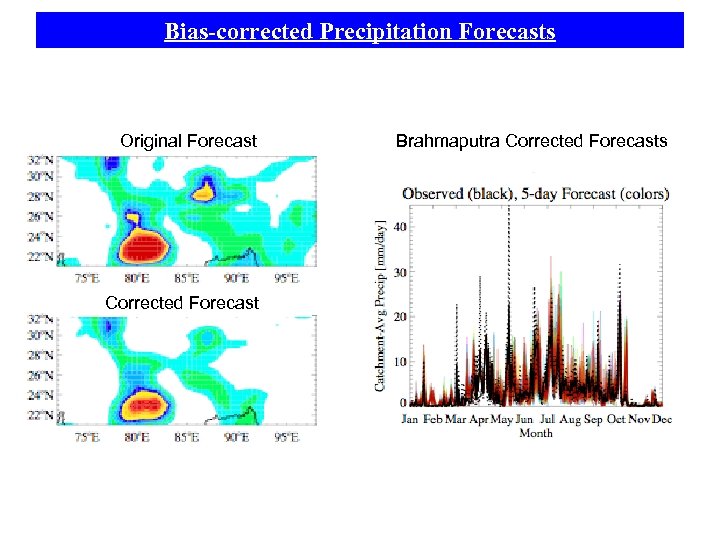
Bias-corrected Precipitation Forecasts Original Forecast Corrected Forecast Brahmaputra Corrected Forecasts
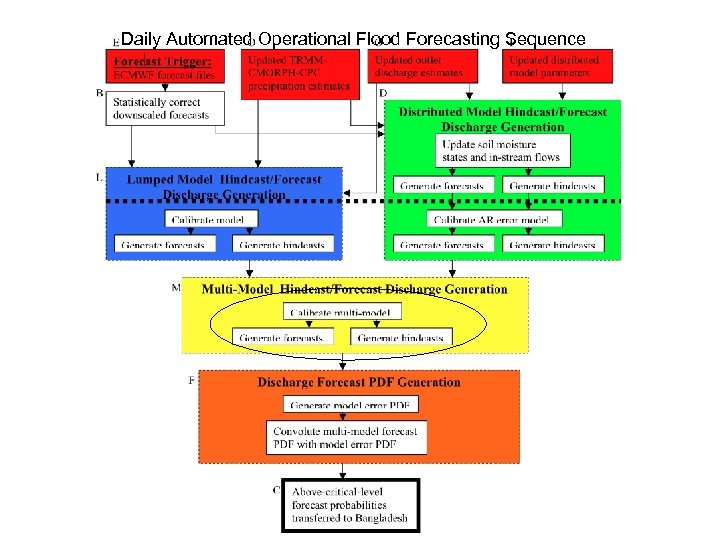
Daily Automated Operational Flood Forecasting Sequence
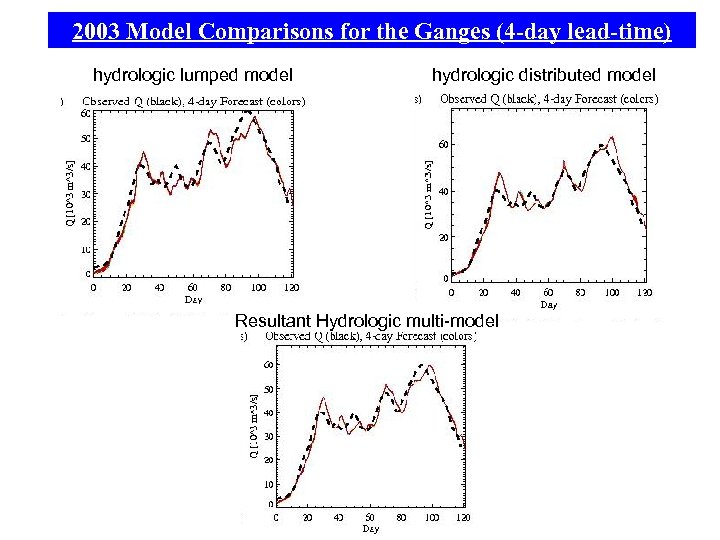
2003 Model Comparisons for the Ganges (4 -day lead-time) hydrologic lumped model hydrologic distributed model Resultant Hydrologic multi-model
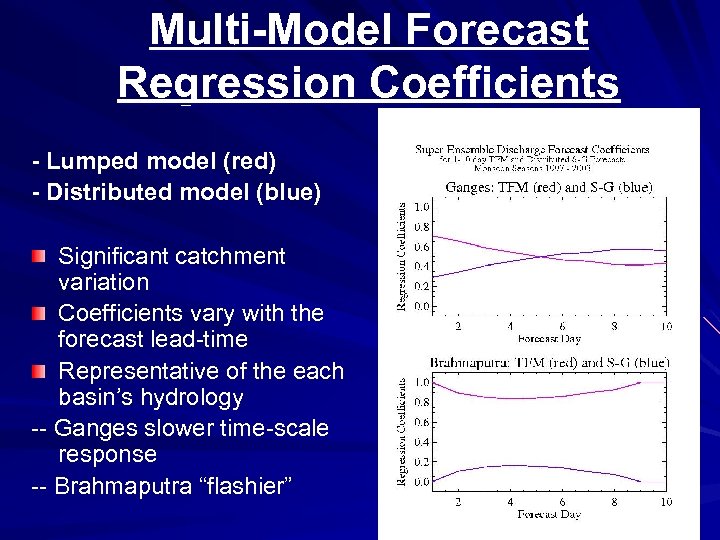
Multi-Model Forecast Regression Coefficients - Lumped model (red) - Distributed model (blue) Significant catchment variation Coefficients vary with the forecast lead-time Representative of the each basin’s hydrology -- Ganges slower time-scale response -- Brahmaputra “flashier”
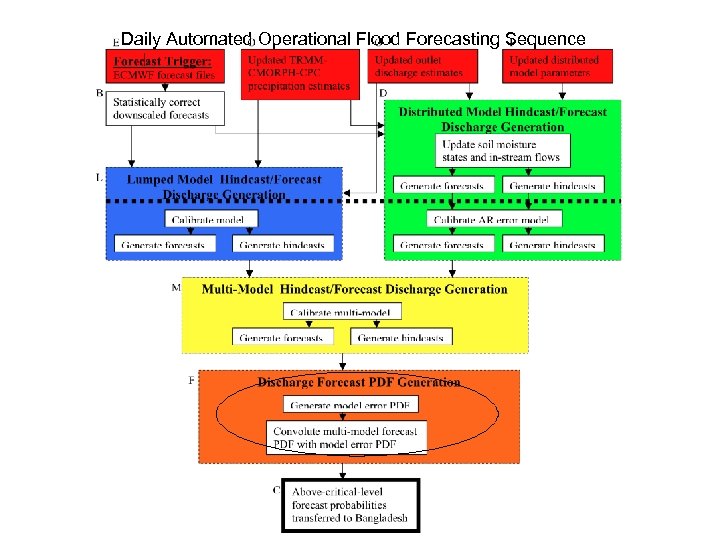
Daily Automated Operational Flood Forecasting Sequence
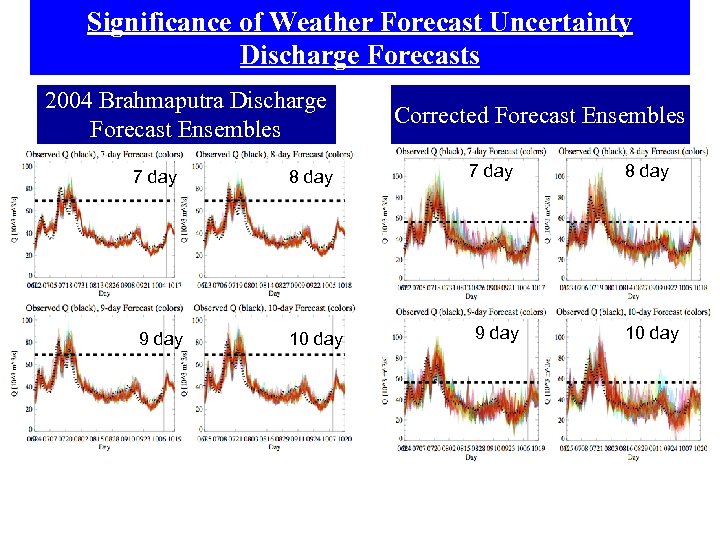
Significance of Weather Forecast Uncertainty Discharge Forecasts 2004 Brahmaputra Discharge Forecast Ensembles 7 day 9 day 8 day 10 day Corrected Forecast Ensembles 7 day 3 day 5 9 day 8 day 4 day 10 day
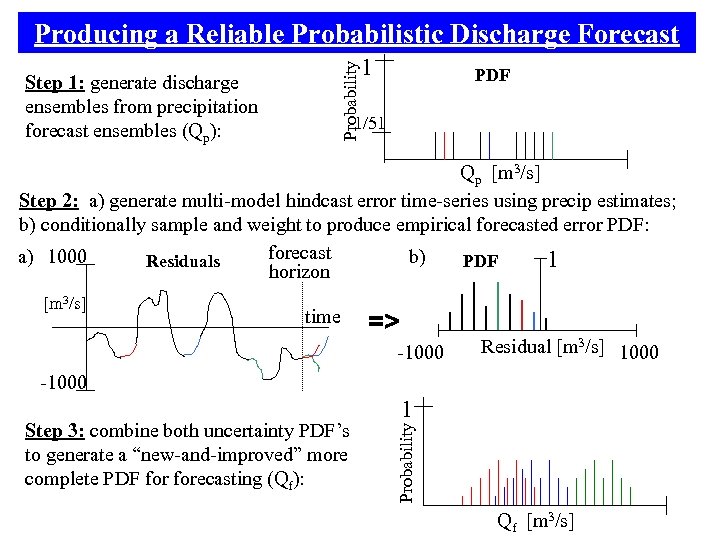
Step 1: generate discharge ensembles from precipitation forecast ensembles (Qp): Probability Producing a Reliable Probabilistic Discharge Forecast 1 PDF 1/51 Qp [m 3/s] Step 2: a) generate multi-model hindcast error time-series using precip estimates; b) conditionally sample and weight to produce empirical forecasted error PDF: forecast a) 1000 b) 1 Residuals PDF horizon [m 3/s] time => -1000 Residual [m 3/s] 1000 -1000 Probability Step 3: combine both uncertainty PDF’s to generate a “new-and-improved” more complete PDF forecasting (Qf): 1 Qf [m 3/s]
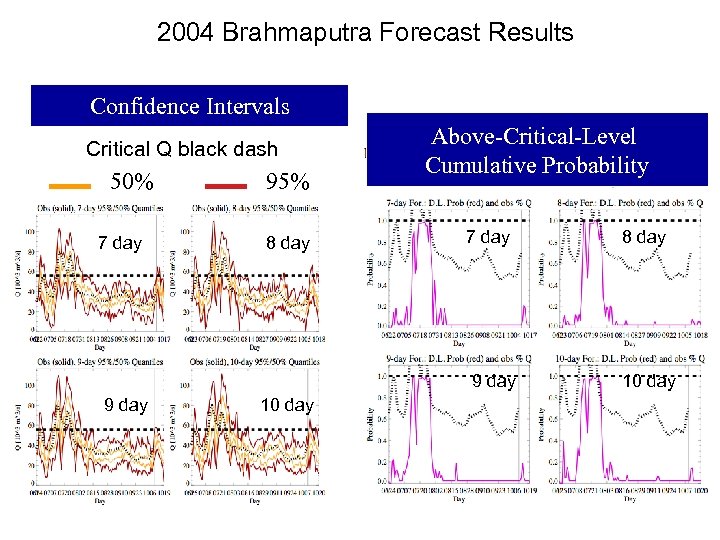
2004 Brahmaputra Forecast Results Confidence Intervals 2 day Critical Q black dash 50% 7 day 3 day 59 day 95% 8 day 4 day Above-Critical-Level Cumulative Probability 7 day 9 day 10 day 8 day 10 day
Overview: Bangladesh flood forecasting I. CFAB History -- sea-level backwater effects II. 1 -10 day Discharge Forecasting 1. precipitation forecast bias removal 2. multi-model river forecasting 3. accounting for all error: weather and hydrologic errors III. 2007 Floods and Warning System Pilot Areas

Five Pilot Sites chosen in 2006 consultation workshops based on biophysical, social criteria: Rajpur Union -- 16 sq km -- 16, 000 pop. Uria Union -- 23 sq km -- 14, 000 pop. Kaijuri Union -- 45 sq km -- 53, 000 pop. Gazirtek Union -- 32 sq km -- 23, 000 pop. Bhekra Union -- 11 sq km -- 9, 000 pop. (annual income: 30, 000 Tk; US$400)
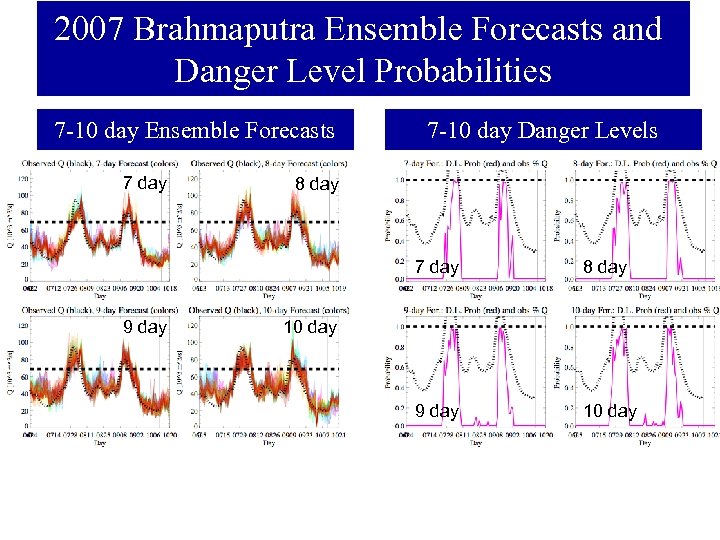
2007 Brahmaputra Ensemble Forecasts and Danger Level Probabilities 7 -10 day Ensemble Forecasts 7 day 7 -10 day Danger Levels 8 day 7 day 9 day 8 day 9 day 10 day
Response of National Institutions for 2007 flood forecasts • Flood Forecasting and Warning Center (FFWC) incorporated the CFAB forecasts to produce water level forecasts for many locations along Brahmaputra and Ganges well in advance • National level Disaster Emergency Response Group prepared emergency response plans, logistics for preparedness and relief in advance Selvaraju (ADPC)
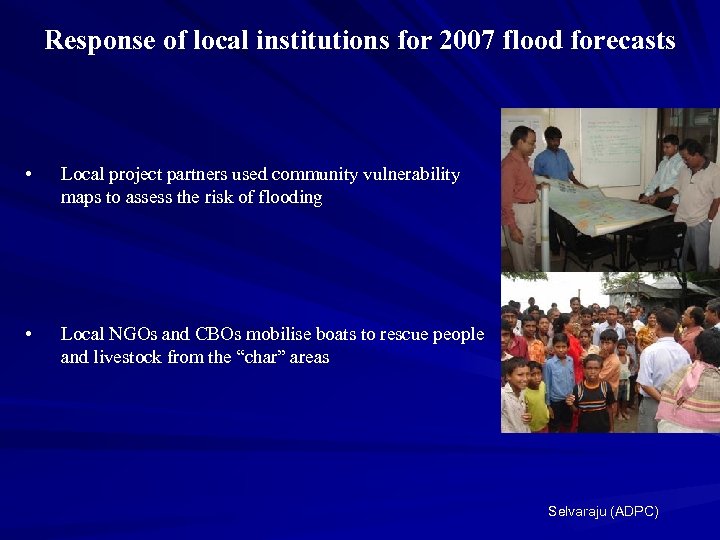
Response of local institutions for 2007 flood forecasts • Local project partners used community vulnerability maps to assess the risk of flooding • Local NGOs and CBOs mobilise boats to rescue people and livestock from the “char” areas Selvaraju (ADPC)
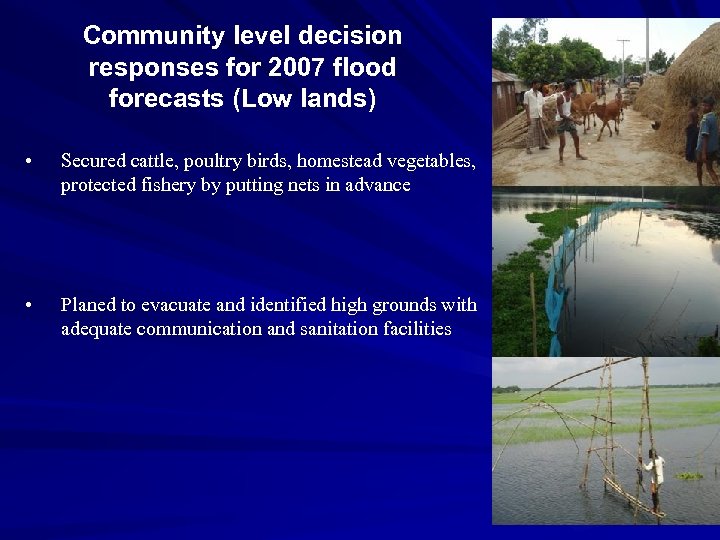
Community level decision responses for 2007 flood forecasts (Low lands) • Secured cattle, poultry birds, homestead vegetables, protected fishery by putting nets in advance • Planed to evacuate and identified high grounds with adequate communication and sanitation facilities
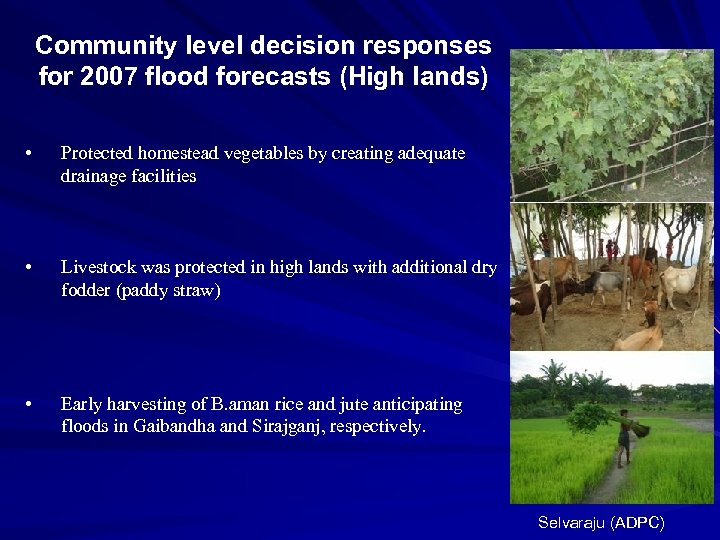
Community level decision responses for 2007 flood forecasts (High lands) • Protected homestead vegetables by creating adequate drainage facilities • Livestock was protected in high lands with additional dry fodder (paddy straw) • Early harvesting of B. aman rice and jute anticipating floods in Gaibandha and Sirajganj, respectively. Selvaraju (ADPC)
2007 ADPC Warnings issued … “We were able to inform the people in advance and on 25 th July we started communicating the information to as many people as possible about the certainty of exceeding danger levels along the Brahmaputra…The local partners, nongovernment organization (NGO) networks and DMC members were advised to inform the poorest of the poor, especially those people living in river islands (“chars”). . . ” “On the 28 th and 29 th, meetings were organized in villages near Rangpur (northern Bangladesh), where the Teesta River was flowing just a few inches below the rim. . . However, they perceived that the river water level would fall, but our forecasts showed a rising trend…We informed them the significant chance of overflow and breaches, as the embankments are weak in certain places. We engaged the local partner NGOs to prepare an evacuation plan urgently…” “We communicated the forecast to another pilot union DMC chairman (Uria Union in Gaibandha District) directly on July 26 th so he could arrange to mobilize resources for evacuation through DMC members and volunteers. All the six villages in the union were later flooded to a height of 4 -6 feet on July 29 th. We contacted him again on the 29 th to know more and he informed us that about 35% of the people in the union were evacuated in advance. ” “The communities in Rajpur Union of Lalmunirhat (relatively medium lands), were able to use the forecast for preparedness activities like mobilizing food, safe drinking water for a week to 10 days, protecting their T. aman rice seedlings, fishing nets, and raising and protecting their fish pods. ” “For the first time we have communicated 10 -day in-advance official forecasts of significant chances of exceeding danger level in all the gauge stations along the Brahmaputra River through the FFWC (and not just in the pilot regions) and directly through all local NGOs, and the DMC members obviously had 8 days extra lead-time they otherwise would not have had. ”
Conclusions 2003: CFAB forecast went operational 2004: -- Forecasts fully-automated -- CFAB became an entity of Bangladesh government -- forecasted severe Brahmaputra flooding event 2006: -- Forecasts incorporated into operational FFWC model -- 5 pilot study dissemination areas trained 2007: 5 pilot areas activated during two severe flooding events
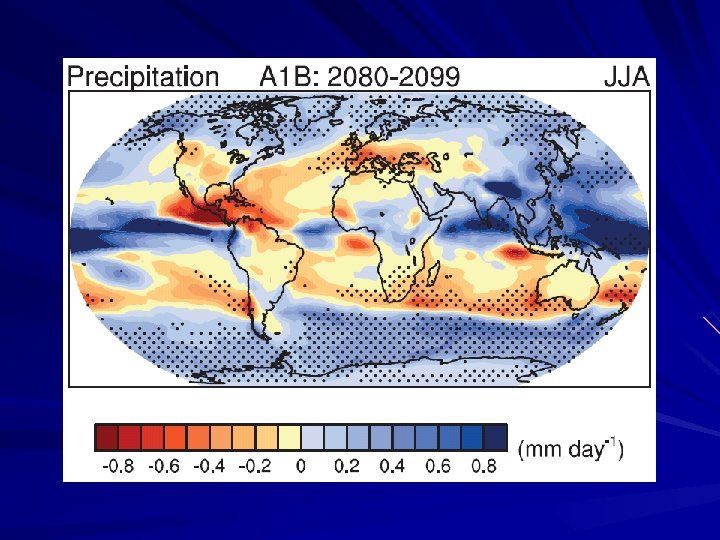
Future Work Dartmouth Flood. Watch Program river discharge estimates Improved river routing Fully-automated forecasting scheme applied to other river basins in Africa (and elsewhere) Climate change impacts …
Thank You!
Скачать презентацию Operational Flood Forecasting for Bangladesh Tom Hopson RAL-NCAR
cbc3837ed3e4bd5390a33ef3589e0e19.ppt