 Скачать презентацию Operation Security Malicious Software Objective
Operation_Software.ppt
- Количество слайдов: 29



Operation Security & Malicious Software
Objective • Understand the core of Operations Security (OPSEC) • Define & identify targets and threats • Establish countermeasures • Identify the Critical Information Commandments • Decipher the value of information
What is Operation Security…? • Have you ever taken precautions against Someone… • …breaking into your house while you’re on vacation? • …stealing your purse? • …stealing packages from your car while your shopping? • …fraudulently using your credit card? Then you have used OPSEC!
What is Operation Security …? • OPSEC is a risk management instrument that enables a manager or commander to view an operation or activity from the perspective of an adversary. It is a process of identifying, analyzing and controlling critical information.
What is Operation Security …? • • • Identify Critical Information Analyze Threats Discover Vulnerabilities Assess Risks Develop Countermeasures
What is Operation Security …? • Identify Critical Information: • Credit card numbers, travel dates, passwords, patterns, changes in patterns, inspection results, information base systems, etc. . • Analyze Threat: • Adversaries, Intelligence agencies – Open source information, corporate/state sponsored spies, eavesdropping, photographing, etc…
What is Operation Security …? • Discover Vulnerabilities: • Flow of information, operations, timing of events, how an adversary would acquire the information, etc… – How would the loss of such data impact the organization? • Assess Risks: • Estimated loss $ x impact of risk x likelihood of risk = $
What is Operation Security …? • Develop Countermeasures: – are based on the vulnerabilities and inherent risks.
Viruses and Other Malicious Content • • computer viruses have got a lot of publicity one of a family of malicious software effects usually obvious have figured in news reports, fiction, movies • getting more attention than deserve • are a concern though
The Most Common Types Of Program To Be Infected by A Virus • • exe com vbs Mp 3 bin script files macros
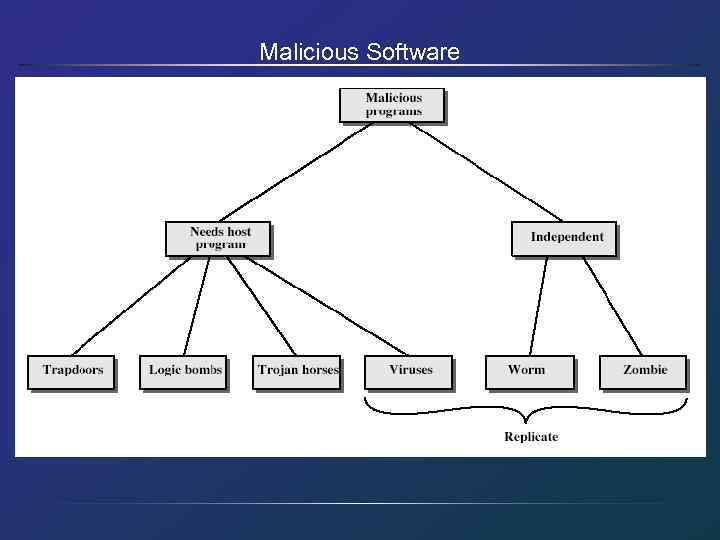
Malicious Software
Trapdoors • secret entry point into a program • allows those who know access bypassing usual security procedures • have been commonly used by developers • a threat when left in production programs allowing exploited by attackers • very hard to block in O/S • requires good s/w development & update
Logic Bomb • one of oldest types of malicious software • code embedded in legitimate program • activated when specified conditions met – eg presence/absence of some file – particular date/time – particular user • when triggered typically damage system – modify/delete files/disks
Trojan Horse • program with hidden side-effects • which is usually superficially attractive – eg game, s/w upgrade etc • when run performs some additional tasks – allows attacker to indirectly gain access they do not have directly • often used to propagate a virus/worm or install a backdoor • or simply to destroy data
Zombie • program which secretly takes over another networked computer • then uses it to indirectly launch attacks • often used to launch distributed denial of service (DDo. S) attacks • exploits known flaws in network systems
Viruses • a piece of self-replicating code attached to some other code • propagates itself & carries a payload – carries code to make copies of itself – as well as code to perform some covert task
Virus Operation • virus phases: – dormant – waiting on trigger event – propagation – replicating to programs/disks – triggering – by event to execute payload – execution – of payload
Types of Viruses - can classify on basis of how they attack • parasitic virus • memory-resident virus • boot sector virus • stealth • polymorphic virus • macro virus
Macro Virus • macro code attached to some data file • interpreted by program using file – eg Word/Excel macros – esp. using auto command & command macros
Email Virus • spread using email with attachment containing a macro virus • triggered when user opens attachment • or worse even when mail viewed by using scripting features in mail agent • usually targeted at Microsoft Outlook mail agent & Word/Excel documents
Worms • replicating but not infecting program • typically spreads over a network • using users distributed privileges or by exploiting system vulnerabilities • widely used by hackers to create zombie PC's, subsequently used for further attacks, esp Do. S • major issue is lack of security of permanently connected systems, esp PC's
Worm Operation • worm phases like those of viruses: – dormant – propagation • search for other systems to infect • establish connection to target remote system • replicate self onto remote system – triggering – execution
Virus Countermeasures • viral attacks exploit lack of integrity control on systems • to defend need to add such controls • typically by one or more of: – prevention - block virus infection mechanism – detection - of viruses in infected system – reaction - restoring system to clean state
Summary • have considered: – various malicious programs – trapdoor, logic bomb, trojan horse, zombie – viruses – worms – countermeasures
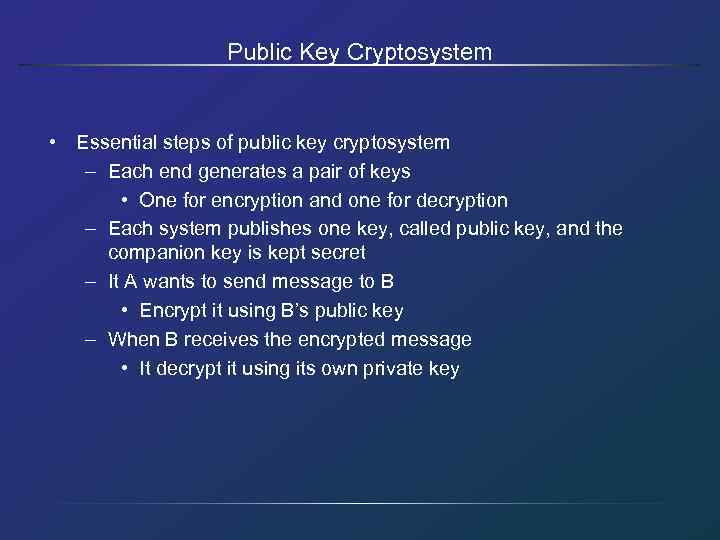
Public Key Cryptosystem • Essential steps of public key cryptosystem – Each end generates a pair of keys • One for encryption and one for decryption – Each system publishes one key, called public key, and the companion key is kept secret – It A wants to send message to B • Encrypt it using B’s public key – When B receives the encrypted message • It decrypt it using its own private key
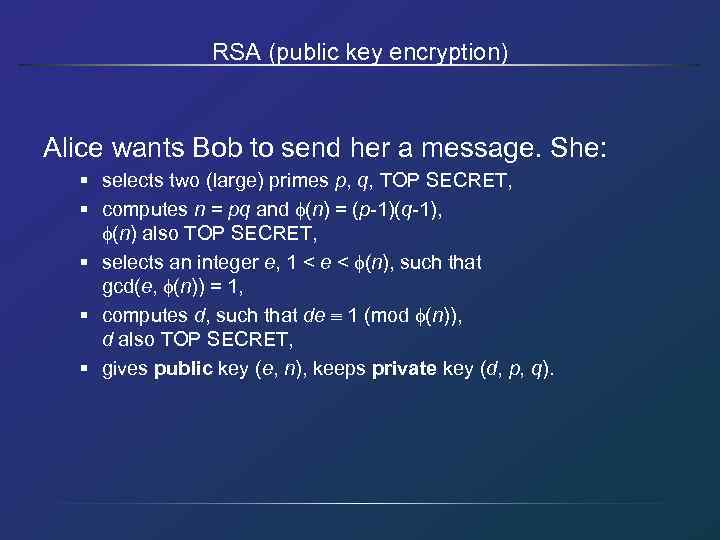
RSA (public key encryption) Alice wants Bob to send her a message. She: § selects two (large) primes p, q, TOP SECRET, § computes n = pq and (n) = (p-1)(q-1), (n) also TOP SECRET, § selects an integer e, 1 < e < (n), such that gcd(e, (n)) = 1, § computes d, such that de 1 (mod (n)), d also TOP SECRET, § gives public key (e, n), keeps private key (d, p, q).
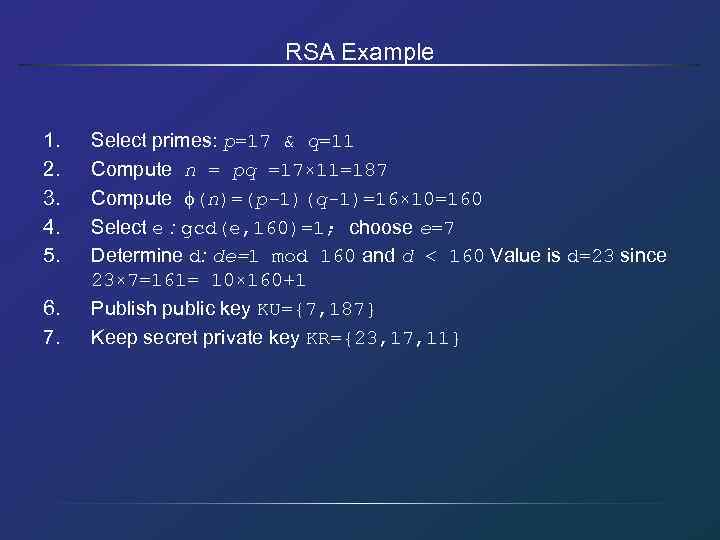
RSA Example 1. 2. 3. 4. 5. 6. 7. Select primes: p=17 & q=11 Compute n = pq =17× 11=187 Compute (n)=(p– 1)(q-1)=16× 10=160 Select e : gcd(e, 160)=1; choose e=7 Determine d: de=1 mod 160 and d < 160 Value is d=23 since 23× 7=161= 10× 160+1 Publish public key KU={7, 187} Keep secret private key KR={23, 17, 11}
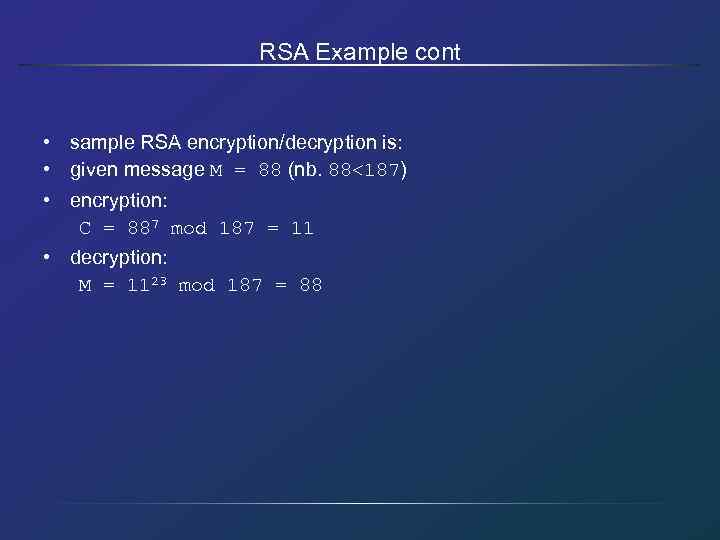
RSA Example cont • sample RSA encryption/decryption is: • given message M = 88 (nb. 88<187) • encryption: C = 887 mod 187 = 11 • decryption: M = 1123 mod 187 = 88
Q&A Questions ?
Скачать презентацию Operation Security Malicious Software Objective
Operation_Software.ppt