


 Скачать презентацию Operant Conditioning Module 19 Cognitive Latent Learning
4daf15b9df15e27e97a05b4804dd26b3.ppt
- Количество слайдов: 29
 Operant Conditioning – Module 19 Cognitive (Latent) Learning – Module 19 Intro Psychology Oct 21 -23, 2009 Classes #23 -24
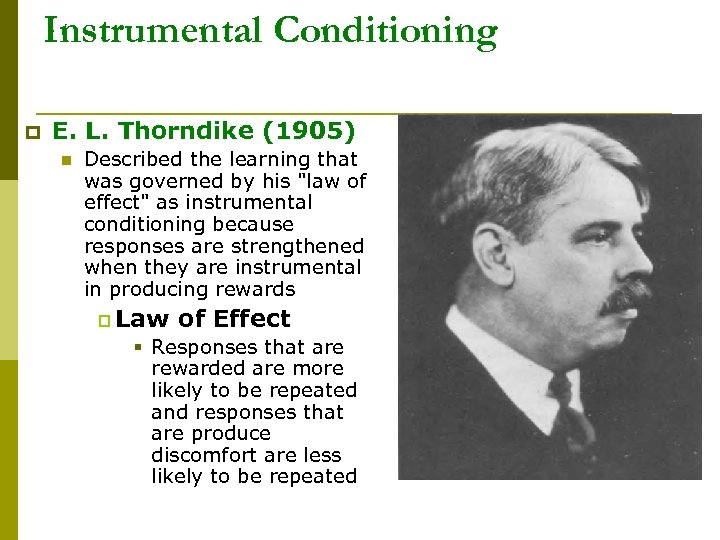 Instrumental Conditioning p E. L. Thorndike (1905) n Described the learning that was governed by his "law of effect" as instrumental conditioning because responses are strengthened when they are instrumental in producing rewards p Law of Effect § Responses that are rewarded are more likely to be repeated and responses that are produce discomfort are less likely to be repeated
 Thorndike's Puzzle Box p In his classic experiment, a cat was locked in the box and enticed to escape by using food that was placed out of the reach from the box n The box included ropes, levers, and latches that the cat could use to escape n Trial and error behavior would lead to ultimate success (usually within three minutes) n Thorndike felt we learned things through trial and error – awareness
 Gestalt Viewpoint p Wolfgang n Kohler A Gestalt psychologist had an opposing view is that we learn things implicitly – unawareness – natural insight p Example: gorilla in a cage – food out of reach – but stick is not…
 Operant Conditioning p Operant n Conditioning A type of learning in which voluntary (controllable and non-reflexive) behavior is strengthened if it is reinforced and weakened if it is punished (or not reinforced)
 Skinner (1938) p The organism learns a response by operating on the environment… p Note: n n The terms instrumental conditioning and operant conditioning describe essentially the same learning process and are often used interchangeably Basically, Skinner extended and formalized many of Thorndike's ideas
 Operant Conditioning p Response comes first and is voluntary unlike classical where stimulus comes first and response is involuntary n Classical: S R n Operant: S R S that becomes R S
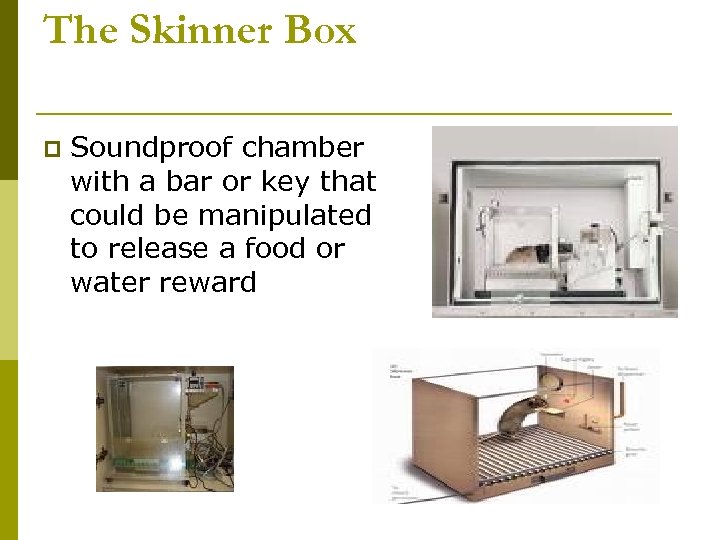 The Skinner Box p Soundproof chamber with a bar or key that could be manipulated to release a food or water reward
 Shaping: Reinforcing successive approximations p Responses that come successively closer to the desired response were reinforced… n n n Skinner referred to this as his “Behavioral Technology” Taught pigeons “unpigeon-like” behaviors Walking in Figure 8, playing ping-pong, and keeping a “guided missile” on course by pecking at a moving target displayed on a screen…but most proud of getting them to hoist an American flag and then to salute it
 B. F. Skinner (1904 -1990)
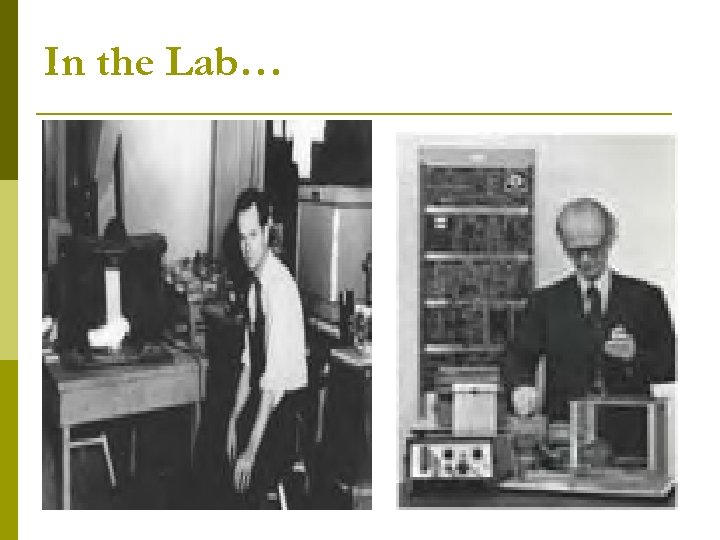 In the Lab…
 Operant Conditioning p Important terms n Primary Reinforcers n Conditioned (Secondary) Reinforcers n Positive Reinforcement n Punishment n Negative Reinforcement
 Reinforcers p Primary Reinforcers n n n p Innately rewarding; no learning necessary Stimulus that naturally strengthens any response that precedes it without the need for any learning on the part of the organism Food, water, etc. Secondary Reinforcers n n n A consequence that is learned by pairing with a primary reinforcer For people, money, good grades, and words of praise, etc. are often linked to basic rewards We need money to buy food, etc.
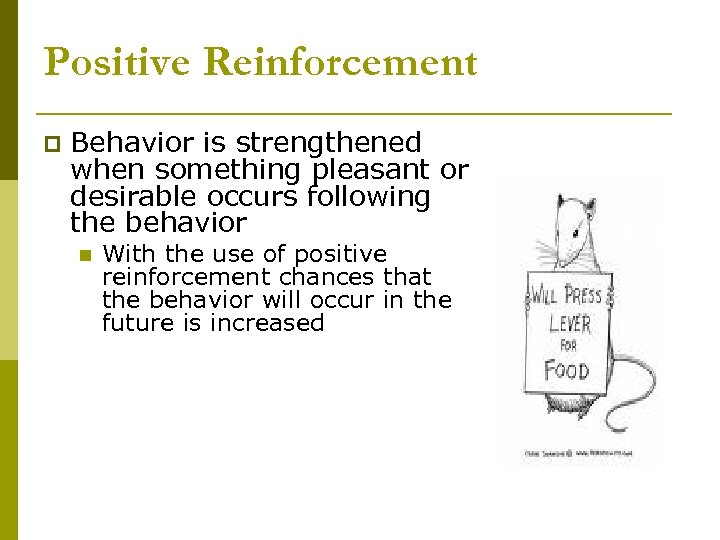 Positive Reinforcement p Behavior is strengthened when something pleasant or desirable occurs following the behavior n With the use of positive reinforcement chances that the behavior will occur in the future is increased
 Punishment p Any stimulus presented immediately after a behavior in order to decrease the future probability of that behavior n For example: p If your kid runs into the middle of the street and you flip out and “express to him how bad he is” this (at least in psychological terms) is only considered to be punishment if it does in fact lead to a decrease in that child’s behavior of running into the street
 Negative Reinforcement p p One of the most misunderstood terms in psychology… Definitely a problem with semantics here n n The word reinforcement means that a response is strengthened The word negative seems to imply that the response is somehow weakened p p This is not the case here! So how literally can a response be negatively reinforced? ? ? Often, this term is misapplied to term punishment So lets try to proceed slowly in our attempts to figure this out…
 Negative Reinforcement p p p Positive Reinforcement is a reward n That’s easy enough Punishment is something that weakens a response n Again, this is pretty basic In an attempt to increase the likelihood of a behavior occurring in the future, an operant response is followed by the removal of an aversive stimulus. This is negative reinforcement… n Example: When a child says "please" and "thank you" to his/her mother, the child may not have to engage in his/her dreaded chore of setting the table
 Negative Reinforcement So we are learning to do something to turn off a bad stimulus n Example: We put on boots to prevent sitting in class with wet socks on p Increasing a behavior to stop a bad thing from occurring p Doing something to remove the reinforcer p
 Types of Negative Reinforcement p Escape Conditioning n p This occurs when the behavior has led to a reduction of the aversiveness of the environment p Example: Rats moving away from the shock area after feeling the pain § This does involve an observable change in the environment Avoidance Conditioning n When a behavior has prevented the onset of an impending increase in the aversiveness of the environment p Example: Rats moving away from the shock area after hearing a signal that the shock is about to be administered p A child apologizes upon seeing their parent frowning thus avoiding being yelled at § Involves no observable change in the environment
 Schedules of Reinforcement p Continuous Reinforcement n p Reinforcement delivered every time a particular response occurs Intermittent Reinforcement n Reinforcement is administered only some of the time
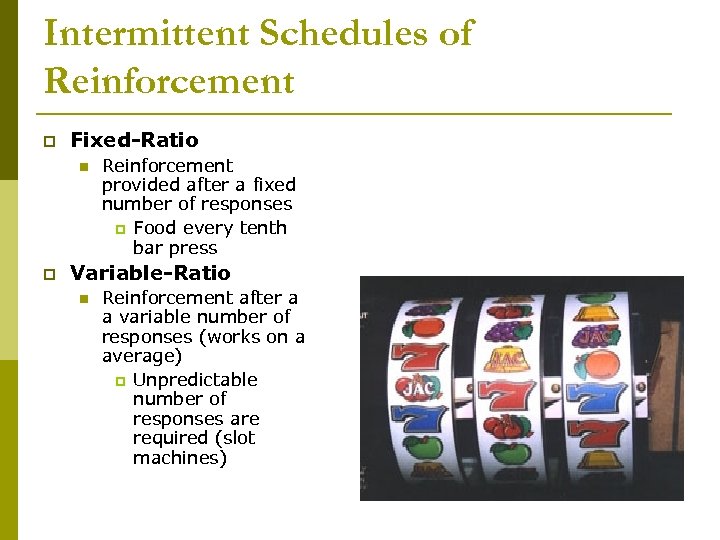 Intermittent Schedules of Reinforcement p Fixed-Ratio n p Reinforcement provided after a fixed number of responses p Food every tenth bar press Variable-Ratio n Reinforcement after a a variable number of responses (works on a average) p Unpredictable number of responses are required (slot machines)
 Intermittent Schedules of Reinforcement p Fixed-Interval Schedules n n p Provides reinforcement for the first response that occurs after some fixed time has passed since the last reward Number of responses doesn’t matter only time p Example: Food is given to rats every 20 min. Variable-Interval Schedule n n n Reinforce the first responses after a certain amount of time has past Again number of responses doesn’t matter But this time the amount of time changes p Might be the first response after ten minutes then the next time it is the first response after 20 minutes, and then the next time it is the first response after 30 min…
 Applications of Operant Conditioning: In the Classroom p p Skinner thought that our education system was ineffective He suggested that one teacher in a classroom could not teach many students adequately when each child learns at a different rate He proposed using teaching machines (what we now call computers) that would allow each student to move at their own pace The teaching machine would provide self-paced learning that gave immediate feedback, immediate reinforcement, identification of problem areas, etc. , that a teacher could not possibly provide
 Applications of Operant Conditioning: In the Workplace p Pedalino & Gamboa (1974) n To help reduce the frequency of employee tardiness, these researchers implemented a game-like system for all employees that arrived on time n When an employee arrived on time, they were allowed to draw a card n Over the course of a 5 -day workweek, the employee would have a full hand for poker n At the end of the week, the best hand won $20 n This simple method reduced employee tardiness significantly and demonstrated the effectiveness of operant conditioning on humans
 Criticisms Of The Use Of Reinforcement p Criticism #1: n Behavior should not have to rely on persuasion… p It is manipulative and controlling p Appropriate behavior should be the norm p Skinner says we are always controlled by rewards but often are unaware of these… p Parents, peers, schools, employers, etc. all use rewards to control our behavior p Skinner: n If its manipulative then everyone is to blame?
 Criticisms Of The Use Of Reinforcement p Criticism n #2: Reinforcement undermines Intrinsic Motivation… p Messes up our inner desire to do something p Now we need to do it for a tangible reward p Example: Child cleaning his/her room… § Why do they do it? § Be careful of overjustification…
 Cognitive Learning Focus on the role of thinking processes in learning p Theory based on unseen internal factors rather than on external factors p n Skinner was very much against these theories but lets look at one…latent learning…
 Latent Learning p Tolman and Honzik (1930) n Took three groups of rats and had them run a maze Group 1 § Reinforced every time they found their way out of the maze (food box) for ten days p Group 2 § Never reinforced (no food at the end) p Group 3 § Reinforced only after day 10 of the experiment p
 Latent Learning p On day 11, they timed the three groups to see which group would make it through the maze the quickest… n Which group do you think was the fastest?