


 Скачать презентацию OPERA physics programme experimental concept
0ac048a2cf56eca4526a5e3c984c4a21.ppt
- Количество слайдов: 29
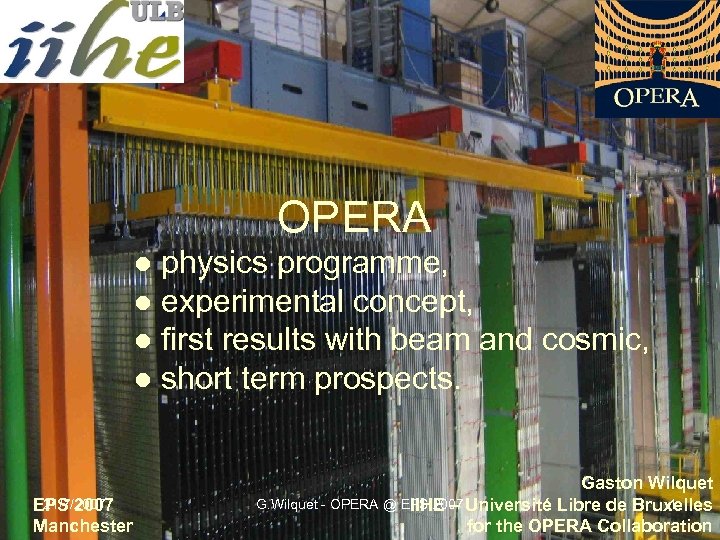 OPERA ● physics programme, ● experimental concept, ● first results with beam and cosmic, ● short term prospects. 21/7/2007 EPS 2007 Manchester Gaston Wilquet G. Wilquet - OPERA @ EPS 2007 Université Libre de Bruxelles 1 IIHE – for the OPERA Collaboration
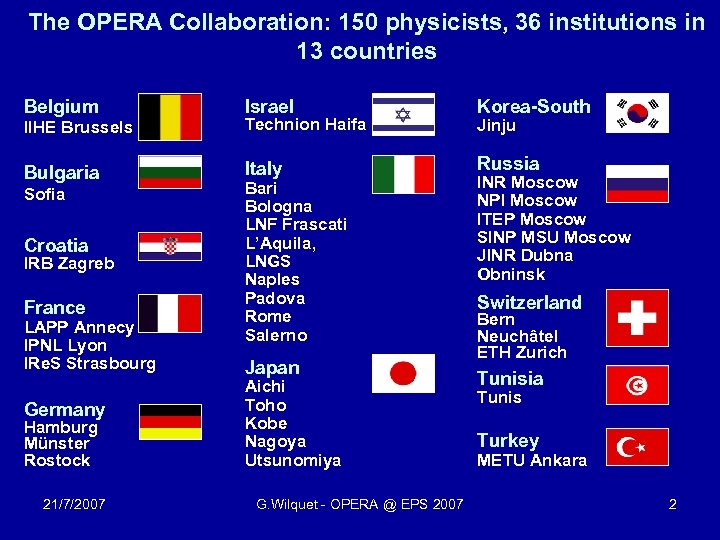 The OPERA Collaboration: 150 physicists, 36 institutions in 13 countries Belgium Israel IIHE Brussels Technion Haifa Korea-South Bulgaria Italy Russia Sofia Croatia IRB Zagreb France LAPP Annecy IPNL Lyon IRe. S Strasbourg Germany Hamburg Münster Rostock 21/7/2007 Bari Bologna LNF Frascati L’Aquila, LNGS Naples Padova Rome Salerno Japan Aichi Toho Kobe Nagoya Utsunomiya G. Wilquet - OPERA @ EPS 2007 Jinju INR Moscow NPI Moscow ITEP Moscow SINP MSU Moscow JINR Dubna Obninsk Switzerland Bern Neuchâtel ETH Zurich Tunisia Tunis Turkey METU Ankara 2
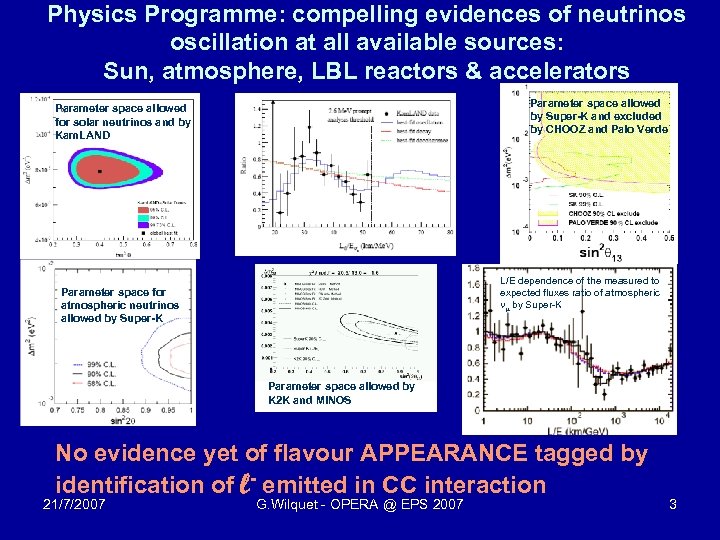 Physics Programme: compelling evidences of neutrinos oscillation at all available sources: Sun, atmosphere, LBL reactors & accelerators Parameter space allowed by Super-K and excluded by CHOOZ and Palo Verde Parameter space allowed for solar neutrinos and by Kam. LAND L/E dependence of the measured to expected fluxes ratio of atmospheric nm by Super-K Parameter space for atmospheric neutrinos allowed by Super-K Parameter space allowed by K 2 K and MINOS No evidence yet of flavour APPEARANCE tagged by identification of l- emitted in CC interaction 21/7/2007 G. Wilquet - OPERA @ EPS 2007 3
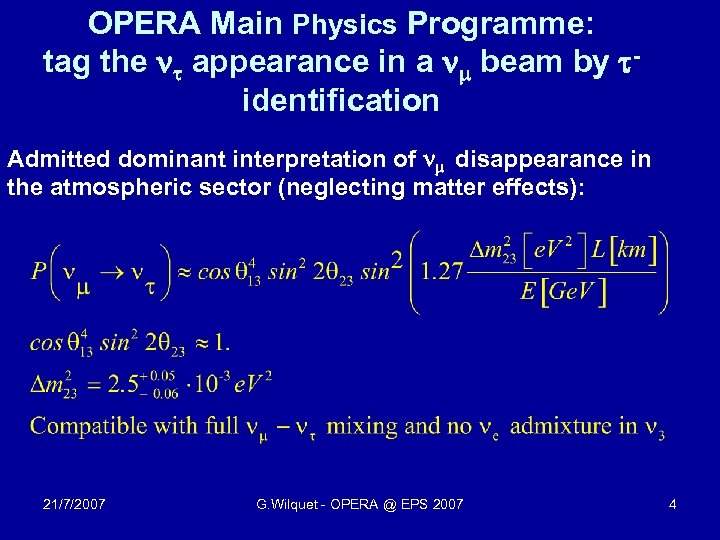 OPERA Main Physics Programme: tag the n appearance in a n beam by identification Admitted dominant interpretation of n disappearance in the atmospheric sector (neglecting matter effects): 21/7/2007 G. Wilquet - OPERA @ EPS 2007 4
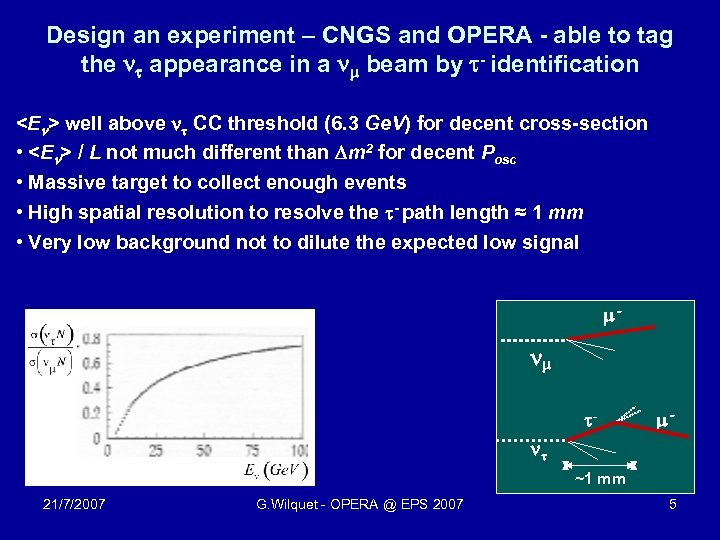 Design an experiment – CNGS and OPERA - able to tag the n appearance in a n beam by - identification
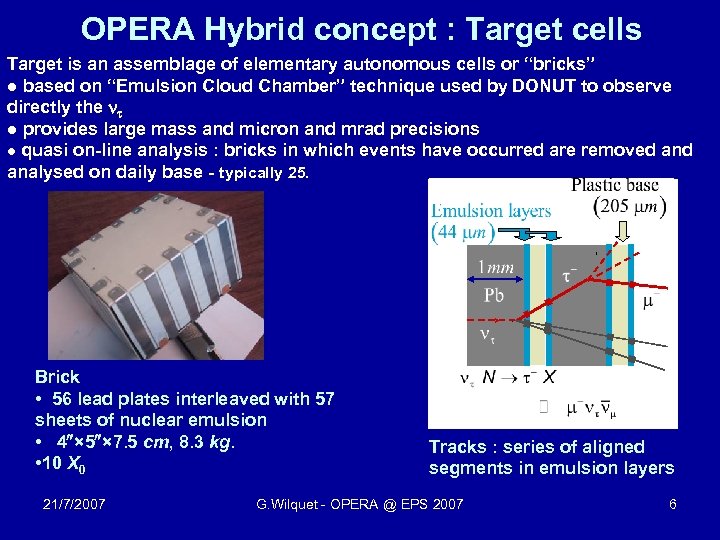 OPERA Hybrid concept : Target cells Target is an assemblage of elementary autonomous cells or “bricks” ● based on “Emulsion Cloud Chamber” technique used by DONUT to observe directly the n ● provides large mass and micron and mrad precisions ● quasi on-line analysis : bricks in which events have occurred are removed analysed on daily base - typically 25. Brick • 56 lead plates interleaved with 57 sheets of nuclear emulsion • 4 × 5 × 7. 5 cm, 8. 3 kg. • 10 X 0 21/7/2007 Tracks : series of aligned segments in emulsion layers G. Wilquet - OPERA @ EPS 2007 6
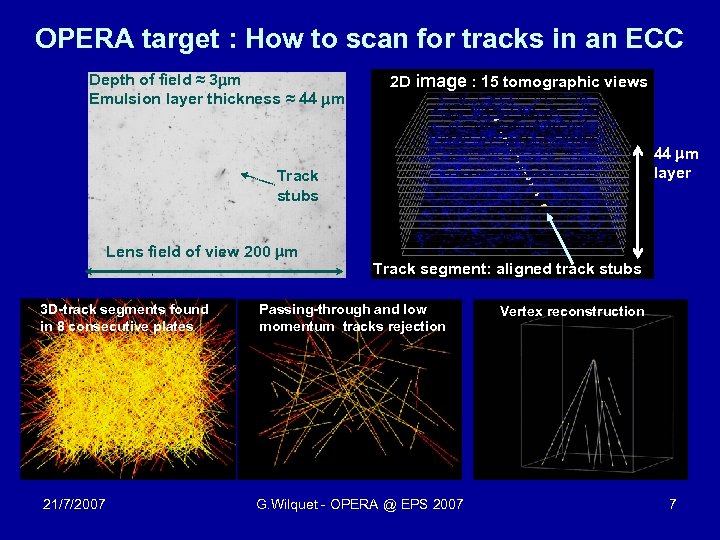 OPERA target : How to scan for tracks in an ECC Depth of field ≈ 3 m Emulsion layer thickness ≈ 44 m 2 D image : 15 tomographic views 44 m layer Track stubs Lens field of view 200 m Track segment: aligned track stubs 3 D-track segments found in 8 consecutive plates Passing-through and low momentum tracks rejection 21/7/2007 G. Wilquet - OPERA @ EPS 2007 Vertex reconstruction 7
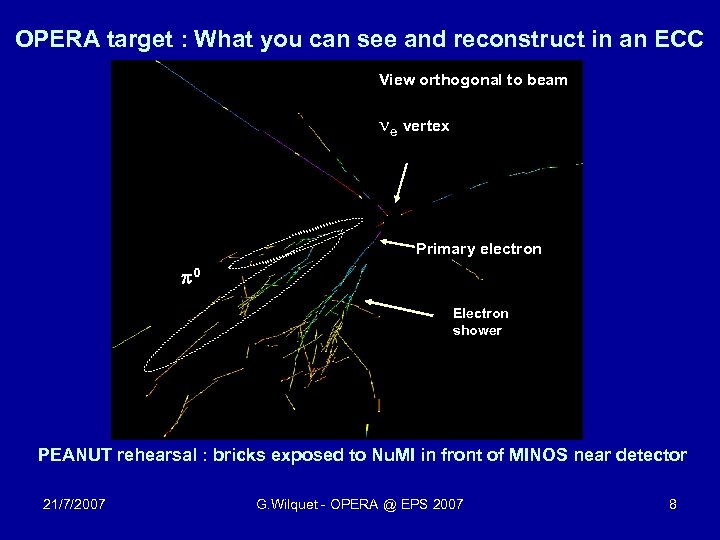 OPERA target : What you can see and reconstruct in an ECC View orthogonal to beam ne vertex Primary electron p 0 Electron shower PEANUT rehearsal : bricks exposed to Nu. MI in front of MINOS near detector 21/7/2007 G. Wilquet - OPERA @ EPS 2007 8
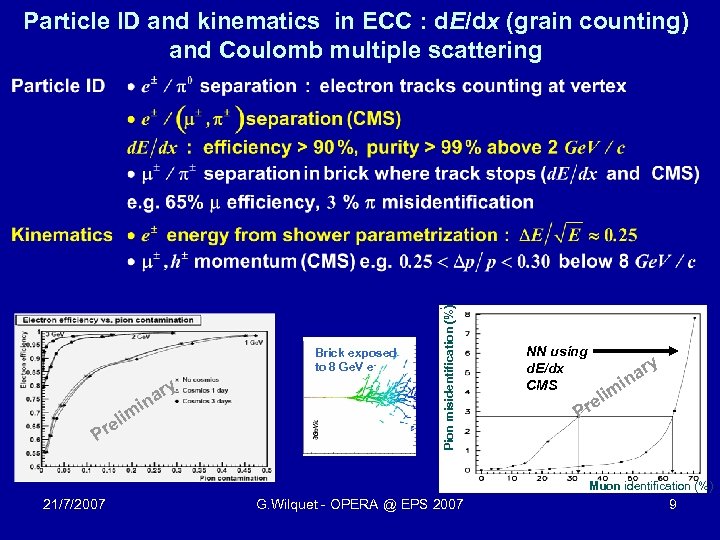 Brick exposed to 8 Ge. V e- m r ina li re P y Pion misidentification (%) Particle ID and kinematics in ECC : d. E/dx (grain counting) and Coulomb multiple scattering NN using d. E/dx CMS y r na i m li re P Muon identification (%) 21/7/2007 G. Wilquet - OPERA @ EPS 2007 9
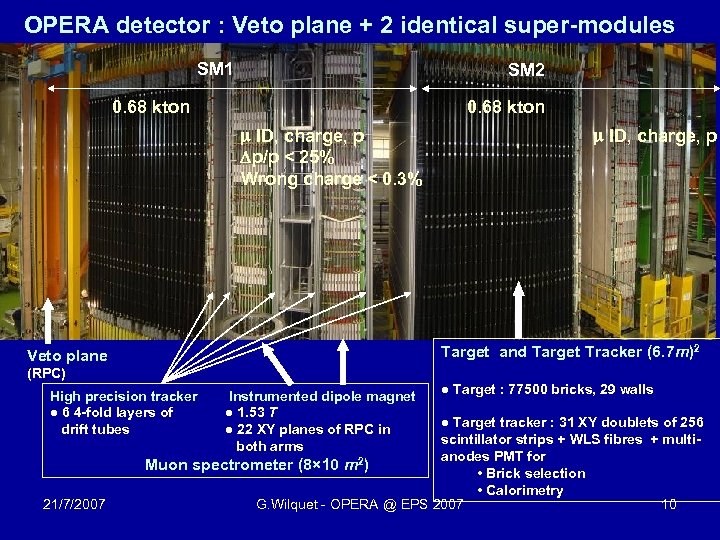 OPERA detector : Veto plane + 2 identical super-modules SM 1 SM 2 0. 68 kton ID, charge, p p/p < 25% Wrong charge < 0. 3% Target and Target Tracker (6. 7 m)2 Veto plane (RPC) High precision tracker ● 6 4 -fold layers of drift tubes 21/7/2007 ID, charge, p Instrumented dipole magnet ● 1. 53 T ● 22 XY planes of RPC in both arms ● Target : 77500 bricks, 29 walls ● Target tracker : 31 XY doublets of 256 scintillator strips + WLS fibres + multianodes PMT for Muon spectrometer (8× 10 m 2) • Brick selection • Calorimetry G. Wilquet - OPERA @ EPS 2007 10
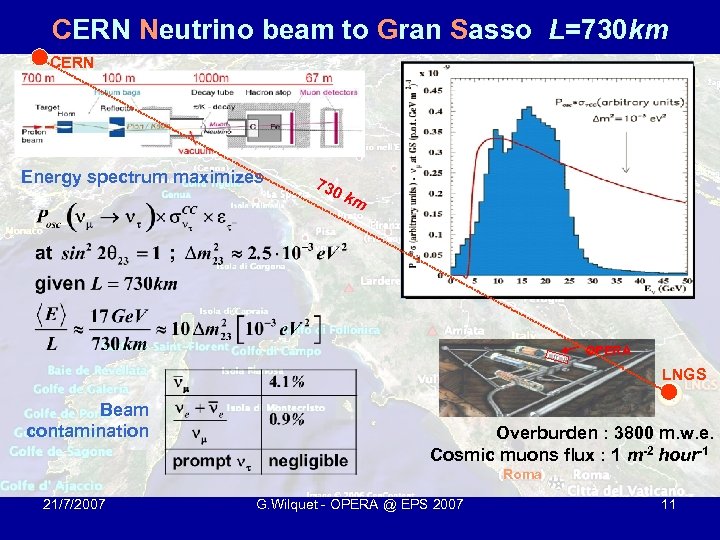 CERN Neutrino beam to Gran Sasso L=730 km CERN Energy spectrum maximizes 730 km OPERA LNGS Beam contamination Overburden : 3800 m. w. e. Cosmic muons flux : 1 m-2 hour-1 Roma 21/7/2007 G. Wilquet - OPERA @ EPS 2007 11
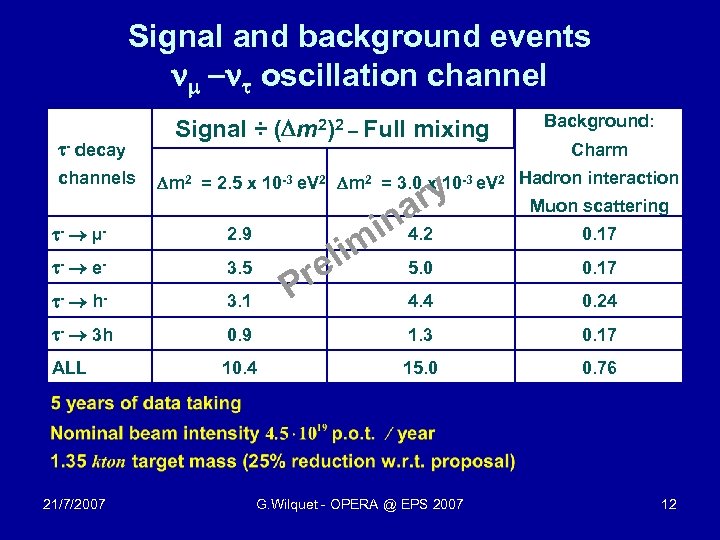 Signal and background events n -n oscillation channel - decay channels Signal ÷ ( m 2)2 – Full mixing - e- 3. 5 - h- 3. 1 - 3 h ALL ry na i 2. 9 21/7/2007 Charm m 2 = 2. 5 x 10 -3 e. V 2 m 2 = 3. 0 x 10 -3 e. V 2 Hadron interaction Muon scattering - µ Background: 4. 2 0. 17 5. 0 0. 17 4. 4 0. 24 0. 9 1. 3 0. 17 10. 4 15. 0 0. 76 lim e r P G. Wilquet - OPERA @ EPS 2007 12
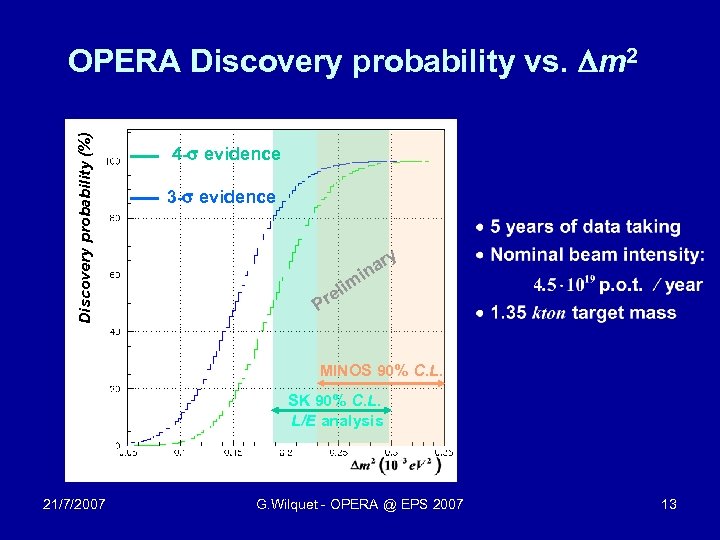 Discovery probability (%) OPERA Discovery probability vs. m 2 4 -s evidence 3 -s evidence m li re y ar in P MINOS 90% C. L. SK 90% C. L. L/E analysis 21/7/2007 G. Wilquet - OPERA @ EPS 2007 13
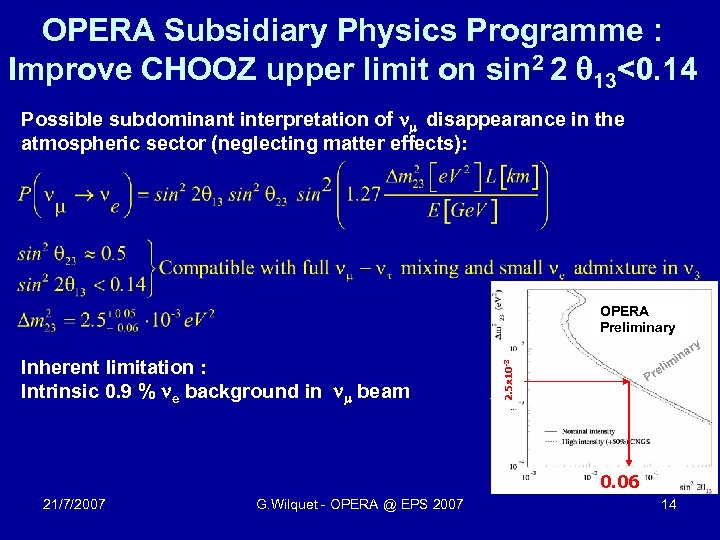 OPERA Subsidiary Physics Programme : Improve CHOOZ upper limit on sin 2 2 q 13<0. 14 Possible subdominant interpretation of n disappearance in the atmospheric sector (neglecting matter effects): OPERA Preliminary ry eli 2. 5 x 10 -3 Inherent limitation : Intrinsic 0. 9 % ne background in n beam na mi Pr 0. 06 21/7/2007 G. Wilquet - OPERA @ EPS 2007 14
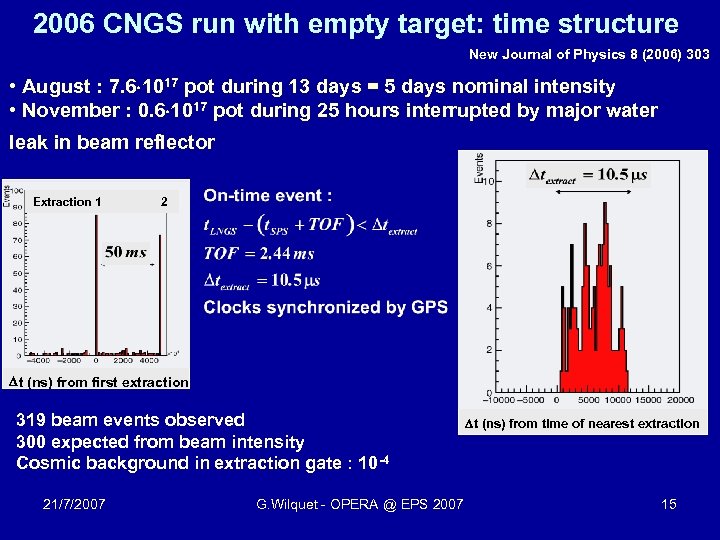 2006 CNGS run with empty target: time structure New Journal of Physics 8 (2006) 303 • August : 7. 6 1017 pot during 13 days = 5 days nominal intensity • November : 0. 6 1017 pot during 25 hours interrupted by major water leak in beam reflector Extraction 1 2 t (ns) from first extraction 319 beam events observed 300 expected from beam intensity Cosmic background in extraction gate : 10 -4 21/7/2007 G. Wilquet - OPERA @ EPS 2007 t (ns) from time of nearest extraction 15
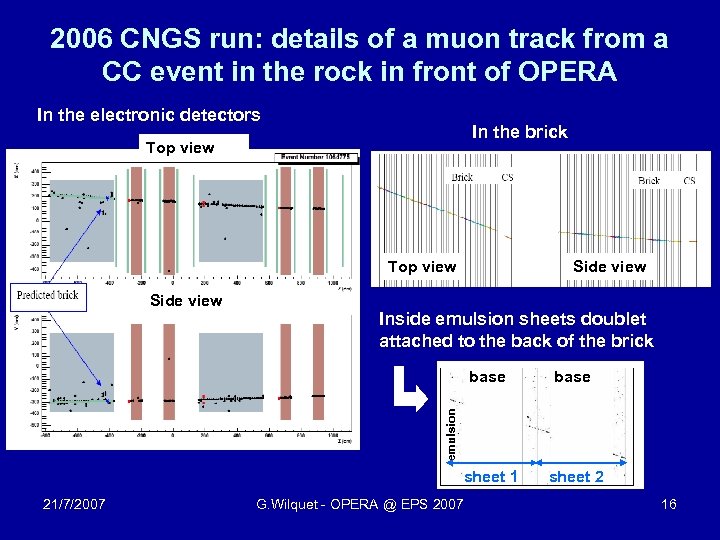 2006 CNGS run: details of a muon track from a CC event in the rock in front of OPERA In the electronic detectors In the brick Top view Side view Inside emulsion sheets doublet attached to the back of the brick base sheet 1 sheet 2 emulsion base 21/7/2007 G. Wilquet - OPERA @ EPS 2007 16
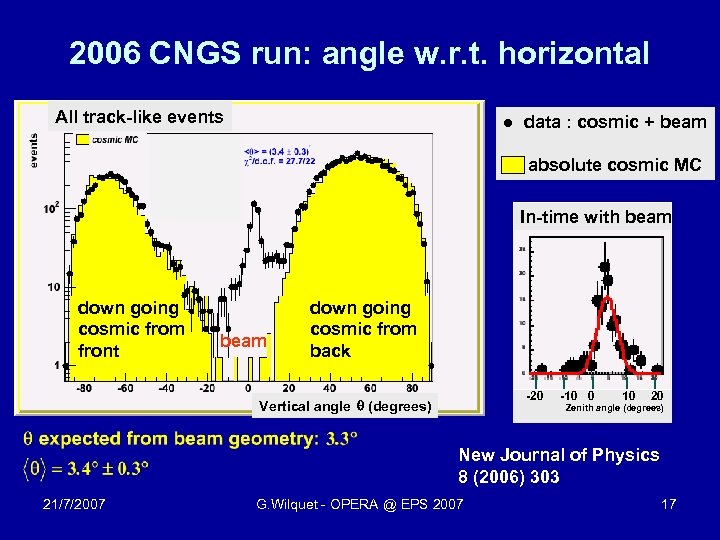 2006 CNGS run: angle w. r. t. horizontal All track-like events ● data : cosmic + beam absolute cosmic MC In-time with beam down going cosmic from front beam down going cosmic from back -20 Vertical angle q (degrees) -10 0 10 20 Zenith angle (degrees) New Journal of Physics 8 (2006) 303 21/7/2007 G. Wilquet - OPERA @ EPS 2007 17
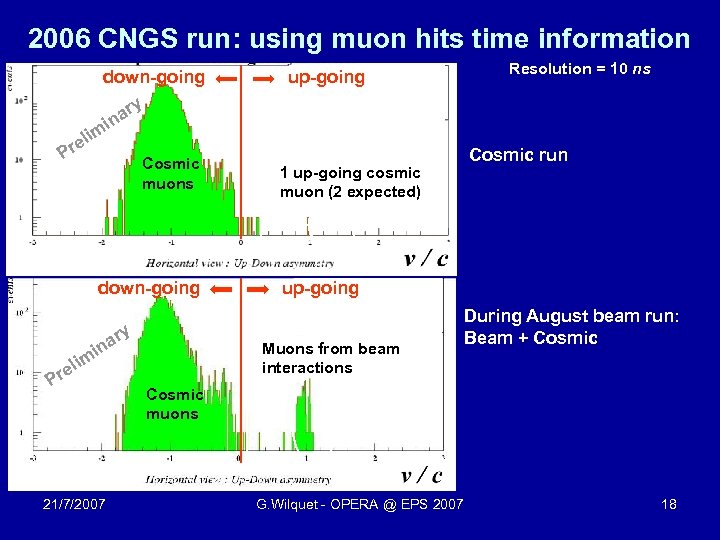 2006 CNGS run: using muon hits time information down-going r na i m eli r P y Cosmic muons down-going y r na i 21/7/2007 Cosmic run 1 up-going cosmic muon (2 expected) up-going Muons from beam interactions m eli Pr Resolution = 10 ns up-going During August beam run: Beam + Cosmic muons G. Wilquet - OPERA @ EPS 2007 18
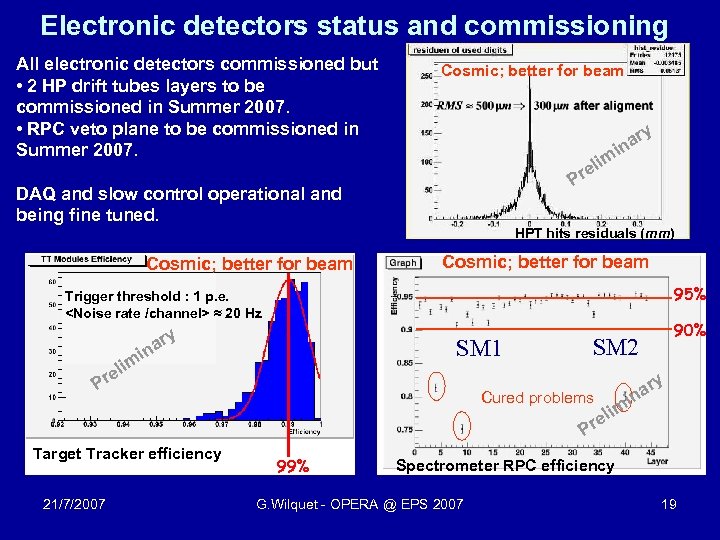 Electronic detectors status and commissioning All electronic detectors commissioned but • 2 HP drift tubes layers to be commissioned in Summer 2007. • RPC veto plane to be commissioned in Summer 2007. Cosmic; better for beam y r na i m li re P DAQ and slow control operational and being fine tuned. HPT hits residuals (mm) Cosmic; better for beam 95% Trigger threshold : 1 p. e.
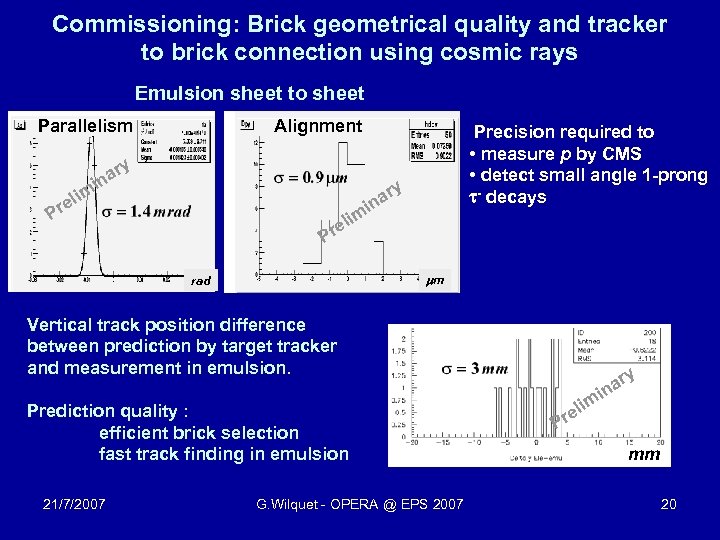 Commissioning: Brick geometrical quality and tracker to brick connection using cosmic rays Emulsion sheet to sheet Alignment Parallelism m eli y ar in Pr m li re Precision required to • measure p by CMS • detect small angle 1 -prong - decays y ar in P mm rad Vertical track position difference between prediction by target tracker and measurement in emulsion. Prediction quality : efficient brick selection fast track finding in emulsion 21/7/2007 G. Wilquet - OPERA @ EPS 2007 y r ina lim e Pr mm 20
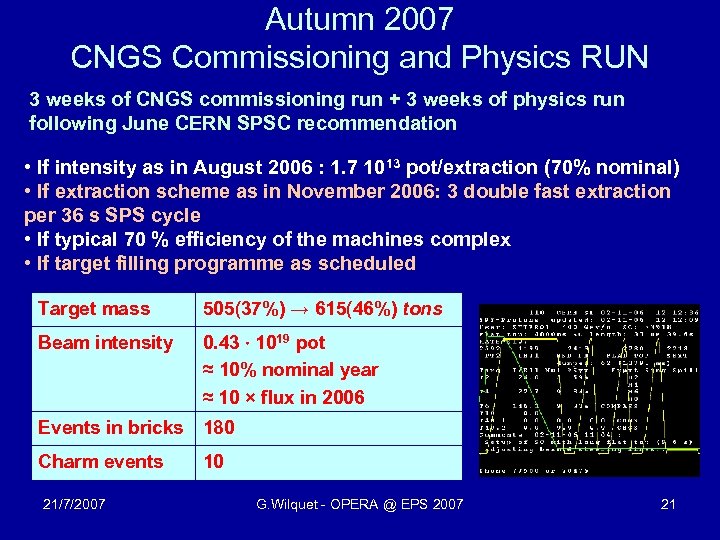 Autumn 2007 CNGS Commissioning and Physics RUN 3 weeks of CNGS commissioning run + 3 weeks of physics run following June CERN SPSC recommendation • If intensity as in August 2006 : 1. 7 1013 pot/extraction (70% nominal) • If extraction scheme as in November 2006: 3 double fast extraction per 36 s SPS cycle • If typical 70 % efficiency of the machines complex • If target filling programme as scheduled Target mass 505(37%) → 615(46%) tons Beam intensity 0. 43 1019 pot ≈ 10% nominal year ≈ 10 × flux in 2006 Events in bricks 180 Charm events 21/7/2007 10 G. Wilquet - OPERA @ EPS 2007 21
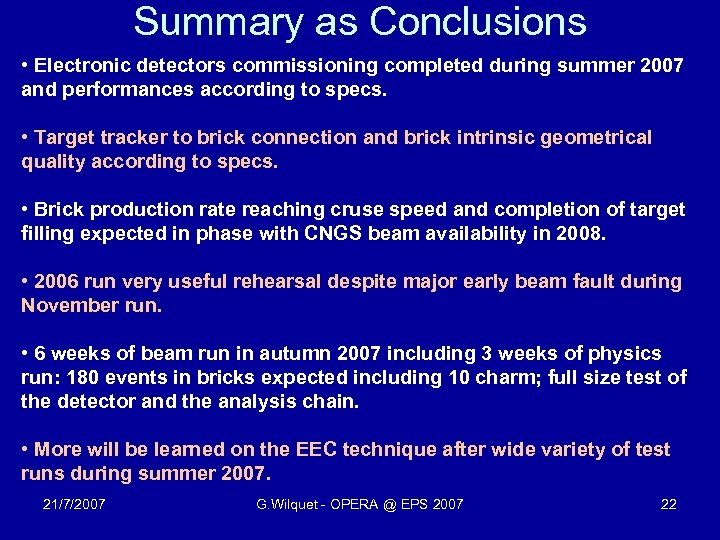 Summary as Conclusions • Electronic detectors commissioning completed during summer 2007 and performances according to specs. • Target tracker to brick connection and brick intrinsic geometrical quality according to specs. • Brick production rate reaching cruse speed and completion of target filling expected in phase with CNGS beam availability in 2008. • 2006 run very useful rehearsal despite major early beam fault during November run. • 6 weeks of beam run in autumn 2007 including 3 weeks of physics run: 180 events in bricks expected including 10 charm; full size test of the detector and the analysis chain. • More will be learned on the EEC technique after wide variety of test runs during summer 2007. 21/7/2007 G. Wilquet - OPERA @ EPS 2007 22
 Reserve 21/7/2007 G. Wilquet - OPERA @ EPS 2007 23
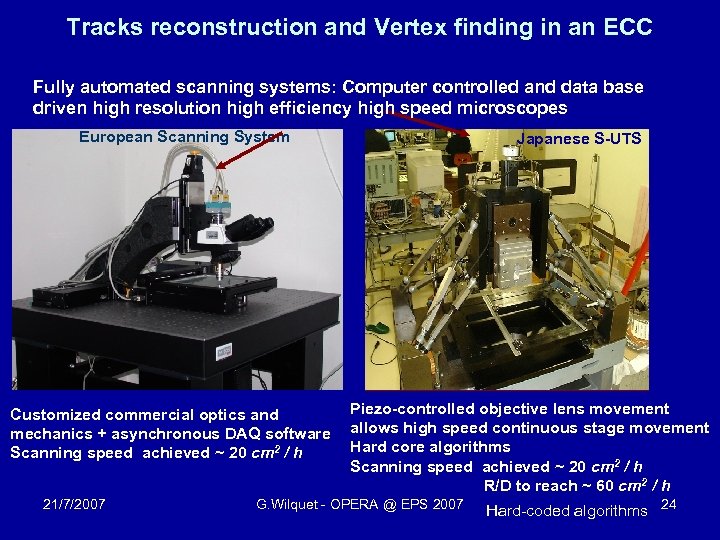 Tracks reconstruction and Vertex finding in an ECC Fully automated scanning systems: Computer controlled and data base driven high resolution high efficiency high speed microscopes European Scanning System Customized commercial optics and mechanics + asynchronous DAQ software Scanning speed achieved ~ 20 cm 2 / h 21/7/2007 Japanese S-UTS Piezo-controlled objective lens movement allows high speed continuous stage movement Hard core algorithms Scanning speed achieved ~ 20 cm 2 / h R/D to reach ~ 60 cm 2 / h G. Wilquet - OPERA @ EPS 2007 Hard-coded algorithms 24
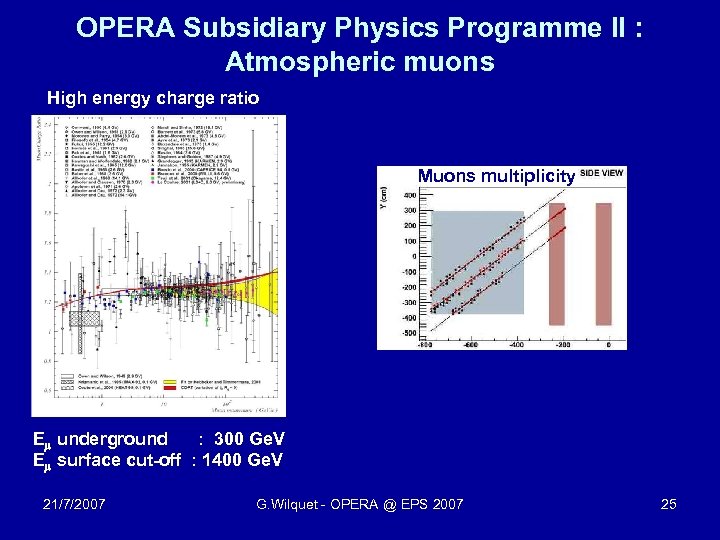 OPERA Subsidiary Physics Programme II : Atmospheric muons High energy charge ratio Muons multiplicity E underground : 300 Ge. V E surface cut-off : 1400 Ge. V 21/7/2007 G. Wilquet - OPERA @ EPS 2007 25
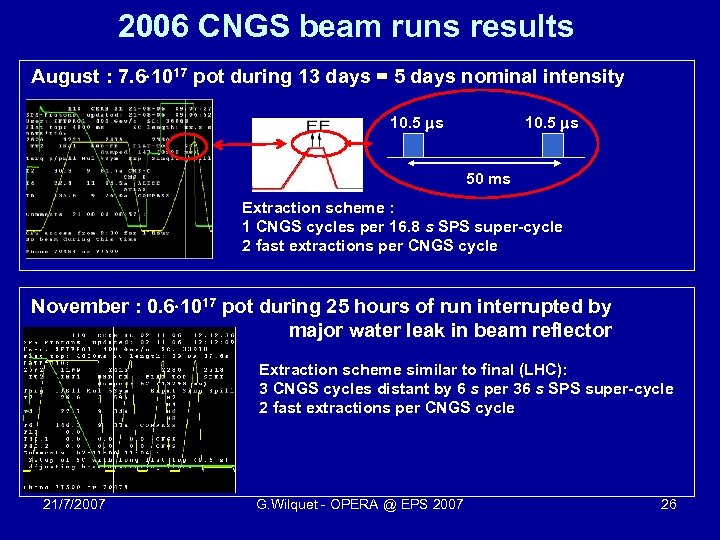 2006 CNGS beam runs results August : 7. 6 1017 pot during 13 days = 5 days nominal intensity 10. 5 s 50 ms Extraction scheme : 1 CNGS cycles per 16. 8 s SPS super-cycle 2 fast extractions per CNGS cycle November : 0. 6 1017 pot during 25 hours of run interrupted by major water leak in beam reflector Extraction scheme similar to final (LHC): 3 CNGS cycles distant by 6 s per 36 s SPS super-cycle 2 fast extractions per CNGS cycle 21/7/2007 G. Wilquet - OPERA @ EPS 2007 26
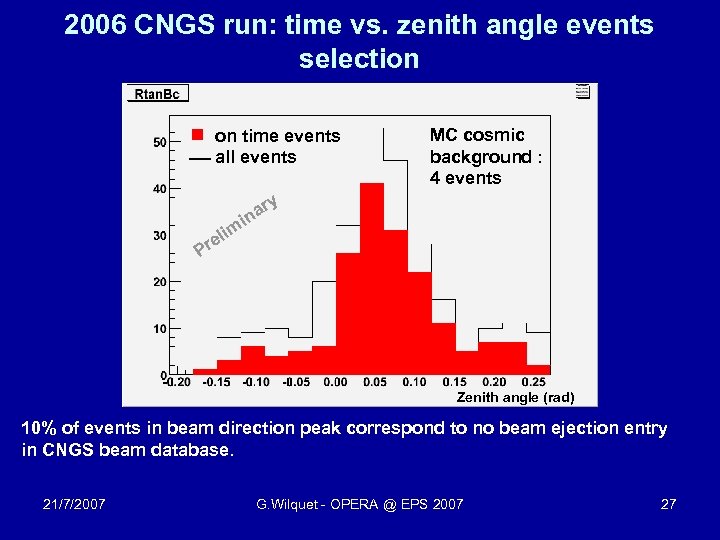 2006 CNGS run: time vs. zenith angle events selection on time events all events m eli MC cosmic background : 4 events y ar n i Pr Zenith angle (rad) 10% of events in beam direction peak correspond to no beam ejection entry in CNGS beam database. 21/7/2007 G. Wilquet - OPERA @ EPS 2007 27
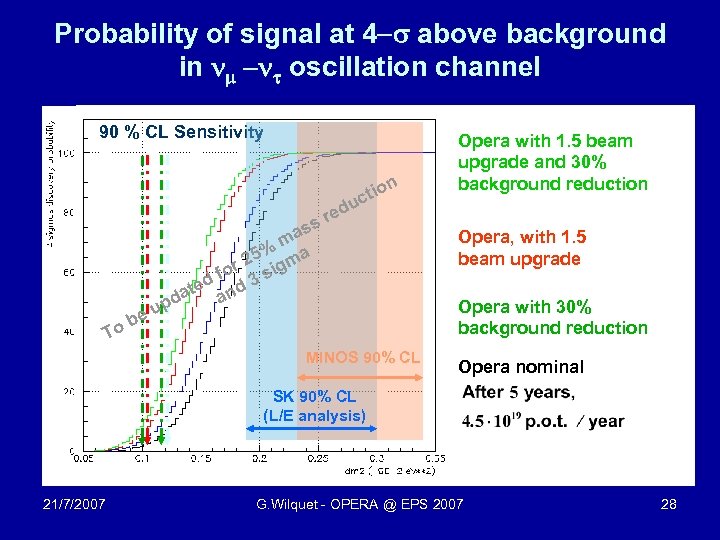 Probability of signal at 4 -s above background in n -n oscillation channel 90 % CL Sensitivity u p To u be s ma 5% a r 2 sigm fo ed nd 3 t a da red s o cti n MINOS 90% CL Opera with 1. 5 beam upgrade and 30% background reduction Opera, with 1. 5 beam upgrade Opera with 30% background reduction Opera nominal SK 90% CL (L/E analysis) 21/7/2007 G. Wilquet - OPERA @ EPS 2007 28
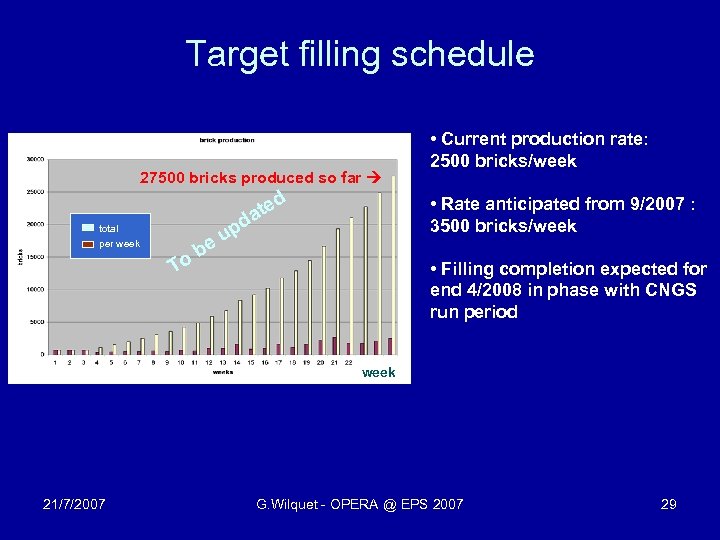 Target filling schedule 27500 bricks produced so far ted a • Rate anticipated from 9/2007 : 3500 bricks/week d up be o total per week • Current production rate: 2500 bricks/week T • Filling completion expected for end 4/2008 in phase with CNGS run period week 21/7/2007 G. Wilquet - OPERA @ EPS 2007 29