


 Скачать презентацию Openness in Goods and Financial Markets Opening the
373aa14ac2bf7ab172a3614bda67f6ab.ppt
- Количество слайдов: 43
 Openness in Goods and Financial Markets Opening the Economy to International Transactions Two dimensions of openness: 1. Openness in Goods Markets 2. Openness in Financial Markets Blanchard: Macroeconomics Chapter 18: Openness in Goods and Financial Markets 1
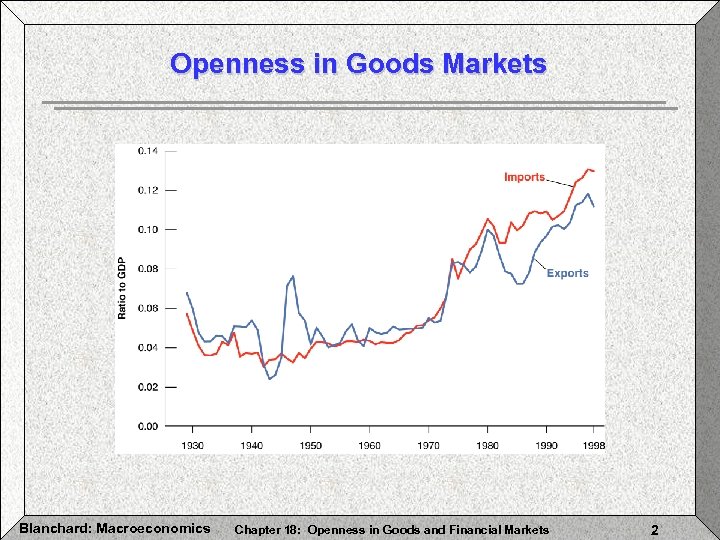 Openness in Goods Markets Blanchard: Macroeconomics Chapter 18: Openness in Goods and Financial Markets 2
 Openness in Goods Markets Observations of U. S. Exports and Imports n Exports and imports in the U. S. were 5% of GDP in 1960, are 12% (11. 2% exports, 13% imports) of GDP today. n Decline in exports and imports from 1929 -1936 due in large part to Smoot-Hawley Act of 1930. n Large trade surpluses of the 1940 s and large trade deficits of the 1980 s. Blanchard: Macroeconomics Chapter 18: Openness in Goods and Financial Markets 3
 Openness in Goods Markets Measuring the Degree of Openness n Volume of Trade: Ratio of exports or imports to GDP (U. S. = 12%) n Tradable Goods Ratio: Percent of output that competes in foreign markets (U. S. = 60%) Blanchard: Macroeconomics Chapter 18: Openness in Goods and Financial Markets 4
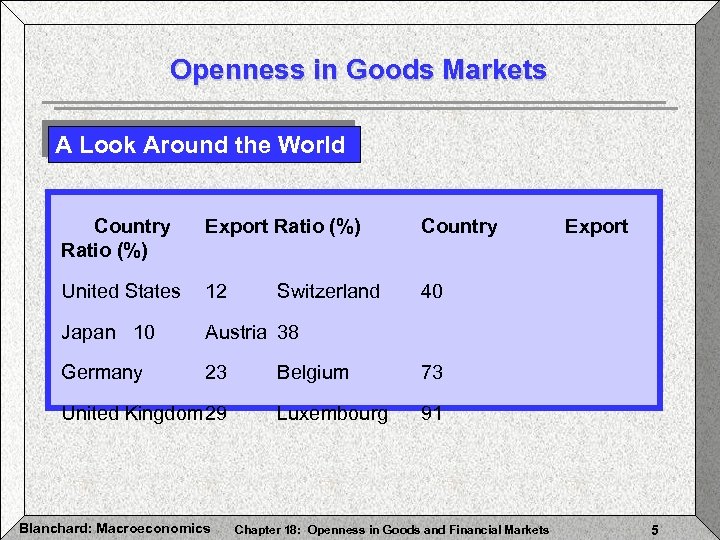 Openness in Goods Markets A Look Around the World Country Ratio (%) Export Ratio (%) Country United States 12 40 Japan 10 Austria 38 Germany 23 United Kingdom 29 Blanchard: Macroeconomics Switzerland Belgium 73 Luxembourg Export 91 Chapter 18: Openness in Goods and Financial Markets 5
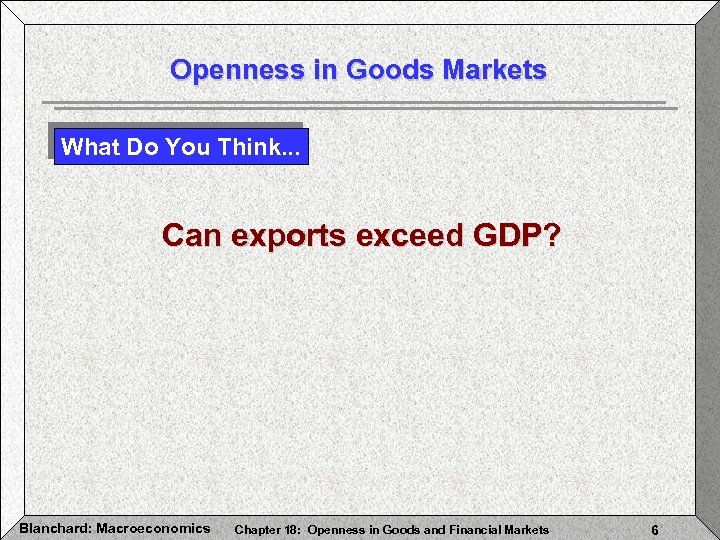 Openness in Goods Markets What Do You Think. . . Can exports exceed GDP? Blanchard: Macroeconomics Chapter 18: Openness in Goods and Financial Markets 6
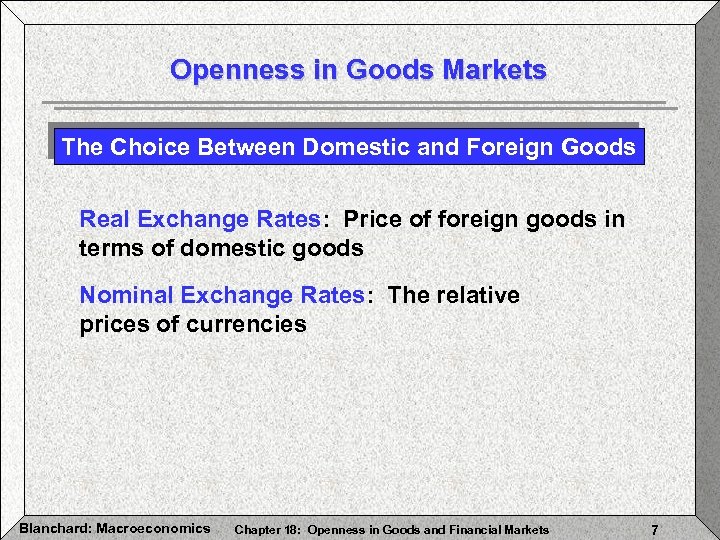 Openness in Goods Markets The Choice Between Domestic and Foreign Goods Real Exchange Rates: Price of foreign goods in terms of domestic goods Nominal Exchange Rates: The relative prices of currencies Blanchard: Macroeconomics Chapter 18: Openness in Goods and Financial Markets 7
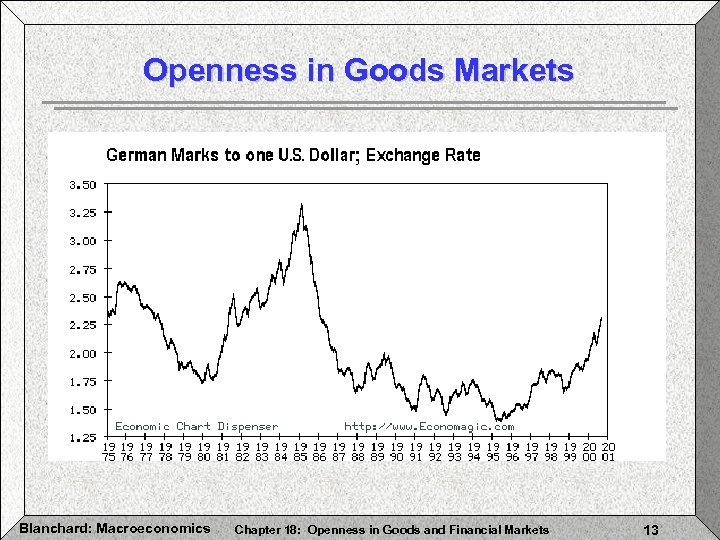
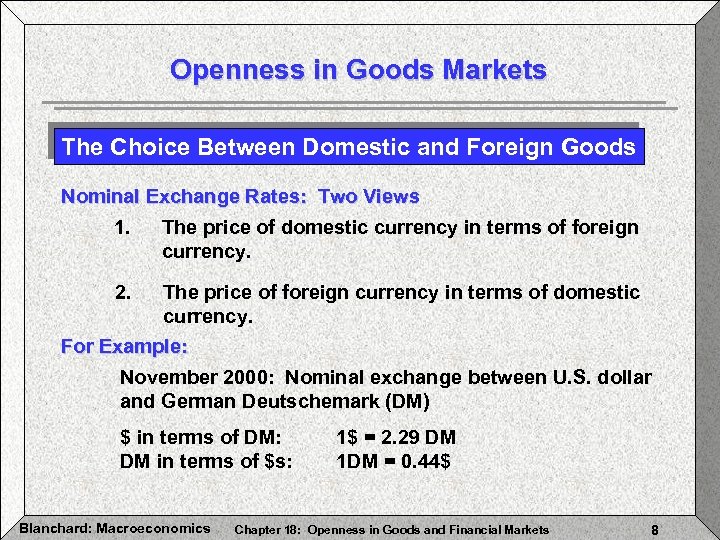 Openness in Goods Markets The Choice Between Domestic and Foreign Goods Nominal Exchange Rates: Two Views 1. The price of domestic currency in terms of foreign currency. 2. The price of foreign currency in terms of domestic currency. For Example: November 2000: Nominal exchange between U. S. dollar and German Deutschemark (DM) $ in terms of DM: DM in terms of $s: Blanchard: Macroeconomics 1$ = 2. 29 DM 1 DM = 0. 44$ Chapter 18: Openness in Goods and Financial Markets 8
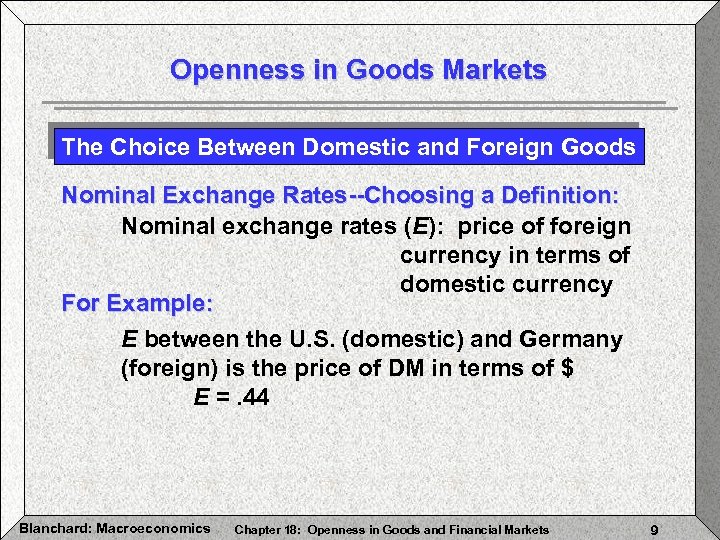 Openness in Goods Markets The Choice Between Domestic and Foreign Goods Nominal Exchange Rates--Choosing a Definition: Nominal exchange rates (E): price of foreign currency in terms of domestic currency For Example: E between the U. S. (domestic) and Germany (foreign) is the price of DM in terms of $ E =. 44 Blanchard: Macroeconomics Chapter 18: Openness in Goods and Financial Markets 9
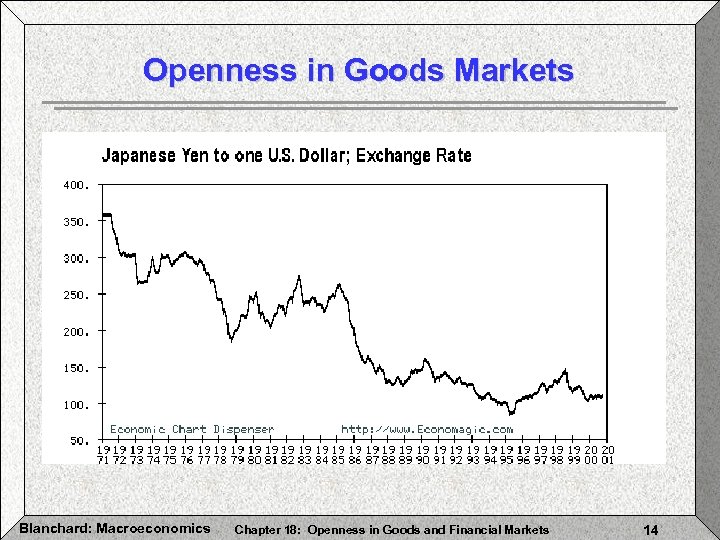
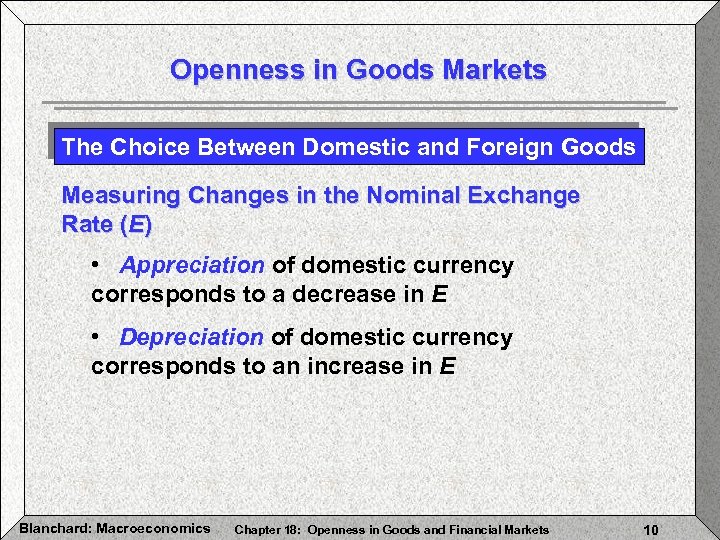 Openness in Goods Markets The Choice Between Domestic and Foreign Goods Measuring Changes in the Nominal Exchange Rate (E) • Appreciation of domestic currency corresponds to a decrease in E • Depreciation of domestic currency corresponds to an increase in E Blanchard: Macroeconomics Chapter 18: Openness in Goods and Financial Markets 10
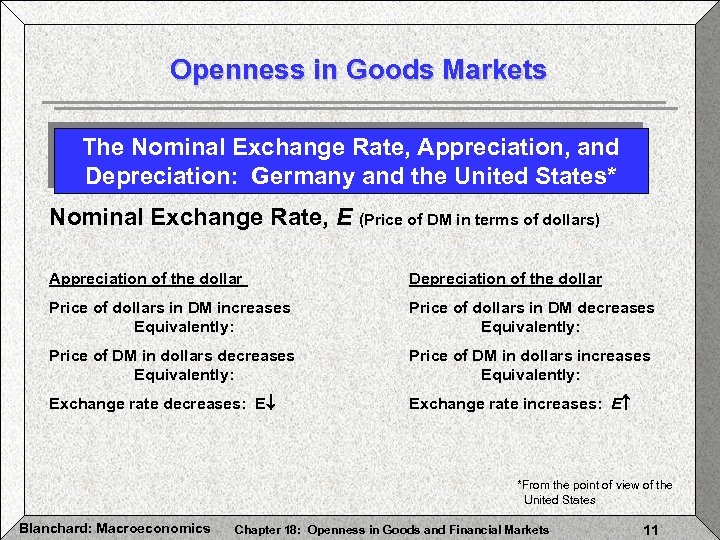 Openness in Goods Markets The Nominal Exchange Rate, Appreciation, and Depreciation: Germany and the United States* Nominal Exchange Rate, E (Price of DM in terms of dollars) Appreciation of the dollar Depreciation of the dollar Price of dollars in DM increases Equivalently: Price of dollars in DM decreases Equivalently: Price of DM in dollars increases Equivalently: Exchange rate decreases: E Exchange rate increases: E *From the point of view of the United States Blanchard: Macroeconomics Chapter 18: Openness in Goods and Financial Markets 11
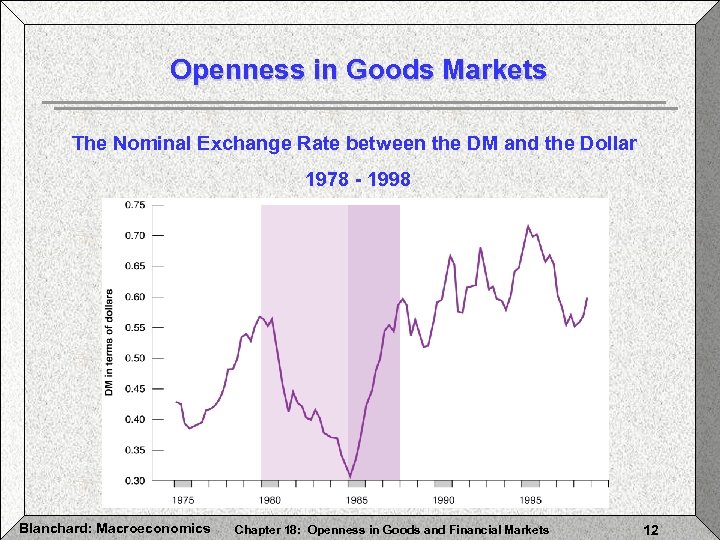 Openness in Goods Markets The Nominal Exchange Rate between the DM and the Dollar 1978 - 1998 Blanchard: Macroeconomics Chapter 18: Openness in Goods and Financial Markets 12
 Openness in Goods Markets Blanchard: Macroeconomics Chapter 18: Openness in Goods and Financial Markets 13
 Openness in Goods Markets Blanchard: Macroeconomics Chapter 18: Openness in Goods and Financial Markets 14
 Openness in Goods Markets Blanchard: Macroeconomics Chapter 18: Openness in Goods and Financial Markets 15
 Openness in Goods Markets The Choice Between Domestic and Foreign Goods Question: Does a decrease in E of U. S. $s for DMs necessarily mean U. S. citizens can buy more German goods with their dollars? Hint: What is the inflation rate in Germany? Blanchard: Macroeconomics Chapter 18: Openness in Goods and Financial Markets 16
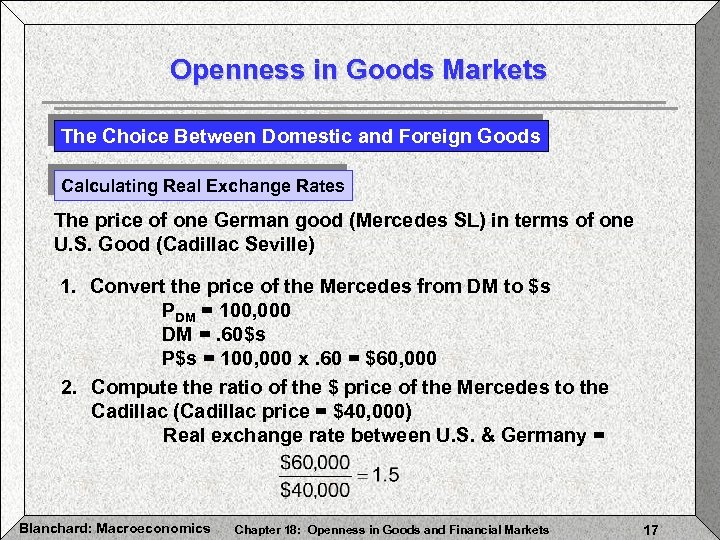 Openness in Goods Markets The Choice Between Domestic and Foreign Goods Calculating Real Exchange Rates The price of one German good (Mercedes SL) in terms of one U. S. Good (Cadillac Seville) 1. Convert the price of the Mercedes from DM to $s PDM = 100, 000 DM =. 60$s P$s = 100, 000 x. 60 = $60, 000 2. Compute the ratio of the $ price of the Mercedes to the Cadillac (Cadillac price = $40, 000) Real exchange rate between U. S. & Germany = Blanchard: Macroeconomics Chapter 18: Openness in Goods and Financial Markets 17
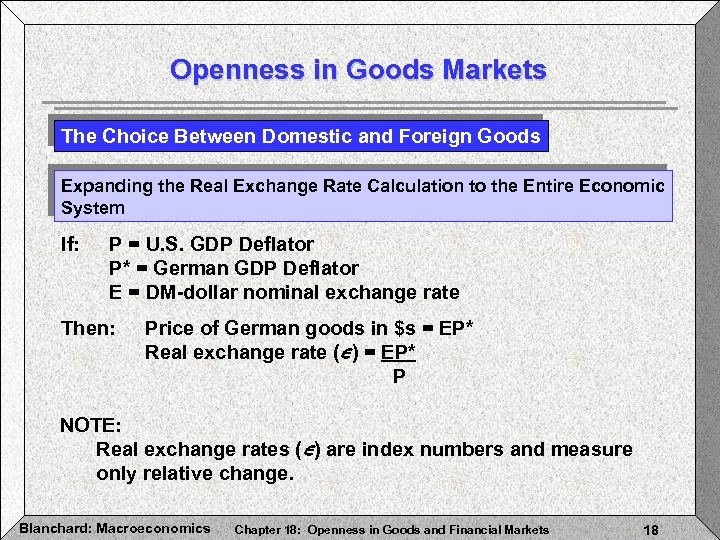 Openness in Goods Markets The Choice Between Domestic and Foreign Goods Expanding the Real Exchange Rate Calculation to the Entire Economic System If: P = U. S. GDP Deflator P* = German GDP Deflator E = DM-dollar nominal exchange rate Then: Price of German goods in $s = EP* Real exchange rate ( ) = EP* P NOTE: Real exchange rates ( ) are index numbers and measure only relative change. Blanchard: Macroeconomics Chapter 18: Openness in Goods and Financial Markets 18
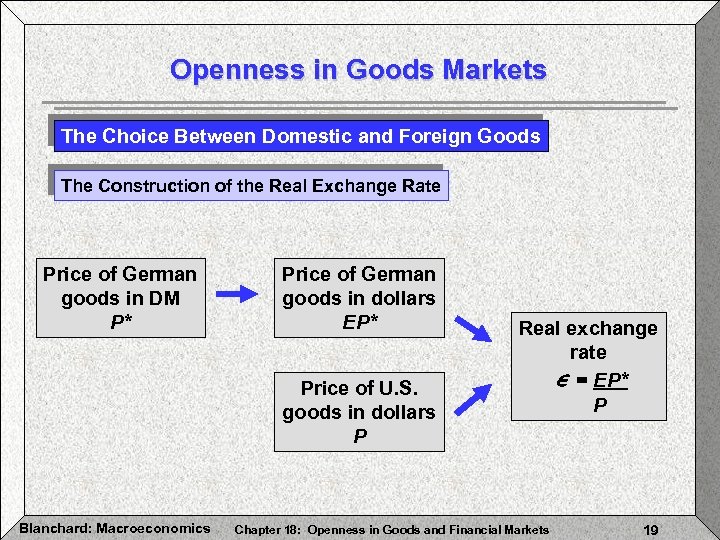 Openness in Goods Markets The Choice Between Domestic and Foreign Goods The Construction of the Real Exchange Rate Price of German goods in DM P* Price of German goods in dollars EP* Price of U. S. goods in dollars P Blanchard: Macroeconomics Real exchange rate = EP* P Chapter 18: Openness in Goods and Financial Markets 19
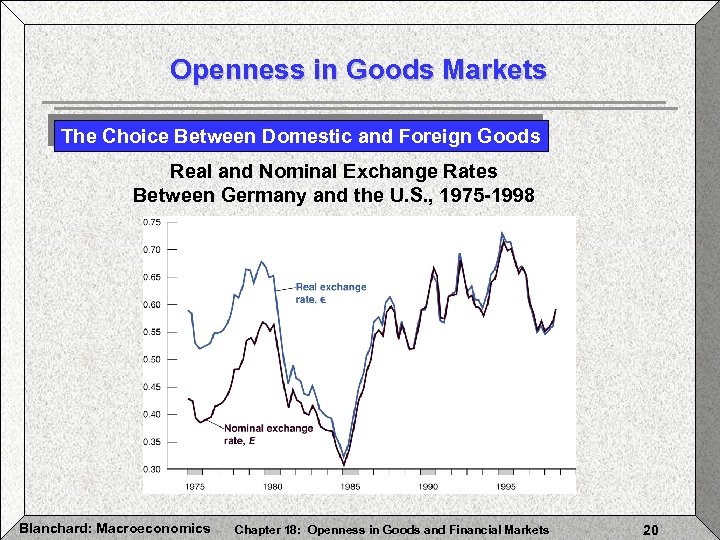 Openness in Goods Markets The Choice Between Domestic and Foreign Goods Real and Nominal Exchange Rates Between Germany and the U. S. , 1975 -1998 Blanchard: Macroeconomics Chapter 18: Openness in Goods and Financial Markets 20
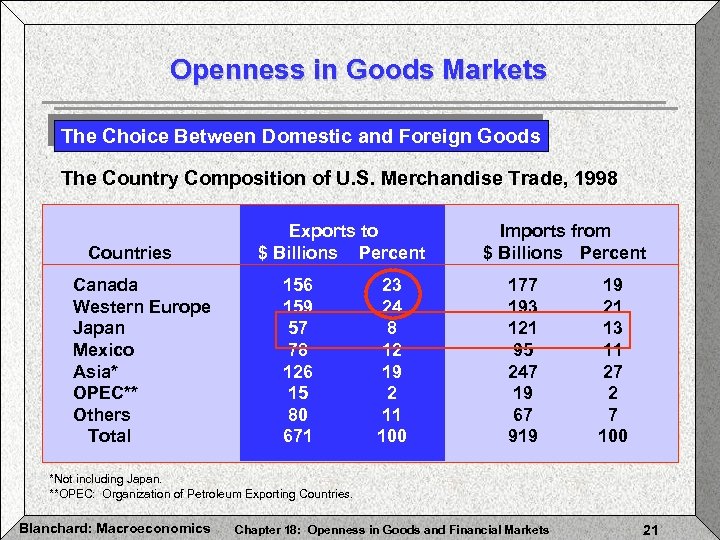 Openness in Goods Markets The Choice Between Domestic and Foreign Goods The Country Composition of U. S. Merchandise Trade, 1998 Countries Canada Western Europe Japan Mexico Asia* OPEC** Others Total Exports to $ Billions Percent 156 159 57 78 126 15 80 671 23 24 8 12 19 2 11 100 Imports from $ Billions Percent 177 193 121 95 247 19 67 919 19 21 13 11 27 2 7 100 *Not including Japan. **OPEC: Organization of Petroleum Exporting Countries. Blanchard: Macroeconomics Chapter 18: Openness in Goods and Financial Markets 21
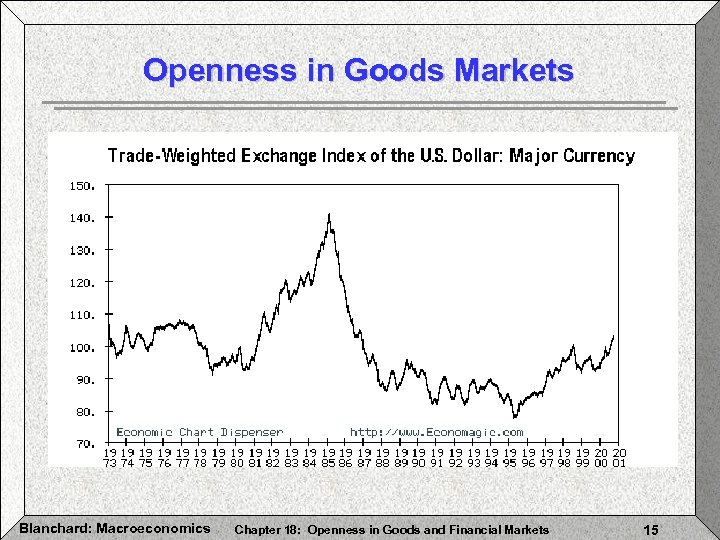
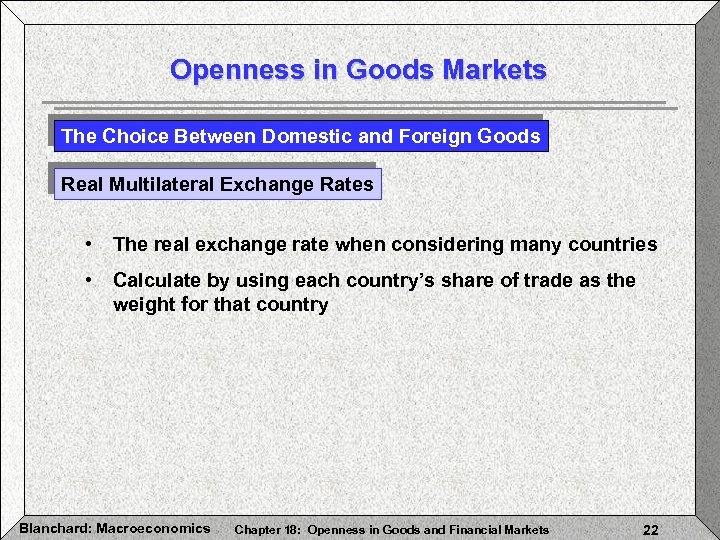 Openness in Goods Markets The Choice Between Domestic and Foreign Goods Real Multilateral Exchange Rates • The real exchange rate when considering many countries • Calculate by using each country’s share of trade as the weight for that country Blanchard: Macroeconomics Chapter 18: Openness in Goods and Financial Markets 22
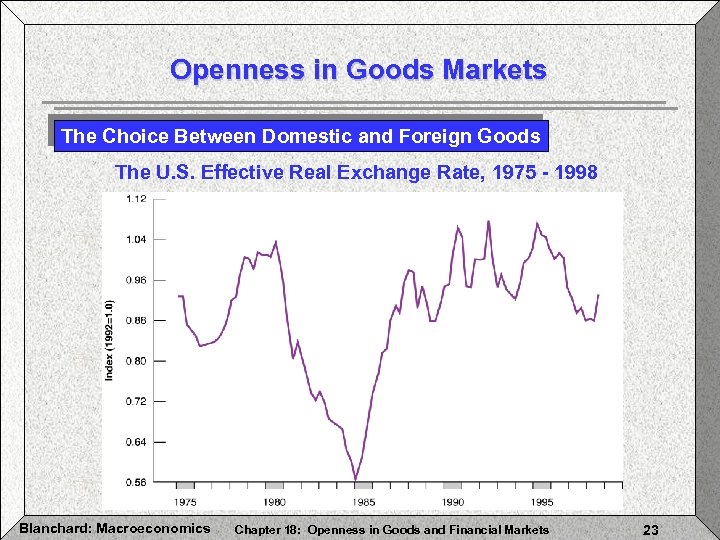 Openness in Goods Markets The Choice Between Domestic and Foreign Goods The U. S. Effective Real Exchange Rate, 1975 - 1998 Blanchard: Macroeconomics Chapter 18: Openness in Goods and Financial Markets 23
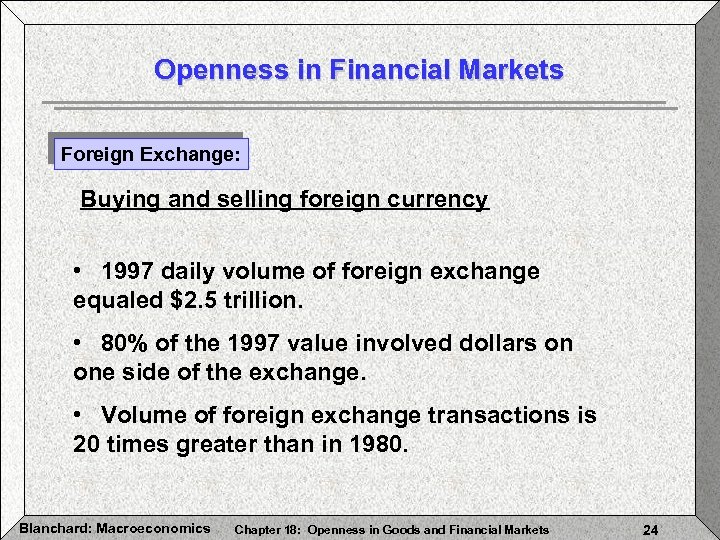 Openness in Financial Markets Foreign Exchange: Buying and selling foreign currency • 1997 daily volume of foreign exchange equaled $2. 5 trillion. • 80% of the 1997 value involved dollars on one side of the exchange. • Volume of foreign exchange transactions is 20 times greater than in 1980. Blanchard: Macroeconomics Chapter 18: Openness in Goods and Financial Markets 24
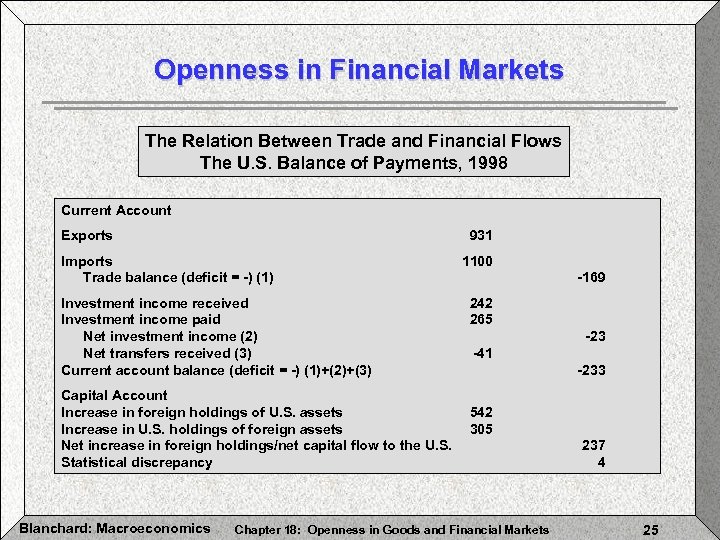 Openness in Financial Markets The Relation Between Trade and Financial Flows The U. S. Balance of Payments, 1998 Current Account Exports 931 Imports Trade balance (deficit = -) (1) Investment income received Investment income paid Net investment income (2) Net transfers received (3) Current account balance (deficit = -) (1)+(2)+(3) Capital Account Increase in foreign holdings of U. S. assets Increase in U. S. holdings of foreign assets Net increase in foreign holdings/net capital flow to the U. S. Statistical discrepancy Blanchard: Macroeconomics 1100 -169 242 265 -23 -41 -233 542 305 Chapter 18: Openness in Goods and Financial Markets 237 4 25
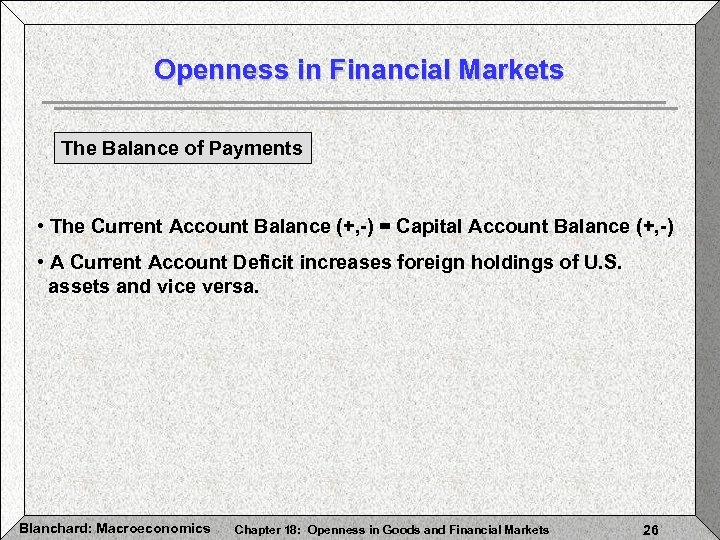 Openness in Financial Markets The Balance of Payments • The Current Account Balance (+, -) = Capital Account Balance (+, -) • A Current Account Deficit increases foreign holdings of U. S. assets and vice versa. Blanchard: Macroeconomics Chapter 18: Openness in Goods and Financial Markets 26
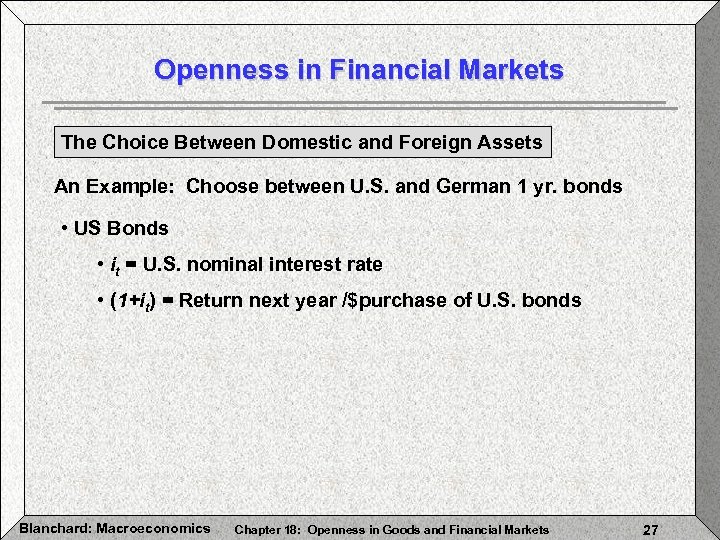 Openness in Financial Markets The Choice Between Domestic and Foreign Assets An Example: Choose between U. S. and German 1 yr. bonds • US Bonds • it = U. S. nominal interest rate • (1+it) = Return next year /$purchase of U. S. bonds Blanchard: Macroeconomics Chapter 18: Openness in Goods and Financial Markets 27
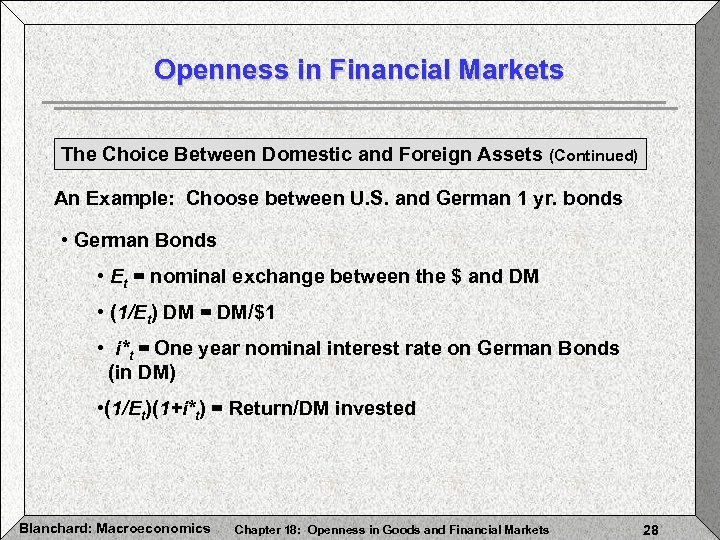 Openness in Financial Markets The Choice Between Domestic and Foreign Assets (Continued) An Example: Choose between U. S. and German 1 yr. bonds • German Bonds • Et = nominal exchange between the $ and DM • (1/Et) DM = DM/$1 • i*t = One year nominal interest rate on German Bonds (in DM) • (1/Et)(1+i*t) = Return/DM invested Blanchard: Macroeconomics Chapter 18: Openness in Goods and Financial Markets 28
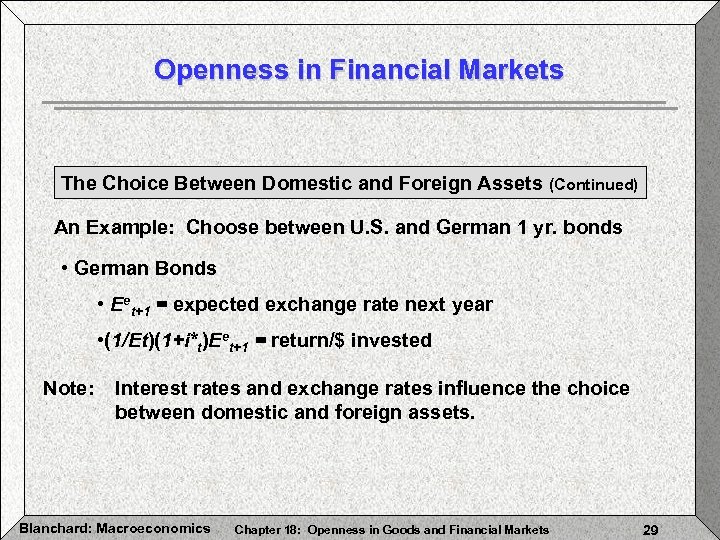 Openness in Financial Markets The Choice Between Domestic and Foreign Assets (Continued) An Example: Choose between U. S. and German 1 yr. bonds • German Bonds • Eet+1 = expected exchange rate next year • (1/Et)(1+i*t)Eet+1 = return/$ invested Note: Interest rates and exchange rates influence the choice between domestic and foreign assets. Blanchard: Macroeconomics Chapter 18: Openness in Goods and Financial Markets 29
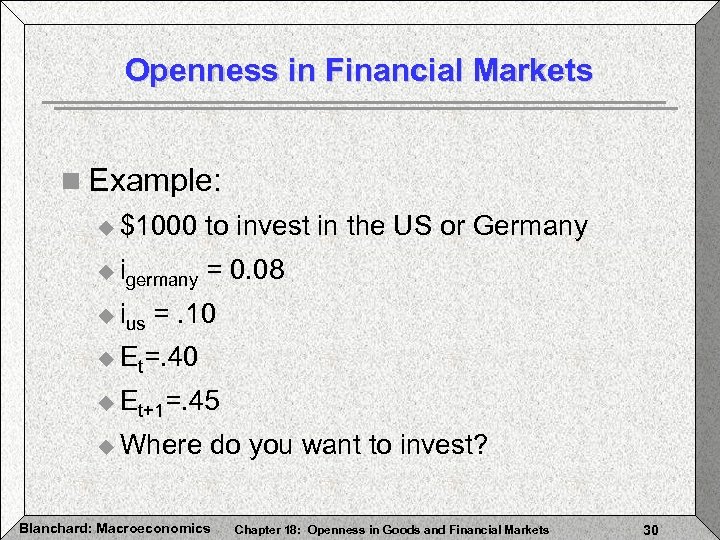 Openness in Financial Markets n Example: u $1000 to invest in the US or Germany u igermany = 0. 08 u ius =. 10 u Et=. 40 u Et+1=. 45 u Where do you want to invest? Blanchard: Macroeconomics Chapter 18: Openness in Goods and Financial Markets 30
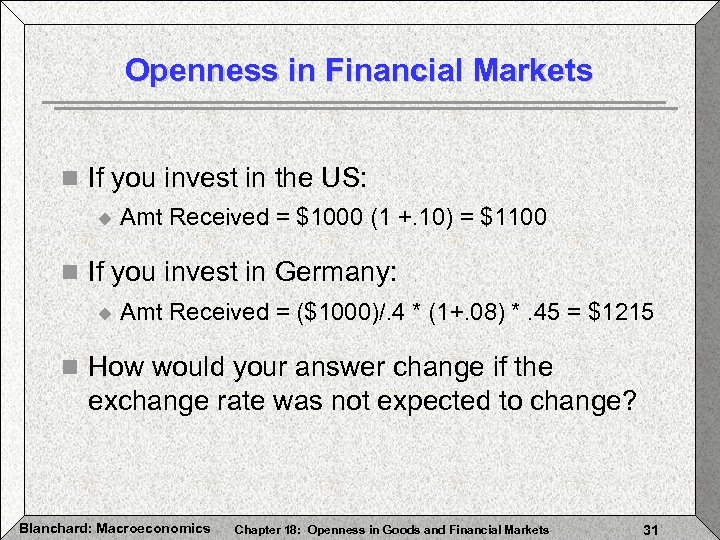 Openness in Financial Markets n If you invest in the US: u Amt Received = $1000 (1 +. 10) = $1100 n If you invest in Germany: u Amt Received = ($1000)/. 4 * (1+. 08) *. 45 = $1215 n How would your answer change if the exchange rate was not expected to change? Blanchard: Macroeconomics Chapter 18: Openness in Goods and Financial Markets 31
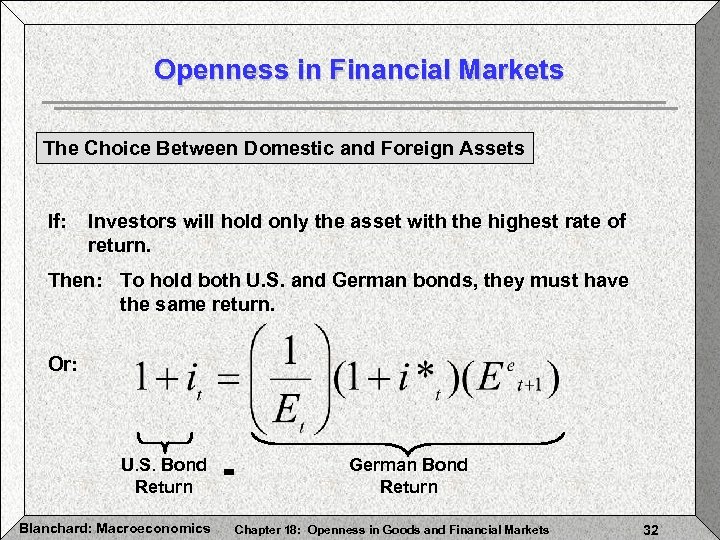 Openness in Financial Markets The Choice Between Domestic and Foreign Assets If: Investors will hold only the asset with the highest rate of return. Then: To hold both U. S. and German bonds, they must have the same return. Or: U. S. Bond = Return Blanchard: Macroeconomics German Bond Return Chapter 18: Openness in Goods and Financial Markets 32
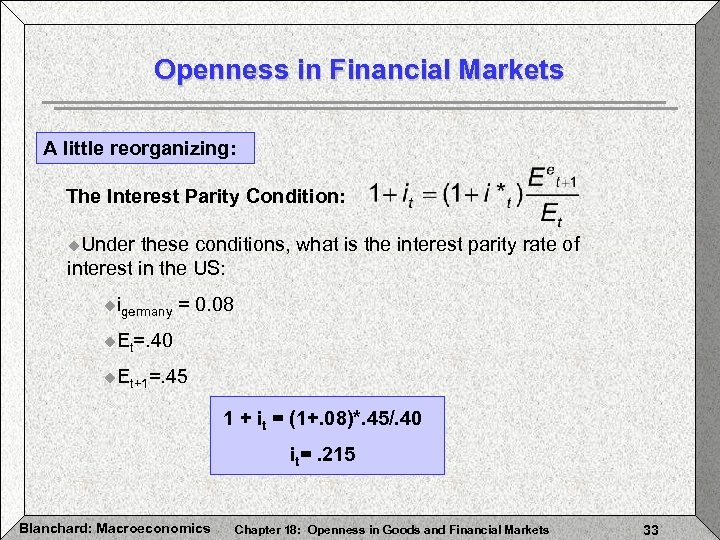 Openness in Financial Markets A little reorganizing: The Interest Parity Condition: u. Under these conditions, what is the interest parity rate of interest in the US: uigermany = 0. 08 u. Et=. 40 u. Et+1=. 45 1 + it = (1+. 08)*. 45/. 40 it=. 215 Blanchard: Macroeconomics Chapter 18: Openness in Goods and Financial Markets 33
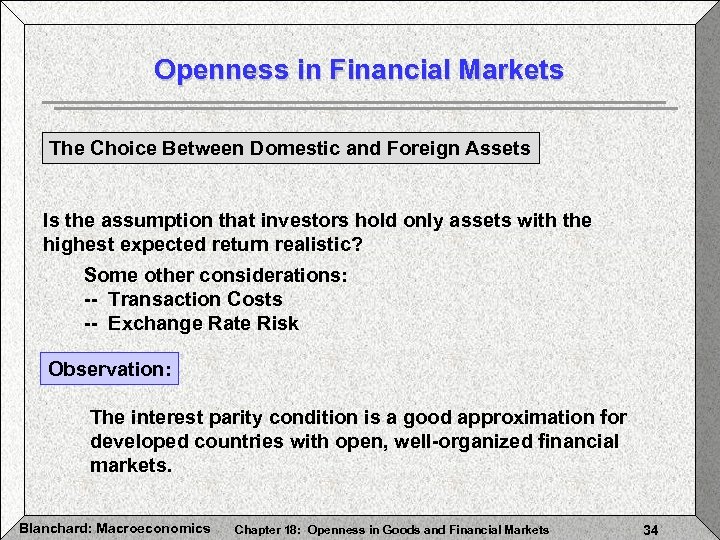 Openness in Financial Markets The Choice Between Domestic and Foreign Assets Is the assumption that investors hold only assets with the highest expected return realistic? Some other considerations: -- Transaction Costs -- Exchange Rate Risk Observation: The interest parity condition is a good approximation for developed countries with open, well-organized financial markets. Blanchard: Macroeconomics Chapter 18: Openness in Goods and Financial Markets 34
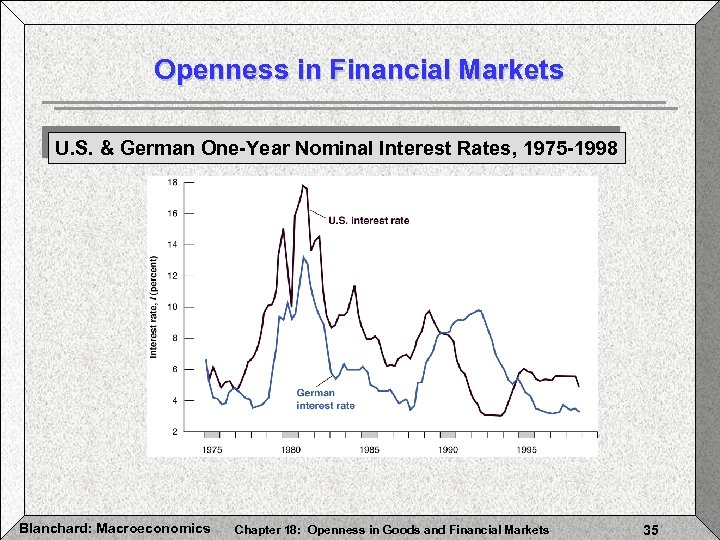 Openness in Financial Markets U. S. & German One-Year Nominal Interest Rates, 1975 -1998 Blanchard: Macroeconomics Chapter 18: Openness in Goods and Financial Markets 35
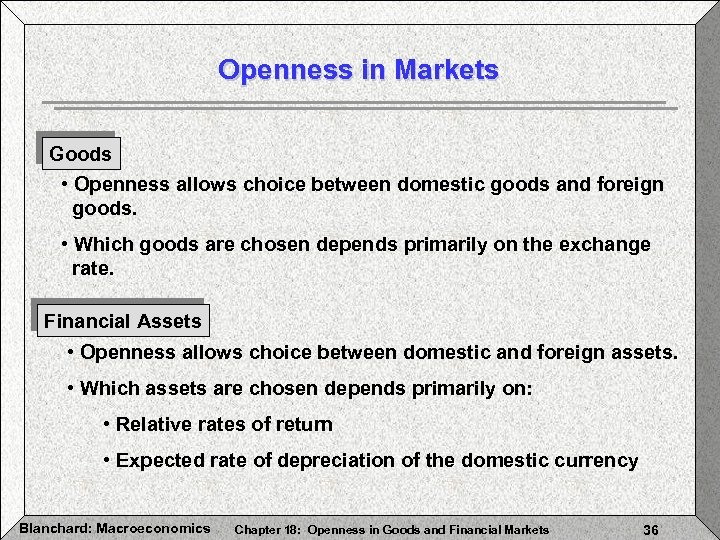 Openness in Markets Goods • Openness allows choice between domestic goods and foreign goods. • Which goods are chosen depends primarily on the exchange rate. Financial Assets • Openness allows choice between domestic and foreign assets. • Which assets are chosen depends primarily on: • Relative rates of return • Expected rate of depreciation of the domestic currency Blanchard: Macroeconomics Chapter 18: Openness in Goods and Financial Markets 36
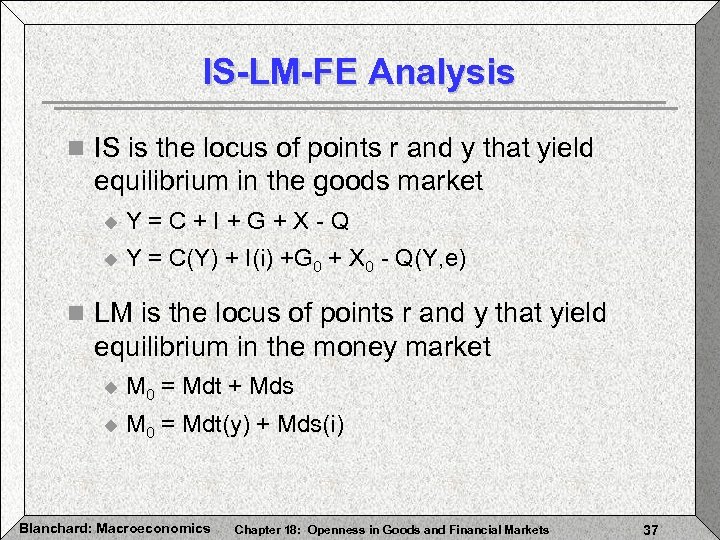 IS-LM-FE Analysis n IS is the locus of points r and y that yield equilibrium in the goods market u Y=C+I+G+X-Q u Y = C(Y) + I(i) +G 0 + X 0 - Q(Y, e) n LM is the locus of points r and y that yield equilibrium in the money market u M 0 = Mdt + Mds u M 0 = Mdt(y) + Mds(i) Blanchard: Macroeconomics Chapter 18: Openness in Goods and Financial Markets 37
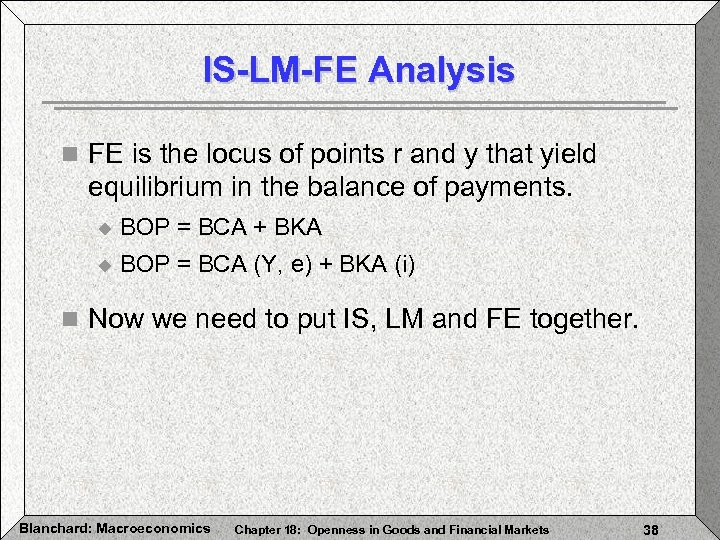 IS-LM-FE Analysis n FE is the locus of points r and y that yield equilibrium in the balance of payments. u BOP = BCA + BKA u BOP = BCA (Y, e) + BKA (i) n Now we need to put IS, LM and FE together. Blanchard: Macroeconomics Chapter 18: Openness in Goods and Financial Markets 38
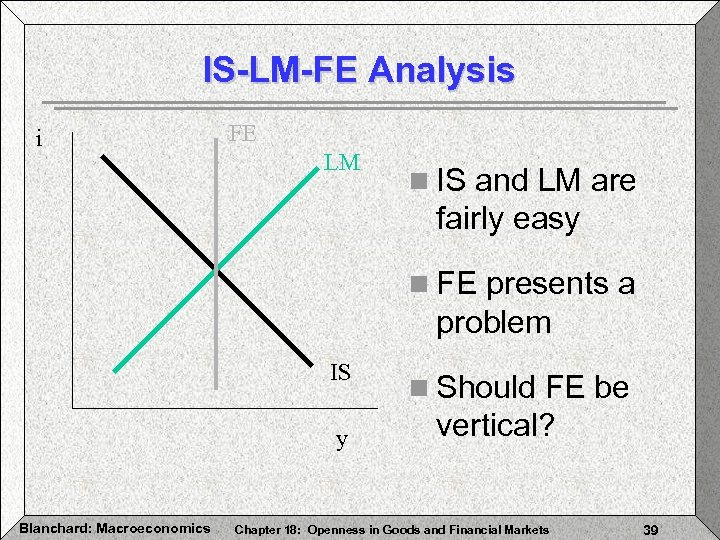 IS-LM-FE Analysis i FE LM n IS and LM are fairly easy n FE presents a problem IS y Blanchard: Macroeconomics n Should FE be vertical? Chapter 18: Openness in Goods and Financial Markets 39
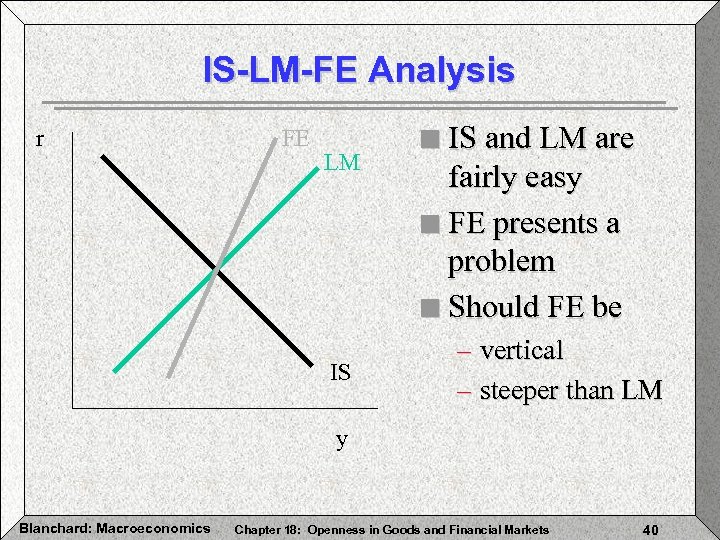 IS-LM-FE Analysis r FE LM IS IS and LM are fairly easy n FE presents a problem n Should FE be n – vertical – steeper than LM y Blanchard: Macroeconomics Chapter 18: Openness in Goods and Financial Markets 40
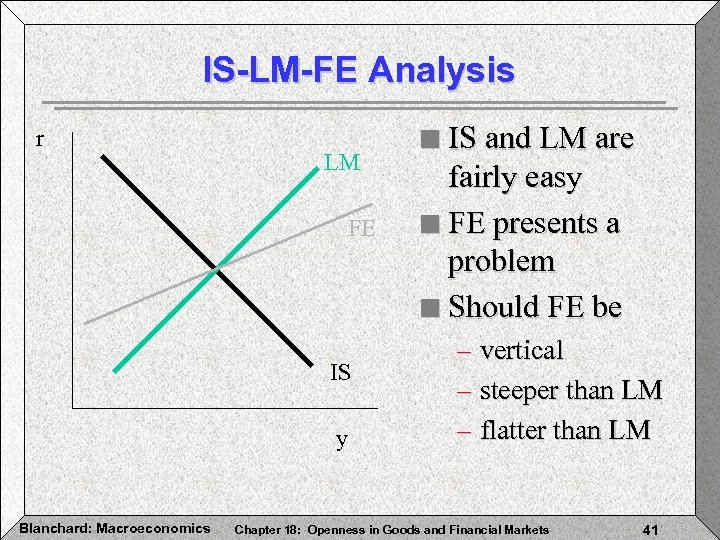 IS-LM-FE Analysis r LM FE IS y Blanchard: Macroeconomics IS and LM are fairly easy n FE presents a problem n Should FE be n – vertical – steeper than LM – flatter than LM Chapter 18: Openness in Goods and Financial Markets 41
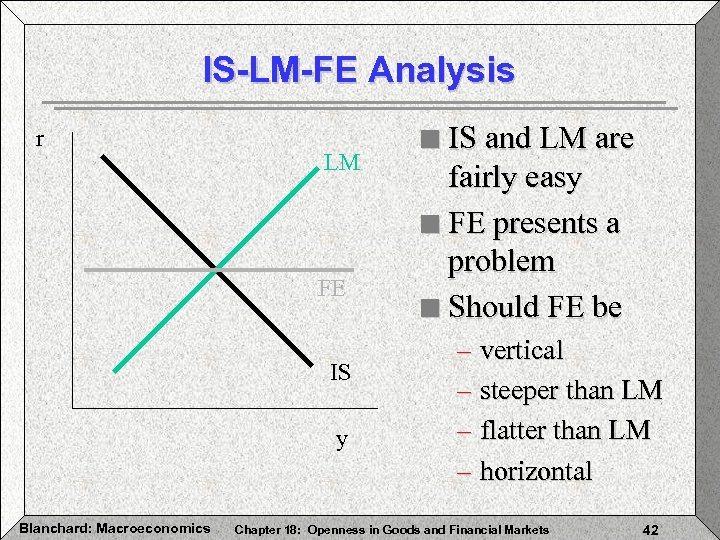 IS-LM-FE Analysis r LM FE IS y Blanchard: Macroeconomics IS and LM are fairly easy n FE presents a problem n Should FE be n – vertical – steeper than LM – flatter than LM – horizontal Chapter 18: Openness in Goods and Financial Markets 42
 IS-LM-FE Analysis n The slope of the FE will depend upon the sensitivity of capital flows to changes in interest rates. u if capital flows are not sensitive to interest rates, the FE line will be vertical u if capital flows are perfectly sensitive to interest rates, the FE line will be horizontal u the more sensitive are capital flows to interest rates, the flatter will be the FE line. Blanchard: Macroeconomics Chapter 18: Openness in Goods and Financial Markets 43