


 Скачать презентацию Open Source Alternative to Deploying Transportation Management Systems
0c92e1c13a4398072a70b8d52271d082.ppt
- Количество слайдов: 27
 Open Source Alternative to Deploying Transportation Management Systems October 20 th 2010 Michael Darter Software Engineer, AHMCT Advanced Highway Maintenance & Construction Research Laboratory University of California, Davis T 3 Webinars are brought to you by the ITS Professional Capacity Building Program (ITS PCB) at the U. S. Department of Transportation’s (USDOT) ITS Joint Program Office, Research and Innovative Technology Administration (RITA)
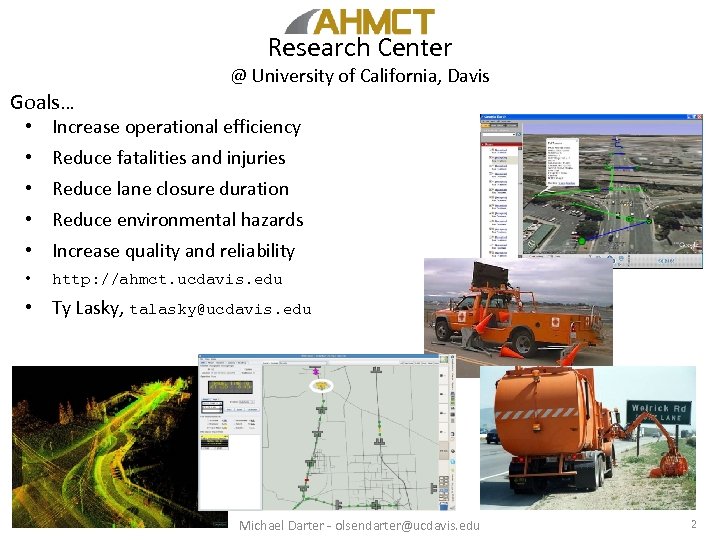 Research Center @ University of California, Davis Goals… • Increase operational efficiency • Reduce fatalities and injuries • Reduce lane closure duration • Reduce environmental hazards • Increase quality and reliability • http: //ahmct. ucdavis. edu • Ty Lasky, talasky@ucdavis. edu Michael Darter - olsendarter@ucdavis. edu 2
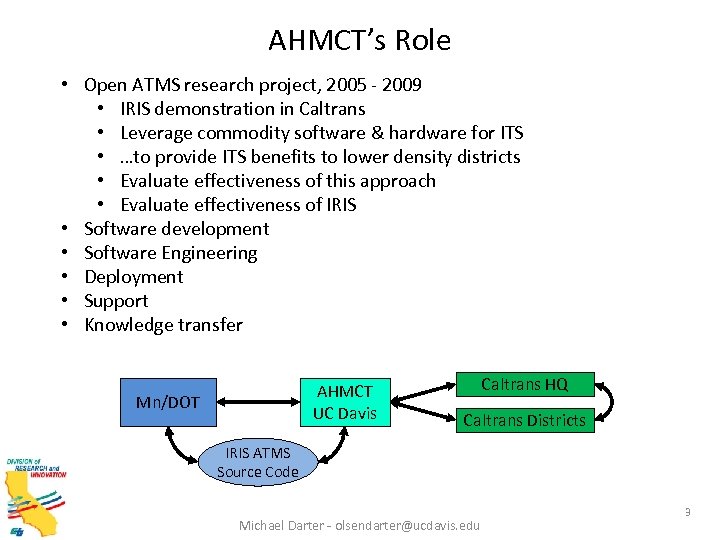 AHMCT’s Role • Open ATMS research project, 2005 - 2009 • IRIS demonstration in Caltrans • Leverage commodity software & hardware for ITS • …to provide ITS benefits to lower density districts • Evaluate effectiveness of this approach • Evaluate effectiveness of IRIS • Software development • Software Engineering • Deployment • Support • Knowledge transfer AHMCT UC Davis Mn/DOT Caltrans HQ Caltrans Districts IRIS ATMS Source Code Michael Darter - olsendarter@ucdavis. edu 3
 Roadmap • Open ATMS project & IRIS • • Technical details Scalability Architecture Information for new implementations • Software engineering process • • Software development process Benefits Testing Collaboration Michael Darter - olsendarter@ucdavis. edu 4
 Open Source What ‘open source’ means… 1. Legal definition, http: //opensource. org 2. Development method Open-source (GPL) requires… • Source code is freely available • Modified code is open-source Results in… • Creation of knowledge communities • Enables cooperative development model • Enables a network effect • Reduces legal complexity, no NDAs Tends to view software as knowledge Michael Darter - olsendarter@ucdavis. edu 5
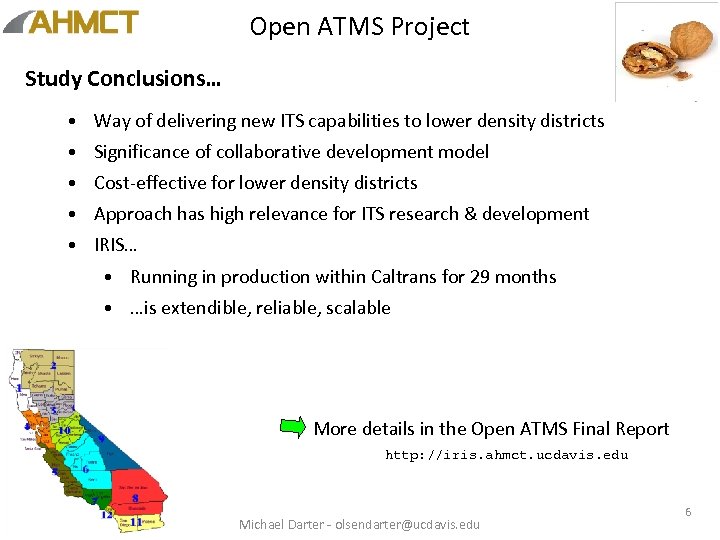 Open ATMS Project Study Conclusions… • Way of delivering new ITS capabilities to lower density districts • Significance of collaborative development model • Cost-effective for lower density districts • Approach has high relevance for ITS research & development • IRIS… • Running in production within Caltrans for 29 months • …is extendible, reliable, scalable More details in the Open ATMS Final Report http: //iris. ahmct. ucdavis. edu 6 Michael Darter - olsendarter@ucdavis. edu 6
 Caltrans Contributions to IRIS • Multi-agency support: – System attributes – Internationalization (I 18 N), “DMS” versus “CMS” – Generalized incidents • Testing – Automated unit test cases (JUnit) – DMS simulation • • • DMS message library Automated Warning System (AWS) functionality Numerous UI refinements – DMS preview, intermediate status updates, etc. – Page-on times, – Extended for use on small monitors • • Google Earth output (KML) Server-side incident feed IRIS binary packaging (RPM) Ongoing… – – • Automated Warning System (AWS) enhancements EIS RTMS traffic driver Road Weather Information System (RWIS) enhancements Spell Checker IRIS Developer Ticketing System Michael Darter - olsendarter@ucdavis. edu 7
 Caltrans IRIS Functionality • • • DMS (CMS) control and monitoring Integration w/ existing Automated Warning System Video monitoring and PTZ control Traffic: speed, flow, density, 30 second Integrated mapping w/ field elements, roads Real-time CHP incidents User authentication Extensive user roles, permissions Reporting Currently not used: – Travel time, Variable Speed Limits (VSL), ramp meters, Active Traffic Management (ATM) Michael Darter - olsendarter@ucdavis. edu 8
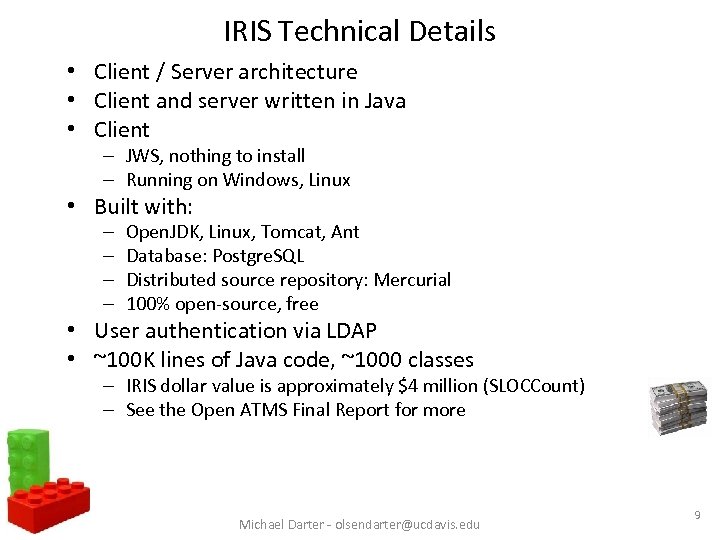 IRIS Technical Details • Client / Server architecture • Client and server written in Java • Client – JWS, nothing to install – Running on Windows, Linux • Built with: – – Open. JDK, Linux, Tomcat, Ant Database: Postgre. SQL Distributed source repository: Mercurial 100% open-source, free • User authentication via LDAP • ~100 K lines of Java code, ~1000 classes – IRIS dollar value is approximately $4 million (SLOCCount) – See the Open ATMS Final Report for more Michael Darter - olsendarter@ucdavis. edu 9
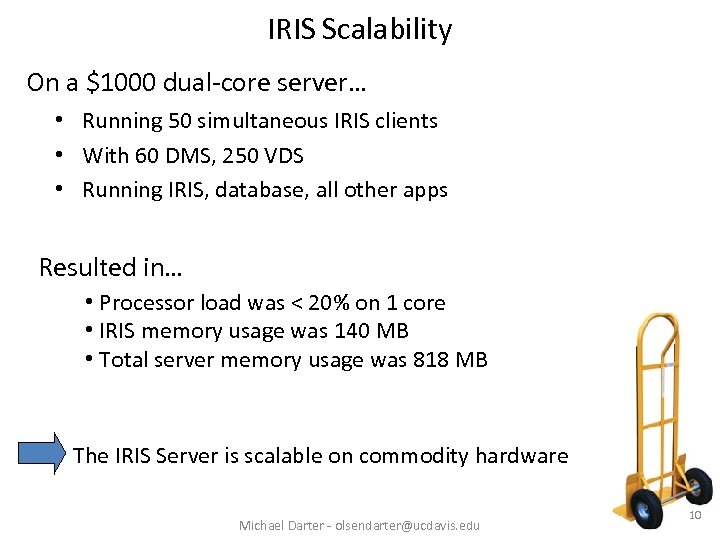 IRIS Scalability On a $1000 dual-core server… • Running 50 simultaneous IRIS clients • With 60 DMS, 250 VDS • Running IRIS, database, all other apps Resulted in… • Processor load was < 20% on 1 core • IRIS memory usage was 140 MB • Total server memory usage was 818 MB The IRIS Server is scalable on commodity hardware Michael Darter - olsendarter@ucdavis. edu 10
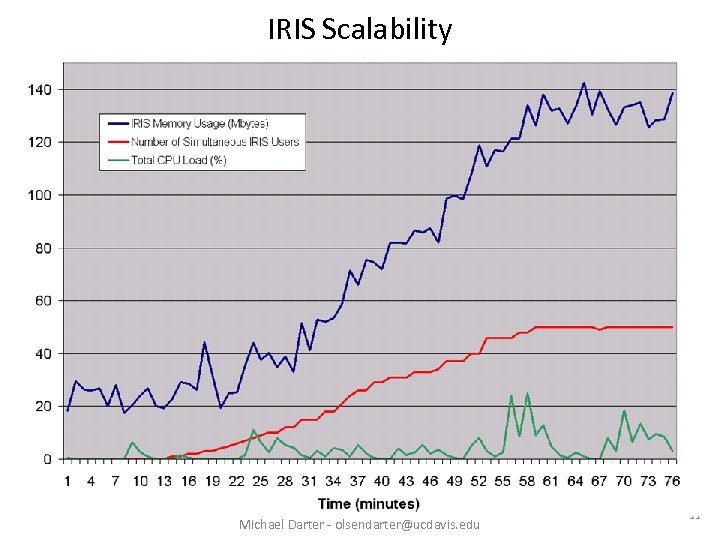 IRIS Scalability Michael Darter - olsendarter@ucdavis. edu 11
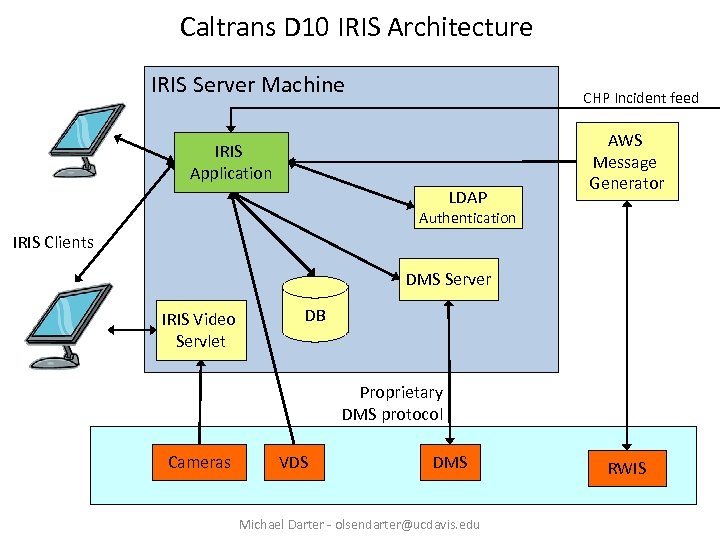 Caltrans D 10 IRIS Architecture IRIS Server Machine CHP Incident feed IRIS Application LDAP AWS Message Generator Authentication IRIS Clients DMS Server IRIS Video Servlet DB Proprietary DMS protocol Cameras VDS DMS Michael Darter - olsendarter@ucdavis. edu RWIS
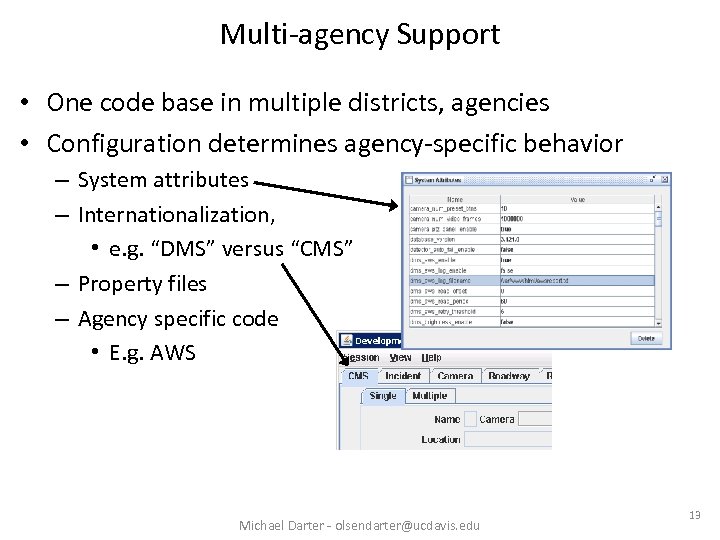 Multi-agency Support • One code base in multiple districts, agencies • Configuration determines agency-specific behavior – System attributes – Internationalization, • e. g. “DMS” versus “CMS” – Property files – Agency specific code • E. g. AWS Michael Darter - olsendarter@ucdavis. edu 13
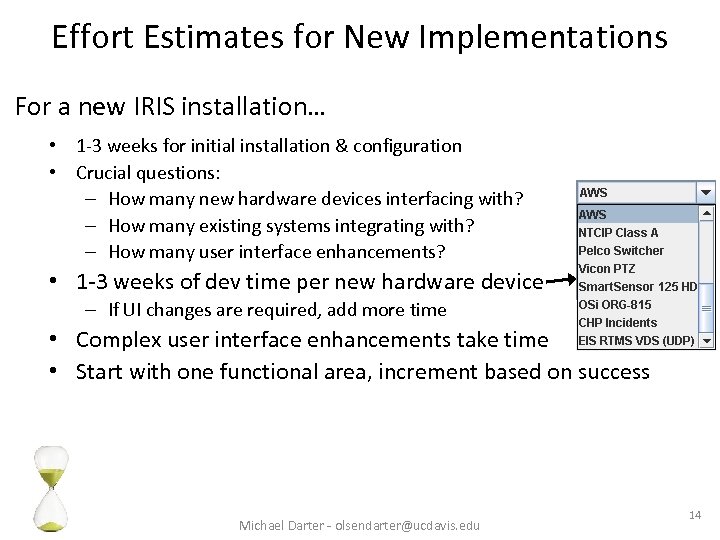 Effort Estimates for New Implementations For a new IRIS installation… • 1 -3 weeks for initial installation & configuration • Crucial questions: – How many new hardware devices interfacing with? – How many existing systems integrating with? – How many user interface enhancements? • 1 -3 weeks of dev time per new hardware device – If UI changes are required, add more time • Complex user interface enhancements take time • Start with one functional area, increment based on success Michael Darter - olsendarter@ucdavis. edu 14
 Software Engineering Motivation for doing it right… • Across industries, 32% of software projects are successful (Standish) – On time – Within budget – With desired features • 50% of projects are rolled back out of production (Gartner) • Annual software project cost overruns are $50 - $80 billion Software development is risky Michael Darter - olsendarter@ucdavis. edu 15
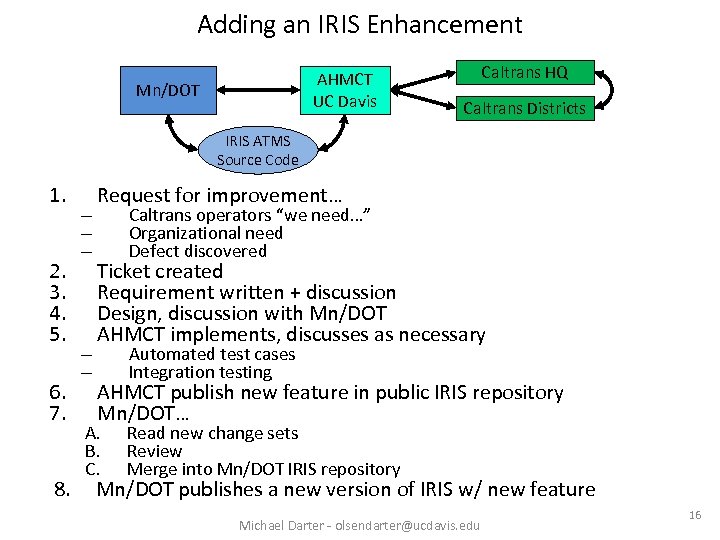 Adding an IRIS Enhancement AHMCT UC Davis Mn/DOT Caltrans HQ Caltrans Districts IRIS ATMS Source Code 1. 2. 3. 4. 5. 6. 7. 8. – – – Request for improvement… Caltrans operators “we need…” Organizational need Defect discovered Ticket created Requirement written + discussion Design, discussion with Mn/DOT AHMCT implements, discusses as necessary Automated test cases Integration testing AHMCT publish new feature in public IRIS repository Mn/DOT… A. B. C. Read new change sets Review Merge into Mn/DOT IRIS repository Mn/DOT publishes a new version of IRIS w/ new feature Michael Darter - olsendarter@ucdavis. edu 16
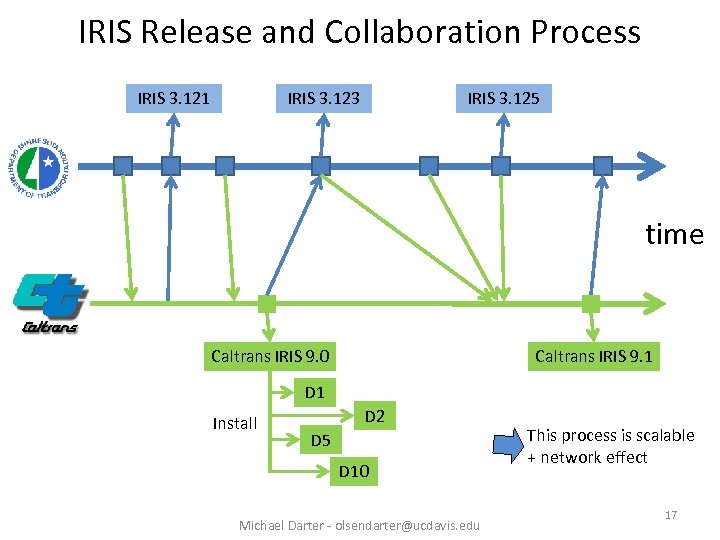 IRIS Release and Collaboration Process IRIS 3. 121 IRIS 3. 123 IRIS 3. 125 time Caltrans IRIS 9. 0 Caltrans IRIS 9. 1 D 1 Install D 2 D 5 D 10 Michael Darter - olsendarter@ucdavis. edu This process is scalable + network effect 17
 Benefits of Collaborative Development Approach (for the software engineering process) 1. 2. 3. 4. 5. Higher code quality Better design Better testing Better planning Increased probability of success for new IRIS projects versus starting development from scratch These are intrinsic to some extent Michael Darter - olsendarter@ucdavis. edu 18
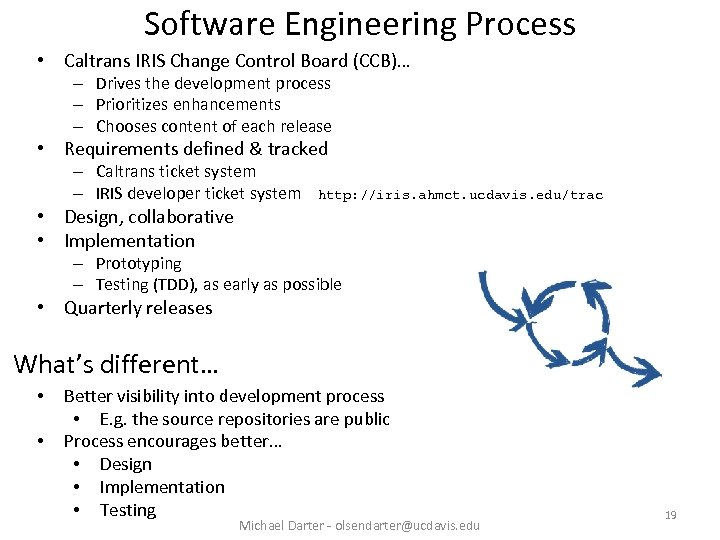 Software Engineering Process • Caltrans IRIS Change Control Board (CCB)… – Drives the development process – Prioritizes enhancements – Chooses content of each release • Requirements defined & tracked – Caltrans ticket system – IRIS developer ticket system http: //iris. ahmct. ucdavis. edu/trac • Design, collaborative • Implementation – Prototyping – Testing (TDD), as early as possible • Quarterly releases What’s different… • • Better visibility into development process • E. g. the source repositories are public Process encourages better… • Design • Implementation • Testing Michael Darter - olsendarter@ucdavis. edu 19
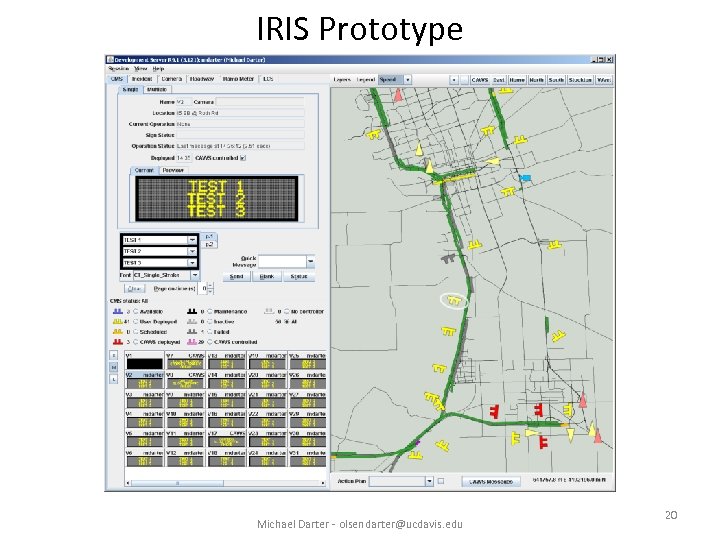 IRIS Prototype Michael Darter - olsendarter@ucdavis. edu 20
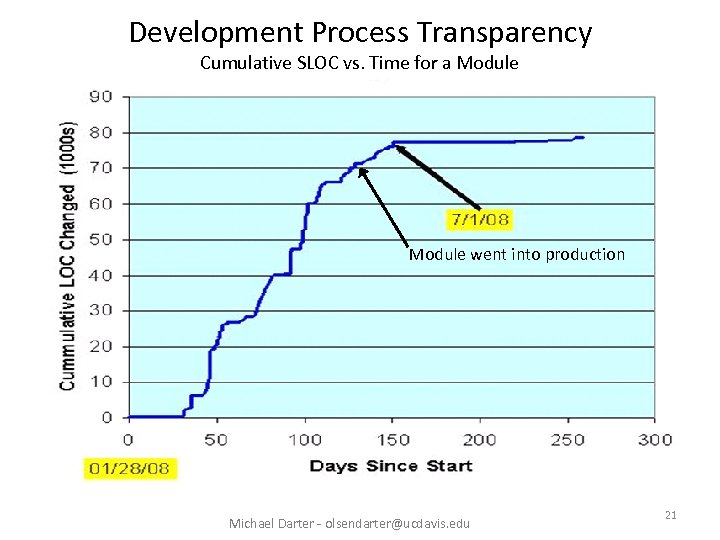 Development Process Transparency Cumulative SLOC vs. Time for a Module went into production Michael Darter - olsendarter@ucdavis. edu 21
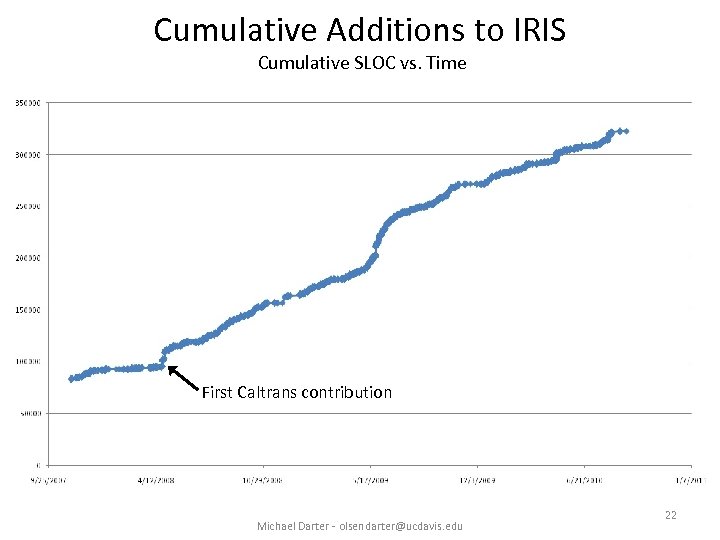 Cumulative Additions to IRIS Cumulative SLOC vs. Time First Caltrans contribution Michael Darter - olsendarter@ucdavis. edu 22
 Testing • Continuous Integration – Test early and often – Automated test cases (600+) • Integrated w/ development process • Enables Test Driven Development (TDD) – DMS Simulator (CASPER) • Validation – User needs requirements design prototype – Users experiment with prototype – User acceptance test cases • Verification – – Automated test cases Integration testing, test cases + ad hoc Multi-agency testing Acceptance test cases • Future – Automated integration tests – Simulated traffic – Capture and replay of traffic and RWIS data Michael Darter - olsendarter@ucdavis. edu 23
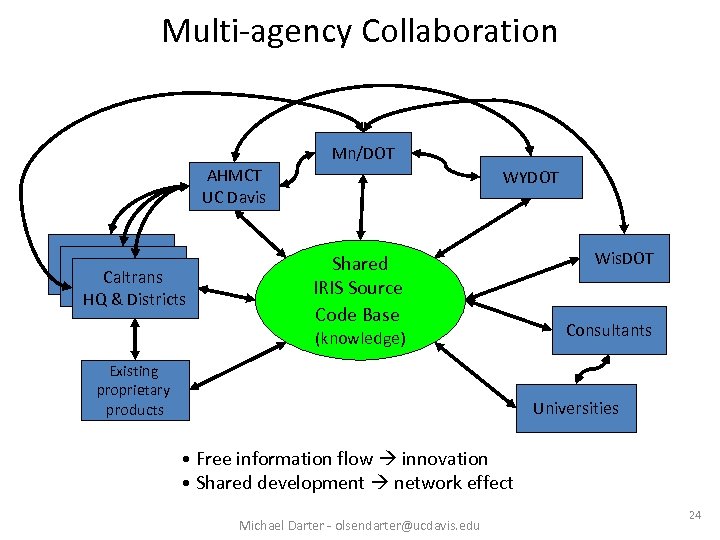 Multi-agency Collaboration Mn/DOT AHMCT UC Davis Caltrans Districts HQ & Districts WYDOT Shared IRIS Source Code Base (knowledge) Existing proprietary products Wis. DOT Consultants Universities • Free information flow innovation • Shared development network effect Michael Darter - olsendarter@ucdavis. edu 24
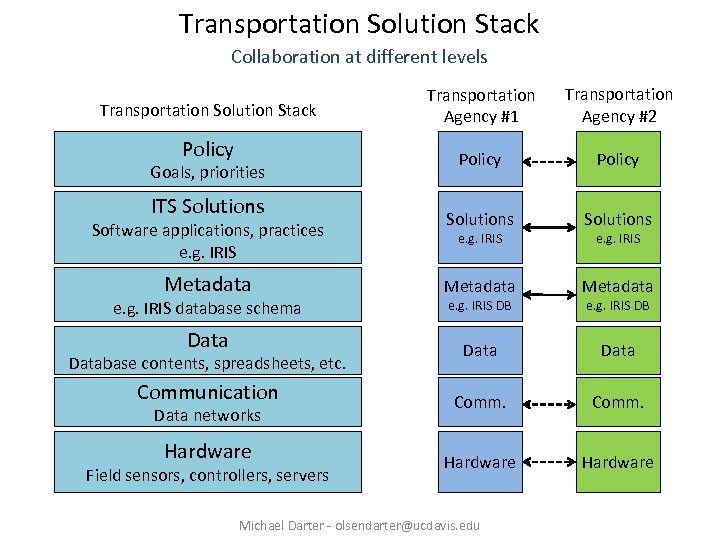 Transportation Solution Stack Collaboration at different levels Transportation Solution Stack Transportation Agency #1 Transportation Agency #2 Policy Solutions Metadata Data Communication Comm. Hardware Goals, priorities ITS Solutions Software applications, practices e. g. IRIS database schema Database contents, spreadsheets, etc. Data networks Field sensors, controllers, servers e. g. IRIS DB Michael Darter - olsendarter@ucdavis. edu e. g. IRIS DB
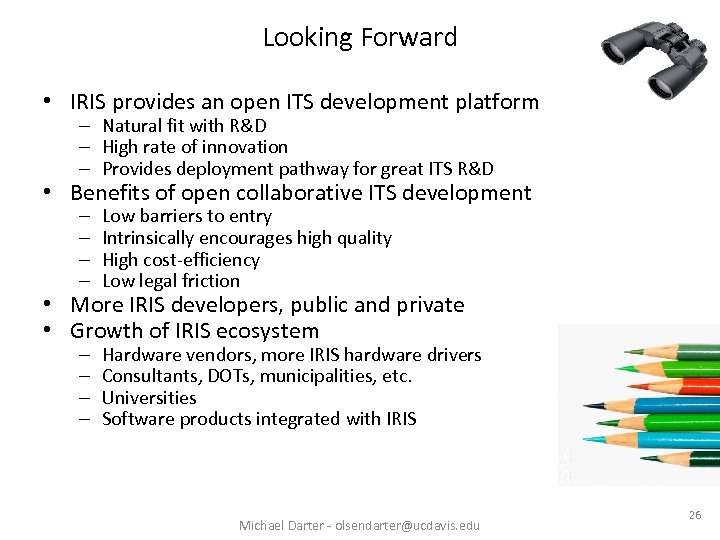 Looking Forward • IRIS provides an open ITS development platform – Natural fit with R&D – High rate of innovation – Provides deployment pathway for great ITS R&D • Benefits of open collaborative ITS development – – Low barriers to entry Intrinsically encourages high quality High cost-efficiency Low legal friction – – Hardware vendors, more IRIS hardware drivers Consultants, DOTs, municipalities, etc. Universities Software products integrated with IRIS • More IRIS developers, public and private • Growth of IRIS ecosystem Michael Darter - olsendarter@ucdavis. edu 26
 Resources • AHMCT – http: //iris. ahmct. ucdavis. edu – – – – IRIS ticket system FAQs Javadoc Documentation Code repositories Open ATMS Final Report Ty Lasky, talasky@ucdavis. edu Bahram Ravani, bravani@ucdavis. edu • Mn/DOT – http: //iris. dot. state. mn. us – Documentation – Repositories Michael Darter - olsendarter@ucdavis. edu 27