


 Скачать презентацию Open Shortest Path First — OSPF IP Routing
6aa3ac6b4a824533234f71797098160c.ppt
- Количество слайдов: 118
 Open Shortest Path First - OSPF IP Routing Jim Binkley 1
 Outline u overview u theory – database, sub-protocols, metrics/SPF, areas, LSAs u protocol headers u LSA formats u security u summary and study questions Jim Binkley 2
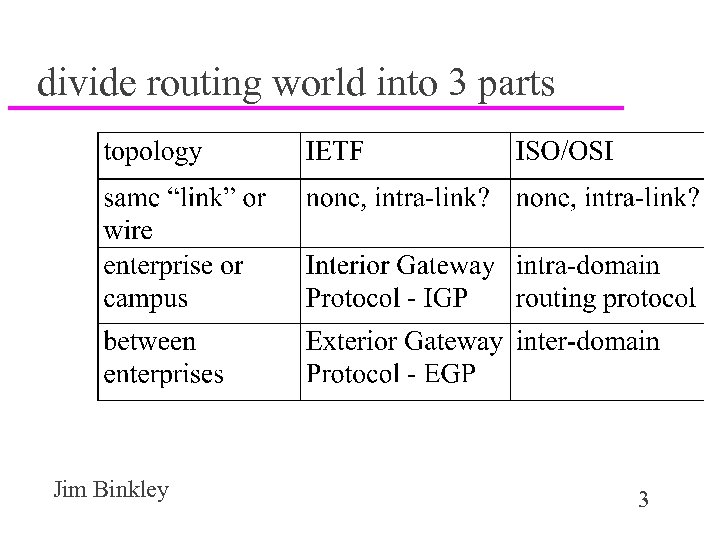 divide routing world into 3 parts Jim Binkley 3
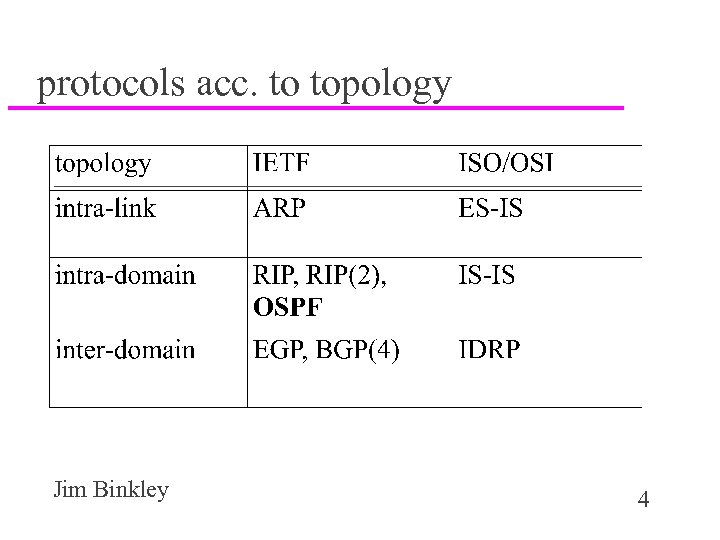 protocols acc. to topology Jim Binkley 4
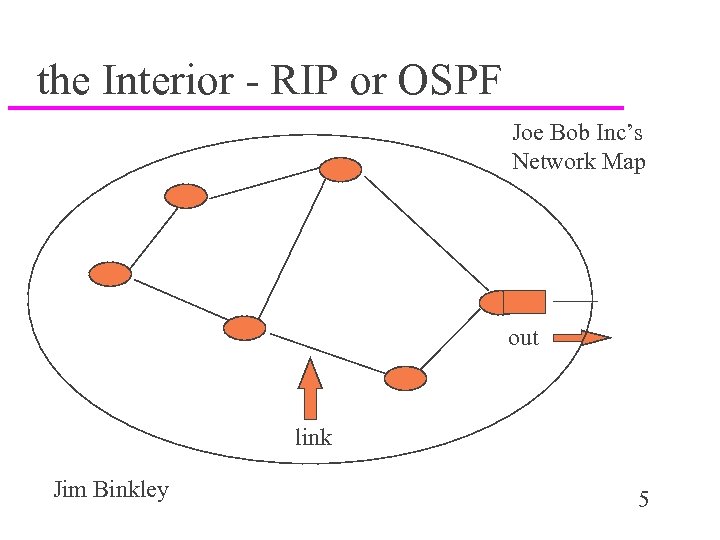 the Interior - RIP or OSPF Joe Bob Inc’s Network Map out link Jim Binkley 5
 Bibliography u RFCs of interest: (others exist, e. g. , MIB) – J. Moy, OSPF Version 2, 2328, 1998 – 2154, OSPF with Digital Signatures (experimental) – 2740, OSPF for IPv 6, R. Coltun, et. all, 1999 u books: – Moy, OSPF – Huitema, Routing in the Internet, c. 6 » “Why Is OSPF So Complex? ” Jim Binkley 6
 History (also Herstory) u Link-State protocols developed early on in history of ARPANET (late 70’s) (1 st DV, then LSP by BBN) – distributed map idea – reaction against DV ideas (or at least RIP) u ISO protocol suite developed IS-IS – IETF attitude was IS-IS == 0, not totally fair to ISO work – OSPF IETF IS-IS cousins and IS-IS predecessor u u Perlman suggested how to make flooding robust OSPF v 1 formulated, but not deployed – problems with distributed link-state database u v 2, RFC 1247, 1991, note v 1 didn’t happen Jim Binkley 7
 herstory, cont. (IS-IS is used) u u Moy in RFC 2328: “A link state algorithm has also been proposed for use as an ISO routing protocol. . The OSPF Working Group of the IETF has extended this work in developing the OSPF protocol”. note that due to existence of a good vendor implementation of IS-IS that speaks IP, there exist AS out there that use IS -IS with IP addresses – as opposed to CNLP ISO addresses (20 byte var. length) IDPR - link-state EGP. . . contention exists about whether it might replace BGP? not hop by hop, sophisticated policy Jim Binkley routing possible 8 u
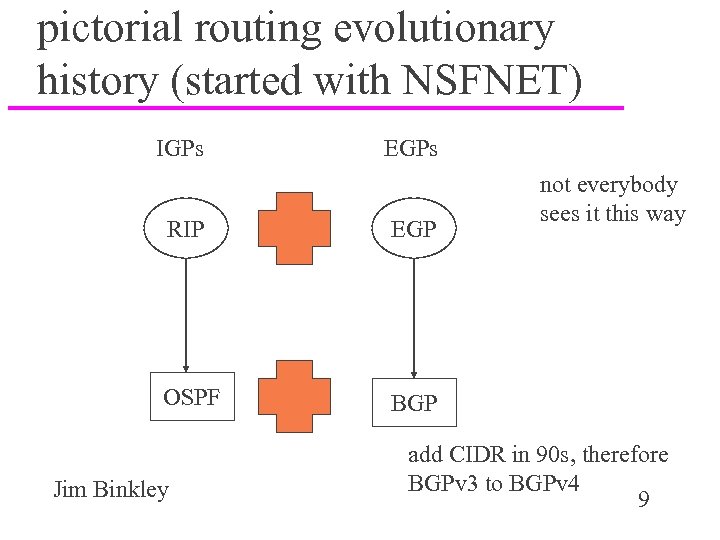 pictorial routing evolutionary history (started with NSFNET) IGPs EGPs RIP EGP OSPF not everybody sees it this way BGP Jim Binkley add CIDR in 90 s, therefore BGPv 3 to BGPv 4 9
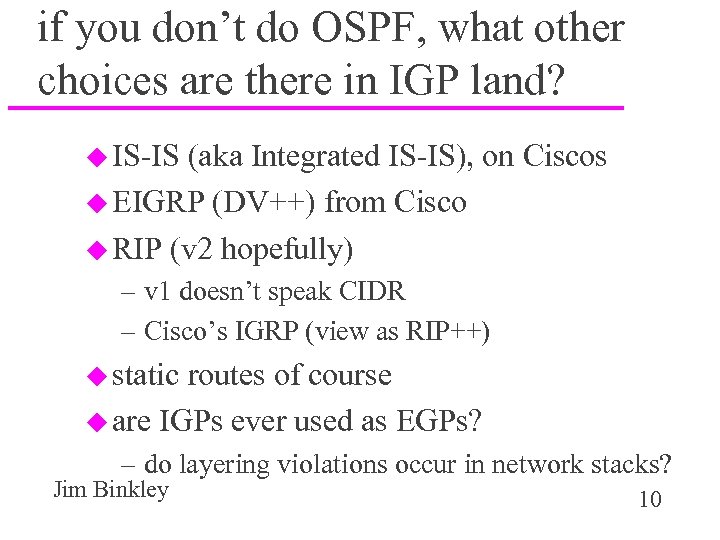 if you don’t do OSPF, what other choices are there in IGP land? u IS-IS (aka Integrated IS-IS), on Ciscos u EIGRP (DV++) from Cisco u RIP (v 2 hopefully) – v 1 doesn’t speak CIDR – Cisco’s IGRP (view as RIP++) u static routes of course u are IGPs ever used as EGPs? – do layering violations occur in network stacks? Jim Binkley 10
 OSPF terminology (from RFC) u AS - autonomous system, assume a group of centrally managed routers under one administrative control (has IP EGP meaning too of course) – aka routing domain u an AS runs an IGP u Router ID - 32 bit number assigned to each router running OSPF (guess which #? )f – must uniquely id router Jim Binkley 11
 terms u network - IP number/netmask pair; therefore subnet (or supernet) u networks come in several kinds acc. to OSPF – broadcast or not (come back to this) u interface – on a router, aka port, aka link but let’s reserve that for the “wire” u neighbor routers – two routers with a common link, formerly common network however (distinction is important) Jim Binkley 12
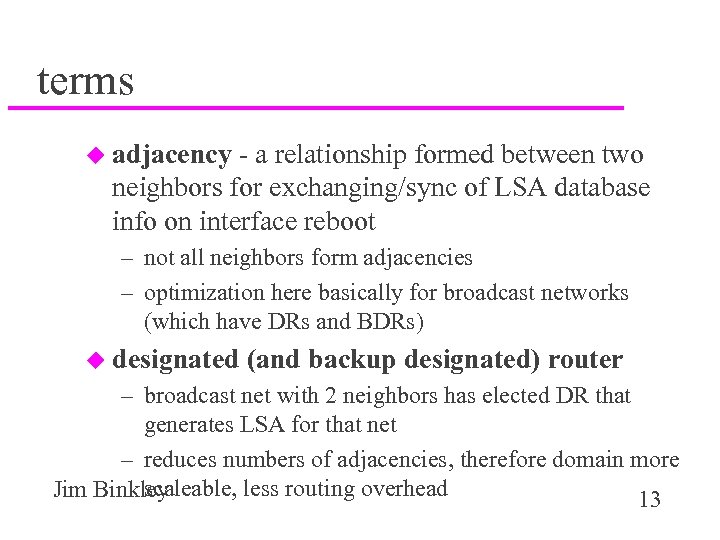 terms u adjacency - a relationship formed between two neighbors for exchanging/sync of LSA database info on interface reboot – not all neighbors form adjacencies – optimization here basically for broadcast networks (which have DRs and BDRs) u designated (and backup designated) router – broadcast net with 2 neighbors has elected DR that generates LSA for that net – reduces numbers of adjacencies, therefore domain more scaleable, less routing overhead Jim Binkley 13
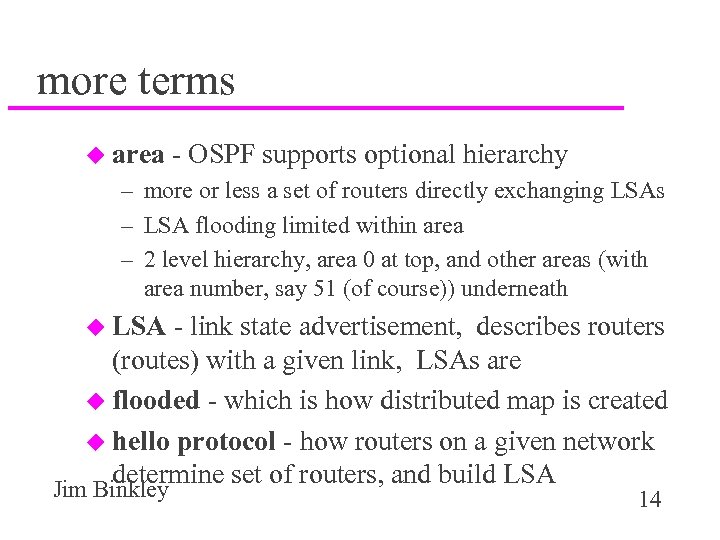 more terms u area - OSPF supports optional hierarchy – more or less a set of routers directly exchanging LSAs – LSA flooding limited within area – 2 level hierarchy, area 0 at top, and other areas (with area number, say 51 (of course)) underneath u LSA - link state advertisement, describes routers (routes) with a given link, LSAs are u flooded - which is how distributed map is created u hello protocol - how routers on a given network determine set of routers, and build LSA Jim Binkley 14
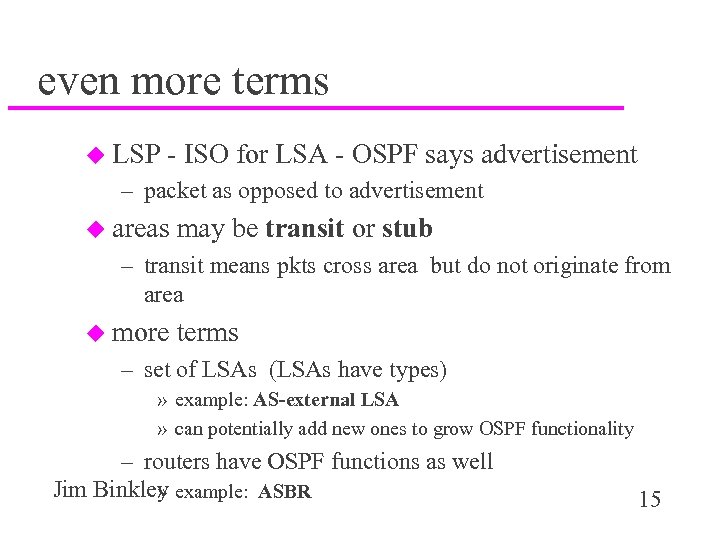 even more terms u LSP - ISO for LSA - OSPF says advertisement – packet as opposed to advertisement u areas may be transit or stub – transit means pkts cross area but do not originate from area u more terms – set of LSAs (LSAs have types) » example: AS-external LSA » can potentially add new ones to grow OSPF functionality – routers have OSPF functions as well Jim Binkley example: ASBR » 15
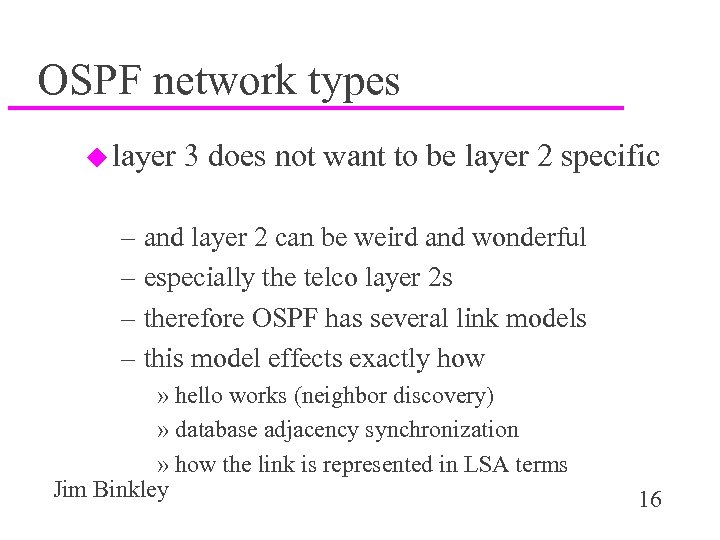 OSPF network types u layer 3 does not want to be layer 2 specific – and layer 2 can be weird and wonderful – especially the telco layer 2 s – therefore OSPF has several link models – this model effects exactly how » hello works (neighbor discovery) » database adjacency synchronization » how the link is represented in LSA terms Jim Binkley 16
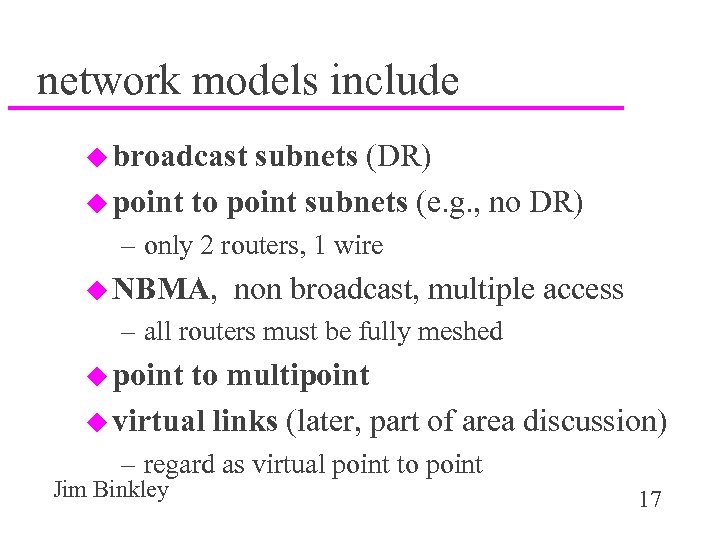 network models include u broadcast subnets (DR) u point to point subnets (e. g. , no DR) – only 2 routers, 1 wire u NBMA, non broadcast, multiple access – all routers must be fully meshed u point to multipoint u virtual links (later, part of area discussion) – regard as virtual point to point Jim Binkley 17
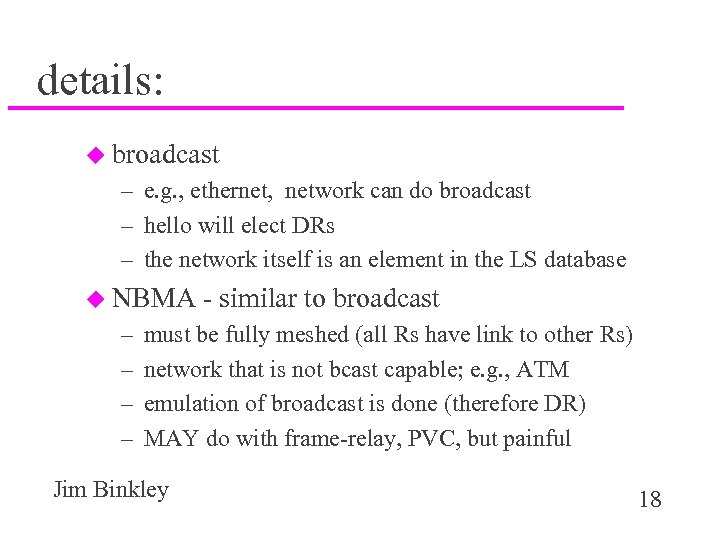 details: u broadcast – e. g. , ethernet, network can do broadcast – hello will elect DRs – the network itself is an element in the LS database u NBMA – – - similar to broadcast must be fully meshed (all Rs have link to other Rs) network that is not bcast capable; e. g. , ATM emulation of broadcast is done (therefore DR) MAY do with frame-relay, PVC, but painful Jim Binkley 18
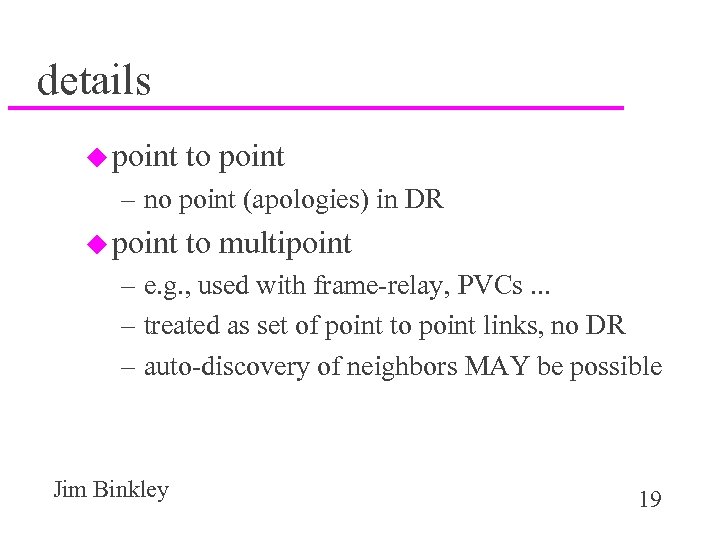 details u point to point – no point (apologies) in DR u point to multipoint – e. g. , used with frame-relay, PVCs. . . – treated as set of point to point links, no DR – auto-discovery of neighbors MAY be possible Jim Binkley 19
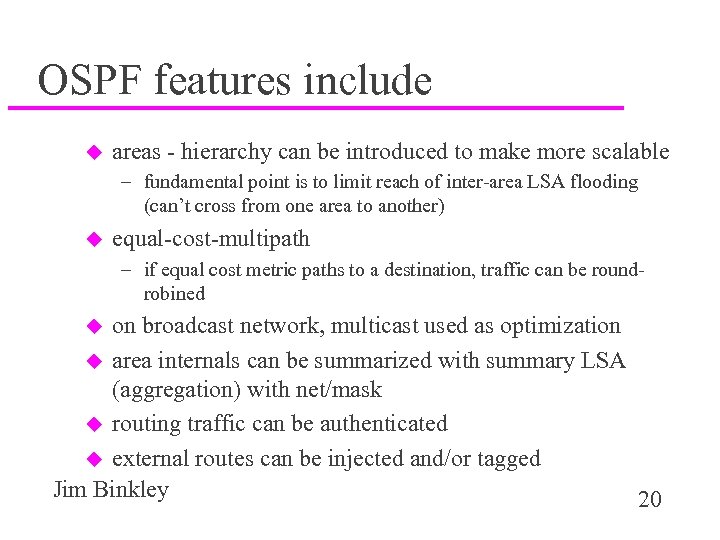 OSPF features include u areas - hierarchy can be introduced to make more scalable – fundamental point is to limit reach of inter-area LSA flooding (can’t cross from one area to another) u equal-cost-multipath – if equal cost metric paths to a destination, traffic can be roundrobined on broadcast network, multicast used as optimization u area internals can be summarized with summary LSA (aggregation) with net/mask u routing traffic can be authenticated u external routes can be injected and/or tagged Jim Binkley 20 u
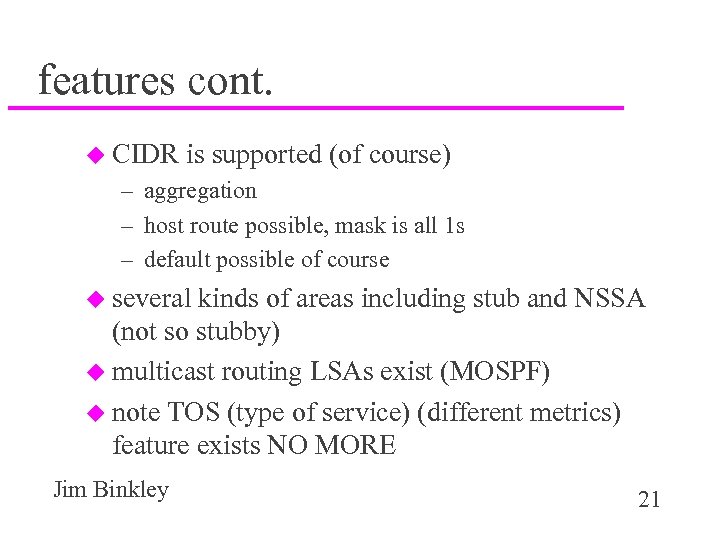 features cont. u CIDR is supported (of course) – aggregation – host route possible, mask is all 1 s – default possible of course u several kinds of areas including stub and NSSA (not so stubby) u multicast routing LSAs exist (MOSPF) u note TOS (type of service) (different metrics) feature exists NO MORE Jim Binkley 21
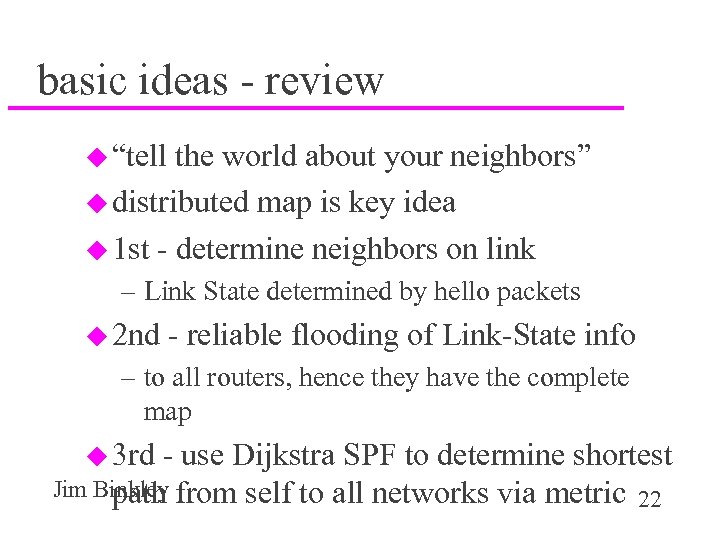 basic ideas - review u “tell the world about your neighbors” u distributed map is key idea u 1 st - determine neighbors on link – Link State determined by hello packets u 2 nd - reliable flooding of Link-State info – to all routers, hence they have the complete map u 3 rd - use Dijkstra SPF to determine shortest Jim Binkley from self to all networks via metric 22 path
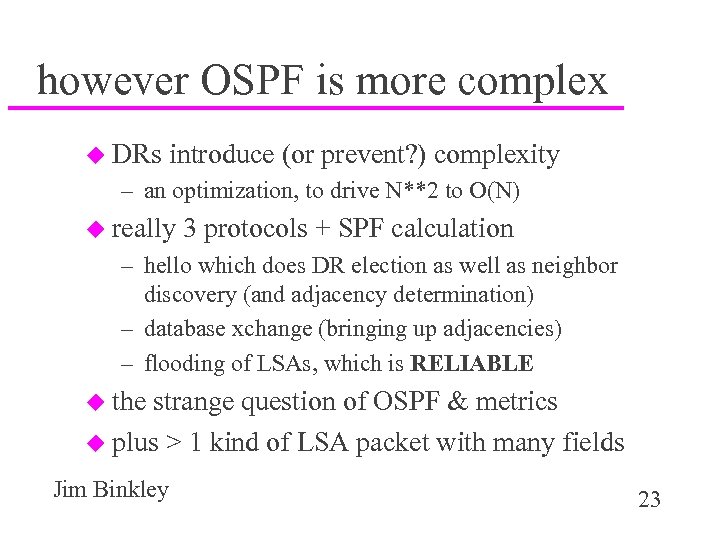 however OSPF is more complex u DRs introduce (or prevent? ) complexity – an optimization, to drive N**2 to O(N) u really 3 protocols + SPF calculation – hello which does DR election as well as neighbor discovery (and adjacency determination) – database xchange (bringing up adjacencies) – flooding of LSAs, which is RELIABLE u the strange question of OSPF & metrics u plus > 1 kind of LSA packet with many fields Jim Binkley 23
 theory overview u LSA database u flooding/sequence numbers u hello/bringing up adjacencies u metrics/Shortest Path First calculation u areas/types of routers u types of LSAs Jim Binkley 24
 LS database - theory u assume point to point for following discussion – note with broadcast net, networks themselves are LS database entries u the LS database consists of a set of LSAs flooded around the IGP domain u each LSA has a cost (metric) associated with it, for now assume metric function is additive and f(x) is good when low (could be good when high) u thus the LS database represents a directed graph for the IGP routing domain Jim Binkley 25
 and this point u LSA has originator (one router with unique router ID) u every other router in domain stores LSA in its LSA database – thus all have the same view – this is not quite totally true, as areas exist to contain LSA flooding – therefore true for routers in same area Jim Binkley 26
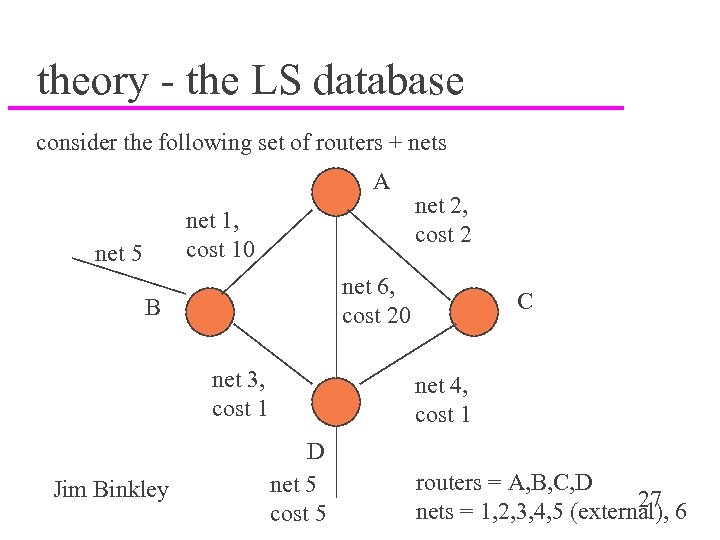 theory - the LS database consider the following set of routers + nets A net 1, cost 10 net 5 net 6, cost 20 B net 3, cost 1 Jim Binkley net 2, cost 2 C net 4, cost 1 D net 5 cost 5 routers = A, B, C, D 27 nets = 1, 2, 3, 4, 5 (external), 6
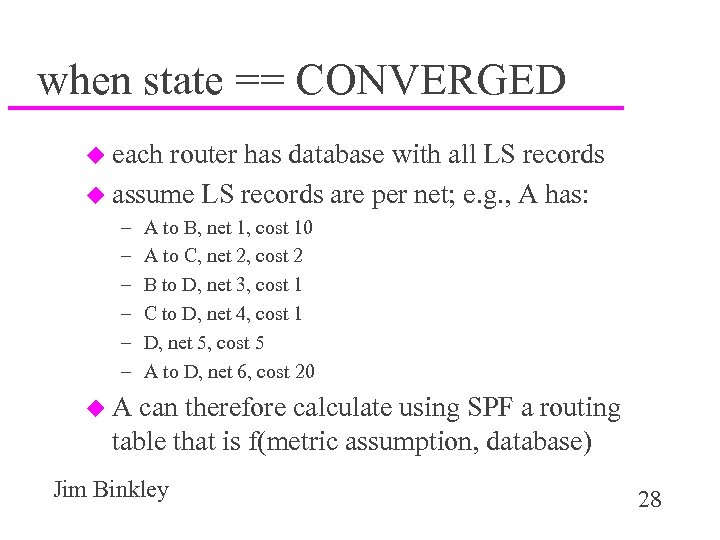 when state == CONVERGED u each router has database with all LS records u assume LS records are per net; e. g. , A has: – – – A to B, net 1, cost 10 A to C, net 2, cost 2 B to D, net 3, cost 1 C to D, net 4, cost 1 D, net 5, cost 5 A to D, net 6, cost 20 u. A can therefore calculate using SPF a routing table that is f(metric assumption, database) Jim Binkley 28
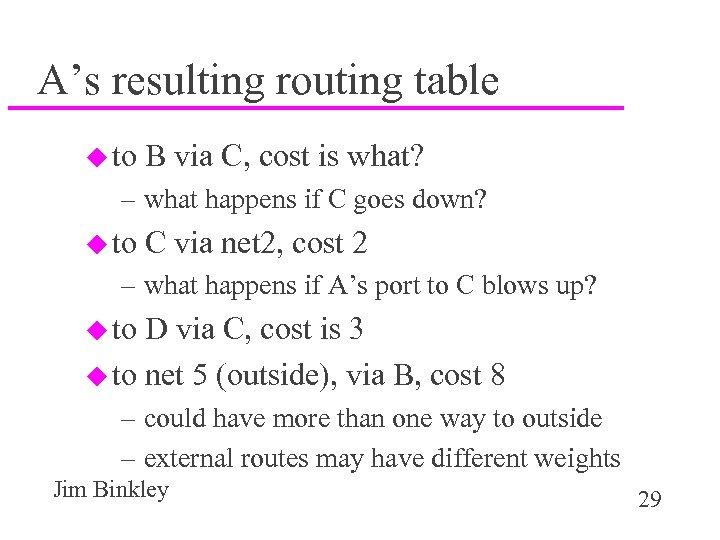 A’s resulting routing table u to B via C, cost is what? – what happens if C goes down? u to C via net 2, cost 2 – what happens if A’s port to C blows up? u to D via C, cost is 3 u to net 5 (outside), via B, cost 8 – could have more than one way to outside – external routes may have different weights Jim Binkley 29
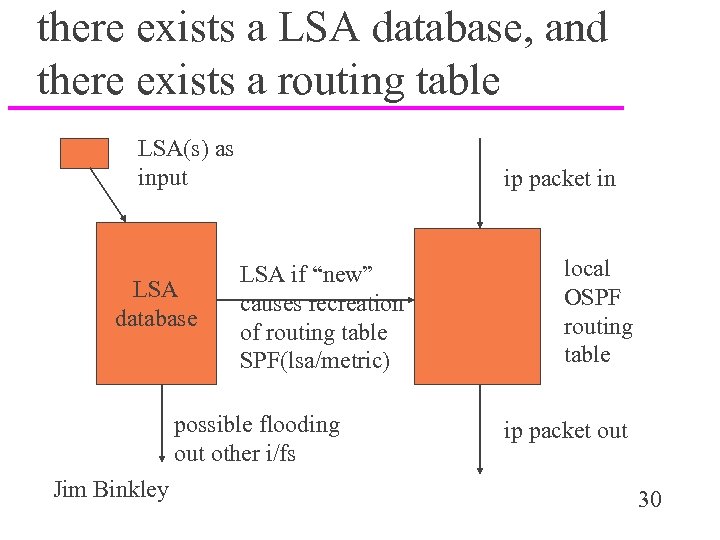 there exists a LSA database, and there exists a routing table LSA(s) as input LSA database ip packet in LSA if “new” causes recreation of routing table SPF(lsa/metric) possible flooding out other i/fs Jim Binkley local OSPF routing table ip packet out 30
 flooding u note that routers or interfaces may fail – interface UP or DOWN » a router can determine its own link has failed » or a neighbor may determine that a router has disappeared » these events can drive LSA generation u note that interfaces have a state machine associated with them – complicated by DR election, adjacencies, hw Jim Binkley knowledge events (link is down) 31
 flooding algorithm basics u flooding is reliable per link u if A/C net fails, A will notify other two links u B e. g. , will tell D but will NOT tell A (don’t send it back thru input i/f) u B will add message to its DB and recompute routing table iff u LSA is more recent, not corrupt, known type u updates would cross from B to/from D, but D would not in turn then forward the pkt to A Jim Binkley 32
 flooding mechanics u protocol includes per link ACK – resend until ACK heard therefore reliable – ACK is optimized in several ways and e. g. , not sent when updates cross – recv may delay in hopes that ACK (may be unicast or multicast) may include multiple ACKs u we need checksum/sequence # pair as well – sequence number must have “overflow” Jim Binkley technique 33
 checksum/sequence # all OSPF packets include checksum and other robustness features in face of errors, hdr has IP csum, LSA has csum too u OSPF does not use spanning tree, but floods which is inherently redundant u router might accidentally delete LSA, therefore originator must refresh LSA on 30 minute basis u pkt discarded if csum fails, checksum not altered by others, (LSA csum excludes age field) u 3 tuple for freshness (csum, sequence number, age #) u every router increments age, hence like IP TTL Jim Binkley – discard at Max. Age 34 u
 freshness, robustness, etc. u rate limit LSA origination, at most 1 per 5 secs u router periodically verifies LSA csums in DB. guards against internal memory failures u originator sends (checksum, seq+1, age=0) u if stored in other R db, age is incremented as it passes through, and over time by timeout function u if 1 hour passes, and no resend, then LSA is tossed (why wait 30 minutes? ) u sequence space WRAP is velly tricky. . . Jim Binkley 35
 sequence space wrap u in ARPANET, LS protocol had famous sequence # failure – in theory Sn+1 > Sn, but unfortunately S 1 > S 2 > S 3 > S 1 happened – entire network had to be power-cycled u v 1 had lollipop algorithm – calculation still felt to be problematic u therefore Jim Binkley v 2 does not wrap. . . 36
 v 2 sequence idea u we have reliable flooding, therefore originator reliably REMOVES LSA from domain, and regenerates it at wrap time u S 0 is Initial. Sequence. Number, max negative, in hex 0 x 800000001, u increment by one until 0 x 7 fffffff, but 1 st u flood deletion with S(max), then send S 0 u in theory, 600 years of time. . . but errors Jim Binkley occur could 37
 hello/bringing up adjacencies u hello is neighbor discovery packet u therefore has these functions – link operational (peers exist) – elect Designated R and BDR on broadcast links u hello sent at default 10 seconds u on write sent to 224. 0. 0. 5 (all-SPF-routers) u list of neighbors are included (i can hear you) – basically this is an ACK, link must be bi-directional u router. Dead. Interval, 40 seconds - must hear from Jim Binkley neighbor within this time, else route around 38
 hello, cont. u decide link is operational iff – other guy has you in its hello – if pt/pt, that is enough – if broadcast, must wait for DR election u election algorithm ideas: – priority field and IP address used as discriminators – highest priority wins, if > 1 with same priority, highest IP wins – always keep DR and BDR, if DR fails, BDR is DR Jim Binkley 39
 election algorithm roughly u if more than one BDR, choose based on 1. priority/2. high IP address is tiebreaker u if no backup, choose based on priority/IP u if > 1 DR, choose based on priority/IP u if no DRs, and BDR, promote BDR u key idea: DRs and BDRs must do database exchange with all other routers on subnet – non DR is adjacent to DR Jim Binkley 40
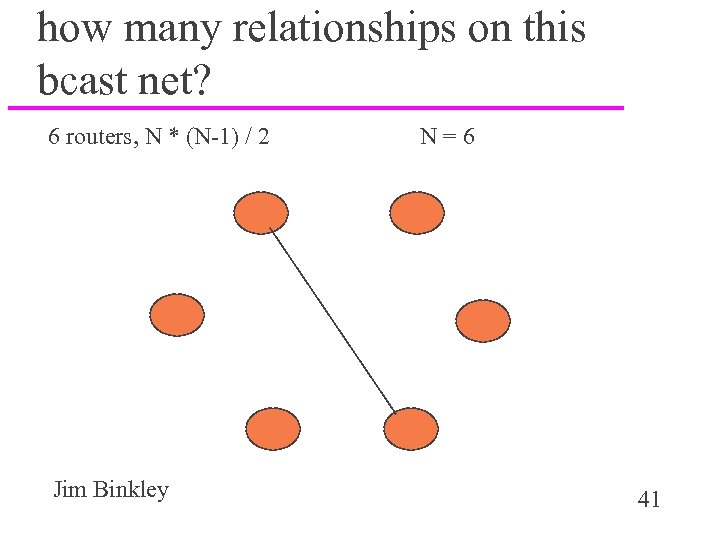 how many relationships on this bcast net? 6 routers, N * (N-1) / 2 Jim Binkley N=6 41
 DR points/are these u non DR routers keep LSA databases in sync with DR using – database exchange (I booted, give me all you got) – reliable flooding – single point of failure, therefore BDR is hot standby – routers must sync with BDR too – this makes complexity linear Jim Binkley 42
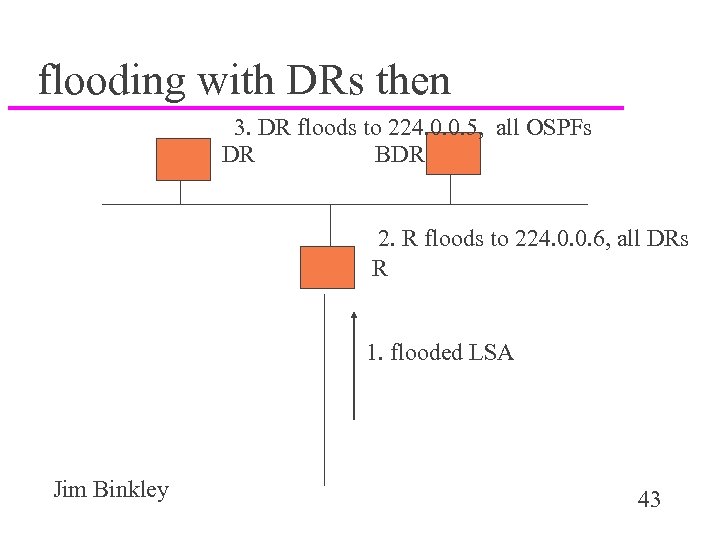 flooding with DRs then 3. DR floods to 224. 0. 0. 5, all OSPFs DR BDR 2. R floods to 224. 0. 0. 6, all DRs R 1. flooded LSA Jim Binkley 43
 database sync u could come from LSA flooding alone u we MUST keep routers in sync with LSA maps u else we risk routing loops, black holes u optimization: at boot, exchange map with adjacent router, or do this at partition fixup u call this database exchange Jim Binkley 44
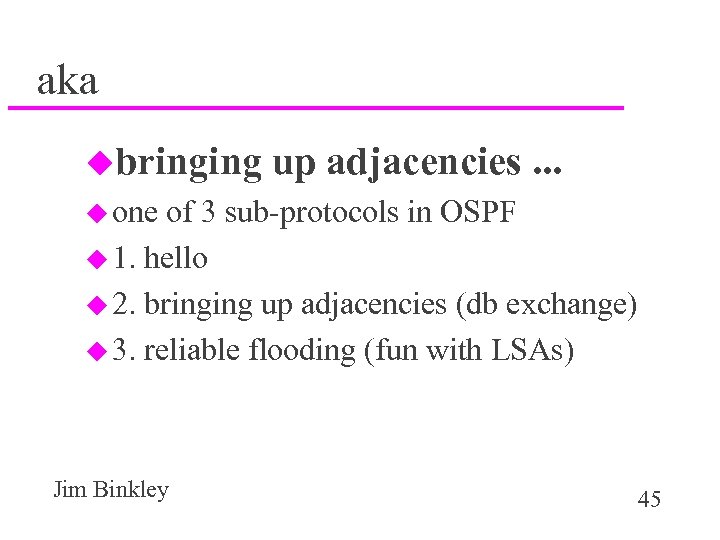 aka ubringing up adjacencies. . . u one of 3 sub-protocols in OSPF u 1. hello u 2. bringing up adjacencies (db exchange) u 3. reliable flooding (fun with LSAs) Jim Binkley 45
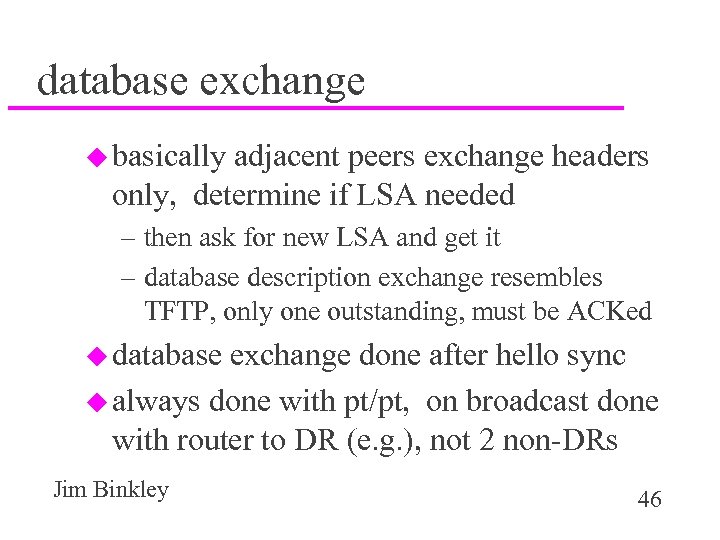 database exchange u basically adjacent peers exchange headers only, determine if LSA needed – then ask for new LSA and get it – database description exchange resembles TFTP, only one outstanding, must be ACKed u database exchange done after hello sync u always done with pt/pt, on broadcast done with router to DR (e. g. ), not 2 non-DRs Jim Binkley 46
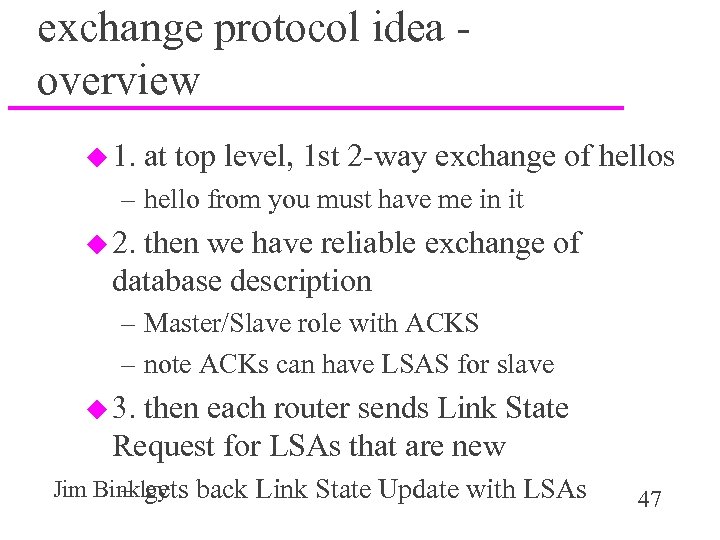 exchange protocol idea overview u 1. at top level, 1 st 2 -way exchange of hellos – hello from you must have me in it u 2. then we have reliable exchange of database description – Master/Slave role with ACKS – note ACKs can have LSAS for slave u 3. then each router sends Link State Request for LSAs that are new Jim Binkley back Link State Update with LSAs – gets 47
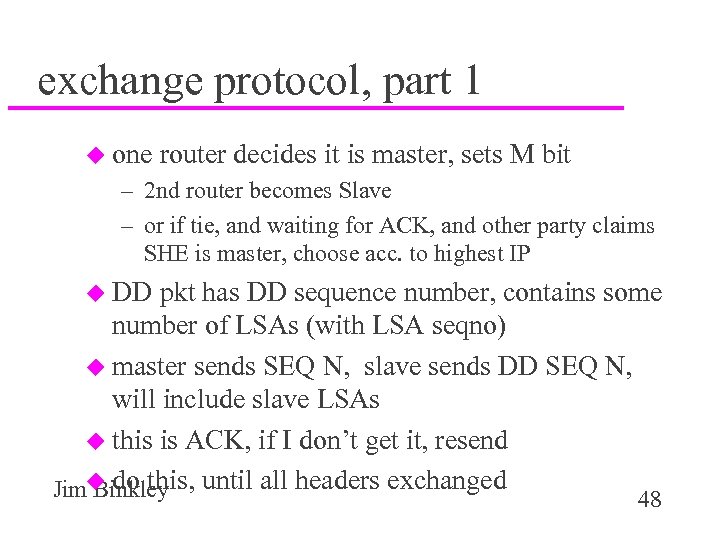 exchange protocol, part 1 u one router decides it is master, sets M bit – 2 nd router becomes Slave – or if tie, and waiting for ACK, and other party claims SHE is master, choose acc. to highest IP u DD pkt has DD sequence number, contains some number of LSAs (with LSA seqno) u master sends SEQ N, slave sends DD SEQ N, will include slave LSAs u this is ACK, if I don’t get it, resend Jimu do this, until all headers exchanged Binkley 48
 part 2, exchange LSAs u send OSPF LSA request, which may include multiple LSAS needed – LSA ID includes LSA sequence number u send OSPF LSA update for LSA that the other party actually wants – this is more or less, ordinary flooding, but can obviousally include multiple LSAs of interest Jim Binkley 49
 metric/routing table calculation u OSPF metric theory: – assume single metric and not dynamic – metric must be integer 1. . 64 k (16 bit LSA field) – metric in theory OPAQUE; ideal is that admin decides and might have choices: (implementations!!!) – must be additive, smaller the better (acc. to Moy) – e. g. , might be hop count, delay, mumble – OSPF MIB suggests transmission time – metric is used in routing table calculation (doh!) Jim Binkley 50
 Cisco metric reality u we weight the numbers to make bigger thruput better u e. g. , if the fastest link is 100 BASE ethernet, choose 100, 000, therefore u 100 BASE ethernet has weight 1 u 10 BASE has weight 10 u thus, choose 100 BASE over 10 BASE – RIP can’t do that Jim Binkley 51
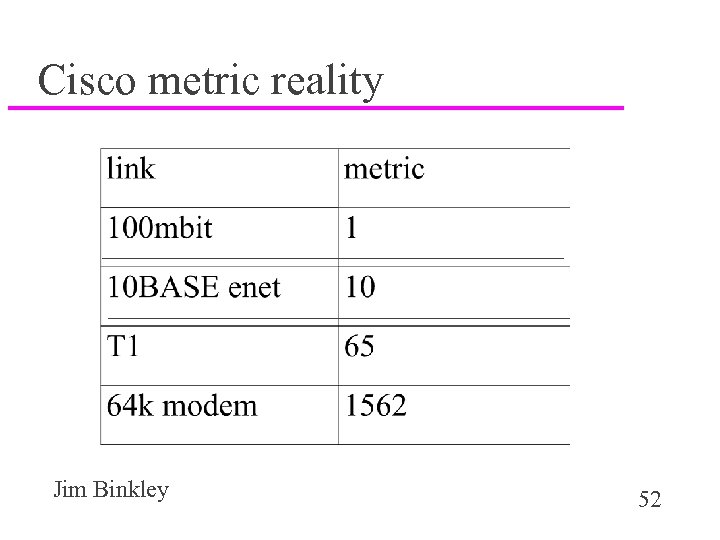 Cisco metric reality Jim Binkley 52
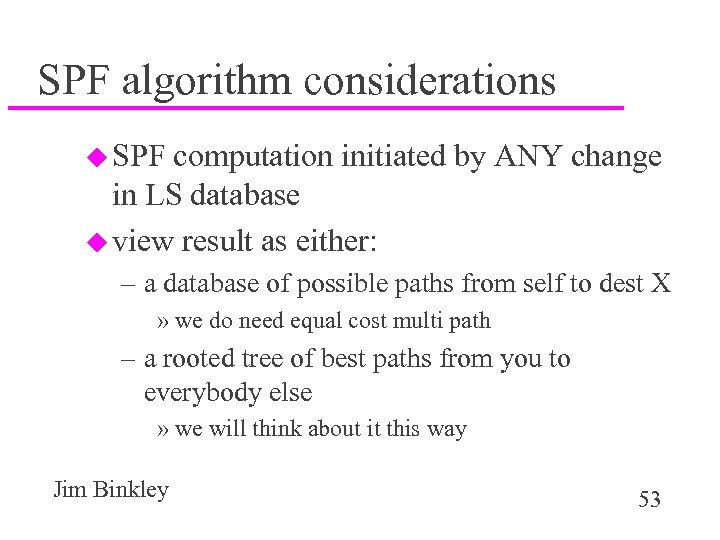 SPF algorithm considerations u SPF computation initiated by ANY change in LS database u view result as either: – a database of possible paths from self to dest X » we do need equal cost multi path – a rooted tree of best paths from you to everybody else » we will think about it this way Jim Binkley 53
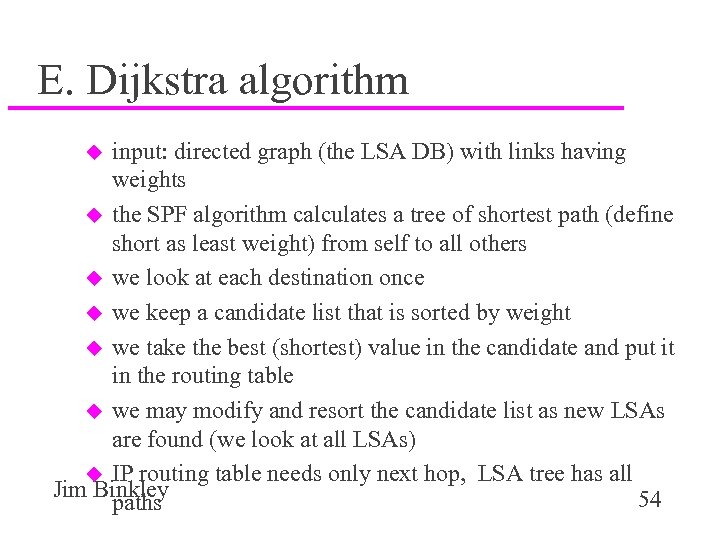 E. Dijkstra algorithm input: directed graph (the LSA DB) with links having weights u the SPF algorithm calculates a tree of shortest path (define short as least weight) from self to all others u we look at each destination once u we keep a candidate list that is sorted by weight u we take the best (shortest) value in the candidate and put it in the routing table u we may modify and resort the candidate list as new LSAs are found (we look at all LSAs) u IP routing table needs only next hop, LSA tree has all Jim Binkley 54 paths u
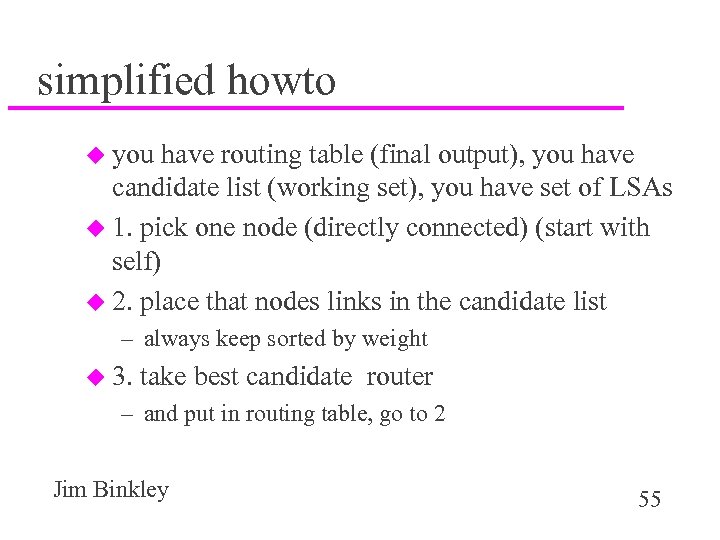 simplified howto u you have routing table (final output), you have candidate list (working set), you have set of LSAs u 1. pick one node (directly connected) (start with self) u 2. place that nodes links in the candidate list – always keep sorted by weight u 3. take best candidate router – and put in routing table, go to 2 Jim Binkley 55
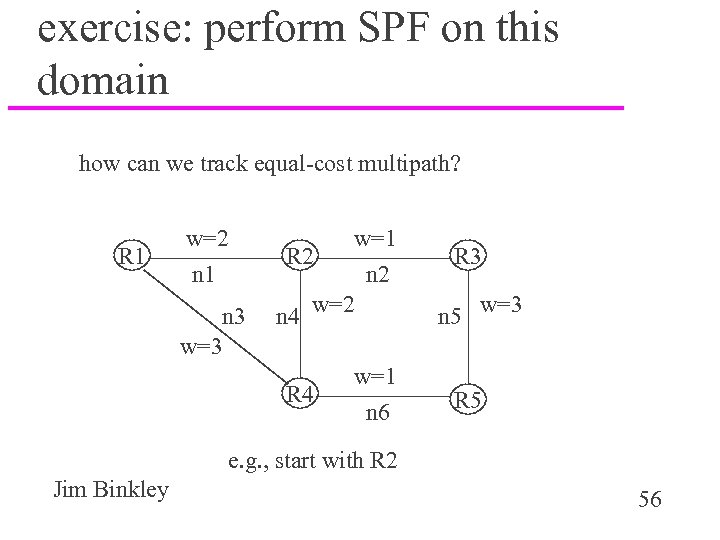 exercise: perform SPF on this domain how can we track equal-cost multipath? R 1 w=2 n 1 n 3 w=1 R 2 n 4 w=2 R 4 w=1 n 6 R 3 n 5 w=3 R 5 e. g. , start with R 2 Jim Binkley 56
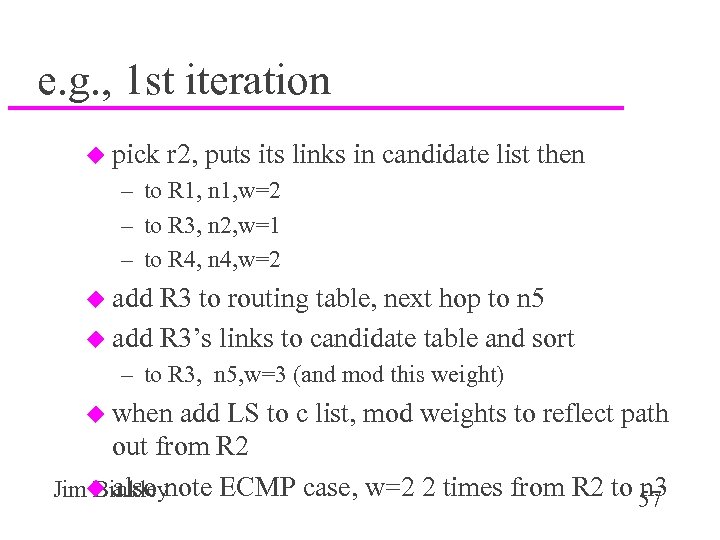 e. g. , 1 st iteration u pick r 2, puts its links in candidate list then – to R 1, n 1, w=2 – to R 3, n 2, w=1 – to R 4, n 4, w=2 u add R 3 to routing table, next hop to n 5 u add R 3’s links to candidate table and sort – to R 3, n 5, w=3 (and mod this weight) u when add LS to c list, mod weights to reflect path out from R 2 n 3 Jimu also note ECMP case, w=2 2 times from R 2 to 57 Binkley
 algorithmic complexity u shortest path is links * nodes * log node count u we keep candidate list sorted, therefore toss log node u if we have DR, we have one node elected for N nodes on link, and can therefore further optimize # of LSAs sent u this gives us more or less: N log N, where N is # of nodes u on paper, Bellman-Ford is N 2, SPF may be better depending on net topology Jim Binkley 58
 areas u OSPF can have optional hierarchy, areas – 2 levels only u must have backbone area, area 0 – level 2 in ISO speak u interface must belong to area, router can be ABR or Area Border Router – 2 i/fs in different areas – if all i/fs in same area, then ordinary area router Jim Binkley 59
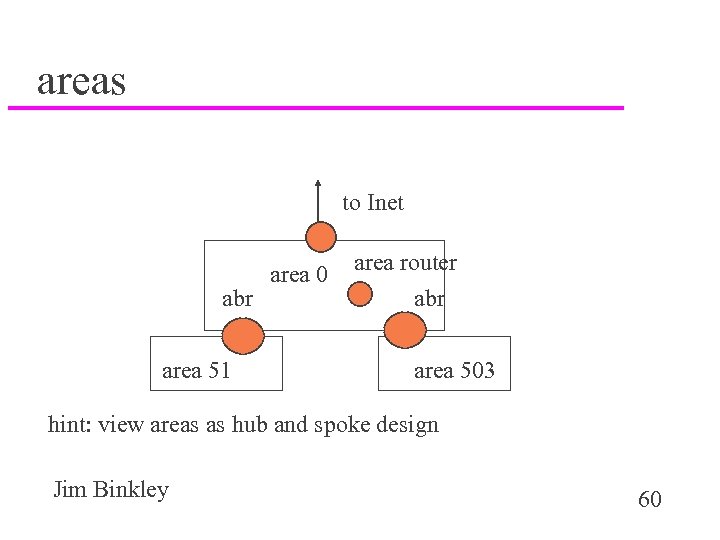 areas to Inet abr area 51 area 0 area router abr area 503 hint: view areas as hub and spoke design Jim Binkley 60
 why bother? u scalability if many routers, many LSAs – areas can limit LSA flooding – ordinary LSAS stay within area (router and net LSAs) u the latter point may be useful for reliability/redundancy – contain other administrations mistakes. . . LSAS you don’t want or need - they do cause SPF to happen in your routers u ABRs can aggregate routes in/out of area – summarize routing table as opposed to individual nets Jim Binkley 61
 assume we have 10. 0/8 u area 51 might have nets 10. 0 and 10. 1/16 u therefore the ABR could advertise – 10. 0/15 into area 0 – as opposed to many smaller subnets u it might advertise the default route into area 51 Jim Binkley 62
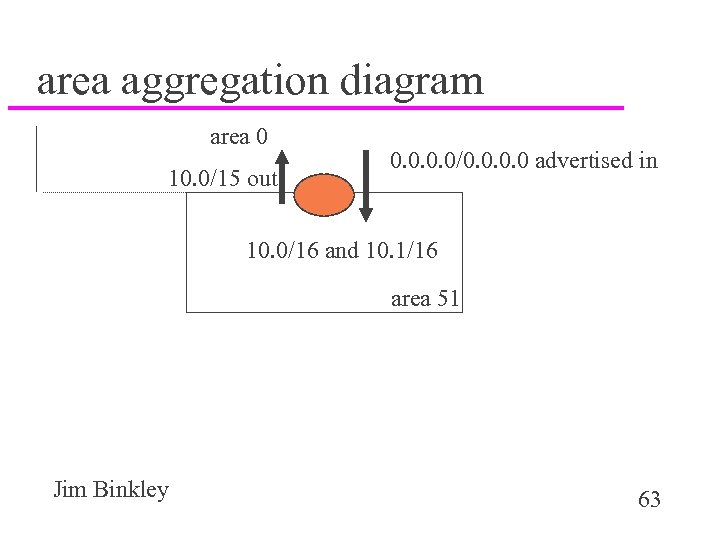 area aggregation diagram area 0 10. 0/15 out 0. 0/0. 0 advertised in 10. 0/16 and 10. 1/16 area 51 Jim Binkley 63
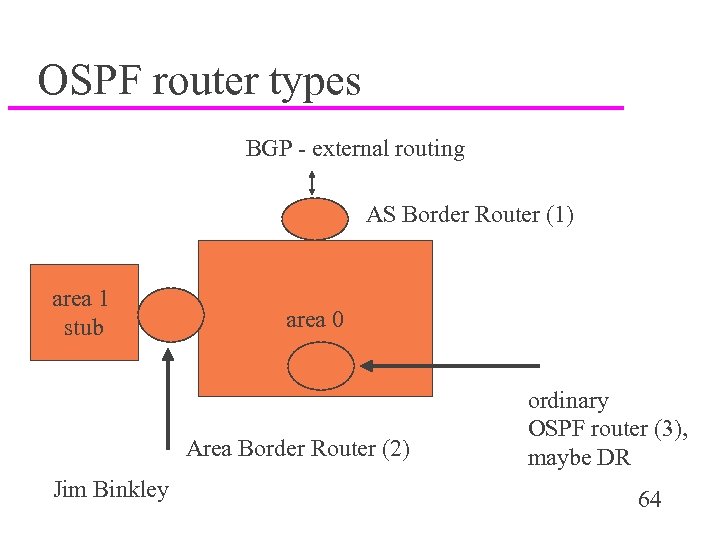 OSPF router types BGP - external routing AS Border Router (1) area 1 stub area 0 Area Border Router (2) Jim Binkley ordinary OSPF router (3), maybe DR 64
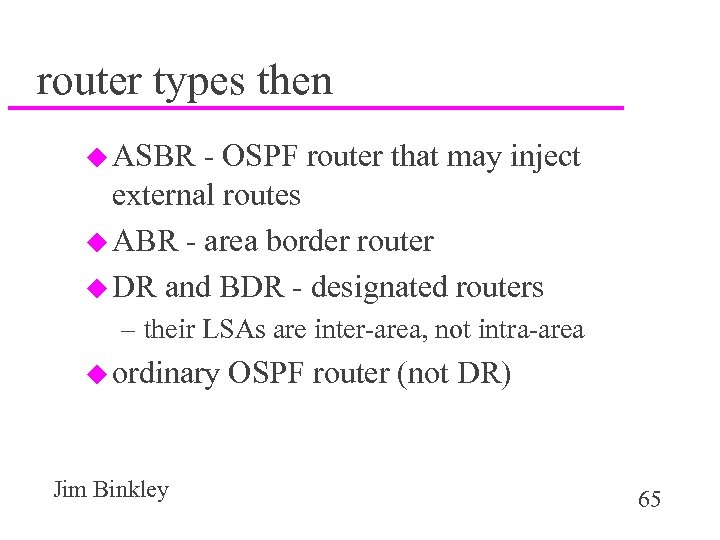 router types then u ASBR - OSPF router that may inject external routes u ABR - area border router u DR and BDR - designated routers – their LSAs are inter-area, not intra-area u ordinary Jim Binkley OSPF router (not DR) 65
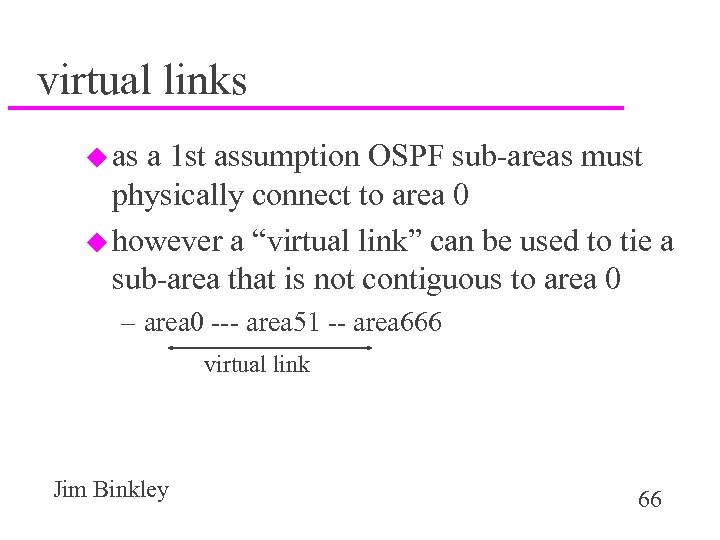 virtual links u as a 1 st assumption OSPF sub-areas must physically connect to area 0 u however a “virtual link” can be used to tie a sub-area that is not contiguous to area 0 – area 0 --- area 51 -- area 666 virtual link Jim Binkley 66
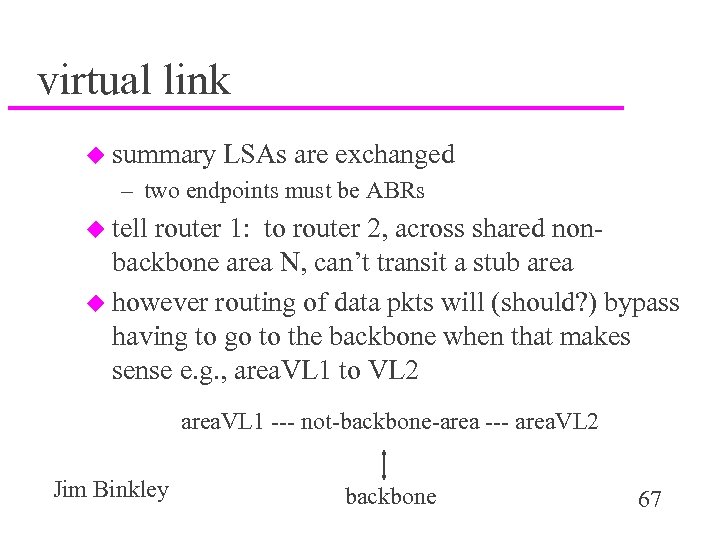 virtual link u summary LSAs are exchanged – two endpoints must be ABRs u tell router 1: to router 2, across shared nonbackbone area N, can’t transit a stub area u however routing of data pkts will (should? ) bypass having to go to the backbone when that makes sense e. g. , area. VL 1 to VL 2 area. VL 1 --- not-backbone-area --- area. VL 2 Jim Binkley backbone 67
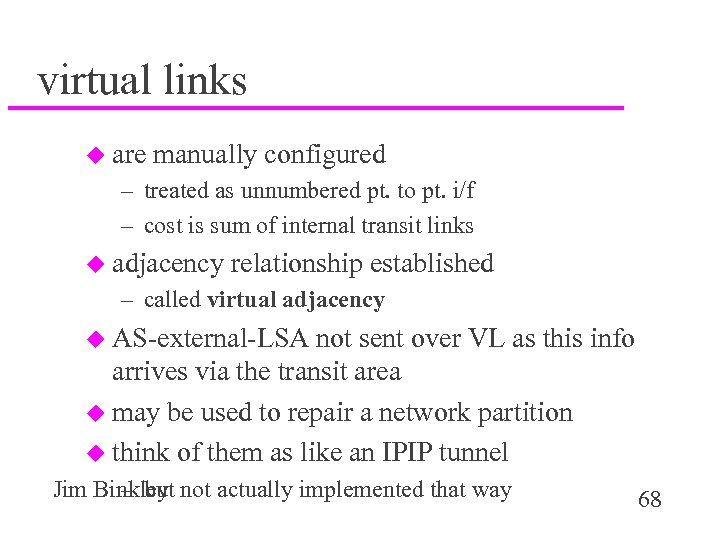 virtual links u are manually configured – treated as unnumbered pt. to pt. i/f – cost is sum of internal transit links u adjacency relationship established – called virtual adjacency u AS-external-LSA not sent over VL as this info arrives via the transit area u may be used to repair a network partition u think of them as like an IPIP tunnel Jim Binkley not actually implemented that way – but 68
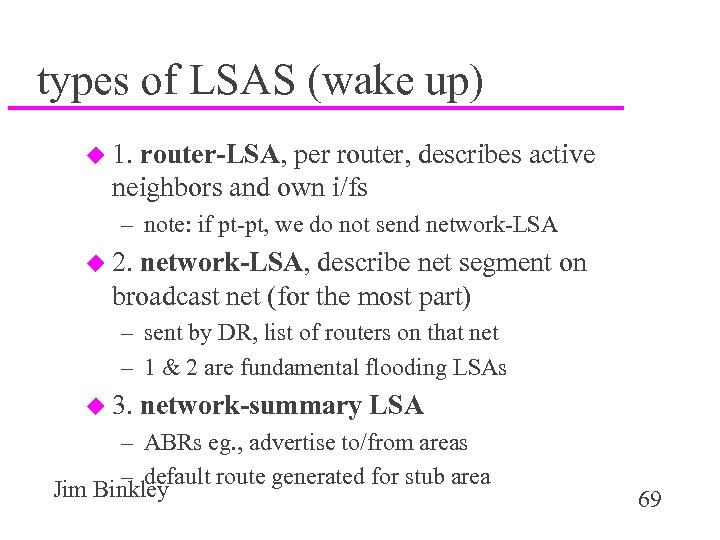 types of LSAS (wake up) u 1. router-LSA, per router, describes active neighbors and own i/fs – note: if pt-pt, we do not send network-LSA u 2. network-LSA, describe net segment on broadcast net (for the most part) – sent by DR, list of routers on that net – 1 & 2 are fundamental flooding LSAs u 3. network-summary LSA – ABRs eg. , advertise to/from areas – default route generated for stub area Jim Binkley 69
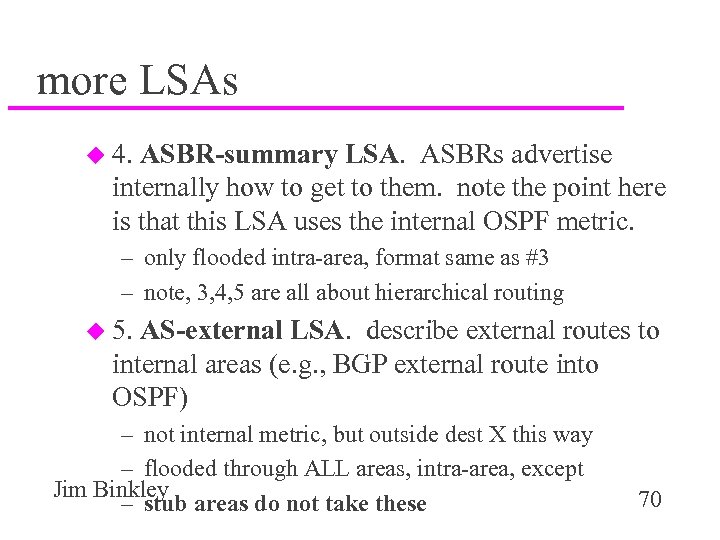 more LSAs u 4. ASBR-summary LSA. ASBRs advertise internally how to get to them. note the point here is that this LSA uses the internal OSPF metric. – only flooded intra-area, format same as #3 – note, 3, 4, 5 are all about hierarchical routing u 5. AS-external LSA. describe external routes to internal areas (e. g. , BGP external route into OSPF) – not internal metric, but outside dest X this way – flooded through ALL areas, intra-area, except Jim Binkley – stub areas do not take these 70
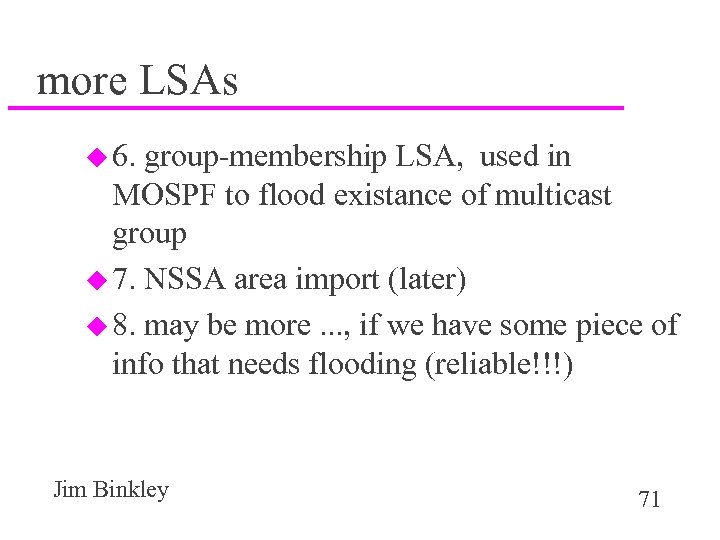 more LSAs u 6. group-membership LSA, used in MOSPF to flood existance of multicast group u 7. NSSA area import (later) u 8. may be more. . . , if we have some piece of info that needs flooding (reliable!!!) Jim Binkley 71
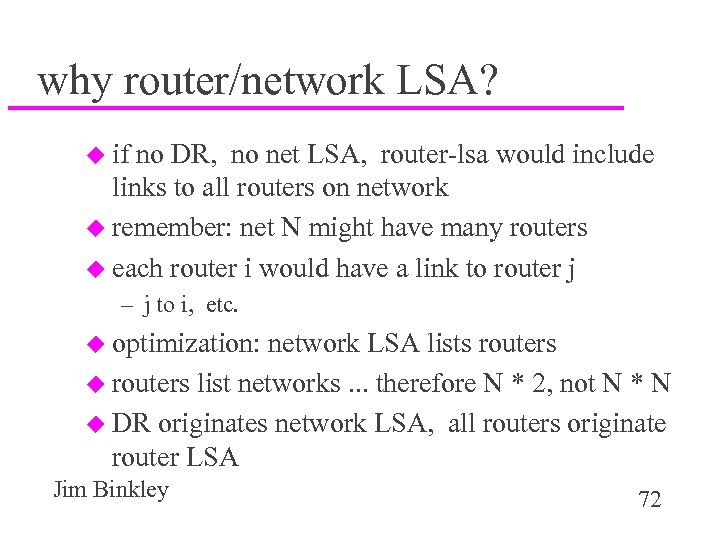 why router/network LSA? u if no DR, no net LSA, router-lsa would include links to all routers on network u remember: net N might have many routers u each router i would have a link to router j – j to i, etc. u optimization: network LSA lists routers u routers list networks. . . therefore N * 2, not N * N u DR originates network LSA, all routers originate router LSA Jim Binkley 72
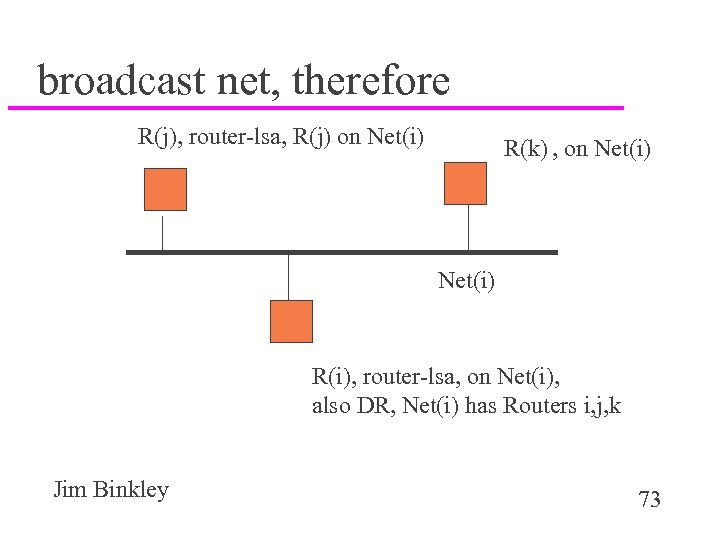 broadcast net, therefore R(j), router-lsa, R(j) on Net(i) R(k) , on Net(i) R(i), router-lsa, on Net(i), also DR, Net(i) has Routers i, j, k Jim Binkley 73
 summary LSAs u 3, 4, 5 all deal with areas u 3 for area aggregation u 4, 5 for routing info needed for routing domain external routes – 4 says how to get to ASBR – 5 says here is a route beyond the ASBR/s – keep in mind possible > 1 ASBR Jim Binkley 74
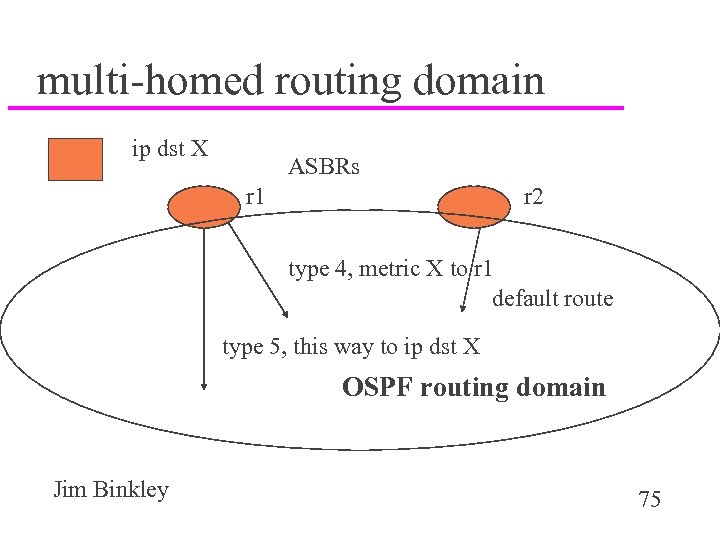 multi-homed routing domain ip dst X ASBRs r 1 r 2 type 4, metric X to r 1 default route type 5, this way to ip dst X OSPF routing domain Jim Binkley 75
 types of areas u ordinary joe bob area (this is about stub areas really, so this is NOT a stub area) – non area 0 router CAN be ASBR u stub area – no transit traffic, no virtual links – does not accept external LSA, no ASBRs – only one way out – consumes least resources Jimu not so Binkley stubby area (NSSA) 76
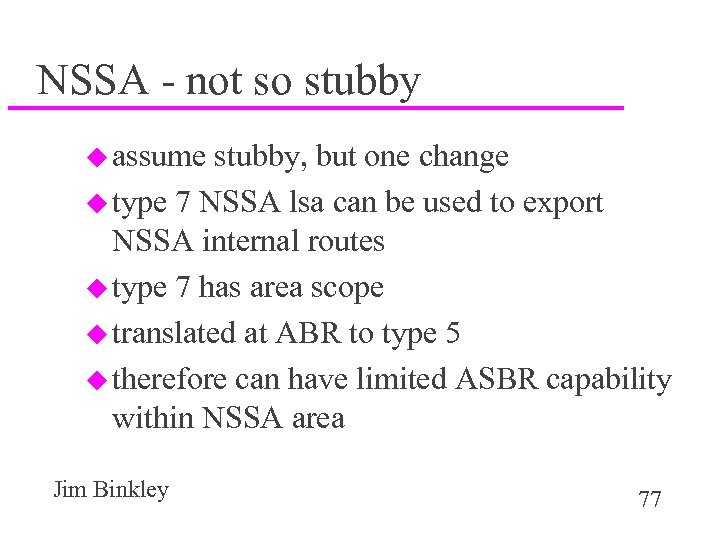 NSSA - not so stubby u assume stubby, but one change u type 7 NSSA lsa can be used to export NSSA internal routes u type 7 has area scope u translated at ABR to type 5 u therefore can have limited ASBR capability within NSSA area Jim Binkley 77
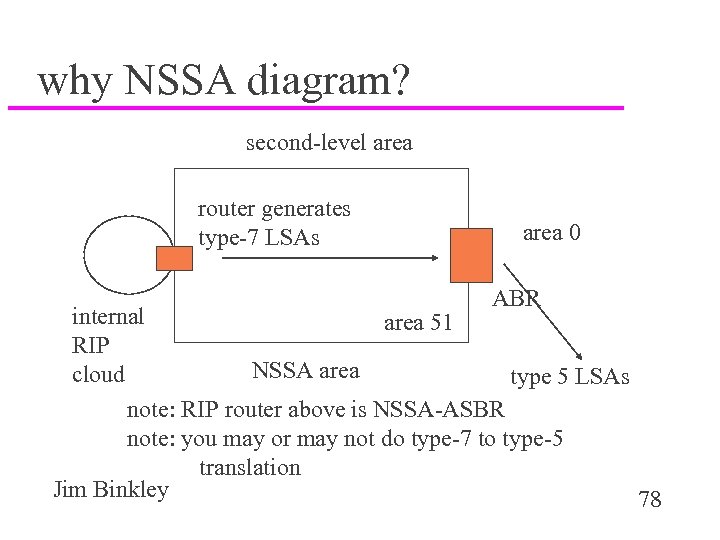 why NSSA diagram? second-level area router generates type-7 LSAs area 0 ABR internal area 51 RIP NSSA area cloud type 5 LSAs note: RIP router above is NSSA-ASBR note: you may or may not do type-7 to type-5 translation Jim Binkley 78
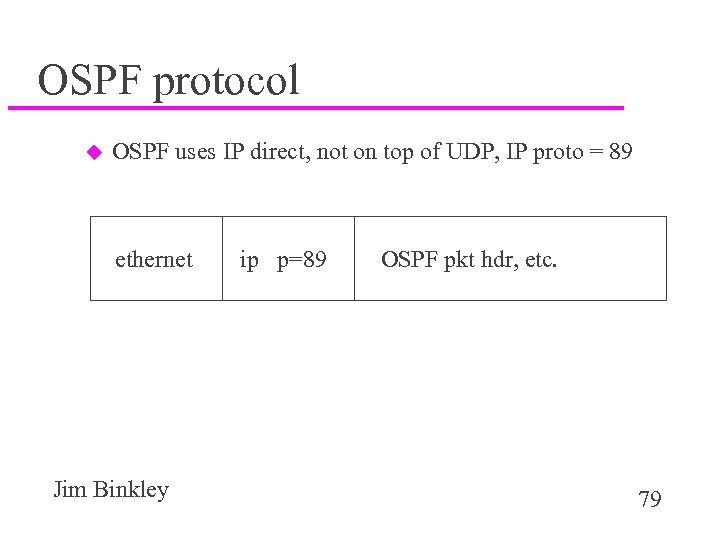 OSPF protocol u OSPF uses IP direct, not on top of UDP, IP proto = 89 ethernet Jim Binkley ip p=89 OSPF pkt hdr, etc. 79
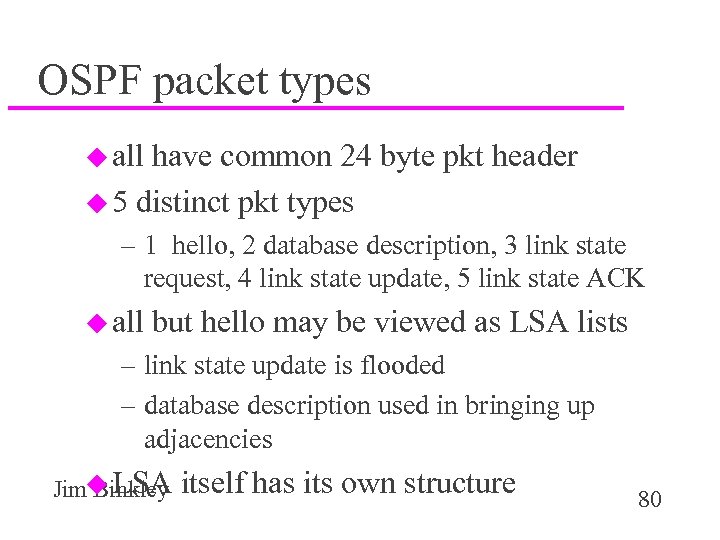 OSPF packet types u all have common 24 byte pkt header u 5 distinct pkt types – 1 hello, 2 database description, 3 link state request, 4 link state update, 5 link state ACK u all but hello may be viewed as LSA lists – link state update is flooded – database description used in bringing up adjacencies Jimu LSA Binkley itself has its own structure 80
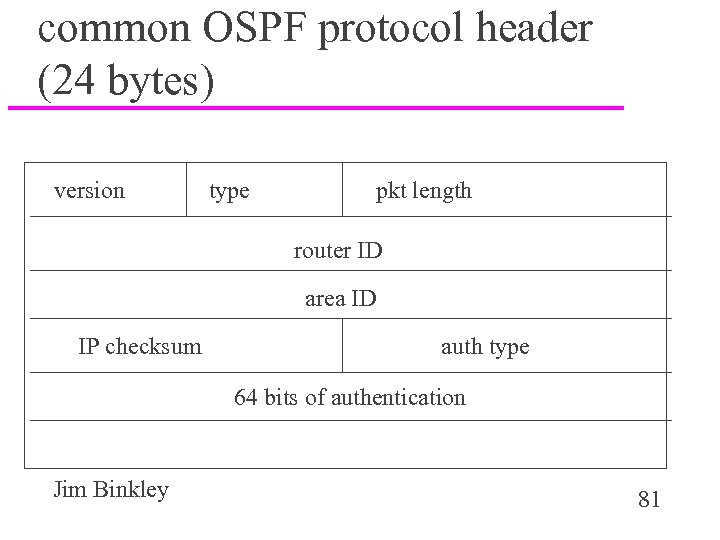 common OSPF protocol header (24 bytes) version type pkt length router ID area ID IP checksum auth type 64 bits of authentication Jim Binkley 81
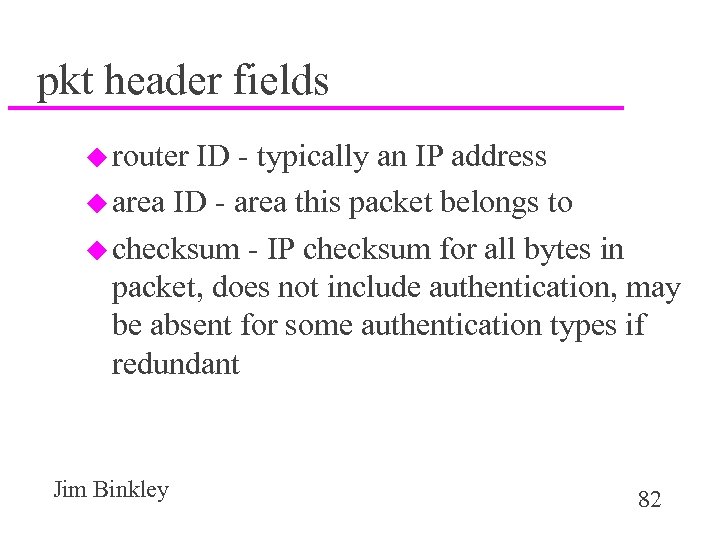 pkt header fields u router ID - typically an IP address u area ID - area this packet belongs to u checksum - IP checksum for all bytes in packet, does not include authentication, may be absent for some authentication types if redundant Jim Binkley 82
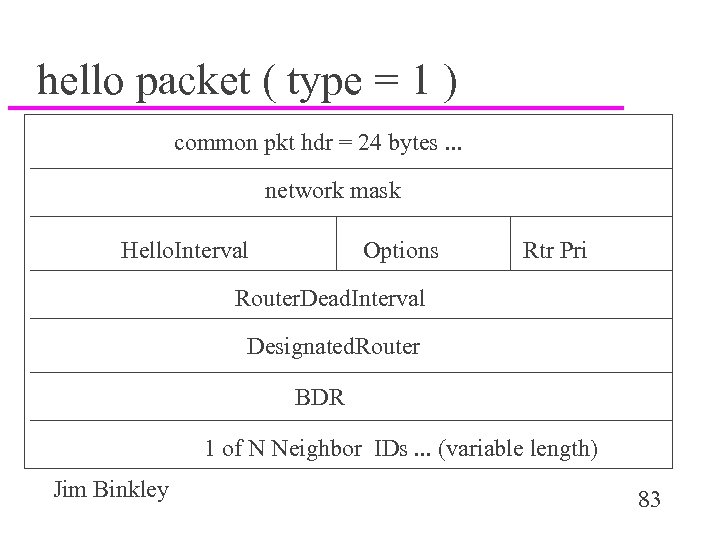 hello packet ( type = 1 ) common pkt hdr = 24 bytes. . . network mask Hello. Interval Options Rtr Pri Router. Dead. Interval Designated. Router BDR 1 of N Neighbor IDs. . . (variable length) Jim Binkley 83
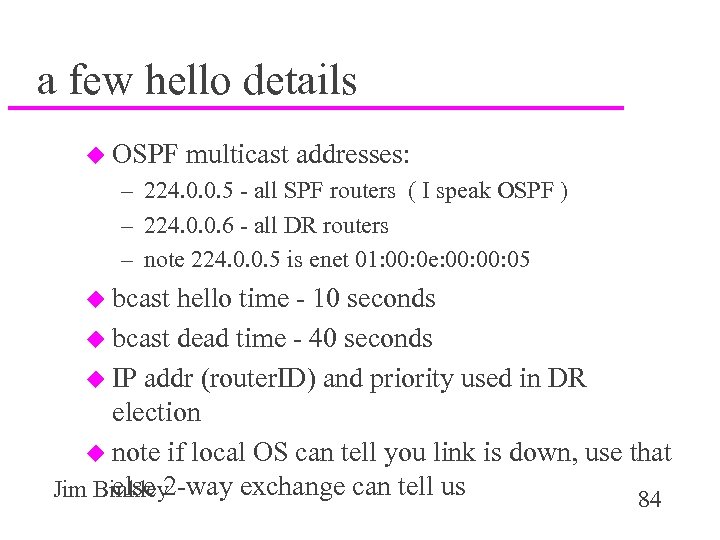 a few hello details u OSPF multicast addresses: – 224. 0. 0. 5 - all SPF routers ( I speak OSPF ) – 224. 0. 0. 6 - all DR routers – note 224. 0. 0. 5 is enet 01: 00: 0 e: 00: 05 u bcast hello time - 10 seconds u bcast dead time - 40 seconds u IP addr (router. ID) and priority used in DR election u note if local OS can tell you link is down, use that else 2 -way exchange can tell us Jim Binkley 84
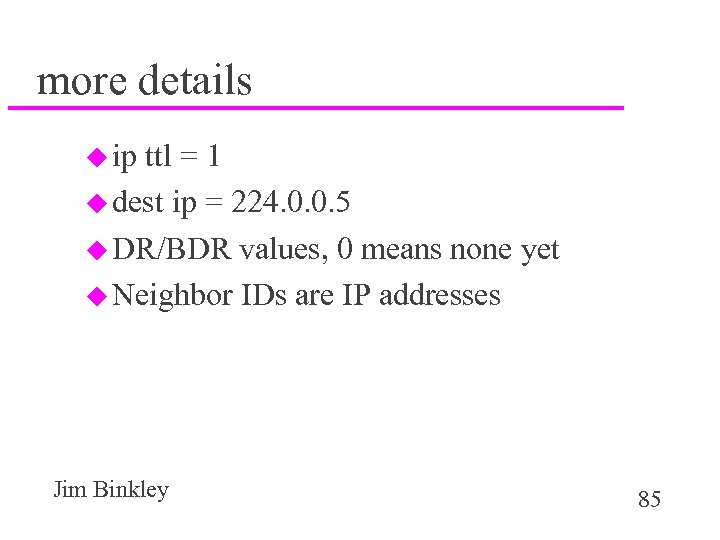 more details u ip ttl = 1 u dest ip = 224. 0. 0. 5 u DR/BDR values, 0 means none yet u Neighbor IDs are IP addresses Jim Binkley 85
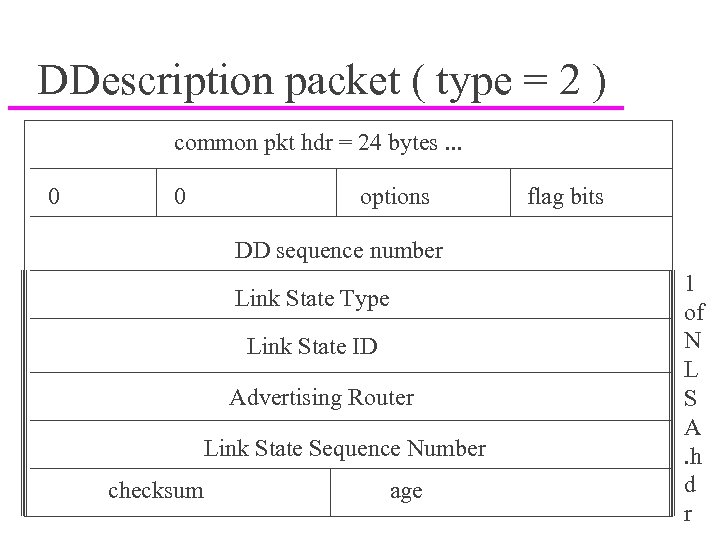 DDescription packet ( type = 2 ) common pkt hdr = 24 bytes. . . 0 0 options flag bits DD sequence number Link State Type Link State ID Advertising Router Link State Sequence Number Jim Binkley checksum age 1 of N L S A. h d 86 r
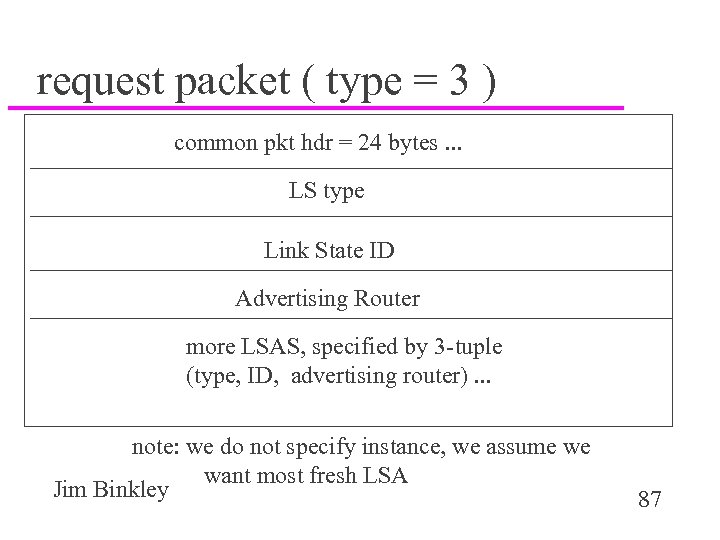 request packet ( type = 3 ) common pkt hdr = 24 bytes. . . LS type Link State ID Advertising Router more LSAS, specified by 3 -tuple (type, ID, advertising router). . . note: we do not specify instance, we assume we want most fresh LSA Jim Binkley 87
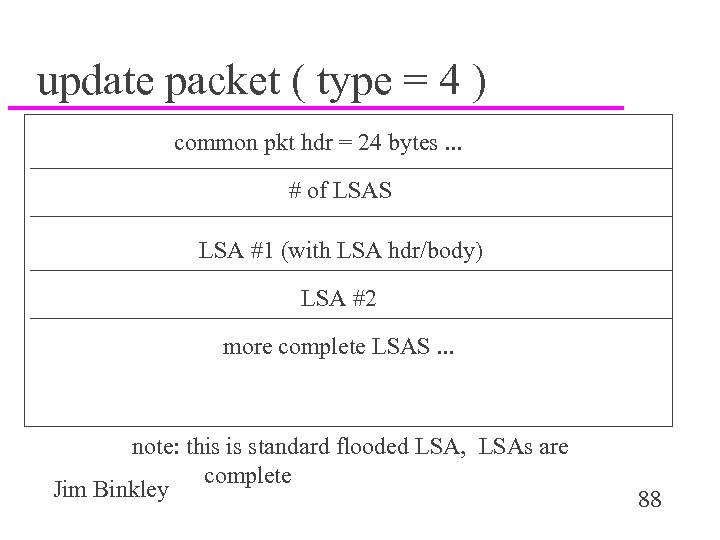 update packet ( type = 4 ) common pkt hdr = 24 bytes. . . # of LSAS LSA #1 (with LSA hdr/body) LSA #2 more complete LSAS. . . note: this is standard flooded LSA, LSAs are complete Jim Binkley 88
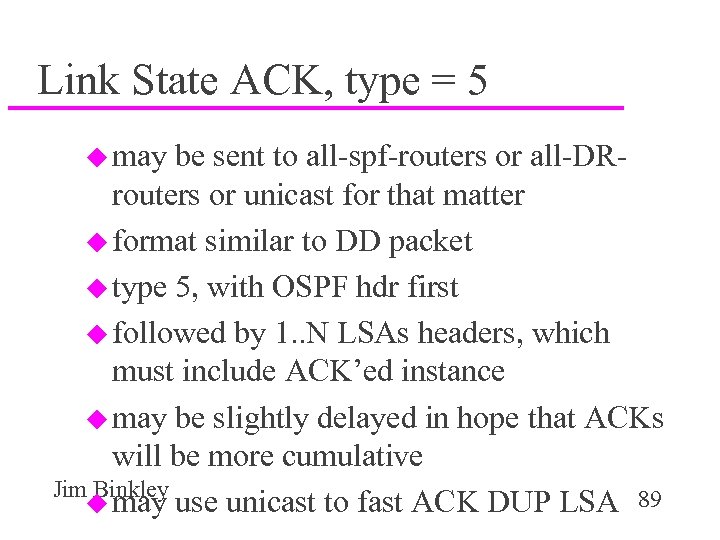 Link State ACK, type = 5 u may be sent to all-spf-routers or all-DRrouters or unicast for that matter u format similar to DD packet u type 5, with OSPF hdr first u followed by 1. . N LSAs headers, which must include ACK’ed instance u may be slightly delayed in hope that ACKs will be more cumulative Jim Binkley u may use unicast to fast ACK DUP LSA 89
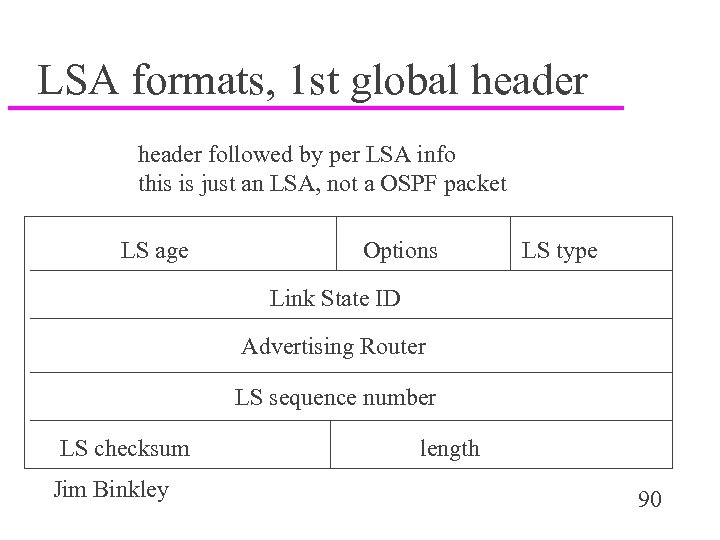 LSA formats, 1 st global header followed by per LSA info this is just an LSA, not a OSPF packet LS age Options LS type Link State ID Advertising Router LS sequence number LS checksum Jim Binkley length 90
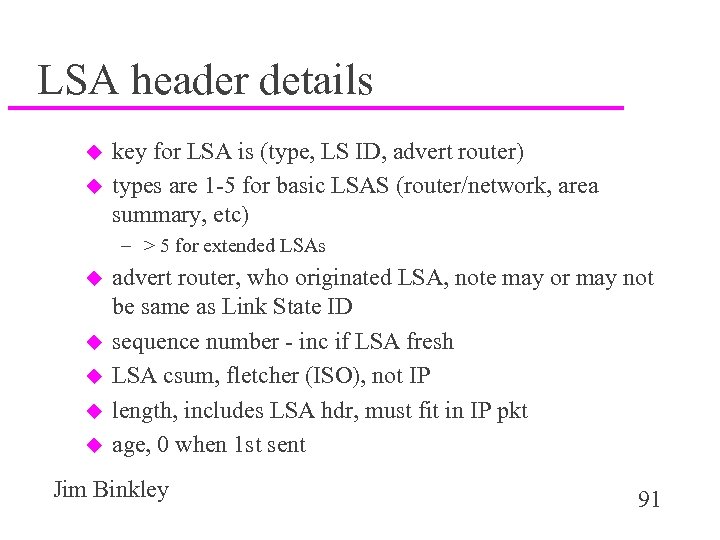 LSA header details u u key for LSA is (type, LS ID, advert router) types are 1 -5 for basic LSAS (router/network, area summary, etc) – > 5 for extended LSAs u u u advert router, who originated LSA, note may or may not be same as Link State ID sequence number - inc if LSA fresh LSA csum, fletcher (ISO), not IP length, includes LSA hdr, must fit in IP pkt age, 0 when 1 st sent Jim Binkley 91
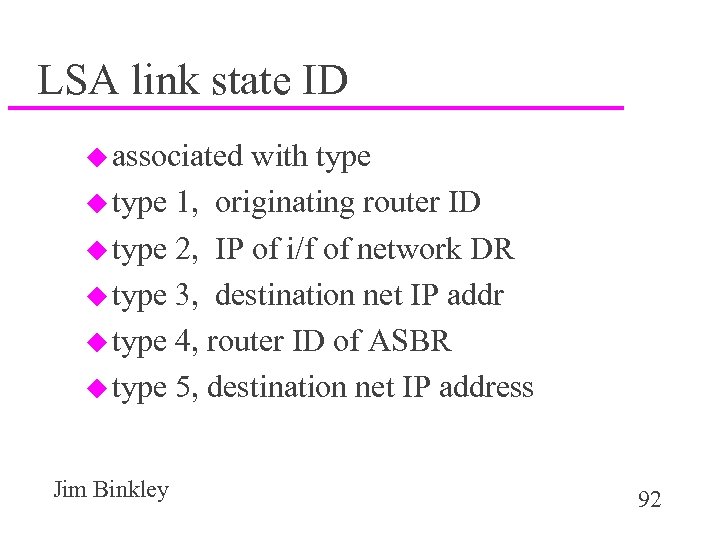 LSA link state ID u associated with type u type 1, originating router ID u type 2, IP of i/f of network DR u type 3, destination net IP addr u type 4, router ID of ASBR u type 5, destination net IP address Jim Binkley 92
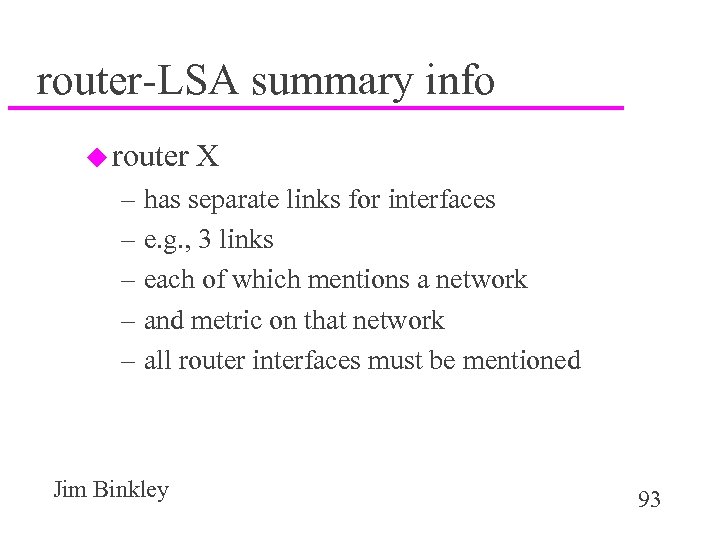 router-LSA summary info u router X – has separate links for interfaces – e. g. , 3 links – each of which mentions a network – and metric on that network – all router interfaces must be mentioned Jim Binkley 93
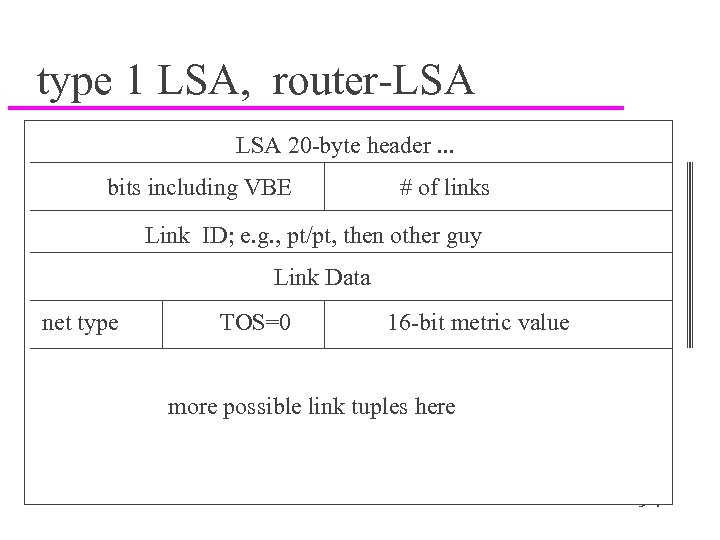 type 1 LSA, router-LSA 20 -byte header. . . bits including VBE # of links Link ID; e. g. , pt/pt, then other guy Link Data net type TOS=0 16 -bit metric value more possible link tuples here Jim Binkley 94
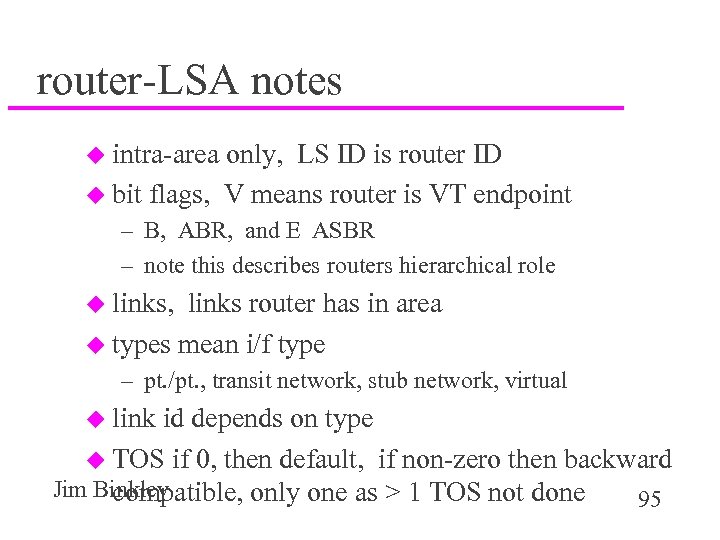 router-LSA notes u intra-area only, LS ID is router ID u bit flags, V means router is VT endpoint – B, ABR, and E ASBR – note this describes routers hierarchical role u links, links router has in area u types mean i/f type – pt. /pt. , transit network, stub network, virtual u link id depends on type u TOS if 0, then default, if non-zero then backward Jim Binkley compatible, only one as > 1 TOS not done 95
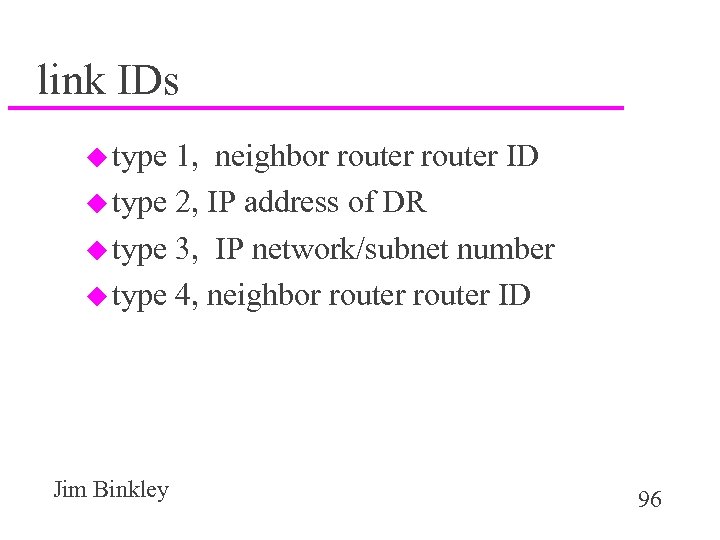 link IDs u type 1, neighbor router ID u type 2, IP address of DR u type 3, IP network/subnet number u type 4, neighbor router ID Jim Binkley 96
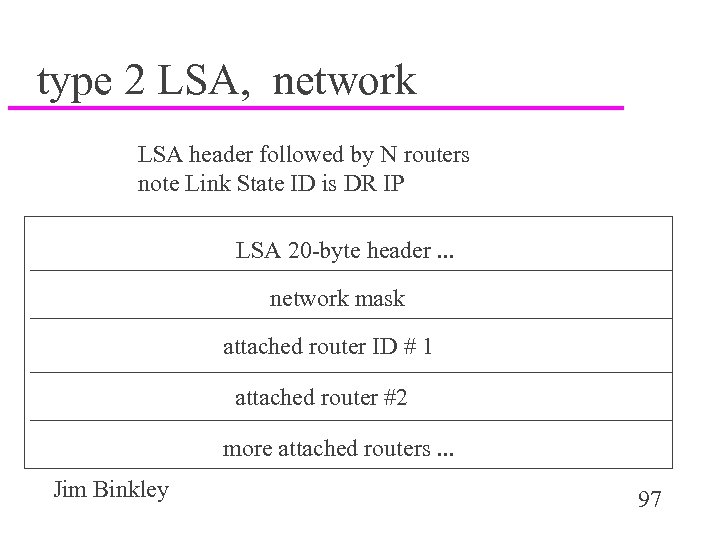 type 2 LSA, network LSA header followed by N routers note Link State ID is DR IP LSA 20 -byte header. . . network mask attached router ID # 1 attached router #2 more attached routers. . . Jim Binkley 97
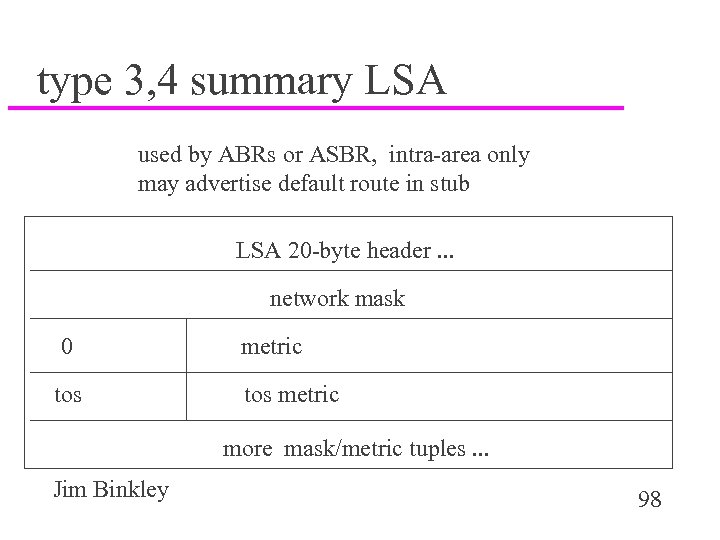 type 3, 4 summary LSA used by ABRs or ASBR, intra-area only may advertise default route in stub LSA 20 -byte header. . . network mask 0 tos metric more mask/metric tuples. . . Jim Binkley 98
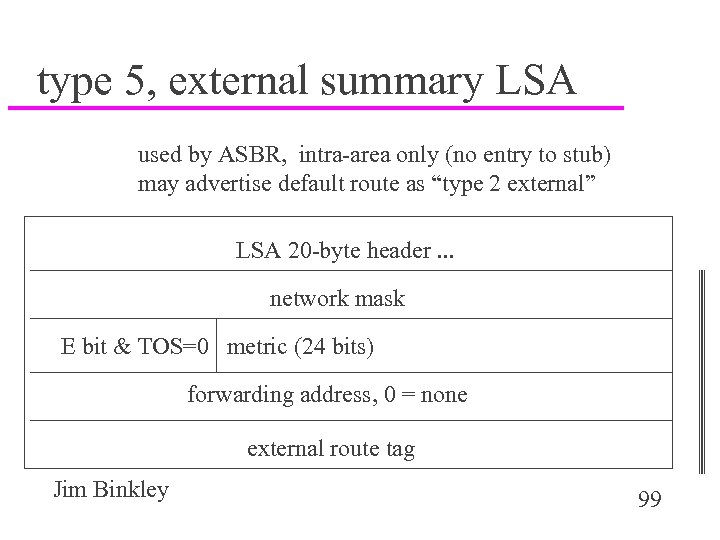 type 5, external summary LSA used by ASBR, intra-area only (no entry to stub) may advertise default route as “type 2 external” LSA 20 -byte header. . . network mask E bit & TOS=0 metric (24 bits) forwarding address, 0 = none external route tag Jim Binkley 99
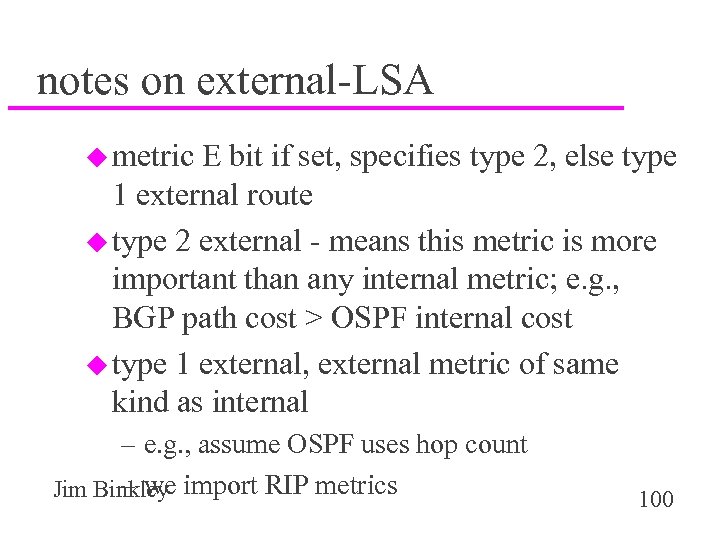 notes on external-LSA u metric E bit if set, specifies type 2, else type 1 external route u type 2 external - means this metric is more important than any internal metric; e. g. , BGP path cost > OSPF internal cost u type 1 external, external metric of same kind as internal – e. g. , assume OSPF uses hop count – we Jim Binkley import RIP metrics 100
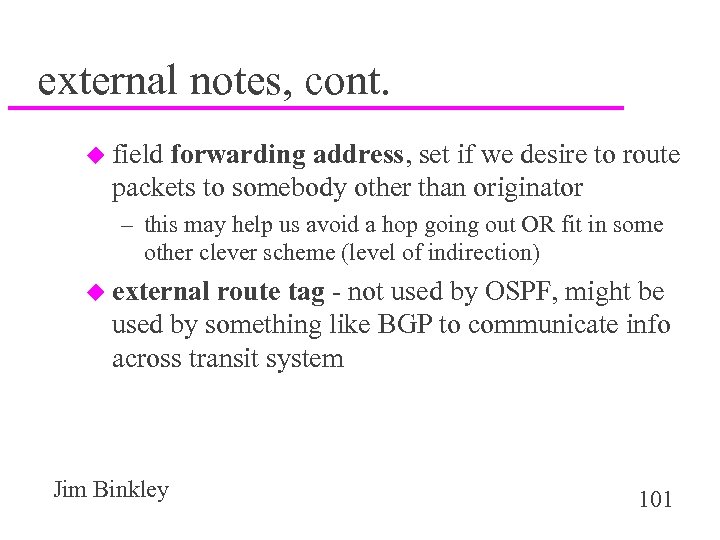 external notes, cont. u field forwarding address, set if we desire to route packets to somebody other than originator – this may help us avoid a hop going out OR fit in some other clever scheme (level of indirection) u external route tag - not used by OSPF, might be used by something like BGP to communicate info across transit system Jim Binkley 101
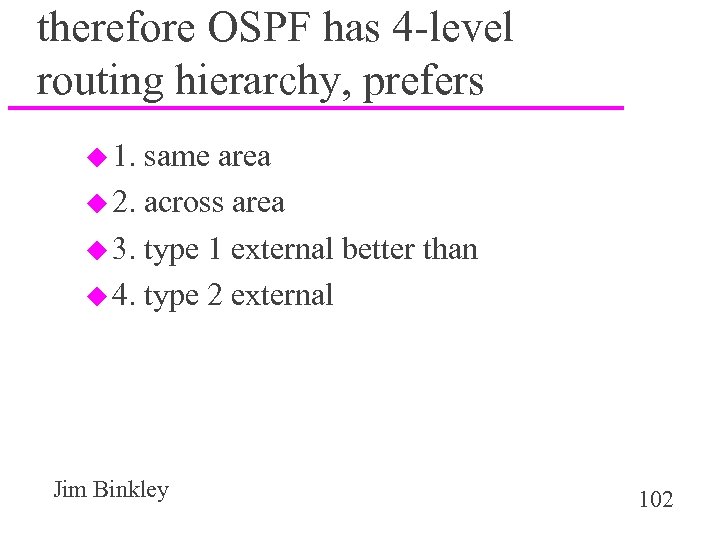 therefore OSPF has 4 -level routing hierarchy, prefers u 1. same area u 2. across area u 3. type 1 external better than u 4. type 2 external Jim Binkley 102
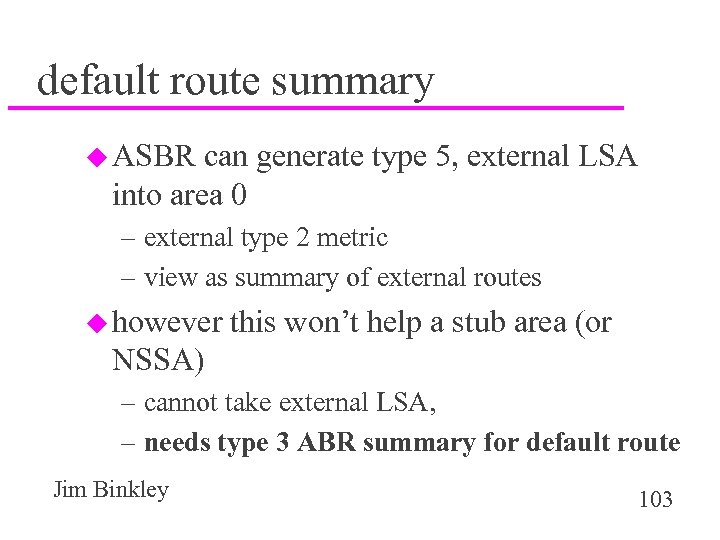 default route summary u ASBR can generate type 5, external LSA into area 0 – external type 2 metric – view as summary of external routes u however this won’t help a stub area (or NSSA) – cannot take external LSA, – needs type 3 ABR summary for default route Jim Binkley 103
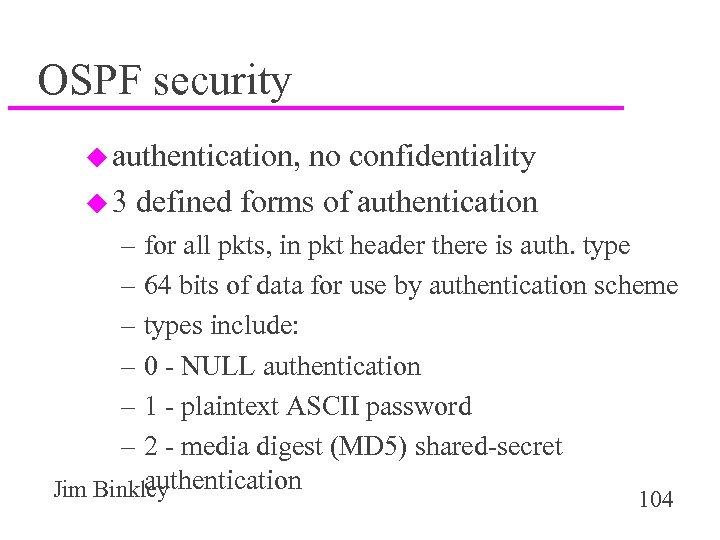 OSPF security u authentication, no confidentiality u 3 defined forms of authentication – for all pkts, in pkt header there is auth. type – 64 bits of data for use by authentication scheme – types include: – 0 - NULL authentication – 1 - plaintext ASCII password – 2 - media digest (MD 5) shared-secret authentication Jim Binkley 104
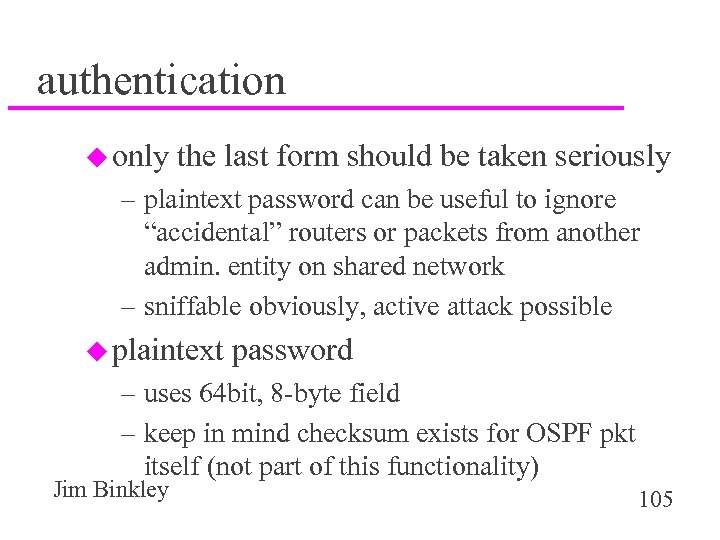 authentication u only the last form should be taken seriously – plaintext password can be useful to ignore “accidental” routers or packets from another admin. entity on shared network – sniffable obviously, active attack possible u plaintext password – uses 64 bit, 8 -byte field – keep in mind checksum exists for OSPF pkt itself (not part of this functionality) Jim Binkley 105
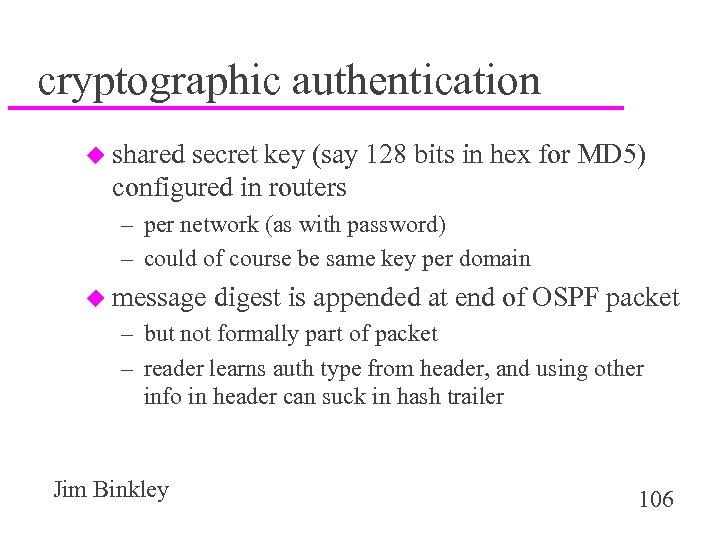 cryptographic authentication u shared secret key (say 128 bits in hex for MD 5) configured in routers – per network (as with password) – could of course be same key per domain u message digest is appended at end of OSPF packet – but not formally part of packet – reader learns auth type from header, and using other info in header can suck in hash trailer Jim Binkley 106
 auth field with crypto authentication 64 bits 0 Key ID auth data len sequence number (not the hash) key id: ids algorithm used (e. g. MD 5) auth data len: how many bytes at end of packet sequence number: unsigned 32 -bit nondecreasing # used to guard against active replay attacks Jim Binkley 107
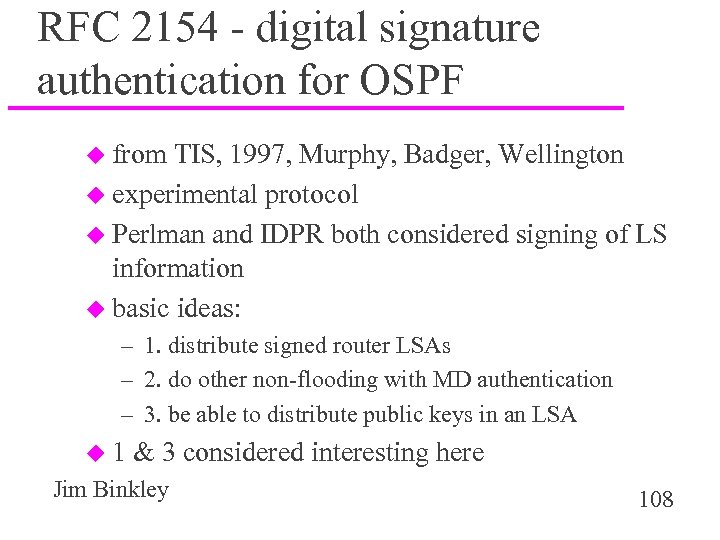 RFC 2154 - digital signature authentication for OSPF u from TIS, 1997, Murphy, Badger, Wellington u experimental protocol u Perlman and IDPR both considered signing of LS information u basic ideas: – 1. distribute signed router LSAs – 2. do other non-flooding with MD authentication – 3. be able to distribute public keys in an LSA u 1 & 3 considered interesting here Jim Binkley 108
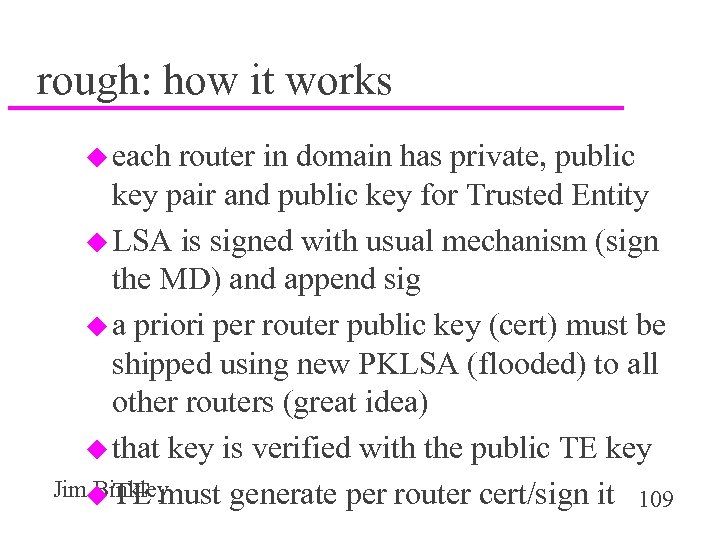 rough: how it works u each router in domain has private, public key pair and public key for Trusted Entity u LSA is signed with usual mechanism (sign the MD) and append sig u a priori per router public key (cert) must be shipped using new PKLSA (flooded) to all other routers (great idea) u that key is verified with the public TE key Jimu TE must generate per router cert/sign it 109 Binkley
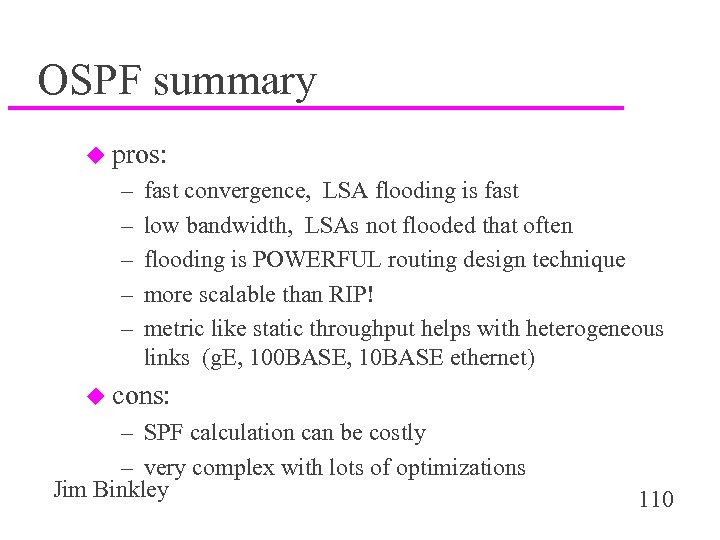 OSPF summary u pros: – – – fast convergence, LSA flooding is fast low bandwidth, LSAs not flooded that often flooding is POWERFUL routing design technique more scalable than RIP! metric like static throughput helps with heterogeneous links (g. E, 100 BASE, 10 BASE ethernet) u cons: – SPF calculation can be costly – very complex with lots of optimizations Jim Binkley 110
 study questions u router to router addressability (how exactly do I talk to you? ) is always a priori important, because “routing” may not exist before the establishment of IGP convergence. How does OSPF establish addressability? – in a broadcast domain? – in a point to multipoint domain? – with virtual links? Jim Binkley 111
 study questions u outline any security attacks that might exist for each of the following OSPF authentication methods – 2. 1 null – 2. 2 ASCII plaintext – 2. 3 message digest/shared secrets – 2. 4 (extra credit. . . ) OSPF with dig. sigs Jim Binkley 112
 study questions u explain what a router-LSA might look like? u why do we have router-LSAs and network. LSAs? u explain the protocol exchange including hellos needed for bringing up adjacencies? u what the heck is an adjacency anyway? Jim Binkley 113
 study questions u compare and contrast the 5 basic LSA types u explain the 5 basic OSPF types of messages – which have something to do with LSAs? u compare and contrast the OSPF basic network types – what differences do broadcast networks bring with them? – what is a virtual link? Jim Binkley 114
 study questions (non-trivial) u ok, you want to implement Mobile-IP as a local area/IGP kinda routing protocol – how could you take advantage of OSPF flooding? (btw, OSPF can handle host routes) u is OSPF a good candidate for a mobile ad hoc routing protocol? – see if you can give one pro and one con Jim Binkley 115
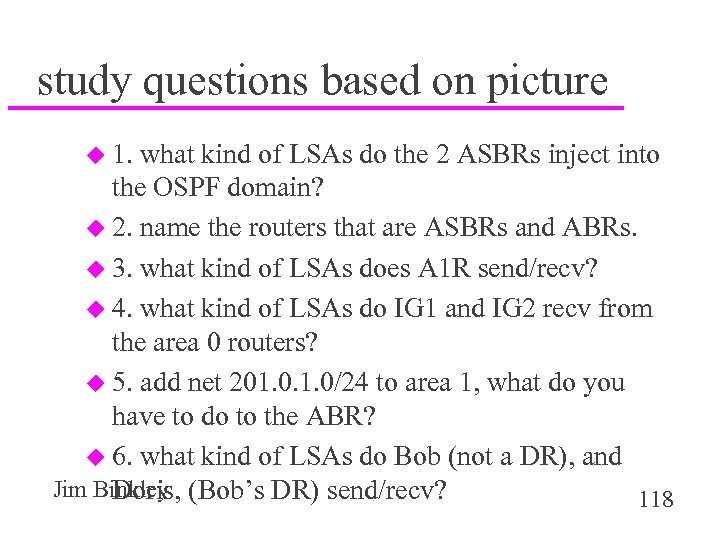
 study question (see next 2 slides) u assume we have a multi-homed stub network, and we are using OSPF BNS - big nearby school IG 1, IG 2, our Inet border routers, assume entire Inet routing table A 1 R - area 1 router, an ABR u the AS has two class C subnets, that are not contiguous, 192. 1. 2. 0/24 & 192. 2. 3. 0/24. It has two OSPF areas, 0, and 1. Jim Binkley 116
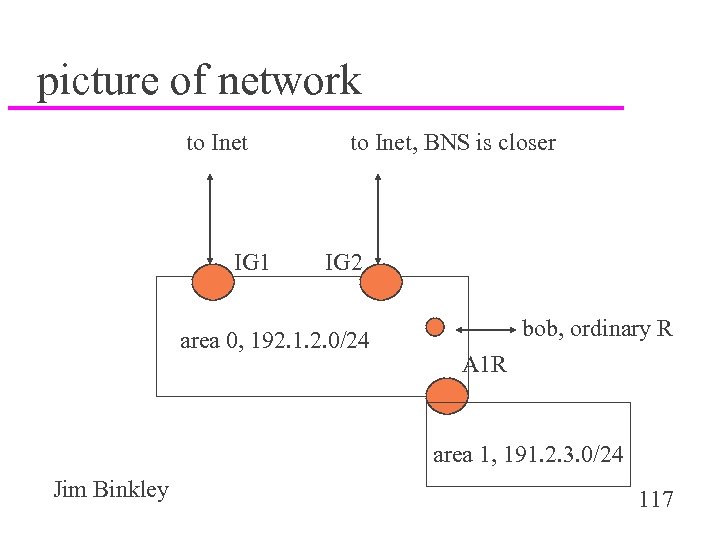 picture of network to Inet IG 1 to Inet, BNS is closer IG 2 area 0, 192. 1. 2. 0/24 bob, ordinary R A 1 R area 1, 191. 2. 3. 0/24 Jim Binkley 117
 study questions based on picture u 1. what kind of LSAs do the 2 ASBRs inject into the OSPF domain? u 2. name the routers that are ASBRs and ABRs. u 3. what kind of LSAs does A 1 R send/recv? u 4. what kind of LSAs do IG 1 and IG 2 recv from the area 0 routers? u 5. add net 201. 0/24 to area 1, what do you have to do to the ABR? u 6. what kind of LSAs do Bob (not a DR), and Jim Binkley (Bob’s DR) send/recv? Doris, 118