 Скачать презентацию Open Networks TDC Views from an Incumbent TRIS
7b858a60391848cf352d8eb78b3e8b5e.ppt
- Количество слайдов: 15



Open Networks TDC: Views from an Incumbent TRIS meeting Copenhagen 24 -25 September Allan Bartroff TDC Legal and regulatory 1
Agenda • Background: TDC in the Danish BB market • Open Networks: Models • Incumbent operator’s business model: Any difference compared to ‘open networks’? • Disclaimer: It is about conditions/options for service providers how to access the networks ≠ any network neutrality discussion 2
The Danish BB market: Platform and service competition • Fixed broadband • 1 st H 2009 DK has 2. 084. 360 broadband subscriptions (36% penetration per inhabitants) • DSL is dominant, but also cable and increasingly fibre + various local networks • 38% BB connections are based on alternative (to DSL) infrastructure: cable, fibre, networks owned by housing associations, internal networks etc. • Cable networks cover about 2/3 of the Danish households (homes passed) and have a 26% share of the broadband market, FTTH accounts for 5 -6% share • Mobile: • 4 mobile network operators o o TDC Telenor Telia 3 (only 3 G) • Each rolling out mobile broadband: 3 G, HSDPA • + MVNOs/Service Providers • Additionally wireless Wi. Fi/Wimax operators 3
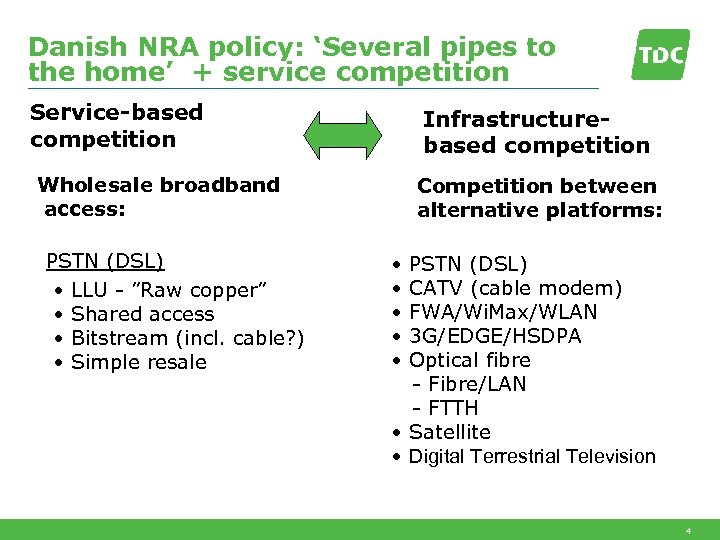
Danish NRA policy: ‘Several pipes to the home’ + service competition Service-based competition Infrastructurebased competition Wholesale broadband access: PSTN (DSL) • LLU - ”Raw copper” • Shared access • Bitstream (incl. cable? ) • Simple resale Competition between alternative platforms: • • • PSTN (DSL) CATV (cable modem) FWA/Wi. Max/WLAN 3 G/EDGE/HSDPA Optical fibre - Fibre/LAN - FTTH • Satellite • Digital Terrestrial Television 4
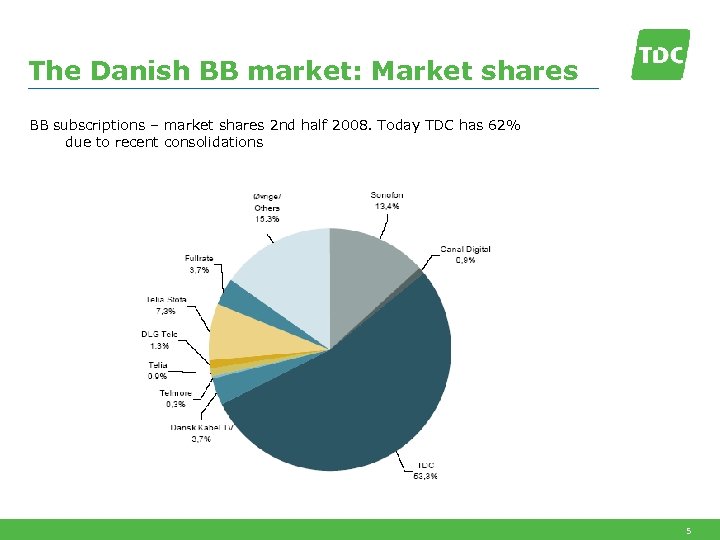
The Danish BB market: Market shares BB subscriptions – market shares 2 nd half 2008. Today TDC has 62% due to recent consolidations 5
Open Networks – models • Open Networks: Where to locate in the value-chain? 1. Network owner provides both wholesale and retail services. Other service providers can get access at both service and network layers (at non-discriminatory conditions? ) to provide their services to end-customers 2. Network owner provide only wholesale. Other operators may offer services (at non-discriminatory conditions? ) without competing at the retail level with the network owner, i. e. a wholesale-only model 3. Regardless 1 or 2: The end-user only needs relations with the service provider(s), i. e. no separate relationship with network owner (one-stop-shopping) 4. Regardless 1 or 2: Choice between more service providers at the same time – one for Internet access, one for TV services etc. • • ‘Open Networks’= A business model >< vertically integrated model of incumbents? Not necessarily – or rather the contrary. . 6
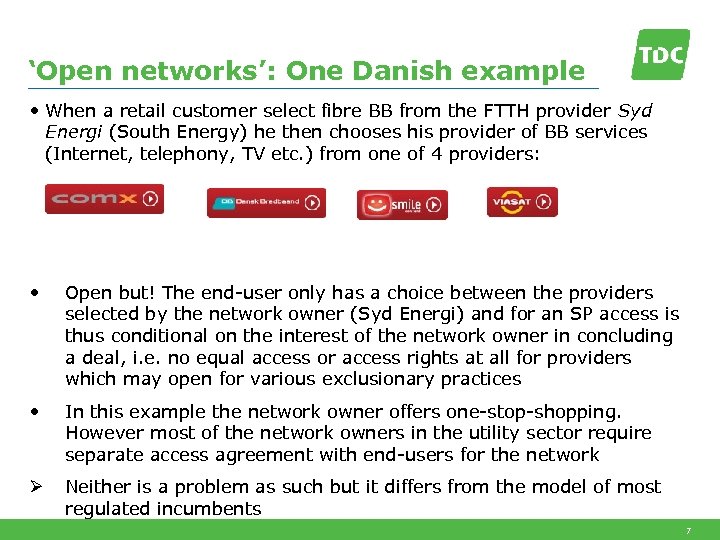
‘Open networks’: One Danish example • When a retail customer select fibre BB from the FTTH provider Syd Energi (South Energy) he then chooses his provider of BB services (Internet, telephony, TV etc. ) from one of 4 providers: • Open but! The end-user only has a choice between the providers selected by the network owner (Syd Energi) and for an SP access is thus conditional on the interest of the network owner in concluding a deal, i. e. no equal access or access rights at all for providers which may open for various exclusionary practices • In this example the network owner offers one-stop-shopping. However most of the network owners in the utility sector require separate access agreement with end-users for the network Ø Neither is a problem as such but it differs from the model of most regulated incumbents 7
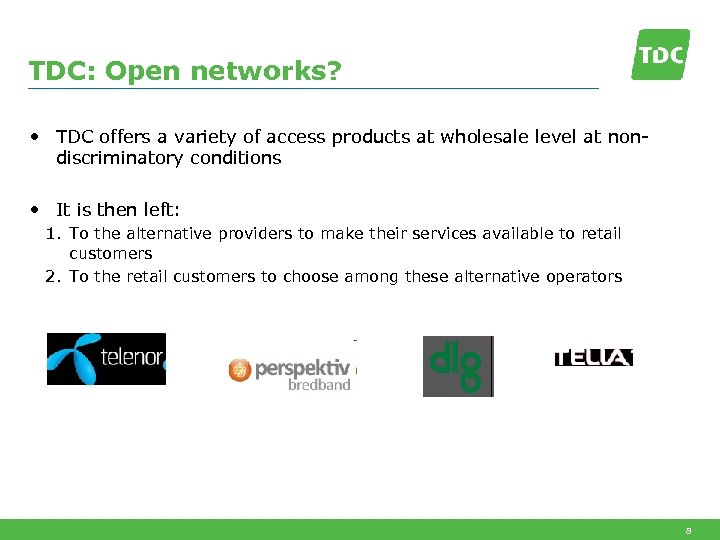
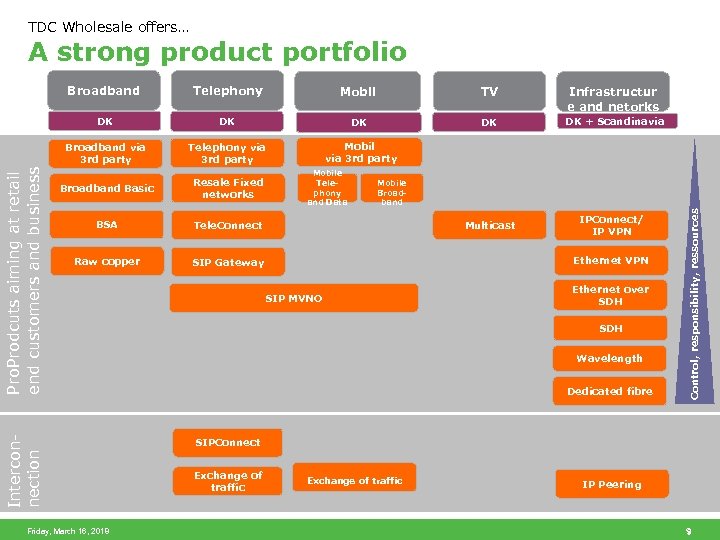
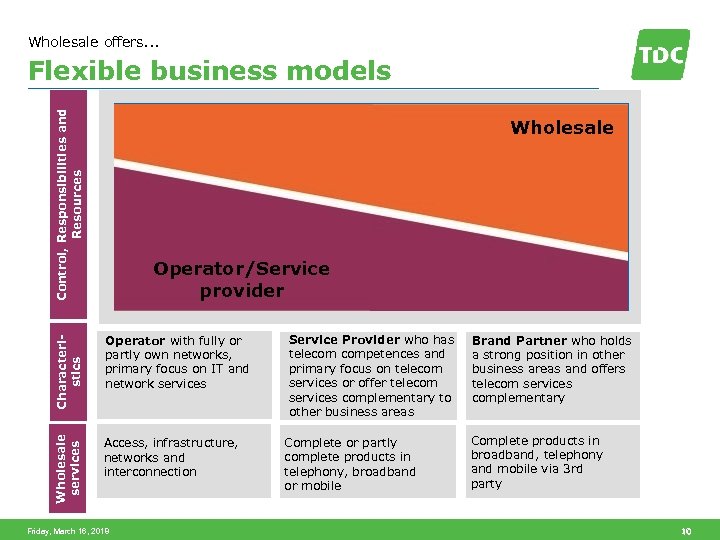
TDC: Open networks? • TDC offers a variety of access products at wholesale level at nondiscriminatory conditions • It is then left: 1. To the alternative providers to make their services available to retail customers 2. To the retail customers to choose among these alternative operators 8
TDC Wholesale offers… A strong product portfolio Mobil TV Infrastructur e and netorks DK DK + Scandinavia Broadband via 3 rd party Telephony via 3 rd party Mobil via 3 rd party Broadband Basic Resale Fixed networks BSA Tele. Connect Raw copper SIP Gateway Interconnection Telephony DK Friday, March 16, 2018 Mobile Telephony and Data Mobile Broadband Multicast IPConnect/ IP VPN Ethernet VPN SIP MVNO Ethernet over SDH Wavelength Dedicated fibre Control, responsibility, ressources Prodcuts aiming at retail end customers and business Broadband SIPConnect Exchange of traffic IP Peering 9
Wholesale offers. . . Control, Responsibilities and Resources Flexible business models Wholesale Characteristics Operator with fully or partly own networks, primary focus on IT and network services Wholesale services Operator/Service provider Access, infrastructure, networks and interconnection Friday, March 16, 2018 Service Provider who has telecom competences and primary focus on telecom services or offer telecom services complementary to other business areas Complete or partly complete products in telephony, broadband or mobile Brand Partner who holds a strong position in other business areas and offers telecom services complementary Complete products in broadband, telephony and mobile via 3 rd party 10 10
Wholesale offers… Flexible co-operation Raw copper (LLU – full/shared) Access line Switch/ platforms TDC Product CPE Internet -access and price CPE Internet -access Product and price Marketing and sale Service provider/operator Customer service and handling Billing Bitstream Access line Switch/ platforms Product Marketing and sale Customer service and handling Billing BB Basic Access line Switch/ platforms Billing Mobile BB Access line Friday, March 16, 2018 Switch/ platforms Billing 11 11
Wholesale offers… Flexible business models TDC Your business 3. part TDC or your business Operator Access Switching /platform s CPE Product and price Marketing and sale Customer service and handling Billing Service Provider Access Switching /platform s Brand Partner Rå kobber/Delt rå kobber Access Friday, March 16, 2018 Centraler/ platforme 12 12
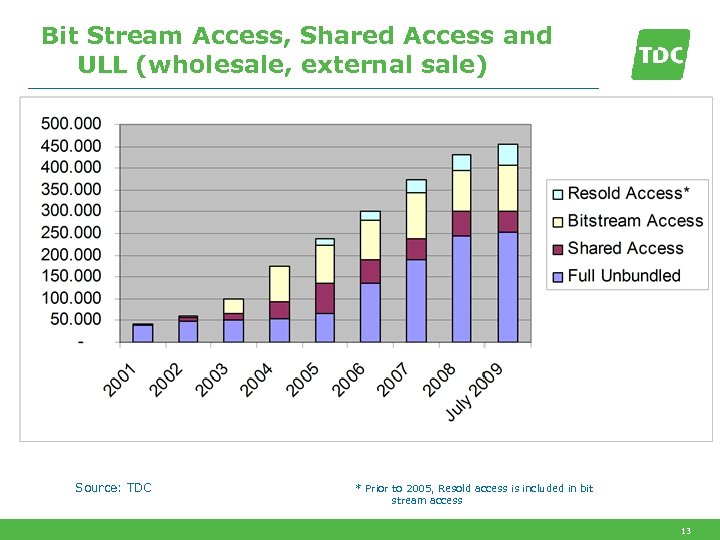
Bit Stream Access, Shared Access and ULL (wholesale, external sale) Source: TDC * Prior to 2005, Resold access is included in bit stream access 13
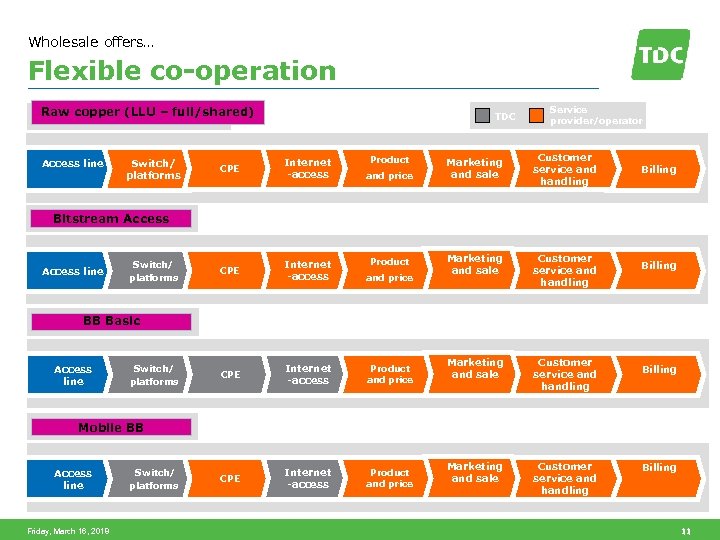
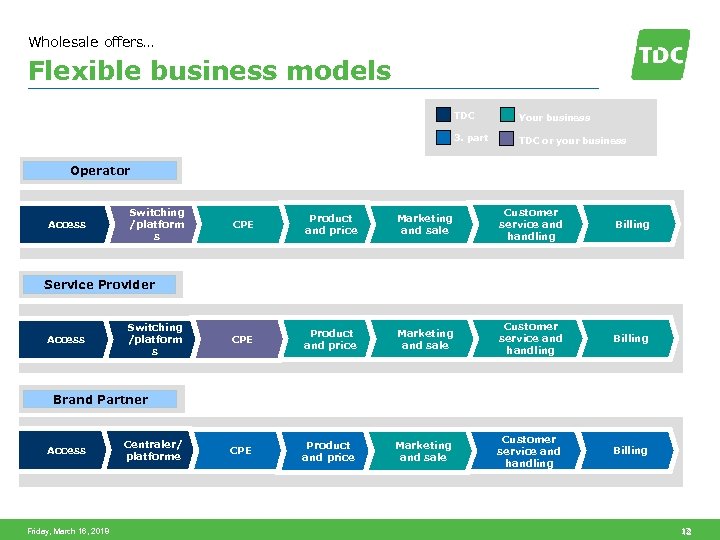
So what’s the difference… • Two major differences TDC >< ‘Open Networks’ (non-regulated, for example Syd Energi model, i. e. wholesale only): Ø Every alternative operator/SP has an access right as the basic products are regulated, i. e. access conditions are non-discriminatory among all providers including TDC Retail Ø There is a variety of access levels, i. e. an SP can chose how to establish his business model(s) and geographical presence. E. g. to invest in more control of network management, development of own services (quality, security, redundancy) or to buy more simplified products with easy access requiring less investment and focus on short lead time to market • Two potential drawbacks: Ø TDC does not as a network provider recommend one particular set of Service Providers Ø For an SP there is a competitive pressure from TDC Retail – and vice versa! 14
Conclusions • Impact of alternative ‘open networks’ on an incumbent regulated operator with a proactive wholesale business is just: Ø Increased competition ay wholesale level which at a point in time may reduce the need for regulated access Ø Regulatory non-discrimination obligation may make it difficult to compete with non-regulated ‘open networks’ at equal footing Ø However, flexibility and product variety of a full fledged wholesale business is incomparable to most ‘open networks’ Ø Increasingly focus on access to internal networks controlled by house owners? 15
Скачать презентацию Open Networks TDC Views from an Incumbent TRIS
7b858a60391848cf352d8eb78b3e8b5e.ppt