


 Скачать презентацию Open-ended investigations and V diagrams in chemistry education
57cf7da58c7deff5e951e295bc3241d1.ppt
- Количество слайдов: 10
 Open-ended investigations and V diagrams in chemistry education Berit Kurtén-Finnäs, FD Liselott Forsman, FD
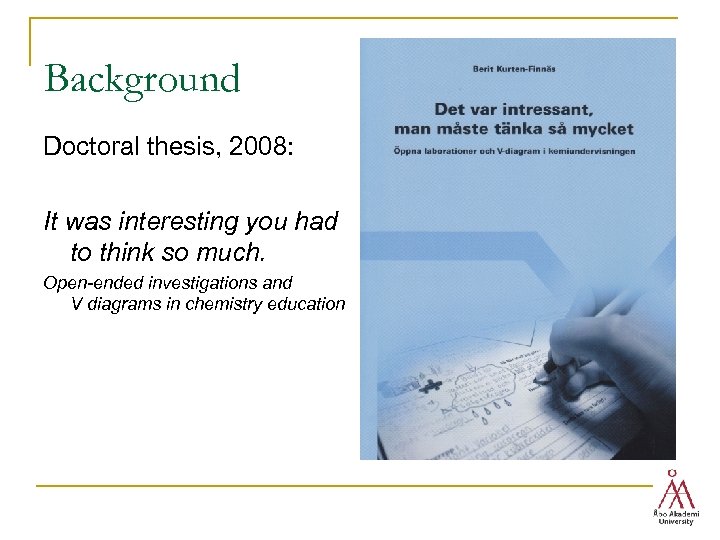 Background Doctoral thesis, 2008: It was interesting you had to think so much. Open-ended investigations and V diagrams in chemistry education
 Some of theoretical background n n n Meaningful learning, V heuristic (Ausubel, Novak, Gowin) Open investigations (Hegarty-Hazel) Authentic school science (Roth)
 Objectives for my doctoral study n n n contribute to the development of the laboratory work within education in chemistry contribute to research by careful study of the implementation of open-ended investigations and a modified version of Gowin’s V diagram focus on affective variables of students’ learning; self-concept, beliefs, attitudes and interest
 Methodology and research methods n n design-based research questionnaires, interviews, selfassessment, audio recording in the class
 Implementation n 4 open-ended investigations together with V diagrams in grade-7 in a comprehensive school in Finland (21 students, 13 -14 years old); their first chemistry course the problems were chosen by the researcher together with the teacher; context-based laboratory groups of 2 -5 students
 Some results and conclusions n n n The work with open-ended investigations and with V diagrams had a favourable effect on the students self-concept, and on their interest in chemistry The group interactions seemed to be important in the students’ development of their understanding A majority of the students felt the V diagrams had helped them in their understanding of the lab
 The S-team project – our part n n cooperation with two chemistry teachers in a secondary school and one teacher at the teacher education students in a chemistry class in the secondary school (16 years old), in a pre-IB class and primary teacher students have worked with open-ended investigation in combination with V diagrams q video-recordings in the classrooms; focus on n n teachers introductions students discussions during their planning and practical work a presentation of open-ended investigations and of V diagrams discussions of different aspects of the work with openended investigations and with V diagrams
 The structure of the web resource Part 1 1. What is an open-ended investigation? 2. Introducing an open-ended investigation in class. 3. Students planning their investigation. 4. Teacher students working with an openended investigation. 5. Concluding discussions about open-ended investigations.
 Part 2 6. What is a V diagram? Theoretical background. 7. Introducing V diagrams in class. 8. Students working with V diagrams. 9. Concluding discussions about V diagrams. Part 3 10. Guidelines for language support in chemistry education.