Скачать презентацию OPEN DAYS 2007 Short Sea Shipping and Motorways
21b2c0a95af45eb225ed459e8618de3b.ppt
- Количество слайдов: 26
 OPEN DAYS 2007 Short Sea Shipping and Motorways of the Sea development in Euskadi Mr. Iñigo Palomino Zubiaurre Director of Transports of the Basque Government Brussels, 10 th October 2007
 Agenda • Short Sea Shipping (SSS) and Motorways of the Sea (MOS) • Short Sea Shipping and Motorways of the Sea promotion • Freight transport current situation in Euskadi • Euskadi’s contribution to the SSS and MOS promotion
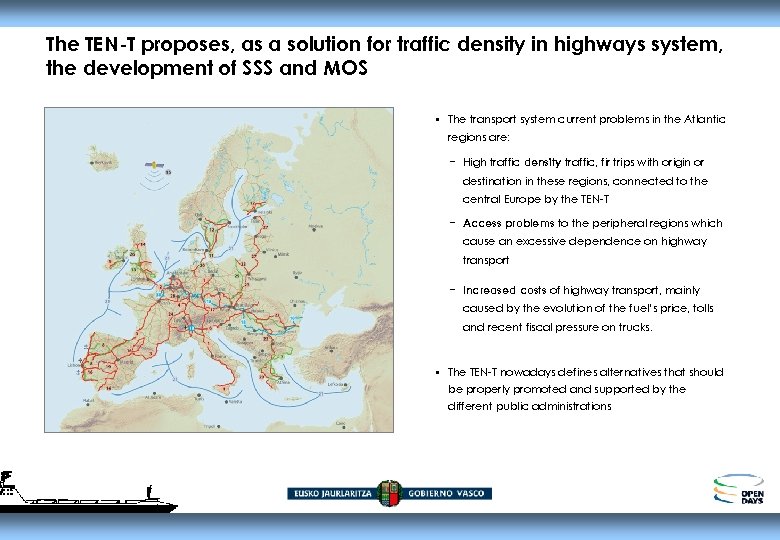 The TEN-T proposes, as a solution for traffic density in highways system, the development of SSS and MOS • The transport system current problems in the Atlantic regions are: − High traffic density traffic, fir trips with origin or destination in these regions, connected to the central Europe by the TEN-T − Access problems to the peripheral regions which cause an excessive dependence on highway transport − Increased costs of highway transport, mainly caused by the evolution of the fuel’s price, tolls and recent fiscal pressure on trucks. • The TEN-T nowadays defines alternatives that should be properly promoted and supported by the different public administrations
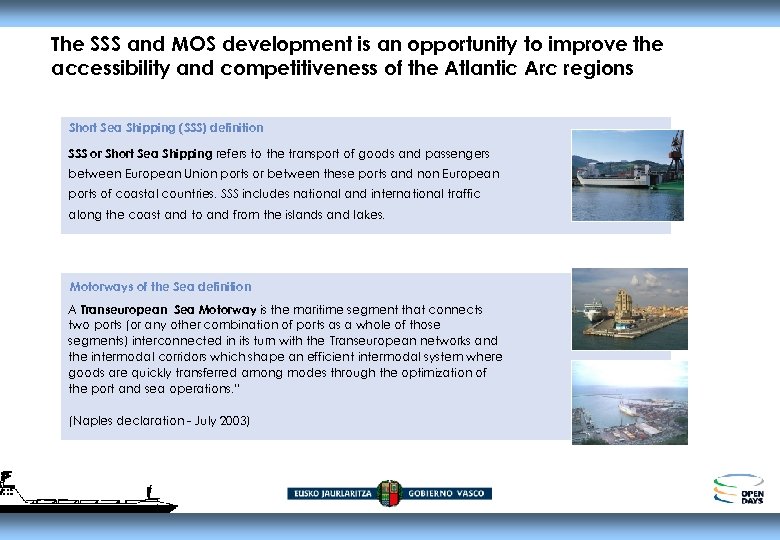 The SSS and MOS development is an opportunity to improve the accessibility and competitiveness of the Atlantic Arc regions Short Sea Shipping (SSS) definition SSS or Short Sea Shipping refers to the transport of goods and passengers between European Union ports or between these ports and non European ports of coastal countries. SSS includes national and international traffic along the coast and to and from the islands and lakes. Motorways of the Sea definition A Transeuropean Sea Motorway is the maritime segment that connects two ports (or any other combination of ports as a whole of those segments) interconnected in its turn with the Transeuropean networks and the intermodal corridors which shape an efficient intermodal system where goods are quickly transferred among modes through the optimization of the port and sea operations. ” (Naples declaration - July 2003)
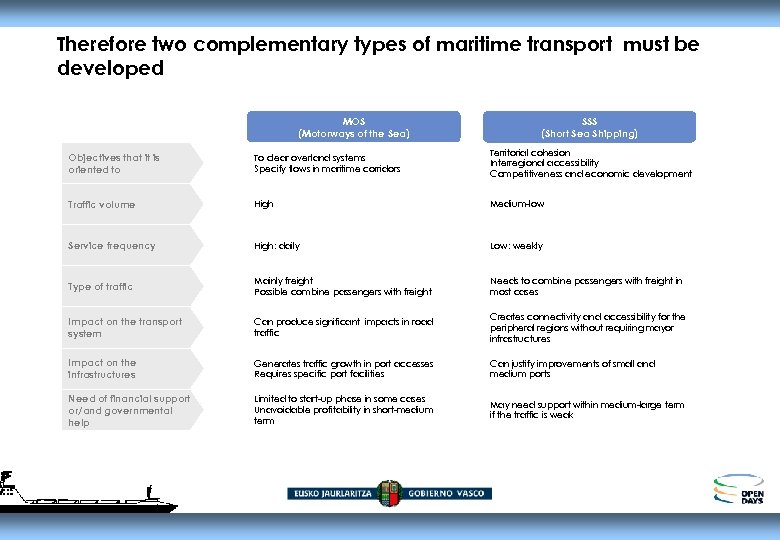 Therefore two complementary types of maritime transport must be developed MOS (Motorways of the Sea) SSS (Short Sea Shipping) Objectives that it is oriented to To clear overland systems Specify flows in maritime corridors Territorial cohesion Interregional accessibility Competitiveness and economic development Traffic volume High Medium-low Service frequency High: daily Low: weekly Type of traffic Mainly freight Possible combine passengers with freight Needs to combine passengers with freight in most cases Impact on the transport system Can produce significant impacts in road traffic Creates connectivity and accessibility for the peripheral regions without requiring mayor infrastructures Impact on the infrastructures Generates traffic growth in port accesses Requires specific port facilities Can justify improvements of small and medium ports Need of financial support or/and governmental help Limited to start-up phase in some cases Unavoidable profitability in short-medium term May need support within medium-large term if the traffic is weak
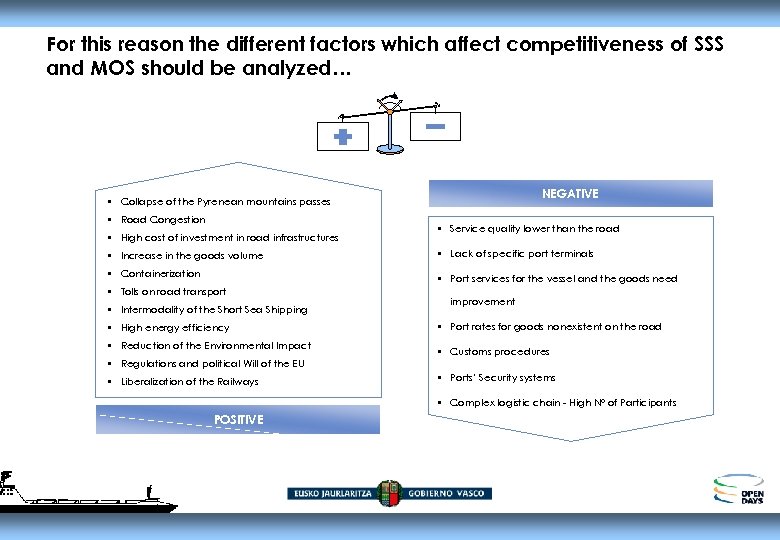 For this reason the different factors which affect competitiveness of SSS and MOS should be analyzed… NEGATIVE • Collapse of the Pyrenean mountains passes • Road Congestion • High cost of investment in road infrastructures • Increase in the goods volume • Containerization • Service quality lower than the road • Lack of specific port terminals • Port services for the vessel and the goods need • Tolls on road transport • Intermodality of the Short Sea Shipping • High energy efficiency • Reduction of the Environmental Impact • Regulations and political Will of the EU • Liberalization of the Railways improvement • Port rates for goods nonexistent on the road • Customs procedures • Ports’ Security systems • Complex logistic chain - High Nº of Participants POSITIVE
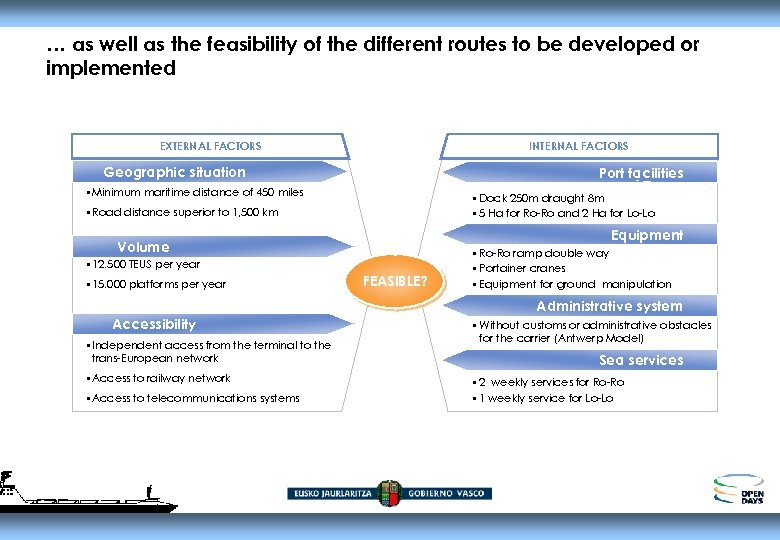 … as well as the feasibility of the different routes to be developed or implemented EXTERNAL FACTORS INTERNAL FACTORS Geographic situation Port facilities • Minimum maritime distance of 450 miles • Dock 250 m draught 8 m • 5 Ha for Ro-Ro and 2 Ha for Lo-Lo • Road distance superior to 1, 500 km Equipment Volume • 12. 500 TEUS per year • 15. 000 platforms per year FEASIBLE? • Ro-Ro ramp double way • Portainer cranes • Equipment for ground manipulation Administrative system Accessibility • Independent access from the terminal to the trans-European network • Access to railway network • Access to telecommunications systems • Without customs or administrative obstacles for the carrier (Antwerp Model) Sea services • 2 weekly services for Ro-Ro • 1 weekly service for Lo-Lo
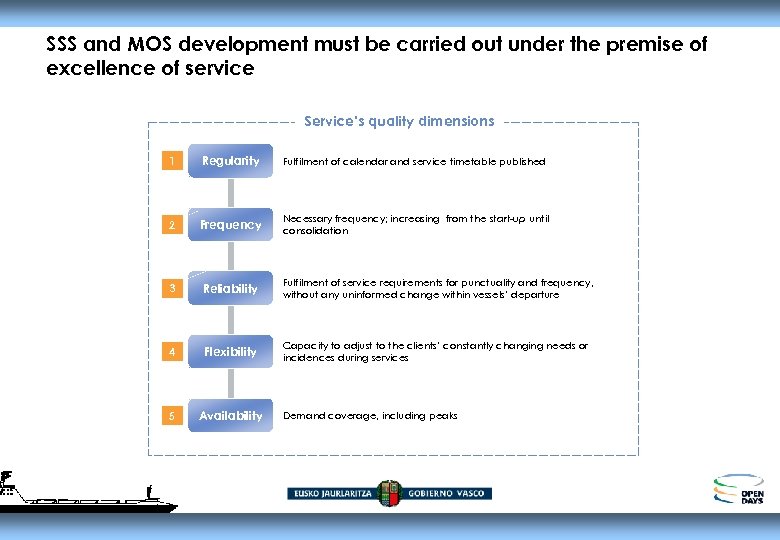 SSS and MOS development must be carried out under the premise of excellence of service Service’s quality dimensions 1 Regularity Fulfilment of calendar and service timetable published 2 Frequency Necessary frequency; increasing from the start-up until consolidation 3 Reliability Fulfilment of service requirements for punctuality and frequency, without any uninformed change within vessels’ departure 4 Flexibility Capacity to adjust to the clients’ constantly changing needs or incidences during services 5 Availability Demand coverage, including peaks
 • Short Sea Shipping (SSS) and Motorways of the Sea (MOS) • Short Sea Shipping and Motorways of the Sea promotion • Freight transport current situation in Euskadi • Euskadi’s contribution to the SSS and MOS promotion
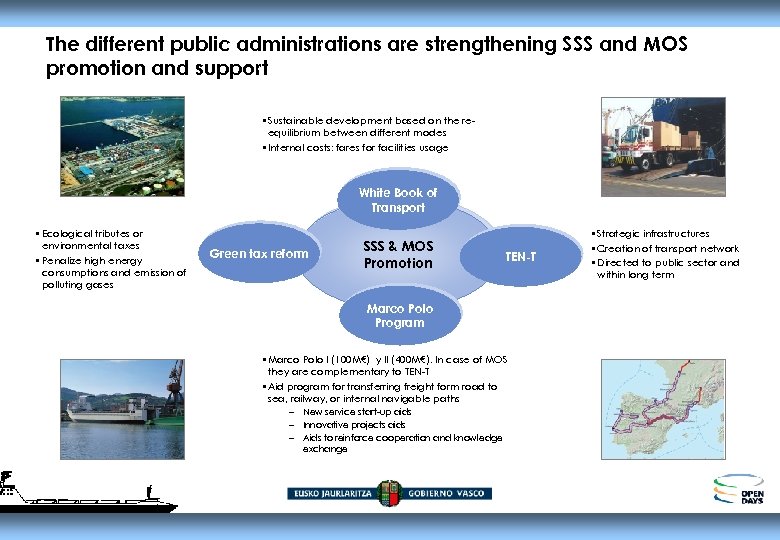 The different public administrations are strengthening SSS and MOS promotion and support • Sustainable development based on the reequilibrium between different modes • Internal costs: fares for facilities usage White Book of Transport • Ecological tributes or environmental taxes • Penalize high energy consumptions and emission of polluting gases Green tax reform SSS & MOS Promotion TEN-T Marco Polo Program • Marco Polo I (100 M€) y II (400 M€). In case of MOS they are complementary to TEN-T • Aid program for transferring freight form road to sea, railway, or internal navigable paths – New service start-up aids – Innovative projects aids – Aids to reinforce cooperation and knowledge exchange • Strategic infrastructures • Creation of transport network • Directed to public sector and within long term
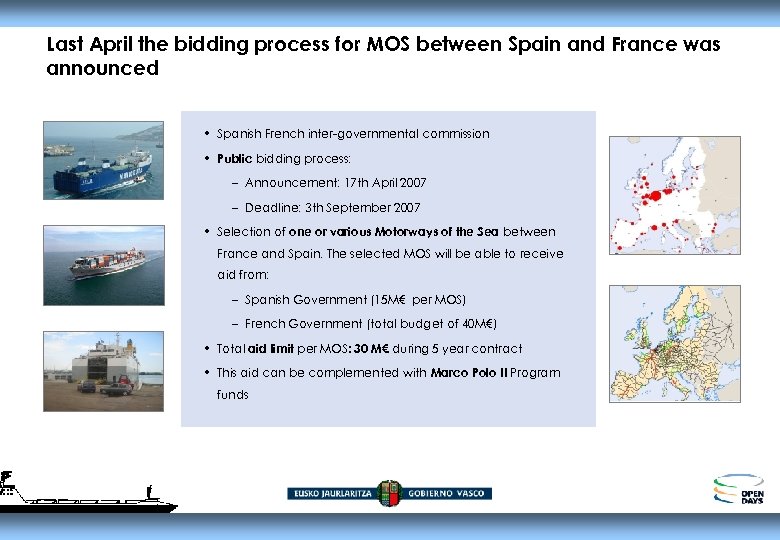 Last April the bidding process for MOS between Spain and France was announced • Spanish French inter-governmental commission • Public bidding process: – Announcement: 17 th April 2007 – Deadline: 3 th September 2007 • Selection of one or various Motorways of the Sea between France and Spain. The selected MOS will be able to receive aid from: – Spanish Government (15 M€ per MOS) – French Government (total budget of 40 M€) • Total aid limit per MOS: 30 M€ during 5 year contract • This aid can be complemented with Marco Polo II Program funds
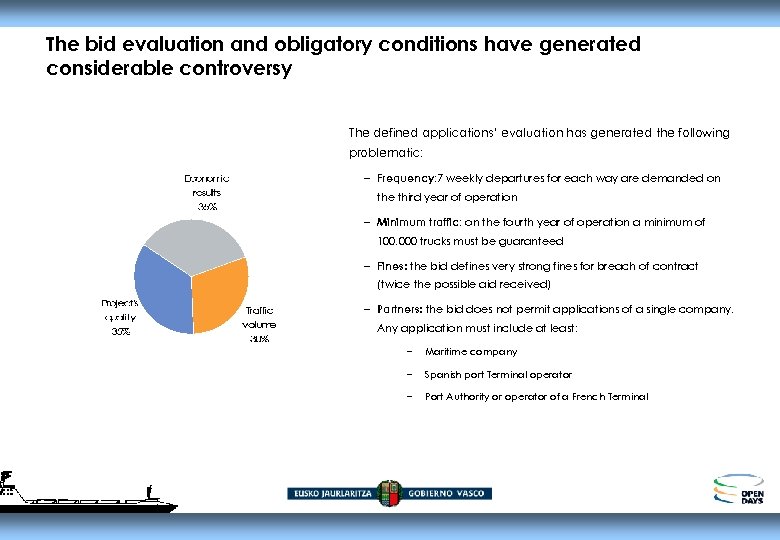 The bid evaluation and obligatory conditions have generated considerable controversy The defined applications’ evaluation has generated the following problematic: – Frequency: 7 weekly departures for each way are demanded on the third year of operation – Minimum traffic: on the fourth year of operation a minimum of 100. 000 trucks must be guaranteed – Fines: the bid defines very strong fines for breach of contract (twice the possible aid received) – Partners: the bid does not permit applications of a single company. Any application must include at least: – Maritime company – Spanish port Terminal operator – Port Authority or operator of a French Terminal
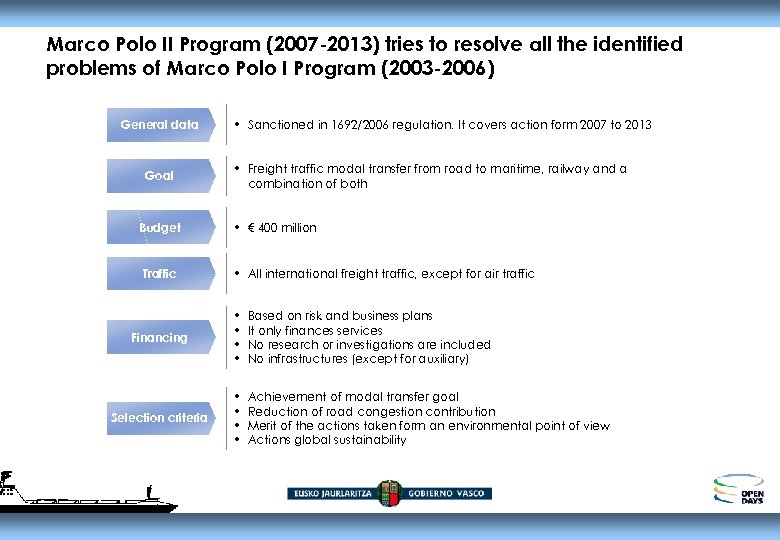 Marco Polo II Program (2007 -2013) tries to resolve all the identified problems of Marco Polo I Program (2003 -2006) General data Goal Budget Traffic • Sanctioned in 1692/2006 regulation. It covers action form 2007 to 2013 • Freight traffic modal transfer from road to maritime, railway and a combination of both • € 400 million • All international freight traffic, except for air traffic Financing • • Based on risk and business plans It only finances services No research or investigations are included No infrastructures (except for auxiliary) Selection criteria • • Achievement of modal transfer goal Reduction of road congestion contribution Merit of the actions taken form an environmental point of view Actions global sustainability
 • Short Sea Shipping (SSS) and Motorways of the Sea (MOS) • Short Sea Shipping and Motorways of the Sea promotion • Freight transport current situation in Euskadi • Euskadi’s contribution to the SSS and MOS promotion
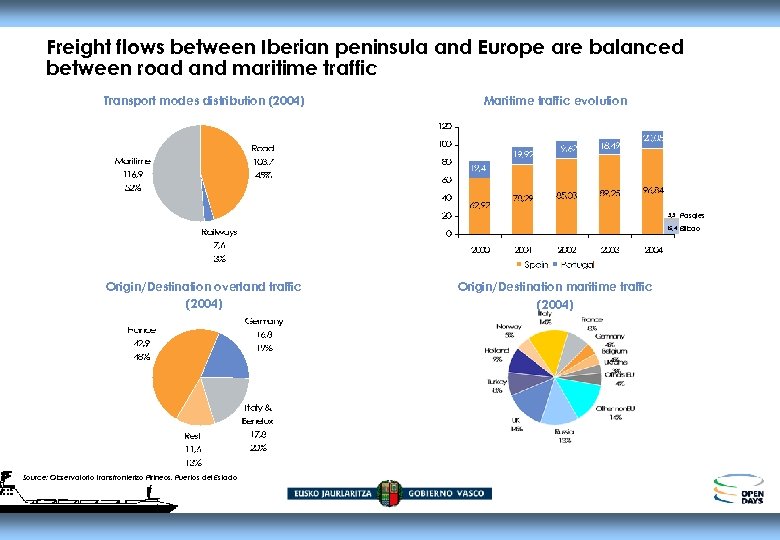 Freight flows between Iberian peninsula and Europe are balanced between road and maritime traffic Transport modes distribution (2004) Maritime traffic evolution 3, 3 Origin/Destination overland traffic (2004) Source: Observatorio transfronterizo Pirineos, Puertos del Estado Origin/Destination maritime traffic (2004) Pasajes 15, 4 Bilbao
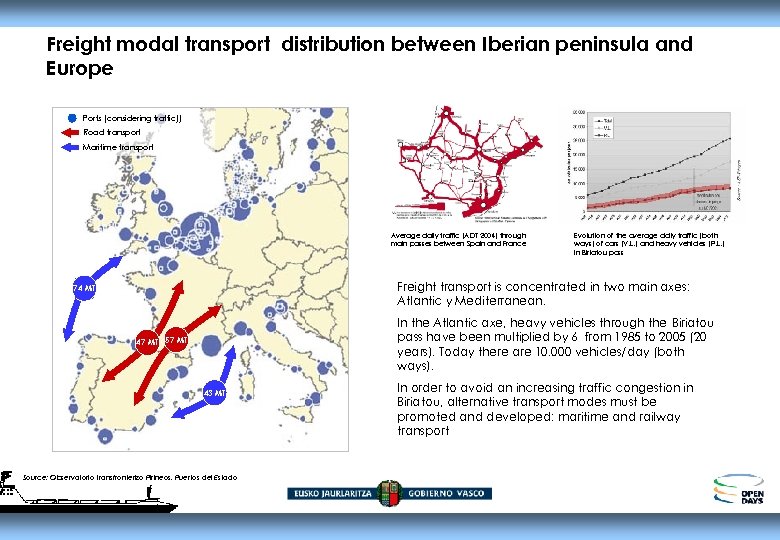 Freight modal transport distribution between Iberian peninsula and Europe Ports (considering traffic)) Road transport Maritime transport Average daily traffic (ADT 2004) through main passes between Spain and France Evolution of the average daily traffic (both ways) of cars (V. L. ) and heavy vehicles (P. L. ) in Biriatou pass Freight transport is concentrated in two main axes: Atlantic y Mediterranean. 74 MT In the Atlantic axe, heavy vehicles through the Biriatou pass have been multiplied by 6 from 1985 to 2005 (20 years). Today there are 10. 000 vehicles/day (both ways). 47 MT 57 MT 43 MT Source: Observatorio transfronterizo Pirineos, Puertos del Estado In order to avoid an increasing traffic congestion in Biriatou, alternative transport modes must be promoted and developed: maritime and railway transport
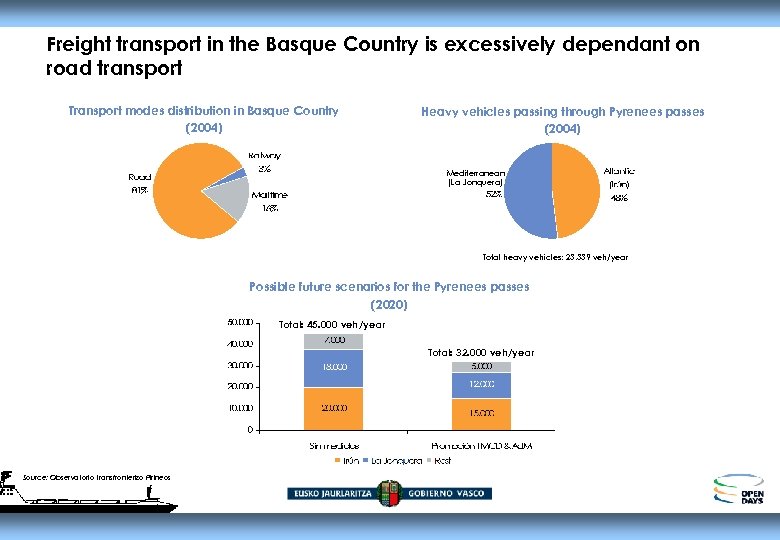 Freight transport in the Basque Country is excessively dependant on road transport Transport modes distribution in Basque Country (2004) Heavy vehicles passing through Pyrenees passes (2004) Mediterranean (La Jonquera) Total heavy vehicles: 23. 339 veh/year Possible future scenarios for the Pyrenees passes (2020) Total: 45. 000 veh/year Total: 32. 000 veh/year Source: Observatorio transfronterizo Pirineos
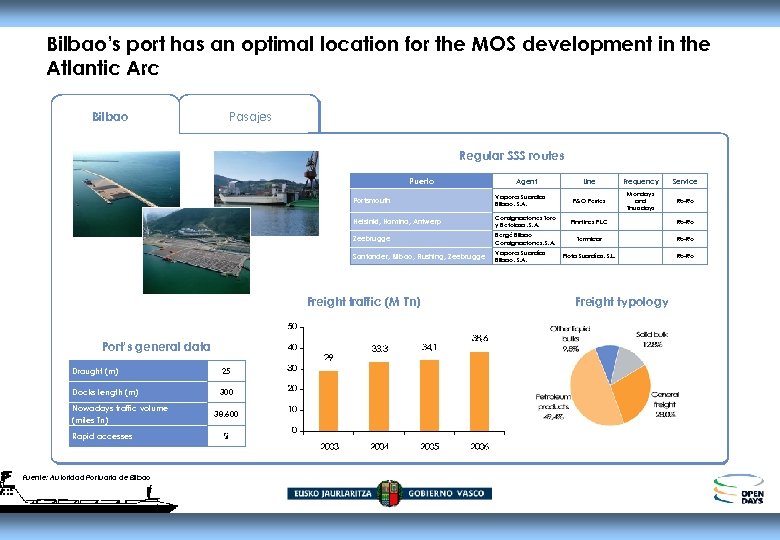 Bilbao’s port has an optimal location for the MOS development in the Atlantic Arc Bilbao Pasajes Regular SSS routes Puerto Agent Line Frequency Service P&O Ferries Mondays and Thursdays Ro-Ro Portsmouth Vapores Suardiaz Bilbao, S. A. Helsinki, Hamina, Antwerp Consignaciones Toro y Betolaza, S. A. Finnlines PLC Ro-Ro Zeebrugge Bergé Bilbao Consignaciones, S. A. Termicar Ro-Ro Santander, Bilbao, Flushing, Zeebrugge Vapores Suardíaz Bilbao, S. A. Flota Suardíaz, S. L. Ro-Ro Freight traffic (M Tn) Port’s general data Draught (m) 25 Docks length (m) 300 Nowadays traffic volume (miles Tn) Rapid accesses Fuente: Autoridad Portuaria de Bilbao 38. 600 Si Freight typology
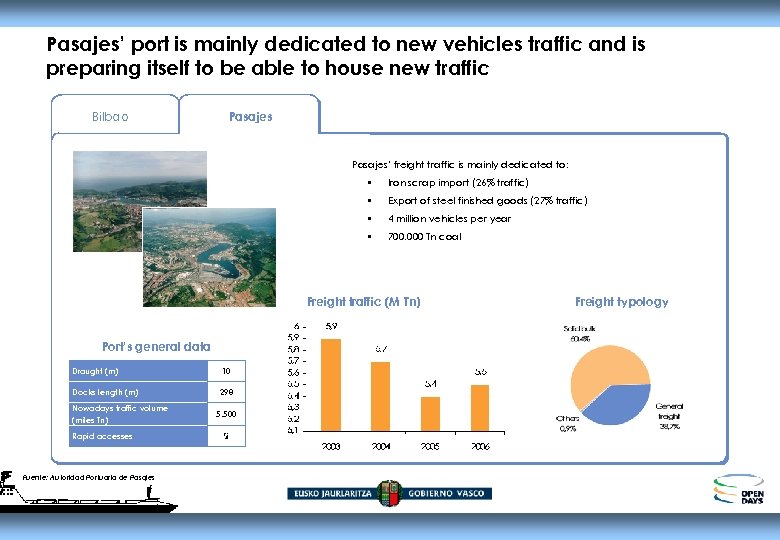 Pasajes’ port is mainly dedicated to new vehicles traffic and is preparing itself to be able to house new traffic Bilbao Pasajes’ freight traffic is mainly dedicated to: • Iron scrap import (26% traffic) • Export of steel finished goods (27% traffic) • 4 million vehicles per year • 700. 000 Tn coal Freight traffic (M Tn) Port’s general data Draught (m) 10 Docks length (m) 298 Nowadays traffic volume (miles Tn) Rapid accesses Fuente: Autoridad Portuaria de Pasajes 5. 500 Si Freight typology
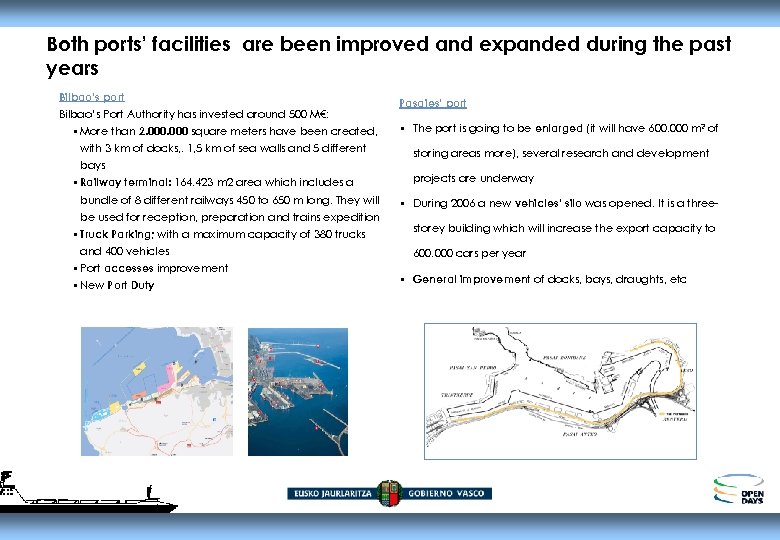 Both ports’ facilities are been improved and expanded during the past years Bilbao’s port Bilbao’s Port Authority has invested around 500 M€: § More than 2. 000 square meters have been created, with 3 km of docks, . 1, 5 km of sea walls and 5 different bays § Railway terminal: 164. 423 m 2 area which includes a bundle of 8 different railways 450 to 650 m long. They will be used for reception, preparation and trains expedition § Truck Parking; with a maximum capacity of 380 trucks and 400 vehicles § Port accesses improvement § New Port Duty Pasajes’ port • The port is going to be enlarged (it will have 600. 000 m² of storing areas more), several research and development projects are underway • During 2006 a new vehicles’ silo was opened. It is a threestorey building which will increase the export capacity to 600. 000 cars per year • General improvement of docks, bays, draughts, etc
 • Short Sea Shipping (SSS) and Motorways of the Sea (MOS) • Short Sea Shipping and Motorways of the Sea promotion • Freight transport current situation in Euskadi • Euskadi’s contribution to the SSS and MOS promotion
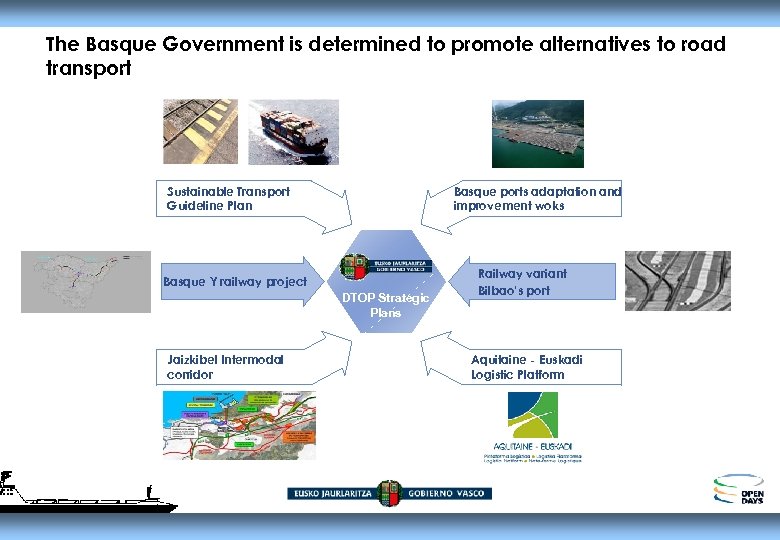 The Basque Government is determined to promote alternatives to road transport Sustainable Transport Guideline Plan Basque ports adaptation and improvement woks Basque Y railway project DTOP Strategic Plans Jaizkibel Intermodal corridor Railway variant Bilbao‘s port Aquitaine - Euskadi Logistic Platform
 The Sustainable Transport Guideline Plan (PDTS) is within the Basque Government’s sustainable transport strategic framework Sustainable Transport definition “Economic activity that has as main target the transfer of people and/or goods, , subjected or not to administrative permission, that must guarantee universal accessibility by a balanced use of different transport modes. This transfer must be done with the adequate security, quality and efficiency conditions and has to also guarantee future generations capacity of solving their necessities” • Principal goal: re-equilibrium of the different transport modes by strengthening of sustainable and less polluting modes (maritime, railways) in coordination with the rest of DTOP strategic projects • The Basques Government’s Sustainable Transport Guideline Plan is articulated by five ambitious partial targets for the next 10 years: ― Separate economical development from an increase in transport demand ― Achieve universal accessibility ― Motivate a re-equilibrium between the different transport modes ― Improve of the Basque Country’s strategic position within Europe ― Advance towards a more sustainable transport model that is respectful with the environment
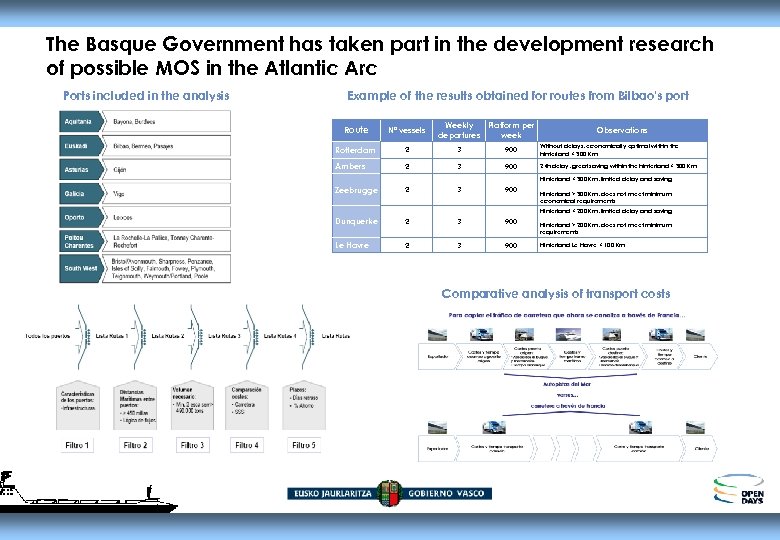 The Basque Government has taken part in the development research of possible MOS in the Atlantic Arc Ports included in the analysis Example of the results obtained for routes from Bilbao's port Weekly Platform per departures week Route Nº vessels Rotterdam 2 3 900 Without delays, economically optimal within the hinterland < 300 Km Ambers 2 3 900 24 h delay, great saving within the hinterland < 300 Km Zeebrugge 2 3 900 Dunquerke 2 3 900 Le Havre 2 3 900 Observations Hinterland < 300 Km, limited delay and saving Hinterland > 300 Km, does not meet minimum economical requirements Hinterland < 200 Km, limited delay and saving Hinterland > 200 Km, does not meet minimum requirements Hinterland Le Havre < 100 Km Comparative analysis of transport costs
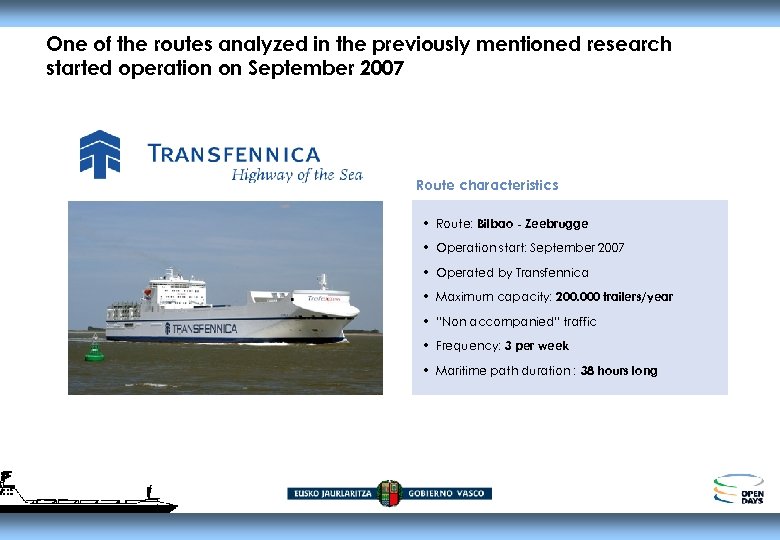 One of the routes analyzed in the previously mentioned research started operation on September 2007 Route characteristics • Route: Bilbao - Zeebrugge • Operation start: September 2007 • Operated by Transfennica • Maximum capacity: 200. 000 trailers/year • “Non accompanied” traffic • Frequency: 3 per week • Maritime path duration : 38 hours long