


 Скачать презентацию Open charm mesons in a hot and dense
bb1825201e4e5df7626af60cb26b7c0e.ppt
- Количество слайдов: 19
 Open charm mesons in a hot and dense medium L. Tolos 1, A. Ramos 2 and T. Mizutani 3 1 FIAS (University of Frankfurt) 2 Universitat de Barcelona 3 Virginia Polytechnic Institute and State University Phys. Rev. C 77 (2008) 015207 Hadrons@FAIR, FIAS June 25 -27, 2008 Frankfurt, Germany Open charm mesons in a hot and dense medium
 Outline 1. Motivation 2. Model: Self-consistent coupled-channel approach for DN scattering c(2593) and c(2800) are dynamically generated 3. Open-charm mesons in hot dense matter 4. Conclusions & Outlook Open charm mesons in a hot and dense medium 2
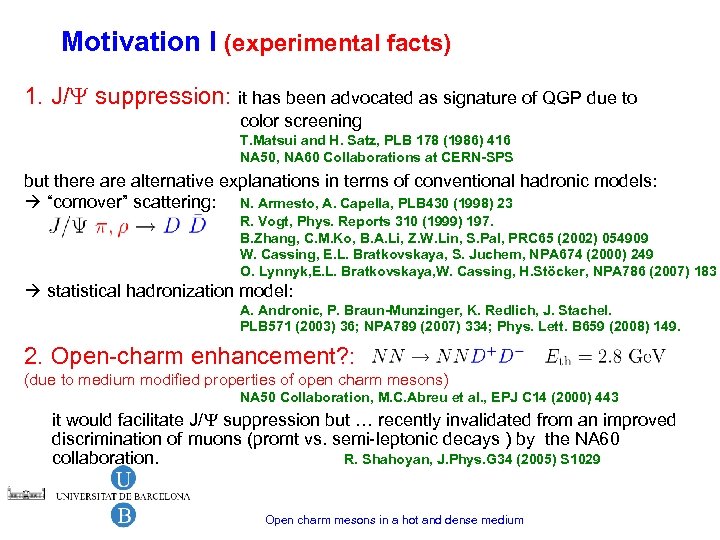 Motivation I (experimental facts) 1. J/ suppression: it has been advocated as signature of QGP due to color screening T. Matsui and H. Satz, PLB 178 (1986) 416 NA 50, NA 60 Collaborations at CERN-SPS but there alternative explanations in terms of conventional hadronic models: “comover” scattering: N. Armesto, A. Capella, PLB 430 (1998) 23 R. Vogt, Phys. Reports 310 (1999) 197. B. Zhang, C. M. Ko, B. A. Li, Z. W. Lin, S. Pal, PRC 65 (2002) 054909 W. Cassing, E. L. Bratkovskaya, S. Juchem, NPA 674 (2000) 249 O. Lynnyk, E. L. Bratkovskaya, W. Cassing, H. Stöcker, NPA 786 (2007) 183 statistical hadronization model: A. Andronic, P. Braun-Munzinger, K. Redlich, J. Stachel. PLB 571 (2003) 36; NPA 789 (2007) 334; Phys. Lett. B 659 (2008) 149. 2. Open-charm enhancement? : (due to medium modified properties of open charm mesons) NA 50 Collaboration, M. C. Abreu et al. , EPJ C 14 (2000) 443 it would facilitate J/ suppression but … recently invalidated from an improved discrimination of muons (promt vs. semi-leptonic decays ) by the NA 60 collaboration. R. Shahoyan, J. Phys. G 34 (2005) S 1029 Open charm mesons in a hot and dense medium
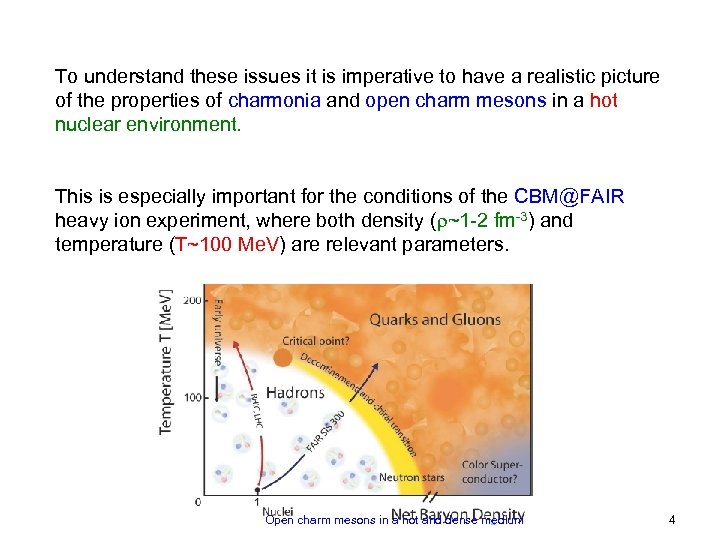 To understand these issues it is imperative to have a realistic picture of the properties of charmonia and open charm mesons in a hot nuclear environment. This is especially important for the conditions of the CBM@FAIR heavy ion experiment, where both density ( ~1 -2 fm-3) and temperature (T~100 Me. V) are relevant parameters. Open charm mesons in a hot and dense medium 4
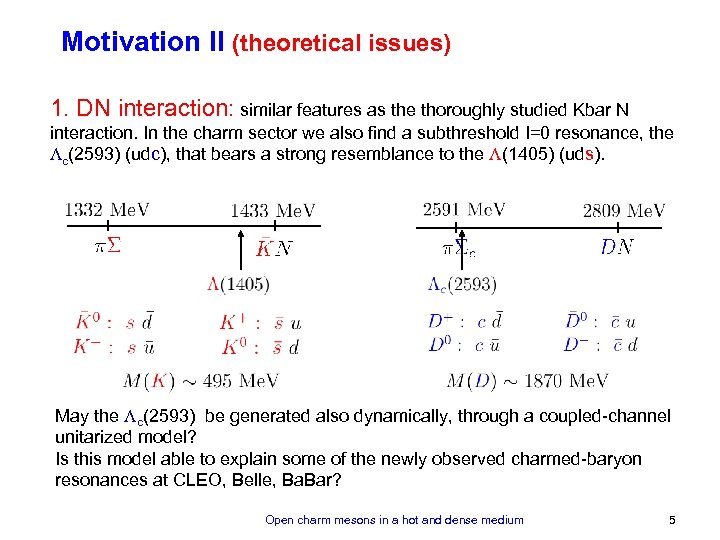 Motivation II (theoretical issues) 1. DN interaction: similar features as the thoroughly studied Kbar N interaction. In the charm sector we also find a subthreshold I=0 resonance, the c(2593) (udc), that bears a strong resemblance to the (1405) (uds). May the c(2593) be generated also dynamically, through a coupled-channel unitarized model? Is this model able to explain some of the newly observed charmed-baryon resonances at CLEO, Belle, Ba. Bar? Open charm mesons in a hot and dense medium 5
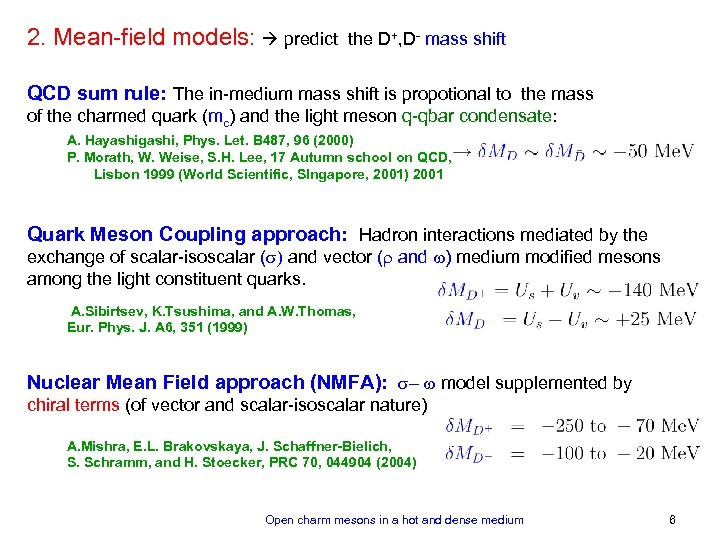 2. Mean-field models: predict the D+, D- mass shift QCD sum rule: The in-medium mass shift is propotional to the mass of the charmed quark (mc) and the light meson q-qbar condensate: A. Hayashigashi, Phys. Let. B 487, 96 (2000) P. Morath, W. Weise, S. H. Lee, 17 Autumn school on QCD, Lisbon 1999 (World Scientific, SIngapore, 2001) 2001 Quark Meson Coupling approach: Hadron interactions mediated by the exchange of scalar-isoscalar (s) and vector ( and w) medium modified mesons among the light constituent quarks. A. Sibirtsev, K. Tsushima, and A. W. Thomas, Eur. Phys. J. A 6, 351 (1999) Nuclear Mean Field approach (NMFA): s- w model supplemented by chiral terms (of vector and scalar-isoscalar nature) A. Mishra, E. L. Brakovskaya, J. Schaffner-Bielich, S. Schramm, and H. Stoecker, PRC 70, 044904 (2004) Open charm mesons in a hot and dense medium 6
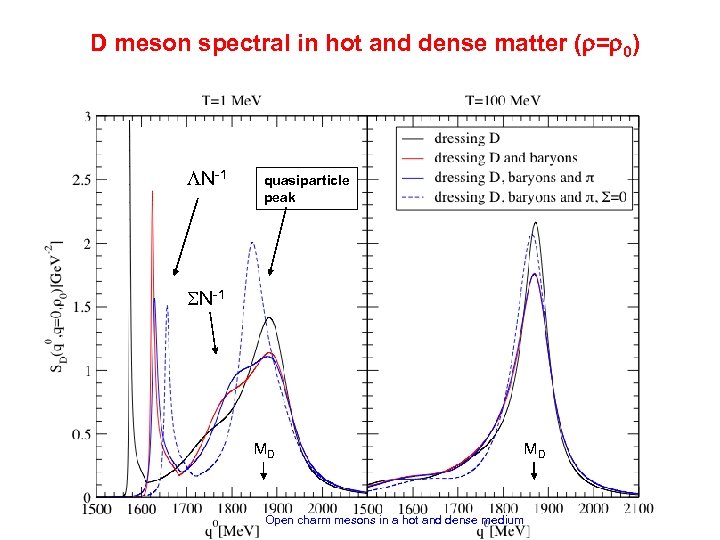
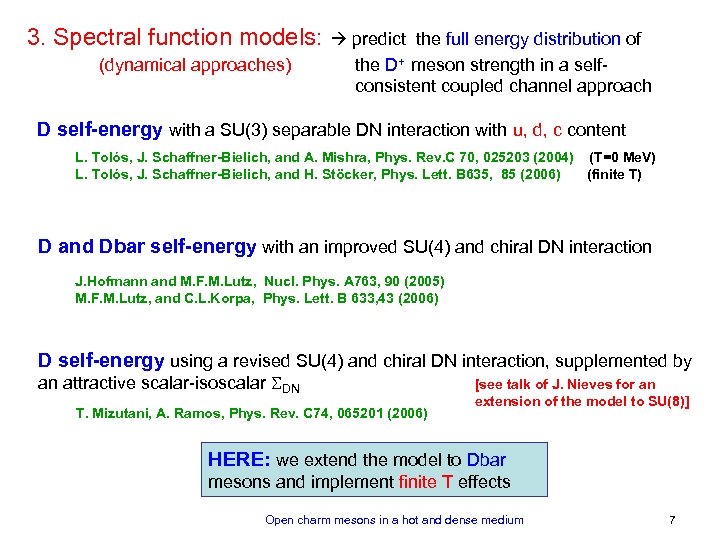 3. Spectral function models: predict (dynamical approaches) the full energy distribution of the D+ meson strength in a selfconsistent coupled channel approach D self-energy with a SU(3) separable DN interaction with u, d, c content L. Tolós, J. Schaffner-Bielich, and A. Mishra, Phys. Rev. C 70, 025203 (2004) (T=0 Me. V) L. Tolós, J. Schaffner-Bielich, and H. Stöcker, Phys. Lett. B 635, 85 (2006) (finite T) D and Dbar self-energy with an improved SU(4) and chiral DN interaction J. Hofmann and M. F. M. Lutz, Nucl. Phys. A 763, 90 (2005) M. F. M. Lutz, and C. L. Korpa, Phys. Lett. B 633, 43 (2006) D self-energy using a revised SU(4) and chiral DN interaction, supplemented by an attractive scalar-isoscalar DN T. Mizutani, A. Ramos, Phys. Rev. C 74, 065201 (2006) [see talk of J. Nieves for an extension of the model to SU(8)] HERE: we extend the model to Dbar mesons and implement finite T effects Open charm mesons in a hot and dense medium 7
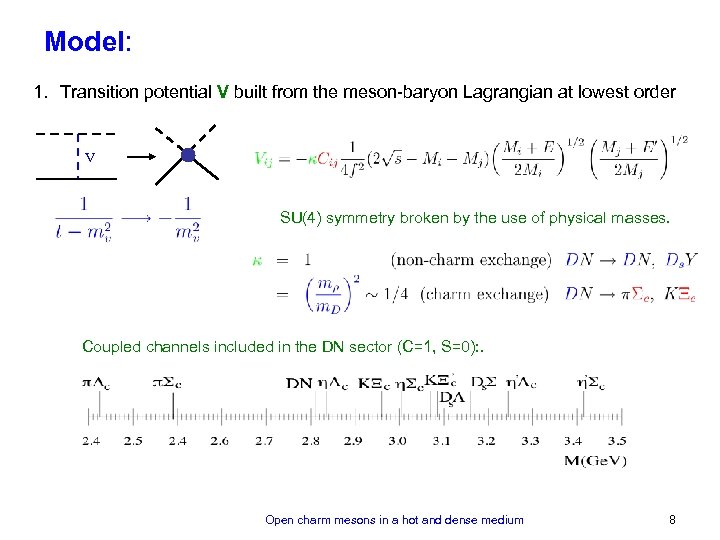 Model: 1. Transition potential V built from the meson-baryon Lagrangian at lowest order V SU(4) symmetry broken by the use of physical masses. Coupled channels included in the DN sector (C=1, S=0): . Open charm mesons in a hot and dense medium 8
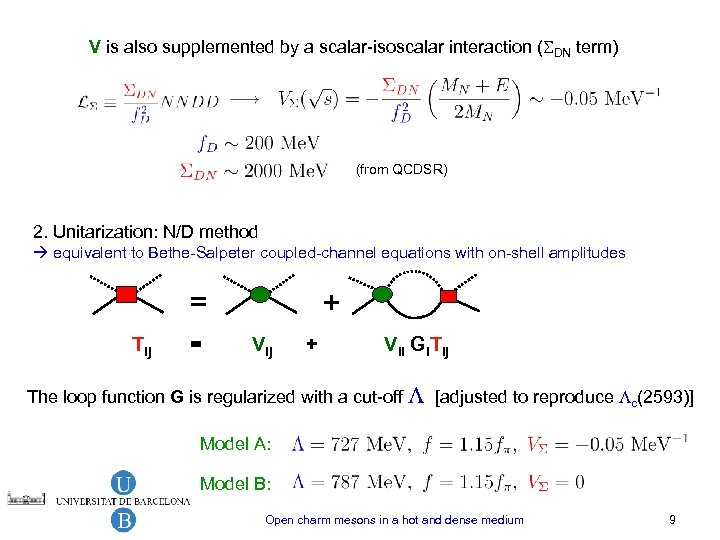 V is also supplemented by a scalar-isoscalar interaction ( DN term) (from QCDSR) 2. Unitarization: N/D method equivalent to Bethe-Salpeter coupled-channel equations with on-shell amplitudes = Tij = + Vij + Vil Gl. Tlj The loop function G is regularized with a cut-off [adjusted to reproduce c(2593)] Model A: Model B: Open charm mesons in a hot and dense medium 9
![Free space DN amplitudes I=0 I=1 R. Mizuk et al. [Belle Collaboration] Phys. Rev.](https://present5.com/presentation/bb1825201e4e5df7626af60cb26b7c0e/image-10.jpg "Free space DN amplitudes I=0 I=1 R. Mizuk et al. [Belle Collaboration] Phys. Rev.") Free space DN amplitudes I=0 I=1 R. Mizuk et al. [Belle Collaboration] Phys. Rev. Lett. 94, 122002(2005) c(2800), G~60 Me. V The model generates the I=0 c(2595) and another resonance in I=1 around the nominal c(2800)! Open charm mesons in a hot and dense medium
Free space DN amplitudes I=0 I=1 R. Mizuk et al. [Belle Collaboration] Phys. Rev. Lett. 94, 122002(2005) c(2800), G~60 Me. V The model generates the I=0 c(2595) and another resonance in I=1 around the nominal c(2800)! Open charm mesons in a hot and dense medium
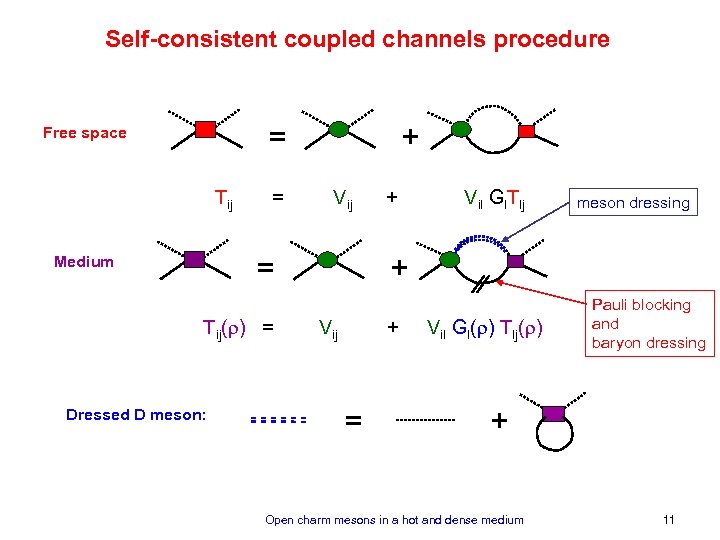 Self-consistent coupled channels procedure = Free space Tij = + Vij = Medium Tij( ) = Dressed D meson: + Vil Gl. Tlj meson dressing + Vij + = Vil Gl( ) Tlj( ) Pauli blocking and baryon dressing + Open charm mesons in a hot and dense medium 11
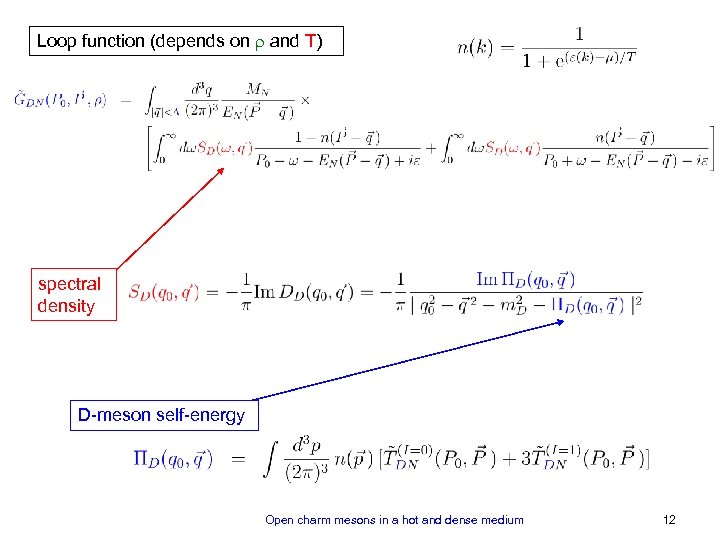 Loop function (depends on and T) spectral density D-meson self-energy Open charm mesons in a hot and dense medium 12
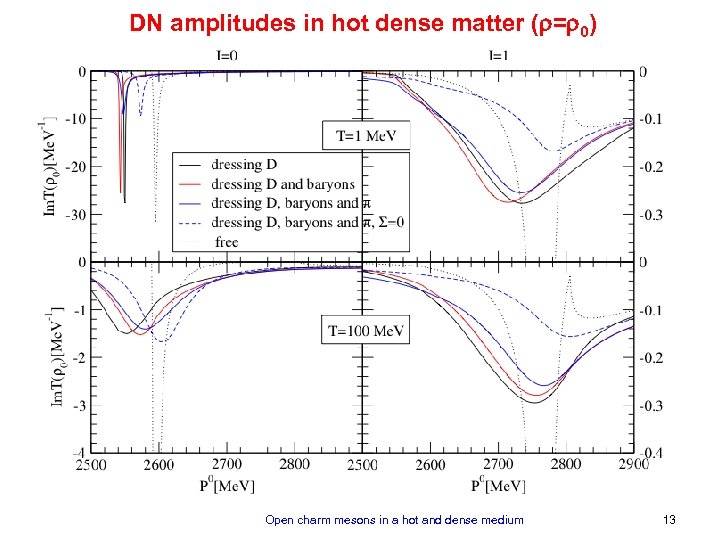 DN amplitudes in hot dense matter (r=r 0) Open charm mesons in a hot and dense medium 13
 D meson spectral in hot and dense matter (r=r 0) N-1 quasiparticle peak N-1 MD Open charm mesons in a hot and dense medium MD
 Evolution with density and temperature r=r 0 r=2 r 0 Similar trend to previous finite temperature results: LT, J. Schaffner-Bielich and H. Stoecker PLB 635 (2006) 85 Open charm mesons in a hot and dense medium
 Free space: Medium (at T=0): DN interaction D optical potential Open charm mesons in a hot and dense medium
 _ D and D meson potentials Open charm mesons in a hot and dense medium
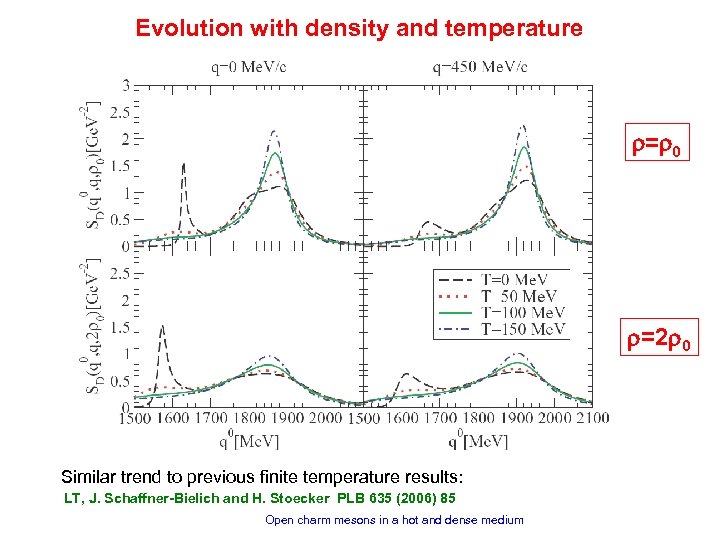
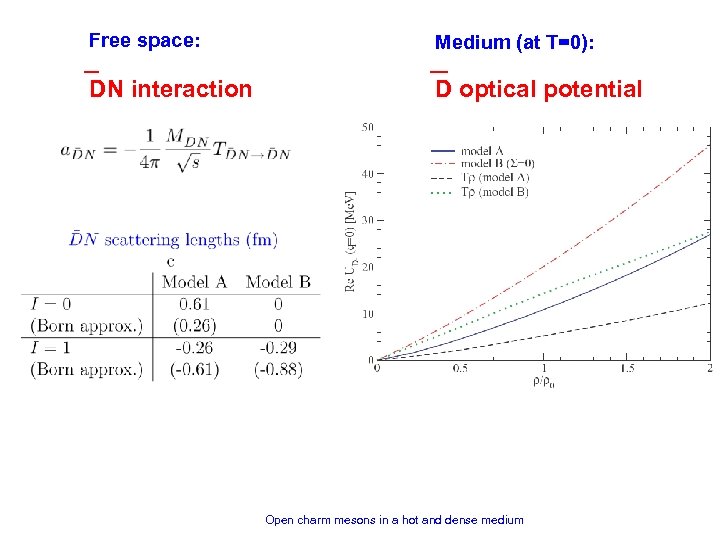
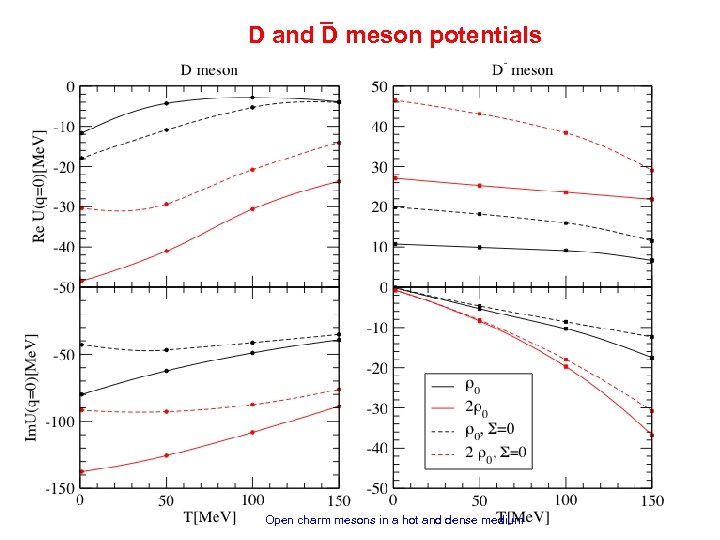
 Conclusions & Outlook We have performed a self-consistent coupled-channel calculation of _ the D and D self-energies in symmetric nuclear matter at finite temperature taking, as bare interaction, the SU(4) TW contribution supplemented by a DN term üIn hot dense matter, c(2593) and c(2800) stay close to their free position but develop a remarkable width üThe D meson spectral density shows a single pronounced peak at finite temperature that melts with increasing density ü _ Up to 0 the low-density theorem is a good approximation for the DN, where the repulsive I=1 component dominates ü Due to the distinct resonant structure of the interaction, temperature _ induces a stronger change in the properties of the D than the D meson Open charm mesons in a hot and dense medium 18
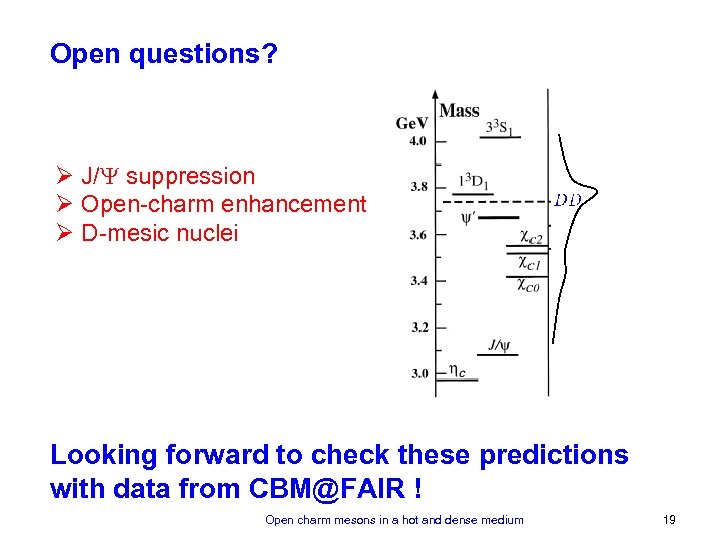 Open questions? Ø J/ suppression Ø Open-charm enhancement Ø D-mesic nuclei Looking forward to check these predictions with data from CBM@FAIR ! Open charm mesons in a hot and dense medium 19