


 Скачать презентацию Open Access to Scholarly Information Resources Ya-ning Arthur
352b69c01d77372e5c7e6471e9b87706.ppt
- Количество слайдов: 44
 Open Access to Scholarly Information Resources Ya-ning Arthur Chen Computing Centre, Academia Sinica 2003 CONCERT Annual Conference 19 Nov. 2003
 The more e-access, the more pricing dilemma is?
 Big Deal? Or Big Chill?
 Are we stuck into the Faustian Bargain?
![[10]](https://present5.com/presentation/352b69c01d77372e5c7e6471e9b87706/image-5.jpg "[10]") [10]
[10]
![[17]](https://present5.com/presentation/352b69c01d77372e5c7e6471e9b87706/image-6.jpg "[17]") [17]
[17]
![[17]](https://present5.com/presentation/352b69c01d77372e5c7e6471e9b87706/image-7.jpg "[17]") [17]
[17]
![[16]](https://present5.com/presentation/352b69c01d77372e5c7e6471e9b87706/image-8.jpg "[16]") [16]
[16]
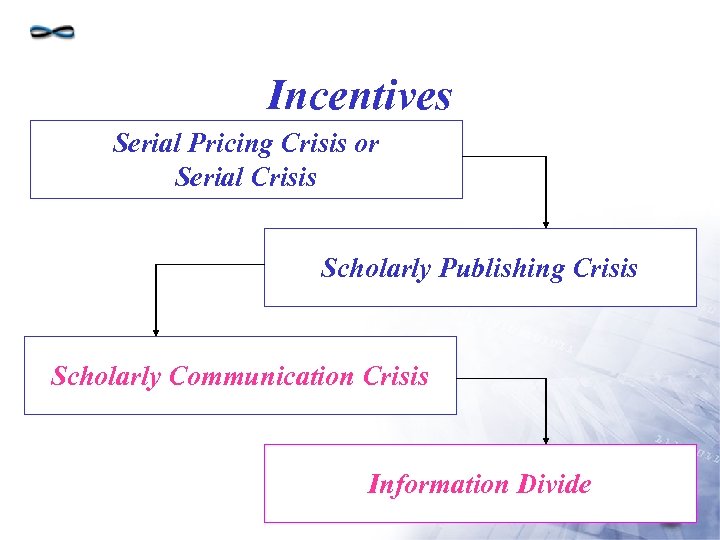 Incentives Serial Pricing Crisis or Serial Crisis Scholarly Publishing Crisis Scholarly Communication Crisis Information Divide
![[23]](https://present5.com/presentation/352b69c01d77372e5c7e6471e9b87706/image-10.jpg "[23]") [23]
[23]
 Ø 1665 – Historical Review of Journal Development 1 Ø Philosophical Transactions of the Royal Society of London Ø Dealt with new information, really aimed at creating a public record of original contributions to knowledge. [6] Ø Reached a wider audience. Ø Peer review was instituted as a means of screening and improving what was published. Ø Citations to earlier articles provided a way to weave previous research into the fabric of the new. [24] Ø Journal des Scavans A French Publication as Republic of Letters. A newsoriented patterns of manuscript epistolary exchanges. It stands closer to something like Scientific American than to a modern scholarly journal. [6]
 Historical Review of Journal Development 2 Ø 1960 s Ø Most societies recovered publication costs largely from members’ dues, which included a journal subscription. Ø The number of articles published by each author was relatively small. Ø Library subscriptions were not a major source of income for publishers. Ø Commercial publishers were generally not attracted to the field because there was little potential for profit. [24]
 Historical Review of Journal Development 3 Ø Post-1961 Ø Societies soon faced problem of having to reject good manuscripts and to delay publication of accepted manuscripts because their journals and their ability to subsidize members’ publication were at capacity. Ø To alleviate the financial strains on journal publishing, the federal government approved the payment of page charges by federal agencies and from federal grants to nonprofit publishers. [24]
 Historical Review of Journal Development 4 Ø Post-1961 Ø Societies quickly took advantage of this new source of revenue to publish more pages in their established journals and to start new journals. Ø Commercial publishers seized the opportunity to offer scientific investigators new outlets for their manuscripts. Ø Commercial publishers started new journals in longestablished fields; but, of greater impact, they identified new or newly popular research areas and established journals in those specialist. [24]
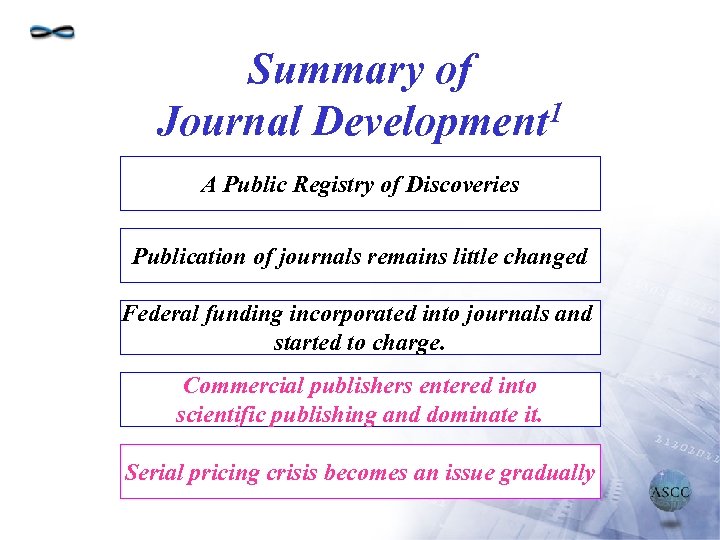 Summary of Journal Development 1 A Public Registry of Discoveries Publication of journals remains little changed Federal funding incorporated into journals and started to charge. Commercial publishers entered into scientific publishing and dominate it. Serial pricing crisis becomes an issue gradually
![Summary of Journal Development 2 Registration Awareness [4] Certification Archiving](https://present5.com/presentation/352b69c01d77372e5c7e6471e9b87706/image-16.jpg "Summary of Journal Development 2 Registration Awareness [4] Certification Archiving") Summary of Journal Development 2 Registration Awareness [4] Certification Archiving
Summary of Journal Development 2 Registration Awareness [4] Certification Archiving
 What is Open 1 Access Ø User’s aspect Its free availability on the public Internet, permitting any users to read, download, copy, distribute, print, search, or link to the full texts of these articles, crawl them for indexing, pass them as data to software, or use them for any other lawful purpose, without financial, legal, or technical barriers other than those inseparable from gaining access to the Internet itself. [20]
 What is Open 2 Access Ø Author’s aspect The only constraint on reproduction and distribution, and the only role for copyright in this domain, should be given authors control over the integrity of their work and the right to be properly acknowledged and cited. [20]
 What is Open 3 Access Ø By open access we mean no-fee access on the public internet to works and data that are currently given away to publishers by researchers and scholars with no expectation of financial payment. [2]
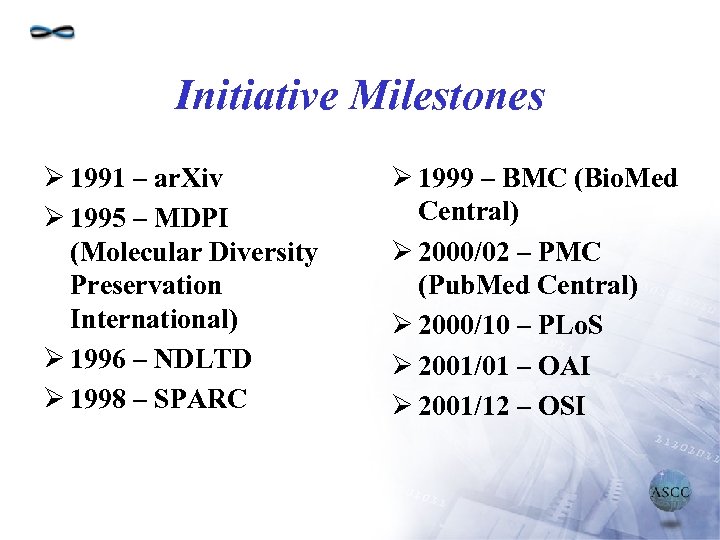 Initiative Milestones Ø 1991 – ar. Xiv Ø 1995 – MDPI (Molecular Diversity Preservation International) Ø 1996 – NDLTD Ø 1998 – SPARC Ø 1999 – BMC (Bio. Med Central) Ø 2000/02 – PMC (Pub. Med Central) Ø 2000/10 – PLo. S Ø 2001/01 – OAI Ø 2001/12 – OSI
 Subversive Proposal Ø Will electronic technologies save us from the economic pressures of the current papyrocentric publishing system? Ø Will they be more expensive than we dreamed? Ø Were journal publication systems the only way authors could make their work public at all during the age when paper publication was their only option? [12]
 Tempe 1 Principles Ø The cost to the academy of published research should be contained so that access to relevant research publications for faculty and students can be maintained and even expanded. Ø Electronic capabilities should be used, among other things, to: provide wide access to scholarship, encourage interdisciplinary research, and enhance interoperability and searchability. Development of common standards will be particularly important in the electronic environment. [21]
 Tempe 2 Principles Ø Scholarly publications must be archived in a secure manner so as to remain permanently available and, in the case of electronic works, a permanent identifier for citation and linking should be provided. Ø The system of scholarly publication must continue to include processes for evaluating the quality of scholarly work and every publication should provide the reader with information about evaluation the work has undergone. [21]
 Tempe 3 Principles Ø The academic community embraces the concepts of copyright and fair use and seeks a balance in the interest of owners and users in the digital environment. Universities, colleges, and especially their faculties should manage copyright and its limitations and exceptions in a manner that assures the faculty access to and use of their own published works in their research and teaching. Ø In negotiating publishing agreements, faculty should assign the rights to their work in a manner that promotes the ready use of their work and choose journals that support the goal of making scholarly publications available at reasonable cost. [21]
 Tempe 4 Principles Ø The time from submission to publication should be reduced in a manner consistent with the requirements for quality control. Ø To assure quality and reduce proliferation of publications, the evaluation of faculty should be place a greater emphasis on quality of publications and a reduced emphasis on quality. Ø In electronic as well as print environments, scholars and students should be assured privacy with regard to their use of materials. [21]
 Declaring Independence Ø To re-think how we can solve the existing issues of serial crisis and scholarly communication crisis. ØStep 1: Does your journal meet its primary goal – To serve its community? ØStep 2: Exploring alternative options ØStep 3: Evaluating the options [13]
 Open Letter Ø Goal is urging publishers to allow the research reports that have appeared in their journals to be distributed freely by independent, online public libraries of science. Ø Domain is focused on medicine and life sciences.
 BOAI Statement Ø Self-archiving or institution repository Ø Open Access Journal/Publishing (OAJ or OAP) [20]
 OAI Specification Ø Can be treated as a promotion and discovery tool for scholarly communication on Internet. Ø Is a protocol to harvest data from electronic materials on Internet – OAIPMH(protocol for metadata harvesting) Ø Is an adoption of DC with un-qualifiers.
 Bethesda Statement Ø Providing open access to the primary scientific literature, including ØThe organizations foster and support scientific research, ØThe scientists generate the research results, ØThe publishers facilitate the peer-review and distribution of results of the research, ØAnd the scientists, librarians and other who depend on access to this knowledge. [19]
 Principles and Strategies for the Reform of Scholarly Communication 1 Ø The broadest possible access to published research and other scholarly writings Ø Increased control by scholars and the academy over the system of scholarly publishing Ø Fair and reasonable prices for scholarly information Ø Competitive markets for scholarly communication Ø A diversified publishing industry Ø Open access to scholarship [1]
 Principles and Strategies for the Reform of Scholarly Communication 2 Ø Innovations in publishing that reduce distribution costs, speed delivery, and extend access to scholarly research Ø Quality assurance in publishing through peer review Ø Fair use of copyrighted information for educational and research purposes Ø Extension of public domain information Ø Preservation of scholarly information for long-term future use Ø The right to privacy in the use of scholarly information [1]
 Sabo Bill Ø This act may be cited as the “Public Access to Science Act” Ø Proposed by Congressman Martin Sabo of Minnesota on 7 July 2003. Ø Goal Publicly funded research data should be openly available to the maximum possible extent. Public funded research data are a public good, produced in the public interest. [22]
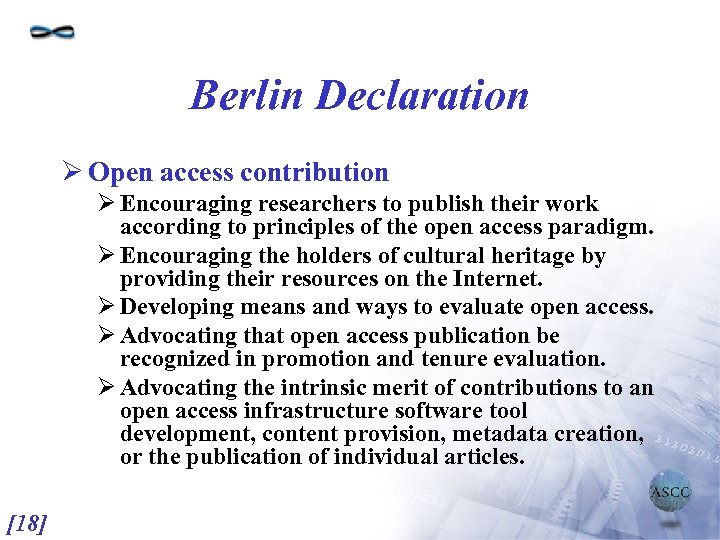 Berlin Declaration Ø Open access contribution Ø Encouraging researchers to publish their work according to principles of the open access paradigm. Ø Encouraging the holders of cultural heritage by providing their resources on the Internet. Ø Developing means and ways to evaluate open access. Ø Advocating that open access publication be recognized in promotion and tenure evaluation. Ø Advocating the intrinsic merit of contributions to an open access infrastructure software tool development, content provision, metadata creation, or the publication of individual articles. [18]
![Purpose Ø To ensure broad distribution and use of information [2] Ø To construct](https://present5.com/presentation/352b69c01d77372e5c7e6471e9b87706/image-35.jpg "Purpose Ø To ensure broad distribution and use of information [2] Ø To construct") Purpose Ø To ensure broad distribution and use of information [2] Ø To construct an alternative model to current scholarly publishing Ø To turn the scholarly publishing market from “boycott” to “be competitive” Ø To change the Rules of Scholarly Publishing Ø To regain right of fair use
Purpose Ø To ensure broad distribution and use of information [2] Ø To construct an alternative model to current scholarly publishing Ø To turn the scholarly publishing market from “boycott” to “be competitive” Ø To change the Rules of Scholarly Publishing Ø To regain right of fair use
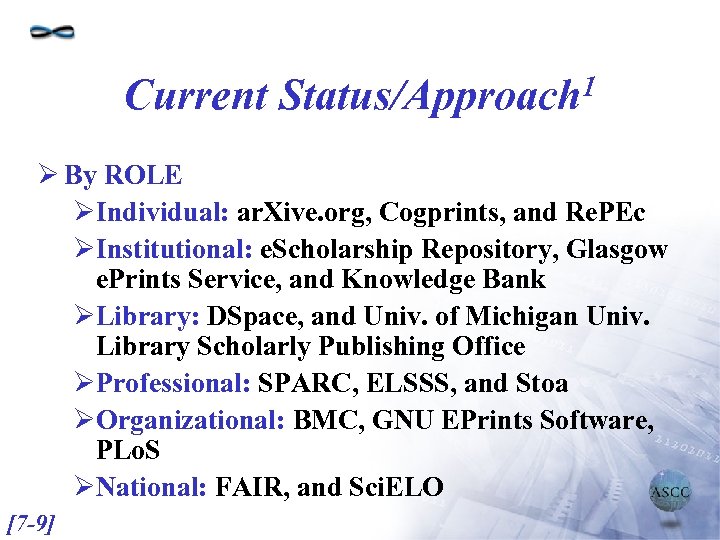 Current 1 Status/Approach Ø By ROLE ØIndividual: ar. Xive. org, Cogprints, and Re. PEc ØInstitutional: e. Scholarship Repository, Glasgow e. Prints Service, and Knowledge Bank ØLibrary: DSpace, and Univ. of Michigan Univ. Library Scholarly Publishing Office ØProfessional: SPARC, ELSSS, and Stoa ØOrganizational: BMC, GNU EPrints Software, PLo. S ØNational: FAIR, and Sci. ELO [7 -9]
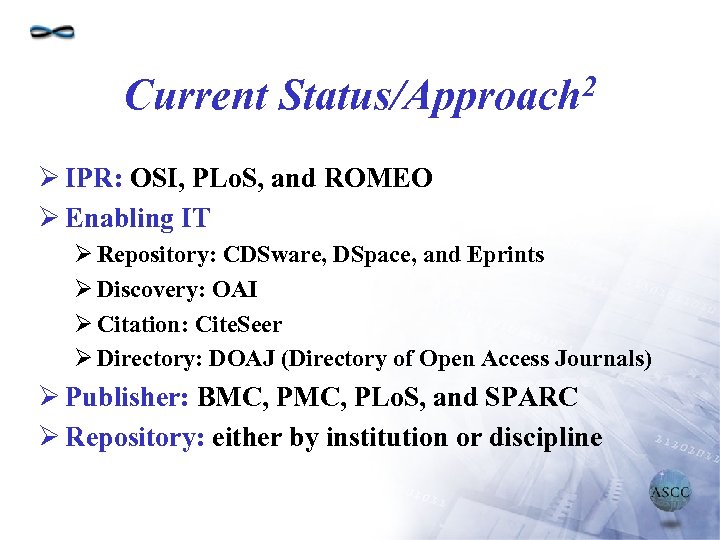 Current 2 Status/Approach Ø IPR: OSI, PLo. S, and ROMEO Ø Enabling IT Ø Repository: CDSware, DSpace, and Eprints Ø Discovery: OAI Ø Citation: Cite. Seer Ø Directory: DOAJ (Directory of Open Access Journals) Ø Publisher: BMC, PLo. S, and SPARC Ø Repository: either by institution or discipline
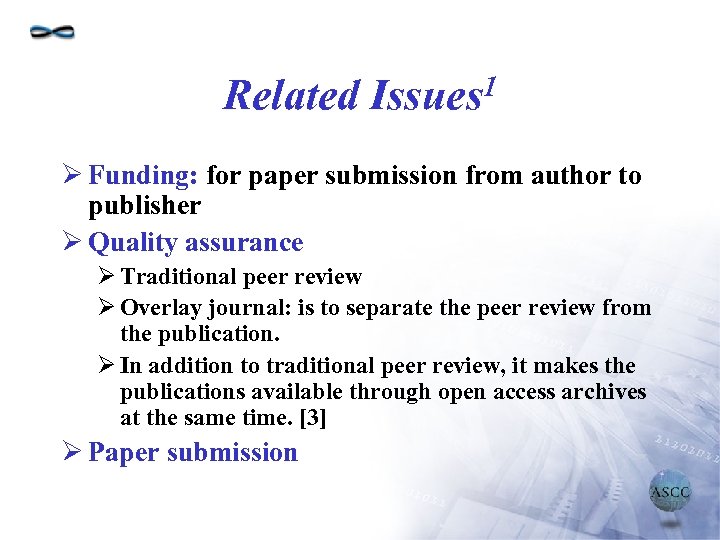 Related 1 Issues Ø Funding: for paper submission from author to publisher Ø Quality assurance Ø Traditional peer review Ø Overlay journal: is to separate the peer review from the publication. Ø In addition to traditional peer review, it makes the publications available through open access archives at the same time. [3] Ø Paper submission
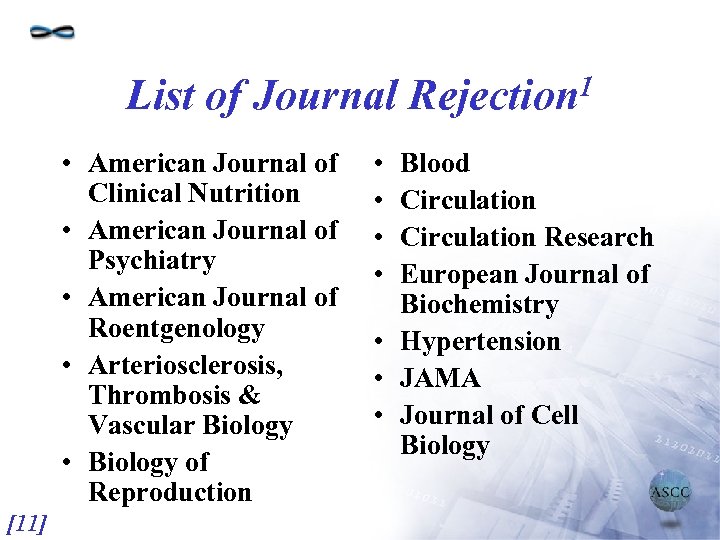 List of Journal • American Journal of Clinical Nutrition • American Journal of Psychiatry • American Journal of Roentgenology • Arteriosclerosis, Thrombosis & Vascular Biology • Biology of Reproduction [11] • • 1 Rejection Blood Circulation Research European Journal of Biochemistry • Hypertension • JAMA • Journal of Cell Biology
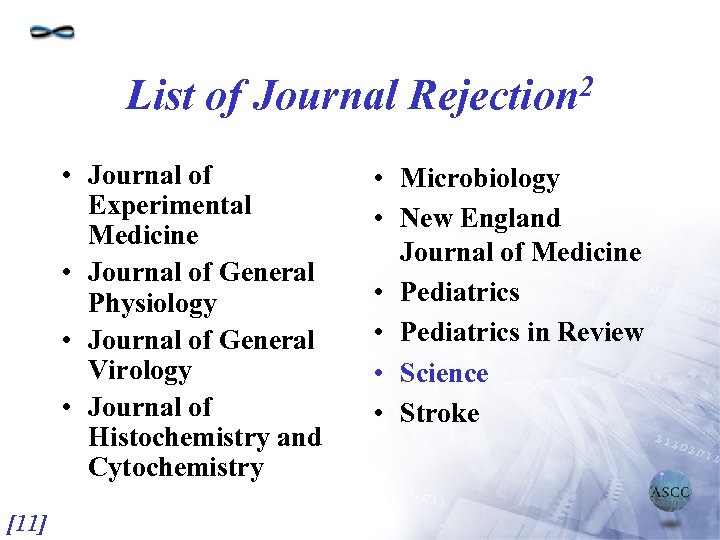 List of Journal • Journal of Experimental Medicine • Journal of General Physiology • Journal of General Virology • Journal of Histochemistry and Cytochemistry [11] 2 Rejection • Microbiology • New England Journal of Medicine • Pediatrics in Review • Science • Stroke
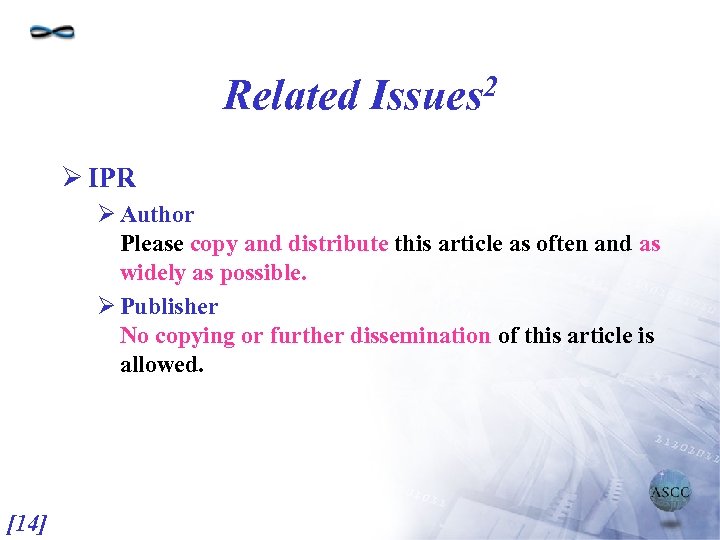 Related 2 Issues Ø IPR Ø Author Please copy and distribute this article as often and as widely as possible. Ø Publisher No copying or further dissemination of this article is allowed. [14]
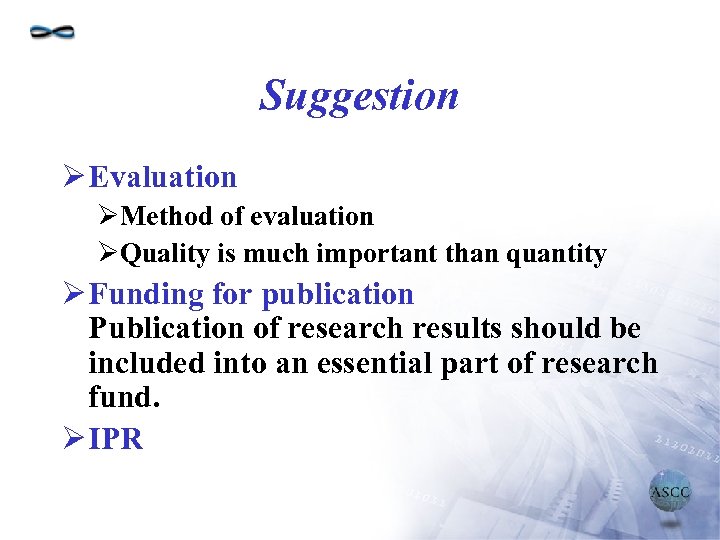 Suggestion Ø Evaluation ØMethod of evaluation ØQuality is much important than quantity Ø Funding for publication Publication of research results should be included into an essential part of research fund. Ø IPR
 Conclusion FREE scholarly communication is our common goal! Ø Information availability Unrestricted Information Accessibility Ø IT interoperability Clear the IT-barriers’ access to information resources
 Thank for your join, and welcome any comments!