


 Скачать презентацию Open Access Matters Increasing Reading Rates and Responses
1381896a6c3a91987b20a8f6ad9d69d6.ppt
- Количество слайдов: 1
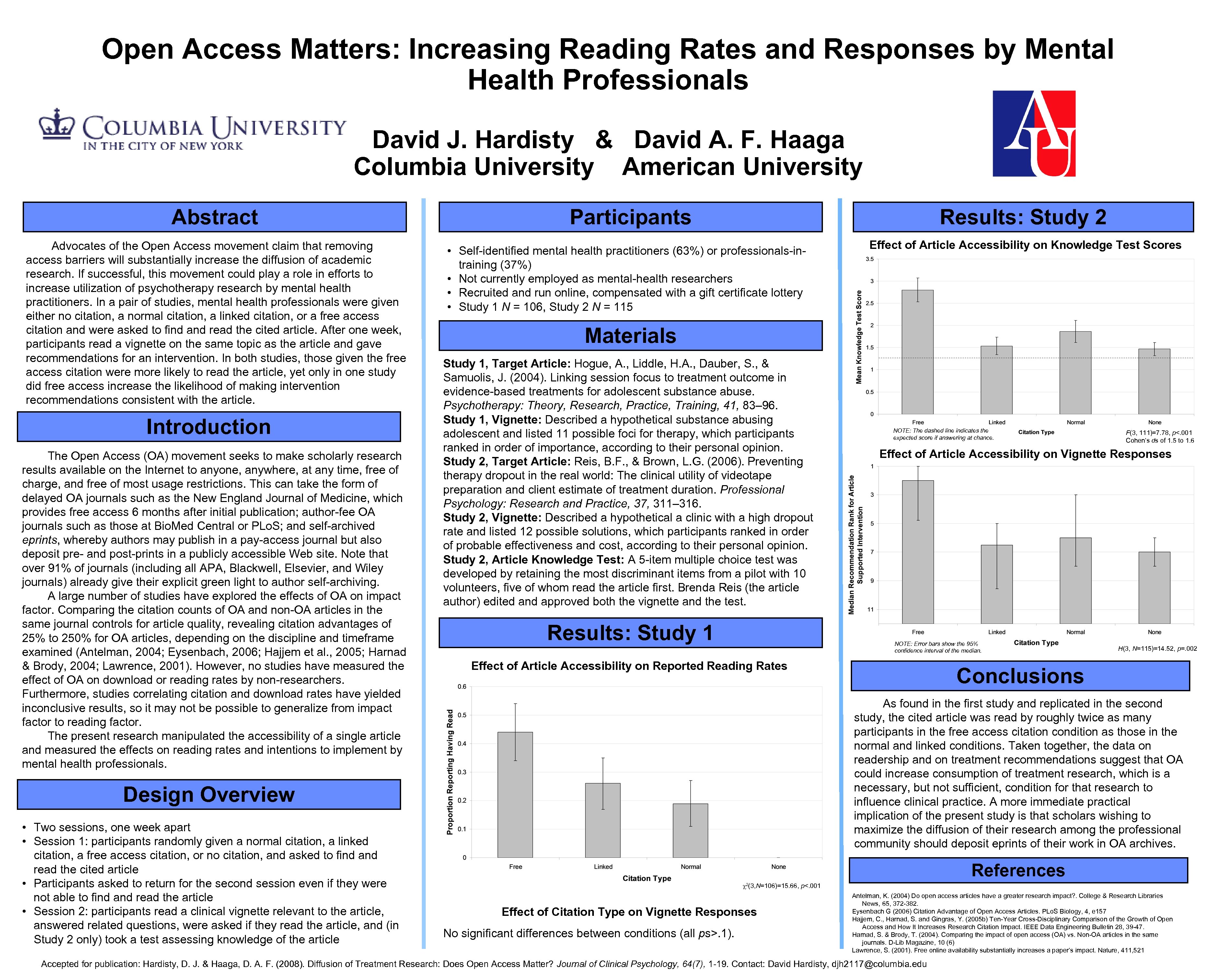 Open Access Matters: Increasing Reading Rates and Responses by Mental Health Professionals David J. Hardisty & David A. F. Haaga Columbia University American University Abstract Advocates of the Open Access movement claim that removing access barriers will substantially increase the diffusion of academic research. If successful, this movement could play a role in efforts to increase utilization of psychotherapy research by mental health practitioners. In a pair of studies, mental health professionals were given either no citation, a normal citation, a linked citation, or a free access citation and were asked to find and read the cited article. After one week, participants read a vignette on the same topic as the article and gave recommendations for an intervention. In both studies, those given the free access citation were more likely to read the article, yet only in one study did free access increase the likelihood of making intervention recommendations consistent with the article. Introduction The Open Access (OA) movement seeks to make scholarly research results available on the Internet to anyone, anywhere, at any time, free of charge, and free of most usage restrictions. This can take the form of delayed OA journals such as the New England Journal of Medicine, which provides free access 6 months after initial publication; author-fee OA journals such as those at Bio. Med Central or PLo. S; and self-archived eprints, whereby authors may publish in a pay-access journal but also deposit pre- and post-prints in a publicly accessible Web site. Note that over 91% of journals (including all APA, Blackwell, Elsevier, and Wiley journals) already give their explicit green light to author self-archiving. A large number of studies have explored the effects of OA on impact factor. Comparing the citation counts of OA and non-OA articles in the same journal controls for article quality, revealing citation advantages of 25% to 250% for OA articles, depending on the discipline and timeframe examined (Antelman, 2004; Eysenbach, 2006; Hajjem et al. , 2005; Harnad & Brody, 2004; Lawrence, 2001). However, no studies have measured the effect of OA on download or reading rates by non-researchers. Furthermore, studies correlating citation and download rates have yielded inconclusive results, so it may not be possible to generalize from impact factor to reading factor. The present research manipulated the accessibility of a single article and measured the effects on reading rates and intentions to implement by mental health professionals. Participants Results: Study 2 • Self-identified mental health practitioners (63%) or professionals-intraining (37%) • Not currently employed as mental-health researchers • Recruited and run online, compensated with a gift certificate lottery • Study 1 N = 106, Study 2 N = 115 Materials Study 1, Target Article: Hogue, A. , Liddle, H. A. , Dauber, S. , & Samuolis, J. (2004). Linking session focus to treatment outcome in evidence-based treatments for adolescent substance abuse. Psychotherapy: Theory, Research, Practice, Training, 41, 83– 96. Study 1, Vignette: Described a hypothetical substance abusing adolescent and listed 11 possible foci for therapy, which participants ranked in order of importance, according to their personal opinion. Study 2, Target Article: Reis, B. F. , & Brown, L. G. (2006). Preventing therapy dropout in the real world: The clinical utility of videotape preparation and client estimate of treatment duration. Professional Psychology: Research and Practice, 37, 311– 316. Study 2, Vignette: Described a hypothetical a clinic with a high dropout rate and listed 12 possible solutions, which participants ranked in order of probable effectiveness and cost, according to their personal opinion. Study 2, Article Knowledge Test: A 5 -item multiple choice test was developed by retaining the most discriminant items from a pilot with 10 volunteers, five of whom read the article first. Brenda Reis (the article author) edited and approved both the vignette and the test. Results: Study 1 NOTE: The dashed line indicates the expected score if answering at chance. F(3, 111)=7. 78, p<. 001 Cohen’s ds of 1. 5 to 1. 6 Effect of Article Accessibility on Vignette Responses NOTE: Error bars show the 95% confidence interval of the median. Effect of Article Accessibility on Reported Reading Rates H(3, N=115)=14. 52, p=. 002 Conclusions As found in the first study and replicated in the second study, the cited article was read by roughly twice as many participants in the free access citation condition as those in the normal and linked conditions. Taken together, the data on readership and on treatment recommendations suggest that OA could increase consumption of treatment research, which is a necessary, but not sufficient, condition for that research to influence clinical practice. A more immediate practical implication of the present study is that scholars wishing to maximize the diffusion of their research among the professional community should deposit eprints of their work in OA archives. Design Overview • Two sessions, one week apart • Session 1: participants randomly given a normal citation, a linked citation, a free access citation, or no citation, and asked to find and read the cited article • Participants asked to return for the second session even if they were not able to find and read the article • Session 2: participants read a clinical vignette relevant to the article, answered related questions, were asked if they read the article, and (in Study 2 only) took a test assessing knowledge of the article Effect of Article Accessibility on Knowledge Test Scores References χ2(3, N=106)=15. 66, p<. 001 Effect of Citation Type on Vignette Responses No significant differences between conditions (all ps>. 1). Antelman, K. (2004) Do open access articles have a greater research impact? . College & Research Libraries News, 65, 372 -382. Eysenbach G (2006) Citation Advantage of Open Access Articles. PLo. S Biology, 4, e 157 Hajjem, C. , Harnad, S. and Gingras, Y. (2005 b) Ten-Year Cross-Disciplinary Comparison of the Growth of Open Access and How It Increases Research Citation Impact. IEEE Data Engineering Bulletin 28, 39 -47. Harnad, S. & Brody, T. (2004). Comparing the impact of open access (OA) vs. Non-OA articles in the same journals. D-Lib Magazine, 10 (6) Lawrence, S. (2001). Free online availability substantially increases a paper’s impact. Nature, 411, 521 Accepted for publication: Hardisty, D. J. & Haaga, D. A. F. (2008). Diffusion of Treatment Research: Does Open Access Matter? Journal of Clinical Psychology, 64(7), 1 -19. Contact: David Hardisty, djh 2117@columbia. edu