


 Скачать презентацию Open Access and National Adoption Scholarly Outputs in
c7db606c8547c81930612b2edee8409e.ppt
- Количество слайдов: 18
 Open Access and National Adoption Scholarly Outputs in Public Health NECOBELAC in association with Irish Institute of Public Health Dublin, 9 th May 2012 Bill Hubbard Centre for Research Communications University of Nottingham
 National adoption • Models from elsewhere • Netherlands – Cream of Science – National coverage • USA – independent • UK – relatively successful
 UK examples • • SHERPA - self-help group SHERPA Plus - self-help and workshop support RSP - centralised support, workshops, consultancy DRIVER - advocacy for IRs, European standards, political confederation • UKCo. RR - repository manager peer group and professional body • Now virtual coverage of the UK research base
 Lessons learnt overview For Open Access to work, need • • • Permissive legal situation Technical capabilities & systems Functioning national network of repositories National network of OA activists Buy-in from stakeholders on OA
 Legal Environment • Permission to archive – work with publishers and advisory services • Direction to archive – work with funders, institutions and governments • Stakeholders - particularly authors - need clarity, reassurance and service-level assistance
 Technical capabilities • Not a technical problem - within current capabilities • To put together a repository, need a techie with web service and LAMP stack skills - or buy it in!
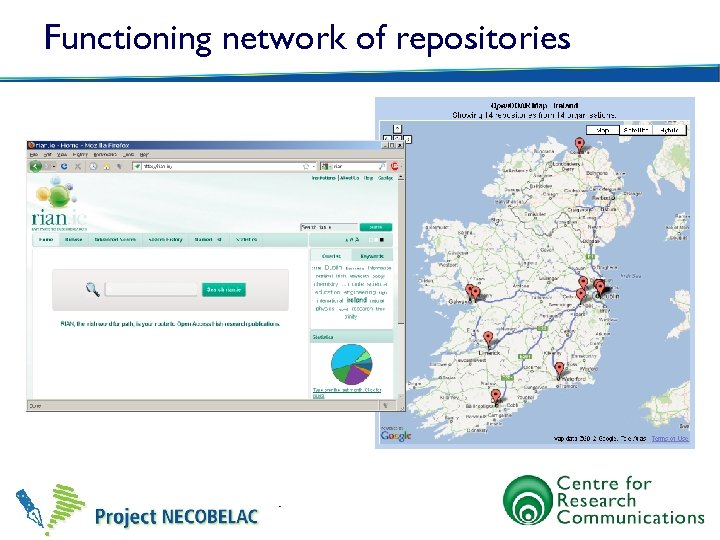 Functioning network of repositories
 National network of OA activists • Identify agents of change • Identify early adopters, local champions – critically analyse any record of success • Support them with information and links • Help them identify local quick wins and political targets • Give them advice and information about benefits and cost/benefit cases
 Provide training and support • Materials are available – See NECOBELAC, SHERPA, RSP websites • Services are available – See Ro. MEO, JULIET, DRIVER • Recognise that peer-to-peer support has value: OA is an intensively collaborative exercise
 Create peer-to-peer and self-help groups • • Example of SHERPA Example of UKCo. RR Example of DRIVER What examples exist within Irish healthcare for other change initiatives?
 Top-down support - Funding Bodies • Recognition of value of OA to mission of funders • Policies/ mandates to ensure OA and/or deposition • Recognition/reward of compliance from authors – and sanctions for non-compliance from authors – work with repository managers • Promotion of OA work to their stakeholders (government, general public, researchers, institutions, learned societies)
 Side-to-side support • Networking amongst peers – email, events, wikis, blogs • Professional training – advocacy, technical issues, legal issues • Share best practice, standards • Self-help - create: – mentoring arrangements – peer-networks – professional support groups - eg, UKCo. RR
 Bottom-up support - local activists • • • Support repositories Create effective policies for/about repository use Advocacy to researchers, authors and library staff Tackle practical problems Identifying work-flows and structures within institutions to support OA deposit • Act as institutional focus to drive repository agenda
 Buy-in from stakeholders on OA
 Who are the stakeholders? • Academic authors • Academic researchers • Medical practitioners, patients, learned societies, general public • Librarians and information professionals • Senior institutional administrators • Funding agencies • Publishers
 First - general stakeholder awareness • Available materials for all stakeholders showing: • Idea and advantages of Open Access to research • Different forms of Open Access – repositories, publishing • Different uses of Open Access repositories and publishing systems • Support material for FAQs and initial concerns and initial enthusiasms
 Achieve buy in from stakeholders • • Demonstrate benefits Integrate with existing workflows Integrate with existing structures Analyse incentives for each stakeholder group and answer • Identify structural blocks to OA adoption • Recognise vested interests and respond
 Questions? • Bill Hubbard • Head of Centre for Research Communications • bill. hubbard@nottingham. ac. uk