


 Скачать презентацию Opamps Part 2 Dr David W Graham West
b1b83f5274ba0316d08fb5577e235c0b.ppt
- Количество слайдов: 22
 Opamps Part 2 Dr. David W. Graham West Virginia University Lane Department of Computer Science and Electrical Engineering © 2009 David W. Graham 1
 High Gain • Goal of opamp design – High gain • Previous opamps do not have very high gain • Example – 5 T Opamp – Gain = -gm 1 ro 2||r 04 – Subthreshold operation – |Gain| ≈ 650 – Above threshold operation – |Gain| ≈ 50 • Need much higher gain – Cascode structures provide high gain – Cascade of multiple amplifiers 2
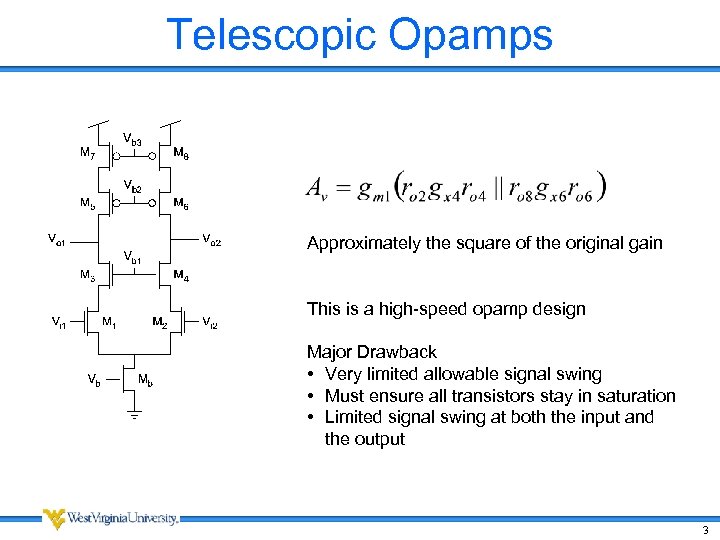 Telescopic Opamps Approximately the square of the original gain This is a high-speed opamp design Major Drawback • Very limited allowable signal swing • Must ensure all transistors stay in saturation • Limited signal swing at both the input and the output 3
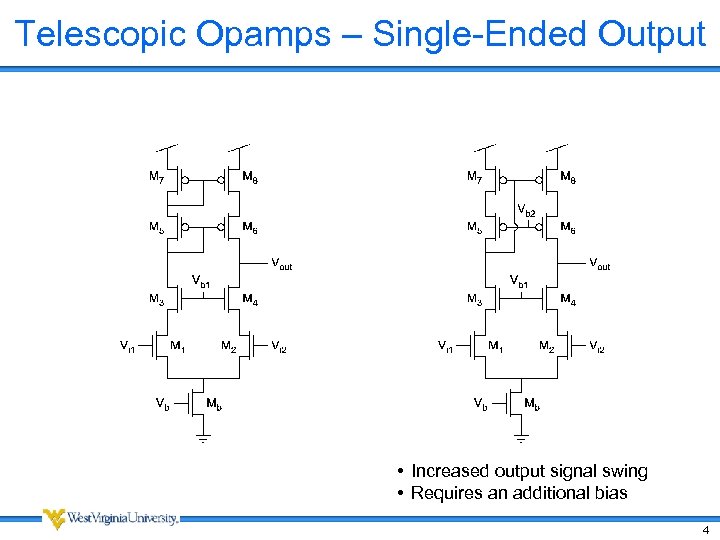 Telescopic Opamps – Single-Ended Output • Increased output signal swing • Requires an additional bias 4
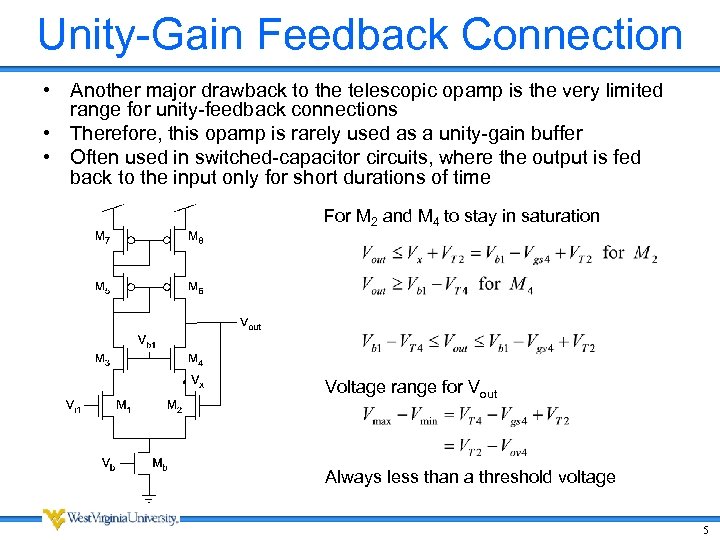 Unity-Gain Feedback Connection • Another major drawback to the telescopic opamp is the very limited range for unity-feedback connections • Therefore, this opamp is rarely used as a unity-gain buffer • Often used in switched-capacitor circuits, where the output is fed back to the input only for short durations of time For M 2 and M 4 to stay in saturation Voltage range for Vout Always less than a threshold voltage 5
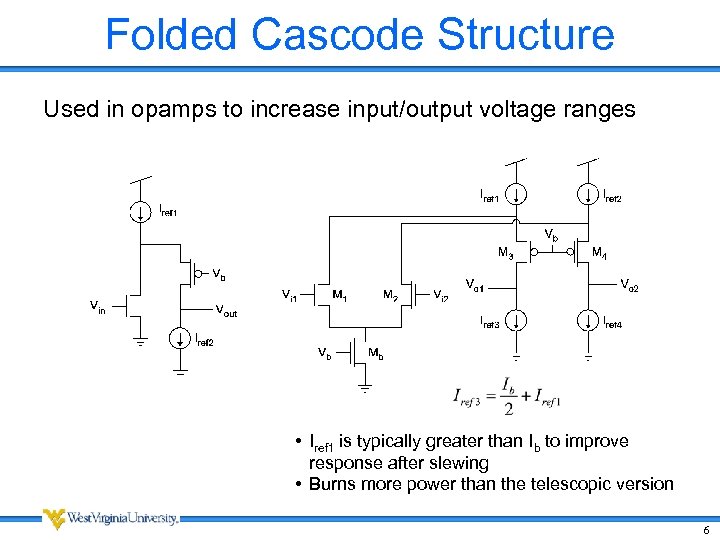 Folded Cascode Structure Used in opamps to increase input/output voltage ranges • Iref 1 is typically greater than Ib to improve response after slewing • Burns more power than the telescopic version 6
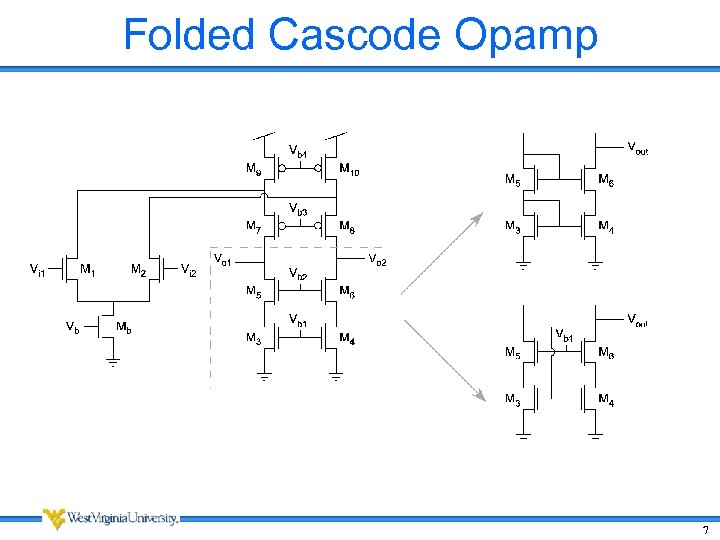 Folded Cascode Opamp 7
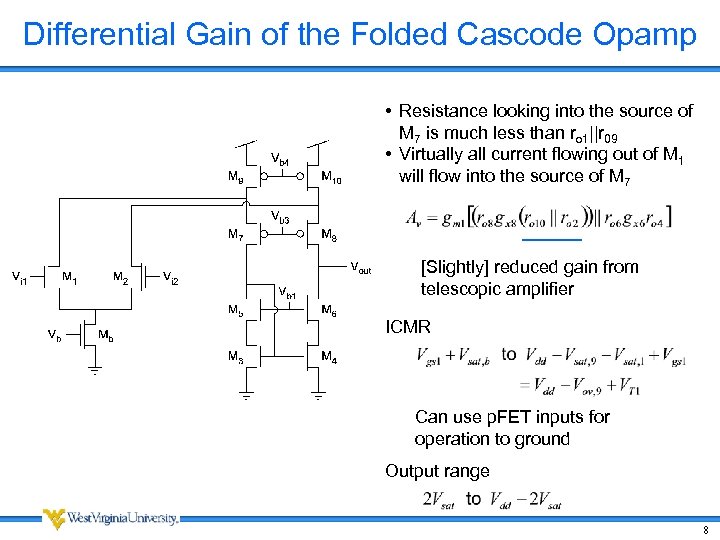 Differential Gain of the Folded Cascode Opamp • Resistance looking into the source of M 7 is much less than ro 1||r 09 • Virtually all current flowing out of M 1 will flow into the source of M 7 [Slightly] reduced gain from telescopic amplifier ICMR Can use p. FET inputs for operation to ground Output range 8
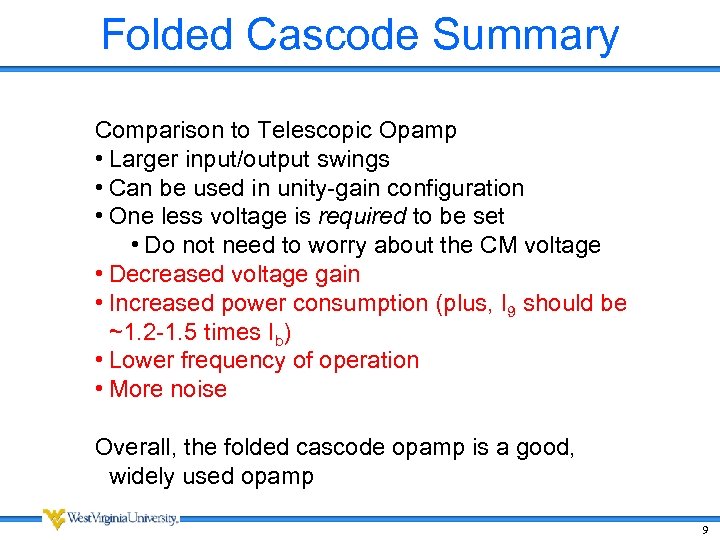 Folded Cascode Summary Comparison to Telescopic Opamp • Larger input/output swings • Can be used in unity-gain configuration • One less voltage is required to be set • Do not need to worry about the CM voltage • Decreased voltage gain • Increased power consumption (plus, I 9 should be ~1. 2 -1. 5 times Ib) • Lower frequency of operation • More noise Overall, the folded cascode opamp is a good, widely used opamp 9
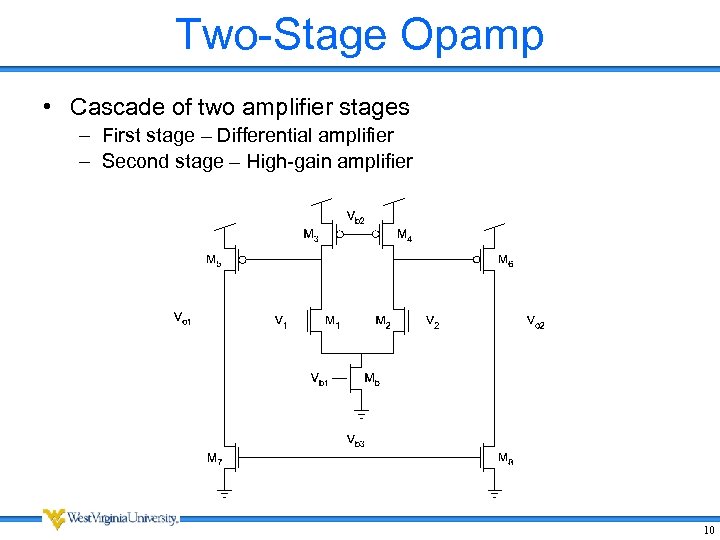 Two-Stage Opamp • Cascade of two amplifier stages – First stage – Differential amplifier – Second stage – High-gain amplifier 10
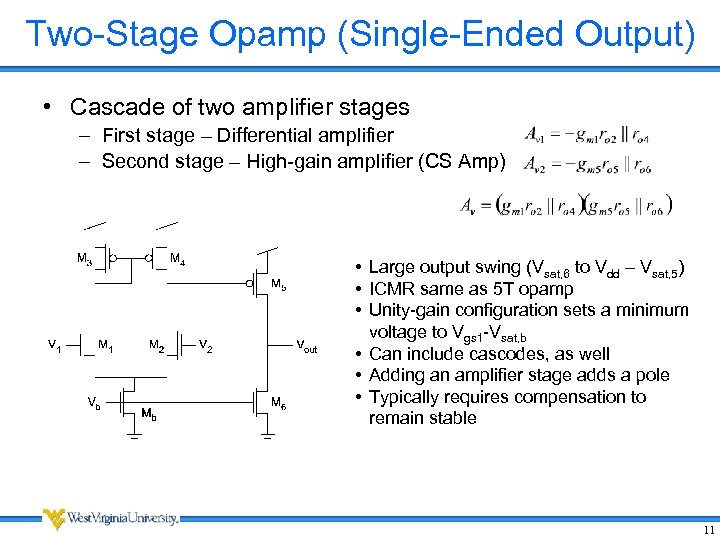 Two-Stage Opamp (Single-Ended Output) • Cascade of two amplifier stages – First stage – Differential amplifier – Second stage – High-gain amplifier (CS Amp) • Large output swing (Vsat, 6 to Vdd – Vsat, 5) • ICMR same as 5 T opamp • Unity-gain configuration sets a minimum voltage to Vgs 1 -Vsat, b • Can include cascodes, as well • Adding an amplifier stage adds a pole • Typically requires compensation to remain stable 11
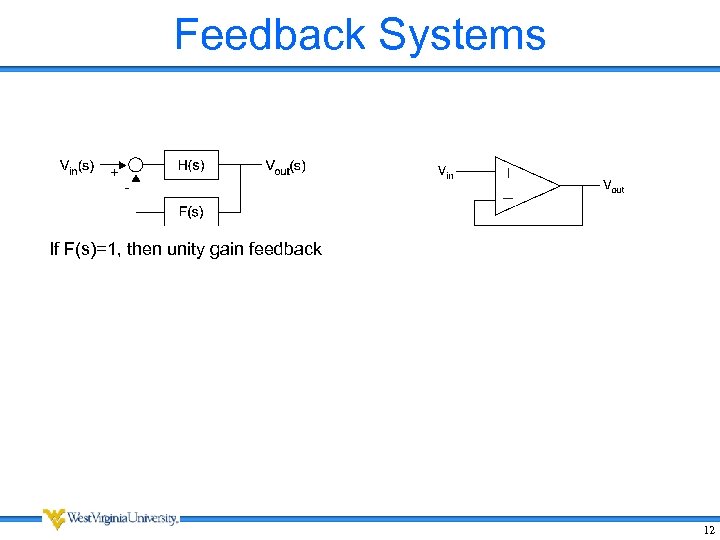 Feedback Systems If F(s)=1, then unity gain feedback 12
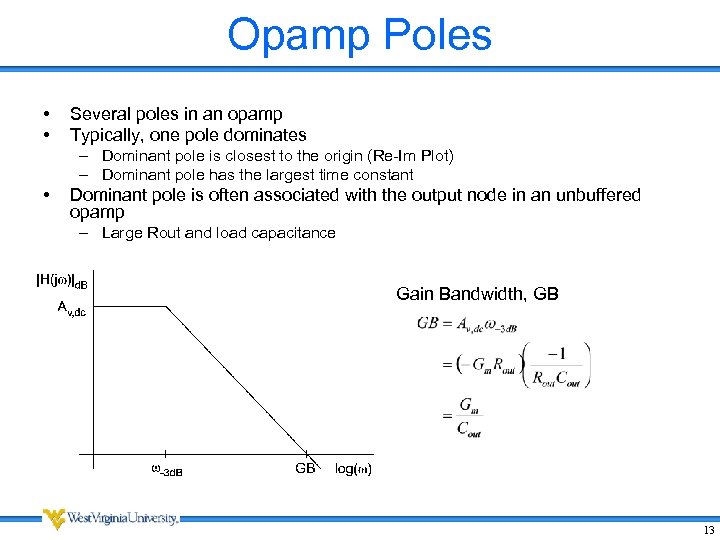 Opamp Poles • • Several poles in an opamp Typically, one pole dominates – Dominant pole is closest to the origin (Re-Im Plot) – Dominant pole has the largest time constant • Dominant pole is often associated with the output node in an unbuffered opamp – Large Rout and load capacitance Gain Bandwidth, GB 13
 Multiple Poles • For multi-pole systems, other poles may be close enough to the dominant pole to affect stability • Typically two poles are of primary concern • Typically, for a two-stage, unbuffered opamp – Pole at output of stage 1 – Pole at output of stage 2 – Dominant pole is usually associated with a large load capacitance (i. e. output node) 14
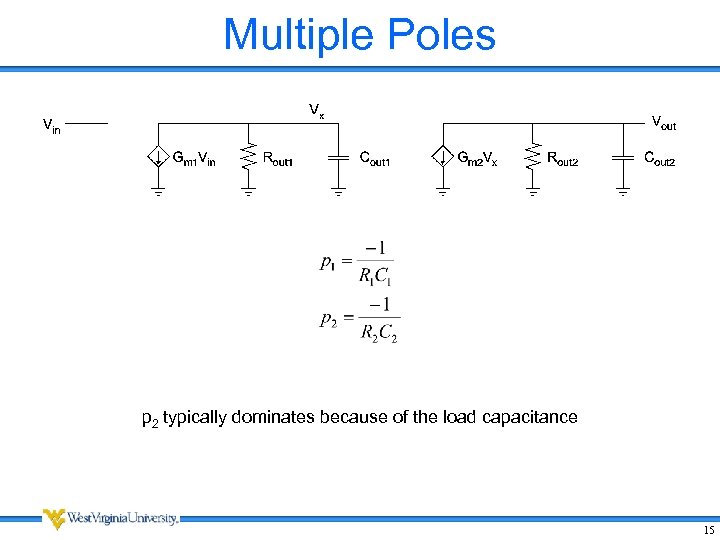 Multiple Poles p 2 typically dominates because of the load capacitance 15
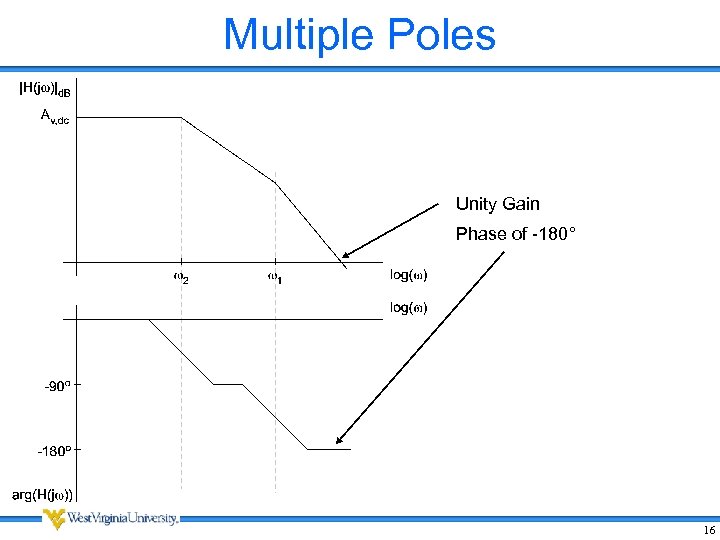 Multiple Poles Unity Gain Phase of -180° 16
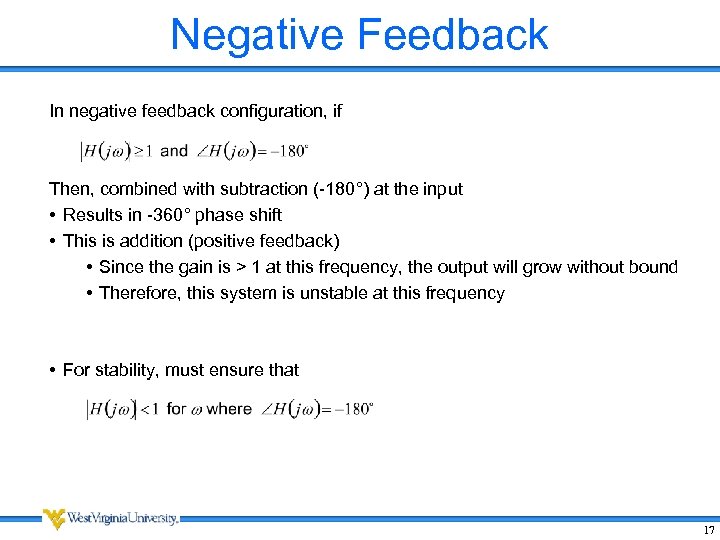 Negative Feedback In negative feedback configuration, if Then, combined with subtraction (-180°) at the input • Results in -360° phase shift • This is addition (positive feedback) • Since the gain is > 1 at this frequency, the output will grow without bound • Therefore, this system is unstable at this frequency • For stability, must ensure that 17
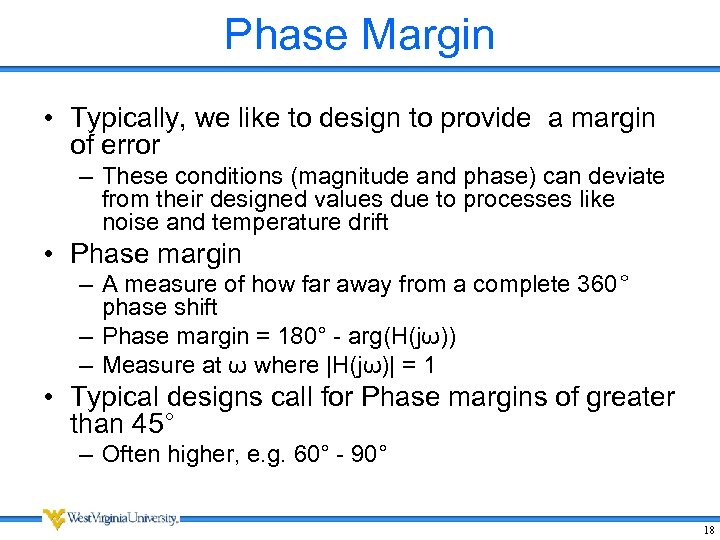 Phase Margin • Typically, we like to design to provide a margin of error – These conditions (magnitude and phase) can deviate from their designed values due to processes like noise and temperature drift • Phase margin – A measure of how far away from a complete 360° phase shift – Phase margin = 180° - arg(H(jω)) – Measure at ω where |H(jω)| = 1 • Typical designs call for Phase margins of greater than 45° – Often higher, e. g. 60° - 90° 18
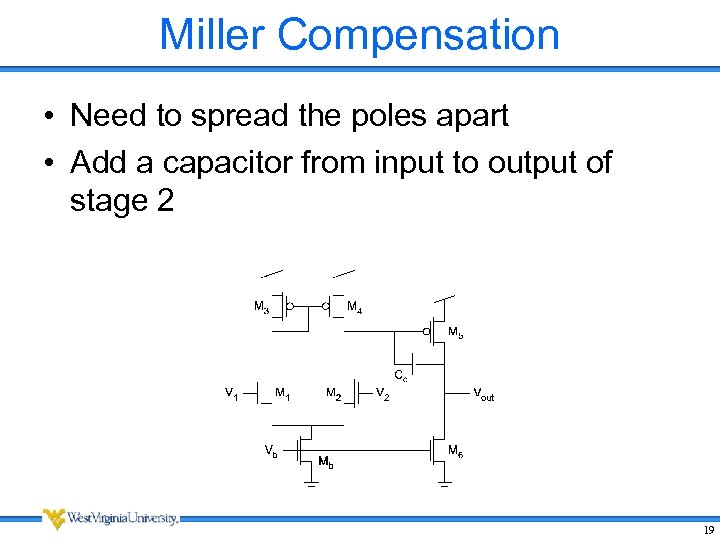 Miller Compensation • Need to spread the poles apart • Add a capacitor from input to output of stage 2 19
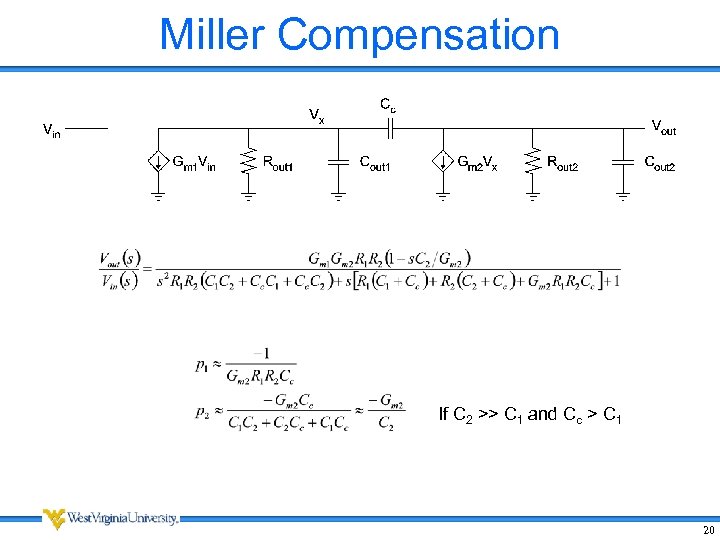 Miller Compensation If C 2 >> C 1 and Cc > C 1 20
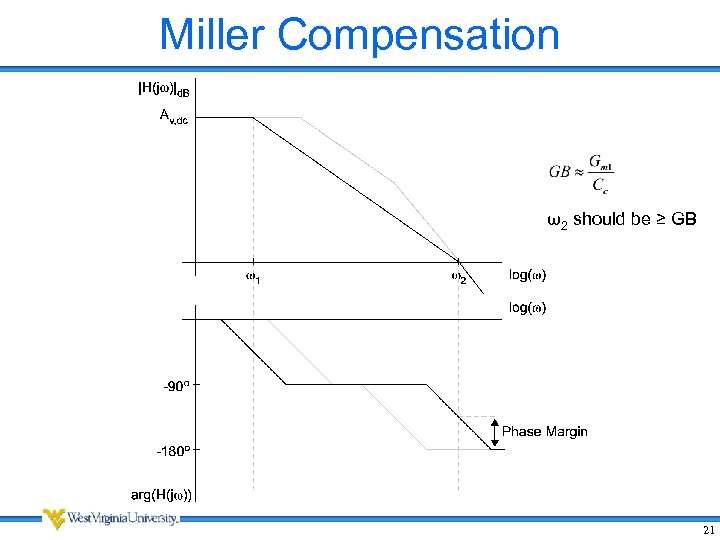 Miller Compensation ω2 should be ≥ GB 21
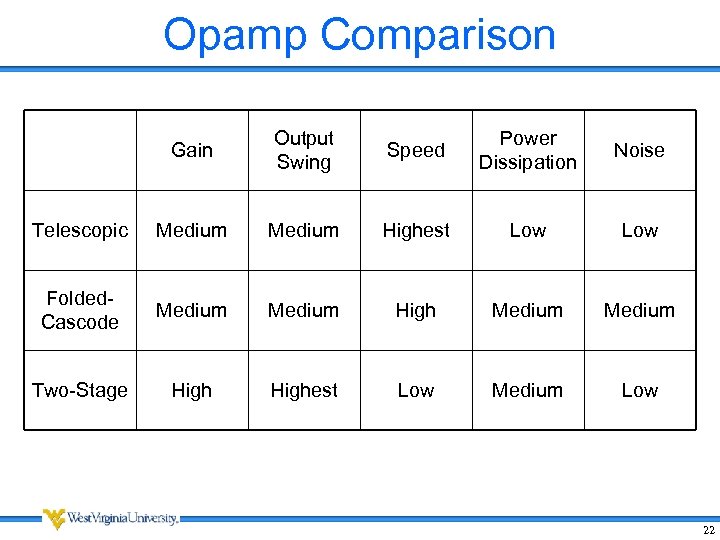 Opamp Comparison Gain Output Swing Speed Power Dissipation Noise Telescopic Medium Highest Low Folded. Cascode Medium High Medium Two-Stage Highest Low Medium Low 22