


 Скачать презентацию OOMPA Lecture 14 n n n Exam solutions
880c82f2ef35af95a89825661f121ddb.ppt
- Количество слайдов: 129
 OOMPA Lecture 14 n n n Exam solutions Together demo Introduction to C++
 Together n Together ( http: //www. togethersoft. com ) n Model-build-deploy tool n Creation, editing of UML diagrams n Synchronization between UML diagrams and source code n Go. F patterns n JAVA, C++, C## n Free limited version available at http: //www. togethercommunity. com/ Demo. . Together 5. 5binTogether. exe
 Exam n n Master solution available on course webpage Evaluation scheme will be available Exam results by November 2 nd, 2001 Grading n 22 out of 38 betyg 3 n 26 out of 38 betyg 4 n 30 out of 38 betyg 5
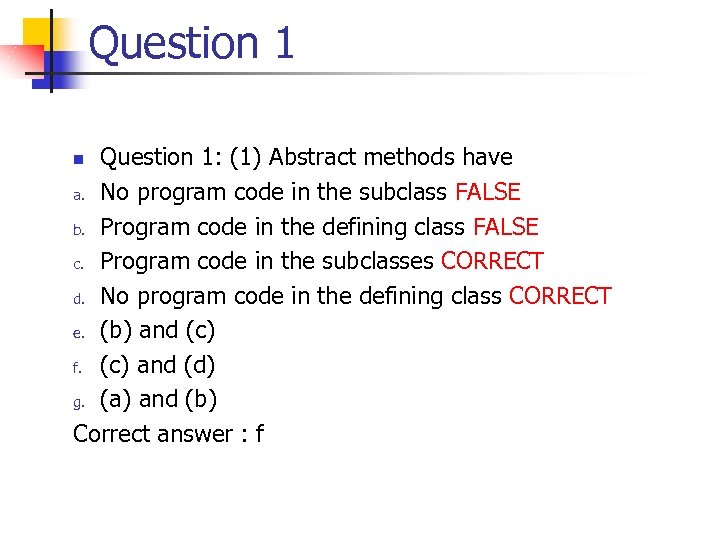 Question 1: (1) Abstract methods have a. No program code in the subclass FALSE b. Program code in the defining class FALSE c. Program code in the subclasses CORRECT d. No program code in the defining class CORRECT e. (b) and (c) f. (c) and (d) g. (a) and (b) Correct answer : f n
 Question 2 n Question 2: (1) An association is a. A straight line in a class diagram FALSE b. Represented by a noun that describes the interaction FALSE c. A relationship between instances of classes CORRECT d. A relationship between classes FALSE e. (a) and (d) f. (b) and (c) n Correct answer: c n n n
 Question 3 n n n n Question 3: (1) Aggregation a. Means an object is built of other objects FALSE b. Means an object contains other objects CORRECT c. Is always of multiplicity 1 -* FALSE d. Is “is a kind of” relationship FALSE e. (b) and (c) f. (a) and (d) Correct answer: b
 Question 4 n n n n Question 4: (1) Which of the following statements are true for statechart diagrams a. An event is caused by a transition. FALSE b. An object has to be in exactly one state at a time. CORRECT c. A state is a condition needed for a transition to occur. FALSE d. In a transition one or more attributes change their value. MAYBE e. (a) and (c) f. (b) and (d) Correct answer: f , but b also counts as a correct answer since changing state does not necessarily means that the object changes its attributes, but for example it could simply change the control flow.
 Question 5 n n n Question 5: (1) Generalization is a. building objects from parts FALSE b. a “has a”-relationship FALSE c. a “is a kind-of” relationship CORRECT d. realized by means of inheritance CORRECT e. realized by means of composition FALSE f. (a) and (b) g. (c) and (d) h. (a) and (e) i. (a), (b) and (e) Correct answer: g
 Question 6 n n n n n Question 6: (1) Polymorphism a. requires abstract classes FALSE b. is realized by means of static binding FALSE c. is realized by means of dynamic binding CORRECT d. enables subclasses to override the method of a superclass CORRECT e. (a), (c) and (d) f. (a) and (c) g. (c) and (d) h. (b) and (d) Correct answer: g
 Question 7 n n n n Question 7: (4) Which of the following phrases best describe the design patterns in the list. Match 10 out of 14 phrases with the 10 concepts below. a. Proxy- Provide a placeholder for another object to control access to it. b. Adapter- Convert the interface of a class into another interface clients expect. c. Low Coupling- Supports low dependency and low impact of change. d. Composite - Lets clients treat individual and group of objects uniformly. e. Factory Method - Lets a class defer instantiation to subclasses. f. Abstract Factory - Provide an interface for creating families of related objects without specifying their concrete classes. g. Singleton - Provides global access to a unique instance
 Question 7 n n n n h. Observer- When one object changes its state the state of dependant objects is synchronized. i. Expert - A class that has the information necessary to fulfill a responsibility. j. Pure Fabrication - Assign responsibilities to an artificial class to support high cohesion and low coupling. k. Controller - An object responsible for receiving or handling system events. l. Strategy - Define a family of algorithms and make them interchangeable. m. Façade - Provide a unified interface to a set of interfaces in a subsystem. n. Mediator - An intermediate object that decouples other objects.
 Question 8 n n n Question 8: (2) Describe in two sentences what is the difference between object oriented analysis and design. OO analysis is concerned with n finding and describing objects or concepts in the problem domain. n what needs to be done. n defining the problem/requirements (do the right thing) OO design is concerned with n defining software objects and how they collaborate n how is it done n conceiving a solution to the problem (do the thing right)
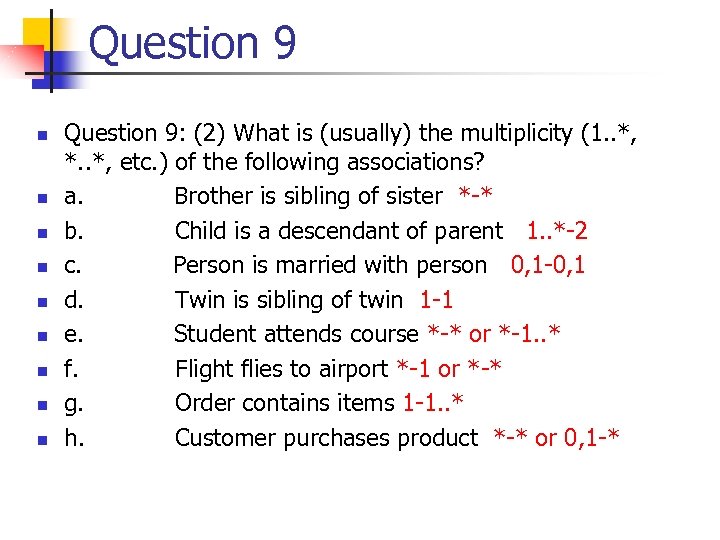 Question 9 n n n n n Question 9: (2) What is (usually) the multiplicity (1. . *, *. . *, etc. ) of the following associations? a. Brother is sibling of sister *-* b. Child is a descendant of parent 1. . *-2 c. Person is married with person 0, 1 -0, 1 d. Twin is sibling of twin 1 -1 e. Student attends course *-* or *-1. . * f. Flight flies to airport *-1 or *-* g. Order contains items 1 -1. . * h. Customer purchases product *-* or 0, 1 -*
 Question 10 n n Question 10: (2) Describe in two sentences the roles of inception and elaboration within the unified process. Answer: Inception is a feasibility study which envisions the product scope, approximate vision and business case. Elaboration generates a refined vision, iterative implementation of core architecture, resolution of high risks, identification of most requirements and scope. (see Larman pages 35 and 109).
 Question 11 n n n n Question 11: (1) In the unified process requirements are described by a. Design model FALSE b. Domain model FALSE c. Use case model CORRECT d. (a) and (b) e. (a) and (c) f. (b) and (c) Correct answer: c
 Question 12 n n n n n Question 12: (1) Extreme Programming advocates a. continuous integration CORRECT b. a sequential, linear lifecycle FALSE c. Refactoring CORRECT d. (a) and (b) e. (a) and (c) f. (b) and (c) g. (a), (b) and (c) Correct answer: e
 Question 13 n n n Question 13: (8) A vending machine offers two different products A and B. Product A costs 4 SEK, product B 6 SEK. The customer inserts one coin at a time into the slot. The machine accepts coins in denominations of 1, 5 or 10 SEK. The machine displays the amount available for purchasing products. The machine has three buttons, button A to dispense product A, button B to dispense product B and button C to obtain change. At any time the customer can press button C to collect her change or amount paid, even if no purchase occurred previously. The customer can press buttons A and B at any time, but the machine only dispenses the corresponding product if the current amount paid is equal to or exceeds the product price. It is possible to make multiple purchases with one payment by using the remaining amount for another purchase (for example inserting a 10 SEK coin and purchasing product A twice and obtain 2 SEK change or for example inserting a 5 SEK coin, purchasing product A, inserting another 5 SEK coin and purchasing product B). a. Draw a state diagram for the vending machine. b. Draw a system sequence diagram for a scenario in which the customer inserts two 5 SEK coins, purchases product B and collects her change. Illustrate the information or product the vending machine shows or dispenses to the customer.
 Question 13 State-Diagram n n n States : Idle, Coins Inserted, Product A dispensable, Product A & B dispensable Events : insert coin, button A, button B, return button Actions : dispense A, dispense B, return change
 Question 13
 Question 13
 Question 13
 Question 14 n Question 14: (4) Draw the collaboration diagram that corresponds to the following sequence diagram
 Question 14
 Question 15: (8) Draw a domain model as a UML class diagram, containing concepts, generalizations, named associations with multiplicity (composition and aggregation where applicable) and attributes for the following domain. The task is to design a software that helps you keep track of your collection of audio CDs. One distinguishes between two different types of releases, namely maxi. CDs and album CDs. Each release (album or maxi-CD) contains one or several recordings, a recording is a particular song performed by a particular artist, for example the album “Hot Rocks” by the Rolling Stones contains recordings of the songs “Time is on my side”, “Heart of Stone”, “Play with Fire” etc. Each recording has a playing time, for example “Time is on my side” has a playing time of 5: 23. The same recording might occur on different releases, for example the original studio album and a “best-of” album. .
 Question 15 The same or a different artist might perform the same song in different recordings, for example the song “American Pie” by Don Mc Lean and Madonna or “Sympathy for the Devil” in a live and a studio version by the Rolling Stones. One distinguishes between solo artists (e. g. Madonna) and bands composed of artists, for example Paul Mc. Cartney, John Lennon, Ringo Starr and George Harrison are members of the Beatles. An artist can occur on different recordings in different roles, either as a solo artist or a band member, for example Sting as a solo artist or as a member of the band Police. A song has a title and is composed by one or several composers, for example the song “Hey Jude” is composed by Paul Mc Cartney and John Lennon. Each release has a title, release date, music label and a playing time that is calculated as the accumulated playing time of the recordings on the release. A release is usually associated with one particular solo artist or band, for example the album “Abbey Road” with the Beatles. Still, this is not always the case for example in case of movie sound tracks or events such as Woodstock, which feature a number of different artists on the same release
 Question 15 Concepts: composer, song, recording, release, artist, solo artist, band, album, maxi-CD
 Differences between JAVA and C++ n n n C++ uses pointers instead or in addition to JAVA references C++ also uses references but in a different way than JAVA C++ has no garbage collection, which means that objects created with new have to be destroyed with delete in order to avoid memory leaks JAVA is an interpreter language (virtual machine), portable across platforms (byte code is somehow between assembler code and source code) C++ programs need to be compiled separately for each target platform.
 Additonal Features of C++ n n n Pointers Operator overloading Template methods and classes Multiple inheritance Standard Template Library (container classes)
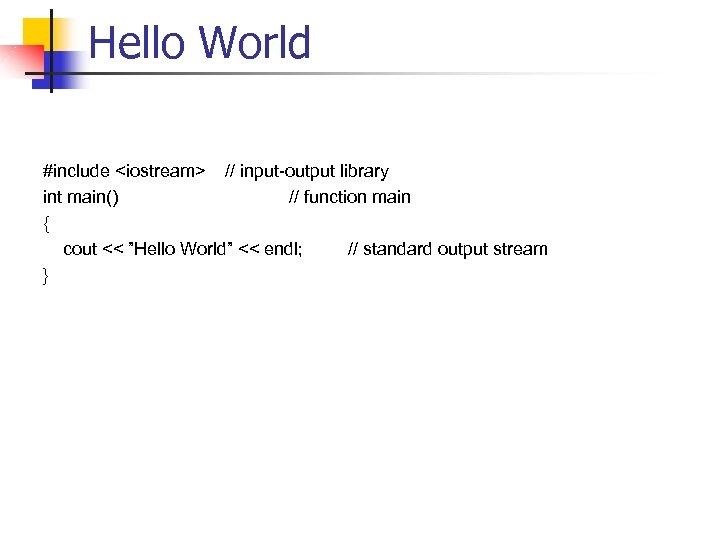 Hello World #include
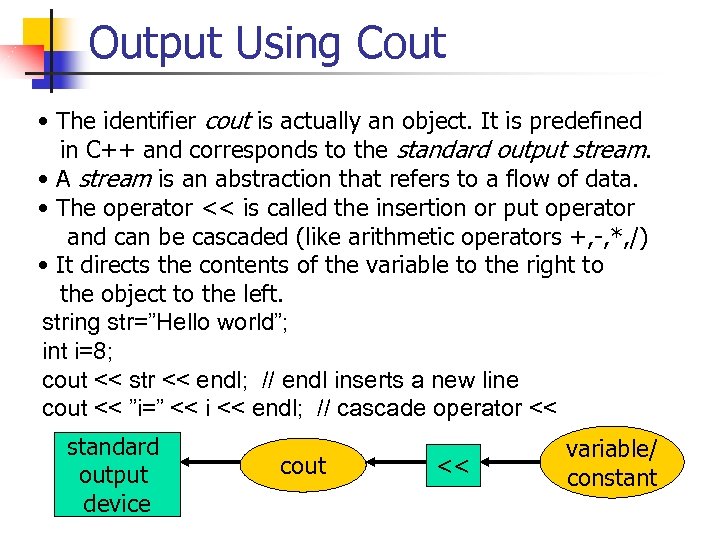 Output Using Cout • The identifier cout is actually an object. It is predefined in C++ and corresponds to the standard output stream. • A stream is an abstraction that refers to a flow of data. • The operator << is called the insertion or put operator and can be cascaded (like arithmetic operators +, -, *, /) • It directs the contents of the variable to the right to the object to the left. string str=”Hello world”; int i=8; cout << str << endl; // endl inserts a new line cout << ”i=” << i << endl; // cascade operator << standard output device cout << variable/ constant
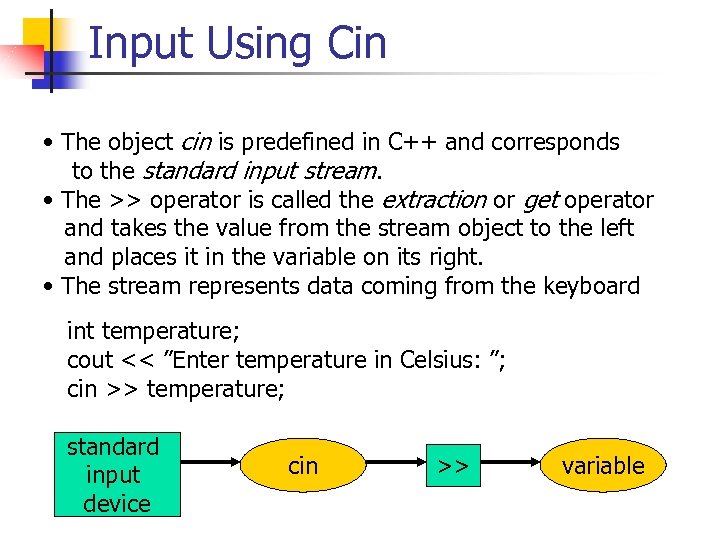 Input Using Cin • The object cin is predefined in C++ and corresponds to the standard input stream. • The >> operator is called the extraction or get operator and takes the value from the stream object to the left and places it in the variable on its right. • The stream represents data coming from the keyboard int temperature; cout << ”Enter temperature in Celsius: ”; cin >> temperature; standard input device cin >> variable
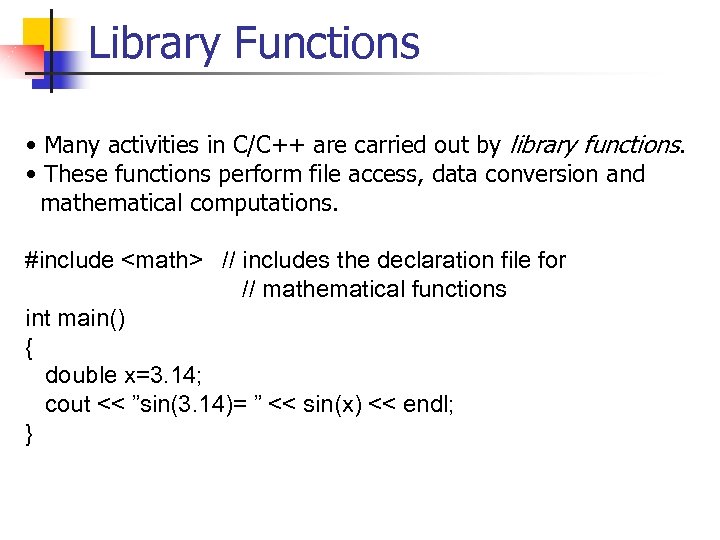 Library Functions • Many activities in C/C++ are carried out by library functions. • These functions perform file access, data conversion and mathematical computations. #include
 Header Files • a header file contains the declaration of functions you want to use in your code • the preprocessor directive #include takes care of incorporating a header file into your source file • example: #include
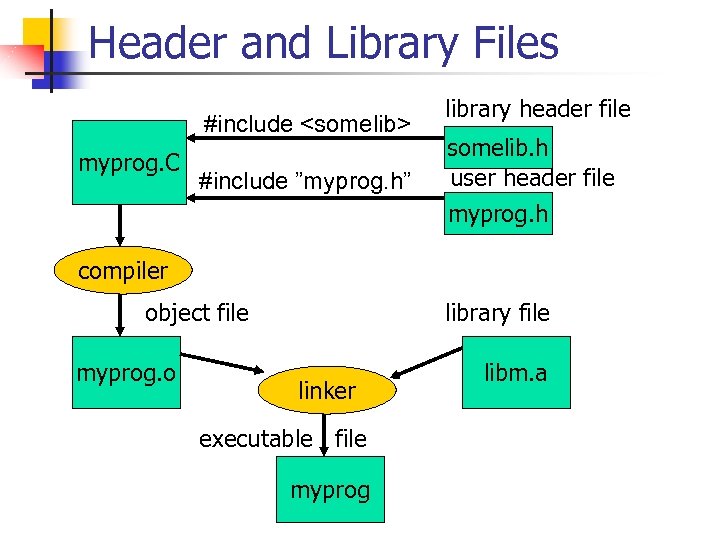 Header and Library Files #include
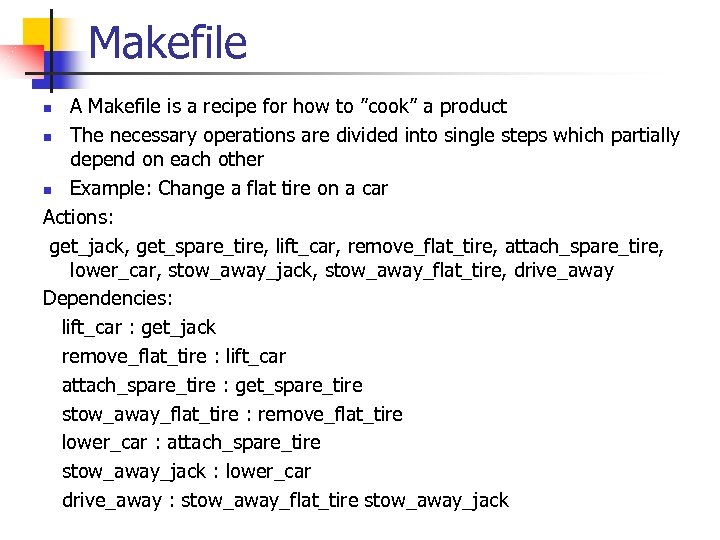 Makefile A Makefile is a recipe for how to ”cook” a product n The necessary operations are divided into single steps which partially depend on each other n Example: Change a flat tire on a car Actions: get_jack, get_spare_tire, lift_car, remove_flat_tire, attach_spare_tire, lower_car, stow_away_jack, stow_away_flat_tire, drive_away Dependencies: lift_car : get_jack remove_flat_tire : lift_car attach_spare_tire : get_spare_tire stow_away_flat_tire : remove_flat_tire lower_car : attach_spare_tire stow_away_jack : lower_car drive_away : stow_away_flat_tire stow_away_jack n
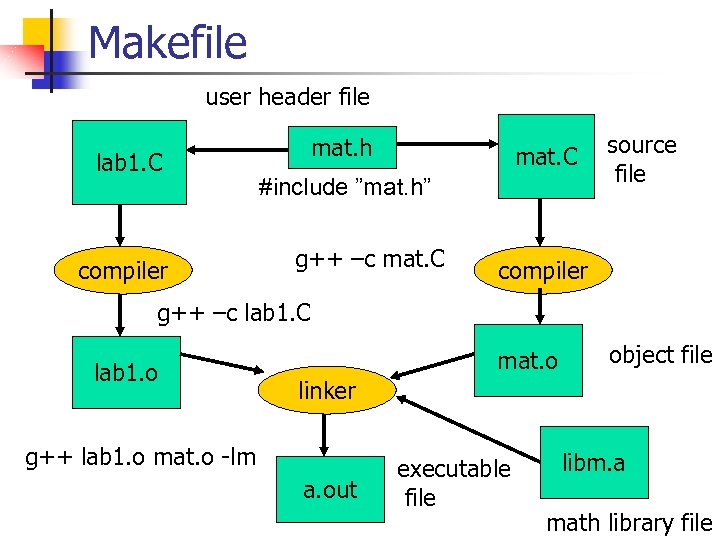 Makefile user header file lab 1. C mat. h mat. C #include ”mat. h” compiler g++ –c mat. C source file compiler g++ –c lab 1. C lab 1. o mat. o object file linker g++ lab 1. o mat. o -lm a. out executable file libm. a math library file
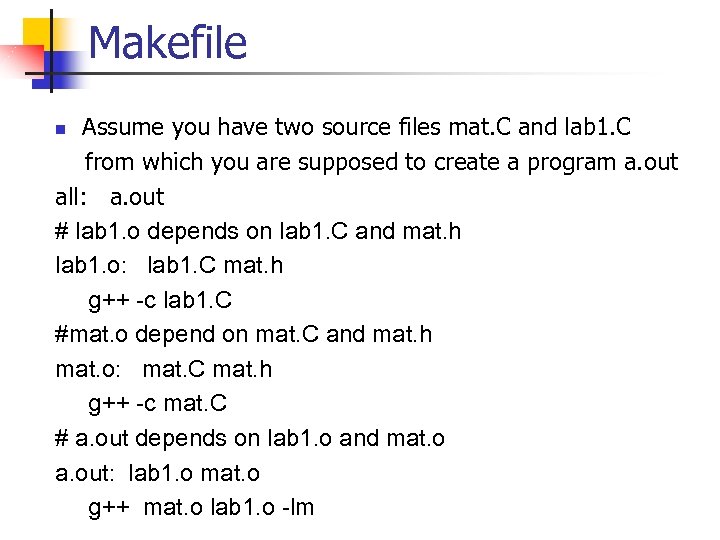 Makefile Assume you have two source files mat. C and lab 1. C from which you are supposed to create a program a. out all: a. out # lab 1. o depends on lab 1. C and mat. h lab 1. o: lab 1. C mat. h g++ -c lab 1. C #mat. o depend on mat. C and mat. h mat. o: mat. C mat. h g++ -c mat. C # a. out depends on lab 1. o and mat. o a. out: lab 1. o mat. o g++ mat. o lab 1. o -lm n
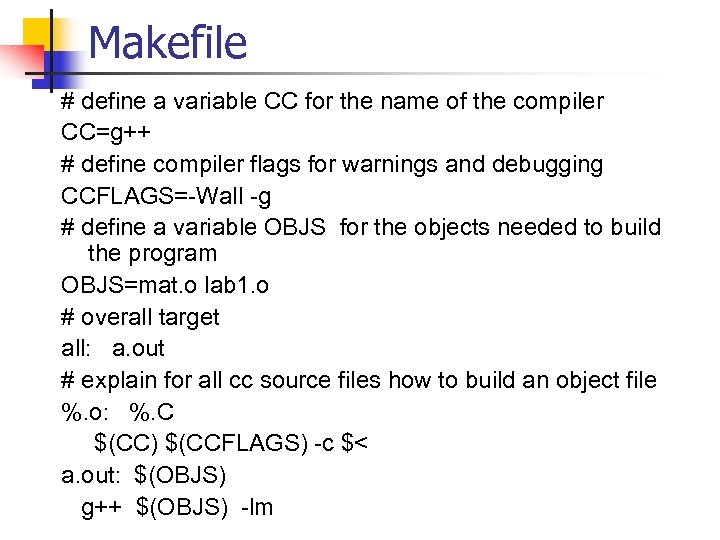 Makefile # define a variable CC for the name of the compiler CC=g++ # define compiler flags for warnings and debugging CCFLAGS=-Wall -g # define a variable OBJS for the objects needed to build the program OBJS=mat. o lab 1. o # overall target all: a. out # explain for all cc source files how to build an object file %. o: %. C $(CC) $(CCFLAGS) -c $< a. out: $(OBJS) g++ $(OBJS) -lm
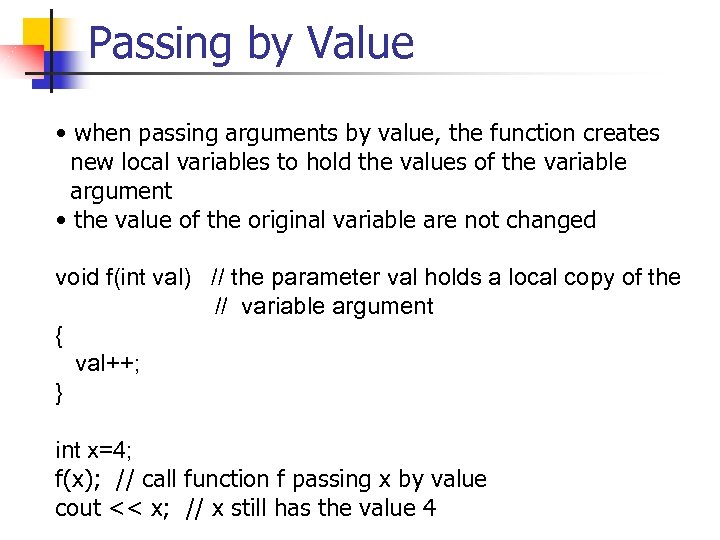 Passing by Value • when passing arguments by value, the function creates new local variables to hold the values of the variable argument • the value of the original variable are not changed void f(int val) // the parameter val holds a local copy of the // variable argument { val++; } int x=4; f(x); // call function f passing x by value cout << x; // x still has the value 4
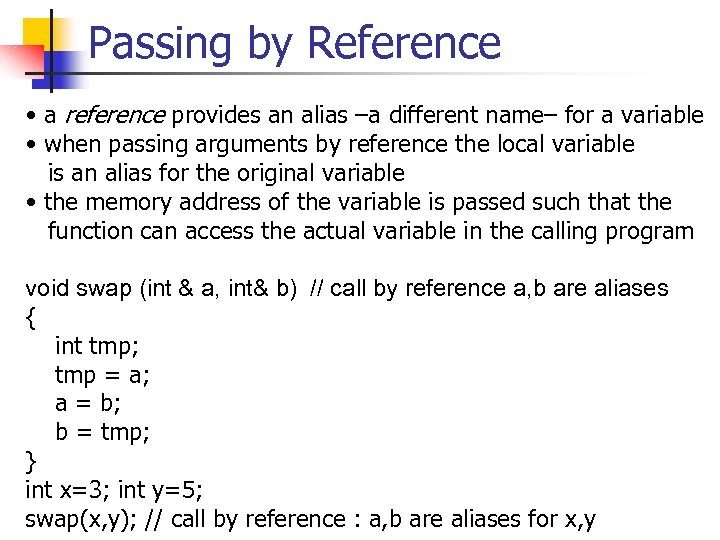 Passing by Reference • a reference provides an alias –a different name– for a variable • when passing arguments by reference the local variable is an alias for the original variable • the memory address of the variable is passed such that the function can access the actual variable in the calling program void swap (int & a, int& b) // call by reference a, b are aliases { int tmp; tmp = a; a = b; b = tmp; } int x=3; int y=5; swap(x, y); // call by reference : a, b are aliases for x, y
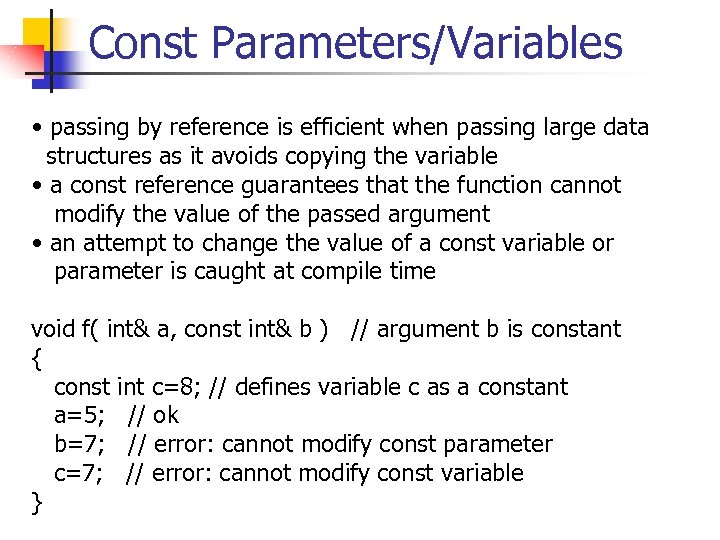 Const Parameters/Variables • passing by reference is efficient when passing large data structures as it avoids copying the variable • a const reference guarantees that the function cannot modify the value of the passed argument • an attempt to change the value of a const variable or parameter is caught at compile time void f( int& a, const int& b ) // argument b is constant { const int c=8; // defines variable c as a constant a=5; // ok b=7; // error: cannot modify const parameter c=7; // error: cannot modify const variable }
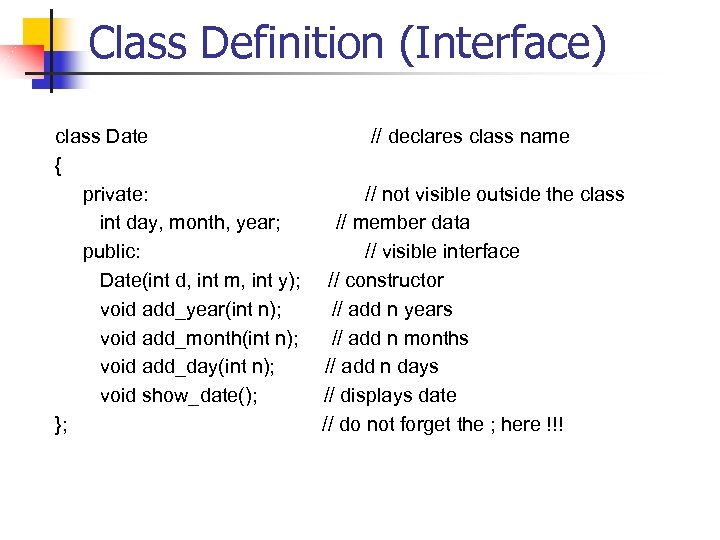 Class Definition (Interface) class Date { private: int day, month, year; public: Date(int d, int m, int y); void add_year(int n); void add_month(int n); void add_day(int n); void show_date(); }; // declares class name // not visible outside the class // member data // visible interface // constructor // add n years // add n months // add n days // displays date // do not forget the ; here !!!
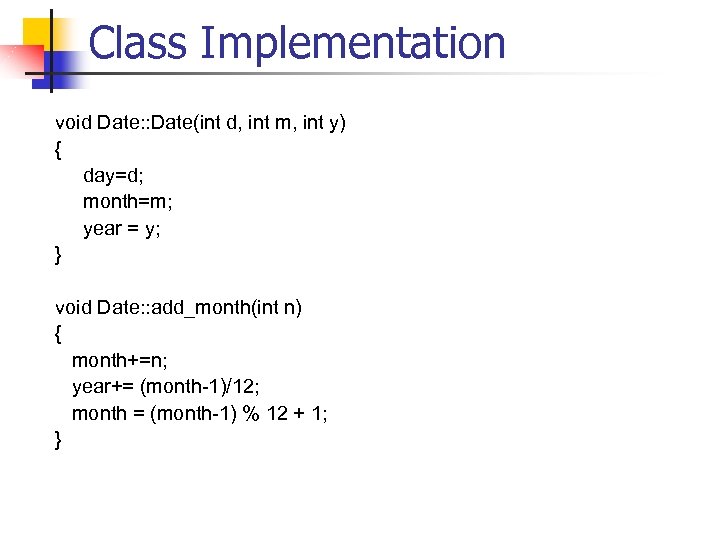 Class Implementation void Date: : Date(int d, int m, int y) { day=d; month=m; year = y; } void Date: : add_month(int n) { month+=n; year+= (month-1)/12; month = (month-1) % 12 + 1; }
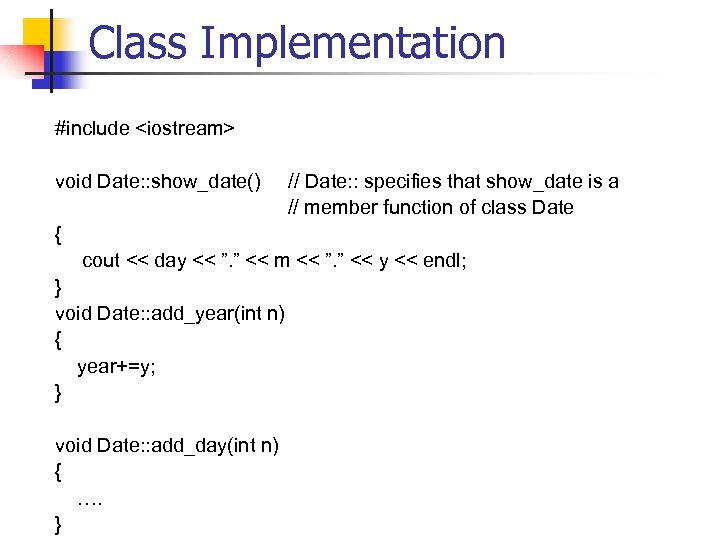 Class Implementation #include
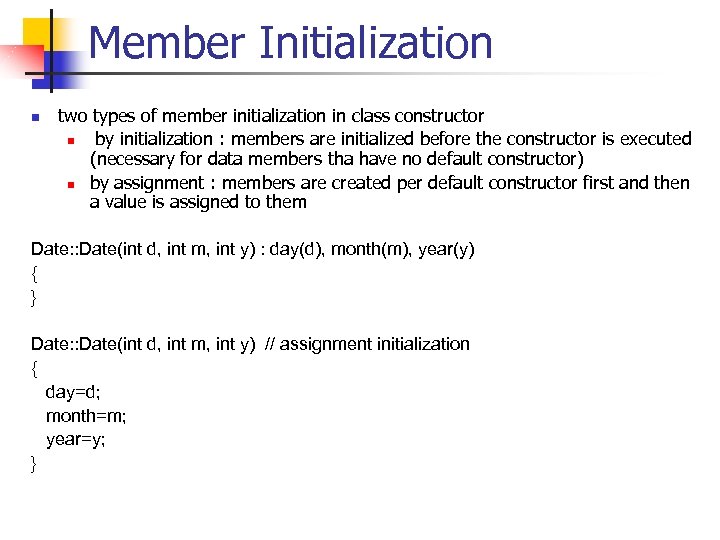 Member Initialization n two types of member initialization in class constructor n by initialization : members are initialized before the constructor is executed (necessary for data members tha have no default constructor) n by assignment : members are created per default constructor first and then a value is assigned to them Date: : Date(int d, int m, int y) : day(d), month(m), year(y) { } Date: : Date(int d, int m, int y) // assignment initialization { day=d; month=m; year=y; }
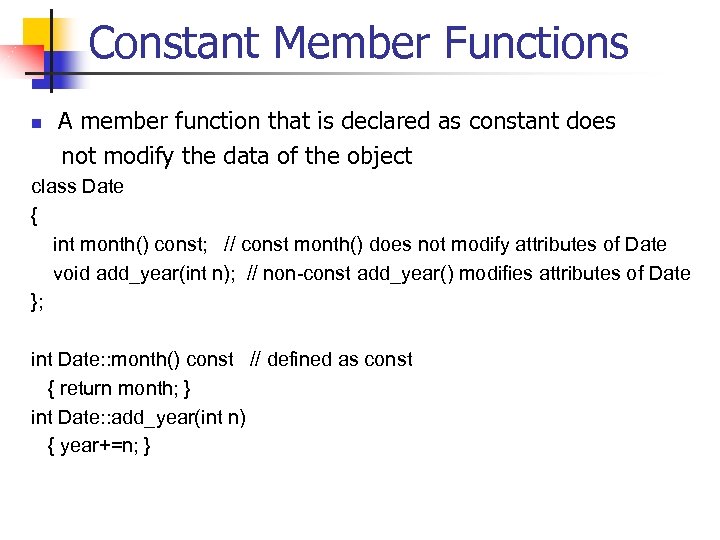 Constant Member Functions A member function that is declared as constant does not modify the data of the object n class Date { int month() const; // const month() does not modify attributes of Date void add_year(int n); // non-const add_year() modifies attributes of Date }; int Date: : month() const // defined as const { return month; } int Date: : add_year(int n) { year+=n; }
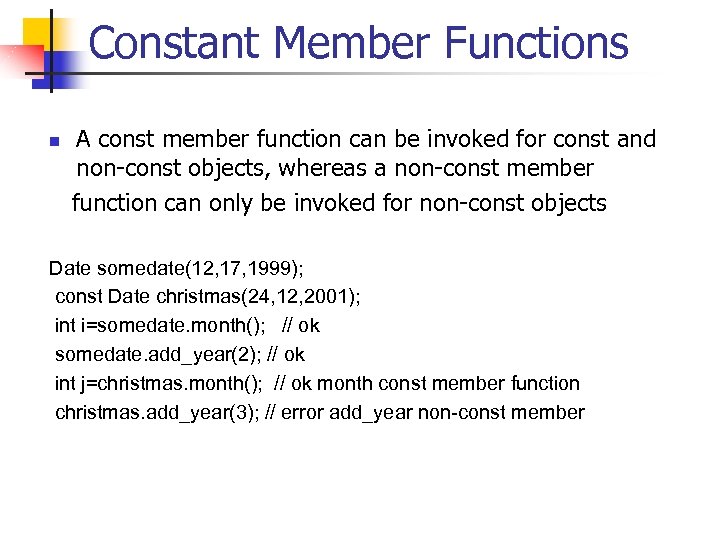 Constant Member Functions A const member function can be invoked for const and non-const objects, whereas a non-const member function can only be invoked for non-const objects n Date somedate(12, 17, 1999); const Date christmas(24, 12, 2001); int i=somedate. month(); // ok somedate. add_year(2); // ok int j=christmas. month(); // ok month const member function christmas. add_year(3); // error add_year non-const member
 Lecture 15 n C++ n Multiple Inheritance n Operator overloading n Templates n Pointers n Dynamic memory allocation n Standard Template Library n Containers n Iterators n Algorithms
 Lecture Schedule n n n Mon 5/11/01 (Bjoern) n Visual. Works/Smalltalk Mon 12/11/01 (Frank) n C++ n Game playing (lab 4) n Course evaluation Tue 20/11/01 (Bjoern) n Visual. Works/Smalltalk
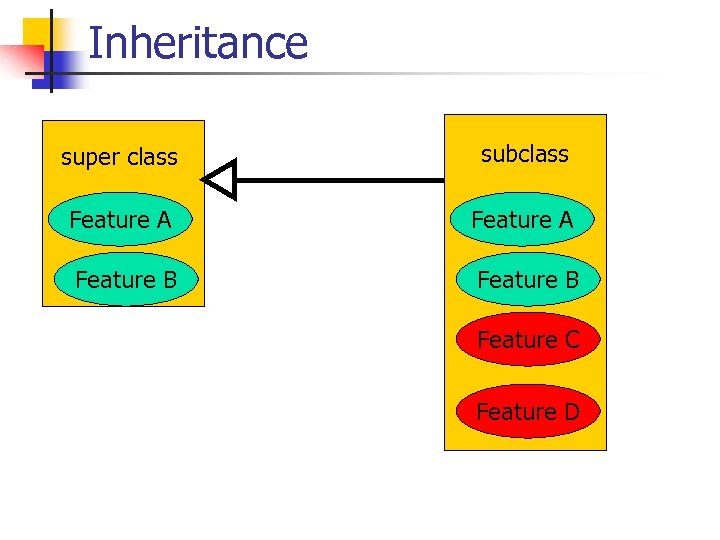 Inheritance super class subclass Feature A Feature B Feature C Feature D
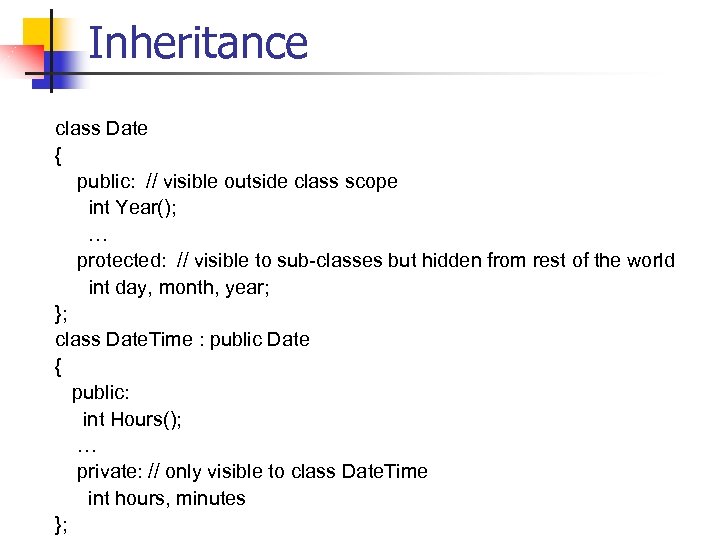 Inheritance class Date { public: // visible outside class scope int Year(); … protected: // visible to sub-classes but hidden from rest of the world int day, month, year; }; class Date. Time : public Date { public: int Hours(); … private: // only visible to class Date. Time int hours, minutes };
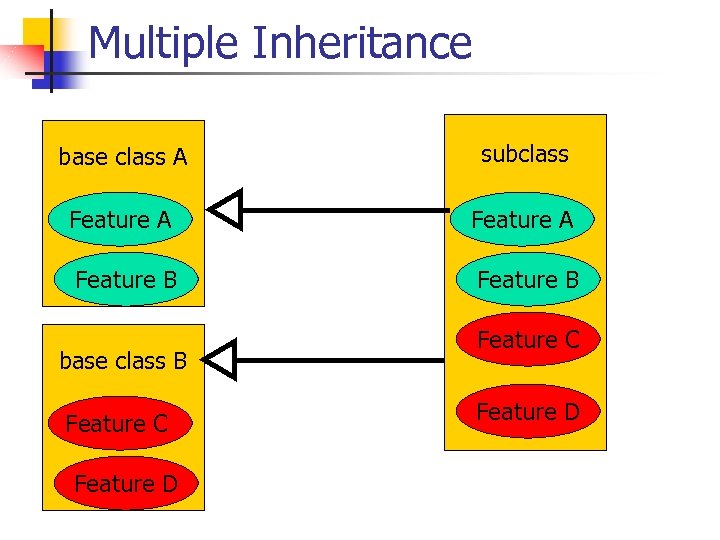 Multiple Inheritance base class A subclass Feature A Feature B base class B Feature C Feature D
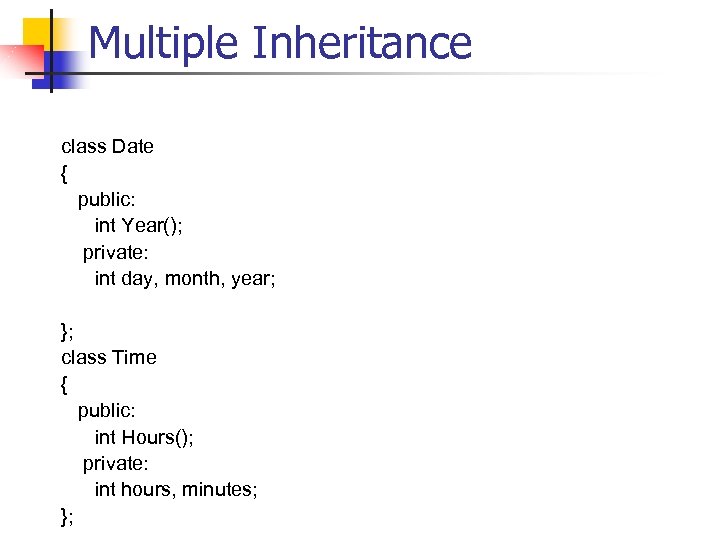 Multiple Inheritance class Date { public: int Year(); private: int day, month, year; }; class Time { public: int Hours(); private: int hours, minutes; };
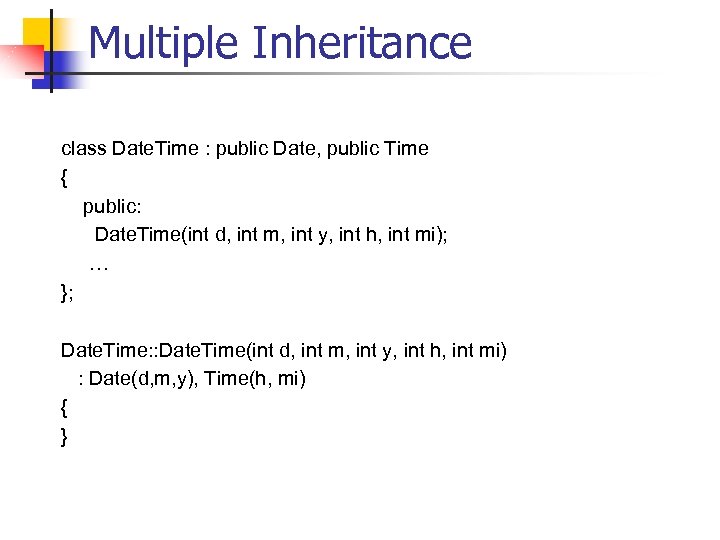 Multiple Inheritance class Date. Time : public Date, public Time { public: Date. Time(int d, int m, int y, int h, int mi); … }; Date. Time: : Date. Time(int d, int m, int y, int h, int mi) : Date(d, m, y), Time(h, mi) { }
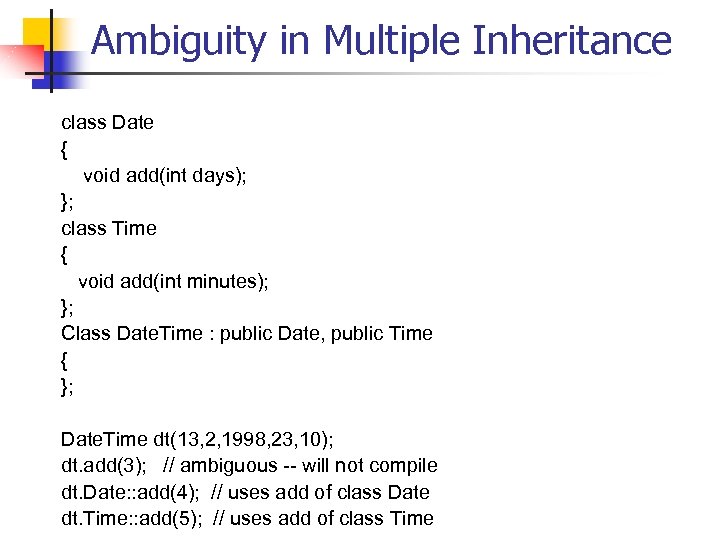 Ambiguity in Multiple Inheritance class Date { void add(int days); }; class Time { void add(int minutes); }; Class Date. Time : public Date, public Time { }; Date. Time dt(13, 2, 1998, 23, 10); dt. add(3); // ambiguous -- will not compile dt. Date: : add(4); // uses add of class Date dt. Time: : add(5); // uses add of class Time
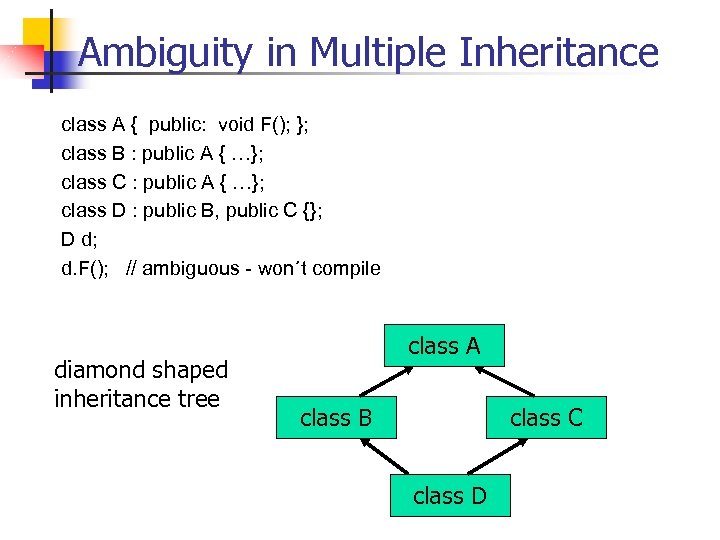 Ambiguity in Multiple Inheritance class A { public: void F(); }; class B : public A { …}; class C : public A { …}; class D : public B, public C {}; D d; d. F(); // ambiguous - won´t compile diamond shaped inheritance tree class A class B class C class D
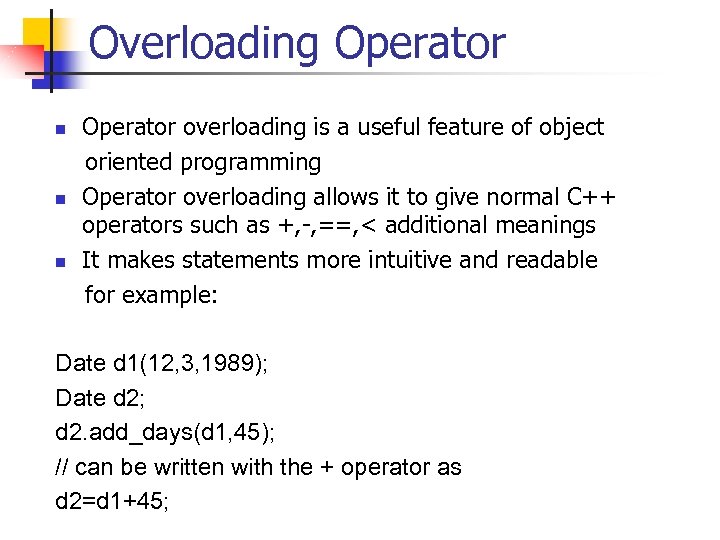 Overloading Operator overloading is a useful feature of object oriented programming n Operator overloading allows it to give normal C++ operators such as +, -, ==, < additional meanings n It makes statements more intuitive and readable for example: n Date d 1(12, 3, 1989); Date d 2; d 2. add_days(d 1, 45); // can be written with the + operator as d 2=d 1+45;
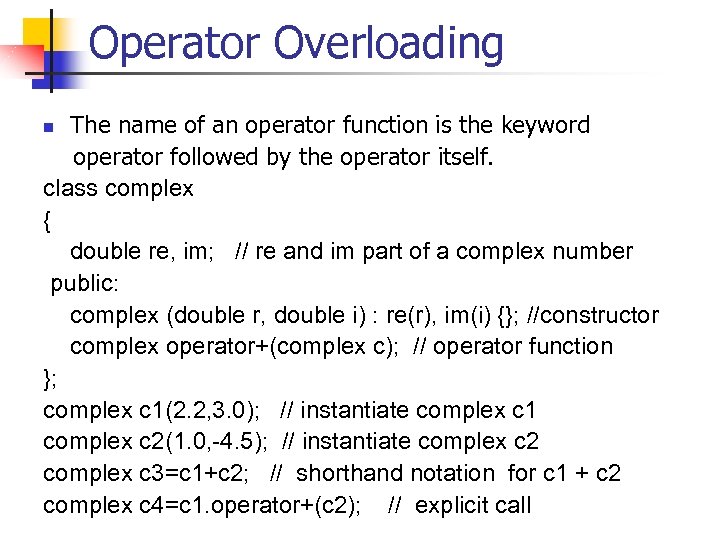 Operator Overloading The name of an operator function is the keyword operator followed by the operator itself. class complex { double re, im; // re and im part of a complex number public: complex (double r, double i) : re(r), im(i) {}; //constructor complex operator+(complex c); // operator function }; complex c 1(2. 2, 3. 0); // instantiate complex c 1 complex c 2(1. 0, -4. 5); // instantiate complex c 2 complex c 3=c 1+c 2; // shorthand notation for c 1 + c 2 complex c 4=c 1. operator+(c 2); // explicit call n
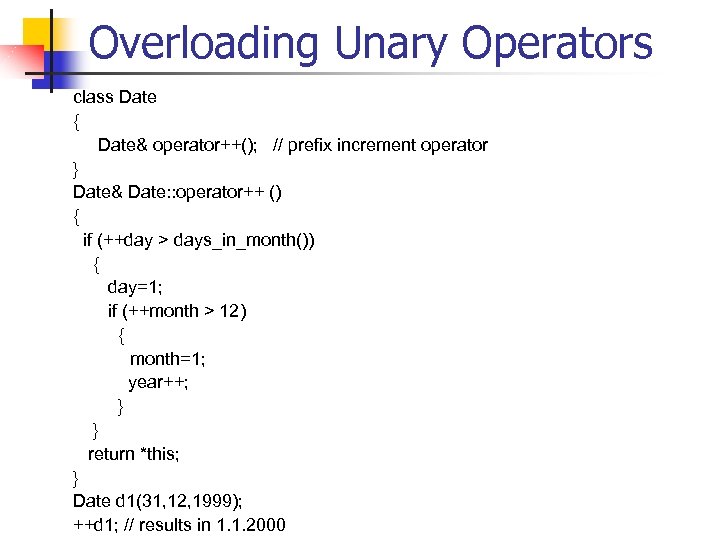 Overloading Unary Operators class Date { Date& operator++(); // prefix increment operator } Date& Date: : operator++ () { if (++day > days_in_month()) { day=1; if (++month > 12) { month=1; year++; } } return *this; } Date d 1(31, 12, 1999); ++d 1; // results in 1. 1. 2000
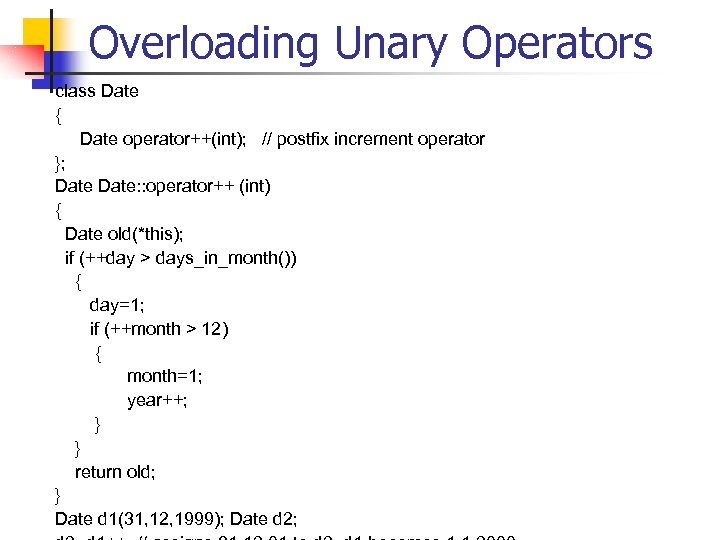 Overloading Unary Operators class Date { Date operator++(int); // postfix increment operator }; Date: : operator++ (int) { Date old(*this); if (++day > days_in_month()) { day=1; if (++month > 12) { month=1; year++; } } return old; } Date d 1(31, 12, 1999); Date d 2;
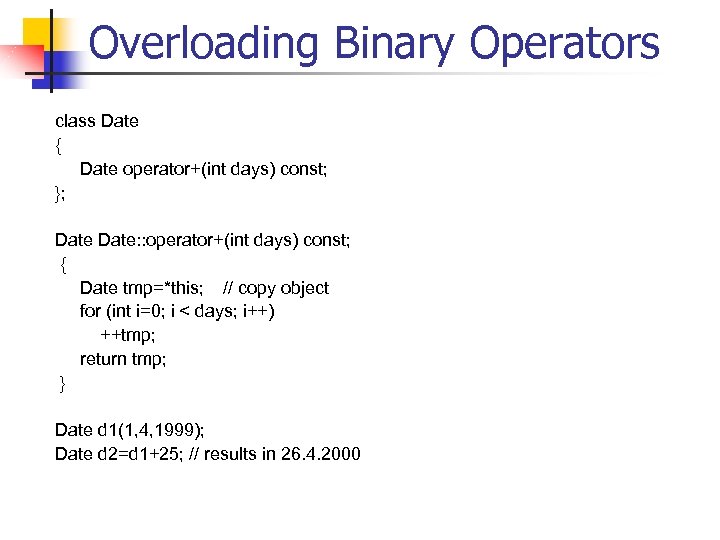 Overloading Binary Operators class Date { Date operator+(int days) const; }; Date: : operator+(int days) const; { Date tmp=*this; // copy object for (int i=0; i < days; i++) ++tmp; return tmp; } Date d 1(1, 4, 1999); Date d 2=d 1+25; // results in 26. 4. 2000
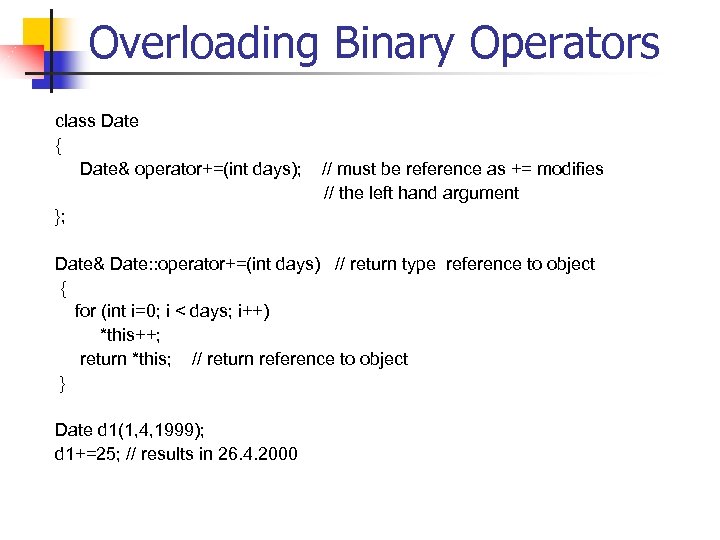 Overloading Binary Operators class Date { Date& operator+=(int days); // must be reference as += modifies // the left hand argument }; Date& Date: : operator+=(int days) // return type reference to object { for (int i=0; i < days; i++) *this++; return *this; // return reference to object } Date d 1(1, 4, 1999); d 1+=25; // results in 26. 4. 2000
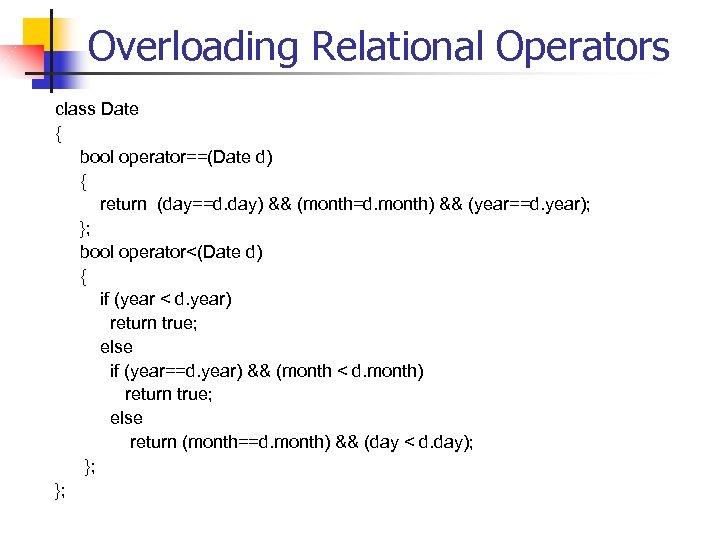 Overloading Relational Operators class Date { bool operator==(Date d) { return (day==d. day) && (month=d. month) && (year==d. year); }; bool operator<(Date d) { if (year < d. year) return true; else if (year==d. year) && (month < d. month) return true; else return (month==d. month) && (day < d. day); }; };
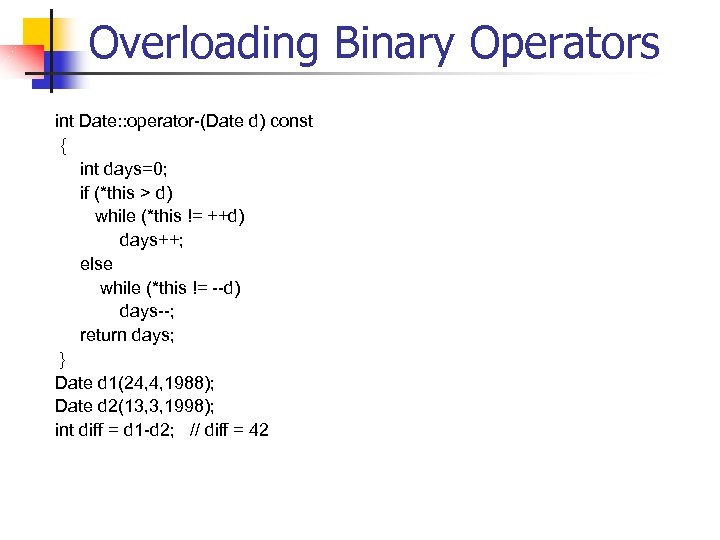 Overloading Binary Operators int Date: : operator-(Date d) const { int days=0; if (*this > d) while (*this != ++d) days++; else while (*this != --d) days--; return days; } Date d 1(24, 4, 1988); Date d 2(13, 3, 1998); int diff = d 1 -d 2; // diff = 42
 Templates A template is a place-holder for an arbitrary built-in or user-defined data type n Templates make is possible to use one function or class to handle many different data types n Function templates allow a parameter to assume an arbitrary data-type n Class templates allow a member data to assume an arbitrary data-type n Templates are another example for polymorphism n
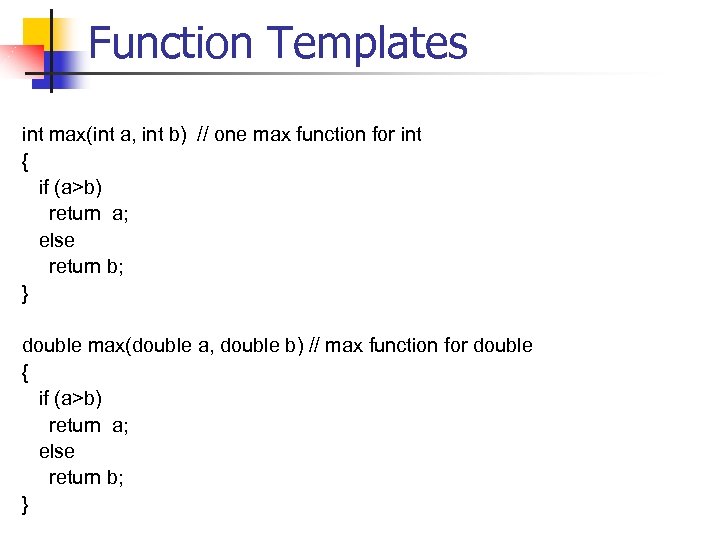 Function Templates int max(int a, int b) // one max function for int { if (a>b) return a; else return b; } double max(double a, double b) // max function for double { if (a>b) return a; else return b; }
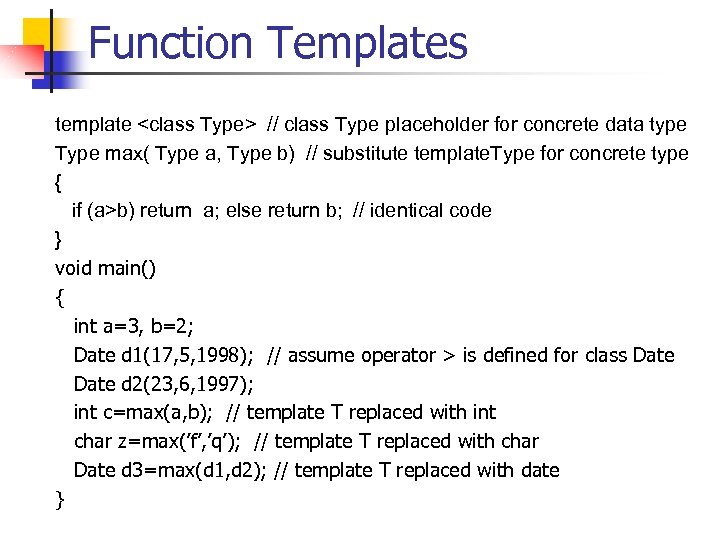 Function Templates template
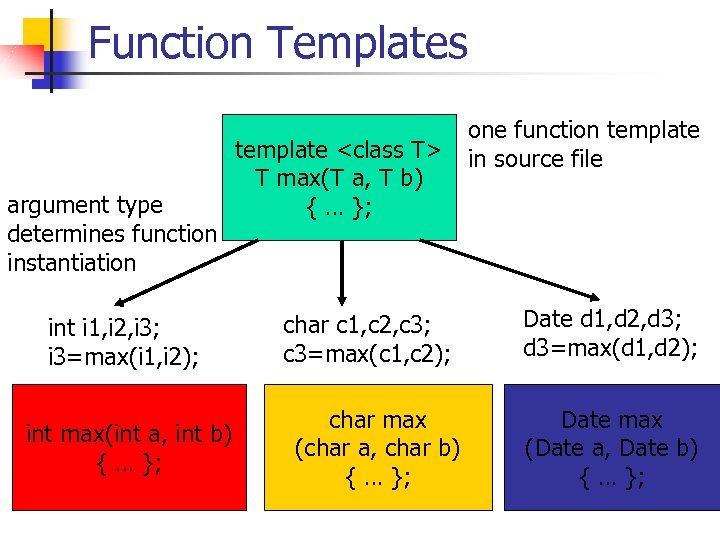 Function Templates argument type determines function instantiation int i 1, i 2, i 3; i 3=max(i 1, i 2); int max(int a, int b) { … }; template
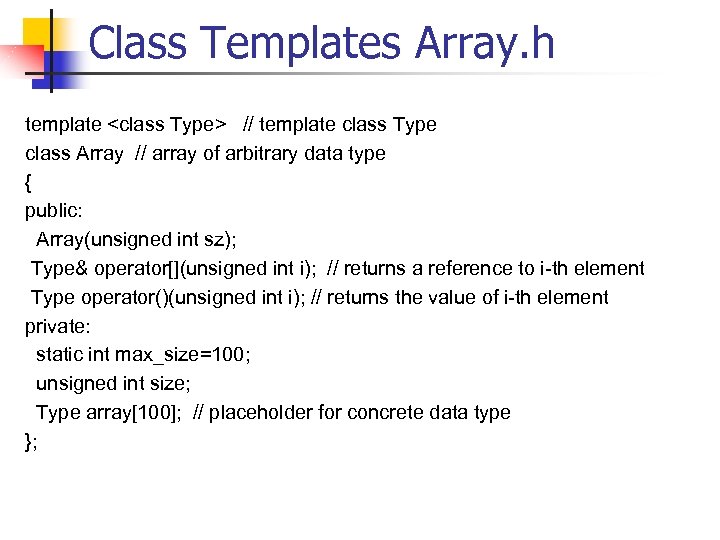 Class Templates Array. h template
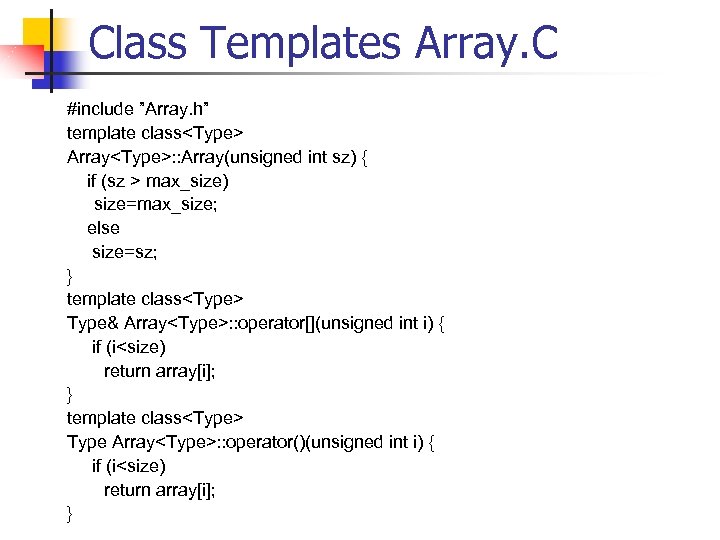 Class Templates Array. C #include ”Array. h” template class
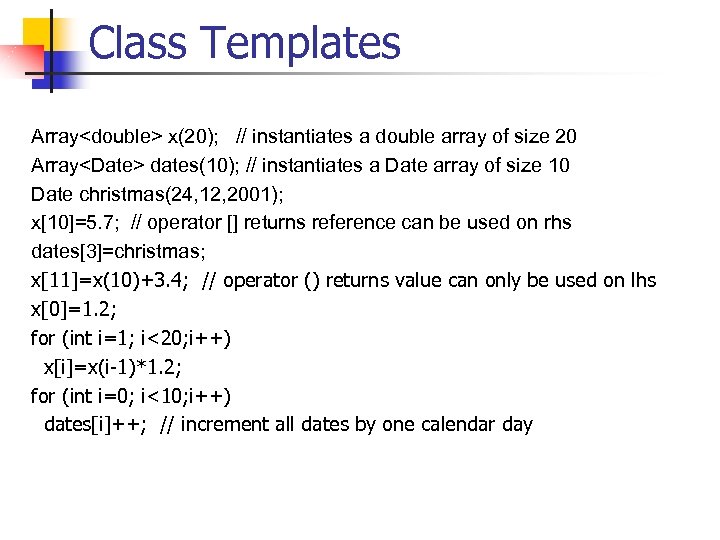 Class Templates Array
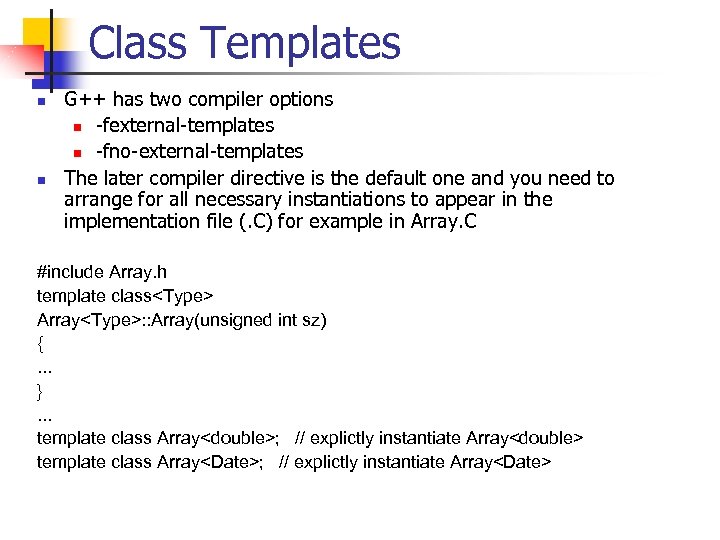 Class Templates n n G++ has two compiler options n -fexternal-templates n -fno-external-templates The later compiler directive is the default one and you need to arrange for all necessary instantiations to appear in the implementation file (. C) for example in Array. C #include Array. h template class
 Pointers n n n Pointers and Arrays Pointers and function arguments Dynamic memory management New and delete
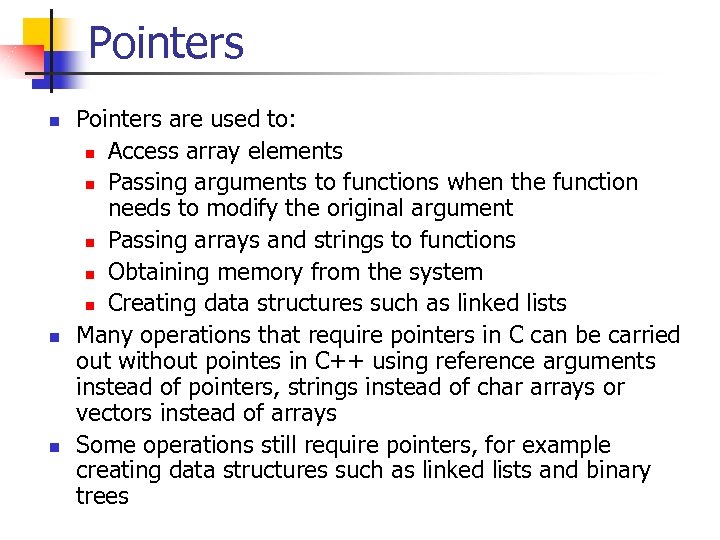 Pointers n n n Pointers are used to: n Access array elements n Passing arguments to functions when the function needs to modify the original argument n Passing arrays and strings to functions n Obtaining memory from the system n Creating data structures such as linked lists Many operations that require pointers in C can be carried out without pointes in C++ using reference arguments instead of pointers, strings instead of char arrays or vectors instead of arrays Some operations still require pointers, for example creating data structures such as linked lists and binary trees
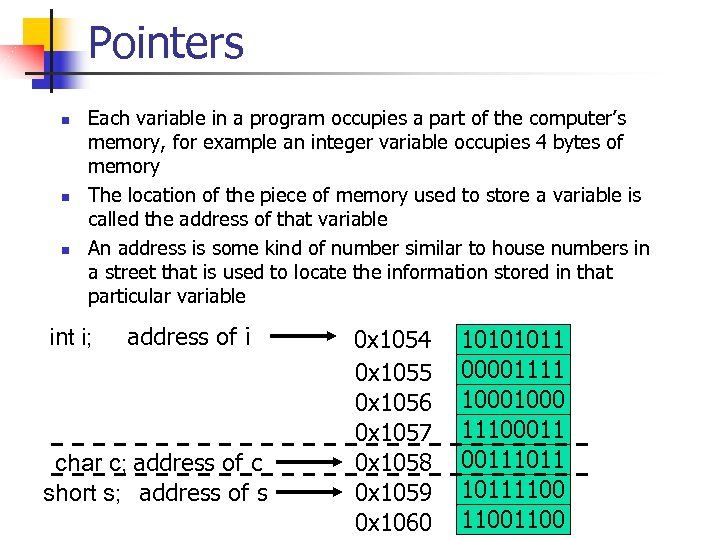 Pointers n n n Each variable in a program occupies a part of the computer’s memory, for example an integer variable occupies 4 bytes of memory The location of the piece of memory used to store a variable is called the address of that variable An address is some kind of number similar to house numbers in a street that is used to locate the information stored in that particular variable int i; address of i char c; address of c short s; address of s 0 x 1054 0 x 1055 0 x 1056 0 x 1057 0 x 1058 0 x 1059 0 x 1060 10101011 00001111 1000 1110001110111100
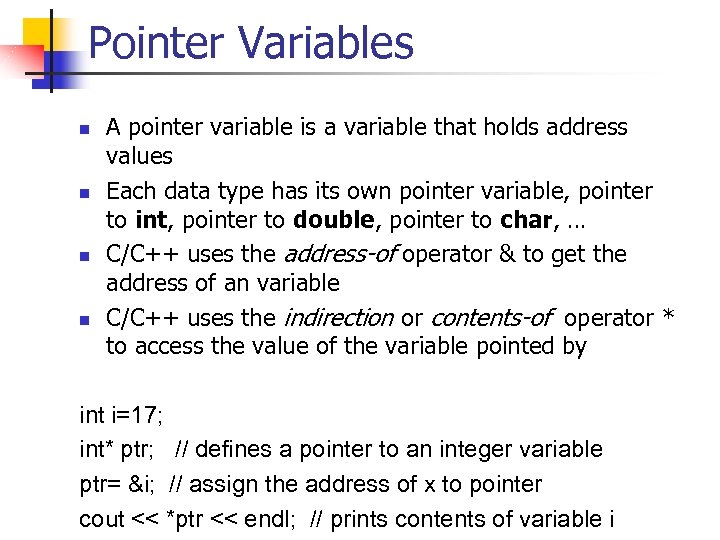 Pointer Variables n n A pointer variable is a variable that holds address values Each data type has its own pointer variable, pointer to int, pointer to double, pointer to char, … C/C++ uses the address-of operator & to get the address of an variable C/C++ uses the indirection or contents-of operator * to access the value of the variable pointed by int i=17; int* ptr; // defines a pointer to an integer variable ptr= &i; // assign the address of x to pointer cout << *ptr << endl; // prints contents of variable i
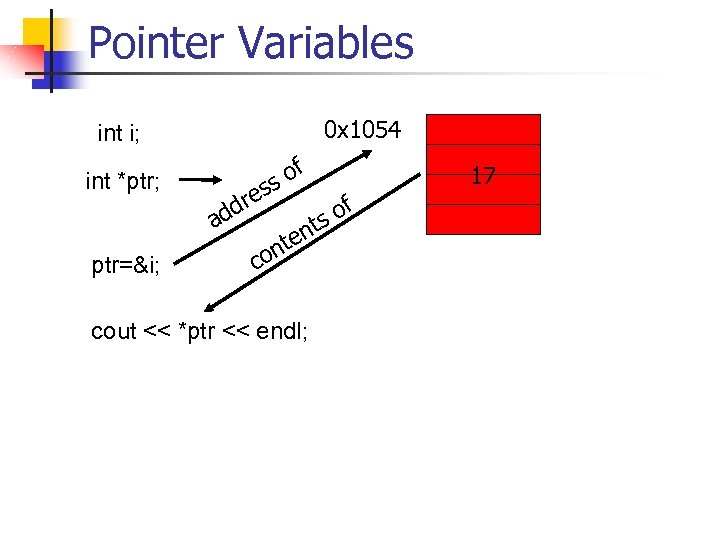 Pointer Variables 0 x 1054 int i; int *ptr; ptr=&i; of ss dre ad of nts te n co cout << *ptr << endl; 17
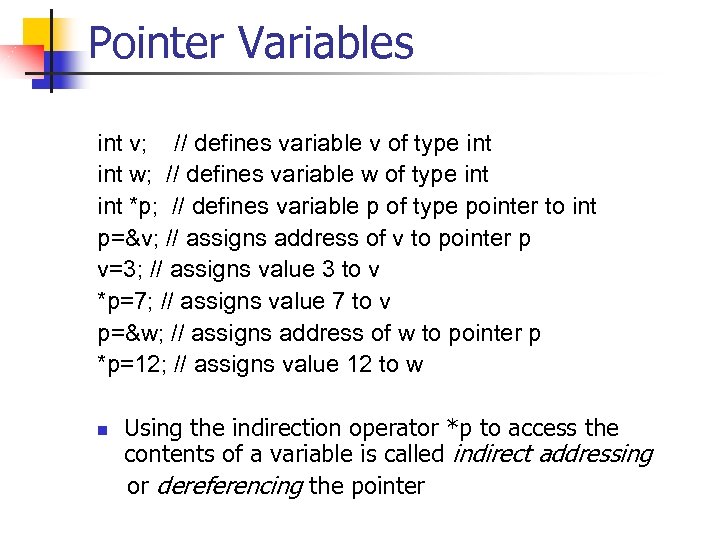 Pointer Variables int v; // defines variable v of type int w; // defines variable w of type int *p; // defines variable p of type pointer to int p=&v; // assigns address of v to pointer p v=3; // assigns value 3 to v *p=7; // assigns value 7 to v p=&w; // assigns address of w to pointer p *p=12; // assigns value 12 to w Using the indirection operator *p to access the contents of a variable is called indirect addressing or dereferencing the pointer n
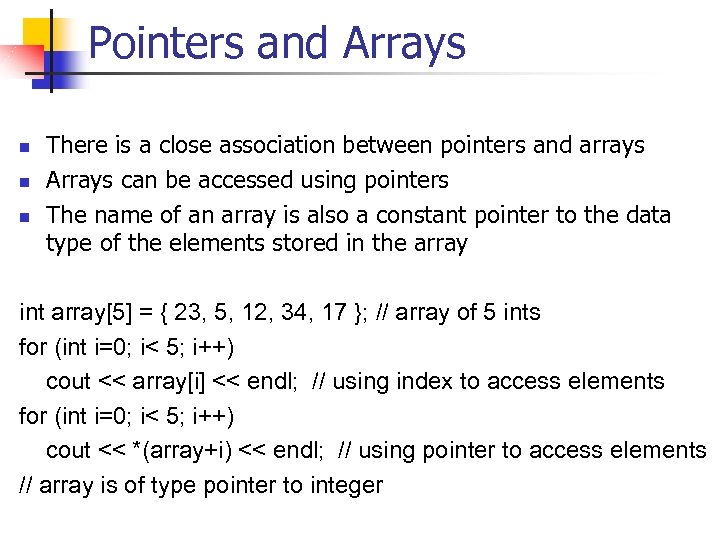 Pointers and Arrays n n n There is a close association between pointers and arrays Arrays can be accessed using pointers The name of an array is also a constant pointer to the data type of the elements stored in the array int array[5] = { 23, 5, 12, 34, 17 }; // array of 5 ints for (int i=0; i< 5; i++) cout << array[i] << endl; // using index to access elements for (int i=0; i< 5; i++) cout << *(array+i) << endl; // using pointer to access elements // array is of type pointer to integer
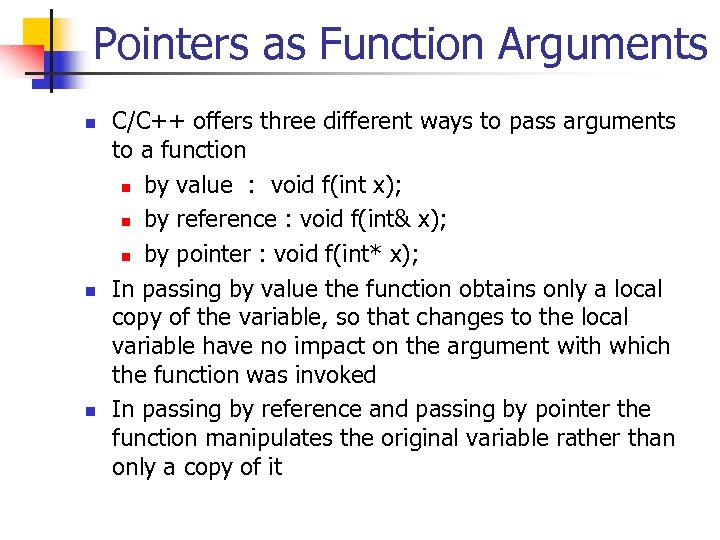 Pointers as Function Arguments n n n C/C++ offers three different ways to pass arguments to a function n by value : void f(int x); n by reference : void f(int& x); n by pointer : void f(int* x); In passing by value the function obtains only a local copy of the variable, so that changes to the local variable have no impact on the argument with which the function was invoked In passing by reference and passing by pointer the function manipulates the original variable rather than only a copy of it
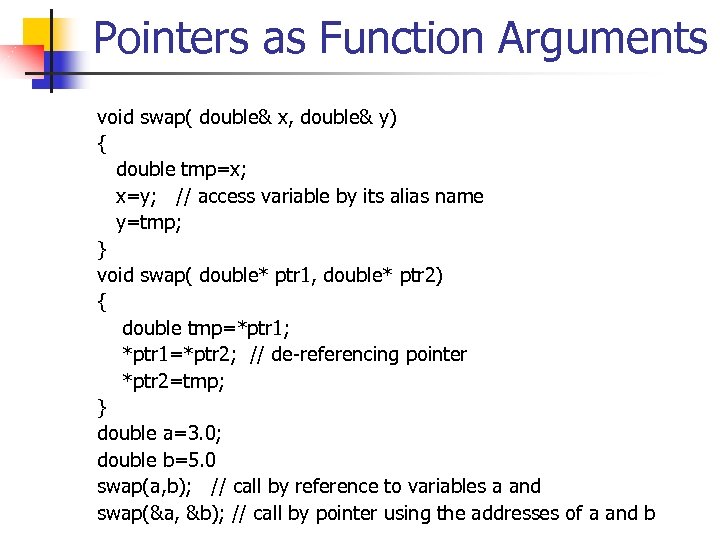 Pointers as Function Arguments void swap( double& x, double& y) { double tmp=x; x=y; // access variable by its alias name y=tmp; } void swap( double* ptr 1, double* ptr 2) { double tmp=*ptr 1; *ptr 1=*ptr 2; // de-referencing pointer *ptr 2=tmp; } double a=3. 0; double b=5. 0 swap(a, b); // call by reference to variables a and swap(&a, &b); // call by pointer using the addresses of a and b
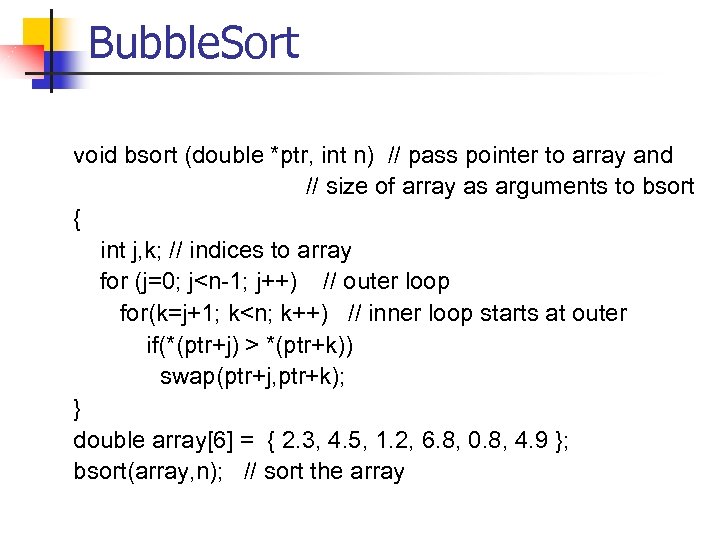 Bubble. Sort void bsort (double *ptr, int n) // pass pointer to array and // size of array as arguments to bsort { int j, k; // indices to array for (j=0; j
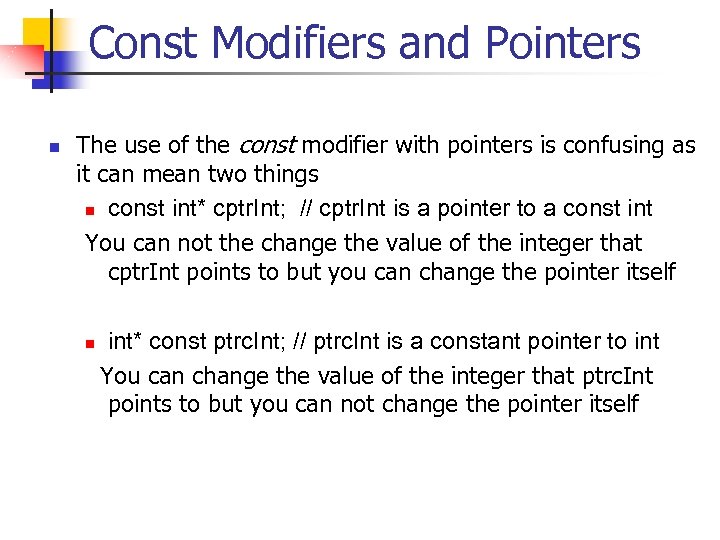 Const Modifiers and Pointers n The use of the const modifier with pointers is confusing as it can mean two things n const int* cptr. Int; // cptr. Int is a pointer to a const int You can not the change the value of the integer that cptr. Int points to but you can change the pointer itself int* const ptrc. Int; // ptrc. Int is a constant pointer to int You can change the value of the integer that ptrc. Int points to but you can not change the pointer itself n
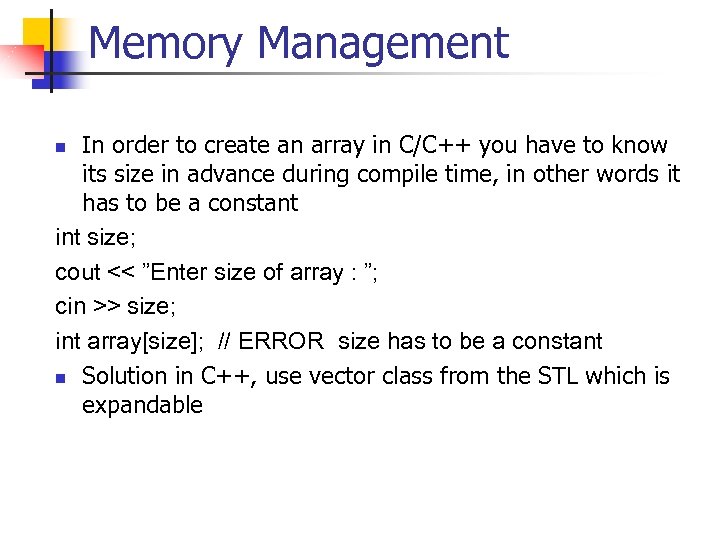 Memory Management In order to create an array in C/C++ you have to know its size in advance during compile time, in other words it has to be a constant int size; cout << ”Enter size of array : ”; cin >> size; int array[size]; // ERROR size has to be a constant n Solution in C++, use vector class from the STL which is expandable n
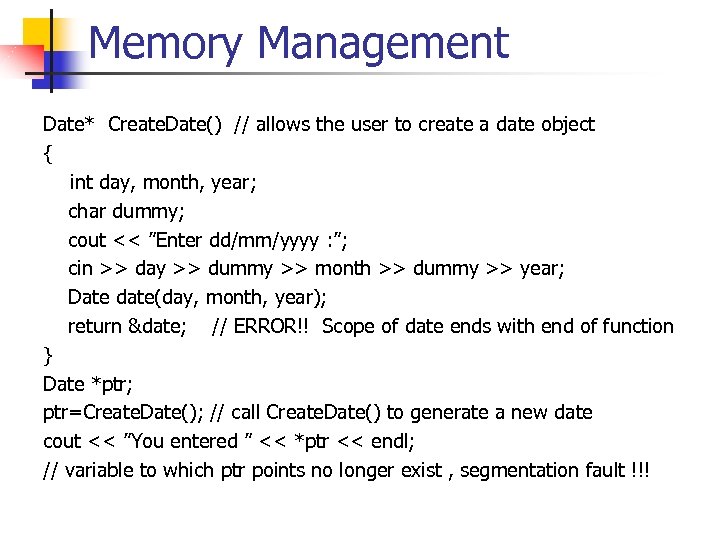 Memory Management Date* Create. Date() // allows the user to create a date object { int day, month, year; char dummy; cout << ”Enter dd/mm/yyyy : ”; cin >> day >> dummy >> month >> dummy >> year; Date date(day, month, year); return &date; // ERROR!! Scope of date ends with end of function } Date *ptr; ptr=Create. Date(); // call Create. Date() to generate a new date cout << ”You entered ” << *ptr << endl; // variable to which ptr points no longer exist , segmentation fault !!!
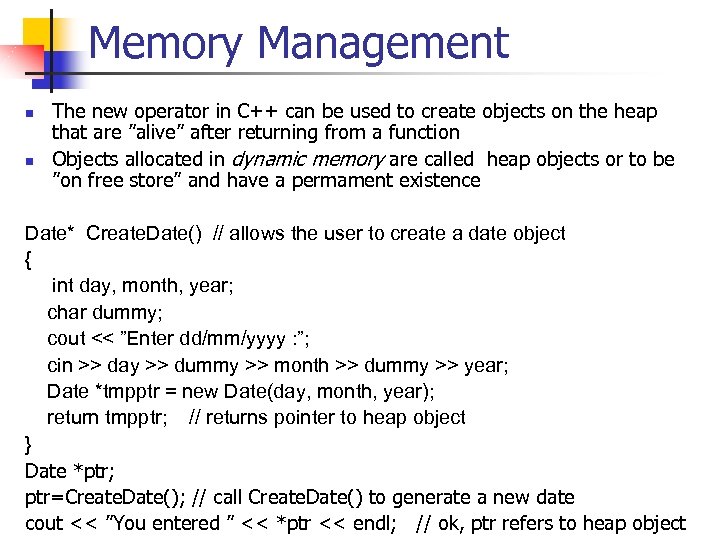 Memory Management n n The new operator in C++ can be used to create objects on the heap that are ”alive” after returning from a function Objects allocated in dynamic memory are called heap objects or to be ”on free store” and have a permament existence Date* Create. Date() // allows the user to create a date object { int day, month, year; char dummy; cout << ”Enter dd/mm/yyyy : ”; cin >> day >> dummy >> month >> dummy >> year; Date *tmpptr = new Date(day, month, year); return tmpptr; // returns pointer to heap object } Date *ptr; ptr=Create. Date(); // call Create. Date() to generate a new date cout << ”You entered ” << *ptr << endl; // ok, ptr refers to heap object
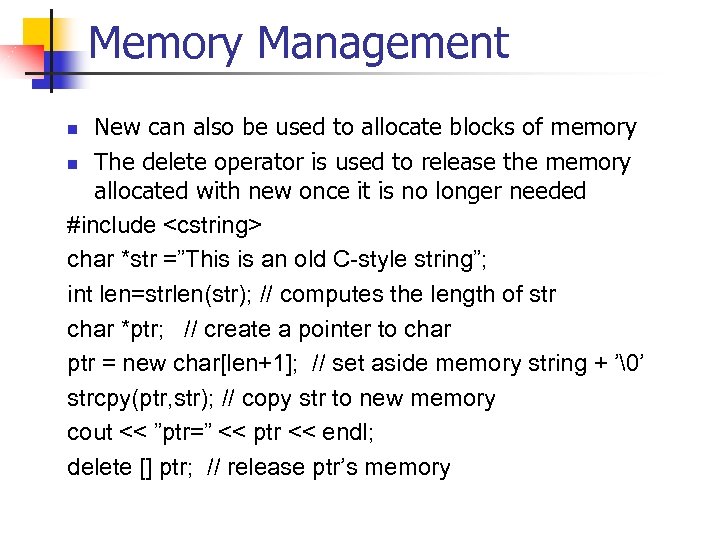 Memory Management New can also be used to allocate blocks of memory n The delete operator is used to release the memory allocated with new once it is no longer needed #include
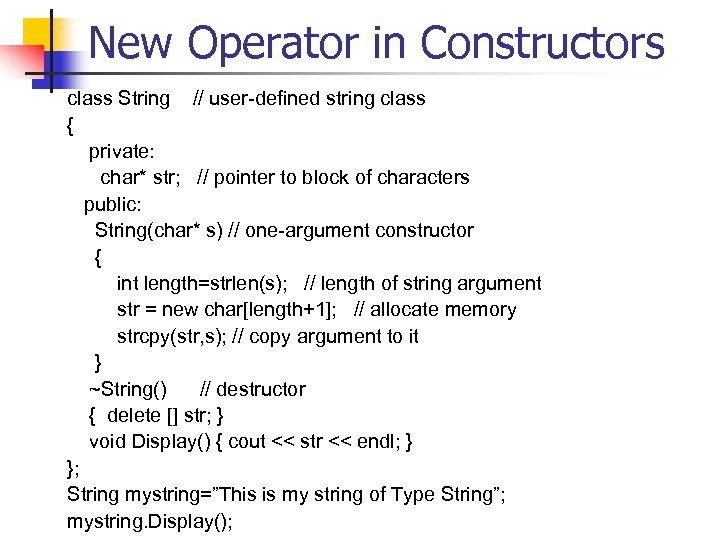 New Operator in Constructors class String // user-defined string class { private: char* str; // pointer to block of characters public: String(char* s) // one-argument constructor { int length=strlen(s); // length of string argument str = new char[length+1]; // allocate memory strcpy(str, s); // copy argument to it } ~String() // destructor { delete [] str; } void Display() { cout << str << endl; } }; String mystring=”This is my string of Type String”; mystring. Display();
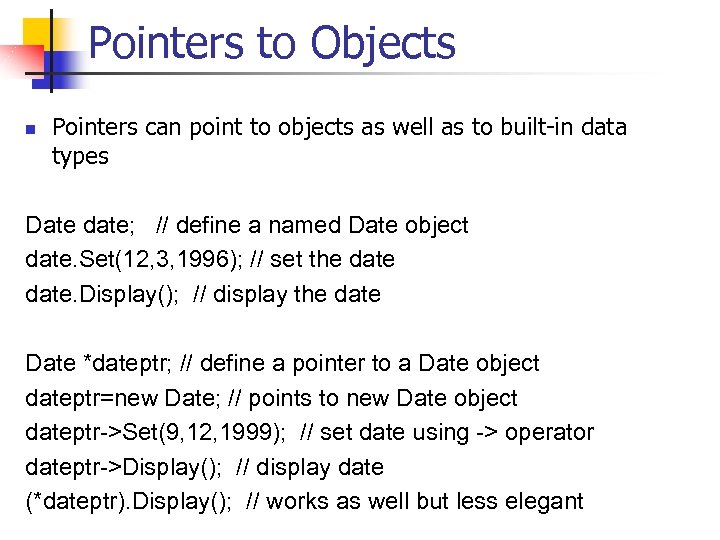 Pointers to Objects n Pointers can point to objects as well as to built-in data types Date date; // define a named Date object date. Set(12, 3, 1996); // set the date. Display(); // display the date Date *dateptr; // define a pointer to a Date object dateptr=new Date; // points to new Date object dateptr->Set(9, 12, 1999); // set date using -> operator dateptr->Display(); // display date (*dateptr). Display(); // works as well but less elegant
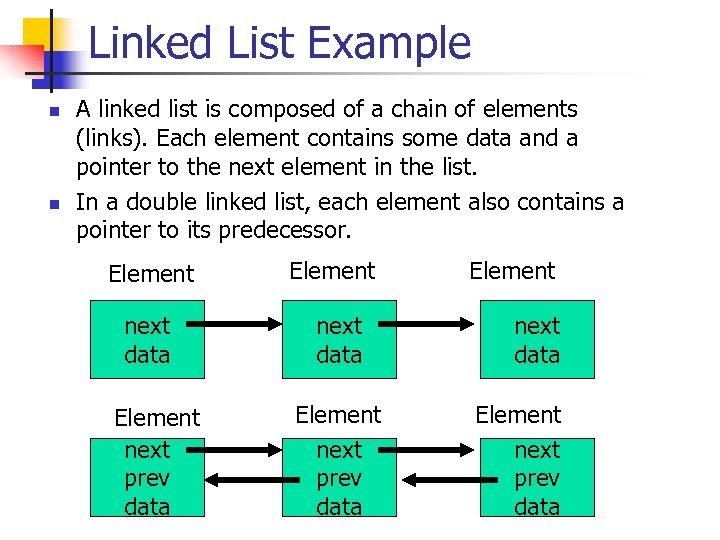 Linked List Example n n A linked list is composed of a chain of elements (links). Each element contains some data and a pointer to the next element in the list. In a double linked list, each element also contains a pointer to its predecessor. Element next data Element next prev data
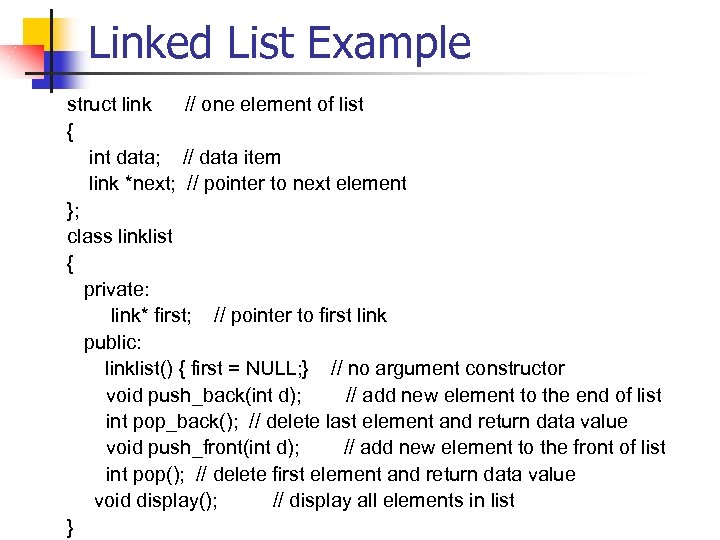 Linked List Example struct link // one element of list { int data; // data item link *next; // pointer to next element }; class linklist { private: link* first; // pointer to first link public: linklist() { first = NULL; } // no argument constructor void push_back(int d); // add new element to the end of list int pop_back(); // delete last element and return data value void push_front(int d); // add new element to the front of list int pop(); // delete first element and return data value void display(); // display all elements in list }
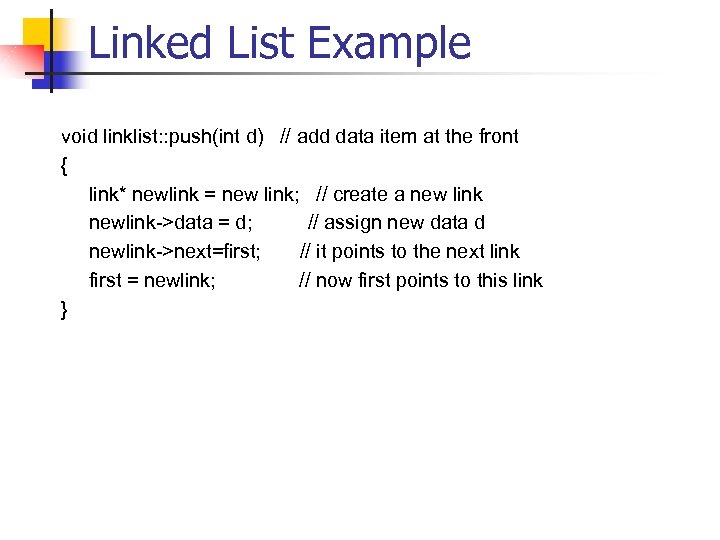 Linked List Example void linklist: : push(int d) // add data item at the front { link* newlink = new link; // create a new link newlink->data = d; // assign new data d newlink->next=first; // it points to the next link first = newlink; // now first points to this link }
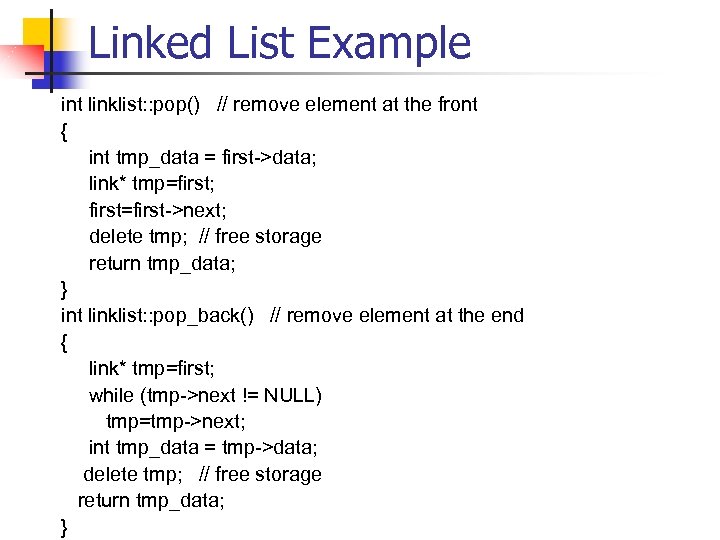 Linked List Example int linklist: : pop() // remove element at the front { int tmp_data = first->data; link* tmp=first; first=first->next; delete tmp; // free storage return tmp_data; } int linklist: : pop_back() // remove element at the end { link* tmp=first; while (tmp->next != NULL) tmp=tmp->next; int tmp_data = tmp->data; delete tmp; // free storage return tmp_data; }
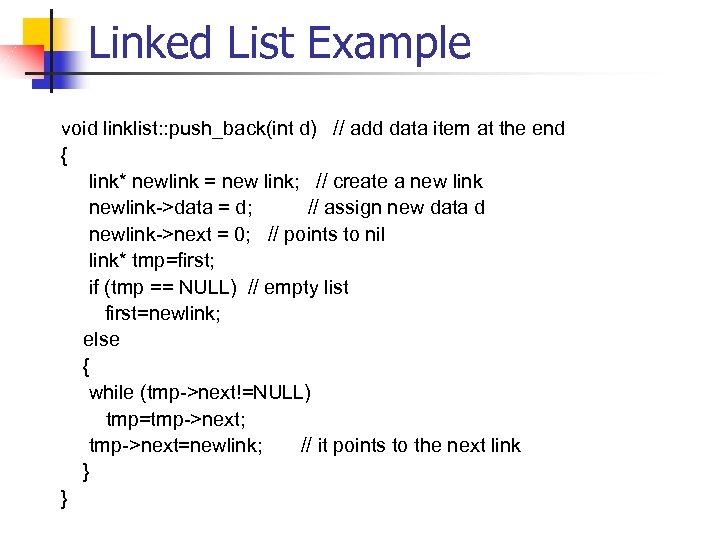 Linked List Example void linklist: : push_back(int d) // add data item at the end { link* newlink = new link; // create a new link newlink->data = d; // assign new data d newlink->next = 0; // points to nil link* tmp=first; if (tmp == NULL) // empty list first=newlink; else { while (tmp->next!=NULL) tmp=tmp->next; tmp->next=newlink; // it points to the next link } }
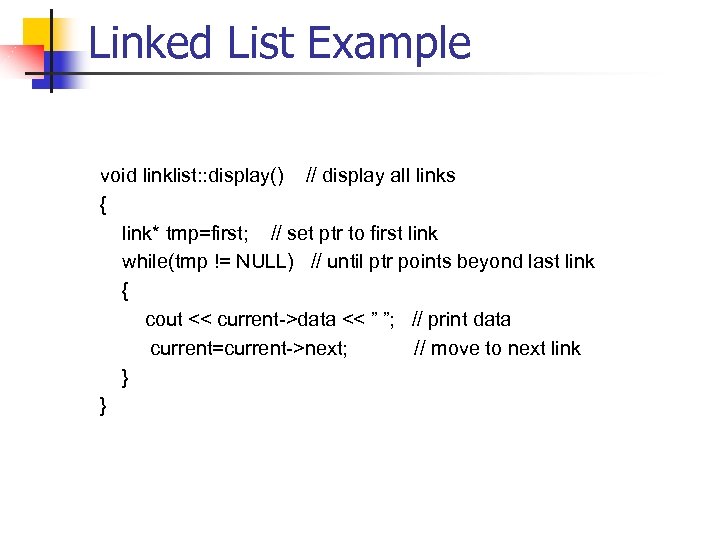 Linked List Example void linklist: : display() // display all links { link* tmp=first; // set ptr to first link while(tmp != NULL) // until ptr points beyond last link { cout << current->data << ” ”; // print data current=current->next; // move to next link } }
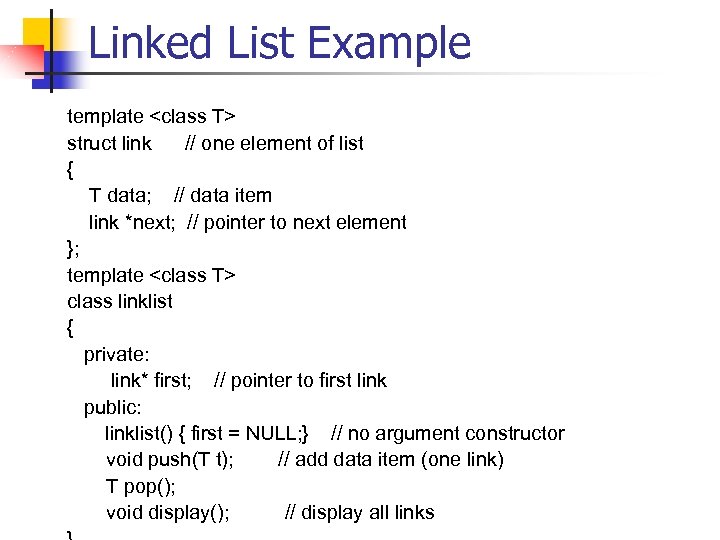 Linked List Example template
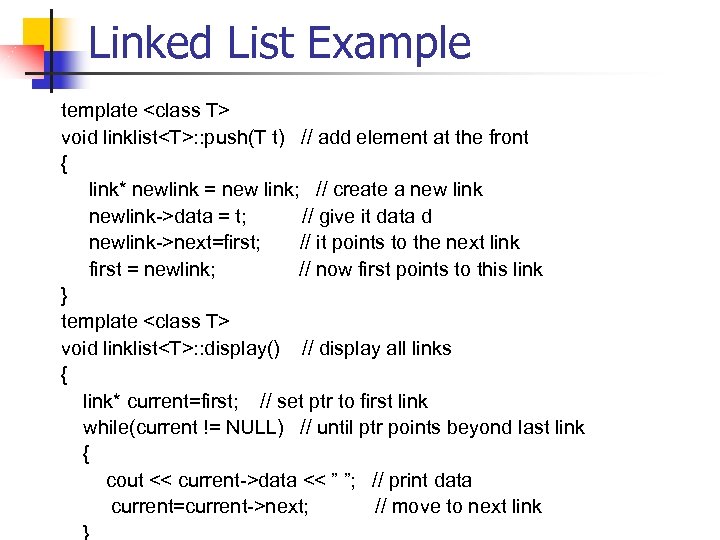 Linked List Example template
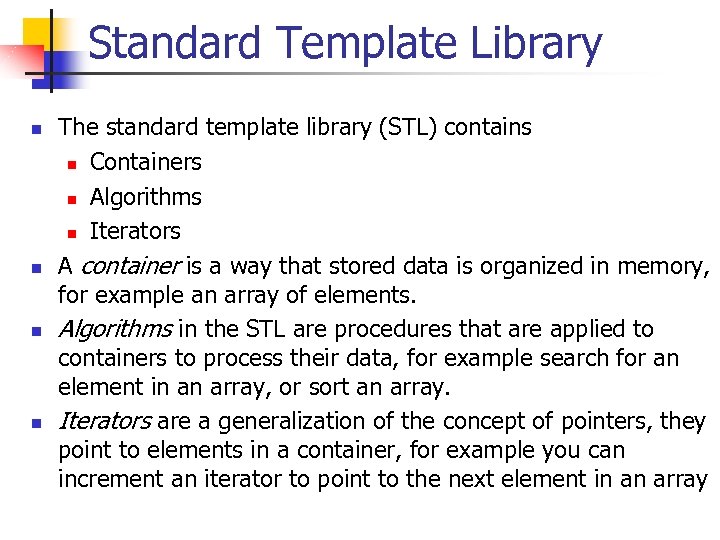 Standard Template Library n n The standard template library (STL) contains n Containers n Algorithms n Iterators A container is a way that stored data is organized in memory, for example an array of elements. Algorithms in the STL are procedures that are applied to containers to process their data, for example search for an element in an array, or sort an array. Iterators are a generalization of the concept of pointers, they point to elements in a container, for example you can increment an iterator to point to the next element in an array
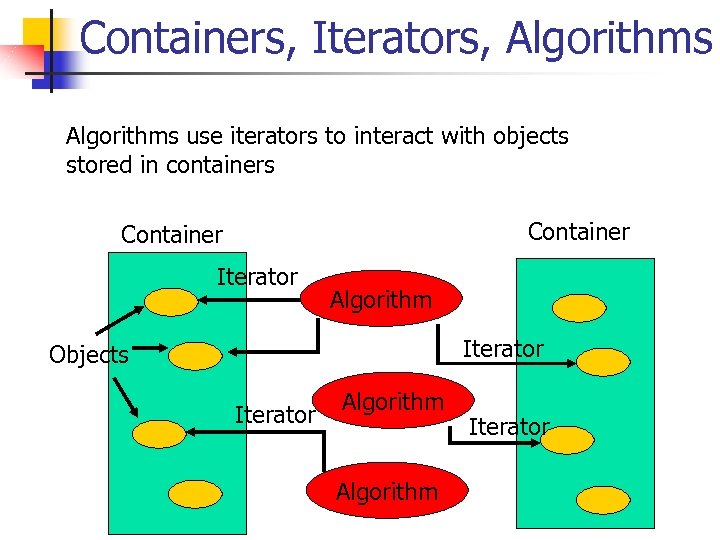 Containers, Iterators, Algorithms use iterators to interact with objects stored in containers Container Iterator Algorithm Iterator Objects Iterator Algorithm Iterator
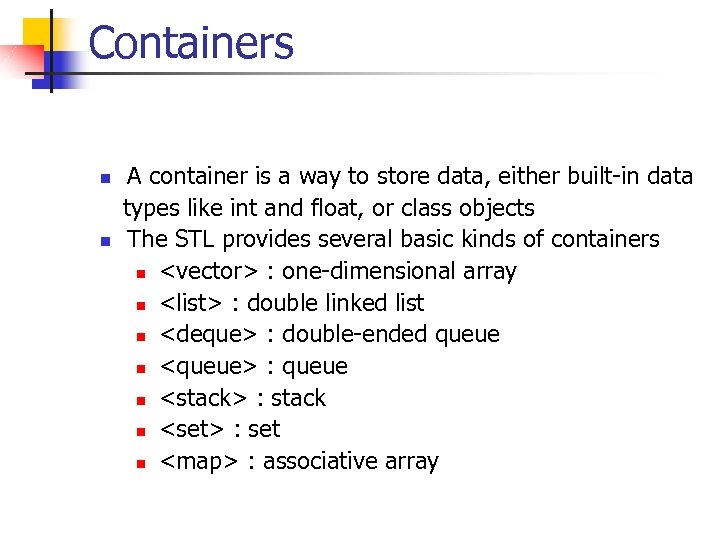 Containers A container is a way to store data, either built-in data types like int and float, or class objects n The STL provides several basic kinds of containers n
 : double linked list n
 Sequence Containers A sequence container stores a set of elements in sequence, in other words each element (except for the first and last one) is preceded by one specific element and followed by another,
 and
 Sequence Containers
 is a double linked list (each element has points to its successor and predecessor), it is quick to insert or delete elements but provides no random access (e. g. return 5 th element in list) n
n
 Associative Containers An associative container is non-sequential but uses a key to access elements. The keys, typically a number or a string, are used by the container to arrange the stored elements in a specific order, for example in a dictionary the entries are ordered alphabetically. n
 Associative Containers A
![Vector Container int array[5] = {12, 7, 9, 21, 13 }; vector<int> v(array, array+5);](https://present5.com/presentation/880c82f2ef35af95a89825661f121ddb/image-105.jpg "Vector Container int array[5] = {12, 7, 9, 21, 13 }; vector<int> v(array, array+5);") Vector Container int array[5] = {12, 7, 9, 21, 13 }; vector
Vector Container int array[5] = {12, 7, 9, 21, 13 }; vector
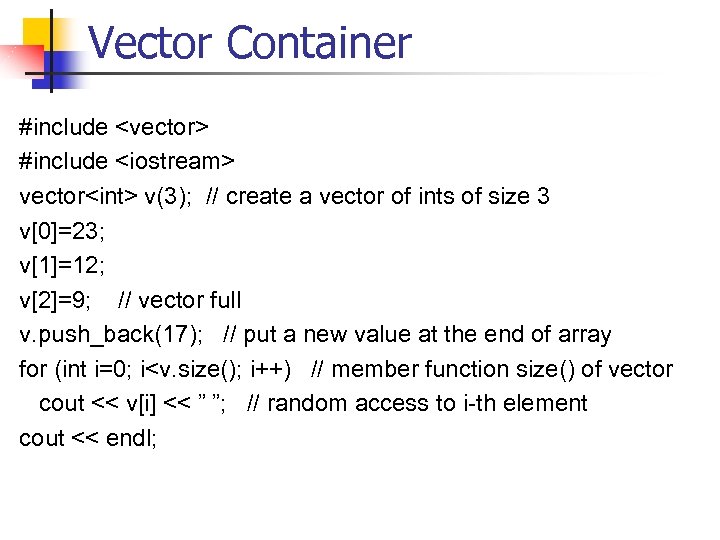 Vector Container #include
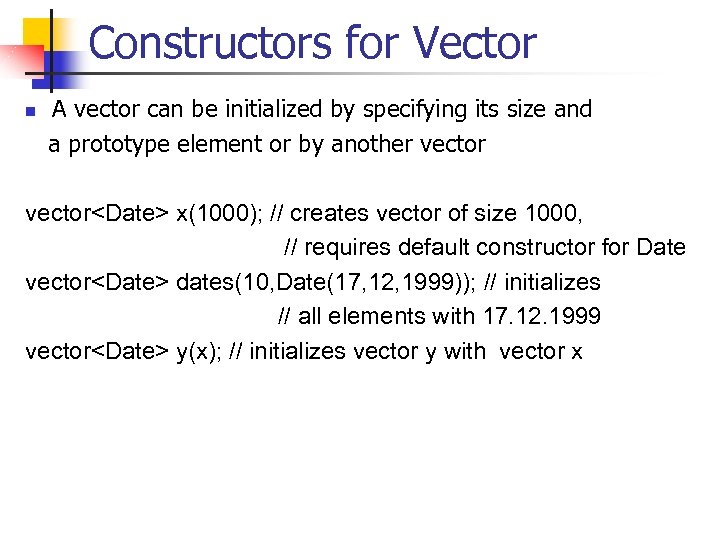 Constructors for Vector A vector can be initialized by specifying its size and a prototype element or by another vector n vector
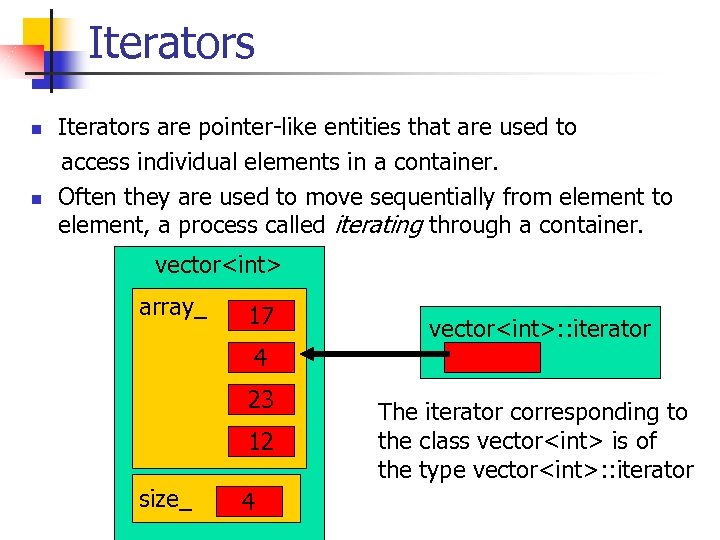 Iterators are pointer-like entities that are used to access individual elements in a container. n Often they are used to move sequentially from element to element, a process called iterating through a container. n vector
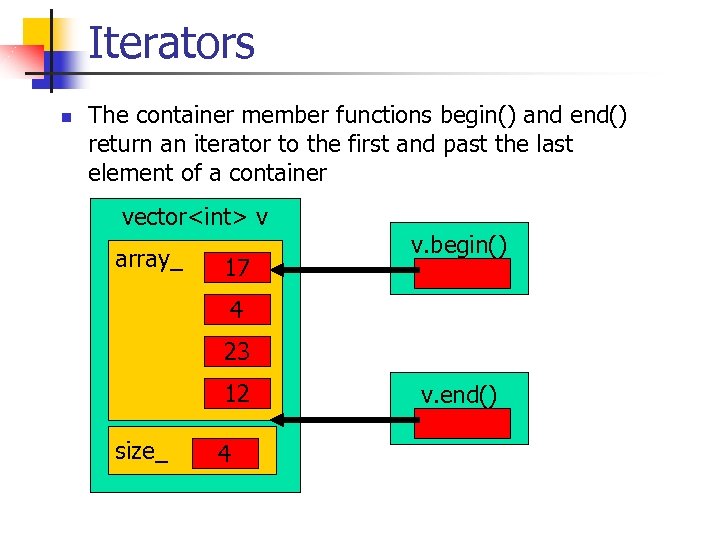 Iterators n The container member functions begin() and end() return an iterator to the first and past the last element of a container vector
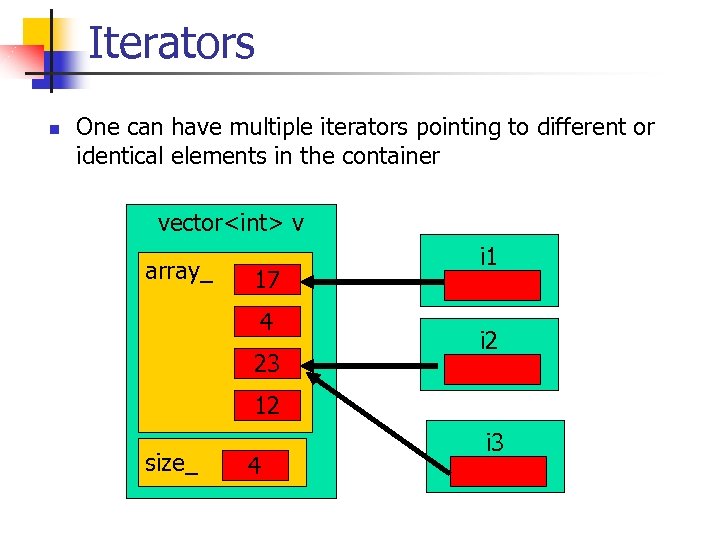 Iterators n One can have multiple iterators pointing to different or identical elements in the container vector
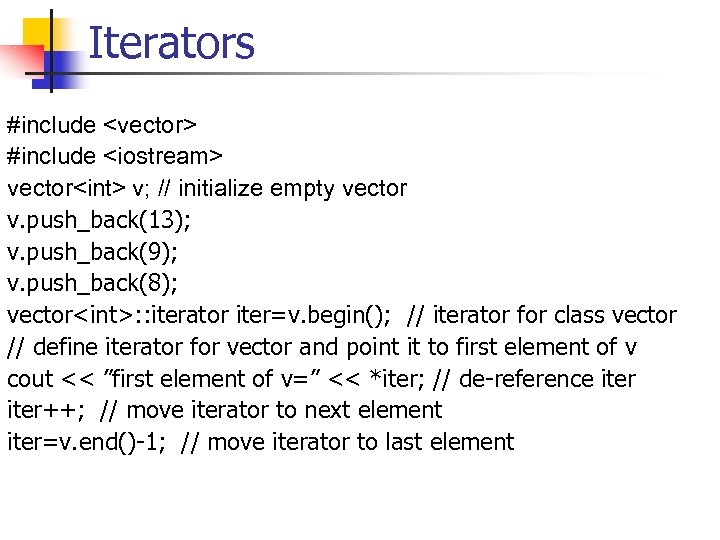 Iterators #include
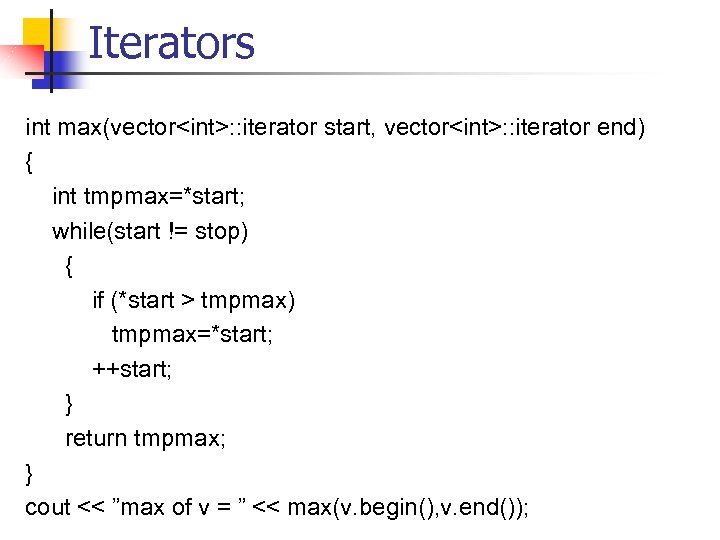 Iterators int max(vector
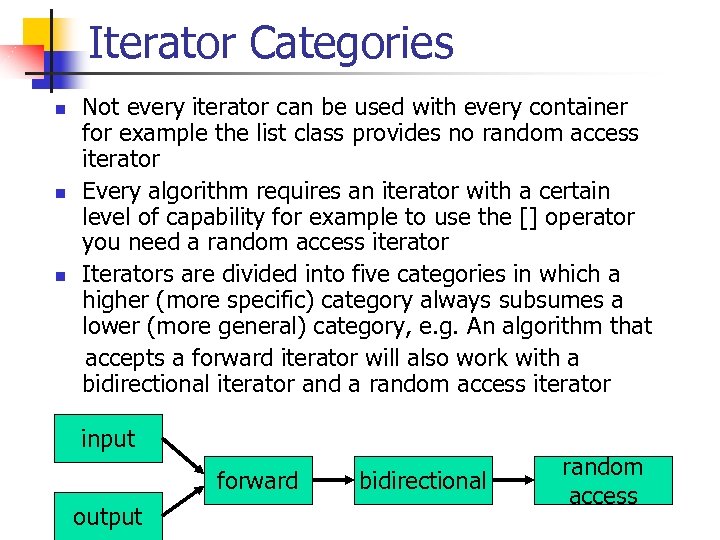 Iterator Categories Not every iterator can be used with every container for example the list class provides no random access iterator n Every algorithm requires an iterator with a certain level of capability for example to use the [] operator you need a random access iterator n Iterators are divided into five categories in which a higher (more specific) category always subsumes a lower (more general) category, e. g. An algorithm that accepts a forward iterator will also work with a bidirectional iterator and a random access iterator n input forward output bidirectional random access
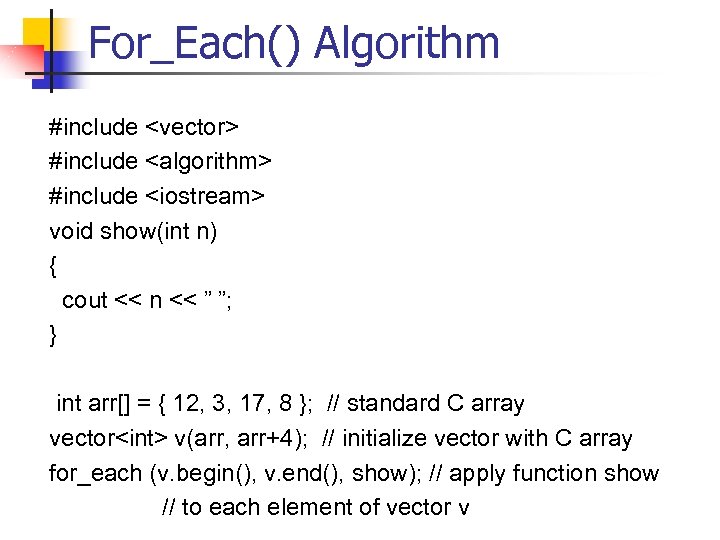 For_Each() Algorithm #include
![Find() Algorithm #include <vector> #include <algorithm> #include <iostream> int key; int arr[] = {](https://present5.com/presentation/880c82f2ef35af95a89825661f121ddb/image-115.jpg "Find() Algorithm #include <vector> #include <algorithm> #include <iostream> int key; int arr[] = {") Find() Algorithm #include
Find() Algorithm #include
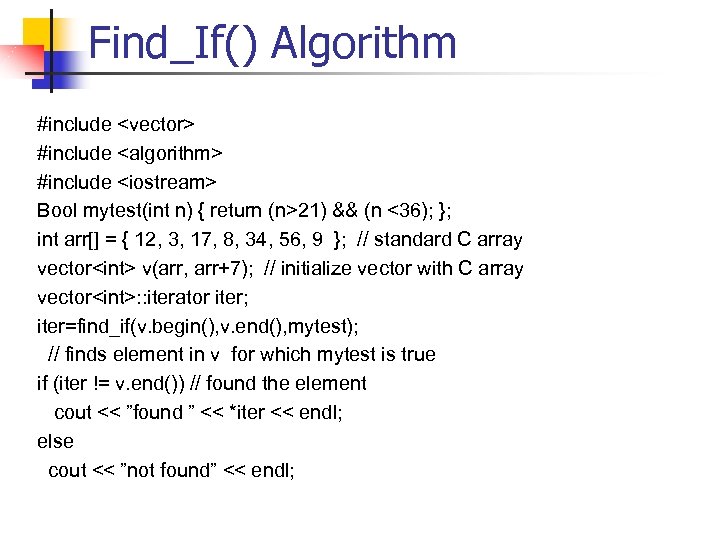 Find_If() Algorithm #include
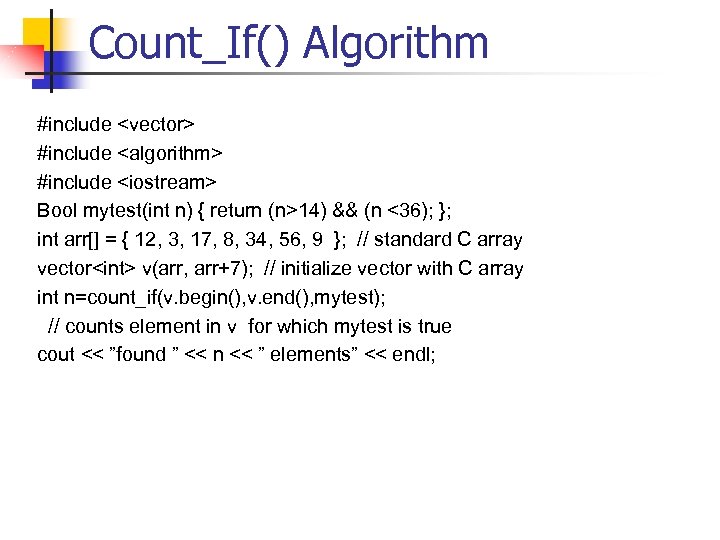 Count_If() Algorithm #include
 List Container A list container is a double linked list, in which each element contains a pointer to its successor and predecessor. n It is possible to add and remove elements at any location in the list n Lists do not allow random access but are efficient to insert new elements and to sort and merge lists n
![List Container int array[5] = {12, 7, 9, 21, 13 }; list<int> li(array, array+5);](https://present5.com/presentation/880c82f2ef35af95a89825661f121ddb/image-119.jpg "List Container int array[5] = {12, 7, 9, 21, 13 }; list<int> li(array, array+5);") List Container int array[5] = {12, 7, 9, 21, 13 }; list
List Container int array[5] = {12, 7, 9, 21, 13 }; list
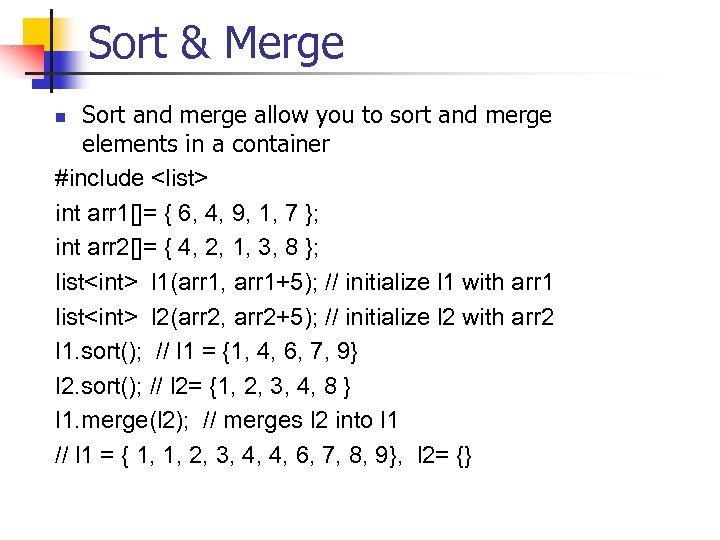 Sort & Merge Sort and merge allow you to sort and merge elements in a container #include
 int arr 1[]= { 6, 4, 9, 1, 7 }; int arr 2[]= { 4, 2, 1, 3, 8 }; list
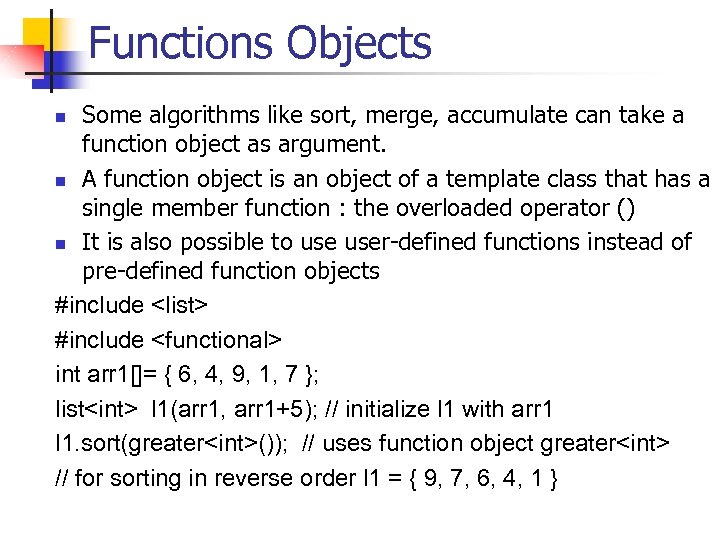 Functions Objects Some algorithms like sort, merge, accumulate can take a function object as argument. n A function object is an object of a template class that has a single member function : the overloaded operator () n It is also possible to user-defined functions instead of pre-defined function objects #include
 #include
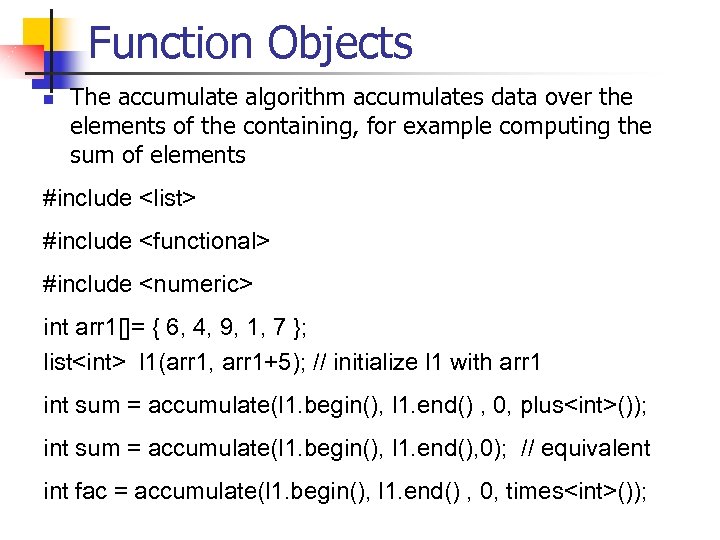 Function Objects n The accumulate algorithm accumulates data over the elements of the containing, for example computing the sum of elements #include
 #include
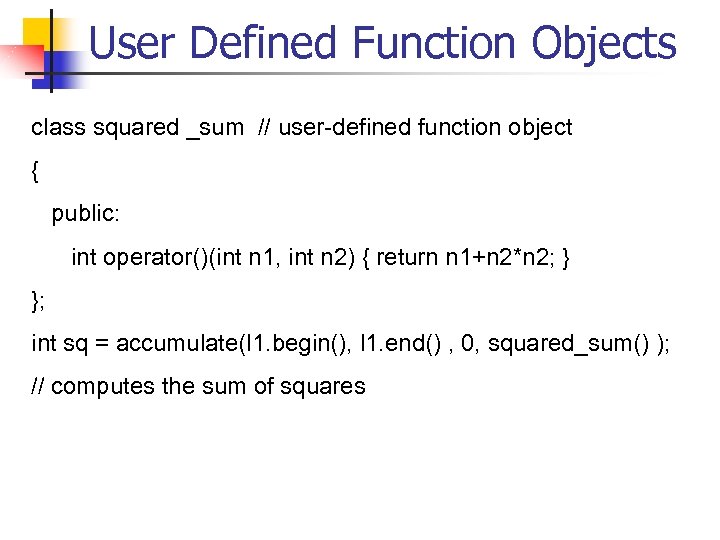 User Defined Function Objects class squared _sum // user-defined function object { public: int operator()(int n 1, int n 2) { return n 1+n 2*n 2; } }; int sq = accumulate(l 1. begin(), l 1. end() , 0, squared_sum() ); // computes the sum of squares
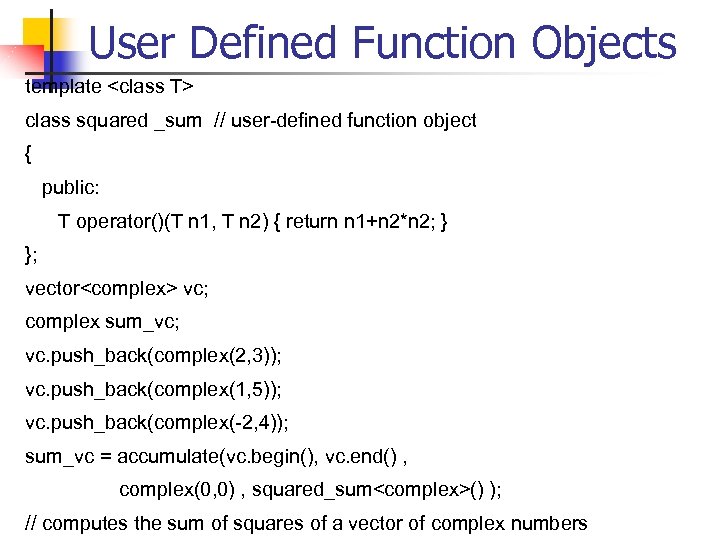 User Defined Function Objects template
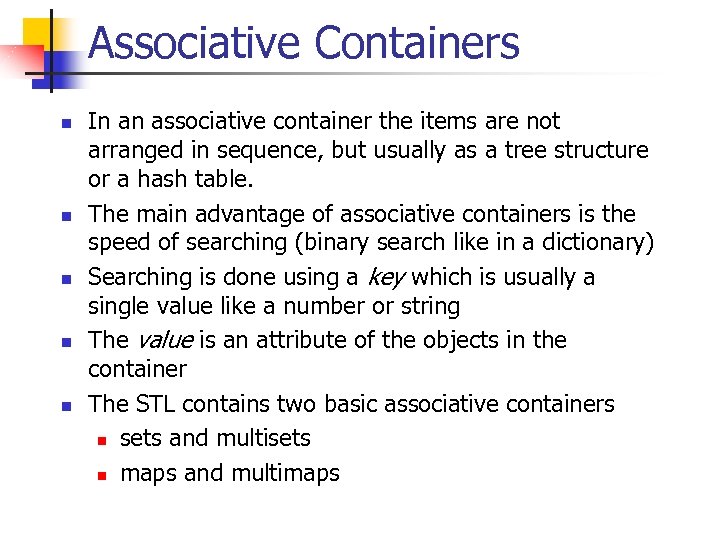 Associative Containers n n n In an associative container the items are not arranged in sequence, but usually as a tree structure or a hash table. The main advantage of associative containers is the speed of searching (binary search like in a dictionary) Searching is done using a key which is usually a single value like a number or string The value is an attribute of the objects in the container The STL contains two basic associative containers n sets and multisets n maps and multimaps
![Sets and Multisets #include <set> string names[] = {”Ole”, ”Hedvig”, ”Juan”, ”Lars”, ”Guido”}; set<string,](https://present5.com/presentation/880c82f2ef35af95a89825661f121ddb/image-126.jpg "Sets and Multisets #include <set> string names[] = {”Ole”, ”Hedvig”, ”Juan”, ”Lars”, ”Guido”}; set<string,") Sets and Multisets #include
Sets and Multisets #include
![Set and Multisets string names[] = {”Ole”, ”Hedvig”, ”Juan”, ”Lars”, ”Guido”, ”Patric”, ”Maria”, ”Ann”};](https://present5.com/presentation/880c82f2ef35af95a89825661f121ddb/image-127.jpg "Set and Multisets string names[] = {”Ole”, ”Hedvig”, ”Juan”, ”Lars”, ”Guido”, ”Patric”, ”Maria”, ”Ann”};") Set and Multisets string names[] = {”Ole”, ”Hedvig”, ”Juan”, ”Lars”, ”Guido”, ”Patric”, ”Maria”, ”Ann”}; set
Set and Multisets string names[] = {”Ole”, ”Hedvig”, ”Juan”, ”Lars”, ”Guido”, ”Patric”, ”Maria”, ”Ann”}; set
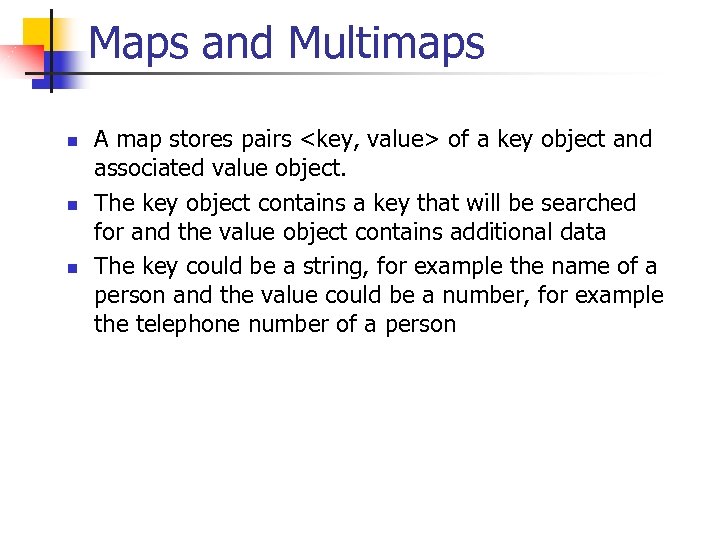 Maps and Multimaps n n n A map stores pairs
![Maps and Multimaps #include <map> string names[]= {”Ole”, ”Hedvig”, ”Juan”, ”Lars”, ”Guido”, ”Patric”, ”Maria”,](https://present5.com/presentation/880c82f2ef35af95a89825661f121ddb/image-129.jpg "Maps and Multimaps #include <map> string names[]= {”Ole”, ”Hedvig”, ”Juan”, ”Lars”, ”Guido”, ”Patric”, ”Maria”,") Maps and Multimaps #include
Maps and Multimaps #include