 Скачать презентацию ONTOPEDIA The Identity of Everything is a Subject
f58cb7db4520961a60d3313fec5868e3.ppt
- Количество слайдов: 45



ONTOPEDIA The Identity of Everything is a Subject The vision of subject-centric computing Steve Pepper, Ontopedia pepper. steve@gmail. com Topic Maps 2008 – Oslo, Norway 2008 -04 -04 http: //www. topicmaps. com/tm 2008/ pepper. ppt
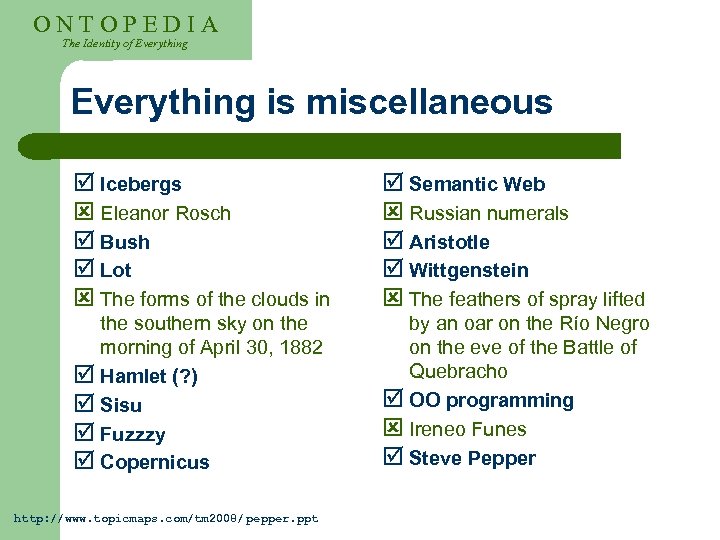
ONTOPEDIA The Identity of Everything is miscellaneous þ Icebergs ý Eleanor Rosch þ Bush þ Lot ý The forms of the clouds in þ Semantic Web ý Russian numerals þ Aristotle þ Wittgenstein ý The feathers of spray lifted the southern sky on the morning of April 30, 1882 þ Hamlet (? ) þ Sisu þ Fuzzzy þ Copernicus by an oar on the Río Negro on the eve of the Battle of Quebracho þ OO programming ý Ireneo Funes þ Steve Pepper http: //www. topicmaps. com/tm 2008/ pepper. ppt
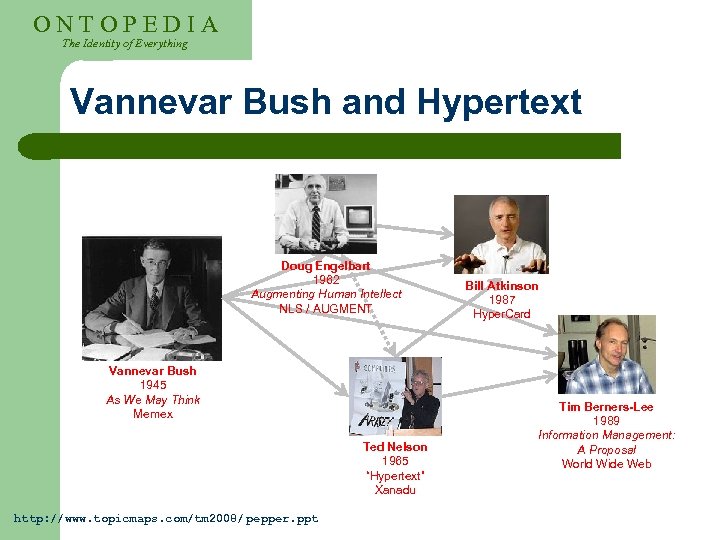
ONTOPEDIA The Identity of Everything Vannevar Bush and Hypertext Doug Engelbart 1962 Augmenting Human Intellect NLS / AUGMENT Vannevar Bush 1945 As We May Think Memex Ted Nelson 1965 “Hypertext” Xanadu http: //www. topicmaps. com/tm 2008/ pepper. ppt Bill Atkinson 1987 Hyper. Card Tim Berners-Lee 1989 Information Management: A Proposal World Wide Web
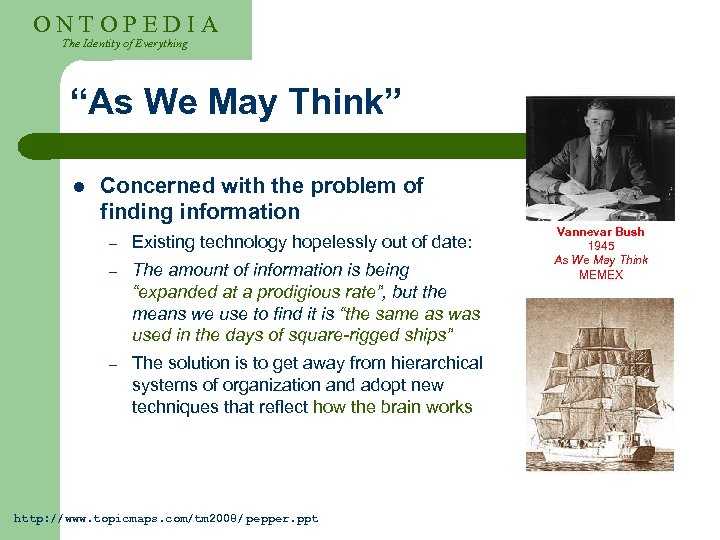
ONTOPEDIA The Identity of Everything “As We May Think” l Concerned with the problem of finding information – Existing technology hopelessly out of date: – The amount of information is being “expanded at a prodigious rate”, but the means we use to find it is “the same as was used in the days of square-rigged ships” – The solution is to get away from hierarchical systems of organization and adopt new techniques that reflect how the brain works http: //www. topicmaps. com/tm 2008/ pepper. ppt Vannevar Bush 1945 As We May Think MEMEX
ONTOPEDIA The Identity of Everything Associative thinking “The human mind … operates by association. With one item in its grasp, it snaps instantly to the next that is suggested by the association of thoughts, in accordance with some intricate web of trails carried by the cells of the brain… The speed of action, the intricacy of trails, the detail of mental pictures, is awe-inspiring beyond all else in nature. ” Vannevar Bush: As We May Think (1945) http: //www. topicmaps. com/tm 2008/ pepper. ppt
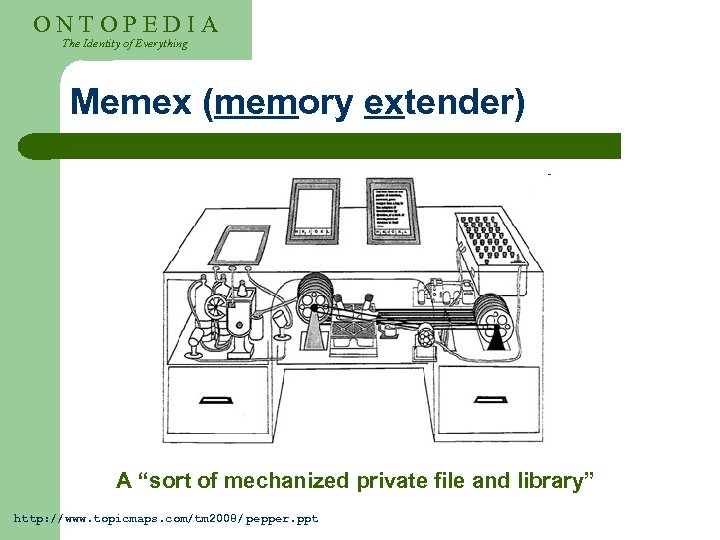
ONTOPEDIA The Identity of Everything Memex (memory extender) A “sort of mechanized private file and library” http: //www. topicmaps. com/tm 2008/ pepper. ppt
ONTOPEDIA The Identity of Everything Memex (memory extender) l Consists of a desk containing – – – l a very large set of documents stored on microfilm screens on which those documents are projected a device for photographing new documents a mechanism for retrieving documents at the push of a button the ability to create links between documents the ability to build trails through documents, add comments to documents, insert new documents, etc. Note how everything revolves around documents http: //www. topicmaps. com/tm 2008/ pepper. ppt
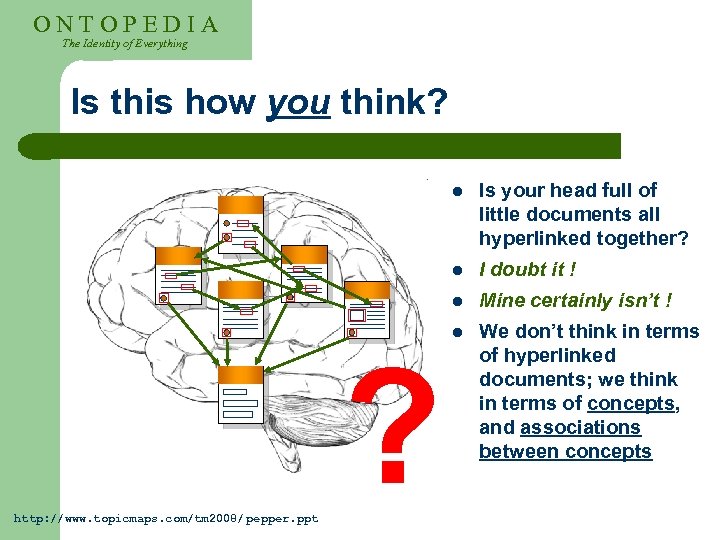
ONTOPEDIA The Identity of Everything Is this how you think? l l http: //www. topicmaps. com/tm 2008/ pepper. ppt I doubt it ! l ? Is your head full of little documents all hyperlinked together? Mine certainly isn’t ! l We don’t think in terms of hyperlinked documents; we think in terms of concepts, and associations between concepts
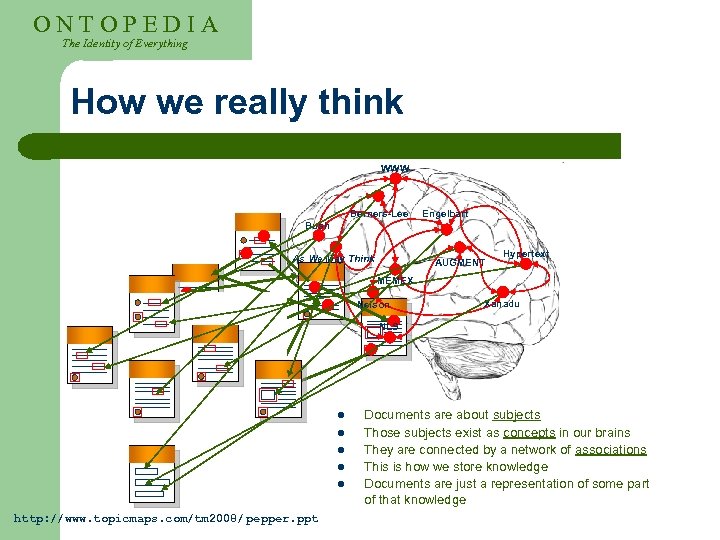
ONTOPEDIA The Identity of Everything How we really think WWW Berners-Lee Engelbart Bush As We May Think AUGMENT Hypertext MEMEX Nelson Xanadu NLS l l l http: //www. topicmaps. com/tm 2008/ pepper. ppt Documents are about subjects Those subjects exist as concepts in our brains They are connected by a network of associations This is how we store knowledge Documents are just a representation of some part of that knowledge
ONTOPEDIA The Identity of Everything Bush – right and wrong l Vannevar Bush was right that people think associatively l He was right that organizing information in this way would make it easier to find l But he was wrong in adopting a document-centric approach to the problem l His basic idea – organize information “as we may way think” – was a great inspiration to Engelbart, Nelson, Atkinson, and Berners-Lee http: //www. topicmaps. com/tm 2008/ pepper. ppt
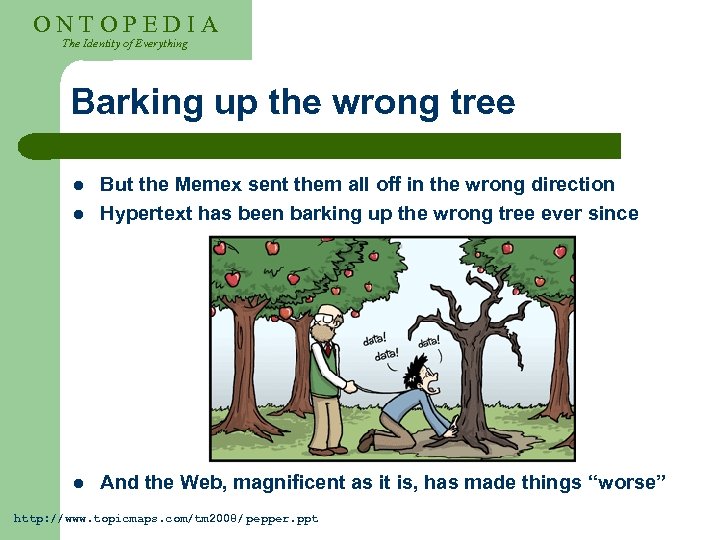
ONTOPEDIA The Identity of Everything Barking up the wrong tree l But the Memex sent them all off in the wrong direction Hypertext has been barking up the wrong tree ever since l And the Web, magnificent as it is, has made things “worse” l http: //www. topicmaps. com/tm 2008/ pepper. ppt
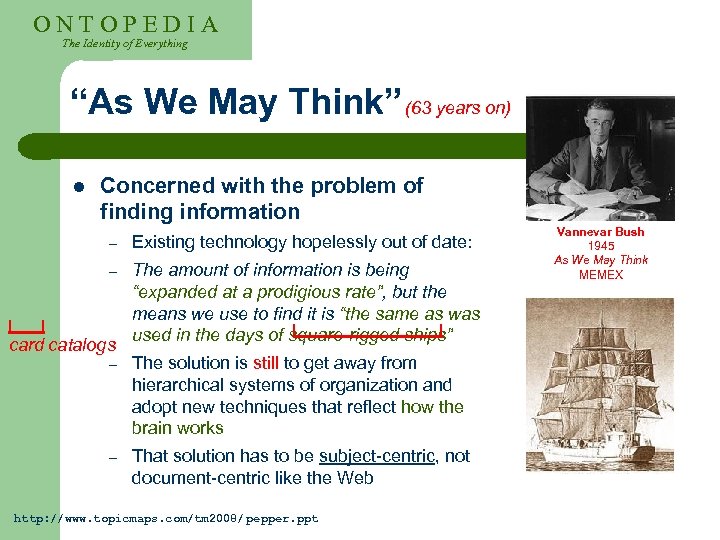
ONTOPEDIA The Identity of Everything “As We May Think” (63 years on) l Concerned with the problem of finding information – Existing technology hopelessly out of date: – The amount of information is being “expanded at a prodigious rate”, but the means we use to find it is “the same as was used in the days of square-rigged ships” card catalogs – The solution is still to get away from hierarchical systems of organization and adopt new techniques that reflect how the brain works – That solution has to be subject-centric, not document-centric like the Web http: //www. topicmaps. com/tm 2008/ pepper. ppt Vannevar Bush 1945 As We May Think MEMEX
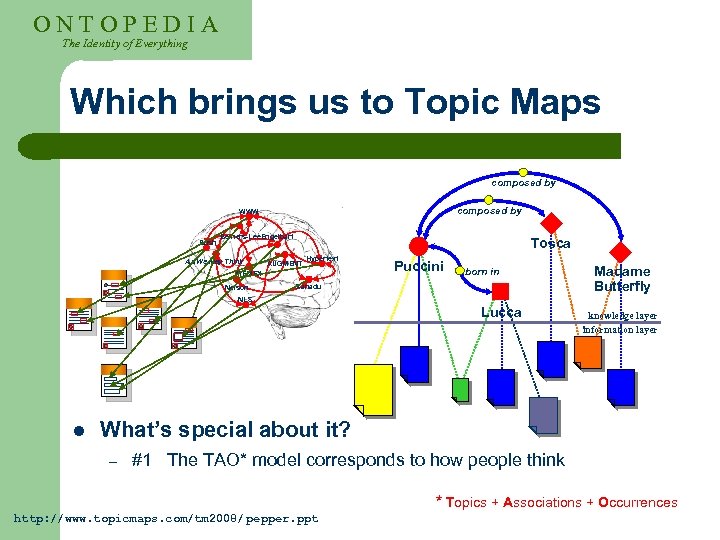
ONTOPEDIA The Identity of Everything Which brings us to Topic Maps composed by WWW Bush Berners-Lee. Engelbart As We May Think Tosca AUGMENT Hypertext MEMEX Nelson Puccini born in Xanadu Madame Butterfly NLS Lucca l knowledge layer information layer What’s special about it? – #1 The TAO* model corresponds to how people think * Topics + Associations + Occurrences http: //www. topicmaps. com/tm 2008/ pepper. ppt
ONTOPEDIA The Identity of Everything TM as information architecture l This is what explains why TMs are ideal for web sites – l It really is computing “as we may think” Subject-centric – – l One page per topic (the concept of “subject page”) Page contents built primarily from names and occurrences Associative – l Associations for navigating from one page (topic) to another Example: topicmaps. com http: //www. topicmaps. com/tm 2008/ pepper. ppt
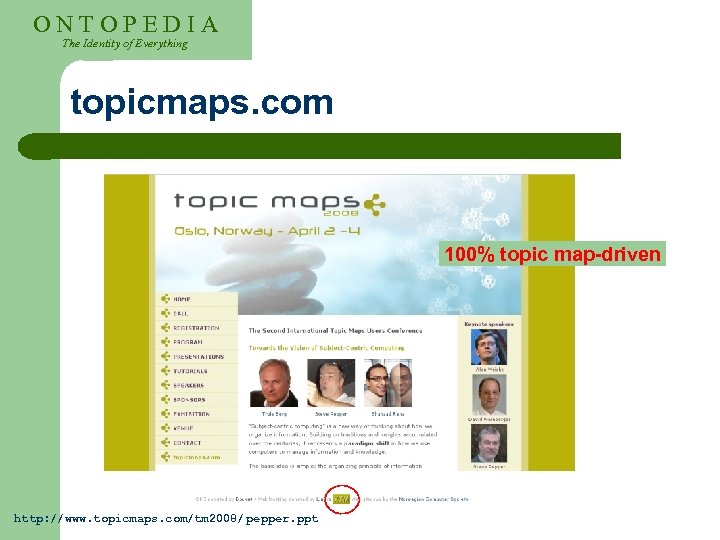
ONTOPEDIA The Identity of Everything topicmaps. com 100% topic map-driven http: //www. topicmaps. com/tm 2008/ pepper. ppt
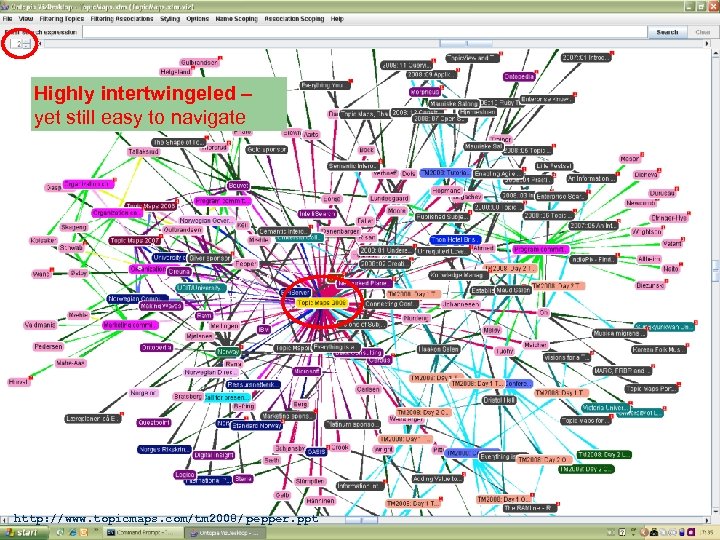
Highly intertwingeled – yet still easy to navigate http: //www. topicmaps. com/tm 2008/ pepper. ppt
ONTOPEDIA The Identity of Everything So is TM a portal technology? l l No, it’s not Many people think so – – l But it wasn’t invented as such It just turned out to be ideal for the purpose, because. . . The underlying model is “as we may think” – l l That model is subject-centric, not document-centric Until recently most applications of Topic Maps were portals Now they are not, as this conference has shown – (But the perception will persist, unless we all do something about it) http: //www. topicmaps. com/tm 2008/ pepper. ppt
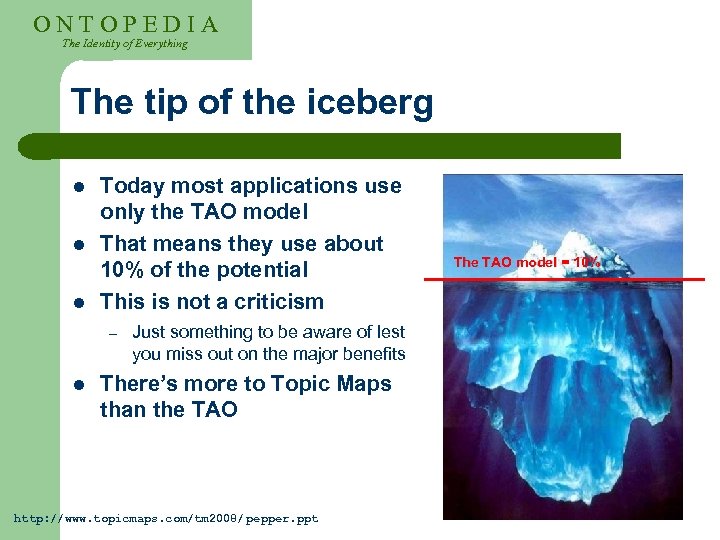
ONTOPEDIA The Identity of Everything The tip of the iceberg l l l Today most applications use only the TAO model That means they use about 10% of the potential This is not a criticism – l Just something to be aware of lest you miss out on the major benefits There’s more to Topic Maps than the TAO http: //www. topicmaps. com/tm 2008/ pepper. ppt The TAO model = 10%
ONTOPEDIA The Identity of Everything What else is there? l Scope Merging l Generalized subject-centric computing l http: //www. topicmaps. com/tm 2008/ pepper. ppt
ONTOPEDIA The Identity of Everything Scope: context is king l l The TAO lets us express knowledge But knowledge has context – – – l l Topic Maps has the concept of scope Scope enables the expression of contextual validity – – l Reality is ambiguous Knowledge has a subjective dimension Assertions may be valid in a one context but not another Permits multiple world views to coexist simultaneously Allows us to handle the “miscellaneousness” of everything Makes TM more than just a semantic technology – – It’s also a pragmatic technology (Also in the sense that it’s ready to go today) http: //www. topicmaps. com/tm 2008/ pepper. ppt
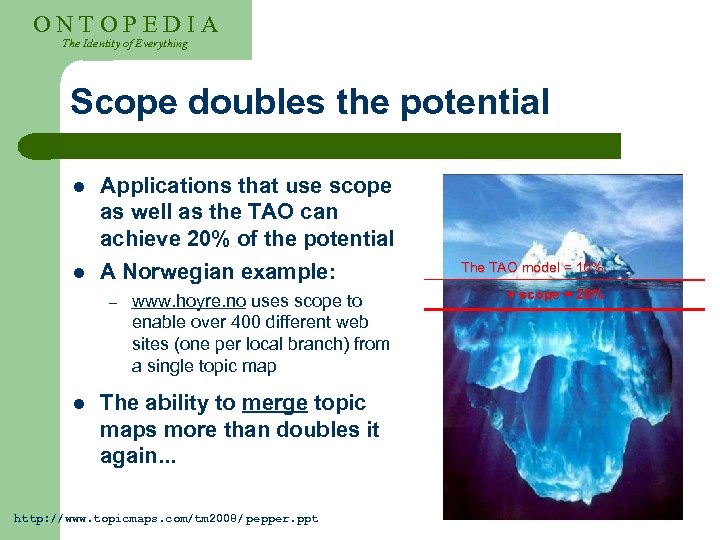
ONTOPEDIA The Identity of Everything Scope doubles the potential l l Applications that use scope as well as the TAO can achieve 20% of the potential A Norwegian example: – l www. hoyre. no uses scope to enable over 400 different web sites (one per local branch) from a single topic map The ability to merge topic maps more than doubles it again. . . http: //www. topicmaps. com/tm 2008/ pepper. ppt The TAO model = 10% + scope = 20%
ONTOPEDIA The Identity of Everything Merging – global knowledge federation l l l Single most powerful feature Original motivation in 1991 Business requirement – l l l Merge multiple, digital, back of book indexes in order to create a master index, without getting caught out by homonyms, synonyms, polysemes and the like Merging has been there from day 1 It’s what enables global knowledge federation And it’s why Lars Helgeland is wrong http: //www. topicmaps. com/tm 2008/ pepper. ppt
ONTOPEDIA The Identity of Everything What’s merging about? l Topic Maps can be merged automatically – – l Arbitrary topic maps can be merged into a single topic map This cannot be done with databases or XML documents Merging enables many advanced applications – Information integration across repositories – Sharing and reusing taxonomies – Automated content aggregation – Distributed knowledge management – Global knowledge federation http: //www. topicmaps. com/tm 2008/ pepper. ppt
ONTOPEDIA The Identity of Everything How can we achieve merging? l l Well, we need to know when we – and our computers – are talking about the same thing Can’t be done using names Almost every subject has multiple names For instance – – synonyms – l multiple languages polysemes Name are notoriously unreliable for this stuff. . . http: //www. topicmaps. com/tm 2008/ pepper. ppt
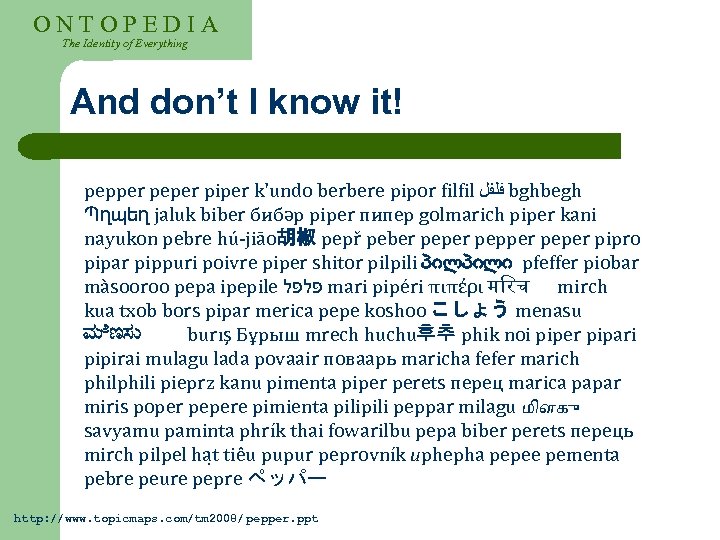
ONTOPEDIA The Identity of Everything And don’t I know it! pepper peper piper k'undo berbere pipor filfil ﻓﻠﻔﻞ bghbegh Պղպեղ jaluk biber бибәр piper пипер golmarich piper kani nayukon pebre hú-jiāo胡椒 pepř peber pepper peper pipro pipar pippuri poivre piper shitor pilpili პილპილი pfeffer piobar màsooroo pepa ipepile פלפל mari pipéri πιπέρι म रच mirch kua txob bors pipar merica pepe koshoo こしょう menasu ಮ ಣಸ burış Бұрыш mrech huchu후추 phik noi piper pipari pipirai mulagu lada povaair поваарь maricha fefer marich phili pieprz kanu pimenta piper perets перец marica papar miris poper pepere pimienta pili peppar milagu ம ளக savyamu paminta phrík thai fowarilbu pepa biber perets перець mirch pilpel ha t tiêu pupur peprovník uphepha pepee pementa pebre peure pepre ペッパー http: //www. topicmaps. com/tm 2008/ pepper. ppt
ONTOPEDIA The Identity of Everything The exceptions are few l Mostly very specific and culture-dependent – – l The Finnish word sisu The Xhosa word ubuntu Then there’s the problem of homonyms – Many names have multiple referents – Ubuntu, whatever its original meaning is also the name of a Linux distribution http: //www. topicmaps. com/tm 2008/ pepper. ppt
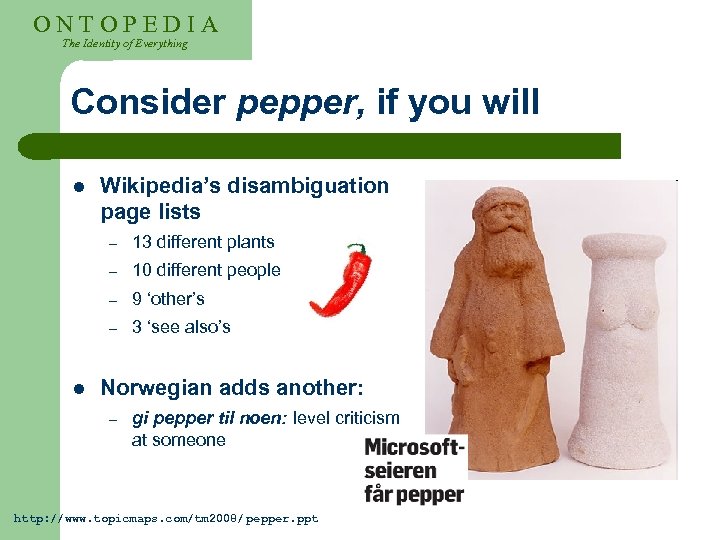
ONTOPEDIA The Identity of Everything Consider pepper, if you will l Wikipedia’s disambiguation page lists – – 10 different people – 9 ‘other’s – l 13 different plants 3 ‘see also’s Norwegian adds another: – gi pepper til noen: level criticism at someone http: //www. topicmaps. com/tm 2008/ pepper. ppt
ONTOPEDIA The Identity of Everything Humans can tackle this l In natural language we get by using names – – l Context – l Various strategies are used, including Negotiation But computers aren’t that smart How can they know when two symbols have the same referent? – l That is, when two topics represent the same subject The only solution for computers is identifiers http: //www. topicmaps. com/tm 2008/ pepper. ppt
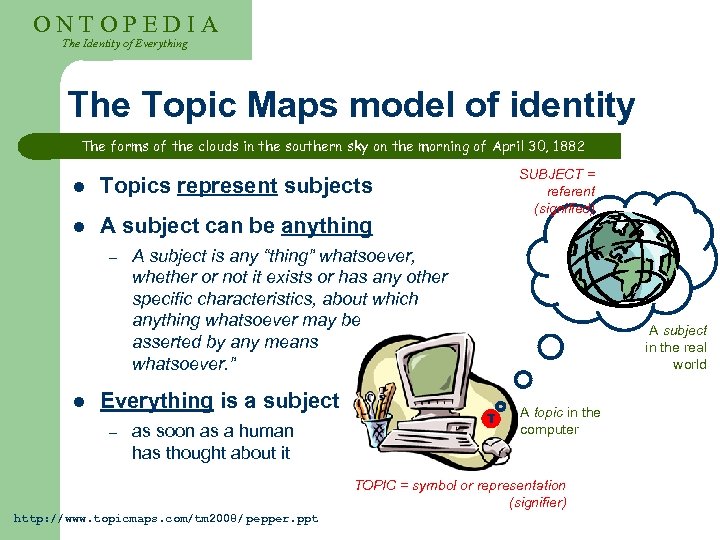
ONTOPEDIA The Identity of Everything The Topic Maps model of identity The forms of the clouds in the southern sky on the morning of April 30, 1882 l Topics represent subjects l SUBJECT = referent (signified) A subject can be anything – l A subject is any “thing” whatsoever, whether or not it exists or has any other specific characteristics, about which anything whatsoever may be asserted by any means whatsoever. ” Everything is a subject – as soon as a human has thought about it A subject in the real world T A topic in the computer TOPIC = symbol or representation (signifier) http: //www. topicmaps. com/tm 2008/ pepper. ppt
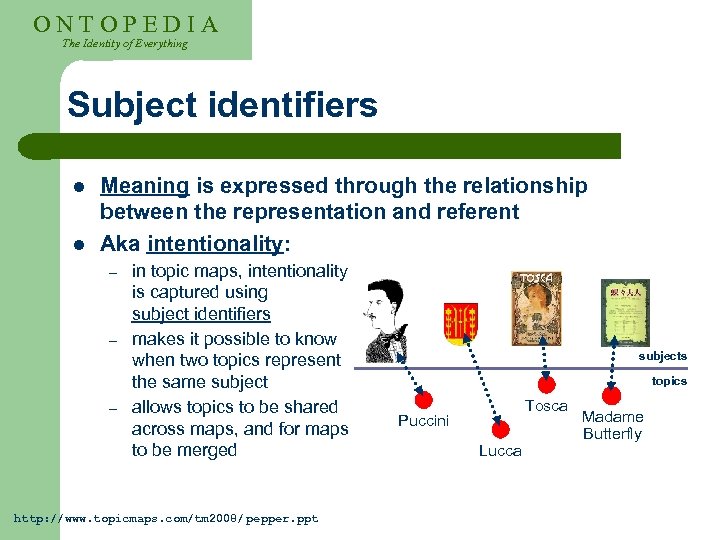
ONTOPEDIA The Identity of Everything Subject identifiers l l Meaning is expressed through the relationship between the representation and referent Aka intentionality: – – – in topic maps, intentionality is captured using subject identifiers makes it possible to know when two topics represent the same subject allows topics to be shared across maps, and for maps to be merged http: //www. topicmaps. com/tm 2008/ pepper. ppt subjects topics Tosca Puccini Lucca Madame Butterfly
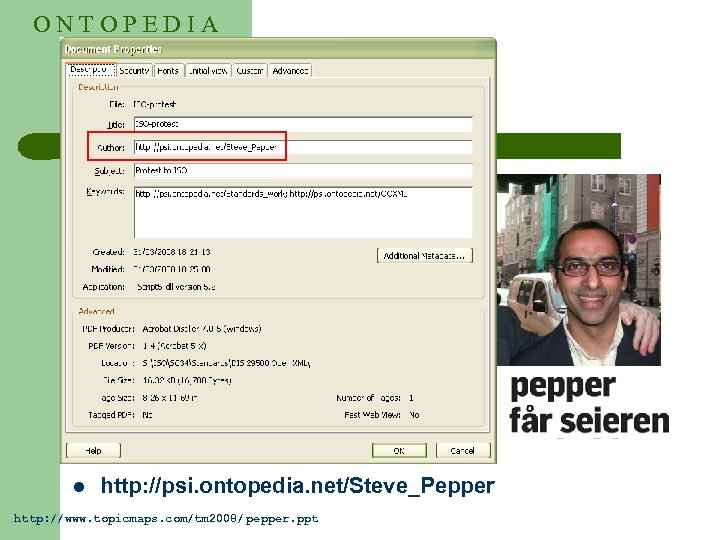
ONTOPEDIA The Identity of Everything Which Steve Pepper? l http: //psi. ontopedia. net/Steve_Pepper http: //www. topicmaps. com/tm 2008/ pepper. ppt
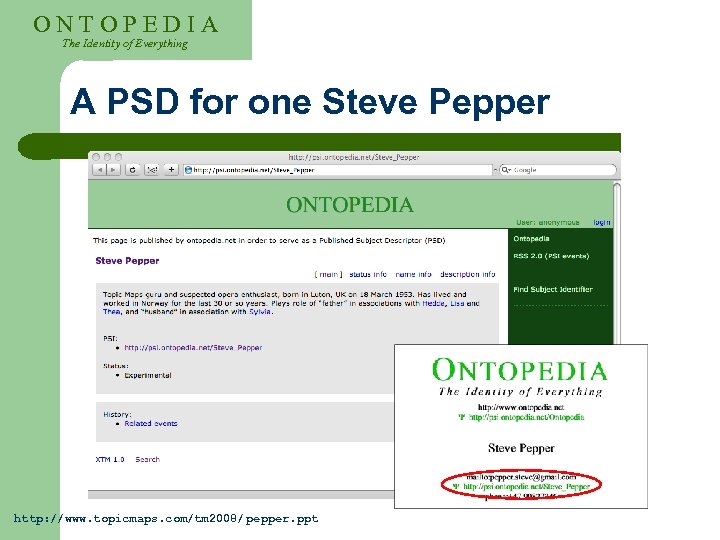
ONTOPEDIA The Identity of Everything A PSD for one Steve Pepper http: //www. topicmaps. com/tm 2008/ pepper. ppt
ONTOPEDIA The Identity of Everything Globally unique identifiers l We’re not the only ones thinking about this – – Publishers (ISBN, ISSN) – Document Object Identifiers (DOI) – l Librarians (I guess) Uniform Resource Names (URN) Best current practice on the Web – l l Use URIs Emerging consensus is to use HTTP URIs The Topic Maps community has proposed a mechanism called Published Subjects – It’s time to get together and talk about this stuff http: //www. topicmaps. com/tm 2008/ pepper. ppt
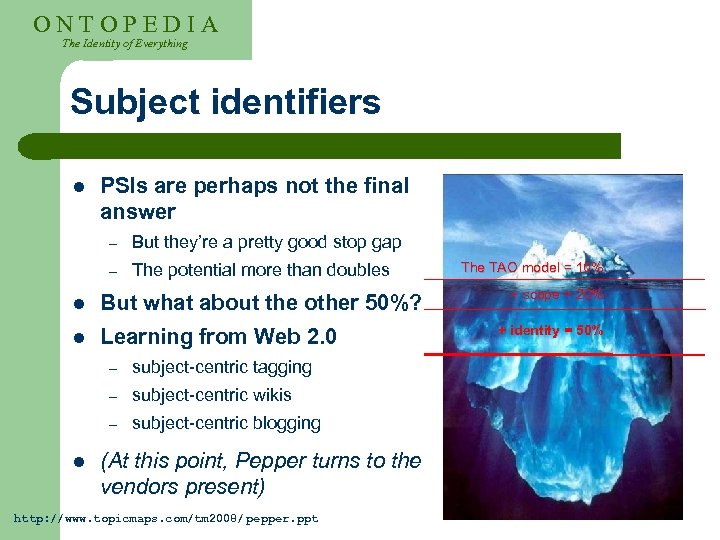
ONTOPEDIA The Identity of Everything Subject identifiers l PSIs are perhaps not the final answer – But they’re a pretty good stop gap – The potential more than doubles l But what about the other 50%? l Learning from Web 2. 0 – – subject-centric wikis – l subject-centric tagging subject-centric blogging (At this point, Pepper turns to the vendors present) http: //www. topicmaps. com/tm 2008/ pepper. ppt The TAO model = 10% + scope = 20% + identity = 50%
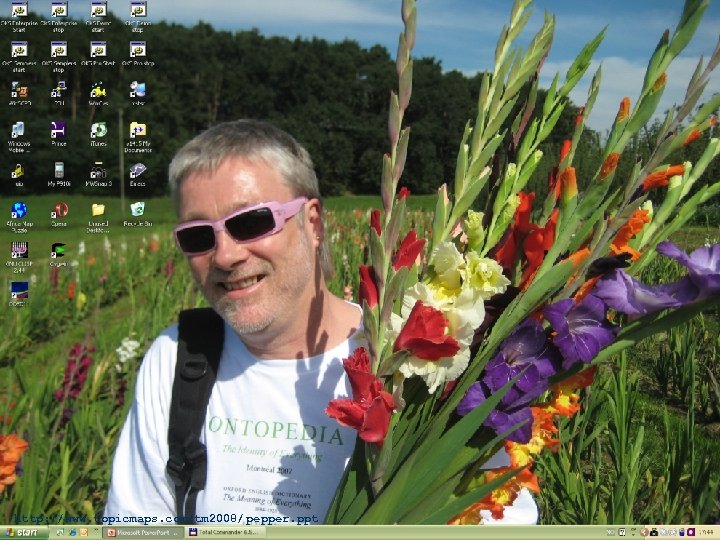
ONTOPEDIA The Identity of Everything Subject-centric desktop l l I’m a Windows user Who uses Windows? – – Outlook mail boxes – Browser bookmarks (favourites) – l Files in the file system . . . all thoroughly document centric. . . Allow me to show you my desktop. . . http: //www. topicmaps. com/tm 2008/ pepper. ppt
ONTOPEDIA The Identity of Everything http: //www. topicmaps. com/tm 2008/ pepper. ppt
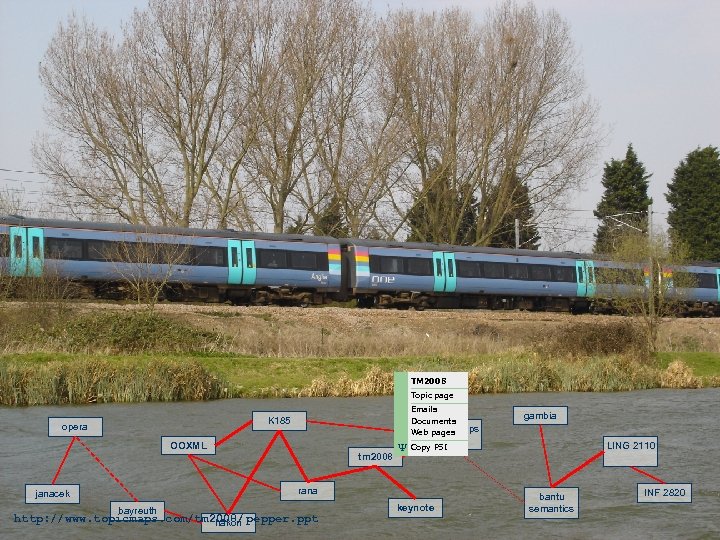
ONTOPEDIA The Identity of Everything TM 2008 Topic page Emails Documents Web topic maps pages K 185 opera OOXML tm 2008 Ψ bayreuth http: //www. topicmaps. com/tm 2008/ pepper. ppt håkon LING 2110 Copy PSI rana janacek gambia keynote bantu semantics INF 2820
ONTOPEDIA The Identity of Everything Subject-centric file system l l l The file system is a hierarchy and that’s a pain Trees aren’t miscellaneous enough Win. FS looked like it might change all that – – l New data storage and management system announced in 2003 Didn’t make it into Vista. Seems to have disappeared Let the new file system be a topic map! – “Folders” are topics with global identifiers – User-defined metadata on “folders” (internal occurrences) – External occurrences – Related through navigable, typed associations http: //www. topicmaps. com/tm 2008/ pepper. ppt
ONTOPEDIA The Identity of Everything Subject-centric operating system l Now that the file system is a topic map, why not go the whole hog? – Services to applications for assigning PSIs – NLP based help for (semi-automatically) categorizing documents – Ability to extract fragments from the system topic map – Peer-to-peer features for exchanging fragments with others – Facilities for context-based virtual merges under user control – . . . http: //www. topicmaps. com/tm 2008/ pepper. ppt
ONTOPEDIA The Identity of Everything The paradigm shift l l l l Topic Maps started out as a way to merge indexes It turned into a knowledge representation formalism But its significance is far greater Now the flag-bearer for subject-centric computing A paradigm shift in how we use computers Cf. object-oriented programming. . . and Copernicus http: //www. topicmaps. com/tm 2008/ pepper. ppt
ONTOPEDIA The Identity of Everything Object-oriented programming l Response to 1960’s software crisis – – l Computer programs more and more complex Difficult to maintain software quality Code simulates the world (as perceived by a human) – – They are grouped into classes (cf. topic types) – l Objects represent real-world concepts (cf. topics) Data structures capture relationships between objects (cf. associations) Represented a paradigm shift in programming – OO languages now near universal (Java, C#, Ruby, Python, . . . ) http: //www. topicmaps. com/tm 2008/ pepper. ppt
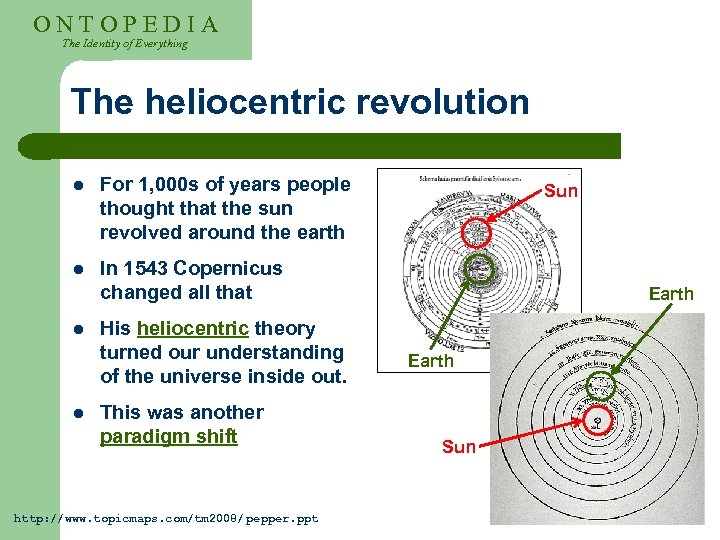
ONTOPEDIA The Identity of Everything The heliocentric revolution l For 1, 000 s of years people thought that the sun revolved around the earth l In 1543 Copernicus changed all that l l His heliocentric theory turned our understanding of the universe inside out. This was another paradigm shift http: //www. topicmaps. com/tm 2008/ pepper. ppt Sun Earth Sun (Actually some Greek, Indian and Muslim scholars knew better, but the view of Aristotle, Ptolemy and the Christian Church was dominant)
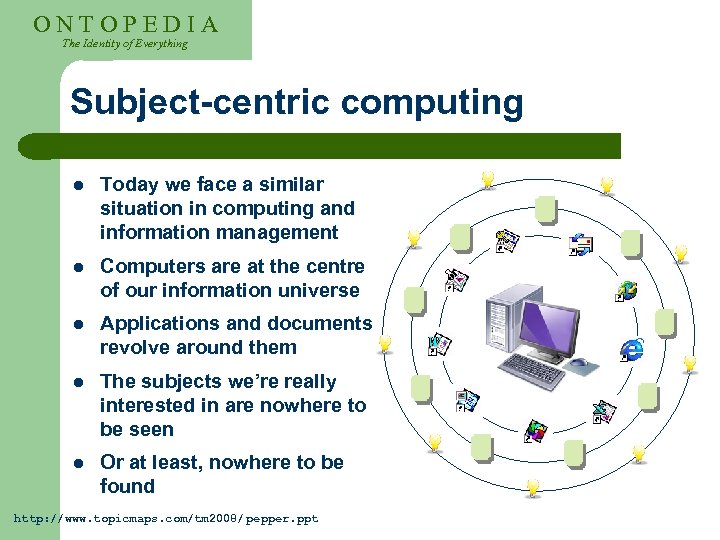
ONTOPEDIA The Identity of Everything Subject-centric computing l Today we face a similar situation in computing and information management l Computers are at the centre of our information universe l Applications and documents revolve around them l The subjects we’re really interested in are nowhere to be seen l Or at least, nowhere to be found http: //www. topicmaps. com/tm 2008/ pepper. ppt
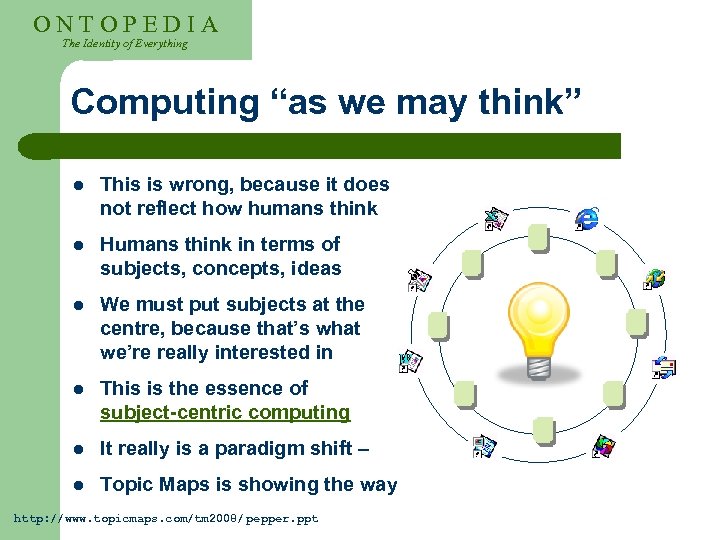
ONTOPEDIA The Identity of Everything Computing “as we may think” l This is wrong, because it does not reflect how humans think l Humans think in terms of subjects, concepts, ideas l We must put subjects at the centre, because that’s what we’re really interested in l This is the essence of subject-centric computing l It really is a paradigm shift – l Topic Maps is showing the way http: //www. topicmaps. com/tm 2008/ pepper. ppt
ONTOPEDIA The Identity of Everything THE END Or is it the beginning? - og forøvrig mener jeg at Norges nasjonale kunnskapsbase må baseres på emnekart. . . http: //www. topicmaps. com/tm 2008/ pepper. ppt
Скачать презентацию ONTOPEDIA The Identity of Everything is a Subject
f58cb7db4520961a60d3313fec5868e3.ppt