 Скачать презентацию Ontology-based Integration of IEC TC 57 standards Agenda
3a1656dc1e36890dcf7220487e511db3.ppt
- Количество слайдов: 18



Ontology-based Integration of IEC TC 57 standards Agenda IEC TC 57 Standards Requirements for Integration Clash: IT vs. Automation people Ontologizing Standards Our Integration Approach 25. 03. 2008 Slide 1 Mathias Uslar
Our problems § Too many ‚standards‘ exist, having dependencies § Standards adress different scopes even being from the same domain [Hasselbring: 2000] § Projects cope with different levels and have to take several standards into account § Standards may not easily be changed for harmonization therefore we need concepts like alignment § Domain specific: there is no real useful classification for the energy domain [Stegwee: 2002] § We have to deal with function and protocols and technology mappings, not only data models, therefore traditional data integration does not work [Spyns et al 2002] 25. 03. 2008 2 Mathias Uslar
Our problems (continued…) § Often clashes between IT and automation people exist – „I do not want you to fumble with my SAP systems /And or field devices (please exchange due to situation…)“ § The system lifecycle for the utility domain is much longer than in most other domains (due to hardware installations which have to be interchangeable for decades) § There are simply to many standards to adhere to! § Mostly standards have to harmonized due to memorandum of understandings or liaisons between standard bodies like ISO, IEC or UN/CEFACT § IEC maintenance cycles lead to problems with intermediate versions § We have to deal with really big models like the CIM (800 classes, 9000 attributes, 700 associations) 25. 03. 2008 3 Mathias Uslar
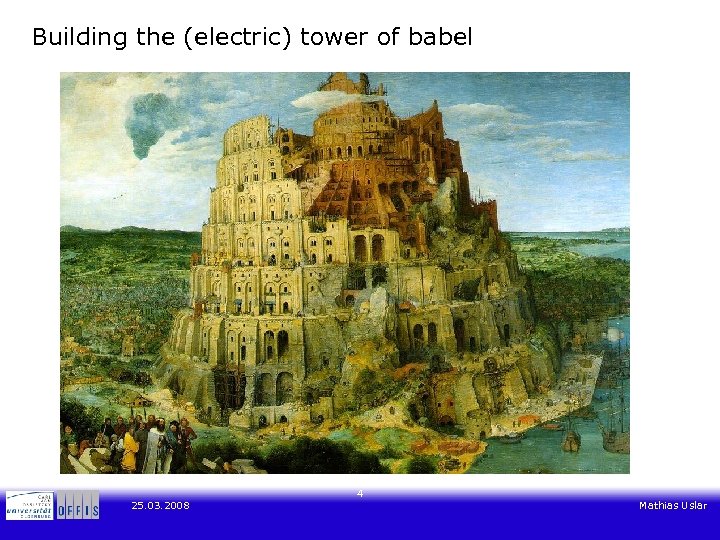
Building the (electric) tower of babel 25. 03. 2008 4 Mathias Uslar
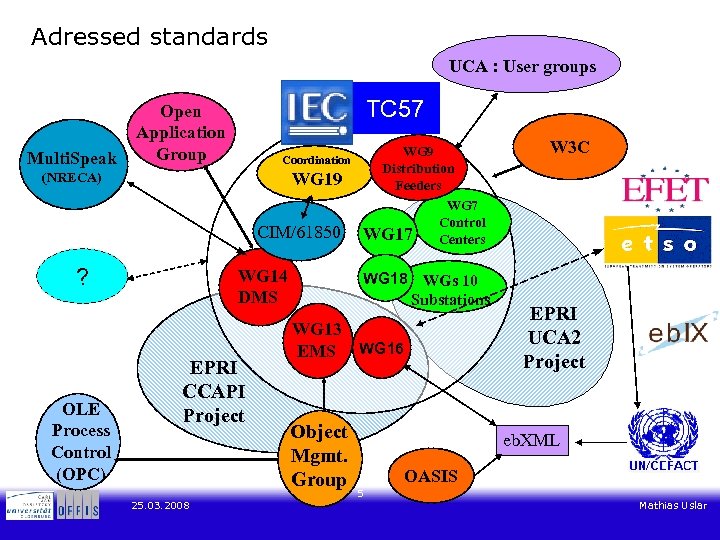
Adressed standards UCA : User groups Multi. Speak TC 57 Open Application Group Coordination WG 19 (NRECA) CIM/61850 ? OLE Process Control (OPC) WG 14 DMS EPRI CCAPI Project 25. 03. 2008 WG 9 Distribution Feeders WG 7 Control WG 17 Centers WG 18 WGs 10 Substations WG 13 EMS WG 16 Object Mgmt. Group W 3 C EPRI UCA 2 Project eb. XML OASIS 5 Mathias Uslar
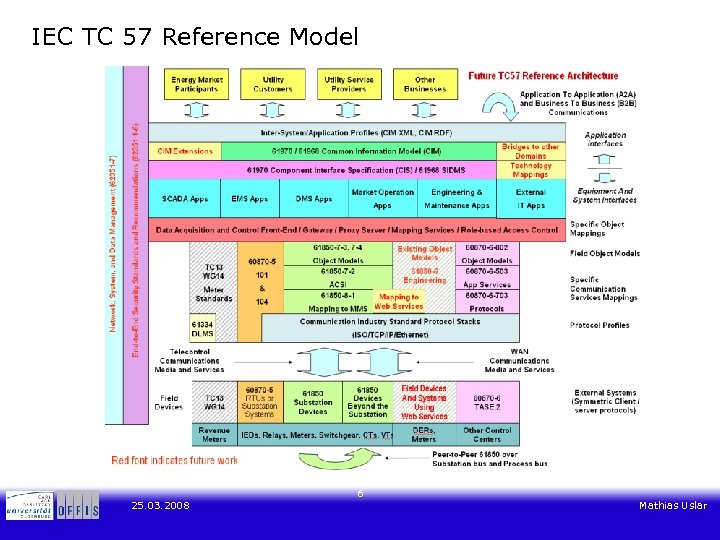
IEC TC 57 Reference Model 25. 03. 2008 6 Mathias Uslar
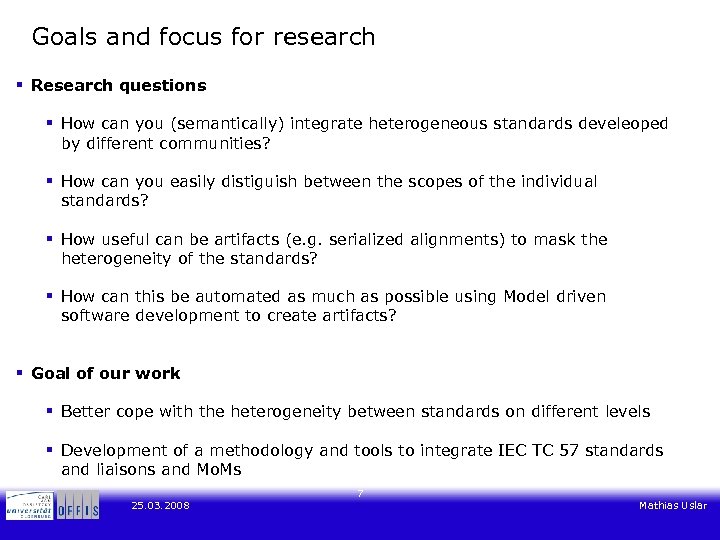
Goals and focus for research § Research questions § How can you (semantically) integrate heterogeneous standards develeoped by different communities? § How can you easily distiguish between the scopes of the individual standards? § How useful can be artifacts (e. g. serialized alignments) to mask the heterogeneity of the standards? § How can this be automated as much as possible using Model driven software development to create artifacts? § Goal of our work § Better cope with the heterogeneity between standards on different levels § Development of a methodology and tools to integrate IEC TC 57 standards and liaisons and Mo. Ms 25. 03. 2008 7 Mathias Uslar
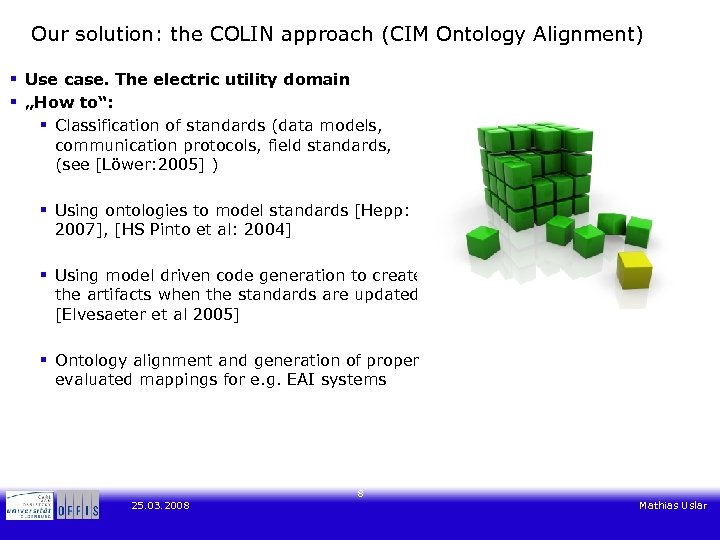
Our solution: the COLIN approach (CIM Ontology Alignment) § Use case. The electric utility domain § „How to“: § Classification of standards (data models, communication protocols, field standards, (see [Löwer: 2005] ) § Using ontologies to model standards [Hepp: 2007], [HS Pinto et al: 2004] § Using model driven code generation to create the artifacts when the standards are updated [Elvesaeter et al 2005] § Ontology alignment and generation of proper evaluated mappings for e. g. EAI systems 25. 03. 2008 8 Mathias Uslar
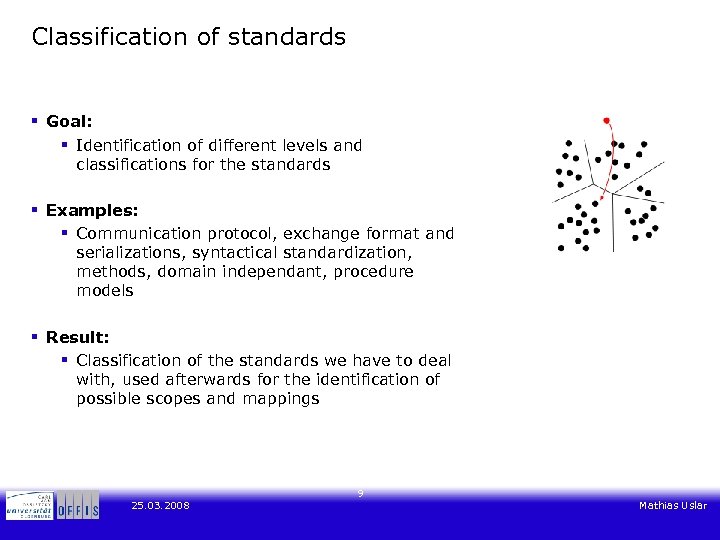
Classification of standards § Goal: § Identification of different levels and classifications for the standards § Examples: § Communication protocol, exchange format and serializations, syntactical standardization, methods, domain independant, procedure models § Result: § Classification of the standards we have to deal with, used afterwards for the identification of possible scopes and mappings 25. 03. 2008 9 Mathias Uslar
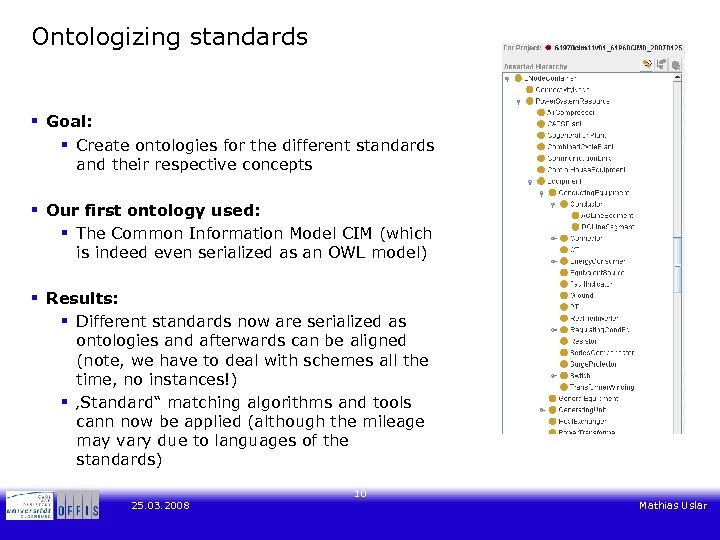
Ontologizing standards § Goal: § Create ontologies for the different standards and their respective concepts § Our first ontology used: § The Common Information Model CIM (which is indeed even serialized as an OWL model) § Results: § Different standards now are serialized as ontologies and afterwards can be aligned (note, we have to deal with schemes all the time, no instances!) § ‚Standard“ matching algorithms and tools cann now be applied (although the mileage may vary due to languages of the standards) 25. 03. 2008 10 Mathias Uslar
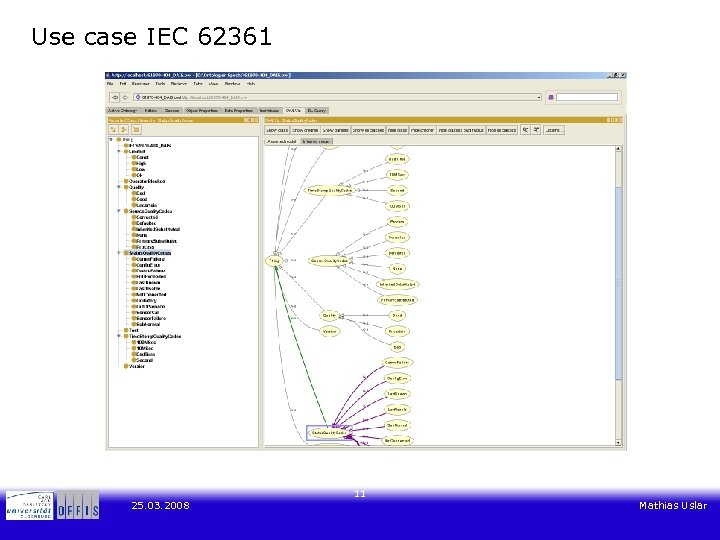
Use case IEC 62361 25. 03. 2008 11 Mathias Uslar
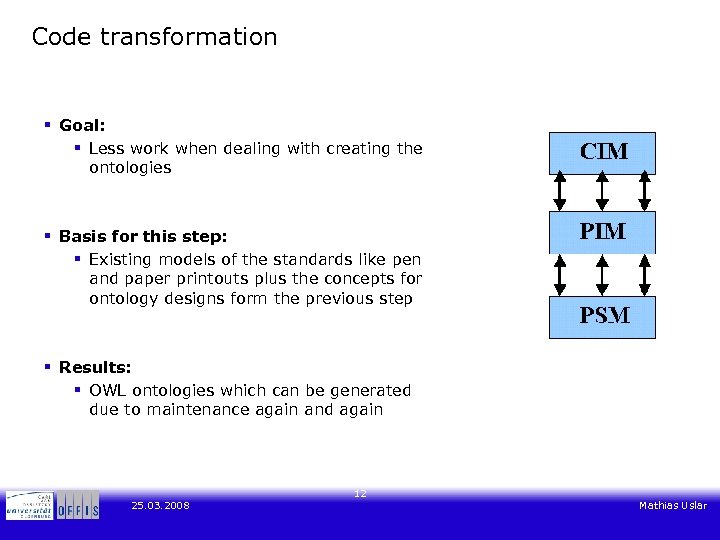
Code transformation § Goal: § Less work when dealing with creating the ontologies § Basis for this step: § Existing models of the standards like pen and paper printouts plus the concepts for ontology designs form the previous step § Results: § OWL ontologies which can be generated due to maintenance again and again 25. 03. 2008 12 Mathias Uslar
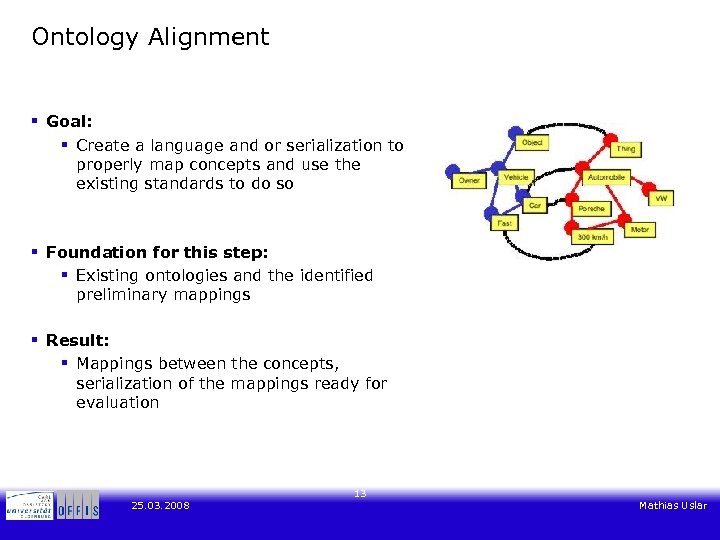
Ontology Alignment § Goal: § Create a language and or serialization to properly map concepts and use the existing standards to do so § Foundation for this step: § Existing ontologies and the identified preliminary mappings § Result: § Mappings between the concepts, serialization of the mappings ready for evaluation 25. 03. 2008 13 Mathias Uslar
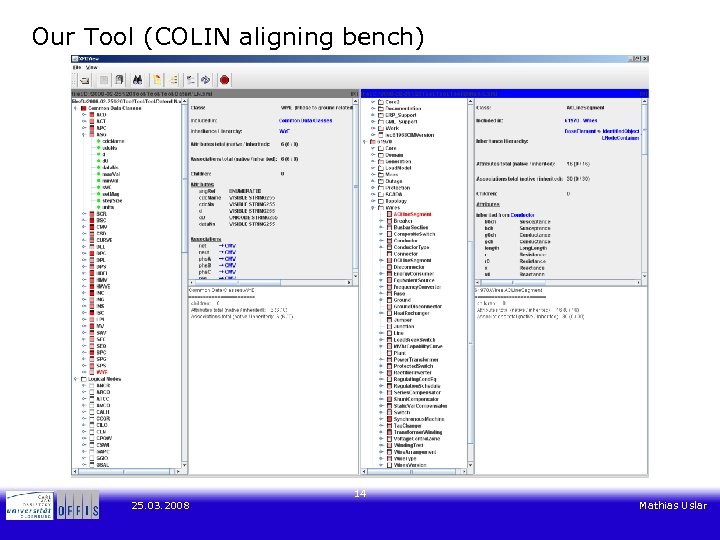
Our Tool (COLIN aligning bench) 25. 03. 2008 14 Mathias Uslar
Evaluation of the COLIN approach § Adressing 3 use cases: § Case 1: Aligning of the standards IEC 61970 (Common Information Model) and IEC 61850 (substation Communication), creating harmonized messages for EAI systems (semantic integration) § Focus on Topologies, data model and quality codes § Case 2: Aligning of the CIM to the UN/CEFACT CCTS (syntactical integration) and the UMM (procedure model integration) § Case 3: Scenario based choice of standards using reasoning § Case 4: Domain expert vs automatical alignment: finding the limits of the automation 25. 03. 2008 15 Mathias Uslar
Comparable approaches § Model driven architecture and ontology development § Gasevic, Djuric, Devedzic: Metamodeling for Integration using MDSD § Ontology Matching methodologies(eg. C-OWL) § Stuckenschmidt: Contextual description for ontology alignment § IEC TC 57 WG 19: Harmonization § Harmonization of standards for IEC TC 57 [de. Vos: 2006] (non vendor specific) § ABB T&D, Dättwil, Swiss § Integration of CIM and IEC 61850 using UML [Kostic et al. 2004] § „Ontologizing standards“ § Hepp: OIS 2006, First International Workshop on Ontologizing Industrial Standards (BMECat, e. BXML, EDIFACT, …) 25. 03. 2008 16 Mathias Uslar
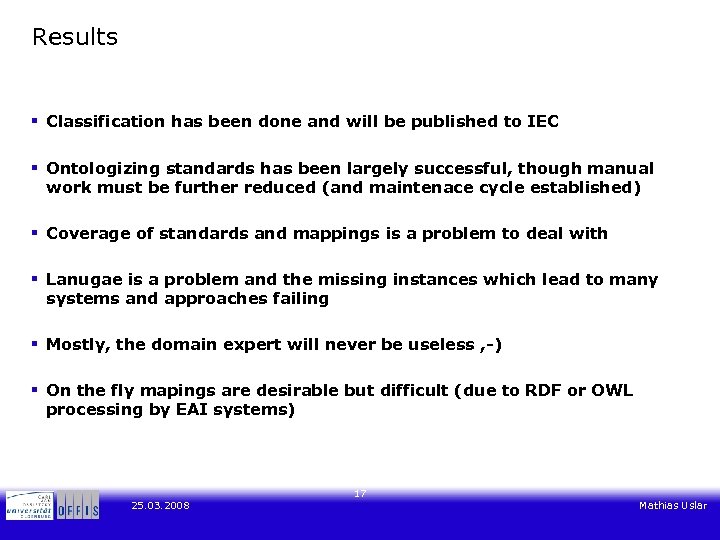
Results § Classification has been done and will be published to IEC § Ontologizing standards has been largely successful, though manual work must be further reduced (and maintenace cycle established) § Coverage of standards and mappings is a problem to deal with § Lanugae is a problem and the missing instances which lead to many systems and approaches failing § Mostly, the domain expert will never be useless , -) § On the fly mapings are desirable but difficult (due to RDF or OWL processing by EAI systems) 25. 03. 2008 17 Mathias Uslar
![References § [Löwer: 2005] Ulrich M. Löwer, Interorganisational Standards: Managing Web Services Specifications for](https://present5.com/presentation/3a1656dc1e36890dcf7220487e511db3/image-18.jpg "References § [Löwer: 2005] Ulrich M. Löwer, Interorganisational Standards: Managing Web Services Specifications for")
References § [Löwer: 2005] Ulrich M. Löwer, Interorganisational Standards: Managing Web Services Specifications for Flexible Supply Chains, Physica-Verlag 2005 § [Hevner et al. : 2004] AR Hevner, S. March, J. Park, S. Ram: Design Science in Information Systems Research, MIS Quaterly, 2004 § [Hepp: 2007] Martin Hepp: Possible Ontologies: How reality contrains the Development of Relevant Ontologies, IEEE Internet Computing, 2007 § [Samuelson: 2006] Pamela Samuelson: Copyrighting Standards, Communications of the ACM (6), 2006 § [HS Pinto et al: 2004] HS Pinto, JP Martins: Ontologies: How can they be Built? , Knowledge and Information Systems, Springer London, (6) 2004 § [Hasselbring: 2000] W. Hasselbring: The Role of Standards for Interoperating Information Systems, In: Information technology standards and standardization: a global perspective, IDEA Group Publishing, 2000 § [Kostic et al. 2004] T. Kostic, O. Preiss, C. Frei: Understanding and using the IEC 61850: a Case for meta-modelling, Computer Standards & Interfaces, 2, 2004, Elsevier Science § [de. Vos: 2006] A. de. Vos, S. Widergren: Ontology and the Age of Integration in the Electric Power Industry, Sem. Tech Proceedings 2006 § [Stegwee: 2002] RA Stegwee, BD Rokanova: Identification of Different Types of Standards for Domain-Specific Interoperability, MISQ Workshop on Standard Making, 2002 § [Elvesaeter et al 2005] Brian Elvesaeter, Axel Hahn, Arne-Jorgen Berre and Tor Neple : Towards an Interoperability Framework for Model-Driven Development of Software Systems, Inter. Op-ESA 2005 Proceedings, Springer 2005 § [Pollock: 2001] JT Pollock: The BIG Issue: Interoperability vs. Integration, EAI Journal, 10, 2001 § [Spyns et al 2002] P Spyns, R Meersmann, M. Jarrar: Data Modelling vs. Ontology Engineering, 2002 25. 03. 2008 18 Mathias Uslar
Скачать презентацию Ontology-based Integration of IEC TC 57 standards Agenda
3a1656dc1e36890dcf7220487e511db3.ppt