 Скачать презентацию Ontologies and the Semantic Web II Deborah L
91535e112b45fa9fc2cf5c1723befb4d.ppt
- Количество слайдов: 115



Ontologies and the Semantic Web II Deborah L. Mc. Guinness Associate Director and Senior Research Scientist Knowledge Systems Laboratory Stanford University Stanford, CA 94305 650 -723 -9770 dlm@ksl. stanford. edu August 9, 2004 Mc. Guinness Deborah L. Mc. Guinness. SWMU May 8, 2003
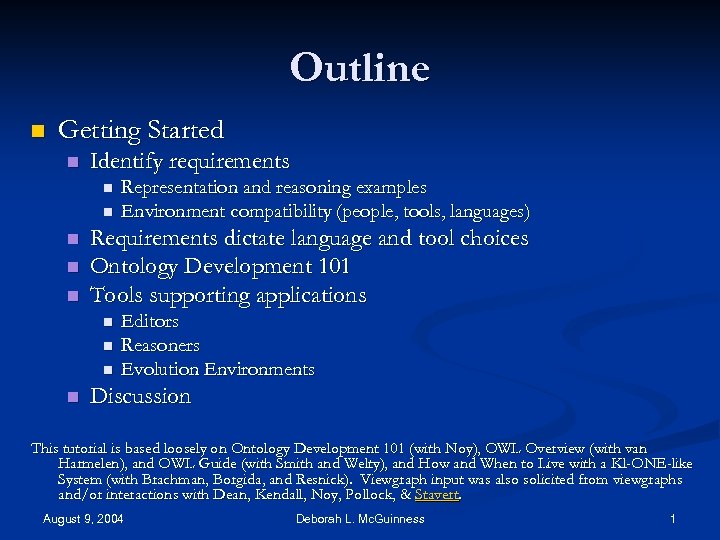
Outline n Getting Started n Identify requirements n n n Requirements dictate language and tool choices Ontology Development 101 Tools supporting applications n n Representation and reasoning examples Environment compatibility (people, tools, languages) Editors Reasoners Evolution Environments Discussion This tutorial is based loosely on Ontology Development 101 (with Noy), OWL Overview (with van Harmelen), and OWL Guide (with Smith and Welty), and How and When to Live with a Kl-ONE-like System (with Brachman, Borgida, and Resnick). Viewgraph input was also solicited from viewgraphs and/or interactions with Dean, Kendall, Noy, Pollock, & Stavert. August 9, 2004 Deborah L. Mc. Guinness 1
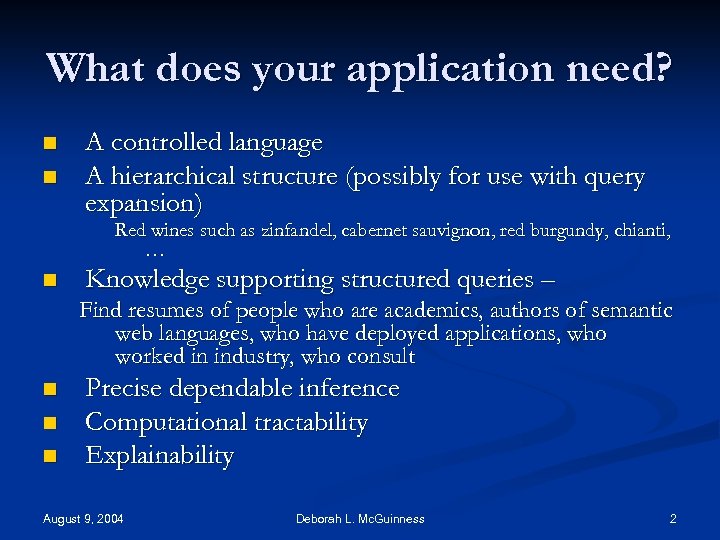
What does your application need? n n A controlled language A hierarchical structure (possibly for use with query expansion) Red wines such as zinfandel, cabernet sauvignon, red burgundy, chianti, … n Knowledge supporting structured queries – Find resumes of people who are academics, authors of semantic web languages, who have deployed applications, who worked in industry, who consult n n n Precise dependable inference Computational tractability Explainability August 9, 2004 Deborah L. Mc. Guinness 2
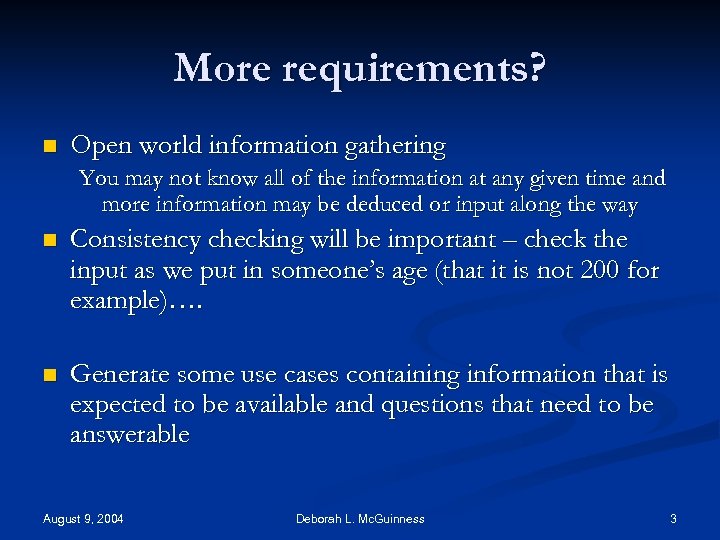
More requirements? n Open world information gathering You may not know all of the information at any given time and more information may be deduced or input along the way n Consistency checking will be important – check the input as we put in someone’s age (that it is not 200 for example)…. n Generate some use cases containing information that is expected to be available and questions that need to be answerable August 9, 2004 Deborah L. Mc. Guinness 3
While gathering requirements… Identify user community(ies) n Language compatibilities n Environmental compatibilities n Legacy systems n August 9, 2004 Deborah L. Mc. Guinness 4
Ontologies “A Specification of a Conceptualization” – Gruber ’ 91 n Ontologies provide and explicit and declarative description of a domain: n concepts – descriptions of classes n properties/attributes of concepts n constraints on properties and attributes n individuals n August 9, 2004 Deborah L. Mc. Guinness 5
Benefits of Ontologies Shared vocabulary (for humans and agents) n Shared common understanding of the structure of information n Reuse of domain knowledge n to avoid “re-inventing the wheel” n to introduce standards n August 9, 2004 Deborah L. Mc. Guinness 6
More Benefits n Assumptions become explicit enabling n n n Explaining assumptions Changing assumptions Hypothetical reasoning (multiple scenarios) Support for evolving systems where time and situations change necessitating re-evaluation of assumptions Support for interoperation with other (potentially legacy) systems Separation of types of knowledge: n n n Declarative domain knowledge vs procedural knowledge Background (unchanging) knowledge from changing information Authoritative vs. other…. August 9, 2004 Deborah L. Mc. Guinness 7
Ontology Development n Define domain terms and inter-relationships Define concepts in the domain (classes) n Identify subclass/superclass relationships (thereby defining a class hierachy. n Identify attributes/properties/slots n Restrict slot values n Define individuals n Define interrelationships between individuals (filling in slots) n August 9, 2004 Deborah L. Mc. Guinness 8
Ontology Development Process n n n n Determine the scope of the domain information Identify resources that may be appropriate to reuse/integrate Identify terms in the vocabulary Define classes/concepts Define properties Add restrictions Generate individuals Note that this process is iterative August 9, 2004 Deborah L. Mc. Guinness 9
Determine Application Domain and Use Case(s) n n n Describe the domain for the ontology Describe how the ontology will be used Identify types example questions and answers for the ontology-supported application Identify ontology users, owners, and maintainers Describe anticipated evolution path for the ontology and the application August 9, 2004 Deborah L. Mc. Guinness 10
Example Questions n n n n Which wine characteristics determine wine choice? What is the color of a burgundy? Is rose wine made in burgundy? Describe a wine that matches a shellfish dish Should I serve zinfandel with crab? What wines in my wine cellar are recommended choices to be served with pasta with a spicy red sauce? What wines could I buy from wine. com that are recommended to be served with Deborah’s specialty? August 9, 2004 Deborah L. Mc. Guinness 11
Reuse n Why reuse other ontologies? to interoperate with other ontologies/controlled vocabularies n to leverage other people’s ontology building work n to use previously validated and/or authoritative source ontologies n to interact with applications and/or tools that use other ontologies n …. n August 9, 2004 Deborah L. Mc. Guinness 12
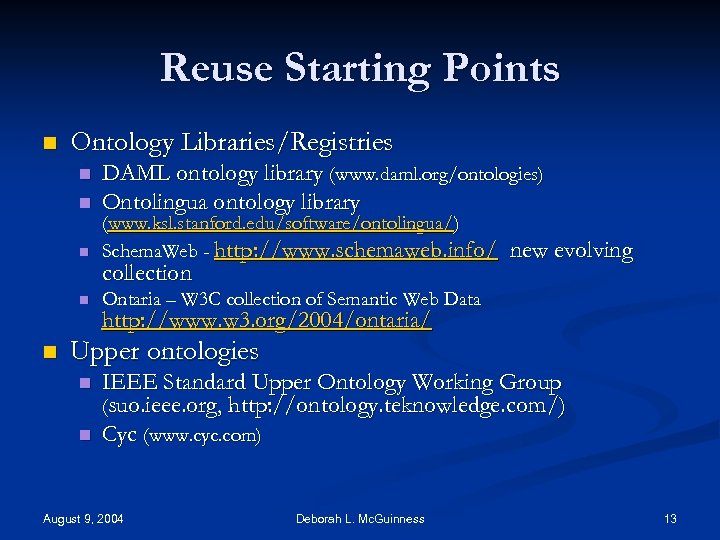
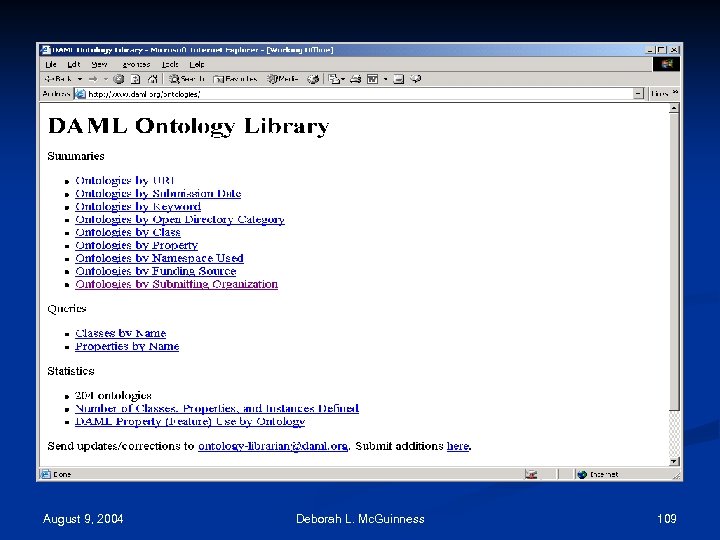
Reuse Starting Points n Ontology Libraries/Registries n n DAML ontology library (www. daml. org/ontologies) Ontolingua ontology library n n n (www. ksl. stanford. edu/software/ontolingua/) Schema. Web - http: //www. schemaweb. info/ Ontaria – W 3 C collection of Semantic Web Data collection new evolving http: //www. w 3. org/2004/ontaria/ Upper ontologies n n IEEE Standard Upper Ontology Working Group (suo. ieee. org, http: //ontology. teknowledge. com/) Cyc (www. cyc. com) August 9, 2004 Deborah L. Mc. Guinness 13
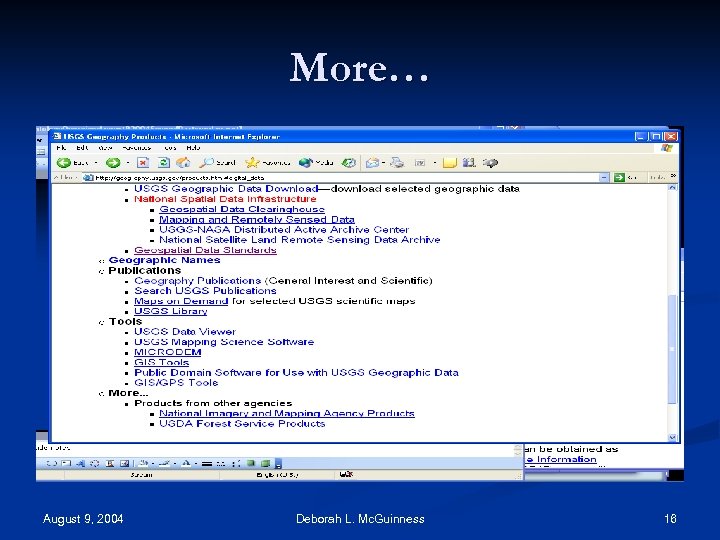
Reuse n General ontologies DMOZ (www. dmoz. org) n Word. Net (www. cogsci. princeton. edu/~wn/) n n Domain-specific ontologies COGNA n US Geography Survey n Geospatial Data Standards n National Geo. Spatial Clearinghouse … n August 9, 2004 Deborah L. Mc. Guinness 14
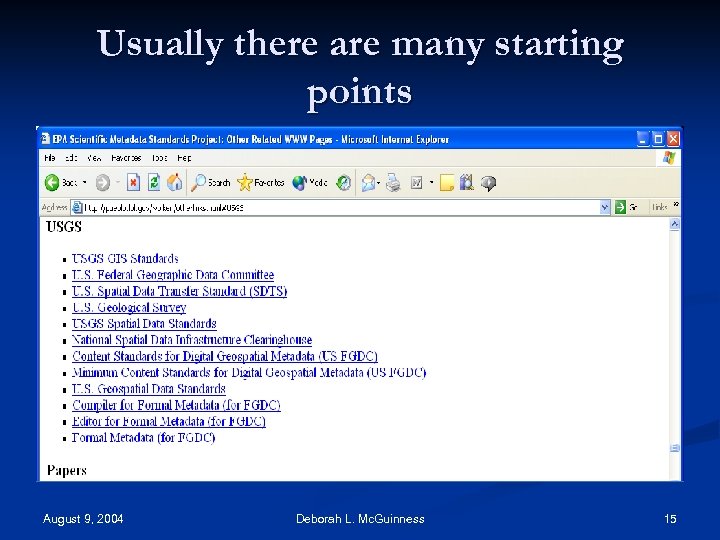
Usually there are many starting points August 9, 2004 Deborah L. Mc. Guinness 15
More… August 9, 2004 Deborah L. Mc. Guinness 16
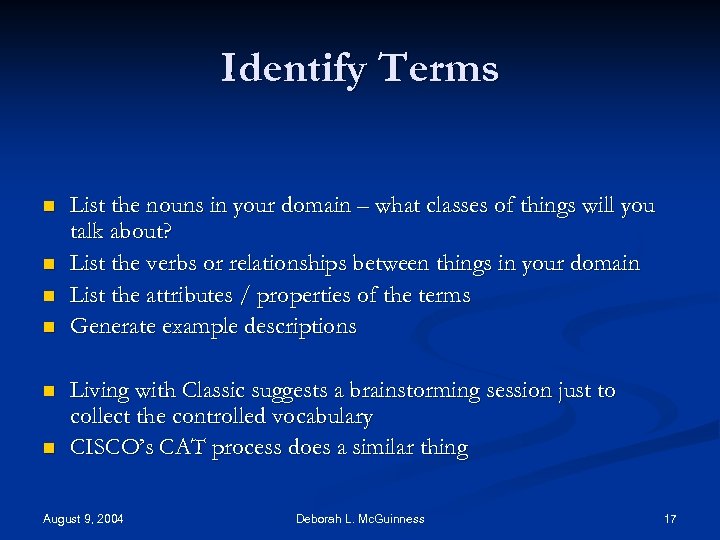
Identify Terms n n n List the nouns in your domain – what classes of things will you talk about? List the verbs or relationships between things in your domain List the attributes / properties of the terms Generate example descriptions Living with Classic suggests a brainstorming session just to collect the controlled vocabulary CISCO’s CAT process does a similar thing August 9, 2004 Deborah L. Mc. Guinness 17
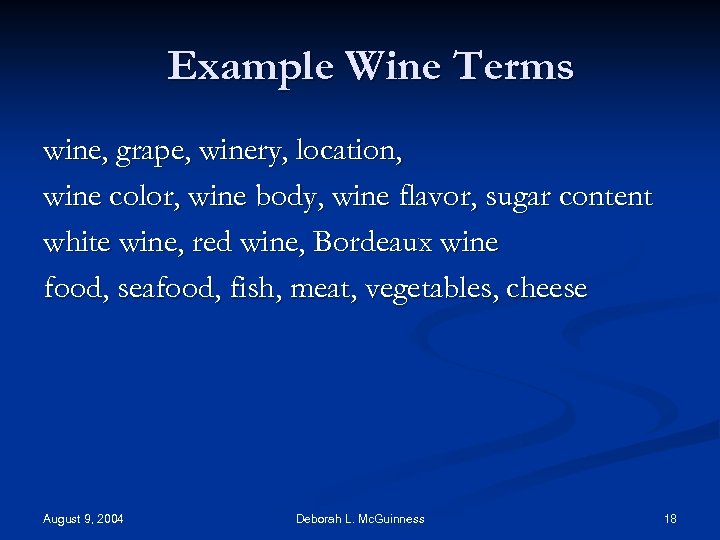
Example Wine Terms wine, grape, winery, location, wine color, wine body, wine flavor, sugar content white wine, red wine, Bordeaux wine food, seafood, fish, meat, vegetables, cheese August 9, 2004 Deborah L. Mc. Guinness 18
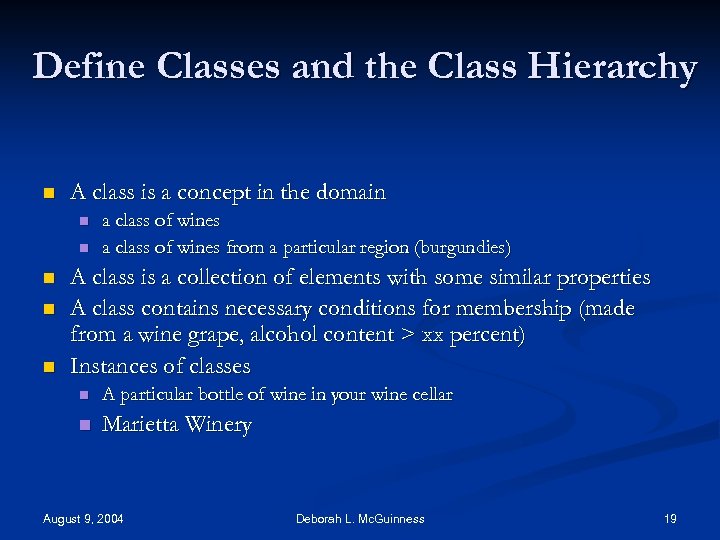
Define Classes and the Class Hierarchy n A class is a concept in the domain n n a class of wines from a particular region (burgundies) A class is a collection of elements with some similar properties A class contains necessary conditions for membership (made from a wine grape, alcohol content > xx percent) Instances of classes n A particular bottle of wine in your wine cellar n Marietta Winery August 9, 2004 Deborah L. Mc. Guinness 19
Class Inheritance n n Classes are organized into a subclass-superclass (or generalization-specialization) hierarchy True subclass relationships are the basis of the formal IS-A hierarchy Classes are “is-a” related if an instance of the subclass is an instance of the superclass n n Classes may be viewed as sets Subclasses of a class are comprised of a subset of the superset August 9, 2004 Deborah L. Mc. Guinness 20
Sub. Class Example n Red. Wine is a subclass of Wine Every red wine is a wine or every instance of a red wine (like Marietta Old Vines Red) is an instance of wine n Napa. Valley. Wine is a subclass of California. Wine Every wine from napa valley is a wine from california August 9, 2004 Deborah L. Mc. Guinness 21
Levels in the Class Hierarchy n Different modes of development top-down - define the most general concepts first and then specialize them n bottom-up - define the most specific concepts and then organize them in more general classes n combination (typical – breadth at the top level and depth along a few branches to test design) n August 9, 2004 Deborah L. Mc. Guinness 22
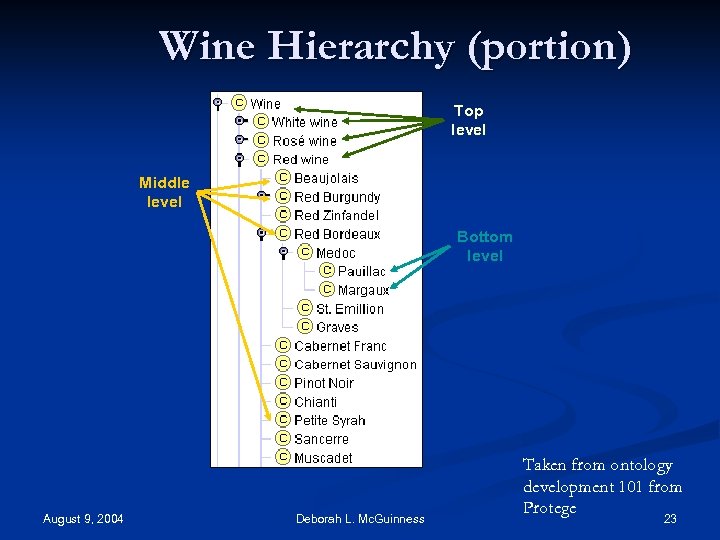
Wine Hierarchy (portion) Top level Middle level Bottom level August 9, 2004 Deborah L. Mc. Guinness Taken from ontology development 101 from Protege 23
Define Properties of Classes n Slots in a class definition describe attributes of members of a class each wine will have color, sugar content, flavor, body, etc. August 9, 2004 Deborah L. Mc. Guinness 24
Slots n Types of properties n n n “intrinsic” properties: flavor and color of wine “extrinsic” properties: name and price of wine parts: ingredients in a dish relations to other objects: producer of wine (winery) Data and object properties n n simple (datatype) contain primitive values (strings, numbers) complex properties: contain other objects (e. g. , a winery instance) August 9, 2004 Deborah L. Mc. Guinness 25
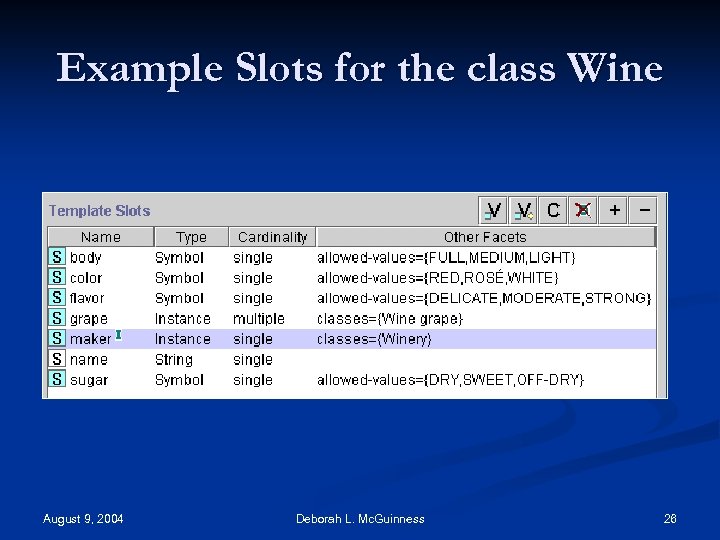
Example Slots for the class Wine August 9, 2004 Deborah L. Mc. Guinness 26
Slot and Class Inheritance n A subclass inherits all the slots from the superclass If a wine has a name and flavor, a red wine also has a name and flavor n If a class has multiple super classes, it inherits slots from all of them Port is both a dessert wine and a red wine. It inherits “sugar content: sweet” from the dessert wine and “color: red” from red wine August 9, 2004 Deborah L. Mc. Guinness 27
Property Constraints n Property constraints describe or limit the set of possible values for a slot the name of a wine is a string the wine producer is an instance of Winery a winery has exactly one location August 9, 2004 Deborah L. Mc. Guinness 28
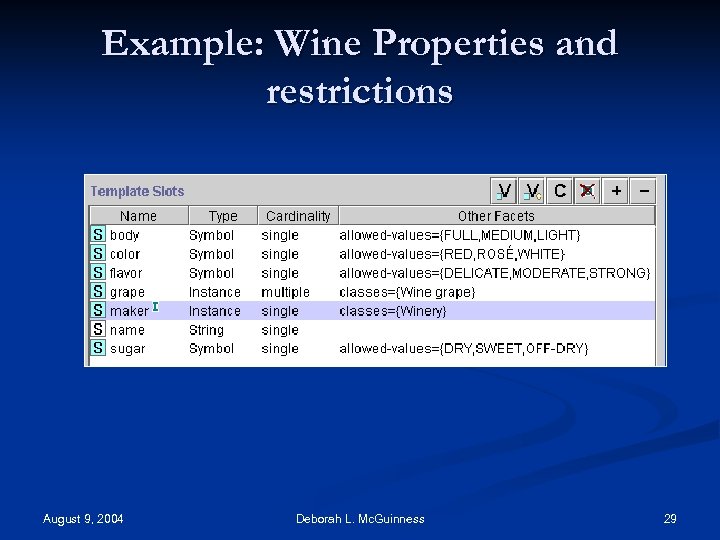
Example: Wine Properties and restrictions August 9, 2004 Deborah L. Mc. Guinness 29
Slot restrictions: Cardinality n Slot cardinality – the number of values a slot can or must have n Cardinality n n Minimum cardinality n n n Cardinality N means that the slot must have N values Minimum cardinality 1 means that the slot must have a value (required) Minimum cardinality 0 means that the slot value is optional Maximum cardinality n n August 9, 2004 Maximum cardinality 1 means that the slot can have at most one value (single-valued slot) Maximum cardinality N means that the slot can have up to N values. When N is greater than 1 it is a multiple-valued slot Deborah L. Mc. Guinness 30
Value Type n Slot value type – what values can the slot have n n n String: a string of characters (“Château Lafite”) Number: an integer or a float (15, 4. 5) Boolean: a true/false flag Enumerated type: a list of allowed values (red, white, rose) Filler: a single value. E. g. , the color slot for a red. Wine must be filled with the single value “red” Object type – a class defined in an ontology. E. g. , Winery is the value restriction on the has. Maker slot on the class Wine August 9, 2004 Deborah L. Mc. Guinness 31
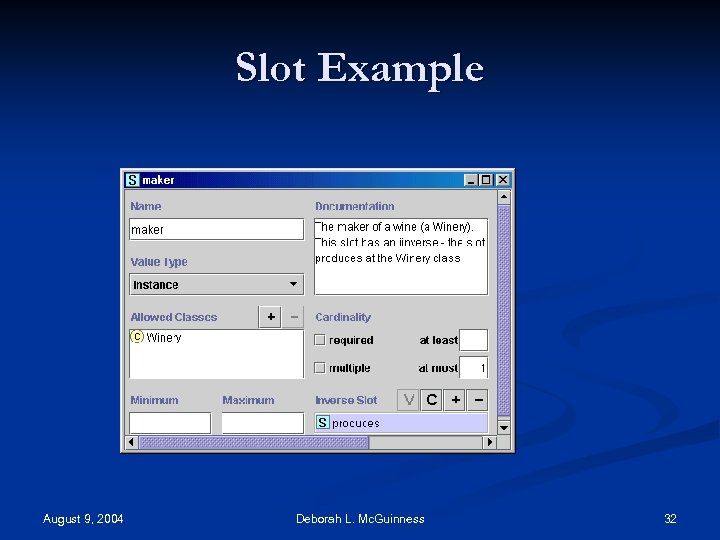
Slot Example August 9, 2004 Deborah L. Mc. Guinness 32
Domain and Range of Slot Domain of a slot – the class (or classes) that may have the slot e. g. , Wine is the domain of the slot has. Wine. Color n Range of a slot – the class (or classes) to which slot values belong e. g. , everything that fills the has. Wine. Color slot is an instance of the enumerated class {red, white, rose} n August 9, 2004 Deborah L. Mc. Guinness 33
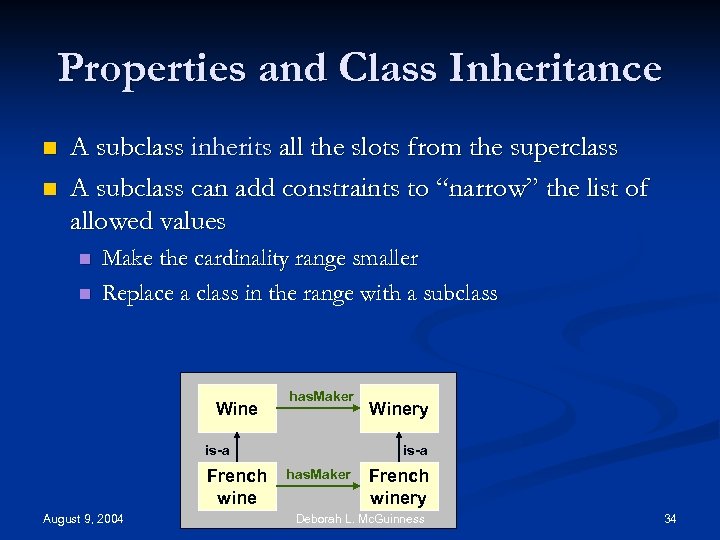
Properties and Class Inheritance n n A subclass inherits all the slots from the superclass A subclass can add constraints to “narrow” the list of allowed values n n Make the cardinality range smaller Replace a class in the range with a subclass Wine has. Maker is-a French wine August 9, 2004 Winery is-a has. Maker French winery Deborah L. Mc. Guinness 34
Create Instances n Create an instance of a class n n n The class becomes a parent of (or type of) the instance Any superclass of a class is an ancestor (or type) of the instance Assign slot values for the instance frame n Slot values should conform to the constraints such as range, value type, cardinality restrictions, etc. August 9, 2004 Deborah L. Mc. Guinness 35
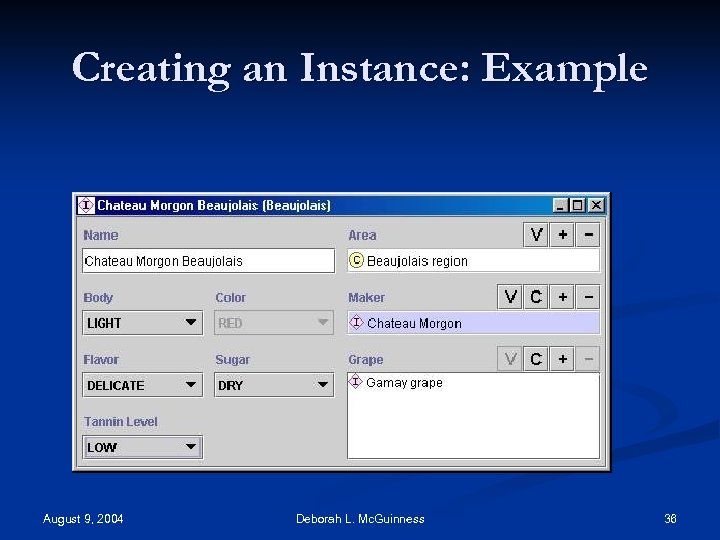
Creating an Instance: Example August 9, 2004 Deborah L. Mc. Guinness 36
Expanding the Ontology n Breadth-oriented n n Depth Oriented n n Identify all/most of the top level classes, properties needed at the top level, and constraints at the top level before deeper Pick an important branch and go down it identifying specific subclasses, sub-classes, etc. and the appropriate properties. Typical ontology design is a combination of both August 9, 2004 Deborah L. Mc. Guinness 37
Defining Classes and a Class Hierarchy n Make sure the isa hierarchy is formal – n n i. e. , is every instance of a subclass an instance of the superclass There is no single best correct class hierarchy but there are some rules of thumb August 9, 2004 Deborah L. Mc. Guinness 38
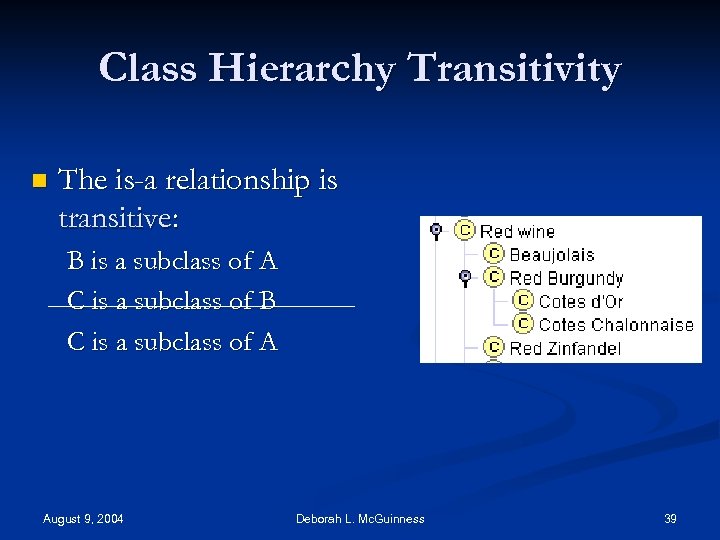
Class Hierarchy Transitivity n The is-a relationship is transitive: B is a subclass of A C is a subclass of B C is a subclass of A August 9, 2004 Deborah L. Mc. Guinness 39
Multiple Inheritance A class can have more than one superclass n The subclass inherits slots and restrictions from all the parents n Different systems may resolve conflicts differently n August 9, 2004 Deborah L. Mc. Guinness 40
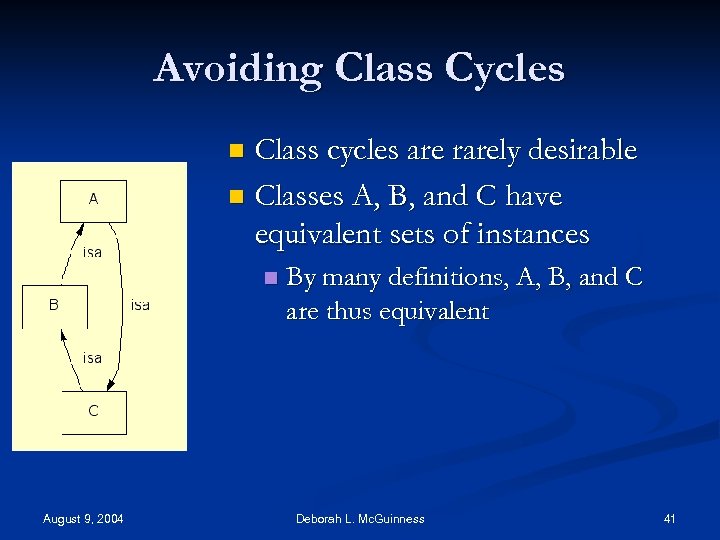
Avoiding Class Cycles Class cycles are rarely desirable n Classes A, B, and C have equivalent sets of instances n n August 9, 2004 By many definitions, A, B, and C are thus equivalent Deborah L. Mc. Guinness 41
Disjoint Classes n n Classes are disjoint if they cannot have common instances Disjoint classes cannot have any common subclasses either E. g. , if winery and wine are disjoint, then there is no instance that is both a winery and a wine. Similarly, there is no class that is both a subclass of winery and simultaneously a subclass of wine Disjointness is often defined to help consistency checking August 9, 2004 Deborah L. Mc. Guinness 42
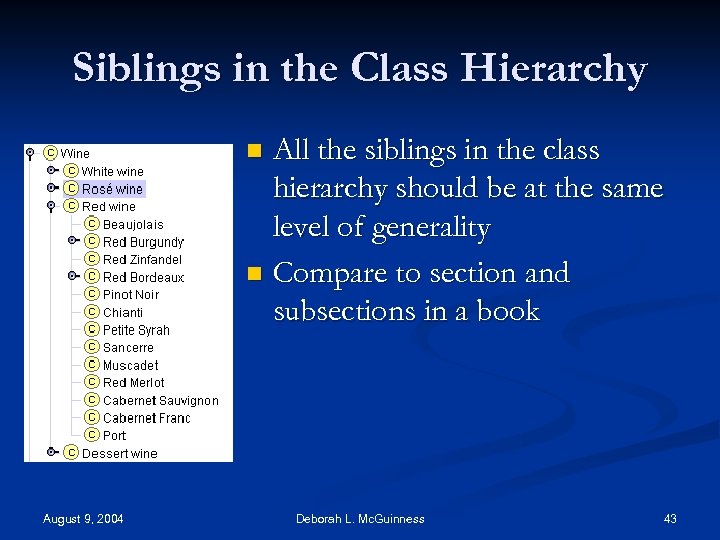
Siblings in the Class Hierarchy All the siblings in the class hierarchy should be at the same level of generality n Compare to section and subsections in a book n August 9, 2004 Deborah L. Mc. Guinness 43
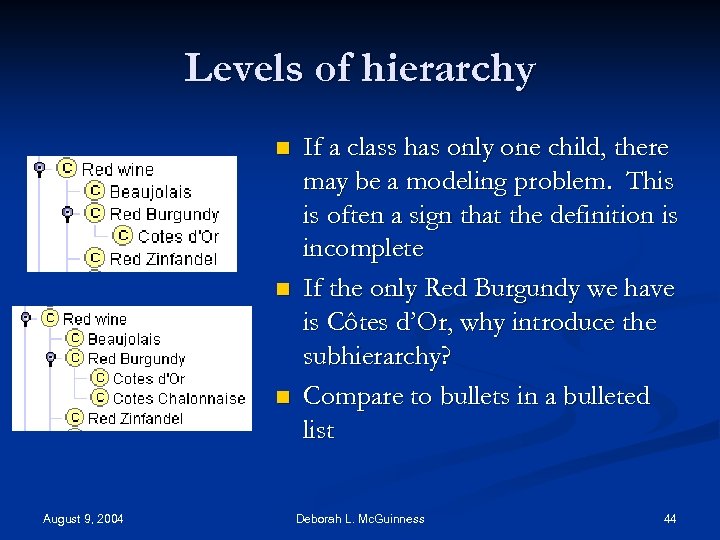
Levels of hierarchy n n n August 9, 2004 If a class has only one child, there may be a modeling problem. This is often a sign that the definition is incomplete If the only Red Burgundy we have is Côtes d’Or, why introduce the subhierarchy? Compare to bullets in a bulleted list Deborah L. Mc. Guinness 44
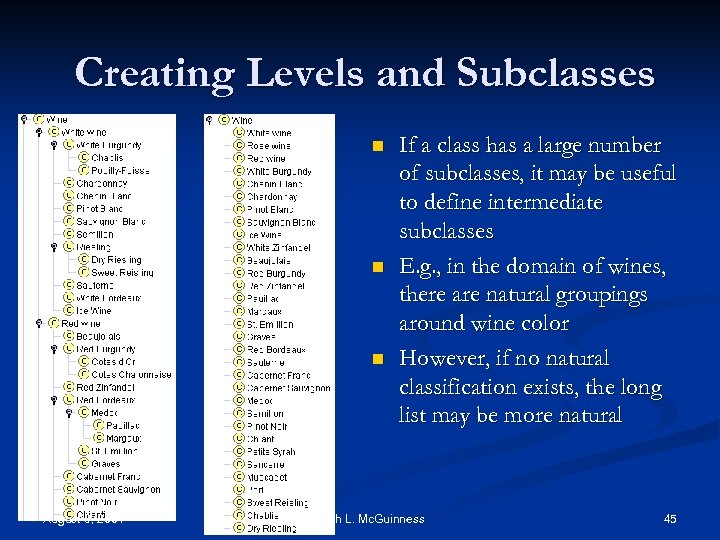
Creating Levels and Subclasses n n n August 9, 2004 If a class has a large number of subclasses, it may be useful to define intermediate subclasses E. g. , in the domain of wines, there are natural groupings around wine color However, if no natural classification exists, the long list may be more natural Deborah L. Mc. Guinness 45
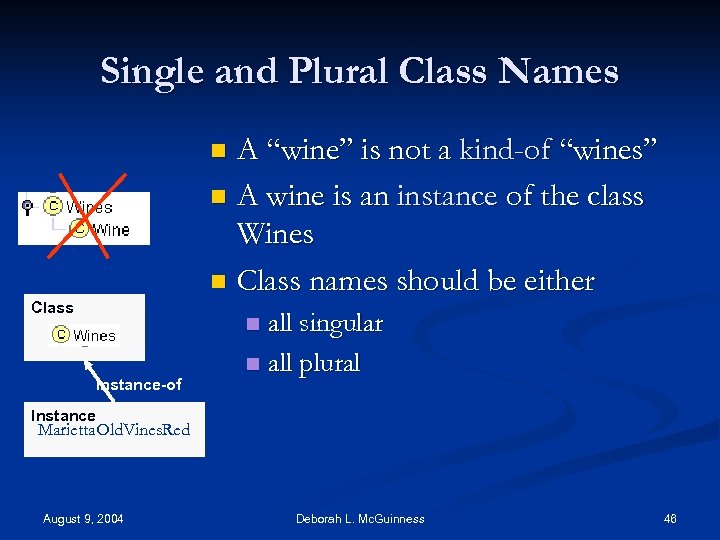
Single and Plural Class Names A “wine” is not a kind-of “wines” n A wine is an instance of the class Wines n Class names should be either n Class all singular n all plural n instance-of Instance Marietta. Old. Vines. Red August 9, 2004 Deborah L. Mc. Guinness 46
Synonyms Synonym names for the same concept are not different classes n Many systems allow listing synonyms as part of the class definition n OWL allows defining necessary and sufficiency condition definitions thereby allowing synonym definitions to be “first class” terms n August 9, 2004 Deborah L. Mc. Guinness 47
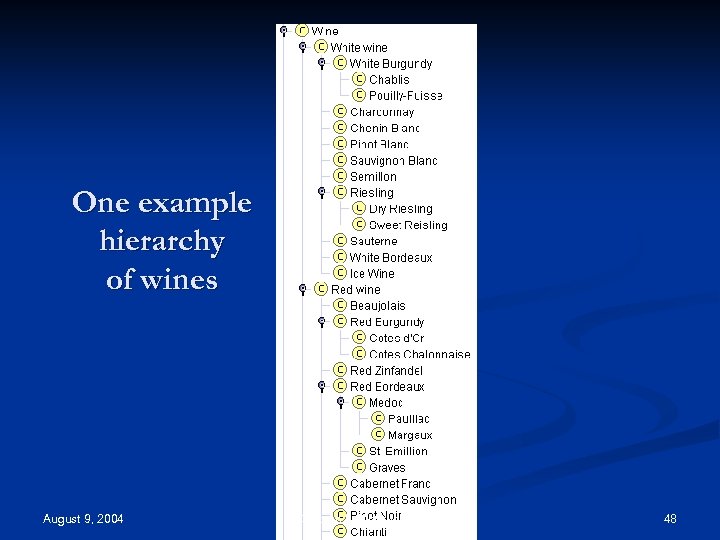
One example hierarchy of wines August 9, 2004 Deborah L. Mc. Guinness 48
When to introduce a new class? n Subclasses of a class usually have Additional properties n Additional slot restrictions n Participate in different relationships n August 9, 2004 Deborah L. Mc. Guinness 49
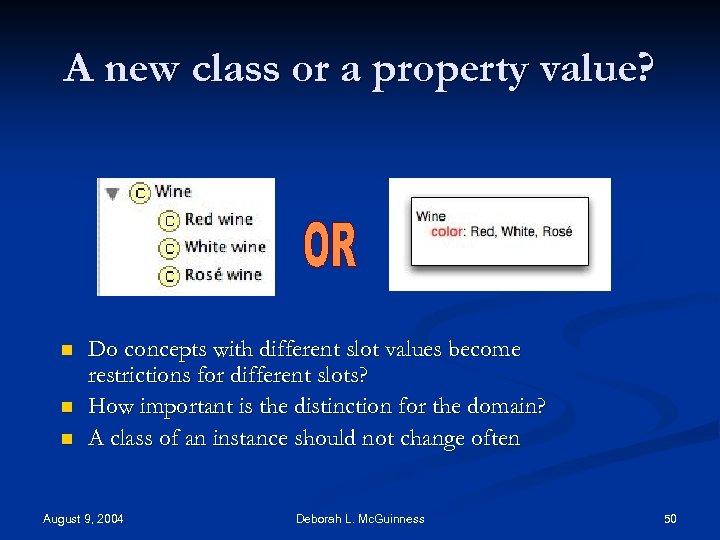
A new class or a property value? n n n Do concepts with different slot values become restrictions for different slots? How important is the distinction for the domain? A class of an instance should not change often August 9, 2004 Deborah L. Mc. Guinness 50
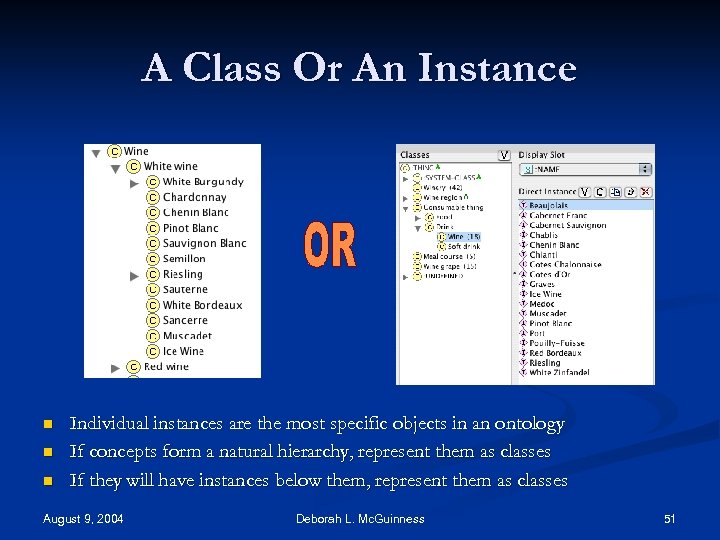
A Class Or An Instance n n n Individual instances are the most specific objects in an ontology If concepts form a natural hierarchy, represent them as classes If they will have instances below them, represent them as classes August 9, 2004 Deborah L. Mc. Guinness 51
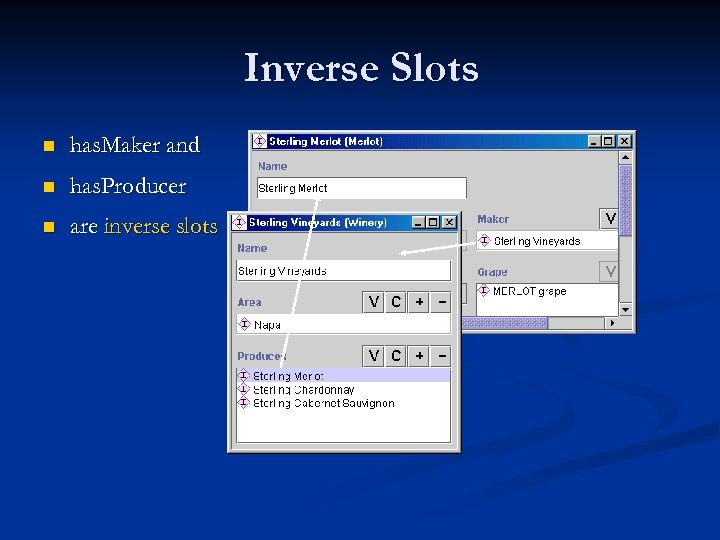
Inverse Slots n has. Maker and n has. Producer n are inverse slots
Inverse Slots (II) n Inverse slots contain redundant information, but n n Allow acquisition of the information in either direction Enable additional verification Allow presentation of information in both directions The actual implementation differs from system to system n n n Are both values stored? When are the inverse values filled in? What happens if we change the link to an inverse slot?
Limiting the Scope n An ontology should not contain all the possible information about the domain n n No need to specialize or generalize more than the application requires No need to include all possible properties of a class n n Only the most salient properties Only the properties that the applications require
Limiting the Scope (II) n Ontology of wine, food, and their pairings probably will not include details not related to wine and food pairings such as: n n n Bottle size (half bottle, full bottle, magnum, …) Label color Wine bottle color (green, amber, …)
Moving to Infrastructure August 9, 2004 Deborah L. Mc. Guinness 56
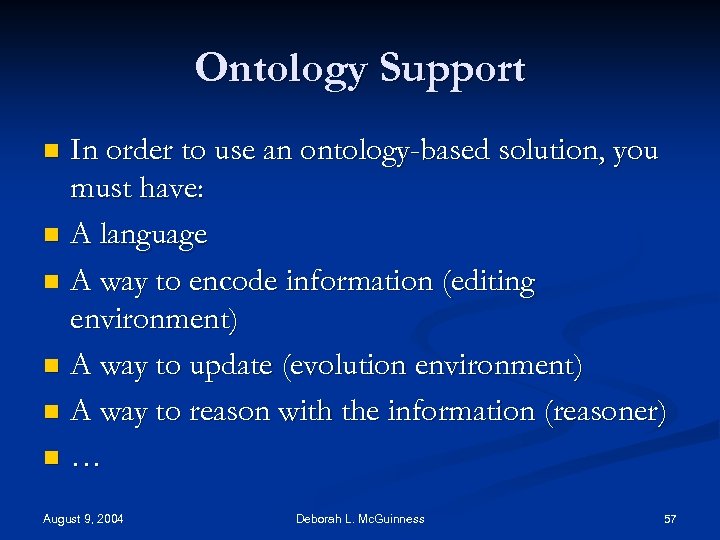
Ontology Support In order to use an ontology-based solution, you must have: n A language n A way to encode information (editing environment) n A way to update (evolution environment) n A way to reason with the information (reasoner) n … n August 9, 2004 Deborah L. Mc. Guinness 57
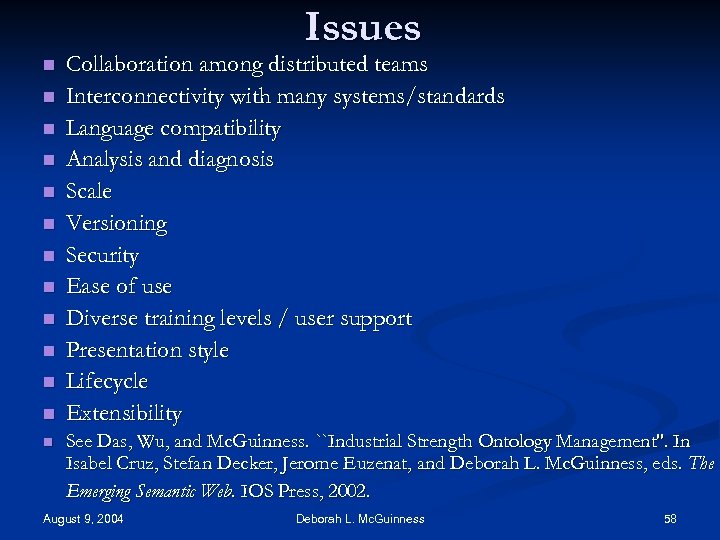
Issues n n n n Collaboration among distributed teams Interconnectivity with many systems/standards Language compatibility Analysis and diagnosis Scale Versioning Security Ease of use Diverse training levels / user support Presentation style Lifecycle Extensibility See Das, Wu, and Mc. Guinness. ``Industrial Strength Ontology Management''. In Isabel Cruz, Stefan Decker, Jerome Euzenat, and Deborah L. Mc. Guinness, eds. The Emerging Semantic Web. IOS Press, 2002. August 9, 2004 Deborah L. Mc. Guinness 58
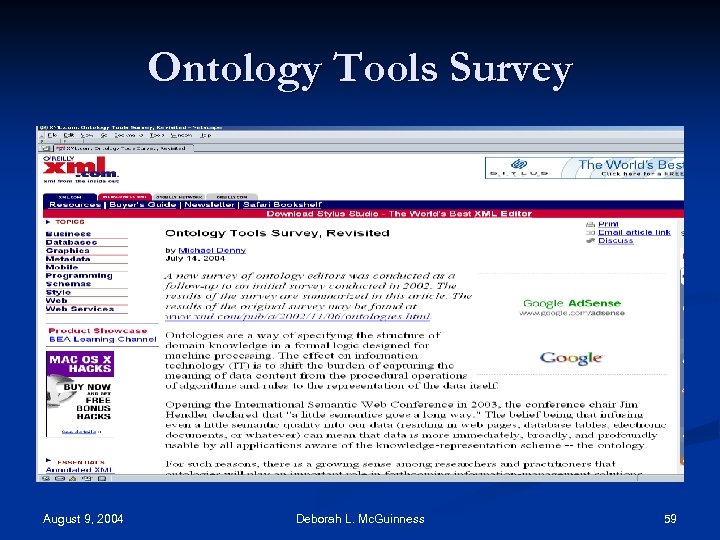
Ontology Tools Survey August 9, 2004 Deborah L. Mc. Guinness 59
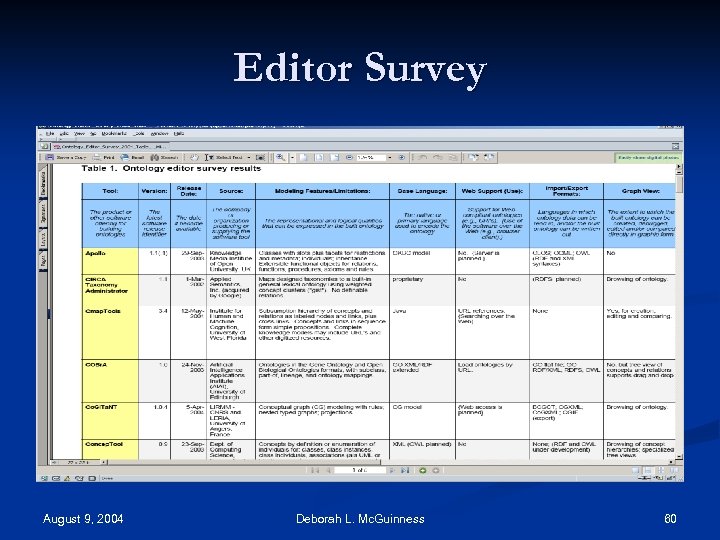
Editor Survey August 9, 2004 Deborah L. Mc. Guinness 60
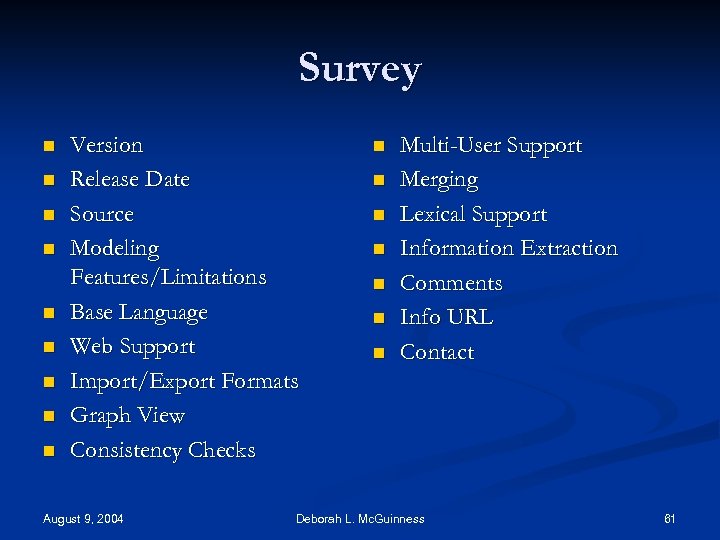
Survey n n n n n Version Release Date Source Modeling Features/Limitations Base Language Web Support Import/Export Formats Graph View Consistency Checks August 9, 2004 n n n n Multi-User Support Merging Lexical Support Information Extraction Comments Info URL Contact Deborah L. Mc. Guinness 61
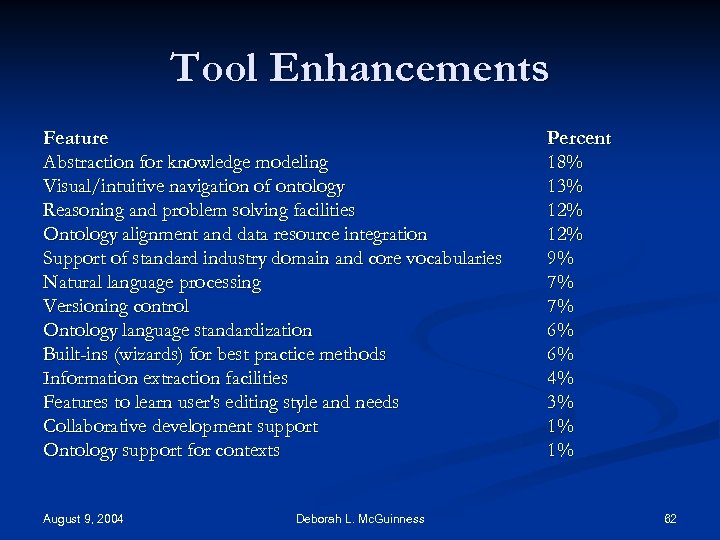
Tool Enhancements Feature Abstraction for knowledge modeling Visual/intuitive navigation of ontology Reasoning and problem solving facilities Ontology alignment and data resource integration Support of standard industry domain and core vocabularies Natural language processing Versioning control Ontology language standardization Built-ins (wizards) for best practice methods Information extraction facilities Features to learn user's editing style and needs Collaborative development support Ontology support for contexts August 9, 2004 Deborah L. Mc. Guinness Percent 18% 13% 12% 9% 7% 7% 6% 6% 4% 3% 1% 1% 62
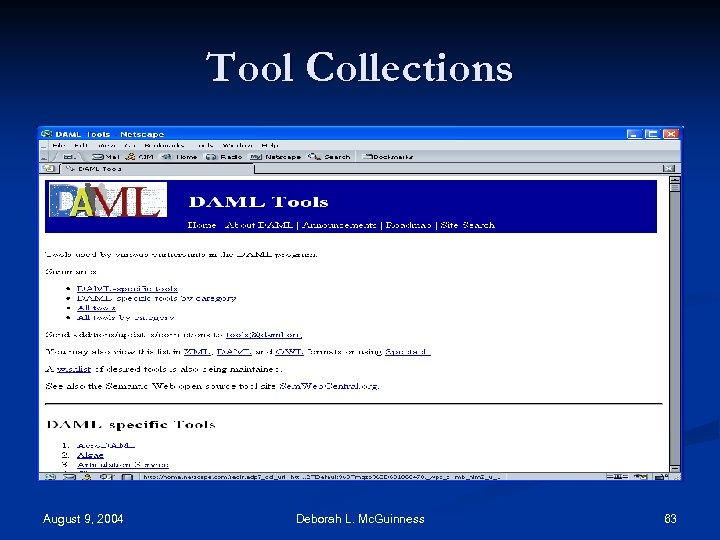
Tool Collections August 9, 2004 Deborah L. Mc. Guinness 63
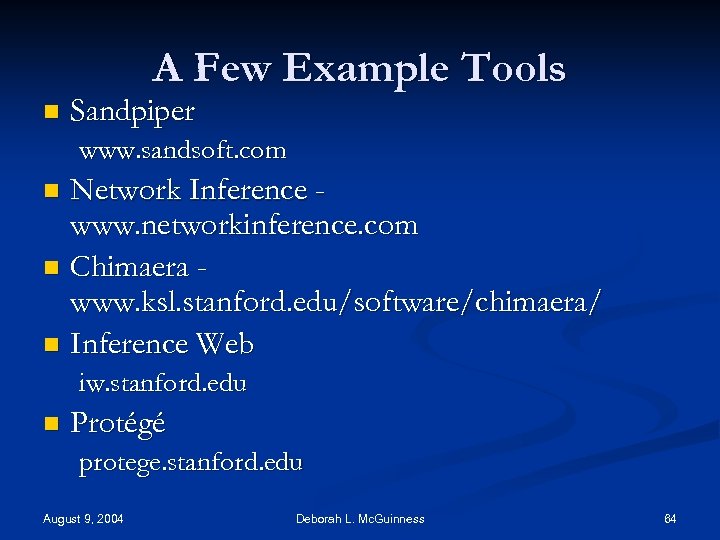
A Few Example Tools n Sandpiper www. sandsoft. com Network Inference www. networkinference. com n Chimaera www. ksl. stanford. edu/software/chimaera/ n Inference Web n iw. stanford. edu n Protégé protege. stanford. edu August 9, 2004 Deborah L. Mc. Guinness 64
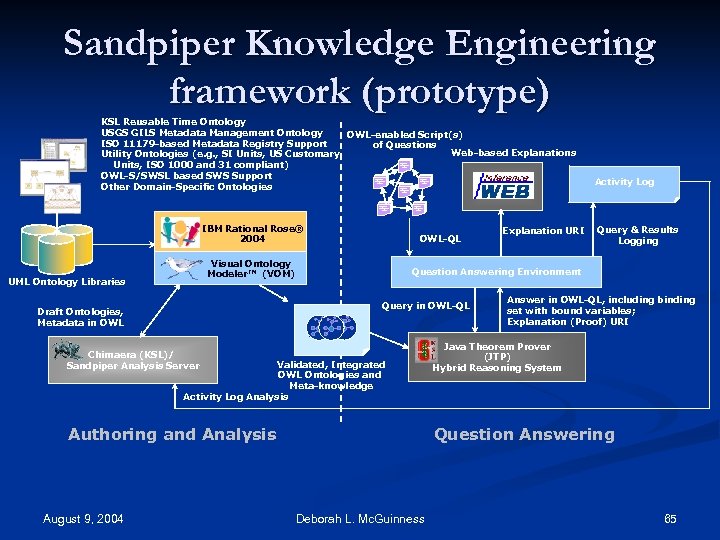
Sandpiper Knowledge Engineering framework (prototype) KSL Reusable Time Ontology USGS GILS Metadata Management Ontology OWL-enabled Script(s) ISO 11179 -based Metadata Registry Support of Questions Web-based Explanations Utility Ontologies (e. g. , SI Units, US Customary Units, ISO 1000 and 31 compliant) OWL-S/SWSL based SWS Support Other Domain-Specific Ontologies IBM Rational Rose® 2004 OWL-QL Visual Ontology Modeler™ (VOM) UML Ontology Libraries Query & Results Logging Question Answering Environment Query in OWL-QL Draft Ontologies, Metadata in OWL Explanation URI Activity Log Answer in OWL-QL, including binding set with bound variables; Explanation (Proof) URI Chimaera (KSL)/ Sandpiper Analysis Server Java Theorem Prover (JTP) Hybrid Reasoning System Authoring and Analysis Question Answering Validated, Integrated OWL Ontologies and Meta-knowledge Activity Log Analysis August 9, 2004 Deborah L. Mc. Guinness 65
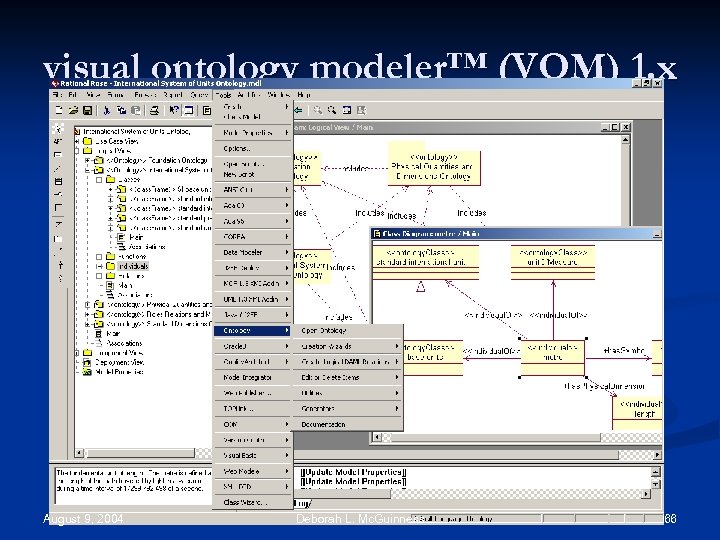
visual ontology modeler™ (VOM) 1. x August 9, 2004 Deborah L. Mc. Guinness 66
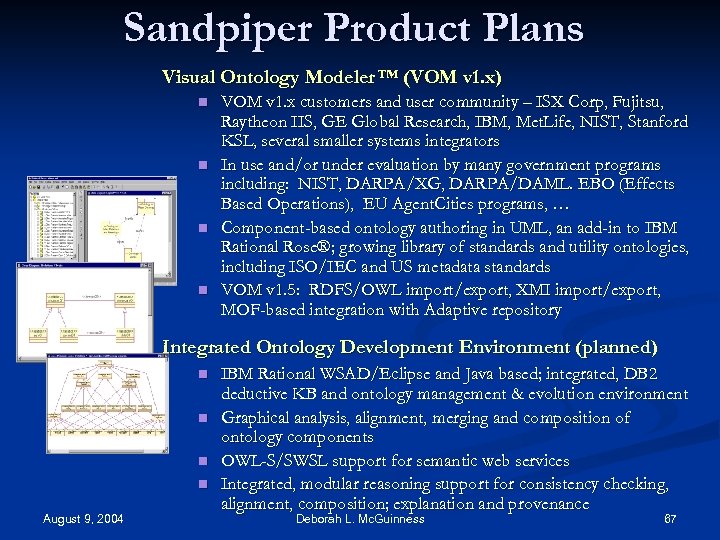
Sandpiper Product Plans Visual Ontology Modeler ™ (VOM v 1. x) n n VOM v 1. x customers and user community – ISX Corp, Fujitsu, Raytheon IIS, GE Global Research, IBM, Met. Life, NIST, Stanford KSL, several smaller systems integrators In use and/or under evaluation by many government programs including: NIST, DARPA/XG, DARPA/DAML. EBO (Effects Based Operations), EU Agent. Cities programs, … Component-based ontology authoring in UML, an add-in to IBM Rational Rose®; growing library of standards and utility ontologies, including ISO/IEC and US metadata standards VOM v 1. 5: RDFS/OWL import/export, XMI import/export, MOF-based integration with Adaptive repository Integrated Ontology Development Environment (planned) n n August 9, 2004 IBM Rational WSAD/Eclipse and Java based; integrated, DB 2 deductive KB and ontology management & evolution environment Graphical analysis, alignment, merging and composition of ontology components OWL-S/SWSL support for semantic web services Integrated, modular reasoning support for consistency checking, alignment, composition; explanation and provenance Deborah L. Mc. Guinness 67
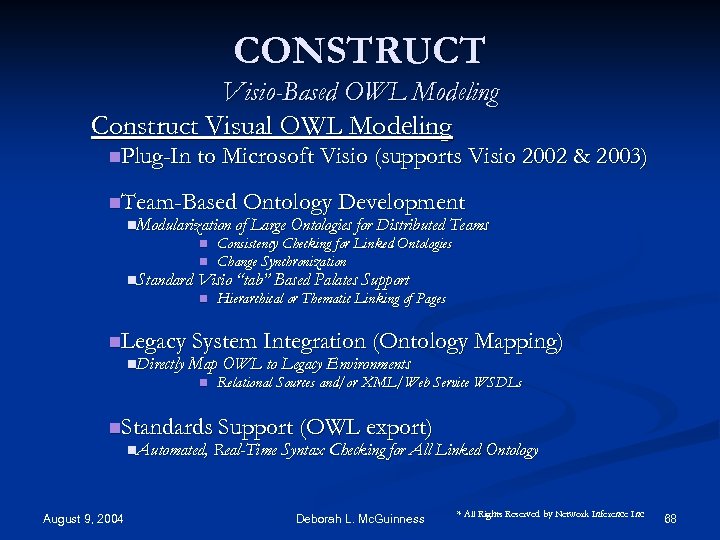
CONSTRUCT Visio-Based OWL Modeling Construct Visual OWL Modeling n. Plug-In to Microsoft Visio (supports Visio 2002 & 2003) n. Team-Based Ontology Development n. Modularization of Large Ontologies for Distributed Teams n n Consistency Checking for Linked Ontologies Change Synchronization n. Standard Visio “tab” Based Palates Support n Hierarchical or Thematic Linking of Pages n. Legacy System Integration (Ontology Mapping) n. Directly Map OWL to Legacy Environments n Relational Sources and/or XML/Web Service WSDLs n. Standards Support (OWL export) n. Automated, Real-Time Syntax Checking for All Linked Ontology August 9, 2004 Deborah L. Mc. Guinness * All Rights Reserved by Network Inference Inc 68
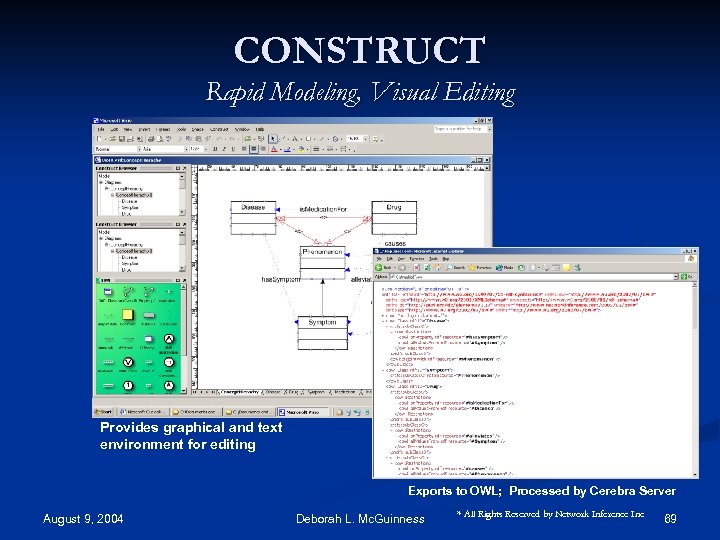
CONSTRUCT Rapid Modeling, Visual Editing Provides graphical and text environment for editing Exports to OWL; Processed by Cerebra Server August 9, 2004 Deborah L. Mc. Guinness * All Rights Reserved by Network Inference Inc 69
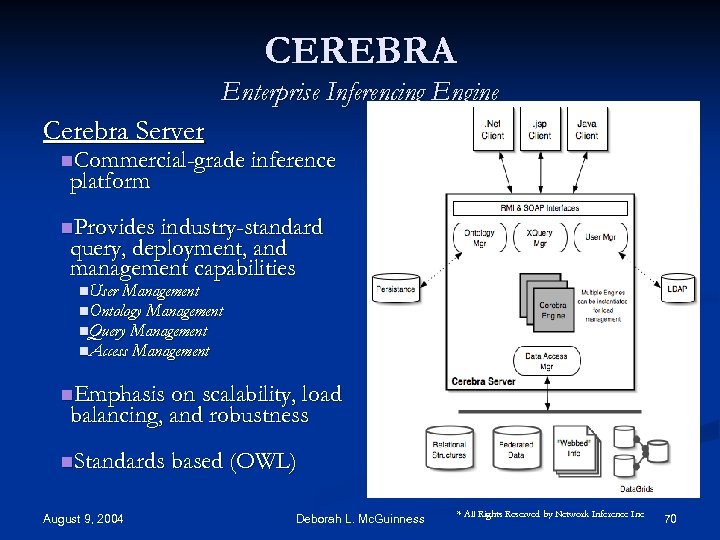
CEREBRA Enterprise Inferencing Engine Cerebra Server n. Commercial-grade inference platform n. Provides industry-standard query, deployment, and management capabilities n. User Management n. Ontology Management n. Query Management n. Access Management n. Emphasis on scalability, load balancing, and robustness n. Standards based (OWL) August 9, 2004 Deborah L. Mc. Guinness * All Rights Reserved by Network Inference Inc 70
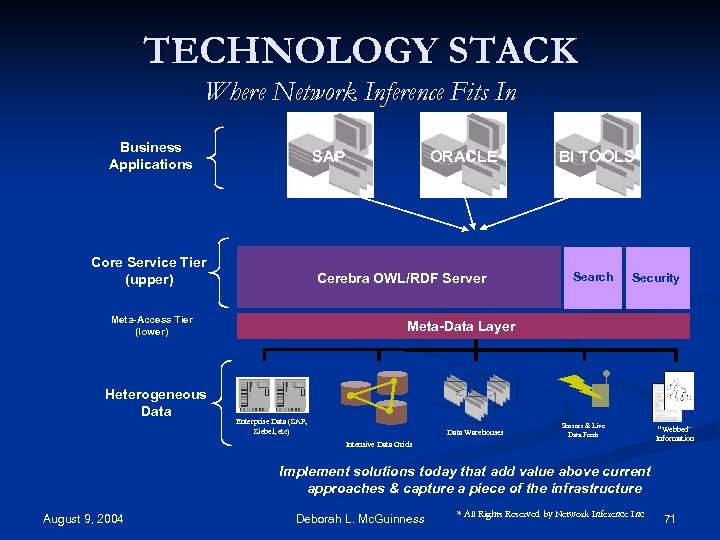
TECHNOLOGY STACK Where Network Inference Fits In Business Applications SAP Core Service Tier (upper) Cerebra OWL/RDF Server Meta-Access Tier (lower) Heterogeneous Data ORACLE BI TOOLS Search Security Meta-Data Layer Enterprise Data (SAP, Siebel, etc) Data Warehouses Sensors & Live Data Feeds Intensive Data Grids “Webbed” Information Implement solutions today that add value above current approaches & capture a piece of the infrastructure August 9, 2004 Deborah L. Mc. Guinness * All Rights Reserved by Network Inference Inc 71
Example Inference Engine Pointers Cerebra – Network Inference’s Engine n Jena – HP’s Semantic Web Platform http: //www. hpl. hp. com/semweb/jena. htm n A few university options: n n n Sem. Web. Central n n n FACT (Manchester) Racer (http: //www. sts. tu-harburg. de/~r. f. moeller/racer/ ) suggested DIG (DL Interface) reasoner for Protégé http: //protege. stanford. edu/plugins/owl/ JTP - Hybrid Reasoner – FOL plus special purpose reasoner Largely open source collection including emerging tools With an evolving workflows section helping guide choice http: //semwebcentral. org/index. jsp? page=workflows SWe. De – SW Development Environment – plugins for Eclipse (BBN) http: //owl-eclipse. projects. semwebcentral. org/ August 9, 2004 Deborah L. Mc. Guinness 72
Evolution Environments n Multiple Ontology Support Merging n Knowledge Base review and suggestions n n Diagnostics n Provable problems, possible problems, … Updates, Source Code Control, Versioning, n Collaborative Components n August 9, 2004 Deborah L. Mc. Guinness 73
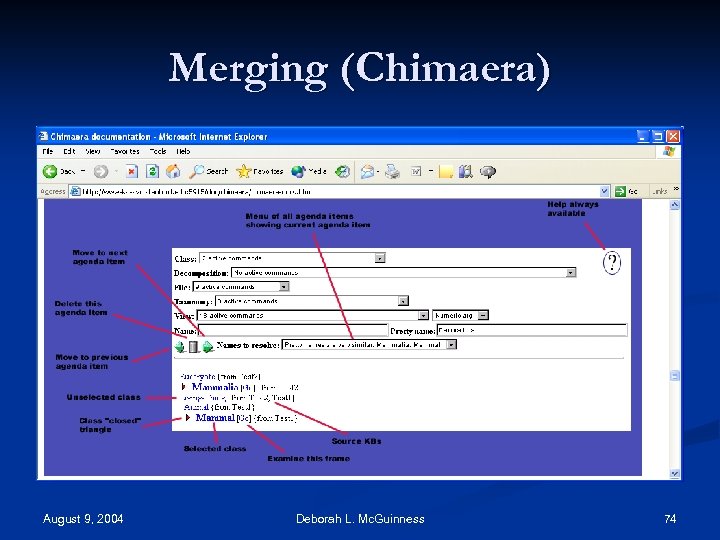
Merging (Chimaera) August 9, 2004 Deborah L. Mc. Guinness 74
Strategies n Lexical Analysis n n n Semantic Analysis n n n Term name similarity Term containment (sports. Car and car) Structural similarity – the same parents, the same slots with the same value restrictions, …. Meta information exploitation Expanded merging issues n If multiple ontologies were used and one contained a disjoint decomposition and the contained those terms along with others at the same level, they may be candidates for the merged disjoint decomposition August 9, 2004 Deborah L. Mc. Guinness 75
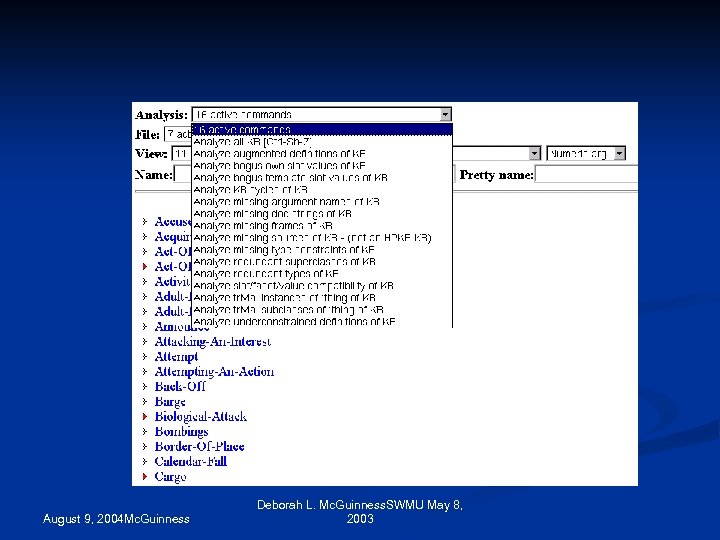
August 9, 2004 Mc. Guinness Deborah L. Mc. Guinness. SWMU May 8, 2003
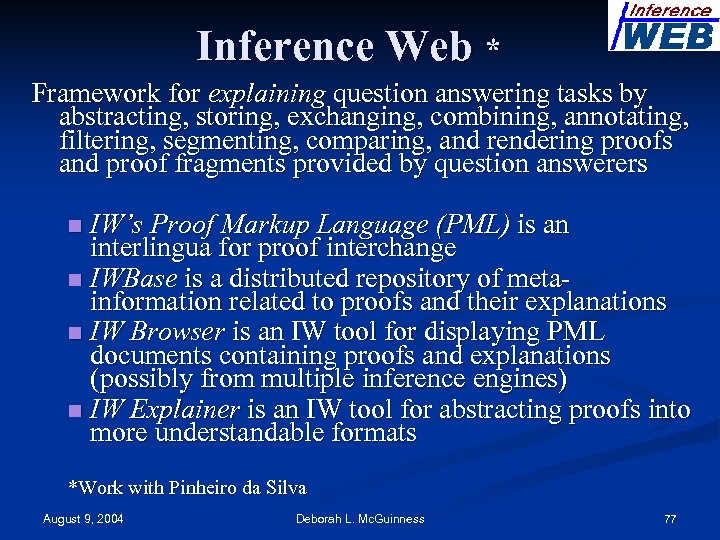
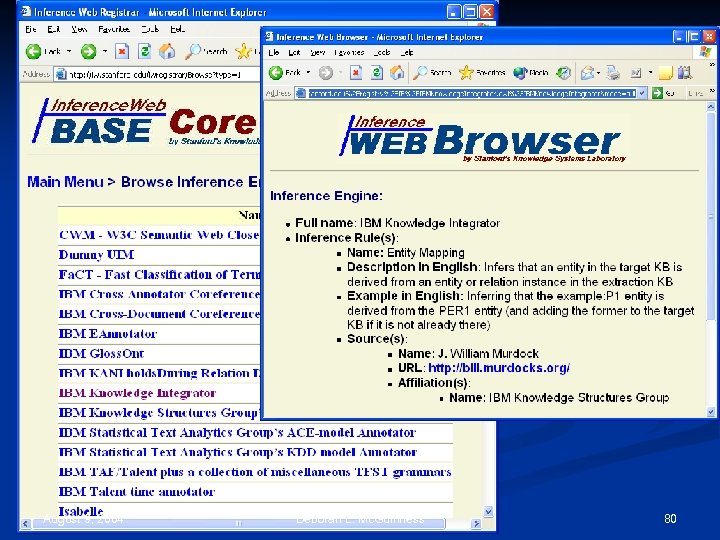
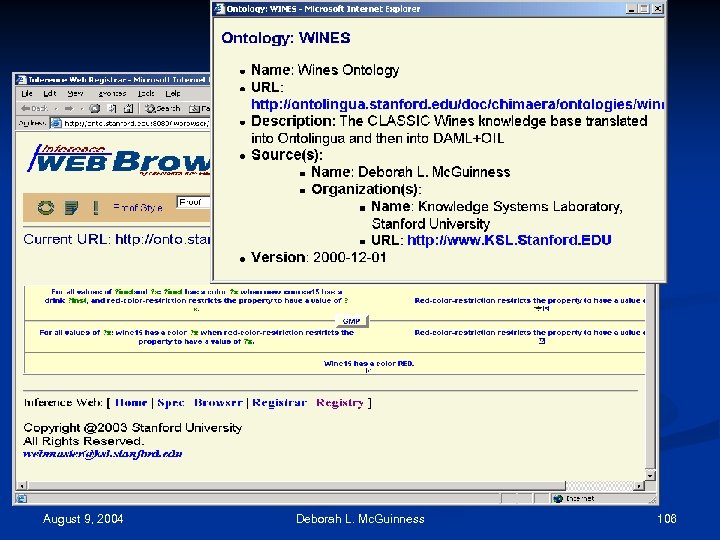
Inference Web * Framework for explaining question answering tasks by abstracting, storing, exchanging, combining, annotating, filtering, segmenting, comparing, and rendering proofs and proof fragments provided by question answerers IW’s Proof Markup Language (PML) is an interlingua for proof interchange n IWBase is a distributed repository of metainformation related to proofs and their explanations n IW Browser is an IW tool for displaying PML documents containing proofs and explanations (possibly from multiple inference engines) n IW Explainer is an IW tool for abstracting proofs into more understandable formats n *Work with Pinheiro da Silva August 9, 2004 Deborah L. Mc. Guinness 77
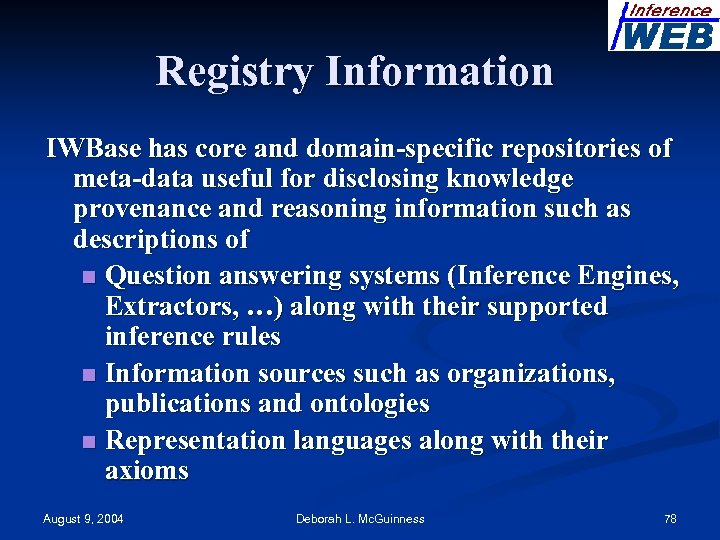
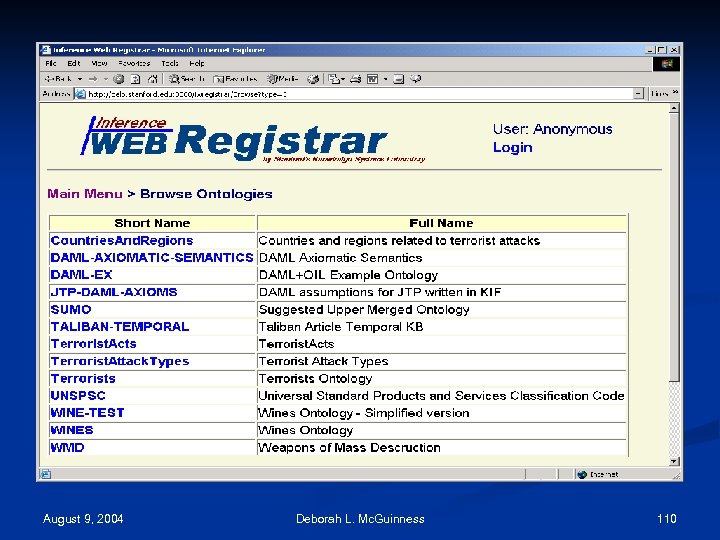
Registry Information IWBase has core and domain-specific repositories of meta-data useful for disclosing knowledge provenance and reasoning information such as descriptions of n Question answering systems (Inference Engines, Extractors, …) along with their supported inference rules n Information sources such as organizations, publications and ontologies n Representation languages along with their axioms August 9, 2004 Deborah L. Mc. Guinness 78
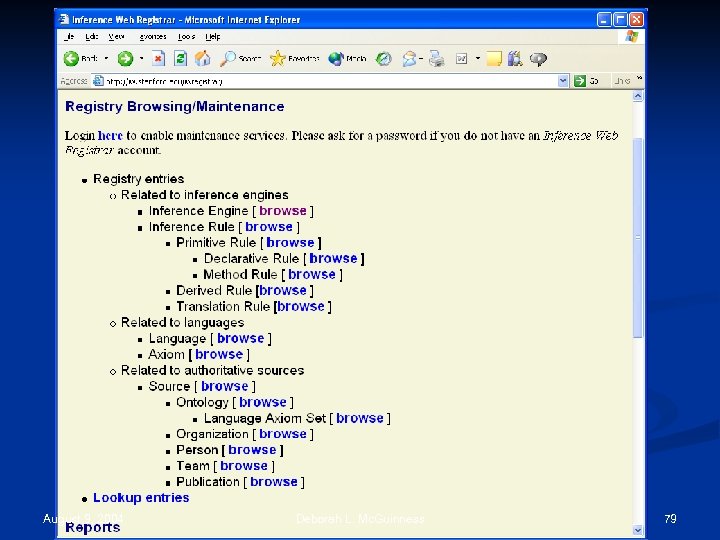
August 9, 2004 Deborah L. Mc. Guinness 79
August 9, 2004 Deborah L. Mc. Guinness 80
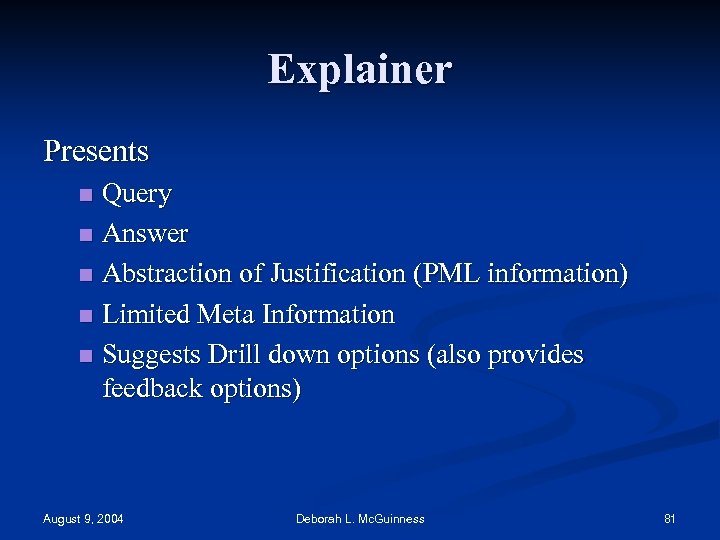
Explainer Presents Query n Answer n Abstraction of Justification (PML information) n Limited Meta Information n Suggests Drill down options (also provides feedback options) n August 9, 2004 Deborah L. Mc. Guinness 81
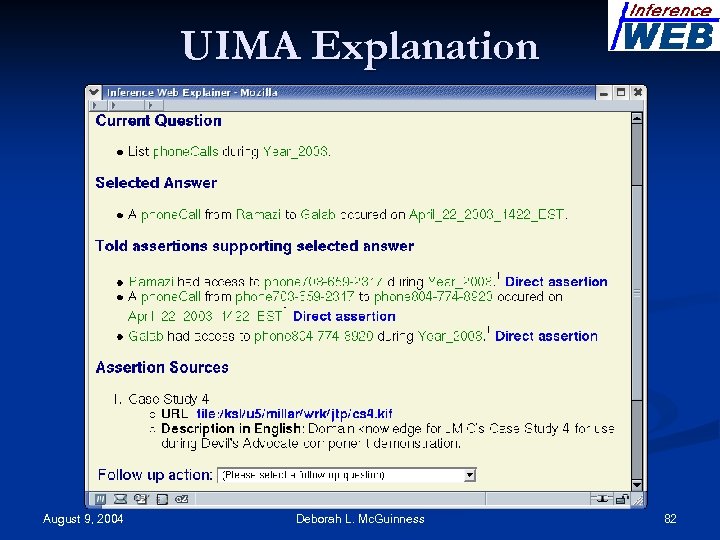
UIMA Explanation August 9, 2004 Deborah L. Mc. Guinness 82
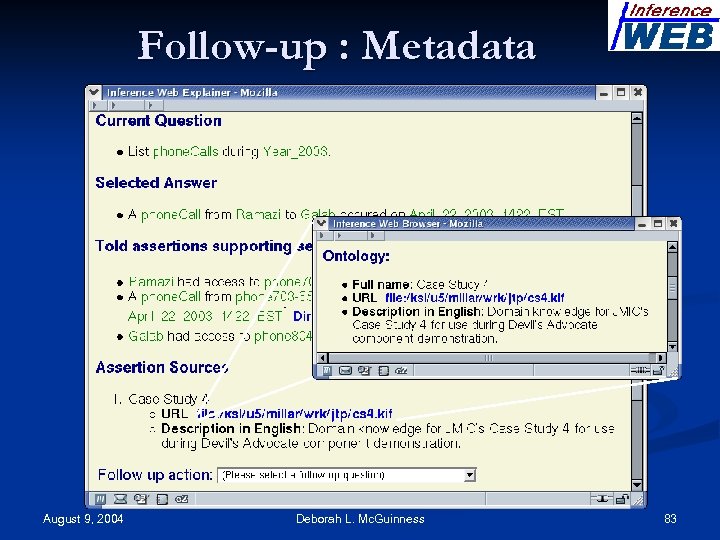
Follow-up : Metadata August 9, 2004 Deborah L. Mc. Guinness 83
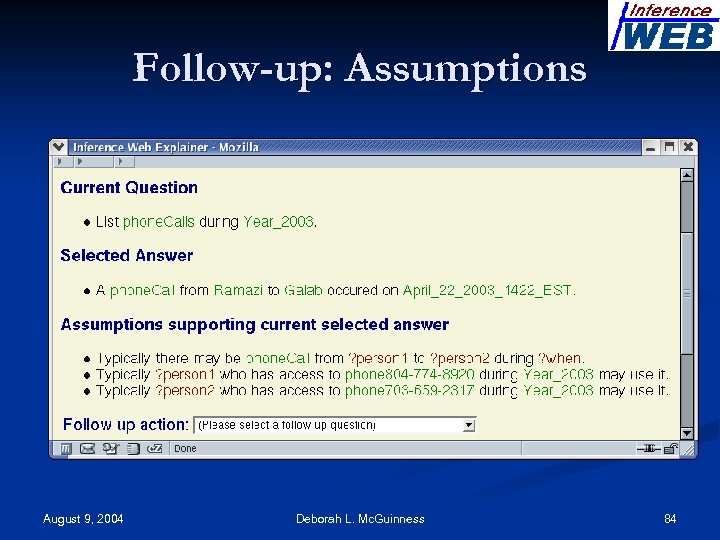
Follow-up: Assumptions August 9, 2004 Deborah L. Mc. Guinness 84
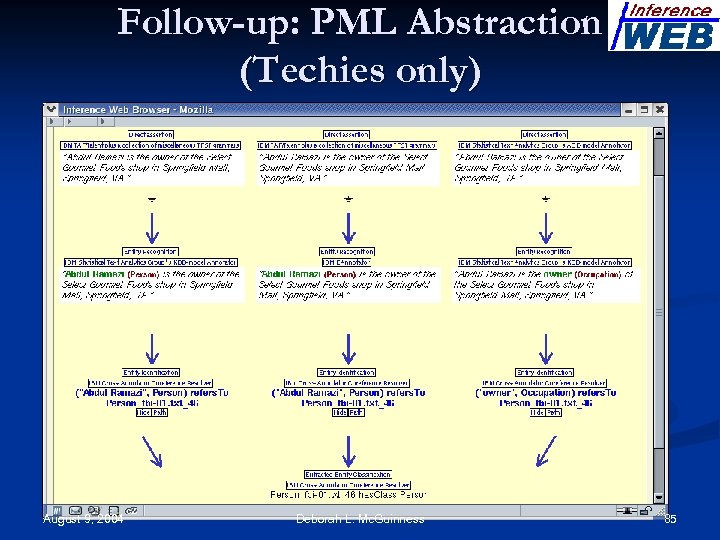
Follow-up: PML Abstraction (Techies only) August 9, 2004 Deborah L. Mc. Guinness 85
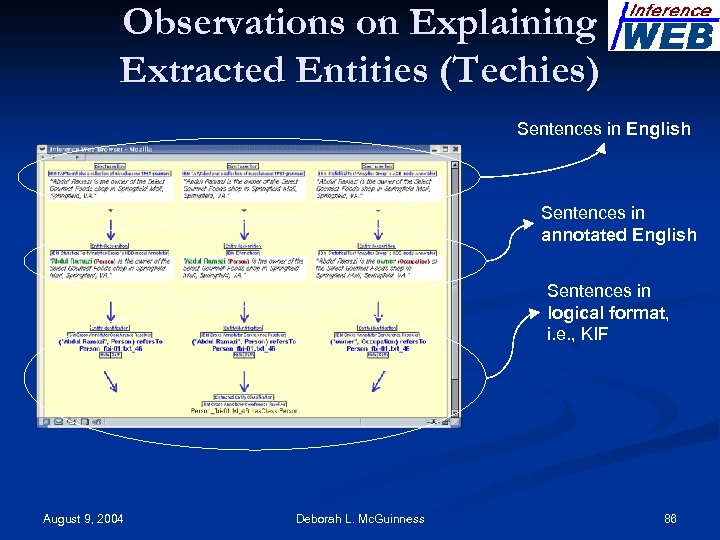
Observations on Explaining Extracted Entities (Techies) Sentences in English Sentences in annotated English Sentences in logical format, i. e. , KIF August 9, 2004 Deborah L. Mc. Guinness 86
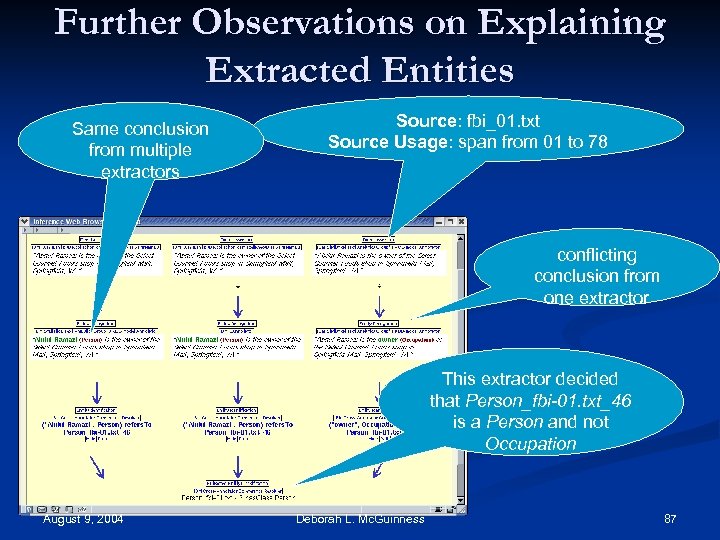
Further Observations on Explaining Extracted Entities Same conclusion from multiple extractors Source: fbi_01. txt Source Usage: span from 01 to 78 conflicting conclusion from one extractor This extractor decided that Person_fbi-01. txt_46 is a Person and not Occupation August 9, 2004 Deborah L. Mc. Guinness 87
Status Inference Web infrastructure (PML, browser, explainer, registry) being used in government programs such as PAL and NIMD, commercial research labs – IBM, Boeing, SRI, Universities – USC, U MD, … Integration and registration process underway with extraction community Useful now for helping decide if information is trustworthy, comes from authoritative sources, consistent, reliable Benefits from more meta data and more information population but is useful in an incremental nature August 9, 2004 Deborah L. Mc. Guinness 88
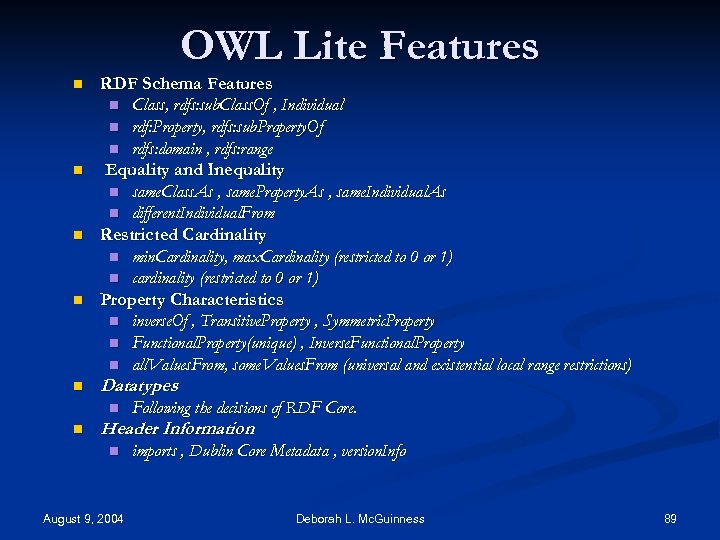
OWL Lite Features n n n RDF Schema Features n Class, rdfs: sub. Class. Of , Individual n rdf: Property, rdfs: sub. Property. Of n rdfs: domain , rdfs: range Equality and Inequality n same. Class. As , same. Property. As , same. Individual. As n different. Individual. From Restricted Cardinality n min. Cardinality, max. Cardinality (restricted to 0 or 1) n cardinality (restricted to 0 or 1) Property Characteristics n inverse. Of , Transitive. Property , Symmetric. Property n Functional. Property(unique) , Inverse. Functional. Property n all. Values. From, some. Values. From (universal and existential local range restrictions) Datatypes n n Following the decisions of RDF Core. Header Information n August 9, 2004 imports , Dublin Core Metadata , version. Info Deborah L. Mc. Guinness 89
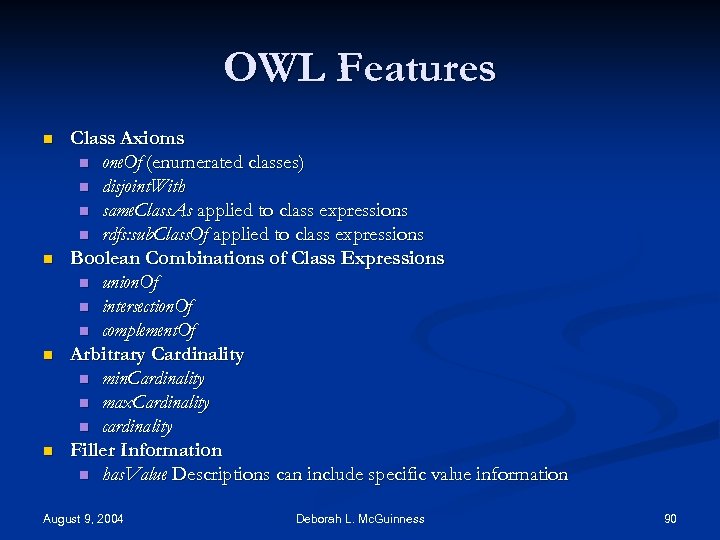
OWL Features n n Class Axioms n one. Of (enumerated classes) n disjoint. With n same. Class. As applied to class expressions n rdfs: sub. Class. Of applied to class expressions Boolean Combinations of Class Expressions n union. Of n intersection. Of n complement. Of Arbitrary Cardinality n min. Cardinality n max. Cardinality n cardinality Filler Information n has. Value Descriptions can include specific value information August 9, 2004 Deborah L. Mc. Guinness 90
OWL Lite and OWL Feature Synopsis: http: //www. w 3. org/TR/owl-features/ n Guide: http: //www. w 3. org/TR/owl-features/ n Reference Description: http: //www. w 3. org/TR/owl-ref/ n August 9, 2004 Deborah L. Mc. Guinness 91
Validators n For RDF: n n http: //www. w 3. org/RDF/Validator/ For OWL: http: //owl. bbn. com/validator/ n http: //phoebus. cs. man. ac. uk: 9999/OWL/Validator n http: //www. mindswap. org/2003/pellet/demo. shtml n August 9, 2004 Deborah L. Mc. Guinness 92
A few direction setting programs DARPA Personal Assistant that Learns (PAL) n Enable computer systems that can reason, learn from experience, be told what to do, explain what they are doing, reflect on their experience, and respond robustly to surprise. DARPA Rapid Knowledge Formation (RKF) n Goal: allow distributed teams of subject matter experts to quickly and easily build, maintain, and use knowledge bases without need for specialized training. DARPA High Performance Knowledge Base (HPKB) n Goal: advance the technology of how computers acquire, represent and manipulate knowledge ARDA’s Novel Intelligence for Massive Data (NIMD) n Goal – Avoid strategic surprise by helping analysts be more effective (focus attention on critical information and help analyze/prune/refine/explain/reuse/…) ARDA’s Advanced Question & Answering for Intelligence (AQUAINT) n Goal – Advance QA against structured and unstructured info Consulting including search, ecommerce, configuration, … August 9, 2004 Deborah L. Mc. Guinness 93
Many Program BAAs Using Results NGA BAA n DARPA XG Radio n DARPA Coordinators n DARPA advanced soldier sensor information system and technology (ASSIST) n DARPA Situation Aware Protocols in Edge Network Technologies (SAPIENT) n …. n August 9, 2004 Deborah L. Mc. Guinness 94
Discussion n n Choose a language (maybe OWL) Find an editing environment (text editor, protégé, construct, vom, …) Generate some markup Validate Use it for… n n n n Search (tap, find. UR, …) Consistency checking Policy checking, enforcement, classification, Configuration Analysis of all types (including NIMD style) Assistant Interoperability …. August 9, 2004 Deborah L. Mc. Guinness 95
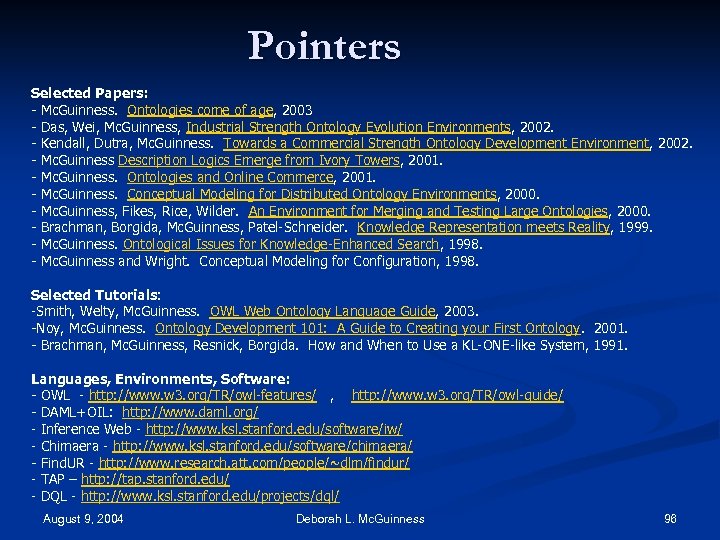
Pointers Selected Papers: - Mc. Guinness. Ontologies come of age, 2003 - Das, Wei, Mc. Guinness, Industrial Strength Ontology Evolution Environments, 2002. - Kendall, Dutra, Mc. Guinness. Towards a Commercial Strength Ontology Development Environment, 2002. - Mc. Guinness Description Logics Emerge from Ivory Towers, 2001. - Mc. Guinness. Ontologies and Online Commerce, 2001. - Mc. Guinness. Conceptual Modeling for Distributed Ontology Environments, 2000. - Mc. Guinness, Fikes, Rice, Wilder. An Environment for Merging and Testing Large Ontologies, 2000. - Brachman, Borgida, Mc. Guinness, Patel-Schneider. Knowledge Representation meets Reality, 1999. - Mc. Guinness. Ontological Issues for Knowledge-Enhanced Search, 1998. - Mc. Guinness and Wright. Conceptual Modeling for Configuration, 1998. Selected Tutorials: -Smith, Welty, Mc. Guinness. OWL Web Ontology Language Guide, 2003. -Noy, Mc. Guinness. Ontology Development 101: A Guide to Creating your First Ontology. 2001. - Brachman, Mc. Guinness, Resnick, Borgida. How and When to Use a KL-ONE-like System, 1991. Languages, Environments, Software: - OWL - http: //www. w 3. org/TR/owl-features/ , http: //www. w 3. org/TR/owl-guide/ - DAML+OIL: http: //www. daml. org/ - Inference Web - http: //www. ksl. stanford. edu/software/iw/ - Chimaera - http: //www. ksl. stanford. edu/software/chimaera/ - Find. UR - http: //www. research. att. com/people/~dlm/findur/ - TAP – http: //tap. stanford. edu/ - DQL - http: //www. ksl. stanford. edu/projects/dql/ August 9, 2004 Deborah L. Mc. Guinness 96
Extras August 9, 2004 Deborah L. Mc. Guinness 97
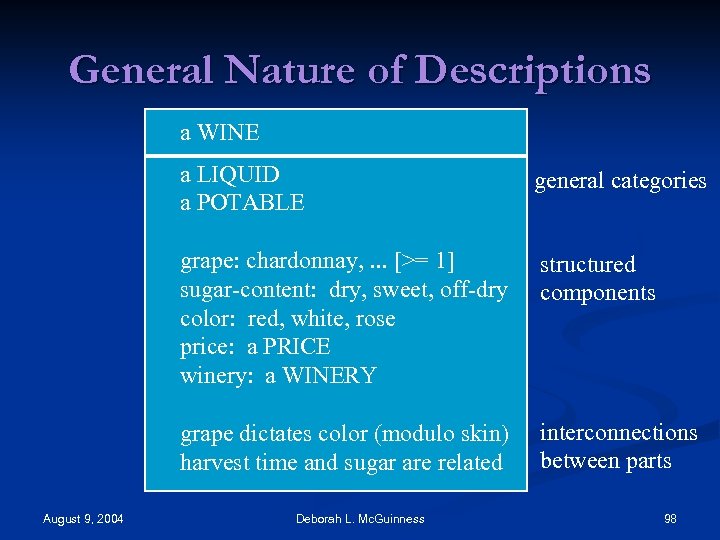
General Nature of Descriptions a WINE a LIQUID a POTABLE grape: chardonnay, . . . [>= 1] sugar-content: dry, sweet, off-dry color: red, white, rose price: a PRICE winery: a WINERY structured components grape dictates color (modulo skin) harvest time and sugar are related August 9, 2004 general categories interconnections between parts Deborah L. Mc. Guinness 98
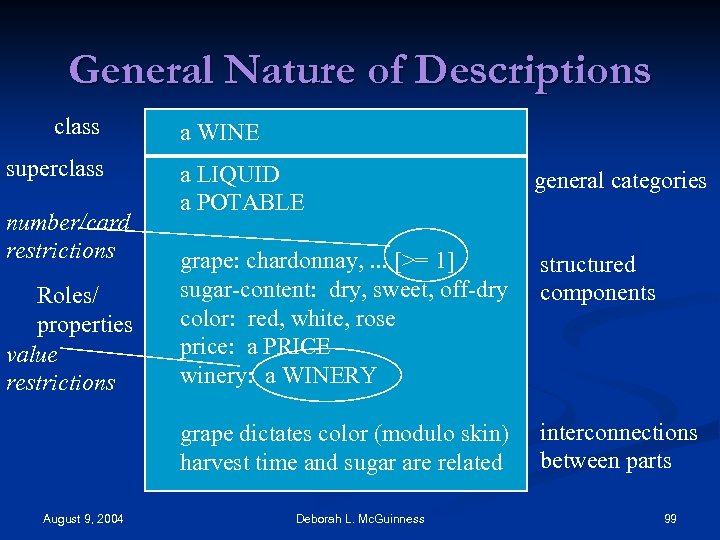
General Nature of Descriptions class superclass a WINE Roles/ properties value restrictions August 9, 2004 general categories grape: chardonnay, . . . [>= 1] sugar-content: dry, sweet, off-dry color: red, white, rose price: a PRICE winery: a WINERY structured components grape dictates color (modulo skin) harvest time and sugar are related number/card restrictions a LIQUID a POTABLE interconnections between parts Deborah L. Mc. Guinness 99
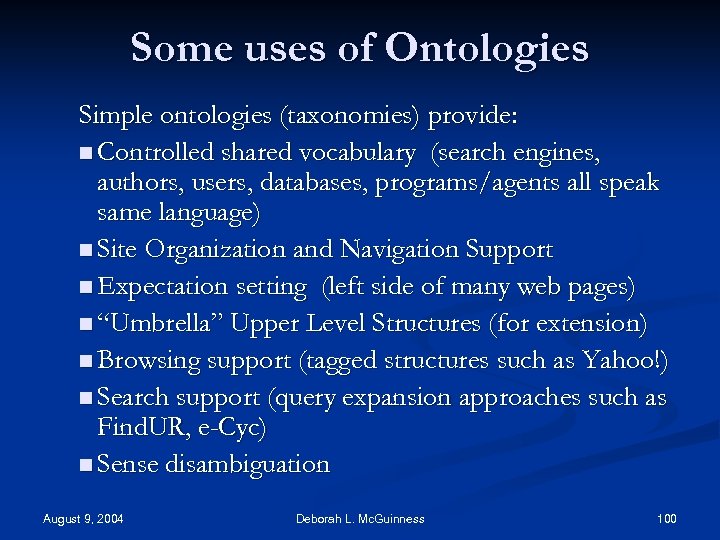
Some uses of Ontologies Simple ontologies (taxonomies) provide: n Controlled shared vocabulary (search engines, authors, users, databases, programs/agents all speak same language) n Site Organization and Navigation Support n Expectation setting (left side of many web pages) n “Umbrella” Upper Level Structures (for extension) n Browsing support (tagged structures such as Yahoo!) n Search support (query expansion approaches such as Find. UR, e-Cyc) n Sense disambiguation August 9, 2004 Deborah L. Mc. Guinness 100
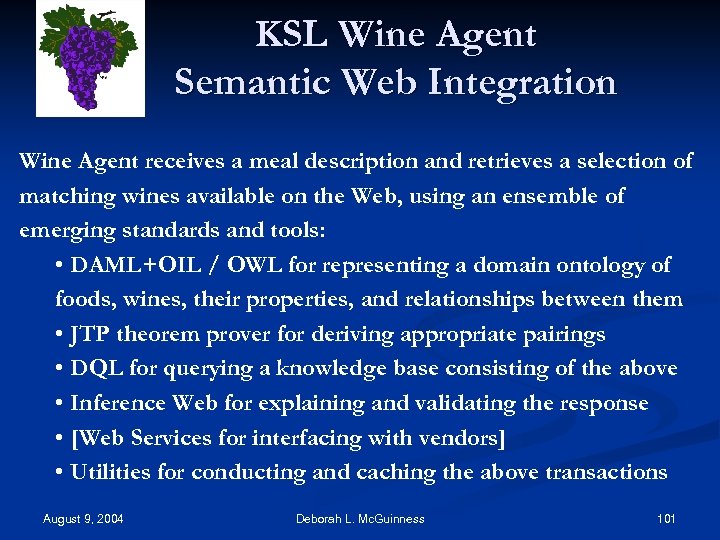
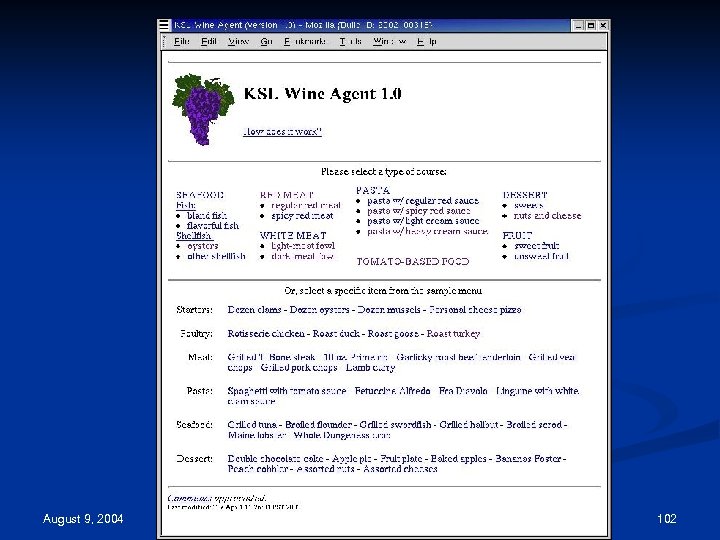
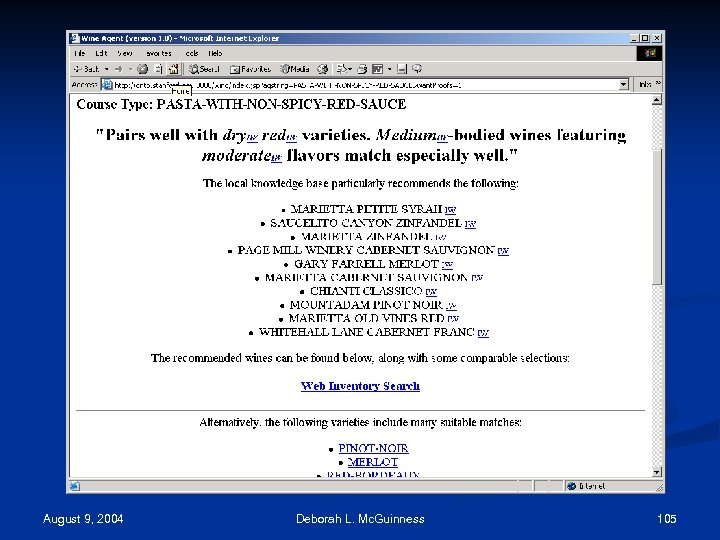
KSL Wine Agent Semantic Web Integration Wine Agent receives a meal description and retrieves a selection of matching wines available on the Web, using an ensemble of emerging standards and tools: • DAML+OIL / OWL for representing a domain ontology of foods, wines, their properties, and relationships between them • JTP theorem prover for deriving appropriate pairings • DQL for querying a knowledge base consisting of the above • Inference Web for explaining and validating the response • [Web Services for interfacing with vendors] • Utilities for conducting and caching the above transactions August 9, 2004 Deborah L. Mc. Guinness 101
August 9, 2004 Deborah L. Mc. Guinness 102
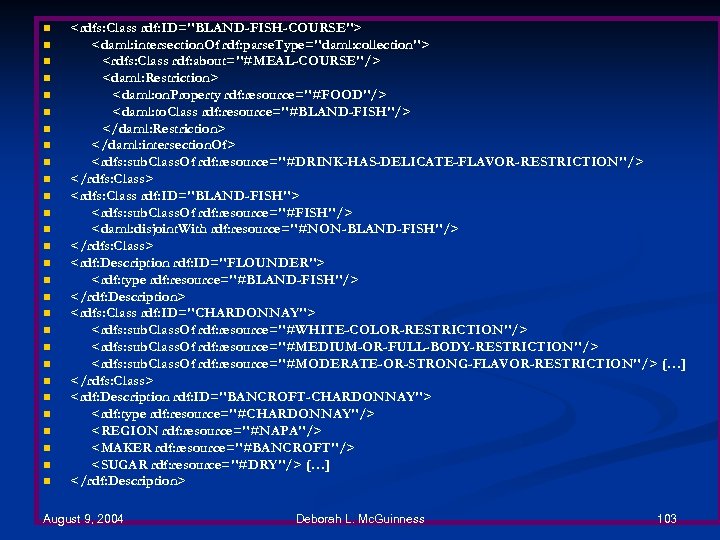
n n n n n n n <rdfs: Class rdf: ID="BLAND-FISH-COURSE"> <daml: intersection. Of rdf: parse. Type="daml: collection"> <rdfs: Class rdf: about="#MEAL-COURSE"/> <daml: Restriction> <daml: on. Property rdf: resource="#FOOD"/> <daml: to. Class rdf: resource="#BLAND-FISH"/> </daml: Restriction> </daml: intersection. Of> <rdfs: sub. Class. Of rdf: resource="#DRINK-HAS-DELICATE-FLAVOR-RESTRICTION"/> </rdfs: Class> <rdfs: Class rdf: ID="BLAND-FISH"> <rdfs: sub. Class. Of rdf: resource="#FISH"/> <daml: disjoint. With rdf: resource="#NON-BLAND-FISH"/> </rdfs: Class> <rdf: Description rdf: ID="FLOUNDER"> <rdf: type rdf: resource="#BLAND-FISH"/> </rdf: Description> <rdfs: Class rdf: ID="CHARDONNAY"> <rdfs: sub. Class. Of rdf: resource="#WHITE-COLOR-RESTRICTION"/> <rdfs: sub. Class. Of rdf: resource="#MEDIUM-OR-FULL-BODY-RESTRICTION"/> <rdfs: sub. Class. Of rdf: resource="#MODERATE-OR-STRONG-FLAVOR-RESTRICTION"/> […] </rdfs: Class> <rdf: Description rdf: ID="BANCROFT-CHARDONNAY"> <rdf: type rdf: resource="#CHARDONNAY"/> <REGION rdf: resource="#NAPA"/> <MAKER rdf: resource="#BANCROFT"/> <SUGAR rdf: resource="#DRY"/> […] </rdf: Description> August 9, 2004 Deborah L. Mc. Guinness 103
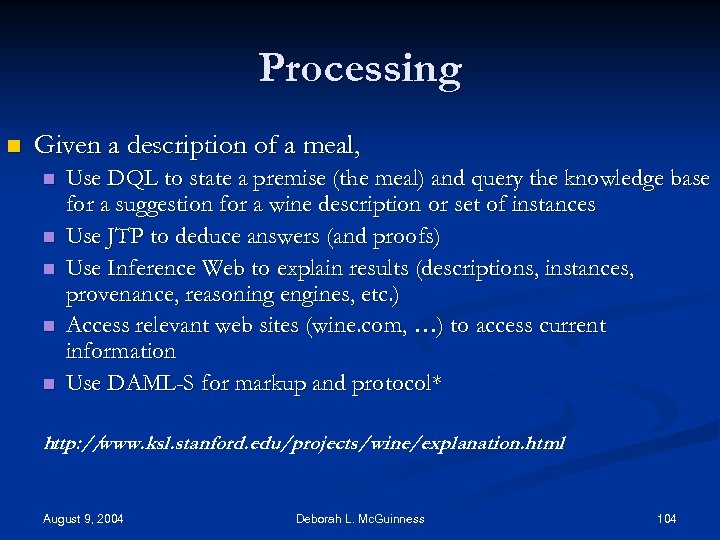
Processing n Given a description of a meal, n n n Use DQL to state a premise (the meal) and query the knowledge base for a suggestion for a wine description or set of instances Use JTP to deduce answers (and proofs) Use Inference Web to explain results (descriptions, instances, provenance, reasoning engines, etc. ) Access relevant web sites (wine. com, …) to access current information Use DAML-S for markup and protocol* http: // www. ksl. stanford. edu/projects/wine/explanation. html August 9, 2004 Deborah L. Mc. Guinness 104
August 9, 2004 Deborah L. Mc. Guinness 105
August 9, 2004 Deborah L. Mc. Guinness 106
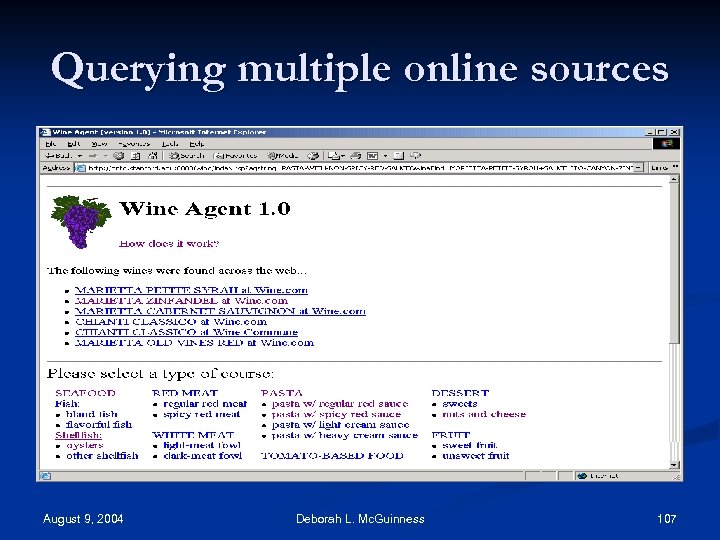
Querying multiple online sources August 9, 2004 Deborah L. Mc. Guinness 107
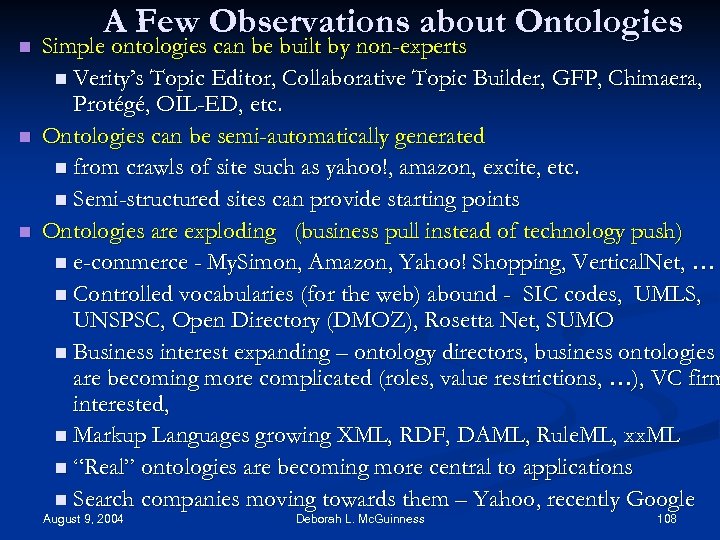
n n n A Few Observations about Ontologies Simple ontologies can be built by non-experts n Verity’s Topic Editor, Collaborative Topic Builder, GFP, Chimaera, Protégé, OIL-ED, etc. Ontologies can be semi-automatically generated n from crawls of site such as yahoo!, amazon, excite, etc. n Semi-structured sites can provide starting points Ontologies are exploding (business pull instead of technology push) n e-commerce - My. Simon, Amazon, Yahoo! Shopping, Vertical. Net, … n Controlled vocabularies (for the web) abound - SIC codes, UMLS, UNSPSC, Open Directory (DMOZ), Rosetta Net, SUMO n Business interest expanding – ontology directors, business ontologies are becoming more complicated (roles, value restrictions, …), VC firm interested, n Markup Languages growing XML, RDF, DAML, Rule. ML, xx. ML n “Real” ontologies are becoming more central to applications n Search companies moving towards them – Yahoo, recently Google August 9, 2004 Deborah L. Mc. Guinness 108
August 9, 2004 Deborah L. Mc. Guinness 109
August 9, 2004 Deborah L. Mc. Guinness 110
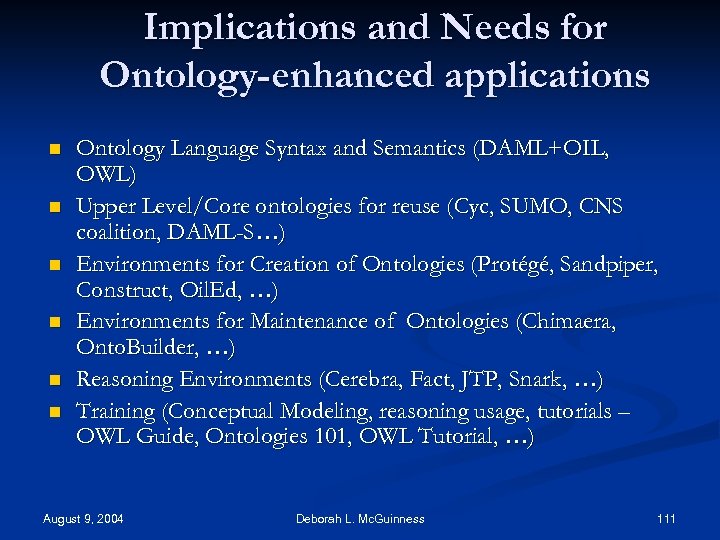
Implications and Needs for Ontology-enhanced applications n n n Ontology Language Syntax and Semantics (DAML+OIL, OWL) Upper Level/Core ontologies for reuse (Cyc, SUMO, CNS coalition, DAML-S…) Environments for Creation of Ontologies (Protégé, Sandpiper, Construct, Oil. Ed, …) Environments for Maintenance of Ontologies (Chimaera, Onto. Builder, …) Reasoning Environments (Cerebra, Fact, JTP, Snark, …) Training (Conceptual Modeling, reasoning usage, tutorials – OWL Guide, Ontologies 101, OWL Tutorial, …) August 9, 2004 Deborah L. Mc. Guinness 111
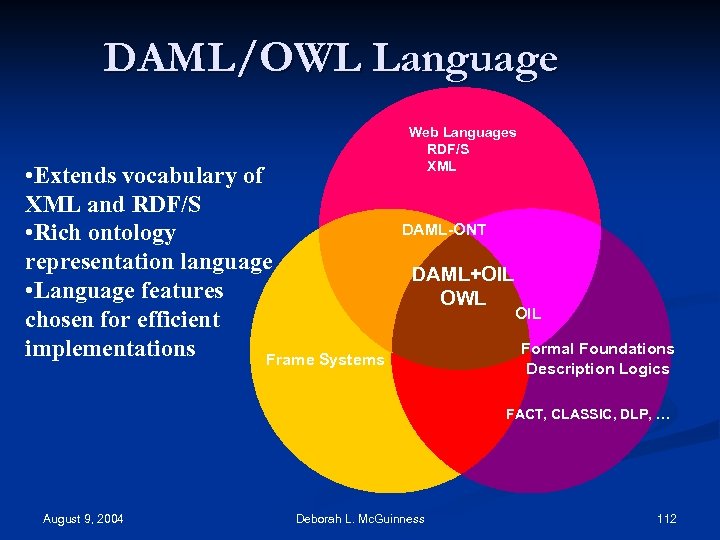
DAML/OWL Language • Extends vocabulary of XML and RDF/S • Rich ontology representation language • Language features chosen for efficient implementations Frame Systems Web Languages RDF/S XML DAML-ONT DAML+OIL OWL OIL Formal Foundations Description Logics FACT, CLASSIC, DLP, … August 9, 2004 Deborah L. Mc. Guinness 112
Issues Collaboration among distributed teams n Interconnectivity with many systems/standards n Analysis and diagnosis n Scale n Versioning n Security n Ease of use n Diverse training levels / user support n Presentation style n Lifecycle n Extensibility n August 9, 2004 Deborah L. Mc. Guinness 113
Pointers Selected Papers: - Mc. Guinness. Ontologies come of age, 2003 - Das, Wei, Mc. Guinness, Industrial Strength Ontology Evolution Environments, 2002. - Kendall, Dutra, Mc. Guinness. Towards a Commercial Strength Ontology Development Environment, 2002. - Mc. Guinness Description Logics Emerge from Ivory Towers, 2001. - Mc. Guinness. Ontologies and Online Commerce, 2001. - Mc. Guinness. Conceptual Modeling for Distributed Ontology Environments, 2000. - Mc. Guinness, Fikes, Rice, Wilder. An Environment for Merging and Testing Large Ontologies, 2000. - Brachman, Borgida, Mc. Guinness, Patel-Schneider. Knowledge Representation meets Reality, 1999. - Mc. Guinness. Ontological Issues for Knowledge-Enhanced Search, 1998. - Mc. Guinness and Wright. Conceptual Modeling for Configuration, 1998. Selected Tutorials: -Smith, Welty, Mc. Guinness. OWL Web Ontology Language Guide, 2003. -Noy, Mc. Guinness. Ontology Development 101: A Guide to Creating your First Ontology. 2001. - Brachman, Mc. Guinness, Resnick, Borgida. How and When to Use a KL-ONE-like System, 1991. Languages, Environments, Software: - OWL - http: //www. w 3. org/TR/owl-features/ , http: //www. w 3. org/TR/owl-guide/ - DAML+OIL: http: //www. daml. org/ - Inference Web - http: //www. ksl. stanford. edu/software/iw/ - Chimaera - http: //www. ksl. stanford. edu/software/chimaera/ - Find. UR - http: //www. research. att. com/people/~dlm/findur/ - TAP – http: //tap. stanford. edu/ - DQL - http: //www. ksl. stanford. edu/projects/dql/ August 9, 2004 Deborah L. Mc. Guinness 114
Скачать презентацию Ontologies and the Semantic Web II Deborah L
91535e112b45fa9fc2cf5c1723befb4d.ppt